

Analysis of Big Data on New Technologies for Port Safety Management in Preparation for Eco-Friendly and Digital Paradigm Transformation

Abstract
1. Introduction
1.1. Background of the Study
1.2. Purpose of the Study
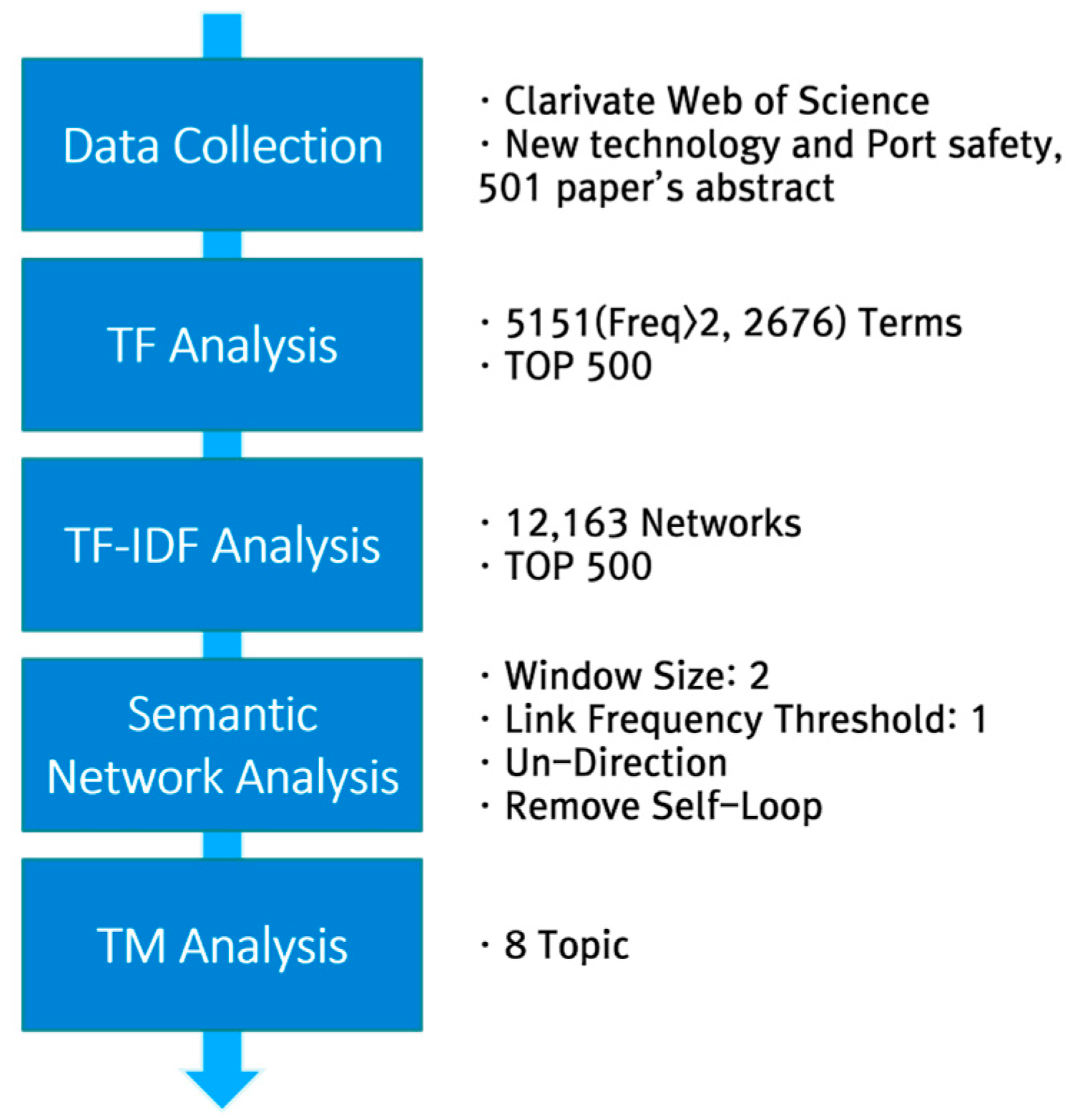
- First of all, by analyzing 501 research abstracts, this study provides a large-scale, data-driven overview of global academic trends in emerging technologies for port safety management, offering quantitative insights into the evolution of research themes.
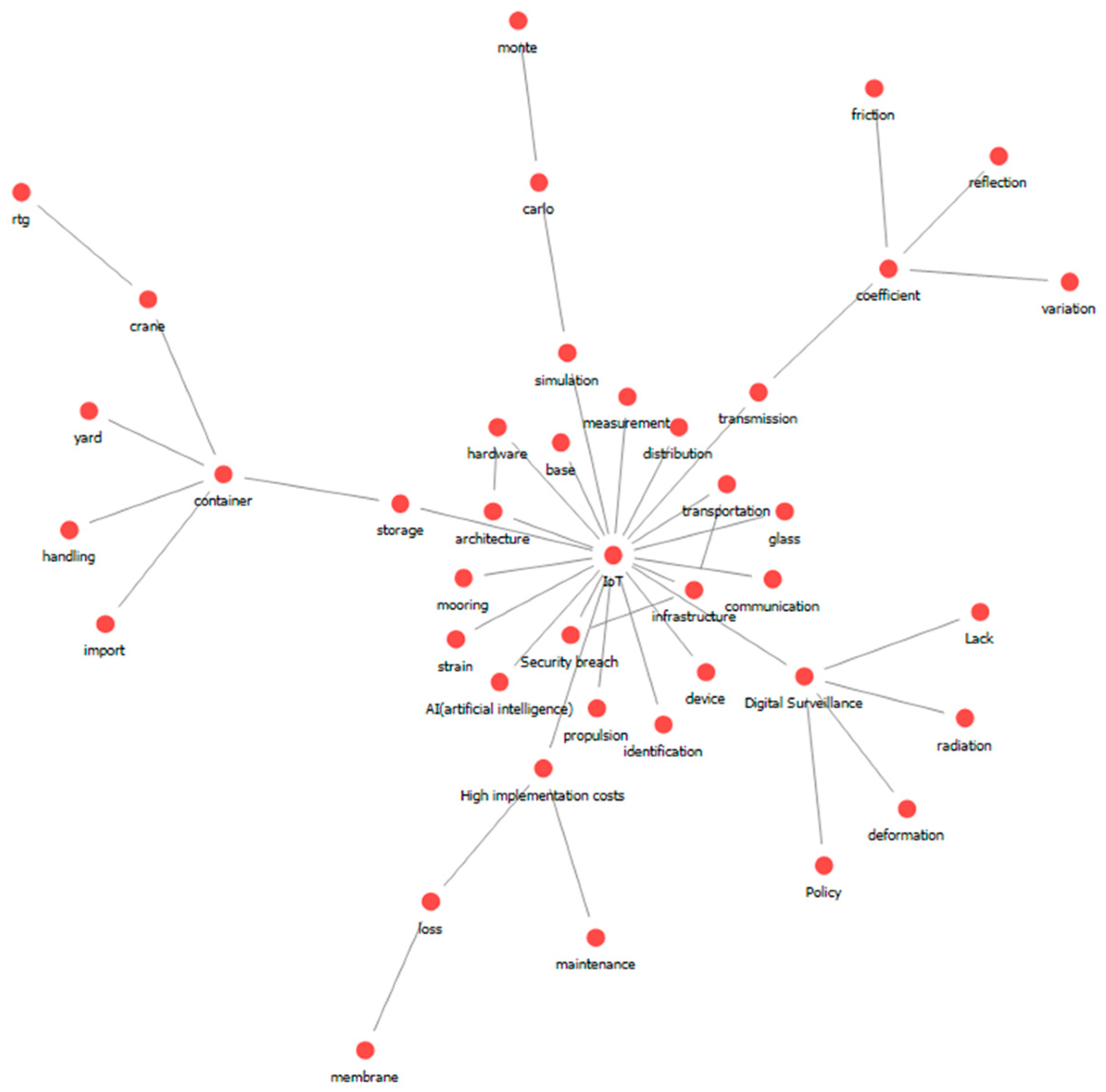
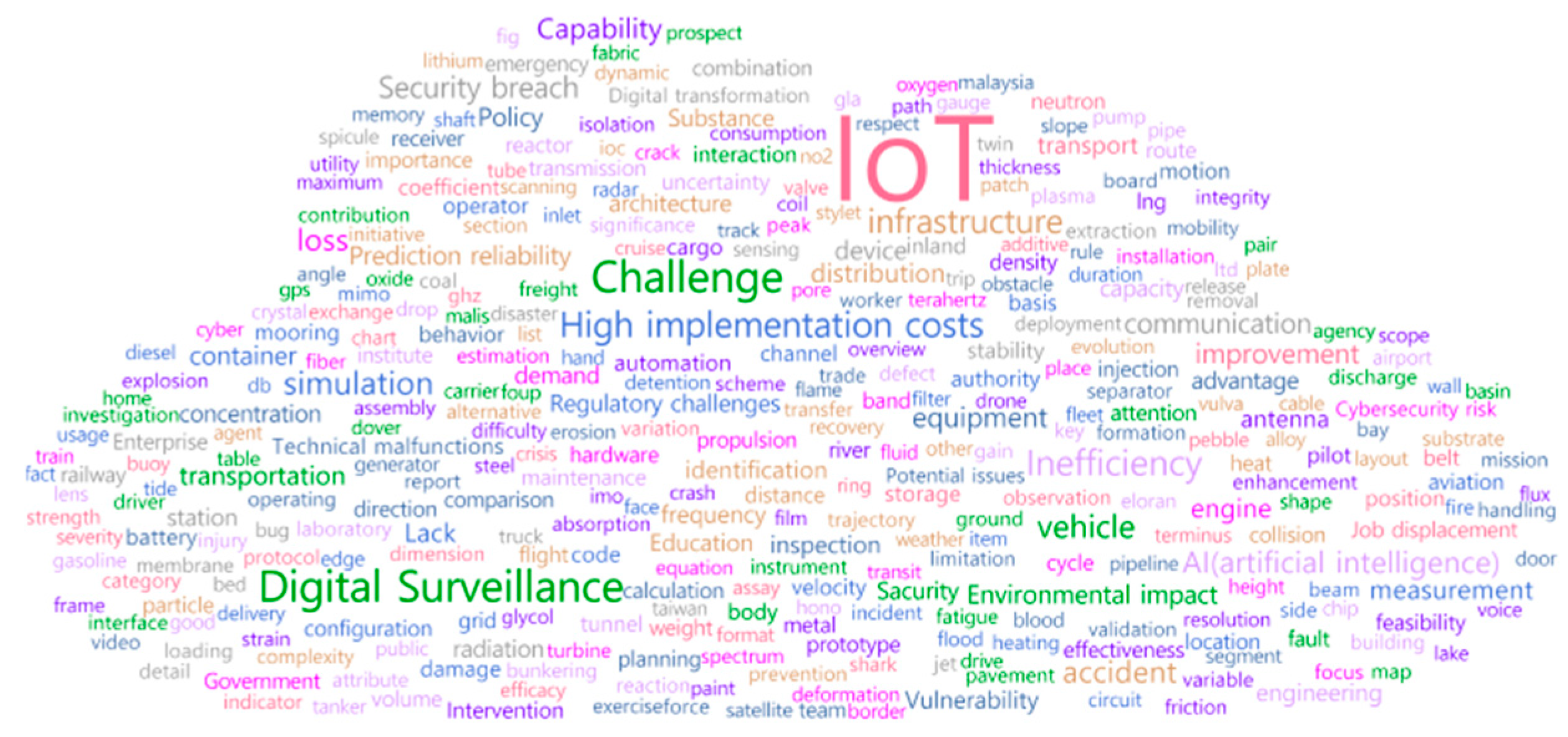
- Secondly, the findings highlight the Internet of Things (IoT) as a central enabling technology for enhancing port safety. At the same time, persistent challenges such as cybersecurity risks, high implementation costs, and limited battery life were identified as major constraints to practical adoption
- Thirdly, in-depth interviews with safety management personnel at Busan New Port were conducted. These interviews validated the relevance of the analytical results and provided practical perspectives on technical limitations, sensor integration, and cost-related barriers.
- Lastly, based on the results, the study presents various implications regarding the role of new technologies in enhancing port safety management amid the ongoing eco-friendly and digital paradigm shift.
2. Review of Previous Studies
2.1. Review of Prior Research on Port Safety Management
2.2. Distinctiveness from Previous Studies
3. Research Design and Analytical Methodology
3.1. Data Collection
3.2. Text-Mining Method
3.2.1. TF Analysis
3.2.2. TF-IDF Analysis
3.2.3. SNA
3.2.4. TM Analysis
4. Findings
4.1. Results of TF Analysis
4.2. Results of TF-IDF Analysis
4.3. Results of SNA
4.4. Results of TM Analysis
5. Conclusions
5.1. Conclusions and Implications
5.2. Limitations and Future Research Directions
Author Contributions
Funding
Institutional Review Board Statement
Informed Consent Statement
Data Availability Statement
Acknowledgments
Conflicts of Interest
References
- Parra, N.M.; Nagi, A.; Kersten, W. Risk Assessment Methods in Seaports. Publications of the HAZARD Project. 2018, Volume 24. Available online: https://www.researchgate.net/publication/331354975_Risk_Assessment_Methods_in_Seaports_A_Literature_Review (accessed on 23 April 2025).
- Kusuma, L.T.W.N.; Tseng, F.-S. Analysis of the Impact of the “Sea Toll” Program for Seaports: Resilience and Competitiveness. Appl. Sci. 2019, 9, 3407. [Google Scholar] [CrossRef]
- Dwarakish, G.S.; Salim, A.M. Review on the Role of Ports in the Development of a Nation. Aquat. Procedia 2015, 4, 295–301. [Google Scholar] [CrossRef]
- Rodrigue, J.-P.; Notteboom, T. Foreland-Based Regionalization: Integrating Intermediate Hubs with Port Hinterlands. Res. Transp. Econ. 2010, 27, 19–29. [Google Scholar] [CrossRef]
- Bichou, K.; Gray, R. A Critical Review of Conventional Terminology for Classifying Seaports. Transp. Res. Part A Policy Pract. 2005, 39, 75–92. [Google Scholar] [CrossRef]
- de la Peña Zarzuelo, I. Cybersecurity in Ports and Maritime Industry: Reasons for Raising Awareness on This Issue. Transp. Policy 2021, 100, 1–4. [Google Scholar] [CrossRef]
- Szymanowska, B.B.; Kozłowski, A.; Dąbrowski, J.; Klimek, H. Seaport Innovation Trends: Global Insights. Mar. Policy 2023, 152, 105585. [Google Scholar] [CrossRef]
- Corrigan, S.; Kay, A.; Ryan, M.; Ward, M.E.; Brazil, B. Human Factors and Safety Culture: Challenges and Opportunities for the Port Environment. Saf. Sci. 2019, 119, 252–265. [Google Scholar] [CrossRef]
- Rauzilan, M.I.B.M.; Suhrab, M.I.R. Risk Assessment and Mitigation for Better Safety: Case Study of Kemaman Port. Univ. Malays. Teren. J. Undergrad. Res. 2021, 3, 69–76. [Google Scholar] [CrossRef]
- Chen, X.; Ma, F.; Wu, Y.; Han, B.; Luo, L.; Biancardo, S.A. MFMDepth: MetaFormer-Based Monocular Metric Depth Estimation for Distance Measurement in Ports. Comput. Ind. Eng. 2025, 207, 111325. [Google Scholar] [CrossRef]
- Tseng, P.-H.; Pilcher, N. Maintaining and Researching Port Safety: A Case Study of the Port of Kaohsiung. Eur. Transp. Res. Rev. 2017, 9, 34. [Google Scholar] [CrossRef]
- Ismail, M.A.; Radzi, E.M.; Othman, A.A.; Hassan, M.G.; Mustafa, M. Enhancing Safety Performance in Seaport: A Scientometric and Scoping Analysis of Performance Evaluation. Int. J. Res. Publ. 2024, 5, 4792–4807. [Google Scholar] [CrossRef]
- Lam, J.S.L.; Su, S. Disruption Risks and Mitigation Strategies: An Analysis of Asian Ports. Marit. Policy Manag. 2015, 42, 415–435. [Google Scholar] [CrossRef]
- Goncalves, A.; Dutra, A.; Mussi, C.C. Occupational Risks and Health and Safety Management Strategies in the Port Sector: A Systematic Literature Review. Saf. Sci. 2025, 184, 106767. [Google Scholar] [CrossRef]
- Motter, A.A.; Santos, M. The Importance of Communication for the Maintenance of Health and Safety in Work Operations in Ports. Saf. Sci. 2017, 96, 117–120. [Google Scholar] [CrossRef]
- Cho, H.S.; Lee, J.S.; Moon, H.C. Maritime Risk in Seaport Operation: A Cross-Country Empirical Analysis with Theoretical Foundations. Asian J. Shipp. Logist. 2018, 34, 240–247. [Google Scholar] [CrossRef]
- Asikia, C.I.I.; Phd, N.E.; Nwabueze, E.; Nwoloziri, C.N.; Mattias, U. Healthcare Maintenance and Safety Policy: Evidence from Port Harcourt Seaport. Int. J. Geogr. Environ. Manag. (IJGEM) 2022, 8, 64–88. [Google Scholar]
- Yoon, B.; Park, Y. A Text-Mining-Based Patent Network: Analytical Tool for High-Technology Trend. J. High Technol. Manag. Res. 2004, 15, 37–50. [Google Scholar]
- Tseng, Y.-H.; Lin, C.-J.; Lin, Y.-I. Text Mining Techniques for Patent Analysis. Inf. Process. Manag. 2007, 43, 1216–1247. [Google Scholar] [CrossRef]
- Hashimi, H.; Hafez, A.; Mathkour, H. Selection Criteria for Text Mining Approaches. Comput. Hum. Behav. 2015, 51, 729–733. [Google Scholar] [CrossRef]
- Kalbarczyk-Jedynak, A.; Kaup, M.; Ślączka, W. Decision Making in the Process of Ensuring Safety within Seaport Area. Procedia Comput. Sci. 2024, 246, 5535–5544. [Google Scholar] [CrossRef]
- Kaup, M.; Łozowicka, D.; Baszak, K.; Ślączka, W.; Kalbarczyk-Jedynak, A. Risk Analysis of Seaport Construction Project Execution. Appl. Sci. 2022, 12, 8381. [Google Scholar] [CrossRef]
- Alyami, H.; Lee, P.T.-W.; Yang, Z.; Riahi, R.; Bonsall, S.; Wang, J. An Advanced Risk Analysis Approach for Container Port Safety Evaluation. Marit. Policy Manag. 2014, 41, 634–650. [Google Scholar] [CrossRef]
- John, A.; Paraskevadakis, D.; Bury, A.; Yang, Z.; Riahi, R.; Wang, J. An Integrated Fuzzy Risk Assessment for Seaport Operations. Saf. Sci. 2014, 68, 180–194. [Google Scholar] [CrossRef]
- Carmody, D.; Zhu, O.; He, Z.; Santi, P.; Ratti, C. Identifying Public Transit Deserts: A Travel Demand-Independent Persistent Homology-Based Method. Transp. Saf. Environ. 2025, 7, tdaf015. [Google Scholar] [CrossRef]
- Liu, W.; Cheng, L.; Liu, Z.; Yang, Y.; Li, L. The Development of Port Safety Training Platform Based on Virtual Reality Technology. In Proceedings of the 2021 IEEE 7th International Conference on Virtual Reality (ICVR), Foshan, China, 20–22 May 2021; IEEE: New York, NY, USA, 2021; pp. 207–214. [Google Scholar]
- Bauk, S.; Schmeink, A.; Colomer, J. An RFID Model for Improving Workers’ Safety at the Seaport in Transitional Environment. Transport 2018, 33, 353–363. [Google Scholar]
- Yang, Y.; Zhong, M.; Yao, H.; Yu, F.; Fu, X.; Postolache, O. Internet of Things for Smart Ports: Technologies and Challenges. IEEE Instrum. Meas. Mag. 2018, 21, 34–43. [Google Scholar] [CrossRef]
- Bouhlal, A.; Aitabdelouahid, R.; Marzak, A. The Internet of Things for Smart Ports. Procedia Comput. Sci. 2022, 203, 819–824. [Google Scholar] [CrossRef]
- Rizal, S.S.; Hashim, F. The Future of IoT Applications in Port Management System in Malaysia. Res. Manag. Technol. Bus. 2025, 6, 102–114. [Google Scholar]
- Beškovnik, B.; Bajec, P. Strategies and Approach for Smart City–Port Ecosystems Development Supported by the Internet of Things. Transport 2021, 36, 433–443. [Google Scholar] [CrossRef]
- Bauk, S. Some ICT Systems for Increasing Occupational Safety with a Reference to the Seaport Environment. NAŠE MORE Znan. Časopis More Pomor. 2018, 65, 94–102. [Google Scholar]
- Li, Y.; Zhu, P.; Zhang, G.; Yu, Y. Improving Seaport Wharf Maintenance and Safety with Structural Health Monitoring System in High Salt and Humidity Environments. Sustainability 2023, 15, 4472. [Google Scholar] [CrossRef]
- Issa, M.; Rizk, P.; Boulon, L.; Rezkallah, M.; Rizk, R.; Ilinca, A. Smart, Connected, and Sustainable: The Transformation of Maritime Ports Through Electrification, IoT, 5G, and Green Energy. Sustainability 2025, 17, 7568. [Google Scholar] [CrossRef]
- Jović, M.; Tijan, E.; Aksentijević, S.; Čišić, D. An Overview of Security Challenges of Seaport IoT Systems. In Proceedings of the 2019 42nd International Convention on Information and Communication Technology, Electronics and Microelectronics (MIPRO), Opatija, Croatia, 20–24 May 2019; IEEE: New York, NY, USA, 2019; pp. 1349–1354. [Google Scholar]
- Dominguez-Péry, C.; Tassabehji, R.; Corset, F.; Chreim, Z. A Holistic View of Maritime Navigation Accidents and Risk Indicators: Examining IMO Reports from 2011 to 2021. J. Shipp. Trade 2023, 8, 11. [Google Scholar] [CrossRef]
- Lee, J.-M.; Ha, D.-Y.; Kim, J.-H. A Study on Trends of Key Issues in Port Safety at Busan Port. J. Navig. Port Res. 2024, 48, 34–48. [Google Scholar]
- Roy, A. Word Frequency-Content Analysis Approach to Identify the Terms in the Content of Library Rules and Regulations of Indian Universities and European Universities: A Comparative Study. Libr. Philos. Pract. (E-J.) 2023, 7658, 1–15. [Google Scholar]
- Chu, C.-Y.; Park, K.; Kremer, G.E. A Global Supply Chain Risk Management Framework: An Application of Text-Mining to Identify Region-Specific Supply Chain Risks. Adv. Eng. Inform. 2020, 45, 101053. [Google Scholar]
- Haq, M.I.U.; Li, Q.; Hassan, S. Text Mining Techniques to Capture Facts for Cloud Computing Adoption and Big Data Processing. IEEE Access 2019, 7, 162254–162267. [Google Scholar] [CrossRef]
- Karami, A.; Ghasemi, M.; Sen, S.; Moraes, M.F.; Shah, V. Exploring Diseases and Syndromes in Neurology Case Reports from 1955 to 2017 with Text Mining. Comput. Biol. Med. 2019, 109, 322–332. [Google Scholar] [CrossRef]
- Thakkar, A.; Chaudhari, K. Predicting Stock Trend Using an Integrated Term Frequency–Inverse Document Frequency-Based Feature Weight Matrix with Neural Networks. Appl. Soft Comput. 2020, 96, 106684. [Google Scholar] [CrossRef]
- Te Liew, W.; Adhitya, A.; Srinivasan, R. Sustainability Trends in the Process Industries: A Text Mining-Based Analysis. Comput. Ind. 2014, 65, 393–400. [Google Scholar] [CrossRef]
- Smith, A. Automatic Extraction of Semantic Networks from Text Using Leximancer. In Proceedings of the Companion Volume of the Proceedings of HLT-NAACL 2003-Demonstrations, Edmonton, AB, Canada, 27 May–1 June 2003; pp. 23–24. [Google Scholar]
- Cenek, M.; Bulkow, R.; Pak, E.; Oyster, L.; Ching, B.; Mulagada, A. Semantic Network Analysis Pipeline—Interactive Text Mining Framework for Exploration of Semantic Flows in Large Corpus of Text. Appl. Sci. 2019, 9, 5302. [Google Scholar] [CrossRef]
- Drieger, P. Semantic Network Analysis as a Method for Visual Text Analytics. Procedia-Soc. Behav. Sci. 2013, 79, 4–17. [Google Scholar] [CrossRef]
- An, H.; Park, M. Approaching Fashion Design Trend Applications Using Text Mining and Semantic Network Analysis. Fash. Text. 2020, 7, 34. [Google Scholar] [CrossRef]
- Mateen, A.; Yasir, M.; Nawaz, Q.; Afsar, S.; Yasin, Q.; Yunusi, M. An Analysis on Text Mining Techniques for Smart Literature Review. Int. J. Adv. Trends Comput. Sci. Eng. 2021, 10, 1284–1288. [Google Scholar] [CrossRef]
- Yu, D.; Xiang, B. Discovering Topics and Trends in the Field of Artificial Intelligence: Using LDA Topic Modeling. Expert Syst. Appl. 2023, 225, 120114. [Google Scholar] [CrossRef]
- Maier, D.; Waldherr, A.; Miltner, P.; Wiedemann, G.; Niekler, A.; Keinert, A.; Pfetsch, B.; Heyer, G.; Reber, U.; Häussler, T. Applying LDA Topic Modeling in Communication Research: Toward a Valid and Reliable Methodology. In Computational Methods for Communication Science; Routledge: Oxfordshire, UK, 2021. [Google Scholar]
- Hagen, L. Content Analysis of E-Petitions with Topic Modeling: How to Train and Evaluate LDA Models? Inf. Process. Manag. 2018, 54, 1292–1307. [Google Scholar] [CrossRef]
- Blei, D.M.; Andrew, Y.N.; Michael, I.J. Latent Dirichlet Allocation. J. Mach. Learn. Res. 2003, 3, 993–1022. [Google Scholar]
- Stevens, K.; Kegelmeyer, P.; Andrzejewski, D.; Buttler, D. Exploring Topic Coherence over Many Models and Many Topics. In Proceedings of the 2012 Joint Conference on Empirical Methods in Natural Language Processing and Computational Natural Language Learning, Jeju Island, Republic of Korea, 12–14 July 2012; Tsujii, J., Henderson, J., Paşca, M., Eds.; Association for Computational Linguistics: Jeju Island, Republic of Korea, 2012; pp. 952–961. [Google Scholar]




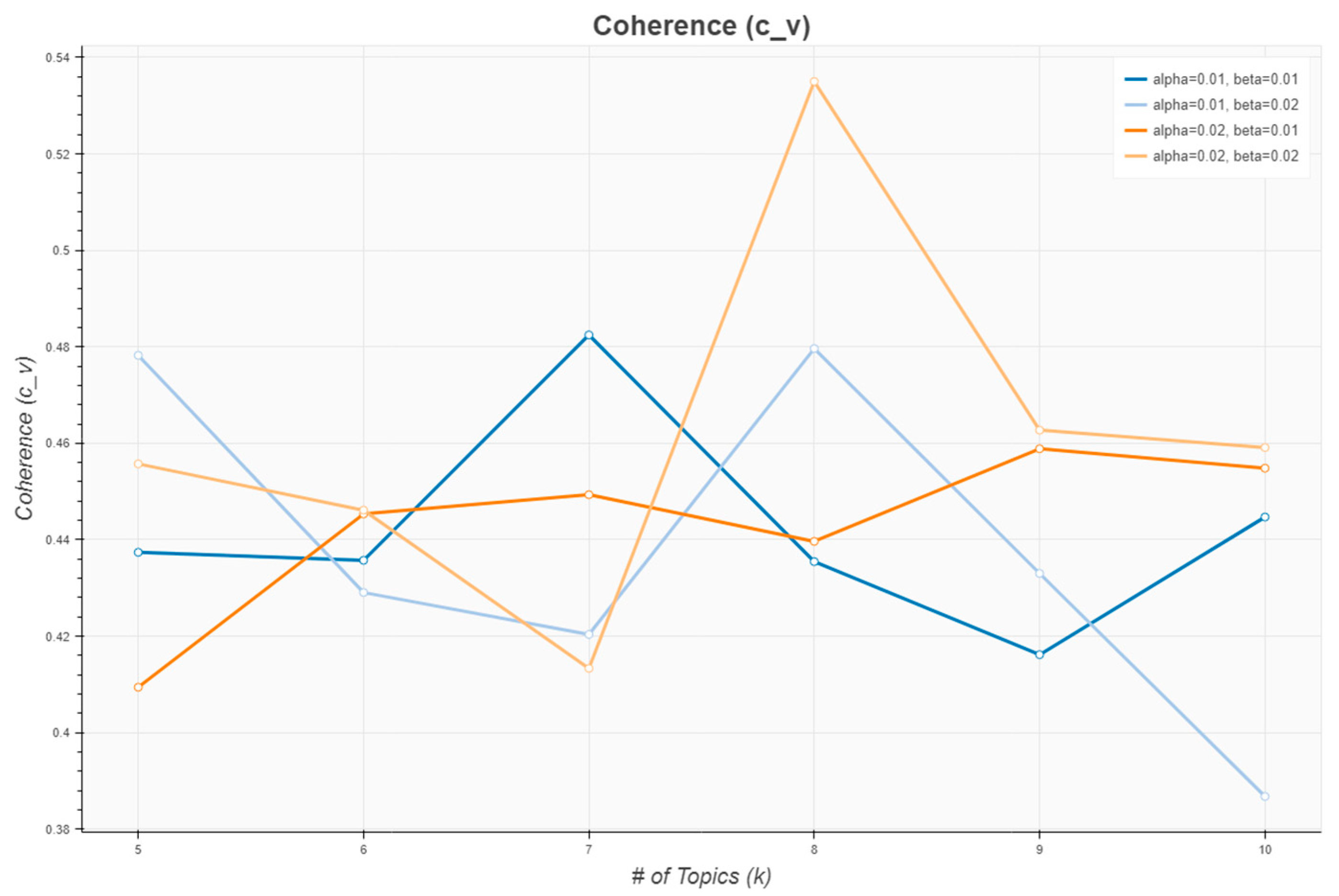
| Topic | Keyword | ||||
|---|---|---|---|---|---|
| 1st | 2nd | 3rd | 4th | 5th | |
| 1 | IoT | Accident | Challenge | AI | Container |
| N = 91 | 0.038 | 0.032 | 0.017 | 0.017 | 0.014 |
| 2 | IoT | Communication | Challenge | Security breach | Battery |
| N = 61 | 0.091 | 0.025 | 0.020 | 0.019 | 0.017 |
| 3 | IoT | Antenna | Radiation | Band | MIMO |
| N = 56 | 0.035 | 0.025 | 0.017 | 0.013 | 0.010 |
| 4 | Digital Surveillance | Tunnel | LNG | Challenge | Belt |
| N = 39 | 0.027 | 0.023 | 0.017 | 0.015 | 0.014 |
| 5 | Substance | Body | Team | Pavement | Assay |
| N = 43 | 0.020 | 0.014 | 0.012 | 0.012 | 0.011 |
| 6 | IoT | Mooring | Inefficiency | Velocity | Motion |
| N = 45 | 0.035 | 0.017 | 0.015 | 0.015 | 0.015 |
| 7 | IoT | Digital Surveillance | Inspection | Security breach | Challenge |
| N = 99 | 0.078 | 0.024 | 0.014 | 0.013 | 0.013 |
| 8 | IoT | Vehicle | Engine | High implementation costs | Inefficient |
| N = 67 | 0.036 | 0.028 | 0.022 | 0.020 | 0.017 |
| Topic | Context |
|---|---|
| 1 | IoT and AI reduce container accidents, but safety challenges in ports still exist |
| 2 | IoT enhances communication but faces challenges like battery limitations and risks of security breaches |
| 3 | Port IoT systems use MIMO antennas across wide bands to boost safety, yet managing radiation remains a key challenge |
| 4 | Digital surveillance in LNG tunnels and belt systems improves port safety but faces operational and environmental challenges |
| 5 | The safety team performed an assay on a suspicious substance found on the pavement near a body |
| 6 | IoT sensors detect vessel motion and velocity to reduce mooring inefficiencies in port operations |
| 7 | Despite IoT and digital surveillance supporting inspection efforts, ports still face challenges in preventing security breaches |
| 8 | IoT integration in port vehicles can reduce engine inefficiencies, but high implementation costs remain a barrier |
Disclaimer/Publisher’s Note: The statements, opinions and data contained in all publications are solely those of the individual author(s) and contributor(s) and not of MDPI and/or the editor(s). MDPI and/or the editor(s) disclaim responsibility for any injury to people or property resulting from any ideas, methods, instructions or products referred to in the content. |
© 2025 by the authors. Licensee MDPI, Basel, Switzerland. This article is an open access article distributed under the terms and conditions of the Creative Commons Attribution (CC BY) license (https://creativecommons.org/licenses/by/4.0/).
Share and Cite
Sim, M.-S.; Lee, C.-H.; Kim, Y.-S. Analysis of Big Data on New Technologies for Port Safety Management in Preparation for Eco-Friendly and Digital Paradigm Transformation. Appl. Sci. 2025, 15, 11269. https://doi.org/10.3390/app152011269
Sim M-S, Lee C-H, Kim Y-S. Analysis of Big Data on New Technologies for Port Safety Management in Preparation for Eco-Friendly and Digital Paradigm Transformation. Applied Sciences. 2025; 15(20):11269. https://doi.org/10.3390/app152011269
Chicago/Turabian StyleSim, Min-Seop, Chang-Hee Lee, and Yul-Seong Kim. 2025. "Analysis of Big Data on New Technologies for Port Safety Management in Preparation for Eco-Friendly and Digital Paradigm Transformation" Applied Sciences 15, no. 20: 11269. https://doi.org/10.3390/app152011269
APA StyleSim, M.-S., Lee, C.-H., & Kim, Y.-S. (2025). Analysis of Big Data on New Technologies for Port Safety Management in Preparation for Eco-Friendly and Digital Paradigm Transformation. Applied Sciences, 15(20), 11269. https://doi.org/10.3390/app152011269