Article

Mechanism of Burial Depth Effect on Recovery Under Different Coupling Models: Response and Simplification


1
School of Mining Engineering, China University of Mining and Technology, Xuzhou 221116, China
2
Yunlong Lake Laboratory of Deep Earth Science and Engineering, Xuzhou 221116, China
*
Author to whom correspondence should be addressed.
Appl. Sci. 2025, 15(21), 11657; https://doi.org/10.3390/app152111657
Submission received: 3 October 2025 / Revised: 26 October 2025 / Accepted: 27 October 2025 / Published: 31 October 2025
(This article belongs to the Special Issue Innovations in Rock Mechanics and Mining Engineering)

Abstract

Coalbed methane (CBM) development involves multiple interacting physical fields, and different coupling schemes can lead to distinctly different production behaviors. A thermo-hydro-mechanical model accounting for gas–water two-phase flow and matrix dynamic diffusion (TP-D-THM) is developed and validated, achieving an error rate below 10%. By embedding the numerically estimated reservoir physical parameters of the Qinshui Basin into the numerical model, multi-field couplings during CBM production, the evolution of physical parameters, and the depth-dependent effects on production characteristics were revealed. The main findings are as follows: The inhibitory effect of water on CBM recovery consistently exceeds the promoting effect of temperature. As burial depth expands, the inhibitory effect first diminishes, then intensifies, ranging from 19.73% to 28.41%, while the thermal promotion effect exhibits a monotonically increasing trend, fluctuating between 8.55% and 16.33% and stabilizing below 1000 m. Temperature and burial depth do not alter the trend in gas production rate. For equilibrium permeability, reproducing a decrease–increase–decrease rate pattern requires explicit inclusion of water and matrix-fracture mass exchange terms, which can explain why different scholars obtained varying gas production rate trends using the THM model. Matrix adsorption-induced strain is the primary control on permeability evolution, and temperature amplifies the magnitude of permeability change. The critical depth essentially reflects the statistical characteristics of reservoir petrophysical properties. A dimensionless critical depth criterion has been proposed, which comprehensively considers reservoir pressure, permeability, and a fractional coverage index. For burial depths ranging from 650 to 1350 m, the TP-D-THM model can be simplified to the gas-mechanical model accounts for matrix dynamic diffusion (D-HM) with an error below 5%, indicating that thermal and water effects nearly cancel each other.

1. Introduction

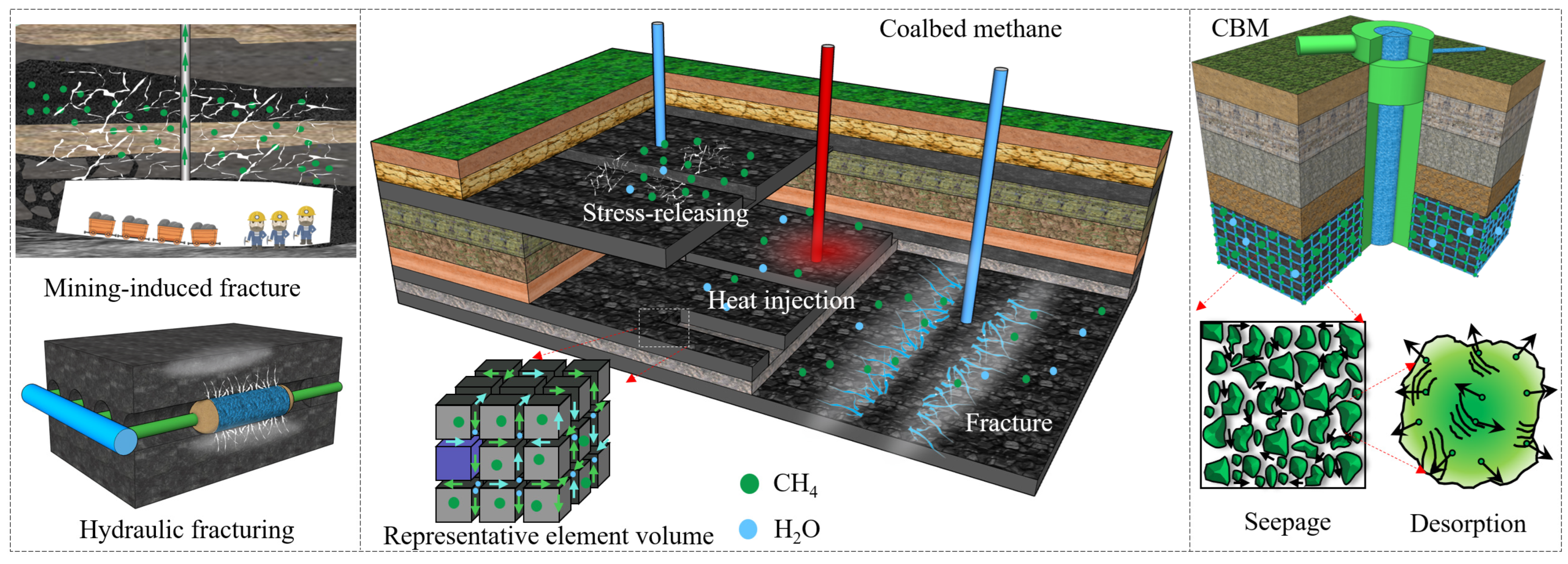
CBM is simultaneously an important clean energy resource (an unconventional natural gas) [1], a potential source of mining hazards (gas explosions and coal-gas outbursts) [2,3], and a significant greenhouse-gas pollutant (with a greenhouse effect 21 times that of CO2) [4]. The efficient development of CBM and related fundamental research has consistently been a hot topic [5,6], such as hydraulic fracturing technology and gas/heat injection enhanced recovery techniques (Figure 1). However, CBM production involves complex, interacting factors, and clarifying the migration patterns of CBM under different burial depths is fundamental to the planning and design of CBM.
Model-based numerical simulation can accurately replicate field and laboratory results and thus supports deeper analysis of CBM production, making it a standard tool in scholarly research [7,8]. To elucidate the transport behavior of coalbed methane within the reservoir, scholars first examined coal-gas interactions. It is generally recognized that variations in stress and gas pressure induce deformation of the coal matrix, thereby altering permeability; accordingly, numerous gas–solid coupling models have been proposed [9,10]. Subsequently, some researchers incorporated the Klinkenberg effect, non-Darcy flow, and a threshold pressure gradient into gas–solid coupling models, while also accounting for the influence of gas ad/desorption on coal-matrix deformation [11,12,13]. The formation of coalbed methane reservoirs requires stable hydrodynamic conditions, with water and coalbed methane coexisting prominently within coal seams [14]. Consequently, gas–water two-phase flow has been progressively incorporated into the governing equations of the flow field, with the transport capacities of the gas and water phases characterized via relative permeability functions [15,16]. However, the extent of mass transfer between the two phases is relatively complex. For instance, determining gas solubility and formulating precise mathematical expressions presents significant challenges. Relying solely on Henry’s Law to describe gas dissolution is questionable [17]. Under typical conditions, mass transfer between gas and liquid phases is generally not considered. The temperature field induces thermal strain in the coal matrix and may even trigger thermal fracturing, altering the density, viscosity, and adsorption capacity of fluids. Neglecting thermal effects will underestimate CBM production, particularly in reservoirs with elevated temperatures [18,19]. The above results indicate that neglecting the effects of water or temperature within coal seams will lead to significant inaccuracies in estimating CBM recovery, thereby affecting gas well design.
In the late stage of CBM migration, transport relies predominantly on diffusion within the matrix system, and the description of diffusion behavior is dependent on the coal body assumptions [20]. For a single porosity medium, the seepage and diffusion terms appear in a single governing equation. Through mathematical transformation, it can be observed that diffusion is essentially a form of seepage. Therefore, the apparent permeability can be employed to unify their expression, and thereby simplify the model [21,22]. For a multi-porosity medium, mass exchange between the matrix system and fracture system is typically described in terms of Fick’s law. Since the resistance to gas migration within the matrix is not constant, time-dependent diffusion coefficients are gradually replacing fixed diffusion coefficients [23,24]. Laboratory test results indicate that the matrix system cannot completely desorb adsorbed gases, which can be modeled by adding a residual pressure threshold to the mass exchange term [25]. From a purely mathematical perspective, the activation pressure gradient effect refers to adding a pressure term to the pressure gradient term in the seepage field equation, which is somewhat analogous to adding a residual pressure term to the mass exchange term. However, the underlying physical behavior is fundamentally different. Furthermore, some scholars even argue that no activation pressure gradient exists for coalbed methane migration [26]. Permeability models are crucial for coupling various physical fields, representing the combined effects of stress, temperature, and seepage fields. Permeability models are essential for coupling various physical fields. The equilibrium permeability model, valued for its simplicity, efficiency, and applicability, is one of the most common approaches used by researchers to address permeability. However, it may fail to explain the permeability evolution trends observed under constant effective stress in laboratory settings [27,28]. Although mathematical models simplify in situ conditions and each entails inherent limitations (Table 1), they remain valuable for informing field practice, with the key lying in the matching of parameters [29,30]. Fan et al. systematically summarized the differences among various coupling models and analyzed the influence of individual factors (temperature, permeability, diffusion coefficient, etc.) on coalbed methane migration [31]. However, key reservoir properties such as temperature, pressure, permeability, and stress vary synchronously with burial depth. Researchers have proposed an indicator system for defining deep coalbeds based on geostress, saturated gas content, and permeability [32], but this approach fails to account for the impact of coalbed methane production characteristics.
Building on the above, A thermo-hydro-mechanical model accounting for gas–water two-phase flow and matrix dynamic diffusion for CBM recovery is developed and validated. A comparative analysis of reservoir parameter responses and coalbed methane migration characteristics under varying burial depths and coupling models is conducted. A critical depth determination method based on reservoir pressure, permeability, and fractional coverage index is proposed, and a critical burial depth for model simplification based on recovery characteristics is provided.

2. TP-D-THM Coupling Model

2.1. Model Assumptions

Based on the occurrence conditions of coal seams and fluid media, the following general assumptions are proposed: (1) The coal reservoir is an isotropic dual porosity medium composed of a matrix system and a fracture system [13]. (2) Water migrates only within the fracture system, disregarding the effects of dissolved gases, water vapor, and the adsorption capacity of water effect [19]. (3) The sum of the volume fractions of free gas and water within the fracture system equals 1, with free gas migration following traditional Darcy’s law [12,28]. (4) The matrix and fracture systems form a series structure, where matrix-fracture mass exchange follows the modified Fick’s law, meaning the diffusion coefficient is not constant [17]. (5) Tensile stress is positive, and compressive stress is negative [26].

2.2. Fracture-System Fluid Transport Equation

The fracture system exhibits relatively high mobility for free gas. During CBM production, the fracture pressure declines first, driven by the matrix-fracture pressure difference, and gas in the matrix gradually diffuses into the fractures. Accordingly, the mass conservation equation for gas migration in a fracture system considering the Klinkenberg effect can be expressed as [33]:
s g ϕ f ρ f g t + M g R T ( p f g + b 1 ) k k r g μ g p f g = 1 ϕ f 3 π 2 M g a 2 R T p m p f g D t
where p f g and p m are the pressures in the fracture and matrix systems (MPa); s g is the gas saturation; k and k r g are the absolute permeability and the gas relative permeability, respectively (m2); μ g is the dynamic viscosity of the gas phase (Pa·s); b 1 is the Klinkenberg factor (MPa); a is the matrix width (m); T is the coal seam temperature (K); M g is the gas molar mass (kg·mol−1); R is the universal gas constant (J·mol−1·K−1); D t is the time-dependent diffusion coefficient (m2·s−1); and ϕ f is the fracture porosity.
The fractal characteristics of pore structures with varying sizes in coal bodies are relatively complex, and its diffusion capacity gradually diminishes over time. The time-dependent diffusion coefficient is defined as [34]:
D t = D 0 exp ( γ t ) + D r
where D 0 and D r are the initial and residual diffusion coefficients, respectively (m2·s−1), and γ is the decay coefficient (s−1).
By comparing how different researchers treat matrix diffusion capacity [35], the right-hand side of Equation (1) is commonly written as ( 1 ϕ f ) M g p m p f g / τ R T , where τ is the time required for the matrix to desorb 63.2% of the adsorbed CBM.
Since the model neglects gas–water interactions, the water-phase transport in the fracture system can be expressed by the conventional Darcy law [36]. For the water phase, the gas pressure in the fracture system is treated as a known quantity; therefore, the saturation equation is used to describe the water-phase transport state [37]:
s w φ f ρ w t + ρ w k k r w μ w p f w = 0 ρ w = c 1 ( T T t ) 2 + c 2 ( T T s ) + ρ w s
where s w is the water saturation; ρ w is the water density (kg·m−3); μ w is the dynamic viscosity of water (Pa·s); p f w is the water pressure in the fractures (MPa), p f w = p f g p c g w ; p c g w is the gas–water capillary pressure (MPa); c 1 and c 2 are the temperature coefficients for water; ρ w a is the water density at standard conditions (kg·m−3); and T s is the standard temperature (K).
Relative permeability depends on the saturations of the gas and water phases. The relative permeability model for gas–water two-phase flow can be expressed as: [38]:
k r g = k r g 0 1 s w s w r 1 s w r s g r 2 1 s w s w r 1 s w r 2 , k r w = k r w 0 s w s w r 1 s w r 4
where s w r is the irreducible water saturation; s g r is the residual gas saturation; k r g 0 is the endpoint relative permeability of the gas phase; and k r w 0 is the endpoint relative permeability of the water phase.

2.3. Matrix-System Diffusion Equation

The gas phase in the matrix system primarily consists of free and adsorbed states. The gas content per unit volume of the coal matrix is [39]:
m m a t r i x = ϕ m M g R T p m + V s g ρ c o a l ρ g a s
where ϕ m is the matrix porosity; ρ c o a l and ρ g a s are the coal density and the gas density at standard conditions (kg·m−3); V s g denotes the gas adsorption capacity (m3·kg−1).
Considering the influence of temperature on the adsorption capacity of the coal matrix, the modified Langmuir adsorption law can be employed for its description:
V s g = V L p m P L + p m exp d 2 1 + d 1 p m T T t
where d1 and d2 are the pressure and temperature coefficients (MPa−1 and K−1), T t is the reference temperature during adsorption experiments (K), V L and P L are the Langmuir volume constant (m3·kg−1) and pressure constant (MPa), respectively.
The gas supply to the fracture system equals the change in the gas content of the matrix system:
m m atrix t = 3 π 2 M g a 2 R T p m p f g D t
Substituting Equations (5) and (6) into Equation (7), the diffusion equation for the matrix system becomes:
t V L p m P L + p m exp d 2 1 + d 1 p m T T t ρ c o a l M g R T s p g a s + ϕ m M g R T p m = 3 π M g a 2 R T p m p f g D t

2.4. Governing Equation for the Temperature Field

Building on conventional thermal convection and conduction, and accounting for internal energy, strain energy, and the heat of ad/desorption, the energy governing equation can be expressed as [40]:
ρ C p s + f T t + η s + f T λ s + f T + K s α T T ε v t + q s t ρ s ρ g a s M g V s g t = 0 λ s + f = 1 ϕ f ϕ m λ s + s g ϕ f + ϕ m λ g + s w φ f λ w η s + f   = k k r g μ g 1 + b 1 p f g ( p f g ) ρ f g C g k k r w μ w ( p f w ) ρ w C w ρ C p s + f = 1 ϕ f ϕ m ρ s C s + s g ϕ f ρ f g + ϕ m ρ m g C g + s w ϕ f ρ w C w
where qst is the isosteric heat of adsorption (kJ·mol−1); The subscripts s, g, and w denote the coal skeleton (solid), gas phase, and water phase, respectively (e.g., Cg, Cs, Cw are their specific heat capacities); α T is the thermal expansion coefficient of the coal skeleton (K−1); C and λ denote specific heat capacity (J·kg−1·K−1) and thermal conductivity (W·m−1·K−1), with subscripts indicating the phase; ε v is the volumetric strain; and the subscript s + f indicates an effective property of the coal including gas and water.

2.5. Governing Equation for the Mechanical Field

Under the assumption of small elastic deformation, coal deformation complies with the generalized Hooke’s law. The stress–strain relationship is given by [41]:
ε i j = 1 2 G σ i j 1 6 G 1 9 K σ k k δ i j
where ε i j and σ i j are the components of the strain and stress tensors, respectively; δ i j is the Kronecker delta; G and K are the shear modulus and bulk modulus of the coal (MPa).
Both temperature variations and ad/desorption in the coal matrix induce swelling or shrinkage. Incorporating the influence of free gas on effective stress, the foregoing equation can be further expressed as:
ε i j = 1 2 G σ i j 1 6 G 1 9 K σ k k δ i j + 1 3 α T T δ i j + 1 3 K α m p m δ i j + 1 3 K α f p f δ i j + 1 3 ε a δ i j
where α f = 1 K / K m , α m = K / K m K / K s ; ε a is the adsorption-induced strain of the coal skeleton; α s g is the adsorption-strain coefficient (kg·m−3); p f is the pore-fluid pressure in the fractures (MPa); α T is the thermal expansion coefficient (K−1).
The stress–strain relationship and the static equilibrium equation can be expressed, respectively, as follows:
σ i j , j + F i = 0 ε i j = 1 2 u i , j + u j , i
where F i and u i represent the components of force and displacement in the i-direction, respectively.
Combining Equations (10)–(12), we obtain the modified Navier equation:
G u i , j j + G 1 2 υ u j , j i α m p m , i α f p f , i K ( α T T , i + ε a , i ) + F i = 0
If the effects of temperature, free gas pressure, and adsorption are neglected, Equation (13) simplifies to the classical Navier equation for an ideal elastic body.

2.6. Coupling Terms

Changes in matrix porosity primarily affect the amount of free gas in the matrix system; the matrix porosity can be expressed as [42]:
φ m = φ m 0 1 + S 0 + α m S S 0 / 1 + S
where S = ε v + p m / K s α T T ε a , S 0 = p m 0 / K s α T T 0 ε a 0 ; the subscript 0 indicates the initial value.
The fracture-system porosity is strongly correlated with the matrix width a and the fracture aperture b :
ϕ f ϕ f 0 = a 0 b 0 × b a = ( 1 + Δ b b 0 ) a 0 a
Because fracture stiffness is difficult to obtain directly, we characterize it indirectly using the bulk coal and the coal matrix; the fracture strain can then be expressed as [43]:
( 1 R m ) Δ σ E K
where the parameter R m denotes the modulus degradation rate; Δ σ E is effective stress change (MPa).
The volumetric strain of the representative elementary volume (REV) comprises two parts: an expansion term and an effective-stress term:
ε v = ( Δ ε m S + Δ ε m T ) + Δ σ E / K
where Δ ε m S and Δ ε m T represent the changes in matrix width caused by adsorption and temperature, respectively.
Substituting Equations (12) and (13) into Equation (11) and assuming a 0 / a 1 , we obtain:
ϕ f ϕ f 0 = ( 1 + Δ b b 0 ) = 1 + ( 1 R m ) ε v ( Δ ε m S + Δ ε m T ) = 1 ( 1 R m ) ( α s g V s g + α T Δ T ) ε v
where ϕ f and ϕ f 0 represent the current and initial porosity, respectively.
The relationship between permeability and porosity is as follows:
k f k f 0 = ( ϕ f ϕ f 0 ) 3
where k f and k f 0 represent the current and initial permeability coefficients, respectively (m2).
Substituting Equation (14) into Equation (15) yields the permeability evolution equation for the fracture system:
k f = k f 0 1 ( 1 R m ) ( α s g V s g + α T Δ T ) ε v / ϕ f 0 3
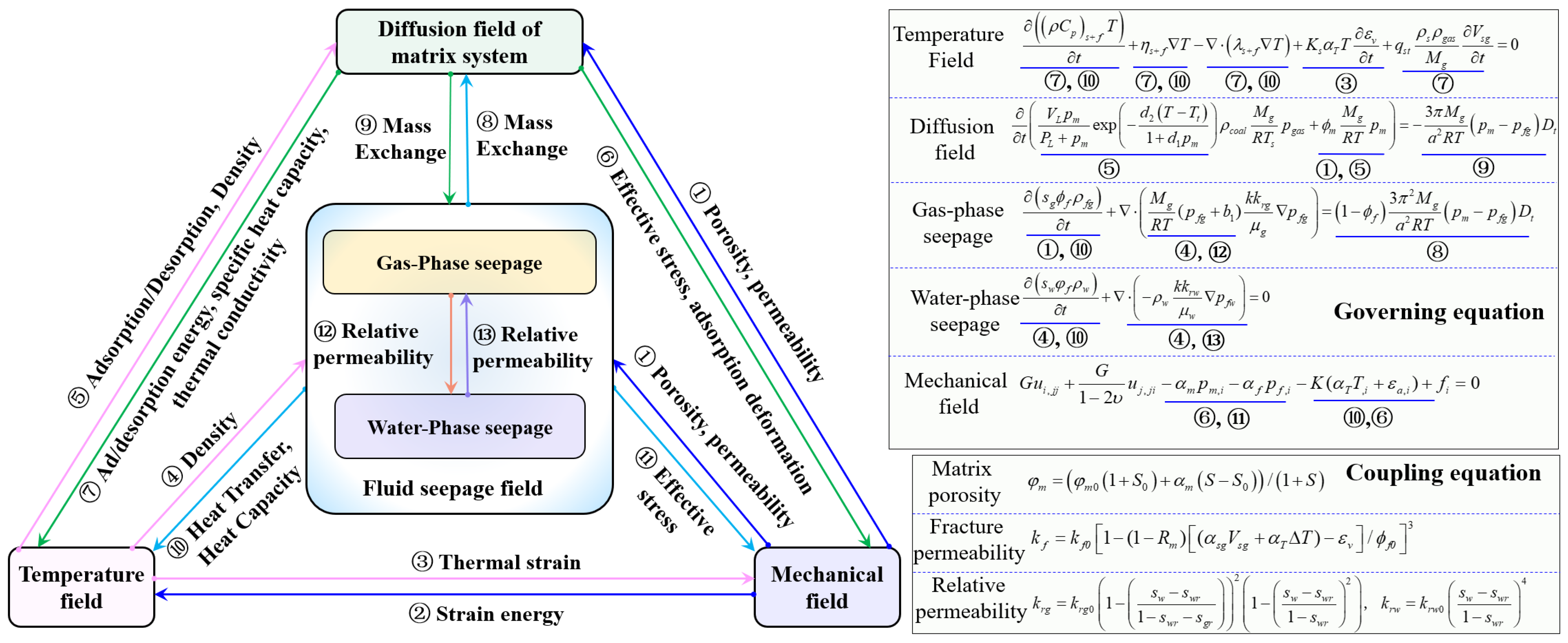
By solving Equations (1), (3), (8), (9), (11), (13), (14) and (20) simultaneously, we obtain a thermo-hydro-mechanical model for CBM production that accounts for gas–water two-phase flow and matrix dynamic diffusion (TP-D-THM). The specific coupling architecture is shown in Figure 2. Based on this architecture, four classes of fluid-solid coupling models are identified: (1) D-GM: considers gas-mechanical coupling while neglecting gas–water two-phase flow and temperature; (2) D-GHM: considers thermo-gas-mechanical coupling while neglecting gas–water two-phase flow; (3) TP-D-HM: considers hydro-mechanical coupling with gas–water two-phase flow while neglecting temperature; (4) TP-D-THM: considers thermo-hydro-mechanical coupling with gas–water two-phase flow. All models are solved using the built-in PDE module of COMSOL Multiphysics 6.1.

3. Effects of Different Coupling Schemes on CBM Production

3.1. Reservoir Petrophysical Characteristics Under Varying Burial Depths

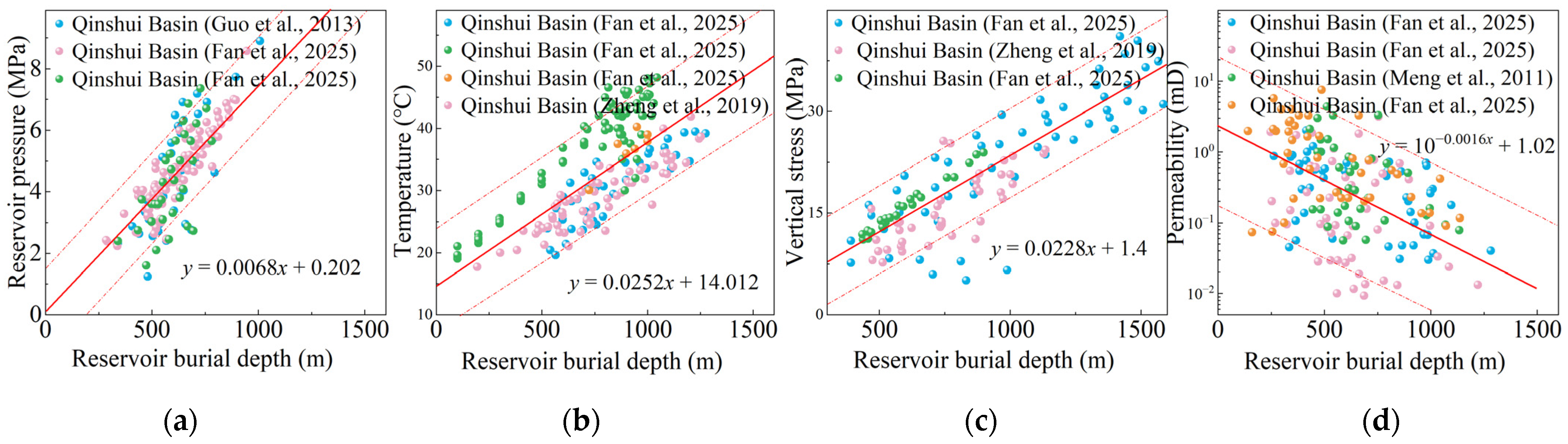
The statistical results for reservoir parameters at different burial depths are shown in Figure 3. With increasing depth, both overburden and horizontal stresses rise, fractures and pores undergo compressive closure, and permeability exhibits an exponential decline. When the depth exceeds 1000 m, the reservoir permeability approaches 0.1 mD. Reservoir pressure and temperature increase approximately linearly with depth. According to Equation (5), pressure and temperature jointly control the adsorbed gas content: the pressure effect appears in the conventional Langmuir term and the temperature sensitivity index term; higher pressure increases the adsorbed gas content, whereas higher temperature reduces it, indicating that the adsorbed gas content does not increase monotonically with depth. Since reservoir physical parameters vary synchronously with reservoir burial depth, the mathematical statistics results of reservoir physical parameters versus burial depth are embedded into COMSOL Multiphysics 6.1 as initial calculation parameters for numerical computation. Specifically, the initial reservoir pressure, initial temperature, initial vertical stress, and initial permeability are expressed as functions with burial depth as the independent variable.

3.2. Numerical Schemes and Model Validation

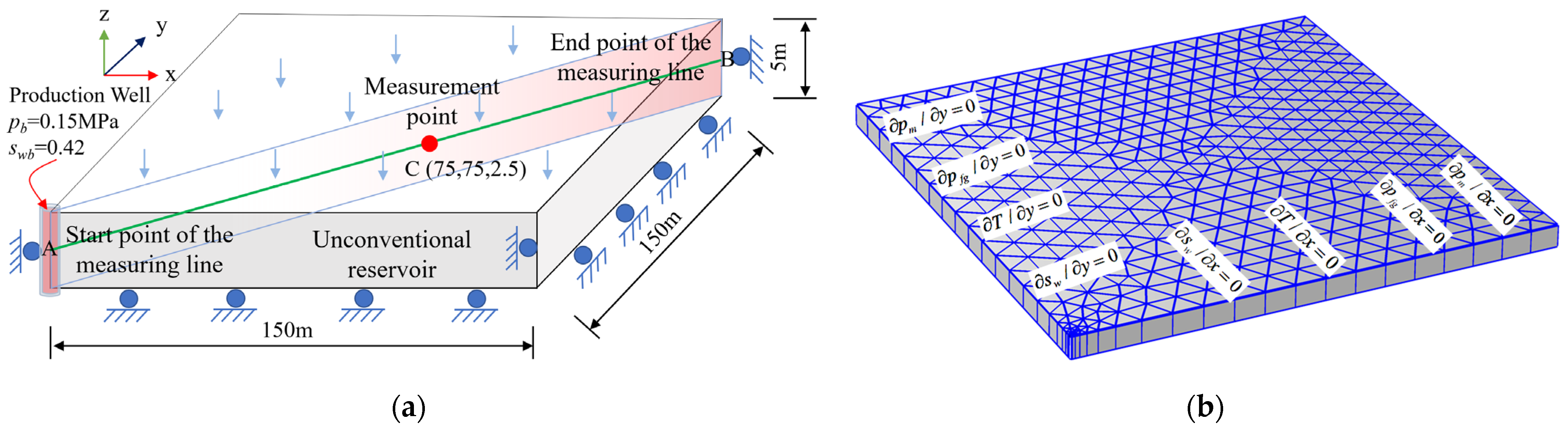
In the Qinshui Basin, typical vertical well spacing is 300~500 m [48]. Considering the rationality of simplifying the model and computational efficiency, reservoir heterogeneity and permeability anisotropy were not considered, which is also a common approach adopted by scholars. The model bottom is fixed for the stress field, the four lateral boundaries are roller supported, and a uniform load correlated with burial depth is applied on the top. For the temperature and fluid transport fields, the model exchanges no mass with the exterior; accordingly, the normal derivatives at the boundaries are set to zero. Because the matrix-fracture system is configured in series, production well boundary conditions are imposed only on the fracture system, with a production pressure of 0.15 MPa and a saturation of 0.42. Since the temperature in production wells is primarily related to coalbed methane desorption, the boundary conditions for the temperature field should not be artificially set (Figure 4).
The upper surface of the model employs a free triangular mesh, with a cubic mesh generated via sweep operations on both upper and lower surfaces. The solution tolerance is set to physics-controlled mode to ensure accuracy, with an absolute tolerance of 0.001. The solver type is implicit, utilizing backward differentiation with second-order Lagrange elements for spatial discretization.
The initial water saturation is 0.82. The initial temperature, reservoir pressure, vertical stress, and permeability are related to the reservoir burial depth (Figure 3). The burial depth ranges from 500 to 1200 m, with intervals of 100 m. Measurement point C is the center point of the model, with coordinates (75,75,5). Table 2 lists the primary parameters used in this study, while Table 3 details all numerical simulation schemes, boundary conditions, and initial conditions employed herein.
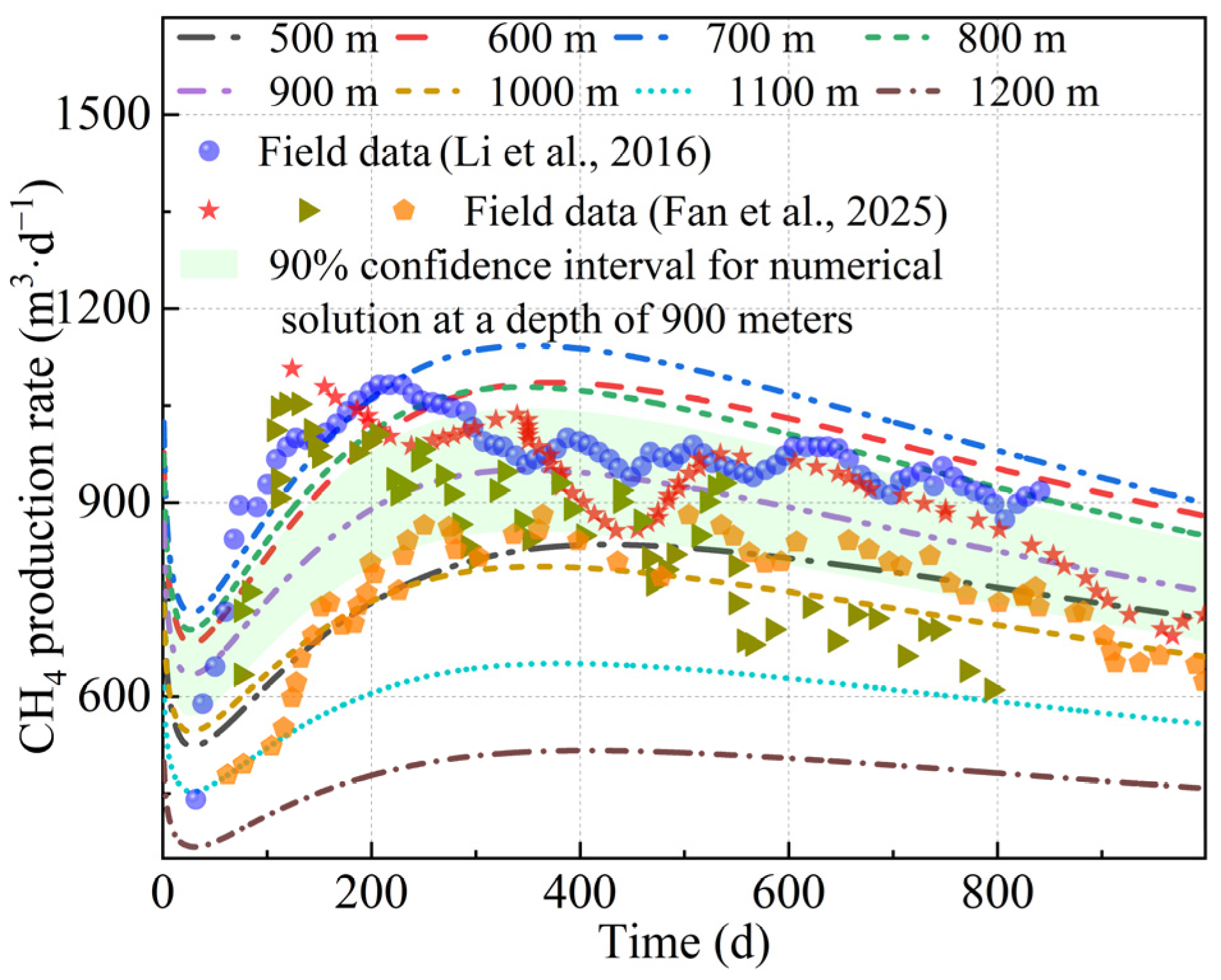
Because the reservoir parameters used in the model are fitted values, directly adopting them may introduce errors. Production data from four representative production wells were selected for model verification (Table 4). The temperatures among different production wells showed little variation, while reservoir pressure and permeability exhibited slight differences. Among these, the production well parameters for the Fanzhuang and Hancheng blocks are relatively close to the fitted values corresponding to the 900 m reservoir depth. Therefore, the production data from the Fanzhuang and Hancheng blocks are primarily used for validation. Despite the relatively high reservoir pressure in the Zhengzhuang block, the low permeability results in a modest gas production rate. The measured in situ gas production rate and simulated gas production rate curve are shown in Figure 5. The simulated gas production rate exhibits a typical trend of rapid decline, followed by an increase and then a gradual decrease. The measured values generally fall within the 90% confidence interval of the simulated values, validating the model’s validity.

3.3. Effects of Coupling Models on CBM Production

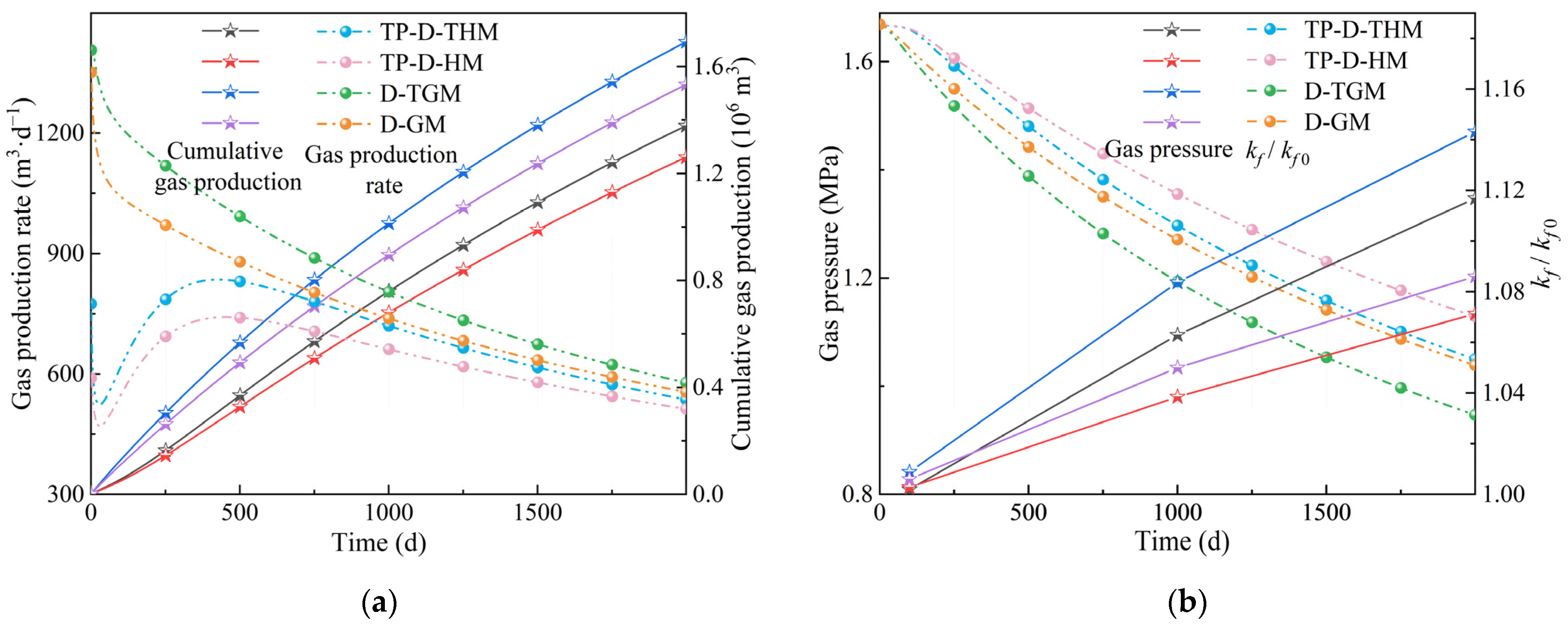
Taking the burial depth of 500 m as an example, the effects of different coupling models on CBM production are shown in Figure 6. By comparing the gas production rate curves corresponding to different coupling models (Figure 6a), it can be observed that the model neglecting thermal effects yields a lower gas production rate than the model incorporating thermal effects, while the model considering water effects produces a lower rate than the model disregarding water effects. The gas production rates for coupling models neglecting water effects (D-TGM, GM) exhibit a trend of rapid decline followed by a gradual, lower rate over time. In contrast, coupling models accounting for water effects (D-THM, GM) show a pattern of rapid decline, followed by an increase, then another decline. Temperature considerations result in higher gas production rates and earlier peak timing. The rapid decline in gas production rate is associated with the swift migration of free gas toward the production well, whereas the subsequent secondary rise is related to coal seam dewatering, which increases the relative permeability to gas and accelerates gas transport.
Cumulative production follows the order D-TGM > D-GM > TP-D-THM > TP-D-HM, with values of 1.69, 1.53, 1.40, and 1.26 × 10⁶ m3, respectively (Figure 6a). The cumulative production of the D-GM coupling model is 21.43% higher than that of the TP-D-HM model, and the D-TGM model yields 18.95% more than the TP-D-THM model, indicating that neglecting water effects leads to an overestimation of CBM recovery. Compared with TP-D-THM, D-TGM increases production by 20.71%, whereas D-HM decreases it by 10.00%, showing that thermal promotion is weaker than water inhibition. The D-TGM model yields 10.40% more cumulative production than the D-GM model, while the TP-D-THM model produces 9.35% more than the TP-D-HM model, indicating that the promotive effect of temperature is more pronounced when the coal seam contains no water.
Gas pressure at the monitoring point is negatively correlated with cumulative production. As production proceeds, the pressures predicted by D-GM and TP-D-THM gradually converge (Figure 6b). When water effects are included, early time behavior is dominated by dewatering, leading to a brief period of slowly declining gas pressure. Decreases in gas pressure and temperature both induce matrix shrinkage and thus enhance fracture permeability; consequently, models that include temperature predict a larger permeability increase. This explains why the gas pressures predicted by the D-GM and TP-D-THM models are relatively close, whereas the permeability increase in the latter is markedly greater than in the former.

3.4. Effects of Burial Depth on CBM Production

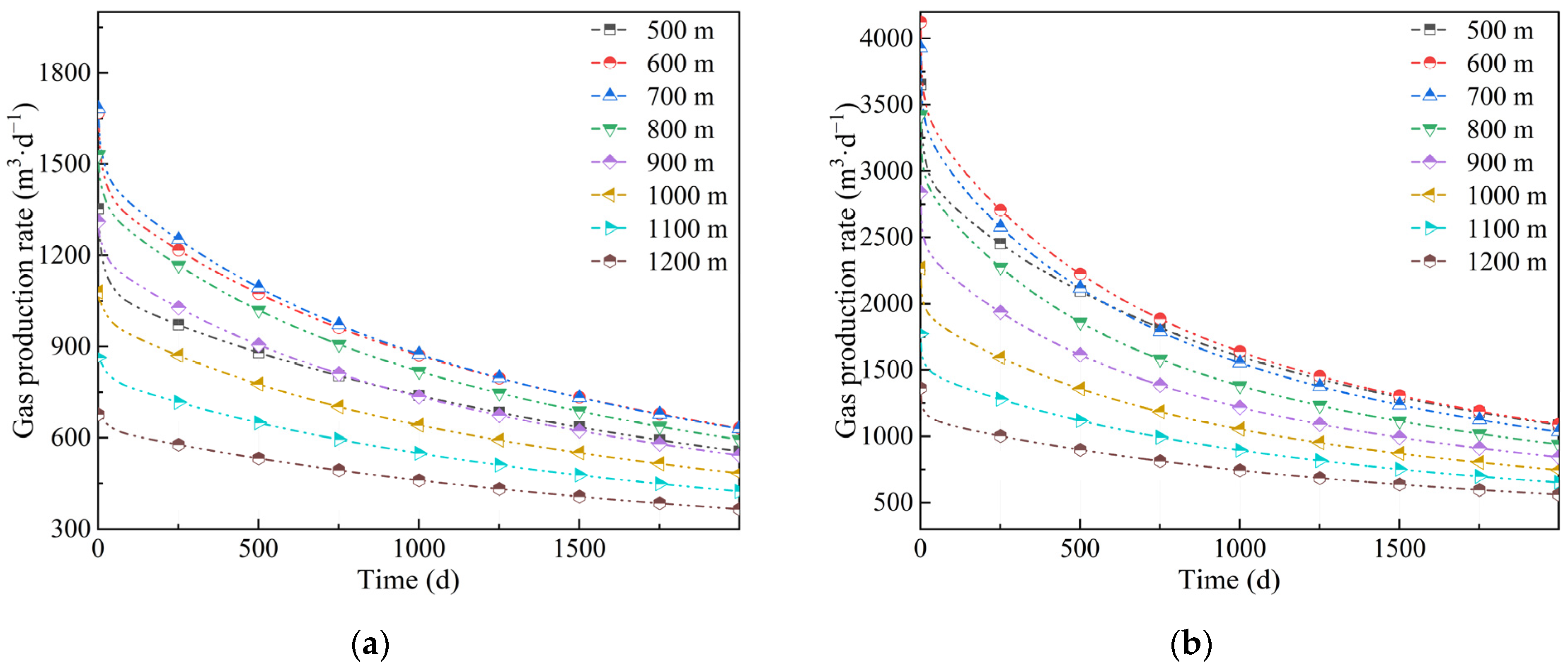
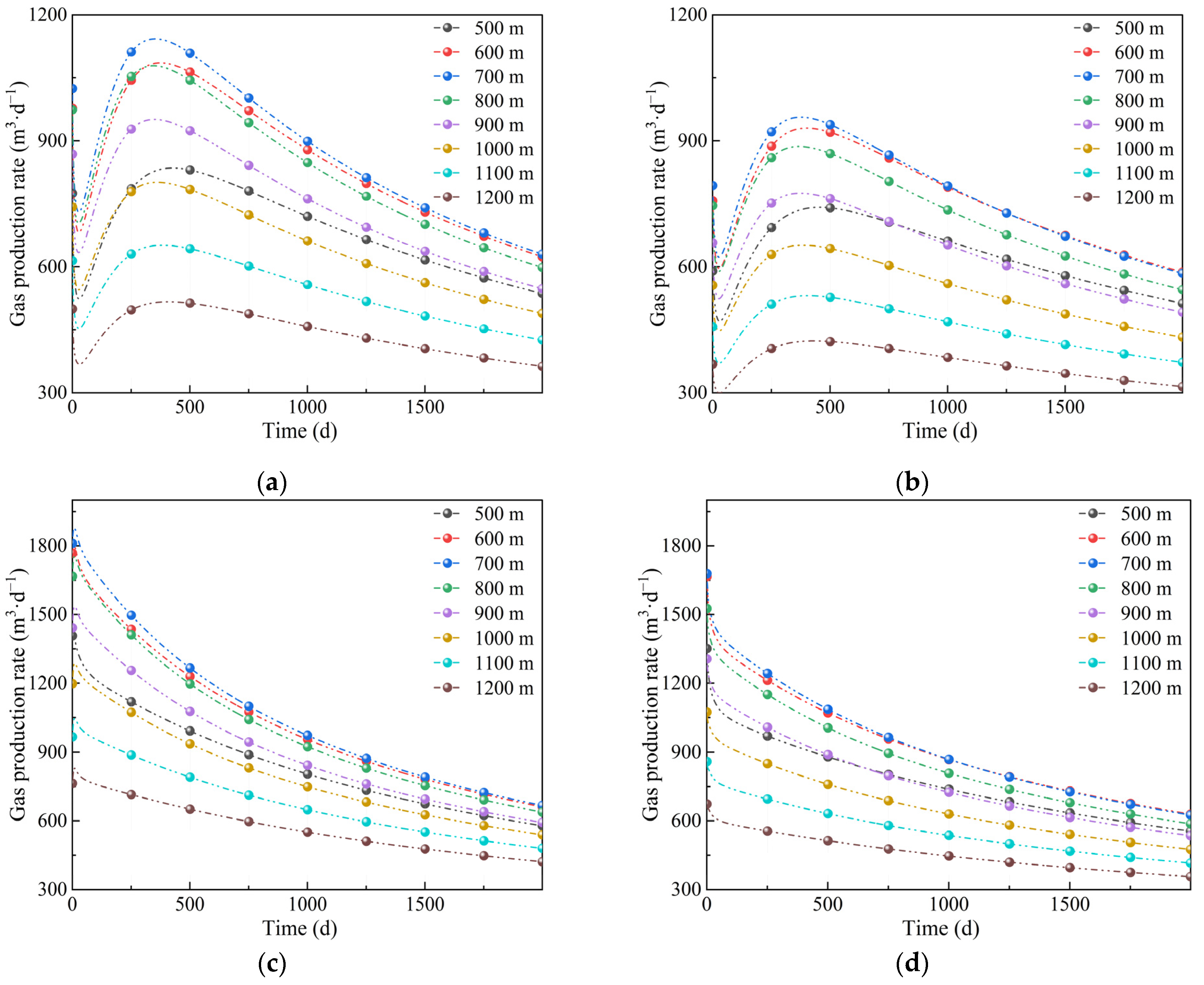
As reservoir burial depth increases, both pressure and temperature rise, so a given production pressure generates a larger pressure gradient, thereby promoting gas transport and desorption. The production rates for different depths and coupling models are shown in Figure 7. Variation in coal seam depth does not alter the qualitative trend of the production rate. As burial depth increases, the peak production rate first rises and then declines, reaching its maximum at a depth of 700 m. For the TP-D-THM and TP-D-HM models, the time corresponding to the peak gas production rate decreases rapidly at first and then increases gradually. The peak gas production rates and corresponding times for different coupling models are shown in Table 5. For example, under the TP-D-THM model at depths of 500, 600, 700, 800, 900, 1000, 1100, and 1200 m, the peak production rates are 835.11, 1085.50, 1142.60, 1078.50, 950.62, 801.06, 651.17, and 516.70 m3/d, occurring at 424, 379, 358, 349, 350, 360, 381, and 407 days, respectively.
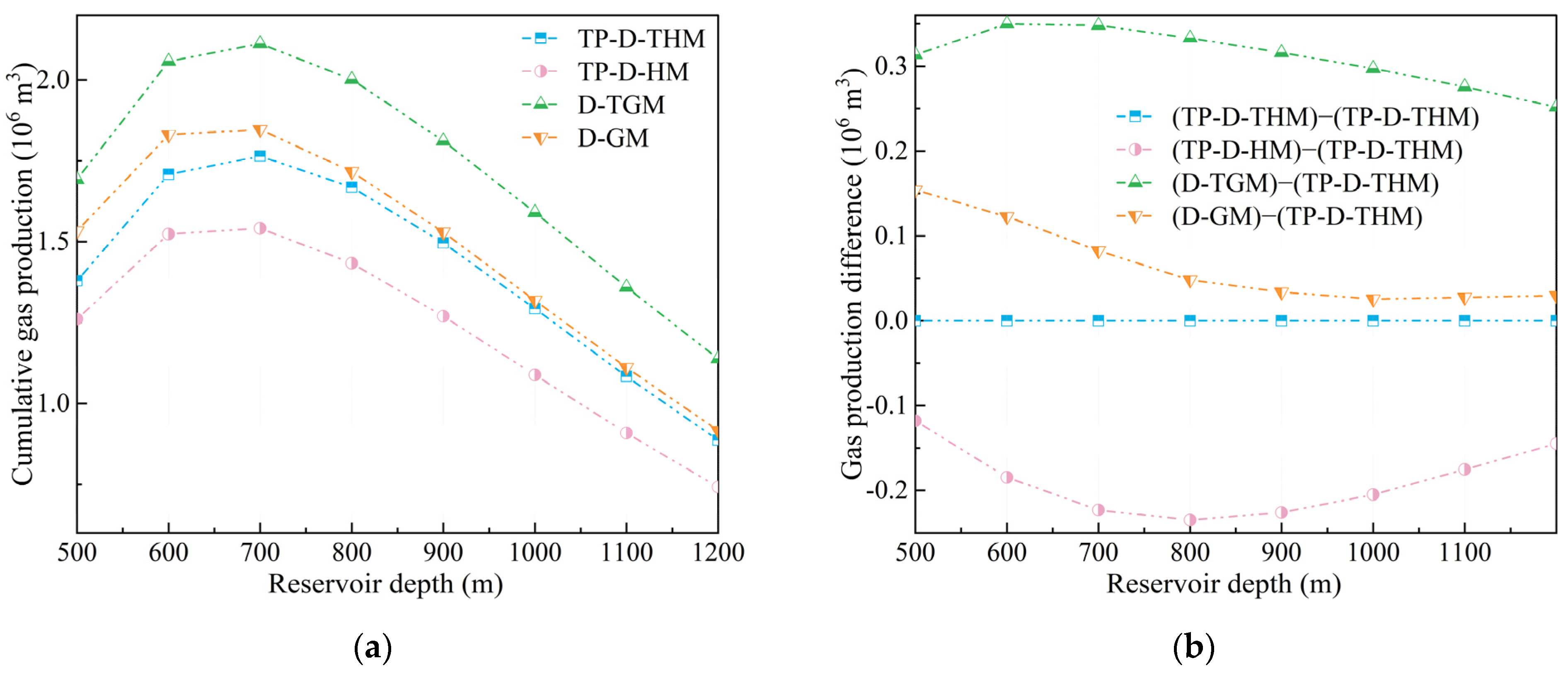
As shown in Figure 8, the cumulative gas production for different coupling models varies with burial depth. As burial depth increases, cumulative gas production first rises rapidly and then declines slowly, with the maximum occurring at a depth of 700 m. This indicates that when the reservoir is deeper than 700 m, the positive effects of elevated reservoir pressure and temperature are outweighed by the negative impacts of higher in situ stress and reduced permeability. The ordering of gas production among the various coupling models is invariant with respect to burial depth. Taking the TP-D-THM model as the baseline, the production differences for TP-D-HM and D-TGM relative to TP-D-THM both first increase and then decrease with depth; the turning point is 600 m for the former and 800 m for the latter. The difference in cumulative production between the D-GM and TP-D-THM models decreases progressively with increasing burial depth, with values of 0.15, 0.12, 0.08, 0.05, 0.03, 0.02, 0.02, and 0.03 × 10⁶ m3 at depths of 500~1200 m.
Comparing the gas production rates from the TP-D-THM and D-TGM models with those from the D-HM and D-GM models reveals that coupling models that neglect water effects will overestimate gas production. This overestimation becomes more pronounced at greater burial depths, particularly when temperature effects are considered. When temperature is considered but water is neglected, the depth-dependent overestimation percentages are 22.74%, 20.48%, 19.73%, 19.96%, 21.12%, 22.30%, 25.46%, and 28.41%.
Comparing the gas production rates from the TP-D-THM and D-HM models with those from the D-TGM and D-GM models reveals that models neglecting temperature effects underestimate gas production. This underestimation increases progressively with burial depth, particularly when water effects are ignored, and stabilizes at depths greater than 1000 m. The underestimation rates of gas production corresponding to different burial depths are 8.55%, 10.81%, 12.65%, 14.08%, 15.10%, 15.86%, 16.17%, and 16.33%, respectively. Overall, the inhibitory effect of water consistently exceeds the promoting effect of temperature. The net difference between inhibition and promotion decreases rapidly and then recovers slowly with depth, reaching a minimum at 800 m.
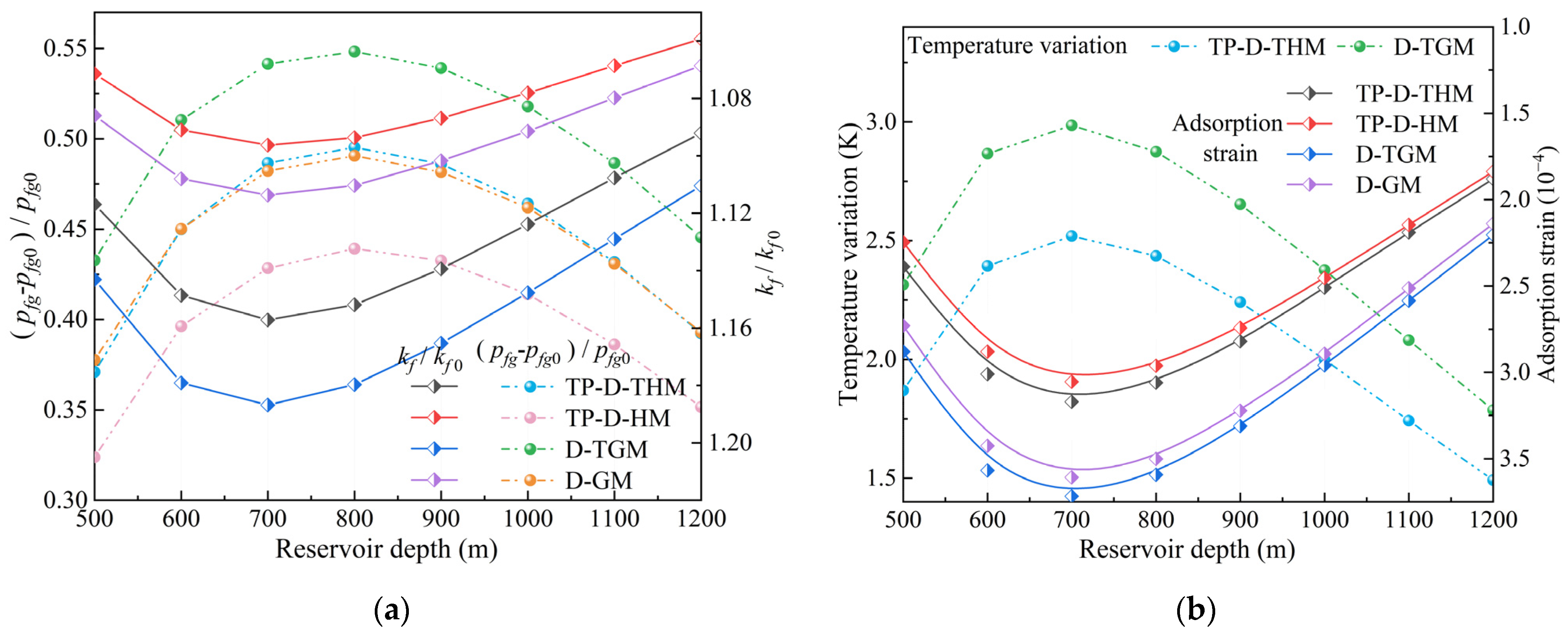
Figure 9 shows the variation in petrophysical parameters at monitoring point C under different burial depths. As depth increases, the pressure drop at point C grows, but its magnitude first increases and then decreases, with a turning point at 800 m, whereas the critical burial depth for the permeability ratio is 700 m. The maximum pressure decline magnitudes across the coupling models are 0.55, 0.49, 0.49, and 0.44 (in descending order), and the corresponding maximum permeability ratios are 1.18, 1.15, 1.11, and 1.09. This is because the adsorbed gas content in coal follows a modified Langmuir isotherm, making the pressure reduction interval particularly influential for cumulative production.
Notably, both the permeability ratio and the temperature change increase and then decrease with depth, with their maxima at 700 m (Figure 9b). Regardless of whether temperature effects are considered, the turning point of the permeability ratio remains at 700 m, indicating that temperature is not the primary control on permeability. Reservoir permeability reflects the combined effects of effective stress, adsorption-induced strain, and thermal strain. For all coupling models, the adsorption-induced strain peaks at 700 m, identifying thermal as the dominant control on permeability evolution. When temperature effects are included, cooling induces matrix shrinkage and an increase in fracture aperture, amplifying the permeability change, hence the larger variation predicted by TP-D-THM relative to D-GM. The cumulative production predicted by the D-GM model exceeds that of the TP-D-THM model. Under gas–water two-phase flow, residual saturations reduce the effective gas permeability of the fracture system to about 0.82 times the absolute permeability; accordingly, the increase in effective gas permeability in TP-D-THM is smaller than in D-GM. In addition, when thermal effects are considered, a decrease in reservoir temperature enhances adsorption capacity. Consequently, the D-GM model yields higher cumulative production than TP-D-THM. It can be inferred that permeability is the primary cause of low productivity in deep coal seams.
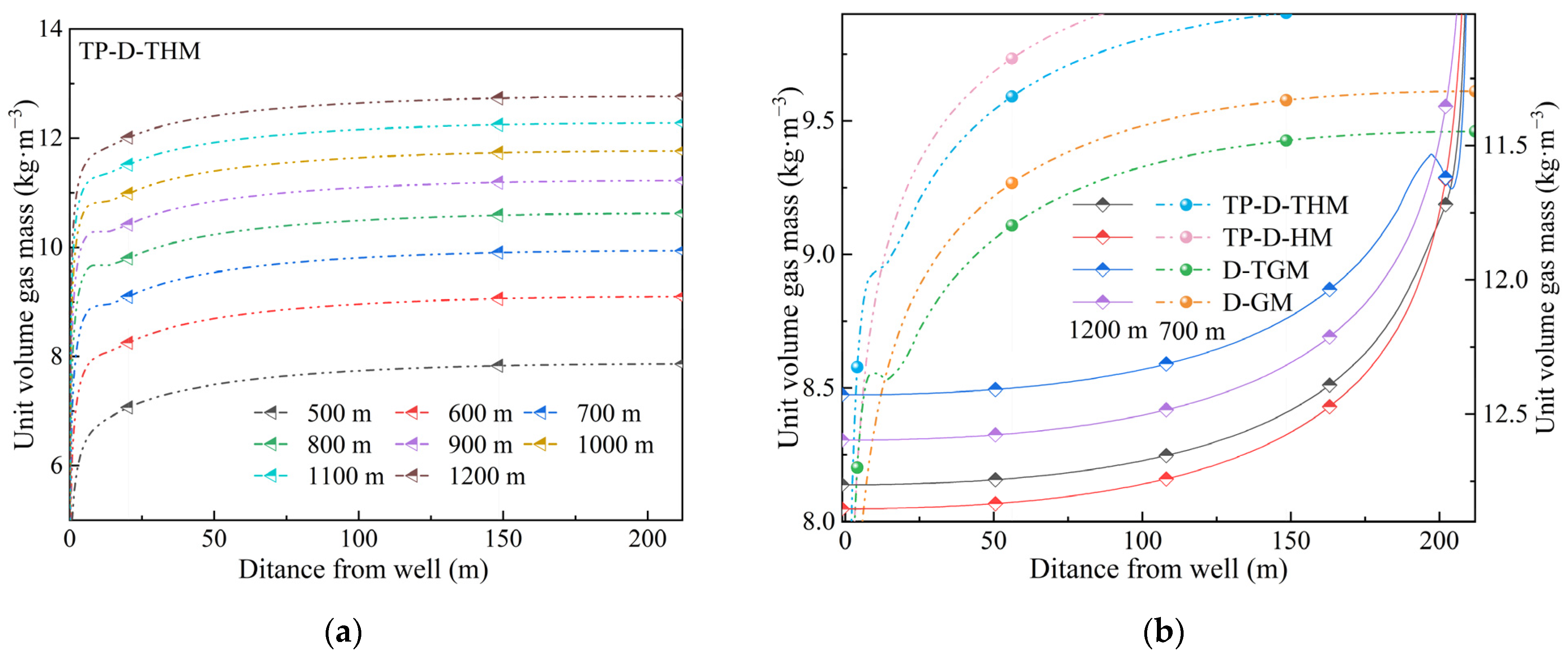
Figure 10 shows the gas mass per unit volume along profile AB under different burial depths and coupling models. Taking TP-D-THM as an example, the differences in mass concentration decrease with depth, with values of 1.23, 0.85, 0.68, 0.60, 0.54, 0.51, and 0.49 kg·m−3. The ranking of mass concentrations along profile AB for different coupling models under varying burial depths is as follows: TP-D-HM > TP-D-THM > D-GM > D-TGM. When temperature effects are included (TP-D-THM, D-TGM), a localized anomaly of increased gas content appears near the production well; similar behavior has been reported during gas injection stimulation and is often attributed to a gas displacement effect [42]. Mechanistically, incorporating temperature leads to a larger temperature drop on the production side, potentially below the laboratory adsorption test temperature T, which, within a certain pressure range, increases the amount of adsorbed gas.

4. Discussion

4.1. Sensitivity Analysis

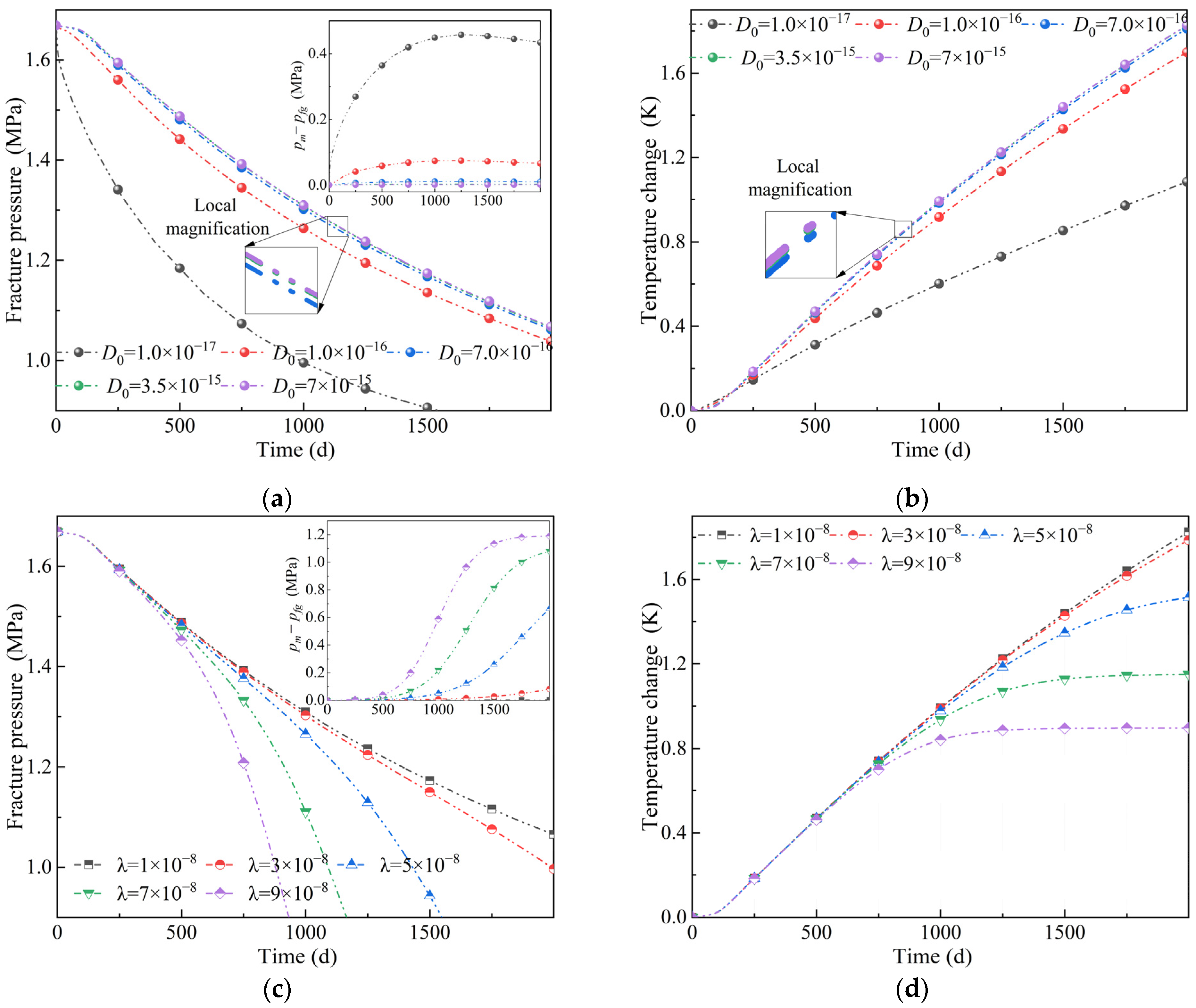
As the initial diffusion coefficient decreases, the pressure drop in the fracture system at point C increases, while the magnitude of the temperature change decreases (Figure 11a). The matrix-fracture pressure differential diminishes with increasing initial diffusion coefficient because a larger initial diffusivity enhances matrix-fracture mass exchange; over time, this pressure differential first increases and then decreases. From the conversion between the diffusion coefficient and the desorption time τ, directly adopting laboratory desorption times overestimates the exchange capacity of the matrix-fracture system. Numerical results indicate that a desorption time on the order of hundreds of days is required to develop a matrix-fracture pressure differential of approximately 0.1 MPa. When the diffusion coefficient is below 1.0 × 10⁻¹⁶ m2·s−1, the temperature drop decreases sharply (Figure 11b).
To isolate the effect of the decay coefficient, the residual diffusion coefficient was set to zero. As the decay coefficient increases, the pressure at point C shifts from a uniform decline to an accelerated decline; higher decay coefficients correspond to lower fracture pressures, in some cases approaching the production-well boundary pressure. Because a larger decay coefficient rapidly diminishes matrix diffusivity, the matrix-fracture pressure differential increases from 10−4 MPa to 1.1 MPa. Meanwhile, the temperature change at point C becomes progressively smaller. For example, at a decay coefficient of 9 × 10⁻⁸, the temperature remains essentially unchanged after 1000 days (Figure 11c,d). The results indicate that when the diffusion coefficient is less than 7 × 10⁻¹⁶ m2/s (τ = 9 d) or the decay coefficient exceeds 3 × 10⁻⁸ s−1, it will lead to an increase in the pressure drop within the fracture system and an increase in the matrix-fracture pressure difference.
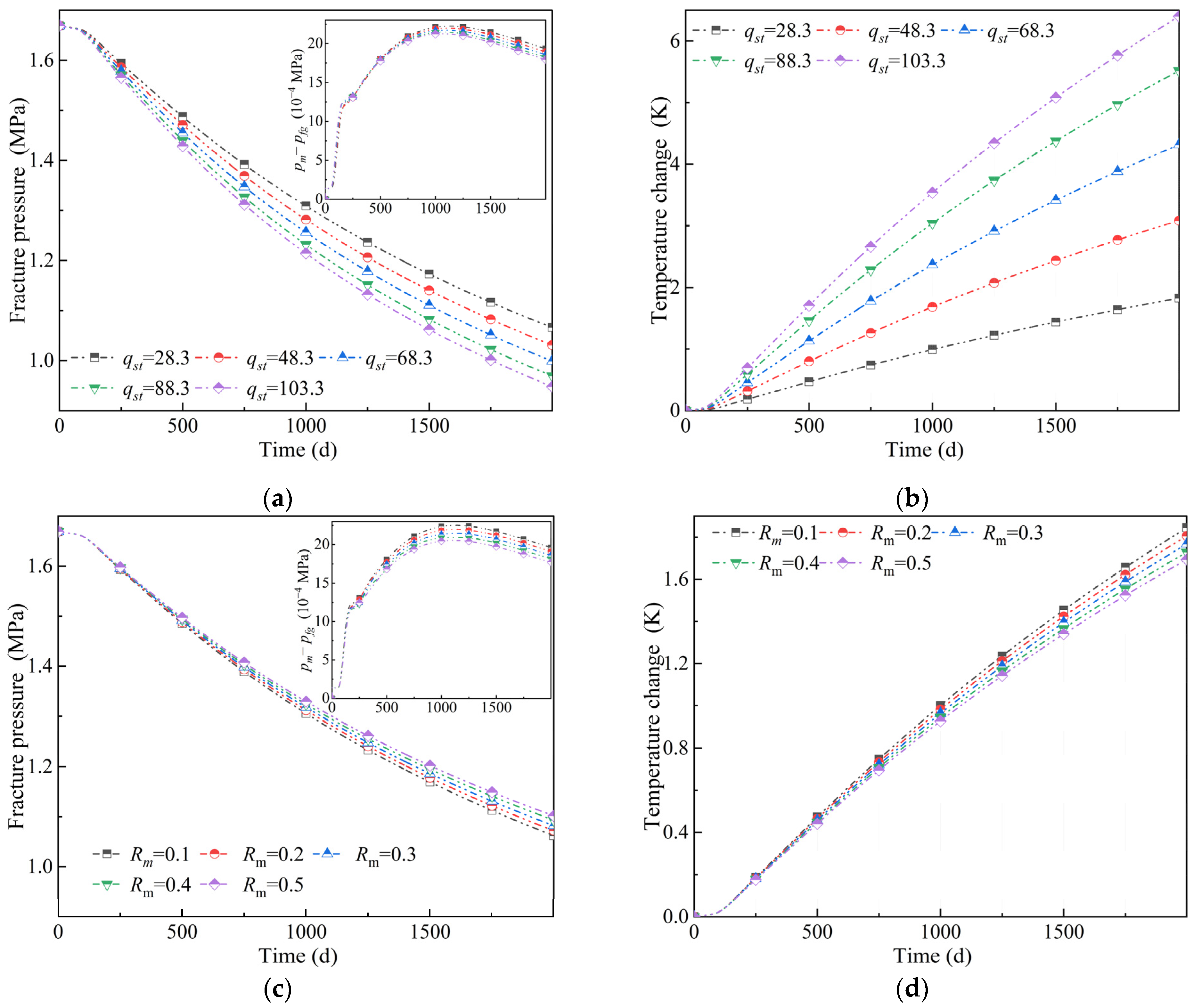
Isosteric heat of adsorption is a key indicator of the reservoir’s thermodynamic behavior. As seen in Figure 12a,b, the greater the isosteric heat of adsorption, the more energy is required for desorption of the adsorbed gas. For the same production duration, this leads to larger temperature variations in the reservoir, more pronounced matrix shrinkage, and a greater increase in permeability, which in turn results in a larger pressure drop at measurement point C. As the isothermal adsorption heat expands, the magnitude of the temperature drop at point C increases, whereas the matrix-fracture pressure differential gradually decreases. After 2000 days, the temperature decreases corresponding to different qst values are 1.83, 3.09, 4.31, 5.52, and 6.40 K. By definition, a larger modulus degradation rate Rm corresponds to a smaller change in permeability. Lower permeability slows the pressure decline in the fracture system and reduces the matrix-fracture pressure difference. Reservoir temperature variation is primarily governed by the desorption gas volume. Higher gas pressure within the matrix system correlates with smaller temperature fluctuations, while larger Rm values correspond to lower temperature variation ranges (Figure 12c,d). The effect of isothermal adsorption heat is stronger than that of the modulus decay rate.

4.2. Production Rate Curve Types

In homogeneous numerical models, the temporal evolution of gas production rate can be broadly classified into three types: ① Gradual decline; ② Rise-decline; ③ Decline-rise-decline. Temperature does not alter the trend of gas production rates but only influences their numerical values. In general, models that neglect water effects exhibit behavior of type-(1) [49], whereas models that include water effects tend to type-(2) [50,51]. Type-(3) behavior is also common in the Qinshui Basin. Analysis of the coupled models corresponding to the third category of gas production rates [52,53] reveals that the coupled models associated with this production rate trend all employ dual porosity and single permeability assumptions while accounting for the influence of water effects.
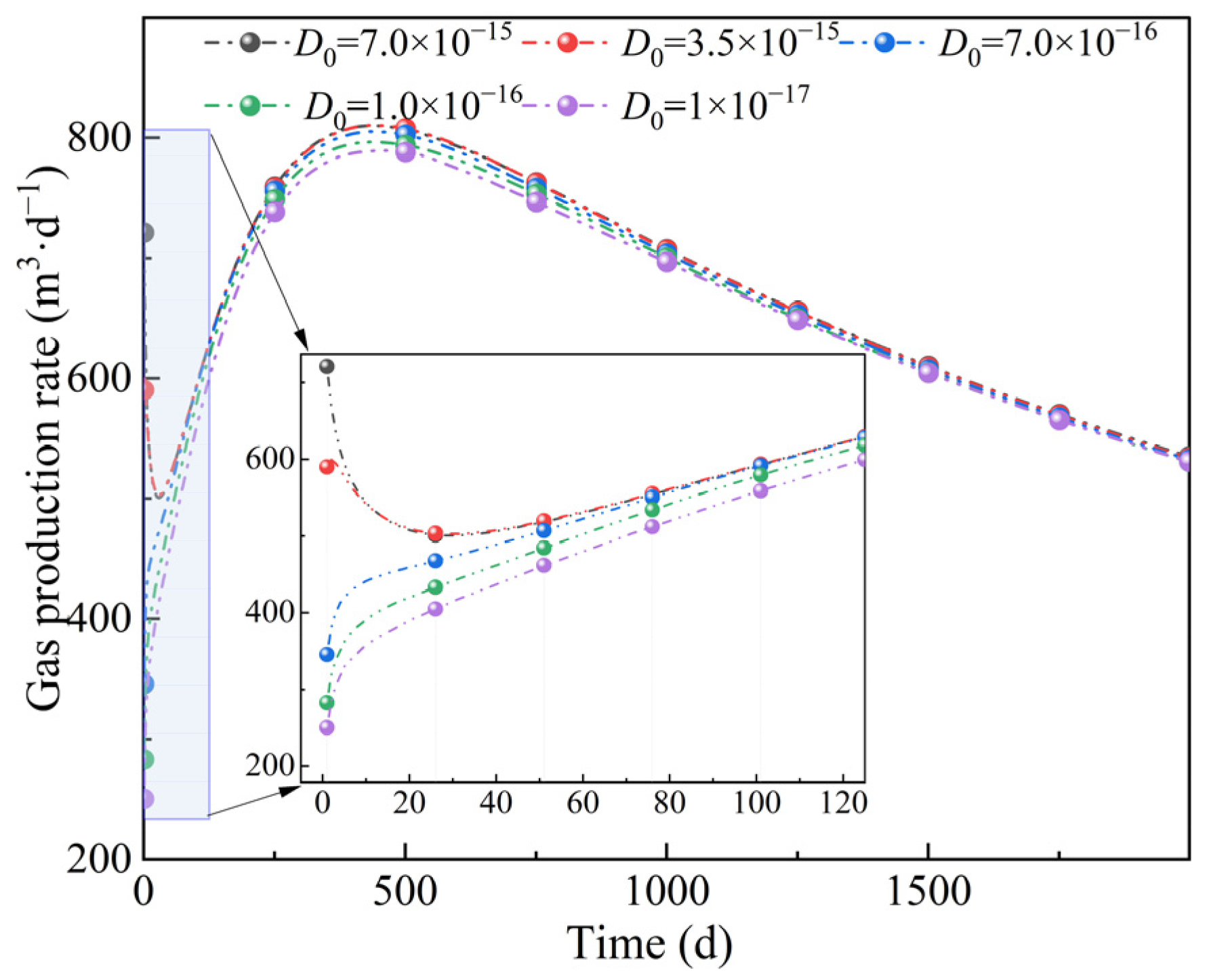
For a single porosity medium, both the seepage term and diffusion term coexist in the fluid transport field equation. The diffusion term slightly expands gas production rates without affecting the morphology of gas production rates. Once gas pressure decreases, the corresponding adsorbed gas volume decreases synchronously. In a dual porosity medium, matrix-fracture mass exchange is explicit and controlled by the diffusion coefficient. As illustrated in Figure 13, when the diffusion coefficient is large, free gas in the matrix system compensates for the fracture system during the initial extraction phase, causing the gas production rate to decline rapidly. When the diffusion coefficient is small, the matrix system’s compensatory capacity for fractures is low, resulting in a gas production rate that first increases and then decreases. The lower the diffusion coefficient, the lower the initial gas production rate. As the diffusion coefficient decreases, the gas production rate shifts from type-(3) to type-(2). This explains why different researchers using the THM model obtain varying trends in gas production rates.
Permeability models can be categorized as equilibrium or non-equilibrium. The analyses above are based on the equilibrium assumption, under which matrix and fracture pressures are equal. Interestingly, under a non-equilibrium permeability model, decreasing the diffusion coefficient drives a progression from type (1) to (2) and ultimately to (3) behavior [28], indicating that the local-equilibrium assumption overestimates matrix-fracture exchange. Although both equilibrium and non-equilibrium formulations can reproduce type-(3) curves, their sensitivities to the diffusion coefficient are opposite. For equilibrium permeability models, a smaller diffusion coefficient approximates a single porosity medium (considering only the fracture system). For non-equilibrium models, a larger diffusion coefficient approximates a single porosity medium (considering both matrix and fractures collectively). Research on non-equilibrium permeability models remains in its preliminary stages, primarily serving to explain laboratory-observed permeability data. There is no consensus on which permeability model should be adopted for numerical calculations.

4.3. Existence of a Critical Burial Depth and Its Determination

The definition of deep CBM has not been fully unified. (1) According to the Chinese industry standard DZ/T 0378-2021 [54] (Assessment Specification of Coalbed Methane Resources. Ministry of Natural Resources of the People’s Republic of China: Beijing, China, 2021). CBM resources at burial depths >1200 m are classified as deep. (2) In industry practice, seams deeper than 1500 m are often regarded as deep CBM, and some even require depths >2000 m. (3) Other scholars argue that deep and shallow are relative concepts: deep reflects a reservoir state jointly controlled by in situ stress and formation temperature rather than burial depth alone [55].
Based on the mathematical statistics characteristics of physical parameters at different burial depths in the Qinshui Basin, this study employs various coupled models to analyze the natural gas expulsion patterns under varying burial conditions. It determines the critical burial depth for natural expulsion to be 700 m, consistent with previous findings [44,56]. Different coupling models only alter the coalbed methane recovery rate without changing the critical depth. Even if temperature effects on adsorption are ignored entirely, the critical depth remains 700 m (Figure 14a).
Fundamentally, the critical depth reflects the statistical attributes of reservoir properties. Because reservoir pressure, permeability, and the fractional coverage index ( p m / P L + p m ) are key to CBM recovery, we multiply these three and nondimensionalize the product. The resulting dimensionless values at increasing depths are 1.32, 1.73, 1.81, 1.70, 1.61, 1.36, 1.12, and 0.91, with the maximum at 700 m. Encouragingly, the ranking of these dimensionless values aligns well with the rankings of cumulative production and production rate.
To validate the proposed method in this paper, analysis was conducted using previously published data on permeability, reservoir pressure, and burial depth [40,50]. The dimensionless values under different burial depth conditions were 2.98, 3.20, 2.86, 2.32, 1.78, 1.32, 0.95, and 0.67, respectively, with a corresponding critical depth of 600 m. Furthermore, by incorporating the relationship between permeability, reservoir pressure, and burial depth into numerical simulation software, the simulated gas production rate characteristics for different burial depth conditions are shown in Figure 14b. As burial depth increases, the gas production rate exhibits a trend of first expanding and then contracting, with 600 m serving as the inflection point. The non-dimensional sorting results align with those for recovery rate and recovery volume sorting.
These results indicate that the critical depth is an outcome of the statistical distribution of reservoir properties. Because petrophysical parameters vary significantly across reservoirs and regions, the critical depth may differ accordingly. This study does not consider the depth dependence of other properties (e.g., elastic modulus, diffusion characteristics), which should be addressed in future work; nonetheless, a critical burial depth is expected to exist.

4.4. Model Reducibility

A large number of THM models for CBM production have been developed and progressively refined using laboratory tests, with the aim of elucidating how various effects influence CBM production. The expansion from a single seepage model to an HM coupled model, and further to THM models and thermo-hydro-mechanical-chemical models, represents a process of incremental addition. However, regardless of the type of coupling model employed, field data can be inverted by adjusting certain parameters. While this approach enhances understanding of coal seam extraction, excessive parameters compromise the model’s convergence and robustness.
In the present model, thermal and water effects act in opposite directions, with the inhibitory effect of water slightly exceeding the promoting effect of temperature. Using the relative error in cumulative recovery, measured against the TP-D-THM baseline, as the evaluation metric, it was found that when the burial depth ranged between 650 and 1350 m, the D-HM model yields errors <5.00%, whereas for depths <650 m, the error ranges from 5.00% to 9.10%. Accordingly, when the burial depth falls within 650–1350 m, the TP-D-THM model can be simplified to the D-GM model for predicting CBM drainage behavior. This paper refers to this range as the critical burial depth interval for model simplification.

5. Conclusions

This study establishes a THM coupling model for CBM drainage with gas–water two-phase flow, achieving an error rate below 10%, and incorporating the governing equations and coupling terms for matrix dynamic diffusion, fracture-system gas flow, water flow, the stress field, and the temperature field. More than 786 datasets relating reservoir parameters to burial depth in the Qinshui Basin are compiled and embedded into COMSOL Multiphysics. The effects of coupling factors and burial depth on CBM drainage behavior and model simplifiability are then analyzed. The main conclusions are as follows:
(1)
Temperature and burial depth do not change the qualitative trend of the production rate. For equilibrium permeability models, incorporating water effects and employing relatively large initial diffusion coefficients can generate a decrease-increase-decrease gas production trend. Using cumulative gas production as the metric, the critical burial depth was determined to be 700 m based on the competing positive and negative effects on coalbed methane recovery. This critical burial depth remains unchanged across different coupling models.
(2)
Omitting the temperature field leads to an underestimation of gas production, especially when water effects are also neglected. The underestimation increases gradually with burial depth and tends to plateau beyond 1000 m, with a magnitude of 8.55~16.33%. Conversely, neglecting water effects leads to an overestimation of gas production, particularly when the temperature field is included; the degree of overestimation first decreases and then increases with burial depth, ranging from 19.72% to 28.41%. Overall, water’s inhibitory effect consistently exceeds thermal promotion.
(3)
The pressure drop increases with depth and then decreases, peaking at 800 m. Matrix shrinkage driven by gas desorption and cooling dominates fracture compression caused by higher effective stress, so permeability shows an overall increasing trend. The permeability-increase ranking is D-TGM > TP-D-THM > D-GM > TP-D-HM. The temperature reduction value, permeability ratio, and cumulative gas production all exhibit a turning point at 700 m, increasing initially and then decreasing as burial depth increases.
(4)
Smaller diffusion coefficients and larger decay rates lead to greater fracture pressure decline and a larger matrix-fracture pressure difference. If the diffusion coefficient falls below 7 × 10⁻¹⁶ m2/s or the decay coefficient exceeds 3 × 10⁻⁸ s−1, a pronounced increase ensues in both the fracture pressure drawdown and the matrix-fracture pressure difference. Directly adopting laboratory desorption time overestimates matrix-fracture exchange capacity; simulations indicate that generating a matrix-fracture pressure difference on the order of 0.1 MPa requires hundreds of days. The effects of isosteric adsorption heat on pressure and temperature outweigh those of the modulus degradation rate.
(5)
A nondimensional critical-depth criterion integrating reservoir pressure, permeability, and the fractional coverage index is proposed and validated. The critical depth interval for model simplification is identified as 650–1350 m, within which the TP-D-THM model can be simplified to the D-GM model (neglecting water and temperature) for CBM production forecasting, with an error rate below 5%.
The mathematical model in this paper does not account for heterogeneity, dissolved gases, or the influence of water on the adsorption capacity of the matrix system. It also disregards damage caused by thermal effects. When determining the characteristics of coalbed methane extraction under different reservoir burial depths, factors such as elastic modulus and diffusion capacity were not considered. Importantly, the results presented here are based on mathematical statistics from the Qinshui Basin. Consequently, the corresponding conclusions are relatively effective for the Qinshui Basin, but their applicability to other regions requires further verification. These research limitations should be addressed in future studies.

Author Contributions

Z.F.: Methodology, Software, Writing—original draft, Writing—review & editing. G.F.: Conceptualization, Methodology. D.Z.: Conceptualization, Formal analysis. T.L.: Data curation. X.H.: Software, Investigation. G.X.: Supervision, Data curation. H.T.: Validation, Supervision. All authors have read and agreed to the published version of the manuscript.

Funding

This work was financially supported by: National Key Research and Development Program Project [grant number 2024YFC3909301, 2024YFC3909302]; National Natural Science Foundation of China [grant number 52404152, 52574177]; Excellent Postdoctoral Funding Project of Jiangsu Province [grant number 2023ZB517]; Basic Research Funds for Central Universities—Youth Science and Technology Fund [grant number 2024QN11078].

Data Availability Statement

The data that support the findings of this study are available from the corresponding author upon reasonable request.

Acknowledgments

The authors are also grateful to the helpful comments provided by the anonymous reviewers.

Conflicts of Interest

The authors declare that they have no conflict of interest.

Abbreviations

The following abbreviations are used in this manuscript:
a 0 initial width of coal matrix R gas molar constant
a width of coal matrix R m modulus attenuation rate
b 0 initial fracture aperture s w water saturation
b fracture aperture s w r irreducible water saturation
b 1 Klinkenberg factor s g gas saturation
c 1 temperature coefficients of water s g r residual gas saturation
c 2 temperature coefficients of water T temperature of coal seam
C s specific heat capacity of coal skeleton T t reference temperature
C g specific heat capacity of CH4 V s g absorbed gas content
C w specific heat capacity of water V L i Langmuir volume constant of CH4
d 1 pressure coefficient of gas sorption α f Biot effective stress coefficient for fracture
d 2 temperature coefficient of gas sorption α m Biot effective stress coefficient for matrix
D 0 i initial diffusion coefficient α s g Volumetric adsorption-induced expansion coefficient
D r i residual diffusion coefficient α T coal skeleton’s thermal expansion coefficient
f i body force ε a adsorption strain
G shear modulus ε v volume strain
K bulk modulus μ w dynamic viscosity of water
k m skeleton bulk modulus μ g dynamic viscosity of CH4
k f 0 initial permeability of fracture λ s heat conductivity of coal skeleton
k absolute permeability of the fracture λ g thermal conductivity of CH4
k r g 0 endpoint relative permeability of the gas λ w conductivity of water
k r g relative permeability of the gas λ s + f effective thermal conductivity of coal mass
k r w 0 endpoint relative permeability of the water η s + f effective heat convection coefficient
k r w relative permeability of the water ρ C p s + f effective specific heat capacity of coal mass
M g molar mass of CH4 ρ g density of CH4
p L Langmuir pressure constant of CH4 ρ g a s density of CH4 under standard state
p m gas pressure in matrix ρ c o a l density of coal skeleton
p f fluid pressure in fracture γ attenuation coefficient
p f g gas pressure in fracture ϕ m porosity in coal matrix
p f w water pressure in fracture ϕ m 0 initial porosity in coal matrix
p c g w capillary pressure ϕ f porosity of fracture
q s t isosteric heat of gas adsorption ϕ f 0 initial porosity of fracture
Δ σ E effective stress change Δ ε m T matrix width variation caused by temperature
Δ ε m S matrix width changes caused by adsorption Δ b change in crack width
Acronyms
THMThermo-hydro-mechanicalTP-D-THMthermo-hydro-mechanical model accounts for gas–water two-phase flow and matrix dynamic diffusion
CBMCoalbed methaneD-GMgas-mechanical model accounts for matrix dynamic diffusion
TP-D-HMhydro-mechanical model accounts for gas–water two-phase flow and matrix dynamic diffusionD-GHMthermo-gas-mechanical accounts for matrix dynamic diffusion
Subscript
0initial value of variable f fracture
m matrix

References

  1. Zhang, Y.; Li, D.; Xin, G.; Jiu, H.; Ren, S. An adsorption micro mechanism theoretical study of CO2-rich industrial waste gas for enhanced unconventional natural gas recovery: Comparison of coalbed methane, shale gas, and tight gas. Sep. Purif. Technol. 2025, 353, 128414. [Google Scholar] [CrossRef]
  2. Mohagheghian, E.; Hassanzadeh, H.; Chen, Z. CO2 sequestration coupled with enhanced gas recovery in shale gas reservoirs. J. CO2 Util. 2019, 34, 646–655. [Google Scholar] [CrossRef]
  3. Basarir, H.; Sun, Y.; Li, G. Gateway stability analysis by global-local modeling approach. Int. J. Rock Mech. Min. Sci. 2019, 113, 31–40. [Google Scholar] [CrossRef]
  4. Wang, Z.; Sang, S.; Zhou, X.; Liu, X. Numerical study on CO2 sequestration in low-permeability coal reservoirs to enhance CH4 recovery: Gas driving water and staged inhibition on CH4 output. J. Pet. Sci. Eng. 2022, 214, 110478. [Google Scholar] [CrossRef]
  5. Yang, H.; Zhang, N.; Han, C.; Sun, C.; Song, G.; Sun, Y.; Sun, K. Stability Control of Deep Coal Roadway under the Pressure Relief Effect of Adjacent Roadway with Large Deformation: A Case Study. Sustainability 2021, 8, 4412. [Google Scholar] [CrossRef]
  6. Gao, C.; Liu, D.; Vandeginste, V.; Cai, Y.; Sun, F. Effects of CO2 injection pressure and confining pressure on CO2-enhanced coalbed methane recovery: Experimental observations at various simulated geological conditions. Chem. Eng. J. 2024, 483, 149207. [Google Scholar] [CrossRef]
  7. Rene, N.; Liang, W.; Ali, A.; Butt, I.; Hussain, S. Modeling of thermo-hydro-mechanical coupling in coalbed seam seepage based on impact factor framework. Phys. Fluids 2025, 37, 055114. [Google Scholar] [CrossRef]
  8. Esen, O.; Fişne, A. A Comprehensive Study on Methane Adsorption Capacities and Pore Characteristics of Coal Seams: Implications for Efficient Coalbed Methane Development in the Soma Basin, Turkiye. Rock Mech. Rock Eng. 2024, 57, 355–6375. [Google Scholar] [CrossRef]
  9. Ge, Z.; Hou, Y.; Zhou, Z.; Wang, Z.; Ye, M.; Huang, S.; Zhang, H. Seepage Characteristics of 3D Micron Pore-Fracture in Coal and a Permeability Evolution Model Based on Structural Characteristics under CO2 Injection. Nat. Resour. Res. 2023, 32, 2883–2899. [Google Scholar] [CrossRef]
  10. Asif, M.; Wang, L.; Naveen, P.; Longinos, S.N.; Hazlett, R.; Ojha, K.; Panigrahi, D.C. Influence of competitive adsorption, diffusion, and dispersion of CH4 and CO2 gases during the CO2-ECBM process. Fuel 2024, 358, 130065. [Google Scholar] [CrossRef]
  11. Danesh, N.N.; Chen, Z.; Aminossadati, S.M.; Kizil, M.S.; Pan, Z.; Connell, L.D. Impact of creep on the evolution of coal permeability and gas drainage performance. J. Nat. Gas Sci. Eng. 2016, 33, 469–482. [Google Scholar] [CrossRef]
  12. Friedel, T.; Voigt, H. Investigation of non-Darcy flow in tight-gas reservoirs with fractured wells. J. Pet. Sci. Eng. 2006, 54, 112–128. [Google Scholar] [CrossRef]
  13. Gao, Q.; Liu, J.; Huang, Y.; Li, W.; Shi, R.; Leong, Y.; Elsworth, D. A critical review of coal permeability models. Fuel 2022, 326, 125124. [Google Scholar] [CrossRef]
  14. Zhao, Y.; Lin, B.; Liu, T. Thermo-hydro-mechanical couplings controlling gas migration in heterogeneous and elastically-deformed coal. Comput. Geotech. 2020, 123, 103570. [Google Scholar] [CrossRef]
  15. Yang, L.; Fan, C.; Luo, M.; Wen, H.; Zhou, L.; Zou, Q.; Sun, H.; Wang, D. Permeability-driven optimization of carbon dioxide injection timing in enhanced coalbed methane recovery. Int. J. Coal Sci. Technol. 2025, 12, 90. [Google Scholar] [CrossRef]
  16. Clarkson, C.R.; Rahmanian, M.; Kantzas, A.; Morad, K. Relative permeability of CBM reservoirs: Controls on curve shape. Int. J. Coal Geol. 2011, 88, 204–217. [Google Scholar] [CrossRef]
  17. Pan, Z.; Connell, L.D. Impact of coal seam as interlayer on CO2 storage in saline aquifers: A reservoir simulation study. Int. J. Greenh. Gas Control 2011, 5, 99–114. [Google Scholar] [CrossRef]
  18. Li, B.; Yu, H.; Xu, W.; Huang, H.; Huang, M.; Meng, S.; Liu, H.; Wu, H. A multi-physics coupled multi-scale transport model for CO2 sequestration and enhanced recovery in shale formation with fractal fracture networks. Energy 2023, 284, 129285. [Google Scholar] [CrossRef]
  19. Zuo, W.; Li, L.; Liu, Y.; Han, H.; Cui, P. Modeling Study of Enhanced Coal Seam Gas Extraction via N2 Injection Under Thermal-Hydraulic-Mechanical Interactions. ACS Omega 2024, 9, 39051–39064. [Google Scholar] [CrossRef] [PubMed]
  20. Fan, Z.; Zhang, D.; Fan, G.; Zhang, L.; Zhang, S.; Liang, S.; Yu, W.; Gao, S.; Guo, W. Non-Darcy thermal-hydraulic-mechanical damage model for enhancing coalbed methane extraction. J. Nat. Gas Sci. Eng. 2021, 93, 104048. [Google Scholar] [CrossRef]
  21. Mishra, D.; Verma, S.; Bhattacharjee, R.; Upadhyay, R.; Sahu, P. Geological and microstructural characterisation of coal seams for methane drainage from underground coal mines. Bull. Eng. Geol. Environ. 2023, 82, 341. [Google Scholar] [CrossRef]
  22. Liu, C.; Liu, Q.; Lv, B.; Han, P.; Cheng, Y.; Wang, L. Numerical analysis of equilibrium control in various isothermal adsorption modes: Criteria for effective equilibrium determination. Adsorpt. J. Int. Adsorpt. Soc. 2025, 31, 37. [Google Scholar] [CrossRef]
  23. Li, S.; Qin, Y.; Tang, D.; Shen, J.; Wang, J.; Chen, S. A comprehensive review of deep coalbed methane and recent developments in China. Int. J. Coal Geol. 2023, 279, 104369. [Google Scholar] [CrossRef]
  24. Shi, Y.; Lin, B.; Liu, T.; Zhao, Y. Modeling and Analysis on Coal Permeability Considering the Mineral Dissolution Caused by Flue Gas in Fractures. Energy Fuels 2024, 38, 22848–22863. [Google Scholar] [CrossRef]
  25. Ye, P.; Li, B.; Ren, C.; Song, H.; Fu, J.; Wu, X. Investigation on damage-permeability model of dual-porosity coal under thermal-mechanical coupling effect. Gas Sci. Eng. 2024, 123, 205229. [Google Scholar] [CrossRef]
  26. Zhao, Y.; Zhao, Y.; Liu, J.; Wei, M.; Zhao, Z.; Elsworth, D. Why does coal permeability time dependency matter? Fuel 2025, 381, 133373. [Google Scholar] [CrossRef]
  27. Xue, S.; Zheng, C.; Kizil, M.; Jiang, B.; Wang, Z.; Tang, M.; Chen, Z. Coal permeability models for enhancing performance of clean gas drainage: A review. J. Pet. Sci. Eng. 2021, 199, 108283. [Google Scholar] [CrossRef]
  28. Liu, X.; Chen, L.; Sheng, J.; Liu, J. A Non-Equilibrium multiphysics model for coal seam gas extraction. Fuel 2023, 331, 125942. [Google Scholar] [CrossRef]
  29. Hu, B.; Wang, J.; Zhang, K.; Ye, Z. A new triple-porosity multiscale fractal model for gas transport in fractured shale gas reservoirs. J. Nat. Gas Sci. Eng. 2020, 78, 103335. [Google Scholar] [CrossRef]
  30. Zhang, R.; Liu, S.; Fan, L.; Blach, T.P.; Sang, G. Unraveling high-pressure gas storage mechanisms in shale nanopores through SANS. Environ. Sci. Nano 2021, 8, 276–2717. [Google Scholar] [CrossRef]
  31. Fan, Z.; Fan, G.; Zhang, D.; Zhang, L.; Zhang, S.; Liang, S.; Yu, W. Optimal injection timing and gas mixture proportion for enhancing coalbed methane recovery. Energy 2021, 222, 119880. [Google Scholar] [CrossRef]
  32. Shen, J.; Qin, Y.; Fu, X.; Chen, G.; Chen, R. Properties of deep coalbed methane reservoir-forming conditions and critical depth discussion. Nat. Gas Geosci. 2014, 25, 1470–1476. (In Chinese) [Google Scholar]
  33. Aaisal, U.; Farrokhrouz, M.; Akhondzadeh, H.; Iglauer, S.; Keshavarz, A. Experimental investigation on coal fines migration through proppant packs: Assessing variation of formation damage and filtration coefficients. Gas Sci. Eng. 2023, 117, 205073. [Google Scholar] [CrossRef]
  34. Pratama, E.; Ismail, M.S.; Ridha, S. Identification of coal seams suitability for carbon dioxide sequestration with enhanced coalbed methane recovery: A case study in South Sumatera Basin, Indonesia. Clean Technol. Environ. Policy 2018, 20, 581–587. [Google Scholar] [CrossRef]
  35. Fan, C.; Xu, L.; Elsworth, D.; Luo, M.; Liu, T.; Li, S.; Zhou, L.; Su, W. Spatial-Temporal Evolution and Countermeasures for Coal and Gas Outbursts Represented as a Dynamic System. Rock Mech. Rock Eng. 2023, 56, 6855–6877. [Google Scholar] [CrossRef]
  36. Kim, J.; Lee, J.Y.; Ahn, T.W.; Yoon, H.C.; Lee, J.; Yoon, S.; Moridis, G.J. Validation of strongly coupled geomechanics and gas hydrate reservoir simulation with multiscale laboratory tests. Int. J. Rock Mech. Min. Sci. 2022, 149, 104958. [Google Scholar] [CrossRef]
  37. Zhang, Q.; Yin, Z.Y.; Yan, X. Anisotropic continuum framework of coupled gas flow-adsorption-deformation in sedimentary rocks. Int. J. Numer. Anal. Methods Geomech. 2024, 48, 1018–1045. [Google Scholar] [CrossRef]
  38. Fan, Z.; Fan, G.; Zhang, D.; Zhang, L.; Chai, Y.; Yu, W. Modelling of flue gas injection and collaborative optimization of multi-injection parameters for efficient coal-based carbon sequestration combined with BP neural network parallel genetic algorithms. Fuel 2024, 368, 131536. [Google Scholar] [CrossRef]
  39. Sun, X.; Zhang, Y.; Li, K.; Gai, Z. A new mathematical simulation model for gas injection enhanced coalbed methane recovery. Fuel 2016, 183, 478–488. [Google Scholar] [CrossRef]
  40. Wu, X.; Liu, W.; Fu, S.; Ma, J.; Cao, J.; Wang, X.; Niu, B.; Lai, X. Molecular simulation study on the adsorption and storage behavior of CO2 in different matrix components of shale. Mol. Simul. 2024, 50, 1064–1075. [Google Scholar] [CrossRef]
  41. Liu, T.; Lin, B.; Fu, X.; Zhao, Y.; Gao, Y.; Yang, W. Modeling coupled gas flow and geomechanics process in stimulated coal seam by hydraulic flushing. Int. J. Rock Mech. Min. Sci. 2021, 142, 104769. [Google Scholar] [CrossRef]
  42. Wu, Y.; Liu, J.; Chen, Z.; Elsworth, D.; Pone, D. A dual poroelastic model for CO2-enhanced coalbed methane recovery. Int. J. Coal Geol. 2011, 86, 177–189. [Google Scholar] [CrossRef]
  43. Liu, J.; Chen, Z.; Elsworth, D.; Miao, X. Evolution of coal permeability from stress-controlled to displacement-controlled swelling conditions. Fuel 2011, 90, 2987–2997. [Google Scholar] [CrossRef]
  44. Fan, Z.; Fan, G.; Zhang, D.; Han, X.; Ren, C.; Yue, X.; Fan, Y.; Yang, C.; Zhang, S. Depth-responsive mechanisms of carbon sequestration-enhanced gas recovery mechanisms and critical burial depth effects. J. China Coal Soc. 2025, 50, 4033–4053. (In Chinese) [Google Scholar]
  45. Guo, P.; Cheng, Y. Permeability Prediction in Deep Coal Seam: A Case Study on the No. 3 Coal Seam of the Southern Qinshui Basin in China. Sci. World J. 2013, 2013, 161457. [Google Scholar] [CrossRef] [PubMed]
  46. Zheng, G.; Sun, B.; Lv, D.; Pan, Z.; Lian, H. Study on Reservoir Properties and Critical Depth in Deep Coal Seams in Qinshui Basin, China. Adv. Civ. Eng. 2019, 2019, 1683413. [Google Scholar] [CrossRef]
  47. Meng, Z.; Zhang, J.; Wang, R. In-situ stress, pore pressure and stress-dependent permeability in the Southern Qinshui Basin. Int. J. Rock Mech. Min. Sci. 2011, 48, 122–131. [Google Scholar] [CrossRef]
  48. Li, S.; Fan, C.; Han, J.; Luo, M.; Yang, Z.; Bi, H. A fully coupled thermal-hydraulic-mechanical model with two-phase flow for coalbed methane extraction. J. Nat. Gas Sci. Eng. 2016, 33, 324–336. [Google Scholar] [CrossRef]
  49. Fan, N.; Wang, J.; Deng, C.; Fan, Y.; Mu, Y.; Wang, T. Numerical study on enhancing coalbed methane recovery by injecting N2/CO2 mixtures and its geological significance. Energy Sci. Eng. 2020, 8, 1104–1119. [Google Scholar] [CrossRef]
  50. Fan, C.; Elsworth, D.; Li, S.; Chen, Z.; Luo, M.; Song, Y.; Zhang, H. Modelling and optimization of enhanced coalbed methane recovery using CO2/N2 mixtures. Fuel 2019, 253, 1114–1129. [Google Scholar] [CrossRef]
  51. Thararoop, P.; Karpyn, Z.T.; Ertekin, T. Development of a multi-mechanistic, dual-porosity, dual-permeability, numerical flow model for coalbed methane reservoirs. J. Nat. Gas Sci. Eng. 2012, 8, 121–131. [Google Scholar] [CrossRef]
  52. Fang, H.; Sang, S.; Liu, S. The coupling mechanism of the thermal-hydraulic-mechanical fields in CH4-bearing coal and its application in the CO2-enhanced coalbed methane recovery. J. Pet. Sci. Eng. 2019, 181, 106177. [Google Scholar] [CrossRef]
  53. Su, E.; Wei, J.; Chen, H.; Chen, X.; Liang, Y.; Zou, Q.; Zhu, X. Effect of CO2 injection on Coalbed Permeability Based on a Thermal-Hydraulic-Mechanical Coupling Model. Energy Fuels 2024, 38, 11078–11092. [Google Scholar] [CrossRef]
  54. DZ/T 0378-2021; Assessment Specification of Coalbed Methane Resources. Ministry of Natural Resources of the People’s Republic of China: Beijing, China, 2021.
  55. Li, H.; Zhou, G.; Chen, S.; Li, S.; Tang, D. In Situ Gas Content and Extraction Potential of Ultra-Deep Coalbed Methane in the Sichuan Basin, China. Nat. Resour. Res. 2025, 34, 563–579. [Google Scholar] [CrossRef]
  56. Shen, J.; Qin, Y.; Zhang, C.; Hu, J.; Chen, W. Feasibility of enhanced coalbed methane recovery by CO2, sequestration into deep coalbed of Oinshui Basin. J. China Coal Soc. 2016, 41, 156–161. (In Chinese) [Google Scholar]
Figure 1. Schematic of Coalbed Methane Migration and Enhancement Measures.
Applsci 15 11657 g001
Figure 2. Multi-field Coupling Relationships.
Applsci 15 11657 g002
Figure 3. Reservoir Physical Properties at Different Burial Depths [44,45,46,47]. (a) Reservoir pressure; (b) Temperature; (c) Vertical stress; (d) Permeability.
Applsci 15 11657 g003
Figure 4. Generalization of Numerical Model and Boundary Conditions. (a) Conceptual Model; (b) Grid Division.
Applsci 15 11657 g004
Figure 5. Model validation under primary CBM recovery [44,48].
Applsci 15 11657 g005
Figure 6. Production behavior and evolution of reservoir parameters at the monitoring point under different coupling models. (a) Gas production rate and cumulative production; (b) Gas pressure at the monitoring point and permeability ratio.
Applsci 15 11657 g006
Figure 7. Gas production rate across coupling models and burial depths. (a) TP-D-THM; (b) TP-D-HM; (c) D-TGM; (d) D-GM.
Applsci 15 11657 g007
Figure 8. Recovery behavior under different coupling models as a function of burial depth. (a) Cumulative gas production; (b) Difference in cumulative production relative to TP-D-THM.
Applsci 15 11657 g008
Figure 9. Variation in petrophysical parameters at the monitoring point. (a) Pressure-drop magnitude and permeability ratio; (b) Temperature change and adsorption-induced strain.
Applsci 15 11657 g009
Figure 10. Mass concentration along profile AB under different coupling models. (a) TP-D-THM; (b) Burial depths of 700 and 1200 m.
Applsci 15 11657 g010
Figure 11. Variations in pressure and temperature at the monitoring point under different parameters. (a) Pressure with different initial diffusion coefficients; (b) Temperature with different initial diffusion coefficients; (c) Pressure with different decay coefficients; (d) Temperature with different decay coefficients.
Applsci 15 11657 g011
Figure 12. Pressure and temperature at the monitoring point under different qst and Rm values. (a) Pressure with different isosteric heats of adsorption; (b) Temperature with different isosteric heats of adsorption; (c) Pressure with different modulus degradation rates; (d) Temperature with different modulus degradation rates.
Applsci 15 11657 g012
Figure 13. Production rate characteristics under different diffusion coefficients.
Applsci 15 11657 g013
Figure 14. Gas production rate versus burial depth. (a) Neglecting temperature effects on adsorption; (b) Model validation.
Applsci 15 11657 g014
Table 1. Comparison of Different Coupling Models.
Basic
Assumptions
Key FactorsReference
Coal DeformationTemperature Water
(Present Only in Fractures)
Seepage Field
(Darcy’s Law)
Dynamic Diffusion (Fick’s Law)Dissolved Gases/
Water Vapor
HeterogeneityEquilibrium PermeabilityNon-Equilibrium Permeability
Single porosity [11]
Single porosity [12]
Dual porosity [28]
Dual porosity [5,13,19]
Dual porosity [4,17]
Triple porosity [29]
Triple porosity [30]
Proposed
(Double porosity)
Table 2. Numerical simulation parameters.
VariableValueUnitReference
Coal-seam density; water density1470, 1000kg·m−3[4,13,15]
Elastic modulus of bulk coal; elastic modulus of coal skeleton2713, 8469MPa[17,18]
Dynamic viscosity of CH4; dynamic viscosity of water1.03, 1.0110−5 Pa⋅s[17,18]
Residual gas saturation; irreducible (bound) water saturation0.05, 0.32 [20,21]
Gas endpoint relative permeability; water endpoint relative permeability1.00, 0.82 [19,42]
Langmuir volume constant0.02m3⋅kg−1[19,35,42]
Langmuir pressure constant1.82MPa[26,31,33]
Thermal conductivity of CH40.031W/(m⋅K)[26,48]
Thermal conductivity of water; thermal conductivity of coal skeleton0.598, 0.191W/(m⋅K)[26,48]
Specific heat capacity of water; specific heat capacity of coal skeleton4200, 1350J/(kg⋅K)[21,48]
Specific heat capacity of CH42160J/(kg⋅K)[36,48]
Equivalent isosteric heat of adsorption of CH428.3kJ⋅mol 1[19]
Initial diffusion coefficient; residual diffusion coefficient3.30, 1.2010−15 m2⋅s−1[19,48]
Decay coefficient1.7 × 10−8 [19]
Adsorption temperature coefficient; adsorption pressure coefficient0.02, 0.07K−1, MPa−1[12,23,31]
Matrix porosity; fracture porosity0.04, 0.01 [16]
Adsorption-strain coefficient0.0128 [16,31]
Volumetric thermal expansion coefficient of the skeleton2.410−5 K−1[16]
Modulus degradation rate0.2 [31]
Table 3. Numerical simulation scheme.
Coupling ModelProduction Well
Boundary Conditions
Reservoir
Parameters
Reservoir
Burial Depth
Number of
Simulations
Corresponding Section
TP-D-THM
(Model Validation)
References [44,48]References [44,48]References [44,48]8Section 3.2
TP-D-THMPressure: 0.15 MPa
Water saturation: 0.42
Fitted value500~1200 m8Section 3.3
TP-D-HM8
D-GHM8
D-GM8
TP-D-THM
(Sensitivity Analysis)
Initial diffusion coefficient500 m5Section 4.1
Diffusion decay rate500 m5
Isosteric heat of adsorption500 m5
Modulus degradation rate500~1200 m5
TP-D-THM
(Critical-Depth Validation)
References [32,47]500~1200 m8Section 4.3
Table 4. Typical Reservoir Parameters of Production Wells.
Reservoir LocationPressure/MPaTemperature/KPermeability/mDReference
South Fan Zhuang Block
No. 1 Coalbed Methane Well
5.2312.50.50[48]
Hancheng Mining Area
W7 Well
5.2300.00.50[44]
South Shizhuang Block
IW Well
4.3296.01.00[44]
Zheng Zhuang Block
Zheng San Well Area
7.2302.50.15[44]
Table 5. Peak gas production rates and corresponding times for different coupling models.
TP-D-THM
Burial Depth (m)500600700800900100011001200
Peak Gas Production Rate (m3/d)835.111085.501142.601078.50950.62801.06651.17516.70
Time (d)424379358349350360381407
TP-D-HM
Burial Depth (m)500600700800900100011001200
Peak Gas Production Rate (m3/d)741.61930.31956.09886.46775.04651.28531.10423.25
Time (d)449404379373374376404428
D-TGM
Burial Depth (m)500600700800900100011001200
Peak Gas Production Rate (m3/d)1417.641811.561878.801755.181536.581288.031046.29829.43
Time (d)358910101010
D-GM
Burial Depth (m)500600700800900100011001200
Peak Gas Production Rate (m3/d)1351.031665.751678.091525.851305.711073.74858.75673.40
Time (d)00000000
Disclaimer/Publisher’s Note: The statements, opinions and data contained in all publications are solely those of the individual author(s) and contributor(s) and not of MDPI and/or the editor(s). MDPI and/or the editor(s) disclaim responsibility for any injury to people or property resulting from any ideas, methods, instructions or products referred to in the content.