1. Introduction
The large-scale integration of distributed energy resources (DERs) has facilitated the transition of electricity consumers into “prosumers” [
1,
2,
3,
4], with virtual power plant (VPP) technology serving as a critical vehicle for power market transformation by aggregating DERs to provide flexible resources [
5,
6,
7,
8]. However, existing wholesale electricity markets impose stringent entry requirements (e.g., capacity thresholds, regulation capabilities, response performance), which disproportionately affect VPPs—especially small-scale ones. Unable to meet these criteria, small-scale VPPs often operate independently, creating market barriers that constrain their economic viability, reduce distributed resource utilization, exacerbate distribution network congestion, and ultimately raise overall system operating costs. Notably, a substantial proportion of VPPs exhibit distributed, small-scale, and scenario-specific characteristics [
9], rendering them ineligible for conventional market participation [
10], thereby necessitating the urgent exploration of coordinated operation strategies between these VPPs, power markets, and grid systems. Reference [
11] finds that renewable energy reduces electricity use, while economic growth and carbon dioxide emissions increase electricity demand, and proposes a sustainable energy transition framework. In this context, this paper defines small-scale virtual power plants (SS-VPPs) as DER-aggregating entities with capacities below 10 MW, localized operational scopes, functionally concentrated services, and an inability to meet wholesale market entry requirements, primarily serving for local grid balancing or specialized end-user energy demands.
In terms of the optimal operation strategies for VPPs in the electricity market environment, Reference [
12] regards VPPs as electricity retailers and adopts a Stackelberg game framework to determine the optimal electricity price for coordinated electric vehicle (EV) charging. However, its profit distribution requires balancing the multi-stakeholder demands of both the retail side and the generation side, resulting in implicit complexity in the process. Reference [
13] establishes an internal resource aggregation model that accounts for the uncertainty of DERs, while Reference [
14] proposes a unified scheduling strategy for heterogeneous flexible resources. Although both studies maximize the regulatory potential of VPPs through internal optimization, neither fully simplifies the profit distribution process: the former needs to coordinate the profit sharing among different DER owners, and the latter leads to difficulties in unifying profit accounting standards due to the heterogeneity of resource types, which indirectly increases the complexity of profit distribution.
In terms of market bidding strategies, References [
15,
16] adopt the price-quota curve (PQC) method. Reference [
15] studies the coordinated operation strategy of VPPs with multiple DER aggregators in the wholesale electricity market and the frequency regulation auxiliary service market. Its optimization process involves three steps: first solving the bidding strategy at the VPP coordination layer, then optimizing the scheduling plan of DER aggregators, and finally calculating the profit distribution through dual transformation. The multi-step profit accounting design leads to a lengthy profit distribution process and requires balancing the interests of the VPP and multiple DER aggregators, further exacerbating the cumbersomeness of distribution. Reference [
16] focuses on the optimal bidding problem of retailers with price-maker attributes in the electricity market under electricity price uncertainty, and proposes a bidding method combining the demand-price quota curve and the probability density function of market prices. Although this method improves bidding flexibility, it does not simplify the profit-sharing mechanism between retailers and VPPs, and profit distribution still relies on complex probability accounting models. References [
17,
18] apply agent-based and game-theoretic models: Reference [
17] proposes a two-layer coordination mechanism and optimization model for multiple VPPs participating in the electricity market. Its profit distribution requires processing massive marginal contribution data, which involves first solving the two-layer game equilibrium through a nested genetic algorithm and then calculating the Shapley value for distribution. The complex algorithm process and data processing requirements make profit distribution a major obstacle to the implementation of this mechanism. Reference [
18] proposes a two-layer game model for demand-side management, which combines non-cooperative games among operators with evolutionary games between operators and users, and solves it through a distributed algorithm. Although this model realizes multi-stakeholder interaction, the game equilibrium results require repeated iterative verification, leading to a long decision-making cycle and a cumbersome process for profit distribution. References [
19,
20] introduce an aggregator role between VPPs and the upper-level electricity market, where the aggregator aggregates lower-level VPPs and guides them to participate in electricity trading. In this model, the profit distribution of VPPs needs to go through the intermediate accounting of the aggregator, which not only adds distribution links but also leads to opaque profit-sharing standards due to information asymmetry between the aggregator and VPPs, further increasing the complexity of profit distribution.
Existing studies mainly focus on the model where SS-VPPs participate in the upper-level market indirectly through aggregators or multi-agent mechanisms. However, these models generally have a common problem: from operation strategies to bidding mechanisms, profit distribution needs to span multiple stakeholders and links, or rely on complex algorithms and accounting models, ultimately resulting in a cumbersome profit distribution process for VPPs. Such structural obstacles in profit distribution force most SS-VPPs to operate independently in practical operations, which greatly limits the flexibility of their dispatching and the exertion of their market potential.
The proliferation of numerous distributed SS-VPPs has not only altered the structure and operational characteristics of distribution networks but also introduced new challenges to their overall operational paradigms. This urgently calls for novel distribution-level business models to optimize resource scheduling, and establishing a distribution-level electricity market can be regarded as an effective solution to this [
21,
22,
23]. In research related to distribution-side electricity markets, reference [
24] considers operational constraints of distribution networks and proposes a generalized Nash bargaining problem to maximize social welfare. Reference [
25] develops a novel incentive mechanism to encourage local CCHP-type microgrids to trade spinning reserves with the distribution system operator (DSO). In distribution-side electricity market research, reference [
23] proposes a generalized Nash bargaining problem to maximize social welfare, accounting for distribution network operational constraints; Reference [
24] develops an incentive mechanism for local CCHP-type microgrids to trade spinning reserves with the DSO; Reference [
25] introduces a reliability-based pricing methodology to identify and recover long-term distribution network investment costs. Reference [
26] proposes a day-ahead charging capacity market for power distribution networks (PDNs) to address the operational and economic challenges brought by the growth of electric vehicle charging loads. Reference [
27] introduces a reliability-based distribution network pricing methodology to identify and recover long-term investment costs. The concept of distribution-level markets has been widely adopted in grid architectures, with existing studies extending the locational marginal price (LMP) mechanism from transmission-level wholesale markets to distribution systems. Specifically, References [
28,
29,
30] establish distribution locational marginal price (DLMP) for distribution systems integrating distributed generation (DG), while Reference [
31] analyzes the impact of electric vehicle charging on DLMP and proposes an EV scheduling scheme based on distribution nodal prices. Collectively, these studies demonstrate that with the continuous increase in DG penetration rates, constructing distribution-side electricity markets has become an inevitable trend in power system evolution. Against this backdrop, SS-VPPs, as emerging market entities in the distribution network, are playing an increasingly important role. As a key link connecting distributed resources and the distribution-side market, SS-VPPs can not only effectively promote the collaborative and optimized operation of distributed energy sources but also fully unleash the potential of the demand-side flexible resources. However, the operational framework and transaction mechanisms for their participation in the distribution-side market remain incomplete. Existing studies mostly focus on scheduling optimization, while there is a lack of systematic exploration into key issues such as the market operation models and transaction rules of SS-VPPs.
To address this research gap and overcome the limitations of existing mechanisms, this paper focuses on exploring pricing mechanisms and clearing optimization strategies for SS-VPPs participating in distribution-level markets. The market architecture and operation strategy proposed in this study are both based on the core scenario assumption that a DSO already exists in the distribution network. Consequently, the research conclusions and application schemes are only applicable to Energy Power Systems (EPS) with an established DSO mechanism, and do not cover distribution network scenarios without DSO configuration for the time being. With a distribution network containing multiple small-scale VPPs as the research object, this paper proposes a novel distribution-side market trading framework and an optimized clearing model. Under this framework, lower-level participants submit market information to the upper-level DSO. The DSO then conducts economically optimized dispatching to minimize the distribution network’s operating costs, while taking into account power transmission capacity constraints and load demand. Market clearing is accordingly achieved through the publication of DLMP. The core contributions of this work are threefold: (1) A new trading and operational paradigm for SS-VPPs in distribution networks is proposed, providing feasible transaction pathways and operational solutions for their market participation. (2) A coordinated optimization model for the distribution network market incorporating SS-VPPs is developed, which enables efficient analysis of market pricing and clearing under diverse operating scenarios, thereby providing theoretical support for the design of distribution-side market mechanisms. (3) An extensible multi-market coordinated trading framework is designed, which accommodates future diversification of market participants.
The remainder of this paper is organized as follows:
Section 2 introduces the framework and model for SS-VPPs participation in distribution-side markets.
Section 3 elaborates on the mathematical formulation of the optimized clearing strategy.
Section 4 designs the solution algorithm.
Section 5 validates the effectiveness of the proposed approach through simulation analysis.
Section 6 concludes the paper and outlines future research directions.
2. Framework for SS-VPPs Participating in Distribution Network Market
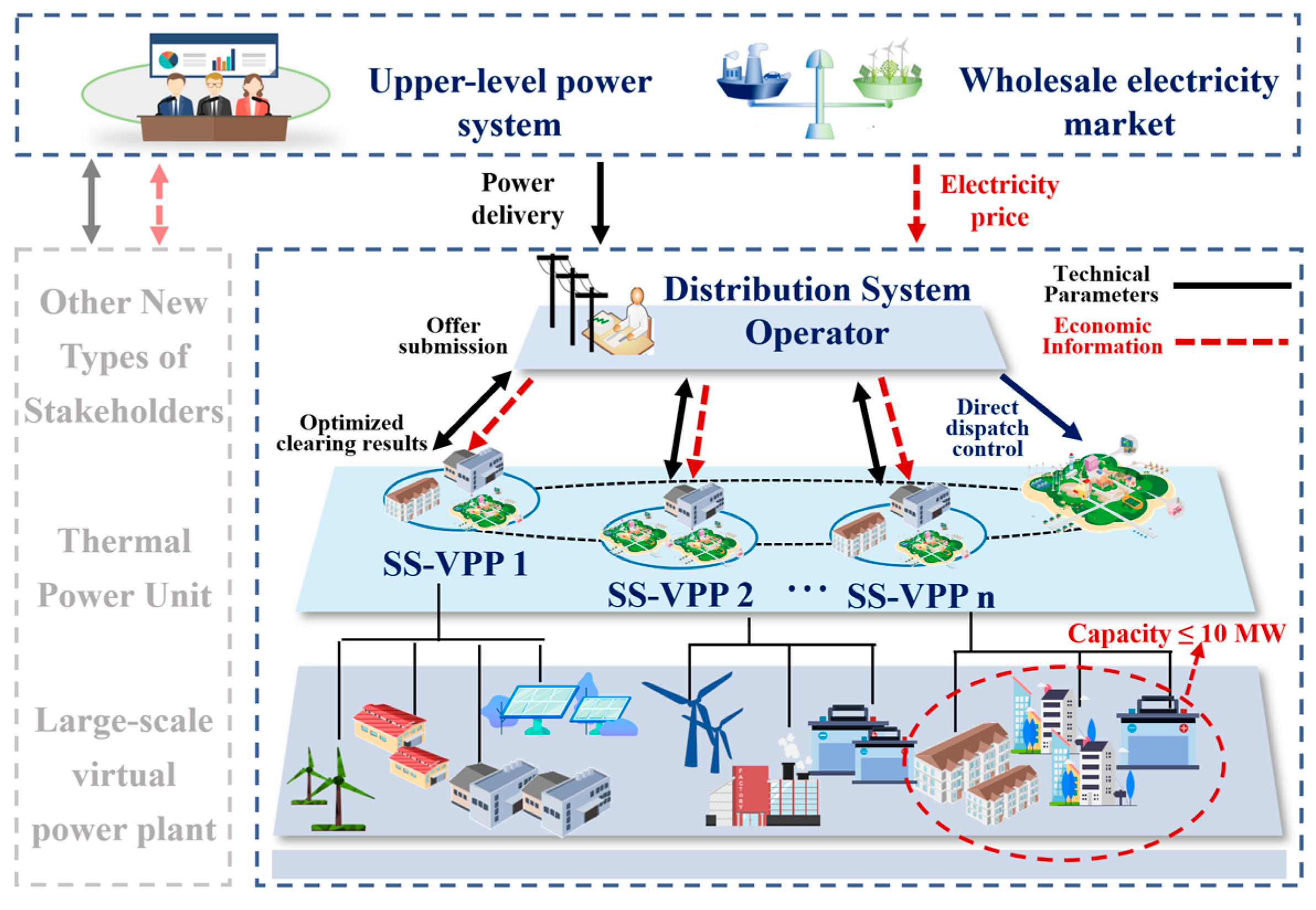
As mentioned earlier, the SS-VPP studied in this paper is an entity centered on distributed energy resource aggregation. It has a capacity of less than 10 MW, a localized operation scope, and relatively concentrated service functions. Due to its inability to meet the access requirements of the wholesale market, it mainly undertakes the task of local power grid balance regulation or meets the energy demands of specific end-users. Therefore, this paper focuses on the distribution-side electricity market and constructs an operational architecture for SS-VPPs to participate in the distribution network day-ahead energy market, as shown in
Figure 1.
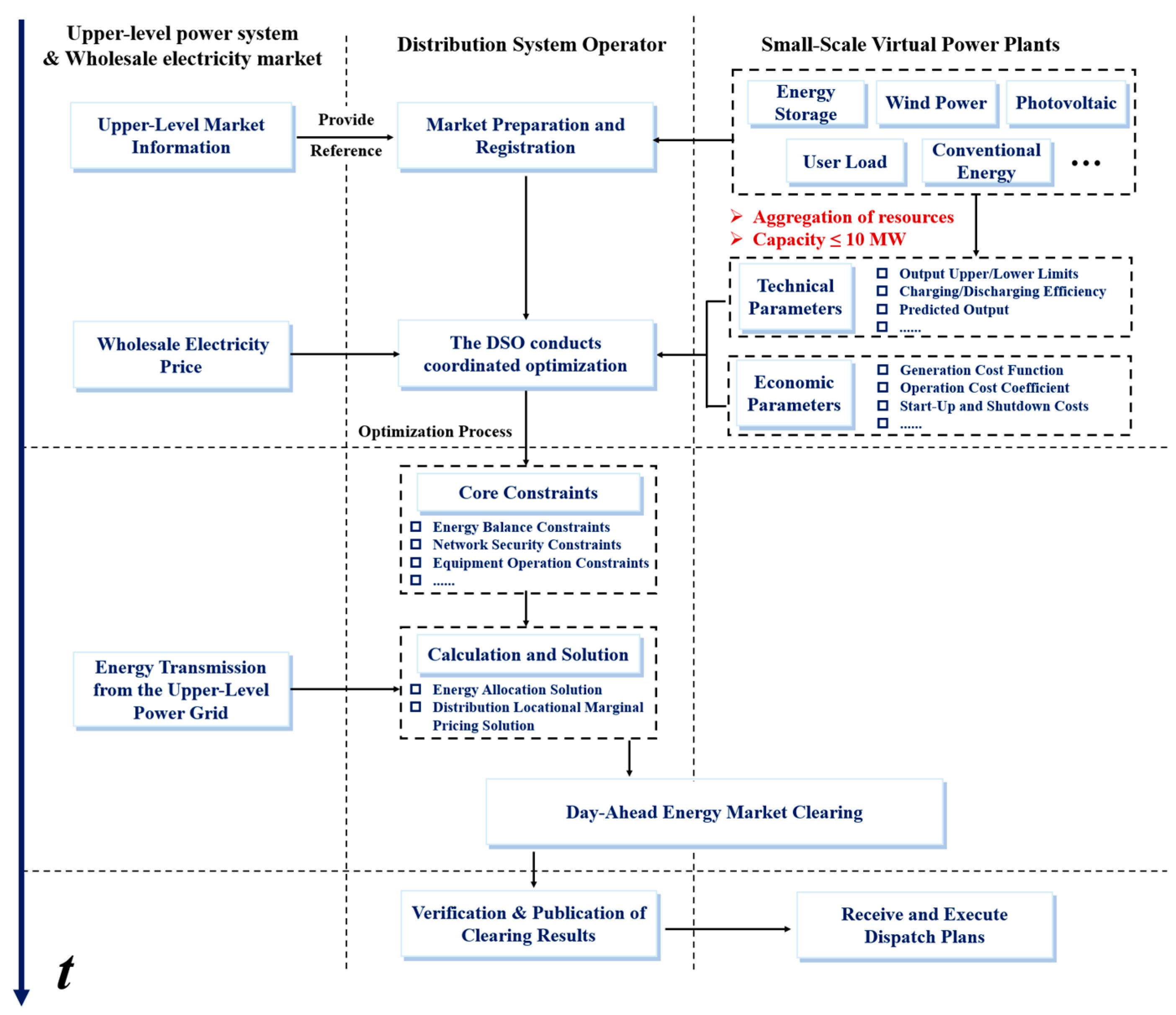
Within its operational boundary, the SS-VPP integrates geographically dispersed small and medium-sized DERs and flexible loads. Specifically, the resources it contains include wind power, photovoltaics (PV), energy storage systems, and flexible loads. During the operation process, the SS-VPP submits its power output declaration, technical parameters, and relevant economic information to the upper-level DSO based on its own operating conditions.
The DSO undertakes dual functions: on the one hand, it is responsible for the real-time operation management and control of the entire distribution network; on the other hand, it operates the distribution-level electricity market in accordance with the established regulatory framework. The DSO collects information from all market participants, comprehensively considers the economic interests of all parties and the operational characteristics of various energy resources, and conducts market operation and clearing work based on the overall load situation of the distribution network. The DSO meets load demands through three main methods: (1) purchasing electricity from the wholesale market of the main grid; (2) purchasing electricity from small-scale SS-VPPs; (3) using power generation resources connected to the Active Distribution Network (ADN) to supply electricity.
After collecting data from all market participants, the DSO minimizes the total operational cost of the distribution network through optimization calculations, while taking into account security constraints and equipment operation limits. Through this optimization process, the optimal power output plans for all market entities are determined. At the same time, the DSO uses duality theory to calculate the Distribution Locational Marginal Prices for each node of the distribution network across 24 time periods, and publishes the clearing prices to all SS-VPPs. This ensures fair benefit distribution among all parties while guaranteeing operational efficiency.
5. Case Studies
5.1. Testing System Description and Parameter Settings
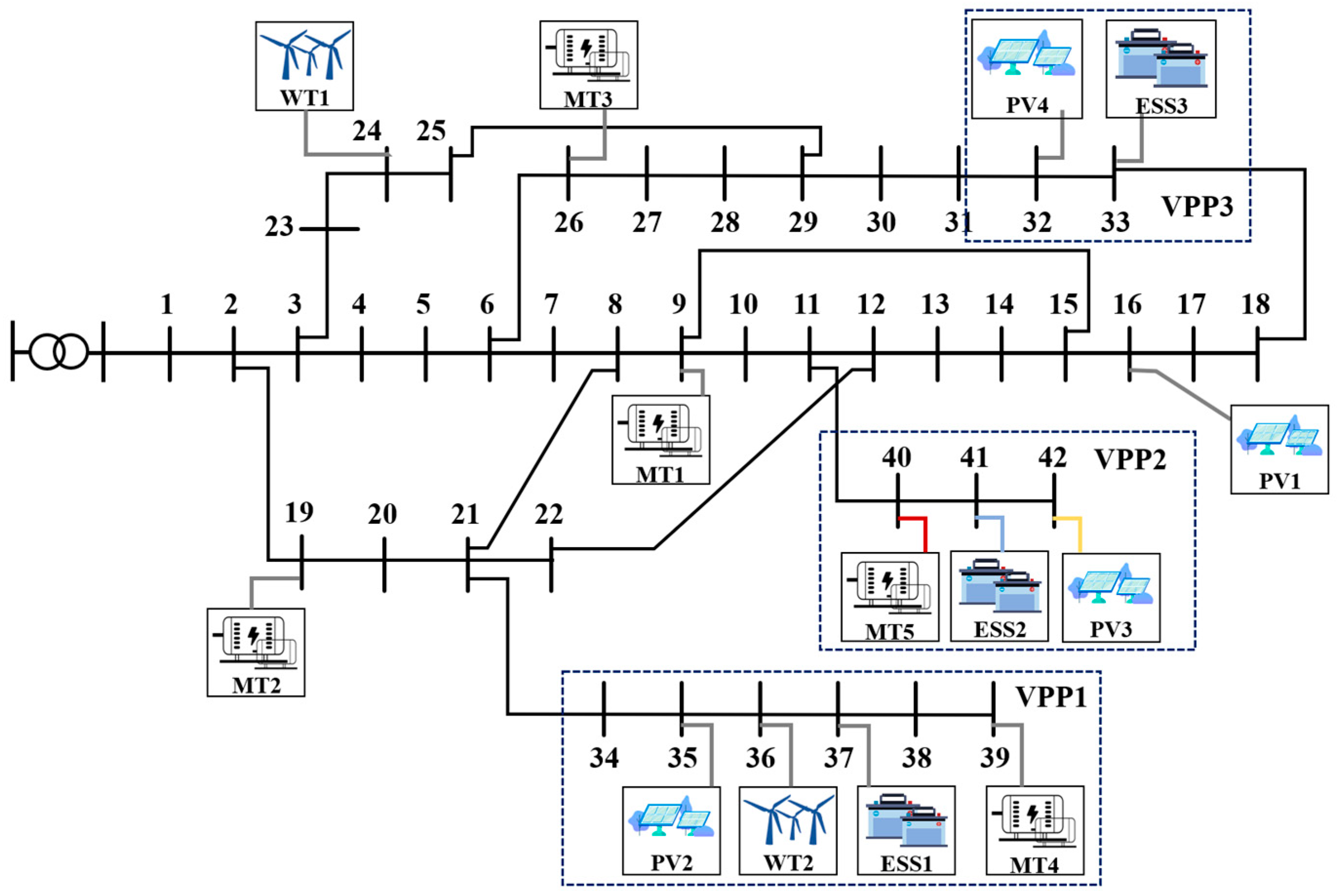
To validate the effectiveness of the proposed method, this study constructs an ADN test model based on a modified IEEE 33-node system, incorporating three SS-VPPs subject to network constraints. The topological structure is shown in
Figure 4 below, with detailed topology and parameter settings provided later. The simulation environment consists of a laptop with an Intel i9-12900H CPU and 16 GB of memory, using MATLAB 2022b as the programming environment and CPLEX as the solver.
The distribution network includes three SS-VPPs located at nodes 34–39, 32–33, and 40–42, respectively. The distribution network operator interacts with the wholesale electricity market of the upper-level power system at Node 1. The ADN comprises MT (microturbines), WT (wind turbines), and PV (photovoltaic) devices, while the SS-VPPs include distributed energy resources and energy storage power stations, as illustrated in
Figure 4.
The base capacity of the test system is 10 MVA. The power generation capacity and operating costs of each device in the system vary. The discharge quotation range for all energy storage devices is [40–45
$/MWh], and the output quotation for new energy devices is in the range of [20–30
$/MWh]. The parameters of the MTs (microturbines) are listed in
Table 1, while the parameters of the energy storage systems are provided in
Table 2.
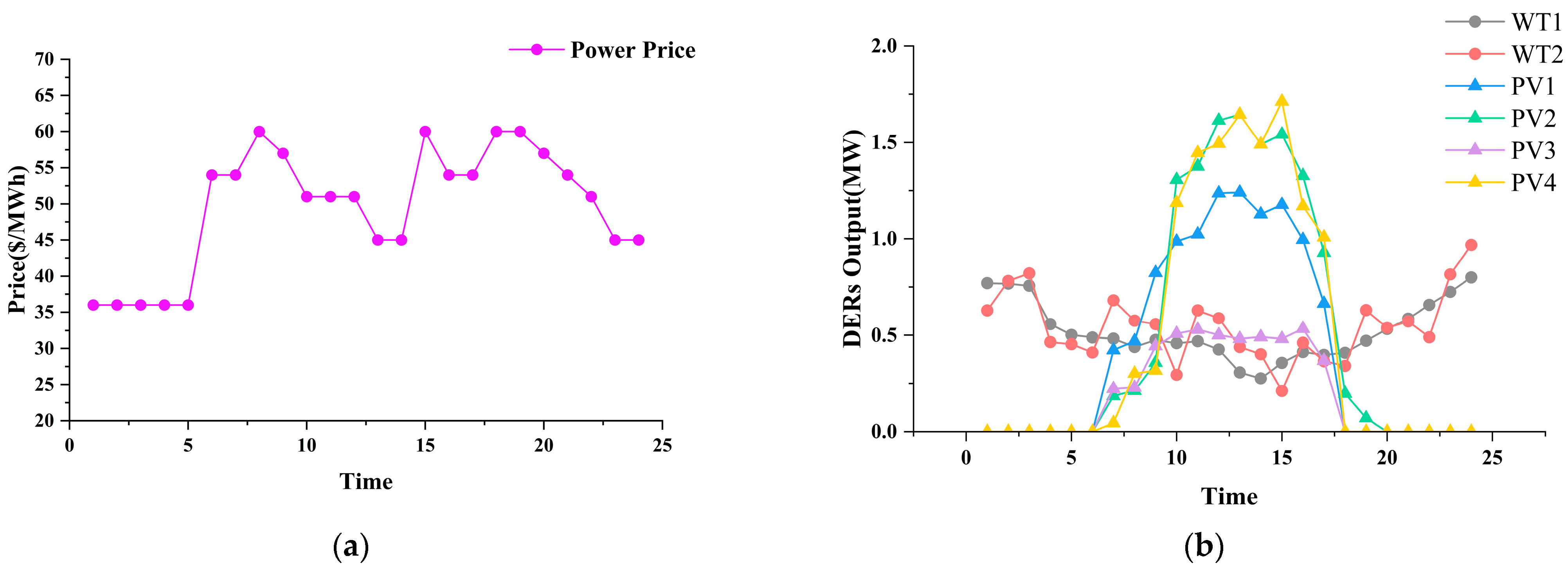
According to the previous settings, the electricity price at which the distribution network operator purchases power from the upper-level grid is determined by the wholesale market and is treated as a given input in the simulations of this study, as shown in
Figure 5 below.
To validate the effectiveness of the proposed day-ahead energy market optimal clearing scheme for the distribution network side, this study establishes four distinct comparative test scenarios. These scenarios represent different operating conditions by combining varying system load profiles with diverse output patterns of renewable energy devices. A comparative analysis of the distribution network’s performance under these conditions is conducted to verify the rationality and feasibility of the proposed scheme. The scenario configurations are as follows:
- (1)
Case 1: All SS-VPPs operate independently with the goal of self-sufficiency and do not participate in the distribution-side electricity market.
- (2)
Case 2: Under the operational framework proposed in this paper, SS-VPP3 fails and does not participate in the optimization and clearing, and the load level of the ADN operation is in a normal state.
- (3)
Case 3: Under the operational framework proposed in this paper, all SS-VPPs participate in operations normally, and the overall operating load of the ADN is relatively small.
- (4)
Case 4: Under the operational framework proposed in this paper, all SS-VPPs participate in operations normally, and the load condition of the ADN is normal.
- (5)
Case 5: Under the operational framework mentioned in the references, where a Virtual Power Operator (VPO) aggregates various SS-VPPs to participate in the upper-level market, all SS-VPPs participate in operations normally, and the distribution network load condition is normal [
19,
20].
To facilitate the comparative analysis of the results, variable control is performed on the parameters of each scenario. Among them, the ADN operating loads of Case 1, Case 2, Case 4 and Case 5 are the same, and the output conditions of the distributed generation in all Cases are the same. Based on the above simulation parameters, case verification is carried out, and the revenue status of each SS-VPP under the four cases is shown in the following table.
In the following text, the above different cases will be analyzed and compared in detail to verify the rationality, universality and feasibility of the architecture.
5.2. Analysis of Operation Modes for SS-VPPs
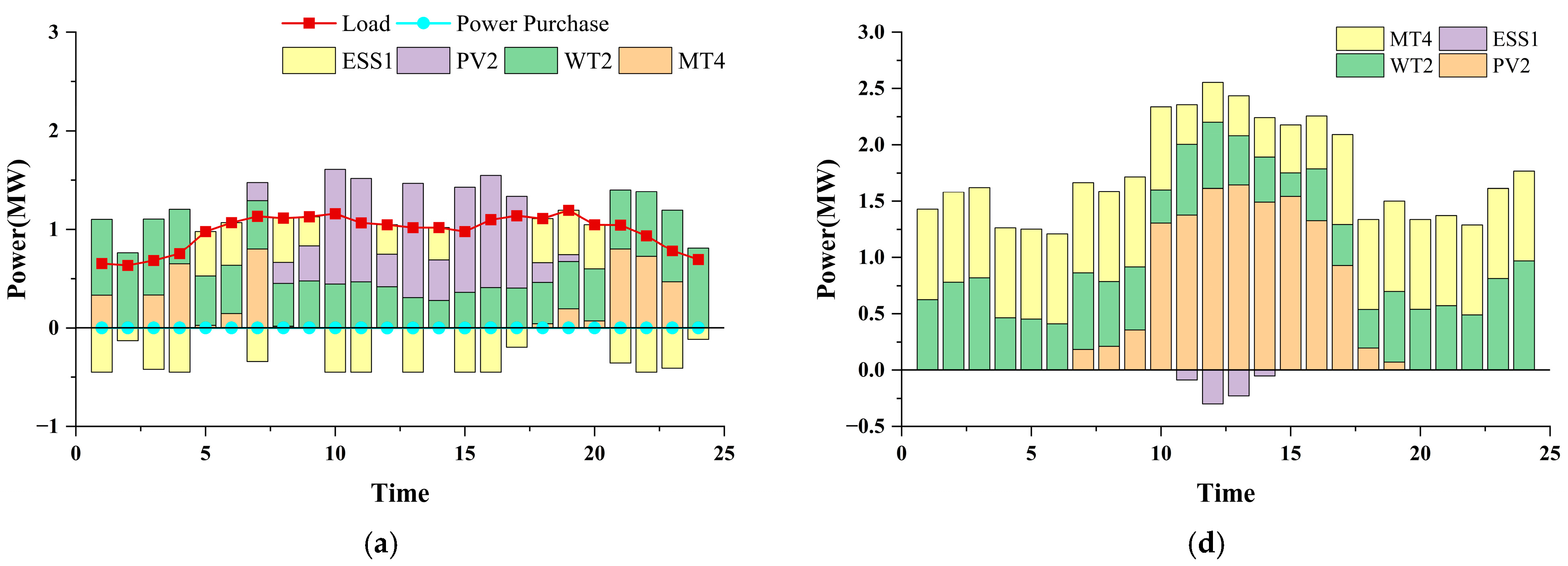
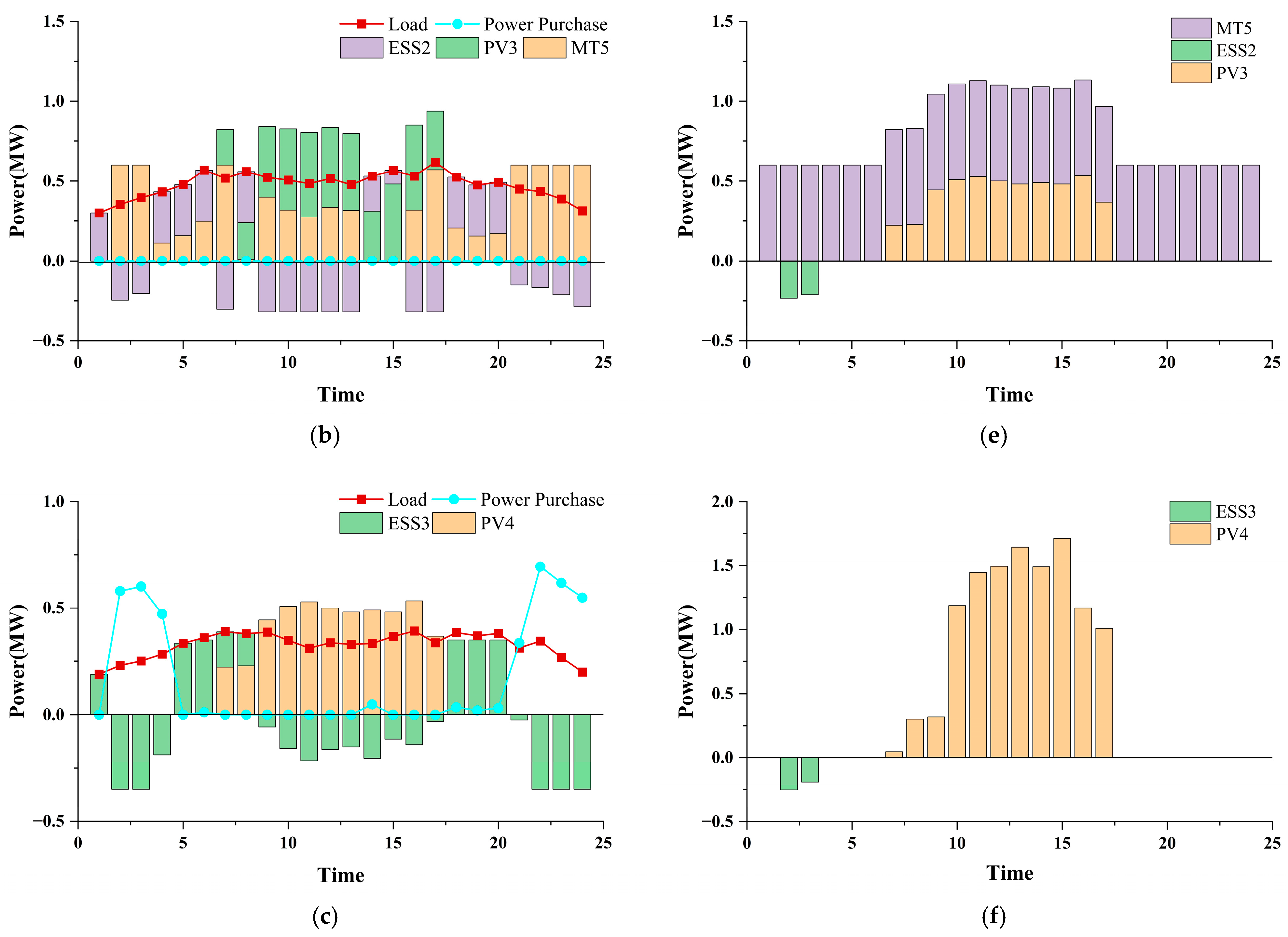
This section will compare the two virtual power plant operation modes under Case 1 and Case 4. In Case 1, each SS-VPP operates independently with the goal of meeting local loads, and the detailed output of each SS-VPP is shown in
Figure 6a–c. The output of each SS-VPP in Case 4 is shown in
Figure 6d–f.
Taking SS-VPP1 as an example, this paper compares and analyzes the output of each device of the SS-VPP under the two operation modes. It can be observed from
Figure 6a that SS-VPP1 contains new energy output devices and micro gas turbines, with large capacity of output devices, which can meet the local load without purchasing electricity from the power grid. New energy is preferred for power supply when its output is sufficient; when new energy output is insufficient, energy storage discharge and micro gas turbine (MT) output are used to make up for the deficit. However, as shown in the 10
th–17th time periods in
Figure 6a, the output of new energy devices is relatively large. Even if energy storage is used to store the excess electricity, the phenomenon of wind and solar curtailment cannot be avoided, which also limits the profit space of the SS-VPP. In Case 4, each SS-VPP participates in the trading and clearing of the entire distribution-side electricity market through the operation mechanism proposed in this paper, and the excess electricity can be transmitted to other nodes for consumption, which increases the overall profit space of the SS-VPP. For example, the profit of SS-VPP1 increases from
$641.90 to
$1258.40. This profit growth of SS-VPP1 mainly comes from solving the curtailment problem in independent operation: the distribution-side trading converts the excess new energy that could not be stored into tradable resources, raising the new energy utilization rate by about 35%. Practically, SS-VPP should prioritize accessing the distribution-side unified market to avoid curtailment losses; DSO can also take SS-VPP1′s Feature as a reference to formulate market access standards for small distributed energy clusters.
5.3. Analysis of the Rationality of the Architecture
This section will compare the overall operational status of different numbers of SS-VPPs participating in the proposed architecture under Case 2 and Case 4, so as to verify the rationality of the proposed architecture. In Cases 2 and 4, the power output profiles of all DERs are illustrated in the figure above, while the parameters of each device remain consistent with the descriptions provided earlier.
- (1)
Energy Optimization Results Analysis
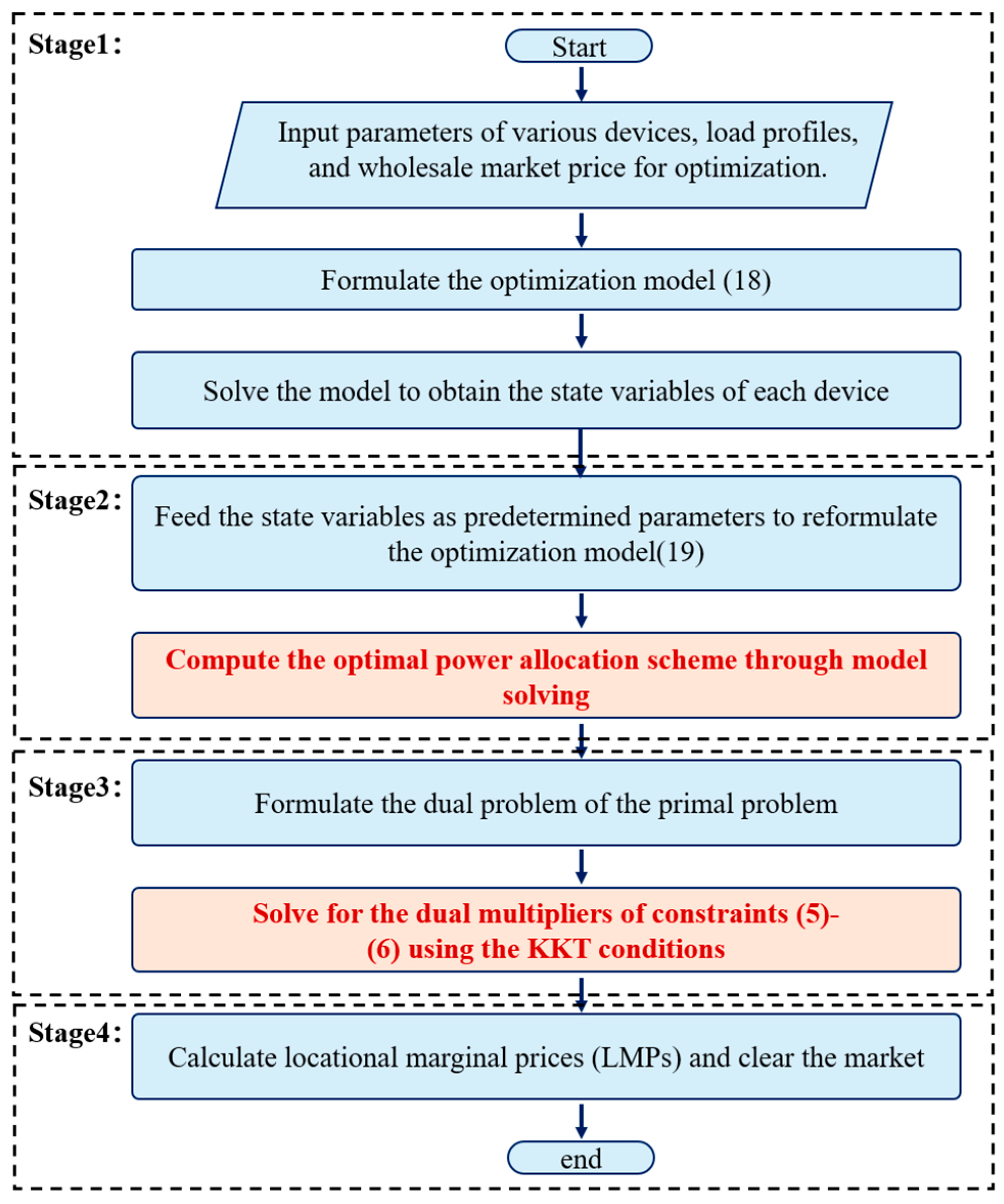
Following the optimization framework outlined in Case 4, the proposed solution process incorporates bidding information and operational parameters from all stakeholders. The computational procedure involves:
First stage: Determining the status variables (on/off states) of MT and ESS units for each stakeholder.
Second stage: Fixing these status variables as deterministic parameters and solving the original problem to obtain the final energy dispatch results, as illustrated in the accompanying figure.
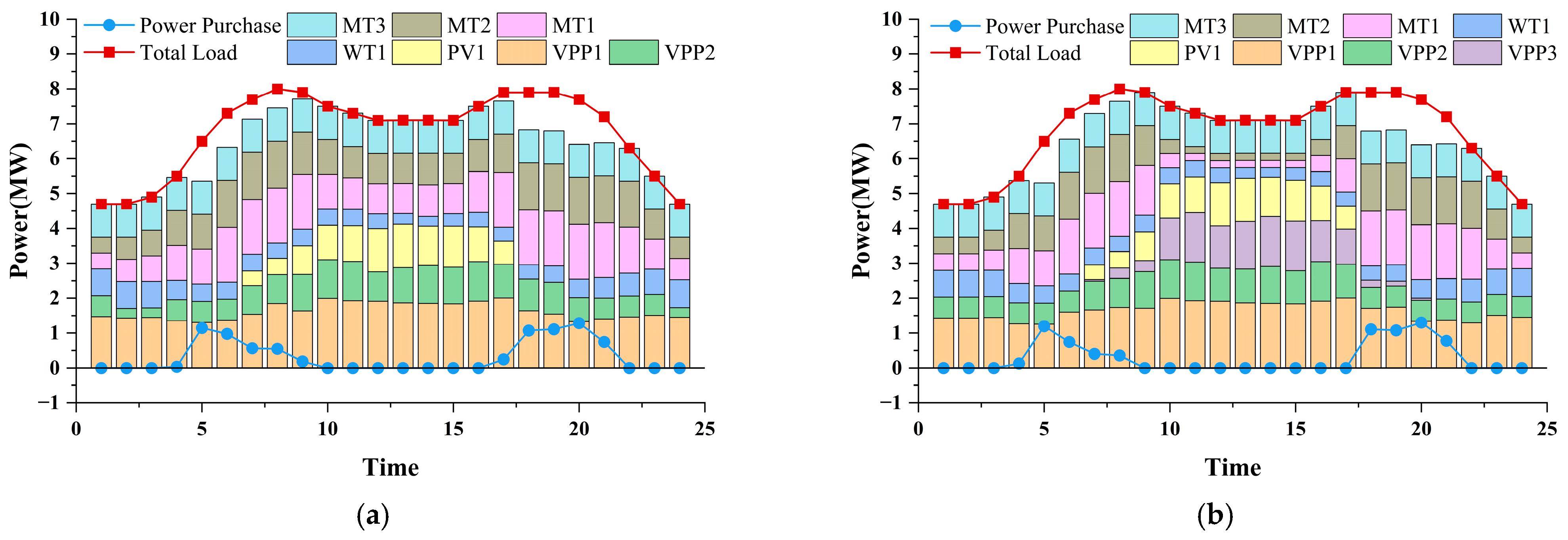
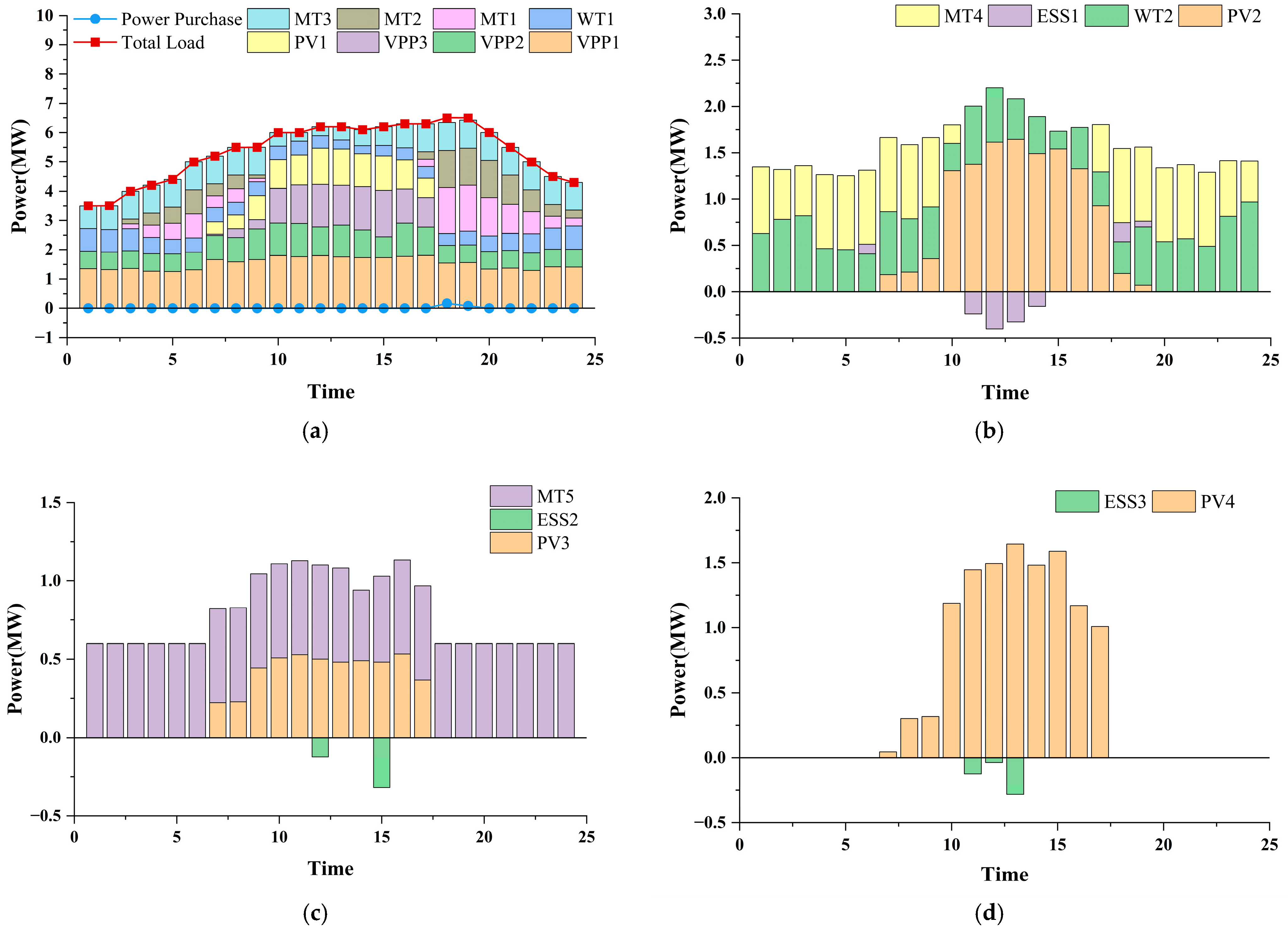
Figure 7a shows the output status of each stakeholder in the ADN with only two SS-VPPs connected in Case 2, and
Figure 7b presents the output situation of each stakeholder in the ADN with all three SS-VPPs connected in Case 4.
Based on the data illustrated in the figure, this study investigates the detailed power output status of various stakeholders in the distribution network across 24 time intervals, analyzing the rationality of the proposed strategy. Using Case 4 as the primary focus of analysis, the figure reveals that in the 1st–3rd time periods, the overall system load is relatively low. The power output from distributed generation (DG), including MT units and SS-VPPs within the distribution network, is sufficient to meet the load demand. Consequently, the DSO does not need to purchase electricity from the main grid during these intervals. In the 4th–8th time periods, the system load gradually increases, and the power output from various devices in the distribution network becomes insufficient to meet the total demand. As a result, the output of these local devices must be increased, and a certain amount of electricity must be purchased from the main grid. In the 9th–17th time periods, the overall system load decreases, while the wholesale electricity price of the main grid remains high. Meanwhile, due to the higher power output from SS-VPPs and PV units within the ADN during this period, the overall generation cost and bidding price are lower than the main grid’s wholesale price. Therefore, the DSO minimizes electricity purchases from the main grid and instead relies more on local device dispatch and power procurement from SS-VPPs to meet the system load. Compared to Case 4, in Case 2, the absence of SS-VPP3 integration forces the DSO to increase the output of MT units and the power purchases from SS-VPP1 and SS-VPP2. However, constrained by the output capacity of SS-VPPs and the power transmission limits of the distribution network, the output of SS-VPP1 and SS-VPP2 does not change significantly. Thus, in Case 2, the primary adjustment involves increasing the output of MT1, MT2, and MT3 units. Consequently, due to the lack of SS-VPP3—which has a lower generation cost—the distribution network in Case 2 requires more MT units for power generation, exacerbating network congestion and indirectly raising the overall generation cost, which in turn increases the electricity price of SS-VPPs. Additionally, the absence of SS-VPP3 reduces competition among SS-VPPs, leading to higher overall profits for SS-VPP1 and SS-VPP2 in Case 2 under similar output conditions, as demonstrated in
Table 3. In the 18th–24th time periods, the system load peaks again. At this time, the output from distributed renewable energy devices in the ADN and SS-VPPs is relatively low. Therefore, the DSO must maximize the dispatch of all available generation units while also purchasing electricity from the main grid to meet the load demand. The analysis of each stakeholder’s output exhibits a similar pattern as discussed earlier and thus will not be reiterated here.
- (2)
Analysis of DLMP and Revenue Situations
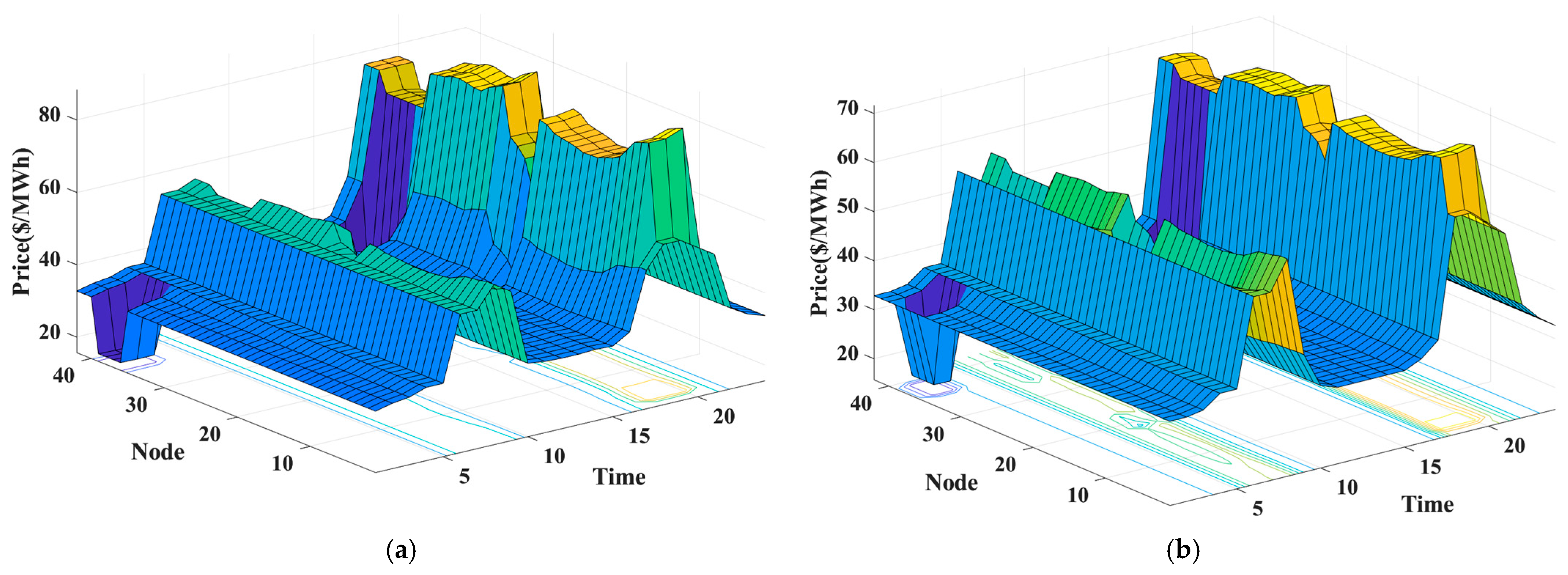
Compare the DLMP of the entire ADN under the Case 2 and Case 4 scenarios. Following the optimization framework established in
Section 4, the nodal electricity prices were calculated based on the energy optimization results of all market participants, while accounting for both system power balance constraints and transmission congestion costs. The time-varying electricity prices at each system node are presented in
Figure 8 below.
Based on the information shown in the figure, it can be observed that:
a. From a temporal perspective, the nodal electricity prices exhibit consistent trends across all nodes, showing a positive correlation with load demand—prices increase during peak load periods (intervals 8–9 and 19–21) and decrease during off-peak hours. This pricing pattern reflects fundamental cost drivers: during high-demand periods, the DSO must dispatch additional generation resources, including potentially costly power purchases from the main grid, leading to higher marginal production costs that translate into elevated electricity prices. This time-of-use pricing mechanism creates important economic incentives: higher prices during peak hours simultaneously encourage demand reduction among end-users while stimulating increased generation from prosumers with distributed energy resources; conversely, lower off-peak prices promote electricity consumption while discouraging excessive generation, thereby effectively balancing supply and demand across the distribution network through market-driven price signals.
b. From a spatial perspective, the DLMP exhibits a significant decrease around nodes 34–39 across all time intervals. This pricing phenomenon can be attributed to several structural and operational factors: (1) The presence of SS-VPP1 at these nodes incorporates renewable generation units (PV2 and WT2) along with MT4 at node 39, which operates at relatively lower generation costs; (2) Although located at the network periphery where power delivery might typically incur higher congestion costs, the area actually experiences minimal congestion expenses due to its generation surplus and relatively light local load—the power flow is predominantly in the direction of exporting energy to other nodes rather than importing. Consequently, these combined factors result in consistently lower nodal prices in this region. Conversely, nodes 23–25 demonstrate elevated DLMP due to their limited local generation capacity and reliance on intermittent WT1 output with higher operating costs. During peak periods, these nodes primarily depend on power imports from both the main grid and other network sections, creating substantial power flows through adjacent lines that generate significant congestion costs, ultimately reflected in higher nodal prices.
c. As can be seen from the comparison between the two cases, under low-load conditions, the nodal price trends of the two cases are relatively similar, and the DLMP of Case 2 is generally higher than that of Case 4. As mentioned earlier, DLMP at this time mainly depends on the real-time power generation cost and network congestion. When the load is low, there is no or slight network congestion, so DLMP mainly depends on the power generation cost. As mentioned earlier, both Case 2 and Case 4 choose to purchase electricity from the main grid under low-load conditions, so their DLMP is also close to the wholesale electricity price of the main grid. Under high-load conditions, however, the DLMP of Case 2 is generally higher than that of Case 4. This is because Case 2 lacks SS-VPP3, which leads to higher overall power generation costs during peak hours and makes power transmission more prone to congestion, thereby pushing up DLMP. In Case 4, the access of SS-VPP3 with lower power generation costs and larger energy storage capacity alleviates the operational pressure of the ADN to a certain extent, resulting in a lower overall DLMP.
Based on the above analysis, the DSO can conduct reasonable benefit distribution among various stakeholders under the optimization strategy proposed in this paper. Meanwhile, the number of stakeholders and their power generation bids will also affect the operational status of the entire ADN. Each stakeholder needs to optimally allocate energy and adjust their own operation strategies according to the operational environment. In summary, the strategy proposed in this paper exhibits certain rationality. This DLMP analysis further confirms the value of the proposed strategy: Case 4′s lower peak DLMP cuts ADN operational costs, while nodes 34–39′s low prices prove that SS-VPPs with low-cost MT reduce local electricity costs. Practically, DSOs can guide SS-VPP deployment to high-DLMP nodes to ease congestion; SS-VPP operators can adjust generation based on temporal price trends to maximize profits.
5.4. Analysis of the Universality of the Strategy
To verify the universality of the proposed strategy, this paper takes the distribution network load as a variable and compares the overall operational status of the distribution network under different working conditions, so as to verify its effectiveness and applicability under different working conditions. Therefore, this section conducts a comparative analysis of the simulation results in Case 3 and Case 4.
- (1)
Analysis of Energy Optimization Results
The optimized operation status of each SS-VPP and the entire distribution network in Case 3 is shown in
Figure 9 below.
As shown in
Figure 9a, compared with Case 4, the overall load of the distribution network under the operating condition of Case 3 is lower. Except for the 18th and 19th time periods, it hardly needs to purchase electricity from the upstream grid to meet the local load in all other time periods. During the whole-day operation, due to the small overall load, the operating costs and power output quotations of WT1, SS-VPP1, and SS-VPP2 remain low, so they are consistently dispatched by the DSO for power generation. In contrast, MT1 and MT2 have higher operating costs, so the DSO minimizes their dispatch time during operation.
Specifically, In the 1st–2nd time periods, low distribution network load means only the lowest-cost MT3 is dispatched (MT1 and MT2 are shut down). In the 3rd–9th time periods, rising load and main grid electricity prices make dispatching MT1/MT2 cheaper than purchasing from the main grid, so MT1 and MT2 are put into operation. In the 10th-17th time periods, SS-VPP3 and PV1 with low costs provide a large amount of electricity, so the DSO shuts down MT1 and MT2 during this period. Meanwhile, during this period, the power output is relatively sufficient and the output cost is low, so all three SS-VPPs choose to charge their energy storage systems to meet the SOC requirements of the energy storage devices. In particular, SS-VPP1 conducts additional charging on the premise of meeting the SOC requirements of the energy storage devices, so as to discharge and sell electricity when the electricity price is higher for arbitrage and to gain greater profits. In the 18th–24th time periods, the overall operating load of the distribution network reaches its peak.
However, since the electricity purchase price from the upstream grid is also high at this moment, the DSO tries not to purchase electricity from the upstream grid and instead gives priority to dispatching MT1 and MT2 to meet the load. In the 18th and 19th time periods, the cost of further increasing the power output of MT devices and SS-VPPs exceeds the cost of purchasing electricity from the main grid, so electricity is purchased from the main grid to meet the load during these two time periods.
Figure 9b–d illustrates the operation of each SS-VPP under the operating condition of Case 3. Since the analysis is similar to that presented earlier, it will not be repeated here.
- (2)
Analysis of DLMP and Revenue Situations
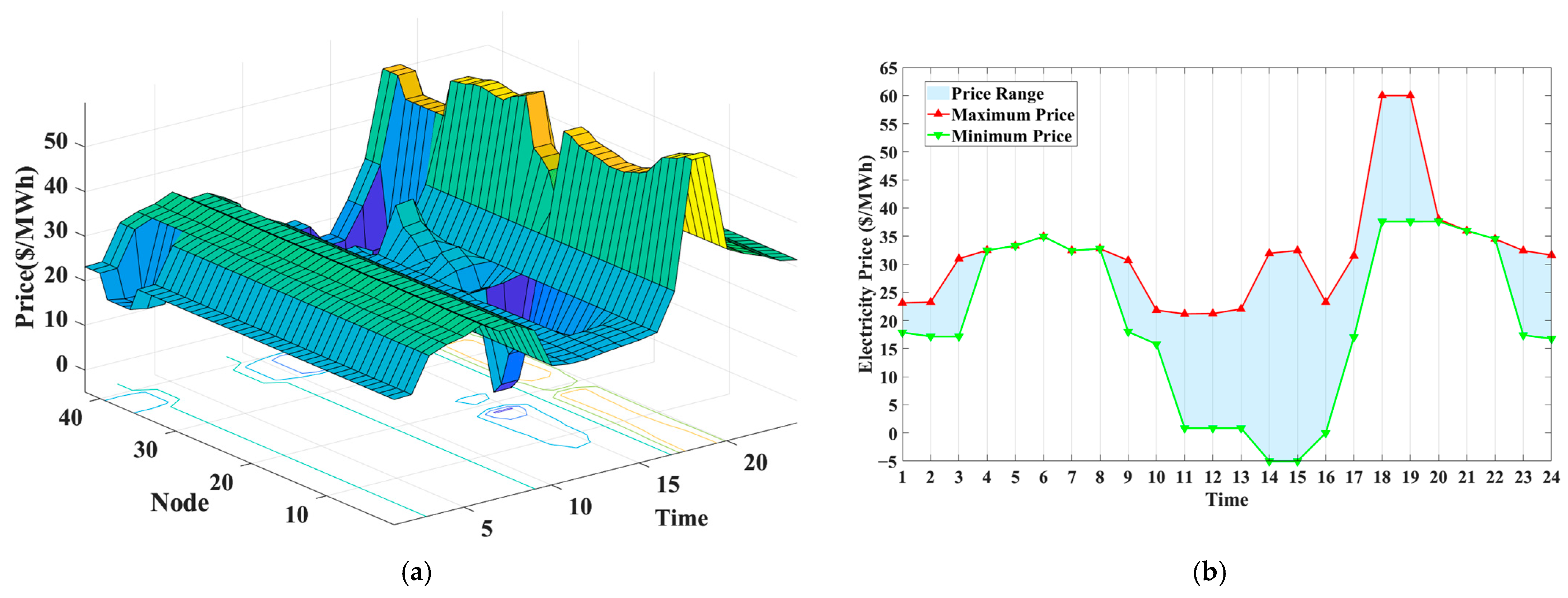
As shown in
Figure 10a, the locational marginal prices of the distribution network under the scenario of Case 3 are presented. In comparison with Case 4, the overall electricity price fluctuation of Case 3 is smaller, and the overall electricity price is lower than that of Case 4. From a spatial perspective, due to the relatively dispersed locations of various SS-VPPs and the small overall operating load of the distribution network, there is almost no congestion in the distribution network throughout the day’s operation. Therefore, the electricity prices at most nodes are relatively low and are determined by the overall power generation cost. From a temporal perspective, the electricity price trend is complementary to the overall output status of new energy in the system.
During the 1st–8th time periods and the 20th–24th time periods, the load and equipment output reach a balance, and there is no obvious congestion in the power grid. At this time, the locational marginal price reflects the production cost per unit of electrical energy, so it is mainly determined by the production cost of electrical energy.
Figure 10b reflects the fluctuation of locational marginal prices of DLMP on the temporal scale. During the 9th–19th time periods, the fluctuation of DLMP is relatively large, and the electricity prices at various nodes also vary significantly at the same time. This is because new energy devices are connected at different locations, and the distribution network as a whole shows a situation of oversupply during this period, resulting in certain congestion during power transmission. Nodes closer to new energy devices have lower electricity prices, thus leading to significant fluctuations in electricity prices during this period. Specifically, during the 14th–15th time periods, the output of photovoltaic devices increases significantly. At this time, there is an oversupply of electricity, and it cannot be transmitted outward due to the constraints of power transmission capacity. Therefore, to avoid power curtailment, DLMP drops to a negative value, and local loads are incentivized to consume electricity through subsidies.
In summary, this section compares and analyzes the operation of the distribution network using the proposed strategy under two different working conditions (Case 3 and Case 4). The analysis shows that the proposed strategy can effectively cope with different working conditions of the distribution network. It can realize a reasonable description of electricity production, transmission, and consumption in the distribution network, complete the rights and interest distribution of various stakeholders, and has certain universality. This Case 3–Case 4 comparison further confirms the proposed strategy’s universality: it adapts to both low-load and high-load scenarios, with DLMP adjustments avoiding curtailment. Practically, DSOs can use this strategy to dynamically dispatch resources based on load changes; SS-VPP can charge storage during low-price periods for peak-price arbitrage to boost profits.
5.5. Comparison of Different Operational Architectures
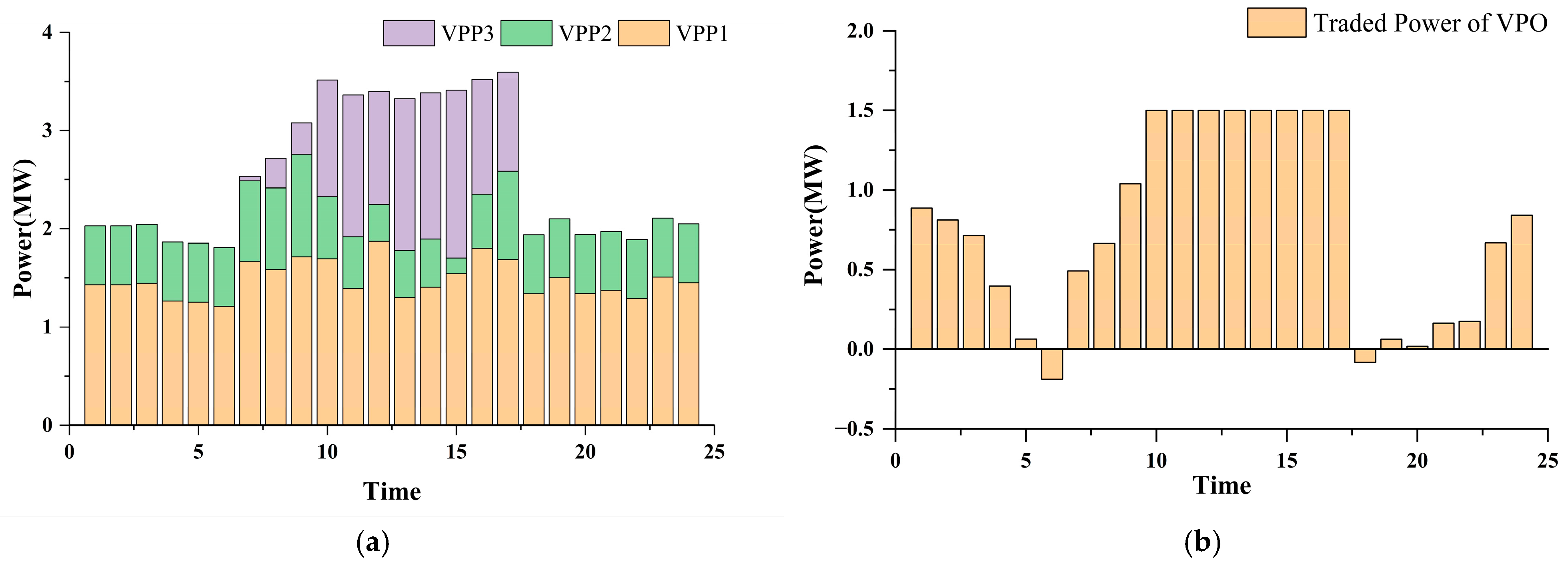
This section conducts a comparative analysis between the SS-VPP operation architecture proposed in this paper and the “multi-level agent-based operator architecture” adopted in existing literature. In Case 5, the resource allocation and scale of the three SS-VPPs are consistent with those in Case 4. The core difference lies in the introduction of a VPO in Case 5: this VPO aggregates and manages the three underlying SS-VPPs in a unified manner, and participates in upper-level power trading. Under this operation architecture, the results of the day-ahead optimal scheduling are shown in
Figure 11. And the revenue of each SS-VPP is presented in
Table 3, which is
$479.89 and
$388.33, respectively. By comparing with Case 5, it can be seen that the total revenue of SS-VPPs in Case 4 has increased by 17.26%.
Among them,
Figure 11a shows the power output of each SS-VPP in Case 5, and
Figure 11b presents the electricity trading volume of the VPO at each time interval under this architecture. From the perspective of the architecture’s essence, in the multi-level agent architecture of Case 5, although the VPO undertakes the responsibility of communication and connection with each SS-VPP, it deducts a share of revenue during the power trading process. This profit loss in the intermediate link is precisely the core reason for the direct reduction in SS-VPP revenue. More importantly, the architecture proposed in this paper is designed to conduct dynamic scheduling based on the actual status of the power grid (such as network congestion), while the optimal scheduling in Case 5 only focuses on the static optimal allocation of energy and completely ignores potential issues in the actual power grid. Therefore, unlike the architecture proposed in this paper, this architecture cannot implement dynamic pricing based on the real-time power output of SS-VPPs and the power flow status of the grid. As a result, it is naturally difficult to achieve reasonable and accurate revenue distribution, which further widens the gap in revenue levels between this architecture and the one proposed in this paper.
In summary, whether compared with the architecture represented by Case 5 or the “independent operation” mode commonly used in the actual operation of SS-VPPs, the architecture proposed in this paper can more effectively improve the operational revenue of SS-VPPs. Moreover, it can achieve more equitable revenue distribution through dynamic pricing and coordinated resource scheduling, thus possessing certain advantages and practical value.
5.6. Analysis of Uncertain Scenarios
To further verify the applicability of the proposed model in practical operation scenarios, this section conducts a stability analysis of the model under uncertain scenarios based on the existing IEEE 33-bus system parameters, with the revenue of SS-VPPs in Case 4 as the benchmark. The analysis focuses on the random uncertainty caused by the output fluctuations of wind power and photovoltaic systems, taking the revenue of each SS-VPP as the core evaluation index, and verifies the model stability through multi-scenario experiments.
- (1)
Scenario Design and Experimental Scheme
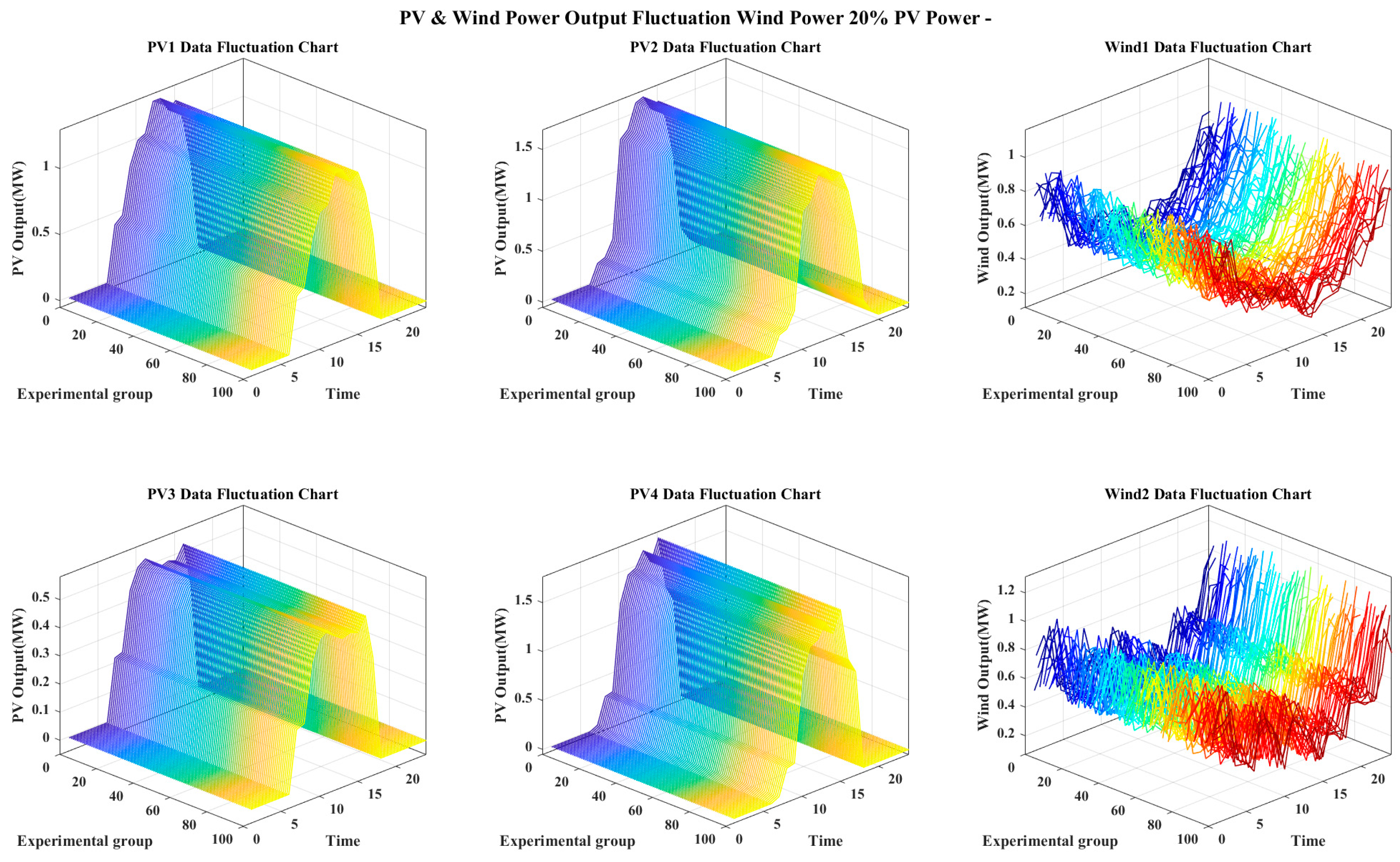
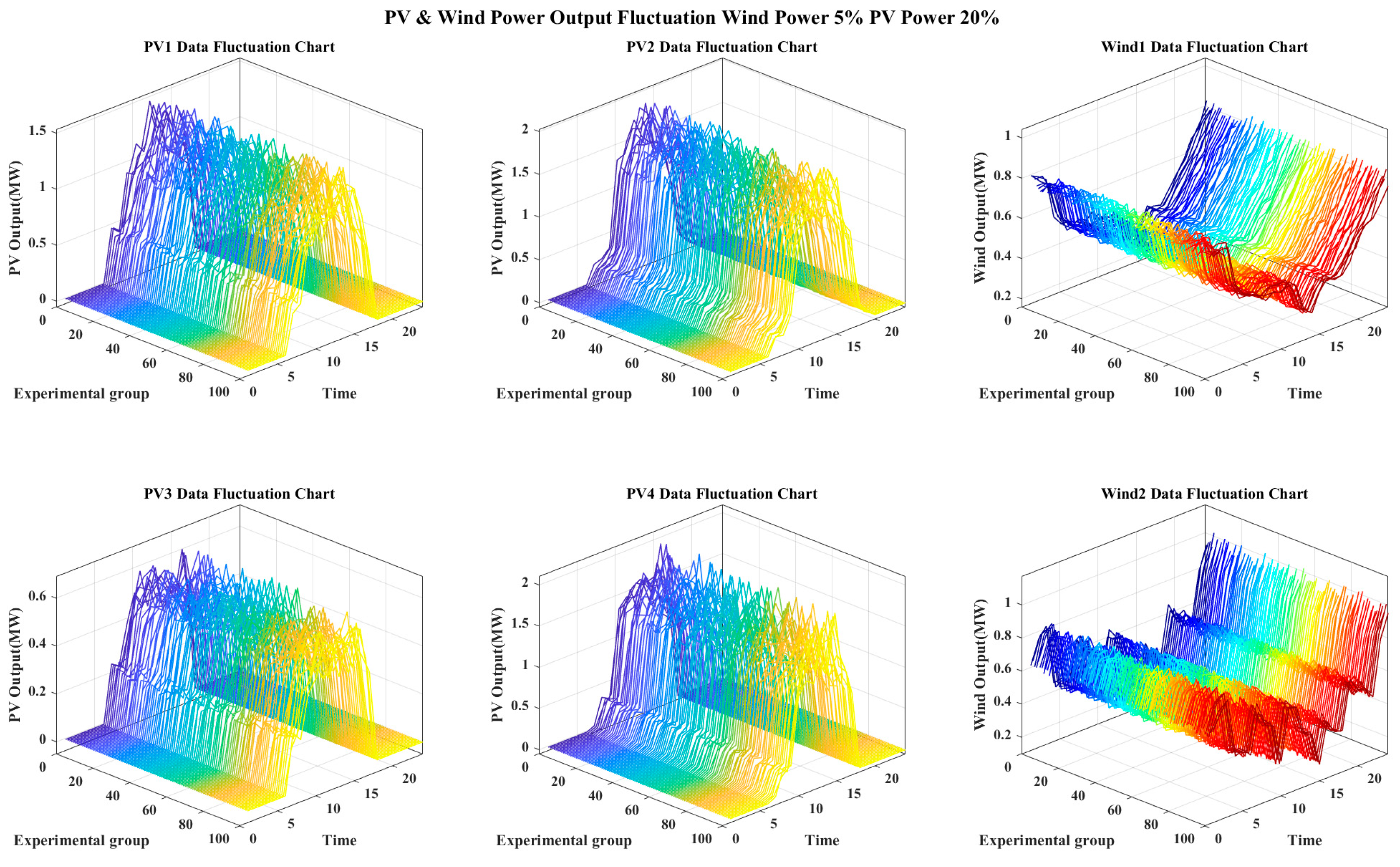
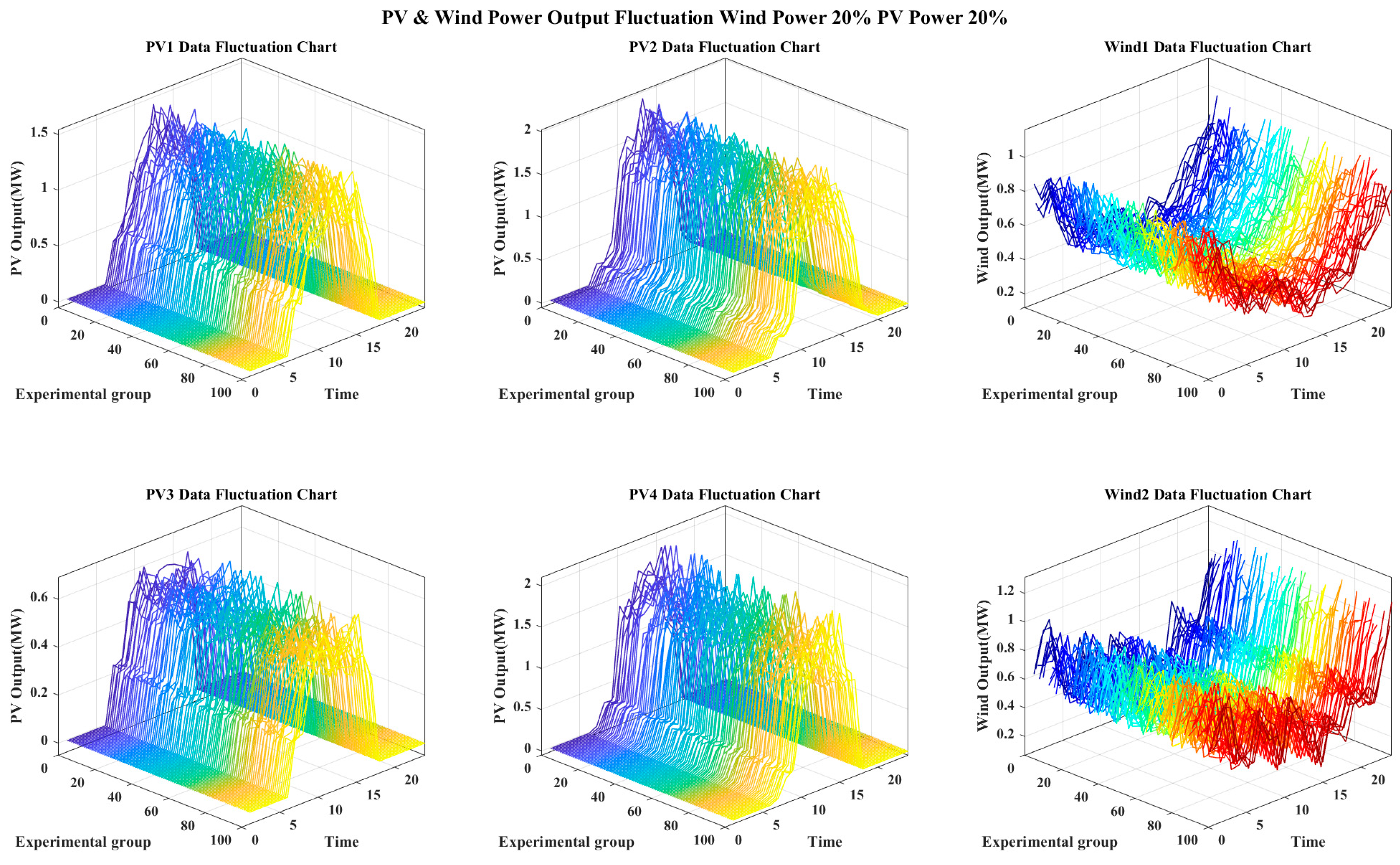
A total of 9 uncertain scenarios are set in this section. The scenario design takes “wind power output fluctuation range” and “PV output fluctuation range” as dual variables, and each variable covers three fluctuation levels: low, medium, and high (wind power: 0/±5%/±20%; PV: 0/±5%/±20%). For each scenario, 100 repeated experiments are carried out, and the revenue fluctuation range of each SS-VPP is finally statistically analyzed to eliminate the random interference of a single experiment.
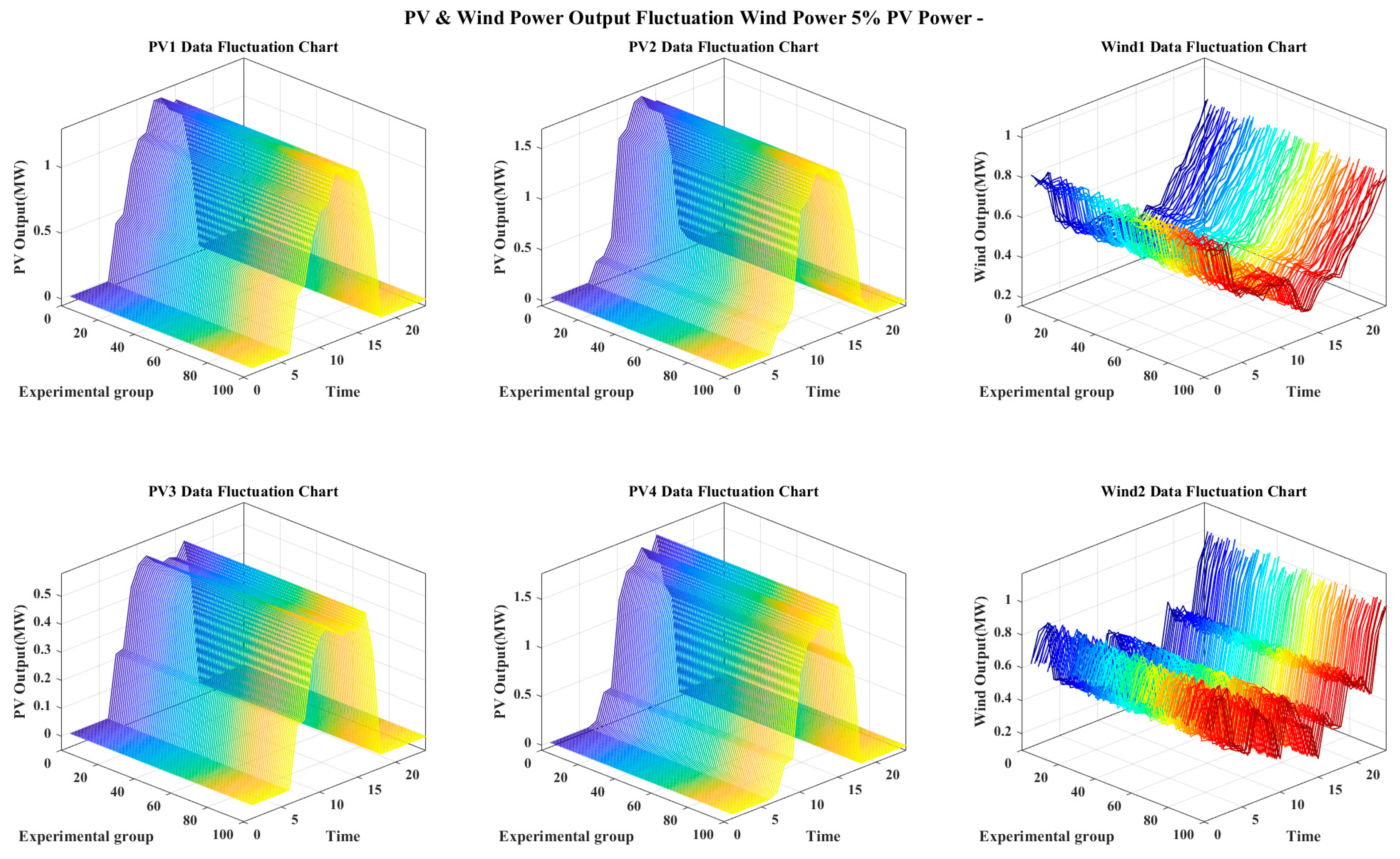
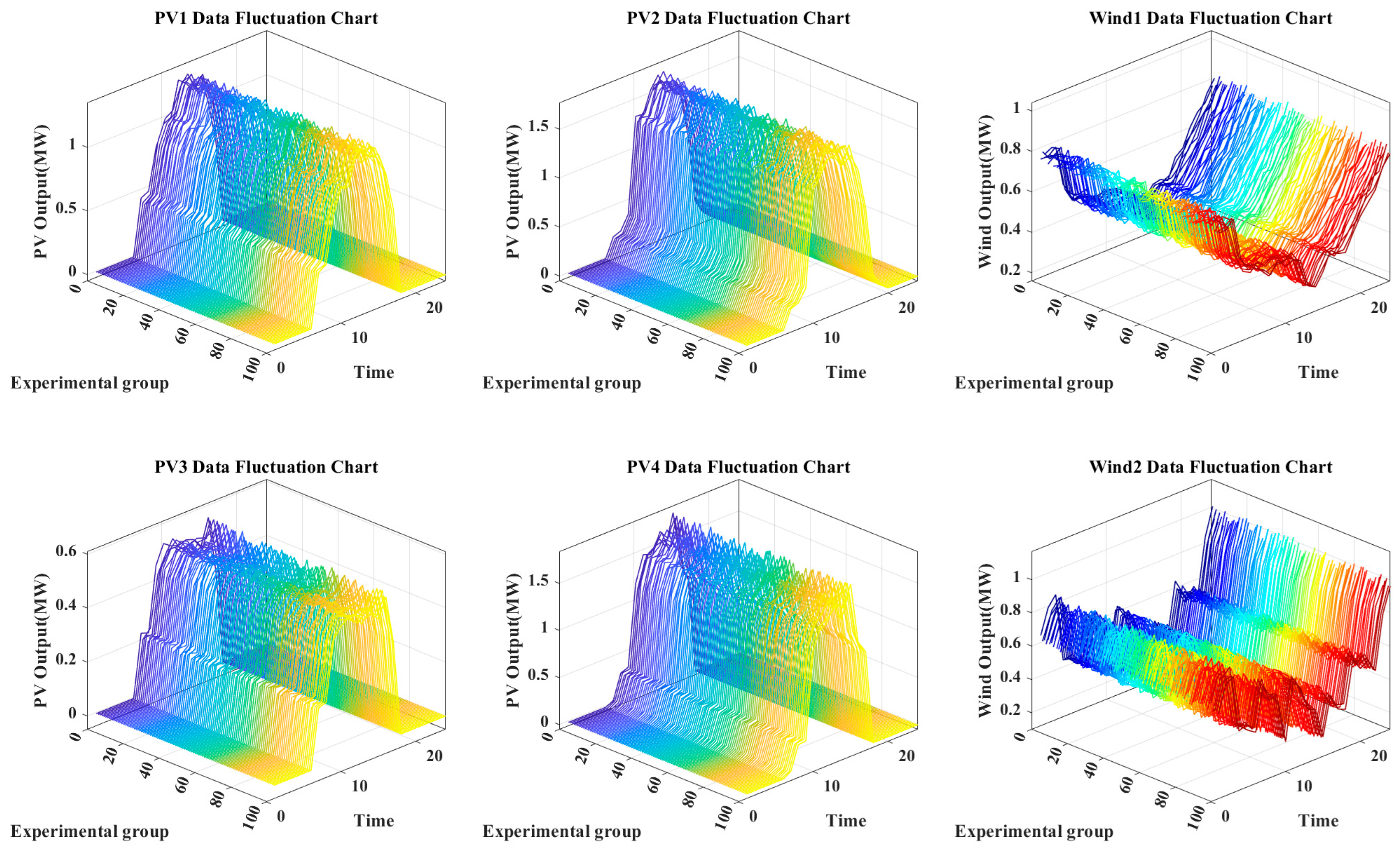
Taking the scenario of “wind power output fluctuation ±5% and PV output fluctuation ±5%” as an example, the actual output curves of wind power and PV in this scenario are shown in
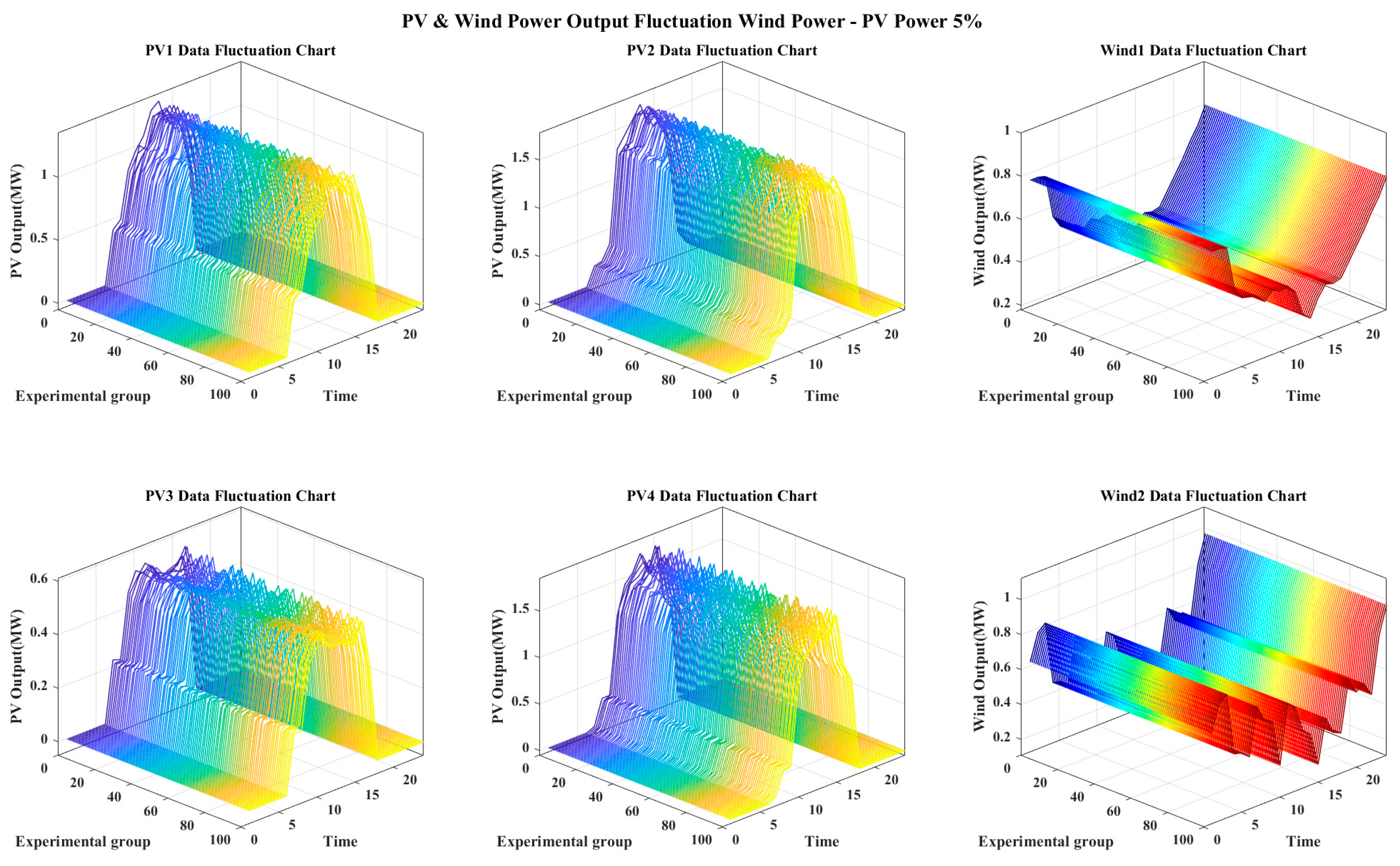
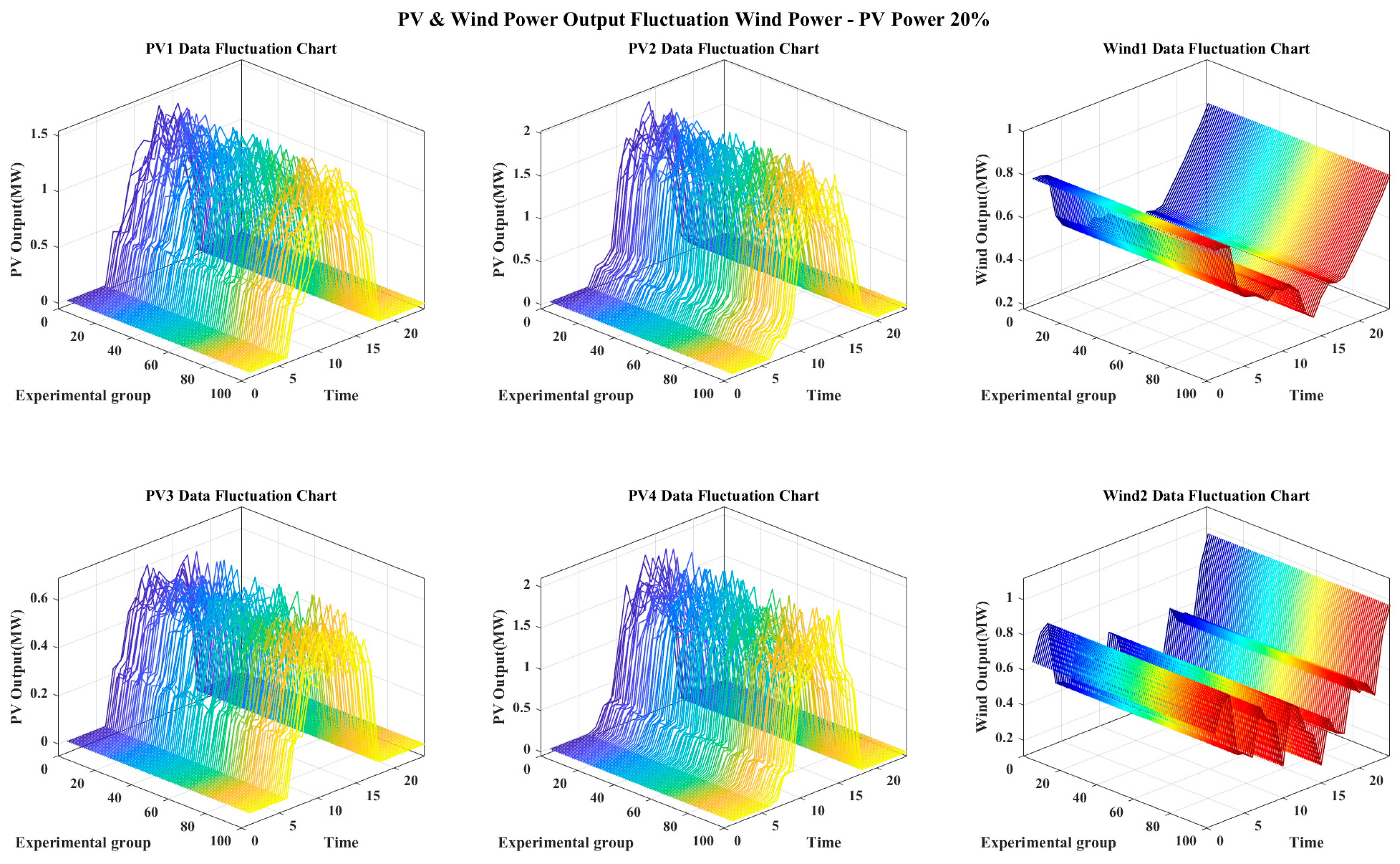
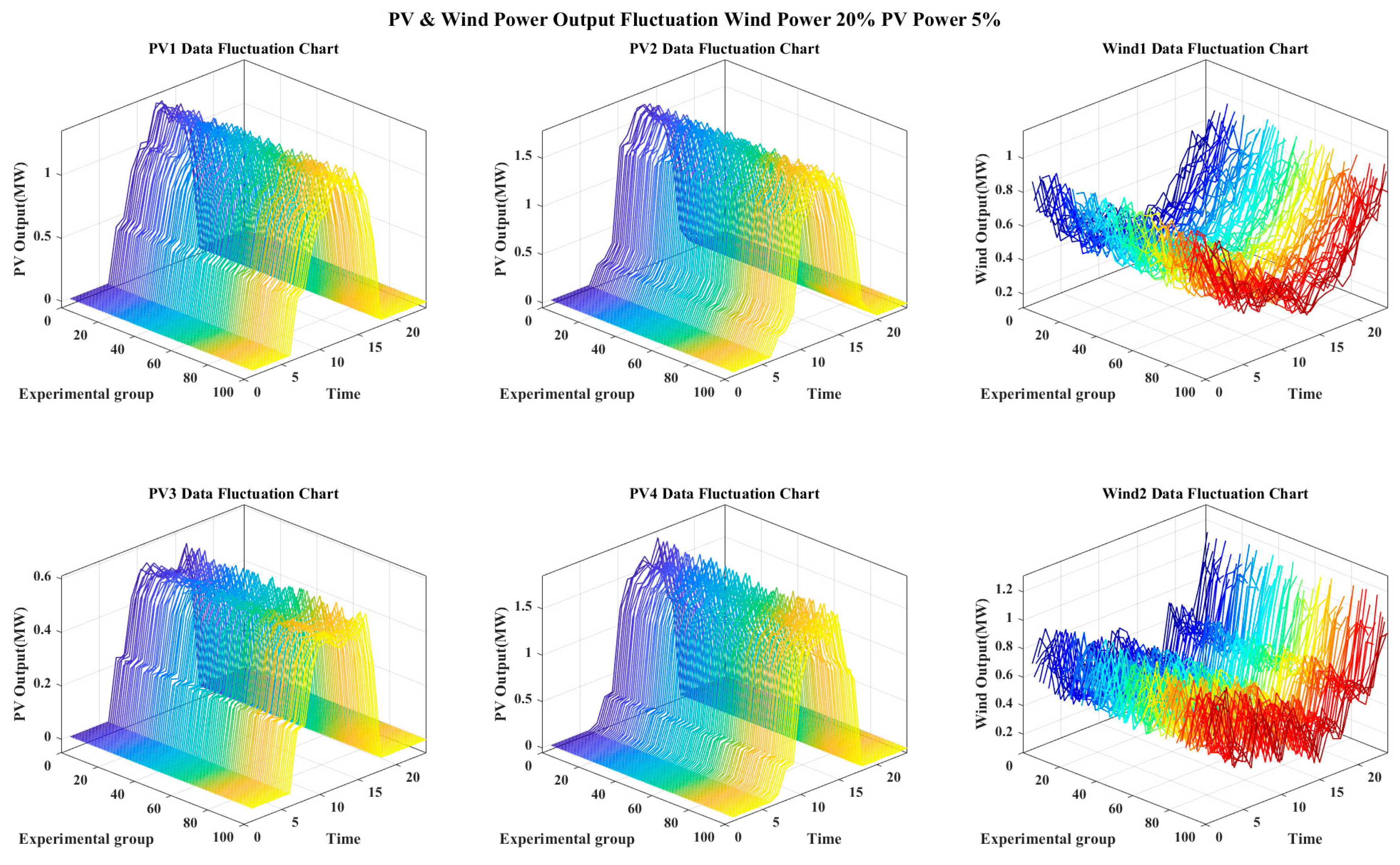
Figure 12. The output diagrams of wind and photovoltaic power under other uncertain scenarios are provided in
Appendix A.
- (2)
Experimental Results and Analysis
The statistical results of the experiments based on the aforementioned scenarios are presented in
Table 4 below.
Based on the data, the following analytical conclusions can be drawn. In the low-range fluctuation scenarios, the revenue of each SS-VPP shows almost no fluctuation. On one hand, the fluctuation range of wind and PV output is relatively small, resulting in limited direct impact on the overall revenue; on the other hand, all SS-VPPs have integrated ESS, which can offset the fluctuations of wind and PV output through real-time charging and discharging regulation, thereby maintaining revenue stability. In the medium-range fluctuation scenarios, the revenue fluctuations of various SS-VPPs present differentiated characteristics. Among them, SS-VPP3 is most significantly affected by PV output fluctuations because its core resource is only a PV4 with a single resource type and weak regulation capability. In contrast, SS-VPP1 and SS-VPP2 have integrated MT and large-capacity ESS, leading to higher regulatory flexibility. Even under medium-range fluctuation conditions, the revenue fluctuation ranges of SS-VPP1 and SS-VPP2 can still be controlled within −4.31%~4.59% and −2.86%~3.65%, respectively. In the high-range fluctuation scenarios, the overall revenue fluctuation range of each SS-VPP expands slightly. However, under the operation framework proposed in this study, the DSO achieves reasonable revenue allocation through the DLMP, while each SS-VPP optimizes the scheduling of internal resources. Ultimately, the revenue fluctuation range of all SS-VPPs is controlled within −4.29%~4.65%.
In summary, verification through 9 scenarios and 100 repeated experiments shows that even in scenarios with high fluctuations of wind and PV output, the proposed model can still maintain revenue stability through the collaborative mechanism of “DSO pricing regulation + SS-VPP resource scheduling”. This verifies the robustness of the model in terms of SS-VPP revenue.




 ,
,