Assessment of Mold-Specific Volatile Organic Compounds and Molds Using Sorbent Tubes and a CDC/NIOSH-Developed Tool in Homes Affected by Hurricane Ian
 , ,
, ,
Featured Application
Abstract
1. Introduction
2. Materials and Methods
2.1. Study Design and Setting
2.2. Selection of Homes
2.3. Air Sampling and VOC Analysis
2.4. Mold Assessment
2.5. Surface Microbial Activity Assessment
2.6. Environmental Measurements
2.7. Data Analysis
3. Results and Discussions
3.1. Visible Mold Growth and Signs of Dampness on the Surfaces as Determined by the CDC/NIOSH DMAT
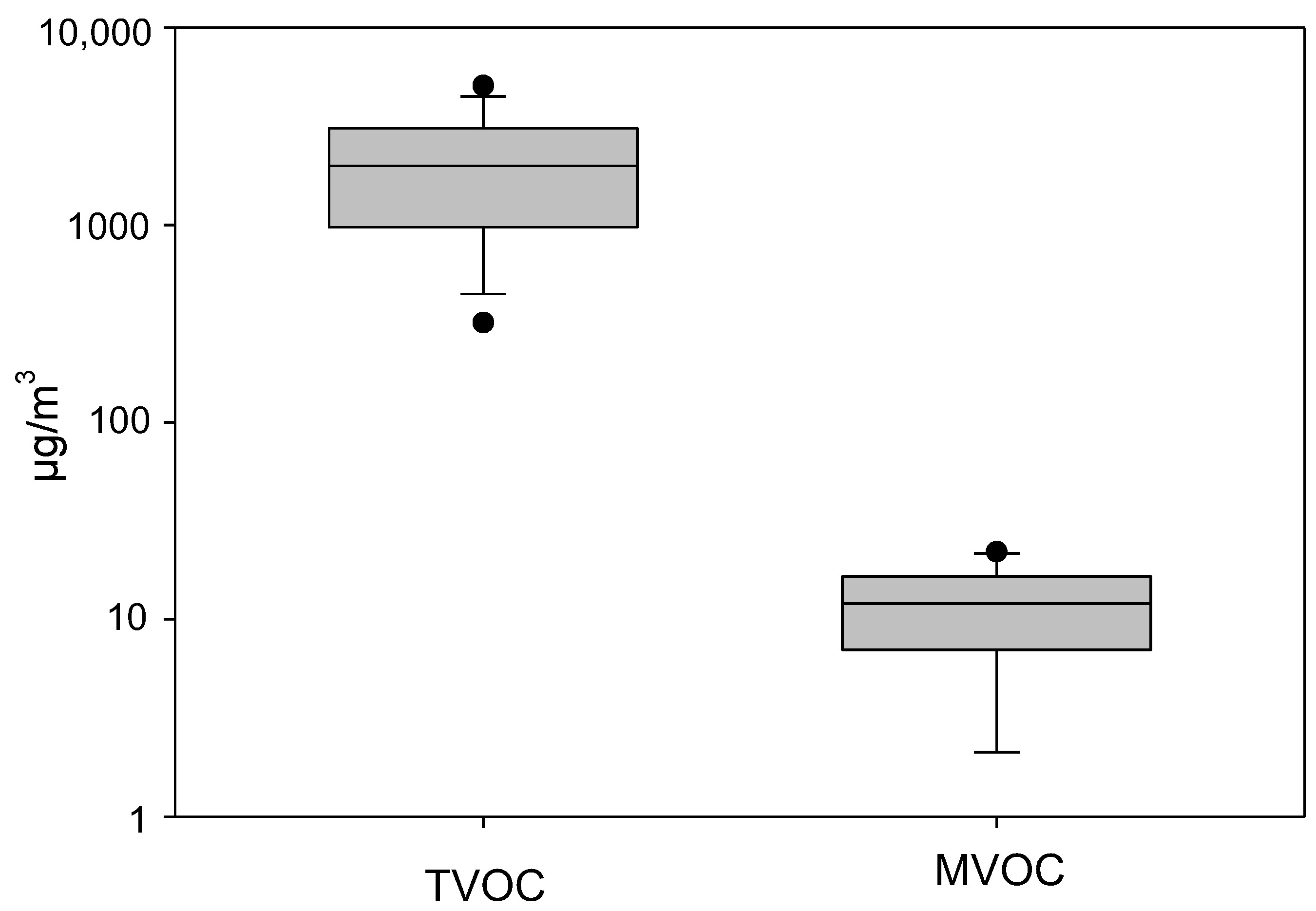
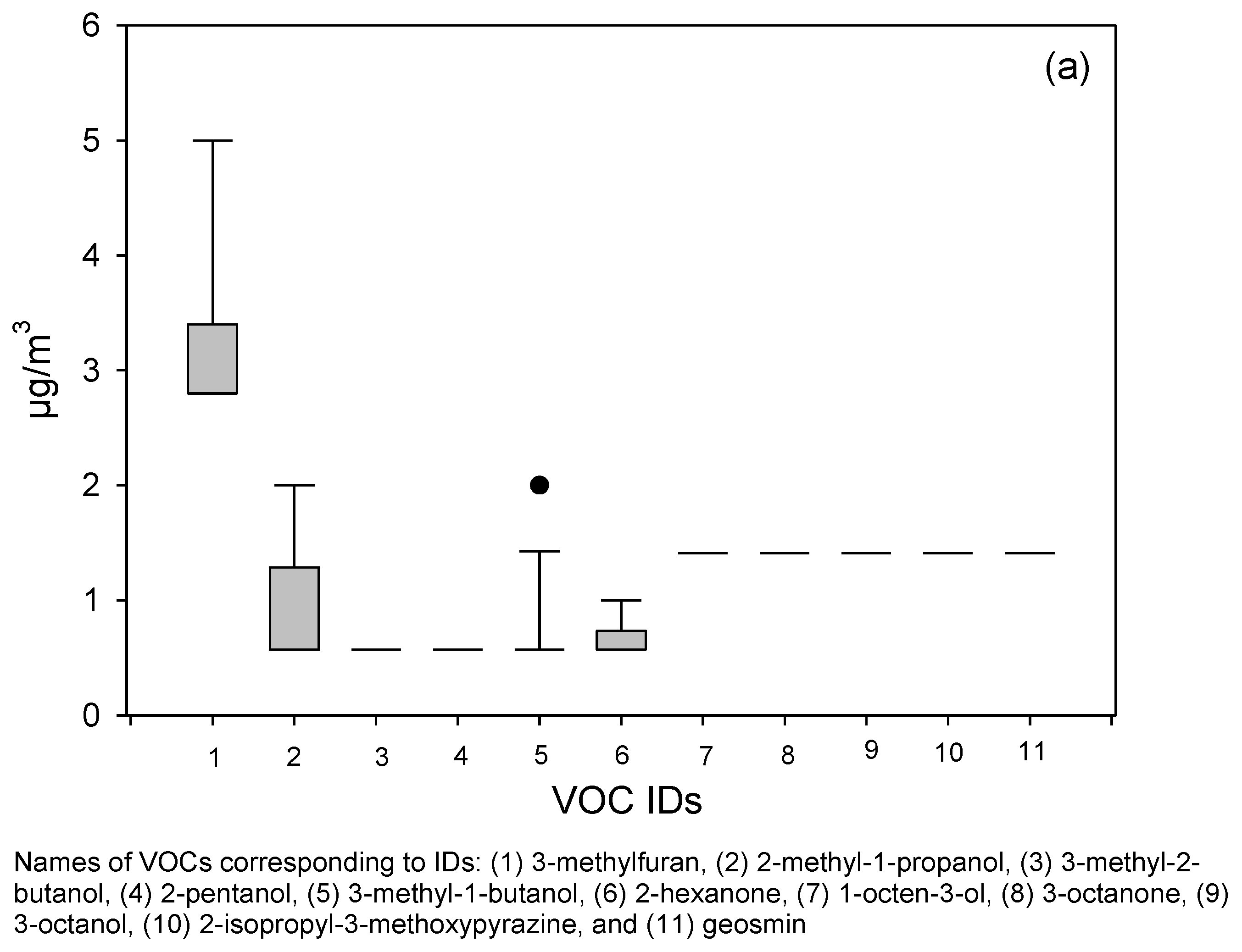
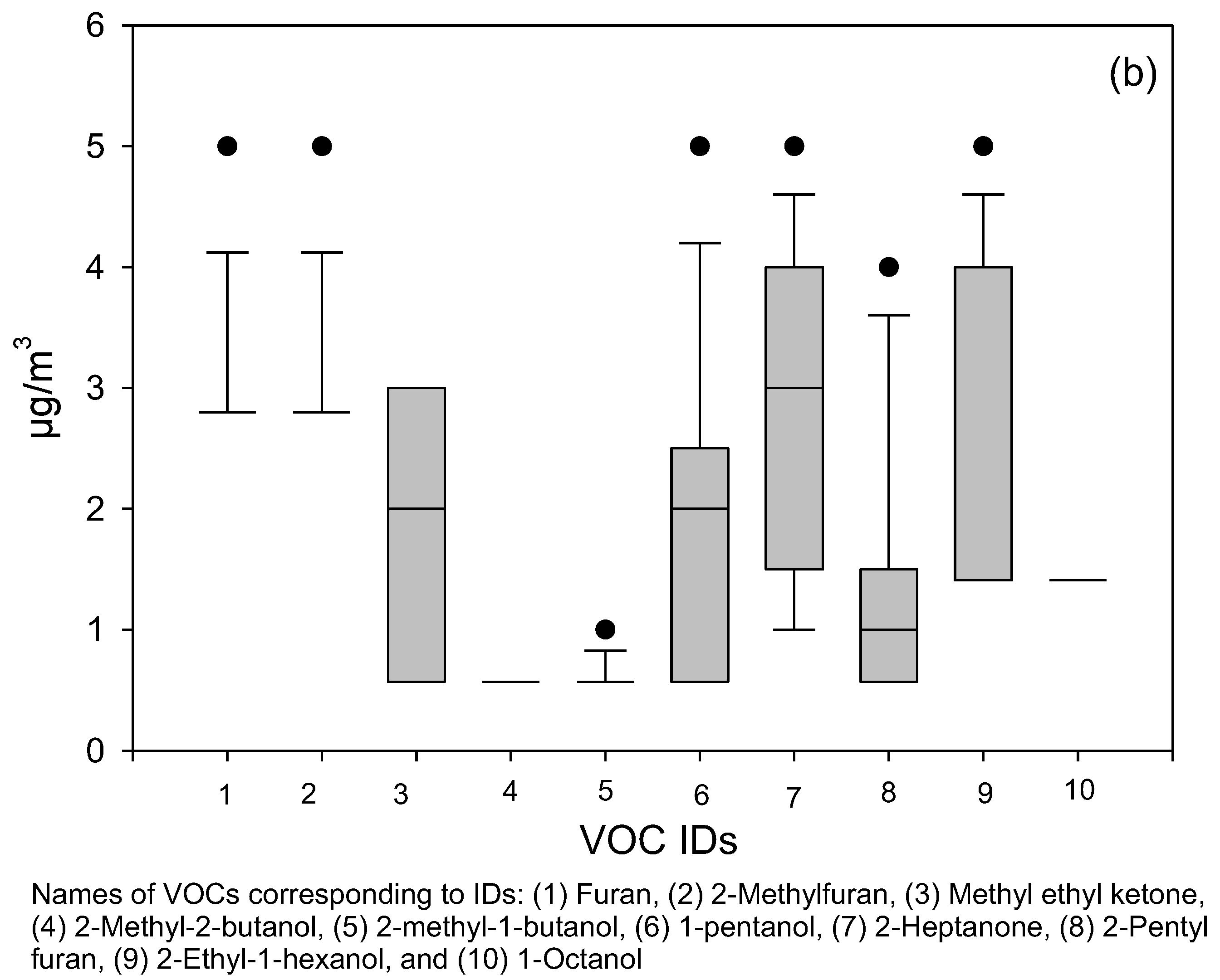
3.2. Levels of TMVOCs and TVOCs in Flood-Affected Homes
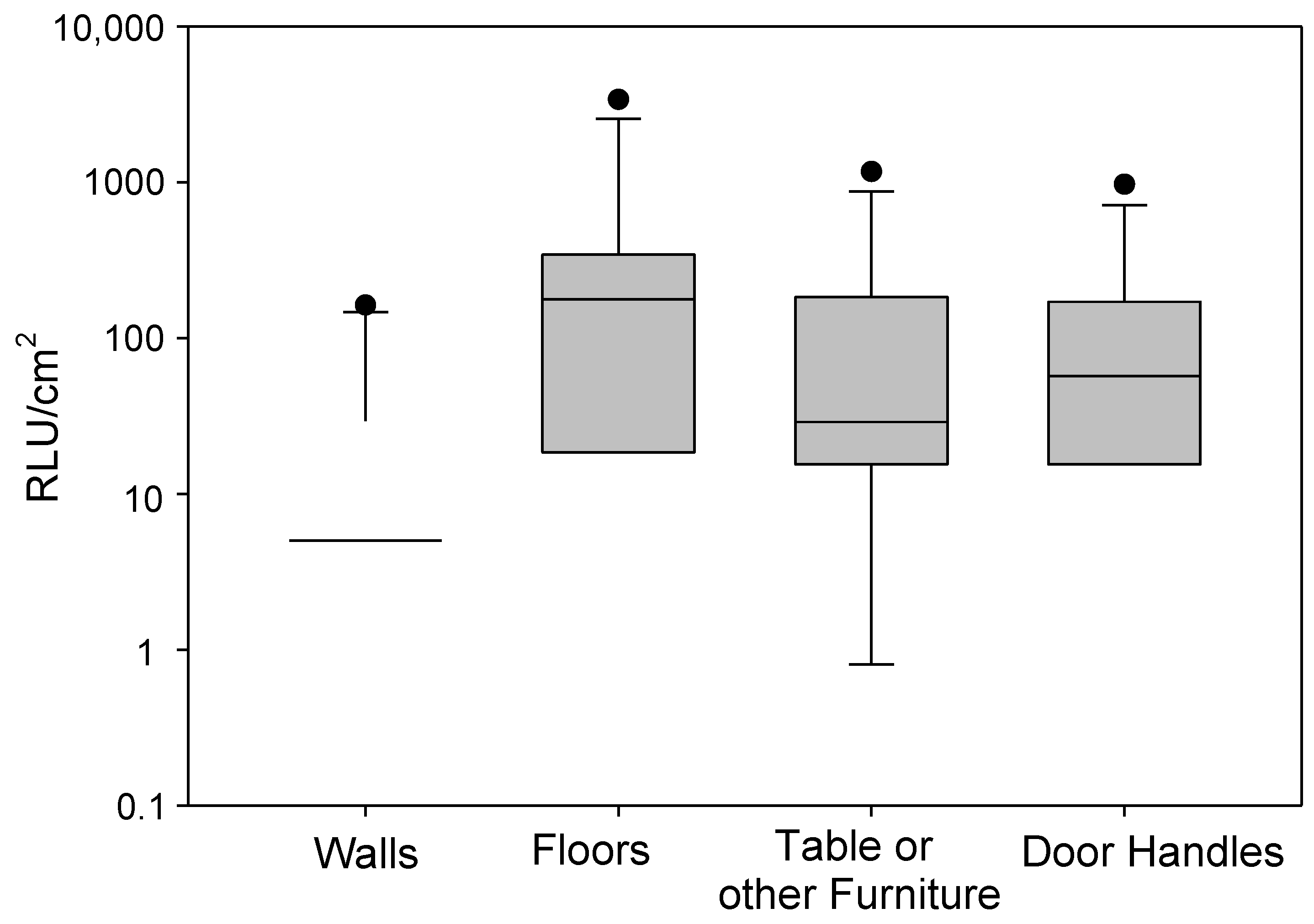
3.3. Surface Microbial Activity in Flood-Affected Homes
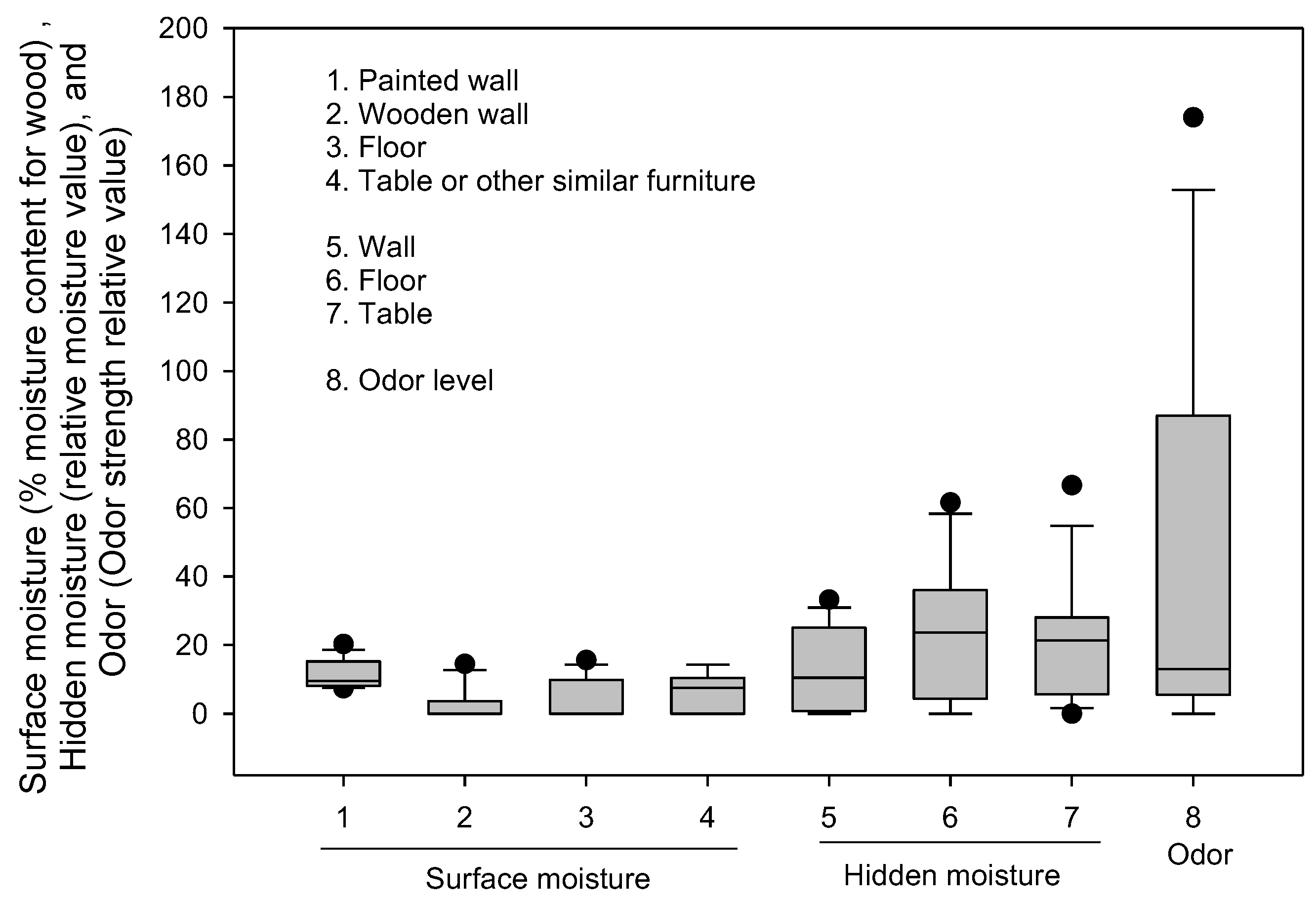
3.4. Hidden Moisture Levels in Flood-Affected Homes and Other Environmental Parameters
3.5. Public Health Implications
3.6. Strengths, Limitations, and Future Directions
4. Conclusions
Author Contributions
Funding
Institutional Review Board Statement
Informed Consent Statement
Data Availability Statement
Acknowledgments
Conflicts of Interest
Abbreviations
| VOC | Volatile Organic Carbons |
| MVOC | Microbial Volatile Organic Carbons |
| TVOC | Total Volatile Organic Carbons |
| ATP | Adenosine triphosphate |
| IAQ | Indoor Air Quality |
| AIHA | American Industrial Hygiene Association |
| GC/MS | Gas Chromatography-Mass Spectrometry |
| DMAT | Dampness and Mold Assessment Tool |
| NIST | National Institute of Standards and Technology |
| PID | Photoionization Detector |
| RLU | Relative Light Units |
| HVAC | Heating, Ventilation, and Air Conditioning |
References
- Brandt, M.; Brown, C.; Burkhart, J.; Burton, N.; Cox-Ganser, J.; Damon, S.; Falk, H.; Fridkin, S.; Garbe, P.; McGeehin, M.; et al. Mold prevention strategies and possible health effects in the aftermath of hurricanes and major floods. MMWR. Recommendations and reports: Morb. Mortal. Wkly. report. Recomm. Rep. 2006, 55, 1–27. [Google Scholar]
- Mudarri, D.; Fisk, W.J. Public health and economic impact of dampness and mold. Indoor Air 2007, 17, 226–235. [Google Scholar] [CrossRef] [PubMed]
- Mendell, M.J.; Mirer, A.G.; Cheung, K.; Tong, M.; Douwes, J. Respiratory and allergic health effects of dampness, mold, and dampness-related agents: A review of the epidemiologic evidence. Environ. Health Perspect. 2011, 119, 748–756. [Google Scholar] [CrossRef] [PubMed]
- Quansah, R.; Jaakkola, M.S.; Hugg, T.T.; Heikkinen, S.A.; Jaakkola, J.J. Residential dampness and molds and the risk of developing asthma: A systematic review and meta-analysis. PLoS ONE 2012, 7, e47526. [Google Scholar] [CrossRef]
- Chew, G.L.; Wilson, J.; Rabito, F.A.; Grimsley, F.; Iqbal, S.; Reponen, T.; Muilenberg, M.L. Mold and endotoxin levels in the aftermath of Hurricane Katrina: A pilot project of homes in New Orleans undergoing renovation. Environ. Health Perspect. 2006, 114, 1883–1889. [Google Scholar] [CrossRef][Green Version]
- Adhikari, A.; Jung, J.; Reponen, T.; Lewis, J.S.; DeGrasse, E.C.; Grimsley, L.F.; Chew, G.L.; Grinshpun, S.A. Aerosolization of fungi, (1-->3)-beta-D glucan, and endotoxin from flood-affected materials collected in New Orleans homes. Environ. Res. 2009, 109, 215–224. [Google Scholar] [CrossRef]
- Adhikari, A.; Lewis, J.S.; Reponen, T.; Degrasse, E.C.; Grimsley, L.F.; Chew, G.L.; Iossifova, Y.; Grinshpun, S.A. Exposure matrices of endotoxin, (1→3)-β-d-glucan, fungi, and dust mite allergens in flood-affected homes of New Orleans. Sci. Total Environ. 2010, 408, 5489–5498. [Google Scholar] [CrossRef]
- Omebeyinje, M.H.; Adeluyi, A.; Mitra, C.; Chakraborty, P.; Gandee, G.M.; Patel, N.; Verghese, B.; Farrance, C.E.; Hull, M.; Basu, P.; et al. Increased prevalence of indoor Aspergillus and Penicillium species is associated with indoor flooding and coastal proximity: A case study of 28 moldy buildings. Environ. Sci. Process. Impacts 2021, 23, 1681–1687. [Google Scholar] [CrossRef]
- Vesper, S.; McKinstry, C.; Cox, D.; Dewalt, G. Correlation between ERMI values and other moisture and mold assessments of homes in the American Healthy Homes Survey. J. Urban Health Bull. N. Y. Acad. Med. 2009, 86, 850–860. [Google Scholar] [CrossRef]
- Korpi, A.; Järnberg, J.; Pasanen, A.L. Microbial volatile organic compounds. Crit. Rev. Toxicol. 2009, 39, 139–193. [Google Scholar] [CrossRef]
- Araki, A.; Kanazawa, A.; Kawai, T.; Eitaki, Y.; Morimoto, K.; Nakayama, K.; Shibata, E.; Tanaka, M.; Takigawa, T.; Yoshimura, T.; et al. The relationship between exposure to microbial volatile organic compound and allergy prevalence in single-family homes. Sci. Total Environ. 2012, 423, 18–26. [Google Scholar] [CrossRef] [PubMed][Green Version]
- Nielsen, G.D. Mechanisms of Activation of the Sensory Irritant Receptor by Airborne Chemicals. Crit. Rev. Toxicol. 1991, 21, 183–208. [Google Scholar] [CrossRef] [PubMed]
- Haines, S.R.; Hall, E.C.; Marciniak, K.; Misztal, P.K.; Goldstein, A.H.; Adams, R.I.; Dannemiller, K.C. Microbial growth and volatile organic compound (VOC) emissions from carpet and drywall under elevated relative humidity conditions. Microbiome 2021, 9, 209. [Google Scholar] [CrossRef] [PubMed]
- Kim, J.L.; Elfman, L.; Mi, Y.; Wieslander, G.; Smedje, G.; Norbäck, D. Indoor molds, bacteria, microbial volatile organic compounds and plasticizers in schools--associations with asthma and respiratory symptoms in pupils. Indoor Air 2007, 17, 153–163. [Google Scholar] [CrossRef]
- Hospodsky, D.; Qian, J.; Nazaroff, W.W.; Yamamoto, N.; Bibby, K.; Rismani-Yazdi, H.; Peccia, J. Human occupancy as a source of indoor airborne bacteria. PLoS ONE 2012, 7, e34867. [Google Scholar] [CrossRef]
- Griffith, C.J.; Cooper, R.A.; Gilmore, J.; Davies, C.; Lewis, M. An evaluation of hospital cleaning regimes and standards. J. Hosp. Infect. 2000, 45, 19–28. [Google Scholar] [CrossRef]
- Andersen, B.M.; Rasch, M.; Kvist, J.; Tollefsen, T.; Lukkassen, R.; Sandvik, L.; Welo, A. Floor cleaning: Effect on bacteria and organic materials in hospital rooms. J. Hosp. Infect. 2009, 71, 57–65. [Google Scholar] [CrossRef]
- National Hurricane Center. Tropical Cyclone Report: Hurricane Ian. National Oceanic and Atmospheric Administration. 2023. Available online: https://www.nhc.noaa.gov/data/tcr/AL092022_Ian.pdf (accessed on 15 September 2025).
- NIOSH. Dampness and Mold Assessment Tool for General Buildings—Form & Instructions. Cox-Ganser J, Martin M, Park JH, Game, S. Morgantown WV: U.S. Department of Health and Human Services, Centers for Disease Control and Prevention, National Institute for Occupational Safety and Health, DHHS (NIOSH) Publication No. 2019-115. 2018. Available online: https://doi.org/10.26616/NIOSHPUB2019115 (accessed on 15 September 2025).
- EPA. Compendium Method TO-17: Determination of Volatile Organic Compounds in Ambient Air Using Active Sampling onto Sorbent Tubes. U.S. Environmental Protection Agency. Method TO-17—Determination of Volatile Organic Compounds in Ambient Air Using Active Sampling onto Sorbent Tubes. 1999. Available online: https://www.epa.gov/sites/default/files/2019-11/documents/to-17r.pdf (accessed on 25 September 2025).
- ISO 16000-6; Indoor Air—Part 6: Determination of Organic Compounds (VVOC, VOC, SVOC) in Indoor and Test Chamber Air by Active Sampling on Sorbent Tubes, Thermal Desorption, and Gas Chromatography Using MS or MSFID. International Organization for Standardization: Geneva, Switzerland, 2004.
- Korpi, A.; Pasanen, A.L.; Pasanen, P. Volatile compounds originating from mixed microbial cultures on building materials under various humidity conditions. Appl. Environ. Microbiol. 1998, 64, 2914–2919. [Google Scholar] [CrossRef]
- Wang, J.; Janson, C.; Gislason, T.; Gunnbjörnsdottir, M.; Jogi, R.; Orru, H.; Norbäck, D. Volatile organic compounds (VOCs) in homes are associated with asthma and lung function among adults in Northern Europe. Environ. Pollut. 2023, 321, 121103. [Google Scholar] [CrossRef]
- Wilkins, K.; Larsen, K.; Simkus, M. Volatile metabolites from mold growth on building materials and synthetic media. Chemosphere 2000, 41, 437–446. [Google Scholar] [CrossRef]
- Schleibinger, H.; Laussmann, D.; Bornehag, C.G.; Eis, D.; Rueden, H. Microbial volatile organic compounds in the air of moldy and mold-free indoor environments. Indoor Air 2008, 18, 113–124. [Google Scholar] [CrossRef]
- Ryan, T.J.; Beaucham, C. Dominant microbial volatile organic compounds in 23 U.S. homes. Chemosphere 2013, 90, 1670–1674. [Google Scholar] [CrossRef]
- Kemmler, E.; Lemfack, M.C.; Goede, A.; Gallo, K.; Toguem, S.M.T.; Ahmed, W.; Millberg, I.; Preissner, S.; Piechulla, B.; Preissner, R. mVOC 4.0: A database of microbial volatiles. Nucleic Acids Res. 2025, 53, D1692–D1696. [Google Scholar] [CrossRef]
- Fiedler, K.; Schütz, E. Detection of microbial volatile organic compounds (MVOCs) produced by moulds on various materials. Int. J. Hyg. Environ. Health 2001, 204, 111–121. [Google Scholar] [CrossRef]
- Betancourt, D.A.; Krebs, K.; Moore, S.A.; Martin, S.M. Microbial volatile organic compound emissions from Stachybotrys chartarum growing on gypsum wallboard and ceiling tile. BMC Microbiol. 2013, 13, 283. [Google Scholar] [CrossRef]
- Qian, J.; Hospodsky, D.; Yamamoto, N.; Nazaroff, W.W.; Peccia, J. Size-resolved emission rates of airborne bacteria and fungi in an occupied classroom. Indoor Air 2012, 22, 339–351. [Google Scholar] [CrossRef]
- Lax, S.; Smith, D.P.; Hampton-Marcell, J.; Owens, S.M.; Handley, K.M.; Scott, N.M.; Gilbert, J.A. Longitudinal analysis of microbial interaction between humans and the indoor environment. Science 2014, 345, 1048–1052. [Google Scholar] [CrossRef] [PubMed]
- Flannigan, B.; Miller, J.D. Microbial Growth in Indoor Environments. In Microorganisms in Home and Indoor Work Environments, 2nd ed.; Miller, J.D., Flannigan, B., Samson, R.A., Cox-Ganser, D.O., Eds.; CRC Press: Boca Raton, FL, USA, 2011; pp. 57–107. [Google Scholar] [CrossRef]
- World Health Organization. WHO Guidelines for Indoor Air Quality: Dampness and Mould; WHO Regional Office for Europe: Copenhagen, Denmark, 2009. [Google Scholar]
- Institute of Medicine (US) Committee on Damp Indoor Spaces and Health. Damp Indoor Spaces and Health; The National Academies Press: Washington, DC, USA, 2004. [Google Scholar] [CrossRef]
- World Health Organization (WHO). Bioaerosols: Assessment and Control; WHO Technical Report Series No. 941; World Health Organization: Geneva, Switzerland, 1990. [Google Scholar]




| Home ID No. | Ceiling | Walls | Floor | Windows | Furnishings | HVAC System | Supplies | Pipes | ||||||||
|---|---|---|---|---|---|---|---|---|---|---|---|---|---|---|---|---|
| Score (0, 1, 2, 3) | Near Exterior Wall (1 = Yes, 0 = No) | Score (0, 1, 2, 3) | Near Exterior Wall (1 = Yes, 0 = No) | Score (0, 1, 2, 3) | Near Exterior Wall (1 = Yes, 0 = No) | Score (0,1,2,3) | Near Exterior Wall (1 = Yes, 0 = No) | Score (0, 1, 2, 3) | Near Exterior Wall (1 = Yes, 0 = No) | Score (0, 1, 2, 3) | Near Exterior Wall (1 = Yes, 0 = No) | Score (0, 1, 2, 3) | Near Exterior Wall (1 = Yes, 0 = No) | Score (0, 1, 2, 3) | Near Exterior Wall (1 = Yes, 0 = No) | |
| 1 | 0 | 0 | 0 | 0 | 0 | 0 | 0 | 0 | 0 | 0 | 0 | 0 | 0 | 0 | 0 | 0 |
| 2 | 0 | 0 | 0 | 0 | 0 | 0 | 0 | 0 | 0 | 0 | 0 | 0 | 0 | 0 | 0 | 0 |
| 3 | 0 | 0 | 0 | 0 | 0 | 0 | 0 | 0 | 0 | 0 | 0 | 0 | 0 | 0 | 0 | 0 |
| 4 | 0 | 0 | 0 | 0 | 2 | 0 | 0 | 0 | 1 | 0 | 0 | 0 | 1 | 0 | 0 | 0 |
| 5 | 0 | 0 | 1 | 0 | 0 | 0 | 0 | 0 | 0 | 0 | 0 | 0 | 0 | 0 | 0 | 0 |
| 6 | 0 | 0 | 0 | 0 | 0 | 0 | 0 | 0 | 0 | 0 | 0 | 0 | 0 | 0 | 0 | 0 |
| 7 | 0 | 0 | 0 | 0 | 0 | 0 | 0 | 0 | 0 | 0 | 0 | 0 | 0 | 0 | 0 | 0 |
| 8 | 0 | 0 | 0 | 0 | 0 | 0 | 0 | 0 | 1 | 0 | 0 | 0 | 0 | 0 | 0 | 0 |
| 9 | 0 | 0 | 0 | 0 | 2 | 0 | 0 | 0 | 0 | 0 | 0 | 0 | 0 | 0 | 0 | 0 |
| 10 | 0 | 0 | 2 | 0 | 2 | 0 | 0 | 0 | 0 | 0 | 0 | 0 | 0 | 0 | 0 | 0 |
| 11 | 0 | 0 | 0 | 0 | 0 | 0 | 0 | 0 | 0 | 0 | 0 | 0 | 0 | 0 | 0 | 0 |
| 12 | 0 | 0 | 0 | 0 | 0 | 0 | 0 | 0 | 0 | 0 | 0 | 0 | 0 | 0 | 0 | 0 |
| 13 | 1 | 0 | 0 | 0 | 0 | 0 | 0 | 0 | 0 | 0 | 0 | 0 | 0 | 0 | 0 | 0 |
Disclaimer/Publisher’s Note: The statements, opinions and data contained in all publications are solely those of the individual author(s) and contributor(s) and not of MDPI and/or the editor(s). MDPI and/or the editor(s) disclaim responsibility for any injury to people or property resulting from any ideas, methods, instructions or products referred to in the content. |
© 2025 by the authors. Licensee MDPI, Basel, Switzerland. This article is an open access article distributed under the terms and conditions of the Creative Commons Attribution (CC BY) license (https://creativecommons.org/licenses/by/4.0/).
Share and Cite
Adhikari, A.; Jegede, O.; Ezeamii, V.C.; Ayo-Farai, O.; Savarese, M.; Gupta, J. Assessment of Mold-Specific Volatile Organic Compounds and Molds Using Sorbent Tubes and a CDC/NIOSH-Developed Tool in Homes Affected by Hurricane Ian. Appl. Sci. 2025, 15, 10805. https://doi.org/10.3390/app151910805
Adhikari A, Jegede O, Ezeamii VC, Ayo-Farai O, Savarese M, Gupta J. Assessment of Mold-Specific Volatile Organic Compounds and Molds Using Sorbent Tubes and a CDC/NIOSH-Developed Tool in Homes Affected by Hurricane Ian. Applied Sciences. 2025; 15(19):10805. https://doi.org/10.3390/app151910805
Chicago/Turabian StyleAdhikari, Atin, Oluwatosin Jegede, Victor Chiedozie Ezeamii, Oluwatoyin Ayo-Farai, Michael Savarese, and Jayanta Gupta. 2025. "Assessment of Mold-Specific Volatile Organic Compounds and Molds Using Sorbent Tubes and a CDC/NIOSH-Developed Tool in Homes Affected by Hurricane Ian" Applied Sciences 15, no. 19: 10805. https://doi.org/10.3390/app151910805
APA StyleAdhikari, A., Jegede, O., Ezeamii, V. C., Ayo-Farai, O., Savarese, M., & Gupta, J. (2025). Assessment of Mold-Specific Volatile Organic Compounds and Molds Using Sorbent Tubes and a CDC/NIOSH-Developed Tool in Homes Affected by Hurricane Ian. Applied Sciences, 15(19), 10805. https://doi.org/10.3390/app151910805