Review

A Novel Real-Time Battery State Estimation Using Data-Driven Prognostics and Health Management

by
Juliano Pimentel
*,†,
Alistair A. McEwan
and
Hong Qing Yu
College of Science and Engineering, University of Derby, Markeaton St., Derby DE22 3AW, UK
*
Author to whom correspondence should be addressed.
These authors contributed equally to this work.
Appl. Sci. 2025, 15(15), 8538; https://doi.org/10.3390/app15158538
Submission received: 14 June 2025 / Revised: 26 July 2025 / Accepted: 27 July 2025 / Published: 31 July 2025
(This article belongs to the Special Issue Design and Applications of Real-Time Embedded Systems)

Abstract

This paper presents a novel data-driven framework for real-time State of Charge (SOC) estimation in lithium-ion battery systems using a data-driven Prognostics and Health Management (PHM) approach. The method leverages an optimized bidirectional Long Short-Term Memory (Bi-LSTM) network, trained with enhanced datasets filtered via exponentially weighted moving averages (EWMAs) and refined through SHAP-based feature attribution. Compared against a Extended Kalman Filter (EKF) and Unscented Kalman Filter (UKF) across ten diverse drive cycles, the proposed model consistently achieved superior performance, with mean absolute errors (MAEs) as low as 0.40%, outperforming EKF (0.66%) and UKF (1.36%). The Bi-LSTM model also demonstrated higher R2 values (up to 0.9999) and narrower 95% confidence intervals, confirming its precision and robustness. Real-time implementation on embedded platforms yielded inference times of 1.3–2.2 s, validating its deployability for edge applications. The framework’s model-free nature makes it adaptable to other nonlinear, time-dependent systems beyond battery SOC estimation.

1. Introduction

Electric vehicles (EVs) have been widely introduced into the transportation sector, aiming to accelerate decarbonization and reduce its emissions. Most EVs of today use lithium-ion (Li-ion) batteries, along with their different chemistries, e.g., NMC, LFP, LCO [1]. State of Charge (SOC) estimation accuracy of Li-ion batteries is critical for the battery cells lifetime and its safe operation for EV applications [2].
Modeling a battery is a difficult task due to the complex nonlinearity and time-variability of the system and various factors that may affect the battery performance, which is why a pure data-driven PHM approach is critical for a lithium-ion battery’s state estimation. Different models have been proposed: the electrochemical model (EM) is used mainly for life prediction and cell degradation purposes; the equivalent circuit model (ECM) is used for battery management systems (BMSs); and the electrochemical impedance model (EIM) is mainly used as a non-destructive characterization technique to determine the electrical response of chemical systems [3].
In many works, the model-based methods, such as ECM, are used in association with adaptive filters and state estimation algorithms. Other methods include particle filters [4], H filters [5], sliding-mode observers [6], and others. Overall, conventional filter-based methods are valuable for real-time onboard estimation with moderate computational demand, while Bayesian and hybrid models offer superior predictive accuracy and uncertainty quantification, which are especially beneficial when long term SOC/SOH prognostics are required in battery management systems. Bayesian machine learning approaches, notably Gaussian Process Regression (GPR), have been increasingly adopted to predict SOH with quantified uncertainty. Recent reviews highlight that GPR can model nonlinear degradation trends, offering probabilistic SOC/SOH forecasts with both mean and variance, often achieving 1% accuracy over wide SoC ranges [7].
The most well-known algorithms for battery state estimation include Kalman filters and their variants [3].
An in-depth feasibility study of using Kalman filters (KFs) for the state estimation of Li-ion batteries is presented in [8]. It implements a wide variety of KFs for a total number of 224 Panasonic NCR18650PD Nickel Cobalt Aluminum (NCA) Oxide cells with a nominal capacity ( C n o m ) of 2.85 Ah used to construct two battery modules.
A ternary Li-ion battery SOC was estimated using the Unscented Kalman Filter (UKF) in [9] with maximum absolute errors below 3%.
Conversely, the emergence of big data and powerful computers has paved the way for the development of relatively new approaches in data-driven SOC estimation. These methods, also referred to as black-box models, rely on empirical observations rather than extensive knowledge of the underlying processes [3]. One of these methods is the long short-term memory network (LSTM), which exhibits faster convergence to the true SOC compared to the Unscented Kalman Filter (UKF) when the initial SOC is inaccurate. The LSTM achieves a root mean square error (RMSE) and mean absolute error (MAE) of less than 2% and 1%, respectively [10]. Moreover, the LSTM can accurately assess SOC by solely monitoring battery measurements such as current, voltage, and temperature. It does not rely on the information of battery internal chemistry, complex reactions, or model parameter estimation [11].
In this paper we propose a novel data-driven PHM (Prognostics and Health Management) framework for the battery SOC estimation, combining a robust offline trained machine learning model, based on a bidirectional LSTM, with an online inference deployment, to forecast the SOC in real time. The offline processing, extensively explored herein, comprises four main stages: measurement noise reduction, additive features attribution, automated model hyperparameter optimization, and model cross-validation.
Initially, the raw data obtained by the system’s measurements is filtered out to reduce the inherent measurement noise [12] by smoothing the signals using exponentially weighted moving averages (EWMAs) and exponentially weighted moving standard deviation (EWMS) quantities of the original measure.
Subsequently, with the enriched dataset, a detailed feature selection is performed by using an additive features attribution method called SHAP (SHapley Additive exPlanation), which quantifies how much each individual feature contributes to the model’s overall performance on a dataset [13]. The outcome of the SHAP method is a subset of the enriched dataset, which contains only the most impactful features for the model output, which in the case herein is the SOC estimation.
After selecting the relevant features, the subsequent step involves optimizing the hyperparameters of the proposed model. The selected model is a bidirectional LSTM, as in [14], due to its inherent capacity to solve the issue of vanishing gradients for time-dependent and sequential data series. A random search process is used to optimize the hyperparameters for the bidirectional LSTM model. The most relevant hyperparameters taken into consideration are the number of hidden layers, neurons per layer, learning rate, and timesteps which determine the time interval that the network will buffer at at any processing step.
Finally, the model is generated and trained, using cross-validation techniques, until it reaches an acceptable mean square error (MSE) loss value and the model is demonstrated with smallest estimated risk [15]. The model is then saved for posterior usage and the offline processing stage is accomplished.
The generated model, referred to herein as data-driven PHM, is then compared with the state-of-the-art Kalman filters methods: Extended Kalman Filter (EKF) and Unscented Kalman Filter (UKF). The EKF uses the entire observable system and aims to linearize the state and observation models by a first-order Taylor-series expansion [8]; whereas UKF samples the observable system generating the so-called sigma points which are then propagated through the nonlinear observation model, and system variables are then estimated. UKF is expected to have better performance for higher-order nonlinear differential systems, which can well represent the battery behavior.
This paper is structured as follows: Section 3 details the Kalman filters’ theory and concepts, for both extended and unscented versions, while Section 4 presents the main contribution of this work—a novel SOC estimator using data-driven PHM approach—including the proposed framework. Section 5 provides the methodology, dataset, and setup used herein, Section 6 presents the main results and its explanation, and finally Section 8 expands the study’s findings and outlines future work.

2. Research Objectives and Contributions

The main objectives of this article are to achieve the following:
  • Propose a novel data-driven PHM-based method for battery State-of-Charge (SOC) estimation, demonstrating enhanced model significance relative to existing state-of-the-art approaches.
  • Test the selected models on a real-world dataset to verify the model’s accuracy and significance, validate the proposed framework and measure the overall system classification.
  • Provide, with the selected PHM model, a real-time inference for the system’s health condition monitoring as well as multi-step ahead forecasting for long-term predictions.
The key contributions of this work can be summarized as follows:
  • A novel real-time PHM methodology based on bidirectional LSTM for battery system state monitoring and control is proposed.
  • A comprehensive dataflow is established including offline and online processing that can be extended for other nonlinear systems.
  • A noise reduction strategy is implemented, which can also be deployed in real-time to cope with noisy measurements’ systems.
  • The data-driven PHM SOC estimation consistently outperforms the state-of-the-art Kalman filters throughout different conditions, demonstrating its accuracy and usability.

3. Battery SOC Model-Driven State-of-the-Art Method

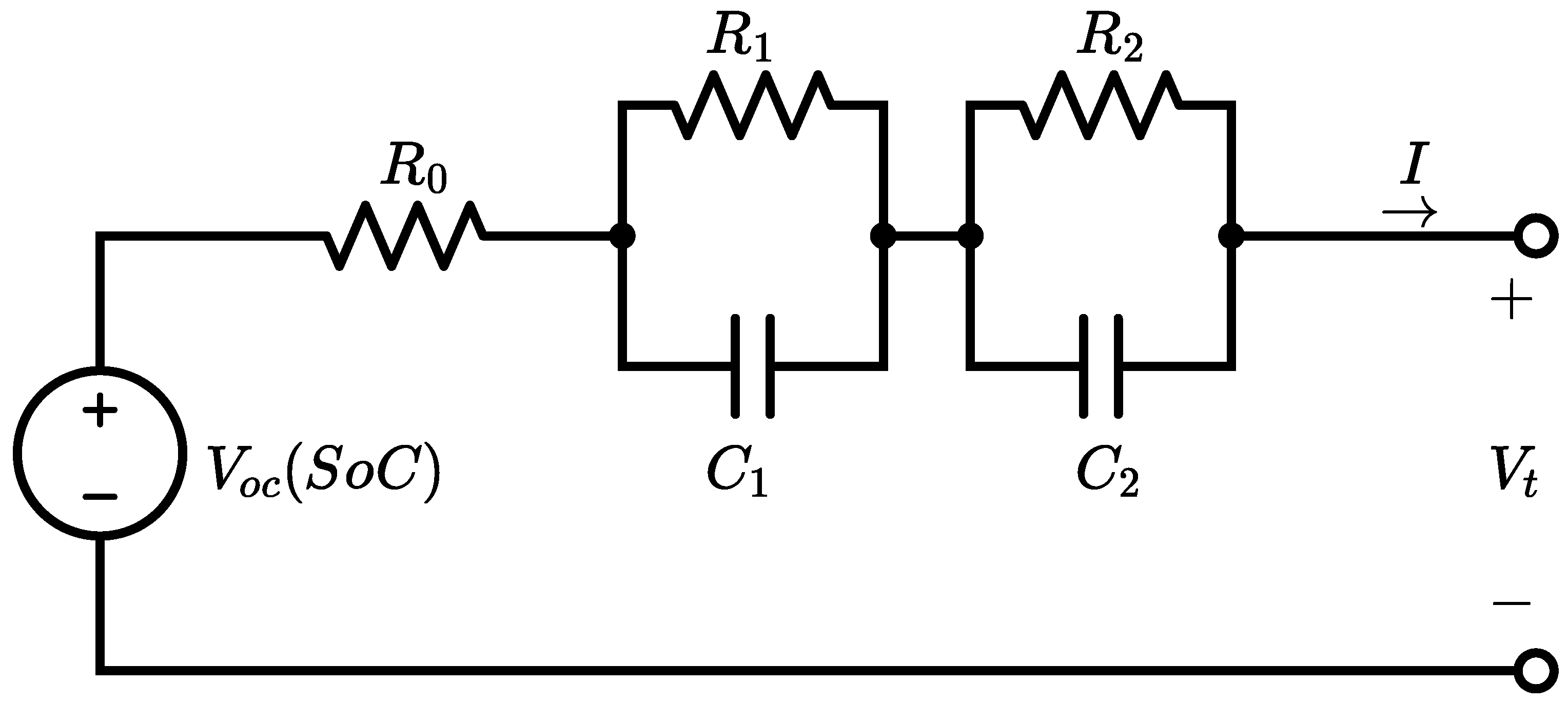
The Thevenin model serves as a commonly employed equivalent circuit model (ECM) for batteries. This model is constructed using one or more resistance–capacitance (RC) pairs, along with an additional resistor and a voltage source [3], as illustrated in Figure 1.
The Ah (Ampere-hour) Coulomb-counting method is a widely adopted approach for estimating the State of Charge ( S O C ), as used in [16], and shown in (1).
S O C k = S O C k 1 + η Q n k 1 k I k d k
Here, Q n represents the rated capacity of the battery, while η denotes the charge–discharge efficiency, which depends on factors such as the charge and discharge rate, operating temperature, and other conditions.
Compared to the first-order 1 R C model (which has only one R C branch in the electrical circuit), the 2 R C model has a smaller estimation error. This indicates that the 2 R C model provides enhanced accuracy, stability, and robustness. It outperforms both the 1 R C and 3 R C models, and also minimizes computational complexity [17]. Therefore, for the purpose of modeling the battery, the second-order R C model is chosen.
Considering Kirchhoff’s voltage law across the full loop, and defining τ n = R n C n , where n [ 1 , 2 ] , it becomes the following:
V t k = O C V k R 0 I k V 1 k V 2 k
V 1 k = V 1 k 1 e t / τ 1 + R 1 ( 1 e t / τ 1 ) I k
V 2 k = V 2 k 1 e t / τ 2 + R 2 ( 1 e t / τ 2 ) I k
Combining (1) to (4), it provides the state matrix in (5).
S O C k V 1 k V 2 k = 1 0 0 0 e t / τ 1 0 0 0 e t / τ 2 S O C k 1 V 1 k 1 V 2 k 1 + η × k Q n R 1 ( 1 e t / τ 1 ) R 2 ( 1 e t / τ 2 ) I k

3.1. The Extended Kalman Filter

The differential equations representing a continuous-time nonlinear system can be expanded with additive noise, as in [8,18]:
x k + 1 = f ( x k , u k ) + w k
y k = g ( x k , u k ) + v k
Herein, x k R n represents the system state vector at time index k.
The initial state x 0 is a random vector with known mean μ 0 = E [ x 0 ] and state error covariance given by P 0 = E [ ( x 0 μ 0 ) ( x 0 μ 0 ) T ] .
The input, u k R l and the measured output y k R m , also called observation vectors, are known variables of the system.
The vectors w k and v k represent, respectively, uncertainties in the model and the measurement noise. It is additionally assumed that the vectors w k and v k are composed of zero-mean white Gaussian distributed noise, stochastic processes temporally uncorrelated, with known covariances:
Q k = E [ w k w k T ]
R k = E [ v k v k T ]
The state vector x contains, for different SOC levels, the overpotential of the R C terms and the SOC itself:
x k = [ S O C k V 1 k V 2 k ] T
According to [18], the Kalman filter is used over the whole observable system, consisting of the data { u 0 , u 1 u k } and { y 0 , y 1 y k } to find the minimum mean squared error estimate x ^ t of the true state x t . Therefore, the objective function is as follows:
x ^ k = arg min x ^ R n E [ ( x k x ^ ) ( x k x ^ ) T ] | u 0 u 1 u k y 0 y 1 y k
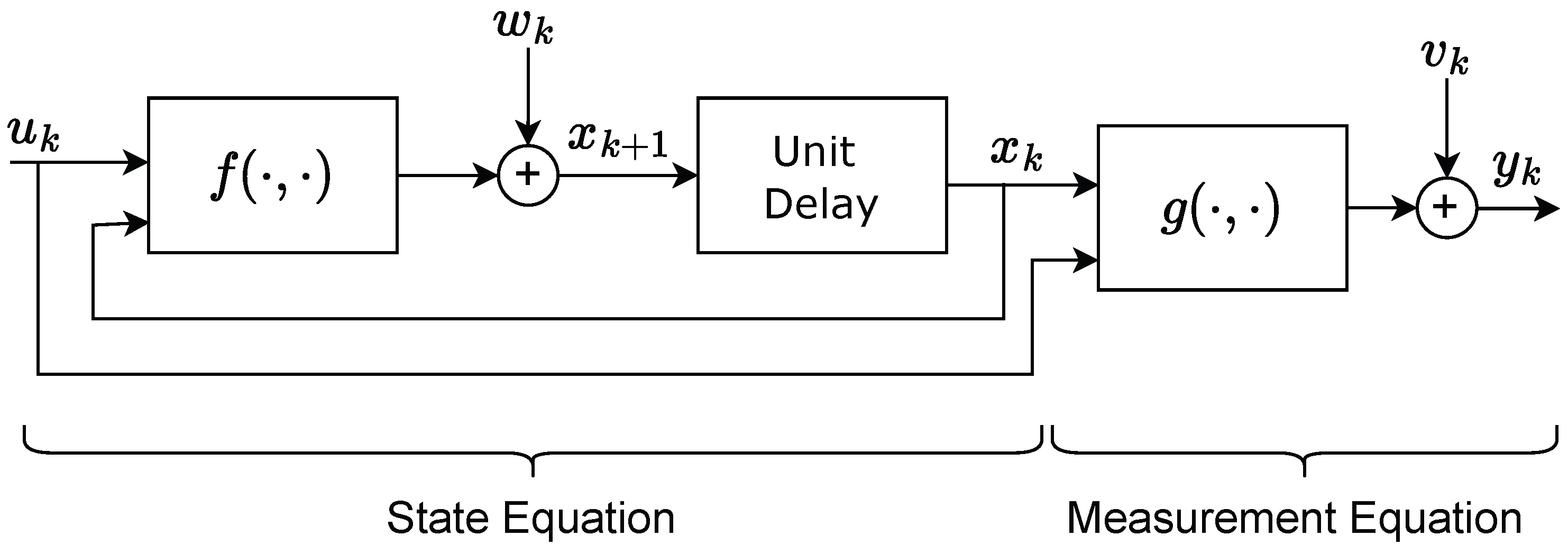
The battery is a nonlinear system, as demonstrated in [19]. Assuming the nonlinearities in the dynamic and the observation model are smooth, the functions in (6) and (7) are differentiable and can be expanded in the Taylor series. If the difference in time between these two functions is small, they can be roughly estimated using the first-order Taylor expansion. Hence, the Extended Kalman Filter (EKF) is also called the First-Order Filter. The nonlinear system is also depicted in the block diagram of Figure 2.
At each timestep, f ( · ) and g ( · ) are linearized by a first-order Taylor-series expansion. Assuming these functions are differentiable at all operating points of x k and u k ,
f ( x k , u k ) f ( x ^ k , u k ) + f ( x k , u k ) x k | x k = x ^ k ( x k x ^ k )
g ( x k , u k ) g ( x ^ k , u k ) + g ( x k , u k ) x k | x k = x ^ k ( x k x ^ k )
The partial derivatives of f ( · ) / x and g ( · ) / x in (12) and (13) are the Jacobian matrices, called herein A k and H k , respectively.
Combining these equations with (6) and (7), the linearized equations are derived to describe the true system state as a function of itself, known inputs, and states u k , x ^ k , along with unmeasurable noise inputs w k and v k :
x k + 1 f ( x ^ k , u k ) + w k + A ^ k ( x k x ^ k )
y k g ( x ^ k , u k ) + v k + H ^ k ( x k x ^ k )

3.2. The Unscented Kalman Filter

EKF can exhibit inaccurate behavior or even filter divergence, primarily due to linearization errors and the omission of higher-order terms in the Taylor series approximation. To overcome these limitations, the Sigma Point Kalman Filter (SPKF) was introduced. Unlike the EKF, SPKF does not require derivatives, as linearization is achieved through a set of sigma points [8]. SPKF provides a generalized approach to the Kalman filter for nonlinear system state estimation. Instead of relying on Taylor expansions for approximating covariance matrices, SPKF estimates these matrices through multiple function evaluations [20]. A widely used variant of SPKF is the Unscented Kalman Filter (UKF).
Equations (6) and (7) are also applicable for a more generic case where neither the system or the noise can be assumed linear, nor the state a Gaussian distribution.
x k = f ( x k 1 ) + w k
y k = g ( x k ) + v k
The unscented transformation computes the possible values of a random variable as it undergoes a nonlinear transformation [9,21].
Consider propagating a random variable x , with dimension n, through the nonlinear function given in (17). Let x ¯ and P x represent the mean and covariance of x , respectively. To compute the statistics of y k in (17), a matrix X comprising 2 n + 1 sigma vectors (associated with corresponding weights W i ) is utilized, following the reasoning outlined below.
Let X k 1 represent a set of 2 n + 1 sigma points, where n denotes the dimension of the state space. The corresponding weights for these sigma points are defined as follows:
X k 1 = { ( x k 1 j , W j ) | j = 0 2 n }
The following sigma points are then selected to incorporate higher-order information into the chosen points:
X 0 = x ¯
1 < W 0 < 1
x k 1 i = x ¯ k 1 + Ψ i i = 1 , , n
x k 1 i + n = x ¯ k 1 Ψ i i = 1 , , n
W j = 1 W 0 2 n j = 1 , , 2 n
j = 0 2 n W j = 1
Ψ = n 1 W 0 P k 1
W 0 determines the sigma points location: W 0 0 points move away from the origin, and W 0 0 points move closer to the origin.
The nonlinear propagation of the sigma point is as follows:
x ^ k j = f ( x k 1 j )
The transformed sigma points are utilized to calculate the mean and covariance of the predicted value of x k .
x ^ k = j = 0 2 n W j x ^ k j
P ^ k = j = 0 2 n W j { x ^ k j x ¯ k } { x ^ k j x ¯ k } T + Q k 1
The sigma points are subsequently propagated through the nonlinear observation model:
y ^ k 1 j = g ( x k 1 j )

4. A Novel Battery SoC Estimation Using a Data-Driven PHM Approach

Modeling battery cells poses challenges that complicate parameter estimation. Among these challenges are intricate transient response dynamics, pronounced voltage hysteresis, and a flat relationship between OCV and SOC [22].
This section proposes a data-driven alternative for the model-driven methodology presented above by learning the battery characteristics and behavior from past input data and then estimating the battery SOC with minimum knowledge about the system and its underlying conditions. The data-driven method used herein is a bidirectional LSTM, a special type of RNN, where it takes the inputs and the outputs, as in the model-driven method, but creates a network of hidden states from a back-propagation through time (BPTT) RNN algorithm [23]. A stepwise approach is proposed herein, which comprises two stages: (1) an offline processing which derives the best model for the system-of-interest and (2) a real-time inference which deploys the model on real-time data to determine the adequate health indicator, the battery SOC.
This proposed approach is a machine learning-based methodology for the PHM of embedded systems, aiming at generalization and real-time performance. It is intended to be applicable to other similar systems with little to no modification, beyond the specific case study and its dataset, as demonstrated in [14,24].
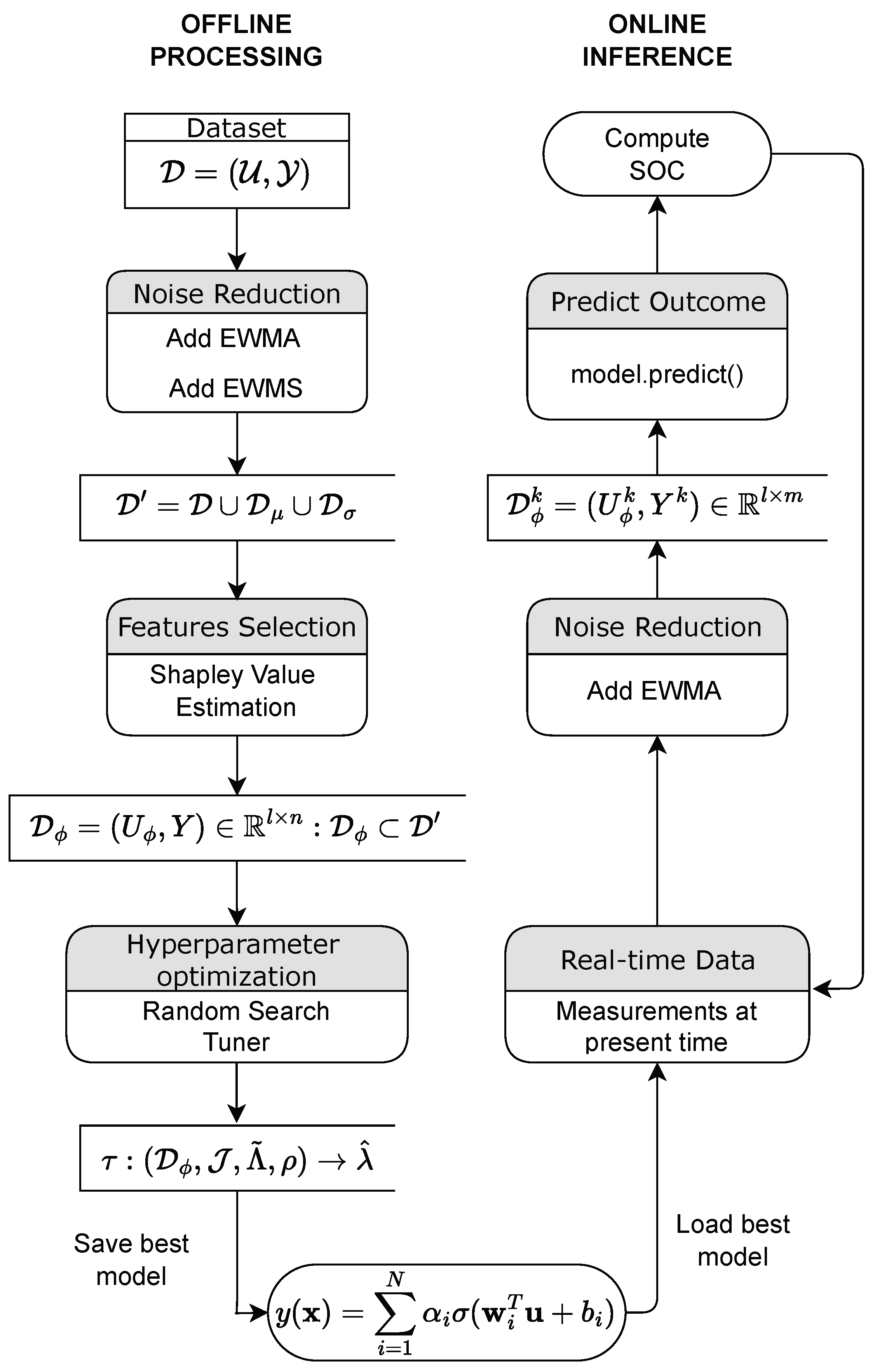
Our approach focuses on four main steps during offline processing. Detailed steps processes are depicted in Figure 3.
(a)
Measurement noise handling
(b)
Additive features attribution
(c)
Automated model’s hyperparameter optimization
(d)
Model cross-validation
Figure 3. Dataflow diagram for data-driven PHM approach.
Applsci 15 08538 g003

4.1. Handling Noisy Measurements

EKF deals with process and measurement noise by modeling the vectors w k and v k as white Gaussians, as explained before. The UKF considers an even worse condition, where noise can also be nonlinear. Recent works have addressed the issue of dealing with uncertaintities in the measurements due to unmodeled noise using the exponentially weighted moving average (EWMA) and the exponentially weighted moving standard deviation (EWMS) of past data [5,12,25].
The EWMA and the EWMS of all input signals u k at a discrete-time k is given by the following:
μ k = i = 0 k w i u k i i = 0 k w i
σ = i = 0 k w i ( u k μ k ) 2 i = 0 k w i
where w i = ( 1 α ) i with α = 2 / ( s + 1 ) and s is an arbitrary span.
Multiple EWMA and EWMS calculations with different spans result in a range of smoothed versions for all time-series and their corresponding standard deviations. To manage memory usage, we only consider four specific values for the span during the exploration process.

4.2. Additive Features Attribution

Feature selection identifies the most relevant attributes for analyzing the system-of-interest [26]. Within the proposed framework, this process is employed to choose features that significantly influence model training while excluding those with minimal or negligible impact on the final algorithm. Additionally, redundant features may also be removed [27].
Recently, feature selection has been used to explain machine learning data-driven models [28], such as x A I , which determines each feature’s contribution to the model performance, helping to determine an optimal feature’s subset. Here, a Shapley tree-based model is used to quantify the contributions of each individual feature to the final performance of the model, given a set of data points [13].

4.3. Automated Hyperparameters Optimization

Hyperparameter optimization (HPO) refers to the process of identifying the set of hyperparameters that maximizes a model’s performance, playing a critical role in enhancing the accuracy of machine learning algorithms [29].
Three main HPO algorithms are found in the literature [30]: grid search, random search, and Bayesian optimization. Grid search performs an exhaustive search on the hyperparameter set with limits defined by the end-user, which requires some previous knowledge on all possible candidates. Random search looks at a randomized search over hyperparameters until the targeted accuracy is obtained. Finally, Bayesian optimization (BO) aims at finding the global optimum with the minimum number of trials. Random search presents superior results when compared with grid or manual searches [31].
Herein, the random search method is selected to find the optimal hyperparameters for the bidirectional LSTM model.

4.4. Cross-Validation for Model Selection

The final step after the model optimization is to perform a cross-validation (CV) which evaluates the risk of the selected estimator. Data are split into a training sample D t r a i n and a validation sample D t e s t , then a CV algorithm will select the minimum loss.
Two CV techniques are identified in the literature [32]: subject-wise and record-wise. The first segregates data for training and validation (also known as holdout), ensuring they are independent. The record-wise technique splits the dataset randomly, where the same data can be shared between training and validation.
A record-wise (k-fold) CV technique is selected herein, which divides the dataset into k blocks (folds). One of the k blocks, where k = 10 , is used as the validation set, while the remaining k 1 are used as the training set. This is an exhaustive process, repeated k times. MSE (or L 2 loss) and the R2 (R-squared), given by (32) are employed as scoring metrics.
R 2 = 1 S S r e s S S t o t = 1 k = 1 n ( y k y ^ k ) 2 i = k n ( y k y ¯ k ) 2

4.5. Multivariate Multi-Step Bidirectional LSTM

A solution that addresses the vanishing gradients issue for time-dependent and sequential data series is a method called long short-term memory (LSTM) [33]. Recurrent neural networks, particularly LSTM, are highly effective for processing sequential information, setting them apart from traditional neural networks [34]. This model replaces the traditional neuron of the perceptron with a memory block [35]. LSTM can learn how to bridge minimal time lags of more than 1000 discrete timesteps.
The LSTM structure calculation process is provided in [36]. Traditional RNNs, such as unidirectional LSTM (also known as forward-pass), are effective for handling sequential data. However, they are only trained in the forward direction. On the other hand, bidirectional learning involves training on both the forward and reverse paths, utilizing two separate hidden layers [37]. Bidi-LSTM leverages this information by independently computing both the forward and reverse paths [14]. The resulting output, which captures the flow of information, is also utilized for learning. As a result, features are extracted more effectively, leading to higher accuracy compared to traditional LSTM models.
As stated above, a RNN computes only the forward hidden sequence h . By implementing the backward hidden sequence, h , the output sequence y is obtained by iterating layers from k = { 1 n } in the forward direction and k = { n 1 } in the reverse direction [38,39]. The formulation of the bidirectional LSTM backward direction is given in (33) and the output function is finally achieved in (34):
h k = H ( W x h · x k + W h h · h k 1 + b h )
y ^ k = σ y ( W h y · h k + W h y · h k + b k )

5. Experimental Setup and Methodology

An extensive review of datasets publicly available for batteries is presented in [40]. The dataset selected herein is the one available in [41] (under ‘CC BY 4.0’), which has been cited in multiple publications, such as in [11,42,43]. Four typical driving cycles are covered within the battery testing dataset, UDDS, US06, LA92, and HWFET, followed by a mix of other cycles. Data is related to a single NCA (Lithium Nickel Cobalt Aluminium Oxide) Panasonic 18650PF cell with a nominal capacity of 2.9 A h . Further details of the battery testing setup and used methodology is presented in [36].
The dataset contains characterization data from Hybrid Power Pulse Characterisation (HPPC) and EIS (Electrochemical Impedance Spectroscopy) tests, and in-cycle measurements from the driving cycles. The HPPC profile consists of pulses of 10 s equivalent to 0.5C, 1C, 2C, 4C, and 6C, where C is the battery nominal capacity, with each pulse followed by a rest period of 20 min. Five pulse discharge HPPC tests (0.5, 1, 2, 4, 6C) are performed at intervals varying between [100:5:0] percent of the SOC.
A series of nine drive cycles were performed in the following order: Cycle 1, Cycle 2, Cycle 3, Cycle 4, US06, HWFET, UDDS, LA92, neural network (NN). Cycles 1–4 consist of random mixes of UDDS, US06, LA92, HWFET, and NN drive cycles (these emission test cycles have been regulated by American authorities [44]). A neural network drive cycle is a combination of US06 and LA92. The drive cycle power profile is calculated for an electric Ford F150 truck with a 35 kWh battery pack scaled down for a single NCA Panasonic 18650PF cell. The drive cycle tests are terminated when voltage first hits 2.5 V for 25 °C.

5.1. Battery Model Estimation

The Hybrid Pulse Power Characterization (HPPC) test dataset at 25 °C provided in [41] was utilized to estimate the parameters of a second-order R C model. A second-order model has two RC networks, R 1     C 1 and R 2     C 2 , according to Figure 1. The HPPC test consists of pulses separated by a rest period that allows the battery to reach a stable state and is used to obtain the battery OCV versus SOC curve and the circuit components’ values R 1     C 1 and R 2     C 2 .
Another battery ECM has been presented and compared to the second-order R C Thevenin model in [45]. For that model, developed by the National Renewable Energy Laboratory (NREL), the equivalent circuit has the components R b , R s , C b , C s , and R t . The terminal resistance R t models the voltage drop when the battery has a load connected, R s and C s model the diffusion effects of the battery, and the bulk resistance R b and bulk capacitor C b represents the battery storage capacity.
The conclusion of the study in [45] is that the 2 R C Thevenin model used herein offers a better performance.

5.2. Battery SOC Estimation

Herein, the nine drive cycles test datasets at 25 °C only, provided in [41], and were used to estimate the SOC of the proposed battery both for the model-based or data-driven approaches.
Each drive cycle has the SOC computed via EKF and UKF for the model-based system. In addition, the ECM terminal voltage V t is also computed, since it is one of the states of the space-state modeling. For the data-driven PHM calculation, the SOC is computed from the dataset without any prior modeling of the system.
For the SOC, four estimations are performed using the following:
  • Coulomb-counting method according to (1),
  • Extended Kalman Filter (EKF) method as elucidated in Section 3.1,
  • Unscented Kalman Filter (UKF) method as elucidated in Section 3.2,
  • Data-driven PHM, as described in Section 4.

5.3. Hardware and Software

The offline training for the data-driven PHM was performed on a NVIDIA 1xQuadro RTX8000-48GB GDDR6 GPU (graphical card), sourced in the UK.
The SOC estimator using EFK and UKF is computed using Matlab and Simulink R2023b. For the battery model estimation, the Parameter Estimator toolbox [46] is used.
The data-driven PHM SOC estimator is computed using Keras [47] with a Tensorflow-backend, with Python version 3.9.7.

6. Results and Analysis

This section summarizes the main results obtained in the evaluation and comparison of the different proposed methods. Initially the battery modeling is established by an optimization process on the battery ECM, and then the SOC estimations can be compared across the different methods.

6.1. Battery Parameter Estimation

The parametrization is performed using the HPPC dataset at 25 °C. Initial values are assigned for the parameters, V o c , R 0 , R 1 , τ 1 , R 2 , τ 2 for each S O C = [0:0.1:1], with 1 equivalent to a battery 100 % charged.
The HPPC dataset is then loaded into the parameter estimator tool [46]. The used software formulates the parameter estimation as an optimization problem, aiming at minimizing a sum-squared error (SSE) cost function.
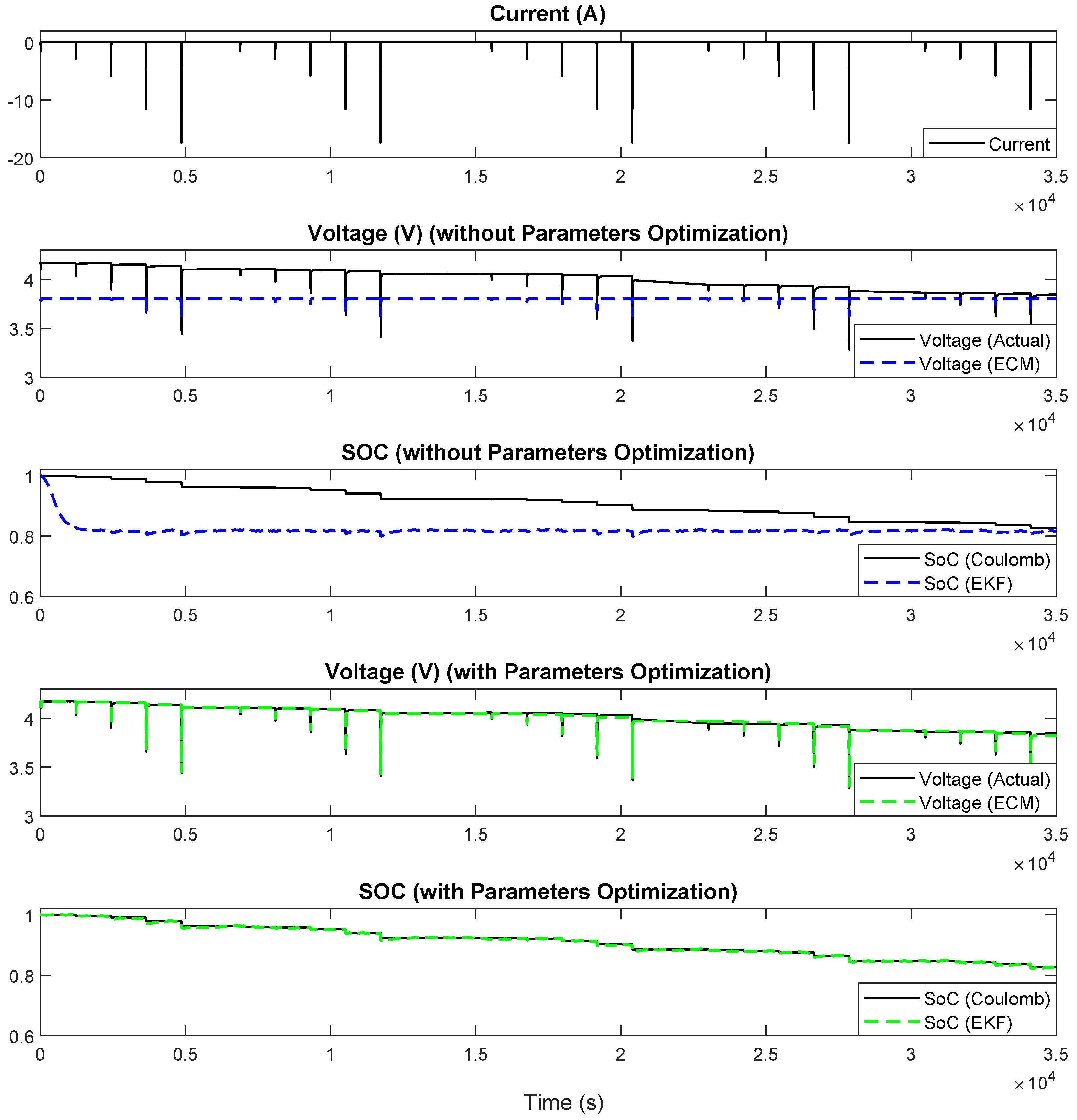
Table 1 shows the results for the parameters for the S O C = [0:0.1:1]. The results for the battery parameter optimization is depicted in Figure 4. The first plot shows the current (A) as detailed in the previous section, that is, pulses of 10 s equivalent to 0.5C, 1C, 2C, 4C, and 6C, with each pulse set apart by 20 min rest. A total of five pulse discharge HPPC tests were performed at each S O C = [100%:5%:0%].
Both the terminal voltage and the SOC without the parameter optimization are shown in the two subsequent plots: it can be seen that the model running with non-optimized parameters does not reach the target values. The voltage (ECM), modeled with non-optimized parameters R 0 , R 1 , τ 1 , R 2 , τ 2 does not fit the Voltage (Actual) profile. Similarly, the SOC (EKF), computed according to Section 3.1, does not follow the SOC (Coulomb) reported by the battery intrinsic modeling.
However, when the battery ECM is loaded with the values shown in Table 1, both the terminal voltage and the SOC meet the accuracy required and track the target values.

6.2. Noise Handling

Initially, a selected number of spans is chosen to enrich the original dataset with values of EWMA and EWMS. In [12], an automated approach to selecting feasible values for the span s is investigated, which is a purely data-driven method to establish the system dynamics. Herein we look at results in Table 1 to determine feasible span values, since they are available from the battery ECM parameter optimization.
We then, as in [12], explore only four possible values for the span in EWMA and EWMS calculation simultaneously in order to limit memory demand.
Ranging from a very short dynamic response to a longer time span, considering the battery ECM full charge or discharge (equivalent to a value approximately between 5 τ ’s to 6 τ ’s), the resulting selected span values are s = { 10 , 50 , 100 , 1000 } .
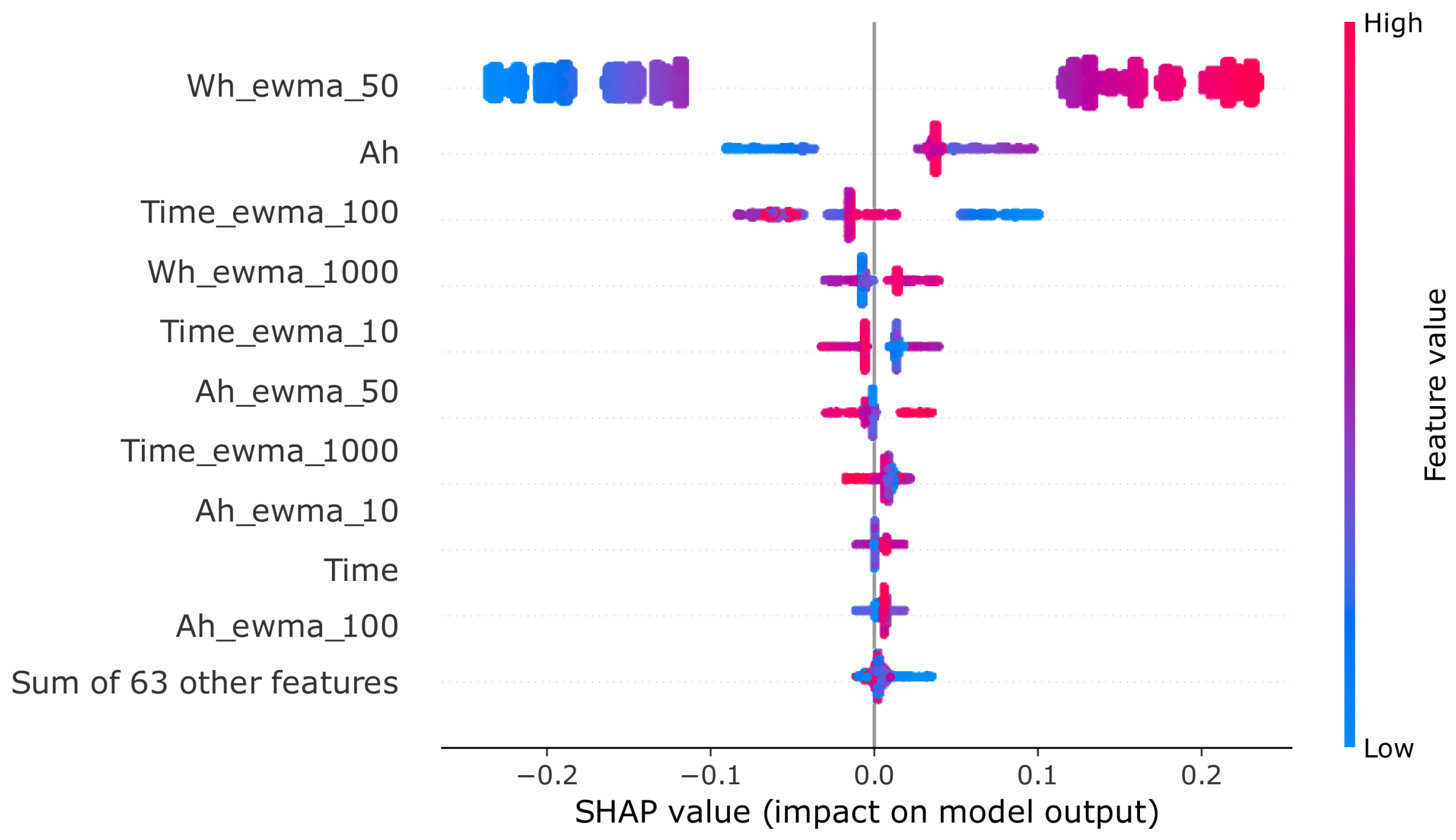
Figure 5 shows a uniform distribution of absolute attributions across the time spans, and the most impactful features are consistently among the time, capacity, and energy quantities, variables naturally needed for the SOC estimation.

6.3. Battery SOC Estimation

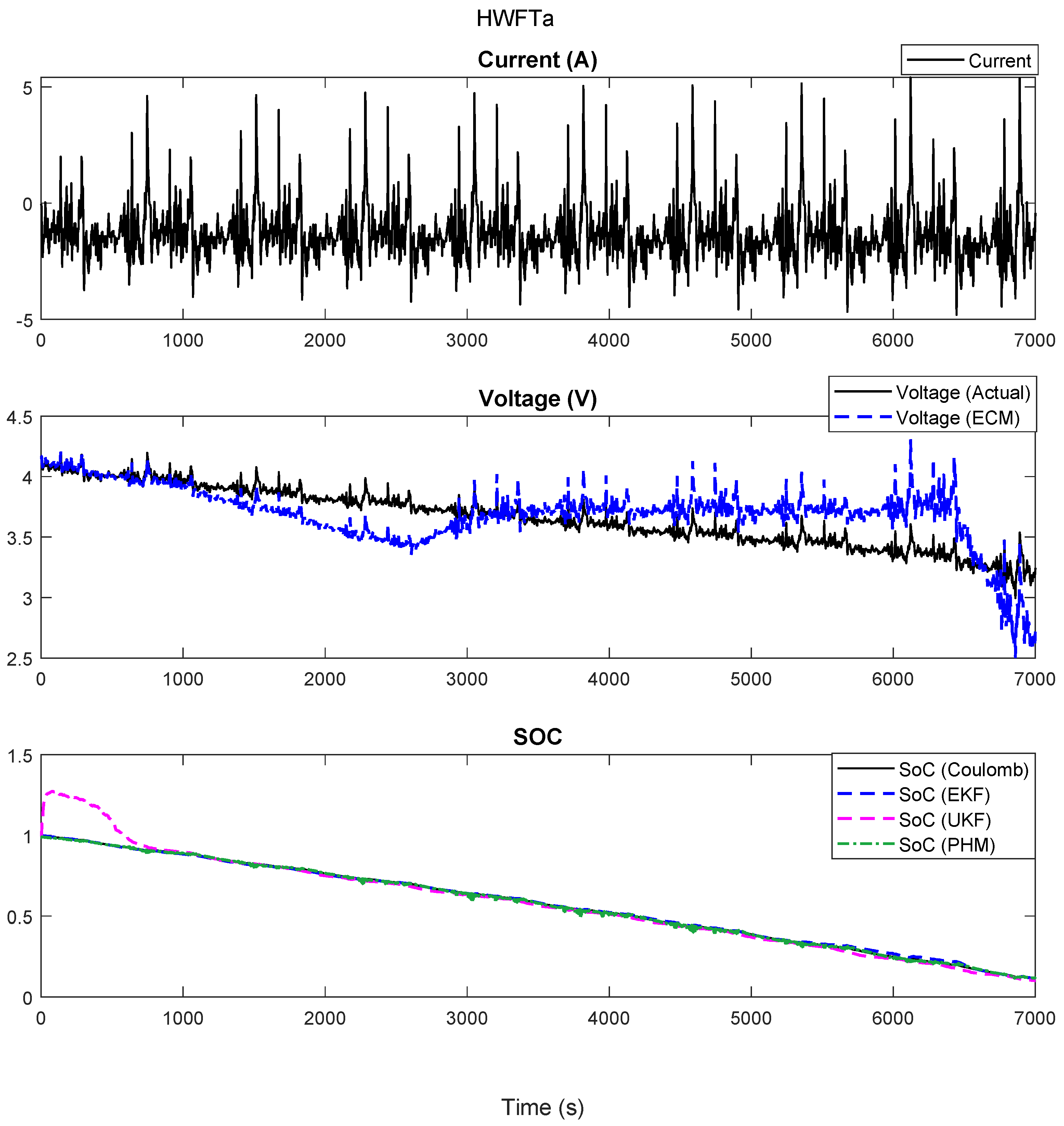
Out of the nine drive cycles tests dataset used during the data-driven PHM comparison with the state-of-the-art Kalman filters, the HWFTa (Highway Fuel Economy Test Cycle, dataset A) has its results presented graphically.
For each of the tested drive cycles, with the second-order battery ECM with optimized parameters, the ECM voltage derived from the battery model was compared with the respective drive cycle dataset, and the SOC was derived and computed according to Section 5.2.
The results for the battery parameter optimization is depicted in Figure 6. The current drawn from the battery is depicted in the first plot. The x-axis is shown in seconds, the current is given in Amperes, and the voltage in Volts. The SOC is an adimensional variable.
The second graphic of Figure 6 shows the battery terminal voltage measured from the experiment in the dataset in black and the one resulting from the battery ECM with optimized parameters in blue. It is seen that the battery ECM voltage is not able to perfectly match the real voltage values. Some reasons are related to the limitation of the optimization process to find suitable R s and C s to better represent the battery cell nonlinearity and its intrinsic behavior. In addition, other aspects such as the battery’s temperature and aging effects are difficult to model.
Finally, the third plot shows the different values and computations for the SOC: Coulomb-counting derived from the dataset, the ones from Kalman filters (both EKF and UKF), and the data-driven PHM one. The graphical result shows an overall good accuracy for all models with regards to the Coulomb-counting method, which shows low data variance for each model. The only noticeable characteristic across the results is the overshoot seen at the SOC estimation with UKF. This behavior during a transient period was previously reported, such as in the case of inaccurate initial SOC [3,10].
The SOC estimation error for two cases, HWFTa and Cycle 3, is presented in Table 2. The results show the maximum absolute error and the mean absolute error (MAE) for each of the three estimators.
The values outperform the ones reported in the literature [9,10,16], with mean absolute errors (MAE) below 2 % for all methods. The data-driven PHM reached 0.40 % and 0.47 % for the drive cycles with the best MAE across the methods.
The results for the ten different drive cycles are consolidated in Table 3. In general, the data-driven PHM method outperforms the Kalman filters by having a higher correlation with the real values, and by displaying a higher R 2 (near the unit value) and lower MSE.
Additionally, the confidence interval (CI) width is presented to compare the precision of the different methods. A confidence level (CL) of 95% is chosen, which gives an equivalent significance level of 5% (or 0.05). The confidence intervals (upper and lower) are then calculated and the CI width is then presented to demonstrate the method’s precision. It can be seen that both EFK and PHM present the best results, confirming that the results are valid to support the superiority of the data-driven PHM for the datasets used.

7. Real-Time Inference

The proposed data-driven PHM methodology has been implemented, in real time, to provide a multi-step ahead (MSA) battery SOC estimation in [36]. The real-time framework is capable of providing an advisory window for the system status and provided consistent results to forecast a SOC horizon of up to thirty timesteps ahead. For comparison, the proposed data-driven bidi-LSTM PHM has been implemented and tested on two drive cycles datasets, the neural network (NN) and the “HWFTa” (Highway Fuel Economy Test Cycle).
The referred method was implemented in two hardware platforms, with standard testbeds available:
  • Raspberry Pi 4 (RP4): using a Broadcom BCM2711 SoC with a 1.5 GHz 64-bit quad-core ARM Cortex-A72 processor, with 1 MB shared L2 cache.
  • Ultra96-V2 (U96): running a quad-core 1.5 GHz ARM Cortex-A53, with 1 MB L2 cache.
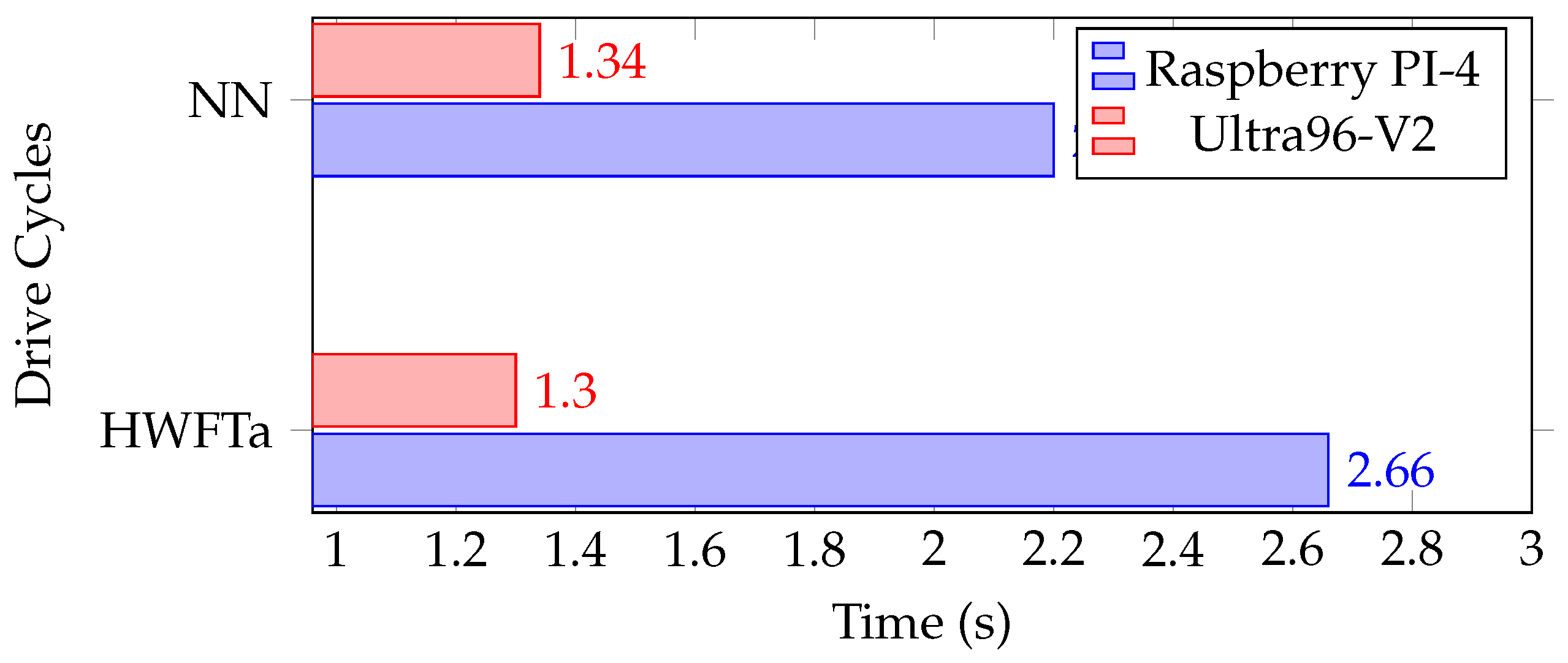
ARM processors are the most widely used architecture for embedded systems due to their low power consumption, high performance, and cost-effectiveness. The Ultra96-V2 (U96) is a MPSoC (multi-processor SoC) and has a wealthy set of processors and a FPGA. The MPSoC is a good candidate to fulfill the requirements of a mixed-criticality system, as implemented in [48]. The algorithms were executed on the referred ARM processors. Figure 7 shows the results for the selected drive cycles.
It can be depicted by the chart that the fastest real-time execution of the proposed data-driven MSA PHM method takes around 1.3 s to run on U96 and 2.2 s on RP4.

8. Conclusions and Future Work

The presented work compares the state-of-the-art SOC estimators based on Kalman filter variants, EKF and UKF, to the proposed data-driven PHM methodology. The latter outperforms the former ones consistently across ten different tested datasets, which reproduced different deployment scenarios and load conditions.
The proposed approach contributes a solid framework to handle noisy measurements which are common in real-time systems limited by measurement device capabilities. By enriching the original dataset with their weighted moving averages selected across different time spans, it was shown that the SOC estimator can attain better results and eliminate inherent noise interferences.
Another important aspect of the framework was to look carefully at the relevant features at the model tuning phase and propose, by using additive features contribution techniques, those which are meaningful for the process. That has the benefit of reducing the computational cost of the system and provides insights on the system behavior by displaying the endogenous variables that are more impactful for the system operation.
The results in this paper propose the use of a bidirectional LSTM as the most effective neural network for this application, which agrees with [14,37,38,49].
It is seen in Table 3 that the proposed data-driven PHM framework outperforms the state-of-the-art methods using Kalman filters for the tested datasets, by having a higher correlation with the real values, and by displaying a higher R 2 (near the unit value) and lower MSE. For very stringent load profiles, as in the US06 and the neural network drive cycles, the UKF matches the PHM performance, but does not outperform it.
For the SOC estimation error comparison, the PHM framework surpasses the ones reported in the literature [9,10,16] with mean absolute errors (MAE) below 2 % for all methods; however, the data-driven PHM reached 0.40 % and 0.47 % for the reported drive cycles with the best MAE across the methods.

8.1. Some Limitations of the Proposed Method

Some limitations of the proposed method can be listed, as follows:
  • Data-driven methods rely heavily on the availability of training data. These approaches depend on historical system data (e.g., training datasets) to identify correlations, establish patterns, and analyze trends that can lead to failure predictions [50].
  • A recursive neural network requires a laborious and computational intensive training process, with large amounts of data required from the system-of-interest.
  • The trained model is typically tailored to a specific system. Therefore, if the system dynamics, internal states, or input–output data profiles change, the model will likely need to be retrained to adapt to the new conditions [51].

8.2. Proposed Work Continuation

For the continuation of this work, it is envisaged to
  • Implement the PHM framework on other Lithium-ion battery chemistries, such as LFP (Lithium Iron Phosphate) and NMC (Manganese Cobalt Oxide), as well as different form-factors, such as VL6P, for instance.
  • Expand the use of the PHM framework for real-time forecasting models, using multi-steps ahead implementation, to allow future predictions beyond k + 1 , which are important aspects for critical safety applications.
  • Advance the whole system design to evolve towards the full PHM capability and remaining useful life (RUL) determination for embedded systems.

Funding

This research received no external funding.

Institutional Review Board Statement

Not applicable.

Informed Consent Statement

Not applicable.

Data Availability Statement

The dataset used in this work is the “Panasonic 18650pf li-ion battery data”, available at https://data.mendeley.com/datasets/wykht8y7tg/1, accessed on 15 May 2024, under a CC BY 4.0 license.

Acknowledgments

The authors acknowledge the University of Derby for the support of this research.

Conflicts of Interest

The authors declare no conflicts of interest.

Abbreviations

The following abbreviations are used in this manuscript:
AAmpère
AIArtificial Intelligence
BMSBattery Management System
BPTTBack-propagation Through Time
CCCoulomb-Counting
CVCross-Validation
ECMEquivalent Circuit Model
EIMElectrochemical Impedance Model
EISElectrochemical Impedance Spectroscopy
EKFExtended Kalman Filter
EMElectrochemical Model
EVElectric Vehicle
EWMAExponentially Weighted Moving Average
EWMSExponentially Weighted Moving Standard Deviation
FPGAField Programmable Gate Arrays
GPUGraphical Processing Unit
HWFETEPA Highway Fuel Economy Test Cycle
HPOHyperparameter Optimization
HPPCHybrid Power Pulse Characterisation
KFKalman Filter
LA92California Unified Driving Schedule
LSTMLong Short-Term Memory
MAEMean Absolute Error
MAPEMean Absolute Percentage Error
MASEMean Absolute Scaled Error
MaxAEMax Absolute Error
MLMachine Learning
MSAMulti-Step Ahead
MPSoCMulti-Processor System-on-Chip
MSEMean Squared Error
NCANickel Cobalt Aluminum (oxide)
OCVOpen Circuit Voltage (V)
PHMPrognostics and Health Management
RMSERoot Mean Squared Error
RNNRecursive Neural Network
RULRemaining Useful Life
SHAPSHapley Additive exPlanation
SOCState of Charge
SoCSystem-on-Chip
SPKFSigma Point Kalman Filter
SSESum-squared error
UDDSUrban Dynamometer Driving Schedule
UKFUnscented Kalman Filter
US06Supplemental Federal Test Procedure driving schedule
VVoltage
xAIExplainable Artificial Intelligence

References

  1. Zhao, J.; Feng, X.; Pang, Q.; Wang, J.; Lian, Y.; Ouyang, M.; Burke, A.F. Battery prognostics and health management from a machine learning perspective. J. Power Sources 2023, 581, 233474. [Google Scholar] [CrossRef]
  2. Hannan, M.A.; How, D.N.T.; Lipu, M.S.H.; Mansor, M.; Ker, P.J.; Dong, Z.Y.; Sahari, K.S.M.; Tiong, S.K.; Muttaqi, K.M.; Mahlia, T.M.I.; et al. Deep learning approach towards accurate state of charge estimation for lithium-ion batteries using self-supervised transformer model. Sci. Rep. 2021, 11, 19541. [Google Scholar] [CrossRef]
  3. How, D.N.T.; Hannan, M.A.; Hossain Lipu, M.S.; Ker, P.J. State of Charge Estimation for Lithium-Ion Batteries Using Model-Based and Data-Driven Methods: A Review. IEEE Access 2019, 7, 136116–136136. [Google Scholar] [CrossRef]
  4. Liu, X.; Fan, X.; Wang, L.; Wu, J. State of Charge Estimation for Power Battery Base on Improved Particle Filter. World Electr. Veh. J. 2023, 14, 8. [Google Scholar] [CrossRef]
  5. Zhang, S.; Wan, Y.; Ding, J.; Da, Y. State of Charge (SOC) Estimation Based on Extended Exponential Weighted Moving Average H-infinite Filtering. Energies 2021, 14, 1655. [Google Scholar] [CrossRef]
  6. Chen, Q.; Jiang, J.; Ruan, H.; Zhang, C. Simply designed and universal sliding mode observer for the SOC estimation of lithium-ion batteries. IET Power Electron. 2017, 10, 697–705. [Google Scholar] [CrossRef]
  7. Dini, P.; Colicelli, A.; Saponara, S. Review on Modeling and SOC/SOH Estimation of Batteries for Automotive Applications. Batteries 2024, 10, 34. [Google Scholar] [CrossRef]
  8. Campestrini, C. Practical Feasibility of Kalman Filters for the State Estimation of Lithium-Ion Batteries. Ph.D. Thesis, Technische Universität München, München, Germany, 2018. [Google Scholar]
  9. Wu, X.; Li, X.; Du, J. State of Charge Estimation of Lithium-Ion Batteries Over Wide Temperature Range Using Unscented Kalman Filter. IEEE Access 2018, 6, 41993–42003. [Google Scholar] [CrossRef]
  10. Yang, F.; Song, X.; Xu, F.; Tsui, K.L. State-of-Charge Estimation of Lithium-Ion Batteries via Long Short-Term Memory Network. IEEE Access 2019, 7, 53792–53799. [Google Scholar] [CrossRef]
  11. Chemali, E.; Kollmeyer, P.J.; Preindl, M.; Ahmed, R.; Emadi, A. Long Short-Term Memory Networks for Accurate State-of-Charge Estimation of Li-ion Batteries. IEEE Trans. Ind. Electron. 2018, 65, 6730–6739. [Google Scholar] [CrossRef]
  12. Kirchgässner, W.; Wallscheid, O.; Böcker, J. Empirical Evaluation of Exponentially Weighted Moving Averages for Simple Linear Thermal Modeling of Permanent Magnet Synchronous Machines. In Proceedings of the 2019 IEEE 28th International Symposium on Industrial Electronics (ISIE), Vancouver, BC, Canada, 12–14 June 2019; pp. 318–323. [Google Scholar] [CrossRef]
  13. Rozemberczki, B.; Watson, L.; Bayer, P.; Yang, H.T.; Kiss, O.; Nilsson, S.; Sarkar, R. The Shapley Value in Machine Learning. In Proceedings of the 31st International Joint Conference on Artificial Intelligence and the 25th European Conference on Artificial Intelligence, Vienna, Austria, 23–29 July 2022. [Google Scholar]
  14. Pimentel, J.; McEwan, A.A.; Yu, H.Q. A Novel Real-Time Framework for Embedded Systems Health Monitoring. In Proceedings of the 2023 26th Euromicro Conference on Digital System Design (DSD), Durres, Albania, 6–8 September 2023; pp. 309–316. [Google Scholar] [CrossRef]
  15. Arlot, S.; Celisse, A. A survey of cross-validation procedures for model selection. Stat. Surv. 2010, 4, 40–79. [Google Scholar] [CrossRef]
  16. Chen, Y.; Huang, D.; Zhu, Q.; Liu, W.; Liu, C.; Xiong, N. A New State of Charge Estimation Algorithm for Lithium-Ion Batteries Based on the Fractional Unscented Kalman Filter. Energies 2017, 10, 1313. [Google Scholar] [CrossRef]
  17. Rajanna, B.V.; Kumar, M. Comparison of one and two time constant models for lithium ion battery. Int. J. Electr. Comput. Eng. 2020, 10, 670–680. [Google Scholar] [CrossRef]
  18. Plett, G.L. Extended Kalman filtering for battery management systems of LiPB-based HEV battery packs: Part 1. Background. J. Power Sources 2004, 134, 252–261. [Google Scholar] [CrossRef]
  19. Galushkin, N.; Yazvinskaya, N.; Galushkin, D. Nonlinear Structural Model of the Battery. Int. J. Electrochem. Sci. 2014, 9, 6305–6327. [Google Scholar] [CrossRef]
  20. Plett, G.L. Sigma-point Kalman filtering for battery management systems of LiPB-based HEV battery packs: Part 1: Introduction and state estimation. J. Power Sources 2006, 161, 1356–1368. [Google Scholar] [CrossRef]
  21. Wan, E.; Van Der Merwe, R. The unscented Kalman filter for nonlinear estimation. In Proceedings of the IEEE 2000 Adaptive Systems for Signal Processing, Communications, and Control Symposium (Cat. No.00EX373), Lake Louise, AB, Canada, 4 October 2000; pp. 153–158. [Google Scholar] [CrossRef]
  22. Santos, R.M.S.; Alves, C.L.G.d.S.; Macedo, E.C.T.; Villanueva, J.M.M.; Hartmann, L.V. Estimation of lithium-ion battery model parameters using experimental data. In Proceedings of the 2017 2nd International Symposium on Instrumentation Systems, Circuits and Transducers (INSCIT), Fortaleza, Brazil, 28 August–1 September 2017; pp. 1–6. [Google Scholar] [CrossRef]
  23. Li, J.; Cheng, J.h.; Shi, J.y.; Huang, F. Brief Introduction of Back Propagation (BP) Neural Network Algorithm and Its Improvement. In Advances in Computer Science and Information Engineering; Jin, D., Lin, S., Eds.; Springer: Berlin/Heidelberg, Germany, 2012; pp. 553–558. [Google Scholar]
  24. Pimentel, J.; McEwan, A.A.; Yu, H.Q. Towards a Real-Time Smart Prognostics and Health Management (PHM) of Safety Critical Embedded Systems. In Proceedings of the 2022 25th Euromicro Conference on Digital System Design (DSD), Maspalomas, Spain, 31 August–2 September 2022; pp. 696–703. [Google Scholar] [CrossRef]
  25. Kirchgässner, W.; Wallscheid, O.; Böcker, J. Estimating Electric Motor Temperatures With Deep Residual Machine Learning. IEEE Trans. Power Electron. 2021, 36, 7480–7488. [Google Scholar] [CrossRef]
  26. Daniel, K.; Jessica, H.; Enrico, B. A Survey of Domain Knowledge Elicitation in Applied Machine Learning. Multimodal Technol. Interact. 2021, 5, 73. [Google Scholar] [CrossRef]
  27. Forke, C.M.; Tropmann-Frick, M. Feature Engineering Techniques and Spatio-Temporal Data Processing. Datenbank-Spektrum 2021, 21, 237. [Google Scholar] [CrossRef]
  28. Nor, A.K.B.M.; Pedapait, S.R.; Muhammad, M. Explainable AI (XAI) for PHM of Industrial Asset: A State-of-the-Art, PRISMA-Compliant Systematic Review. arXiv 2021, arXiv:2107.03869. [Google Scholar]
  29. Wu, J.; Chen, X.Y.; Zhang, H.; Xiong, L.D.; Lei, H.; Deng, S.H. Hyperparameter optimization for machine learning models based on Bayesian optimization. J. Electron. Sci. Technol. 2019, 17, 26–40. [Google Scholar]
  30. Yu, T.; Zhu, H. Hyper-parameter optimization: A review of algorithms and applications. arXiv 2020, arXiv:2003.05689. [Google Scholar]
  31. Bergstra, J.; Bengio, Y. Random search for hyper-parameter optimization. J. Mach. Learn. Res. 2012, 13, 281–305. [Google Scholar]
  32. Tougui, I.; Jilbab, A.; Mhamdi, J.E. Impact of the Choice of Cross-Validation Techniques on the Results of Machine Learning-Based Diagnostic Applications. Healthc. Inform. Res. 2021, 27, 189–199. [Google Scholar] [CrossRef] [PubMed]
  33. Staudemeyer, R.C.; Morris, E.R. Understanding LSTM—A tutorial into Long Short-Term Memory Recurrent Neural Networks. arXiv 2019, arXiv:1909.09586. [Google Scholar]
  34. Gonzalez, J.; Yu, W. Non-linear system modeling using LSTM neural networks. IFAC-PapersOnLine 2018, 51, 485–489. [Google Scholar] [CrossRef]
  35. López, E.; Valle, C.; Allende, H.; Gil, E.; Madsen, H. Wind Power Forecasting Based on Echo State Networks and Long Short-Term Memory. Energies 2018, 11, 526. [Google Scholar] [CrossRef]
  36. Pimentel, J.; McEwan, A.A.; Yu, H.Q. Multi-Step Ahead Battery SOC Estimation Using Data-Driven Prognostics and Health Management. In Proceedings of the 2024 13th International Conference on Software and Information Engineering, Derby, UK, 2–4 December 2024; ICSIE ’24. pp. 104–109. [Google Scholar] [CrossRef]
  37. Cui, Z.; Ke, R.; Pu, Z.; Wang, Y. Deep Bidirectional and Unidirectional LSTM Recurrent Neural Network for Network-wide Traffic Speed Prediction. arXiv 2019, arXiv:1801.02143. [Google Scholar]
  38. Hong, C.W.; Lee, C.; Lee, K.; Ko, M.S.; Kim, D.E.; Hur, K. Remaining Useful Life Prognosis for Turbofan Engine Using Explainable Deep Neural Networks with Dimensionality Reduction. Sensors 2020, 20, 6626. [Google Scholar] [CrossRef]
  39. Graves, A.; Jaitly, N.; Mohamed, A.r. Hybrid speech recognition with Deep Bidirectional LSTM. In Proceedings of the 2013 IEEE Workshop on Automatic Speech Recognition and Understanding, Olomouc, Czech Republic, 8–12 December 2013; pp. 273–278. [Google Scholar] [CrossRef]
  40. dos Reis, G.; Strange, C.; Yadav, M.; Li, S. Lithium-ion battery data and where to find it. Energy AI 2021, 5, 100081. [Google Scholar] [CrossRef]
  41. Kollmeyer, P. Panasonic 18650PF Li-Ion Battery Data; McMaster University: Hamilton, ON, Canada, 2018. [Google Scholar] [CrossRef]
  42. Li, C.; Xiao, F.; Fan, Y. An Approach to State of Charge Estimation of Lithium-Ion Batteries Based on Recurrent Neural Networks with Gated Recurrent Unit. Energies 2019, 12, 1592. [Google Scholar] [CrossRef]
  43. Wong, K.L.; Bosello, M.; Tse, R.; Falcomer, C.; Rossi, C.; Pau, G. Li-Ion Batteries State-of-Charge Estimation Using Deep LSTM at Various Battery Specifications and Discharge Cycles. In Proceedings of the Conference on Information Technology for Social Good, New York, NY, USA, 26–28 May 2021; GoodIT ’21. pp. 85–90. [Google Scholar] [CrossRef]
  44. Singh, S.; Kulshrestha, M.J.; Rani, N.; Kumar, K.; Sharma, C.; Aswal, D. An overview of vehicular emission standards. Mapan 2023, 38, 241–263. [Google Scholar] [CrossRef]
  45. Monsalve, G.; Cardenas, A.; Martinez, W. Analysis of two Equivalent Circuit Models for State of Charge Estimation using Kalman Filters. In Proceedings of the 2022 IEEE 31st International Symposium on Industrial Electronics (ISIE), Anchorage, AK, USA, 1–3 June 2022; pp. 347–353. [Google Scholar] [CrossRef]
  46. The MathWorks Inc. Optimization Toolbox Version: R2023b; The MathWorks Inc.: Natick, MA, USA, 2023. [Google Scholar]
  47. Chollet, F. Keras. 2015. Available online: https://github.com/fchollet/keras (accessed on 15 May 2024).
  48. Pimentel, J.; Vladimirova, T. Towards MPSoC Enabled Subsea Embedded Systems for Fault Tolerant Applications. In Proceedings of the 2019 NASA/ESA Conference on Adaptive Hardware and Systems (AHS), Colchester, UK, 22–24 July 2019; pp. 1–8. [Google Scholar] [CrossRef]
  49. Cui, Z.; Ke, R.; Pu, Z.; Wang, Y. Stacked bidirectional and unidirectional LSTM recurrent neural network for forecasting network-wide traffic state with missing values. Transp. Res. Part C Emerg. Technol. 2020, 118, 102674. [Google Scholar] [CrossRef]
  50. Li, X.; Ding, Q.; Sun, J.Q. Remaining useful life estimation in prognostics using deep convolution neural networks. Reliab. Eng. Syst. Saf. 2018, 172, 1–11. [Google Scholar] [CrossRef]
  51. Niu, K.; Zhou, M.; Abdallah, C.T.; Hayajneh, M. Deep transfer learning for system identification using long short-term memory neural networks. arXiv 2022, arXiv:eess.SY/2204.03125. [Google Scholar]
Figure 1. Second-order RC Thevenin battery model.
Applsci 15 08538 g001
Figure 2. Nonlinear discrete-time system block diagram.
Applsci 15 08538 g002
Figure 4. HPPC with and without battery parameter optimization.
Applsci 15 08538 g004
Figure 5. UDDS optimal input attribution of the most impactful features.
Applsci 15 08538 g005
Figure 6. HWFTa drive cycle estimation.
Applsci 15 08538 g006
Figure 7. Execution times for the selected methods.
Applsci 15 08538 g007
Table 1. Battery ECM parameter optimization for different SOC levels.
    SOC VOC
(V)
R 0
( Ω )
R 1
( Ω )
τ 1
(s)
R 2
( Ω )
τ 2
(s)
0.10 2.6216 0.0999 0.0098 1.1541 0.0097 12.7400
0.20 3.9563 0.1000 0.0099 66.8010 0.0097 48.8030
0.30 3.7915 0.0353 0.0100 49.5000 0.0097 52.7700
0.40 3.8678 0.0696 0.0100 73.2770 0.0097 58.1370
0.50 3.8172 0.04304 0.0099 47.4710 0.0097 51.9410
0.60 3.8620 0.0666 0.0099 72.8030 0.0097 57.7570
0.70 3.4726 0.0272 0.0006 3.5125 0.0042 173.9300
0.80 3.7527 0.0291 0.0076 12.7400 0.0094 123.7300
0.90 4.0085 0.02918 0.0070 8.6985 0.0100 37.9880
1.00 4.1717 0.0357 0.0100 11.9480 0.0075 79.9610
Table 2. SOC estimation error comparison.
Drive
Cycles
MethodSOC Max
Absolute Error
SOC Mean
Absolute Error
EKF 10.10 % 0.66 %
HWFTaUKF 13.14 % 1.90 %
PHM 7.66 % 0.40 %
EKF 11.26 % 1.58 %
Cycle 3UKF 10.22 % 1.36 %
PHM 2.66 % 0.47 %
Table 3. Drive cycles estimation comparison.
Drive
Cycles
MethodCorrelation
(corr)
Variance
(var)
Bias R 2 MSECI
Width
EKF 0.9984 2.2 × 10 4 8.6 × 10 3 0.9967 3.0 × 10 4 4.9 × 10 3
UDDSUKF 0.9996 4.7 × 10 5 3.3 × 10 3 0.9991 5.6 × 10 5 5.3 × 10 3
PHM 0.9999 3.1 × 10 5 8.1 × 10 4 0.9999 3.2 × 10 5 4.9 × 10 3
EKF 0.9997 5.7 × 10 5 6.5 × 10 3 0.9994 1.0 × 10 4 8.7 × 10 3
HWFTaUKF 0.9997 4.2 × 10 5 3.6 × 10 3 0.9995 4.9 × 10 5 9.7 × 10 3
PHM 0.9998 3.2 × 10 5 9.2 × 10 4 0.9996 3.3 × 10 5 8.8 × 10 3
EKF 0.9996 1.9 × 10 3 7.6 × 10 3 0.9992 1.9 × 10 3 8.7 × 10 3
HWFTbUKF 0.9994 4.6 × 10 5 6.4 × 10 3 0.9989 7.5 × 10 5 9.7 × 10 3
PHM 0.9997 3.4 × 10 5 6.9 × 10 3 0.9994 8.2 × 10 5 8.7 × 10 3
EKF 0.9994 6.3 × 10 5 7.4 × 10 3 0.9989 1.2 × 10 4 6.0 × 10 3
LA92UKF 0.9995 5.6 × 10 5 3.7 × 10 3 0.9991 6.6 × 10 5 6.7 × 10 3
PHM 0.9999 2.4 × 10 5 1.0 × 10 3 0.9998 1.3 × 10 4 5.9 × 10 3
EKF 0.9998 1.4 × 10 5 4.2 × 10 3 0.9996 3.2 × 10 5 1.1 × 10 3
US06UKF 0.9999 5.8 × 10 6 3.3 × 10 3 0.9998 1.4 × 10 5 1.2 × 10 3
PHM 0.9999 6.9 × 10 6 3.8 × 10 3 0.9998 2.1 × 10 5 1.1 × 10 3
Neural
Network
EKF 0.9972 2.9 × 10 5 6.1 × 10 3 0.9944 6.6 × 10 5 6.6 × 10 3
UKF 0.9997 3.0 × 10 5 3.9 × 10 3 0.9994 4.3 × 10 5 7.0 × 10 3
PHM 0.9997 1.6 × 10 5 1.1 × 10 3 0.9994 5.6 × 10 5 6.7 × 10 3
EKF 0.9995 4.4 × 10 5 8.1 × 10 3 0.9990 1.1 × 10 4 7.1 × 10 3
Cycle 1UKF 0.9997 3.2 × 10 5 3.9 × 10 3 0.9994 4.3 × 10 5 7.5 × 10 3
PHM 0.9999 1.4 × 10 5 5.7 × 10 3 0.9998 2.0 × 10 5 7.0 × 10 3
EKF 0.9986 2.4 × 10 4 1.0 × 10 2 0.9972 3.4 × 10 4 7.1 × 10 3
Cycle 2UKF 0.9997 2.8 × 10 5 3.8 × 10 3 0.9994 3.9 × 10 5 7.7 × 10 3
PHM 0.9999 1.5 × 10 5 4.9 × 10 3 0.9998 1.7 × 10 5 7.2 × 10 3
EKF 0.9974 2.6 × 10 4 1.6 × 10 2 0.9948 5.1 × 10 4 6.5 × 10 3
Cycle 3UKF 0.9996 3.6 × 10 5 3.9 × 10 3 0.9992 4.8 × 10 5 7.2 × 10 3
PHM 0.9998 1.4 × 10 5 4.7 × 10 3 0.9996 3.6 × 10 5 6.6 × 10 3
EKF 0.9989 2.2 × 10 4 8.1 × 10 3 0.9979 2.9 × 10 4 7.4 × 10 3
Cycle 4UKF 0.9993 9.2 × 10 5 6.2 × 10 3 0.9986 1.2 × 10 4 8.1 × 10 3
PHM 0.9999 7.4 × 10 5 1.2 × 10 3 0.9998 2.2 × 10 4 7.3 × 10 3
Disclaimer/Publisher’s Note: The statements, opinions and data contained in all publications are solely those of the individual author(s) and contributor(s) and not of MDPI and/or the editor(s). MDPI and/or the editor(s) disclaim responsibility for any injury to people or property resulting from any ideas, methods, instructions or products referred to in the content.