A Titanium Alloy Defect Detection Method Based on Optical–Acoustic Image Fusion

Abstract
Featured Application
Abstract
1. Introduction
2. Principle
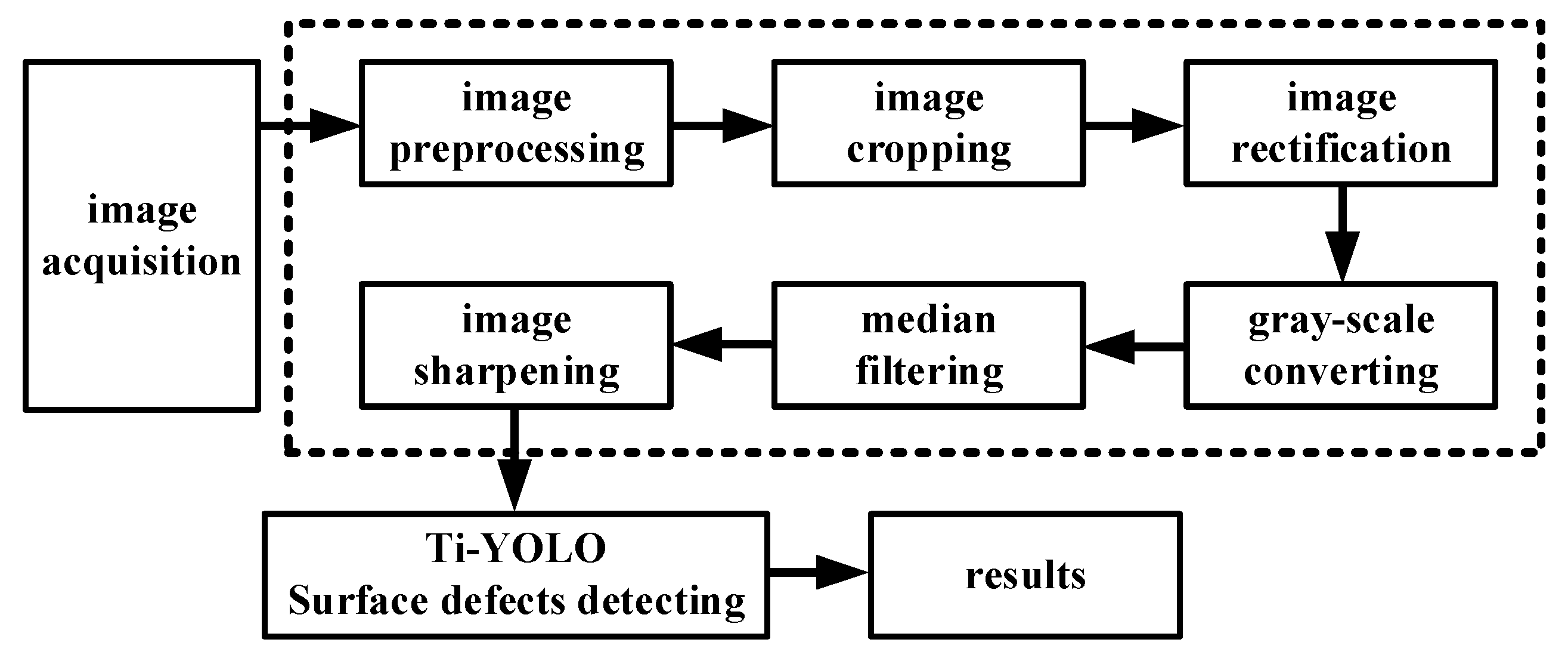
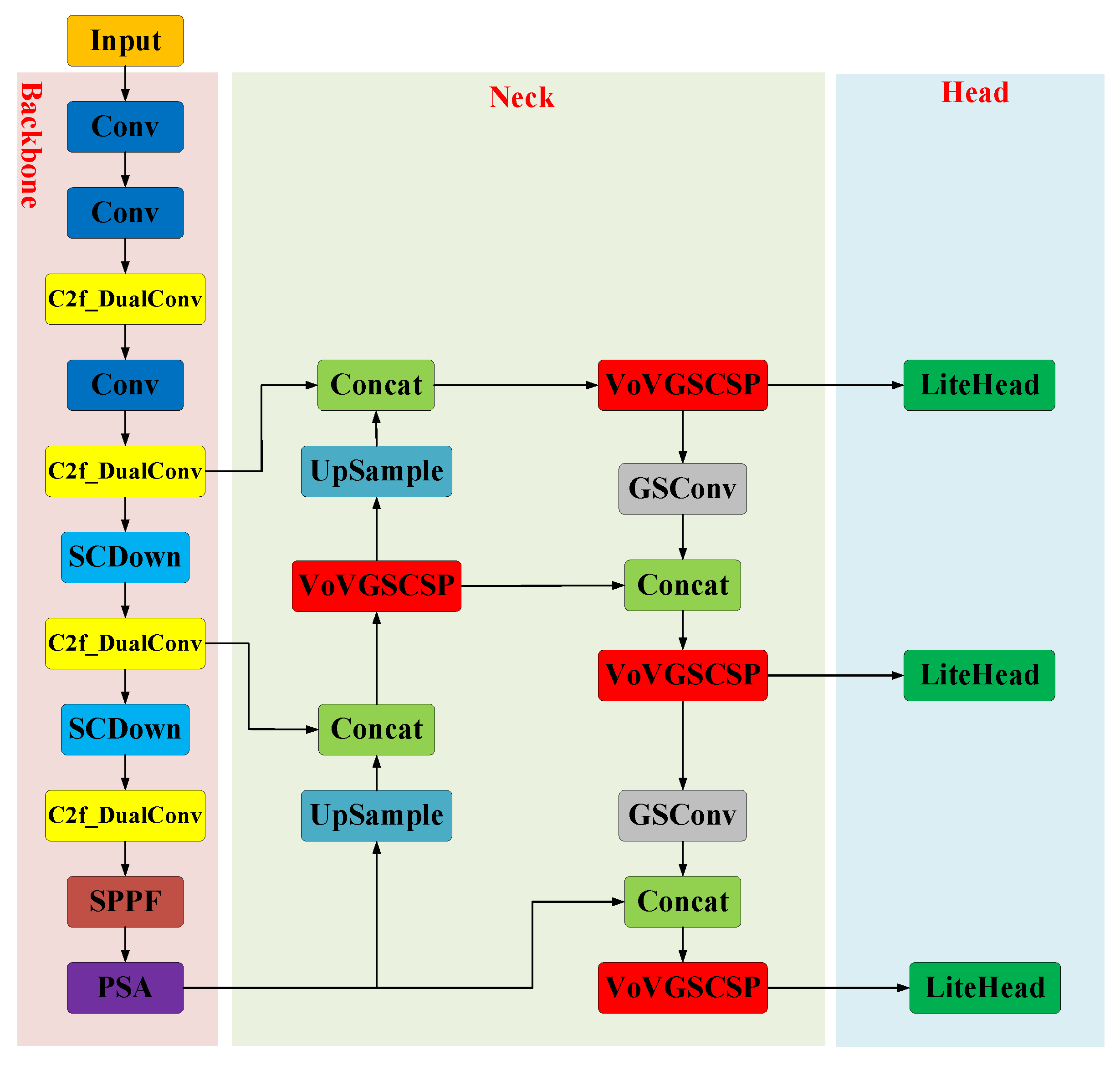
2.1. Optical Detection of Surface Defects
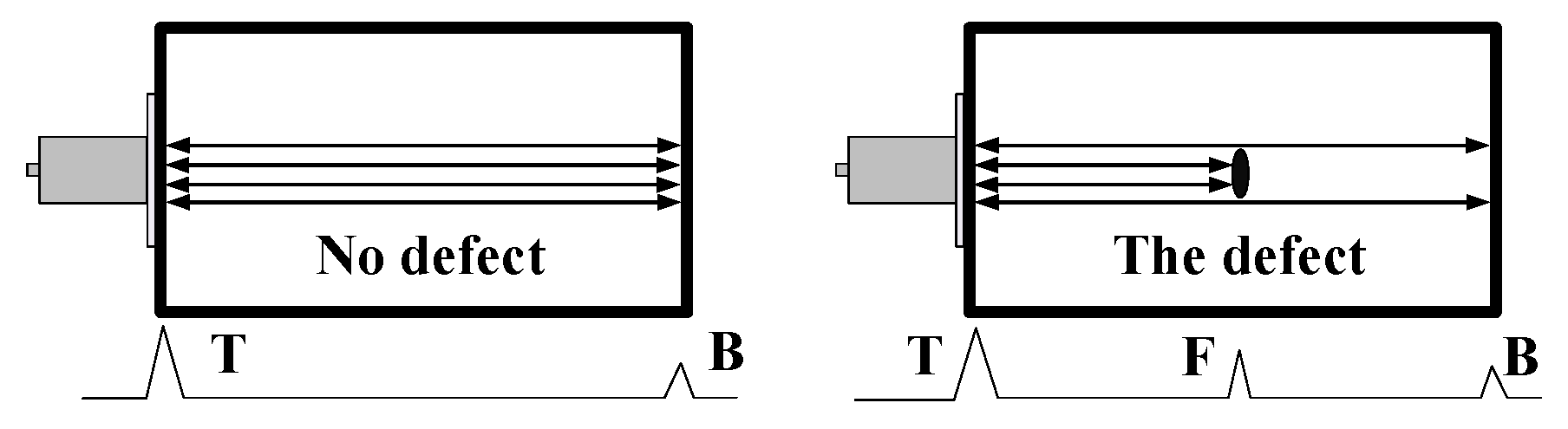
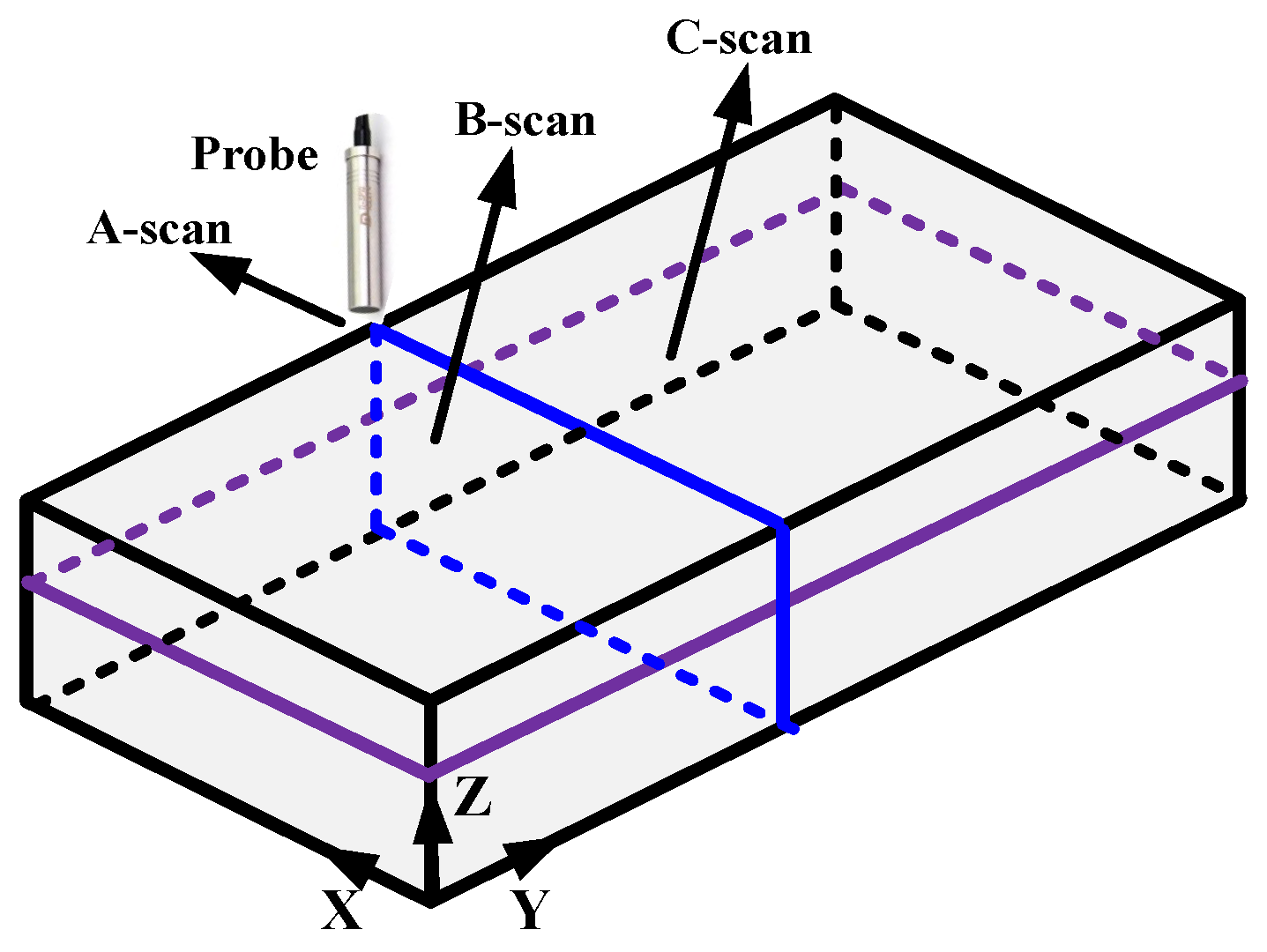
2.2. Acoustic Detection of Internal Defects
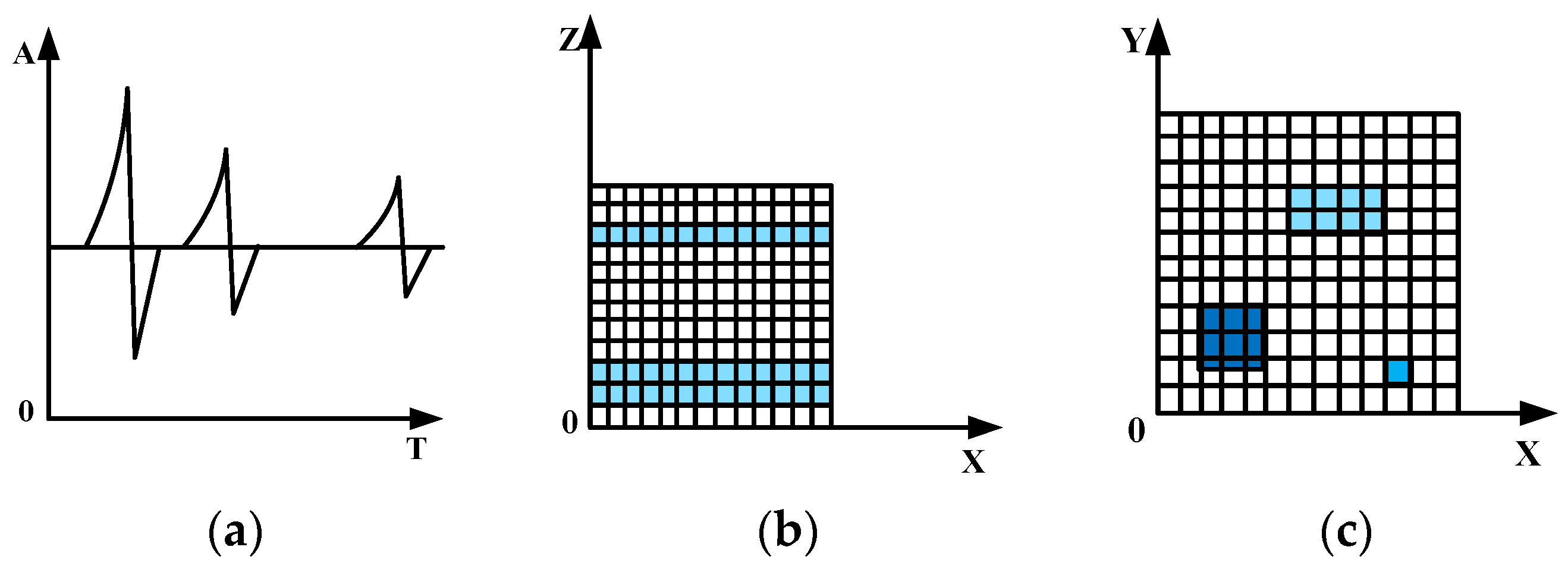
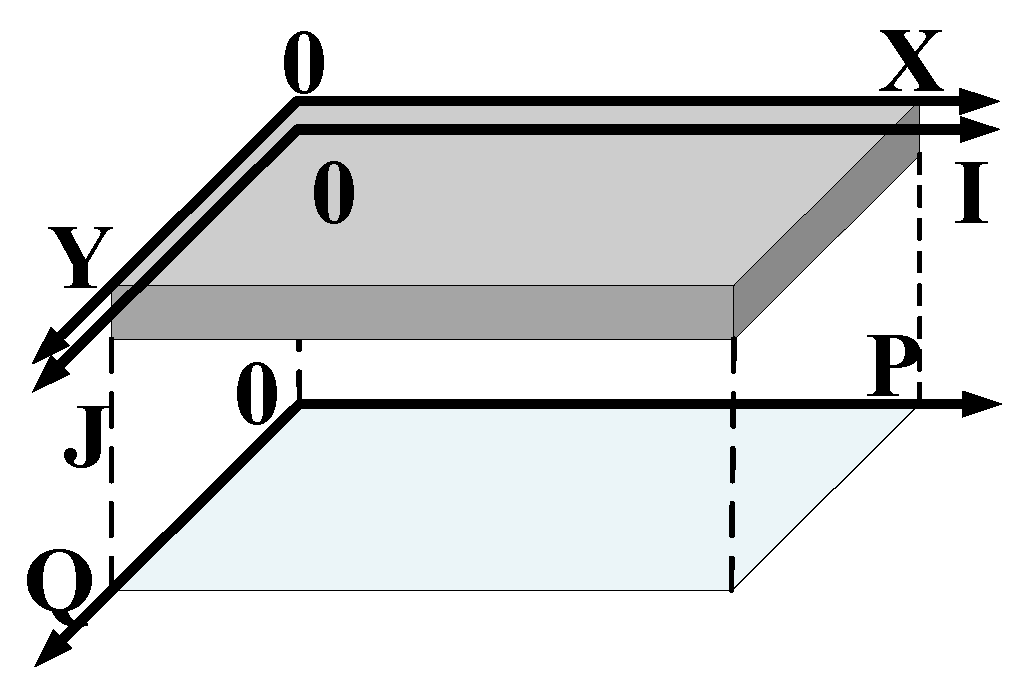
2.3. Technology of Optical–Acoustic Image Information Fusion
| Algorithm 1. The flow of optical–acoustic image fusion titanium alloy defect detection |
| (1) Input the optical surface detection image and data of the titanium alloy. |
| (2) Input the image and data of titanium alloy acoustic internal detection. |
| (3) Generate the fusion background field according to the surface detection image. |
| (4) The optical surface detection image and data results are vertically projected to the fusion background field. |
| (5) The spatial registration of optical and acoustic detection image information fusion in the background field is completed by using coordinate mapping technology. |
| (6) Output fusion detection results. |
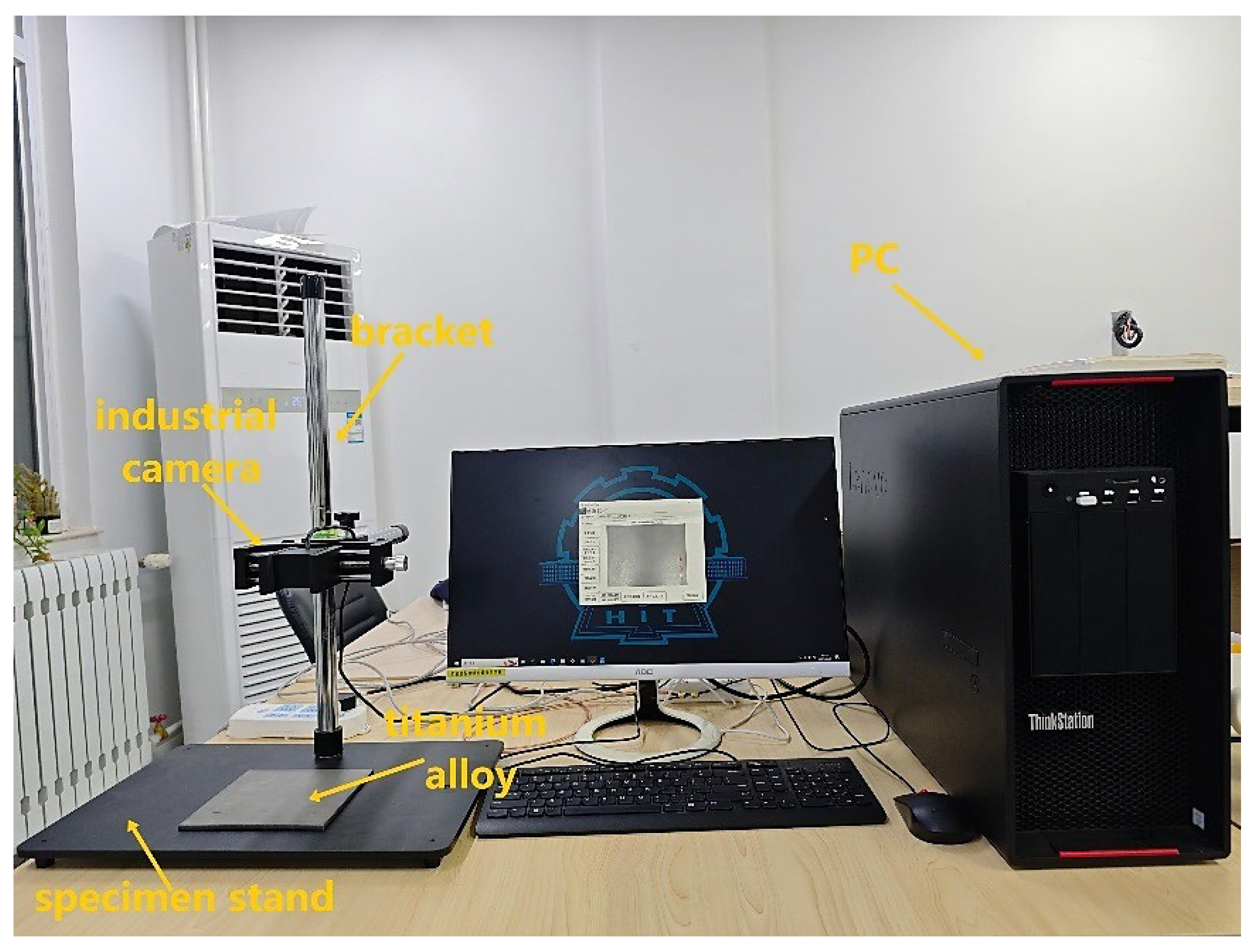
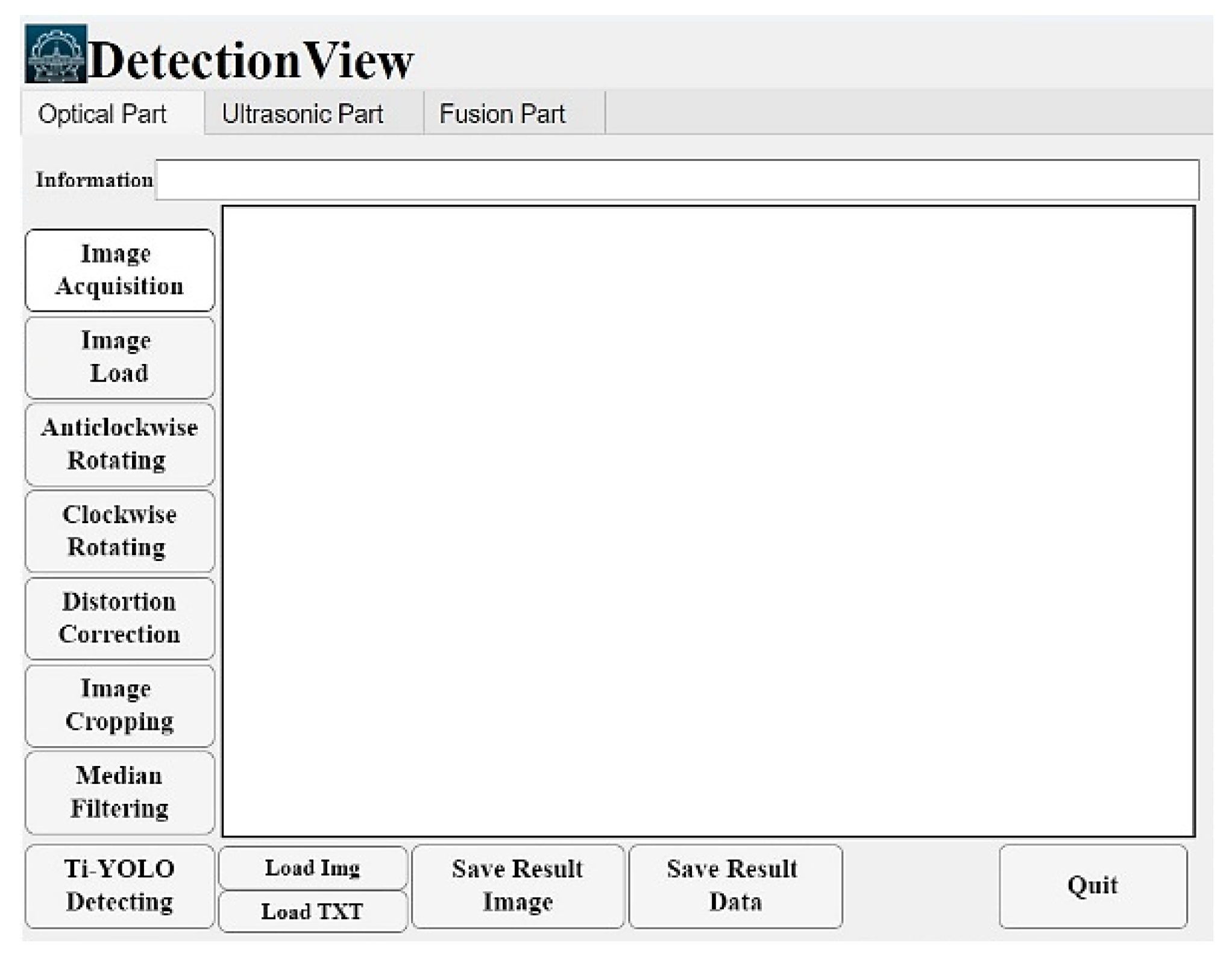
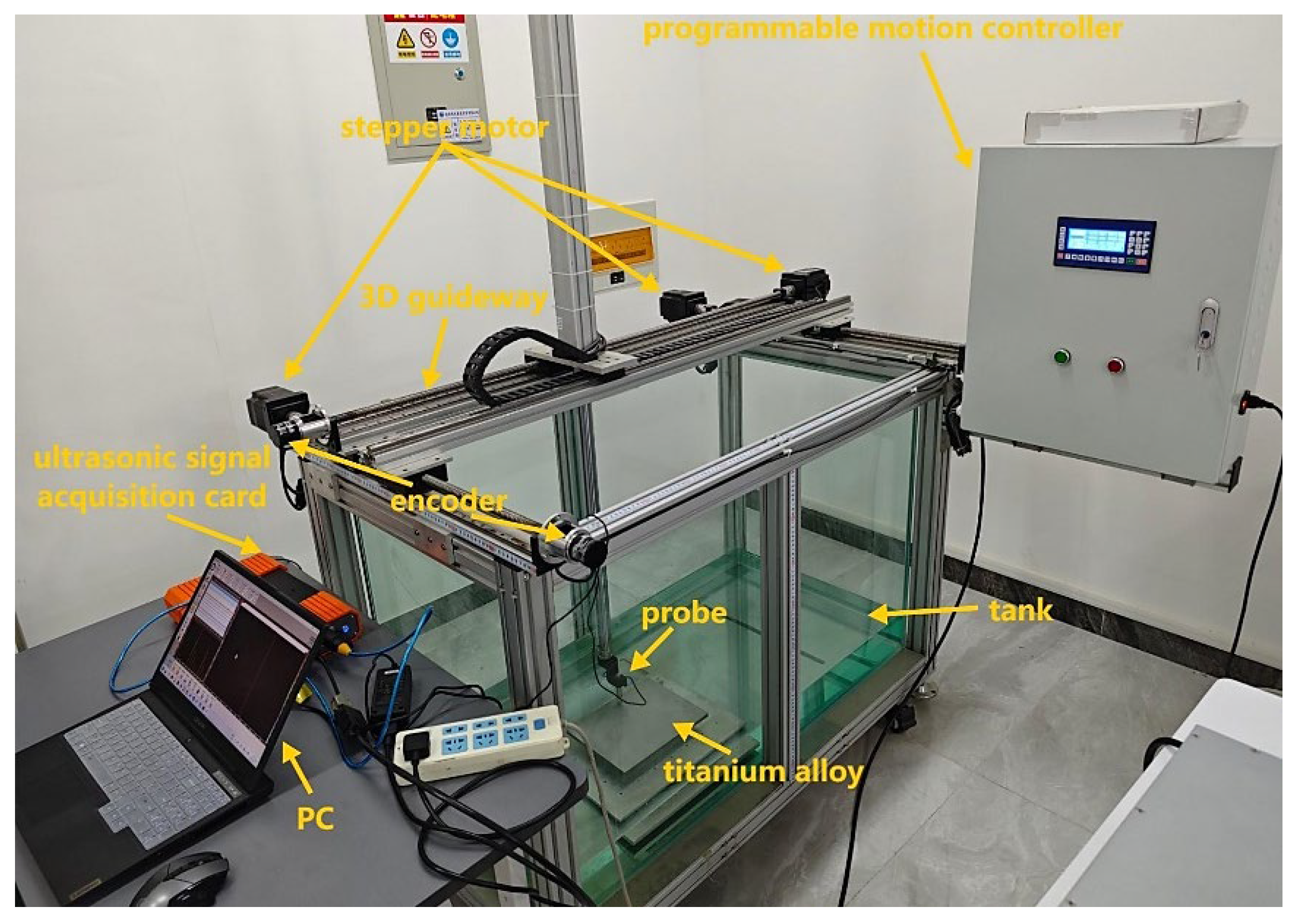
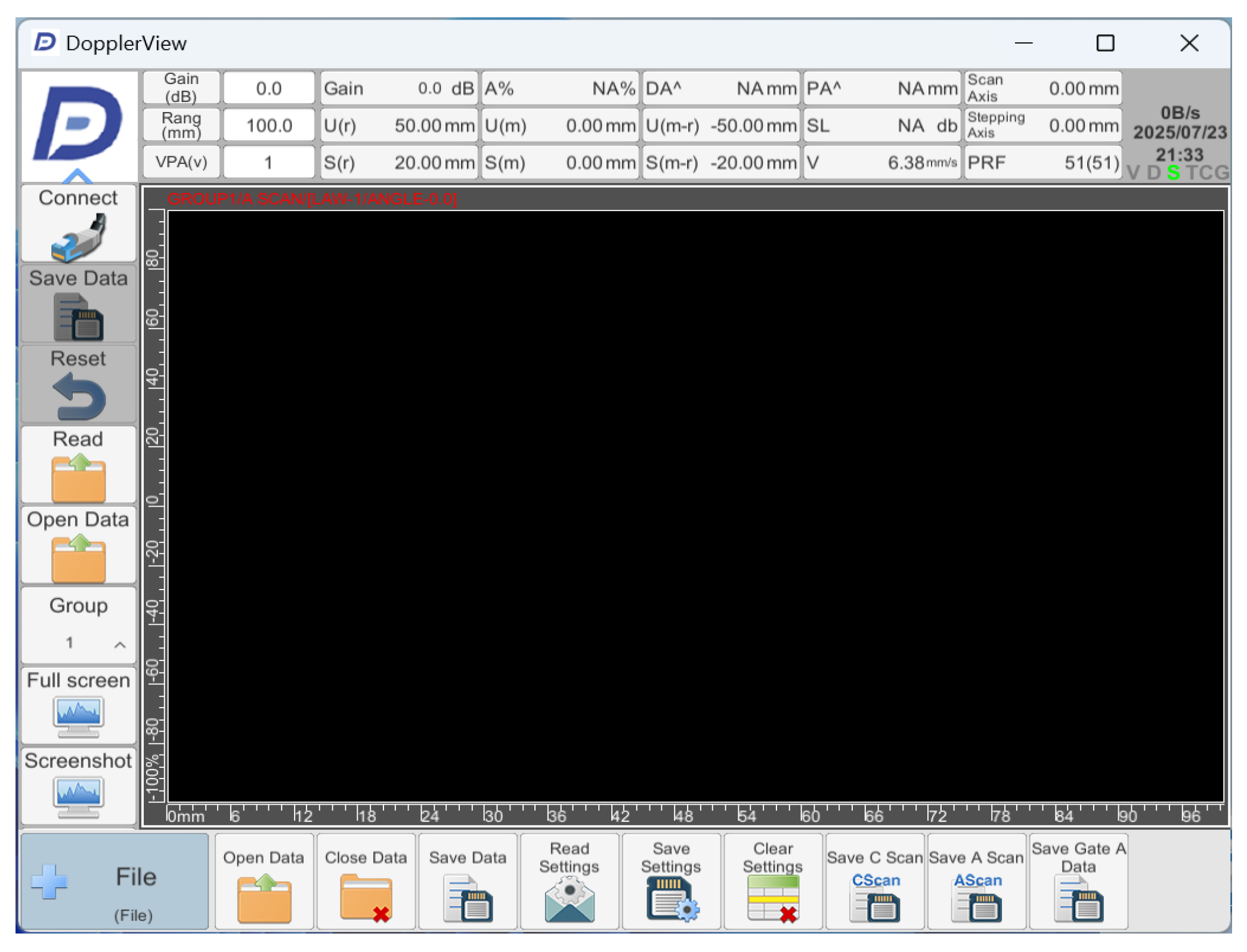
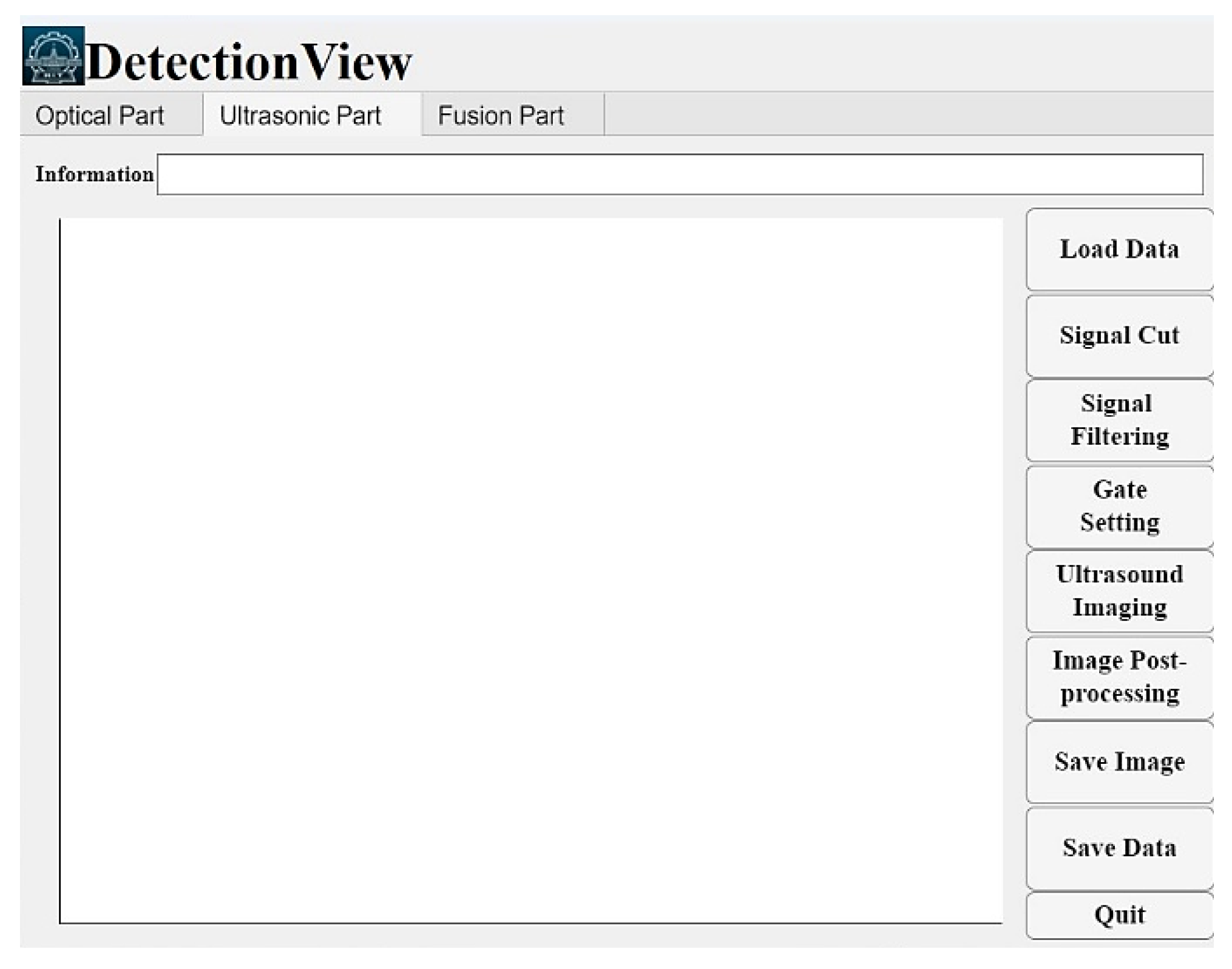
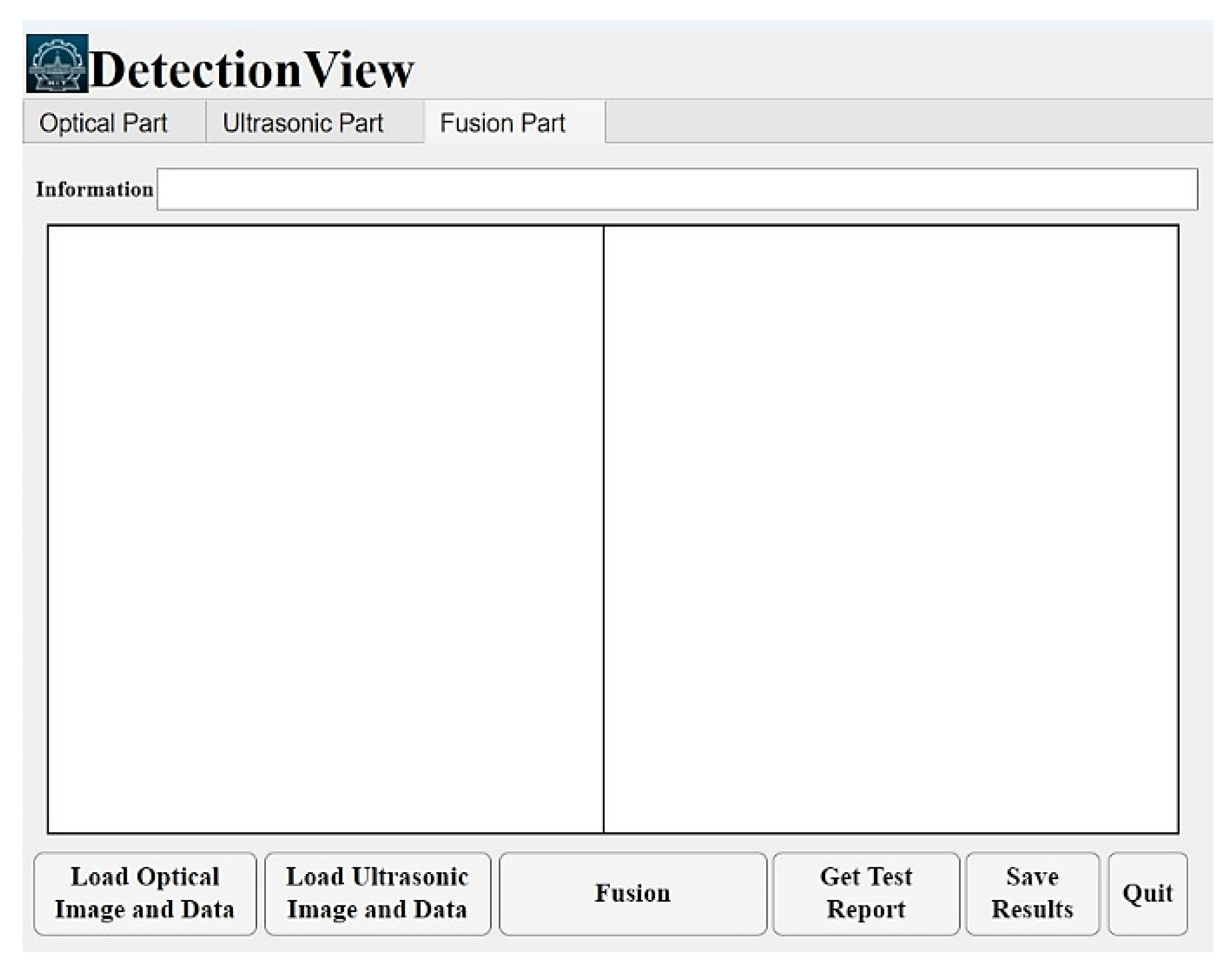
3. Experiment Systems
4. Practical Experiment
4.1. Experiment Setup
4.2. Results and Analysis
5. Discussion
6. Conclusions
Author Contributions
Funding
Institutional Review Board Statement
Informed Consent Statement
Data Availability Statement
Conflicts of Interest
Abbreviations
| YOLO | You only look once |
| NDT | Nondestructive testing |
| CCD | Charge-coupled device |
References
- Zhao, Y.Q.; Ge, P.; Xin, S.W. Research and development progress of titanium alloy materials in recent five years. Mater. China 2020, 39, 527–534. [Google Scholar]
- Wang, Y.; Zhou, X.F. Research front and trend of specific laser additive manufacturing techniques. Laser Technol. 2021, 45, 475–484. [Google Scholar]
- Bao, X.M.; Wang, S.Q. An overview of target detection algorithms based on deep learning. Transducer Microsyst. Technol. 2022, 41, 5–9. [Google Scholar]
- Xie, W.N.; Ma, W.F.; Sun, X.Y. An efficient re-parameterization feature pyramid network on YOLOv8 to the detection of steel surface defect. Neurocomputing 2025, 614, 128775. [Google Scholar] [CrossRef]
- Zhao, Y.F.; Song, W.H.; Liu, X.L. Rail defect detection method based on improved YOLOv7. Electron. Meas. Technol. 2024, 47, 177–185. [Google Scholar]
- Li, J.W.; Chen, J.M. Nondestructive Testing Manua, 1st ed.; China Machine Press: Beijing, China, 2001; pp. 2–15. [Google Scholar]
- Ban, R.; Zhang, R.F.; Tao, Z.Y. Laser ultrasonic nondestructive testing of small defects in metals using multi-channel fiber interference. Chin. J. Lasers 2024, 51, 152–160. [Google Scholar]
- De, S.; Gupta, K.; Stanley, R.J. A comprehensive structural analysis process for failure assessment in aircraft lap-joint mimics using intramodal fusion of eddy current data. Res. Nondestruct. Eval. 2012, 23, 146–170. [Google Scholar] [CrossRef]
- Canil, M.; Pegoraro, J.; Rossi, M. milliTRACE-IR: Contact tracing and temperature screening via mmWave and infrared sensing. IEEE J. Sel. Top. Signal Process. 2022, 16, 208–223. [Google Scholar] [CrossRef]
- Xiong, G.M.; Luo, Z.; Sun, D. Target detection and tracking of smoke obscured driverless vehicles based on fusion of infrared camera and millimeter wave radar. J. Mil. Ind. 2024, 45, 893–906. [Google Scholar]
- Sun, M.J.; Liu, T.; Cheng, X.Z. Nondestructive testing method of metal material defects based on multi-model signals. Acta Phys. Sin. 2016, 65, 227–240. [Google Scholar]
- Redmon, J.; Divvala, S.; Girshick, R. You only look once: Unified real-time object detection. In Proceedings of the Computer Vision and Pattern Recognition, Las Vegas, NV, USA, 12 December 2016. [Google Scholar]
- Redmon, J.; Farhadi, A. YOLO9000: Better, Faster, Stronger. IEEE 2017, 1, 6517–6525. [Google Scholar]
- Redmon, J.; Farhadi, A. YOLOv3: An incremental improvement. arXiv 2018, arXiv:1804.02767. [Google Scholar]
- Bochkovskiy, A.; Wang, C.Y. YOLOv4: Optimal speed and accuracy of object detection. arXiv 2020, arXiv:2004.10934. [Google Scholar]
- Li, C.Y.; Jia, H.L. YOLOv6: A single-stage object detection framework for industrial applications. arXiv 2022, arXiv:2209.02976. [Google Scholar]
- Wang, C.Y.; Bochkovskiy, A.; Liao, H.Y.M. YOLOv7: Trainable bag-of-freebies sets new state of the art for real-time object detectors. arXiv 2022, arXiv:2207.02696. [Google Scholar]
- Wang, C.Y.; Ye, H.; Liao, H.Y.M. YOLOv9: Learning what you want to learn using programmable gradient information. In Proceedings of the European Conference on Computer Vision (ECCV), Milan, Italy, 29 September–4 October 2024. [Google Scholar]
- Wang, A. YOLOv10: Real-time end-to-end object detection. arXiv 2024, arXiv:2405.14458. [Google Scholar]
- Shen, H.W.; Fu, M.M. Optical element surface roughness measurement system based on image preprocessing. Laser J. 2024, 42, 252–256. [Google Scholar]
- Gong, J.Y.; Fu, W.H.; Liu, N.A. Design of preprocessing module for SAR image target contour enhancement. Syst. Eng. Electron. 2024, 46, 4010–4017. [Google Scholar]
- Wu, L.; Hao, H.Y.; Song, Y. Review of industrial metal surface defect detection based on computer vision. Acta Autom. Sin. 2024, 50, 1261–1283. [Google Scholar]
- Wang, X.C.; Peng, F.L.; Li, X.Y. Infrared target detection algorithm based on improved Faster R-CNN. J. Appl. Opt. 2024, 45, 346–353. [Google Scholar] [CrossRef]
- Qin, H.; Li, Y.J.; Liang, Q. K Asymmetric geometric correction network for document images. J. Image Graph. 2023, 28, 2314–2329. [Google Scholar]
- Liu, T. Research on Multi-Object Tracking Technology Based on Infrared and Radar Fusion. Master’s Thesis, Harbin Institute of Technology, Harbin, China, 1 May 2023. [Google Scholar]
- Shang, H.; Sun, L.B.; Qin, W.H. Pedestrian detection at night based on fusion of infrared camera and millimeter wave radar. Chin. J. Sens. Actuators 2021, 34, 1137–1145. [Google Scholar]
- Kong, S.; Gan, L.; Wang, R. Target tracking algorithm of radar and infrared sensor based on multi-source information fusion. In Proceedings of the 2022 International Conference on Artificial Intelligence, Information Processing and Cloud Computing (AIIPCC), Kunming, China, 19–21 August 2022. [Google Scholar]
- Wang, Q.R.; Tian, X.Y.; Li, D.C. Multimodal soft jumping robot with self-decision ability. Smart Mater. Struct. 2021, 30, 085038. [Google Scholar] [CrossRef]
- Masalkhi, M.; Ong, J.; Waisberg, E. Google DeepMind’s gemini AI versus ChatGPT: A comparative analysis in ophthalmology. Eye 2024, 38, 1412–1417. [Google Scholar] [CrossRef] [PubMed]
- Sandler, M.; Howard, A.; Zhu, M. MobileNetV2: Inverted residuals and Linear Bottlenecks. arXiv 2018, arXiv:1801.04381. [Google Scholar]



| Setting | Parameter |
|---|---|
| Operating system | Windows 10 |
| CPU | Intel Xeon Sliver 4210R |
| GPU | NVIDIA RTX A5000 |
| RAM | 24 G |
| Deep learning framework | Pytorch 2.0.1 |
| GPU general parallel computing architecture | CUDA 11.7 |
| Programming language | Python 3.9 |
| Neural network library | CUDNN 8500 |
| Setting | Parameter |
|---|---|
| optimization algorithm | random gradient descent |
| lr0 | 0.01 |
| lrf | 0.01 |
| momentum | 0.937 |
| weight decay | 0.0005 |
| confidence | 0.25 |
| IoU | 0.7 |
| works | 8 |
| mosaic | off |
| pretraining model | off |
| epochs | 200 |
| batch size | 16 |
| image size | 640 × 640 |
| No | Type | Frequency (MHz) | Wafer Diameter (mm) | Focal Distance (mm) |
|---|---|---|---|---|
| 1 | non-focused | 5 | 10 | |
| 2 | non-focused | 15 | 15 | |
| 3 | non-focused | 20 | 20 | |
| 4 | focused | 5 | 10 | 50 |
| 5 | focused | 10 | 10 | 60 |
| 6 | focused | 20 | 6 | 60 |
| 7 | focused | 25 | 6 | 25 |
| No | Data 1 | Data 2 | Data 3 | Data 4 | Data 5 | Data 6 |
|---|---|---|---|---|---|---|
| 1 | 0 | 0.925583 | 0.579705 | 0.029259 | 0.067535 | 0.771795 |
| 2 | 0 | 0.925583 | 0.879900 | 0.020425 | 0.065595 | 0.733762 |
| 3 | 0 | 0.924944 | 0.728856 | 0.024445 | 0.064646 | 0.643998 |
| No | Type | Position(mm) | Length(mm) |
|---|---|---|---|
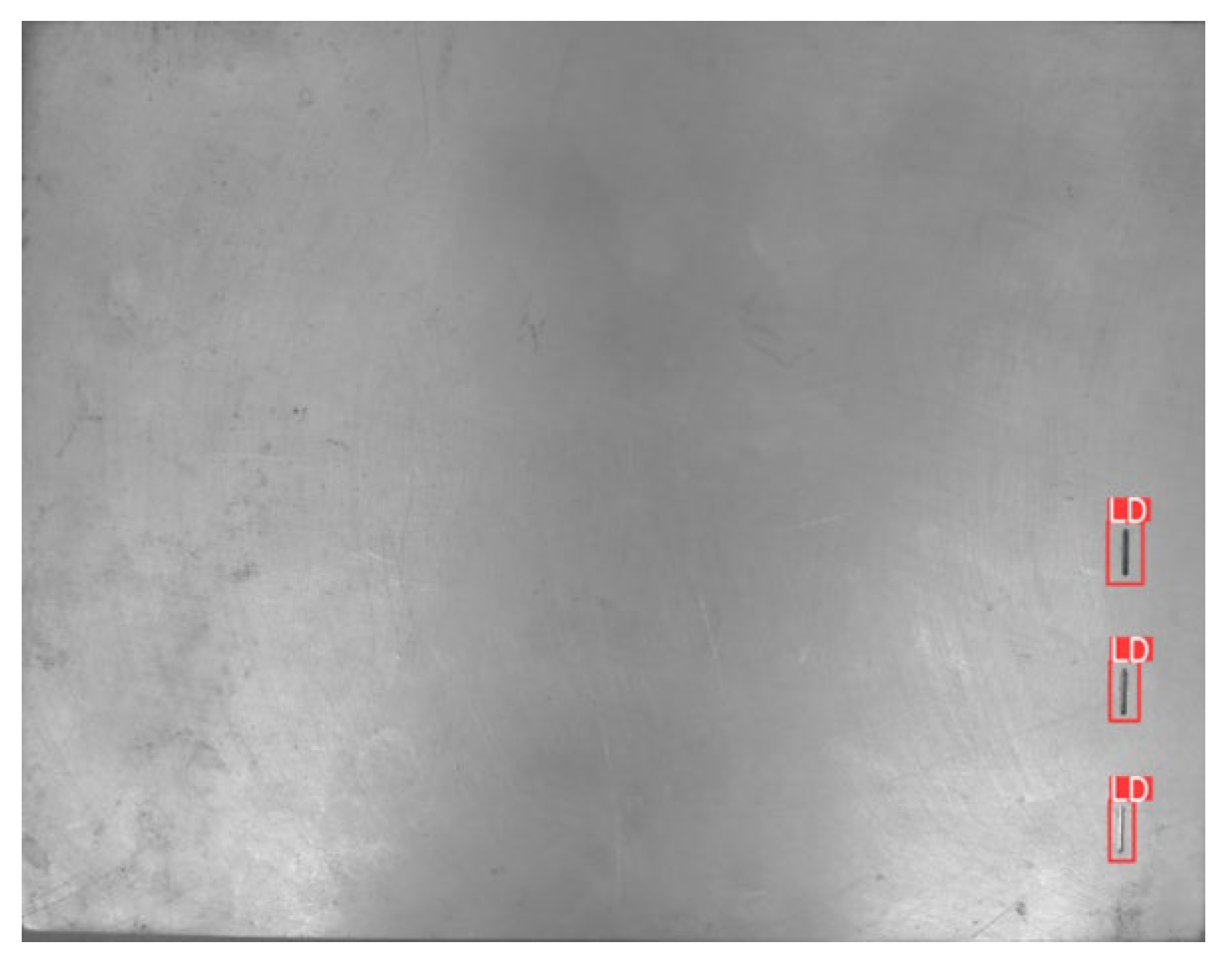
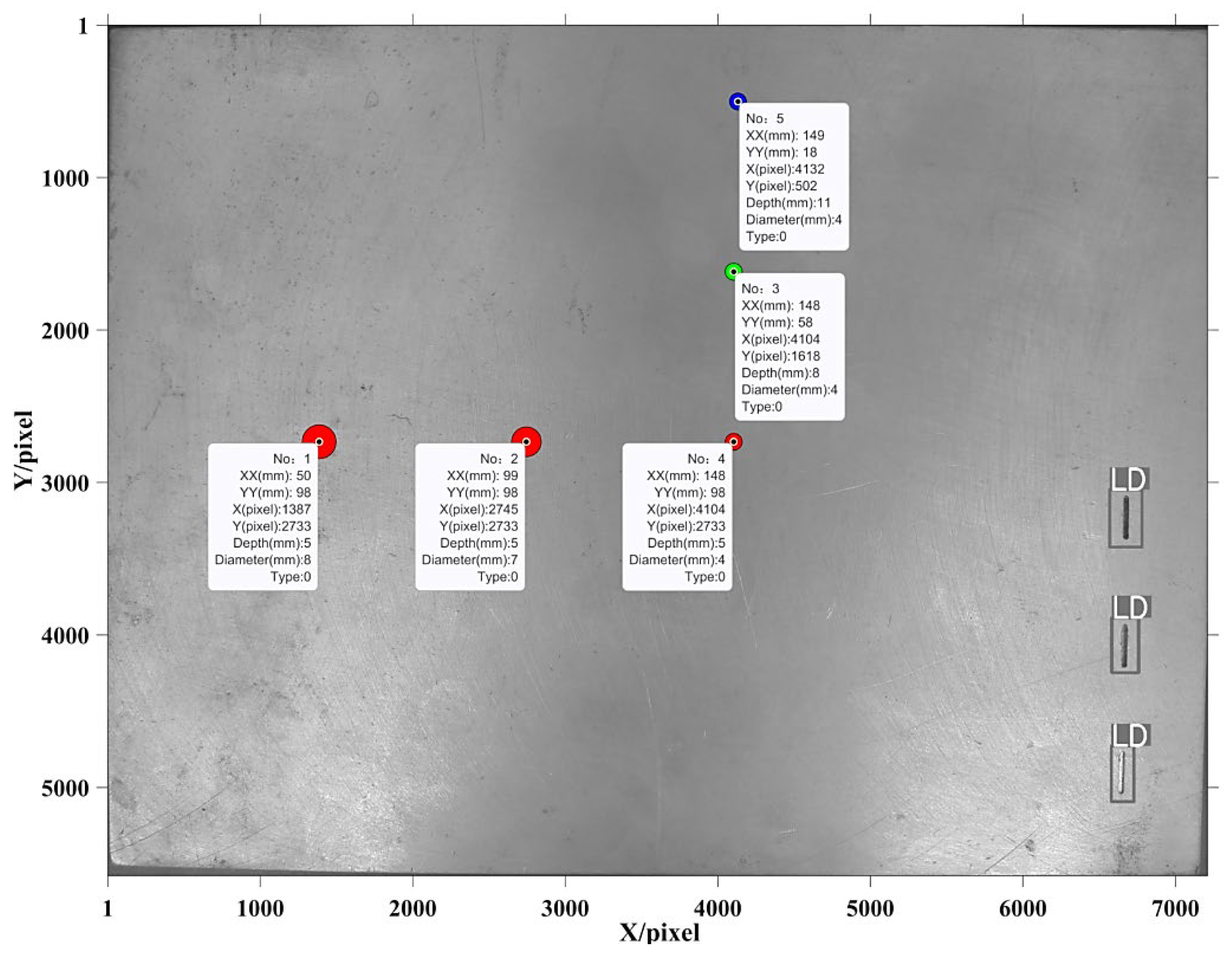
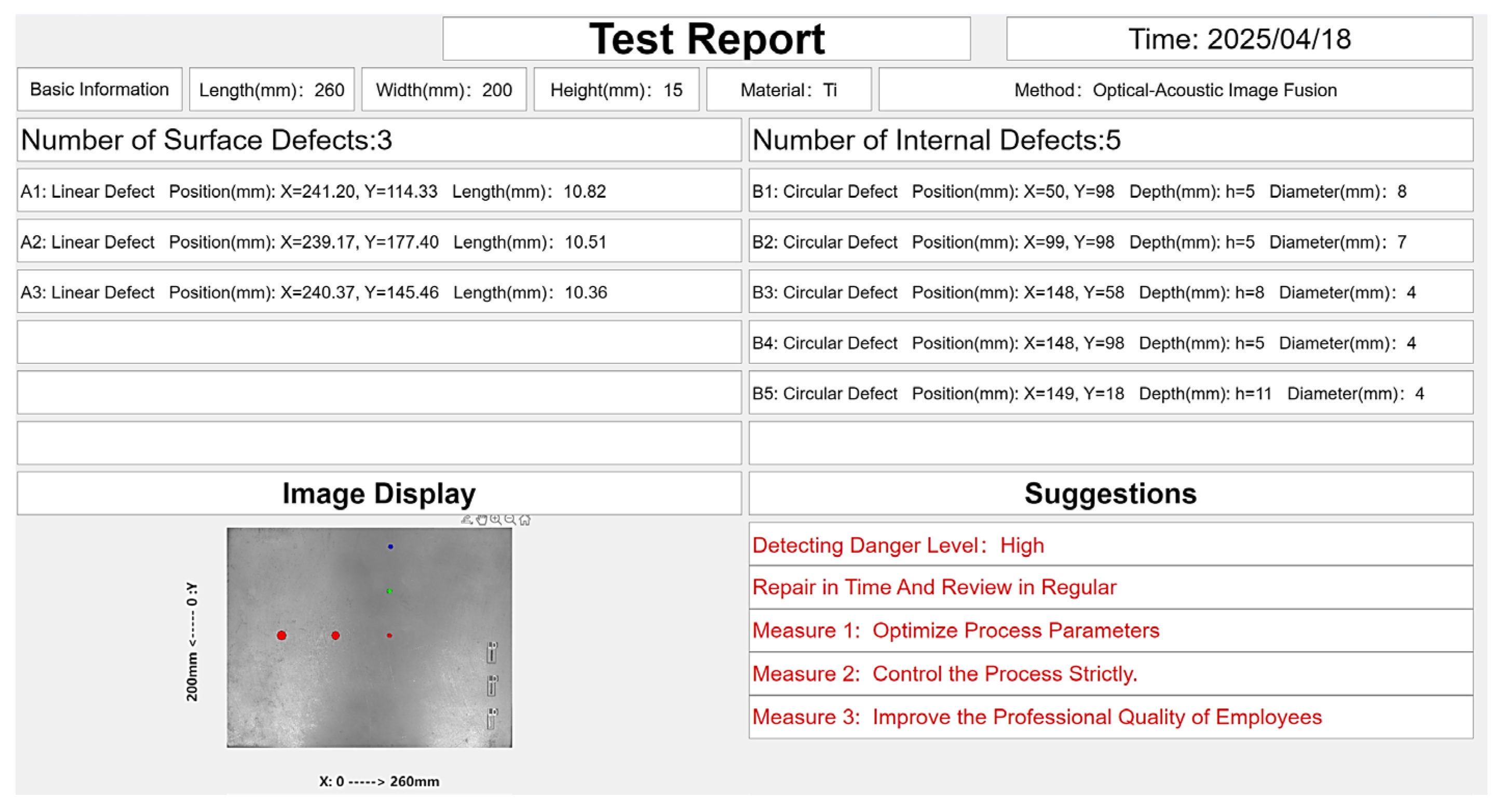
| 1 | line defect | X = 241.19, Y = 114.32 | 10.82 |
| line defect | X = 240, Y = 115 | 10 | |
| 2 | line defect | X = 240.36, Y = 145.46 | 10.35 |
| line defect | X = 240, Y = 145 | 10 | |
| 3 | line defect | X = 239.17, Y = 177.40 | 10.50 |
| line defect | X = 240, Y = 175 | 10 | |
| absolute error |
| No | Type | Position(mm) | Diameter(mm) | Depth(mm) |
|---|---|---|---|---|
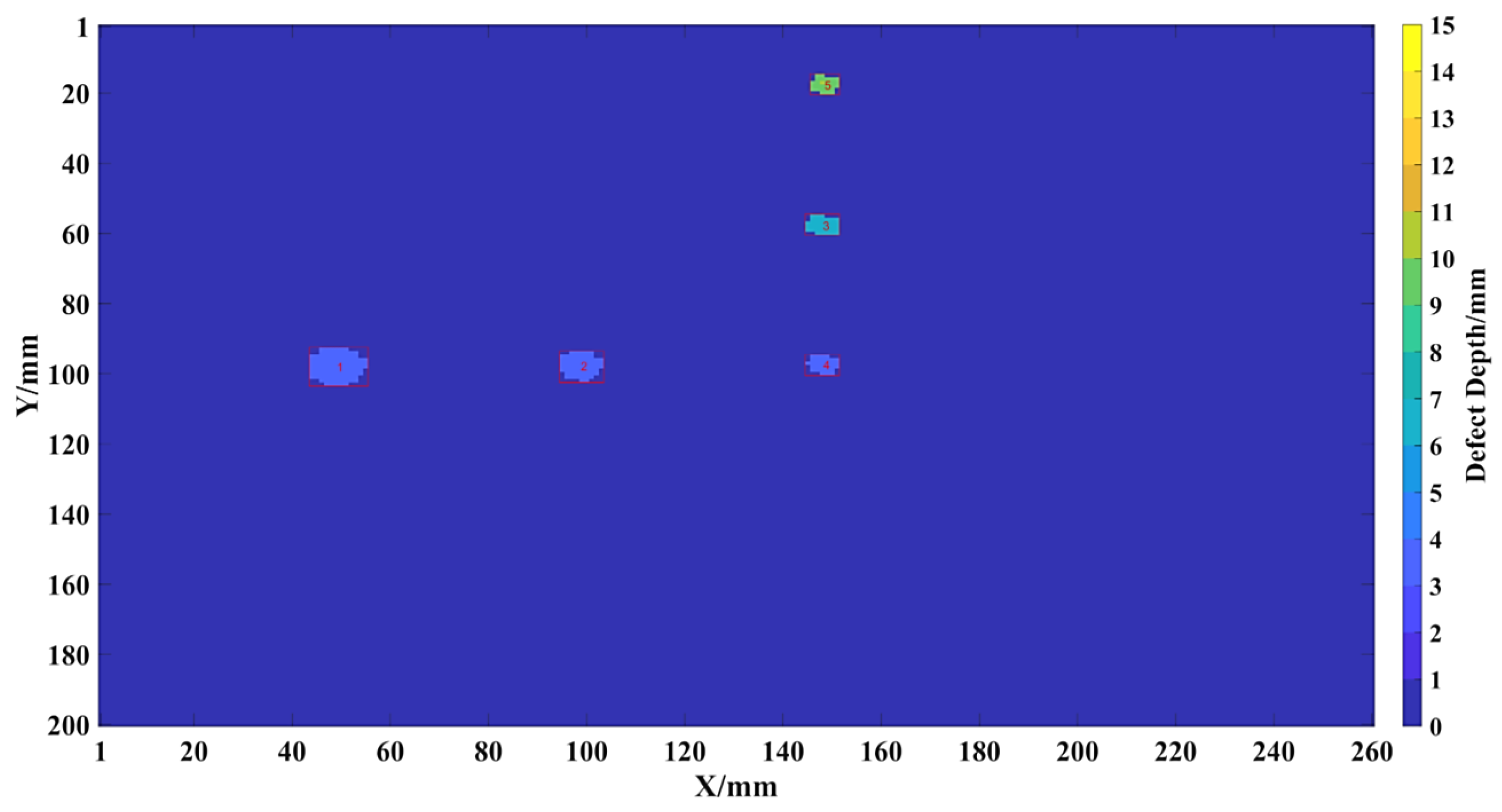
| 1 | circle | X = 50, Y = 100 | 8 | 5 |
| circle | X = 50, Y = 98 | 8 | 5 | |
| 2 | circle | X = 100, Y = 100 | 6 | 5 |
| circle | X = 99, Y = 98 | 7 | 5 | |
| 3 | circle | X = 150, Y = 60 | 4 | 8 |
| circle | X = 148, Y = 58 | 4 | 8 | |
| 4 | circle | X = 150, Y = 100 | 4 | 5 |
| circle | X = 148, Y = 98 | 4 | 5 | |
| 5 | circle | X = 150, Y = 20 | 4 | 11 |
| circle | X = 149, Y = 18 | 4 | 11 | |
| absolute error |
Disclaimer/Publisher’s Note: The statements, opinions and data contained in all publications are solely those of the individual author(s) and contributor(s) and not of MDPI and/or the editor(s). MDPI and/or the editor(s) disclaim responsibility for any injury to people or property resulting from any ideas, methods, instructions or products referred to in the content. |
© 2025 by the authors. Licensee MDPI, Basel, Switzerland. This article is an open access article distributed under the terms and conditions of the Creative Commons Attribution (CC BY) license (https://creativecommons.org/licenses/by/4.0/).
Share and Cite
Wang, M.; Zhao, Y.; Huang, Y.; Zhao, G. A Titanium Alloy Defect Detection Method Based on Optical–Acoustic Image Fusion. Appl. Sci. 2025, 15, 8294. https://doi.org/10.3390/app15158294
Wang M, Zhao Y, Huang Y, Zhao G. A Titanium Alloy Defect Detection Method Based on Optical–Acoustic Image Fusion. Applied Sciences. 2025; 15(15):8294. https://doi.org/10.3390/app15158294
Chicago/Turabian StyleWang, Mingzhen, Yang Zhao, Yufeng Huang, and Gang Zhao. 2025. "A Titanium Alloy Defect Detection Method Based on Optical–Acoustic Image Fusion" Applied Sciences 15, no. 15: 8294. https://doi.org/10.3390/app15158294
APA StyleWang, M., Zhao, Y., Huang, Y., & Zhao, G. (2025). A Titanium Alloy Defect Detection Method Based on Optical–Acoustic Image Fusion. Applied Sciences, 15(15), 8294. https://doi.org/10.3390/app15158294