Communication

Enrichment of Spatial eGenes Colocalized with Type 2 Diabetes Mellitus Genome-Wide Association Study Signals in the Lysosomal Pathway

School of Systems Biomedical Science and Integrative Institute of Basic Science, Soongsil University, 369 Sangdo-ro, Dongjak-gu, Seoul 06978, Republic of Korea
*
Author to whom correspondence should be addressed.
Appl. Sci. 2023, 13(18), 10447; https://doi.org/10.3390/app131810447
Submission received: 27 July 2023 / Revised: 8 September 2023 / Accepted: 15 September 2023 / Published: 19 September 2023
(This article belongs to the Special Issue Data Science for Medical Informatics 2nd Edition)

Abstract

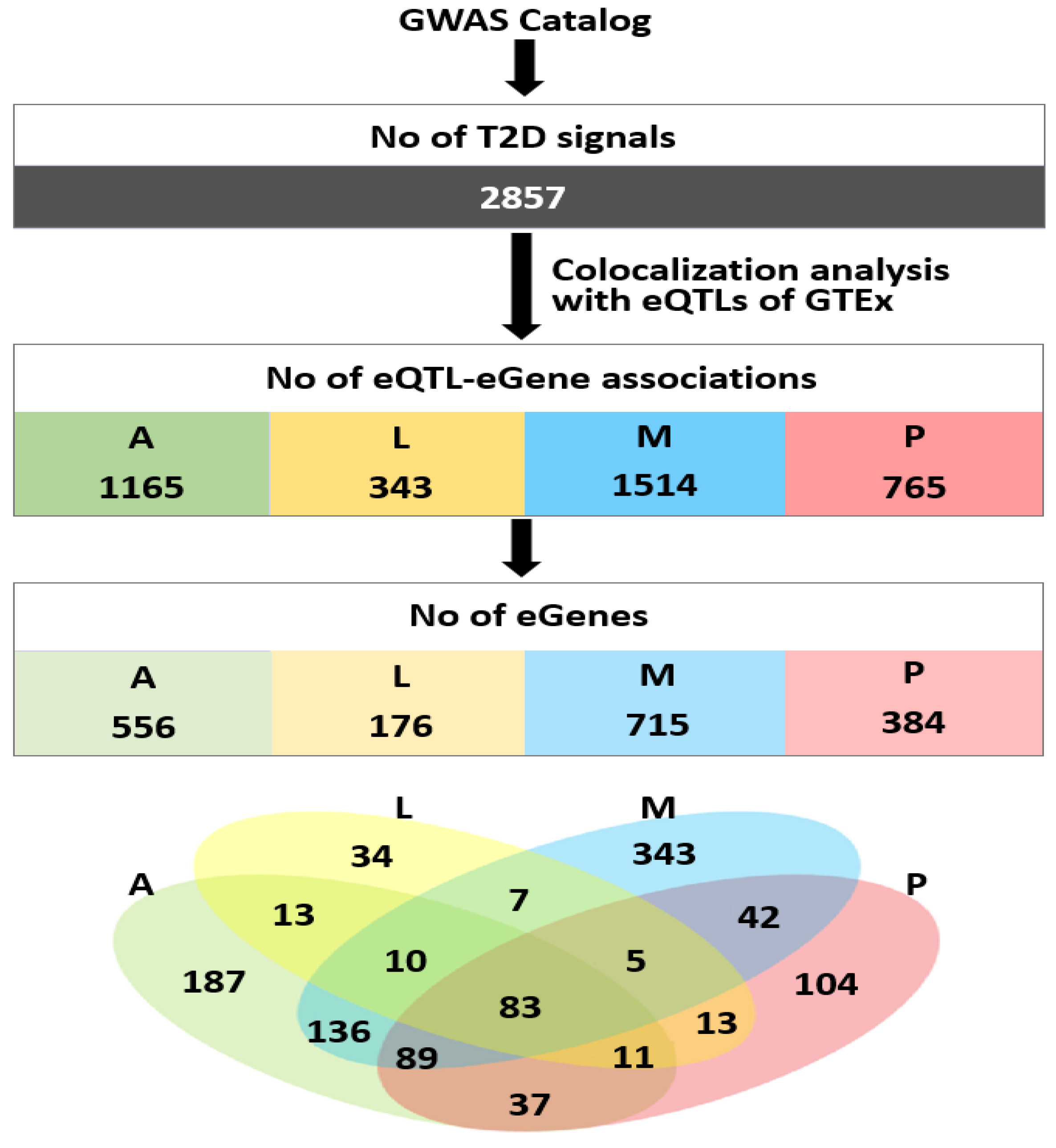
Genome-wide association studies (GWAS) have identified genetic markers associated with type 2 diabetes mellitus (T2DM). Additionally, tissue-specific expression quantitative trait loci (eQTL) studies have revealed regulatory elements influencing gene expression in specific tissues. We performed enrichment analyses using spatial eGenes corresponding to known T2DM GWAS signals to uncover T2DM pathological pathways. T2DM GWAS signals were obtained from the GWAS Catalog, and spatial eQTL data from T2DM-associated tissues, including visceral adipose tissue, liver, skeletal muscle, and pancreas, were sourced from the Genotype-Tissue Expression Consortium. The eGenes were enriched in Kyoto Encyclopedia of Genes and Genomes biological pathways using the Benjamini–Hochberg method. Colocalization analysis of 2857 independent T2DM GWAS signals identified 556 eGenes in visceral adipose tissue, 176 in liver, 715 in skeletal muscle, and 384 in pancreas (PFDR < 0.05 where PFDR is the false discovery rate). These eGenes showed enrichment in various pathways (PBH < 0.05 where PBH is the corrected P for the Benjamini–Hochberg multiple testing), especially the lysosomal pathway in pancreatic tissue. Unlike the mTOR pathway in T2DM autophagy dysregulation, the role of lysosomes remains poorly understood. The enrichment analysis of spatial eGenes associated with T2DM GWAS signals highlights the importance of the lysosomal pathway in autophagic termination. Thus, investigating the processes involving autophagic termination associated with lysosomes is a priority for understanding T2DM pathogenesis.
Keywords: autophagy; enrichment analysis; expression gene; lysosome; type 2 diabetes autophagy; enrichment analysis; expression gene; lysosome; type 2 diabetes