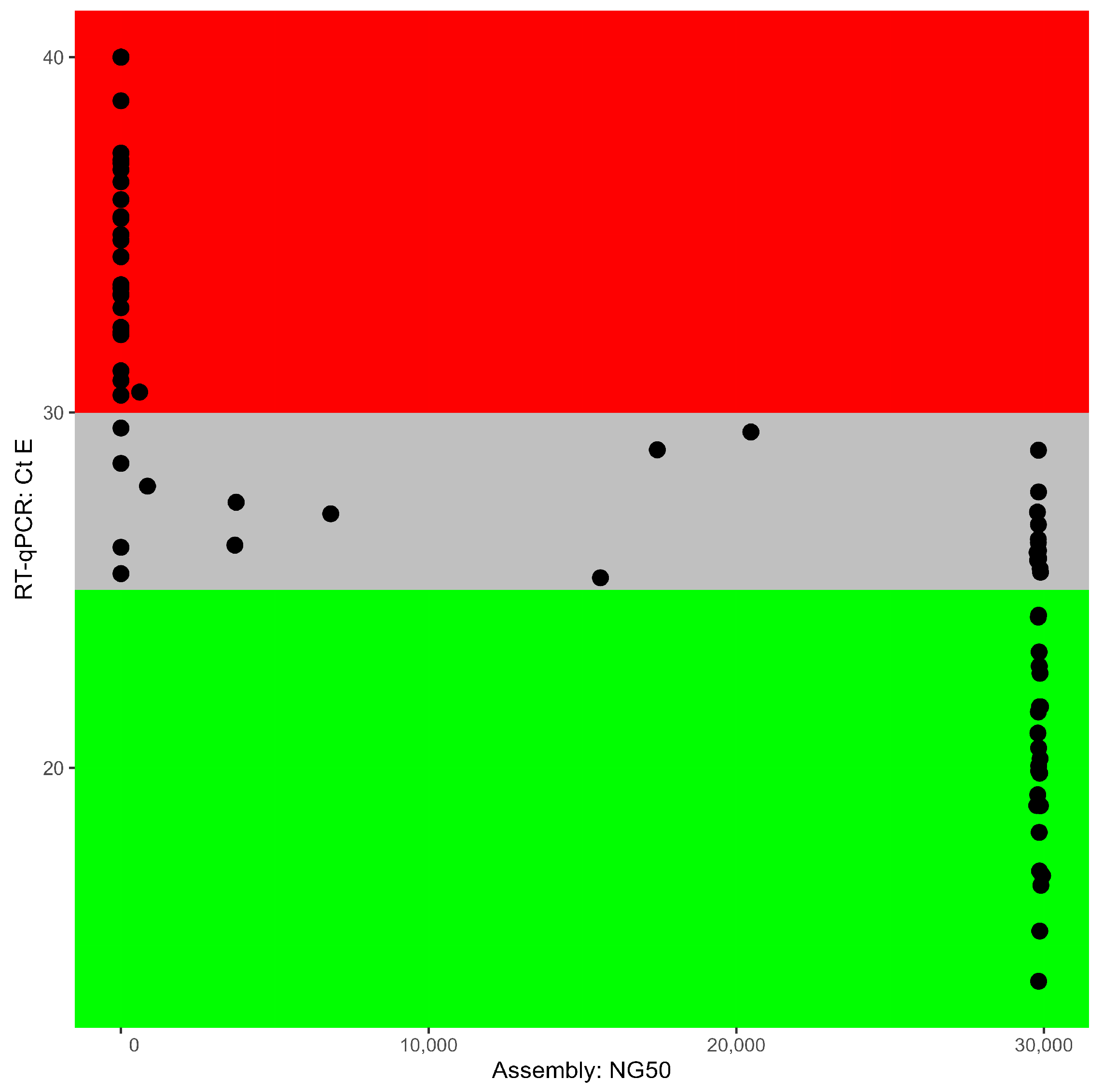
Ct Value from RT-qPCR Can Predict SARS-CoV-2 Virus Assembly and Lineage Assignment Success

 , ,
, , Featured Application
Abstract
Share and Cite
Hadzega, D.; Babisová, K.; Hyblová, M.; Janostiaková, N.; Sabaka, P.; Janega, P.; Minarik, G. Ct Value from RT-qPCR Can Predict SARS-CoV-2 Virus Assembly and Lineage Assignment Success. Appl. Sci. 2023, 13, 10431. https://doi.org/10.3390/app131810431
Hadzega D, Babisová K, Hyblová M, Janostiaková N, Sabaka P, Janega P, Minarik G. Ct Value from RT-qPCR Can Predict SARS-CoV-2 Virus Assembly and Lineage Assignment Success. Applied Sciences. 2023; 13(18):10431. https://doi.org/10.3390/app131810431
Chicago/Turabian StyleHadzega, Dominik, Klaudia Babisová, Michaela Hyblová, Nikola Janostiaková, Peter Sabaka, Pavol Janega, and Gabriel Minarik. 2023. "Ct Value from RT-qPCR Can Predict SARS-CoV-2 Virus Assembly and Lineage Assignment Success" Applied Sciences 13, no. 18: 10431. https://doi.org/10.3390/app131810431
APA StyleHadzega, D., Babisová, K., Hyblová, M., Janostiaková, N., Sabaka, P., Janega, P., & Minarik, G. (2023). Ct Value from RT-qPCR Can Predict SARS-CoV-2 Virus Assembly and Lineage Assignment Success. Applied Sciences, 13(18), 10431. https://doi.org/10.3390/app131810431