Article

FF-PCA-LDA: Intelligent Feature Fusion Based PCA-LDA Classification System for Plant Leaf Diseases

1
Directorate General National Repository, Islamabad 44000, Pakistan
2
Department of Computer Science, Air University, Islamabad 44000, Pakistan
3
Department of ICT Convergence System Engineering, Chonnam National University, Gwangju 500757, Korea
4
Department of Electrical and Computer Engineering, Air University, Islamabad 44000, Pakistan
5
Department of Computer Science, Bahauddin Zakariya University, Multan 60800, Pakistan
6
Department of Physics, Allama Iqbal Open University, Islamabad 44310, Pakistan
*
Author to whom correspondence should be addressed.
Appl. Sci. 2022, 12(7), 3514; https://doi.org/10.3390/app12073514
Submission received: 18 March 2022 / Revised: 23 March 2022 / Accepted: 26 March 2022 / Published: 30 March 2022

Abstract

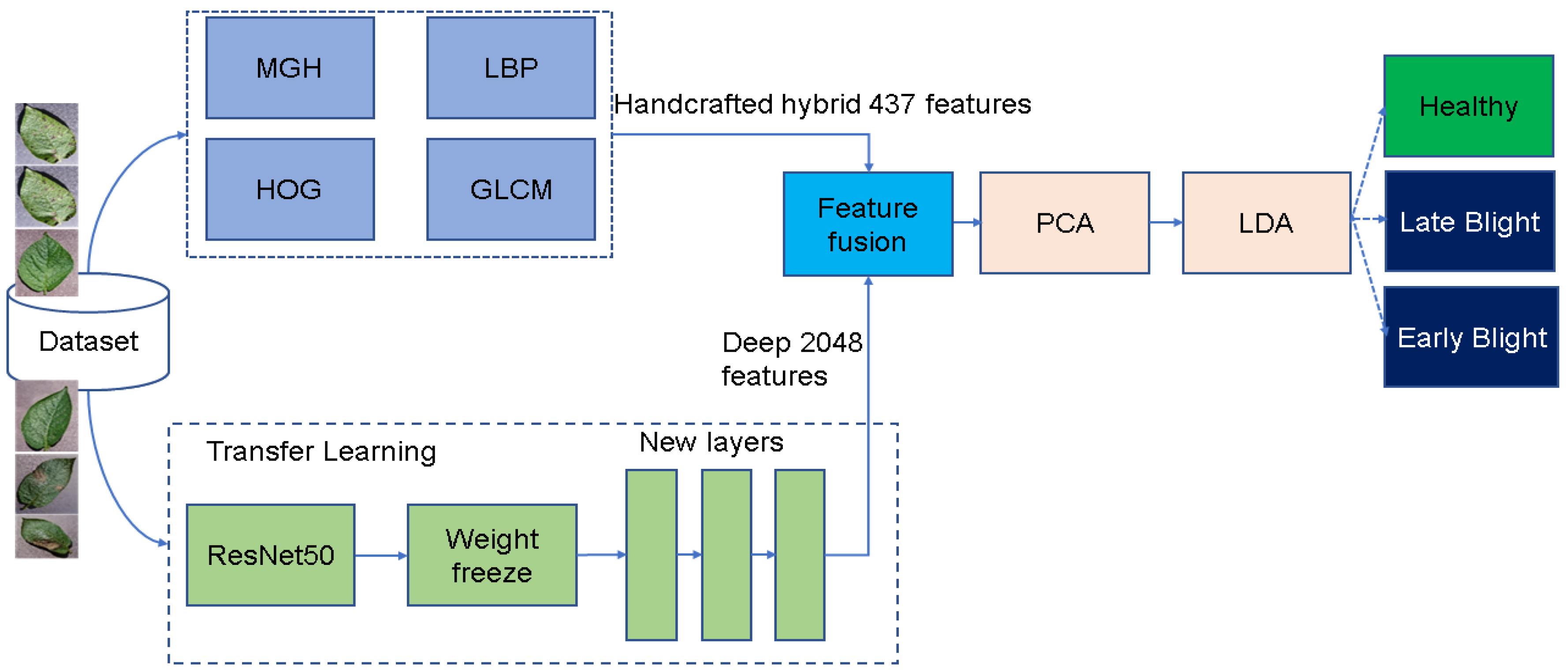
Crop leaf disease management and control pose significant impact on enhancement in yield and quality to fulfill consumer needs. For smart agriculture, an intelligent leaf disease identification system is inevitable for efficient crop health monitoring. In this view, a novel approach is proposed for crop disease identification using feature fusion and PCA-LDA classification (FF-PCA-LDA). Handcrafted hybrid and deep features are extracted from RGB images. TL-ResNet50 is used to extract the deep features. Fused feature vector is obtained by combining handcrafted hybrid and deep features. After fusing the image features, PCA is employed to select most discriminant features for LDA model development. Potato crop leaf disease identification is used as a case study for the validation of the approach. The developed system is experimentally validated on a potato crop leaf benchmark dataset. It offers high accuracy of 98.20% on an unseen dataset which was not used during the model training process. Performance comparison of the proposed technique with other approaches shows its superiority. Owing to the better discrimination and learning ability, the proposed approach overcomes the leaf segmentation step. The developed approach may be used as an automated tool for crop monitoring, management control, and can be extended for other crop types.
Keywords: deep learning; ResNet50; feature fusion; PCA; Alternaria solani; LDA deep learning; ResNet50; feature fusion; PCA; Alternaria solani; LDA