Article

Dynamic Preventive Maintenance Optimization of Subway Vehicle Traction System Considering Stages
College of Locomotive and Rolling Stock Engineering, Dalian Jiaotong University, Dalian 116028, China
*
Author to whom correspondence should be addressed.
Appl. Sci. 2022, 12(17), 8617; https://doi.org/10.3390/app12178617
Submission received: 27 July 2022 / Revised: 20 August 2022 / Accepted: 24 August 2022 / Published: 28 August 2022
(This article belongs to the Special Issue New Trends in Lifecycle Reliability Engineering)

Abstract

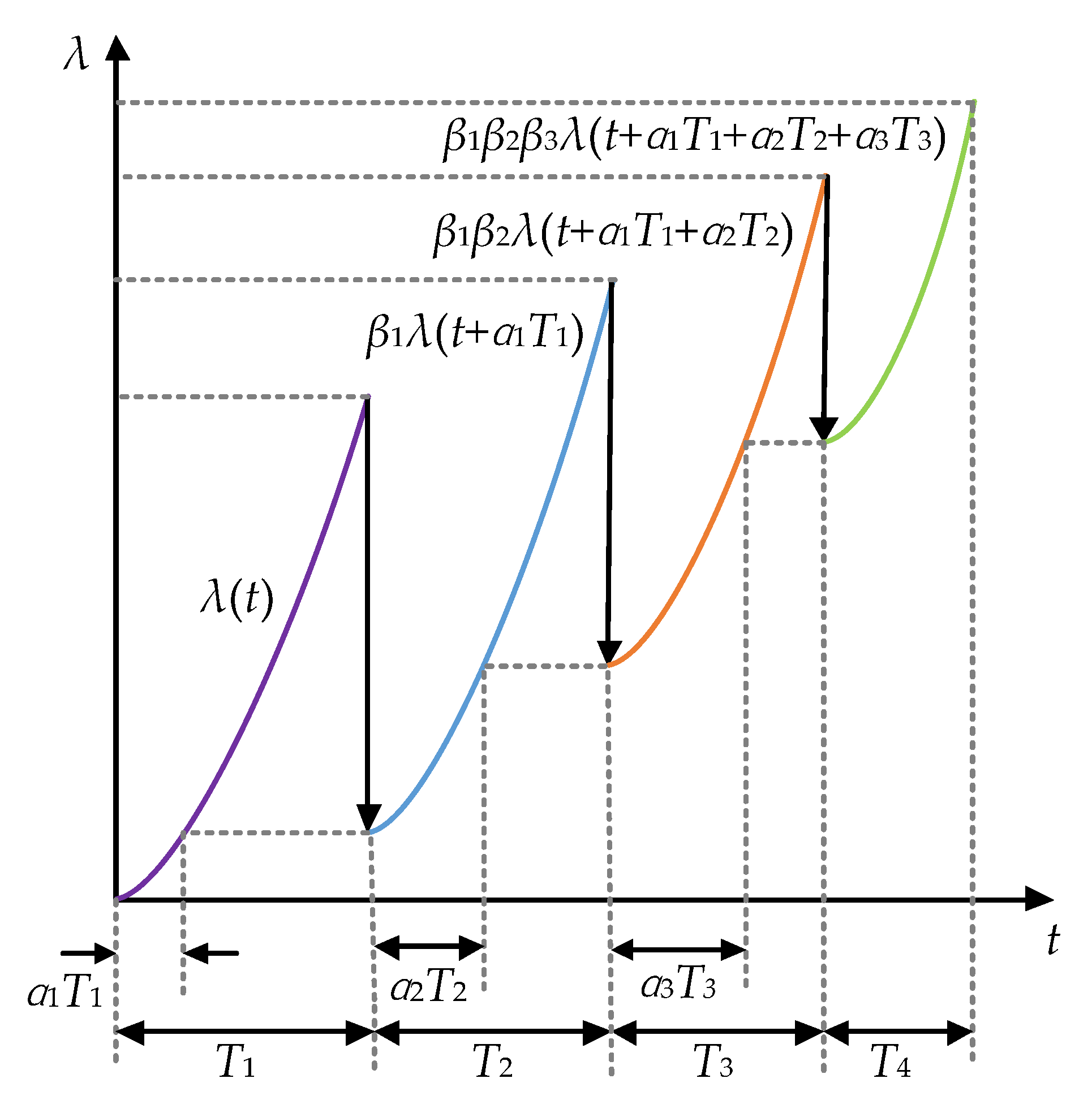
The current maintenance mode of the subway vehicle traction system does not consider the change of failure rate in the operation of components, and there is an unreasonable maintenance interval and high maintenance cost. To solve this problem, a dynamic preventive maintenance strategy for subway vehicle traction systems considering stages is proposed. Service age decreasing factor and failure rate increasing factor are introduced to build a new dynamic reliability model considering the effect of preventive maintenance on component failure rate. Non-preventive failure maintenance, preventive maintenance, preventive update maintenance and opportunistic maintenance are adopted. For the components in degradation or random failure stages, a preventive maintenance optimization model with the least maintenance cost, constrained by reliability, is established. The maintenance strategy is optimized and solved based on the enumeration method to obtain single-component irregular preventive maintenance intervals and multi-component group preventive maintenance times. The results show that the proposed maintenance models are reasonable and feasible. On the premise of ensuring the system reliability, the number of vehicle outages for maintenance and the maintenance cost are reduced. Feasible and effective maintenance models and methods are provided. They can ensure the reliability of subway vehicles and reduce maintenance costs. The effectiveness and economy of maintenance work is increased.
Keywords: traction system; dynamic reliability; preventive maintenance; optimization traction system; dynamic reliability; preventive maintenance; optimization