


A New Biorefinery Approach for the Full Valorisation of Anchovy Residues: Use of the Sludge Generated during the Extraction of Fish Oil as a Nitrogen Supplement in Anaerobic Digestion




Featured Application
Abstract
1. Introduction
2. Materials and Methods
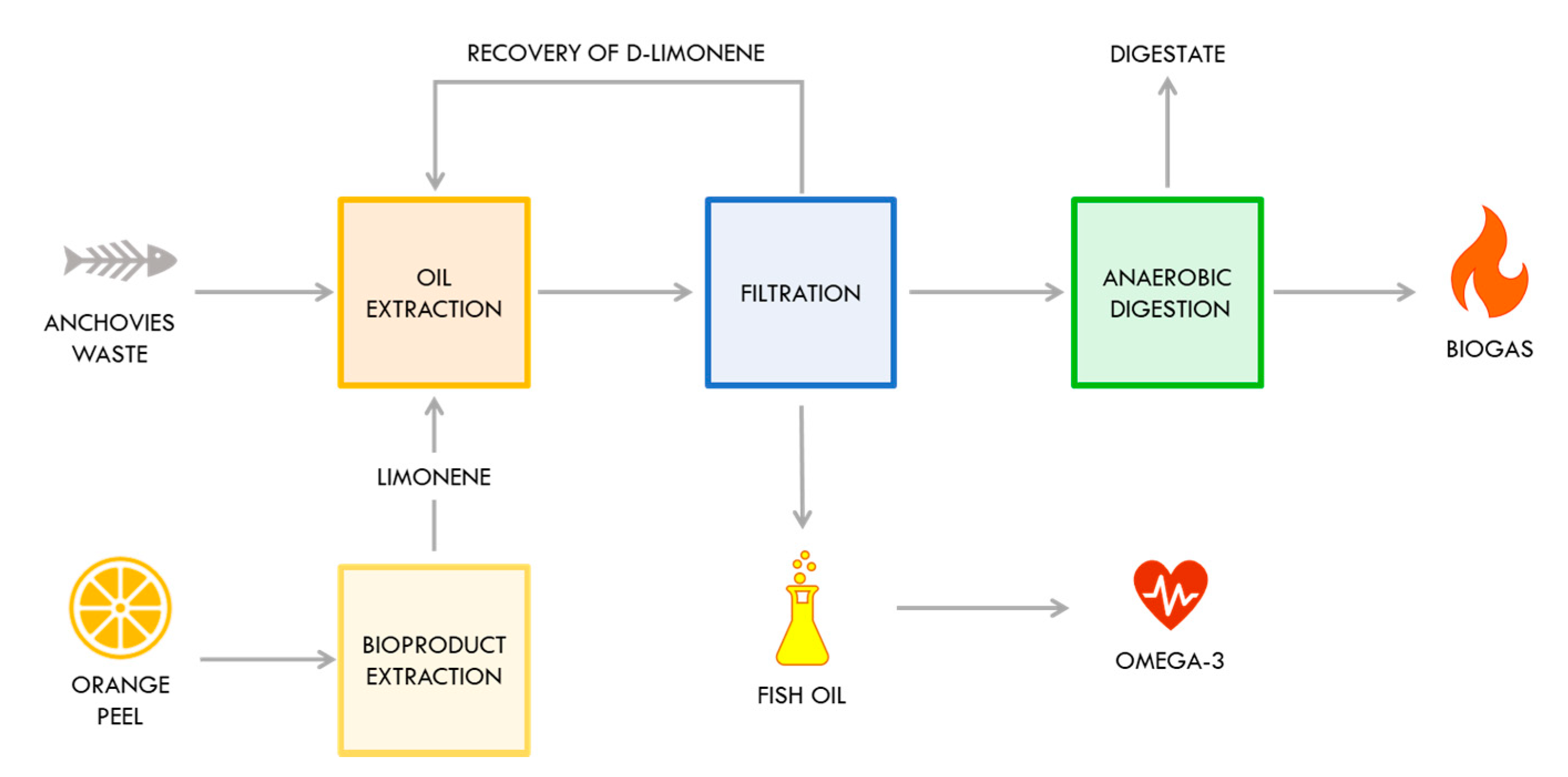
2.1. Fish Oil Extraction Process
2.2. Substrates and Inoculum Characterisation
2.3. Biomethane Potential (BMP) Tests
2.4. Semi-Continuous Experiments
3. Results and Discussion
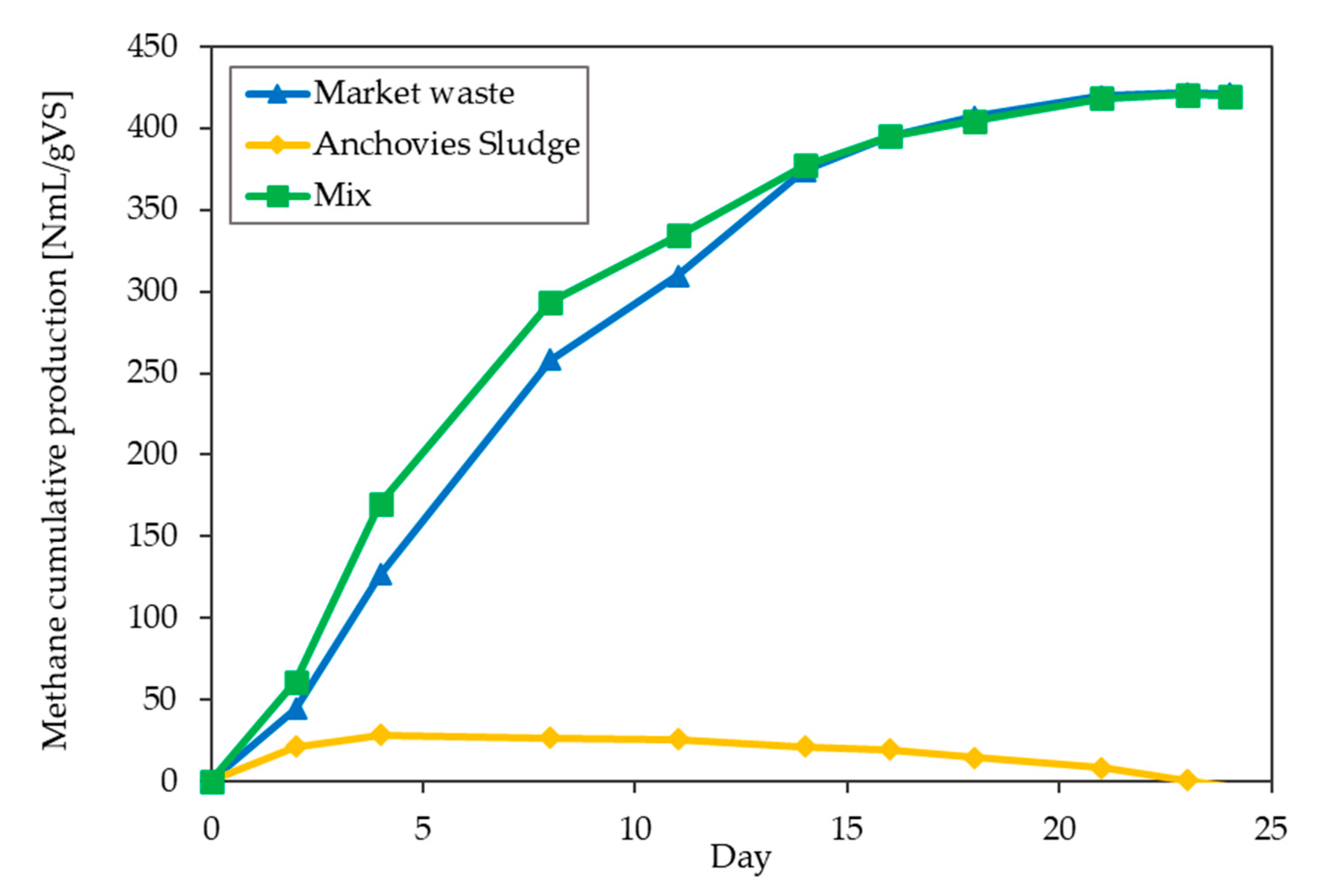
3.1. BMP Tests
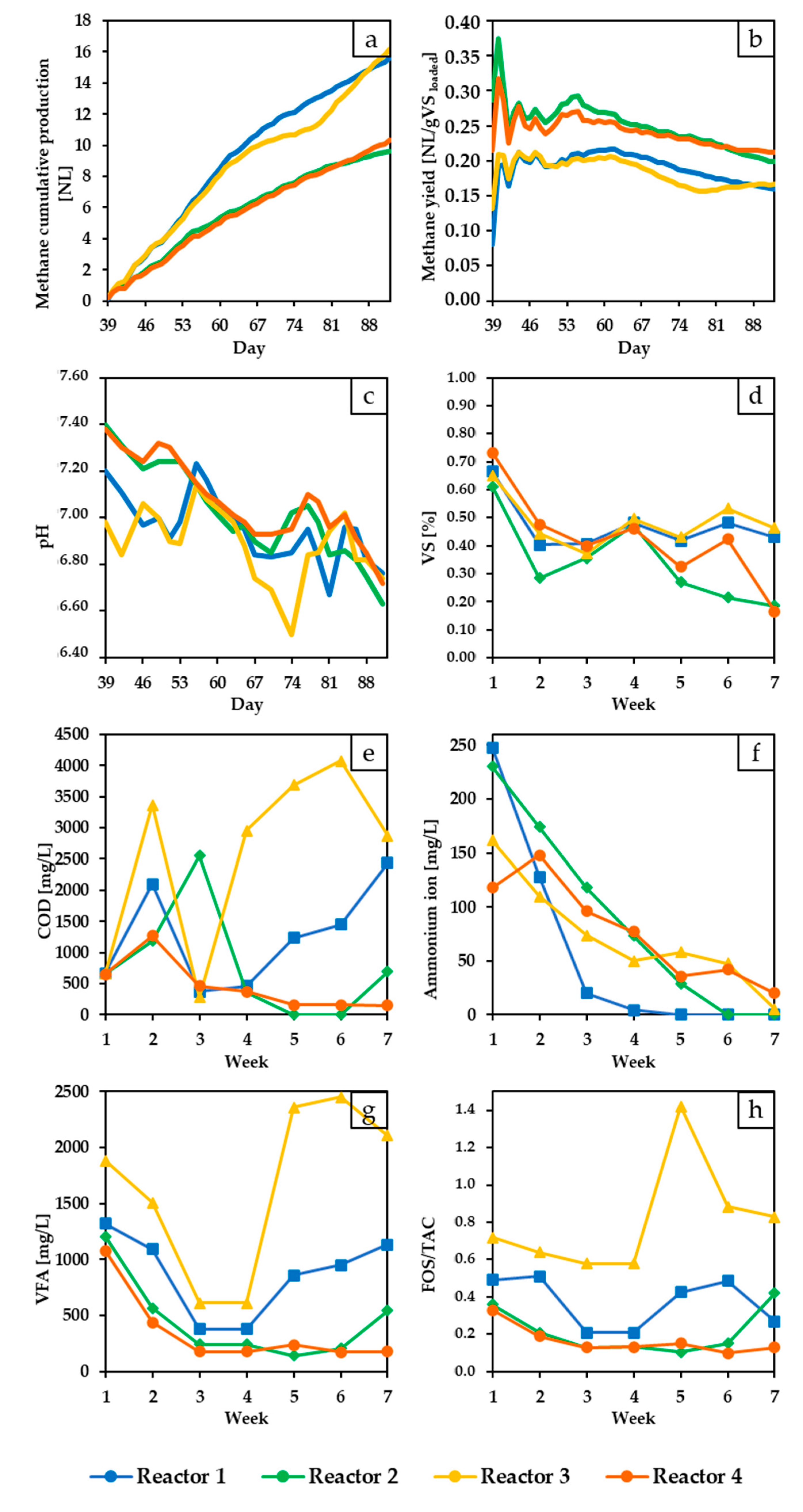
3.2. Semi-Continuous Experiments
4. Conclusions
Author Contributions
Funding
Data Availability Statement
Acknowledgments
Conflicts of Interest
References
- Ellen MacArthur Foundation Universal Circular Economy Policy Goals: Enabling the Transition to Scale. Available online: https://www.ellenmacarthurfoundation.org/publications/universal-circular-economy-policy-goals-enabling-the-transition-to-scale (accessed on 27 July 2021).
- European Commission. Circular Economy Action Plan; European Commission: Brussels, Belgium, 2020; p. 28. [Google Scholar] [CrossRef]
- Zema, D.A.; Calabrò, P.S.; Folino, A.; Tamburino, V.; Zappia, G.; Zimbone, S.M. Valorisation of citrus processing waste: A review. Waste Manag. 2018, 80, 252–273. [Google Scholar] [CrossRef] [Scilit]
- Fazzino, F.; Mauriello, F.; Paone, E.; Sidari, R.; Calabrò, P.S. Integral valorization of orange peel waste through optimized ensiling: Lactic acid and bioethanol production. Chemosphere 2021, 271, 129602. [Google Scholar] [CrossRef] [Scilit] [PubMed]
- García-Vargas, M.C.; Contreras, M.d.M.; Castro, E. Avocado-Derived Biomass as a Source of Bioenergy and Bioproducts. Appl. Sci. 2020, 10, 8195. [Google Scholar] [CrossRef] [Scilit]
- Câmara-Salim, I.; Conde, P.; Feijoo, G.; Moreira, M.T. The use of maize stover and sugar beet pulp as feedstocks in industrial fermentation plants—An economic and environmental perspective. Clean. Environ. Syst. 2021, 2, 100005. [Google Scholar] [CrossRef] [Scilit]
- Rajesh Banu, J.; Preethi; Kavitha, S.; Tyagi, V.K.; Gunasekaran, M.; Karthikeyan, O.P.; Kumar, G. Lignocellulosic biomass based biorefinery: A successful platform towards circular bioeconomy. Fuel 2021, 302, 121086. [Google Scholar] [CrossRef] [Scilit]
- The Blue Economy—Home. Available online: https://www.theblueeconomy.org/ (accessed on 27 July 2021).
- FAO. FAO Fisheries & Aquaculture—Fishery Statistical Collections—Global Capture Production. Available online: https://www.fao.org/fishery/statistics/global-capture-production/en (accessed on 24 October 2021).
- Laso, J.; Margallo, M.; Serrano, M.; Vázquez-Rowe, I.; Avadí, A.; Fullana, P.; Bala, A.; Gazulla, C.; Irabien, Á.; Aldaco, R. Introducing the Green Protein Footprint method as an understandable measure of the environmental cost of anchovy consumption. Sci. Total Environ. 2018, 621, 40–53. [Google Scholar] [CrossRef] [Scilit]
- Laso, J.; Margallo, M.; Celaya, J.; Fullana, P.; Bala, A.; Gazulla, C.; Irabien, A.; Aldaco, R. Waste management under a life cycle approach as a tool for a circular economy in the canned anchovy industry. Waste Manag. Res. 2016, 34, 724–733. [Google Scholar] [CrossRef] [Scilit]
- Shepherd, C.J.; Jackson, A.J. Global fishmeal and fish-oil supply: Inputs, outputs and marketsa. J. Fish. Biol. 2013, 83, 1046–1066. [Google Scholar] [CrossRef] [Scilit]
- Paone, E.; Fazzino, F.; Pizzone, D.M.; Scurria, A.; Pagliaro, M.; Ciriminna, R.; Calabrò, P.S. Towards the anchovy biorefinery: Biogas production from anchovy processing waste after fish oil extraction with biobased Limonene. Sustainability 2021, 13, 2428. [Google Scholar] [CrossRef] [Scilit]
- Ruiz, B.; Flotats, X. Citrus essential oils and their influence on the anaerobic digestion process: An overview. Waste Manag. 2014, 34, 2063–2079. [Google Scholar] [CrossRef] [Scilit] [PubMed]
- Calabrò, P.S.; Fazzino, F.; Folino, A.; Paone, E.; Komilis, D. Semi-Continuous Anaerobic Digestion of Orange Peel Waste: Effect of Activated Carbon Addition and Alkaline Pretreatment on the Process. Sustainability 2019, 11, 3386. [Google Scholar] [CrossRef] [Scilit]
- Wu, Y.; Wang, S.; Liang, D.; Li, N. Conductive materials in anaerobic digestion: From mechanism to application. Bioresour. Technol. 2020, 298, 122403. [Google Scholar] [CrossRef] [Scilit]
- Pan, C.; Fu, X.; Lu, W.; Ye, R.; Guo, H.; Wang, H.; Chusov, A. Effects of conductive carbon materials on dry anaerobic digestion of sewage sludge: Process and mechanism. J. Hazard. Mater. 2020, 384, 121339. [Google Scholar] [CrossRef] [Scilit] [PubMed]
- Baek, G.; Kim, J.J.; Kim, J.J.; Lee, C. Role and potential of direct interspecies electron transfer in anaerobic digestion. Energies 2018, 11, 107. [Google Scholar] [CrossRef] [Scilit]
- Yang, Y.; Zhang, Y.; Li, Z.; Zhao, Z.; Quan, X.; Zhao, Z. Adding granular activated carbon into anaerobic sludge digestion to promote methane production and sludge decomposition. J. Clean. Prod. 2017, 149, 1101–1108. [Google Scholar] [CrossRef] [Scilit]
- Capaccioni, B.; Caramiello, C.; Tatàno, F.; Viscione, A. Effects of a temporary HDPE cover on landfill gas emissions: Multiyear evaluation with the static chamber approach at an Italian landfill. Waste Manag. 2011, 31, 956–965. [Google Scholar] [CrossRef] [Scilit] [PubMed]
- Calabrò, P.S.; Fazzino, F.; Folino, A.; Scibetta, S.; Sidari, R. Improvement of semi-continuous anaerobic digestion of pre-treated orange peel waste by the combined use of zero valent iron and granular activated carbon. Biomass Bioenergy 2019, 129, 105337. [Google Scholar] [CrossRef] [Scilit]
- APHA; AWWA; WEF. Standard Methods for the Examination of Water and Wastewater, 22nd ed.; Rice, E.W., Baird, R.B., Eaton, A.D., Clesceri, L.S., Eds.; American Public Health Association, American Water Works Association, Water Environment Federation: Washington, DC, USA, 2012; ISBN 9780875530130. [Google Scholar]
- Calabro, P.S.; Panzera, M.F. Biomethane production tests on ensiled orange peel waste. Int. J. Heat Technol. 2017, 35, S130–S136. [Google Scholar] [CrossRef] [Scilit]
- Calabro’, P.S.; Folino, A.; Fazzino, F.; Komilis, D. Preliminary evaluation of the anaerobic biodegradability of three biobased materials used for the production of disposable plastics. J. Hazard. Mater. 2020, 390, 121653. [Google Scholar] [CrossRef] [Scilit]
- Buchauer, K. A comparison of two simple titration procedures to determine volatile fatty acids in influents to waste-water and sludge treatment processes. Water SA 1998, 24, 49–56. [Google Scholar]
- Liebetrau, J.; Pfeiffer, D.; Thrän, D. Collection of Methods for Biogas; Federal Ministry for Economic Affairs and Energy (BMWi): Berlin, Germany, 2016. [Google Scholar]
- Lopez, V.M.; De la Cruz, F.B.; Barlaz, M.A. Chemical composition and methane potential of commercial food wastes. Waste Manag. 2016, 56, 477–490. [Google Scholar] [CrossRef] [Scilit]
- Masebinu, S.O.; Akinlabi, E.T.; Muzenda, E.; Aboyade, A.O.; Mbohwa, C. Experimental and feasibility assessment of biogas production by anaerobic digestion of fruit and vegetable waste from Joburg Market. Waste Manag. 2018, 75, 236–250. [Google Scholar] [CrossRef] [Scilit]
- Forgács, G.; Pourbafrani, M.; Niklasson, C.; Taherzadeh, M.J.; Hováth, I.S.; Forgcs, G.; Pourbafrani, M.; Niklasson, C.; Taherzadeh, M.J.; Hováth, I.S. Methane production from citrus wastes: Process development and cost estimation. J. Chem. Technol. Biotechnol. 2012, 87, 250–255. [Google Scholar] [CrossRef] [Scilit]
- Wikandari, R.; Millati, R.; Cahyanto, M.N.; Taherzadeh, M.J. Biogas Production from Citrus Waste by Membrane Bioreactor. Membrane 2014, 4, 596–607. [Google Scholar] [CrossRef] [Scilit] [PubMed]
- Wang, Y.; Zhang, Y.; Wang, J.; Meng, L. Effects of volatile fatty acid concentrations on methane yield and methanogenic bacteria. Biomass Bioenergy 2009, 33, 848–853. [Google Scholar] [CrossRef] [Scilit]
- Parkin, G.F.; Owen, W.F. Fundamentals of Anaerobic Digestion of Wastewater Sludges. J. Environ. Eng. 1986, 112, 867–920. [Google Scholar] [CrossRef] [Scilit]
- Zhang, C.; Su, H.; Tan, T. Batch and semi-continuous anaerobic digestion of food waste in a dual solid-liquid system. Bioresour. Technol. 2013, 145, 10–16. [Google Scholar] [CrossRef] [Scilit]
- Ruffino, B.; Fiore, S.; Roati, C.; Campo, G.; Novarino, D.; Zanetti, M. Scale effect of anaerobic digestion tests in fed-batch and semi-continuous mode for the technical and economic feasibility of a full scale digester. Bioresour. Technol. 2015, 182, 302–313. [Google Scholar] [CrossRef] [Scilit] [PubMed]
- Browne, J.D.; Allen, E.; Murphy, J.D. Assessing the variability in biomethane production from the organic fraction of municipal solid waste in batch and continuous operation. Appl. Energy 2014, 128, 307–314. [Google Scholar] [CrossRef] [Scilit]

| Anchovy Sludge | Market Waste | Inoculum (Batch Tests) | Inoculum (Semi-Continuous t.) | |
|---|---|---|---|---|
| TS [%] | 20.1 | 19.4 | 3.9 | 3.1 |
| VS [%TS] | 66.7 | 93.3 | 66.6 | 66.7 |
| pH | 6.85 | 5.26 | 8.13 | 8.04 |
| C/N | 3.4 | 36.3 | - | - |
| d-limonene [g/g] | 0.125 1 0.160 2 | - | - | - |
| Substrate | Market Waste (MW) | Anchovy Sludge (AS) | Mix (95% MW + 5% AS) |
|---|---|---|---|
| pH | 8.1 | 8.1 | 8.1 |
| C/N | 36.31 | 3.41 | 24.73 |
| gVSsubstrate/gVSinoculum | 0.30 | 0.30 | 0.30 |
| TS [g] | 3.35 | 4.69 | 3.40 |
| TS at the beginning of the experiment | 3.17% | 3.39% | 3.18% |
| Reactor 1 | Reactor 2 | Reactor 3 | Reactor 4 | |
|---|---|---|---|---|
| Reinoculation (end of start-up phase) | YES | YES | NO | YES |
| Loading (regime phase) [gVS·L−1·day−1] | 1 | 0.5 | 1 | 0.5 |
| Market Waste (TS basis) | 100% | 100% | 95% | 95% |
| Anchovy Sludge (TS basis) | - | - | 5% | 5% |
| C/N substrate | 36.3 | 36.3 | 24.7 | 24.7 |
| Substrate addition [g·d−1] (regime phase) | 10.00 | 5.00 | 10.10 | 5.05 |
| Expected regime d-limonene conc. [mg·L−1] | - | - | 680 1 870 2 | 340 1 436 2 |
| Addition of GAC—10 g·L−1 (days) | - | - | 74–83 | - |
| Market Waste | Anchovy Sludge | Mix (Market w. + Anch. Sludge) | |
|---|---|---|---|
| pH | 7.6 ± 0.00 | 7.6 ± 0.06 | 7.5 ± 0.01 |
| COD [mg/L] | 7008 ± 398 | 11470 ± 130 | 7073 ± 385 |
| ammonium ion [mg/L] | 1435 ± 60 | 1861 ± 61 | 1411 ± 39 |
| chloride [mg/L] | 1280 ± 93 | 1563 ± 105 | 1363 ± 274 |
| VFA [mg/L] | 550 ± 156 | 3662 ± 69 | 651 ± 129 |
| FOS/TAC | 0.11 ± 0.03 | 0.4 ± 0.02 | 0.12 ± 0.02 |
Publisher’s Note: MDPI stays neutral with regard to jurisdictional claims in published maps and institutional affiliations. |
© 2021 by the authors. Licensee MDPI, Basel, Switzerland. This article is an open access article distributed under the terms and conditions of the Creative Commons Attribution (CC BY) license (https://creativecommons.org/licenses/by/4.0/).
Share and Cite
Fazzino, F.; Paone, E.; Pedullà, A.; Mauriello, F.; Calabrò, P.S. A New Biorefinery Approach for the Full Valorisation of Anchovy Residues: Use of the Sludge Generated during the Extraction of Fish Oil as a Nitrogen Supplement in Anaerobic Digestion. Appl. Sci. 2021, 11, 10163. https://doi.org/10.3390/app112110163
Fazzino F, Paone E, Pedullà A, Mauriello F, Calabrò PS. A New Biorefinery Approach for the Full Valorisation of Anchovy Residues: Use of the Sludge Generated during the Extraction of Fish Oil as a Nitrogen Supplement in Anaerobic Digestion. Applied Sciences. 2021; 11(21):10163. https://doi.org/10.3390/app112110163
Chicago/Turabian StyleFazzino, Filippo, Emilia Paone, Altea Pedullà, Francesco Mauriello, and Paolo S. Calabrò. 2021. "A New Biorefinery Approach for the Full Valorisation of Anchovy Residues: Use of the Sludge Generated during the Extraction of Fish Oil as a Nitrogen Supplement in Anaerobic Digestion" Applied Sciences 11, no. 21: 10163. https://doi.org/10.3390/app112110163
APA StyleFazzino, F., Paone, E., Pedullà, A., Mauriello, F., & Calabrò, P. S. (2021). A New Biorefinery Approach for the Full Valorisation of Anchovy Residues: Use of the Sludge Generated during the Extraction of Fish Oil as a Nitrogen Supplement in Anaerobic Digestion. Applied Sciences, 11(21), 10163. https://doi.org/10.3390/app112110163

