Review

Recent Applications of Deep Eutectic Solvents in Environmental Analysis

by
Ruth Rodríguez-Ramos
1,
Álvaro Santana-Mayor
1,
Bárbara Socas-Rodríguez
2,* and
Miguel Ángel Rodríguez-Delgado
1
1
Departamento de Química, Unidad Departamental de Química Analítica, Facultad de Ciencias, Universidad de La Laguna (ULL), Avenida Astrofísico Francisco Sánchez s/n, 38206 San Cristóbal de La Laguna, Tenerife, Spain
2
Laboratory of Foodomics, Institute of Food Science Research, CIAL, CSIC, Nicolás Cabrera 9, 28049 Madrid, Spain
*
Author to whom correspondence should be addressed.
Appl. Sci. 2021, 11(11), 4779; https://doi.org/10.3390/app11114779
Submission received: 21 April 2021 / Revised: 18 May 2021 / Accepted: 20 May 2021 / Published: 23 May 2021
(This article belongs to the Special Issue Applications of Deep Eutectic Solvents in Analytical Chemistry)

Abstract

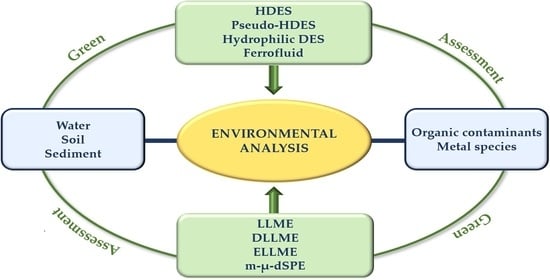
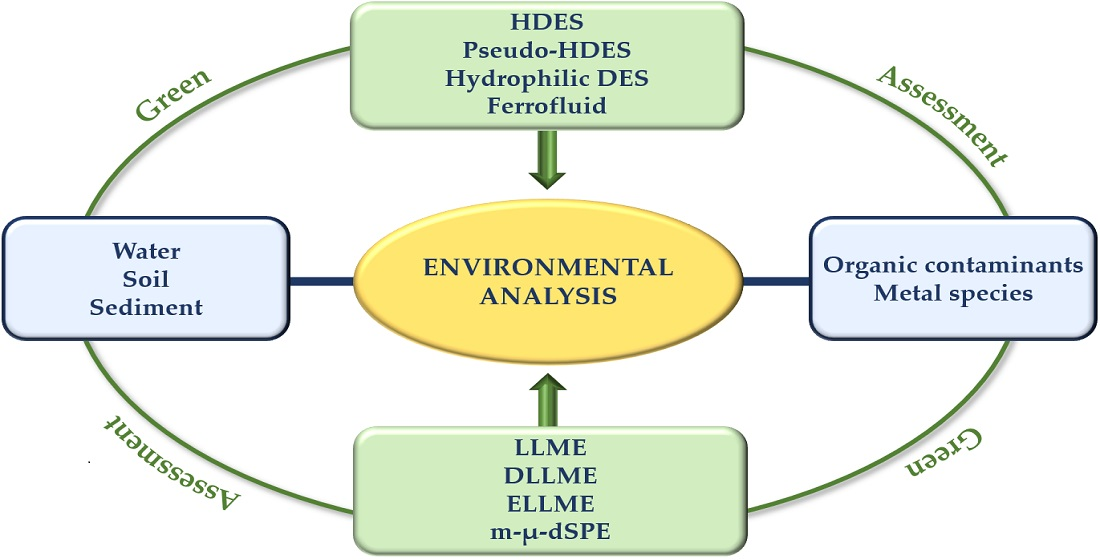
The incessant generation of toxic waste and the growing concern over the environment have led the scientific community to delve into the search for more sustainable systems. In this regard, the application of deep eutectic solvents (DESs) has become one of the main strategies in green chemistry. These solvents have emerged as a promising alternative to conventional toxic solvents and even to the well-known ionic liquids. Their unique properties, components availability, and easy preparation, among others, have led to a new trend within the scientific community and industry, based on the use of these up-and-coming solvents not only in science but also in quotidian life. Among the areas that have benefited from the advantages of DESs is analytical chemistry, in which they have been largely used for sample preparation, including the extraction and determination of organic and inorganic compounds from environmental samples. The considerable number of applications developed in the last year in this field and the increasing generation of new data necessitate the continuous updating of the literature. This review pretends to compile the most relevant applications of DESs in environmental analysis and critically discuss them to provide a global vision about the advantages and drawbacks/limitations of these neoteric solvents in the area of environmental analysis.
Keywords: green solvents; sustainability; water; soil; contaminant; environment; green analytical chemistry green solvents; sustainability; water; soil; contaminant; environment; green analytical chemistry
Graphical Abstract