Feed Rate Variation Strategy for Semi-Conical Shell Workpiece in Ball Head End Milling Process

Featured Application
Abstract
1. Introduction
- (1)
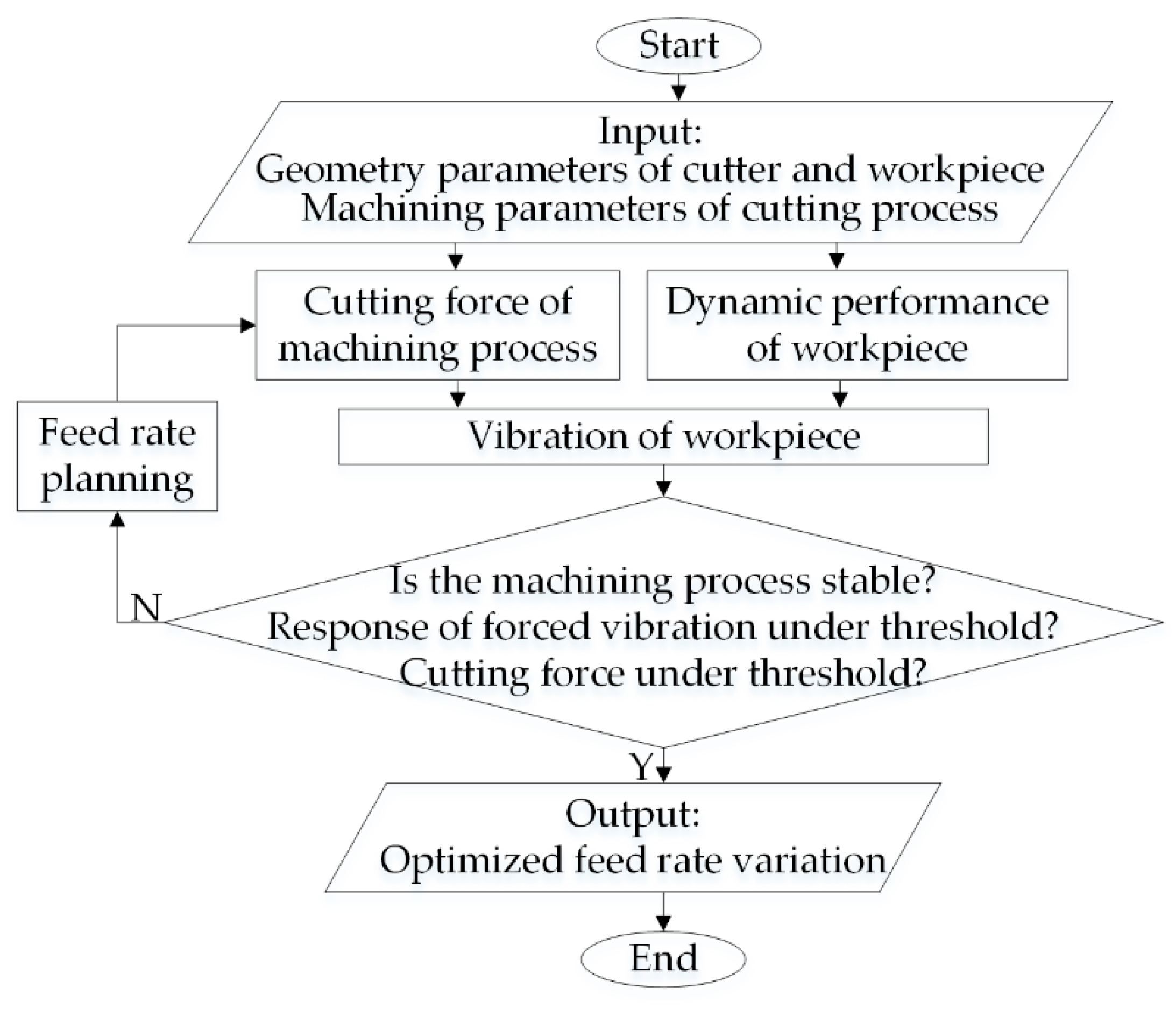
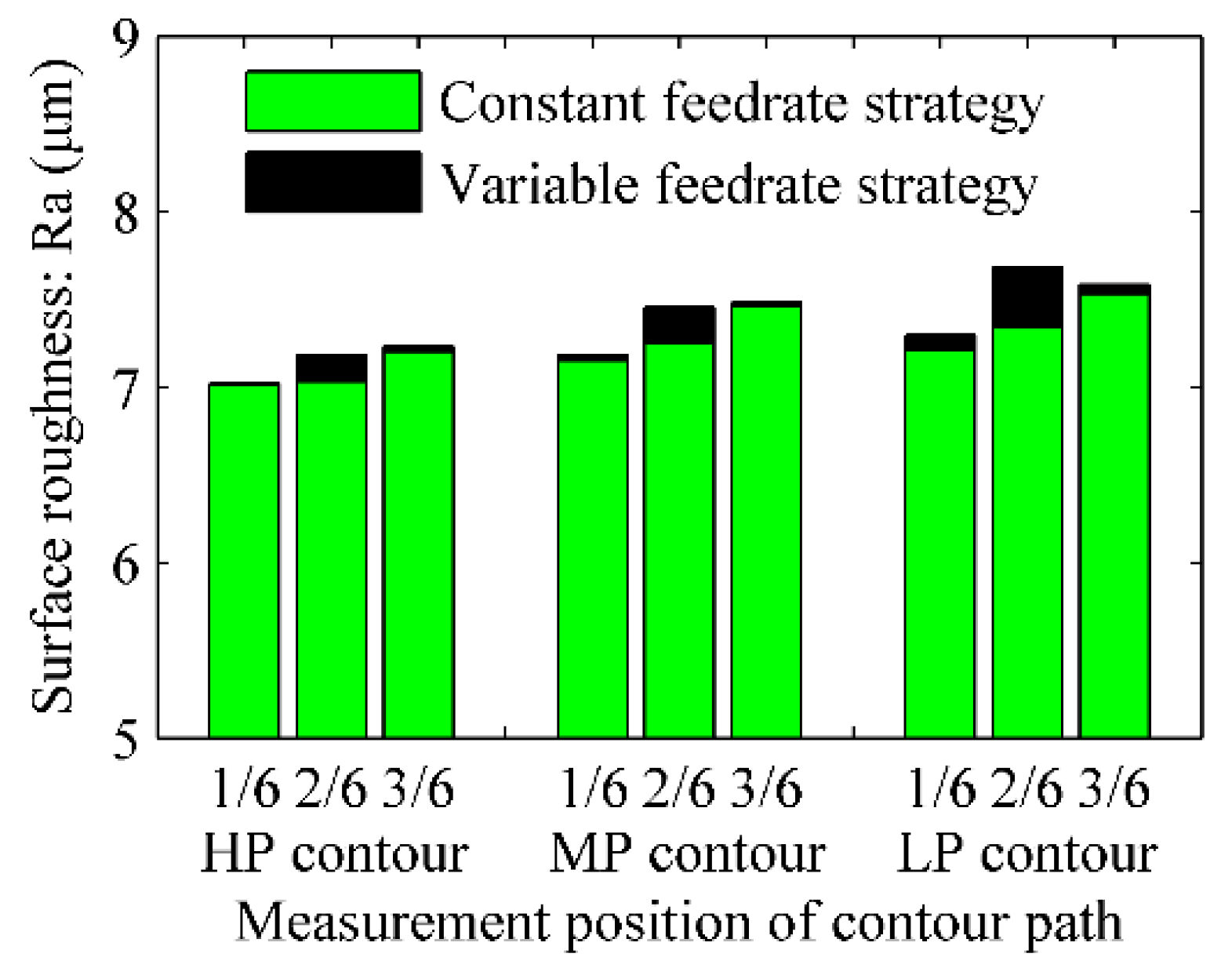
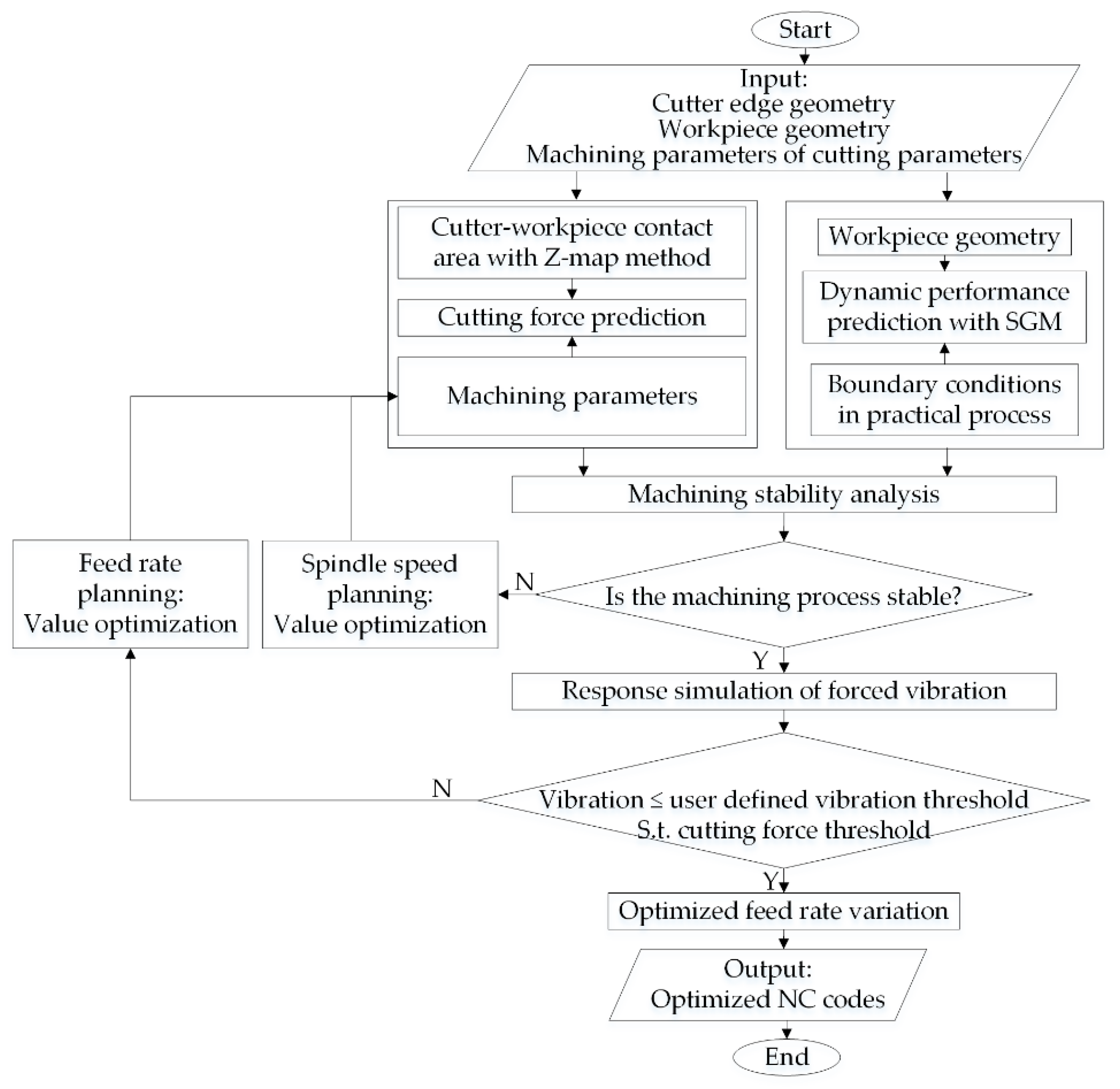
- Comparing to the traditional feed rate variation strategy, both cutting force and vibration response are used to design the optimal feed rate variation. This can be more effective for the special thin-walled parts like semi-conical shell workpiece with special stiffness distribution.
- (2)
- Combining the cutting force and dynamic performance prediction, the forced vibration response of the semi-conical shell workpiece is obtained and used in the variable feed rate planning. The proposed feed rate variation strategy can be applied to the ball head end milling process with the contour tool path, and nearly a quarter of the consuming time can be saved.
2. Vibration Simulation of the Milling Process
2.1. Cutting Force Prediction
2.2. Dynamic Performance of Workpiece and Stability Prediction of Cutting System
2.3. Vibration Response Analysis
3. Design of Feed Rate Variation Strategy
3.1. Design of Continuous Feed Rate Variation
3.2. Design of Discrete Feed Rate Variation
4. Experiment Results and Validation
5. Discussion
6. Conclusions
Author Contributions
Funding
Acknowledgments
Conflicts of Interest
References
- De Souza, A.F.; Berkenbrock, E.; Diniz, A.E.; Rodrigues, A.R. Influences of the tool path strategy on the machining force when milling free form geometries with a ball-end cutting tool. J. Braz. Soc. Mech. Sci. Eng. 2014, 37, 675–687. [Google Scholar] [CrossRef] [Scilit]
- Tounsi, N.; Elbestawi, M. Optimized feed scheduling in three axes machining. Part I: Fundamentals of the optimized feed scheduling strategy. Int. J. Mach. Tools Manuf. 2003, 43, 253–267. [Google Scholar] [CrossRef] [Scilit]
- Vavruska, P.; Zeman, P.; Stejskal, M. Reducing Machining Time by Pre-Process Control of Spindle Speed and Feed-Rate in Milling Strategies. Procedia CIRP 2018, 77, 578–581. [Google Scholar] [CrossRef] [Scilit]
- Bediaga, I.; Munoa, J.; Hernandez, J.; De Lacalle, L.N.L. An automatic spindle speed selection strategy to obtain stability in high-speed milling. Int. J. Mach. Tools Manuf. 2009, 49, 384–394. [Google Scholar] [CrossRef] [Scilit]
- Wibowo, Y.T.; Baskoro, S.Y.; Manurung, V.A.T. Toolpath Strategy and Optimum Combination of Machining Parameter during Pocket Mill Process of Plastic Mold Steels Material. IOP Conf. Series Mater. Sci. Eng. 2018, 306, 012137. [Google Scholar] [CrossRef] [Scilit]
- Kurt, M.; Bagci, E. Feedrate optimisation/scheduling on sculptured surface machining: A comprehensive review, applications and future directions. Int. J. Adv. Manuf. Technol. 2011, 55, 1037–1067. [Google Scholar] [CrossRef] [Scilit]
- Wang, W. Solid modeling for optimizing metal removal of three-dimensional NC end milling. J. Manuf. Syst. 1988, 7, 57–65. [Google Scholar] [CrossRef] [Scilit]
- Zhang, X.; Yu, T.; Wang, W. Modeling, simulation, and optimization of five-axis milling processes. Int. J. Adv. Manuf. Technol. 2014, 74, 1611–1624. [Google Scholar] [CrossRef] [Scilit]
- Salami, R.; Sadeghi, M.; Motakef, B. Feed rate optimization for 3-axis ball-end milling of sculptured surfaces. Int. J. Mach. Tools Manuf. 2007, 47, 760–767. [Google Scholar] [CrossRef] [Scilit]
- Benardos, P.; Vosniakos, G.-C. Offline flexible optimisation of feed and speed in computer numerical control machining of sculptured surfaces exploiting dedicated cutting force metamodels. Proc. Inst. Mech. Eng. Part B-J. Eng. Manuf. 2005, 228, 878–892. [Google Scholar] [CrossRef] [Scilit]
- Ferry, W.B.; Altintas, Y. Virtual Five-Axis Flank Milling of Jet Engine Impellers—Part II: Feed Rate Optimization of Five-Axis Flank Milling. J. Manuf. Sci. Eng. 2008, 130, 011013. [Google Scholar] [CrossRef] [Scilit]
- Erdim, H.; Lazoglu, I.; Ozturk, B. Feedrate scheduling strategies for free-form surfaces. Int. J. Mach. Tools Manuf. 2006, 46, 747–757. [Google Scholar] [CrossRef] [Scilit]
- Wang, Z.; Wong, Y.; Rahman, M. Optimisation of multi-pass milling using genetic algorithm and genetic simulated annealing. Int. J. Adv. Manuf. Technol. 2004, 24, 727–732. [Google Scholar] [CrossRef] [Scilit]
- Xu, P.; Lee, R.-S. Feedrate optimization based on hybrid forward-reverse mappings of artificial neural networks for five-axis milling. Int. J. Adv. Manuf. Technol. 2016, 87, 3033–3049. [Google Scholar] [CrossRef] [Scilit]
- Layegh, S.E.; Erdim, H.; Lazoglu, I. Offline Force Control and Feedrate Scheduling for Complex Free Form Surfaces in 5-Axis Milling. Procedia CIRP 2012, 1, 96–101. [Google Scholar] [CrossRef] [Scilit]
- Arruda, T.M.; De Paiva, A.P.; Brandão, L.C.; Ferreira, J.R. Robust optimisation of surface roughness of AISI H13 hardened steel in the finishing milling using ball nose end mills. Precis. Eng. 2019, 60, 194–214. [Google Scholar] [CrossRef] [Scilit]
- Lacalle, L.N.; Lamikiz, A.; Sánchez, J.A.; Salgado, M.A. Toolpath selection based on the minimum deflection cutting forces in the programming of complex surfaces milling. Int. J. Mach. Tools Manuf. 2007, 47, 388–400. [Google Scholar] [CrossRef] [Scilit]
- Lamikiz, A.; Muñoa, J.; Sánchez, J.A. The CAM as the centre of gravity of the five-axis high speed milling of complex parts. Int. J. Prod. Res. 2005, 43, 1983–1999. [Google Scholar] [CrossRef] [Scilit]
- Bustillo, A.; Díez-Pastor, J.-F.; Quintana, G.; García-Osorio, C. Avoiding neural network fine tuning by using ensemble learning: Application to ball-end milling operations. Int. J. Adv. Manuf. Technol. 2011, 57, 521–532. [Google Scholar] [CrossRef] [Scilit]
- Arnaiz-González, Á.; Fernández-Valdivielso, A.; Bustillo, A.; De Lacalle, L.N.L. Using artificial neural networks for the prediction of dimensional error on inclined surfaces manufactured by ball-end milling. Int. J. Adv. Manuf. Technol. 2016, 83, 847–859. [Google Scholar] [CrossRef] [Scilit]
- Yang, J.; Aslan, D.; Altintas, Y. A feedrate scheduling algorithm to constrain tool tip position and tool orientation errors of five-axis CNC machining under cutting load disturbances. CIRP J. Manuf. Sci. Technol. 2018, 23, 78–90. [Google Scholar] [CrossRef] [Scilit]
- Qian, L.; Yang, B.; Lei, S. Comparing and combining off-line feedrate rescheduling strategies in free-form surface machining with feedrate acceleration and deceleration. Robot. Comput. Manuf. 2008, 24, 796–803. [Google Scholar] [CrossRef] [Scilit]
- De Lacalle, L.N.L.; Lamikiz, A.; Muñoa, J.; Salgado, M.; Sánchez, J. Improving the high-speed finishing of forming tools for advanced high-strength steels (AHSS). Int. J. Adv. Manuf. Technol. 2006, 29, 49–63. [Google Scholar] [CrossRef] [Scilit]
- Altintas, Y.; Erkorkmaz, K. Feedrate Optimization for Spline Interpolation in High Speed Machine Tools. CIRP Ann. 2003, 52, 297–302. [Google Scholar] [CrossRef] [Scilit]
- Erkorkmaz, K.; Layegh, S.E.; Lazoglu, I.; Erdim, H. Feedrate optimization for freeform milling considering constraints from the feed drive system and process mechanics. CIRP Ann. 2013, 62, 395–398. [Google Scholar] [CrossRef] [Scilit]
- Fei, J.; Xu, F.; Lin, B.; Huang, T. State of the art in milling process of the flexible workpiece. Int. J. Adv. Manuf. Technol. 2020, 109, 1695–1725. [Google Scholar] [CrossRef] [Scilit]
- Wei, Z.C.; Wang, M.J.; Cai, Y.J.; Zhu, J.N.; Wang, L. Form error estimation in ball-end milling of sculptured surface with z-level contouring tool path. Int. J. Adv. Manuf. Technol. 2012, 65, 363–369. [Google Scholar] [CrossRef] [Scilit]
- Schmitz, T.L.; Mann, B.P. Closed-form solutions for surface location error in milling. Int. J. Mach. Tools Manuf. 2006, 46, 1369–1377. [Google Scholar] [CrossRef] [Scilit]
- Dong, Z.; Jiao, L.; Wang, X.; Liang, Z.; Liu, Z.; Yi, J. FEA-based prediction of machined surface errors for dynamic fixture-workpiece system during milling process. Int. J. Adv. Manuf. Technol. 2015, 85, 299–315. [Google Scholar] [CrossRef] [Scilit]
- Wei, Z.C.; Wang, M.J.; Cai, Y.J.; Wang, S.F. Prediction of cutting force in ball-end milling of sculptured surface using improved Z-map. Int. J. Adv. Manuf. Technol. 2013, 68, 1167–1177. [Google Scholar] [CrossRef] [Scilit]
- Shi, D.; Shi, X.; Li, W.L.; Wang, Q. Free transverse vibrations of orthotropic thin rectangular plates with arbitrary elastic edge supports. J. Vibroengineering 2014, 16, 389–398. [Google Scholar]
- Pelayo, G.U.; Olvera-Trejo, D.; Luo, M.; De Lacalle, L.L.; Elías-Zuñiga, A. Surface roughness prediction with new barrel-shape mills considering runout: Modelling and validation. Measurement 2020. [Google Scholar] [CrossRef] [Scilit]
- Lazoglu, I.; Boz, Y.; Erdim, H. Five-axis milling mechanics for complex free form surfaces. CIRP Ann. 2011, 60, 117–120. [Google Scholar] [CrossRef] [Scilit]
- Wei, Z.; Wang, M.; Zhu, J.; Gu, L. Cutting force prediction in ball end milling of sculptured surface with Z-level contouring tool path. Int. J. Mach. Tools Manuf. 2011, 51, 428–432. [Google Scholar] [CrossRef] [Scilit]
- Imani, B.M.; Sadeghi, M.; Elbestawi, M. An improved process simulation system for ball-end milling of sculptured surfaces. Int. J. Mach. Tools Manuf. 1998, 38, 1089–1107. [Google Scholar] [CrossRef] [Scilit]
- Yigit, I.; Layegh K., S.E.L.; Lazoglu, I. A Solid Modeler Based Engagement Model for 5-axis Ball End Milling. Procedia CIRP 2015, 31, 179–184. [Google Scholar] [CrossRef] [Scilit]
- Boz, Y.; Erdim, H.; Lazoglu, I. A comparison of solid model and three-orthogonal dexelfield methods for cutter-workpiece engagement calculations in three- and five-axis virtual milling. Int. J. Adv. Manuf. Technol. 2015, 81, 811–823. [Google Scholar] [CrossRef] [Scilit]
- Zeng, L.; Zhang, Y.; Kunpeng, Z.; Yu, Z. Modeling of the instantaneous milling force per tooth with tool run-out effect in high speed ball-end milling. Int. J. Mach. Tools Manuf. 2017, 119, 37–48. [Google Scholar] [CrossRef] [Scilit]
- Urbikain, G.P. Modelling of static and dynamic milling forces in inclined operations with circle-segment end mills. Precis. Eng. 2018, 56, 123–135. [Google Scholar] [CrossRef] [Scilit]
- Lamikiz, A.; De Lacalle, L.L.; Sánchez, J.A.; Salgado, M.; Lamikiz, A.; De Lacalle, L.N.L. Cutting force estimation in sculptured surface milling. Int. J. Mach. Tools Manuf. 2004, 44, 1511–1526. [Google Scholar] [CrossRef] [Scilit]
- Lamikiz, A.; De Lacalle, L.N.L.; Sánchez, J.A.; Salgado, M.A. Cutting force integration at the CAM stage in the high-speed milling of complex surfaces. Int. J. Comput. Integr. Manuf. 2005, 18, 586–600. [Google Scholar] [CrossRef] [Scilit]
- Layegh, S.E.; Lazoglu, I. A New Identification Method of Specific Cutting Coefficients for Ball End Milling. Procedia CIRP 2014, 14, 182–187. [Google Scholar] [CrossRef] [Scilit]
- Liu, Q.; Li, Z.Q. Simulation and Optimization of CNC Milling Process: Modeling, Algorithms, and Applications; Aviation Industry Press: Beijing, China, 2011. [Google Scholar]
- Wang, M.; Zan, T.; Gao, X.; Li, S. Suppression of the time-varying vibration of ball screws induced from the continuous movement of the nut using multiple tuned mass dampers. Int. J. Mach. Tools Manuf. 2016, 107, 41–49. [Google Scholar] [CrossRef] [Scilit]
- Altintaş, Y.; Budak, E. Analytical Prediction of Stability Lobes in Milling. CIRP Ann. 1995, 44, 357–362. [Google Scholar] [CrossRef] [Scilit]
- Altıntas, Y.; Shamoto, E.; Lee, P.; Budak, E. Analytical Prediction of Stability Lobes in Ball End Milling. J. Manuf. Sci. Eng. 1999, 121, 586–592. [Google Scholar] [CrossRef] [Scilit]
- Bolsunovskiy, S.; Vermel, V.; Gubanov, G.; Kacharava, I.; Kudryashov, A.B. Thin-Walled Part Machining Process Parameters Optimization based on Finite-Element Modeling of Workpiece Vibrations. Procedia CIRP 2013, 8, 276–280. [Google Scholar] [CrossRef] [Scilit]





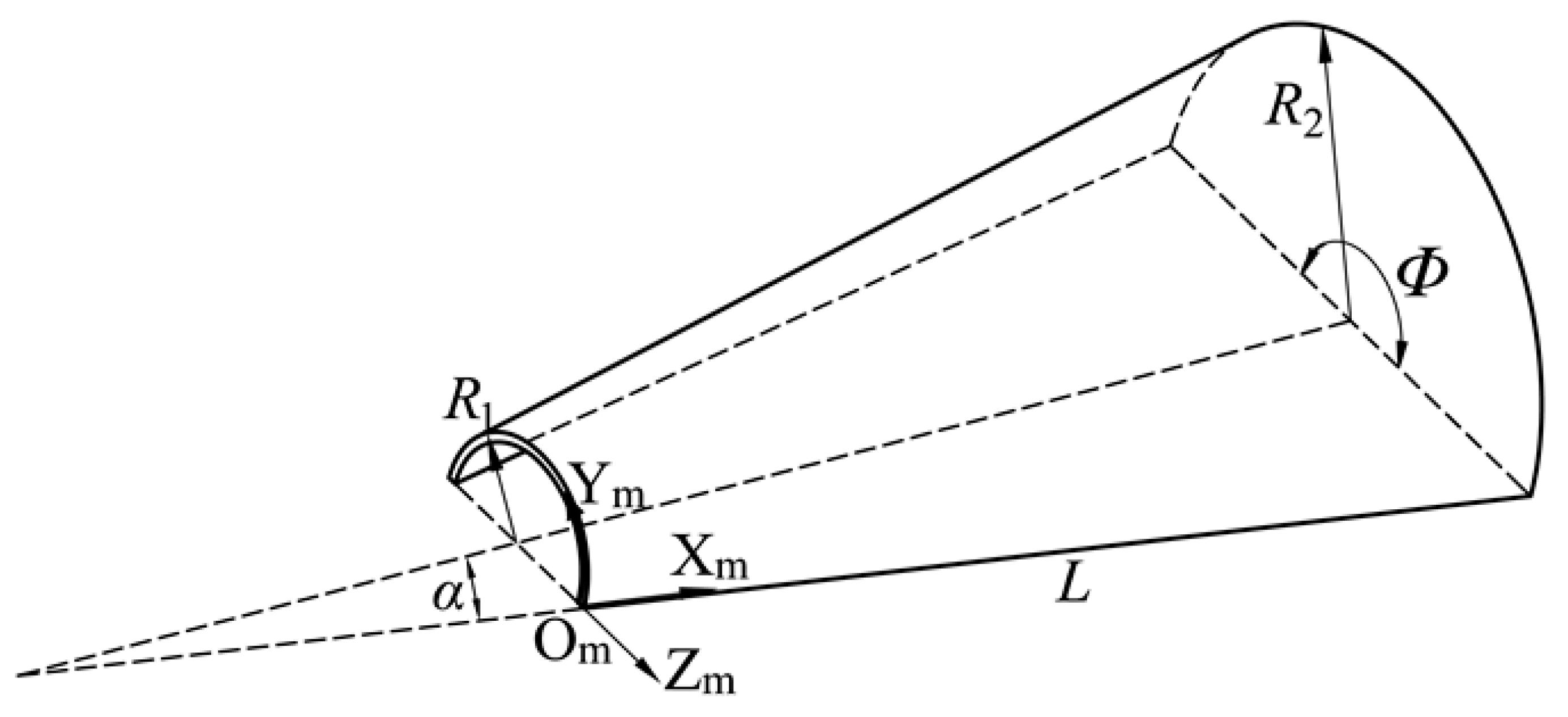
| Parameter Name | Parameter Value | |
|---|---|---|
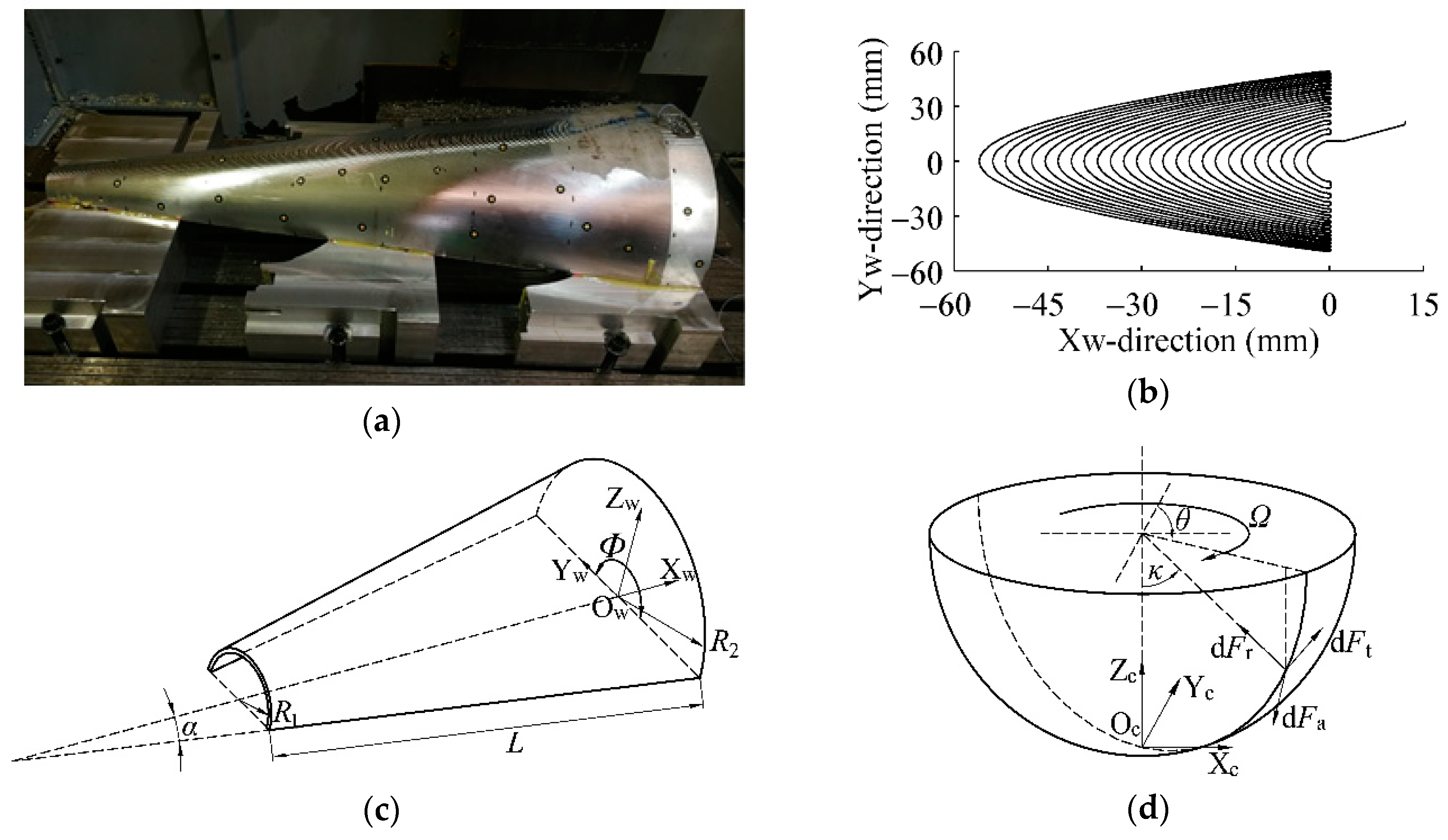
| Workpiece | R1 (mm) | 26 |
| R2 (mm) | 147 | |
| L (mm) | 842 | |
| h (mm) | 10 | |
| Φ (rad) | π | |
| Material | Al-Cu cast aluminum alloy | |
| Endmill cutter | Number of teeth | 2 |
| Helix angle (deg) | 25 | |
| Diameter (mm) | 20 | |
| Manufacturer and model | X-BTC2002 of DHF | |
| Material | tungsten steel |
| Cutting Force Coefficients | Value |
|---|---|
| Cutting force component in the tangential direction, Ktc (N mm−2) | 895.5 |
| Cutting force component in the radial direction, Krc (N mm−2) | 327.5 |
| Cutting force component in the axial direction, Kac (N mm−2) | 64.2 |
| Component of edge effects in the tangential direction, Kte (N mm−1) | 22.5 |
| Component of edge effects in the radial direction, Kre (N mm−1) | 21.2 |
| Component of edge effects in the axial direction, Kae (N mm−1) | 3.7 |
| Methods | First Five Natural Frequencies (Hz) | ||||
|---|---|---|---|---|---|
| 1 | 2 | 3 | 4 | 5 | |
| SGM with M = N = 15 | 600.54 | 985.30 | 1602.4 | 1913.6 | 2147.0 |
| FEM | 583.94 | 957.09 | 1533.1 | 1722.5 | 1995.5 |
| EMA | 586.44 | 966.23 | 1572.4 | 1703.2 | 1989.3 |
Publisher’s Note: MDPI stays neutral with regard to jurisdictional claims in published maps and institutional affiliations. |
© 2020 by the authors. Licensee MDPI, Basel, Switzerland. This article is an open access article distributed under the terms and conditions of the Creative Commons Attribution (CC BY) license (http://creativecommons.org/licenses/by/4.0/).
Share and Cite
Qin, P.; Wang, M.; Sun, L. Feed Rate Variation Strategy for Semi-Conical Shell Workpiece in Ball Head End Milling Process. Appl. Sci. 2020, 10, 9135. https://doi.org/10.3390/app10249135
Qin P, Wang M, Sun L. Feed Rate Variation Strategy for Semi-Conical Shell Workpiece in Ball Head End Milling Process. Applied Sciences. 2020; 10(24):9135. https://doi.org/10.3390/app10249135
Chicago/Turabian StyleQin, Peng, Min Wang, and Lele Sun. 2020. "Feed Rate Variation Strategy for Semi-Conical Shell Workpiece in Ball Head End Milling Process" Applied Sciences 10, no. 24: 9135. https://doi.org/10.3390/app10249135
APA StyleQin, P., Wang, M., & Sun, L. (2020). Feed Rate Variation Strategy for Semi-Conical Shell Workpiece in Ball Head End Milling Process. Applied Sciences, 10(24), 9135. https://doi.org/10.3390/app10249135