1. Introduction
Artificial intelligence (AI) is increasingly reshaping how organizations perceive, structure, and manage economic value across industries. Beyond its role in automation and efficiency, AI now functions as a cognitive and strategic infrastructure capable of supporting prediction, simulation, and complex decision-making in environments characterized by uncertainty and volatility (
McAfee & Brynjolfsson, 2017). Recent developments in generative AI, machine learning, and intelligent analytics have accelerated the integration of AI into managerial and organizational processes, extending its influence beyond operational optimization toward strategic planning, investment analysis, and digital ecosystem development (
Skuridin & Wynn, 2024). In sectors such as finance, entrepreneurship, and real estate, AI-driven systems increasingly influence valuation practices, risk assessment procedures, forecasting models, and organizational decision-making (
Chui et al., 2023). These transformations are not solely technological; they are also organizational and socio-technical, requiring new forms of trust, experience, digital competence, and readiness among both individuals and organizations. Previous research conducted in the Lebanese banking sector similarly highlighted that while AI may enhance operational efficiency and digital service quality, human trust, experiential familiarity, and relational interaction remain central determinants shaping acceptance of AI-enabled systems in developing-country environments (
Boustani, 2022).
Within this broader digital transformation, the emergence of the Metaverse represents a significant evolution in immersive digital interaction and virtual economic ecosystems. The Metaverse is commonly described as a network of persistent and interoperable virtual environments in which users interact, collaborate, create content, and conduct economic activities through digital representations and immersive technologies (
Yang et al., 2022). Technologically, these environments rely on the convergence of extended reality (XR), virtual reality (VR), augmented reality (AR), blockchain infrastructures, decentralized digital systems, and AI-enabled interfaces. Conceptually, the Metaverse extends traditional digital interaction by introducing immersive and spatially oriented virtual experiences that increasingly blur the boundaries between physical and digital environments.
Academic and industry discussions increasingly recognize that immersive digital ecosystems may reshape the way organizations and individuals interact with workspaces, financial systems, education, commerce, and spatial environments. In particular, sectors involving visualization, planning, and digital interaction, such as real estate and urban systems, have attracted growing attention within Metaverse-related discussions (
F. Y. Wang et al., 2022). AI-enabled digital twins, immersive property visualization, and virtual collaboration environments are increasingly explored as tools that may support simulation, planning, and strategic decision-making processes. Similarly, blockchain-enabled ecosystems involving cryptocurrencies, NFTs, and decentralized finance (DeFi) have introduced new debates regarding digital ownership, governance, trust, and perceived financial security within emerging virtual economies (
Morgan, 2022). While real estate-related applications are frequently discussed as an important example of Metaverse transformation, the broader issue underlying these developments concerns how individuals and organizations perceive readiness for participation in immersive digital ecosystems.
Despite increasing technological enthusiasm surrounding the Metaverse, adoption remains uneven and often characterized by uncertainty. Existing perception studies indicate that individuals simultaneously associate immersive digital environments with innovation and future opportunity while expressing concerns regarding legitimacy, security, regulation, and long-term value creation (
Kontogianni & Anthopoulos, 2024). Such ambivalent perceptions are particularly important in relation to decentralized financial ecosystems, where confidence in digital asset governance, liquidity, and security strongly influences willingness to engage with emerging technologies. Research on blockchain-enabled smart contracts and decentralized financial solutions in Lebanon has likewise emphasized that trust, perceived security, and institutional uncertainty strongly shape openness toward blockchain-based ecosystems and DeFi-related applications in crisis-affected economies (
Boustani & Magnaghi, 2022). Unlike traditional systems supported by institutional regulation and long-established financial structures, decentralized digital ecosystems often rely on user perceptions of trust, transparency, and technological credibility.
In this context, experiential familiarity may play an important role in shaping openness toward immersive digital ecosystems. Prior exposure to virtual collaboration tools, digital communication environments, and immersive technologies may reduce cognitive uncertainty associated with Metaverse adoption. The COVID-19 pandemic significantly accelerated the normalization of remote work and digital collaboration practices across organizations and educational institutions worldwide. As a result, many individuals developed greater familiarity with virtual interaction environments, online teamwork, and technology-mediated communication. This accumulated digital experience may influence how immersive ecosystems are perceived and evaluated in post-pandemic environments.
Similarly, familiarity with VR/AR technologies may contribute to greater openness toward Metaverse-related environments by increasing comfort with immersive interaction systems. Individuals who are already interested in immersive technologies may perceive virtual environments as more accessible, useful, or less intimidating. At the same time, trust in decentralized financial systems may influence perceptions regarding the legitimacy and long-term viability of digital ecosystems connected to blockchain-based infrastructures. In immersive environments where economic transactions increasingly intersect with cryptocurrencies, NFTs, tokenized assets, and decentralized financial systems, perceptions of financial security become closely linked to broader attitudes toward participation and organizational investment.
These dynamics become particularly relevant in developing and crisis-affected economies, where institutional instability and weakened trust in traditional systems may significantly shape technology adoption processes. Lebanon offers a particularly relevant empirical setting for examining these issues. The country has experienced prolonged economic and financial instability, banking restrictions, currency depreciation, and declining confidence in traditional financial institutions. Historically, real estate and property ownership have functioned as important mechanisms for wealth preservation and intergenerational value transfer in Lebanon. At the same time, recent crises have contributed to increasing interest in alternative digital financial ecosystems, including cryptocurrencies and blockchain-related assets, although often under conditions of uncertainty and regulatory ambiguity.
Within the Lebanese context, immersive digital ecosystems are therefore likely to be evaluated through a lens shaped by feasibility, trust, experience, and financial security rather than technological enthusiasm alone. Infrastructure constraints, uneven digital accessibility, and uncertainty surrounding digital financial governance may influence how individuals and organizations assess immersive environments and related digital opportunities. Conversely, prior exposure to remote work and digital collaboration practices may reduce resistance toward immersive virtual interaction and contribute to greater openness toward Metaverse-related environments.
From a theoretical perspective, technology adoption models such as the Technology Acceptance Model (TAM) and the Unified Theory of Acceptance and Use of Technology (UTAUT) emphasize the importance of perceived usefulness, experience, facilitating conditions, and familiarity in shaping attitudes toward technology adoption (
Davis, 1989;
Venkatesh et al., 2003). However, rather than directly operationalizing all TAM or UTAUT constructs, this study adopts a broader socio-technical readiness perspective informed by selected concepts from these frameworks. Within this perspective, immersive technology familiarity may relate to technology affinity and experiential ease of engagement, remote work experience may reflect facilitating conditions and accumulated digital exposure, while perceived financial security in decentralized finance may be associated with trust and perceived risk dimensions.
Despite a growing body of conceptual and technical discussions surrounding the Metaverse, empirical research examining human-centered readiness for immersive digital ecosystems remains limited, particularly in developing-country contexts. Existing research often focuses on technological architectures, speculative market potential, or isolated sectoral applications (
Yang et al., 2022). Industry reports similarly emphasize technological innovation and future economic opportunities while devoting less attention to experiential familiarity, trust formation, and perception-based readiness (
Robinson et al., 2022). Furthermore, empirical evidence from the MENA region remains relatively scarce, and few quantitative studies distinguish between individual openness toward immersive technologies and perceptions regarding organizational adoption expectations.
Another limitation in the current literature is the tendency to examine technological familiarity, financial trust, and immersive readiness separately rather than within an integrated analytical framework. Existing studies rarely explore how prior digital experience, immersive technology familiarity, and perceptions of decentralized financial security may jointly relate to readiness for participation in AI-enabled virtual ecosystems. This gap is particularly relevant in developing and crisis-affected economies, where technology adoption is often shaped by contextual constraints, institutional uncertainty, and accumulated experiential adaptation.
Addressing these gaps, this study examines experiential and financial factors associated with readiness for Metaverse adoption in Lebanon. More specifically, the research investigates how immersive technology familiarity (VR/AR interest), remote work experience, and perceived financial security in decentralized digital financial environments relate to both individual readiness and perceived organizational expectations regarding Metaverse adoption. Rather than proposing a deterministic adoption model, the study adopts an exploratory and human-centered perspective on how experiential familiarity, financial trust, and virtual collaboration experience may shape openness toward immersive digital ecosystems in a developing and crisis-affected environment.
2. Literature Review and Hypotheses Development
2.1. Artificial Intelligence as a Driver of Organizational and Managerial Transformation
Artificial intelligence has progressively shifted from a back-office efficiency tool to a core driver of organizational transformation. Contemporary AI systems enable organizations to process large volumes of data, automate complex cognitive tasks, and support strategic decision-making under uncertainty. This evolution has significantly altered managerial roles and required competencies, placing greater emphasis on data interpretation, algorithmic judgment, and human–AI collaboration (
McAfee & Brynjolfsson, 2017;
Skuridin & Wynn, 2024). Rather than replacing managerial decision-makers, AI increasingly acts as a cognitive augmenting force, reshaping how organizations coordinate activities, evaluate performance, and innovate business models.
The literature increasingly emphasizes that AI adoption should not be interpreted exclusively as a technical issue but rather as a socio-organizational process shaped by trust, institutional context, experiential familiarity, and human adaptability. Organizations that successfully integrate AI often combine technological capabilities with adaptive leadership, governance mechanisms, and learning-oriented organizational cultures capable of aligning AI deployment with strategic and ethical objectives (
Stahl & Eke, 2024). Consequently, digital transformation depends not only on technological infrastructure but also on perceptions of legitimacy, readiness, and organizational confidence in digital systems.
This human-centered dimension of AI adoption appears particularly important in developing-country environments where institutional fragility and uncertainty may influence attitudes toward digital transformation. Previous research conducted in the Lebanese banking sector suggested that although AI technologies improve operational efficiency and service quality, human trust, experiential familiarity, and relational interaction remain central determinants shaping acceptance of AI-enabled systems (
Boustani, 2022). The study also highlighted that AI-related transformation in developing economies tends to generate both opportunities and concerns regarding organizational adaptation, employment structures, and trust in automated systems. These findings reinforce the argument that AI adoption involves socio-technical adaptation processes rather than purely technological change.
2.2. The Metaverse as an Immersive Digital Ecosystem and Organizational Transformation
The Metaverse has emerged as a convergence point for several AI-enabled technologies, including extended reality (XR), machine learning, blockchain, and decentralized digital infrastructures. Rather than constituting a single virtual world, the Metaverse is increasingly conceptualized as an ecosystem of interoperable platforms that support social interaction, professional collaboration, and economic exchange (
Nadini et al., 2021). AI plays a central role in this ecosystem by enabling intelligent avatars, automated content generation, personalization, and real-time analytics, thereby shaping user experience and organizational functionality.
From a business and management perspective, the Metaverse extends digital transformation into immersive organizational spaces. Robinson et al. highlights that Metaverse development is guided by three foundational principles: decentralization, interoperability, and trust. These principles have direct implications for perceived organizational expectations, as they require firms to rethink governance structures, data ownership, cybersecurity, and compliance in AI-augmented environments. The Metaverse thus becomes not only a technological innovation but also an organizational experiment in new forms of coordination, control, and value creation.
Recent contributions have also introduced the concept of “MetaEnterprises,” in which organizations operate virtual counterparts alongside physical operations to support simulation, prediction, and optimization through AI-enabled feedback systems (
Y. Wang et al., 2022). Within this perspective, immersive ecosystems may enhance organizational agility, experimentation, and strategic decision-making processes. However, these opportunities presuppose a certain degree of technological familiarity, digital competence, and trust among organizational actors.
At the same time, the Metaverse remains associated with uncertainty regarding regulation, legitimacy, security, and long-term economic viability. Existing studies indicate that attitudes toward immersive digital ecosystems are shaped not only by technological capability but also by prior digital experience, familiarity with immersive environments, and trust in supporting financial infrastructures (
Kontogianni & Anthopoulos, 2024). Consequently, readiness for immersive digital ecosystems may depend as much on experiential familiarity and perceived trust as on technological innovation itself.
2.3. Technology Acceptance, Experience, and Readiness in AI-Enabled Environments
The literature on technology adoption provides an important theoretical foundation for understanding why certain individuals and organizations may exhibit greater openness toward immersive digital ecosystems than others. The Technology Acceptance Model (TAM) suggests that perceived usefulness and perceived ease of use significantly influence attitudes toward technology adoption (
Davis, 1989). Similarly, the Unified Theory of Acceptance and Use of Technology (UTAUT) emphasizes the importance of facilitating conditions, social influence, and prior experience in shaping technology-related perceptions and behavioral intentions (
Venkatesh et al., 2003).
Although these frameworks were initially developed within more traditional information system environments, recent studies suggest that their underlying principles remain relevant in immersive and AI-enabled ecosystems. However, rather than directly operationalizing all TAM or UTAUT constructs, the present study adopts a broader socio-technical readiness perspective informed by selected concepts from these frameworks. Within this perspective, immersive technology familiarity may relate to technology affinity and experiential ease of engagement, while remote work experience may reflect accumulated digital exposure and facilitating conditions associated with technology-mediated collaboration environments.
Prior experience with related digital technologies becomes particularly important when technologies are perceived as complex, abstract, or uncertain. Familiarity with immersive tools, AI-adjacent systems, and digital collaboration platforms may reduce uncertainty, strengthen perceived competence, and increase openness toward virtual environments. In this study, interest in immersive technologies (VR/AR) is therefore considered an exploratory proxy for familiarity with immersive and AI-adjacent digital ecosystems commonly associated with Metaverse environments. While this construct does not directly measure AI expertise or technical competence, previous research suggests that familiarity with immersive technologies may reduce resistance toward advanced digital systems and increase openness toward virtual interaction environments.
Remote work experience represents another important form of experiential familiarity. The COVID-19 pandemic accelerated the global adoption of digital collaboration platforms and remote interaction systems at an unprecedented scale. Organizations and educational institutions increasingly relied on technology-mediated communication, thereby expanding exposure to virtual collaboration environments. Studies indicate that positive remote work experiences characterized by perceived productivity, flexibility, and effective digital interaction may contribute to greater openness toward advanced forms of immersive collaboration (
Waizenegger et al., 2020).
In this sense, remote work experience may function as an experiential bridge toward readiness for immersive digital ecosystems. Individuals who adapted positively to remote collaboration systems and digital communication environments may perceive Metaverse-based workspaces and immersive virtual interaction systems as more accessible and feasible. Consequently, experiential familiarity may contribute to reducing cognitive barriers associated with immersive digital environments and strengthen openness toward Metaverse-related engagement.
2.4. Digital Finance, DeFi Trust, and Economic Readiness for the Metaverse
Beyond experiential familiarity, financial perceptions and trust in decentralized digital infrastructures may also shape readiness for immersive digital ecosystems. The Metaverse is increasingly intertwined with blockchain-based systems involving cryptocurrencies, decentralized finance (DeFi), NFTs, and tokenized digital assets. These technologies facilitate ownership, exchange, and economic interaction within virtual ecosystems, thereby forming an important economic foundation for many Metaverse-related environments (
Nadini et al., 2021).
However, decentralized digital finance systems are also associated with uncertainty and perceived risk. Research on NFT markets and virtual digital assets suggests that investment behavior and perceived value often depend heavily on trust in digital infrastructures, transaction security, and financial governance mechanisms (
Nakavachara & Saengchote, 2022). Individuals with greater familiarity or confidence in blockchain-based ecosystems may therefore perceive immersive digital economies as more legitimate and viable than individuals who associate such systems with volatility, opacity, or insecurity.
Research on blockchain-enabled smart contracts and decentralized financial solutions in Lebanon similarly emphasized that trust, perceived security, and institutional uncertainty strongly shape openness toward blockchain-based ecosystems and DeFi-related applications in crisis-affected economies (
Boustani & Magnaghi, 2022). The study highlighted that decentralized financial systems may be perceived simultaneously as innovative alternatives and as sources of uncertainty, particularly in contexts characterized by macroeconomic instability and weakened trust in traditional institutions. These findings suggest that financial trust may represent an important component of readiness toward broader immersive digital ecosystems.
From an organizational perspective, trust in decentralized financial infrastructures may also shape perceptions regarding investment feasibility, strategic viability, and long-term organizational engagement within immersive environments. Industry analyses indicate that organizations are more likely to support Metaverse-related initiatives when blockchain-based infrastructures are perceived as sufficiently reliable and compatible with organizational risk management frameworks (
Morgan, 2022). Consequently, perceived financial security may function as an important dimension shaping organizational expectations regarding immersive digital ecosystems.
These issues become particularly relevant in developing and crisis-affected economies. Existing studies on AI, digital finance, and immersive ecosystems are often grounded in advanced economies characterized by relatively stable infrastructures and institutional environments. However, scholars increasingly argue that technology adoption in developing-country contexts follows different dynamics shaped by infrastructural constraints, institutional fragility, economic volatility, and contextual uncertainty (
Robinson et al., 2022).
Lebanon represents a particularly relevant setting for examining these dynamics. Macroeconomic instability, banking restrictions, regulatory ambiguity regarding crypto-assets, and declining confidence in traditional financial institutions may significantly influence how individuals and organizations evaluate immersive digital ecosystems. In such contexts, readiness may depend less on technological enthusiasm alone and more on experiential familiarity, perceived feasibility, and trust in decentralized financial infrastructures. Consequently, examining Metaverse readiness in Lebanon offers important contextual insights into AI-enabled transformation processes under conditions of constraint rather than abundance.
Despite growing discussions surrounding immersive digital ecosystems, empirical research examining experiential familiarity and financial trust jointly remains limited, particularly in developing-country contexts. Existing studies frequently focus on technological architectures, speculative market opportunities, or isolated sectoral applications while devoting less attention to perception-based readiness and experiential dimensions associated with immersive ecosystems. Furthermore, empirical evidence from the MENA region remains relatively scarce.
Addressing these gaps, the present study examines experiential and financial factors associated with readiness for Metaverse adoption in Lebanon. More specifically, the study investigates how immersive technology familiarity (VR/AR interest), remote work experience, and perceived financial security in decentralized digital financial environments relate to both individual readiness and perceived organizational expectations regarding Metaverse adoption. Accordingly, the study addresses the following research question: How do experiential familiarity and perceived financial trust relate to readiness for Metaverse adoption in Lebanon?
To empirically examine these relationships, two exploratory hypotheses are proposed. Previous studies suggest that familiarity with immersive technologies and positive digital collaboration experiences may reduce uncertainty and strengthen openness toward virtual environments. Individuals who adapted positively to remote collaboration systems and technology-mediated interaction may therefore exhibit greater readiness toward immersive ecosystems.
Hypothesis 1 (H1). Interest in immersive technologies (VR/AR) and positive remote work experiences are positively associated with individual readiness-related perceptions regarding Metaverse use.
Similarly, trust in decentralized financial environments may shape perceptions regarding the legitimacy, feasibility, and organizational viability of immersive digital ecosystems. Individuals perceiving decentralized financial systems as secure and reliable may therefore express stronger expectations regarding organizational openness toward Metaverse-related initiatives.
Hypothesis 2 (H2). Perceived financial security in decentralized digital assets is positively associated with perceived organizational expectations and investment expectations regarding Metaverse-related environments.
3. Methodology
3.1. Research Design, Context, and Data Collection
This study adopts a quantitative cross-sectional research design to examine experiential and financial factors associated with readiness for Metaverse adoption within a developing-country context. A survey-based approach was considered appropriate given the exploratory and perception-based nature of the research, particularly in relation to emerging technologies characterized by limited behavioral adoption and evolving conceptual boundaries. Consistent with prior research on technology acceptance, digital transformation, and AI-related adoption processes, survey methods are suitable for capturing attitudes, perceptions, experiential familiarity, and readiness-related dimensions associated with complex digital ecosystems (
Davis, 1989;
Venkatesh et al., 2003).
The study is theory-informed but exploratory in orientation. Rather than testing a fully operationalized causal adoption model, the research examines associative relationships between immersive technology familiarity, remote work experience, perceived financial security in decentralized digital finance, and readiness-related perceptions regarding immersive digital ecosystems. This exploratory orientation is particularly relevant in the context of Immersive Metaverse environments, where technological diffusion remains at an early stage and where perception-based readiness may precede actual behavioral adoption.
The empirical focus on Lebanon is theoretically motivated rather than incidental. Much of the existing literature on AI, immersive ecosystems, and decentralized digital finance implicitly assumes stable infrastructures, mature institutional environments, and relatively high levels of digital penetration. By contrast, Lebanon is characterized by prolonged macroeconomic instability, infrastructural fragility, banking restrictions, and regulatory ambiguity, particularly regarding digital finance and crypto-assets. Examining Metaverse-related readiness in this context allows for a more nuanced understanding of how experiential familiarity, trust in decentralized financial infrastructures, and virtual collaboration experience interact under conditions of institutional uncertainty and economic constraint rather than technological abundance.
Data were collected through a structured online questionnaire specifically designed to capture perceptions, experiences, and expectations associated with immersive digital ecosystems, remote work environments, decentralized financial systems, and Metaverse-related engagement. The questionnaire was informed by constructs commonly discussed in the technology acceptance, digital transformation, and socio-technical readiness literature and was adapted to the emerging Metaverse context and the realities of a developing and crisis-affected economy.
The questionnaire included 19 substantive items organized around five main dimensions: (1) demographic and socio-professional characteristics, (2) immersive technology familiarity and digital experience, (3) remote work experience, (4) perceived financial security in decentralized digital finance environments, and (5) readiness-related perceptions regarding Metaverse engagement and organizational expectations. Most perceptual items were measured using five-point Likert scales ranging from strongly disagree (1) to strongly agree (5), consistent with common practices in management and technology adoption research. Binary and categorical variables were additionally used for demographic and experiential indicators, including prior cryptocurrency or NFT investment experience.
The questionnaire was disseminated digitally between February 2025 and July 2025 through the researcher’s personal and professional networks, including colleagues, acquaintances, and digital platforms such as WhatsApp and Facebook, using a voluntary non-probabilistic convenience sampling approach. This recruitment procedure was selected due to the exploratory nature of the study and the absence of a clearly identifiable sampling frame for individuals exposed to immersive technologies, digital finance, and Metaverse-related environments within Lebanon.
Only participants aged 18 years and above who voluntarily agreed to participate were included in the study. The initial questionnaire category was relabeled during data cleaning to reflect the eligible adult age group; no minors were included in the final dataset. Participation was entirely voluntary, and respondents were informed of the academic purpose of the research prior to completing the questionnaire. Responses that were incomplete or inconsistent were excluded during the data cleaning stage to ensure analytical reliability.
The final sample consisted of 231 valid responses collected from individuals residing and/or working in Lebanon. Respondents represented diverse socio-professional categories and fields of work, including business, engineering, education, healthcare, and other sectors. The sample included both students and employed professionals, individuals with varying degrees of exposure to digital finance, and participants with prior experience of remote work or remote study during the COVID-19 pandemic.
Although the sample is not intended to be statistically representative of the entire Lebanese population, it remains appropriate for exploratory theory-informed analysis and regression-based examination of readiness-related perceptions. The sample size exceeds commonly accepted thresholds for multiple regression analysis and provides sufficient statistical power for the exploratory relationships examined in this study.
3.2. Measurement, Operationalization, and Data Analysis
The study operationalized its key constructs based on both theoretical relevance and empirical feasibility within an emerging technological context. Because the study investigates an emerging and exploratory technological phenomenon, several constructs were operationalized using perception-based single-item indicators rather than validated multidimensional adoption scales. Consequently, the findings should be interpreted as exploratory associative relationships rather than comprehensive measures of technology adoption behavior. Internal consistency reliability was assessed for the multi-item constructs included in the study using Cronbach’s alpha coefficients. The remote work experience construct demonstrated acceptable reliability, supporting the aggregation of the related perception-based items into a composite indicator. In contrast, several exploratory variables associated with immersive technology familiarity and perceived financial security were operationalized using single-item indicators due to the emerging nature of the phenomenon and the exploratory orientation of the study.
Construct 1: Immersive Technology Familiarity (VR/AR Interest) refers to respondents’ openness toward and interest in technologies commonly associated with immersive digital ecosystems, including virtual reality (VR) and augmented reality (AR). In this study, interest in immersive technologies was used as an exploratory proxy for familiarity with immersive and AI-adjacent digital environments commonly associated with Metaverse ecosystems. While this indicator does not directly capture AI expertise or technical competence, prior literature suggests that familiarity with immersive technologies may reduce uncertainty and increase openness toward advanced virtual interaction systems during early stages of adoption research. The construct was operationalized using a five-point Likert-scale item assessing respondents’ level of interest in VR/AR technologies: (Q9: “I am interested in virtual reality (VR) and augmented reality (AR) technologies.”)
Construct 2: Remote Work Experience captures respondents’ perceptions and evaluations of digitally mediated collaboration environments during and after the COVID-19 period, including enjoyment of remote interaction, preference for remote work arrangements, and perceived productivity of remote work practices. It is operationalized through a set of items measuring enjoyment of remote work or study during the COVID-19 pandemic, perceived productivity when working from home, and preference for permanent remote work if organizational policies allow. Together, these indicators reflect both affective and cognitive evaluations of remote work and serve as experiential antecedents of readiness for more immersive virtual work environments.
Construct 3: Perceived Financial Security in Decentralized Digital Assets represents respondents’ level of trust in blockchain-based financial systems. It is measured using a Likert-scale item assessing the extent to which respondents feel financially secure when using decentralized finance platforms. (Q8. “I feel financially secure when using decentralized finance (DeFi) platforms (e.g., cryptocurrencies, NFTs).”) This construct is central to RQ2 and H2, as prior research shows that trust in digital finance strongly influences openness to Metaverse-based economic activities and investment expectations, particularly in relation to virtual land and digital real estate markets.
Construct 4: Individual Readiness for Metaverse Adoption is conceptualized as attitudinal readiness rather than actual usage, reflecting the early diffusion stage of the Metaverse in Lebanon. Individual readiness is operationalized as willingness to use the Metaverse for work, education, or professional activities. (Q14. “I am willing to use the Metaverse for work, education, or professional activities.”)
Construct 5: Perceived Organizational Benefit Expectation captures respondents’ perceptions regarding potential organizational openness toward Metaverse-related adoption and investment rather than measuring objective perceived organizational expectations directly. Because the sample includes students and unemployed respondents in addition to employed professionals, the construct should be interpreted as a perception-based indicator of anticipated organizational orientation rather than as a direct organizational capability assessment. The construct was operationalized through items examining respondents’ expectations regarding organizational investment in Metaverse-related environments, anticipated effects on business models, and perceived impact on organizational financial performance. (Q15: “When do you think your organization would invest in the Metaverse?”)
Data analysis was conducted in several stages. First, descriptive statistics (frequencies, means, and standard deviations) were computed to profile the sample and summarize perceptions related to AI, DeFi, remote work, and the Metaverse. Second, for multi-item constructs, internal consistency reliability was assessed using Cronbach’s alpha, with values above 0.70 considered acceptable. Correlation analysis was used to examine initial associations among key variables and to assess potential multicollinearity.
To test H1 and H2, the study employs multiple linear regression analysis, which is appropriate for examining the influence of multiple independent variables on readiness-related outcomes. Individual readiness for Metaverse adoption is regressed on the interest in immersive technologies and remote work experience variables, while perceived organizational expectations and investment expectations are regressed on perceived financial security in decentralized finance. Regression assumptions were assessed through standard diagnostic procedures, and statistical significance was evaluated at conventional thresholds (p < 0.05).
The study adheres to standard ethical guidelines for social science research. Participation was voluntary, respondents were informed of the academic purpose of the study, and no personally identifiable information was collected. Data were analyzed in aggregated form to ensure confidentiality and anonymity.
4. Results
In this section, the authors first report descriptive statistics and reliability analyses to assess the quality and internal consistency of the measurement scales. Second, the authors conduct a correlation analysis to examine initial relationships among key variables. Third, regression analyses test hypotheses H1 and H2. Fourth, robustness and explanatory power are discussed. Finally, we present an integrated empirical model that summarizes the results.
4.1. Sample Characteristics
The final sample consists of 231 respondents residing and/or working in Lebanon. Female respondents represent 57.1% of the sample, while males account for 42.9%. The age distribution is concentrated among young adults, with 65.8% of respondents aged between 18 and 26 and 26.0% between 27 and 35. Respondents over 35 account for 8.2% of the sample.
From a socio-professional perspective, 45.5% of respondents are employed, 36.8% are students, and 17.7% are unemployed. The participants come from diverse professional backgrounds, including business and management (26.8%), engineering and IT (20.8%), healthcare (16.0%), education (10.4%), and other sectors (26.0%). Regarding exposure to digital finance, 40.7% of respondents report prior investment in cryptocurrencies or NFTs. Concerning remote work or study during the COVID-19 pandemic, 48.9% report high enjoyment, 26.0% moderate enjoyment, and 25.1% low enjoyment.
Table 1 indicates a heterogeneous sample with meaningful variation in age, professional status, digital finance exposure, and remote work experience, providing a suitable empirical basis for examining readiness for Metaverse adoption in a developing-country context.
4.2. Descriptive Statistics and Reliability
Table 2 reports the descriptive statistics for the main variables used in the analysis.
All mean values are above the midpoint of the scale, showing moderate openness to AI-enabled Metaverse scenarios. None of the factors approach extreme values, implying cautious and differentiated perceptions as opposed to polarized opinions. Internal consistency was then assessed for the multi-item constructs using Cronbach’s alpha as shown in
Table 3.
These results support the internal consistency of the composite variables used in the regression analyses. The remote work experience construct demonstrated strong internal consistency reliability (α = 0.841). In addition, the perceived organizational benefit expectations construct showed acceptable reliability (α = 0.755).
Both constructs exceed the 0.70 threshold, indicating good internal consistency. Variables measured using single items (VR/AR interest, DeFi security, individual readiness) are treated as such, and reliability coefficients are therefore not applicable.
The organizational investment horizon variable ((Q15) “When do you think your organization will invest in the Metaverse?”) is intentionally excluded from the composite scale, as it captures categorical timing rather than perceived benefits.
4.3. Correlation Analysis
Pearson correlation coefficients were computed to examine bivariate associations and assess multicollinearity. As shown in
Table 4, all correlations are positive and statistically significant, indicating that greater interest in immersive technologies, more positive remote work experiences, and stronger perceived financial security in decentralized digital assets are associated with higher levels of individual readiness and perceived organizational expectations regarding the Metaverse. The strongest association was observed between individual readiness and organizational expectations (r = 0.53,
p < 0.01), suggesting that respondents who express greater willingness to engage with Metaverse-related activities also tend to perceive stronger organizational opportunities associated with these environments.
To further assess whether the independent variables were highly correlated with one another, multicollinearity diagnostics were conducted using Variance Inflation Factor (VIF) values. As reported in
Table 5, all VIF values were low, ranging from 1.06 to 1.17.
All VIF values were substantially below the commonly accepted threshold of 5, indicating that multicollinearity was not a concern in the estimated models.
4.4. Hypothesis Testing
4.4.1. H1: Individual Readiness for Metaverse Adoption
To test H1, multiple linear regression analysis was conducted, with individual readiness for Metaverse adoption as the dependent variable. Independent variables include interest in VR/AR technologies and remote work experience. Age, gender, and socio-professional status were included as control variables. The results are presented in
Table 6.
Both VR/AR interest and remote work experience exhibit strong, positive, and statistically significant effects on individual readiness. Control variables are not significant. The model explains 29% of the variance, indicating meaningful explanatory power. H1 is supported.
The standardized coefficients suggest that immersive technology familiarity and remote work experience exhibit moderate practical importance in explaining individual readiness-related perceptions regarding Metaverse adoption.
4.4.2. H2: Perceived Organizational Expectations and Investment Expectations
To test H2, a second regression model was estimated, with organizational benefit expectations as the dependent variable. The results are presented in
Table 7.
Residual diagnostics were additionally examined to assess model adequacy (
Table 8). Residual distributions appeared reasonably normal, and no major heteroscedasticity patterns were detected. Given the exploratory nature of the study and the use of Likert-scale perception variables, the regression assumptions were considered sufficiently satisfied for inferential purposes. Perceived financial security in decentralized digital assets has a positive and statistically significant effect on perceived organizational expectations, supporting its central role in shaping expectations regarding Metaverse investment. Technological interest and remote work experience also contribute significantly, indicating that perceived organizational expectations is both financially and experientially grounded. H2 is supported.
Although perceived financial security in decentralized finance was statistically significant, the effect size should be interpreted cautiously given the exploratory and perception-based nature of the study.
Residual diagnostics indicated acceptable residual behavior for the first regression model. While the second model exhibited some departures from normality, the robustness analyses reported below produced results consistent with the main findings.
Two robustness checks were conducted to assess the stability of the results.
First, Spearman rank correlations were computed for all key relationships to account for the ordinal nature of Likert-scale variables (
Table 9). The direction and significance of all relationships remained unchanged.
Second, ordered logistic regression was performed using the organizational investment horizon variable (Q15) as the dependent variable. Results indicate that higher perceived DeFi security, greater VR/AR interest, and stronger remote work experience significantly increase the likelihood of expecting earlier organizational investment in the Metaverse. These findings are consistent with the OLS regression results.
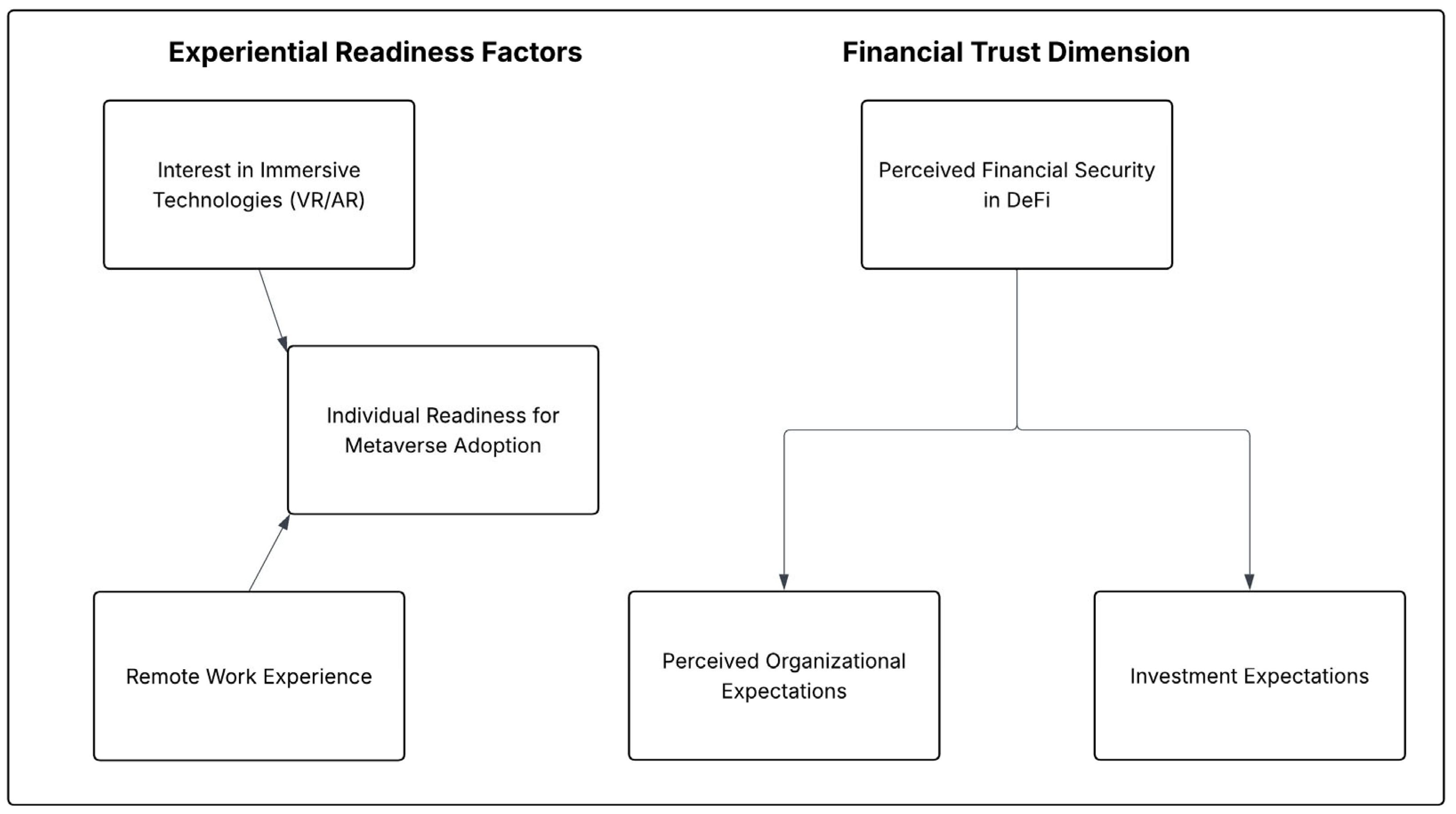
Based on the validated results, the empirical model of readiness for Metaverse adoption is summarized in
Figure 1 as follows:
The empirical model illustrates two complementary exploratory pathways associated with readiness for Immersive Metaverse environments. On the one hand, immersive technology familiarity and positive remote work experience are positively associated with individual readiness-related perceptions regarding Metaverse engagement. On the other hand, perceived financial security in decentralized finance is associated with stronger organizational expectations and expected investment timing regarding immersive digital ecosystems. The dual-path structure highlights the socio-technical and trust-based dimensions associated with Metaverse readiness in developing and crisis-affected environments.
The findings suggest that readiness for Immersive Metaverse environments in developing and crisis-affected economies is associated not only with technological interest but also with experiential familiarity and perceived financial trust. Respondents reporting stronger interest in immersive technologies and more positive remote work experiences tend to express greater openness toward Metaverse-related environments, while perceptions of financial security in decentralized finance are associated with stronger organizational expectations and expected investment timing. These findings support the relevance of socio-technical and trust-related dimensions in understanding readiness for emerging immersive digital ecosystems.
5. Discussion
This study contributes to the growing literature on immersive digital ecosystems by suggesting that openness toward Metaverse environments in developing and crisis-affected economies depends not only on technological innovation but also on trust in digital infrastructures and familiarity with virtual interaction environments.
5.1. Theoretical Implications
The empirical support for H1 suggests that experiential dimensions, particularly interest in immersive technologies (VR/AR) and positive remote work experience, are positively associated with individual readiness-related perceptions regarding Metaverse adoption. This finding generally aligns with the Technology Acceptance Model (TAM) and the Unified Theory of Acceptance and Use of Technology (UTAUT), which emphasize perceived usefulness, facilitating conditions, and prior experience as important dimensions shaping openness toward technology adoption (
Davis, 1989;
Venkatesh et al., 2003). However, the present study extends these perspectives by suggesting that experiential familiarity may function as an important readiness mechanism in immersive and AI-enabled environments.
Rather than evaluating the Metaverse as a completely discontinuous technological innovation, respondents appear to interpret immersive environments through the lens of their prior digital experiences. Familiarity with immersive technologies may reduce cognitive distance from virtual environments, while positive remote work experiences may normalize collaboration, interaction, and productivity through digital channels. This interpretation is consistent with studies emphasizing the importance of experiential learning, digital self-efficacy, and accumulated digital exposure in shaping receptivity toward advanced technologies (
Waizenegger et al., 2020;
Kniffin et al., 2021).
The findings also reinforce socio-technical perspectives suggesting that technology adoption is shaped through the interaction between technical systems and social practices rather than through technical functionality alone. In this regard, readiness for immersive digital ecosystems appears to emerge progressively through accumulated exposure to digital communication environments and virtual collaboration practices. This interpretation challenges purely technocentric narratives that portray Metaverse adoption as primarily driven by innovation enthusiasm or speculative technological curiosity.
Importantly, the findings further suggest that experiential familiarity may partially mitigate traditional demographic divides associated with digital adoption. Once experiential variables were introduced into the regression models, demographic variables such as age, gender, and socio-professional status exhibited lower explanatory relevance. This observation differs somewhat from earlier digital divide literature that primarily emphasized structural or generational barriers and instead suggests that accumulated digital exposure may gradually reduce resistance toward immersive digital ecosystems, particularly in rapidly evolving technological environments.
The support for H2 additionally highlights the importance of perceived financial security in decentralized finance as a significant dimension associated with perceived organizational expectations and expected investment timing regarding Metaverse-related environments. This result is consistent with emerging literature emphasizing the role of blockchain-based financial infrastructures in supporting digital ownership, exchange, and valuation within immersive ecosystems (
Jim et al., 2023;
Yang et al., 2022). Unlike traditional economic systems characterized by relatively stable institutional frameworks, immersive digital ecosystems frequently rely on decentralized infrastructures where trust in financial mechanisms becomes closely linked to trust in the broader digital environment itself.
The findings therefore reinforce trust-based interpretations of digital economic behavior, suggesting that organizational expectations regarding immersive ecosystems are associated not only with technological feasibility but also with perceptions of financial legitimacy, security, and institutional reliability. At the same time, the results indicate that financial trust alone may not fully explain readiness-related perceptions. Experiential familiarity and digital collaboration experience remain important complementary dimensions associated with openness toward immersive digital environments. Consequently, readiness appears to emerge through a layered socio-technical process combining experiential exposure, financial trust, and digital competence.
The empirical model examined in this study therefore suggests a dual-path exploratory framework associated with readiness for Immersive Metaverse environments. On the one hand, immersive technology familiarity and positive remote work experience are associated with stronger individual readiness-related perceptions. On the other hand, perceived financial security in decentralized finance is associated with stronger organizational expectations and expected investment timing regarding immersive ecosystems. This dual-path interpretation contributes to the literature by integrating experiential and financial dimensions within a single exploratory framework adapted to a developing-country context.
5.2. Contextual Implications in a Developing and Crisis-Affected Economy
The Lebanese context provides important insights into how immersive digital ecosystems may be evaluated under conditions of institutional fragility, economic instability, and weakened confidence in traditional systems. Unlike many advanced economies, where Metaverse-related discussions often focus primarily on technological innovation and future market opportunities, respondents in Lebanon appear to evaluate immersive environments through a more trust-intensive and experience-dependent perspective shaped by prolonged economic uncertainty and digital adaptation.
Historically, physical property ownership has represented an important mechanism for value preservation and economic stability in Lebanon. Consequently, immersive digital ecosystems associated with virtual assets, decentralized finance, and tokenized environments may generate both interest and hesitation. The findings suggest that individuals and organizations do not necessarily reject these emerging ecosystems; rather, they appear to evaluate them through perceptions of trust, familiarity, and experiential feasibility formed under conditions of financial instability and institutional uncertainty.
In this context, immersive digital ecosystems may be perceived less as replacements for physical environments and more as complementary or hybrid extensions of existing organizational and economic practices. This interpretation aligns with more cautious perspectives on digital transformation suggesting that immersive environments are likely to coexist with physical systems rather than abruptly replace them, particularly in sectors where material ownership, stability, and physical presence remain culturally and economically important.
The discussion of real estate implications should therefore be interpreted as a contextual extension of the broader findings on Metaverse readiness rather than as direct empirical evidence regarding virtual property adoption or tokenized real estate investment behavior. Nevertheless, the findings suggest that openness toward immersive real estate-related applications such as virtual collaboration spaces, AI-enabled digital twins, or immersive visualization environments may depend heavily on prior digital exposure and trust in supporting financial infrastructures.
5.3. Managerial and Practical Implications
The findings generate several practical implications for organizations, managers, and policymakers involved in digital transformation and immersive ecosystem development. First, the results suggest that investments in immersive digital environments should not focus exclusively on technological infrastructure. Organizational openness toward Metaverse-related initiatives appears to be associated with both experiential familiarity and trust in decentralized financial systems. Consequently, organizations seeking to develop immersive digital strategies may benefit from progressively strengthening digital collaboration capabilities, virtual interaction familiarity, and employee exposure to immersive technologies before expecting broader perceived organizational expectations.
Second, the importance of remote work experience suggests that digital collaboration environments may function as transitional mechanisms facilitating openness toward more immersive forms of virtual interaction. Organizations that successfully integrated remote collaboration practices during and after the COVID-19 pandemic may therefore possess more favorable conditions for experimenting with immersive collaboration environments and AI-enabled virtual ecosystems.
Third, the findings emphasize the importance of trust-building mechanisms within decentralized digital ecosystems. Because perceived financial security in decentralized finance was significantly associated with organizational expectations and expected investment timing, policymakers and platform developers may need to strengthen transparency, governance clarity, cybersecurity protections, and user education surrounding decentralized digital finance systems. In developing and crisis-affected economies, trust in digital infrastructures may represent a prerequisite for broader organizational engagement with immersive ecosystems.
Finally, the findings suggest that readiness for immersive digital ecosystems should be approached as a gradual socio-technical adaptation process rather than as a purely technological transition. Human-centered digital transformation strategies emphasizing digital literacy, experiential learning, institutional trust, and incremental adoption may therefore be more effective than purely technology-driven approaches.
Last but not least, these findings support the relevance of socio-technical and trust-related dimensions in understanding readiness for emerging immersive digital ecosystems (
Stahl & Eke, 2024). By doing this, the results both support and clarify the body of knowledge already available on virtual economies, immersive environments, and real estate transformation, especially when it comes to refuting popularized accounts of the Metaverse (
Dwivedi et al., 2022).
6. Conclusions, Implications, and Future Research
This study examined experiential and financial factors associated with readiness for Metaverse adoption within a developing-country context. Using survey data collected in Lebanon, the research explored how immersive technology familiarity (VR/AR interest), remote work experience, and perceived financial security in decentralized finance relate to both individual readiness and perceived organizational expectations regarding immersive digital ecosystems.
The findings suggest that readiness for Metaverse-related environments is associated not only with technological interest but also with accumulated digital experience and perceptions of financial trust. More specifically, interest in immersive technologies and positive remote work experiences were positively associated with individual readiness-related perceptions, while perceived financial security in decentralized finance was significantly associated with organizational expectations and expected investment timing toward immersive ecosystems.
From a theoretical perspective, the study contributes to the literature on AI adoption, immersive ecosystems, and digital transformation by integrating experiential familiarity and financial trust within a socio-technical readiness framework. The findings further suggest that technology acceptance perspectives such as TAM and UTAUT remain relevant in immersive environments when contextualized through prior digital experience and trust-related dimensions. By focusing on Lebanon as a developing and crisis-affected economy, the study also highlights how institutional uncertainty and financial instability may shape openness toward emerging digital ecosystems.
The findings additionally generate practical implications for organizations, managers, and policymakers. Organizations seeking to develop Metaverse-related initiatives may benefit from progressively strengthening digital collaboration capabilities, immersive technology familiarity, and trust in decentralized financial infrastructures. Similarly, policymakers and ecosystem developers may support readiness through digital literacy initiatives, trust-building mechanisms, and clearer governance frameworks surrounding decentralized digital finance systems.
Several limitations should be acknowledged. First, the study relied on a non-probabilistic convenience sample collected within a single-country context, which limits the generalizability of the findings beyond Lebanon. Second, because the data were collected through self-reported perceptions using a cross-sectional questionnaire, common method bias and response subjectivity may be present. In addition, several variables were operationalized using exploratory perception-based indicators rather than validated multidimensional scales, reflecting the emerging nature of Metaverse-related research. Consequently, the findings should be interpreted as exploratory associative relationships rather than causal effects.
Future research could extend these findings through longitudinal studies, cross-country comparisons, and sector-specific investigations while incorporating broader multidimensional measures of immersive technology familiarity, organizational digital readiness, and financial trust. Further studies could also explore mediating or moderating mechanisms associated with experiential familiarity, digital competence, and decentralized financial ecosystems.