1. Introduction
In the rapidly evolving landscape of the tourism and hospitality sector, digital transformation has emerged as a cornerstone of organizational competitiveness and sustainability (
Aljoghaiman et al., 2024;
Moustafa et al., 2024;
Mavitha & Kushe, 2025). Among the key enablers of this transformation is digital talent—professionals who possess the technical, analytical, and innovative capabilities necessary to leverage digital technologies effectively (
Donmez & Donmez, 2025;
Hasanein & Metwally, 2025). As digital platforms increasingly dominate customer interaction channels and expectations continue to rise, organizations must rely on digitally skilled employees to sustain agility, responsiveness, and continuous marketing innovation (
Gilch & Sieweke, 2021;
Liu et al., 2023;
Hasanein et al., 2026).
Digital talent plays a critical role in shaping marketing innovation within tourism and hospitality organizations. These professionals are often at the forefront of adopting new technologies, personalizing customer experiences, and integrating data-driven strategies to enhance marketing outcomes. Beyond its direct contribution, digital talent also exerts an indirect influence by shaping the organizational context in which innovation occurs (
Ercik & Kardaş, 2024). Moreover, digital talent not only influences marketing innovation directly but also contributes significantly to building a strong digital culture and formulating forward-looking digital strategies (
Karaboga et al., 2020;
Rowles & Brown, 2017). This dual role highlights that digital talent functions not only as an operational resource but also as a driver of organizational transformation (
Gilch & Sieweke, 2021). A workforce equipped with digital skills helps foster a culture that values experimentation, knowledge sharing, and digital collaboration. Simultaneously, these individuals are instrumental in crafting and executing digital strategies that align organizational goals with emerging market trends and technological advancements (
Ahsan, 2025;
Attah et al., 2023).
Digital culture and digital strategy serve as vital mediators in the relationship between digital talent and marketing innovation. A robust digital culture nurtures creativity, open communication, and a willingness to adopt innovative practices, thereby amplifying the impact of digital talent on marketing innovation (
Proksch et al., 2024;
Hasanein & Al-Romeedy, 2026). Similarly, a coherent and adaptable digital strategy provides the structural and strategic direction necessary to transform digital capabilities into effective marketing initiatives (
Cosa, 2024). Rather than acting as parallel factors, digital culture and digital strategy operate as complementary mechanisms that translate individual digital capabilities into coordinated organizational outcomes (
Ngo & Ngo, 2026). When digital talent operates within a supportive digital culture and is guided by a strategic framework, organizations are better positioned to introduce innovative marketing approaches that resonate with digital-era consumers (
Kotwal, 2025).
Dynamic Capabilities Theory (DCT) emphasizes an organization’s ability to integrate, build, and reconfigure internal and external competencies to address rapidly changing environments (
Cavusgil & Deligonul, 2025;
Hasanein & Elrayah, 2025). In the context of this study, digital talent represents a key internal resource, while digital culture and digital strategy are seen as dynamic capabilities that mediate the talent’s influence on marketing innovation (
Khaira et al., 2023). This perspective allows the study to move beyond static explanations by framing marketing innovation as the outcome of an ongoing capability-building and reconfiguration process. By leveraging these capabilities, tourism and hospitality organizations can adapt swiftly to technological shifts, enhance their marketing innovation processes, and sustain competitive advantage in an increasingly digital marketplace (
Hussein et al., 2024).
Despite the growing interest in digital transformation across the tourism and hospitality sectors (
Kumar et al., 2024), there remains a noticeable gap in the literature regarding the specific mechanisms through which digital talent influences marketing innovation. Most existing studies focus separately on digital capabilities, marketing performance, or innovation practices (e.g.,
Jung & Shegai, 2023;
Al Koliby et al., 2024), without sufficiently explaining how digital talent—conceptualized as a strategic human resource—translates into marketing innovation outcomes. In particular, limited attention has been given to the intermediate organizational processes that convert digital talent into innovation, leaving the underlying transformation mechanisms insufficiently theorized and empirically tested. Moreover, while digital culture and digital strategy are frequently recognized as important enablers of innovation (
Proksch et al., 2024;
Amankona et al., 2025;
Snowball et al., 2022;
Díaz-Pelaez et al., 2025), their specific roles as mediating mechanisms remain underexplored, particularly in the context of tourism and hospitality organizations. These two constructs are especially relevant as they capture complementary dimensions of organizational transformation: digital culture reflects the behavioral and cognitive environment that supports innovation, whereas digital strategy represents the structural and directional alignment of digital initiatives with organizational objectives (
Gerçek & Özveren, 2024;
Yeow et al., 2018). Despite their theoretical importance, prior research has rarely examined these mediators simultaneously within a unified model, limiting the understanding of how digital talent is effectively leveraged at the organizational level. While other potential mediators, such as digital leadership, organizational learning, and technological infrastructure, have been acknowledged in the literature, the present study focuses specifically on digital culture and digital strategy due to their direct relevance to marketing-related transformation processes. Digital culture shapes the behavioral environment that enables the effective utilization of digital talent (
Khaira et al., 2023), while digital strategy provides the formal direction through which digital initiatives are aligned with marketing objectives (
Schallmo et al., 2019). Compared to alternative constructs, these two dimensions more directly capture the mechanisms through which digital talent is translated into marketing innovation within tourism and hospitality contexts.
Furthermore, the application of Dynamic Capabilities Theory (DCT) in this context remains fragmented, with limited empirical efforts to explain how digital talent, digital culture, and digital strategy interact as integrated capabilities to drive marketing innovation. Therefore, there is a need for a comprehensive framework that integrates these elements to explain how organizations can systematically transform digital talent into sustained marketing innovation outcomes in the digital era.
In response to the identified gaps, this study aims to achieve the following research objectives:
To examine the direct effect of digital talent on marketing innovation, digital culture, and digital strategy.
To assess the effect of digital culture and digital strategy on marketing innovation.
To assess the mediating role of digital culture and digital strategy in the relationship between digital talent and marketing innovation.
This study is expected to contribute to the literature by developing a comprehensive model that highlights the strategic role of digital talent in driving marketing innovation within the tourism and hospitality sectors. Unlike prior studies that treat these constructs in isolation, this research integrates digital talent, digital culture, and digital strategy within a single explanatory framework. More importantly, this study extends Dynamic Capabilities Theory by positioning digital talent as a micro-level foundational driver of dynamic capabilities, rather than treating capabilities as abstract organizational constructs. In doing so, it shifts the focus from capabilities as outcomes to the underlying human resources that activate and shape them. By integrating DCT, it will offer new insights into how digital culture and digital strategy mediate this relationship, addressing key gaps in existing research. This perspective provides a more nuanced understanding of how individual-level digital competencies are translated into organizational-level innovation through specific cultural and strategic mechanisms. The findings will enhance theoretical understanding and provide practical guidance for leveraging internal capabilities to achieve sustainable innovation in the digital age.
2. Literature Review and Hypothesis Development
2.1. Dynamic Capabilities Theory (DCT)
DCT provides a valuable theoretical lens for understanding how tourism and hospitality organizations adapt and thrive in rapidly changing digital environments. At its core, DCT emphasizes an organization’s ability to integrate, build, and reconfigure internal and external competencies to respond to environmental turbulence and technological change (
Hussein et al., 2024). Rather than focusing on static resources, DCT highlights how organizations continuously renew their capabilities to maintain competitiveness in dynamic contexts (
Ayoub & Sopuru, 2026). In the context of this study, digital talent represents a critical internal resource—individuals with the skills and knowledge to leverage emerging technologies and generate innovative marketing solutions (
Galanti & Fantinelli, 2025). However, possessing digital talent alone is insufficient. Its effectiveness depends on the organization’s ability to mobilize and embed this talent within broader organizational processes (
Gilch & Sieweke, 2021). The organization must also develop dynamic capabilities, such as fostering a strong digital culture that supports innovation and shaping a forward-looking digital strategy that aligns digital initiatives with business goals (
Alam et al., 2025). Importantly, this study extends DCT by conceptualizing digital talent as a micro-level foundation of dynamic capabilities, rather than treating capabilities as purely organizational-level constructs. This perspective highlights how individual digital competencies actively contribute to the formation and activation of higher-order capabilities.
These two mediating constructs—digital culture and digital strategy—are conceptualized as dynamic capabilities that enable the transformation of digital talent into meaningful marketing innovation. Digital culture reflects the organization’s capacity to promote openness to change, experimentation, and digital collaboration (
Velyako & Musa, 2024), while digital strategy denotes the organization’s ability to sense digital opportunities, seize them effectively, and reconfigure operations to support strategic marketing innovation (
Volberda et al., 2021;
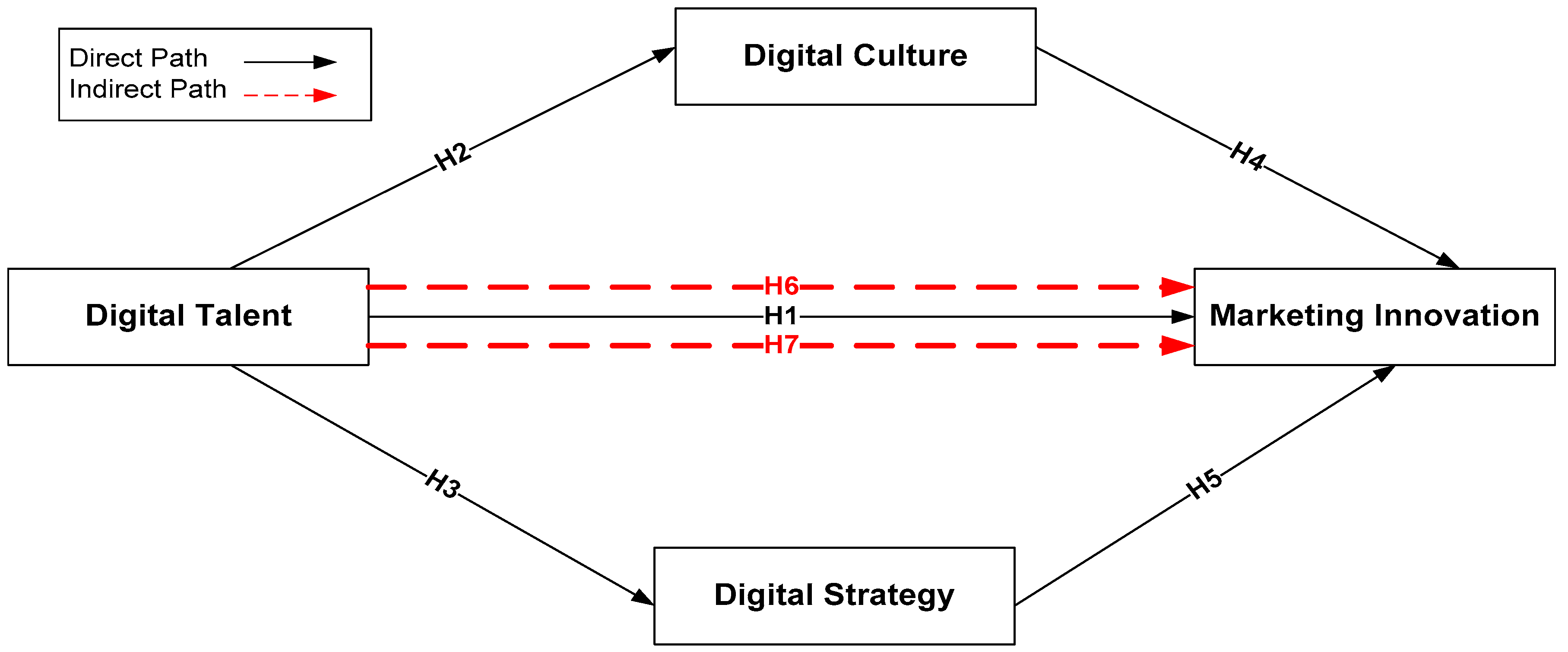
Faraj & Leonardi, 2022). Together, these capabilities represent complementary mechanisms through which organizations convert individual digital competencies into coordinated innovation outcomes. By explicitly linking digital talent to these mediating capabilities, the study moves beyond traditional DCT applications that emphasize capabilities as outcomes, offering a more granular explanation of how capabilities are internally generated and operationalized. Hence, the study contributes to DCT by offering an integrated framework that explains how organizations can leverage their digital talent base, mediated by internal dynamic capabilities, to achieve continuous innovation and sustained competitive advantage in the digital era (see
Figure 1).
2.2. The Effect of Digital Talent on Marketing Innovation
Digital talent refers to employees who possess advanced digital competencies and the ability to effectively leverage emerging technologies to support organizational objectives (
Alder & Dinnen, 2022). Marketing innovation, on the other hand, involves the implementation of new ideas, creative strategies, or advanced technologies in marketing practices to improve customer engagement, communication, and market positioning. It includes innovations in pricing, promotion, distribution, and customer experience, enabled by digital and data-driven tools (
Pantano et al., 2018).
Employees equipped with digital competencies are better positioned to create personalized digital marketing campaigns, leverage analytics to understand consumer behavior, and adopt cutting-edge technologies like artificial intelligence, virtual reality, and mobile applications (
Chaffey & Smith, 2022). These capabilities enable organizations to respond more effectively to evolving customer expectations and competitive market conditions (
Wielgos et al., 2021). In service-based industries like tourism and hospitality—where customer experience is central—these innovative marketing capabilities can significantly influence brand perception, loyalty, and revenue growth (
Ruilin & Lin, 2023;
Kathuria & Tandon, 2025).
From a DCT perspective, digital talent can be conceptualized not merely as a static human resource but as a strategic capability that enables organizations to sense emerging market trends and technological shifts (
Mele et al., 2024). According to DCT, organizations must continuously reconfigure their internal resources and competencies to adapt to dynamic market environments (
Espina-Romero et al., 2026). In this context, digitally skilled employees enhance the firm’s sensing capability by identifying digital opportunities while simultaneously contributing to seizing these opportunities through the design and execution of innovative marketing initiatives (
Guadamillas et al., 2026). Digital talent acts as a key resource that enables such reconfiguration by equipping firms with the cognitive, technical, and creative capabilities needed to respond to digital disruption and evolving consumer demands (
Leso et al., 2024;
Dan et al., 2021).
Moreover, marketing innovation can be viewed as the tangible outcome of the firm’s reconfiguration process, whereby digital knowledge and skills are transformed into new marketing practices and value-creating mechanisms (
Homburg & Wielgos, 2022). Through the proactive engagement of digital talent, organizations develop the capacity to sense opportunities, seize them through innovation, and transform marketing practices accordingly. This causal chain explicitly aligns digital talent with the micro-foundations of dynamic capabilities, thereby positioning it as a primary driver of marketing innovation rather than merely a supporting factor (
Kowalski et al., 2025). Thus, this relationship reinforces the DCT proposition that those internal human capabilities—when properly leveraged—form the basis of dynamic marketing innovation and sustainable competitive advantage (
Durman et al., 2025;
Ajayi-Nifise et al., 2024). However, prior research also suggests that the presence of digital talent alone may not automatically lead to innovation outcomes, particularly in organizations where structural constraints, limited strategic alignment, or resistance to change inhibit the effective utilization of digital capabilities (
Wang, 2022). This indicates that the impact of digital talent may vary depending on the organizational context and the extent to which it is supported by enabling mechanisms (
Hu et al., 2025). Hence, the following hypothesis is suggested:
H1. Digital talent positively affects marketing innovation.
2.3. The Effect of Digital Talent on Digital Culture
Digital culture refers to the collective mindset, values, behaviors, and practices within an organization that support and encourage the adoption, integration, and creative use of digital technologies. It encompasses openness to innovation, collaboration through digital platforms, continuous learning, and a proactive attitude toward technological change (
Rowles & Brown, 2017). A strong digital culture is not only shaped by leadership directives but also by the competencies, attitudes, and behaviors of the workforce—particularly those with advanced digital expertise (
Shin et al., 2023).
Digital talent significantly contributes to the development and reinforcement of a robust digital culture within tourism and hospitality organizations (
Minor et al., 2025). Individuals with digital skills naturally serve as change agents who introduce and normalize the use of digital tools, platforms, and practices. Their daily interactions—such as using cloud-based tools, automating routine tasks, analyzing data for decision-making, or experimenting with digital content—help model and reinforce digital behaviors among colleagues (
Guillén-Gámez et al., 2024). Moreover, digital talent often acts as informal mentors or influencers, spreading knowledge, encouraging experimentation, and reducing resistance to digital change. As a result, their presence catalyzes the gradual institutionalization of digital norms and values across the organization (
Dan et al., 2021).
Adopting a process-oriented view grounded in DCT, digital culture does not emerge instantaneously but is socially constructed through repeated interactions, shared practices, and collective learning processes (
Anning-Dorson et al., 2025). In this regard, digital talent plays a central role in shaping these interactions by continuously introducing new ways of working, thereby influencing how employees interpret, adopt, and internalize digital practices (
Cetindamar & Abedin, 2021). Through ongoing collaboration, knowledge sharing, and experimentation, digitally skilled employees contribute to the gradual alignment of individual behaviors with digitally oriented organizational norms. This iterative process transforms isolated digital practices into shared cultural patterns that define how the organization responds to technological change (
Valk & Planojevic, 2021). From a dynamic capabilities perspective, this socially embedded transformation process reflects the organization’s ability to reconfigure its behavioral and cognitive foundations, positioning digital culture as an evolving outcome of collective adaptation rather than a static organizational attribute (
El Mazyani et al., 2025).
Nevertheless, the extent to which digital talent can shape digital culture is not guaranteed across all organizational settings (
Rowles & Brown, 2017). In environments characterized by rigid structures or low readiness for change, the influence of digitally skilled employees may remain limited or confined to isolated practices rather than diffusing into shared organizational norms (
Trenerry et al., 2021). This implies that the cultural impact of digital talent depends on the organization’s ability to accommodate and internalize digitally driven changes. Thus, the effect of digital talent on digital culture illustrates how internal competencies not only drive technical outcomes but also shape the intangible, behavioral dimensions that support long-term organizational adaptability (
Marlapudi & Lenka, 2024;
Velyako & Musa, 2024). So, the following hypothesis is reported:
H2. Digital talent positively affects digital culture.
2.4. The Effect of Digital Talent on Digital Strategy
Digital strategy refers to the organization’s long-term plan for leveraging digital technologies to achieve strategic goals, enhance customer experiences, and improve operational efficiency. It encompasses decisions related to digital investments, platform integration, data utilization, and the alignment of digital initiatives with broader business objectives (
Peppard & Ward, 2016). A well-crafted digital strategy provides direction, prioritizes digital initiatives, and ensures that technology adoption supports value creation across the organization (
Ahmad et al., 2022).
Digital talent plays a critical role in shaping and informing the development of digital strategy (
Gilch & Sieweke, 2021). Professionals with strong digital expertise contribute unique insights into emerging technologies, consumer behavior trends, and platform capabilities that influence strategic planning. Their hands-on experience with digital tools and analytics allows them to identify opportunities, forecast digital trends, and recommend practical, innovative solutions that align with the organization’s mission (
Wiblen, 2024). Moreover, digital talent often bridges the gap between technical teams and strategic leadership, ensuring that digital initiatives are both visionary and executable. Their input helps ensure that digital strategies are grounded in real-world capabilities and tailored to the evolving demands of the tourism and hospitality market (
Dan et al., 2021).
Moving beyond a descriptive view, DCT suggests that effective strategy development depends on the organization’s ability to orchestrate resources and align them with rapidly changing environmental conditions (
Yeow et al., 2018). In this regard, digital talent functions as a strategic orchestrator that actively shapes how digital resources, technologies, and capabilities are configured into a coherent strategic direction (
Rugg-Gunn, 2023). Rather than merely contributing technical input, digitally skilled employees influence the formulation of digital strategy by integrating market intelligence, technological possibilities, and organizational objectives into actionable strategic choices (
Yu & Moon, 2021). This integrative role enables the alignment between digital initiatives and broader business priorities, ensuring that strategy is not only responsive but also internally consistent and executable (
Bharadwaj et al., 2013). This alignment process reflects the firm’s ability to translate sensed opportunities into structured strategic commitments (
Yeow et al., 2018). Accordingly, digital strategy can be understood as an outcome of strategic orchestration, where digital talent plays a central role in configuring and aligning resources to support long-term adaptability and innovation (
Marchese et al., 2026).
That said, the strategic influence of digital talent may be constrained in organizations where decision-making remains highly centralized or where strategic direction is predominantly driven by top management with limited integration of technical expertise (
Wiblen & Marler, 2021). In such cases, digital talent may contribute operationally without significantly shaping strategic priorities (
Gilch & Sieweke, 2021). Hence, the following hypothesis is indicated:
H3. Digital talent positively affects digital strategy.
2.5. The Effect of Digital Culture on Marketing Innovation
Digital culture plays a pivotal role in enabling marketing innovation—the process of introducing new or significantly improved marketing methods, including changes in product design, promotion, placement, or pricing (
Purchase & Volery, 2020). A strong digital culture encourages openness to new ideas, supports risk-taking, and promotes the effective use of digital tools, all of which are essential for innovative marketing efforts in the highly dynamic tourism and hospitality sectors (
Serafimova & Vasilev, 2024;
Kabangire & Korir, 2023).
A well-established digital culture positively influences marketing innovation by creating an environment where creativity, digital experimentation, and cross-functional collaboration are actively supported (
Mahayani & Darma, 2025). In such cultures, marketing teams are more likely to explore emerging technologies such as AI-driven personalization, immersive virtual experiences, or automated customer engagement tools (
Muneesawang et al., 2025). Employees feel empowered to test new digital marketing strategies, analyze performance data in real time, and adapt campaigns based on consumer feedback (
Feroz et al., 2024). Furthermore, digital culture fosters agility and responsiveness, enabling marketing departments to anticipate and swiftly react to changes in market demands, competitive dynamics, or customer preferences (
Foltean & van Bruggen, 2022).
Rather than functioning merely as a supportive context, digital culture can be conceptualized as an enabling infrastructure that activates the organization’s capacity for marketing innovation (
Zhen et al., 2021). In this sense, cultural attributes such as openness, experimentation, and digital collaboration act as underlying conditions that legitimize innovative behavior and reduce organizational resistance to change (
Goncalves et al., 2020). Through this enabling role, digital culture transforms potential innovative ideas into actionable marketing practices by creating a psychologically safe and technologically supportive environment in which employees are encouraged to experiment, iterate, and refine digital marketing solutions. This activation mechanism ensures that innovation is not sporadic but continuously embedded in everyday marketing activities (
Cetinkaya & Surucu, 2025). From a DCT perspective, such an enabling environment facilitates the continuous renewal of marketing practices by lowering barriers to change and accelerating the translation of opportunities into innovative outcomes (
Konlechner et al., 2018). Accordingly, digital culture operates as a catalyst that converts organizational readiness into realized marketing innovation (
Zhang et al., 2025). Therefore, the influence of digital culture on marketing innovation underscores its role as a dynamic capability that facilitates continuous strategic renewal in response to a rapidly evolving digital landscape (
Shen et al., 2025).
However, the presence of a digital culture does not automatically guarantee marketing innovation. In some cases, an overemphasis on experimentation without clear strategic direction may lead to fragmented initiatives or inefficient use of digital resources (
Rowles & Brown, 2017). This suggests that the effectiveness of digital culture in driving innovation depends on its alignment with organizational priorities and the ability to translate cultural values into coordinated action (
Trushkina et al., 2020). Therefore, the following hypothesis is assumed:
H4. Digital culture positively affects marketing innovation.
2.6. The Effect of Digital Strategy on Marketing Innovation
Digital strategy plays a pivotal role in enabling marketing innovation (
Yasmine et al., 2024). It defines the vision, priorities, and roadmaps for digital integration across departments, ensuring that marketing efforts are aligned with technological capabilities and consumer expectations. A clear digital strategy provides a framework for identifying which platforms to invest in, which tools to adopt, and how to integrate data and technology to enhance customer engagement, personalization, and brand differentiation (
Taherdoost, 2024a).
With a strategic digital direction in place, marketing teams are empowered to experiment with advanced technologies such as AI-driven personalization, mobile applications, and immersive content experiences (
Raut et al., 2025). A well-defined digital strategy reduces ambiguity, allocates resources efficiently, and ensures that innovative marketing initiatives are not isolated experiments but part of a cohesive organizational effort. It also facilitates better decision-making through data analytics, market intelligence, and real-time customer feedback, all of which support more targeted and effective innovation in marketing campaigns (
Taherdoost, 2024b).
Digital strategy can be more rigorously understood as a governance mechanism that structures how digital initiatives are prioritized, coordinated, and controlled within the organization (
Snow et al., 2017). Rather than merely enabling innovation, it establishes clear boundaries, decision rules, and accountability systems that guide how marketing innovation is pursued and evaluated (
Nylén & Holmström, 2015). Through this governance role, digital strategy reduces fragmentation in innovation efforts by aligning dispersed digital activities under a unified strategic direction. It ensures that marketing innovations are not driven by isolated experimentation but are instead selectively developed based on strategic relevance, resource availability, and long-term value creation (
Soto Setzke et al., 2023). From a DCT perspective, this disciplined approach reflects the organization’s ability to intentionally direct and stabilize its transformation processes, ensuring that adaptive responses to digital change are strategically coherent rather than reactive (
Mele et al., 2024). In this way, digital strategy channels innovation efforts toward outcomes that are both innovative and strategically sustainable (
Zaki et al., 2025). Therefore, the influence of digital strategy on marketing innovation illustrates how long-term strategic planning—when infused with digital foresight—can transform organizational agility into sustained marketing advantage (
Kohli, 2025).
At the same time, the presence of a well-defined digital strategy does not necessarily guarantee enhanced innovation. In some contexts, excessive reliance on predefined plans and structured processes may reduce responsiveness to emerging opportunities and limit the spontaneity required for creative marketing solutions (
Peppard & Ward, 2016). This indicates that the effectiveness of digital strategy in fostering innovation depends on its ability to remain adaptive rather than overly prescriptive (
Gobble, 2018). Accordingly, the following hypothesis is highlighted:
H5. Digital strategy positively affects marketing innovation.
2.7. The Mediating Role of Digital Culture
While digital talent provides the essential skills and knowledge to drive change, the mere presence of such talent does not automatically result in marketing innovation (
Gilch & Sieweke, 2021). Digital talent translates into meaningful marketing innovation more effectively when embedded in a culture that supports digital thinking, collaboration, and continuous learning (
Rowles & Brown, 2017). Digital culture acts as the organizational environment that nurtures and amplifies the contributions of digital talent, turning individual capabilities into collective innovation outcomes (
Dan et al., 2021).
Specifically, digital culture creates the psychological and structural conditions that allow digital talent to experiment with new ideas, share digital knowledge across teams, and advocate for customer-centric digital solutions (
Kotwal, 2025). It encourages risk-taking and the use of emerging technologies, making it easier for digital professionals to introduce innovative marketing practices without facing institutional resistance (
Leal-Rodríguez et al., 2023). In environments lacking such a culture, even highly skilled digital professionals may struggle to implement their ideas, leading to underutilized talent and limited innovation (
Kofler et al., 2020).
According to DCT, the relationship between digital talent and marketing innovation is not direct but transformational in nature, requiring an intermediate mechanism that converts individual-level capabilities into organization-wide outcomes. In this context, digital culture serves as a conversion interface through which the latent potential of digital talent is activated and transformed into collective innovative action (
Rowles & Brown, 2017). This mediating process reflects a shift from individual competence to shared organizational capability, where digital practices, values, and behaviors are internalized and diffused across the organization (
Foerster-Metz et al., 2018). Through this transformation, digital talent is no longer confined to isolated contributions but becomes embedded within a broader system that continuously generates and sustains marketing innovation (
Vaz, 2024). Accordingly, digital culture enables the effective mobilization and scaling of digital talent, ensuring that its impact extends beyond individual performance to influence organizational-level innovation outcomes (
Rowles & Brown, 2017). This perspective aligns with DCT by emphasizing that sustainable innovation emerges from the organization’s ability to convert internal resources into coordinated and adaptive capabilities (
Taghizadeh et al., 2024). Therefore, the mediating role of digital culture illustrates how internal human capital must be coupled with the right organizational context to yield sustained marketing innovation in the digital age. Accordingly, the following hypothesis is developed:
H6. Digital culture mediates the link between digital talent and marketing innovation.
2.8. The Mediating Role of Digital Strategy
While digital talent brings the skills, creativity, and technological fluency needed to initiate change, its impact on marketing innovation is most fully realized when guided by a clear and adaptive digital strategy (
Ismail et al., 2023). Digital talent contributes to marketing innovation more effectively when it informs and operates within a well-structured strategic framework. In other words, digital strategy acts as a bridge that translates the capabilities of digital professionals into actionable and aligned marketing innovations (
Gilch & Sieweke, 2021).
Digital strategy provides the structure and direction needed to prioritize, integrate, and scale the ideas and solutions proposed by digital talent. Without such a framework, even highly capable individuals may face obstacles in implementing their innovations due to misalignment with organizational goals, fragmented initiatives, or lack of executive support (
Gilch & Sieweke, 2021;
Schallmo et al., 2019). However, when digital talent is actively involved in shaping digital strategy, their insights into market dynamics, technological trends, and customer behavior directly influence strategic decisions that guide marketing innovation (
Tarabasz, 2024). This alignment ensures that digital marketing efforts are not only creative and responsive but also strategically coherent and resource-efficient (
Ordóñez de Pablos, 2024).
Unlike cultural mechanisms that evolve organically, digital strategy represents a deliberate and formally articulated pathway through which organizations structure their transformation efforts (
Chanias et al., 2019). In this context, the influence of digital talent is systematically embedded into decision-making processes, strategic priorities, and resource allocation mechanisms that guide marketing innovation (
Galanti & Fantinelli, 2025;
Cosa & Torelli, 2024). This process captures the organization’s ability to institutionalize opportunity-driven insights into formal strategic pathways in the light of DCT (
Amoa-Gyarteng et al., 2026). Digital strategy, therefore, acts as a structuring mechanism that transforms dispersed knowledge into coherent innovation trajectories, ensuring that marketing innovation is both strategically aligned and sustainably implemented (
Florek-Paszkowska & Ujwary-Gil, 2025;
Arantes & Ferreira, 2025). So, the following hypothesis is suggested:
H7. Digital strategy mediates the link between digital talent and marketing innovation.
3. Method
3.1. Measurement Scale Development and Assessment
The survey instrument employed in this study was systematically structured into three primary sections. The initial section served as an introductory framework, outlining the overarching objectives of the research and providing detailed guidance on how participants should complete the questionnaire. The second section was designed to gather demographic and professional background information from respondents. The final section focused on the measurement of key constructs central to the research inquiry. To ensure consistency in responses, all items were rated on a 7-point Likert scale, where a score of 7 represented “strongly agree” and 1 denoted “strongly disagree.” The construct of digital talent (DT) was assessed using a four-item scale derived from the work of
Khaira et al. (
2023). For example, items include “In my organization, employees possess strong digital skills relevant to tourism and hospitality operations” and “Employees in my organization are proficient in using advanced digital tools and technologies in their daily tasks”. Regarding marketing innovation (MI), a five-item scale was employed, adapted from
Nieves and Diaz-Meneses (
2016). For example, items include “My organization develops innovative marketing approaches using digital platforms” and “My organization frequently introduces new digital marketing techniques to attract customers”. The digital culture (DC) dimension was evaluated using a five-item measure developed by
Lukas et al. (
2013). For example, items include “My organization promotes a culture that encourages the use of digital technologies in all operations” and “Employees in my organization are encouraged to share digital knowledge and best practices”. Digital strategy (DS) was operationalized through a five-item scale adapted from
Hakala and Kohtamäki (
2011). For example, items include “My organization has a clear strategy for integrating digital technologies into its business processes” and “Digital initiatives in my organization are aligned with overall business objectives”. The full set of measurement items used in this study is provided in
Appendix A to ensure transparency and facilitate the assessment of content validity and replicability. Prior to full-scale data collection, a pilot test was conducted involving 35 professionals from the tourism and hospitality sectors, including senior-level managers and industry specialists. Based on their feedback, minor revisions were made to the wording of select survey items to enhance clarity and ensure content validity.
3.2. Procedures
The investigation mainly studies the relationship between digital talent and marketing innovation in Egyptian tourism and hospitality organizations. It also examines the mediating role of digital culture and digital strategy on the relationship between digital talent and marketing innovation. The current study employed a purposive sampling approach targeting employees of travel agencies and hotels located in Greater Cairo. In this study, Class A travel agencies refer to agencies officially licensed by the Egyptian Ministry of Tourism and Antiquities to conduct comprehensive tourism activities (inbound, outbound, and domestic tourism services) based on specific regulatory and operational criteria. Participants were provided with the option to complete the survey in either Arabic or English to accommodate linguistic preferences and enhance comprehension. The English version of the questionnaire underwent a thorough review by multilingual experts to ensure linguistic accuracy, conceptual clarity, and cultural appropriateness across both language versions.
The electronic survey (E-survey) was designed in alignment with the methodological framework proposed by
Hair et al. (
2010), ensuring rigor in both structure and content. Prior to deployment, the survey instrument underwent a comprehensive review to validate its relevance and clarity, following which the finalized e-survey was disseminated to participants via an accessible online link. The opening section of the questionnaire outlined the study’s aims and extended an invitation to employees of travel agencies and hotel establishments to participate. Participants were explicitly informed of the research objectives and assured of the confidentiality of their responses. To reach the target population, the bilingual (Arabic and English) survey link was distributed through various social media platforms, specifically targeting employees of Class A travel agencies and five-star hotels within the Greater Cairo area. Importantly, the survey was not disseminated as an open public link; rather, it was shared through controlled and targeted channels, including professional and personal networks, ensuring that only eligible participants within the defined population were invited to respond. The collected data included respondents from multiple independent travel agencies and hotel establishments, ensuring variability in organizational contexts and reducing the risk of single-organization bias. The final sample consisted of respondents from both sectors, with representation from travel agencies and hotels. Specifically, data were collected from approximately 188 travel agencies and 34 hotel establishments within the Greater Cairo area. This distribution reflects the structure of the tourism and hospitality sector and enhances the representativeness of the sample. Throughout the data collection period, the research team monitored incoming responses on a daily basis to ensure data integrity and address any issues promptly. Additionally, researchers provided their contact information to all participants, encouraging follow-up inquiries or clarification requests upon completion of the survey.
To uphold ethical standards of the e-survey, participants were fully informed about the purpose and scope of the study prior to providing their consent. Participation was entirely voluntary, and verbal consent was obtained, with all respondents confirming their willingness to proceed after reviewing the questionnaire content. Anonymity was strictly maintained, as no identifying information was collected, thereby ensuring that responses could not be traced back to individual participants. The sampling approach utilized a combination of professional and familial networks to recruit participants, enhancing reach within the targeted population. All participants acknowledged that their involvement constituted part of a formal research effort and agreed to the data collection procedures. The data collection phase extended from February to April 2025, encompassing a three-month period. The distribution of 500 questionnaires was based on a targeted sampling strategy, in which invitations were sent directly to potential respondents within the defined population. This approach was adopted to account for potential non-response and incomplete submissions, ensuring that a sufficient number of valid responses would be obtained for statistical analysis. Accordingly, the response rate (86.4%) was calculated based on the number of completed responses (432) relative to the total number of distributed questionnaires (500), rather than general public exposure to the survey link. Notably, the dataset was free of missing values, ensuring its integrity for subsequent analysis.
The sample size was determined in line with the requirements of Structural Equation Modeling (SEM), which was employed as the primary data analysis technique in this study. SEM requires an adequate sample size to ensure parameter estimation accuracy, model stability, and statistical power. According to established guidelines (
Hair et al., 2010), a minimum ratio of 10 observations per measurement item is recommended. Given that the final questionnaire included 19 measurement items, the minimum required sample size was 190 valid responses. Therefore, the achieved sample of 432 valid responses substantially exceeds this threshold, confirming the adequacy and robustness of the sample for SEM analysis.
Demographic analysis revealed that 316 respondents (73.2%) were male and 116 (26.8%) were female. The majority (75.6%) were within the 26–35 age range, and a substantial proportion (88.2%) demonstrated a high level of familiarity with digital practices within travel agencies and hotel operations. This demographic profile reflects the nature of operational and marketing roles within the tourism and hospitality sector, which are often dominated by younger and digitally engaged employees. However, this concentration may also indicate a degree of sample homogeneity that could influence the strength of certain relationships examined in the study.
3.3. Data Analysis and Evaluation
Data analysis was conducted using Partial Least Squares Structural Equation Modeling (PLS-SEM), implemented through Smart-PLS version 4.01, in accordance with the methodological recommendations of
Ringle et al. (
2020). This approach was selected in lieu of the conventional Covariance-Based SEM (CB-SEM), as PLS-SEM is particularly well-suited for exploratory and predictive modeling, offering greater flexibility in handling complex models and small-to-moderate sample sizes (
Hair et al., 2017;
Henseler et al., 2009). Unlike CB-SEM, PLS-SEM does not impose strict assumptions regarding data normality, making it an appropriate analytical tool for studies with varied sample characteristics (
Do Valle & Assaker, 2016). Given the study’s predictive and theory-development orientation, PLS-SEM provided a robust analytical framework for evaluating the proposed relationships among constructs. To address the potential threat of common method variance (CMV), Harman’s single-factor test was employed, following the procedure outlined by
Podsakoff et al. (
2003), thereby enhancing the validity of the findings by minimizing systematic bias in the measurement model.
4. Results
4.1. Measurement Model
The results of the Exploratory Factor Analysis (EFA) conducted on the 19 measurement items revealed that the first unrotated factor accounted for approximately 32% of the total variance. This relatively low percentage suggests that Common Method Variance (CMV) is unlikely to significantly distort the findings, thereby indicating that CMV does not constitute a serious methodological concern in this study. Further supporting this conclusion, the Variance Inflation Factor (VIF) values for all constructs were below the conservative threshold of 5, as shown in
Table 1, demonstrating the absence of multicollinearity and affirming the independence of predictor variables within the regression model. To evaluate the psychometric properties of the measurement scales employed in the conceptual framework, several reliability and validity indices were assessed, including Average Variance Extracted (AVE), Composite Reliability (CR), and Cronbach’s alpha (α), as reported in
Table 1. All constructs demonstrated satisfactory convergent validity, with standardized factor loadings (λ) exceeding the recommended threshold of 0.70 in the pretest phase. These results collectively affirm the internal consistency, reliability, and validity of the measurement model.
As presented in
Table 2, each construct demonstrates a higher degree of variance explained by its associated indicators than by indicators of any other construct, in line with the Fornell-Larcker criterion for assessing discriminant validity (
Fornell & Larcker, 1981;
Hair et al., 2017). This confirms that the constructs are empirically distinct from one another and that the measurement model possesses adequate discriminant validity. Additionally, the analysis revealed that each item loads more strongly on its intended latent construct than on any alternative construct within the model. These results further substantiate the discriminant validity of the measurement framework, as initially advocated by
Chin (
1998).
The Heterotrait–Monotrait (HTMT) ratio of correlations was employed to assess the degree of similarity between latent constructs, serving as a rigorous test for discriminant validity. As recommended by
Henseler et al. (
2016), HTMT values below the threshold of 0.90 indicate that constructs are sufficiently distinct and not excessively overlapping. As shown in
Table 3, all HTMT ratios fall well below the 0.90 benchmark, thereby confirming that the constructs in the proposed model exhibit strong discriminant validity. These results suggest that each construct captures a unique aspect of the conceptual framework, with no evidence of multicollinearity or conceptual redundancy. Consequently, the findings reinforce the structural integrity and discriminant distinctiveness of the measurement model.
To ensure the model’s robustness and predictive relevance, several statistical indicators were examined. The R
2 values show that the model has strong explanatory power: Digital Talent explains 57.3% of the variance in Digital Culture and 72.4% in Digital Strategy, while Digital Talent, Culture, and Strategy together explain 54.3% of the variance in Marketing Innovation (see
Table 4). These results indicate that the model effectively captures the key drivers of the endogenous variables. Moreover, the Stone–Geisser Q
2 values demonstrated that Digital Culture (0.369), Digital Strategy (0.529), and Marketing Innovation (0.358) all exceeded the critical threshold of zero, confirming the model’s predictive relevance and its ability to effectively link exogenous and endogenous constructs. Regarding the overall model fit, the standardized root mean square residual (SRMR) was 0.032, well below the acceptable cutoff of 0.08, and the normed fit index (NFI) was 0.961, surpassing the recommended threshold of 0.90. These indices collectively suggest that the structural model exhibits a strong fit and accurately reflects the underlying relationships among the study variables.
4.2. Structure Model
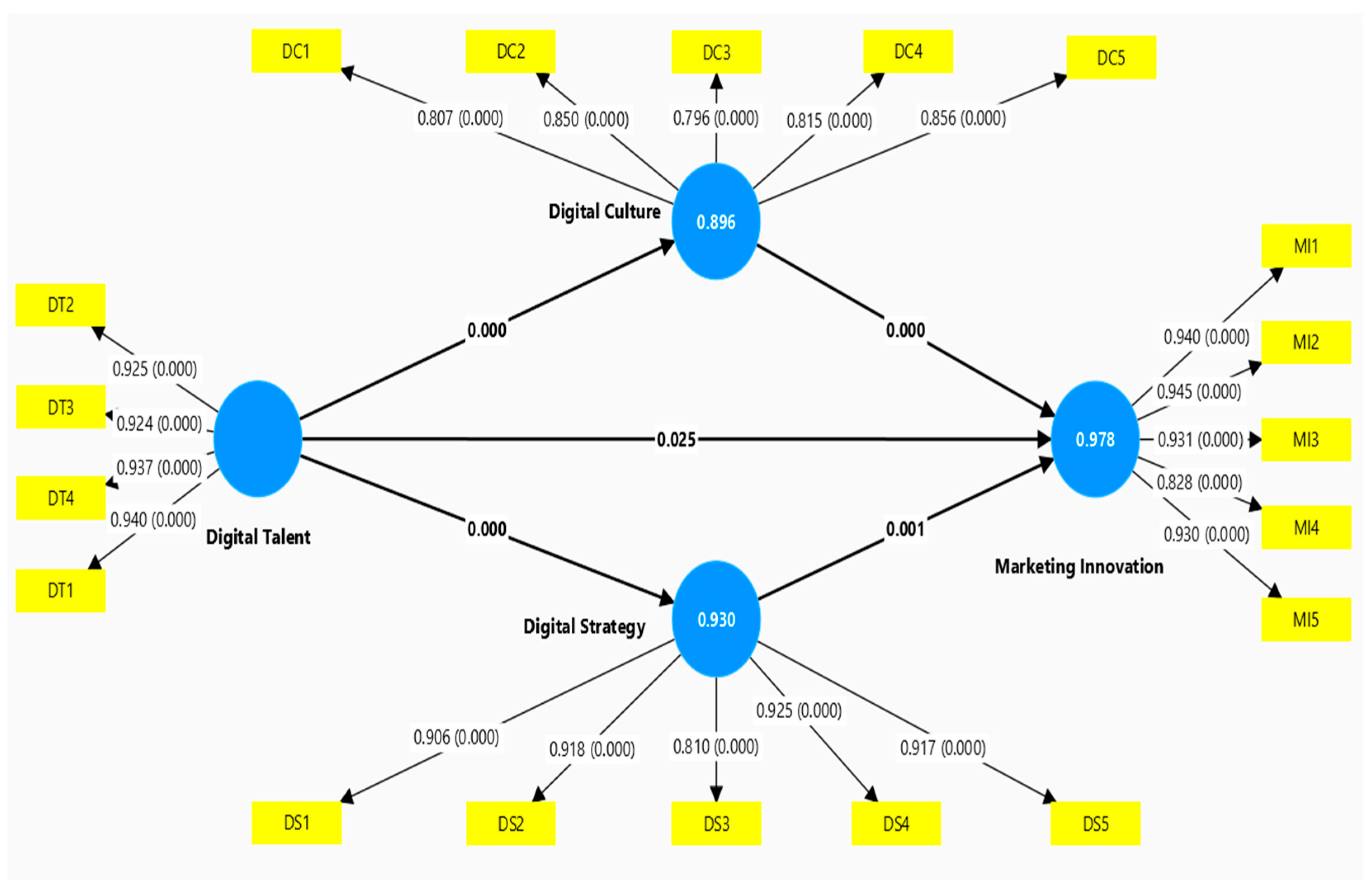
This study investigates the influence of digital talent (DT) on marketing innovation (MI) in tourism and hospitality organizations, also exploring the indirect mediating role of digital culture and digital strategy in the relationship between digital talent and marketing innovation. Regarding the first hypothesis (H1), the direct effect between digital talent and marketing innovation was found to be statistically significant (β = 0.188, T = 2.236,
p = 0.025), suggesting that the presence of digitally skilled personnel directly enhances an organization’s ability to implement innovative marketing practices (see
Table 5 and
Figure 2). This result confirms that digital talent contributes independently to marketing innovation efforts, enabling firms to adopt, implement, and manage modern marketing techniques more effectively. As for the second hypothesis (H2), digital talent significantly predicted digital culture (β = 0.946, T = 8.716,
p = 0.000), implying that digitally competent individuals play a critical role in establishing a shared set of values, practices, and norms that support digital transformation across the organization. Similarly, in support of the third hypothesis (H3), digital talent exhibited a strong positive influence on digital strategy (β = 0.964, T = 10.2,
p = 0.000), reinforcing the notion that skilled digital personnel are instrumental in formulating, guiding, and executing strategic digital plans. The fourth hypothesis (H4), which examined the influence of digital culture on marketing innovation, was also supported (β = 0.495, T = 4.879,
p = 0.000), suggesting that an organization-wide digital mindset significantly boosts marketing innovation. The fifth hypothesis (H5) found that digital strategy also significantly contributes to marketing innovation (β = 0.322, T = 3.461,
p = 0.001). These direct pathways collectively highlight the foundational role of digital talent not only in shaping the organizational environment but also in influencing core marketing innovation outcomes.
In addition to the direct effects, the study revealed significant indirect pathways through which digital talent exerts its influence on marketing innovation (see
Table 5).
Figure 2 presents the final structural model of the study and provides a visual representation of the relationships among the research variables. The model shows that digital talent has a statistically significant direct effect on marketing innovation, while also exerting stronger indirect effects through digital culture and digital strategy. The paths from digital talent to both digital culture and digital strategy are particularly strong, indicating that digitally skilled employees play a key role in shaping the organization’s digital environment and strategic orientation. Furthermore, both digital culture and digital strategy demonstrate significant positive effects on marketing innovation, confirming their mediating roles. Overall, the figure highlights that the impact of digital talent on marketing innovation is reinforced when supported by an enabling digital culture and a well-defined digital strategy.
Regarding the sixth hypothesis (H6), the indirect effect of digital talent on marketing innovation through digital culture was statistically significant (β = 0.468, T = 4.439, p = 0.000), confirming that digital culture partially mediates this relationship. This indicates that while digital talent directly drives marketing innovation, it also contributes to cultivating a digital-oriented organizational culture that further facilitates innovation. Likewise, as confirmed by the seventh hypothesis (H7), digital strategy was found to be a significant partial mediator (β = 0.311, T = 3.477, p = 0.001), revealing that the strategic orientation of the organization translates digital capabilities into structured innovation outcomes. Since the direct effect of digital talent on marketing innovation remains significant alongside these indirect effects, both digital culture and digital strategy function as partial mediators rather than full mediators. These findings underscore the importance of embedding digital talent within a supportive cultural and strategic framework to maximize its impact on marketing innovation. The dual pathways suggest that marketing innovation in hospitality and tourism organizations is not solely a function of individual digital capabilities but also of the broader organizational context in which those talents are leveraged. In terms of explanatory strength and practical significance, the reported effect sizes (f2) range from small to substantial (0.025 to 0.395), indicating varying degrees of influence across the model relationships.
5. Discussion
In today’s digitally driven environment, organizations increasingly recognize the strategic importance of digital talent in shaping their innovation capabilities and adapting to changing market demands (
Ajayi-Nifise et al., 2024). The findings of this study shed light on the dynamic interplay between digital talent, digital culture, digital strategy, and marketing innovation, offering valuable insights for organizations seeking sustainable competitive advantages.
The results indicate that digital talent directly enhances marketing innovation. According to
Pascucci et al. (
2023), individuals with advanced digital capabilities contribute significantly to the development of novel marketing ideas, the application of emerging technologies, and the reconfiguration of marketing processes.
Ajayi-Nifise et al. (
2024) added that these talents are often the source of creativity and adaptability that enable organizations to craft unique value propositions and respond swiftly to market shifts. This strong relationship can be interpreted as evidence that digital talent functions not merely as an operational resource but as a core driver of innovation capability, particularly in service-intensive sectors such as tourism and hospitality, where customer experience and responsiveness are critical. This finding is broadly consistent with prior research emphasizing the role of digital capabilities in fostering innovation (
Pascucci et al., 2023); however, it further extends this perspective by positioning digital talent itself—rather than general capabilities—as a more immediate and influential driver of marketing innovation within tourism and hospitality organizations.
Digital talent also has a significant impact on shaping digital culture within organizations, as the results highlight.
Del Giudice et al. (
2021) justified this as when organizations are populated with individuals who are digitally fluent and innovation-oriented, they tend to cultivate a work environment that values experimentation, collaboration, and openness to change. This digital culture, in turn, supports the diffusion of innovative marketing practices by creating a fertile ground for testing new approaches and embracing technological disruption (
O’Dwyer, 2021). The strength of this relationship suggests that digital talent actively shapes organizational norms and behaviors, rather than simply operating within pre-existing cultural conditions (
Held et al., 2025). This may be particularly relevant in the Egyptian tourism context, where organizations are still evolving digitally, making employee capabilities a primary catalyst for cultural transformation (
Tyagi et al., 2025). While earlier studies have acknowledged the importance of organizational culture in enabling innovation (
Li et al., 2018), the present findings highlight a more dynamic and bottom-up process, where digital talent actively contributes to the formation and reinforcement of digital culture in tourism and hospitality settings.
Furthermore, the analysis reveals that digital culture itself positively affects marketing innovation.
Holbeche (
2019) explained that a strong digital culture encourages teams to explore unconventional solutions, adopt agile methodologies, and integrate digital tools into marketing workflows. This cultural foundation empowers employees to take calculated risks and continuously refine marketing strategies based on data-driven insights. This finding indicates that innovation is not solely driven by individual competencies but is significantly reinforced by a supportive organizational environment that legitimizes experimentation and continuous improvement, as
Graf et al. (
2025) mentioned.
The study also highlights the influence of digital talent on the development of digital strategy.
Rugg-Gunn (
2023) argued that digitally skilled individuals often lead the formulation and execution of strategies that align technology with business goals.
Alder and Dinnen (
2022) reported that their insights and competencies help bridge the gap between technological potential and organizational objectives, enabling more precise and responsive strategic planning. This helps explain the particularly strong relationship observed between digital talent and digital strategy, as strategy formation in such contexts tends to be closely embedded in the knowledge, experience, and judgment of digitally skilled employees (
Ott et al., 2017). At the same time, this strong association may also reflect a degree of conceptual proximity between the two constructs, since both involve digital knowledge, decision-making, and technology-oriented thinking. While they remain theoretically distinct, their close interaction in practice—especially in digitally evolving organizations—may partially account for the strength of the observed effect. This finding aligns with prior research linking digital capabilities to strategic development, yet it further suggests that, in tourism and hospitality organizations, digital talent plays a more immediate and influential role in shaping digital strategy compared to more formalized structural mechanisms, according to
Ullah et al. (
2025) and
Gilch and Sieweke (
2021).
In turn, digital strategy was found to have a direct and positive effect on marketing innovation.
Aliyeva (
2024) claimed that a well-crafted digital strategy provides a roadmap for leveraging digital tools, platforms, and channels to enhance customer engagement, personalization, and campaign performance. It ensures that marketing innovation is not sporadic but guided by a clear, coherent vision aligned with long-term goals (
Verma & Diwan, 2025). This highlights the role of digital strategy as a coordination mechanism that transforms dispersed digital capabilities into structured and scalable innovation outcomes.
Importantly, the study identified two key mediating mechanisms. First, digital culture mediates the relationship between digital talent and marketing innovation. This suggests that while digital talent provides the raw capabilities for innovation, the presence of a supportive digital culture amplifies their impact by nurturing collaboration and risk-taking. This mediation effect indicates that without an enabling cultural context, the influence of digital talent may remain fragmented or underutilized, emphasizing the importance of aligning human capabilities with organizational values. Second, digital strategy mediates the link between digital talent and marketing innovation. This indicates that strategic alignment is essential for translating digital competencies into effective innovation outcomes. Digital talent contributes to strategic thinking, but it is through structured digital strategies that organizations can channel these competencies into scalable and sustainable marketing innovations (
Hokmabadi et al., 2024;
Chowdhury, 2025). Together, these findings suggest that digital talent alone is insufficient; its impact is maximized when embedded within both a supportive cultural environment and a clearly defined strategic framework, reflecting an integrated capability-building process.
6. Theoretical Implications
This study makes a significant theoretical contribution to DCT by empirically illustrating how tourism and hospitality organizations can transform internal human resources—specifically digital talent—into dynamic capabilities that drive marketing innovation. Unlike prior DCT applications that predominantly conceptualize capabilities at the organizational level, this study positions digital talent as a micro-level foundational driver that actively shapes and activates these capabilities. The finding that digital talent positively affects marketing innovation, digital culture, and digital strategy provides clear evidence that skilled individuals are not merely operational contributors but catalysts for organizational adaptability and transformation. By integrating and applying their digital expertise, these professionals help organizations sense market trends, adapt to technological shifts, and innovate in their marketing efforts. This supports the DCT perspective that internal resources must be actively developed and reconfigured to respond to environmental change.
Furthermore, the study confirms that digital culture significantly influences marketing innovation, showing that a supportive, innovation-oriented environment enables the effective translation of digital skills into creative marketing practices. A strong digital culture encourages experimentation, rapid learning, and collaboration—all essential features of dynamic capabilities that allow organizations to remain agile and resilient in the face of disruption. Similarly, the finding that digital strategy has a positive effect on marketing innovation reinforces the importance of strategic alignment. A clearly defined and flexible digital strategy allows organizations to seize digital opportunities and systematically integrate them into marketing processes, thereby embodying the DCT principle of strategic reconfiguration.
Critically, the study reveals that digital culture and digital strategy mediate the relationship between digital talent and marketing innovation, highlighting the process through which dynamic capabilities are built. While digital talent provides the foundational skills and knowledge, it is through the development of a shared digital mindset (culture) and a coherent action plan (strategy) that these skills are transformed into sustainable innovation. This mediating effect underscores a central tenet of DCT: dynamic capabilities are not static attributes but are developed through purposeful organizational processes that reshape and reconfigure resources in response to environmental demands.
Importantly, by simultaneously examining digital culture and digital strategy as complementary mediating mechanisms, the study offers a more granular and integrated explanation of how dynamic capabilities emerge and operate in practice—an aspect that has been relatively underexplored in prior DCT research.
In this vein, this study enriches DCT by demonstrating how digital talent initiates the formation of dynamic capabilities—specifically digital culture and digital strategy—which in turn enable marketing innovation. By unpacking these internal mechanisms within tourism and hospitality organizations, the study offers a practical and theory-based pathway for how firms can leverage internal competencies to sustain competitive advantage in a digital world.
7. Practical Implications
The findings of this study yield several important practical and innovative implications for managers and decision-makers in the tourism and hospitality industry who seek to enhance their organizations’ marketing innovation in the digital age. First, the strong and direct impact of digital talent on marketing innovation highlights the urgent need for organizations to prioritize the recruitment, development, and retention of digitally skilled professionals. This includes not only individuals with technical expertise but also those with creative thinking, adaptability, and a strategic mindset. Organizations should design targeted training programs, establish digital upskilling initiatives, and build career pathways that attract top digital talent capable of driving marketing transformation.
Second, the study emphasizes that the presence of digital talent alone is not sufficient—building a strong digital culture is essential to unlocking their full potential. This suggests that tourism and hospitality organizations must actively cultivate a work environment that encourages openness to experimentation, embraces digital change, and rewards innovative thinking. Leadership must play a central role in modeling digital values, promoting collaboration across departments, and reducing resistance to change. Creating digital champions, forming cross-functional digital innovation teams, and integrating digital literacy into the organizational culture are all actionable steps toward fostering a culture that supports continuous innovation.
Third, the positive impact of digital strategy on marketing innovation implies that having a clear, adaptable, and forward-looking digital strategy is critical. Organizations should invest in the development of digital roadmaps that are closely aligned with customer needs, market trends, and emerging technologies. These strategies should not remain at the top level but must be operationalized across departments, especially marketing, to ensure that digital initiatives are translated into customer-focused innovation. Regular strategic reviews, scenario planning, and stakeholder engagement can help keep digital strategies relevant and responsive to change.
Finally, the study’s demonstration of the mediating roles of digital culture and digital strategy in the link between digital talent and marketing innovation provides a roadmap for organizations to think holistically. It suggests that to innovate successfully, managers must simultaneously invest in people, mindset, and strategy. Practical steps include aligning HR and marketing departments around shared digital goals, integrating digital KPIs across performance systems, and establishing innovation labs or pilot programs where digital talent can collaborate to test new marketing ideas within a supportive cultural and strategic framework.
8. Limitations and Future Research
While this study offers valuable insights into the role of digital talent, digital culture, and digital strategy in enhancing marketing innovation in tourism and hospitality organizations, several limitations must be acknowledged, each opening avenues for future research. First, the study’s findings are based on data collected within a specific regional or national context (Egypt), which may limit the generalizability of the results across different geographic and cultural settings. The influence of digital talent and the development of digital culture and strategy may vary significantly depending on regional technological infrastructure, cultural values, and market maturity. Future research should extend this model to comparative international studies across diverse countries and tourism markets (e.g., UAE, Saudi Arabia) to examine whether these relationships hold consistently or vary due to contextual factors.
Second, the study primarily adopts a cross-sectional research design, capturing perceptions and organizational practices at a single point in time. In addition, the study relies on self-reported data collected from respondents, which may introduce common method bias and subjective evaluation. Moreover, the use of self-reported measures may also increase the likelihood of response bias, as participants’ perceptions may not fully reflect actual organizational practices. This approach limits the ability to assess how digital talent and dynamic capabilities evolve and impact marketing innovation over time. To address this, future research could adopt a longitudinal design, tracking the development of digital talent, the implementation of digital strategies, and the evolution of digital culture to assess their cumulative and long-term effects on marketing innovation. As well, the cross-sectional nature of the data may raise potential endogeneity concerns, as causal relationships cannot be fully established and reciprocal effects between variables cannot be ruled out. Future research may address this limitation by employing longitudinal designs or advanced analytical techniques to better account for potential endogeneity.
Third, the use of purposive sampling through social media platforms and professional and personal networks may introduce potential selection bias, as respondents may not fully represent the broader population of tourism and hospitality employees. This limitation may affect the generalizability of the findings. Additionally, the sample is relatively homogeneous, with a high concentration of younger and digitally proficient respondents, which may influence the strength of the relationships examined—particularly those related to digital talent and digital culture. Future studies are encouraged to adopt probabilistic sampling techniques to enhance representativeness and external validity.
Fourth, this study exclusively focuses on digital culture and digital strategy as mediators in the relationship between digital talent and marketing innovation. While these two factors are undoubtedly critical components of organizational transformation, the model may not fully capture the complexity of the mediating mechanisms at play. Other potentially influential mediators—such as digital leadership, organizational learning, or technological infrastructure—were not examined. As a result, the explanatory power of the model may be somewhat limited, and future research is encouraged to incorporate additional mediating variables to gain a more comprehensive understanding of how digital talent influences marketing innovation within tourism and hospitality contexts.
Finally, the study focuses on marketing innovation as the main outcome variable. While this is a critical area for tourism and hospitality organizations, digital transformation also affects other domains such as customer service, operational efficiency, and product development. Future research should broaden the scope to explore the impact of digital talent and dynamic capabilities on multiple dimensions of organizational innovation and performance, offering a more holistic understanding of digital transformation in the sector.
Author Contributions
Conceptualization, B.S.A.-R. and A.M.H.; methodology, A.M.H.; software, A.M.H.; validation, A.M.H. and B.S.A.-R.; formal analysis, A.M.H.; investigation B.S.A.-R. and A.M.H.; resources, B.S.A.-R. and A.M.H.; data curation, B.S.A.-R. and A.M.H.; writing—original draft preparation, A.M.H. and B.S.A.-R.; writing—review and editing, A.M.H. and B.S.A.-R.; visualization, A.M.H. and B.S.A.-R.; supervision, A.M.H.; project administration, A.M.H.; funding acquisition, A.M.H. All authors have read and agreed to the published version of the manuscript.
Funding
This research was funded by the Deanship of Scientific Research, Vice Presidency for Graduate Studies and Scientific Research, King Faisal University, Saudi Arabia, grant number [KFU261128].
Institutional Review Board Statement
The study was conducted in accordance with the Declaration of Helsinki, and approved by the Institutional Review Board (or Ethics Committee) of Deanship of Scientific Research Ethical Committee, King Faisal University (protocol code KFU261128 and date of approval 1 January 2025).
Informed Consent Statement
Informed consent was obtained from all subjects involved in this study.
Data Availability Statement
Data are available upon request from researchers who meet the eligibility criteria. Kindly contact the first author privately through e-mail.
Conflicts of Interest
The authors declare no conflicts of interest.
Appendix A. Scale Items
Digital Talent (DT) (Khaira et al., 2023)
DT-1: In my organization, employees possess strong digital skills relevant to tourism and hospitality operations.
DT-2: Employees in my organization are proficient in using advanced digital tools and technologies in their daily tasks.
DT-3: My organization attracts and retains employees with high-level digital competencies.
DT-4: Employees in my organization are able to adapt quickly to emerging digital technologies. |
Digital Culture (DC) (Lukas et al., 2013)
DC-1: My organization promotes a culture that encourages the use of digital technologies in all operations.
DC-2: Employees in my organization are encouraged to share digital knowledge and best practices.
DC-3: Digital transformation is strongly supported within my organization’s culture.
DC-4: My organization encourages innovation through digital tools at all levels.
DC-5: My organization supports continuous learning to enhance digital capabilities. |
Digital Strategy (DS) (Hakala & Kohtamäki, 2011)
DS-1: My organization has a clear strategy for integrating digital technologies into its business processes.
DS-2: Digital initiatives in my organization are aligned with overall business objectives.
DS-3: My organization prioritizes investment in digital technologies as part of its strategy.
DS-4: My organization continuously updates its digital strategy to maintain competitiveness.
DS-5: Digital transformation efforts in my organization are systematically planned and implemented. |
Marketing Innovation (MI) (Nieves & Diaz-Meneses, 2016)
MI-1: My organization develops innovative marketing approaches using digital platforms.
MI-2: My organization frequently introduces new digital marketing techniques to attract customers.
MI-3: My organization effectively uses technology to enhance customer engagement.
MI-4: Marketing campaigns in my organization are regularly improved through digital innovation.
MI-5: My organization applies creative digital solutions to differentiate its services from competitors. |
References
- Ahmad, T., Aakula, A., Ottori, M., & Saini, V. (2022). Developing a strategic roadmap for digital transformation. Journal of Computational Intelligence and Robotics, 2(2), 28–68. [Google Scholar]
- Ahsan, M. J. (2025). Cultivating a culture of learning: The role of leadership in fostering lifelong development. The Learning Organization, 32(2), 282–306. [Google Scholar] [CrossRef]
- Ajayi-Nifise, A., Odeyemi, O., Mhlongo, N., Ibeh, C., Elufioye, O., & Falaiye, T. (2024). Digital transformation in banking: The HR perspective on managing change and cultivating digital talent. International Journal of Science and Research Archive, 11(1), 1452–1459. [Google Scholar] [CrossRef]
- Alam, M. M. D., Razzak, M. R., Khreis, S. H. A., Al Balushi, M. K., & Al Lawati, H. (2025). Digital leadership orientation and organizational resilience: Strategic foresight, agility, and flexibility. Management Decision, 1–31. [Google Scholar] [CrossRef]
- Alder, M., & Dinnen, M. (2022). Digital talent: Find, recruit and retain the people your business needs in a world of digital transformation. Kogan Page Publishers. [Google Scholar]
- Aliyeva, N. (2024). Rules for creating an effective digital marketing strategy. GSI Journals Serie B: Advancements in Business and Economics, 7(1), 1–16. [Google Scholar]
- Aljoghaiman, A., Hasanein, A. M., Elshaer, I. A., & Sobaih, A. E. E. (2024). Does environmental performance make any difference in the relationship between green supply chain management and hotel competitiveness? Logistics, 8(3), 70. [Google Scholar] [CrossRef]
- Al Koliby, I., Mehat, N., Al-Swidi, A., & Al-Hakimi, M. (2024). Unveiling the linkages between entrepreneurial culture, innovation capability, digital marketing capability and sustainable competitive performance of manufacturing SMEs: Evidence from emerging countries. The Bottom Line, 37(4), 473–500. [Google Scholar] [CrossRef]
- Amankona, D., Yi, K., Tackie, E., Tweneboa, L., & Odai, L. (2025). Responsible digital innovation and innovation performance in ghana’s high-tech industry: The mediating roles of digital organizational culture and strategy, and the moderating role of digital literacy. SAGE Open, 15(2), 21582440251341256. [Google Scholar]
- Amoa-Gyarteng, K., Dhliwayo, S., Onyin-Emi, E., & Sisay, S. (2026). The role of innovation strategy in entrepreneurial venture survival: A moderated mediation analysis of organizational adaptability and environmental influences. Journal of Small Business and Enterprise Development, 33(8), 32–62. [Google Scholar] [CrossRef]
- Anning-Dorson, T., Baba, F., Zulu, M., & Acheampong, G. (2025). Data-driven dynamic capabilities in emerging markets: A grounded theory approach to digital transformation in african retail banking. International Journal of Information Management, 84, 102914. [Google Scholar] [CrossRef]
- Arantes, L., & Ferreira, J. J. (2025). Innovative sustainability strategies and the role of digital transformation in organisations. Corporate Social Responsibility and Environmental Management, 32(3), 3088–3121. [Google Scholar] [CrossRef]
- Attah, R., Ogunsola, O., & Garba, B. (2023). Leadership in the digital age: Emerging trends in business strategy, innovation, and technology integration. Iconic Research and Engineering Journals, 6(9), 389–411. [Google Scholar]
- Ayoub, H. S., & Sopuru, J. C. (2026). Reconfiguring strategic capabilities in the digital era: How AI-enabled dynamic capability, data-driven culture, and organizational learning shape firm performance. Sustainability, 18(3), 1157. [Google Scholar] [CrossRef]
- Bharadwaj, A., El Sawy, O. A., Pavlou, P. A., & Venkatraman, N. V. (2013). Digital business strategy: Toward a next generation of insights. MIS Quarterly, 37(2), 471–482. [Google Scholar] [CrossRef]
- Cavusgil, S., & Deligonul, S. (2025). Dynamic capabilities framework and its transformative contributions. Journal of International Business Studies, 56(1), 33–42. [Google Scholar] [CrossRef]
- Cetindamar, D., & Abedin, B. (2021). Understanding the role of employees in digital transformation: Conceptualization of digital literacy of employees as a multi-dimensional organizational affordance. Journal of Enterprise Information Management, 34(6), 1649–1672. [Google Scholar]
- Cetinkaya, B., & Surucu, L. (2025). The influence of digital culture and digital leadership on innovative work behavior. Studies in Media and Communication, 13(3), 236–247. [Google Scholar] [CrossRef]
- Chaffey, D., & Smith, P. (2022). Digital marketing excellence: Planning, optimizing and integrating online marketing. Routledge. [Google Scholar]
- Chanias, S., Myers, M. D., & Hess, T. (2019). Digital transformation strategy making in pre-digital organizations: The case of a financial services provider. The Journal of Strategic Information Systems, 28(1), 17–33. [Google Scholar] [CrossRef]
- Chin, W. (1998). Commentary: Issues and opinion on structural equation modeling. JSTOR. Available online: https://www.jstor.org/stable/249674 (accessed on 23 September 2025).
- Chowdhury, R. (2025). Digital leadership and organizational learning: Technologies for business transformation and operational excellence. Deep Science Publishing. [Google Scholar]
- Cosa, M. (2024). Business digital transformation: Strategy adaptation, communication and future agenda. Journal of Strategy and Management, 17(2), 244–259. [Google Scholar] [CrossRef]
- Cosa, M., & Torelli, R. (2024). Digital transformation and flexible performance management: A systematic literature review of the evolution of performance measurement systems. Global Journal of Flexible Systems Management, 25(3), 445–466. [Google Scholar] [CrossRef]
- Dan, S., Ivana, D., Zaharie, M., Metz, D., & Drăgan, M. (2021). Digital talent management. Springer International Publishing. [Google Scholar]
- Del Giudice, M., Scuotto, V., Papa, A., Tarba, S. Y., Bresciani, S., & Warkentin, M. (2021). A self-tuning model for smart manufacturing SMEs: Effects on digital innovation. Journal of Product Innovation Management, 38(1), 68–89. [Google Scholar] [CrossRef]
- Díaz-Pelaez, A., Chura-Quispe, G., Clemente-Almendros, J., & Velarde-Molina, J. (2025). Analysing the influence of digital strategy and innovation on MSMEs’ performance in emerging countries. Creativity and Innovation Management, 34(2), 351–363. [Google Scholar] [CrossRef]
- Donmez, D., & Donmez, M. (2025). Integrating digital skills in talent management: A comprehensive bibliometric analysis. Human Systems Management. [Google Scholar] [CrossRef]
- Do Valle, P. O., & Assaker, G. (2016). Using partial least squares structural equation modeling in tourism research: A review of past research and recommendations for future applications. Journal of Travel Research, 55(6), 695–708. [Google Scholar] [CrossRef]
- Durman, S., Iyiola, K., Alzubi, A. B., & Aljuhmani, H. Y. (2025). Dynamic capabilities in action: Digital capability, business model innovation and absorptive capacity. Management Decision. [Google Scholar] [CrossRef]
- El Mazyani, H., Belmourd, L., & Bey, Y. (2025). The contribution of organizational culture to the dynamics of organizational learning: A Theoretical Literature Review. Open Journal of Social Sciences, 13(7), 265–286. [Google Scholar] [CrossRef]
- Ercik, C., & Kardaş, K. (2024). Reflections of digital technologies on human resources management in the tourism sector. Worldwide Hospitality and Tourism Themes, 16(5), 646–663. [Google Scholar] [CrossRef]
- Espina-Romero, L., Chafloque-Céspedes, R., Gutiérrez Hurtado, H., Nava-Chirinos, Á. A., Ramírez Corzo, J., & Ochoa-Díaz, A. (2026). Digital human resource management and digital competencies: Keys to sustainable digital transformation in SMEs. Discover Sustainability, 7, 445. [Google Scholar] [CrossRef]
- Faraj, S., & Leonardi, P. (2022). Strategic organization in the digital age: Rethinking the concept of technology. Strategic Organization, 20(4), 771–785. [Google Scholar] [CrossRef]
- Feroz, A., Khan, G., & Sponder, M. (2024). Digital analytics for marketing. Routledge. [Google Scholar]
- Florek-Paszkowska, A., & Ujwary-Gil, A. (2025). The digital-sustainability ecosystem: A conceptual framework for digital transformation and sustainable innovation. Journal of Entrepreneurship, Management and Innovation, 21(2), 116–137. [Google Scholar] [CrossRef]
- Foerster-Metz, U. S., Marquardt, K., Golowko, N., Kompalla, A., & Hell, C. (2018). Digital transformation and its implications on organizational behavior. Journal of EU Research in Business, 2018(3), 1–14. [Google Scholar] [CrossRef]
- Foltean, F., & van Bruggen, G. (2022). Digital technologies, marketing agility, and marketing management support systems: How to remain competitive in changing markets. In Organizational innovation in the digital age (pp. 1–38). Springer International Publishing. [Google Scholar]
- Fornell, C., & Larcker, D. F. (1981). Evaluating structural equation models with unobservable variables and measurement error. Journal of Marketing Research, 18(1), 39–50. [Google Scholar] [CrossRef]
- Galanti, T., & Fantinelli, S. (2025). Managing the future of talents: Digital innovation in learning organizations. The Learning Organization, 32(4), 554–580. [Google Scholar] [CrossRef]
- Gerçek, M., & Özveren, C. G. (2024). Redefining organizational culture for the digital age: A model proposal for digital organizational culture. Yildiz Social Science Review, 10(1), 54–71. [Google Scholar] [CrossRef]
- Gilch, P., & Sieweke, J. (2021). Recruiting digital talent: The strategic role of recruitment in organisations’ digital transformation. German Journal of Human Resource Management, 35(1), 53–82. [Google Scholar] [CrossRef]
- Gobble, M. M. (2018). Digital strategy and digital transformation. Research-Technology Management, 61(5), 66–71. [Google Scholar] [CrossRef]
- Goncalves, D., Bergquist, M., Bunk, R., & Alänge, S. (2020). Cultural aspects of organizational agility affecting digital innovation. Journal of Entrepreneurship, Management and Innovation, 16(4), 13–46. [Google Scholar] [CrossRef]
- Graf, L., Marques, M., & Lambrechts, A. A. (2025). Skills development for the twin transition: Building transnational skills ecosystems through experimentalist governance. Regulation & Governance, 20, 209–523. [Google Scholar] [CrossRef]
- Guadamillas, F., González-Ramos, M. I., Ortiz, B., & Donate, M. J. (2026). Assessing the impact of strategic and organizational factors on digital capabilities. Strategic Change. [Google Scholar] [CrossRef]
- Guillén-Gámez, F., Colomo-Magaña, E., Cívico-Ariza, A., & Linde-Valenzuela, T. (2024). Which is the digital competence of each member of educational community to use the computer? Which predictors have a greater influence? Technology, Knowledge and Learning, 29(1), 1–20. [Google Scholar] [CrossRef]
- Hair, J., Black, W. C., Babin, B. J., Anderson, R. E., & Tatham, R. L. (2010). Multivariate data analysis (6th ed.). Prentice-Hall. [Google Scholar]
- Hair, J., Matthews, L. M., Matthews, R. L., & Sarstedt, M. (2017). PLS-SEM or CB-SEM: Updated guidelines on which method to use. International Journal of Multivariate Data Analysis, 1(2), 107. [Google Scholar] [CrossRef]
- Hakala, H., & Kohtamäki, M. (2011). Confgurations of entrepreneurial-customer-and technology orientation: Differences in learning and performance of software companies. International Journal of Entrepreneurial Behavior Research, 17(1), 64–81. [Google Scholar] [CrossRef]
- Hasanein, A. M., Alhaidar, M. A., Al-Romeedy, B. S., & Seraj, A. H. (2026). Leading innovation in tourism and hospitality: The mediating role of knowledge sharing and organizational agility. Systems, 14(4), 369. [Google Scholar] [CrossRef]
- Hasanein, A. M., & Al-Romeedy, B. S. (2026). Turning knowledge into innovation: The systemic role of knowledge management capability, intellectual capital, and knowledge utilization. Systems, 14(2), 179. [Google Scholar] [CrossRef]
- Hasanein, A. M., & Elrayah, M. (2025). Beyond the workplace: How psychological empowerment influences employee creativity in the Saudi hotel sector—The mediating role of affective commitment and the moderating role of psychological safety. European Journal of Investigation in Health, Psychology and Education, 15(5), 76. [Google Scholar] [CrossRef] [PubMed]
- Hasanein, A. M., & Metwally, A. (2025). Hospitality leading green for a sustainable scene: The mediating role of green organizational culture in the relationship between green servant leadership and environmental performance. Geo Journal of Tourism and Geosites, 60, 1243–1253. [Google Scholar] [CrossRef]
- Held, P., Heubeck, T., & Meckl, R. (2025). Boosting SMEs’ digital transformation: The role of dynamic capabilities in cultivating digital leadership and digital culture. Review of Managerial Science, 20, 1687–1715. [Google Scholar] [CrossRef]
- Henseler, J., Hubona, G., & Ray, P. A. (2016). Using PLS path modeling in new technology research: Updated guidelines. Industrial Management & Data Systems, 116(1), 2–20. [Google Scholar] [CrossRef]
- Henseler, J., Ringle, C. M., & Sinkovics, R. R. (2009). The use of partial least squares path modeling in international marketing. In New challenges to international marketing (Vol. 20, pp. 277–319). Emerald Group Publishing Limited. [Google Scholar] [CrossRef]
- Hokmabadi, H., Rezvani, S., & de Matos, C. (2024). Business resilience for small and medium enterprises and startups by digital transformation and the role of marketing capabilities—A systematic review. Systems, 12(6), 220. [Google Scholar] [CrossRef]
- Holbeche, L. S. (2019). Shifts in organizational culture when implementing agility. Journal of Creating Value, 5(2), 124–138. [Google Scholar] [CrossRef]
- Homburg, C., & Wielgos, D. M. (2022). The value relevance of digital marketing capabilities to firm performance. Journal of the Academy of Marketing Science, 50(4), 666–688. [Google Scholar] [CrossRef]
- Hu, S., Lin, K., Wang, H., & Wang, H. (2025). Illuminating the digital path: The signalling effects of talent subsidies on enterprise digital transformation. Applied Economics. [Google Scholar] [CrossRef]
- Hussein, H., Albadry, O., Mathew, V., Al-Romeedy, B., Alsetoohy, O., Abou Kamar, M., & Khairy, H. (2024). Digital leadership and sustainable competitive advantage: Leveraging green absorptive capability and eco-innovation in tourism and hospitality businesses. Sustainability, 16(13), 5371. [Google Scholar] [CrossRef]
- Ismail, A., Hidajat, T., Dora, Y., Prasatia, F., & Pranadani, A. (2023). Leading the digital transformation: Evidence from Indonesia. Asadel Publisher. [Google Scholar]
- Jung, S., & Shegai, V. (2023). The impact of digital marketing innovation on firm performance: Mediation by marketing capability and moderation by firm size. Sustainability, 15(7), 5711. [Google Scholar] [CrossRef]
- Kabangire, J., & Korir, J. (2023). Innovation and creativity in hospitality management. Journal of Hospitality and Tourism, 3(3), 20–41. [Google Scholar] [CrossRef]
- Karaboga, T., Gurol, Y., Binici, C., & Sarp, P. (2020). Sustainable digital talent ecosystem in the new era: Impacts on businesses, governments and universities. Istanbul Business Research, 49(2), 360–379. [Google Scholar] [CrossRef]
- Kathuria, S., & Tandon, U. (2025). Conceptualizing blockchain in tourism consumer experience: Implications for tourism marketing. Global Knowledge, Memory and Communication, 74(3/4), 1223–1241. [Google Scholar]
- Khaira, N., Triyonggo, Y., & Sukmawati, A. (2023). Examining the mediating role of digital culture on digital talent in the telecommunication sector. Jurnal Aplikasi Manajemen, 21(2), 439–454. [Google Scholar] [CrossRef]
- Kofler, I., Innerhofer, E., Marcher, A., Gruber, M., & Pechlaner, H. (2020). The future of high-skilled workers: Regional problems and global challenges. Springer Nature. [Google Scholar]
- Kohli, C. (2025). Strategies for digital business. Educohack Press. [Google Scholar]
- Konlechner, S., Müller, B., & Güttel, W. H. (2018). A dynamic capabilities perspective on managing technological change: A review, framework and research agenda. International Journal of Technology Management, 76(3–4), 188–213. [Google Scholar] [CrossRef]
- Kotwal, R. (2025). Managing digital and media organizations. Educohack Press. [Google Scholar]
- Kowalski, M., Bernardes, R. C., Gomes, L., & Borini, F. M. (2025). Microfoundations of dynamic capabilities for digital transformation. European Journal of Innovation Management, 28(8), 3717–3746. [Google Scholar] [CrossRef]
- Kumar, S., Kumar, V., Kumari Bhatt, I., Kumar, S., & Attri, K. (2024). Digital transformation in tourism sector: Trends and future perspectives from a bibliometric-content analysis. Journal of Hospitality and Tourism Insights, 7(3), 1553–1576. [Google Scholar] [CrossRef]
- Leal-Rodríguez, A., Sanchís-Pedregosa, C., Moreno-Moreno, A., & Leal-Millán, A. (2023). Digitalization beyond technology: Proposing an explanatory and predictive model for digital culture in organizations. Journal of Innovation & Knowledge, 8(3), 100409. [Google Scholar] [CrossRef]
- Leso, B., Cortimiglia, M., Ghezzi, A., & Minatogawa, V. (2024). Exploring digital transformation capability via a blended perspective of dynamic capabilities and digital maturity: A pattern matching approach. Review of Managerial Science, 18(4), 1149–1187. [Google Scholar] [CrossRef]
- Li, W., Bhutto, T. A., Nasiri, A. R., Shaikh, H. A., & Samo, F. A. (2018). Organizational innovation: The role of leadership and organizational culture. International Journal of Public Leadership, 14(1), 33–47. [Google Scholar] [CrossRef]
- Liu, Y., Chung, H. F., Zhang, Z., & Wu, M. (2023). When and how digital platforms empower professional services firms: An agility perspective. Journal of Service Theory and Practice, 33(2), 149–168. [Google Scholar] [CrossRef]
- Lukas, B. A., Whitwell, G. J., & Heide, J. B. (2013). Why do customers get more than they need? How organizational culture shapes product capability decisions. Journal of Marketing, 77(1), 1–12. [Google Scholar] [CrossRef]
- Mahayani, M., & Darma, G. (2025). Digital banking, digital culture, organizational learning, innovation, and employee performance. Jurnal Manajemen, 29(1), 66–87. [Google Scholar] [CrossRef]
- Marchese, S., Gastaldi, L., & Corso, M. (2026). Orchestrating innovation ecosystems and digital technologies for dynamic capabilities development: The case of EdTech industry. European Journal of Innovation Management, 29(2), 429–463. [Google Scholar] [CrossRef]
- Marlapudi, K., & Lenka, U. (2024). Unlocking the potential: Redefining talent and competency mapping for Industry 4.0. Management Research Review, 47(11), 1805–1832. [Google Scholar] [CrossRef]
- Mavitha, K., & Kushe, S. (2025). Mapping the landscape of digital transformation and digital technologies in the hotel industry: A comprehensive bibliometric analysis. Digital Transformation and Society, 4(3), 329–347. [Google Scholar] [CrossRef]
- Mele, G., Capaldo, G., Secundo, G., & Corvello, V. (2024). Revisiting the idea of knowledge-based dynamic capabilities for digital transformation. Journal of Knowledge Management, 28(2), 532–563. [Google Scholar] [CrossRef]
- Minor, K., McLoughlin, E., & Carlisle, S. (2025). The digital skills gap–Is it time to rethink the needs of tourism and hospitality organizations in the UK? Journal of Hospitality & Tourism Education, 37(3), 301–312. [Google Scholar]
- Moustafa, M. A., Elrayah, M., Aljoghaiman, A., Hasanein, A. M., & Ali, M. A. (2024). How does sustainable organizational support affect job burnout in the hospitality sector? The mediating role of psychological capital. Sustainability, 16(2), 840. [Google Scholar] [CrossRef]
- Muneesawang, P., Yawised, K., & Apasrawirote, D. (2025). From digital marketing to immersive marketing strategies: Key enablers for effective immersive marketing abstract. International Journal of Quality and Service Sciences, 1–39. [Google Scholar] [CrossRef]
- Ngo, Q. D., & Ngo, T. L. (2026). Knowledge ecosystem integration in digital transformation: A configurational analysis of anticipatory governance, creative behaviour and digital culture in cultural industries. Journal of Knowledge Management, 30(2), 824–845. [Google Scholar] [CrossRef]
- Nieves, J., & Diaz-Meneses, G. (2016). Antecedents and outcomes of marketing innovation: An empirical analysis in the hotel industry. International Journal of Contemporary Hospitality Management, 28(8), 1554–1576. [Google Scholar] [CrossRef]
- Nylén, D., & Holmström, J. (2015). Digital innovation strategy: A framework for diagnosing and improving digital product and service innovation. Business Horizons, 58(1), 57–67. [Google Scholar] [CrossRef]
- O’Dwyer, N. (2021). Digital scenography: 30 years of experimentation and innovation in performance and interactive media. Bloomsbury Publishing. [Google Scholar]
- Ordóñez de Pablos, P. (2024). Digital technologies for a resource efficient economy. IGI Global. [Google Scholar]
- Ott, T. E., Eisenhardt, K. M., & Bingham, C. B. (2017). Strategy formation in entrepreneurial settings: Past insights and future directions. Strategic Entrepreneurship Journal, 11(3), 306–325. [Google Scholar] [CrossRef]
- Pantano, E., Bassano, C., & Priporas, C. (2018). Technology and innovation for marketing. Routledge. [Google Scholar]
- Pascucci, F., Savelli, E., & Gistri, G. (2023). How digital technologies reshape marketing: Evidence from a qualitative investigation. Italian Journal of Marketing, 2023(1), 27–58. [Google Scholar] [CrossRef]
- Peppard, J., & Ward, J. (2016). The strategic management of information systems: Building a digital strategy. John Wiley & Sons. [Google Scholar]
- Podsakoff, P. M., MacKenzie, S. B., Lee, J.-Y., & Podsakoff, N. P. (2003). Common method biases in behavioral research: A critical review of the literature and recommended remedies. Journal of Applied Psychology, 88(5), 879–903. [Google Scholar] [CrossRef]
- Proksch, D., Rosin, A., Stubner, S., & Pinkwart, A. (2024). The influence of a digital strategy on the digitalization of new ventures: The mediating effect of digital capabilities and a digital culture. Journal of Small Business Management, 62(1), 1–29. [Google Scholar] [CrossRef]
- Purchase, S., & Volery, T. (2020). Marketing innovation: A systematic review. Journal of Marketing Management, 36(9–10), 763–793. [Google Scholar] [CrossRef]
- Raut, S., Chandel, A., & Mittal, S. (2025). Enhancing marketing and brand communication with AI-driven content creation. In AI, corporate social responsibility, and marketing in modern organizations (pp. 139–172). IGI Global Scientific Publishing. [Google Scholar]
- Ringle, C. M., Sarstedt, M., Mitchell, R., & Gudergan, S. P. (2020). Partial least squares structural equation modeling in HRM research. The International Journal of Human Resource Management, 31(12), 1617–1643. [Google Scholar] [CrossRef]
- Rowles, D., & Brown, T. (2017). Building digital culture: A practical guide to successful digital transformation. Kogan Page Publishers. [Google Scholar]
- Rugg-Gunn, M. (2023). Managing talent: A short guide for the digital age. Routledge. [Google Scholar]
- Ruilin, Z., & Lin, L. (2023). Research on the integration mode of production and teaching of digital marketing talents training in application-oriented universities. International Journal of New Developments in Education, 5(17), 11. [Google Scholar] [CrossRef]
- Schallmo, D., Williams, C. A., & Lohse, J. (2019). Digital strategy—Integrated approach and generic options. International Journal of Innovation Management, 23(08), 1940005. [Google Scholar] [CrossRef]
- Serafimova, V., & Vasilev, V. (2024). Digital culture as a competitive advantage in the sustainable development of organizations. AGORA International Journal of Economical Sciences, 18(1), 210–222. [Google Scholar] [CrossRef]
- Shen, Y., Deng, Y., Xiao, Z., Zhang, Z., & Dai, R. (2025). Driving green digital innovation in higher education: The influence of leadership and dynamic capabilities on cultivating a green digital mindset and knowledge sharing for sustainable practices. BMC Psychology, 13(1), 288. [Google Scholar] [CrossRef] [PubMed]
- Shin, J., Mollah, M., & Choi, J. (2023). Sustainability and organizational performance in South Korea: The effect of digital leadership on digital culture and employees’ digital capabilities. Sustainability, 15(3), 2027. [Google Scholar] [CrossRef]
- Snow, C. C., Fjeldstad, Ø. D., & Langer, A. M. (2017). Designing the digital organization. Journal of Organization Design, 6(1), 7. [Google Scholar] [CrossRef]
- Snowball, J., Tarentaal, D., & Sapsed, J. (2022). Innovation and diversity in the digital cultural and creative industries. In Arts, entrepreneurship, and innovation (pp. 187–215). Springer Nature. [Google Scholar]
- Soto Setzke, D., Riasanow, T., Böhm, M., & Krcmar, H. (2023). Pathways to digital service innovation: The role of digital transformation strategies in established organizations. Information Systems Frontiers, 25(3), 1017–1037. [Google Scholar] [CrossRef]
- Taghizadeh, S. K., Rahman, S. A., Nikbin, D., Radomska, M., & Maleki Far, S. (2024). Dynamic capabilities of the SMEs for sustainable innovation performance: Role of environmental turbulence. Journal of Organizational Effectiveness: People and Performance, 11(4), 767–787. [Google Scholar] [CrossRef]
- Taherdoost, H. (2024a). Digital transformation roadmap: From vision to execution. CRC Press. [Google Scholar]
- Taherdoost, H. (2024b). Innovation through research and development: Strategies for success. Springer Nature. [Google Scholar]
- Tarabasz, A. (2024). The impact of digital on marketing strategy. In Digital marketing (pp. 21–37). CRC Press. [Google Scholar]
- Trenerry, B., Chng, S., Wang, Y., Suhaila, Z. S., Lim, S. S., Lu, H. Y., & Oh, P. H. (2021). Preparing workplaces for digital transformation: An integrative review and framework of multi-level factors. Frontiers in Psychology, 12, 620766. [Google Scholar] [CrossRef]
- Trushkina, N., Abazov, R., Rynkevych, N., & Bakhautdinova, G. (2020). Digital transformation of organizational culture under conditions of the information economy. Virtual Economics, 3(1), 7–38. [Google Scholar] [CrossRef]
- Tyagi, P. K., Singh, A. K., Kaushik, K., & Nadda, V. (2025). Business transformation and digital innovation in the service sector. CRC Press. [Google Scholar]
- Ullah, I., Ud Din, S., Wang, B., Fiaz, M., Yuan, Y., Hayat Mughal, Y., & Alhaider, M. (2025). Digitalizing the hospitality industry: The impact of digital transformational leadership, digital culture and taking charge on organizational resilience. International Journal of Contemporary Hospitality Management, 37(11), 3791–3813. [Google Scholar] [CrossRef]
- Valk, R., & Planojevic, G. (2021). Addressing the knowledge divide: Digital knowledge sharing and social learning of geographically dispersed employees during the COVID-19 pandemic. Journal of Global Mobility: The Home of Expatriate Management Research, 9(4), 591–621. [Google Scholar] [CrossRef]
- Vaz, E. (2024). Regional knowledge economies: Exploring the intersection of technology, geography, and innovation in the digital era. Springer Nature. [Google Scholar]
- Velyako, V., & Musa, S. (2024). The relationship between digital organizational culture, digital capability, digital innovation, organizational resilience, and competitive advantage. Journal of the Knowledge Economy, 15(3), 11956–11975. [Google Scholar] [CrossRef]
- Verma, S., & Diwan, H. (2025). Marketing innovation for sustainability: Review, trends, and way forward. Business Ethics, the Environment & Responsibility, 34(3), 912–935. [Google Scholar]
- Volberda, H., Khanagha, S., Baden-Fuller, C., Mihalache, O., & Birkinshaw, J. (2021). Strategizing in a digital world: Overcoming cognitive barriers, reconfiguring routines and introducing new organizational forms. Long Range Planning, 54(5), 102110. [Google Scholar] [CrossRef]
- Wang, Y. (2022). Analyzing the mechanism of strategic orientation towards digitization and organizational performance settings enduring employee resistance to innovation and performance capabilities. Frontiers in Psychology, 13, 1006310. [Google Scholar] [CrossRef]
- Wiblen, S. (2024). Rethinking talent decisions: A tale of complexity, technology and subjectivity. Walter de Gruyter GmbH & Co KG. [Google Scholar]
- Wiblen, S., & Marler, J. H. (2021). Digitalised talent management and automated talent decisions: The implications for HR professionals. The InTernaTIonal Journal of Human Resource Management, 32(12), 2592–2621. [Google Scholar] [CrossRef]
- Wielgos, D. M., Homburg, C., & Kuehnl, C. (2021). Digital business capability: Its impact on firm and customer performance. Journal of the Academy of Marketing Science, 49(4), 762–789. [Google Scholar] [CrossRef]
- Yasmine, C., Khalid, S., Abdellatif, C., & Hicham, B. (2024). Innovation strategies and performance in the enterprise: An Analysis of digital marketing role. In The international workshop on big data and business intelligence (pp. 122–135). Springer Nature. [Google Scholar]
- Yeow, A., Soh, C., & Hansen, R. (2018). Aligning with new digital strategy: A dynamic capabilities approach. The Journal of Strategic Information Systems, 27(1), 43–58. [Google Scholar] [CrossRef]
- Yu, J., & Moon, T. (2021). Impact of digital strategic orientation on organizational performance through digital competence. Sustainability, 13(17), 9766. [Google Scholar] [CrossRef]
- Zaki, K., Alhomaid, A., Ghareb, A., Shared, H., Raslan, A., Khalifa, G. S., & Elnagar, A. K. (2025). Digital synergy and strategic vision: Unlocking sustainability-oriented innovation in Saudi SMEs. Administrative Sciences, 15(2), 59. [Google Scholar] [CrossRef]
- Zhang, H., Shah, T., Ghani, U., Khan, W., Ullah, A., & Lew, T. Y. (2025). Plugged in and powered up: Digital transformation and ambidextrous innovation in green supply chains. Corporate Social Responsibility and Environmental Management, 33, 2448–2464. [Google Scholar] [CrossRef]
- Zhen, Z., Yousaf, Z., Radulescu, M., & Yasir, M. (2021). Nexus of digital organizational culture, capabilities, organizational readiness, and innovation: Investigation of SMEs operating in the digital economy. Sustainability, 13(2), 720. [Google Scholar] [CrossRef]
| Disclaimer/Publisher’s Note: The statements, opinions and data contained in all publications are solely those of the individual author(s) and contributor(s) and not of MDPI and/or the editor(s). MDPI and/or the editor(s) disclaim responsibility for any injury to people or property resulting from any ideas, methods, instructions or products referred to in the content. |