From Story to Action: Affective Pathways to Engagement in Tourism Video Advertising

 , , ,
, , ,  and
and 
Abstract
1. Introduction
2. Literature Review
2.1. Narrative Transportation, Advertising Design, and Advertising Stimulation
2.2. Destination Familiarity
2.3. Engagement
3. Materials and Methods
4. Results
4.1. Common Method Bias
4.2. Measurement Model
4.3. Structural Model and Hypothesis Testing
5. Discussion
5.1. Theoretical Implications
5.2. Practical Implications
5.3. Limitations
5.4. Future Research
6. Conclusions
Author Contributions
Funding
Institutional Review Board Statement
Informed Consent Statement
Data Availability Statement
Conflicts of Interest
References
- Andsager, J. L., & Drzewiecka, J. A. (2002). The desirability of differences in destinations. Annals of Tourism Research, 29(2), 401–421. [Google Scholar] [CrossRef]
- Appel, M. (2022). Narrative persuasion. In J. P. Dillard, & L. Shen (Eds.), The SAGE handbook of persuasion (3rd ed.). SAGE Publications. [Google Scholar]
- Appel, M., & Richter, T. (2007). Persuasive effects of fictional narratives increase over time. Media Psychology, 10(1), 113–134. [Google Scholar] [CrossRef]
- Arvidsson, A., & Caliandro, A. (2015). Brand public. Journal of Consumer Research, 42(5), 727–748. [Google Scholar] [CrossRef]
- Baloglu, S. (2001). Image variations of Turkey by familiarity index: Informational and experiential dimensions. Tourism Management, 22(2), 127–133. [Google Scholar] [CrossRef]
- Bartlett, F. C. (1932). Remembering: A study in experimental and social psychology. Cambridge University Press. [Google Scholar]
- Bianchi, C., Milberg, S., & Cúneo, A. (2017). Understanding travelers’ intentions to visit a short versus long-haul emerging vacation destination: The case of Chile. Tourism Management, 59, 312–324. [Google Scholar] [CrossRef]
- Brechman, J., & Purvis, S. (2015). Narrative advertising: The role of identification, transportation, and emotion. International Journal of Advertising, 34(3), 366–381. [Google Scholar] [CrossRef]
- Brooks, M. E., & Highhouse, S. (2006). Familiarity breeds ambivalence. Corporate Reputation Review, 9(2), 105–113. [Google Scholar] [CrossRef]
- Brooks, M. E., Highhouse, S., Russell, S. S., & Mohr, D. C. (2003). Familiarity, ambivalence, and firm reputation: Is corporate fame a double-edged sword? Journal of Applied Psychology, 88(5), 904. [Google Scholar] [CrossRef] [PubMed]
- Cao, X., Qu, Z., Liu, Y., & Hu, J. (2021). How the destination short video affects the customers’ attitude: The role of narrative transportation. Journal of Retailing and Consumer Services, 62, 102672. [Google Scholar] [CrossRef]
- Casali, G. L., Liu, Y., Presenza, A., & Moyle, C. L. (2021). How does familiarity shape destination image and loyalty for visitors and residents? Journal of Vacation Marketing, 27(2), 151–167. [Google Scholar] [CrossRef]
- Chang, C. (2009). Being hooked by editorial content: The implications for processing narrative advertising. Journal of Advertising, 38(1), 21–34. [Google Scholar] [CrossRef]
- Chen, X., Huang, R., & Su, C. (2023). Emotional design and consumer brand preference: The mediating role of narrative engagement. Journal of Business Research, 158, 113680. [Google Scholar]
- Chen, Z. (2025). Four-stage framework of tourism decision-making in the social media era. Journal of Hospitality and Tourism Technology. ahead-of-print. [Google Scholar] [CrossRef]
- Christou, E. (2003). Guest loyalty likelihood about hotels’ corporate image and reputation: A study of three European countries. Journal of Hospitality & Leisure Marketing, 10(3/4), 85–99. [Google Scholar] [CrossRef]
- Cummins, R. G. (2021). The influence of Ad design elements on consumer attention and behavior. Journal of Advertising Research, 61(1), 7–20. [Google Scholar]
- Dessart, L. (2018). Do ads that tell stories always perform better? The role of emotion in narrative advertising. Journal of Advertising Research, 58(3), 301–313. [Google Scholar]
- Duffett, R. G. (2015). Facebook advertising’s influence on intention-to-purchase and purchase amongst millennials. Internet Research, 25(4), 498–526. [Google Scholar] [CrossRef]
- Dwivedi, A., McDonald, R., & Johnson, L. (2020). The impact of visual complexity on consumer responses. Marketing Letters, 31(1), 67–81. [Google Scholar]
- Escadas, M. (2007). Publicidade e emoção: O papel das narrativas na persuasão [Doctoral dissertation, Universidade Técnica de Lisboa]. [Google Scholar]
- Ferreira, S., Santos, S., & Santo, P. E. (2021). Social media engagement through video advertising: Informativeness and self brand connection as predictors. In T. Antipova (Ed.), Advances in digital science (Vol. 1352, pp. 249–260). Springer International Publishing. [Google Scholar]
- Fiske, S. T., & Taylor, S. E. (1991). Social cognition (2nd ed.). McGraw-Hill. [Google Scholar]
- Fornell, C., & Larcker, D. F. (1981). Evaluating structural equation models with unobservable variables and measurement error. Journal of Marketing Research, 18(1), 39–50. [Google Scholar] [CrossRef]
- Gan, J., Shi, S., Filieri, R., & Leung, W. K. S. (2023). Short video marketing and travel intentions: The interplay between visual perspective, visual content, and narration appeal. Tourism Management, 99, 104795. [Google Scholar] [CrossRef]
- Gefen, D. (2000). E-commerce: The role of familiarity and trust. Omega: The International Journal of Management Science, 28(6), 725–737. [Google Scholar] [CrossRef]
- Gefen, D., & Straub, D. W. (2004). Consumer trust in b2c e-commerce and the importance of social presence: Experiments in e-products and e-services. The International Journal of Management Science, 32(6), 407–424. [Google Scholar] [CrossRef]
- Gerrig, R. J. (1993). Experiencing narrative worlds: On the psychological activities of reading. Yale University Press. [Google Scholar]
- Green, M. C. (1996). Mechanisms of narrative persuasion [Doctoral dissertation, University of Pennsylvania]. [Google Scholar]
- Green, M. C., & Brock, T. C. (2000). The role of transportation in the persuasiveness of public narratives. Journal of Personality and Social Psychology, 79(5), 701–721. [Google Scholar] [CrossRef] [PubMed]
- Green, M. C., & Brock, T. C. (2002). In the mind’s eye: Imagery and transportation. In M. C. Green, J. Strange, & T. Brock (Eds.), Narrative impact: Social and cognitive foundations (pp. 315–341). Lawrence Erlbaum. [Google Scholar]
- Green, M. C., & Clark, J. (2012). Transportation into narrative worlds: Implications for the influence of entertainment media. In L. J. Shrum (Ed.), The psychology of entertainment media (pp. 113–137). Routledge. [Google Scholar]
- Guan, J., Chan, J. H., Bi, J., & Qi, X. (2022). Cultural proximity, destination familiarity, and tourists’ sense of away-from-home (SAFH). Journal of Destination Marketing & Management, 23, 100670. [Google Scholar] [CrossRef]
- Guttmann, A. (2019). Color psychology in digital advertising. Journal of Visual Communication, 12(2), 145–159. [Google Scholar]
- Hair, J., Black, W., Babin, B., & Anderson, R. (2018). Multivariate data analysis: Global edition (8th ed.). Annabel Ainscow. [Google Scholar]
- Hall, C. M. (2016). Sharing economy and tourism: Emerging research themes. Annals of Tourism Research, 59, 34–53. [Google Scholar]
- Hamby, A., & Brinberg, D. (2016). The persuasive role of storytelling in wine marketing. International Journal of Wine Business Research, 28(1), 93–108. [Google Scholar]
- Hammitt, W. E., Kyle, G. T., & Oh, C. O. (2009). Comparison of place models in recreation resource management. Journal of Leisure Research, 41(1), 55–70. [Google Scholar] [CrossRef]
- Harrigan, P., Evers, U., Miles, M., & Daly, T. (2017). Customer engagement with tourism social media brands. Tourism Management, 59, 597–609. [Google Scholar] [CrossRef]
- Holbrook, M. B., & Hirschman, E. C. (1982). The experiential aspects of consumption: Consumer fantasies, feelings, and fun. Journal of Consumer Research, 9(2), 132–140. [Google Scholar] [CrossRef]
- Hu, Y., & Ritchie, J. R. (1993). Measuring destination attractiveness: A contextual approach. Journal of Travel Research, 32(2), 25–34. [Google Scholar] [CrossRef]
- Jansson, A. (2018). Rethinking post-tourism in the age of social media. Annals of Tourism Research, 69, 101–110. [Google Scholar] [CrossRef]
- Johnson, E. J., & Russo, J. E. (1984). Product familiarity and learning new information. Journal of Consumer Research, 11(1), 542–550. [Google Scholar] [CrossRef] [PubMed]
- Krowinska, A., & Dineva, D. (2025). The role and forms of social media branded content driving active customer engagement behaviours. Journal of Marketing Management, 41(9–10), 1030–1060. [Google Scholar] [CrossRef]
- Lange, D., Lee, P. M., & Dai, Y. (2011). Organizational reputation: A review. Journal of Management, 37(1), 153–184. [Google Scholar] [CrossRef]
- Leung, D., Law, R., van Hoof, H., & Buhalis, D. (2013). Social media in tourism and hospitality: A literature review. Journal of Travel & Tourism Marketing, 30(1–2), 3–22. [Google Scholar] [CrossRef]
- Li, L., & An, H. (2025). Research on the influencing factors of user engagement in tourism short video from the perspective of configuration. PLoS ONE, 20(12), e0337406. [Google Scholar] [CrossRef] [PubMed]
- Li, S., Huang, H., Liu, X., & Chen, Z. (2024). The power of visuals in destination advertising. Annals of Tourism Research, 107, 103790. [Google Scholar] [CrossRef]
- Lian, T., & Yu, C. (2019). Impacts of online images of a tourist destination on tourist travel decision. Tourism Geographies, 21, 635–664. [Google Scholar] [CrossRef]
- Luhmann, N. (2000). Familiarity, confidence, trust: Problems and alternatives. In Trust: Making and breaking cooperative relations (Vol. 6, pp. 94–107). University of Oxford. Available online: https://citeseerx.ist.psu.edu/document?repid=rep1&type=pdf&doi=a5ae78f779284090b9cadb9c5b05501c223f9c23 (accessed on 1 September 2025).
- Mahon, J. F., & Mitnick, B. M. (2010). Reputation shifting. Journal of Public Affairs, 10(4), 280–299. [Google Scholar] [CrossRef]
- Mariani, M. M., Di Felice, M., & Mura, M. (2016). Facebook as a destination marketing tool: Evidence from Italian regional Destination Management Organizations. Tourism Management, 54, 321–343. [Google Scholar] [CrossRef]
- Marinao, E., Torres, E., & Chasco, C. (2012). Trust in tourist destinations. The role of local inhabitants and institutions. Academia. Revista Latinoamericana de Administración, 51, 27–47. Available online: https://www.redalyc.org/pdf/716/71625040003.pdf (accessed on 1 September 2025).
- Meyers-Levy, J., & Tybout, A. M. (1989). Schema congruity as a basis for product evaluation. Journal of Consumer Research, 16(1), 39–54. [Google Scholar] [CrossRef]
- Milman, A., & Pizam, A. (1995). The role of familiarity in tourist behavior. Journal of Travel Research, 33(3), 21–28. [Google Scholar] [CrossRef]
- Monin, B. (2003). The warm glow heuristic: When liking leads to familiarity. Journal of Personality and Social Psychology, 85(6), 1035. [Google Scholar] [CrossRef] [PubMed]
- Pine, B. J., II, & Gilmore, J. H. (1998). Welcome to the experience economy. Harvard Business Review, 76(4), 97–105. [Google Scholar] [PubMed]
- Podsakoff, P., MacKenzie, S., Lee, J.-Y., & Podsakoff, N. (2003). Common method biases in behavioral research: A critical review of the literature and recommended remedies. The Journal of Applied Psychology, 88, 879–903. [Google Scholar] [CrossRef] [PubMed]
- Prentice, R. (2004). Tourist familiarity and imagery. Annals of Tourism Research, 31(4), 923–945. [Google Scholar] [CrossRef]
- Santini, F. O., Ladeira, W. J., Pinto, D. C., Herter, M. M., Sampaio, C. H., & Babin, B. J. (2020). Customer engagement in social media: A framework and meta-analysis. Journal of the Academy of Marketing Science, 48, 1211–1228. [Google Scholar] [CrossRef]
- Sarkis, N., Al Maalouf, N. J., & Al Geitany, S. (2025). The power of digital engagement: Unveiling how social media shapes customer responsiveness in the food and beverage industry. Administrative Sciences, 15(7), 278. [Google Scholar] [CrossRef]
- Schmitt, B. (1999). Experiential marketing. Journal of Marketing Management, 15(1–3), 53–67. [Google Scholar] [CrossRef]
- Shaouf, A., Lü, K., & Li, X. (2016). The effect of web advertising visual design on online purchase intention: An examination across gender. Computers in Human Behavior, 60, 622–634. [Google Scholar] [CrossRef]
- Snowden, R. (1999). The psychology of storytelling. Oxford University Press. [Google Scholar]
- So, K. K. F., King, C., Sparks, B. A., & Wang, Y. (2014). The role of customer engagement in building consumer loyalty to tourism brands. Journal of Travel Research, 55(1), 64–78. [Google Scholar] [CrossRef]
- Solja, E., Liljander, V., & Söderlund, M. (2018). Short brand stories on packaging: An examination of consumer responses. Psychology & Marketing, 35(4), 294–306. [Google Scholar] [CrossRef]
- Stylidis, D., & Terzidou, M. (2024). Why individuals do not visit a destination? The role of familiarity and novelty seeking in shaping non-visitors’ destination image. Journal of Travel Research, 65(1), 205–221. [Google Scholar] [CrossRef]
- Tan, W. K., & Wu, C. E. (2016). Investigating the relationships among destination familiarity, destination image, and future visit intention. Journal of Destination Marketing & Management, 5(3), 214–226. [Google Scholar] [CrossRef]
- Trunfio, M., & Rossi, S. (2021). Conceptualising and measuring social media engagement: A systematic literature review. Italian Journal of Marketing, 2021, 267–292. [Google Scholar] [CrossRef]
- Tsai, S. (2012). Place attachment and tourism marketing: Investigating international tourists in Singapore. International Journal of Tourism Research, 14(2), 139–152. [Google Scholar] [CrossRef]
- van Laer, T., de Ruyter, K., Visconti, L. M., & Wetzels, M. (2014). The extended transportation-imagery model: A meta-analysis of the antecedents and consequences of consumers’ narrative transportation. Journal of Consumer Research, 40(5), 797–817. [Google Scholar] [CrossRef]
- Voorveld, H. A. M., van Noort, G., Muntinga, D. G., & Bronner, F. (2018). Engagement with social media and social media advertising: The differentiating role of platform type. Journal of Advertising, 47(1), 38–54. [Google Scholar] [CrossRef]
- Wang, D. (2025). Examining the effects of potential tourists’ destination familiarity on destination image and travel intention: A mixed approach of PLS-SEM and fsQCA. SAGE Open, 15(1), 21582440251319612. [Google Scholar] [CrossRef]
- Wang, X., Lai, I. K. W., Lu, Y., & Liu, X. (2023). Narrative or non-narrative? The effects of short video content structure on mental simulation and resort brand attitude. Journal of Hospitality Marketing & Management, 32(5), 593–614. [Google Scholar] [CrossRef]
- Yang, S. U. (2007). An integrated model for the organization—Public relational for the organization—Public relational outcomes, organizational reputation, and their antecedents. Journal of Public Relations Research, 19(2), 91–121. [Google Scholar] [CrossRef]
- Zhang, S.-N., Zeng, A.-J., Ruan, W.-Q., Li, Y.-Q., & Zhou, Y. (2025). How different destination brand personalities choose the right tourism short video ads? Journal of Vacation Marketing. Advance online publication. [CrossRef]
- Zhang, X., & Ramayah, T. (2024). Solving the mystery of storytelling in destination marketing: A systematic review. Journal of Hospitality and Tourism Management, 59, 222–237. [Google Scholar] [CrossRef]
- Zhu, L., Li, X., & Zhang, H. (2024). Narrative transportation in tourism video advertising. Journal of Travel Research, 63(1), 45–60. [Google Scholar]


| Constructs and Items | Standardized Loadings | t-Value | |
|---|---|---|---|
| Code | Item | ||
| Narrative Transportation (α = 0.87; CR = 0.875; AVE = 0.70) | |||
| NATX1 | While watching the promotional video, I did not think about anything else. | 0.89 | (a) |
| NATX2 | This promotional video captivated me from beginning to end. | 0.91 | 36.03 |
| NATX3 | This promotional video held my attention from start to finish. | 0.70 | 24.73 |
| Advertising Stimulation (α = 0.82; CR = 0.840; AVE = 0.64) | |||
| ADST1 | I was thrilled by this promotional video. | 0.66 | (a) |
| ADST2 | This promotional video seduced me. | 0.84 | 21.43 |
| ADST3 | This promotional video is original and unique. | 0.89 | 22.20 |
| Destination Familiarity (α = 0.84; CR = 0.845; AVE = 0.58) | |||
| FAM1 | I know the Alentejo well. | 0.72 | (a) |
| FAM2 | I am aware of the attractions that the Alentejo has to offer tourists. | 0.76 | 20.70 |
| FAM3 | I often look for information about the Alentejo. | 0.78 | 21.27 |
| FAM4 | I know the Alentejo better than my friends and family. | 0.78 | 21.26 |
| Advertising Design (α = 0.95; CR = 0.939; AVE = 0.76) | |||
| ADSG1 | Overall, the visual elements of the video (e.g., colors, images, lighting, size, shape, etc.) are of high quality. | 0.91 | (a) |
| ADSG2 | Overall, the elements used made the video professional and well-designed. | 0.91 | 43.82 |
| ADSG3 | The video contained appealing visual connections. | 0.92 | 45.07 |
| ADSG4 | In general, the visual elements in the video were pleasing. | 0.87 | 39.90 |
| Engagement (α = 0.91; CR = 0.912; AVE = 0.64) | |||
| ENG1 | I am familiar with the Alentejo Tourism website (VisitAlentejo). | 0.79 | 28.78 |
| ENG2 | I frequently visit the Alentejo Tourism website (VisitAlentejo). | 0.69 | 23.58 |
| ENG3 | I am familiar with the Alentejo Tourism Facebook/Instagram pages (VisitAlentejo). | 0.62 | 20.53 |
| ENG4 | I will follow/I follow the Alentejo Tourism (VisitAlentejo) Facebook/Instagram pages. | 0.89 | 35.73 |
| ENG5 | I want to comment on Alentejo Tourism (VisitAlentejo) content on its Facebook/Instagram page. | 0.92 | 37.51 |
| ENG6 | I often share Alentejo Tourism (VisitAlentejo) content on Facebook/Instagram. | 0.85 | (a) |
| Construct | NATX | ADST | FAM | ADSG | ENG |
|---|---|---|---|---|---|
| NATX | 0.838 | ||||
| ADST | 0.564 ** | 0.800 | |||
| FAM | 0.071 | 0.088 | 0.760 | ||
| ADSG | 0.227 ** | 0.241 ** | 0.013 | 0.870 | |
| ENG | 0.092 ** | 0.128 ** | 0.329 ** | 0.014 | 0.799 |
| Hypothesis | Path | β | t-Value | Significance |
|---|---|---|---|---|
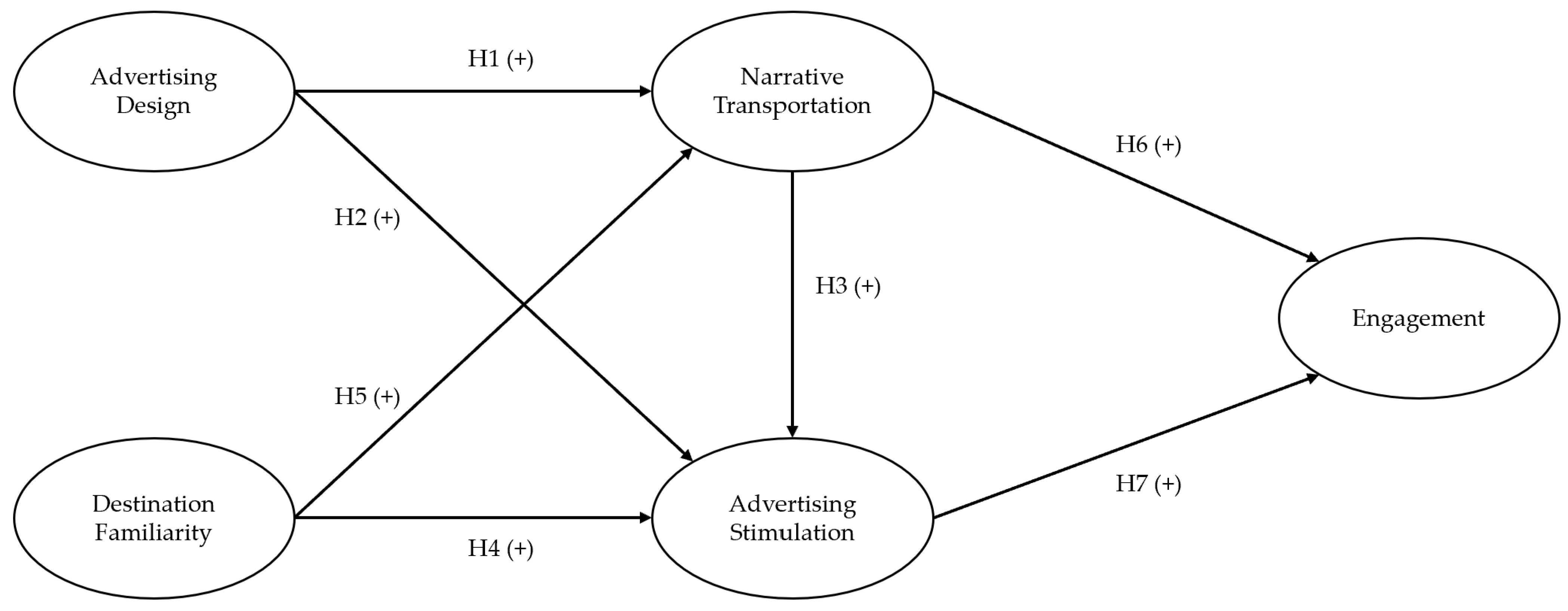
| H1 (+) | ADSG → NATX | 0.451 | 13.636 | Supported (p < 0.01) |
| H2 (+) | ADSG → ADST | 0.158 | 5.123 | Supported (p < 0.01) |
| H3 (+) | NATX → ADST | 0.659 | 14.757 | Supported (p < 0.01) |
| H4 (+) | FAM → ADST | 0.104 | 3.604 | Supported (p < 0.01) |
| H5 (+) | FAM → NATX | 0.215 | 6.261 | Supported (p < 0.01) |
| H6 (+) | NATX → ENG | 0.086 | 1.445 | Not Supported (n.s.) |
| H7 (+) | ADST → ENG | 0.288 | 4.679 | Supported (p < 0.01) |
Disclaimer/Publisher’s Note: The statements, opinions and data contained in all publications are solely those of the individual author(s) and contributor(s) and not of MDPI and/or the editor(s). MDPI and/or the editor(s) disclaim responsibility for any injury to people or property resulting from any ideas, methods, instructions or products referred to in the content. |
© 2026 by the authors. Licensee MDPI, Basel, Switzerland. This article is an open access article distributed under the terms and conditions of the Creative Commons Attribution (CC BY) license.
Share and Cite
Santos, S.; Santo, P.E.; Ferreira, S.; Pires, P.B.; Santos, J.D. From Story to Action: Affective Pathways to Engagement in Tourism Video Advertising. Adm. Sci. 2026, 16, 300. https://doi.org/10.3390/admsci16070300
Santos S, Santo PE, Ferreira S, Pires PB, Santos JD. From Story to Action: Affective Pathways to Engagement in Tourism Video Advertising. Administrative Sciences. 2026; 16(7):300. https://doi.org/10.3390/admsci16070300
Chicago/Turabian StyleSantos, Sara, Pedro Espírito Santo, Sónia Ferreira, Paulo Botelho Pires, and José Duarte Santos. 2026. "From Story to Action: Affective Pathways to Engagement in Tourism Video Advertising" Administrative Sciences 16, no. 7: 300. https://doi.org/10.3390/admsci16070300
APA StyleSantos, S., Santo, P. E., Ferreira, S., Pires, P. B., & Santos, J. D. (2026). From Story to Action: Affective Pathways to Engagement in Tourism Video Advertising. Administrative Sciences, 16(7), 300. https://doi.org/10.3390/admsci16070300