1. Introduction
Hotel loyalty programs now operate across booking platforms, brand apps, on-property service encounters, and post-stay communications, so guests repeatedly evaluate the same hotel brand across a sequence of digital and in-person interactions. Recent hospitality studies therefore link engagement to trust and behavioral intention (
Chen et al., 2022;
So et al., 2025), brand experience to loyalty outcomes (
K. N. Liu et al., 2022;
Dai et al., 2025), and value co-creation to satisfaction and loyalty-related responses among hotel guests and program members (
J. Liu et al., 2020;
Solakis et al., 2022;
Ribeiro et al., 2023). Yet hotel research still lacks a sufficiently integrated explanation of how engagement is translated into loyalty, particularly in loyalty-program settings where experience, participation, and repeated choice operate simultaneously.
First, most hospitality studies treat experience and co-creation as separate explanatory streams. Experience-centered models show that hotel brand experience relates to loyalty and revisit outcomes (
K. N. Liu et al., 2022;
Dai et al., 2025), whereas co-creation-centered work emphasizes DART conditions, participation, and value formation (
J. Liu et al., 2020;
Solakis et al., 2022;
Ribeiro et al., 2023). Engagement-based models, in turn, often rely on direct effects or a single mediator such as trust or service evaluation (
Chen et al., 2022;
So et al., 2025;
Chatzigeorgiou et al., 2025). What remains underdeveloped is a hospitality model that estimates HBX and HVCC together as concurrent mechanisms through which engagement is converted into loyalty. Without such joint estimation, it is difficult to determine whether the two mechanisms are complementary, redundant, or differently salient across loyalty facets.
Second, loyalty-formation logic remains unsettled in hotel loyalty-program research. Classic theory proposes a staged sequence from cognitive to affective to conative loyalty before action (
Oliver, 1999), but hospitality studies also show that value/quality beliefs, emotions/satisfaction, and commitment may exert direct influence on repeat patronage and advocacy in repeatedly reinforced service settings (
Back & Parks, 2003;
Han et al., 2011;
Tanford, 2016;
Christou et al., 2025b). For hotel loyalty programs, where guests make recurring booking decisions under varying trip purposes and service encounters, it is important to test whether the attitudinal facets operate strictly in sequence or whether they jointly calibrate action loyalty.
Third, cohort-based heterogeneity is often acknowledged but seldom modeled across the full engagement-to-loyalty chain. Hospitality and tourism research indicates that generational cohorts differ in digital expectations, participation preferences, and loyalty-program responses (
X. Li et al., 2013;
Seyfi et al., 2024;
Whalen et al., 2024). However, cohort is rarely treated as a boundary condition spanning the upstream activation of experience and co-creation and the downstream formation of multiple loyalty facets under established measurement invariance.
Accordingly, the EECL framework re-specifies prior hospitality models in three precise ways (
Table A1,
Appendix A). First, it positions engagement as an upstream activation state that simultaneously energizes an experience mechanism (HBX) and a co-creation mechanism (HVCC), rather than assuming a single conversion route. Second, it models loyalty as a multi-facet system in which cognitive, affective, and conative loyalty are estimated as parallel antecedents of action loyalty. Third, it examines whether these translations vary across generational cohorts after confirming measurement invariance. The novelty of EECL therefore lies not in introducing new constructs, but in reconfiguring how well-established hospitality constructs are structurally connected within one predictive model.
In light of these gaps, this study develops and tests an Engagement–Experience–Co-creation–Loyalty (EECL) framework for hotel loyalty-program members. Specifically, EECL proposes that engagement activates two concurrent conversion mechanisms, HBX and HVCC, which in turn shape cognitive, affective, and conative loyalty; these attitudinal facets then jointly predict action loyalty. Generational cohort is examined as a boundary condition on the core structural links.
Based on these gaps, the study pursues three objectives:
Objective 1: To examine how Hospitality Brand Experience and Hospitality Value Co-creation concurrently mediate the relationship between Hospitality Brand Engagement and Hospitality Brand Loyalty.
Objective 2: To assess whether and how these mediation pathways differ among Generation Z, Millennials, Generation X, and Baby Boomers.
Objective 3: To test a non-sequential (parallel) formation logic of multidimensional hospitality brand loyalty, specifying cognitive, affective, and conative loyalty as concurrent (parallel) antecedents of action loyalty.
The study’s contribution is threefold. First, it offers a hospitality-specific mechanism model that integrates engagement, experience, and co-creation within a single dual-path architecture. Second, it advances hotel-loyalty theorizing by directly testing a parallel, rather than strictly staged, attitudinal-to-action structure. Third, it establishes a generational cohort as a theoretically meaningful boundary condition on the engagement-to-loyalty translation process.
Empirically, the EECL framework is estimated using variance-based PLS-SEM. Measurement invariance is assessed via the MICOM procedure prior to cohort comparisons (
Henseler et al., 2016), and out-of-sample predictive performance is evaluated using PLSpredict (
Shmueli et al., 2019).
2. Theoretical Framework
2.1. Service-Dominant Logic and Resource Integration
Service-dominant logic frames hotel value as co-created through guest–firm interactions rather than embedded solely in the room or brand offering (
Vargo & Lusch, 2004,
2008;
Christou et al., 2025a). In hotel loyalty programs, value is formed when guests use the app, redeem benefits, interact with staff, customize aspects of the stay, and evaluate whether the brand makes participation worthwhile. From this perspective, engagement represents a voluntary investment of attention, emotion, and effort into hotel-brand interactions (
Brodie et al., 2011). Engaged members should therefore be more likely to notice opportunities for dialog, information exchange, and participation, which in turn should increase their perception of co-creation-enabling conditions such as dialogue, access, transparency, and risk–benefit clarity (
Prahalad & Ramaswamy, 2004;
Solakis et al., 2017).
2.2. Experience Economy and Experiential Marketing
Experience-economy and experiential-marketing perspectives are equally relevant in hotel settings because the stay unfolds through a series of concrete encounters: Browsing and booking, arrival, room use, service recovery, on-property amenities, and post-stay follow-up (
Tsaur et al., 2007). What matters is not only the availability of these stimuli, but how deeply guests attend to and interpret them. Engagement should intensify sensory, affective, cognitive, and behavioral responses to hotel-brand stimuli and thus strengthen the overall hospitality brand experience (HBX) rather than automatically producing loyalty (
Brakus et al., 2009;
Song et al., 2015).
2.3. Loyalty Formation Beyond Strict Staging
Classic loyalty theory proposes a staged sequence from cognitive to affective to conative loyalty before culminating in action (
Oliver, 1999). However, hospitality research commonly operationalizes loyalty as multidimensional and finds that attitudinal facets can exert direct, concurrent effects on behavioral commitment in program-based, repeatedly reinforced contexts (
Han et al., 2011;
Tanford, 2016). Yet hotel loyalty programs are repeatedly reinforced contexts in which guests evaluate value and service quality, feel satisfaction or emotional attachment, and form continuation intentions around the same brand across multiple stays. In such settings, beliefs (cognitive), emotions/satisfaction (affective), and commitment/revisit intentions (conative) may operate concurrently rather than only sequentially. EECL therefore specifies the three attitudinal facets as parallel antecedents of action loyalty.
2.4. Hospitality Brand Engagement (HBE)
Customer engagement is the cognitive, emotional, and behavioral investment in brand interactions across online/offline contexts and settings; in hospitality, participatory relational exchanges amplify attention, effort, and value-in-use, linking HBE to favorable evaluations, repatronage, and loyalty intentions (
Nguyen, 2024;
So et al., 2025). Conceptually, engagement acts as a resource activator (attention, time, skills), deepening processing at touchpoints and mobilizing customers to co-productive roles, consistent with marketing guidance on engagement-led value creation (
Arıca et al., 2023;
Ribeiro et al., 2023;
John & Supramaniam, 2024). Accordingly, HBE is expected to energize experiential (richer, more immersive) and participatory value-creation routes (feedback, customization, co-design). In digital tourism ecosystems, some highly mobile segments (e.g., digital nomads) can also act as unintentional influencers through ambient content sharing, shaping destination and hospitality brand imagery in ways that may spill over to engagement dynamics (
Simeli et al., 2025;
Lee et al., 2023).
In hotel loyalty programs, engagement reflects how much cognitive attention, positive feeling, and behavioral investment guests direct toward a focal hotel brand across stays and brand interactions. Engaged members are more likely to monitor the brand, compare it with alternatives, interact with its digital and human interfaces, and expend effort in maintaining the relationship. In hospitality settings, such investment should heighten both experiential richness and readiness to participate in value formation, making HBE an upstream activator of HBX and HVCC.
2.5. Distinguishing HBX and HVCC
HBX and HVCC are related but not interchangeable. HBX captures the guest’s overall experiential response to the hotel brand: The sensory, affective, cognitive, and behavioral impressions formed while encountering the brand (
Brakus et al., 2009). HVCC, by contrast, captures the perceived interaction conditions that allow the guest to help shape value-in-use, especially dialog, access, transparency, and risk–benefit clarity (
Prahalad & Ramaswamy, 2004;
Payne et al., 2008;
Vargo & Lusch, 2008). A hotel stay can be experientially rich with limited guest participation, and it can also be highly participatory without necessarily producing a distinctive experiential response. Treating the two as parallel mediators therefore allows the model to separate experience-as-response from co-creation-as-enabling conditions.
Consistent with experiential marketing and customer-journey views, engaged guests devote greater attention and emotional involvement to brand stimuli across touchpoints, which should strengthen their experiential responses and overall hospitality brand experience (HBX) (
Brakus et al., 2009;
Lemon & Verhoef, 2016).
In hotel contexts, guests who are more engaged with a brand should process stay-related cues more intensely, remember them more vividly, and attach greater personal meaning to them. This should strengthen HBX across booking, arrival, room, service, and post-stay encounters.
Likewise, engaged guests should be more likely to notice and use opportunities to ask questions, share preferences, customize service, and evaluate whether the hotel communicates openly and reduces uncertainty. This should strengthen perceived HVCC conditions (
Prahalad & Ramaswamy, 2004;
Vargo & Lusch, 2008). Accordingly, the following hypotheses are advanced:
2.6. Hospitality Value Co-Creation (HVCC) and Loyalty Facets
HVCC captures whether hotel guests perceive that the brand enables meaningful participation through dialog, access, transparency, and risk–benefit clarity (
Prahalad & Ramaswamy, 2004;
Vargo & Lusch, 2008;
Solakis et al., 2022). Recent accommodation research also suggests that psychological risk can condition how consumers translate eWOM into purchase intentions, underscoring the importance of risk–benefit clarity in value formation (
Doan Do et al., 2024;
Pérez-Ricardo & García-Mestanza, 2023). In hotel settings, such conditions can improve evaluative beliefs about the brand, generate stronger emotional reassurance and satisfaction, and reinforce commitment to future use because the guest feels heard, informed, and able to shape the stay (
K. N. Liu et al., 2022;
Wang et al., 2024;
So et al., 2025). Accordingly, HVCC is expected to relate positively to cognitive, affective, and conative loyalty.
H3a: HVCC positively affects hospitality cognitive brand loyalty (HBLcg).
H3b: HVCC positively affects hospitality conative brand loyalty (HBLco).
H3c: HVCC positively affects hospitality affective brand loyalty (HBLaf).
2.7. Hospitality Brand Experience (HBX) and Loyalty Facets
HBX captures the overall experiential response guests form toward the hotel brand from the stay and its surrounding interactions (
Zha et al., 2024;
Cho & Ko, 2025). Richer and more coherent hotel-brand experiences should strengthen value/quality beliefs (cognitive loyalty), deepen emotional attachment and satisfaction (affective loyalty), and reinforce commitment and revisit intention (conative loyalty) (
Shin et al., 2022;
Coudounaris et al., 2025). Thus, HBX is expected to relate positively to the three attitudinal loyalty facets.
H4a: HBX positively affects hospitality cognitive brand loyalty (HBLcg).
H4b: HBX positively affects hospitality conative brand loyalty (HBLco).
H4c: HBX positively affects hospitality affective brand loyalty (HBLaf).
2.8. Parallel Mediating Mechanisms
If engagement heightens both experiential response and co-creation conditions, and if each mechanism contributes to the loyalty facets, then HBX and HVCC should function as parallel transmission routes between engagement and loyalty. This view aligns with contemporary engagement perspectives and service-dominant logic in which experience formation and customer participation represent parallel value-creation mechanisms (
Jiddi, 2023;
Ribeiro et al., 2023;
John & Supramaniam, 2024;
Ladeira et al., 2024;
Satar et al., 2024). Consistent with this mechanism perspective, HBE is conceptualized as an upstream activation state whose influence on the loyalty facets is expected to materialize through value formation, rather than through a residual direct link that bypasses experience and participation mechanisms. Accordingly, direct HBE → loyalty paths are not hypothesized in the baseline framework; engagement’s downstream association with the loyalty facets is evaluated through the specific indirect effects via HBX and HVCC. In EECL, engagement is therefore modeled as an upstream activation state whose downstream association with loyalty is expected to be carried primarily through experience and participation mechanisms rather than assumed to bypass them. This yields the following mediation hypotheses:
H5a: HBX mediates the relationship between HBE and HBLcg.
H5b: HBX mediates the relationship between HBE and HBLco.
H5c: HBX mediates the relationship between HBE and HBLaf.
H6a: HVCC mediates the relationship between HBE and HBLcg.
H6b: HVCC mediates the relationship between HBE and HBLco.
H6c: HVCC mediates the relationship between HBE and HBLaf.
2.9. From Attitudinal Loyalty to Action Loyalty
Loyalty is multidimensional; cognitive, affective, and conative components are distinct yet interrelated and, consistent with prior work, can exert direct effects on action loyalty rather than only via
Oliver’s (
1999) strictly staged sequence (
Jiddi, 2023;
Ladeira et al., 2024;
Zikienė et al., 2024). In hospitality, low situational barriers and frequent service encounters often allow attitudes to translate swiftly into behavior (repeat patronage, advocacy), implying that each attitudinal facet can contribute independently to action (
K. N. Liu et al., 2022;
Satar et al., 2024;
Wang et al., 2024). Thus, it is hypothesized that:
H7: HBLcg positively affects hospitality action brand loyalty (HBLac).
H8: HBLco positively affects hospitality action brand loyalty (HBLac).
H9: HBLaf positively affects hospitality action brand loyalty (HBLac).
2.10. Generational Cohort as a Boundary Condition
Generational cohort is treated here as a boundary condition, not as an additional latent construct. Hotel loyalty-program members from different cohorts are likely to differ in digital socialization, willingness to self-manage service encounters, expectations about personalization, and the kinds of reassurance they seek before acting. Differences in digital socialization, expectations, risk–benefit perceptions, and service preferences imply that cohorts may translate engagement, experience, and co-creation into loyalty with varying intensities (
Khan et al., 2020;
Ladeira et al., 2024;
Seyfi et al., 2024;
Yang et al., 2024). Evidence on Generation Z e-loyalty formation also indicates that personal characteristics and social influences shape loyalty in digital tourism contexts, supporting cohort-contingent engagement-to-loyalty translations (
Singh & Sibi, 2023). Cohort delineations follow widely used definitions in demographic and generational research and official statistical practice (Baby Boomers 1946–1964; Gen X 1965–1980; Millennials 1981–1996; Gen Z 1997–2012) (
Schewe & Meredith, 2004;
Dimock, 2019;
U.S. Census Bureau, 2025). Younger cohorts are often more accustomed to app-mediated interaction, peer-to-peer information, and participatory service design, whereas older cohorts may place relatively greater weight on consistency, clarity, and experiential evidence accumulated across repeated stays (
X. Li et al., 2013;
Seyfi et al., 2024;
Whalen et al., 2024;
Christou et al., 2026).
These cohort differences can matter at multiple points in the EECL chain. They may influence how strongly engagement is converted into experience and co-creation, and they may also alter whether experiential or co-creative mechanisms carry more weight when guests form cognitive, affective, and conative loyalty toward a hotel brand. In line with hospitality segmentation practice, moderation is therefore operationalized through generational cohort membership and assessed via MICOM followed by PLS-MGA, rather than as a linear continuous-age interaction (
Cheah et al., 2023). Accordingly, the following cohort-based moderation hypotheses are proposed:
H10: Generational cohort moderates the effect of HBE on HBX.
H11: Generational cohort moderates the effect of HBE on HVCC.
H12a: Generational cohort moderates the effect of HBX on HBLcg.
H12b: Generational cohort moderates the effect of HBX on HBLco.
H12c: Generational cohort moderates the effect of HBX on HBLaf.
H13a: Generational cohort moderates the effect of HVCC on HBLcg.
H13b: Generational cohort moderates the effect of HVCC on HBLco.
H13c: Generational cohort moderates the effect of HVCC on HBLaf.
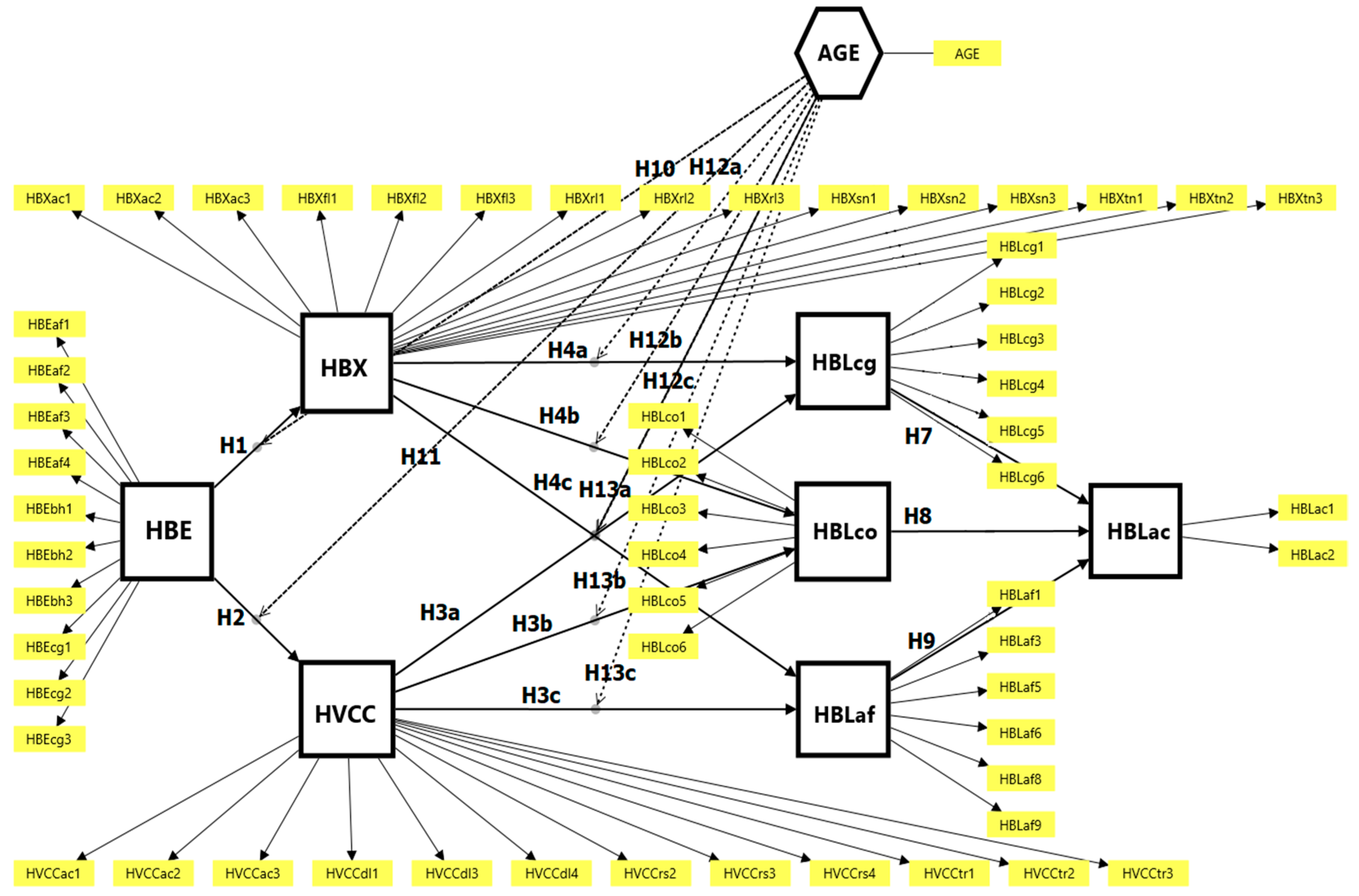
Based on the foregoing evidence, the following framework (
Figure 1) positions HBE as a driver of two complementary conduits, HBX and HVCC, leading to cognitive, affective, and conative loyalty that, in turn, feed action loyalty, while allowing for cohort-based differences across links.
3. Materials and Methods
3.1. Research Design
The study uses variance-based PLS-SEM to examine how HBE relates to multidimensional loyalty through two parallel mediators (HBX, HVCC), with generational cohort as the grouping variable for multi-group analysis. Age was operationalized as generational cohort membership (Gen Z, Millennials, Gen X, Baby Boomers) based on widely used birth-year cutoffs (
Dimock, 2019;
U.S. Census Bureau, 2025). The model therefore contains seven reflective latent constructs; generational cohort is not modeled as an eighth construct. In line with the conceptual framework (
Figure 1), the baseline structural specification focuses on the theorized mediated routes and does not include direct HBE → loyalty paths. PLS-SEM is appropriate because the study is prediction-oriented, includes seven latent constructs and 57 indicators, and involves multiple indirect effects and cross-cohort comparisons (
Shmueli et al., 2019;
Hair et al., 2022;
Henseler et al., 2016;
Cheah et al., 2023;
Reinartz et al., 2009;
Ringle et al., 2012). Significance was assessed via non-parametric bootstrapping with two-tailed tests; full bootstrapping outputs are provided in the
Supplementary Material (Tables S12–S14). As an additional sensitivity analysis,
Supplementary Table S20 examines whether small residual HBE → loyalty associations remain after HBX and HVCC are taken into account at the construct-correlation level.
3.2. Sample and Data Collection
Given the study aims, a non-probability purposive design recruited only participants meeting explicit inclusion criteria (current loyalty-program members in particular), appropriate when depth and relevance outweigh statistical generalizability (
Hair et al., 2020). The target population comprised English-speaking customers who self-identified as members of at least one of four global hotel loyalty programs (Marriott Bonvoy, Hilton Honors, IHG One Rewards, World of Hyatt) and passed the survey’s eligibility screen (Section Data Quality and Membership Verification). Recruitment used restricted-access Facebook forums dedicated to these loyalty programs, which are typically moderated and gate participation by requesting evidence of program membership for admission. Importantly, the research team did not access any credentials used for forum admission and did not collect membership numbers, tier/status, or other identifying documentation; therefore, “membership verification” in this study should be interpreted as eligibility screening (community gatekeeping combined with respondents’ self-reported screening confirmations) rather than administrative verification by the researchers. To ensure a consistent referent for all survey items, respondents were instructed to evaluate one focal program/brand among the four (i.e., the program they currently use most frequently/most recently stayed with) and to answer all “this hotel brand” items with that focal brand in mind.
As the respondents are screened loyalty-program members with repeated brand interactions, their prior experience and relational familiarity may contribute to reciprocal causality between engagement and experience, a common condition in customer–brand relationship studies (
Bowden, 2009;
Hollebeek et al., 2014;
Vivek et al., 2018). Exploratory region heterogeneity was assessed using MICOM followed by Henseler’s MGA (bootstrap-based, 5000 resamples; group-specific bootstrapping enabled). These programs span luxury, full-service, and select-service segments and are widely studied, enhancing external validity and managerial relevance (
Shin et al., 2022). Quota-guided recruitment (target N = 353 per cohort) was applied by monitoring incoming responses and pausing recruitment efforts once each cohort target was reached, yielding near-equal group sizes and improving statistical power for PLS-MGA (
Hair et al., 2022). After screening and data cleaning (Section Data Quality and Membership Verification), the final analytical sample comprised 1407 valid responses; because invitations were distributed via open posts rather than individualized sampling frames, an accurate response rate could not be computed. Participation was voluntary and anonymous; no personally identifying information was stored; data processing complied with GDPR and institutional ethics approval (Protocol No. 101/30-09-2024).
Data Quality and Membership Verification
As recruitment relied on anonymous online communities and the survey collected no personally identifying information, data quality was addressed through a transparent screening-and-cleaning protocol. The term “membership verification” is used here in a pragmatic sense: Eligibility was inferred from (a) membership in restricted program-focused forums and (b) respondents’ screening confirmations at the beginning of the questionnaire; the research team did not independently validate program credentials (e.g., membership numbers, screenshots, or tier documentation).
Eligibility screening: The questionnaire opened with mandatory screening items requiring respondents to confirm that they were (i) current members of at least one of the four focal hotel loyalty programs (Marriott Bonvoy, Hilton Honors, IHG One Rewards, World of Hyatt), (ii) at least 18 years old, and (iii) able to complete the survey in English.
Completion screening: To ensure analyzable responses for the full measurement model, cases were retained only if respondents reached the final page of the questionnaire and provided usable indicator responses for the latent-variable measures; all submissions that did not reach the survey end were removed as incomplete.
Duplicate and response-quality screening: Potential duplicates were assessed using non-identifying pattern diagnostics by flagging submissions with identical or near-identical response vectors across the modeled indicators, combined with matching key demographics and highly proximate submission times; where duplicates were detected, only the earliest complete submission was retained. In addition, responses were screened for insufficient-effort responding, including straight-lining/near-zero variance across extended Likert blocks, internally inconsistent response patterns, and implausibly short completion times, corresponding to the 80% of completion-time distribution. No stand-alone attention-check item was included; instead, the above response-quality diagnostics were used to identify insufficient effort responding.
Screening outcomes: A total of 1672 submissions were downloaded from Google Forms. Of these, 117 failed the eligibility screen (non-member of the focal programs and/or <18 and/or unable to complete the survey in English) and were excluded. 207 submissions that did not reach the final page were removed as incomplete. A further 58 cases were removed due to suspected duplication and/or insufficient-effort responding (straight-lining/near-zero variance, internally inconsistent patterns, or implausibly short completion time). The resulting analytical sample comprised 1407 valid responses. Straight-lining was flagged when responses were invariant across extended Likert blocks (near-zero within-person variance), and completion-time outliers were flagged using a distribution-based cut-off (empirical lower tail of completion times).
3.3. Measurement Instrument
A self-administered questionnaire was employed; no translation was required because all adopted scales were originally published in English. All constructs were measured via self-report, 5-point Likert scales (1 = strongly disagree, 5 = strongly agree), consistent with the cited measures. Negatively worded indicators were reverse-coded prior to analysis (HBXsn3; HBLaf5; HBLaf6) so that higher scores consistently reflected higher levels of the underlying construct (
Hair et al., 2022).
Although engagement, experience, and co-creation each contain recognizable subfacets, the EECL hypotheses concern their overall mechanism-level roles rather than facet-specific effects. The full item batteries were therefore retained to represent conceptual breadth, but HBE, HBX, and HVCC were modeled parsimoniously as single first-order reflective constructs. Loyalty, by contrast, was modeled multidimensionally because the study directly tests whether cognitive, affective, and conative loyalty jointly predict action loyalty (
Hair et al., 2022).
3.4. Hospitality Brand Engagement (HBE)
HBE was operationalized with
Hollebeek et al.’s (
2014) 10-item, three-dimension scale—cognitive (3), affective (4), behavioral (3)—and treated as a first-order reflective construct. Although brand engagement is commonly conceptualized as multidimensional,
Hollebeek et al. (
2014) also report a reliable overall engagement scale, and prior PLS-SEM applications frequently operationalize engagement as a global first-order factor when the theoretical focus is overall engagement (α = 0.943). In addition, subsequent studies have similarly modeled this scale as a first-order construct or have found it to behave unidimensionally in specific contexts (e.g.,
Nguyen, 2024;
Marbach et al., 2019). Accordingly, the full item battery was retained to represent the construct’s conceptual breadth, but HBE was specified parsimoniously as a single first-order reflective construct capturing the shared variance across its facets; the measurement results (indicator loadings, reliability, and convergent validity) supported this specification. It was preferred over
So et al. (
2014) because it is more inclusive, is extensively used in hospitality/tourism (e.g.,
S. Li & Wei, 2021), and aligns conceptually with the study’s engagement architecture;
Harrigan et al. (
2018) clarify correspondences between the two approaches (e.g., identification ↔ emotional; interaction ↔ behavioral; absorption/enthusiasm/attention ↔ cognitive/affective).
3.5. Hospitality Brand Experience (HBX)
HBX was operationalized with 15 items adapted from
Tsaur et al. (
2007), grounded in
Schmitt’s (
1999) experiential modules. This instrument was retained because it captures experiential responses that are directly meaningful in hotel contexts, sensory appeal, mood, curiosity, memory, and social connection during or immediately after the stay. The study models HBX as a single first-order reflective construct because the hypotheses concern overall experiential response rather than separate SENSE/FEEL/THINK/ACT/RELATE effects. Importantly, the behaviorally worded ACT/RELATE items are treated as immediate experience-related expressions (e.g., wanting to remember, share, or connect through the stay), not as indicators of long-run loyalty behavior, which is measured separately through HBLac.
These indicators are retained because they operationalize
Schmitt’s (
1999) experiential modules as adapted by
Tsaur et al. (
2007) and therefore capture the experience-driven behavioral responses and social connectedness that arise from the encounter (experience-as-response), rather than brand-priority or repeat patronage over time. In the present model, “action loyalty” is measured separately as brand priority and past-year visit frequency (HBLac), which reflects sustained behavioral commitment rather than immediate experiential expression (
Han et al., 2011). The 15 items (adapted from strategic experiential modules applications in tourism) are treated as interchangeable indicators of the same underlying experiential-response domain rather than modeled as separate dimensions, consistent with the broader view of brand experience as an integrated set of sensory, affective, intellectual, and behavioral responses (
Tsaur et al., 2007;
Song et al., 2015;
Brakus et al., 2009). This specification is appropriate because the experiential responses captured by the items are expected to covary as manifestations of an overall brand-related experiential response, and the study does not seek to isolate the incremental effects of individual experiential modules.
Brakus et al.’s (
2009) brand-experience scale was not used because it was developed for non-hospitality brands and emphasizes outcomes rather than diagnosable levers, limiting managerial actionability in services (
Khan & Rahman, 2015). Destination adaptations (
Barnes et al., 2014) may also challenge respondent comprehension (e.g., “bodily experience”), reinforcing the fit of tourism-specific measures (
Godovykh & Tasci, 2020).
3.6. Hospitality Value Co-Creation (HVCC)
HVCC was operationalized with 12 DART-based items adapted from
Solakis et al. (
2017). The scale was selected because it reflects hotel guests’ perception that the brand enables participation through dialog, access, transparency, and risk–benefit clarity—conditions that are directly relevant in hotel service encounters and loyalty-program interactions. In line with the study’s mechanism-level theorizing, the full DART item battery was retained but modeled as a single first-order reflective construct capturing the overall co-creation climate perceived by the guest.
HVCC is grounded in the DART logic, because it captures the interaction conditions that enable customers’ active participation in shaping value-in-use. While DART can be discussed as a set of elements, scale-development work conceptualizes these elements as complementary facets of a broader co-creation readiness/conditions domain. Accordingly, and consistent with hospitality validations of DART in customer settings, this study retains the full DART item battery but operationalizes HVCC parsimoniously as a single first-order reflective construct, so the structural model captures guests’ overall perception of co-creation-enabling conditions rather than estimating four separate mechanisms (
Albinsson et al., 2016;
Solakis et al., 2017,
2022). The reflective specification follows the view that dialog, access, transparency, and risk–benefit clarity represent interrelated manifestations of a commonly perceived co-creation climate/condition; the objective is not to form an index where DART elements may vary independently. Items were drawn from
Solakis et al. (
2017), who validated DART from the customer perspective in Greek hospitality; the approach is broadly applicable in services where value co-creation centers on experiential quests (
Prahalad & Ramaswamy, 2004;
Solakis et al., 2022) and provides an implementation structure (
Tanev et al., 2011).
Albinsson et al. (
2016) was not adopted because it targets firm-side responsibilities.
3.7. Hospitality Brand Loyalty (HBL)
HBL was modeled as a multidimensional, cognitive, affective, and conative action, assessing simultaneous interdependence among attitudinal stages toward action loyalty given the evidence that purely sequential accounts are insufficient (
Hinson et al., 2016;
Yaqub et al., 2023). The study adapted
Han et al.’s (
2011) 24-item scale: Cognitive via perceived value (3) and service quality (3); affective via positive emotions (2), negative emotions (2), satisfaction (2); conative via commitment (3) and revisit intention (3); action via 2 items, retaining 20 items in the final measurement. The operationalization follows the hospitality validation by
Han et al. (
2011) and aligns with
Oliver’s (
1999) staging logic in which the cognitive component of loyalty reflects evaluative beliefs about the brand. Accordingly, perceived value and service quality items are treated here as the belief-based content of hospitality cognitive loyalty (HBLcg), i.e., customers’ evaluative conviction that the focal brand offers superior value/quality relative to alternatives. Likewise, satisfaction is included within affective loyalty (HBLaf) as an affect-laden summary judgment that co-occurs with positive/negative affective episodes during the stay, consistent with hospitality loyalty models that embed satisfaction within the affective component (
Back & Parks, 2003;
Han et al., 2011). At the same time, alternative specifications conceptualize value/quality and satisfaction as antecedents of loyalty; the present study adopts Han et al.’s operationalization to maintain comparability and to keep the focus on the engagement-to-loyalty conversion chain rather than on a broader service-evaluation antecedent model. In the affective dimension, the negative-emotion indicators (SHAME; SURPRISE) were reverse-coded prior to analysis so that higher HBLaf values consistently indicated stronger affective loyalty (i.e., stronger positive affect/satisfaction and fewer negative-affect episodes). Because SURPRISE can be valence-ambiguous in isolation, its retention is assessed empirically; measurement diagnostics show that the reverse-coded SURPRISE indicator loads strongly on HBLaf and does not exhibit problematic cross-loadings (
Table S20, Supplementary Material).
Hinson et al. (
2016) was not adopted due to its telecommunications context and limited transferability to hospitality.
3.8. Controls
Age, gender, education, and country of residence (later aggregated to continent of residence) were collected. Age was used to classify respondents into four generational cohorts for MGA; it was not modeled as a latent construct.
Common-method bias (CMB) can be a concern in single-source, cross-sectional survey research where predictors and outcomes are collected in the same instrument. Procedurally, the study reduced this risk through anonymous participation, the use of established scales, and some negatively worded items. As a post hoc robustness diagnostic, the single-item demographic variable GENDER was used as an exogenous marker and added as a predictor to all endogenous constructs; results were then compared against the baseline model in terms of R2 and structural coefficients. As the questionnaire did not include a dedicated multi-item, theory-unrelated marker variable at the design stage, this gender-based marker should be read as a conservative robustness check rather than as a definitive CMV test. It was considered suitable for this limited purpose because it is exogenous to the focal model, is measured outside the focal Likert batteries, and is unlikely to explain the full covariance pattern among engagement, experience, co-creation, and loyalty. Detailed baseline-versus-marker outputs are available from the authors upon request.
To address potential endogeneity in the PLS-SEM framework, the Gaussian copula approach was applied to all structural paths following
Hair et al. (
2022). For each potentially endogenous predictor, a Gaussian copula term was constructed and added to the corresponding structural equation; significance of the copula term indicates endogeneity, and the copula-augmented specification provides an endogeneity-adjusted robustness estimate (
Supplementary Table S11). The diagnostics flagged significant copula terms for the HBE → HBX path (
p < 0.001) and for the HVCC → HBLcg path (
p = 0.004), with marginal evidence for HVCC → HBLco (
p = 0.069). All remaining copula terms were non-significant, indicating selective (link-specific) rather than systemic endogeneity. Accordingly, baseline results are retained for the primary hypothesis tests, but links flagged by the copula diagnostics are interpreted conservatively as associative rather than as unidirectional causal effects.
4. Results
All detailed statistical tables (e.g., outer loadings, HTMT, Fornell–Larcker, PLSpredict, MICOM, and MGA) are available in the online
Supplementary Material to ensure transparency and reproducibility.
Table 1 presents the demographics of the survey respondents.
4.1. Measurement Model
Indicator reliability and internal consistency were assessed via outer loadings, Cronbach’s α, CR, and AVE. All retained indicators exceed 0.70; loadings range from 0.745 to 0.948 (
Table 2). The reverse-coded sensory-appeal item (HBXsn3) and the reverse-coded negative-emotion items (HBLaf5; HBLaf6) performed as intended, with high target loadings (0.775–0.822) and clear separation from their highest cross-loadings (Δ = 0.282–0.306;
Table S20, Supplementary Material). Multicollinearity is not a concern, below 5.0 and the 3.3 full-collinearity heuristic (
Hair et al., 2022). A measured-marker (GENDER) showed negligible changes (mean ΔR
2 ≈ 0.0005; max ΔR
2 = 0.002; mean |Δβ| ≈ 0.0003; max |Δβ| = 0.002) and no change in significance. This pattern indicates that the substantive relationships in the EECL model are robust to the inclusion of an exogenous single-item marker and are therefore unlikely to be artifacts of shared measurement methods. While no single diagnostic can definitively eliminate CMV in cross-sectional self-report designs, the near-zero shifts in both explained variance and structural coefficients suggest that any residual method-related covariance is not materially biasing the hypothesis tests.
The internal consistency of each construct was examined through Cronbach’s α and composite reliability coefficients (CR). Internal consistency was satisfactory (α/CR ≥ 0.70) (
Table 2).
Convergent validity was assessed via the AVE, with all constructs surpassing the 0.50 threshold prescribed by
Fornell and Larcker (
1981). Convergent validity is supported (all AVE ≥ 0.50) (
Table 2).
The assessment of discriminant validity proceeded in two complementary stages, following established guidelines (
Henseler et al., 2016). First, the Fornell–Larcker criterion is satisfied, with the square roots of AVE on the diagonal exceeding the corresponding inter-construct correlations (
Table 3).
The heterotrait–monotrait (HTMT) ratio of correlations was calculated to provide a more stringent test of discriminant validity. All ratios remain at or below 0.688, supporting discriminant validity (
Table 3). Importantly, the HBX–HVCC HTMT ratio (
Table 3) falls well below conservative thresholds (e.g., 0.85/0.90), supporting discriminant validity between the two mediators. Taken together, the indicator loadings and reliability/validity evidence support treating HBE, HBX, and HVCC as coherent global constructs for the study’s level of abstraction; accordingly, the analysis focuses on the structural relations among these mechanisms rather than on facet-specific effects.
The assessment of global model fit employed both absolute and incremental indices. SRMR values, which are reported descriptively in composite-based SEM (
Hair et al., 2022), typically aligned with <0.08 guidelines for approximate fit (
Hu & Bentler, 1999) (
Table 4).
4.2. Predictive Assessment
In line with the predictive ethos of PLS-SEM (
Shmueli et al., 2019), PLSpredict results demonstrate out-of-sample utility. At the construct level, Q
2_predict values fall in the 0.137–0.233 interval, evidencing out-of-sample utility (
Table 4).
4.3. MICOM Invariance
Before MGA, measurement invariance was assessed using MICOM (
Henseler et al., 2016). Reported are permutation
p-values for compositional invariance (Step 2) and the equality of composite means and variances (Step 3), the corresponding pass/fail decisions, and the overall MICOM conclusion. Full measurement invariance is concluded when Step 2 and both Step-3 tests are non-significant (
p > 0.05);
Table 4 presents the compact decision summary.
4.4. Structural Model
The explanatory power of the structural model was evaluated by examining the coefficient of determination (R
2) for each endogenous construct (
Table 4). Explained variance falls in the moderate range (
Hair et al., 2022) (
Table 4).
Path estimates, t-statistics,
p-values, and effect sizes are reported in
Table 5 (full bootstrapping outputs are provided in
Supplementary Table S12). HBE shows strong positive associations with both mediators: HBE → HBX = 0.584 (
p < 0.001; f
2 = 0.518, large) and HBE → HVCC = 0.533 (
p < 0.001; f
2 = 0.396, large), supporting H1 and H2. Copula diagnostics indicated endogeneity signals in the HBE → HBX and HVCC → HBLcg links; accordingly, these paths are statistically robust in the baseline model but are interpreted conservatively as associations rather than as firm unidirectional causal effects. In the copula-augmented robustness specification (
Supplementary Table S11), the HBE → HBX coefficient attenuates and is not statistically different from zero, consistent with possible reciprocal engagement–experience reinforcement and/or omitted antecedents, whereas HVCC → HBLcg remains positive and statistically significant; HVCC → HBLco becomes marginal. Both HBX and HVCC are positively associated with the three attitudinal loyalty dimensions: HBX → HBLcg/HBLco/HBLaf = 0.443/0.476/0.417 (all
p < 0.001), and HVCC → HBLcg/HBLco/HBLaf = 0.402/0.451/0.481 (all
p < 0.001), supporting H3a–H4c. Finally, HBLcg, HBLco, and HBLaf are each positively associated with HBLac (0.262, 0.294, and 0.281; all
p < 0.001), supporting H7–H9. Overall, the pattern supports a dual-path architecture in which engagement is linked to loyalty primarily through concurrent experiential and co-creative mechanisms.
4.5. Mediation
Table 6 reports the specific indirect effects. In line with the proposed EECL framework (
Figure 1), HBE is modeled as an upstream activation construct whose downstream association with the loyalty facets is expected to operate through two complementary conduits, HBX and HVCC. The results document statistically significant indirect transmission through both routes, supporting H5a–H6c (
Table 6). As a post hoc sensitivity check,
Supplementary Table S20 examines residual direct HBE → loyalty coefficients using the latent construct correlation matrix. After HBX and HVCC are partialled out, the residual HBE coefficients are small (β = 0.111 for HBLcg; β = −0.038 for HBLco; β = 0.035 for HBLaf), indicating that the mediated architecture remains the dominant transmission pattern, although a modest direct evaluative link to cognitive loyalty cannot be ruled out. Given the copula diagnostics, indirect effects involving the HBE → HBX or HVCC → HBLcg links are interpreted as associative rather than strictly causal.
4.6. Multi-Group Analysis (MGA)
The sample was segmented into four cohorts (Generation Z, Millennials, Generation X, Baby Boomers). After establishing measurement invariance, between-cohort differences in structural paths were evaluated using PLS-MGA.
Table 7 provides a compact summary of how many of the six possible pairwise contrasts are significant for each link; the full two-tailed pairwise differences (Δβ) and
p-values are reported in
Supplementary Table S19. Accordingly, moderation findings are interpreted as differences in structural relations across cohorts (i.e., cohort-contingent translations) rather than as evidence of a linear continuous-age effect. The analysis indicates that generational cohort moderates every direct relationship posited in H10–H13, with at least four of the six possible pairwise contrasts significant for each link; this pattern implies that the strength with which engagement is translated into experience and co-creation, and with which these mechanisms shape the loyalty facets, varies by cohort (
Supplementary Table S19). To interpret the degree of empirical support, a proportion-based evaluation was adopted following established guidelines (e.g.,
Hair et al., 2022): For the present design with six pairwise contrasts per link, labels were operationalized as full support = 6/6, strong support = 5/6, and partial support = 4/6 significant contrasts. When applying these criteria, moderation by cohort was selective rather than uniform, with the weakest evidence observed for HBX → HBLaf and HVCC → HBLcg (partial support) (
Table 7).
The validated measurement model satisfies reliability and validity criteria (
Hair et al., 2022), the structural model corroborates a dual-mediator engagement-to-loyalty architecture with moderate explained variance, mediation is robust across both routes, generational heterogeneity in path strengths is statistically significant under full measurement invariance (
Cheah et al., 2023), and the model exhibits meaningful out-of-sample prediction (
Shmueli et al., 2019).
5. Discussion
This study develops and tests the EECL framework to explain how engagement is translated into hotel loyalty among loyalty-program members. The results show that hospitality brand engagement (HBE) (
Chen et al., 2022) is positively associated with two distinct conversion mechanisms—an experience route (HBX) (
Guan et al., 2021) and a value co-creation route (HVCC) (
Ribeiro et al., 2023)—that jointly relate to cognitive, affective, and conative loyalty and, in turn, to action loyalty. The structural evidence supports a dual-path architecture in which both mechanisms contribute non-redundant explanatory power for the attitudinal loyalty facets, and where these facets operate as concurrent antecedents of action loyalty rather than a strict, staged sequence. At the same time, Gaussian-copula diagnostics indicated link-specific endogeneity in the HBE → HBX and HVCC → HBLcg relationships, implying that some translations may operate within feedback loops or omitted-variable structures. Accordingly, these relationships are interpreted as predictive associations in the proposed model rather than as evidence of unidirectional causality, while the dual-engine logic remains informative for understanding how engagement is linked to downstream loyalty outcomes across cohorts (
Brodie et al., 2011;
Hollebeek et al., 2014).
The auxiliary direct-path sensitivity check also indicates that any residual HBE → loyalty association is small relative to the mediated routes, especially for conative and affective loyalty. As the design is cross-sectional and copula diagnostics flagged selected links, the discussion below interprets the structural pattern as a robust set of predictive associations rather than as proof of unidirectional causality.
5.1. Engagement as the Activation Trigger of Two Loyalty Engines: Experience vs. Co-Creation
The first contribution of the study is to show that engagement is better treated as an upstream activator of two hotel-specific mechanisms rather than as a direct, one-step antecedent of loyalty. HBX captures how richly and coherently guests experience the hotel brand, whereas HVCC captures whether guests perceive that the hotel enables meaningful participation through dialog, access, transparency, and risk–benefit clarity. Estimating both mechanisms simultaneously is useful because each retain independent explanatory value for the loyalty facets even when the other is present in the model. Consistent with service-dominant logic, engaged customers are more likely to integrate resources, interact with the firm, and enact participation behaviors that translate into perceived co-creation conditions (HVCC) (
Vargo & Lusch, 2004,
2008;
Payne et al., 2008). In parallel, the experience economy perspective explains why the same engagement state can deepen holistic, multi-touchpoint impressions (HBX), and the perceived quality of brand-designed encounters that accumulate into an overall experience (
Brakus et al., 2009;
Schmitt, 1999;
Lemon & Verhoef, 2016).
Importantly, this dual-engine structure helps reconcile a recurring tension in hospitality research: Studies often treat “experience” and “co-creation” as interchangeable levers, which can blur mechanisms and inflate conceptual overlap. Here, discriminant validity evidence (e.g., HBX–HVCC) supports treating them as non-redundant constructs, aligning HBX with primarily firm-orchestrated touchpoint impressions, and HVCC with customer-enacted participation and perceived co-creation affordances (e.g., DART-type conditions) (
Prahalad & Ramaswamy, 2004;
J. Liu et al., 2020;
Ribeiro et al., 2023). The theoretical implication is that engagement does not merely “increase loyalty”; it channels loyalty formation through (at least) two qualitatively different routes that organizations can manage with different design principles and governance routines. Rather than assuming that experience and co-creation collapse into the same process, the results suggest that distinguishing them improves analytical precision. In hotel settings, a stay can generate strong experiential responses even when guest participation is limited, and it can also invite participation without necessarily producing a particularly distinctive experiential impression. This distinction matters theoretically because the two mechanisms imply different managerial levers: One concerns how the hotel brand is encountered and felt, while the other concerns how the guest is allowed to participate and influence the service experience.
Engagement deepens experiential immersion and strengthens loyalty via enhanced experience quality (
Chen et al., 2022), while engagement/involvement fosters co-creative affordances and participation mechanisms, information sharing, feedback, citizenship, and is linked to satisfaction and loyalty among program members (
J. Liu et al., 2020). Reviews corroborate co-creation’s centrality and map outcomes for customers and firms (
Ribeiro et al., 2023). In sum, engagement operates as a multi-mechanism generator simultaneously activating firm-orchestrated experience and customer-enacted participation.
At the same time, the endogeneity signal on HBE → HBX cautions against reading engagement as a purely one-way driver of experience. In loyalty-program contexts, guests who repeatedly stay with the brand may simultaneously bring past experience into current engagement and current engagement into the next experience. The practical implication is not that the relationship disappears, but that engagement and experience may reinforce one another over time.
5.2. Experience and Co-Creation as Complementary Pathways to Attitudinal Loyalty
The second contribution concerns how these two mechanisms connect to the attitudinal loyalty system. HBX is positively associated with cognitive loyalty, meaning that richer hotel-brand experiences coincide with stronger beliefs about value and service quality; it is also positively associated with affective and conative loyalty, indicating deeper emotional attachment/satisfaction and stronger continuation intentions (
Guan et al., 2021). HBX also shows direct and mediated effects (
K. N. Liu et al., 2022), and smart-hotel attributes anchor cognitive–affective mechanisms (
Dai et al., 2025). By contrast, co-creative affordances and participation mechanisms, green practices, participatory options, and feedback loops strengthen trust, satisfaction, and loyalty intentions (
Shulga et al., 2021;
Ruiz-Molina et al., 2023). The observed complementarity fits a networked view in which beliefs, feelings, and intentions are co-activated rather than strictly sequential. HVCC shows a parallel pattern: When guests perceive open dialog, access to useful information, and clearer participation conditions, they also report stronger evaluative beliefs, emotional attachment, and commitment toward the hotel brand.
Brand experience influences loyalty by strengthening customers’ perceived brand meaning (cognitive), emotional attachment (affective), and intention-based commitment (conative) (
Guan et al., 2021;
K. N. Liu et al., 2022;
Dai et al., 2025). At the same time, the HVCC route corroborates the premise that co-creation conditions and participatory behaviors generate value that customers subsequently “credit” to the brand, elevating attitudinal loyalty (
Shulga et al., 2021;
Ruiz-Molina et al., 2023;
Ribeiro et al., 2023). This pattern suggests complementarity rather than substitution. HBX appears to work through how the hotel brand is lived and interpreted, whereas HVCC works through how the guest perceives the possibility of shaping and navigating the stay. In hotel loyalty programs, both mechanisms matter because repeated choice depends not only on memorable or coherent stays, but also on whether the brand makes participation feel worthwhile, transparent, and low-friction.
The copula signal on HVCC → HBLcg further suggests caution in causal wording for the cognitive path. Even so, the broader pattern remains stable: Co-creation conditions retain a distinct association with value/quality-based loyalty even after HBX is simultaneously estimated.
5.3. Loyalty Formation Beyond Strict Staging: Attitudinal Facets Operate in Parallel
A third implication is that hotel loyalty does not appear to operate only as a strict stage model. In the EECL results, cognitive, affective, and conative loyalty each have direct positive links to action loyalty. This means that repeat patronage and behavioral priority are jointly calibrated by evaluative beliefs, emotional attachment/satisfaction, and commitment/revisit intention. For hotel brands, action loyalty is therefore not merely the last step of a fixed ladder; it is the behavioral outcome of multiple attitudinal forces operating in parallel within repeated service relationships. This pattern is consistent with the view that hospitality decisions often reflect simultaneous evaluation (cognitive), attachment (affective), and commitment/intent (conative), each capable of translating into behavior depending on context and customer state (
Tanford, 2016;
Ladeira et al., 2024). In doing so, the EECL architecture advances loyalty theorizing by focusing on configuration and complementarity, two upstream engines feeding three attitudinal mechanisms that jointly explain action, rather than treating action as the inevitable terminal step of a single pathway.
5.4. Boundary Condition: Cohort-Contingent Translations
The multi-group analysis indicates that generational cohort meaningfully conditions several translations in the model. Younger cohorts convert engagement more strongly into both HBX and HVCC, consistent with stronger responsiveness to digitally mediated interaction and participatory service formats. Older cohorts, by contrast, rely more heavily on experience when forming cognitive loyalty, suggesting that coherent experiential evidence remains especially important for how they judge hotel value and quality. This is theoretically important because it frames age not as a “methodological appendix,” but as a boundary condition on how engagement is converted into experience, co-creation, and ultimately loyalty outcomes. Prior research suggests that cohorts differ in what they value in service interactions, how they interpret brand signals, and the friction they tolerate before acting, which can shift the relative importance of experience-based versus participation-based loyalty mechanisms (
Seyfi et al., 2024;
Fu et al., 2024;
Whalen et al., 2024).
These differences should be read as cohort-specific operating logics rather than as simple mean-level age effects. The implication for hotel loyalty programs is that the same engagement stimulus does not necessarily travel through the same mechanism for every cohort. Some guests respond more through participatory value formation, whereas others place greater weight on how convincingly the stay itself supports value and quality judgments.
Taken together, predictive assessment, invariance testing, and the auxiliary sensitivity analyses indicate that the central EECL pattern is robust: Engagement is linked to hotel loyalty primarily through parallel experience and co-creation mechanisms, and the strength of these translations varies across cohorts.
Finally, robustness checks (e.g., predictive assessment; endogeneity diagnostics) underscore that the study’s central conclusions are not artifacts of a single evaluation lens. In particular, where endogeneity signals appear in selected links, interpretation should focus on the stable pattern: The engagement–(experience/co-creation)–loyalty–action architecture remains substantively informative for explaining loyalty formation in hospitality settings (
Shmueli et al., 2019;
Hair et al., 2022).
5.5. Boundary Extensions: Cross-Domain Expectations, Personalization, and the Human Factor
Although EECL is deliberately centered on the guest–brand relationship, contemporary hotel loyalty does not evolve in a vacuum. Guests increasingly benchmark hotels against the most seamless service encounters they experience elsewhere, including platform interfaces, retail convenience, and digital assistance ecosystems. From this perspective, hyper-personalization may operate as an upstream organizational capability that shapes both HBX and HVCC, while in some contexts guests may value reduced decision effort as much as active participation. Likewise, the model does not explicitly isolate human attachment, interpersonal trust in employees, or guest-care relationships, even though such people-based bonds may independently stabilize loyalty in hotel settings. These considerations do not contradict EECL; rather, they define important boundary extensions for future hospitality research.
5.6. Theoretical Implications
Theoretically, the study contributes at three levels. First, it specifies a hospitality-specific mechanism model in which engagement is translated through two concurrent routes rather than through one undifferentiated engagement → loyalty link. Second, it supports a parallel attitudinal-to-action structure that complements, and in hotel settings may be more diagnostic than, a strictly staged reading of loyalty. Third, it shows that generational cohort is not merely a demographic control but a boundary condition on how hotel guests convert engagement into experience, co-creation, and subsequent loyalty facets.
5.7. Extensions and Transferability
More broadly, the EECL architecture offers a transferable template for service contexts that combine branded experience, customer participation, and repeated choice. At the same time, transferability should be tested rather than assumed, because the relative weight of experiential response, participatory conditions, and people-based trust may vary across restaurants, healthcare, retail, education, and other service domains.
6. Managerial Implications
The results suggest that hotel loyalty strategy can be usefully approached as a dual-mechanism system: (i) An experience mechanism (HBX) through which guests form experiential responses to the brand, and (ii) a co-creation mechanism (HVCC) through which guests assess whether the hotel enables worthwhile, transparent, and low-friction participation. As the design is cross-sectional and selected paths showed endogeneity signals, the implications below are framed as mechanism-aligned managerial actions consistent with the observed associations rather than as deterministic causal prescriptions.
6.1. Design and Stabilize the Experience Engine (HBX)
Managers should prioritize consistency across booking, arrival, room use, service recovery, and post-stay contact so that guests receive coherent cues that support both evaluative confidence and emotional attachment. Investments should be judged not only by immediate satisfaction but also by whether they strengthen the attitudinal facets that feed action loyalty.
6.2. Operationalize Co-Creation as Governed Participation (HVCC), Not as a One-Off Feature
HVCC should be designed as governed participation rather than as shifting work onto the guest. Structured dialog channels, transparent information, credible handling of risk–benefit tradeoffs, and rapid follow-through on guest input can strengthen participation without creating friction. Frontline employees remain central because they translate both experience design and co-creation promises into credible in-stay interactions. In other words, co-creation is most effective when guests can choose the degree of involvement they want and when participation reduces complexity rather than adds effort.
6.3. Manage the Translation to Action with Parallel Levers
Because cognition, affect, and conation each contribute to action, loyalty initiatives can be matched to the dominant lever: (a) Cognitive, which include clear value signals, reliability proof points, and meaningful differentiation; (b) affective, which refer to recognition moments, empathy, and relationship cues; (c) conative, in relation to commitment prompts, goal framing, and friction reduction at the decision point (booking, renewal, redemption).
6.4. Calibrate by Cohort and Monitor with Mechanism-Aligned Dashboards
Cohort-contingent path differences indicate that “one-size-fits-all” loyalty design can waste resources. Segment-level dashboards should track engagement inputs, activation of HBX and HVCC, attitudinal shifts, and action outcomes in a linked way, enabling managers to allocate investment between experience upgrades and participation mechanisms based on which route is currently driving action for each cohort.
7. Policy and Social Implications
Although the EECL model is estimated at the customer-perception level, its mechanisms correspond to designable participation and information conditions that can be shaped through governance. In particular, HVCC is operationalized through DART-type conditions (dialog, access, transparency, and risk–benefit clarity), and the structural results indicate that these co-creation conditions retain unique associations with cognitive, affective, and conative loyalty even when brand experience (HBX) is simultaneously modeled. This pattern implies that loyalty-program innovation should be governed not only as a marketing issue, but also as a participation and information-governance issue.
First, because access and transparency are integral to the co-creation mechanism linked to loyalty formation, policy can strengthen baseline requirements for privacy-by-design and meaningful consent across data-mediated touchpoints (e.g., understandable notices, data minimization, and effective access/deletion pathways) so customers can participate without opaque data trade-offs. Second, where algorithmic decisioning intermediates access, dialog, or benefit allocation (e.g., prioritization, pricing, offers), governance should require the documentation of decision logic, periodic bias, and performance audits, and human-override procedures to preserve accountability and contestability. Third, consumer-protection standards should target loyalty-program terms that calibrate action loyalty (e.g., clarity of point accrual/redemption rules, transparent changes to benefits, and proportionality in restrictions), reducing information asymmetries that can erode trust and willingness to participate.
Beyond firm performance, the EECL architecture also implies societal effects because it organizes how people engage, participate, and ultimately act within hospitality ecosystems. If co-creation is operationalized as low-friction participation with credible transparency and risk–benefit clarity, it can widen inclusion by enabling guests with different abilities, preferences, and digital comfort levels to shape their service experience through both human and assisted channels, without penalizing those who opt out of technology-intensive touchpoints. Likewise, because the experience mechanism (HBX) is strongly associated with attitudinal loyalty in the model, social value also depends on how experiences are produced across touchpoints; industry standards and labor-oriented policies that protect service quality and job dignity (training, workload guardrails, and fair service-recovery practices) can indirectly support the experience-based mechanism that underpins loyalty formation. These policy implications are therefore framed as mechanism-aligned governance priorities consistent with the observed model associations rather than as causal claims.
8. Originality and Contribution to Knowledge
The study integrates experiential marketing and value co-creation into a single EECL framework where brand experience and co-creation operate concurrently, explaining how engagement converts into multidimensional loyalty. This concurrent logic prevents the misattribution of attitudinal drivers and reconceptualizes loyalty formation as a networked rather than staged process.
EECL advances loyalty theory by demonstrating that cognitive, affective, and conative loyalty act as parallel antecedents of action loyalty and by identifying generational cohort as a boundary condition shaping the strength of experience- versus co-creation-based mechanisms. These insights clarify when and for whom each “loyalty engine” dominates.
The invariance-first MICOM → PLS-MGA workflow combined with predictive diagnostics (PLSpredict) offers a replicable template for cross-group SEM studies that bridges explanatory and predictive goals. Together, these contributions extend both theory and empirical practice in hospitality management research.
9. Limitations and Future Research
This study has six main limitations: (1) A cross-sectional design limiting causal inference and leaving reciprocal effects only partially addressed; (2) reliance on self-reports, risking social-desirability bias, common-method variance, and aspiration–behavior gaps; (3) exclusive use of variance-based PLS-SEM, limiting direct comparability with covariance-based global-fit benchmarks; (4) moderation operationalized through generational cohorts, which may still conflate cohort with adjacent life-stage or psychographic factors; (5) the sample comprises screened loyalty-program members, so generalization to first-time or non-member guests should be cautious; and (6) the model is brand-centered and does not explicitly capture hyper-personalization capability, interpersonal trust in employees, or cross-domain service standards that guests may import from other service sectors. Moreover, because respondents were pooled across four loyalty programs, unobserved program-level differences (e.g., benefit structures, digital interfaces, tier mechanics) may introduce heterogeneity in engagement and loyalty formation that is not explicitly modeled; accordingly, the reported effects should be interpreted as pooled associations among loyalty-program members rather than as program-specific estimates. In addition, as the copula results flagged selective endogeneity in the HBE → HBX and HVCC → HBLcg links, future longitudinal, experimental, or panel designs could examine reciprocal effects and omitted-variable structures more directly. The auxiliary direct-path sensitivity check suggests that residual direct engagement-to-loyalty associations are small, but a modest direct evaluative link to cognitive loyalty cannot be ruled out.
Future research could further unpack these global mechanisms by examining facet-level patterns (e.g., engagement facets, experiential modules, and DART elements), by incorporating people-based variables such as employee trust or human attachment, and by testing hyper-personalization or complexity-reduction capability as upstream antecedents or moderators. Cross-industry comparisons may also be useful, because hotel guests may transfer service expectations from platform, retail, health, or digital-assistance contexts into hotel evaluations.
Methodologically, future studies could estimate competing direct-path models and reciprocal longitudinal models, broaden samples across countries and adjacent service contexts, and triangulate survey data with operational or transaction data (e.g., bookings, loyalty redemptions, service-use logs). Replications with CB-SEM, higher-order specifications, multilevel designs, and richer segmentation variables would further test the robustness and boundary conditions of EECL.
10. Conclusions
The EECL framework clarifies that hotel engagement is not linked to loyalty through a single universal route. Instead, engagement is translated primarily through two distinct mechanisms—experience and co-creation—that jointly shape what guests believe about the brand, how they feel toward it, and how strongly they intend to stay with it. The auxiliary sensitivity check further indicates that these mediated routes dominate the engagement-to-loyalty pattern, even though a small residual direct link to cognitive loyalty cannot be fully excluded. Action loyalty therefore reflects the combined contribution of cognitive, affective, and conative loyalty operating in parallel in hotel loyalty-program contexts.
Cohort differences further suggest that loyalty formation is conditional rather than uniform. Younger cohorts respond more strongly to engagement cues that enable interaction and participation, whereas older cohorts place greater weight on experiential evidence when forming cognitive loyalty. These insights shift hotel loyalty strategy from “one best path” to cohort-sensitive design; they strengthen experiential consistency, enable transparent low-friction participation, and recognize that future extensions should also incorporate personalization capability and the human factor.