1. Introduction
South Africa’s apartheid history continues to shape enduring racialised and gendered inequalities, most visibly reflected in the uneven access to quality education and stable employment pathways for women (
Jacobson, 2025;
Narayan, 2025;
Saka, 2024). These historical inequalities remain particularly pronounced in engineering and other STEM professions, where access, recognition, and progression continue to be unevenly distributed along gendered and racialised lines. The central problem addressed in this study concerns the continued dominance of deeply masculinised and racialised organisational norms within engineering workplaces, which shape women’s experiences of belonging, recognition, and professional legitimacy despite formal commitments to equity and transformation. Historically, these disciplines have been dominated by white men, shaped by colonial and apartheid legacies that constructed STEM as a racialized and gendered domain privileging white, male, and middle-class identities (
Mkhize, 2022). Although equality-driven legislation has made meaningful inroads into addressing past injustices (
Mkhize, 2023;
Sokani, 2025), the imprint of institutionalised exclusion remains visible within organisational cultures and everyday professional practices, particularly in engineering workplaces which remain deeply masculinised spaces where normative ideas of technical expertise (
Du Plessis & Barkhuizen, 2019) and leadership (
Van Vuuren et al., 2021) continue to be associated with whiteness and masculinity. As a result, women’s entry, progression, and professional recognition remain uneven within the engineering professional space, with gender and race jointly shaping access to legitimacy and authority (
Sokani, 2025;
Van Vuuren et al., 2021). These dynamics point to a persistent structural problem addressed in this study, namely the continued privileging of narrow norms of competence and belonging within engineering cultures.
Since South Africa’s democratic transition, numerous policies have been introduced to expand women’s participation in the workforce. The National Development Plan 2030, for example, identifies gender equity as a national priority, calling for the removal of systemic barriers to women’s advancement (
National Planning Commission, 2012). Yet despite these commitments, women accounted for only 14.2% of all registered engineers in 2022/2023 (
Engineering Council of South Africa [ECSA], 2023). This ongoing underrepresentation highlights the same central problem addressed in this study, namely the persistence of deeply masculinised and racialised organisational norms that continue to constrain women’s experiences of belonging, recognition, and professional legitimacy within engineering environments, even beyond structural access barriers. In response, scholarly interest in identity negotiation and belonging among South African women engineers has increased, but critical gaps remain.
Existing scholarship is largely concentrated in Euro-American contexts, which, while valuable, does not adequately capture the historically situated, racialised, and socio-political dynamics shaping African STEM environments (
Li, 2024;
Mkhize, 2024). Moreover, research seldom examines how South African women engineers negotiate identity, belonging, and professional legitimacy through everyday organisational interactions, even though international studies increasingly highlight identity negotiation as central to wellbeing in STEM careers (
Bork & Mondisa, 2022). This gap is particularly consequential in the South African context, where an intersectional perspective is necessary to understand how gender, race, and other axes of power converge to shape women’s opportunities, constraints, and claims to competence within masculinised professional spaces (
Neely et al., 2023). These dynamics have direct implications for processes of identity construction and retention, which are closely linked to women’s career trajectories and the reproduction or disruption of organisational inequality (
Ewim & Dosunmu, 2025;
J. Kim & Meister, 2023).
Against this backdrop, there is a compelling need for intersectional, contextually grounded research that examines how gendered and racialised inequalities are produced and experienced within engineering workplaces. This study responds to that need by examining how South African women engineers experience and navigate professional identity within organisational contexts shaped by enduring gendered and racialised norms. By centring women engineers’ accounts, the analysis addresses underexamined questions of belonging, legitimacy, and professional credibility in organisational engineering research.
This article advances organisational and STEM scholarship by conceptualising identity negotiation as a relational organisational process through which gendered and racialised norms are reproduced and contested in engineering workplaces. By centring women engineers’ lived experiences, the study moves beyond representational and outcome-focused approaches to examine how belonging, legitimacy, and professional credibility are negotiated in everyday organisational contexts. In doing so, it addresses a notable absence of qualitative, intersectional, identity-focused research in South African engineering settings and contributes analytically to scholarship on identity negotiation in masculinised and historically unequal STEM contexts. Accordingly, this study is guided by the following research questions:
How do women engineers in South Africa negotiate their professional identities within masculinised organisational environments?
How do the intersections of gender and race shape women’s experiences of belonging, legitimacy and everyday professional life?
2. Literature Review
Understanding how women engineers in South Africa negotiate identity and belonging requires engagement with a multidisciplinary body of scholarship spanning gendered and racialised organisational cultures, intersectionality, identity negotiation, and STEM participation. While existing studies have examined persistent gender disparities in engineering, far less attention has been paid to the intersectional and contextually situated dynamics that shape African women’s professional experiences within racially and historically stratified contexts. This literature review synthesises contemporary research on gendered and racialised engineering cultures, draws on intersectionality as a central analytical lens, and explores how identity, belonging, and legitimacy are negotiated within masculinised organisational environments. Together, these strands of scholarship provide the conceptual and analytical framing for the present study and highlight the ongoing need for qualitative, intersectional research that foregrounds women’s lived experiences within South Africa’s engineering sector.
2.1. Gendered and Racialised Cultures of Engineering Workplaces
Engineering remains one of the most persistently masculinised professional domains, shaped by longstanding associations between technical competence, rationality, authority, and masculinity. Organisational research shows that these professional norms continue to inform hiring, evaluation, leadership pathways, and notions of “fit” within engineering workplaces (
Chan et al., 2023;
Else-Quest & Hyde, 2016;
Nichols et al., 2025). Women entering engineering environments frequently report working within organisational climates in which competence is implicitly constructed as male, resulting in heightened performance pressure and ongoing scrutiny (
J. Kim & Meister, 2023;
Nguyen & Riegle-Crumb, 2024). In the South African context, these gendered dynamics intersect with racialised organisational structures shaped by apartheid-era inequalities. African women engineers, in particular, have been shown to experience conditional professional legitimacy, exclusion from influential professional networks, and restricted access to high-visibility technical roles (
Mkhize, 2023,
2024). These conditions shape everyday workplace experiences and require women to actively navigate intersecting gendered and racialised expectations in order to be recognised as credible professionals. Such organisational cultures shape not only daily work experiences, but also longer-term patterns of retention, advancement, and career sustainability within engineering professions.
These organisational conditions have well-documented and tangible consequences for women’s professional lives. Research demonstrates that women in male-dominated STEM environments encounter exclusionary climates, persistent challenges to technical credibility, and constrained access to informal networks, mentorship, and leadership opportunities, with significant implications for wellbeing and career progression (
J. Kim & Meister, 2023;
T. Kim & Kim, 2023;
Ogbuanya & Ogbuefi, 2025;
Silva et al., 2023;
Wilkins-Yel et al., 2022). In South Africa, such consequences are further intensified by racialised institutional cultures, where African women often experience sustained scrutiny and the need to continually assert professional authority, despite formal organisational commitments to equity and transformation (
Mkhize, 2023,
2024).
Taken together, scholarship on gendered and racialised engineering cultures highlights the need for explicit analytical attention to how women experience belonging, professional legitimacy, and identity negotiation within these environments. Belonging captures how women are positioned as insiders or outsiders in masculinised workplaces; professional legitimacy refers to the recognition of competence and authority within gendered and racialised organisational norms; and identity negotiation describes the everyday practices through which women manage, contest, and adapt to these conditions. Together, these concepts provide a coherent analytical orientation for examining women engineers’ experiences within South Africa’s historically stratified engineering sector.
2.2. Intersectionality and Inequality in STEM Professions
Intersectionality provides a critical analytical framework for understanding how multiple axes of power, such as gender, race, class, and culture, shape women’s access to opportunity within engineering. Originating from Black feminist scholarship, intersectionality highlights how single-axis gender analysis obscures the distinct ways women located at marginalised racial positions experience discrimination (
Crenshaw, 1991;
Mkhize, 2024;
Sikhosana et al., 2023). Recent studies applying intersectionality to STEM professions demonstrate how overlapping and mutually constitutive inequalities produce differentiated experiences of exclusion, legitimacy, and belonging (
B. King, 2023;
Mistretta et al., 2022;
Mkhize & Idahosa, 2025;
Sweeney & McComas, 2022;
Yang, 2023). Intersectionality posits that individuals concurrently belong to multiple unique categories, including gender, ethnicity, class, and sexuality (
Crenshaw, 1991). This indicates that white women, despite facing gender-based disadvantages, concurrently benefit from racial privilege, and hence their experiences cannot be solely ascribed to gender (
Frankenberg, 1993). Intersectional analyses clarify how various forms of oppression exacerbate the discrimination experienced by black women, and how privilege interacts with disadvantage to influence perceptions of competence, recognition of potential, and access to informal organisational networks and professional mentorship (
Acker, 2006). In South African engineering contexts, this requires attention to the historical effects of apartheid on women’s access to legitimacy and agency across racial groups (
Mkhize, 2023;
Sikhosana et al., 2023). Intersectionality therefore offers a lens through which to analyse how engineering as a profession is simultaneously gendered and racialised, and how these intersecting structures condition the identity negotiation and identity work women must undertake to navigate professional spaces.
2.3. Identity Negotiation, Belonging and Professional Legitimacy in Engineering
Identity negotiation has emerged as a central concept in understanding persistence and wellbeing in STEM fields. Engineering cultures privilege a narrow conception of the “ideal engineer”, one who is technically confident, continuously available, emotionally neutral, and aligned with masculine-coded norms (
Bork & Mondisa, 2022;
Fernandez et al., 2023;
Nichols et al., 2025;
Silva et al., 2023). Within these environments, women often engage in complex identity work to reconcile personal, gendered, and cultural identities with dominant expectations, work that may involve downplaying femininity, over-performing competence, or adjusting communication styles to gain recognition and legitimacy (
J. Kim & Meister, 2023). For African women in South Africa, identity negotiation is further shaped by racialised constructions of technical authority and competence, intensifying the demands associated with being recognised as a credible professional (
Mkhize, 2024). In contexts where women are routinely positioned as organisational outsiders, identity negotiation becomes an ongoing and effortful process shaped by organisational responses, peer interactions, and broader socio-political narratives. Such identity work is frequently accompanied by identity strain and what has been conceptualised as “status fatigue”, as women must continually manage intersecting gendered and racialised expectations in order to sustain professional legitimacy (
Chan et al., 2023;
Ridgeway et al., 2022;
Unver, 2025). Over time, these pressures shape patterns of belonging, persistence, and career advancement within engineering professions. These dynamics are unevenly structured by race. Women of colour report heightened epistemic exclusion, reduced access to mentorship, and elevated levels of identity-based stress compared to white women, even within ostensibly progressive organisational settings (
Else-Quest & Hyde, 2016;
Ridgeway et al., 2022;
Westover, 2024). South African scholarship similarly documents how African women in STEM continue to face systemic and historically embedded barriers, resulting in conditional recognition and constrained access to professional networks (
Mkhize, 2023,
2023;
Sibisi et al., 2025;
Sikhosana et al., 2023).
Taken together, this body of research underscores how belonging and professional legitimacy in engineering are not simply individual achievements, but are negotiated through ongoing identity work shaped by gendered and racialised organisational norms. Identity negotiation thus operates as a continuous process through which women navigate inclusion, recognition, and career sustainability within masculinised and historically unequal professional spaces.
2.4. Agency, Resistance and Strategies for Navigating Engineering Spaces
Despite structural inequalities, women engineers actively employ strategies to navigate, resist, and reshape the organisational cultures in which they work. Recent research points to women creating peer support networks, mentoring relationships, and professional counter-spaces that provide emotional resilience and technical affirmation (
Bork & Mondisa, 2022;
Sweeney & McComas, 2022). Through these practices, women engage in forms of identity bricolage, what
S. King and Calder (
2025) conceptualise as the strategic assembling of multiple semiotic and social resources to produce multidimensional identities, and what
Visscher et al. (
2018) describe as bricoleurs’ active construction of legitimate professional selves through recombining symbolic and material elements which, in this context, involves selectively drawing on gendered, racialised and professional identities to claim legitimacy in masculinised spaces.
This identity work requires emotional and cognitive labour, but it also reflects agency and creativity. Women leverage interpersonal relationships, technical competence, discursive strategies, and adaptive professional identities to assert belonging and challenge exclusionary norms (
Wilkins-Yel et al., 2022), while African women in South Africa additionally mobilise cultural and community-based identity resources to counter racialised assumptions about their abilities and bolster professional confidence (
Mkhize, 2023). However, the cumulative labour involved in navigating these intersectional pressures illustrates the ongoing structural challenges embedded within engineering workplaces.
2.5. Gaps in the Literature and Contribution of This Study
Although a growing body of research has examined gender disparities, organisational cultures and persistence in engineering, this scholarship remains geographically, conceptually, and methodologically constrained. Much of the empirical research continues to be produced in Euro-American contexts (
Chan et al., 2023;
Else-Quest & Hyde, 2016;
Nichols et al., 2025), which do not adequately reflect the historically situated, racialised and socio-political dynamics shaping engineering professions in South Africa (
Mkhize, 2023,
2024). While intersectionality has gained increasing traction in STEM organisational studies (
B. King, 2023;
Mistretta et al., 2022;
Sweeney & McComas, 2022), few South African analyses apply this framework to engineering workplaces, despite evidence that African women experience conditional legitimacy, racialised technical scrutiny, cultural expectations and exclusion from professional networks in ways that differ substantively from their counterparts elsewhere (
Mkhize, 2023;
Sibisi et al., 2025;
Sikhosana et al., 2023). Moreover, although identity negotiation and belonging are recognised as central to wellbeing in engineering (
Fernandez et al., 2023;
González-Pérez et al., 2022;
J. Kim & Meister, 2023), there is limited empirical attention to how women actively and relationally navigate these processes within South Africa’s racially stratified engineering sector. Existing international research documents strategies such as adaptive identity work, identity bricolage, and community-based resource mobilisation (
Bork & Mondisa, 2022;
B. King, 2023;
Visscher et al., 2018;
Wilkins-Yel et al., 2022) yet there remains little analysis of how these practices unfold for African women negotiating intersecting gendered and racialised organisational norms. This absence of qualitative, intersectional research obscures the nuanced ways in which South African women engineers construct and contest professional legitimacy within masculinised technical spaces.
This study addresses these gaps by offering a qualitatively grounded, intersectionality-informed analysis of how nine women engineers in South Africa negotiate professional identity within a highly masculinised and racialised engineering context. By centring women engineers’ lived experiences, the study advances theoretical understanding of identity negotiation in STEM, extends existing scholarship by foregrounding African perspectives, and contributes empirical insight into how belonging and professional legitimacy are constructed and contested within historically unequal engineering environments.
3. Conceptual Framework
This study adopts a conceptual framework grounded in intersectionality and social constructionism to make sense of how women engineers negotiate identity and belonging in gendered and racialised professional spaces. In organisational research, particularly in studies attentive to gender, race, and context, scholars have drawn on intersectional and social constructionist perspectives to examine how inequality is both structurally organised and enacted through everyday practices (
Acker, 2006;
Burr, 2015;
Hardy, 2022;
Mkhize, 2024). The organisational inequality regime concept (
Acker, 2006) demonstrates how multiple axes of inequality, including gender, race, and class, are interlocked within workplace structures, while social constructionist approaches emphasise how categories such as competence, authority, and professionalism are produced and sustained through discourse, interaction, and shared meanings (
Burr, 2015). When used together, these perspectives enable an analytical approach that attends both to structural positioning and to the meaning-making processes through which professional identities are constructed and contested. In the present study, this combined lens informs the interpretation of women engineers’ narratives by situating individual accounts of identity negotiation, belonging, and legitimacy within the broader organisational and historical contexts in which they arise, thereby ensuring coherence between theoretical framing and analytic focus.
Intersectionality rejects a single-axis understanding of inequality and examines how multiple social positions, such as race, gender and class, operate simultaneously to shape lived experience, opportunity structures and exposure to harm (
Crenshaw, 1991;
Mkhize, 2023;
Mkhize & Idahosa, 2025;
Sikhosana et al., 2023). In the South African STEM context, intersectional work has shown how African women’s trajectories are constrained by the ongoing entanglement of colonial, apartheid and neoliberal legacies, which continue to position white, masculine norms as the benchmark of merit and competence (
Du Plessis & Barkhuizen, 2019;
Mkhize, 2023;
Mkhize & Idahosa, 2025;
Mtshali, 2024). Intersectionality acknowledges that all women are concurrently influenced by gender and race, illustrating that the lives of white women embody the interplay of gender disadvantage and racial privilege, whereas black women encounter compounded marginalisation (
Crenshaw, 1991). This study examines the impact of race and gender on the experiences of women in the sample, highlighting the heightened challenges encountered by African, Indian, and Coloured women, while also analytically attending to how whiteness may function as a relative axis of organisational privilege in male-dominated environments.
Complementing this, social constructionism accentuates the processes through which individuals describe, explain and come to perceive their social realities, foregrounding how meanings are produced through discourse, interaction and institutional practices (
Burr, 2015;
Burr & Dick, 2017;
Dick, 2024;
Gergen, 2015;
Karunanayaka, 2025;
Saguy, 2025). From this perspective, language is not simply reflective but performative: it does things in the world by legitimising particular identities, hierarchies and ways of being, while marginalising others (
Burr, 2015;
Burr & Dick, 2017). Discourses circulating in organisations therefore have productive power; they shape the possibilities for how individuals see themselves, how others see them, and how they act within institutional settings (
Hardy, 2022;
Krzpiet, 2024).
Within this framework, identity is understood as relational, contextual and continuously negotiated rather than static. Professional identities emerge through ongoing socialisation and everyday interaction, as individuals seek recognition and belonging in particular occupational communities (
Moorhead et al., 2025). Gender in engineering is often constructed and maintained through social practices, repeated interactions, institutional norms, and cultural expectations rather than being an innate, fixed attribute. These practices tend to reinforce a normative image of the “ideal engineer” as rational, technically oriented, and implicitly male, which can position women as outsiders who must continually prove their competence (
Fernandez et al., 2023;
Silva et al., 2023). Race is likewise treated as a socially constructed axis of differentiation that continues to organise access to resources, recognition and authority in post-apartheid South Africa, with racialised women often encountering layered scrutiny and misrecognition in professional spaces (
Mkhize, 2023;
Sikhosana et al., 2023).
Taken together, intersectionality and social constructionism provide a robust lens for analysing how structural forces and inequality regimes are lived and negotiated at the level of everyday identity work. These frameworks allow for tracing how women engineers interpret and respond to gendered and racialised expectations, how they navigate exclusion and belonging, and how they exercise agency through identity negotiation within organisational cultures that remain patterned by white, masculine ideals of the “ideal engineer”.
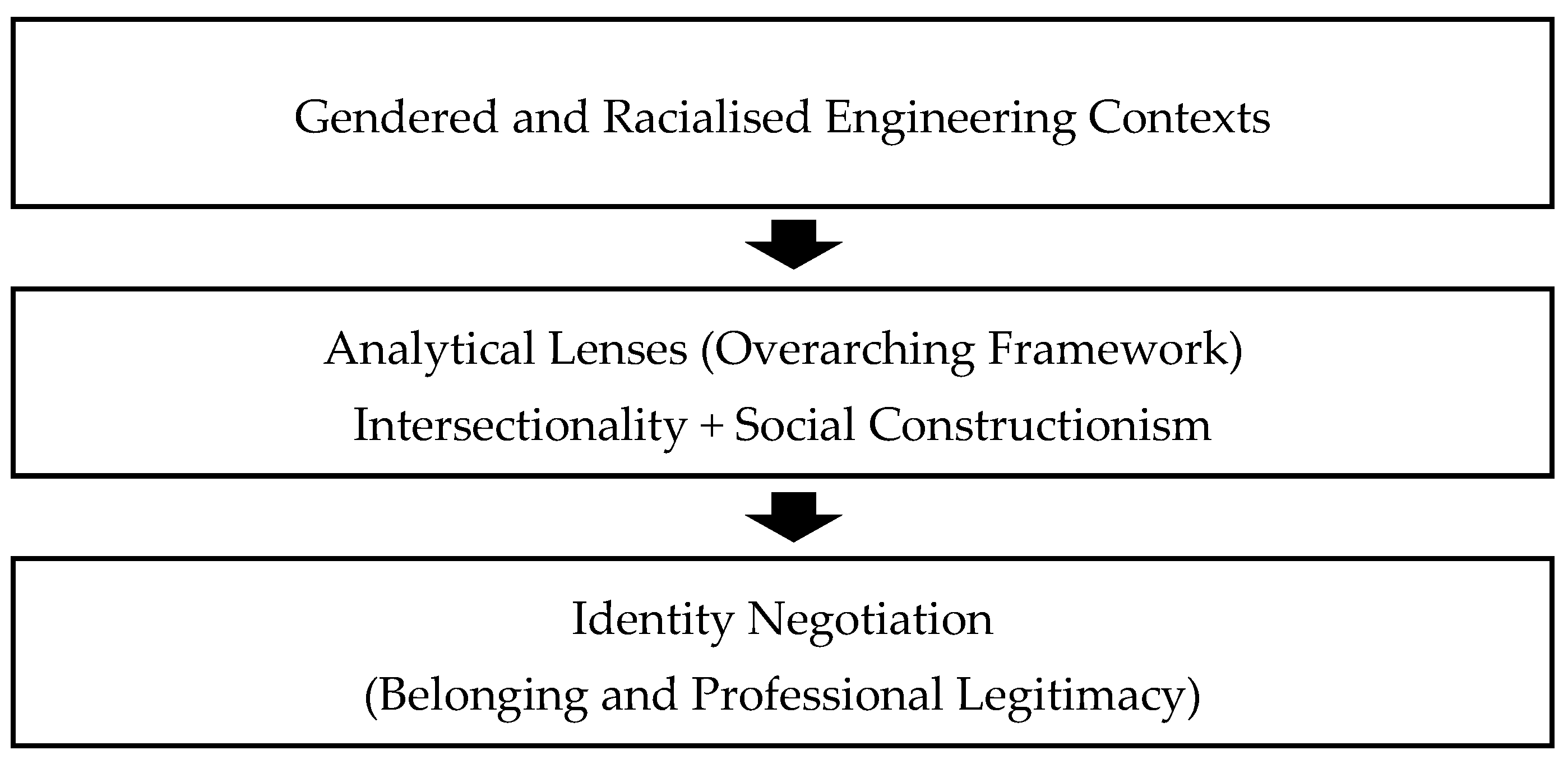
Figure 1 summarises the conceptual logic guiding the study, illustrating how gendered and racialised engineering contexts are examined through the overarching analytical lenses of intersectionality and social constructionism to focus analytically on identity negotiation.
4. Materials and Methods
4.1. Research Design and Epistemological Positioning
This article draws on data generated within a broader qualitative study that formed part of a master’s dissertation examining the professional experiences of female engineers in South Africa. Although the original study addressed several dimensions of women’s participation in the engineering sector, the present paper concentrates on the intersection of gender and race and the ways in which these intersecting social positions shape women’s professional identities. This focus is warranted given the continued salience of race and gender in structuring opportunities, constraints, and forms of recognition within South African workplaces, including those in science and engineering. The analysis therefore turns to one of the central themes that surfaced across the dataset, which concerns the ongoing negotiation of intersecting identities within engineering environments that remain characterised by masculine norms and expectations. A qualitative research design was employed to investigate how women engineers construct, interpret, and ascribe meaning to their professional experiences. Qualitative inquiry, as
Creswell and Poth (
2018) argue, is particularly suited to research concerned with questions of meaning making, identity formation, and the social contexts that shape these processes. Such an approach facilitates sustained engagement with participants’ accounts and allows for the careful examination of how women articulate their lived realities within organisational environments that remain structured by gendered and racialised norms.
The study is situated within a social constructionist and constructivist epistemological framework, which conceptualises reality as produced through social interaction, language, and historical context. As
Burr (
2015) notes, such perspectives recognise that individuals’ narratives are shaped by their social locations and cultural experiences, and that multiple interpretations of reality can coexist and remain meaningful within their respective contexts. This orientation is consistent with
Aguzzoli et al.’s (
2024) argument that identity is always negotiated within broader social fields rather than derived solely from individual traits. Positioning the study within this epistemological tradition supports its focus on identity work, a process that unfolds in relation to gendered and racialised meanings embedded in engineering cultures and the everyday practices that sustain them.
4.2. Research Questions
Although the original dissertation engaged with a broader constellation of research questions, the present article foregrounds a single analytic theme that warrants focused examination. For the purposes of this paper, the analysis is organised around two guiding questions:
How do women engineers in South Africa negotiate their professional identities within masculinised organisational environments?
How do the intersections of gender and race shape women’s experiences of belonging, legitimacy and everyday professional life?
4.3. Population and Sampling Strategy
Participants were recruited through purposive, criterion-based sampling aligned with the study’s focus on gendered and racialised experiences within engineering work. Eligible participants identified as women, were qualified engineers, represented a range of racial groups including Black African, Coloured, Indian, and White, had a minimum of two years of engineering experience, and were older than twenty-three years. Criterion-based purposive sampling remains a widely recognised strategy in qualitative inquiry for locating information-rich participants capable of offering substantive insight into the phenomenon under study (
Aguzzoli et al., 2024;
Creswell & Poth, 2018). Snowball sampling complemented this process, as initial participants referred additional women engineers who met the study’s criteria, facilitating access to a broader professional network within a specialised field. The final sample comprised nine women engineers from diverse racial backgrounds (White, Indian, Black African, and Coloured), working across a range of organisational settings and engineering sub-fields. Data collection continued until sufficient analytic depth and recurrence of patterns were evident across participants’ accounts, rather than to achieve representativeness. The resulting sample size was therefore considered appropriate for the study’s qualitative aims, given the depth of interviews and the coherence of emerging themes across narratives. Variation in race and professional experience (ranging from early to senior career stages, with approximately two to nineteen years of experience) was addressed analytically through comparative reading across participants’ accounts, rather than through stratified subgroup analysis. This approach enabled attention to both shared patterns and meaningful variation in how identity negotiation was experienced across different racialised and professional positions, while treating these dimensions as relational and contextual, rather than fixed descriptive variables. All participant names reported in this article, as indicated in
Table 1, are pseudonyms assigned to protect participant confidentiality and to comply with established ethical research practices.
4.4. Researcher Positioning and Reflexivity
The data for this study were originally collected by a master’s student researcher who approached the project as a woman and as an outsider to the engineering profession. This positionality shaped the dynamics of rapport during interviews and informed the interpretive lens through which emerging insights were understood. Throughout data collection and the early stages of analysis, the researcher maintained a reflexive journal to record assumptions, emotional responses, and unfolding analytic decisions. Reflexivity, as discussed by
Bright et al. (
2024) and
Ide and Beddoe (
2024), was treated not as a single declaration but as an ongoing ethical and epistemological practice that attends to the shifting relationship between researcher and data. In preparing this manuscript with supervisory co-authors, reflexive engagement continued through collaborative discussions that revisited interpretive claims and interrogated the development of the analytic themes. These conversations supported a re-examination of the material and helped ensure that the final thematic constructions remained grounded in participants’ accounts, thereby strengthening the rigour and transparency of the analysis.
4.5. Data Collection
Data were collected through in-depth semi-structured interviews, a method well suited to examining lived experience, identity negotiation, and the ways in which social categories such as gender and race intersect in professional contexts. Semi-structured interviewing remains a widely validated approach within qualitative research because it enables participants to articulate their perspectives in their own words while providing sufficient structure for the researcher to explore core areas of inquiry (
Chand, 2025;
Creswell & Poth, 2018;
Wong et al., 2023). This method is particularly appropriate for studies concerned with meaning making and identity work, as it supports the emergence of nuanced accounts that reflect both individual interpretations and broader sociocultural influences. Seven interviews were conducted face to face, one via Skype, and one telephonically. Interviews ranged from sixty to ninety minutes in duration and were held at locations selected by participants to support comfort, privacy, and confidentiality. All interviews were audio recorded with participants’ informed consent and transcribed verbatim. This approach allowed for detailed engagement with participants’ narratives and facilitated a close analysis of how women made sense of their experiences within engineering contexts that remain structured by gendered and racialised norms.
4.6. Data Analysis
Data analysis followed a reflexive thematic analysis approach and was undertaken in a systematic and iterative manner to identify patterned meanings across participants’ accounts. The analytic process involved repeated familiarisation with the data, inductive coding, the development and refinement of themes, and ongoing reflexive engagement to ensure analytic coherence and depth. The interview transcripts were analysed using reflexive thematic analysis, drawing on contemporary methodological guidance that emphasises flexibility, reflexivity, and transparency in qualitative inquiry (
Braun & Clarke, 2006;
Naeem et al., 2023;
Pearson et al., 2025). Reflexive thematic analysis was selected for its alignment with a social constructionist epistemology and its capacity to identify patterned meanings while attending to context, discourse, and power (
Kogen, 2024;
Naeem et al., 2023). This approach supports an interpretive engagement with participants’ accounts rather than a mechanistic categorisation of data, making it well suited to studies concerned with identity and meaning making.
Coding followed an inductive, reflexive approach, with initial codes generated from participants’ accounts rather than imposed deductively from the conceptual framework. Intersectionality informed the analysis through comparative reading across participants’ narratives, with attention to how experiences of competence, belonging, and professional legitimacy were shaped by the intersections of gender, race, and organisational context. Rather than treating race or gender as descriptive categories, the analysis examined how these positions were relationally constructed and negotiated within workplace interactions.
A social constructionism perspective shaped interpretation by foregrounding language, meaning-making, and identity positioning within participants’ accounts. Analytic attention focused on how participants narrated professional competence, justified authority, and negotiated legitimacy through discourse, enabling identity negotiation to be examined as an ongoing, socially situated process.
4.7. Ensuring Rigour and Trustworthiness
Rigour in this study was guided by the qualitative criteria of credibility, transferability, dependability, and confirmability, as articulated by
Lincoln and Guba (
1985). Credibility was strengthened through the inclusion of women from diverse organisational and racial backgrounds, which enabled comparison across varied experiences and aligns with established guidance for producing trustworthy qualitative analyses (
Braun & Clarke, 2006;
Creswell & Poth, 2018). Transferability was supported through purposive sampling and the provision of contextual detail that enables readers to assess the applicability of the findings to comparable settings. Dependability was addressed by maintaining an audit trail, reviewing transcripts against audio recordings, and revisiting codes and themes to ensure analytic consistency, practices consistent with recommendations for dependable thematic analysis (
Nowell et al., 2017). Confirmability was enhanced through reflexive journaling and analytic memoing, approaches highlighted by
Bright et al. (
2024) and
Ide and Beddoe (
2024) as important for minimising researcher bias and strengthening interpretive transparency. Together, these strategies support a rigorous and trustworthy account of women’s experiences in engineering environments.
4.8. Ethical Considerations
Ethical approval for the study was granted by the University of KwaZulu-Natal (reference number HSS 0395/017M). Prior to participation, all individuals received a detailed explanation of the study’s purpose, procedures, and potential risks, and provided written informed consent. Participation was voluntary, and participants were reminded of their right to withdraw from the study at any stage without penalty. Pseudonyms were assigned to all participants’, identifying information was removed from transcripts, and data were handled in accordance with institutional guidelines to ensure confidentiality and secure storage. Interviews were scheduled at times and locations selected by participants to support comfort, privacy, and autonomy throughout the research process.
5. Results
This section presents the findings of the study through an explicitly intersectional analytical lens, focusing on how gender and race jointly shape women engineers’ experiences of identity, belonging, and professional legitimacy. The analysis generated one overarching theme, Negotiating the Intersection of Multiple Identities, which captures the ways in which women continually navigate and recalibrate their professional selves within engineering environments shaped by masculinised and racialised norms.
The analytical framework underpinning this section foregrounds identity negotiation as a relational and ongoing process, shaped through organisational cultures, interpersonal interactions, and broader socio-historical power relations. Although participants differed in race, career stage, and engineering discipline, their accounts consistently reflected shared patterns of identity work, alongside important points of divergence shaped by racialised positioning and relational contexts. The central theme is elaborated through three interrelated subthemes, each of which addresses a distinct dimension of how identity negotiation is enacted in practice.
Table 2 provides an overview of the overarching theme and its subthemes, while the sections that follow present illustrative participant narratives alongside analytic interpretation grounded in intersectional and organisational theory.
5.1. Adapting the Self Within a Masculinised Professional Culture
This subtheme reports how women engineers described adapting behaviour and emotional expression in response to workplace expectations within engineering environments. Across most participants’ accounts, engineering was described as a context that required active adaptation of the self. The profession was widely perceived as governed by masculine norms, and women described cultivating particular behavioural repertoires such as assertiveness, emotional restraint and heightened resilience to navigate these expectations. Olivia explained this adaptive process:
“It makes you stronger… more resilient and you can survive at any time. If you can be the only female all the time and hardly notice it anymore… you need to be tough to go in there.”
Several participants referred to similar adjustments, including the need for a “bigger, thicker skin” (Arianna) or becoming “no longer emotional” (Valerie). These descriptions indicate a shared pattern across participants, although the intensity and form of adaptation varied. For some participants, these adaptive demands were described as conflicting with their preferred interpersonal styles, creating tension between how they wished to interact and the behaviours they perceived as necessary at work. Emily reflected on this tension:
“That’s not how I deal with things… but you have to engage in the male mindset to get them to understand.”
In these accounts, participants described experiencing discomfort when workplace expectations conflicted with their preferred ways of interacting. Several participants also noted that adaptive behaviours adopted at work occasionally extended into their personal lives. Olivia shared that she sometimes struggled to “switch off,” which could result in “overly aggressive” responses outside work. These accounts indicate that for some women, behavioural adaptations associated with engineering work extended beyond workplace settings. Racialised differences were evident in how these expectations were experienced. Valerie explained:
“If you are female and you are black, it is five times harder… you really have to be assertive.”
Such accounts were reported by a smaller subset of participants, particularly Black African women, who described heightened expectations around assertiveness and self-presentation. Taken together, participants’ accounts show how women described adjusting behaviour and emotional expression in response to perceived expectations within masculinised engineering workplaces, with variation in how these demands were experienced across individuals and social positions.
5.2. Negotiating Social, Relational and Racialised Identity Positions
This subtheme reports how participants described the negotiation of identity beyond workplace practices, extending into social, relational, and racialised contexts. Participants’ accounts indicated that experiences related to work were not confined to formal organisational settings but extended into everyday social and relational life.
Several participants described a reduced capacity for social engagement due to the emotional demands associated with engineering work. Emily shared:
“Finding the energy to go out and socialise… I would rather sit on the couch and sleep.”
Other participants described how aspects of their social identities could positively shape professional relationships. As Emily reflected:
“Those roles… it is a nice way to connect with other people.”
Most participants acknowledged a limited overlap between their social and professional identities. Olivia noted:
“The impact is not as big as what people would think… what’s your world like, it’s pretty normal.”
For some participants, career choices were described as influencing romantic relationships. Olivia explained that her professional independence and role as an engineer could be perceived as intimidating:
“Once they know what I do for a living… my independence can be intimidating.”
Taken together, these accounts show that participants described managing social and relational identities alongside professional demands, with variation in how social engagement, relational expectations, and boundary management were experienced across individuals.
Participants also described how racialised assumptions shaped their professional trajectories, particularly through access to informal networks. A smaller subset of participants, primarily Black African, Indian, and Coloured women, recounted how informal networks reinforced racial boundaries. Valerie explained how her male colleague benefitted from shared cultural affinities with senior white Afrikaans engineers:
“They would immediately think of him… they have other things in common… rugby this, rugby that. You can imagine how difficult it is if you are a female and you are black.”
These dynamics were not reported uniformly across all participants. While white women also described navigating gendered expectations within engineering, their accounts placed less emphasis on racialised scrutiny in relation to access to networks and professional recognition.
Similarly, Anika described a perceived misalignment between her identity and implicit expectations within engineering contexts:
“You just do not fit the profile of what they are looking for… career progression is like a straight line.”
For some participants, perceptions of exclusion and misalignment were described as shifting over time. Several women noted changes in how they interpreted workplace interactions as their confidence increased. As Arianna noted,
“I realised it had a lot to do with what I was thinking… once that intimidation fell away, it opened up more doors.”
Overall, participants’ accounts show how social, relational, and racialised dynamics were experienced as shaping professional belonging beyond formal organisational structures, with variation in how these dynamics were described and navigated across participants.
5.3. Role Demands and Wellbeing
This subtheme reports how participants described the demands of engineering in relation to wellbeing, resilience, and future orientations across different career and life stages. Participants described the demands of engineering as strenuous and, at times, as contributing to feelings of increased confidence or capability. Several women described framing challenging experiences as opportunities for personal or professional development. As Arianna explained:
“It makes you want to work more… I understand things better because I put in the extra work.”
Valerie similarly reflected on the developmental value of overcoming difficulty:
“All of these challenges really made me stronger… more confident… my work ethic has increased.”
For one participant, caregiving responsibilities were described as intensifying the demands associated with engineering work. Vanessa, the only mother in the sample, explained:
“… if I had to go back and study again and knew about being a mom and knowing what engineering demands of you, I might not have chosen it.”
Some participants also anticipated similar tensions in relation to potential future caregiving roles, even when speaking hypothetically. Reflecting on how current work patterns were shaped by life circumstances, Elizabeth noted that working late “works out” in the absence of children, but “would be a different story” if they had them. Similarly, Isabella reflected on how early-career demands were understood as time-bound, explaining that “being single and not having children might be the perfect time… to move up in your career,” as she anticipated that “when you become a mother one day you won’t have that time.”
Participants with more professional experience described early-career engineers as being more vulnerable to discouragement. Emily suggested:
“A graduate might take these things differently… they might not overcome them the way I have.”
Taken together, these accounts indicate that participants described experiencing the demands of engineering differently depending on career stage and personal circumstances. While several women described experiences of growth and increased confidence, others highlighted strain or expressed uncertainty about sustaining these demands alongside caregiving responsibilities or anticipated future roles. Overall, participants’ accounts show that wellbeing, resilience, and future aspirations were described in relation to ongoing negotiations between professional demands and personal circumstances, with variation in how these negotiations were experienced across participants.
6. Discussion
6.1. Theoretical Implications: Identity Negotiation in Gendered and Racialised Engineering Contexts
The findings of this study demonstrate how a sample of women engineers in South Africa negotiate their professional identities within their organisational spaces shaped by deeply embedded gendered and racialised norms. Guided by an analytical framework that integrates intersectionality and identity negotiation, the findings are best understood as relational and contextually situated processes, rather than individualised responses to workplace demands. Drawing primarily on patterns identified in Sub-themes 5.1 and 5.2, participants’ experiences were not reducible to gender alone, but were structured through the convergence of gender, race, relational roles, and broader socio-historical hierarchies (
Crenshaw, 1991;
Mkhize, 2024;
Sikhosana et al., 2023). These intersecting dynamics shaped how women anticipated scrutiny, interpreted belonging, managed behaviour, and crafted strategic identities in response to engineering cultures that continue to privilege white, masculine ideals of technical competence (
Chan et al., 2023;
Nichols et al., 2025).
A central theoretical implication concerns the adaptation of the self as a dominant mode of identity negotiation within engineering. Participants’ accounts revealed sustained efforts to modify communication styles, suppress emotional expression, and cultivate toughness in order to align with unspoken organisational expectations. These patterns resonate with scholarship identifying the “ideal engineer” as rational, continuously available, and emotionally neutral (
Fernandez et al., 2023;
Silva et al., 2023). Such adaptations extended beyond momentary strategies and frequently required ongoing identity labour, often seeping into participants’ personal lives where behavioural repertoires developed for professional survival were difficult to “switch off.” This finding aligns with research on identity strain and “status fatigue,” highlighting how legitimacy in masculinised technical environments remains precarious and subject to continual evaluation (
Ridgeway et al., 2022;
Unver, 2025). The prominence of anticipatory identity management further suggests that women actively pre-empt how they may be perceived and adjust behaviour to avert misrecognition or stigma, reinforcing the relational nature of professional legitimacy (
Beigi et al., 2025).
The analysis also reveals how racialised readings of competence intensify identity negotiation for women of colour. Black African and Indian participants described heightened scrutiny, reduced access to informal networks, and persistently conditional recognition, underscoring how gendered expectations are racialised within engineering workplaces. These findings are consistent with international and South African scholarship demonstrating that engineering organisations remain embedded within broader racial hierarchies that shape whose expertise is assumed and whose presence is treated as normative (
Else-Quest & Hyde, 2016;
S. King & Calder, 2025). At the same time, the experiences of white women illustrate how marginalisation among women engineers is internally stratified. While white women navigated sexism and exclusion from the masculine ideal, they appeared to encounter fewer barriers to assumed competence and organisational legitimacy. Whiteness thus functioned as a relational resource that mitigated certain forms of identity labour, reinforcing the need to resist monolithic accounts of women’s experiences in engineering and highlighting the analytic value of intersectionality.
Belonging emerged as a further relational achievement negotiated across multiple organisational and social domains. Participants described ambivalent visibility, being simultaneously hypervisible as women and invisible as legitimate engineers. This paradox reflects how recognition is contingent on interpersonal affinity, cultural alignment, and informal organisational practices, echoing
Faulkner’s (
2009) observation that gender in engineering is both hypervisible and erased. Difficulties accessing informal networks, navigating cultural misalignment, and forming rapport with senior white male engineers further illustrate how organisational cultures regulate belonging through subtle relational mechanisms (
González-Pérez et al., 2022;
Sweeney & McComas, 2022). For Black African and Indian women in particular, these dynamics reinforced historically embedded patterns of exclusion documented in South African STEM research (
Mkhize, 2023;
Sibisi et al., 2025).
Taken together, these findings advance theoretical understanding of identity negotiation by demonstrating how professional legitimacy and belonging in engineering are relationally produced and unevenly distributed through intersecting systems of power. Identity negotiation emerges not as a singular or stable process, but as an ongoing, effortful practice shaped by organisational norms, racialised hierarchies, and socio-historical context. This underscores the importance of theoretical approaches that account simultaneously for structural inequality and lived experience in understanding women’s participation in STEM professions.
6.2. Agency, Resilience, and Adaptive Identity Strategies
Beyond experiences of constraint and exclusion, the findings also highlight women engineers’ expressions of agency and resilience in navigating masculinised and racialised organisational environments. Building most directly on patterns identified in Sub-theme 5.3, with support from Sub-theme 5.1, participants’ accounts illustrate how women actively reframed challenge, scrutiny, and marginalisation as opportunities for professional development, drawing on preparation, technical competence, and interpersonal skill to construct and sustain professional legitimacy. These practices align with research on identity bricolage, which conceptualises identity work as the strategic mobilisation of available social, cultural, and professional resources to navigate exclusionary institutional contexts (
Bork & Mondisa, 2022;
S. King & Calder, 2025;
Visscher et al., 2018).
Importantly, agency in this study does not appear as resistance external to organisational structures, but as relational and adaptive, enacted within the constraints of engineering cultures that continue to privilege narrow norms of competence and authority. As women gained professional experience, several described increased confidence and resilience. These shifts suggest that agency is not a fixed individual attribute but develops over time through accumulated experience and ongoing interaction with organisational expectations. This finding resonates with scholarship demonstrating that persistence in engineering is shaped not only by structural barriers, but also by women’s adaptive strategies and growing self-efficacy (
Bork & Mondisa, 2022;
J. Kim & Meister, 2023).
At the same time, participants’ accounts underscore the ambivalence of resilience. While adaptive identity strategies enabled professional survival and advancement, they were often accompanied by emotional and cognitive labour, reflecting what prior research describes as the tension between sustaining and depleting identity work in STEM professions (
Volpe et al., 2025). The need to balance performance, self-regulation, and legitimacy illustrates how resilience is produced within conditions of inequality, rather than in spite of them. This reinforces calls to move beyond celebratory accounts of individual resilience and to situate agency within the organisational and relational contexts that shape its costs and limits.
Taken together, this subtheme advances theoretical understanding by demonstrating that agency and resilience among women engineers are best understood as contextually produced practices, shaped by intersecting gendered and racialised norms rather than as purely individual capacities. Identity negotiation thus involves not only coping with exclusion, but also the continual recalibration of self-presentation, confidence, and professional positioning in response to shifting organisational conditions.
6.3. Relational and Life-Course Dimensions of Identity Negotiation
The findings further demonstrate that identity negotiation among women engineers extends beyond formal organisational boundaries and unfolds across relational and life-course contexts. Extending insights from Sub-themes 5.2 and 5.3, participants’ accounts reveal how professional identities are continuously negotiated in relation to relationships and everyday social contexts, reflected in challenges “finding the energy to… socialise” and difficulties “switch[ing] off,” underscoring the permeability of boundaries between professional and personal spheres. These dynamics are particularly salient in engineering contexts, where occupational identities are closely associated with cultural expectations of authority, availability, and independence. Existing scholarship suggests that professional independence and occupational status can disrupt gendered norms within personal relationships, highlighting tensions between engineering identities and culturally embedded ideals of femininity, care, and deference (
Mkhize & Idahosa, 2025). These relational dynamics illustrate how identity work is shaped not only by organisational cultures, but also by social expectations that extend into private life. From a social constructionist perspective, such tensions reflect how identities are co-constructed through discourse and interaction across multiple social sites, rather than fixed attributes enacted in a single domain (
Burr, 2015;
Hardy, 2022).
Life-course considerations further shaped participants’ interpretations of professional belonging and sustainability. While only one participant was a mother, several women articulated anticipatory concerns about the compatibility of engineering careers with future caregiving, often framing career intensity and progression as contingent on life stage. These anticipatory orientations underscore how organisational cultures influence not only present experiences, but also women’s imagined professional futures and evaluations of long-term sustainability within the field. Research suggests that such anticipatory identity work can play a significant role in shaping long-term engagement and retention in STEM fields (
Meese et al., 2023;
Moors et al., 2022).
Together, these findings underscore that identity negotiation is both temporally situated and relationally produced, shaped by evolving life stages, shifting responsibilities, and changing interpretations of professional fit. Rather than being confined to discrete organisational encounters, identity work unfolds across time and social contexts, influencing how women assess alignment between professional demands, personal aspirations, and possible selves. This life-course perspective extends organisational research by demonstrating how questions of belonging and legitimacy are continuously renegotiated as women engineers navigate intersecting professional and relational expectations.
6.4. Practical and Managerial Implications
The findings suggest that efforts to address gendered and racialised inequality in engineering must extend beyond representational change to attend to the organisational and institutional conditions through which professional legitimacy and belonging are produced. Across participants’ accounts, professional competence was closely tied to masculinised norms of behaviour, emotional restraint, and constant availability. Women frequently described the need to adapt communication styles, regulate emotional expression, and cultivate toughness in order to be recognised as legitimate engineers. These patterns indicate that prevailing performance expectations implicitly privilege narrow, masculine-coded forms of authority, placing an uneven burden of identity labour on women. Organisations may therefore benefit from leadership development, evaluation, and promotion practices that recognise diverse modes of professional contribution and authority, rather than rewarding conformity to a singular ideal of the “competent engineer.”
The findings also highlight the central role of relational and informal organisational processes in shaping professional belonging. Access to networks, recognition, and advancement was unevenly distributed, particularly for Black African, Indian, and Coloured women, for whom informal gatekeeping reinforced racialised patterns of inclusion and exclusion. This underscores the need for organisational practices that make relational processes more visible and accountable, such as transparent criteria for advancement, structured mentoring or sponsorship, and deliberate attention to how informal networks operate within teams and departments. Such practices may also inform the work of professional bodies and industry associations concerned with equity and progression within engineering.
Finally, participants’ accounts demonstrate that wellbeing, resilience, and career sustainability are shaped by the interaction of professional demands, career stage, and life-course considerations. Expectations of constant availability and linear progression were frequently assessed in relation to anticipated or existing caregiving responsibilities, including reflections on whether such demands could be sustained alongside motherhood. For one participant who was a mother, as well as those anticipating motherhood, engineering careers were often evaluated in terms of timing, intensity, and long-term feasibility rather than immediate constraint alone. These findings suggest value in more flexible, life-course-aware approaches to career development, including policies that support caregiving, varied workload patterns, and non-linear career trajectories, particularly for those navigating or anticipating parental roles, without positioning resilience as solely an individual responsibility.
Taken together, these implications emphasise that efforts to improve equity in engineering require attention to organisational practices, professional norms, and institutional expectations through which legitimacy and belonging are continually negotiated. Without attention to these everyday processes, initiatives focused solely on increasing numerical representation are unlikely to produce sustainable change.
6.5. Limitations and Directions for Future Research
As with all qualitative research, the findings of this study should be interpreted in light of certain limitations that also point to important directions for future research. First, the study draws on a relatively small, purposively selected sample of women engineers within a specific organisational and socio-historical context. While this enabled in-depth, contextually grounded analysis of identity negotiation, it limits the extent to which findings can be generalised across engineering settings. Future research could extend this work through comparative qualitative designs, examining identity negotiation across different organisational types, engineering disciplines, or national contexts, to better understand how institutional variation shapes experiences of belonging and legitimacy. In particular, the racialised dynamics of recognition and legitimacy identified here warrant further investigation, including how informal networks, sponsorship practices, and assumptions of competence operate across career stages and organisational contexts.
Second, the cross-sectional design captures participants’ experiences at a particular point in their professional trajectories. Several findings, especially those related to career stage, anticipated caregiving, and evolving confidence, suggest that identity negotiation is a temporally dynamic process. Longitudinal qualitative research would therefore be well suited to tracing how women’s identity work, resilience strategies, and interpretations of professional fit develop over time, particularly during key transitions such as early career entry, advancement, or changes in family responsibilities.
Third, while the study attends to variation in race and professional experience through comparative reading, it does not aim to produce systematic subgroup analysis. Future research could adopt explicitly intersectional and comparative designs to examine how identity negotiation is shaped across racial groups, career stages, and organisational contexts, while remaining attentive to the risks of reifying social categories. Such approaches could further clarify how intersecting systems of power condition experiences of legitimacy and belonging in differentiated ways.
Finally, the researchers positionality shaped the analytic process and interpretive boundaries of the study. The researcher’s social location, professional background, and interpretive standpoint informed analytic decisions regarding what was foregrounded and how participants’ narratives were understood. While reflexive practices were employed throughout the research process, future studies may benefit from collaborative analytic approaches, including multi-researcher teams or participatory methods that involve participants in interpretive sense-making. These strategies could further strengthen reflexivity and generate alternative perspectives on the processes examined.
Taken together, these limitations highlight productive opportunities to extend research on identity negotiation in engineering through longitudinal, comparative, and reflexively plural methodologies. Such work would not only build on the present study’s findings but also contribute to more nuanced, context-sensitive accounts of how gendered and racialised inequalities are negotiated across diverse organisational and socio-cultural settings.