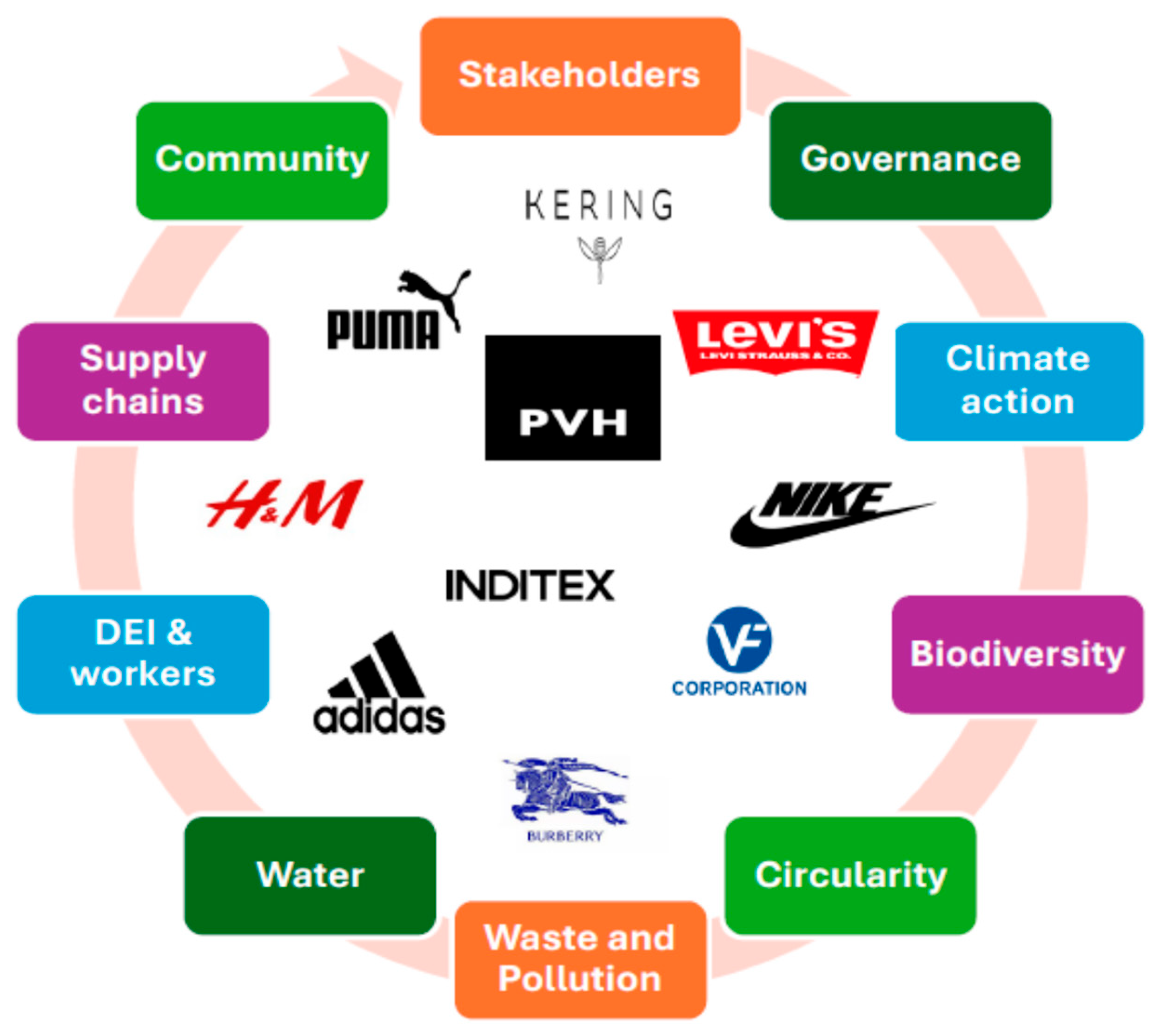
Sustainability in Fashion Industry: A View Through the Top Ten Multinational Strategies



Abstract
1. Introduction
2. Fashion and Its Impact on Sustainable Development
2.1. The Evolution of the Fashion Industry and Its Economic Impact
2.2. From Environmental and Social Impact to Sustainable Fashion
3. Empirical Design
4. Evidence for Case Studies
4.1. Puma
4.2. Kering
4.3. Levi Strauss & Co.
4.4. H&M Group
4.5. Burberry
4.6. VF Corporation
4.7. PVH Corporation
4.8. NIKE
4.9. Inditex
4.10. Adidas
4.11. Cross-Case Synthesis
- Science-based decarbonisation: All companies have aligned their goals with the Paris Agreement (1.5 °C) and utilise the Science-Based Targets initiative (SBTi) as an external validator. Scope 1 and 2 emission reductions are now a consolidated practice, while Scope 3 remains the primary shared challenge.
- Material substitution (preferred materials): There is a universal consensus regarding the transition towards lower-impact raw materials. The strategy is identical across all sub-sectors: reliance on organic/BCI cotton and recycled polyester (rPET). For instance, both direct competitors (Adidas vs. Nike) and indirect competitors (H&M vs. Levi’s) utilise the same certifications as a governance mechanism.
- Supply chain transparency: Driven by regulatory pressure, all firms have adopted Supplier Codes of Conduct and Restricted Substance lists (ZDHC, RSL). The disclosure of supplier lists (Tier 1 and Tier 2) has shifted from being a competitive advantage to a basic operational factor.
- ✓
- The “Sportswear” Cluster: Technical Innovation and Labour Rights.It includes Nike, Adidas and Puma. This group prioritises technical innovation and labour risk management. Puma (Forever Better) and Adidas stand out for aggressive targets regarding plastic elimination and the use of recycled polyester (e.g., Puma’s RE:FIBRE). Likely due to past reputational crises, this cluster demonstrates the most mature social auditing and worker empowerment systems (e.g., the Fair Wage Network explicitly mentioned by Puma and Adidas). Their narrative links sustainability with sports performance and health.
- ✓
- The “Luxury and Heritage” Cluster: Biodiversity and Natural Capital.It is configured by Kering and Burberry. This group focuses on regeneration and the sourcing of noble raw materials, rather than purely operational efficiency. Kering leads with its EP&L (Environmental Profit and Loss) methodology and natural regeneration funds, while Burberry emphasises carbon neutrality and the ban on exotic skins. Unlike fast fashion, their circularity strategy relies not on mass post-consumer recycling, but on product longevity, luxury resale (e.g., Kering-Vestiaire Collective collaboration), and the preservation of craftsmanship (Heritage).
- ✓
- The “Mass Retail & Denim” Cluster: Scalable Circular Economy and Water Stewardship.The group includes Inditex, H&M, Levi’s, PVH and VF. Their priority is the logistical scalability of sustainability and resource efficiency (water/energy) at high volumes. H&M and Inditex lead investments in textile-to-textile recycling technologies and in-store take-back schemes. Levi’s (and by extension PVH/VF) stands out specifically in water stewardship due to the water intensity of denim production. This group faces the significant challenge, attempting to reconcile volume growth with absolute footprint reduction. Their social programmes (e.g., Inditex’s “Workers at the Centre”) focus on mass coverage within extensive supply chains.
5. A Global Vision of Sustainability in the Fashion World
5.1. Stakeholders
- -
- Better Cotton Initiative (BCI): Initiative to promote standards and sustainable practices in cotton farming.
- -
- Fashion for Good: Platform to generalise the adoption of responsible and sustainable innovation in the fashion sector.
- -
- Leather Working Group (LWG): Association dedicated to building a responsible future for leather.
- -
- Textile Exchange: Non-profit organisation dedicated to promoting the positive impact of the textile industry on climate and nature.
- -
- Zero Discharge of Hazardous Chemicals Foundation (ZDHC): Foundation to eliminate the discharge of hazardous chemicals into wastewater.
- -
- Fashion Pact: A pact signed by the 32 largest fashion and luxury companies, representing around 150 brands, to limit their impact on climate, biodiversity and oceans by setting targets between 2030 and 2050.
- -
- The Microfibre Consortium: Initiative to facilitate the development of projects that minimise the environmental impact of fibre fragmentation, one of the main challenges facing the sector.
- -
- Clean by Design: Programme to improve energy and water efficiency in the sector.
- -
- Sustainable Apparel Coalition (SAC): An alliance of textile corporations that produces according the Higg Index, a standardised tool for measuring the environmental, social and labour impacts of the supply chain.
5.2. Governance and Transparency
5.3. Decarbonisation
- -
- Self-consumption of electricity through the installation of rooftop solar panels and wind farms.
- -
- Energy efficiency: Facilities with LED lighting, insulated windows, and heating and cooling systems with temperature limits, among other measures, certified by standards such as Leadership in Energy and Environmental Design (LEED) or Building Research Establishment Environmental Assessment Methodology (BREEAM). Elimination of the fuels fossils to favour of renewable fuels.
- -
- Green tariffs: Renewable energy supply contracts.
- -
- Low-impact logistics alternatives through electrification and transport optimisation.
- -
- Power Purchase Agreements (PPAs): Long-term contracts for the purchase of electricity from a renewable energy producer. One type of PPA is the virtual PPA. There is no direct delivery of energy, but the parties agree on a contract price and exchange payments based on the difference between the contract price and the electricity market price.
- -
- Energy Attributes Certificates (EACs): Documents certifying that the energy comes from clean and renewable sources. The certificate used in the European Union is called a Guarantee of Origin (GO). In the US and Canada, it is the Renewable Energy Certificate (REC) and the International Renewable Energy Certificate (I-REC).
- -
- Green bond: A type of debt security issued to raise funds for environmental or climate change projects.
- -
- Carbon sequestration: Through forest restoration projects, storage in products—carbon captured by trees is stored in wooden buildings—or permanent storage—carbon is captured from the air and stored in a stable form.
5.4. Biodiversity Conservation and Restoration
5.5. Circularity
5.6. Reducing Waste and Pollution from the Use of Plastics
5.7. Elimination of Hazardous Chemicals and Preservation of Water Quality
5.8. Diversity, Equity and Inclusion: Employee Engagement
5.9. Responsible Supply Chains
5.10. Community: Donations and Volunteering
6. Discussion: Lessons and Perspectives
7. Conclusions
Author Contributions
Funding
Institutional Review Board Statement
Informed Consent Statement
Data Availability Statement
Conflicts of Interest
Appendix A. Sustainability Practices by Fashion Multinationals
| Puma | ||
| Stakeholder Engagement | ||
|
|
|
Governance and Transparency
| ||
Decarbonisation
| ||
Biodiversity Conservation and Restoration
| ||
Circularity
| ||
Reducing Waste Plastics and Eliminating Hazardous Chemicals
| ||
Water Quality
| ||
Diversity, Equity, Inclusion (DEI) and Workers
| ||
Supply Chain Responsibility
| ||
Supporting Communities
| ||
| Kering | ||
| Stakeholder Engagement | ||
|
|
|
Governance and Transparency
| ||
Decarbonisation
| ||
Biodiversity Conservation and Restoration
| ||
Circularity
| ||
| ||
Reducing Waste and Plastics and Eliminating Hazardous Chemicals
| ||
Water Quality
| ||
Diversity, Equity, Inclusion (DEI) and Workers
| ||
Supply Chain Responsibility
| ||
Supporting Communities
| ||
| Levi’s | ||
| Stakeholder Engagement | ||
|
|
|
| Governance and Transparency | ||
| ||
Decarbonisation
| ||
Biodiversity Conservation and Restoration
| ||
Circularity
| ||
Reducing Waste and Plastics and Eliminating Hazardous Chemicals
| ||
Water Quality
| ||
Diversity, Equity, Inclusion (DEI) and Workers
| ||
Supply Chain Responsibility
| ||
Supporting Communities
| ||
| H&M | ||
| Stakeholder Engagement | ||
|
|
|
Governance and Transparency
| ||
Decarbonisation
| ||
Biodiversity Conservation and Restoration
| ||
Circularity
| ||
| ||
Reducing Waste and Plastics and Eliminating Hazardous Chemicals
| ||
Water Quality
| ||
Diversity, Equity, Inclusion (DEI) and Workers
| ||
Supply Chain Responsibility
| ||
Supporting Communities
| ||
| VF corporation | ||
| Stakeholder Engagement | ||
|
|
|
Governance and Transparency
| ||
Decarbonisation
| ||
Biodiversity Conservation and Restoration
| ||
Circularity
| ||
Reducing Waste and Plastics and Eliminating Hazardous Chemicals
| ||
| ||
Water Quality
| ||
Diversity, Equity, Inclusion (DEI) and Workers
| ||
Supply Chain Responsibility
| ||
Supporting Communities
| ||
| PVH corporation | ||
| Stakeholder Engagement | ||
|
|
|
Governance and Transparency
| ||
Decarbonisation
| ||
Biodiversity Conservation and Restoration
| ||
Circularity
| ||
Reducing Waste and Plastics and Eliminating Hazardous Chemicals
| ||
Water Quality
| ||
Diversity, Equity, Inclusion (DEI) and Workers
| ||
Supply Chain Responsibility
| ||
Supporting Communities
| ||
| NIKE | ||
| Stakeholder Engagement | ||
|
|
|
Governance and Transparency
| ||
Decarbonisation
| ||
Biodiversity Conservation and Restoration
| ||
Circularity
| ||
Reducing Waste and Plastics and Eliminating Hazardous Chemicals
| ||
Water Quality
| ||
Diversity, Equity, Inclusion (DEI) and Workers
| ||
Supply Chain Responsibility
| ||
Supporting Communities
| ||
| Inditex | ||
| Stakeholder Engagement | ||
|
|
|
Governance and Transparency
| ||
Decarbonisation
| ||
Biodiversity Conservation and Restoration
| ||
| ||
Circularity
| ||
Reducing Waste and Plastics and Eliminating Hazardous Chemicals
| ||
Water Quality
| ||
Diversity, Equity, Inclusion (DEI) and Workers
| ||
| ||
Supply Chain Responsibility
| ||
Supporting Communities
| ||
| Adidas | ||
| Stakeholder Engagement | ||
|
|
|
Governance and Transparency
| ||
Decarbonisation
| ||
Biodiversity Conservation and Restoration
| ||
Circularity
| ||
Reducing Waste and Plastics and Eliminating Hazardous Chemicals
| ||
Water Quality
| ||
Diversity, Equity, Inclusion (DEI) and Workers
| ||
Supply Chain Responsibility
| ||
Supporting Communities
| ||
| Burberry | ||
Stakeholder Engagement
| ||
Governance and Transparency
| ||
Decarbonisation
| ||
Biodiversity Conservation and Restoration
| ||
Circularity
| ||
Reducing Waste and Plastics and Eliminating Hazardous Chemicals
| ||
Water Quality
| ||
Diversity, Equity, Inclusion (DEI) and Workers
| ||
Supply Chain Responsibility
| ||
Supporting Communities
| ||
Appendix B. Cross-Case Analysis of the Ten Fashion Multinationals
| Company | Stakeholder Engagement | Governance and Transparency | Decarbonisation | Biodiversity Conservation and Restoration | Circularity | Reducing Waste and Plastics and Eliminating Hazardous Chemicals | Water Quality | Diversity, Equity, Inclusion (DEI) and Workers | Supply Chain Responsibility | Supporting Communities |
| Puma | Collaboration with UNFCCC, Textile Recycling Excellence. | Sustainability architecture. Bonus: 10% for directors. Reports: GRI, EP&L. | −85% GHG (own). Low-carbon shipments (Maersk). | Certifications: FSC, Canopy (“Green Shirt”). Regenerative agriculture. | RE:SUEDE (compostable). RE:FIBRE (textile-to-textile). | 89% waste diversion. Plastic-free packaging. RSL aligned with ZDHC (“Aspirational level”). | Water intensity reduction targets (33% suppliers). | United Against Racism. ISO 45001 (Safety). Work–life balance policies. | Audits: FLA, ILO Better Work. Fair Wage Network. | Donations and volunteering programmes. |
| Kering | Engagement with IPBES, Fashion Pact. | EP&L (Env. Profit and Loss). Bonus: 10% managers. TCFD, TNFD. | -71% absolute emissions. 100% renewable energy. | Regenerative Fund for Nature. AR3T Framework. | Investment in Vestiaire Collective. Material Innovation Lab. | Reduction in virgin plastics. Clean by Design programme. Phasing out hazardous inputs. | Water consumption reduction targets across supply chain. | 63% women in leadership. Global Baby Leave (14 weeks). Living Wage analysis. | Vendor Rating Platform. Ethical trading standards. | Kering Foundation (Combating violence against women). |
| Levi Strauss | Collaboration with Ceres, BSR. | SASB, TCFD reporting. ESG bonus (15%) for managers. | -90% GHG (Scope 1–2). Climate Action Plan 2025. | >99% sustainable cotton (Better Cotton/Organic). | Levi’s Second Hand. Circular 501. | “Zero Waste” (TRUE certification). Screened Chemistry methodology. | Water < Less® technology (billions of litres saved). | Diversity in hiring. Zero tolerance for harassment. Employee well-being programmes. | Worker Well-being Guidebook. Terms of Engagement. | Levi Strauss Foundation (HIV/AIDS, social justice). |
| H&M Group | Partnerships with ILO, Ellen MacArthur Fdn. | Sustainability-linked bonds. Green bonds. OECD alignment. | -56% emissions. Carbon capture (Climeworks). Green transport. | Partnership with WWF (reforestation). Regenerative agriculture. | Looop (in-store recycling). H&M Preloved. | Elimination of single-use plastic packaging. ZDHC contributor and Chemical Restrictions. | Water Stewardship strategy with WWF. | “Layers” diversity programme. Inclusion strategy. Global Labour Relations. | Fair Living Wage Strategy. Higg FEM/FSLM adoption. | H&M Foundation (Humanitarian aid, education). |
| Burberry | Member of The Prince’s Trust. | Burberry Beyond. ESG targets in executive pay. | Net Zero 2040. -46% Scope 3 (2030). 100% renewable electricity. | Biodiversity Strategy (COP26). 100% certified leather/wool. | ReBurberry (Repair, Rental, Resale). | 100% plastic-free consumer packaging. Phase-out of PFCs. Detox commitment. | Water reduction in manufacturing. | 71% female workforce (Tier 1). Diversity and Inclusion strategy. Living Wage Employer (UK). | Ethical Trading Programme. 100% traceability key materials. | Burberry Foundation (Burberry Inspire for youth). |
| VF Corp | Paradigm for Parity, UN Global Compact. | Executive compensation tied to ESG goals. GRI, SASB. | -42% GHG (Scope 1–2). LEED certified buildings. | Regenerative rubber/leather. Deforestation-free policies. | Smartwool (Second Cut). The North Face Renewed. | 97% waste diversion at distribution centres. Chem-IQSM programme. | Water reduction goals in leather tanning. | Employee Resource Groups (ERGs). Gender parity focus. Health and Safety standards. | Worker Rights Social Impact Model. | VF Foundation (Disaster relief, skilled trades). |
| PVH Corp | Fashion for Good, ZDHC, AAFA. | Forward Fashion strategy. Compensation linked to targets. | -69% GHG (Scope 1–2). Fashion Climate Fund founder. | Ban on exotic skins. Sustainable material sourcing. | Jeans Redesign. Rental pilots (Rotaro). Mycelium innovation. | Single-use plastic elimination goals. Commitment to ZDHC standards. | Water stewardship in high-stress basins. | Women’s empowerment. Inclusion and Diversity commitments. PVH University (Talent). | Supplier Code of Conduct. Vendor assessment. | Investment in supply chain communities. |
| NIKE | Fair Labour Association (FLA). | Corp. Responsibility and Sustainability Committee. | -70% GHG (owned). Move to Zero. 100% renewable (NA/EU). | 100% sustainable cotton. No deforestation policy. | Nike Refurbished. Nike Grind (waste to materials). | Elimination of manufacturing waste to landfill. Chemistry Playbook. ZDHC MRSL compliance. | Water restoration projects in cotton growing regions. | Focus on racial diversity (US). Empowerment of girls. Coaching for inequality. | Supplier Code of Conduct. Capability building. | Made to Play (getting kids active). 2% pre-tax income invested. |
| Inditex | Water.org, MSF, IndustriALL. | Sustainability Committee on Board. ESG bonus for directors. | Net Zero 2040. 100% renewable energy (2022). | Workers at the Centre. 100% organic/BCI cotton. | Zara Pre-Owned. Join Life. Closing the Loop. | Green to Pack (box reuse). Single-use plastic elimination. The List by Inditex (chemicals). | Global Water Strategy. Zero Discharge commitment. | Gender equality plans. Inclusion of people with disabilities. Health and Safety OHSAS 18001. | Living wages strategy. Traceability. Social audits. | Investment in social programmes (education, employment). |
| Adidas | Greenpeace (Detox), Parley for the Oceans. | ISO 14001/45001 Management Systems. | Climate Neutral 2050. Phase out coal boilers (Tier 2). | Avoid shipping routes near biodiversity hotspots. | Made to be Remade. Product take-back schemes. | End Plastic Waste. Parley Ocean Plastic partnership. Chemical Management (A-01). | Water efficiency in Tier 1 and Tier 2 suppliers. | “Own the Game” strategy. Equal pay standards. Employee listening and well-being. | Strict workplace standards. Fair Labour Association. | Adidas Football Collective. Access to sport. |
| 1 | The treatment and dyeing of polyester releases microfibres that are toxic to oceans and rivers, and the harvesting of cotton requires the use of highly toxic pesticides, causing rivers and seas—such as the Sea of Galilee—to dry up. Aral—and occupy land that could be used for food crops. For more information, visit the UN Alliance for Sustainable Fashion. 2021. https://unfashionalliance.org/ (accessed on 12 January 2025). |
| 2 | Driven by François-Henri Pinault, CEO of the Kering group. |
| 3 | Blockchain technology can be used to ensure traceability through tokens. Saint Laurent has started to implement the pioneering Textile GenesisTM traceability platform, which tracks textile products from the origin of the fibres to their distribution, using FibercoinsTM. |
| 4 | It is a series of steps that guide companies’ actions to (i) prevent future impacts, (ii) reduce current impacts, (iii) restore and regenerate ecosystems, and (iv) transform systems. |
| 5 | The difference between upcycling or creative recycling and recycling is that upcycling does not mean losing the original form, but rather reimagining the product and adding value in a sustainable way. |
| 6 | The ERGs. They are voluntary groups led by employees, who share a purpose or interest, where they exchange experiences and promote actions for guaranteeing the inclusivity. |
References
- Abbate, S., Centobelli, P., Cerchione, R., Nadeem, S. P., & Riccio, E. (2024). Sustainability trends and gaps in the textile, apparel and fashion industries. Environment, Development and Sustainability, 26(2), 2837–2864. [Google Scholar] [CrossRef]
- Adamkiewicz, J., Kochańska, E., Adamkiewicz, I., & Łukasik, R. M. (2022). Greenwashing and sustainable fashion industry. Current Opinion in Green and Sustainable Chemistry, 38, 100710. [Google Scholar] [CrossRef]
- Aibar-Guzmán, C., García-Sánchez, I. M., & Salvador-González, C. (2023). Do codes of conduct really mean a change in corporate practices with regard to human rights? Evidence from the largest garment companies worldwide. The International Journal of Human Rights, 27(2), 282–306. [Google Scholar] [CrossRef]
- Alizadeh, L., Liscio, M. C., & Sospiro, P. (2024). The phenomenon of greenwashing in the fashion industry: A conceptual framework. Sustainable Chemistry and Pharmacy, 37, 101416. [Google Scholar] [CrossRef]
- Atik, D., & Ozdamar Ertekin, Z. (2023). The restless desire for the new versus sustainability: The pressing need for social marketing in fashion industry. Journal of Social Marketing, 13(1), 1–19. [Google Scholar] [CrossRef]
- Battilana, J., Leca, B., & Boxenbaum, E. (2009). How actors change institutions: Towards a theory of institutional entrepreneurship. The Academy of Management Annals, 3(1), 65–107. [Google Scholar] [CrossRef]
- Beck, A. C., Campbell, D., & Shrives, P. J. (2010). Content analysis in environmental reporting research: Enrichment and rehearsal of the method in a British-German context. The British Accounting Review, 42, 207–222. [Google Scholar] [CrossRef]
- Berg, A., Magnus, K. H., Kappelmark, S., Granskog, A., Lee, L., Sawers, C., Polgampola, P., Lehmann, M., Syett, H., & Arici, G. (2020). Fashion on climate: How the fashion industry can urgently act to reduce its greenhouse gas emissions. McKinsey-GFA. Available online: https://www.mckinsey.com/~/media/mckinsey/industries/retail/our%20insights/fashion%20on%20climate/fashion-on-climate-full-report.pdf (accessed on 12 January 2025).
- Bhardwaj, V., & Fairhurst, A. (2010). Fast fashion: Response to changes in the fashion industry. The International Review of Retail, Distribution and Consumer Research, 20(1), 165–173. [Google Scholar] [CrossRef]
- Bieńkowska, J. (2025). The effects of artificial intelligence on the fashion industry—Opportunities and challenges for sustainable transformation. Sustainable Development, 33, 3774–3790. [Google Scholar] [CrossRef]
- Bruce, M., & Daly, L. (2011). Adding value: Challenges for UK apparel supply chain management—A review. Production Planning & Control, 22(3), 210–220. [Google Scholar]
- Business of Fashion. (2022). The BoF sustainability index 2022. Available online: https://insights.businessoffashion.com/products/the-bof-sustainability-index-2022#:~:text=The%20findings%20of%20The%20BoF,transform%20the%20industry%20by%202030 (accessed on 12 January 2025).
- Business of Fashion & McKinsey & Company. (2024). The State of Fashion 2024: Riding out the storm. Available online: https://www.businessoffashion.com/reports/news-analysis/the-state-of-fashion-2024-report-bof-mckinsey/ (accessed on 20 January 2026).
- Campos Franco, J., Hussain, D., & McColl, R. (2020). Luxury fashion and sustainability: Looking good together. Journal of Bussiness Strategy, 41, 55–61. [Google Scholar] [CrossRef]
- Caniato, F., Caridi, M., Crippa, L., & Moretto, A. (2012). Environmental sustainability in fashion supply chains: An exploratory case-based research. International Journal of Production Economics, 135(2), 659–670. [Google Scholar] [CrossRef]
- Clancy, G., Fröling, M., & Peters, G. (2015). Ecolabels as drivers of clothing design. Journal of Cleaner Production, 99, 345–353. [Google Scholar] [CrossRef]
- Colasante, A., & D’Adamo, I. (2021). The circular economy and bioeconomy in the fashion sector: Emergence of a sustainability bias. Journal of Cleaner Production, 329, 129774. [Google Scholar] [CrossRef]
- Colucci, M., & Vecchi, A. (2024). Tackling climate change with end-of-life circular fashion practices—Remade in Italy with Amore. British Journal of Management, 35, 1157–1179. [Google Scholar] [CrossRef]
- D’Adamo, I., Lupi, G., Morone, P., & Settembre-Blundo, D. (2022). Towards the circular economy in the fashion industry: The second-hand market as a best practice of sustainable responsibility for businesses and consumers. Environmental Science and Pollution Research, 29, 46620–46633. [Google Scholar] [CrossRef] [PubMed]
- Dana, L., Boardman, R., Salamzadeh, A., Pereira, V., & Brandstrup, M. (2024). Fashion and environmental sustainability: Entrepreneurship, innovation and technology. De Gruyter. [Google Scholar]
- Dang, H. C. T., Nguyen, P. L. T., Le, P. L. T., Nguyen, T. T. H., & Vu, B. T. (2025). Impact of big data analytics capabilities on sustainable performance of Vietnamese retail companies: The mediating role of innovation. Journal of Open Innovation: Technology, Market, and Complexity, 11, 100569. [Google Scholar] [CrossRef]
- Daukantienė, V. (2023). Analysis of the sustainability aspects of fashion: A literature review. Textile Research Journal, 93(3–4), 991–1002. [Google Scholar] [CrossRef]
- De Brito, M., Carbone, V., & Blanquart, C. (2008). Towards a sustainable fashion retail supply chain in Europe: Organisation and performance. International Journal of Production Economics, 114(2), 534–553. [Google Scholar] [CrossRef]
- De Ponte, C., Liscio, M. C., & Sospiro, P. (2023). State of the art on the Nexus between sustainability, fashion industry and sustainable business model. Sustainable Chemistry and Pharmacy, 32, 100968. [Google Scholar] [CrossRef]
- Dey, R., & Lewis, S. C. (2021). Natural disasters linked to climate change. Chapter 6. In T. M. Letcher (Ed.), The Impacts of Climate Change (pp. 177–193). Elsevier. [Google Scholar]
- DiMaggio, P. J., & Powell, W. W. (1983). The iron cage revisited: Institutional isomorphism and collective rationality in organizational fields. American Sociological Review, 48(2), 147–160. [Google Scholar] [CrossRef]
- Dordevic, D. B., Vukovic, M., Urosevic, S., Strbac, N., & Vukovic, A. (2019). Studying the corporate social responsibility in apparel and textile industry. Industria Textila, 70(4), 336–341. [Google Scholar] [CrossRef]
- Eccles, R. G., Lee, L. E., & Stroehle, J. C. (2020). The social origins of ESG: An analysis of Innovest and KLD. Organization & Environment, 33(4), 575–596. [Google Scholar]
- Ermini, C., Visintin, F., & Boffelli, A. (2024). Understanding supply chain orchestration mechanisms to achieve sustainability-oriented innovation in the textile and fashion industry. Sustainable Production and Consumption, 49, 415–430. [Google Scholar] [CrossRef]
- Etzion, D., & Ferraro, F. (2010). The role of analogy in the institutionalization of sustainability reporting. Organization Science, 21(5), 1092–1107. [Google Scholar] [CrossRef]
- EY & Modaes. (2024). Shaking sustainability in the fashion business 2024. Available online: https://www.ey.com/es_es/insights/rethinking-sustainability/shaking-sustainability-2024 (accessed on 20 January 2026).
- Faisal, A., & Ekawanto, I. (2021). The role of social media marketing in increasing brand awareness, brand image and purchase intention. Indonesian Management and Accounting Research, 20(2), 185–208. [Google Scholar] [CrossRef]
- Faludi, J. (2025). Sustainable fashion, circularity and consumer behavior–Systematic review and a social marketing research and policy agenda. Social Marketing Quarterly, 31(1), 35–59. [Google Scholar] [CrossRef]
- Fletcher, K. (2008). Sustainable fashion and textiles: Design journeys. Routledge. [Google Scholar]
- Flyvbjerg, B. (2006). Five misunderstandings about case-study research. Qualitative Inquiry, 12(2), 219–245. [Google Scholar] [CrossRef]
- García-Sánchez, I. M., Ali, R., Enciso-Alfaro, S.-Y., & Rehman, R. (2025). Remodelling fashion: Climate governance and the sustainable energy transition. Business Strategy and the Environment, 34(6), 7539–7558. [Google Scholar] [CrossRef]
- García-Sánchez, I. M., Enciso-Alfaro, S. Y., & García-Sánchez, A. (2024). Energy transition disclosures and female directors: Do gender egalitarian societies matter? Journal of Cleaner Production, 480, 144039. [Google Scholar] [CrossRef]
- Gavurova, B., Ribeiro-Soriano, D., Montesinos-Sansaloni, E., & Kovac, V. (2026). Dynamics of circular economy transformation processes in relation to individual waste types recycling—Net zero for sustainable development. British Journal of Management, e70036. [Google Scholar] [CrossRef]
- Gazzola, P., Pavione, E., Pezzetti, R., & Grechi, D. (2020). Trends in the fashion industry. The perception of sustainability and circular economy: A gender/generation quantitative approach. Sustainability, 12(7), 2809. [Google Scholar] [CrossRef]
- Geissdoerfer, M., Savaget, P., Bocken, N. M., & Hultink, E. J. (2017). The circular economy—A new sustainability paradigm? Journal of Cleaner Production, 143, 757–768. [Google Scholar] [CrossRef]
- Gereffi, G. (1999). International trade and industrial upgrading in the apparel commodity chain. Journal of International Economics, 48(1), 37–70. [Google Scholar] [CrossRef]
- Global Fashion Agenda, Boston Consulting Group and Sustainable Apparel Coalition. (2019). Pulse of the fashion industry 2019 update. Available online: https://globalfashionagenda.org/pulse-of-the-industry/ (accessed on 12 January 2025).
- Gornostaeva, G. (2024). Design and sustainability in the fashion industry: The example of independent labels in London. Cleaner and Responsible Consumption, 15, 100221. [Google Scholar] [CrossRef]
- Greenwood, R., Raynard, M., Kodeih, F., Micelotta, E. R., & Lounsbury, M. (2011). Institutional complexity and organizational responses. Academy of Management Annals, 5(1), 317–371. [Google Scholar] [CrossRef]
- Hadi, N. U., Almessabi, B., & Khan, M. I. (2025). Leveraging Industry 4.0 and circular open innovation for digital sustainability: The role of circular ambidexterity. Journal of Open Innovation: Technology, Market, and Complexity, 11, 100545. [Google Scholar] [CrossRef]
- Hallstedt, S. I., Thompson, A. W., & Lindahl, P. (2013). Key elements for implementing a strategic sustainability perspective in the product innovation process. Journal of Cleaner Production, 51, 277–288. [Google Scholar] [CrossRef]
- Harmsen, P., Scheffer, M., & Bos, H. (2021). Textiles for circular fashion: The logic behind recycling options. Sustainability, 13, 9714. [Google Scholar] [CrossRef]
- Hart, S. L. (1995). A natural-resource-based view of the firm. Academy of Management Review, 20(4), 986–1014. [Google Scholar] [CrossRef]
- Hart, S. L., & Dowell, G. (2011). Invited editorial: A natural-resource-based view of the firm: Fifteen years after. Journal of Management, 37(5), 1464–1479. [Google Scholar] [CrossRef]
- Haukkala, T., Niinimäki, K., & Turunen, L. L. M. (2023). Fashion in turmoil: Impact of the COVID-19 pandemic on Finland’s textile and fashion industry. Sustainability: Science, Practice and Policy, 19(1), 2173424. [Google Scholar] [CrossRef]
- Hertelendy, A. J., Salio, F., & Ciottone, G. R. (2024). Re-envisioning the response to natural disasters by leveraging WHO emergency medical teams. The Lancet, 5(6), e594–e605. [Google Scholar] [CrossRef]
- Hur, E., & Cassidy, T. (2019). Perceptions and attitudes towards sustainable fashion design: Challenges and opportunities for implementing sustainability in fashion. International Journal of Fashion Design, Technology and Education, 12(2), 208–217. [Google Scholar] [CrossRef]
- Islam, M. M., Perry, P., & Gill, S. (2021). Mapping environmentally sustainable practices in textiles, apparel and fashion industries: A systematic literature review. Journal of Fashion Marketing and Management, 25(2), 331–353. [Google Scholar] [CrossRef]
- Jia, F., Yin, S., Chen, L., & Chen, X. (2020). The circular economy in the textile and apparel industry: A systematic literature review. Journal of Cleaner Production, 259, 120728. [Google Scholar] [CrossRef]
- Joyce, A., & Paquin, R. L. (2016). The triple layered business model canvas: A tool to design more sustainable business models. Journal of Cleaner Production, 135, 1474–1486. [Google Scholar] [CrossRef]
- Jung, S., & Jin, B. (2014). A theoretical investigation of slow fashion: Sustainable future of the apparel industry. International Journal of Consumer Studies, 38, 510–519. [Google Scholar] [CrossRef]
- Kapferer, J. N., & Michaut-Denizeau, A. (2014). Is luxury compatible with sustainability? Luxury consumers’ viewpoint. Journal of Brand Management, 21(1), 1–22. [Google Scholar] [CrossRef]
- Karaosman, H., Morales-Alonso, G., & Brun, A. (2016). From a systematic literature review to a classification framework: Sustainability integration in fashion operations. Sustainability, 9(1), 30. [Google Scholar] [CrossRef]
- Khan, M., Serafeim, G., & Yoon, A. (2016). Corporate sustainability: First evidence on materiality. The Accounting Review, 91(6), 1697–1724. [Google Scholar] [CrossRef]
- Ki, C. W., Park, S., & Ha-Brookshire, J. E. (2021). Toward a circular economy: Understanding consumers’ moral stance on corporations’ and individuals’ responsibilities in creating a circular fashion economy. Business Strategy and the Environment, 30(2), 1121–1135. [Google Scholar] [CrossRef]
- Klingelhöfer, D., Müller, R., Braun, M., Brüggmann, D., & Groneberg, D. A. (2020). Climate change: Does international research fulfill global demands and necessities? Environmental Sciences Europe, 32, 137. [Google Scholar] [CrossRef]
- Koeksal, D., Straehle, J., Mueller, M., & Freise, M. (2017). Social sustainable supply chain management in the textile and apparel industry—A literature review. Sustainability, 9(1), 100. [Google Scholar] [CrossRef]
- Kolbe, R. H., & Burnett, M. S. (1991). Content-analysis research: An examination of applications with directives for improving research reliability and objectivity. Journal of Consumer Research, 18, 243–250. [Google Scholar] [CrossRef]
- Kozlowski, A., Bardecki, M., & Searcy, C. (2012). Environmental impacts in the fashion industry: A life-cycle and stakeholder framework. The Journal of Corporate Citizenship, 45, 17–38. [Google Scholar]
- Kwilinski, A., Dacko-Pikiewicz, Z., Szczepanska-Woszczyna, K., Lyulyov, O., & Pimonenko, T. (2025). The role of innovation in the transition to a green economy: A path to sustainable growth. Journal of Open Innovation: Technology, Market, and Complexity, 11(2), 100530. [Google Scholar] [CrossRef]
- Li, Z., Zhou, Y., Zhao, M., Guan, D., & Yang, Z. (2024). The carbon footprint of fast fashion consumption and mitigation strategies-a case study of jeans. Science of The Total Environment, 924, 171508. [Google Scholar] [CrossRef]
- Long, X., & Nasiry, J. (2022). Sustainability in the fast fashion industry. Manufacturing & Service Operations Management, 24(3), 1276–1293. [Google Scholar] [CrossRef]
- Macchion, L., Da Giau, A., Caniato, F., Caridi, M., Danese, P., Rinaldi, R., & Vinelli, A. (2017). Strategic approaches to sustainability in fashion supply chain management. Production Planning & Control, 29(1), 9–28. [Google Scholar] [CrossRef]
- Mathew, M., & Spinelli, R. (2025). Decoding sustainable drivers: A systematic literature review on sustainability-induced consumer behaviour in the fast fashion industry. Sustainable Production and Consumption, 55, 132–145. [Google Scholar] [CrossRef]
- Mavlutova, I., Spilbergs, A., Romanova, I., Kuzmina, J., Fomins, A., Verdenhofs, A., & Natrins, A. (2025). The role of green digital investments in promoting sustainable development goals and green energy consumption. Journal of Open Innovation: Technology, Market, and Complexity, 11(2), 100518. [Google Scholar] [CrossRef]
- McKinsey. (2025). The state of fashion 2025: Challenges at every turn. Available online: https://www.mckinsey.com/industries/retail/our-insights/state-of-fashion#/ (accessed on 20 January 2026).
- McNeill, L., & Moore, R. (2015). Sustainable fashion consumption and the fast fashion conundrum: Fashionable consumers and attitudes to sustainability in clothing choice. International Journal of Consumer Studies, 39(3), 212–222. [Google Scholar] [CrossRef]
- Merlo, E., & Pinchera, V. (2023). Configuring cultural emerging industries: A comparison of the French and Italian fashion industries. Business History Review, 97(4), 779–807. [Google Scholar] [CrossRef]
- Meyer, J. W., & Rowan, B. (1977). Institutionalized organizations: Formal structure as myth and ceremony. American Journal of Sociology, 83(2), 340–363. [Google Scholar] [CrossRef]
- Mohammadian, N., Valilai, O. F., & Schlüter, A. (2025). Sustainable design and repair: Leveraging circular economy and machine learning for product development. Journal of Open Innovation: Technology, Market, and Complexity, 11(1), 100469. [Google Scholar] [CrossRef]
- Mukendi, A., Davies, I., McDonagh, P., & Glozer, S. (2020). Sustainable fashion: Current and future research directions. European Journal of Marketing, 54(11), 2873–2909. [Google Scholar] [CrossRef]
- Nguyen-Van, H., Le, A. H., Van Nguyen, C., Ho, L. D., & Nguyen, Q. T. T. (2025). Green ambidextrous innovation and sustainable performance in Vietnam’s low-carbon transition: The role of green intellectual capital, green ambidextrous leadership, and green entrepreneurial orientation. Journal of Open Innovation: Technology, Market, and Complexity, 11, 100655. [Google Scholar] [CrossRef]
- Niinimäki, K., Peters, G., Dahlbo, H., Perry, P., Rissanen, T., & Gwilt, A. (2020). The environmental price of fast fashion. Nature Reviews Earth & Environment, 1(4), 189–200. [Google Scholar]
- Ofori, E. A., Akweley, B. D., Eghan, B., Seidu, R. K., & Acquaye, R. (2025). A review on upcycling as a strategic marketing tool for sustainability in the fashion industry. Journal of Responsible Production and Consumption, 2(1), 3–26. [Google Scholar] [CrossRef]
- Papamichael, I., Chatziparaskeva, G., Pedreno, J. N., Voukkali, I., Almendro Candel, M. B., & Zorpas, A. A. (2022). Building a new mind set in tomorrow fashion development through circular strategy models in the framework of waste management. Current Opinion in Green and Sustainable Chemistry, 36, 100638. [Google Scholar] [CrossRef]
- Paras, M. K., & Pal, R. (2018). Application of Markov chain for LCA: A study on the clothes ‘reuse’ in Nordic countries. International Journal of Advanced Manufacturing Technology, 94, 191–201. [Google Scholar] [CrossRef]
- Pedersen, E. R. G., Gwozdz, W., & Hvass, K. K. (2018). Exploring the relationship between business model innovation, corporate sustainability, and organisational values within the fashion industry. Journal of Business Ethics, 149, 267–284. [Google Scholar] [CrossRef]
- Pereira, L., Carvalho, R., Dias, Á., Costa, R., & António, N. (2021). How does sustainability affect consumer choices in the fashion industry? Resources, 10(4), 38. [Google Scholar] [CrossRef]
- Porter, M. E., & van der Linde, C. (1995). Toward a new conception of the environment-competitiveness relationship. Journal of Economic Perspectives, 9(4), 97–118. [Google Scholar] [CrossRef]
- Puspita, H., & Chae, H. (2021). An explorative study and comparison between companies’ and customers’ perspectives in the sustainable fashion industry. Journal of Global Fashion Marketing, 12(2), 133–145. [Google Scholar] [CrossRef]
- Robinson, A., & Langley, P. (2025). Leveraging networks to enhance sustainability: A rhizomatic approach for designer fashion enterprises. Sustainability: Science, Practice and Policy, 21(1), 2523648. [Google Scholar] [CrossRef]
- Scott, W. R. (1995). Institutions and organizations. Sage. [Google Scholar]
- Scott, W. R. (2014). Institutions and organizations: Ideas, interests, and identities (4th ed.). Sage Publications. [Google Scholar]
- Seuring, S., & Müller, M. (2008). From a literature review to a conceptual framework for sustainable supply chain management. Journal of Cleaner Production, 16(15), 1699–1710. [Google Scholar] [CrossRef]
- Shen, D., Richards, J., & Liu, F. (2013). Consumers’ awareness of sustainable fashion. Marketing Management Journal, 23(2), 134–147. [Google Scholar] [CrossRef]
- Shirvanimoghaddam, K., Motamed, B., Ramakrishna, S., & Naebe, M. (2020). Death by waste: Fashion and textile circular economy case. Science of the Total Environment, 718, 137317. [Google Scholar] [CrossRef]
- Simona Segre, R. (2005). China and Italy: Fast fashion versus Pret a Porter. Towards a new culture of fashion. Fashion Theory, 9(1), 43–56. [Google Scholar] [CrossRef]
- Siwiec, D., Gajdzik, B., Gawlik, R., Wolniak, R., & Pacana, A. (2025). Open eco-innovations in sustainable product development: Model framework of design thinking in quality life cycle assessment (DT-QLCA). Journal of Open Innovation: Technology, Market, and Complexity, 11(1), 100480. [Google Scholar] [CrossRef]
- Tang, S., & Higgins, C. (2022). Do not forget the “How” along with the “What”: Improving the transparency of sustainability reports. California Management Review, 65(1), 44–63. [Google Scholar] [CrossRef]
- Taylor, B., Retamal, M., & Hanlon, M. (2020). Will COVID-19 support the transition to a more sustainable fashion industry? Sustainability: Science, Practice and Policy, 16, 298–308. [Google Scholar] [CrossRef]
- Tebaldi, L., Bigliardi, B., & Bottani, E. (2018). Sustainable supply chain and innovation: A review of the recent literature. Sustainability, 10(11), 3946. [Google Scholar] [CrossRef]
- Thomas, K. (2019). Cultures of sustainability in the fashion industry. Fashion Theory, 24(5), 715–742. [Google Scholar] [CrossRef]
- Thorisdottir, T. S., & Johannsdottir, L. (2019). Sustainability within fashion business models: A systematic literature review. Sustainability, 11(8), 2233. [Google Scholar] [CrossRef]
- Thorisdottir, T. S., & Johannsdottir, L. (2020). Corporate social responsibility influencing sustainability within the fashion industry. A systematic review. Sustainability, 12(21), 9167. [Google Scholar] [CrossRef]
- Todeschini, B. V., Cortimiglia, M. N., & de Medeiros, J. F. (2020). Collaboration practices in the fashion industry: Environmentally sustainable innovations in the value chain. Environmental Science & Policy, 106, 1–11. [Google Scholar] [CrossRef]
- UN Alliance for Sustainable Fashion. (2025). What is the UN alliance for sustainable fashion? Available online: https://unfashionalliance.org/ (accessed on 20 January 2026).
- von der Assen, L., & Braun, A. (2025). Do investors care about ESG scores in the fashion industry? The influence of ESG rating on market value. Research Journal of Textile and Apparel. ahead-of-print. [Google Scholar] [CrossRef]
- Wagner, M. M., & Heinzel, T. (2020). Human perceptions of recycled textiles and circular fashion: A systematic literature review. Sustainability, 12(24), 10599. [Google Scholar] [CrossRef]
- Walls, J. L., Berrone, P., & Phan, P. H. (2012). Corporate governance and environmental performance: Is there really a link? Strategic Management Journal, 33(8), 885–913. [Google Scholar] [CrossRef]
- Welters, L., & Lillethun, A. (2020). Introduction to focused issue: History of textiles and fashion. Clothing and Textiles Research Journal, 38(4), 227–239. [Google Scholar] [CrossRef]
- White, K., Habib, R., & Hardisty, D. J. (2019). How to SHIFT consumer behaviors to be more sustainable: A literature review and guiding framework. Journal of Marketing, 83(3), 22–49. [Google Scholar] [CrossRef]
- Whiteman, G., Walker, B., & Perego, P. (2013). Planetary boundaries: Ecological foundations for corporate sustainability. Journal of Management Studies, 50(2), 307–336. [Google Scholar] [CrossRef]

Disclaimer/Publisher’s Note: The statements, opinions and data contained in all publications are solely those of the individual author(s) and contributor(s) and not of MDPI and/or the editor(s). MDPI and/or the editor(s) disclaim responsibility for any injury to people or property resulting from any ideas, methods, instructions or products referred to in the content. |
© 2026 by the authors. Licensee MDPI, Basel, Switzerland. This article is an open access article distributed under the terms and conditions of the Creative Commons Attribution (CC BY) license.
Share and Cite
García-Sánchez, I.-M.; Carnicero-Martínez, M. Sustainability in Fashion Industry: A View Through the Top Ten Multinational Strategies. Adm. Sci. 2026, 16, 90. https://doi.org/10.3390/admsci16020090
García-Sánchez I-M, Carnicero-Martínez M. Sustainability in Fashion Industry: A View Through the Top Ten Multinational Strategies. Administrative Sciences. 2026; 16(2):90. https://doi.org/10.3390/admsci16020090
Chicago/Turabian StyleGarcía-Sánchez, Isabel-María, and Maite Carnicero-Martínez. 2026. "Sustainability in Fashion Industry: A View Through the Top Ten Multinational Strategies" Administrative Sciences 16, no. 2: 90. https://doi.org/10.3390/admsci16020090
APA StyleGarcía-Sánchez, I.-M., & Carnicero-Martínez, M. (2026). Sustainability in Fashion Industry: A View Through the Top Ten Multinational Strategies. Administrative Sciences, 16(2), 90. https://doi.org/10.3390/admsci16020090