Article

Can the Application of Artificial Intelligence Technology Enhance the ESG Performance of Tourism Enterprises?


1
Research Centre for Integrated Development of Culture and Tourism at the Philosophy and Social Sciences Research Base of Sichuan Province, Sichuan Tourism University, Chengdu 610101, China
2
School of Economics and Management, Sichuan Normal University, Chengdu 610101, China
*
Author to whom correspondence should be addressed.
Adm. Sci. 2026, 16(2), 70; https://doi.org/10.3390/admsci16020070
Submission received: 18 December 2025 / Revised: 19 January 2026 / Accepted: 21 January 2026 / Published: 30 January 2026
(This article belongs to the Special Issue AI-Driven Business Sustainability and Competitive Strategy)

Abstract

As global sustainable development increasingly intersects with rapid advances in artificial intelligence (AI), understanding how emerging technologies reshape corporate environmental, social, and governance (ESG) behavior has become essential. This study investigates the role of artificial intelligence adoption in shaping firms’ ESG performance and analyzes the channels through which such effects are realized. Panel data on Chinese A-share listed tourism enterprises for the period 2013–2023 were used in the analysis. Grounded in corporate social responsibility theory and stakeholder theory, the empirical analysis indicates that the adoption of artificial intelligence is positively associated with improved ESG performance among tourism enterprises. Further analysis suggests that AI adoption positively affects ESG performance mainly through two channels: customer base diversification and improvements in corporate reputation. Moderating effect tests reveal that climate risk strengthens the promoting effect of AI on ESG performance, while media attention weakens this effect. The heterogeneity results indicate that the positive impact of AI adoption on ESG performance is stronger among firms facing less government environmental scrutiny and those operating outside the culture, sports, and entertainment sectors. These findings deepen the understanding of how emerging technologies support sustainable corporate development in the tourism industry and provide evidence that may assist policymakers in promoting the coordinated advancement of AI applications and green governance.

1. Introduction

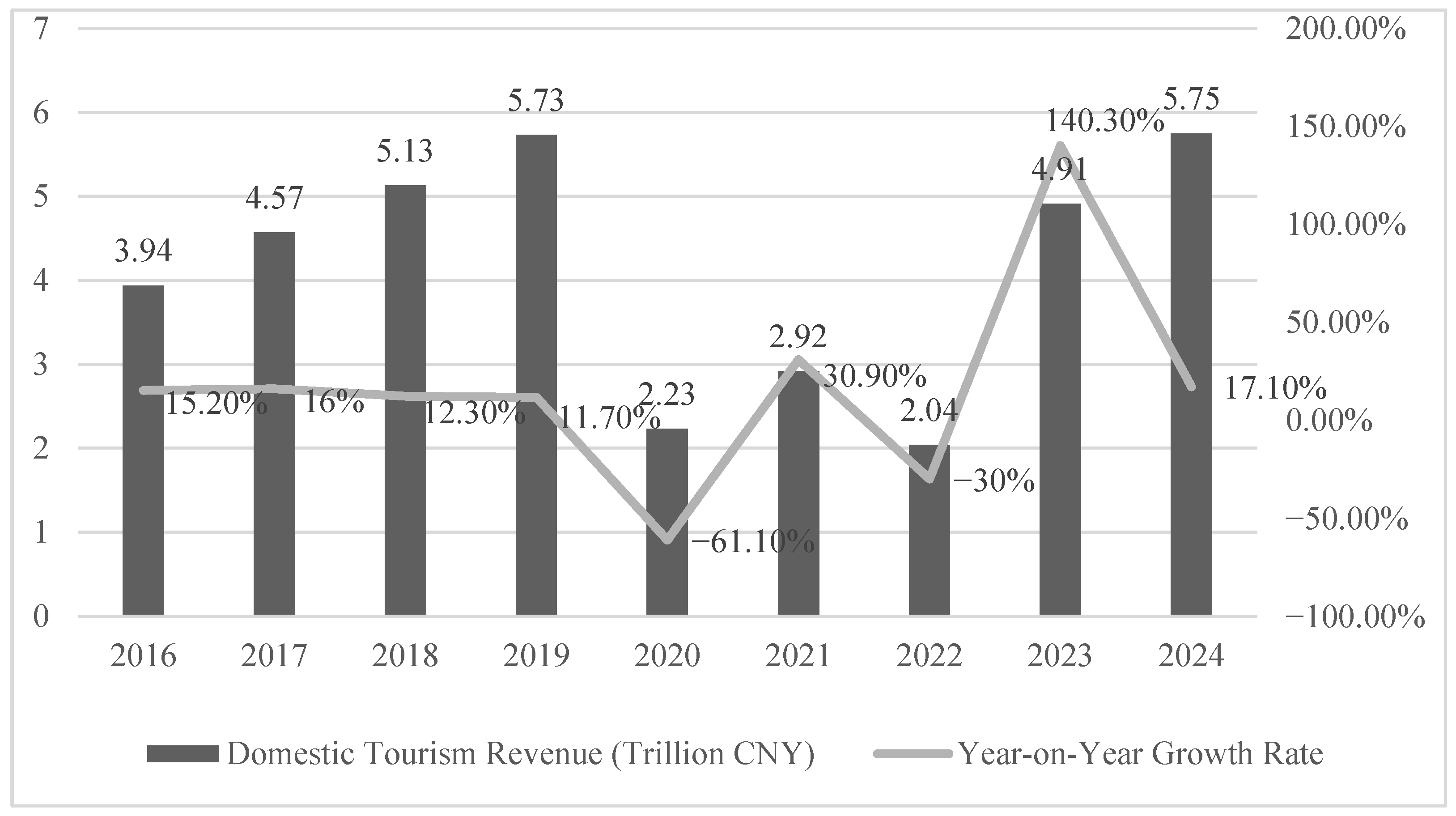
As a core component of the culture and tourism sector, tourism enterprises have exhibited strong growth momentum owing to policy support, market expansion, and technological advancement. After the severe shock imposed by the COVID-19 outbreak in 2020, the tourism sector experienced a swift rebound, with tourism revenues maintaining a steady growth trajectory. Within this context, China occupies a distinctive position in the global tourism landscape. Its research significance arises not only from its rich historical and cultural foundations but also from the scale, dynamism, and substantial economic weight of its tourism industry. According to the China Statistical Yearbook published by China’s National Bureau of Statistics, domestic tourism revenue in China was approximately CNY 5.73 trillion in 2019, before the COVID-19 outbreak. Although the pandemic led to a pronounced downturn in subsequent years, the industry exhibited a notable recovery, with tourism revenue rebounding to about CNY 5.75 trillion in 2024 (Figure 1). This recovery underscores the economic and social significance of the tourism sector, which functions as an important pillar of the national economy by supporting enterprise development, employment creation, and cultural exchange. Accordingly, examining the development trajectories and management strategies of Chinese tourism enterprises is crucial for enhancing firm competitiveness and promoting industry upgrading.
In recent years, rising global temperatures have been associated with an increasing incidence of extreme weather phenomena, exerting substantial pressure on natural ecosystems (Choi, 2024). In addition to major exogenous shocks affecting the tourism sector, its strong reliance on natural and climatic conditions also exposes it to climate-related risks. Extreme weather events not only threaten human health and livelihoods but also undermine the attractiveness of tourism destinations (Hillmann & Guenther, 2021).
The concept of ESG emerged in the early 2000s within the United Nations Global Compact framework, aiming to evaluate corporate sustainability through environmental, social, and governance dimensions. Building on this foundation, the United Nations advanced the global sustainability agenda in 2015 by launching the 2030 Agenda for Sustainable Development, which set out 17 Sustainable Development Goals (Gidage & Bhide, 2025). As an industry highly dependent on natural resources, tourism faces an urgent need for green transformation and must actively implement ESG principles. Therefore, exploring the intrinsic motivations of tourism enterprises to improve their ESG performance has become a critical research topic.
Artificial intelligence (AI) has emerged as a strategic general-purpose technology shaping contemporary technological progress and industrial development. According to data released by the market research firm Precedence Research, the global AI market size reached USD 638.23 billion in 2024. The firm projects that the market will grow from an estimated USD 757.58 billion in 2025 to approximately USD 3680.47 billion by 2034, representing a compound annual growth rate (CAGR) of approximately 19.20% over the forecast period (2025–2034). At the macro level, AI is characterized by its penetrative, substitutive, synergistic, and creative capabilities, enabling deep integration with various economic and social sectors (Huang & Rust, 2020). It exerts profound influences on economic growth, employment, income distribution, productivity, technological innovation, and industrial structure (Brynjolfsson et al., 2017; Aghion et al., 2017). At the enterprise level, AI empowers organizations in activities such as decision-making, task automation, employee and performance management, customer relations, risk management, and innovation management (Fang & Lv, 2023; Gama & Magistretti, 2023; Shaik et al., 2023). AI contributes not only to firms’ competitive positioning but also to the technological foundations of ESG improvement. Accordingly, this study analyzes the relationship between AI adoption and ESG performance in tourism enterprises, with a focus on the mechanisms at work. As digital transformation increasingly intersects with sustainability objectives, the role of technological change in shaping ESG practices within service industries has attracted growing scholarly attention. Studies indicate that the role of technology exhibits a dual nature: while it enhances operational efficiency and governance transparency, it may also introduce new challenges due to contextual variations (Efthymiou et al., 2023). Differences in the applicability of technology across varying contexts often result in distinct ESG performance characteristics, underscoring the moderating role of external environments and internal conditions in shaping the effectiveness of technology-enabled outcomes.
Prior studies have largely examined the economic implications of AI, whereas firm-level evidence from the tourism industry remains relatively scarce. In particular, the pathways through which AI shapes enterprise-level ESG performance and the conditions under which such effects vary have not been rigorously identified. Against this background, this study seeks to address the following research questions. First, does the application of artificial intelligence enhance the ESG performance of tourism enterprises? Second, through which mechanisms do AI application influence firms’ ESG outcomes, particularly in terms of customer diversification and corporate reputation? Third, how do external contextual factors, such as climate risk and media attention, condition the relationship between AI application and ESG performance?
To answer these questions, this study draws on corporate social responsibility theory and stakeholder theory and employs firm-level data on Chinese A-share listed tourism enterprises over the period 2013–2023. Using panel regression models complemented by instrumental variable and matching-based estimations, the analysis examines both the direct effects of AI adoption on ESG performance and the underlying mechanisms and boundary conditions.
This study contributes to the literature in three important ways. First, it introduces artificial intelligence into the analysis of ESG performance in tourism enterprises, thereby extending existing research on sustainability in the tourism sector. Second, it moves beyond a purely correlational perspective by identifying the mechanisms through which AI application influences ESG outcomes. Third, it explicitly analyzes how climate risk and media attention, as salient external conditions, moderate the relationship between AI application and ESG performance, clarifying when and in what contexts AI adoption is more likely to translate into improved corporate sustainability.

2. Theoretical Background and Hypothesis Developments

2.1. Theoretical Background

Understanding the relationship between AI application and ESG performance requires a theoretical perspective that goes beyond technological efficiency and focuses on firms’ responsibilities toward a broad set of stakeholders. ESG performance reflects how firms manage their environmental impacts, social responsibilities, and governance practices, all of which are shaped by strategic decisions regarding resource allocation, information disclosure, and stakeholder engagement (Galbreath, 2012). In this sense, the implications of AI adoption are not limited to operational outcomes but also extend to how firms fulfill their broader social and environmental obligations.
Corporate social responsibility (CSR) theory provides a foundational framework for examining why firms engage in ESG-related activities. This theory emphasizes that firms are expected to pursue economic objectives while simultaneously addressing social and environmental concerns (Ali et al., 2017). Digital technologies, including AI, can enhance the feasibility and effectiveness of CSR practices by improving firms’ ability to monitor environmental performance (Liu et al., 2024), deliver socially responsible services, and implement governance mechanisms. From this perspective, AI adoption can be understood as a strategic tool that enables firms to better align economic performance with social and environmental responsibility.
Stakeholder theory further complements this view by emphasizing the role of multiple stakeholder groups in shaping corporate behavior. Firms operate within a network of stakeholders, including customers, employees, suppliers, regulators, and the broader public, whose expectations and pressures influence managerial decision-making (Friedman & Miles, 2002). AI reshapes these relationships by altering information flows, service interactions, and governance processes (Peltier et al., 2023). By enabling more personalized services, enhanced transparency, and improved risk management (Aziz & Dowling, 2019), AI can affect how firms respond to stakeholder demands and, consequently, how ESG outcomes are generated. Together, CSR theory and stakeholder theory provide an integrated analytical lens for understanding the mechanisms and boundary conditions through which AI application influences ESG performance in tourism enterprises.
It is also important to note that existing studies commonly rely on ESG ratings as proxies for corporate sustainability performance, yet such measures are not without limitations. ESG ratings are inherently normative in nature and may reflect firms’ disclosure strategies, regulatory compliance, or institutional expectations rather than purely objective sustainability outcomes (Gangwani & Kashiramka, 2024). Rating-based distortions may arise due to differences in information disclosure quality, rating methodologies, and country-specific regulatory environments. In emerging economies such as China, ESG assessments may be particularly sensitive to institutional contexts and policy orientations, which raises concerns regarding cross-firm and cross-industry comparability. Recognizing these limitations is essential for interpreting empirical findings and highlights the importance of conducting robustness checks and adopting a cautious interpretation of ESG-related results.

2.2. AI Application and ESG Performance

The digital economy has been widely recognized as a key driver of productivity growth and process efficiency in the real economy (Brynjolfsson & Hitt, 2000). Within the tourism sector, digital transformation facilitates consumption upgrading and enhances tourism performance by improving infrastructure provision and market-based allocation of production factors, thereby supporting the sustained and efficient development of tourism activities. At the firm level, the digital transformation of tourism enterprises relies on the effective use of data generated through tourism-related economic activities, encompassing data acquisition, management, and utilization (Jiang & Jin, 2022). Through these processes, firms can optimize resource allocation and service workflows, improve service quality, and promote high-quality development across the industry (X. Chen et al., 2023).
As a core component of digital transformation, AI reshapes how tourism enterprises organize production, deliver services, and make managerial decisions. For managers, AI enhances organizational efficiency by altering managerial workflows and operational models while simultaneously improving the quality of decision-making. From the perspective of consumers, AI enables more responsive and convenient service experiences, thereby strengthening firms’ market competitiveness.
In terms of operational mechanisms, AI technologies contribute to tourism enterprises through several interrelated channels. First, AI-driven ambient intelligence and intelligent recommendation systems enhance service personalization by adapting service environments and matching tourism products with individual preferences (Bulchand-Gidumal, 2022; Ukpabi et al., 2019). Second, AI facilitates cost management by streamlining operations and reducing dependence on labor inputs. Advances in connectivity, cloud infrastructure, and algorithmic capabilities support scalable personalized service delivery (Ahani et al., 2019), while automation technologies significantly reduce labor costs and reshape workforce structures in the tourism sector (Borges et al., 2021; Frey & Osboene, 2017). Third, AI improves operational coordination and responsiveness in complex service scenarios, generating efficiency gains across stakeholder networks that include employees, suppliers, and partners (Azis et al., 2020). For example, AI-based voice assistants can handle routine inquiries and support frontline staff in addressing more complex tasks through human–machine collaboration (Wilson & Daugherty, 2018).
Beyond operational efficiency, AI application may also have important implications for firms’ ESG performance. At the environmental level, digital technologies enable tourism enterprises to monitor energy consumption and waste generation, optimize resource use, and support more sustainable operations (Li et al., 2024). From the social perspective, AI-driven platforms can improve service accuracy and responsiveness, thereby enhancing customer satisfaction and stakeholder engagement. In terms of corporate governance, digitalization tends to increase operational transparency, ease information asymmetry, and strengthen internal control through improved risk identification and compliance monitoring.
However, despite these plausible links, the existing literature does not yet provide a clear and consistent conclusion on whether AI adoption systematically improves firms’ overall ESG performance, particularly at the firm level and within service-oriented industries such as tourism. Prior studies have often emphasized aggregate economic outcomes or focused on specific sustainability dimensions, leaving relatively limited and sometimes mixed evidence on how AI translates into comprehensive ESG performance. Moreover, the mechanisms through which AI affects ESG outcomes, as well as the contextual conditions under which these effects vary, remain insufficiently examined. Accordingly, building on the above discussion, this study tests the direct relationship between AI application and ESG performance in tourism enterprises and proposes the following hypothesis:
H1. 
The application of AI technologies is linked to better ESG outcomes among tourism enterprises.

2.3. Mediating Mechanisms

While AI application may exert a direct influence on ESG performance, its effects are more likely to be realized through specific organizational and market-level mechanisms. According to corporate social responsibility theory and stakeholder theory, firms translate technological capabilities into ESG outcomes by reshaping their interactions with stakeholders and by accumulating intangible assets that support responsible behavior. In the context of tourism enterprises, changes in customer structure and corporate reputation represent two particularly important channels through which AI adoption can influence ESG performance. Accordingly, this study focuses on customer diversification and corporate reputation as key mediating mechanisms linking AI application to ESG outcomes.

2.3.1. Customer Diversity as a Mediator

Corporate social responsibility (CSR) theory emphasizes that firms are expected to pursue economic objectives while simultaneously fulfilling social and environmental responsibilities in order to enhance overall social welfare. In the tourism industry, the fulfillment of social responsibility is closely linked to tourist loyalty and firm competitiveness (Shen, 2012). In service-oriented contexts such as hospitality, well-designed CSR initiatives can foster positive psychological responses among consumers and strengthen brand advocacy, highlighting the strategic importance of socially responsible practices.
Stakeholder theory further suggests that firms must balance the interests of multiple stakeholder groups, including tourists, local residents, enterprises, and government authorities (Ahmad et al., 2023). Within this framework, customer diversification represents a concrete way through which tourism enterprises respond to heterogeneous stakeholder demands (Xu et al., 2024). By offering personalized service solutions tailored to different customer groups, firms can serve a broader and more diverse customer base, thereby promoting social inclusion and stability. This aligns closely with the “social” dimension of ESG, which emphasizes the integration of social value creation with sustainable economic development.
Artificial intelligence provides important technological support for achieving customer diversification. First, AI enhances resource coordination and information dissemination within tourism enterprises, improving tourists’ perceptions of attractions, services, transportation, and comfort (C. F. Chen & Tsai, 2007). Second, through human–computer interaction and data-driven decision-making, AI-enabled systems analyze consumer preferences and identify latent demand, enabling firms to design personalized services and expand their target markets. Existing evidence indicates that AI adoption facilitates the expansion and diversification of customer segments (Zhong et al., 2025). In summary, AI application can promote customer diversification, which in turn strengthens the social dimension of ESG performance in tourism enterprises. Accordingly, we propose the following hypothesis:
H2. 
The application of AI can increase customer diversity in tourism enterprises, thereby enhancing their ESG performance.

2.3.2. Corporate Reputation as a Mediator

Corporate reputation reflects the collective perceptions and evaluations of a firm formed by its stakeholders over time based on past behavior and performance. In the tourism industry, where service quality and customer experience are central to value creation, corporate reputation constitutes a critical intangible asset. A favorable reputation conveys credibility and reliability, signaling that a firm is capable of honoring commitments and effectively managing risks (Gatzert, 2015). Such signals reduce information costs for customers, investors, and business partners, thereby facilitating access to high-quality capital and human resources.
Beyond its signaling function, corporate reputation also shapes firms’ incentives to engage in responsible behavior. As ESG considerations become increasingly salient in capital markets, reputational risk is closely linked to financing conditions and market valuation. Empirical evidence suggests that reputational concerns are positively associated with firms’ cost of capital, implying that reputational damage can impose tangible economic penalties (Becchetti et al., 2023). To mitigate such risks, firms are more likely to internalize social responsibility and proactively manage environmental, social, and governance issues. Through these channels, corporate reputation contributes to improved ESG performance by both externally transmitting positive signals and internally reinforcing responsible managerial behavior.
AI provides new pathways through which tourism enterprises can build and maintain corporate reputation. By analyzing consumer behavior and preferences, AI enables firms to deliver more precise marketing strategies and customized services, thereby enhancing customer satisfaction and strengthening positive market perceptions (Dubey et al., 2019; Qian & Xu, 2019). In addition, AI-driven data processing technologies facilitate the integration of internal and external information, reducing information costs and improving operational transparency. For example, intelligent inventory and demand forecasting systems can enhance resource efficiency while controlling costs, contributing to an image of responsible and well-managed operations.
Moreover, AI-supported customer feedback systems and public sentiment monitoring tools allow firms to shift from reactive reputation management to a more proactive and continuous governance approach. By systematically identifying stakeholder concerns and adjusting service and management practices in a timely manner, tourism enterprises can form a virtuous cycle of “demand identification, service optimization, and reputation accumulation” (Zhao, 2021). Through this process, AI adoption strengthens corporate reputation, which in turn facilitates the translation of technological capabilities into enhanced ESG performance. Thus, Hypothesis 3 is proposed:
H3. 
AI enhances the ESG performance of tourism enterprises by elevating their corporate reputation.

2.4. Moderating Effects

2.4.1. Moderating Effect of Climate Risk

Increasing climate risk reduces enterprise total factor productivity (Song et al., 2023), while extreme high-temperature weather directly decreases business revenue (Pankratz et al., 2023). As an industry that relies heavily on natural conditions and environmental stability, tourism is particularly vulnerable to climate-related shocks. Climate risk not only affects tourism demand but also poses substantial challenges to firms’ crisis response capacity and resource allocation efficiency.
Existing studies indicate that firms operating in regions exposed to higher climate risk tend to exhibit greater engagement in corporate social responsibility activities (Ozkan et al., 2023), as climate-related pressures incentivize companies to increase investments in sustainability and social responsibility initiatives (Mbanyele & Muchenje, 2022). In this context, digital technologies play an increasingly important role in helping enterprises anticipate and manage climate-related disruptions. By enabling firms to analyze climate risks and demand patterns, digital tools facilitate timely responses to extreme weather events and operational shocks (Dubey et al., 2022). For tourism enterprises, artificial intelligence constitutes a critical technological support for enhancing risk management capabilities, ensuring tourist safety, reducing asset losses, and maintaining operational continuity. As a result, firms operating in high climate risk environments face stronger incentives to adopt AI technologies and to deploy them in ways that support sustainability-oriented objectives. Under such conditions, AI adoption is more likely to translate into observable improvements in ESG performance. Accordingly, we propose the following hypothesis:
H4. 
Climate risk positively moderates the relationship between AI application and the ESG performance of tourism enterprises.

2.4.2. Moderating Effect of Media Attention

The media plays a dual role in corporate governance by serving both as an information intermediary and as an external monitoring mechanism. Through professional reporting, media coverage reduces information asymmetry between firms and investors, while public scrutiny generated by media attention exerts reputational pressure that can influence corporate decision-making.
In the context of AI application, a moderate level of media attention can function as an external incentive, encouraging tourism enterprises to utilize AI technologies to enhance service quality and environmental performance in order to maintain a favorable social image and market reputation. Relevant media reporting may also help stakeholders recognize the sustainability potential of AI, thereby accelerating the realization of ESG-related benefits (Jia et al., 2016). However, for tourism enterprises that are highly visible and reputation-sensitive, excessive media attention is more likely to generate countervailing effects. Heightened scrutiny can induce firms to adopt more conservative strategies due to concerns over potential controversies associated with AI application, such as data privacy risks or algorithmic accountability issues, and may amplify negative public perceptions of emerging technologies. As a result, firms may become more cautious in experimenting with or fully deploying AI applications, which constrains innovation incentives and weakens the translation of AI adoption into ESG improvements (S. Wen & Zhou, 2017). Thus, although media attention can exert a disciplining effect under certain conditions, we argue that excessive media scrutiny in the tourism industry is more likely to constrain the ESG-enhancing role of AI adoption. Accordingly, we propose the following hypothesis:
H5. 
Media attention negatively moderates the relationship between AI application and the ESG performance of tourism enterprises.

2.5. The Study Framework

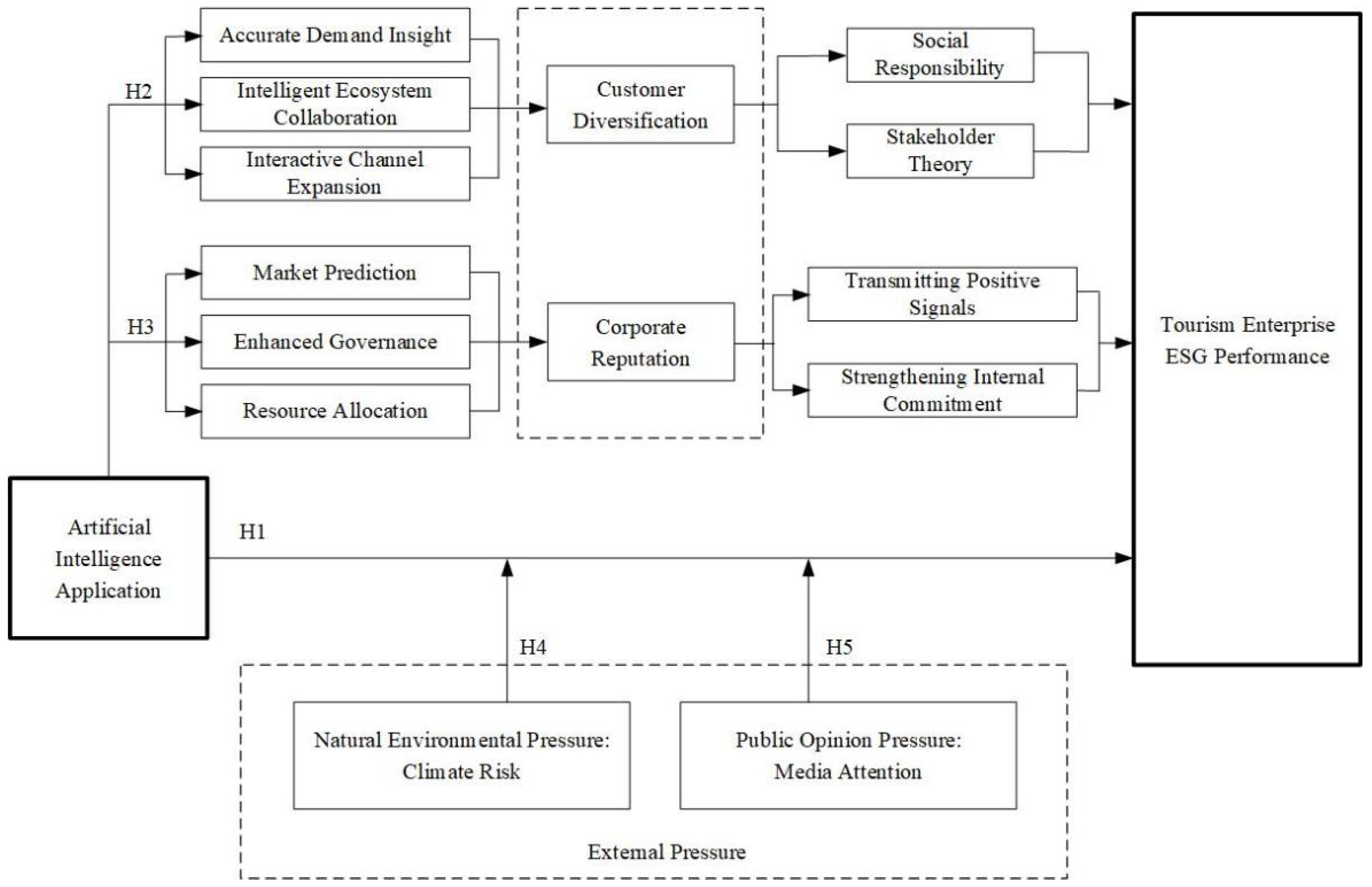
Based on corporate social responsibility theory and stakeholder theory, this study constructs a theoretical framework linking AI application to ESG performance in tourism enterprises. As shown in Figure 2, AI application affects ESG performance both directly and indirectly through customer diversification and corporate reputation, while climate risk and media attention act as moderating factors that shape the strength of this relationship.

3. Methodology

3.1. Data

The sample consists of Chinese A-share listed tourism enterprises observed over the period 2013–2023. Information on AI-related activities was identified through keyword searches of firms’ annual reports, while firm-level financial and control variables were obtained from the CSMAR database. ESG performance data were sourced from the Huazheng ESG rating system. The dataset was further processed by excluding observations with missing key variables, abnormal values, and special treatment firms such as ST and PT companies. To mitigate the influence of extreme values, all continuous variables were winsorized at the 1% level. After data cleaning, the final sample included 868 firm-year observations covering 133 tourism enterprises.

3.2. Model Specification

3.2.1. Baseline Model Specification

We estimate the following baseline model (1) to analyze the effect of AI adoption on firms’ ESG outcomes:
E S G i t = α 0 + α 1 l n A I i t + θ c o n t r o l i t + λ j + μ t + ε i t
In the specification, α 0 represents the constant term, while α 1 and θ are the influence coefficients of the variables. Subscripts i and t refer to firms and years, respectively. ESG represents the dependent variable measuring firms’ ESG performance, and lnAI denotes the core explanatory variable reflecting the extent of AI application. Control is a vector of control variables. Fixed effects λ j and μ t are included to account for unobserved industry heterogeneity and year specific shocks, and ε is the error term.

3.2.2. Mediating Effect Model Specification

Following the mediation analysis framework developed by (Z. Wen & Ye, 2014), this study constructs a mediating effect model to examine Hypotheses 2 and 3, as specified below.
M = β 0 + β 1 l n A I i t + θ c o n t r o l i t + λ j + μ t + ε i t
E S G i t = γ 0 + γ 1 l n A I i t + γ 2 M + θ c o n t r o l i t + λ j + μ t + ε i t
where M refers to the mediators, namely, corporate reputation (Rep) and customer diversification (CD), while the definitions of other variables follow the baseline regression.

3.2.3. Moderating Effect Model Specification

This study constructs moderating effect models. Both the explanatory and moderating variables are centralized, and their interaction terms are included. Models (4) and (5) are specified as follows:
E S G i t = δ 0 + δ 1 l n A I i t + δ 2 C P R I i t + δ 3 c _ l n A I i t × c _ C P R I i t + θ c o n t r o l i t + λ j + μ t + ε i t
E S G i t = δ 0 + δ 1 l n A I i t + δ 2 M A i t + δ 3 c _ l n A I i t × c _ M A i t + θ c o n t r o l i t + λ j + μ t + ε i t
where c _ l n A I × c _ C P R I denotes the interaction between the mean-centered AI adoption variable (lnAI) and climate risk (CPRI), and c _ l n A I × c _ M A captures the interaction between mean-centered AI application and media attention (MA). The remaining variables are specified in line with the baseline model.
To facilitate clarity, the empirical models are explicitly linked to the hypotheses tested in this study. Model (1) examines the baseline relationship between AI application and ESG performance and is used to test Hypothesis 1. Models (2) and (3) introduce customer diversification and corporate reputation as mediating variables to examine Hypotheses 2 and 3, respectively, as well as the corresponding mediation effects. Models (4) and (5) incorporate interaction terms between AI application and climate risk and media attention to test the moderating effects proposed in Hypotheses 4 and 5. This explicit mapping ensures transparency in the empirical design and clarifies how each hypothesis is empirically evaluated.

3.3. Variable

3.3.1. Explained Variable

ESG performance (ESG). Firm-level ESG performance is proxied by the Huazheng ESG rating, which has been extensively used in studies of Chinese listed firms and is closely aligned with China’s regulatory and institutional environment (Lu et al., 2023). The Huazheng ESG rating provides a comprehensive assessment across environmental, social, and governance dimensions, making it suitable for evaluating sustainability performance among service-oriented firms such as tourism enterprises. Firms are classified into nine rating levels, each corresponding to a numerical score ranging from 1 to 9. Following standard practice, the average score over four quarters is used as the annual ESG indicator. To ensure robustness, the Bloomberg ESG score is employed as an alternative measure.

3.3.2. Explanatory Variable

AI application (AI). The extent of AI adoption is measured by the logarithm of one plus the frequency of AI-related keywords disclosed in firms’ annual reports (lnAI). As a robustness check, an alternative measure is constructed using the logarithm of one plus the number of AI-related keywords appearing in the Management Discussion and Analysis section of the annual reports (lnAI_MD&A) (Yao et al., 2024).

3.3.3. Mediating Variables

Customer Diversification (CD). Customer diversification is proxied by the share of annual sales derived from customers other than the top five, with the corresponding concentration measure constructed from the sales share of the top five customers (Wu & Yao, 2023).
Corporate Reputation (Rep). Corporate reputation is measured using a comprehensive evaluation system consisting of 12 indicators across four dimensions, comprising consumers and society, creditors, shareholders, and the enterprise itself. These indicators are synthesized into a composite score through factor analysis, which is used as the proxy for corporate reputation. Higher values of this index indicate a stronger corporate reputation (Guan & Zhang, 2019).

3.3.4. Moderating Variables

Climate Risk (CPRI). Following existing research (Guo et al., 2024), the China Provincial Climate Risk Index is constructed based on raw meteorological data from the National Oceanic and Atmospheric Administration (NOAA). The index is constructed based on provincial-level records of extreme weather events, including days with unusually low or high temperatures, extreme precipitation, and severe droughts, covering all Chinese provinces over the period 2003–2023. These indicators are standardized and aggregated into a composite measure that captures regional physical climate risk.
Media Attention (MA). Media attention is measured as the natural logarithm of one plus the annual count of online news articles referencing the firm.
Table 1 presents the definitions and measurements of the key variables used in this study.
Table 2 reports the descriptive statistics for the main variables. The mean ESG score is 4.14, indicating that the overall ESG performance of tourism enterprises is relatively modest and generally falls within the BBB–C rating range. This suggests that, on average, ESG practices in the tourism sector remain at an early to intermediate stage of development. Moreover, an ESG score with a median value of 4.000 and a standard deviation of 1.082 indicates that the overall ESG performance of tourism enterprises is moderate but exhibits noticeable dispersion across firms.
Regarding AI application, the mean value of lnAI is 1.072, with a standard deviation of 1.053. This distribution implies pronounced variation in the extent of AI application across enterprises. Notably, the minimum value of zero indicates that a subset of firms has not yet engaged in AI-related activities, while the relatively high maximum value shows that some firms have already achieved a comparatively advanced level of AI adoption. Overall, these statistics suggest that AI diffusion in the tourism industry remains uneven and is still in an early stage of development.

4. Results

4.1. Baseline Regression

With respect to control variables, firms with higher profitability, larger size, greater ownership concentration, and a higher proportion of independent directors tend to exhibit better ESG performance. In contrast, leverage and firm age are negatively associated with ESG scores. The coefficients on Tobin’s Q, CEO duality, board size, cash holdings, and ownership separation are not statistically significant. Overall, the adjusted R2 increases from 0.123 to 0.354 after the inclusion of control variables, indicating a substantial improvement in explanatory power.
Table 3 reports the baseline regression results examining the relationship between AI application and ESG performance. Column (1) presents the estimation results without control variables, while Column (2) incorporates a full set of firm-level controls as well as industry and year fixed effects. In Column (1), the coefficient on lnAI is positive and statistically significant at the 1% level, with an estimated value of 0.140, indicating a strong unconditional association between AI application and ESG performance.
After the inclusion of control variables in Column (2), the coefficient on lnAI remains positive and statistically significant at the 5% level, although its magnitude declines to 0.082. This reduction suggests that part of the baseline association is related to observable firm characteristics. However, the persistence of a statistically significant coefficient with a comparable order of magnitude indicates that the positive relationship between AI application and ESG performance is not solely driven by firm-level covariates. These results provide empirical support for H1.
Regarding the control variables, firms with higher profitability, larger size, greater ownership concentration, and a higher proportion of independent directors tend to exhibit better ESG performance, while leverage and firm age are negatively associated with ESG scores. The adjusted R2 increases substantially from 0.123 to 0.354 after the inclusion of control variables, indicating a notable improvement in explanatory power.

4.2. Robustness Tests

4.2.1. Robustness Check

Before presenting the robustness checks, it is important to acknowledge a potential source of measurement bias arising from the proxy used to capture AI application. Specifically, measuring AI adoption through keyword frequency in firms’ annual reports may partly reflect disclosure intensity or strategic signaling, rather than the actual depth of technological implementation. Differences in reporting practices across firms may therefore lead to measurement noise. To address this concern, we conduct a series of robustness checks and alternative specifications. These include instrumental variable estimation, propensity score matching, and alternative model settings, which help mitigate potential bias and strengthen the credibility of the baseline results.
First, the regression is re-estimated using the Bloomberg ESG score, which ranges from 0 to 100, as an alternative measure of ESG performance. Second, the core explanatory variable is replaced by the logarithm of one plus the frequency of AI-related keywords appearing in the Management Discussion and Analysis section of firms’ annual reports. Third, to account for possible delayed effects of AI application, the one-period lag of the AI variable is incorporated into the regression model. Fourth, observations from the year 2020 are excluded to alleviate the influence of extraordinary external shocks that substantially disrupted tourism activities worldwide, including widespread mobility constraints and sharp changes in travel demand. Fifth, the sample is further restricted to the period after 2019, taking into consideration the introduction of national-level guidelines on the governance of artificial intelligence issued in this year. The regression results in Table 4 demonstrate that the positive effect of AI application on ESG performance remains stable across all robustness checks, providing further support for H1. Moreover, the estimated coefficients on AI application remain within a comparable range across alternative specifications, including different ESG measures, alternative AI proxies, lagged variables, and subsample analyses. This consistency in magnitude suggests that the robustness of the results reflects substantive stability in the AI–ESG relationship, rather than merely repeated statistical significance.

4.2.2. Endogeneity Tests

To address potential endogeneity concerns, this study employs two instrumental variables. The first IV is the one-period lagged AI variable (IV1), used to mitigate endogeneity. Column (1) of Table 5 presents the first-stage results of the 2SLS regression, with IV1 yielding a coefficient of 0.696, which is statistically significant at the 1% level. The second IV (IV2) is constructed as the interaction between a firm’s deviation from the annual mean AI level across all firms and the one-period lagged AI variable (Goldsmith-Pinkham et al., 2020). Column (3) of Table 6 reports the first-stage results for IV2, where the coefficient is 0.514, also significant at the 1% level. For both IVs, the Kleibergen–Paap rk Wald F-statistics significantly exceed the critical values from the Stock–Yogo weak instrument test, confirming that the instruments are not weak. Additionally, the Anderson LM test rejects the null hypothesis, further indicating that the instruments have strong explanatory power. The second-stage regression results for both models are significantly positive, reinforcing the robustness of the main findings.
To address potential sample self-selection bias, this study utilizes the Propensity Score Matching (PSM) method. The sample is split into treatment and control groups based on the presence of AI-related keywords in annual reports. Control variables from Model (1) are used as matching criteria, and a 1:2 nearest neighbor matching with replacement is applied. The balance test results (Table A1) show that after matching, the standard errors between the treatment and control groups are significantly reduced. The standardized biases for all covariates are below 10%, and t-tests do not reject the null hypothesis of no systematic differences between the groups. These findings confirm the effectiveness of the matching process and suggest that sample selection bias has been adequately controlled.
Under the condition that the balancing assumption is satisfied, the Average Treatment effect on the Treated (ATT) estimation based on the matched sample (Table A2) shows that the ESG performance of tourism enterprises applying AI is, on average, 0.267 units higher than that of non-applying enterprises. Compared to the pre-matching group difference of 0.307, the ATT estimate is more conservative but still robustly confirms the enhancing effect of AI on ESG performance, supporting H1.
After controlling for selection bias, the coefficient for lnAI is 0.101, significant at the 5% level. This suggests that the application of AI continues to positively influence the ESG performance of tourism enterprises. The PSM results in Table 6 further reinforce the robustness of our baseline regression.

5. Mechanism and Further Analyses

5.1. Mediation Effect Analysis

The mediation analysis results based on Models (2) and (3) are reported in Table 7. Corporate reputation (Rep) and customer diversification (CD) are introduced as mediating variables following the three-step procedure proposed by Wen Zhonglin. The estimation results show that the coefficients of CD and Rep are positive and statistically significant at the 1% and 5% levels, respectively. In addition, the coefficients of lnAI remain significantly positive in the corresponding regressions. Taken together, these findings provide evidence that AI application influences ESG performance through both mediating channels.
The mediation effects are further examined using the Bootstrap approach with 5000 resamples. The estimation results reported in Table 8 indicate that the 95% bias-corrected confidence intervals for the indirect effects of both customer diversification and corporate reputation exclude zero, confirming that both pathways are statistically significant. Moreover, the indirect effect through corporate reputation (β = 0.0299) is substantially larger than that through customer diversification (β = 0.0068). Together, these patterns indicate that corporate reputation accounts for a substantially larger share of the association between AI adoption and ESG performance, serving as the primary explanatory mechanism, while customer diversification contributes a smaller, though still meaningful, incremental role. These findings provide empirical support for H2 and H3.

5.2. Moderating Effect Analysis

The results reported in Column (1) of Table 9 indicate that the interaction term between climate risk and AI application (CPRI × lnAI) has a coefficient of 0.011 and is statistically significant at the 5% level. This finding suggests that climate risk strengthens the positive effect of AI application on ESG performance, thereby providing empirical support for Hypothesis 4.
The estimation results reported in Column (2) of Table 9 indicate that the interaction term between media attention and AI application (MA × lnAI) carries a coefficient of −0.0870 and is statistically significant at the 1% level. This result suggests that media attention weakens the positive association between AI application and ESG performance, providing empirical support for Hypothesis 5. One possible explanation is that intense media scrutiny may amplify concerns related to AI applications, such as energy consumption, data privacy, and algorithmic fairness, triggering public skepticism. For brand-sensitive tourism enterprises, such public pressure can offset the positive benefits of AI in service experience and ESG performance.

5.3. Heterogeneity Analysis

(1)
Industry Heterogeneity
To examine industry-specific heterogeneity, the sample was divided into two groups based on the “Industrial Classification for National Economic Activities” (GB/T 4754-2017) (National Bureau of Statistics of China, 2017): cultural, sports, and entertainment tourism enterprises versus other tourism enterprises. The grouped regression results reported in Columns (1) and (2) of Table 10 indicate that the positive effect of AI application on ESG performance is more pronounced and statistically significant in the cultural, sports, and entertainment sectors.
This heterogeneity is interpreted as reflecting structural characteristics of these industries, rather than merely differences in the intensity of AI adoption. Cultural, sports, and entertainment tourism enterprises are typically more content-driven, reputation-sensitive, and closely connected to public engagement and community interaction. As a result, AI applications related to content creation, digital interaction, and audience engagement are more directly aligned with ESG-relevant outcomes, such as social inclusion, cultural value creation, and governance transparency. In contrast, other tourism enterprises, which are more oriented toward standardized services such as accommodation and transportation, may face weaker linkages between AI deployment and observable ESG improvements.
(2)
Government Environmental Attention
Government environmental attention represents an important external institutional context that may influence the effectiveness of AI application in improving ESG performance. Following prior studies (Elmagrhi et al., 2019), we examine whether differences in regulatory attention alter the AI–ESG relationship. Government environmental attention is measured using text analysis of government work reports from 272 cities over the period 2013–2023, based on the frequency of environment-related keywords covering dimensions such as air quality, water resources, ecology, and sustainable development (Wang et al., 2022).
The results show that the positive effect of AI application on ESG performance is stronger in regions with relatively lower levels of government environmental attention. Importantly, this heterogeneity does not contradict the baseline findings but rather highlights the context-dependent role of AI as a governance-enhancing tool. In regulatory environments with less intensive direct oversight, AI adoption can play a more prominent role in improving information transparency, risk management, and ESG-related practices. In contrast, where government environmental attention is already high, the marginal ESG-enhancing effect of AI may be partially substituted by existing regulatory pressure.

6. Discussion and Implications

6.1. Main Findings

To provide a concise overview of the empirical findings, Table 11 summarizes all hypotheses tested in this study and indicates whether they are supported by the results.
This study investigates how the application of artificial intelligence (AI) technology shapes the ESG performance of tourism enterprises using panel data from Chinese A-share listed firms from 2013 to 2023. The results consistently show that AI application contributes to improved ESG performance. Mechanism analysis further reveals that AI promotes customer diversification and strengthens corporate reputation, which serve as key channels through which AI supports sustainable corporate development. The influence of AI is also found to vary across external conditions: climate risk reinforces the positive effect of AI, whereas media attention weakens it by increasing external scrutiny. In addition, the impact of AI is more pronounced among firms operating outside the culture, sports, and entertainment sectors and in regions with lower government environmental attention. These findings deepen the understanding of the role of emerging technologies in advancing ESG performance and offer insights into the conditions under which AI can most effectively support sustainable development in the tourism industry.
The findings of this study should also be interpreted in light of the Chinese institutional context. In China, ESG practices are closely intertwined with evolving regulatory frameworks, policy guidance, and government-led sustainability initiatives. Tourism enterprises operate within a governance environment in which environmental regulation, disclosure requirements, and policy signals play a prominent role in shaping corporate behavior. Against this backdrop, AI adoption may translate more readily into ESG improvements by strengthening firms’ compliance capacity, risk management, and information disclosure practices. Moreover, the observed moderating effects of climate risk and media attention reflect the salience of external pressures in the Chinese context, where firms tend to be particularly responsive to regulatory expectations and public scrutiny.

6.2. Theoretical Implications

Drawing on the theoretical framework and empirical findings of this study, several theoretical implications can be identified. First, the results extend the literature on AI and corporate sustainability by demonstrating that the ESG effects of AI adoption in tourism enterprises are not purely technology-driven but are mediated through organizational and market-level mechanisms. By explicitly identifying customer diversification and corporate reputation as key transmission channels, this study enriches the understanding of how technological capabilities are translated into ESG outcomes.
Second, by incorporating climate risk and media attention as moderating factors, this study highlights the importance of external contextual conditions in shaping the sustainability implications of AI adoption. This finding advances existing CSR and stakeholder-based perspectives by showing that the effectiveness of AI in promoting ESG performance depends on both substantive environmental pressures and informational or reputational scrutiny. In doing so, this study contributes to a more nuanced, context-sensitive theoretical understanding of AI-driven sustainability in the tourism industry.

6.3. Practical and Policy Implications

From a practical perspective, the findings suggest several actionable implications for tourism enterprises and policymakers. First, the ESG-enhancing effects of AI adoption are closely linked to how firms organize human–AI interactions. Managers should therefore view AI as a complement to human judgment and service capabilities, embedding intelligent management systems into daily operations while aligning digital deployment with long-term sustainability objectives. Strengthening employees’ digital skills and fostering collaboration between technical and operational teams are essential for translating AI adoption into substantive ESG improvements.
Second, tourism enterprises can leverage AI to better identify heterogeneous customer needs and to develop more inclusive and low-carbon products. Enhancing the transparency of AI-enabled ESG practices through regular disclosure, such as thematic sustainability reports, can further reinforce corporate reputation and stakeholder trust. Industry associations may facilitate this process by disseminating best practices and exemplary cases of ESG-oriented digital transformation.
Third, policy design should account for contextual differences in external environments. In regions exposed to higher climate risk, priority can be given to AI applications in disaster warning, emergency response, and resource allocation, where the sustainability value of AI is more pronounced. At the same time, improving ESG disclosure norms and strengthening communication of the social and environmental benefits of AI can help enterprises manage public expectations and mitigate reputational pressure under heightened media attention.
Finally, the findings are particularly relevant for small- and medium-sized tourism enterprises and firms operating under weaker regulatory pressure. Rather than pursuing large-scale digital investments, these firms may benefit from targeted and scalable AI applications that enhance service quality and resource efficiency. Targeted policy tools, such as equipment subsidies, digital skills training, and smart tourism demonstration programs, can lower adoption barriers and encourage SMEs to integrate digital transformation with ESG objectives.

7. Limitations and Future Research

This study has several limitations that should be acknowledged and that also point to promising directions for future research. First, artificial intelligence adoption is measured through textual analysis of AI-related keywords disclosed in firms’ annual reports. Although this approach is widely adopted in the literature and suitable for large-sample analysis, it may not fully distinguish between symbolic disclosure and substantive implementation of AI technologies. Firms with more comprehensive disclosure practices may therefore appear to be more advanced in AI adoption. Future research could complement text-based measures with alternative indicators, such as AI-related investment, patent data, or survey-based evidence of actual AI usage. Second, ESG performance is proxied using a third-party rating index. While ESG ratings provide a standardized and widely used measure, they are inherently normative and may be influenced by rating methodologies, disclosure quality, and institutional contexts. As a result, ESG scores may not fully capture firms’ underlying sustainability practices. Future studies could employ alternative ESG measures or examine environmental, social, and governance dimensions separately to obtain a more nuanced understanding of the AI–ESG relationship. Third, despite extensive robustness checks and endogeneity treatments, reverse causality cannot be completely ruled out. Firms with stronger ESG performance may be more likely to adopt advanced digital technologies, including AI. Although instrumental variable approaches and propensity score matching help mitigate this concern, future research could leverage quasi-natural experiments or policy shocks related to digital infrastructure or AI regulation to further strengthen causal inference. Finally, this study focuses on Chinese A-share listed tourism enterprises, which may limit the generalizability of the findings. China’s institutional environment and regulatory framework differ from those of other countries, and listed firms may not represent smaller or unlisted tourism enterprises. Future research could extend the analysis to different national contexts or firm types and further explore potential risks, such as AI-driven greenwashing, and the ethical implications of integrating AI into corporate sustainability strategies.

Author Contributions

Conceptualization, T.W. and C.W.; methodology, T.W.; software, Y.H.; validation, T.W., Y.H. and C.W.; formal analysis, Y.H.; investigation, D.L.; resources, C.W.; data curation, Y.H.; writing—original draft preparation, T.W. and Y.H.; writing—review and editing, D.L. and T.W.; visualization, Y.H.; supervision, T.W.; project administration, C.W.; funding acquisition, C.W., D.L. and T.W. contributed equally to this work. All authors have read and agreed to the published version of the manuscript.

Funding

This research was funded by the Projects of Philosophy and Social Sciences Research of the Chinese Ministry of Education, grant number [23YJA790075]; Chengdu Philosophy and Social Science Research Projects, grant numbers [2024BZ168] and [2025CS096]; Natural Science Foundation of Sichuan, grant number [2026NSFSC1109]; Sichuan Province Philosophy and Social Science Research Projects, grant number [SC25TJ019]; and Sichuan Province Science and Technology Department Research Projects, grant number [SCJJ25RKX170]. The APC was funded by [23YJA790075].

Institutional Review Board Statement

Not applicable.

Informed Consent Statement

Not applicable.

Data Availability Statement

The datasets generated and/or analyzed during the current study are available from the corresponding author upon reasonable request.

Conflicts of Interest

The authors declare no conflicts of interest.

Appendix A

Table A1. Propensity score matching results.
VariableUnmatched
Matched
Mean% Bias% Reduction
Bias
t-TestV(T)/V(C)
TreatedControltp > t
ROAU0.029330.0126220.6 3.040.0020.70 *
M0.029690.025055.772.20.970.3311.09
AgeU2.89422.9066−3.7 −0.550.5820.82 *
M2.89482.88373.4100.480.6290.74 *
TobinQU2.51162.7198−9.8 −1.450.1480.74 *
M2.51182.5158−0.298.1−0.030.9760.95
DualU1.74091.778−8.7 −1.280.2011.11
M1.75761.7587−0.396.9−0.040.9681
BoardU2.32112.3233−0.8 −0.120.9010.66 *
M2.31542.31261.1−25.50.160.8760.65 *
IndepU0.380640.378352.9 0.430.6691.08
M0.381750.379922.319.80.340.7331.08
Top1U0.386530.374957 1.030.3051.03
M0.384830.38871−2.366.5−0.340.7321.05
LevU0.471120.453528.1 1.190.2350.77 *
M0.467260.47257−2.469.8−0.350.7280.70 *
SizeU22.76822.58912.8 1.880.061.02
M22.7322.7250.397.40.050.9611
CashU0.049010.043916.9 1.010.3120.77 *
M0.049530.043757.8−13.21.150.2510.79 *
SOEU0.504550.57009−13.2 −1.940.053
M0.517480.491845.160.90.750.453
SeparationU3.67794.2719−8.6 −1.270.2030.9
M3.69943.64910.791.50.110.9121.09
Note: * indicate significance at the 10%.
Table A2. ATT estimation results.
VariableSampleTreatedControlsDifferenceS.E.T-Stat
ESGUnmatched4.290909093.984034270.3068748230.0727405554.22
ATT4.298951054.031954160.2669968920.0853133983.13

References

  1. Aghion, P., Jones, B. F., & Jones, C. I. (2017). Artificial intelligence and economic growth. Social Science Electronic Publishing. [Google Scholar]
  2. Ahani, A., Nilashi, M., Ibrahim, O., Sanzogni, L., & Weaven, S. (2019). Market segmentation and travel choice prediction in Spa hotels through TripAdvisor’s online reviews. International Journal of Hospitality Management, 80, 52–77. [Google Scholar] [CrossRef]
  3. Ahmad, N., Ahmad, A., & Siddique, I. (2023). Responsible tourism and hospitality: The intersection of altruistic values, human emotions, and corporate social responsibility. Administrative Sciences, 13(4), 105. [Google Scholar] [CrossRef]
  4. Ali, W., Frynas, J. G., & Mahmood, Z. (2017). Determinants of corporate social responsibility (CSR) disclosure in developed and developing countries: A literature review. Corporate Social Responsibility and Environmental Management, 24(4), 273–294. [Google Scholar] [CrossRef]
  5. Azis, N., Amin, M., Chan, S., & Aprilia, C. (2020). How smart tourism technologies affect tourist destination loyalty. Journal of Hospitality and Tourism Technology, 11, 603–625. [Google Scholar] [CrossRef]
  6. Aziz, S., & Dowling, M. (2019). Machine learning and AI for risk management. In Disrupting finance: FinTech and strategy in the 21st Century (pp. 33–50). Palgrave Macmillan. [Google Scholar]
  7. Becchetti, L., Cucinelli, D., Ielasi, F., & Rossolini, M. (2023). Corporate social irresponsibility: The relationship between ESG misconduct and the cost of equity. International Review of Financial Analysis, 89, 102833. [Google Scholar] [CrossRef]
  8. Borges, A. F. S., Laurindo, F. J. B., Spínola, M. M., Gonçalves, R. F., & Mattos, C. A. (2021). The strategic use of artificial intelligence in the digital era: Systematic literature review and future research directions. International Journal of Information Management, 57, 102225. [Google Scholar] [CrossRef]
  9. Brynjolfsson, E., & Hitt, L. M. (2000). Beyond computation: Information technology, organizational transformation and business performance. Journal of Economic Perspectives, 14(4), 23–48. [Google Scholar] [CrossRef]
  10. Brynjolfsson, E., Rock, D., & Syverson, C. (2017). Artificial intelligence and the modern productivity paradox: A clash of expectations and statistics. Social Science Electronic Publishing. [Google Scholar]
  11. Bulchand-Gidumal, J. (2022). Impact of artificial intelligence in travel, tourism, and hospitality. In Handbook of e-tourism (Vol. 81, pp. 1943–1962). Springer. [Google Scholar]
  12. Chen, C. F., & Tsai, D. C. (2007). How destination image and evaluative factors affect behavioral intentions? Tourism Management, 28(4), 1115–1122. [Google Scholar] [CrossRef]
  13. Chen, X., Bai, C., Chen, Y., & Xu, J. (2023). Digital governance and high-quality tourism destination service supply: A comprehensive case study based on 31 Chinese cities. Journal of Management World, 39(10), 126–150. [Google Scholar]
  14. Choi, S. (2024). Climate change exposure and the use of short-term debt. Finance Research Letters, 65, 105579. [Google Scholar] [CrossRef]
  15. Dubey, R., Brydeb, D. J., Dwivedi, Y. K., Grahame, G., & Foropon, C. (2022). Impact of AI-driven big data analytics culture on agility and resilience in humanitarian supply chain: A practice-based view. International Journal of Production Economics, 250, 108618. [Google Scholar] [CrossRef]
  16. Dubey, R., Gunasekaran, A., Childe, S. J., Blome, C., & Papadopoulos, T. (2019). Big data and predictive analytics and manufacturing performance: Integrating institutional theory, resource-based view and big data culture. British Journal of Management, 30(2), 341–361. [Google Scholar] [CrossRef]
  17. Efthymiou, L., Kulshrestha, A., & Kulshrestha, S. (2023). A study on sustainability and ESG in the service sector in India: Benefits, challenges, and future implications. Administrative Sciences, 13(7), 165. [Google Scholar] [CrossRef]
  18. Elmagrhi, M. H., Ntim, C. G., Elamer, A. A., & Zhang, Q. (2019). A study of environmental policies and regulations, governance structures, and environmental performance: The role of female directors. Business Strategy and the Environment, 28(1), 206–220. [Google Scholar] [CrossRef]
  19. Fang, Y., & Lv, X. (2023). AI and management: Evolution, implementation and limitations. China Management Accounting Review, 25(3), 21–29. [Google Scholar]
  20. Frey, C. B., & Osboene, M. A. (2017). The future of employment: How susceptible are jobs to computerisation? Technological Forecasting and Social Change, 114, 254–280. [Google Scholar] [CrossRef]
  21. Friedman, A. L., & Miles, S. (2002). Developing stakeholder theory. Journal of Management Studies, 39(1), 1–21. [Google Scholar] [CrossRef]
  22. Galbreath, J. (2012). ESG in focus: The Australian evidence. Journal of Business Ethics, 118(3), 529–541. [Google Scholar] [CrossRef]
  23. Gama, F., & Magistretti, S. (2023). Artificial intelligence in innovation management: A review of innovation capabilities and a taxonomy of AI applications. Journal of Product Innovation Management, 42, 76–111. [Google Scholar] [CrossRef]
  24. Gangwani, M., & Kashiramka, S. (2024). Does ESG performance impact value and risk-taking by commercial banks? Evidence from emerging market economies. Business Strategy and the Environment, 33, 7562–7589. [Google Scholar]
  25. Gatzert, N. (2015). The impact of corporate reputation and reputation damaging events on financial performance: Empirical evidence from the literature. European Management Journal, 33(6), 485–499. [Google Scholar] [CrossRef]
  26. Gidage, M., & Bhide, S. (2025). ESG and economic growth: Catalysts for achieving sustainable development goals in developing economies. Sustainable Development, 33(2), 2060–2077. [Google Scholar] [CrossRef]
  27. Goldsmith-Pinkham, P., Sorkin, I., & Swift, H. (2020). Bartik instruments: What, when, why, and how. American Economic Review, 110(8), 2586–2624. [Google Scholar] [CrossRef]
  28. Guan, K., & Zhang, R. (2019). Corporate reputation and earnings management: Efficient contract theory or rent-seeking theory. Accounting Research, 375(1), 59–64. [Google Scholar]
  29. Guo, K., Ji, Q., & Zhang, D. (2024). A dataset to measure global climate physical risk. Data in Brief, 54, 110502. [Google Scholar] [CrossRef]
  30. Hillmann, J., & Guenther, E. (2021). Organizational resilience: A valuable construct for management research? International Journal of Management Reviews, 23(1), 7–44. [Google Scholar] [CrossRef]
  31. Huang, M.-H., & Rust, R. T. (2020). A strategic framework for artificial intelligence in marketing. Journal of the Academy of Marketing Science, 49(1), 30–50. [Google Scholar] [CrossRef]
  32. Jia, X., Liu, Y., & Liao, Y. (2016). Stakeholders pressure, corporate social responsibility, and firm value. Chinese Journal of Management, 13(2), 267–274. [Google Scholar]
  33. Jiang, X., & Jin, J. (2022). Digital technology promotes economic efficiency: Labor division of service, industrial synergy and digital-real twins. Journal of Management World, 38(12), 9–26. [Google Scholar]
  34. Li, J., Wu, T., Liu, B., & Zhou, M. (2024). Can digital transformation enhance corporate ESG performance? The moderating role of dual environmental regulations. Finance Research Letters, 62, 105241. [Google Scholar] [CrossRef]
  35. Liu, X., Ma, C., & Ren, Y.-S. (2024). How AI powers ESG performance in China’s digital frontier? Finance Research Letters, 70, 106324. [Google Scholar] [CrossRef]
  36. Lu, Y., Xu, C., Zhu, B., & Sun, Y. (2023). Digitalization transformation and ESG performance: Evidence from China. Business Strategy and the Environment, 33(2), 352–368. [Google Scholar] [CrossRef]
  37. Mbanyele, W., & Muchenje, L. T. (2022). Climate change exposure, risk management and corporate social responsibility: Cross-country evidence. Journal of Multinational Financial Management, 66, 100771. [Google Scholar] [CrossRef]
  38. National Bureau of Statistics of China. (2017). Industrial classification for national economic activities (GB/T 4754-2017). National Bureau of Statistics of China.
  39. National Bureau of Statistics of China. (2025). China statistical yearbook 2025. China Statistics Press. [Google Scholar] [CrossRef]
  40. Ozkan, A., Temiz, H., & Yildiz, Y. (2023). Climate risk, corporate social responsibility, and firm performance. British Journal of Management, 34(4), 1791–1810. [Google Scholar]
  41. Pankratz, N. M. C., Bauer, R., & Derwall, J. (2023). Climate change, firm performance, and investor surprises. Management Science, 69(12), 7352–7398. [Google Scholar] [CrossRef]
  42. Peltier, J. W., Dahl, A. J., & Schibrowsky, J. A. (2023). Artificial intelligence in interactive marketing: A conceptual framework and research agenda. Journal of Research in Interactive Marketing, 18(1), 54–90. [Google Scholar] [CrossRef]
  43. Qian, M., & Xu, Z. (2019). A study of dynamic recognition of consumer brand decision-making preference based on machine learning method. Nankai Business Review, 22(03), 66–76. [Google Scholar]
  44. Shaik, A. S., Alshibani, S. M., Jain, G., Gupta, B., & Mehrotra, A. (2023). Artificial intelligence (AI)-driven strategic business model innovations in small- and medium-sized enterprises. Insights on technological and strategic enablers for carbon neutral businesses. Business Strategy and the Environment, 33(4), 2731–2751. [Google Scholar]
  45. Shen, P. (2012). A study on the effects of social responsibility of tourism enterprises on destination image and tourist loyalty. Tourism Tribune, 27(2), 72–79. [Google Scholar]
  46. Song, Y., Wang, C., & Wang, Z. (2023). Climate risk, institutional quality, and total factor productivity. Technological Forecasting and Social Change, 189, 122365. [Google Scholar] [CrossRef]
  47. Ukpabi, D. C., Aslam, B., & Karjaluoto, H. (2019). Chatbot adoption in tourism services: A conceptual exploration. In Robots, artificial intelligence, and service automation in travel, tourism and hospitality. Emerald Publishing Limited. [Google Scholar]
  48. Wang, S., Ma, J., & Li, Z. (2022). The impact of government environmental concerns on the land resource allocation efficiency in Chinese cities. Economic Geography, 42(12), 186–193. [Google Scholar]
  49. Wen, S., & Zhou, L. (2017). The influencing mechanism of carbon disclosure on financial performance—“Inverted U-shaped” moderating role of media governance. Management Review, 29(11), 183–195. [Google Scholar]
  50. Wen, Z., & Ye, B. (2014). Analyses of mediating effects: The development of methods and models. Advances in Psychological Science, 22(5), 731–745. [Google Scholar] [CrossRef]
  51. Wilson, H. J., & Daugherty, P. R. (2018). Collaborative intelligence: Humans and AI are joining forces. Harvard Business Review, 96, 114–123. [Google Scholar]
  52. Wu, Q., & Yao, Y. (2023). Firm digital transformation and supply chain configuration: Centralization or diversification. China Industrial Economics, (8), 99–117. [Google Scholar] [CrossRef]
  53. Xu, H., Li, Y., Lin, W., & Wang, H. (2024). ESG and customer stability: A perspective based on external and internal supervision and reputation mechanisms. Humanities and Social Sciences Communications, 11(1), 981. [Google Scholar] [CrossRef]
  54. Yao, J., Zhang, K., Guo, L., & Feng, X. (2024). How does artificial intelligence improve firm productivity? Based on the perspective of labor skill structure adjustment. Journal of Management World, 40(2), 101–122, 133. [Google Scholar]
  55. Zhao, C. (2021). Digital development and servitization: Empirical evidence from listed manufacturing companies. Nankai Business Review, 24(2), 149–163. [Google Scholar]
  56. Zhong, J., Ding, Y., Lin, Z., & Wei, Y. (2025). AI applications and diversification of enterprise customer configuration: A quasi-natural experiment based on AI innovation application pilot zone. Foreign Economics & Management, 47(6), 18–35. [Google Scholar]
Figure 1. Domestic tourism revenue and year-on-year growth rate (2016–2024). Source: National Bureau of Statistics of China (2025), China Statistical Yearbook 2025.
Admsci 16 00070 g001
Figure 2. The study framework.
Admsci 16 00070 g002
Table 1. Variable definitions.
VariableVariable NameType Variable Symbol
Explanatory VariableCorporate AI ApplicationlnAI
Corporate AI Application (Alternative Measure)lnAI_MD&A
Explained VariableHuazheng ESG RatingESG
Bloomberg ESG Score (Alternative Measure)BloombergESG
Mediating VariablesCustomer DiversificationCD
Corporate ReputationRep
Moderating VariablesClimate RiskCPRI
Media AttentionMA
Control VariablesReturn on AssetsROA
Tobin’s QTobinQ
Firm SizeSize
Firm AgeAge
Leverage RatioLev
Board SizeBoard
CEO DualityDual
Ownership ConcentrationTop1
Nature of OwnershipSOE
Separation of Control and OwnershipSeparation
Corporate Cash FlowCash
Proportion of Independent DirectorsIndep
Table 2. Descriptive statistics (N = 868).
Variable NameMeanSDMinMedianMax
ESG4.1401.0821.2504.0006.750
lnAI1.0721.0530.0000.6933.738
ROA0.0210.081−0.3670.0290.194
Age2.9000.3311.9462.9443.526
TobinQ2.6142.1180.8151.89413.995
Dual1.7590.4281.0002.0002.000
Board2.3220.2631.6092.3033.045
Indep0.3800.0790.2310.3640.625
Top10.3810.1660.0770.3760.760
Lev0.4620.2180.0790.4310.982
Size22.6791.40020.27322.39926.457
Cash0.0460.074−0.2330.0510.259
SOE0.5370.4990.0001.0001.000
Separation3.9716.8700.0000.00027.698
Table 3. Regression results: AI and tourism enterprises’ ESG performance.
(1)(2)
ESGESG
lnAI0.140 ***0.082 **
(0.039)(0.035)
ROA 1.915 ***
(0.553)
Age −0.338 ***
(0.107)
TobinQ −0.014
(0.018)
Dual −0.078
(0.080)
Board −0.098
(0.122)
Indep 1.084 ***
(0.404)
Top1 0.556 **
(0.218)
Lev −0.823 ***
(0.193)
Size 0.253 ***
(0.030)
Cash 0.227
(0.506)
SOE 0.501 ***
(0.083)
Separation −0.006
(0.004)
_cons3.989 ***−0.842
(0.052)(0.797)
IndustryYESYES
YearYESYES
N868868
Adj.R20.1230.354
Note: *** and ** indicate significance at the 1% and 5% levels, respectively. Robust standard errors are reported in parentheses. Industry and year fixed effects are included in all specifications.
Table 4. Robustness tests.
(1)(2)(3)(4)(5)
Alternative
Dependent Variable
Alternative
Explanatory Variable
Lagged
Explanatory Variable
Excluding 2020 Pandemic DataPost-2019 Sub-Sample Only
ESGESGESGESGESG
lnAI0.900 * 0.078 **0.111 **
(0.487) (0.036)(0.043)
lnAI_MD&A 0.102 ***
(0.036)
L.lnAI 0.115 ***
(0.040)
ROA7.5671.867 ***1.678 ***2.057 ***2.047 ***
(7.000)(0.551)(0.638)(0.585)(0.789)
Age−2.688 **−0.341 ***−0.223 *−0.398 ***−0.243
(1.274)(0.107)(0.127)(0.109)(0.152)
TobinQ0.374−0.013−0.011−0.017−0.001
(0.245)(0.018)(0.024)(0.018)(0.027)
Dual−1.060−0.080−0.055−0.1020.020
(0.969)(0.080)(0.091)(0.082)(0.115)
Board3.523 **−0.103−0.182−0.074−0.348 **
(1.633)(0.121)(0.134)(0.125)(0.163)
Indep4.2241.122 ***1.692 ***0.814 **1.244 **
(4.471)(0.405)(0.453)(0.411)(0.542)
Top12.9510.529 **0.536 **0.506 **1.011 ***
(2.634)(0.218)(0.249)(0.222)(0.318)
Lev2.354−0.815 ***−0.850 ***−0.775 ***−0.922 ***
(2.930)(0.192)(0.225)(0.196)(0.266)
Size3.451 ***0.254 ***0.238 ***0.242 ***0.253 ***
(0.510)(0.030)(0.034)(0.031)(0.041)
Cash−7.3440.2510.0140.329−0.924
(5.507)(0.504)(0.601)(0.511)(0.899)
SOE−0.2150.501 ***0.548 ***0.516 ***0.464 ***
(1.119)(0.083)(0.093)(0.086)(0.113)
Separation−0.325 ***−0.006−0.004−0.005−0.006
(0.060)(0.004)(0.005)(0.005)(0.006)
_cons−54.294 ***−0.859−0.953−0.349−0.889
(13.269)(0.796)(0.936)(0.815)(1.075)
IndustryYESYESYESYESYES
YearYESYESYESYESYES
N305868641802476
Adj.R20.6330.3560.3630.3490.391
Note: ***, **, and * indicate significance at the 1%, 5%, and 10% levels, respectively. Robust standard errors are reported in parentheses. Industry and year fixed effects are included in all specifications.
Table 5. IV regression results.
(1)(2)(3)(4)
IV1IV2
First Stage
lnAI
Second Stage
ESG
First Stage
lnAI
Second Stage
ESG
IV10.696 ***
(0.031)
IV2 0.514 ***
(0.024)
lnAI 0.165 *** 0.188 ***
(2.86) (3.31)
ROA0.6671.568 **0.789 *1.525 **
(0.422)(0.643)(0.440)(0.645)
Age−0.020−0.220 *−0.041−0.218 *
(0.108)(0.129)(0.109)(0.129)
TobinQ−0.000−0.011−0.005−0.011
(0.017)(0.024)(0.017)(0.024)
Dual−0.124 *−0.034−0.114−0.031
(0.074)(0.092)(0.075)(0.092)
Board0.179 *−0.2120.218 **−0.219
(0.106)(0.138)(0.106)(0.138)
Indep0.1761.663 ***0.1491.658 ***
(0.357)(0.457)(0.362)(0.459)
Top1−0.0900.551 **−0.0700.549 **
(0.186)(0.251)(0.189)(0.252)
Lev−0.151−0.825 ***−0.069−0.824 ***
(0.167)(0.226)(0.165)(0.226)
Size0.0340.233 ***0.0390.230 ***
(0.026)(0.034)(0.026)(0.034)
Cash−0.3310.068−0.5180.081
(0.421)(0.605)(0.450)(0.606)
SOE−0.143 *0.571 ***−0.186 **0.581 ***
(0.076)(0.096)(0.075)(0.096)
Separation−0.005−0.004−0.006 *−0.003
(0.003)(0.005)(0.003)(0.005)
_cons−0.331 −0.435
(0.738) (0.745)
IndustryYESYESYESYES
YearYESYESYESYES
Kleibergen–Paap rk LM statistic 149.93 *** 134.58 ***
Kleibergen–Paap rk Wald F statistic 490.32 477.89
N641641641641
Adj.R20.6230.2470.6130.244
Note: ***, **, and * indicate significance at the 1%, 5%, and 10% levels, respectively. Robust standard errors are reported in parentheses. Industry and year fixed effects are included in all specifications.
Table 6. Regression analysis based on the PSM sample.
(1)
PSM
ESG
lnAI0.101 **
(0.039)
ROA2.414 ***
(0.647)
Age−0.326 ***
(0.121)
TobinQ−0.032
(0.020)
Dual−0.167 *
(0.095)
Board−0.104
(0.136)
Indep0.790
(0.486)
Top10.573 **
(0.247)
Lev−0.781 ***
(0.219)
Size0.249 ***
(0.034)
Cash−0.123
(0.573)
SOE0.469 ***
(0.093)
Separation−0.005
(0.005)
_cons−0.501
(0.927)
IndustryYES
YearYES
N696
Adj.R20.353
Note: ***, **, and * indicate significance at the 1%, 5%, and 10% levels, respectively. Robust standard errors are reported in parentheses. Industry and year fixed effects are included in all specifications.
Table 7. Impact mechanism of AI application on tourism enterprises’ ESG performance.
(1)(2)(3)(4)
Customer DiversificationCorporate Reputation
CDESGRepESG
lnAI0.020 ***0.074 **0.236 ***0.066 *
(0.007)(0.035)(0.054)(0.035)
CD 0.406 **
(0.175)
Rep 0.066 ***
(0.021)
ROA−0.0311.927 ***8.098 ***1.380 **
(0.098)(0.549)(0.907)(0.587)
Age−0.009−0.335 ***−0.307 *−0.318 ***
(0.020)(0.107)(0.159)(0.106)
TobinQ−0.007−0.011−0.009−0.013
(0.005)(0.018)(0.029)(0.018)
Dual0.044 ***−0.096−0.127−0.069
(0.016)(0.081)(0.114)(0.079)
Board−0.006−0.096−0.513 **−0.065
(0.028)(0.121)(0.204)(0.122)
Indep0.1061.041 ***2.635 ***0.910 **
(0.073)(0.402)(0.575)(0.409)
Top10.145 ***0.498 **1.441 ***0.461 **
(0.042)(0.213)(0.332)(0.217)
Lev−0.013−0.817 ***−0.185−0.811 ***
(0.042)(0.193)(0.279)(0.192)
Size0.038 ***0.237 ***1.825 ***0.132 ***
(0.006)(0.031)(0.049)(0.045)
Cash0.244 ***0.1282.114 ***0.087
(0.086)(0.511)(0.707)(0.503)
SOE0.045 ***0.483 ***−0.0780.507 ***
(0.016)(0.084)(0.130)(0.082)
Separation−0.002−0.0050.014 *−0.007
(0.001)(0.004)(0.008)(0.004)
_cons−0.281 *−0.728−35.254 ***1.488
(0.155)(0.794)(1.216)(1.046)
IndustryYESYESYESYES
YearYESYESYESYES
N868868868868
Adj.R20.2720.3580.7940.360
Note: ***, **, and * indicate significance at the 1%, 5%, and 10% levels, respectively. Robust standard errors are reported in parentheses. Industry and year fixed effects are included in all specifications.
Table 8. Mediation effect results.
PathEffectObserved CoefficientBiasBootstrap Standard Error95% Confidence Interval
AI

CD

ESG
Indirect Effect0.00676−0.000110.003820.000480.01499(P)
0.001120.01662(BC)
Direct Effect0.088600.000270.032320.02475
0.02445
0.15270
0.15230
(P)
(BC)
AI

Rep

ESG
Indirect Effect0.02990−0.000100.007890.01588
0.01680
0.04669
0.04842
(P)
(BC)
Direct Effect0.065450.000820.03287−0.00011
−0.00220
0.12942
0.12718
(P)
(BC)
Note: P is the p-value based on bootstrap standard errors; BC is the bias-corrected estimate.
Table 9. Moderating effect results.
(1)(2)
Climate Risk
ESG
Media Attention
ESG
lnAI0.079 **0.081 **
(0.035)(0.035)
CPRI × lnAI0.011 **
(0.006)
CPRI0.000
(0.006)
MA × lnAI −0.087 ***
(0.022)
MA 0.067 **
(0.031)
ROA1.938 ***1.985 ***
(0.556)(0.561)
Age−0.346 ***−0.354 ***
(0.106)(0.108)
TobinQ−0.016−0.023
(0.018)(0.018)
Dual−0.086−0.092
(0.080)(0.080)
Board−0.084−0.094
(0.122)(0.122)
Indep1.081 ***0.911 **
(0.404)(0.404)
Top10.555 **0.567 ***
(0.217)(0.215)
Lev−0.796 ***−0.837 ***
(0.193)(0.193)
Size0.248 ***0.221 ***
(0.030)(0.034)
Cash0.2120.232
(0.504)(0.504)
SOE0.496 ***0.511 ***
(0.083)(0.083)
Separation−0.006−0.005
(0.004)(0.004)
_cons−0.726−0.342
(0.816)(0.812)
IndustryYESYES
YearYESYES
N868868
Adj.R20.3560.365
Note: *** and ** indicate significance at the 1% and 5% levels, respectively. Robust standard errors are reported in parentheses. Industry and year fixed effects are included in all specifications.
Table 10. Heterogeneity tests.
(1)(2)(3)(4)
Industry ClassificationGov. Env. Attention
Culture, Sports, and Entertainment
ESG
Non-Culture, Sports, and Entertainment
ESG
Higher Attention
ESG
Lower Attention
ESG
lnAI0.180 **0.0240.0160.131 ***
(0.075)(0.038)(0.053)(0.046)
ROA2.3551.620 ***2.195 ***1.474 *
(1.466)(0.577)(0.790)(0.784)
Age0.087−0.573 ***−0.335 **−0.288 *
(0.195)(0.121)(0.156)(0.153)
TobinQ0.030−0.019−0.0340.013
(0.042)(0.020)(0.024)(0.027)
Dual−0.265−0.068−0.032−0.135
(0.191)(0.084)(0.116)(0.120)
Board−0.034−0.2010.045−0.259
(0.330)(0.126)(0.180)(0.173)
Indep2.067 **0.6010.6581.371 **
(0.902)(0.426)(0.597)(0.570)
Top11.234 **−0.1930.537 *0.724 **
(0.490)(0.240)(0.302)(0.328)
Lev−0.819−1.050 ***−0.916 ***−0.649 **
(0.533)(0.205)(0.284)(0.274)
Size0.159 *0.319 ***0.268 ***0.217 ***
(0.087)(0.031)(0.047)(0.041)
Cash1.578−0.2960.1690.463
(1.310)(0.478)(0.693)(0.714)
SOE0.997 ***0.261 ***0.451 ***0.574 ***
(0.211)(0.090)(0.115)(0.130)
Separation0.006−0.009 **−0.007−0.005
(0.013)(0.004)(0.006)(0.006)
_cons−0.745−0.715−1.257−0.139
(2.252)(0.820)(1.228)(1.091)
IndustryYESYESYESYES
YearYESYESYESYES
N224644410458
Adj.R20.3580.3580.3760.334
Fisher’s Permutation Test p-value0.0330.056
Note: ***, **, and * indicate significance at the 1%, 5%, and 10% levels, respectively. The p-values for the tests of coefficient differences between groups in the heterogeneity analysis are calculated using Fisher’s Permutation Test (with 1000 replications).
Table 11. Summary of hypotheses and empirical results.
HypothesisDescriptionEmpirical Result
H1AI application is positively associated with ESG performance.Supported
H2The application of AI can increase customer diversity in tourism enterprises, thereby enhancing their ESG performance.Supported
H3AI enhances the ESG performance of tourism enterprises by elevating their corporate reputation.Supported
H4Climate risk positively moderates the relationship between AI application and the ESG performance of tourism enterprises.Supported
H5Media attention negatively moderates the relationship between AI application and the ESG performance of tourism enterprises.Supported
Disclaimer/Publisher’s Note: The statements, opinions and data contained in all publications are solely those of the individual author(s) and contributor(s) and not of MDPI and/or the editor(s). MDPI and/or the editor(s) disclaim responsibility for any injury to people or property resulting from any ideas, methods, instructions or products referred to in the content.