Innovating Fiscal Transparency Through Open Government Partnerships: A Comparative Study of Local Governments in Australia and Germany


Abstract
1. Introduction
2. Literature Review
2.1. Public Sector Innovation and Open Government
2.2. Fiscal Transparency as an Innovation Outcome
2.3. Open Government Partnership and Local Government Contexts
2.4. Comparative Perspectives: Australia and Germany
2.5. Identified Gaps in the Literature
3. Methodology
3.1. Research Design and Approach
3.2. Sampling and Case Selection
3.3. Data Collection Methods
3.4. Ethical Considerations
3.5. Data Analysis
4. Results
5. Discussion
6. Conclusions
6.1. Practical Implications
6.2. Theoretical Implications
6.3. Limitations
Author Contributions
Funding
Institutional Review Board Statement
Informed Consent Statement
Data Availability Statement
Conflicts of Interest
Appendix A
- 1.
- How long have you been working for the {insert name of local government area} and what is your exact Job title?
- 2.
- What are the responsibilities of your job?
- 3.
- To what extent is Open Data a familiar concept to you? When did you first hear of this term?
- 4.
- What do you understand by Open Data—Open data (transparency of administrative actions)?
- 5.
- Are you aware of the goals of the Open Data Initiative, which were defined within the framework of the “Open Government Partnership”?
- 6.
- Have you been informed about this, or are there any possible content stipulations as to which data should be transparent?
- 7.
- Where do you see possible advantages/opportunities or disadvantages/risks or possible dangers of Open Data that you are familiar with so far?
- 8.
- What are the reactions of your colleagues in the administration when you bring this issue to their attention?
- 9.
- Which data do you see as adding value?
- 10.
- How do you see the future of Open Data? What do you think about the introduction of an Open Data Portal?
- 11.
- How do you assess the current state of municipal transparency within {insert name of local government area}?
- 12.
- How can citizens/business communities/civil society groups be involved in questioning the need for transparency or in responding to requests for greater accountability?
- 13.
- In your view, where could more transparency be achieved in order to motivate citizens to become more involved?
- 14.
- Is there any assigned official who has all access to publish the data and information on the homepage?
- 15.
- What do you think is already published on the homepage of the city in your area of responsibility and can you tell me the most important data?
- 16.
- Can these data contribute to innovative value creation by citizens and businesses?
- 17.
- What information do you have about which data is of interest to the public? If so, from which sections of the public?
- 18.
- Are the published data prepared in such a way that they can be understood by non-administrators?
- 19.
- Is there an internal administrative guideline or regulation as to what data should be published and in what form?
- 20.
- In which formats are the data and information provided so far and are they subject to a license?
- 21.
- Should {insert name of local government area} publish more data to increase interest and participation in local governance processes?
- 22.
- Are charges currently being made for the re-use of public data?
- 23.
- Is data collected on the number of visits to the homepage every day and if so, how many visits are recorded?
| Is Implemented | Yes | Partial | No |
| |||
| |||
| |||
| |||
| |||
| |||
| |||
| |||
| |||
| |||
| |||
| |||
| |||
| |||
| |||
| |||
| |||
| |||
8.1 Profit plans
| |||
| |||
| |||
| |||
8.2. Results achieved
| |||
| |||
| |||
| 8.3 Available Resources | |||
| Annual publication of available resources (human and financial resources by source of funding) for each product and/or area of expertise | |||
| 8.4 Task Criticism by Purpose and Execution Criticism: Annual publication of: | |||
| |||
| |||
| Indicator 9 Public access to financial information | |||
| Annual publication of: | |||
| |||
| |||
| |||
| |||
| |||
| |||
| |||
| |||
| |||
| Pillar III: Assets and liability Management | |||
| Indicator 10: Report on financial risks | |||
| 10.1 Monitored by shareholders | |||
| Yearly publication of audited financial reports of all participations and aggregated financial statements by 30 June next year. | |||
| 10.3: Current liabilities or financial risks | |||
| Annual publication of consolidated information on current liabilities and financial risks arising from participating interests. | |||
| Indicator 11: Management of public investments | |||
| 11.1: Economic analyses | |||
| Publication of profitability analyses of all planned capital works | |||
| 11.2 Selection of capital works | |||
| Publication of standard criteria for selection and prioritization of planned capital works | |||
| 11.3 Calculation of capital works | |||
| Publication of forecasts of the total life cycle costs of capital works (investment costs and current costs for the next 3 years). | |||
| 11.4 Supervision of capital works | |||
| Annual publication of the total costs incurred and the state of implementation of capital works | |||
| Indicator 12 Public wealth management | |||
| 12.1 Supervision of financial assets | |||
| Annual publication of financial assets according to international accounting standards (market value) | |||
| 12.2 Supervision of non-financial assets | |||
| Yearly fixed assets reporting including information on depreciation | |||
| 12.3 Transparency of asset retirement | |||
| Annual publication on asset retirement (including information on sale or transfer) | |||
| Indicator 13 Debt management | |||
| 13.3: Strategy on Debt management | |||
| Annual publication of a medium-term debt management strategy covering existing and future debt. The strategy includes target corridors (best case and worst case) on the development of interest rates and refinancing. The annual report also includes statements on the achievement of the debt management objectives to date. | |||
| Pillar IV: Financial strategy and budgeting Policy | |||
| Indicator 15: Financial plan | |||
| 15.3 Report on financial results | |||
| Annual publication on the implementation of the financial strategy, including a description on deviation reasons from the set objectives and about the countermeasures taken. | |||
| Pillar V: Predictability and control of budgetary implementation | |||
| Indicator 19 Revenue management | |||
| 19.1. publication of the rights and obligations of debtors, and on the administrative procedures and procedures for an appeal (not only as a reference to the decision, but generally available to the public on the Internet) | |||
| Indicator 24 Procurement | |||
| 24.3. public access to procurement information (access without restriction, registration or cost) Complete, reliable and timely publication of: | |||
| |||
| |||
| |||
| |||
| |||
| |||
| Pillar VI: Accounting and its reporting | |||
| Indicator 28: Intermediate budget statements | |||
| 28.1 Monthly budget implementation reports that must be prepared and made publicly accessible within 2 weeks after the end of each month. | |||
| Pillar VII: External audit and review | |||
| Indicator 31 Policy review of audit reports | |||
| 31.4 Transparency of policy review of audit reports All hearings and deliberations regarding audit reports will be open to the public, and committee reports must be readily available for public access. | |||
Appendix B. A Comparative Analysis of Fiscal Transparency and Accountability Through the PEFA (2016) Framework
| Indicator/Criterion | Melbourne | ACT | Osnabrück | Delmenhorst | ||||||||
| Implemented | Y | P | N | Y | P | N | Y | P | N | Y | P | N |
| Pillars I–II: Reliability and Transparency of Budget | ||||||||||||
| Indicator 5 Information on the budget | ||||||||||||
| Annual publication within the framework of the budget documentation of | ||||||||||||
| X | X | X | X | ||||||||
| X | X | X | X | ||||||||
| X | X | X | X | ||||||||
| X | X | X | X | ||||||||
| Deficit financing (anticipated composition: Not applicable (no deficit) | - | - | - | - | X | - | ||||||
| X | X | X | X | ||||||||
| X | X | X | X | ||||||||
| X | X | X | X | ||||||||
| X | X | X | X | ||||||||
| X | X | X | X | ||||||||
| X | X | X | X | ||||||||
| Indicator 6 Information on the financial reports of budgetary and extrabudgetary units | ||||||||||||
| X | X | X | X | ||||||||
| Indicator 8: Performance information regarding service delivery | ||||||||||||
| 8.1 Performance strategies for service delivery: Annual publication of: | ||||||||||||
| X | X | X | X | ||||||||
| X | X | X | X | ||||||||
| X | X | X | X | ||||||||
| 8.2 Performance on the achievement of service delivery Yearly publication of: | ||||||||||||
| X | X | X | X | ||||||||
| X | X | X | X | ||||||||
| 8.3: Resources received for service delivery | ||||||||||||
| X | X | X | X | ||||||||
| 8.4 Task Criticism by Purpose and Execution Criticism: Annual publication of: | ||||||||||||
| X | X | X | X | ||||||||
| X | X | X | X | ||||||||
| Indicator 9 Public access to fiscal information | ||||||||||||
| Annual publication of: | ||||||||||||
| X | X | X | X | ||||||||
| X | X | X | X | ||||||||
| X | X | X | X | ||||||||
| X | X | X | X | ||||||||
| X | X | X | X | ||||||||
| X | X | X | X | ||||||||
| X | X | X | X | ||||||||
| X | X | X | X | ||||||||
| X | X | X | X | ||||||||
| Pillar III: Assets and liability management | ||||||||||||
| Indicator 10: Report on financial risks | ||||||||||||
| 10.1 Public corporations monitoring | ||||||||||||
| X | X | X | X | ||||||||
| 10.3: Current liabilities or financial risks | ||||||||||||
| X | X | X | X | ||||||||
| Indicator 11: Management of public investment | ||||||||||||
| 11.1 Financial analysis of investment plans | ||||||||||||
| X | X | X | X | ||||||||
| 11.2 Project selection for investment | ||||||||||||
| X | X | X | X | ||||||||
| 11.3 Investment project costing | ||||||||||||
| X | X | X | X | ||||||||
| 11.4 Auditing investment project | ||||||||||||
| X | X | X | X | ||||||||
| Indicator 12 Public asset management | ||||||||||||
| 12.1 Financial asset auditing | ||||||||||||
| X | X | X | X | ||||||||
| 12.2 Auditing of non-financial asset monitoring | ||||||||||||
| X | X | X | X | ||||||||
| 12.3 Asset disposal transparency | ||||||||||||
| X | X | X | X | ||||||||
| Indicator 13 Debt management | ||||||||||||
| 13.3 Debt management plans | ||||||||||||
| X | X | X | X | ||||||||
| Pillar IV: Policy-based financial strategy and budgeting | ||||||||||||
| Indicator 15: Fiscal strategy | ||||||||||||
| 15.3 Fiscal outcomes reporting | ||||||||||||
| X | X | X | X | ||||||||
| Pillar V: Predictability and control of budgetary implementation | ||||||||||||
| Indicator 19 Revenue administration | ||||||||||||
| 19.1: Obligations for revenue measure | ||||||||||||
| X | X | X | X | ||||||||
| Indicator 24 Procurement | ||||||||||||
| 24.3. Public access to procurement information (access without restriction, registration or cost) | ||||||||||||
| Complete, reliable and timely publication of: | ||||||||||||
| X | X | X | X | ||||||||
| X | X | X | X | ||||||||
| X | X | X | X | ||||||||
| X | X | X | X | ||||||||
| X | X | X | X | ||||||||
| X | X | X | X | ||||||||
| Pillar VI: Accounting and reporting | ||||||||||||
| Indicator 28: Current year budget reports | ||||||||||||
| 28.1 Coverage and comparability of reports | ||||||||||||
| X | X | X | X | ||||||||
| 28.2 Timing of current year budget publication | ||||||||||||
| X | X | X | X | ||||||||
| Pillar VII External audit and review | ||||||||||||
| Indicator 31 Scrutiny of audit reports by the Council | ||||||||||||
| 31.4 Transparency in Council audit review All hearings are generally open to the public, with exceptions only for highly sensitive matters, such as national security. Reports produced by the committee must be readily accessible to the public. | X | X | X | X | ||||||||
| Legend: An ‘X’ in this table indicates that the item is checked and that the municipality is compliant. Y = Yes (Implemented), P = Partially Implemented, N = Not Implemented. Source: Authors’ assessment based on PEFA (2016). | ||||||||||||
References
- ACT Act. (1988). Australian capital territory (self-government) act, 1988. Available online: https://www.legislation.gov.au/C2004A03699/2013-03-31/text (accessed on 27 July 2024).
- Alcaide Muñoz, L., Rodríguez Bolívar, M. P., & Villamayor Arellano, C. L. (2019). Open government initiatives in Spanish local governments: An examination of the state of the art. In M. Rodríguez Bolívar, K. Bwalya, & C. Reddick (Eds.), Governance models for creating public value in open data initiatives (Vol. 31). Springer. [Google Scholar] [CrossRef]
- Annual Plan and Budget. (2020). Annual plan and budget 2020–21. Available online: https://www.melbourne.vic.gov.au/annual-plan-and-budget (accessed on 30 July 2024).
- Annual Report. (2021). City of Melbourne, annual report 2020–21. Available online: https://www.melbourne.vic.gov.au/annual-report (accessed on 5 July 2024).
- Ansari, B., Barati, M., & Martin, E. G. (2022). Enhancing the usability and usefulness of open government data: A comprehensive review of the state of open government data visualization research. Government Information Quarterly, 39(1), 101657. [Google Scholar] [CrossRef]
- Benmohamed, N., Shen, J., & Vlahu-Gjorgievska, E. (2024). Public value creation through the use of open government data in Australian public sector: A quantitative study from employees’ perspective. Government Information Quarterly, 41(2), 101930. [Google Scholar] [CrossRef]
- Berliner, D., Ingrams, A., & Piotrowski, S. J. (2022). Process effects of multistakeholder institutions: Theory and evidence from the Open Government Partnership. Regulation & Governance, 16(4), 1343–1361. [Google Scholar] [CrossRef]
- Beteiligungsbericht. (2021). Stadt Osnabrück, Beteiligungsbericht-2021-Osnabrueck_01. Available online: https://demokratisch.osnabrueck.de/fileadmin/demokratisch/Downloads/beteiligungen/Beteiligungsbericht-2021-Osnabrueck_01.pdf (accessed on 1 August 2025).
- Bock, C. L., & Bokhari, H. (2020). Implementing open government: Lessons from Germany. In International conference on electronic governance and open society: Challenges in Eurasia, St. Petersburg, Russia, November 18–19 (pp. 124–138). Springer International Publishing. [Google Scholar] [CrossRef]
- Budget Papers. (2021). ACT government. Available online: https://www.treasury.act.gov.au/budget/budget-2020-21 (accessed on 7 August 2024).
- Caamaño-Alegre, J., Lago-Peñas, S., Reyes-Santias, F., & Santiago-Boubeta, A. (2013). Budget transparency in local governments: An empirical analysis. Local Government Studies, 39(2), 182–207. [Google Scholar] [CrossRef]
- Cahlikova, T., & Mabillard, V. (2020). Open data and transparency: Opportunities and challenges in the Swiss context. Public Performance & Management Review, 43(3), 662–686. [Google Scholar] [CrossRef]
- Coulson, K., & Gilchrist, D. (2015). Public accounts committees in the Pacific—A PEFA perspective. In Making governments accountable (pp. 170–194). Routledge. [Google Scholar] [CrossRef]
- da Cruz, N. F., Tavares, A. F., Marques, R. C., Jorge, S., & de Sousa, L. (2016). Measuring local government transparency. Public Management Review, 18(6), 866–893. [Google Scholar] [CrossRef]
- Financial Plan. (2021). A plan 2021-31. Available online: https://participate.melbourne.vic.gov.au/council-plan-2021-25 (accessed on 25 August 2024).
- Forson, J. A. (2023). Budget credibility and global surprises in Ghana: A critical reflection through PEFA framework. International Journal of Management, Knowledge and Learning, 12(1), 89–97. [Google Scholar] [CrossRef]
- Francey, A., & Mettler, T. (2021). The effects of open government data: Some stylised facts. Information Polity, 26(3), 273–288. [Google Scholar] [CrossRef]
- Gao, Y., Janssen, M., & Zhang, C. (2023). Understanding the evolution of open government data research: Towards open data sustainability and smartness. International Review of Administrative Sciences, 89(1), 59–75. [Google Scholar] [CrossRef]
- Gil-Garcia, J. R., Gasco-Hernandez, M., & Pardo, T. A. (2020). Beyond transparency, participation, and collaboration? A reflection on the dimensions of open government. Public Performance & Management Review, 43(3), 483–502. [Google Scholar] [CrossRef]
- Haushaltsplan. (2021). Budget 2021 final landkreis Osnabruck. Available online: www.landkreis-osnabrueck.de (accessed on 3 June 2025).
- Hein, A., Engert, M., Ryu, S., Schaffer, N., Hermes, S., & Krcmar, H. (2023). Building open government data platform ecosystems: A dynamic development approach that engages users from the start. Government Information Quarterly, 40(4), 101878. [Google Scholar] [CrossRef]
- Hossain, S. S. (2015). Quality of public financial management in Bangladesh: An analysis from PEFA framework perspective. Journal of Humanities and Social Science, 20(6), 43–55. [Google Scholar] [CrossRef]
- Ishengoma, F., Shao, D., da Silva, R. G., Wiedenhoft, G. C., Alexopoulos, C., Rizun, N., & Saxena, S. (2024). Value co-creation (VCC) and value co-destruction (VCD) via open government data (OGD): Empirical case of Tanzania. The Electronic Journal of Information Systems in Developing Countries, 90(4), e12320. [Google Scholar] [CrossRef]
- ITU. (2025). Measuring digital development, the ICT development index 2025. Available online: https://www.itu.int/hub/publication/d-ind-ict_mdd-2025-1/ (accessed on 2 September 2025).
- Kempeneer, S., Pirannejad, A., & Wolswinkel, J. (2023). Open government data from a legal perspective: An AI-driven systematic literature review. Government Information Quarterly, 40(3), 101823. [Google Scholar] [CrossRef]
- Khurshid, M. M., Zakaria, N. H., Rashid, A., Ahmad, M. N., Arfeen, M. I., & Faisal Shehzad, H. M. (2020). Modeling of open government data for public sector organizations using the potential theories and determinants—A systematic review. Informatics, 7(3), 24–35. [Google Scholar] [CrossRef]
- Kristensen, J. K., Bowen, M., Long, C., Mustapha, S., & Zrinski, U. (Eds.). (2019). PEFA, public financial management, and good governance. World Bank Publications. [Google Scholar] [CrossRef]
- LG Act. (2020). Local government act, 2020. Available online: https://www.legislation.vic.gov.au/in-force/acts/local-government-act-2020/024 (accessed on 3 August 2024).
- MacLean, D., & Titah, R. (2022). A systematic literature review of empirical research on the impacts of e-government: A public value perspective. Public Administration Review, 82(1), 23–38. [Google Scholar] [CrossRef]
- Matheus, R., & Janssen, M. (2020). A systematic literature study to unravel transparency enabled by open government data: The window theory. Public Performance & Management Review, 43(3), 503–534. [Google Scholar] [CrossRef]
- Muñoz, L. A., Bolívar, M. P. R., & Arellano, C. L. V. (2022). Factors in the adoption of open government initiatives in Spanish local governments. Government Information Quarterly, 39(4), 101743. [Google Scholar] [CrossRef]
- Mustapa, M. N., Hamid, S., & Md Nasaruddin, F. H. (2022). Factors influencing open government data post-adoption in the public sector: The perspective of data providers. PLoS ONE, 17(11), e0276860. [Google Scholar] [CrossRef]
- Nayak, D. K., & Jena, P. R. (2025). Bridging the budget divide: How PEFA assessments and PFM reforms diagnose the budget reliability. National Institute of Public Finance and Policy. Available online: www.nipfp.org.in (accessed on 31 August 2025).
- Nikiforova, A., & McBride, K. (2021). Open government data portal usability: A user-centred usability analysis of 41 open government data portals. Telematics and Informatics, 58, 101539. [Google Scholar] [CrossRef]
- OECD. (2020). Open, useful and re-usable data (OURdata) index: 2019. OECD Publishing. Available online: https://www.oecd.org/gov/digital-government/ourdata-index-policy-paper-2020.pdf (accessed on 22 August 2025).
- OGP. (2022). Open government partnership global report. Open Government Partnership. Available online: https://www.opengovpartnership.org/global-report (accessed on 12 October 2024).
- Open Data. (2020). ACT government open data portal. Available online: https://www.data.act.gov.au/ (accessed on 1 September 2024).
- Open Data. (2021). Open data platform. Available online: https://www.melbourne.vic.gov.au/open-data (accessed on 9 July 2024).
- Park, C. H., & Kim, K. (2022). Exploring the effects of the adoption of the open government partnership: A cross-country panel data analysis. Public Performance & Management Review, 45(2), 229–253. [Google Scholar] [CrossRef]
- Park, C. H., Richards, R. C., & Reedy, J. (2022). Assessing emergency information sharing between the government and the public during the COVID-19 pandemic: An open government perspective. Public Performance & Management Review, 45(4), 828–859. [Google Scholar] [CrossRef]
- Park, S., & Gil-Garcia, J. R. (2022). Open data innovation: Visualizations and process redesign as a way to bridge the transparency-accountability gap. Government Information Quarterly, 39(1), 101456. [Google Scholar] [CrossRef]
- Participate Melbourne. (2021). Shape Melbourne’s future, city of Melbourne. Available online: https://participate.melbourne.vic.gov.au/ (accessed on 2 December 2024).
- Pedersen, K. (2020). What can open innovation be used for and how does it create value? Government Information Quarterly, 37(2), 101459. [Google Scholar] [CrossRef]
- PEFA. (2016). Framework for assessing public financial management. PEFA Secretariat. Available online: https://www.pefa.org/resources/pefa-2016-framework (accessed on 3 December 2024).
- Procurement Report. (2021). Capital framework. Available online: https://www.treasury.act.gov.au/capital-framework (accessed on 17 August 2024).
- Produkthaushalt. (2021). Produkthaushalt-2021-Grafische Darstellung city of Delmenhorst (Germany). Available online: www.delmenhorst.de (accessed on 6 July 2025).
- Purwanto, A., Zuiderwijk, A., & Janssen, M. (2020). Citizen engagement with open government data: Lessons learned from Indonesia’s presidential election. Transforming Government: People, Process and Policy, 14(1), 1–30. [Google Scholar] [CrossRef]
- Quarterly Report Card. (2021). July to September 2021, council plan 2021–25. Available online: https://www.melbourne.vic.gov.au/council-plan-vision (accessed on 7 August 2025).
- Ramírez-Alujas, Á. V. (2025). Open government policies and strategies in Ibero-America: A decade of changes and reforms in the context of the open government partnership (2011–2021). In Research handbook on Open Government (pp. 206–229). Edward Elgar Publishing. [Google Scholar] [CrossRef]
- Reggi, L., Dawes, S. S., & Gil-Garcia, J. R. (2022). The effects of open government data on the inclusiveness of governance networks: Identifying management strategies and success factors. Information Polity, 27(4), 473–490. [Google Scholar] [CrossRef]
- Romero, R. C. (2024). The problem of measurements: Fiscal transparency and diverging outcomes. International Review of Public Policy, 6(1), 63–89. [Google Scholar] [CrossRef]
- Ruge, K., & Ritgen, K. (2021). Local self-government and administration. In S. Kuhlmann, I. Proeller, D. Schimanke, & J. Ziekow (Eds.), Public administration in Germany. Palgrave Macmillan. [Google Scholar] [CrossRef]
- Tang, R., & Jiang, J. (2021). Characteristics of open government data (OGD) around the world: A country-based comparative meta-analysis. Data and Information Management, 5(1), 11–26. [Google Scholar] [CrossRef]
- Thöne, M., & Bullerjahn, J. (2020). Municipal finances and municipal financial equalization in Germany. GIZ, Deutsche Gesellschaft Für. [Google Scholar]
- Waheduzzaman, W., & Khandaker, S. (2022). Selected financial and governance factors influencing the transparency of council decisions: The case of city councils in Victoria, Australia. Cities, 125, 103620. [Google Scholar] [CrossRef]
- Wang, H. J., & Lo, J. (2019). Factors influencing the adoption of open government data at the firm level. IEEE Transactions on Engineering Management, 67(3), 670–682. [Google Scholar] [CrossRef]
- Wilson, B., & Cong, C. (2021). Beyond the supply side: Use and impact of municipal open data in the US. Telematics and Informatics, 58, 101526. [Google Scholar] [CrossRef]
- Wirtz, B. W., Becker, M., & Langer, P. F. (2023). An integrated model of digital open government. International Journal of Public Administration, 46(13), 951–970. [Google Scholar] [CrossRef]
- Zhao, Y., Liang, Y., Yao, C., & Han, X. (2022). Key factors and generation mechanisms of open government data performance: A mixed methods study in the case of China. Government Information Quarterly, 39(4), 101717. [Google Scholar] [CrossRef]
- Zhenbin, Y., Kankanhalli, A., Ha, S., & Tayi, G. K. (2020). What drives public agencies to participate in open government data initiatives? An innovation resource perspective. Information & Management, 57(3), 103179. [Google Scholar] [CrossRef]
- Zuiderwijk, A., & Hinnant, C. C. (2019). Open data policy-making: A review of the state-of-the-art and an emerging research agenda: Introduction to a selection of open data policy-making papers from dg.o2018. Information Polity, 24(2), 117–129. [Google Scholar] [CrossRef]
- Zuiderwijk, A., & Reuver, M. D. (2021). Why open government data initiatives fail to achieve their objectives: Categorizing and prioritizing barriers through a global survey. Transforming Government: People, Process and Policy, 15(4), 377–395. [Google Scholar] [CrossRef]



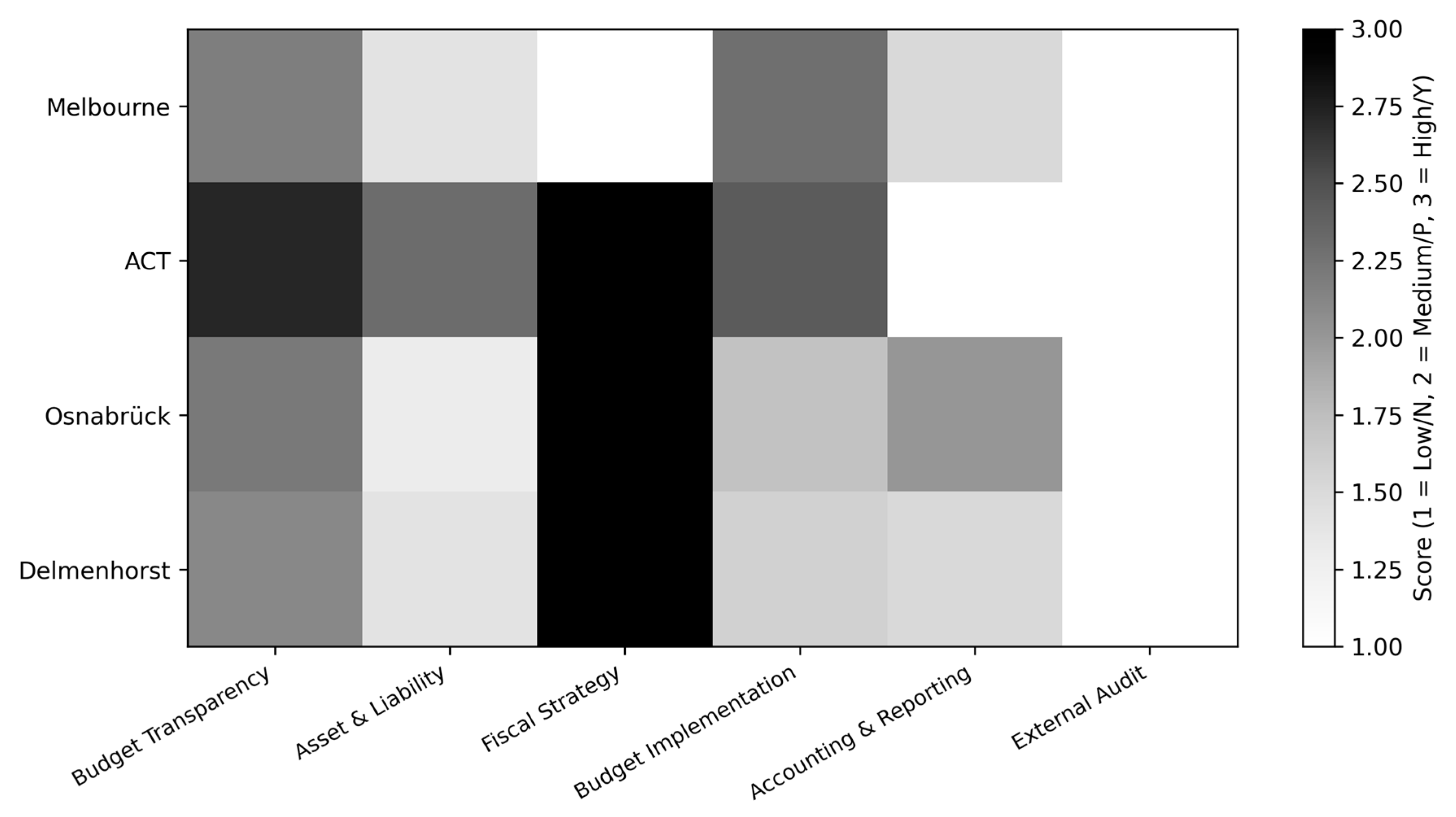
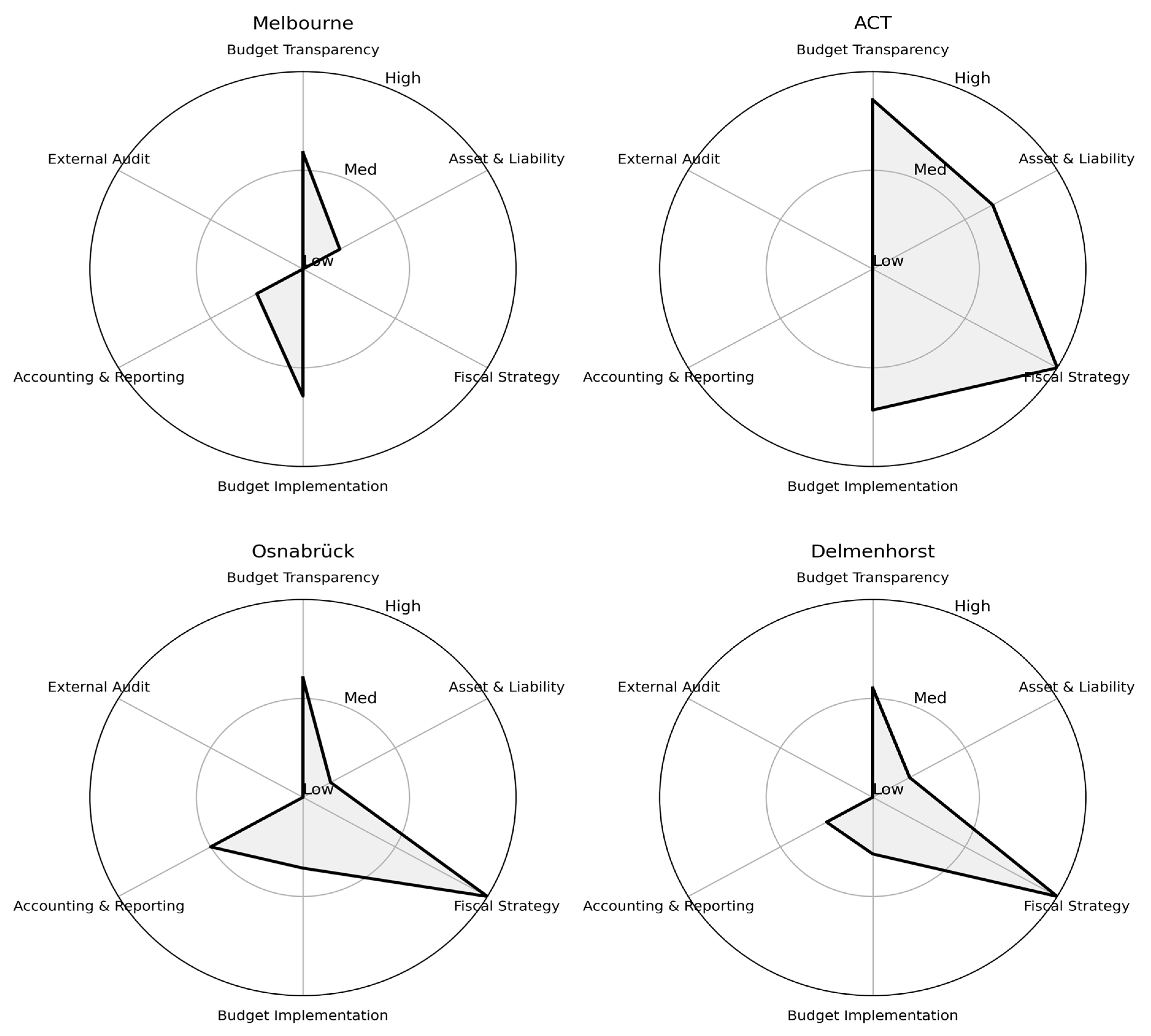
| PEFA Pillar | Melbourne | ACT | Osnabrück | Delmenhorst | Total of all Four Councils | Percentage of Y/P/N |
|---|---|---|---|---|---|---|
| Pillar I–II: Budget Transparency | 13Y/7P/8N | 24Y/0P/4N | 16Y/3P/10N | 12Y/7P/9N | 65Y/17P/31N | 58/15/27 |
| Pillar III: Asset & Liability Management | 2Y/0P/8N | 6Y/1P/3N | 0Y/3P/7N | 1Y/2P/7N | 7Y/6P/27N | 18/15/67 |
| Pillar IV: Fiscal Strategy | 0Y/0P/1N | 1Y/0P/0N | 1Y/0P/0N | 1Y/0P/0N | 3Y/0P/1N | 75/0/25 |
| Pillar V: Budget Implementation | 4Y/1P/2N | 5Y/0P/2N | 2Y/1P/4N | 2Y/0P/5N | 13Y/2P/13N | 46/08/46 |
| Pillar VI: Accounting & Reporting | 0Y/1P/1N | 0Y/0P/2N | 1Y/0P/1N | 0Y/1P/1N | 1Y/1P/6N | 12/13/75 |
| Pillar VII: External Audit & Oversight | 0Y/0P/1N | 0Y/0P/1N | 0Y/0P/1N | 0Y/0P/1N | 0Y/0P/4N | 0/0/100 |
| Total = 49 | 19Y/9P/21N | 36Y/1P/12N | 19Y/7P/23N | 16Y/10P/23N | 90Y/27P/79N | 46/14/40 |
Disclaimer/Publisher’s Note: The statements, opinions and data contained in all publications are solely those of the individual author(s) and contributor(s) and not of MDPI and/or the editor(s). MDPI and/or the editor(s) disclaim responsibility for any injury to people or property resulting from any ideas, methods, instructions or products referred to in the content. |
© 2026 by the authors. Licensee MDPI, Basel, Switzerland. This article is an open access article distributed under the terms and conditions of the Creative Commons Attribution (CC BY) license.
Share and Cite
Coghill, K.; Buchholz, G.; Waheduzzaman, W. Innovating Fiscal Transparency Through Open Government Partnerships: A Comparative Study of Local Governments in Australia and Germany. Adm. Sci. 2026, 16, 106. https://doi.org/10.3390/admsci16020106
Coghill K, Buchholz G, Waheduzzaman W. Innovating Fiscal Transparency Through Open Government Partnerships: A Comparative Study of Local Governments in Australia and Germany. Administrative Sciences. 2026; 16(2):106. https://doi.org/10.3390/admsci16020106
Chicago/Turabian StyleCoghill, Ken, Gabriele Buchholz, and Wahed Waheduzzaman. 2026. "Innovating Fiscal Transparency Through Open Government Partnerships: A Comparative Study of Local Governments in Australia and Germany" Administrative Sciences 16, no. 2: 106. https://doi.org/10.3390/admsci16020106
APA StyleCoghill, K., Buchholz, G., & Waheduzzaman, W. (2026). Innovating Fiscal Transparency Through Open Government Partnerships: A Comparative Study of Local Governments in Australia and Germany. Administrative Sciences, 16(2), 106. https://doi.org/10.3390/admsci16020106