Skip to Content
Administrative SciencesAdministrative Sciences
  • Systematic Review
  • Open Access

20 February 2026

Entrepreneurship Education as a Moderating Mechanism in the Formation of Entrepreneurial Intentions: A Systematic Integrative Review with Implications for Sustainability in Emerging Economies with Special Reference to Oman


and
Department of Marketing and Entrepreneurship, College of Commerce and Business Administration, Dhofar University, Salalah 211, Oman
*
Author to whom correspondence should be addressed.

Abstract

Entrepreneurship education (EE) is increasingly considered an important tool in promoting sustainable economic development, yet the empirical base for its effect on entrepreneurial intention (EI) is dispersed and not consistent. However, the literature fails to address EE as a direct antecedent of EI and pays little attention to conditional mechanisms that explain how education contributes to shaping entrepreneurial cognition. To address this gap, this article performs a systematic–integrative review of the literature where entrepreneurship education is a moderating variable in entrepreneurial intentionality. Based on PRISMA 2020, peer-reviewed journal papers from 2000 to 2025 were collected through Scopus and Web of Science and systematized with the theory-building integrative method. Using the Theory of Planned Behavior, Shapero’s Entrepreneurial Event Model, Social Cognitive Theory and Human Capital Theory, we show in the review that entrepreneurship education primarily moderates how entrepreneurial attitudes, subjective norms and perceived behavioral control predict entrepreneurial intention rather than exert uniform direct effects. The results also reveal that the moderating effect of EE is dependent on pedagogical quality, level of experiential depth, extent of cultural fit and institutional support, with strong implications for emerging and collectivist economies. Holistic in approach, the study demonstrates how education for entrepreneurship can focus entrepreneurial intention on sustainable value creation, economic diversification and inclusive development contributing directly to SDGs 4 (quality education), 8 (decent work and economic growth) and 9 (industry innovation and infrastructure). The paper introduces a context-dependent conceptual framework, and discusses some implications for sustainability-related educational design and policy.

1. Introduction

Entrepreneurship has increasingly been recognized as a cornerstone of sustainable economic development, social resilience, and innovation-driven growth, particularly in emerging and transition economies (Ebabu et al., 2025; Naguib & Barbar, 2025). Beyond its traditional association with venture creation and employment generation, entrepreneurship is now understood as a multidimensional phenomenon that contributes to broader sustainability outcomes, including poverty reduction, social inclusion, technological upgrading, and environmental innovation (Elmonshid & Sayed, 2024; Al Boinin, 2023). This expanded understanding has positioned entrepreneurship at the center of global development agendas, most notably within the United Nations Sustainable Development Goals (SDGs) (Günzel-Jensen et al., 2020). In particular, SDG 4 (Quality Education), SDG 8 (Decent Work and Economic Growth), and SDG 9 (Industry, Innovation, and Infrastructure) explicitly underscore the role of education-led entrepreneurship in fostering inclusive and sustainable economic systems.
Within this policy and development context, entrepreneurship education (EE) has emerged as a key institutional mechanism through which governments and higher education institutions seek to cultivate entrepreneurial mindsets, skills, and intentions among young people (Ahmad et al., 2023; Khalil et al., 2024). Universities, especially in emerging economies, are increasingly expected to function not only as centers of knowledge transmission but also as catalysts for innovation, employability, and sustainable value creation (Dalmarco et al., 2018). As a result, entrepreneurship education has become deeply embedded in national development strategies, youth employment policies, and sustainability-oriented educational reforms (Foucrier & Wiek, 2019).
At the individual level, entrepreneurial intention (EI) has been widely accepted as the most proximal and reliable predictor of entrepreneurial behavior (Lihua, 2022; Brás et al., 2024). Intention-based models dominate entrepreneurship research (Liñán, 2004) because entrepreneurial action is rarely spontaneous; rather, it is preceded by deliberate cognitive processes shaped by attitudes, perceptions, and social influences. Consequently, a substantial body of empirical research (Perreault et al., 2014; Higgs & Dulewicz, 2014; Fernández-Pérez et al., 2019) has focused on identifying the antecedents of EI, with particular emphasis on psychological, educational, and contextual determinants.
Early entrepreneurial intention studies largely conceptualized entrepreneurship education as a direct antecedent of EI, implicitly assuming a linear and universal relationship between exposure to entrepreneurship courses and increased entrepreneurial motivation. While several studies reported positive effects of EE on EI (Liu et al., 2019; Zhang et al., 2014; Jena, 2020), subsequent research produced far more mixed and context-dependent findings. Meta-analyses and large-scale reviews have shown that the magnitude, direction, and even the significance of EE’s impact on EI vary considerably across countries, educational systems, pedagogical designs, and cultural contexts (Bae et al., 2014; Martin et al., 2013; Martínez-Gregorio et al., 2021; Nabi et al., 2017).
This growing ambiguity has prompted a gradual but important shift in the EI literature—from a narrow focus on direct effects toward a more nuanced examination of contingent, conditional, and moderating mechanisms. Rather than asking whether entrepreneurship education “works,” scholars are increasingly concerned with how, when, and under what conditions EE influences entrepreneurial intention (Nabi et al., 2017). This shift reflects broader theoretical developments in behavioral science, which recognize that education does not operate in a vacuum but interacts dynamically with individual cognition, social norms, and institutional environments.
Behavioral intention theories provide strong theoretical justification for this shift. The Theory of Planned Behavior (TPB) posits that entrepreneurial intention is shaped by three core antecedents: attitudes toward entrepreneurship, subjective norms, and perceived behavioral control (Ajzen, 1991). Importantly, TPB does not assume that these antecedents exert fixed or uniform effects across individuals or contexts (Hassan et al., 2016). Instead, their influence may be strengthened, weakened, or reshaped by learning processes, socialization, and institutional exposure. From this perspective, entrepreneurship education can be more plausibly conceptualized as a moderating mechanism that conditions how attitudes, norms, and perceived control translate into entrepreneurial intention, rather than as a standalone causal factor (Entrialgo & Iglesias, 2016).
Despite this theoretical logic, the empirical literature examining entrepreneurship education as a moderator remains fragmented and underdeveloped. Many studies continue to treat EE as an exogenous variable with direct effects, often without sufficient attention to pedagogical quality, duration, or contextual relevance. Where moderation effects are examined, findings are inconsistent. Some studies report that EE strengthens the impact of entrepreneurial attitudes or perceived behavioral control on EI (Aga & Singh, 2022; Ngo et al., 2024), while others find weak or insignificant moderating effects (Melchor-Duran et al., 2024; Ilomo & Mwantimwa, 2023). These contradictions suggest that the role of entrepreneurship education is far more complex than previously assumed and that its effectiveness is contingent upon contextual and institutional factors.
Contextual variation is particularly salient in emerging and collectivist economies, where cultural norms, family expectations, and labor market structures differ markedly from those in Western individualistic societies (Hofstede, 2001). In such contexts, subjective norms and family influence often exert a stronger impact on career intentions than personal attitudes alone. Consequently, entrepreneurship education may play a critical moderating role by reshaping social perceptions, legitimizing entrepreneurial careers, and enhancing perceived feasibility (Shah et al., 2020).
The Gulf Cooperation Council (GCC) region provides a particularly compelling context for examining these dynamics. Despite significant investments in entrepreneurship education and innovation ecosystems, youth entrepreneurial activity remains uneven, and public-sector employment continues to dominate graduate career aspirations (Al Shabibi, 2020). In regions such as Dhofar Governorate in Oman, deeply embedded collectivist values, strong family structures, and historical dependence on public employment shape students’ entrepreneurial cognition in distinctive ways. Entrepreneurship education in such contexts cannot be assumed to operate similarly to that in Western economies; instead, its role is likely to be contingent upon cultural alignment, pedagogical design, and institutional support.
From a sustainability perspective, this contextual sensitivity is critical. Sustainable entrepreneurship is not merely about increasing the number of new ventures but about fostering responsible, inclusive, and long-term value creation aligned with societal needs (Bischoff & Volkmann, 2018). If entrepreneurship education fails to account for local socio-cultural realities, it risks producing superficial or short-lived outcomes that do little to advance sustainable development objectives. Conversely, when designed and implemented effectively, EE can serve as a powerful lever for aligning individual entrepreneurial aspirations with broader sustainability goals, including social cohesion, environmental responsibility, and economic diversification (Suguna et al., 2024).
Despite the strategic importance of these issues, existing review studies have largely failed to provide an integrative understanding of entrepreneurship education as a moderating mechanism in the formation of entrepreneurial intention. Prior reviews tend to focus either on the overall effectiveness of EE (Martin et al., 2013; Nabi et al., 2017) or on the bibliometric mapping of EI research without deep theoretical synthesis. Few studies systematically integrate behavioral theories, empirical findings, and contextual considerations to explain why EE strengthens EI in some settings while failing to do so in others. This gap is particularly pronounced for emerging economies and collectivist societies, which remain underrepresented in mainstream entrepreneurship education research.
Addressing this gap is not only of academic interest but also of significant policy relevance. Governments and higher education institutions continue to invest substantial resources in entrepreneurship education as part of sustainability-oriented development strategies. Without a clear understanding of the mechanisms through which EE influences entrepreneurial intention, such investments risk inefficiency or misalignment with local development needs. A theoretically grounded and context-sensitive synthesis is therefore essential for informing evidence-based educational design and policy formulation.
Despite extensive research on entrepreneurship education and entrepreneurial intention, the precise mechanism through which EE influences EI remains theoretically under-specified. Most prior studies have treated EE as a direct antecedent of intention, overlooking its potential role as a contextual and pedagogical conditioning force. This creates a conceptual gap between intention-based theory and educational practice. Specifically, the literature lacks a structured explanation of how EE interacts with the core antecedents of entrepreneurial intention—attitude, subjective norms, and perceived behavioral control—and under what contextual conditions these interactions vary. Addressing this mechanism-based gap, particularly in emerging and collectivist economies, forms the central research problem of this review.
Against this backdrop, the present study undertakes a systematic integrative review of the literature on entrepreneurship education and entrepreneurial intention, with a specific focus on the moderating role of EE. The review seeks to move beyond the question of whether entrepreneurship education works, toward a deeper understanding of how, when, and under what conditions it shapes entrepreneurial intention. By synthesizing theoretical foundations, empirical evidence, and contextual insights, this review aims to develop a coherent conceptual framework that explains the contingent role of EE in EI formation.
The specific objectives of this review are threefold. First, it aims to critically examine the theoretical foundations underpinning entrepreneurial intention research, with particular attention to how education interacts with cognitive and social antecedents. Second, it seeks to synthesize empirical findings on entrepreneurship education as a moderating mechanism, identifying patterns, contradictions, and explanatory factors across studies. Third, it aims to propose a context-sensitive conceptual framework that integrates sustainability considerations and is particularly relevant for emerging and collectivist economies.
In doing so, this review makes several contributions. At the theoretical level, it advances entrepreneurship education research by reconceptualizing EE as a conditional and context-dependent mechanism rather than a universally effective intervention. At the empirical level, it highlights systematic gaps in the literature, particularly the underrepresentation of emerging economies and sustainability-oriented perspectives. At the policy and educational level, it provides insights for designing entrepreneurship education programs that are better aligned with local socio-cultural realities and sustainable development objectives. This review also forms part of an approved institutional research project examining the moderating role of entrepreneurship education in the formation of entrepreneurial intentions among students in Dhofar Governorate, Oman. As such, it provides the theoretical and empirical foundation for subsequent empirical investigation, while contributing more broadly to the international literature on entrepreneurship, education, and sustainability.

2. Review Methodology

Based on the works of (Mueller & Pieperhoff, 2023; Klarin & Suseno, 2023; Cronin & George, 2023), this study adopts a systematic–integrative review methodology. It combines the procedural rigor of systematic reviews with the theory-building orientation of integrative synthesis. This methodological choice is particularly appropriate for entrepreneurship education and entrepreneurial intention research, where conceptual diversity, methodological heterogeneity, and strong contextual dependence limit the usefulness of purely aggregative approaches such as meta-analysis. By integrating systematic search and screening procedures with critical and interpretive synthesis, the present review aims to generate a coherent understanding of entrepreneurship education (EE) as a moderating mechanism in the formation of entrepreneurial intentions (EIs), rather than merely summarizing prior findings. The review protocol follows the PRISMA 2020 guidelines, ensuring transparency, replicability, and methodological rigor throughout the identification, screening, eligibility, and inclusion stages (Page et al., 2021; Sarkis-Onofre et al., 2021). At the same time, the integrative component allows for the reconciliation of diverse theoretical perspectives and empirical results, which is essential given the fragmented and often contradictory nature of the EE–EI literature.

2.1. Rationale for a Systematic–Integrative Review Approach

It is clear from the review of the literature that research on entrepreneurship education comes from many fields which include management, education, psychology, sociology, and development studies, among others (Béchard & Grégoire, 2005). Also, studies differ in their theories, research designs, methods of measurement, and the contexts in which they are conducted. Because of the above-mentioned facts, the literature is highly diverse. This diversity makes synthesis challenging. Traditional narrative reviews can be flexible, but they often rely too much on the author’s judgment. On the other hand, purely systematic or quantitative reviews tend to focus on patterns and effect sizes (Ben Hassen, 2022). In doing so, they may miss important meanings, explanations, and contextual differences. These limitations are especially relevant in entrepreneurship education research. However, an integrative review helps to overcome these issues. It is well suited to answering questions about how and why entrepreneurship education works. This approach allows empirical findings to be combined with theoretical insights. As a result, it supports deeper interpretation and the development of new conceptual understanding (Blenker et al., 2014). In this study, the integrative approach makes it possible to rethink the role of entrepreneurship education. Instead of viewing it only as a direct predictor of entrepreneurial intention, it is examined as a moderating mechanism. In this role, entrepreneurship education shapes how cognitive, social, and institutional factors influence intention formation. At the same time, the review follows a systematic and PRISMA-compliant process. This ensures clarity, transparency, and rigor. Together, these elements provide a balanced review that meets the expectations of high-quality journals in sustainability and education research.

2.2. Review Protocol and Reporting Standards

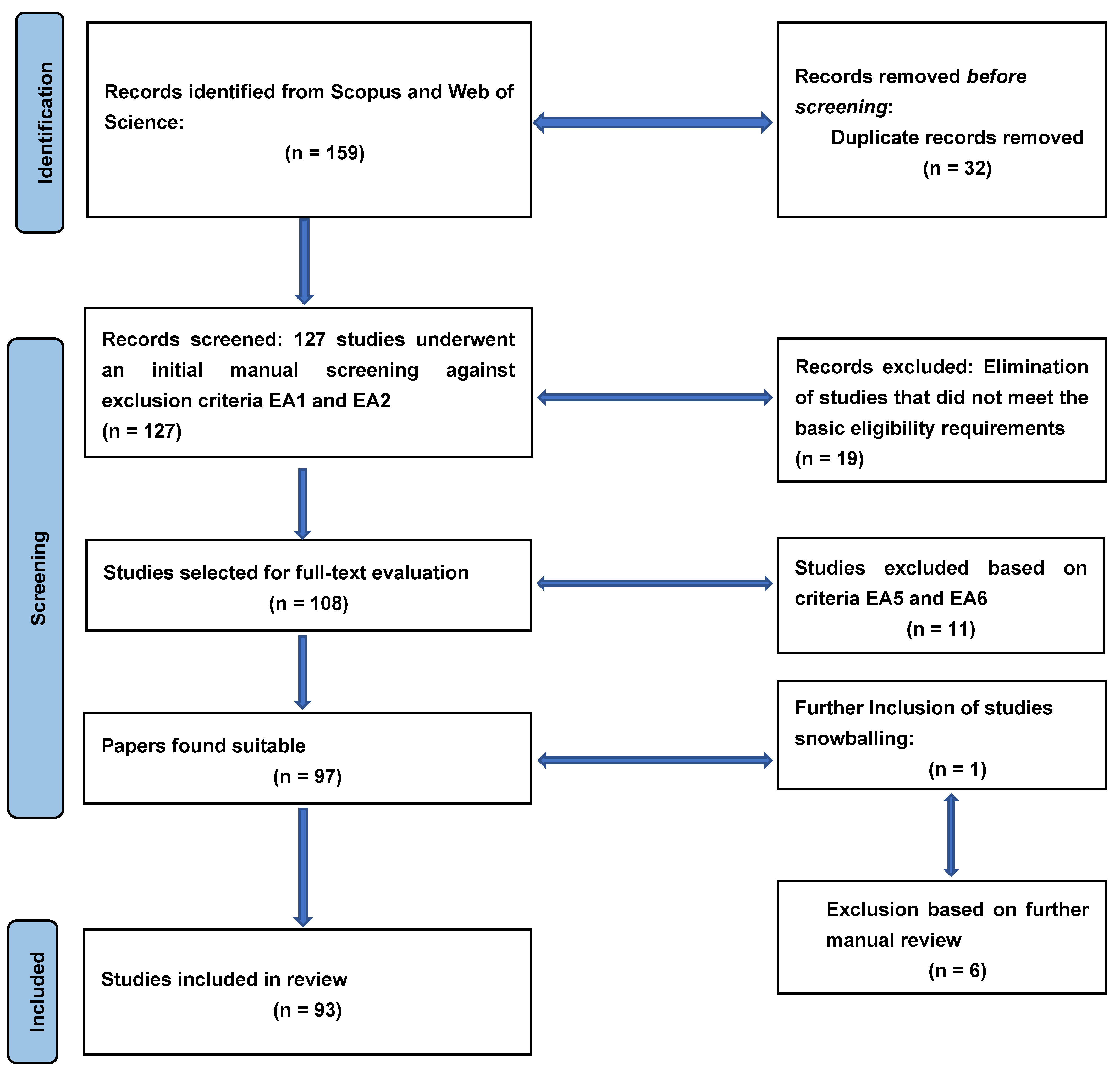
The review followed the PRISMA 2020 Statement, which offers clear and updated guidance for conducting and reporting systematic reviews (Sarkis-Onofre et al., 2021). PRISMA was chosen because it promotes transparent reporting of search procedures, selection decisions, and synthesis methods. Although it was first developed for health-related research, it is now widely used in management, education, and sustainability studies to improve rigor and credibility. The PRISMA framework structured the review process into four main steps (Figure 1). First, relevant studies were identified through systematic database searches. Next, titles and abstracts were screened to remove clearly irrelevant papers. This was followed by a full-text assessment to check eligibility against the defined criteria. Finally, the studies that met all requirements were included in the final synthesis.
Figure 1. PRISMA 2020 flow diagram illustrating the identification, screening, eligibility, and inclusion process for studies examining entrepreneurship education and entrepreneurial intention.

2.3. Data Sources and Search Strategy

Based on the work of Al-Lawati et al. (2021), a comprehensive literature search was conducted using Scopus and Web of Science (WoS). These databases were selected due to their extensive coverage of high-quality, peer-reviewed journals in entrepreneurship, business, education, and sustainability research. Together, they provide robust representation of Q1 and Q2 journals and are commonly recommended for systematic reviews in management and social sciences.
The search covered the period 2000–2025, reflecting the timeframe during which entrepreneurial intention research became theoretically consolidated and entrepreneurship education gained prominence as a policy and pedagogical tool. Earlier studies were excluded to maintain conceptual coherence and relevance to contemporary sustainability debates.
The search strategy employed a combination of keywords and Boolean operators, developed iteratively to balance sensitivity and specificity. Core search terms included:
  • “entrepreneurship education”;
  • “entrepreneurial intention”;
  • “moderator” OR “moderating effect”;
  • “students” OR “higher education”;
  • “emerging economies” OR “developing countries”.
Search strings were adapted to the syntax requirements of each database. Truncations and quotation marks were used where appropriate to capture variations in terminology. Reference lists of key articles were also manually screened to identify additional relevant studies not captured through database searches.

2.4. Inclusion and Exclusion Criteria

2.4.1. Inclusion Criteria (IA)

Table 1 presents the inclusion criteria applied to ensure that the selected studies explicitly examine the role of entrepreneurship education (EE) in shaping entrepreneurial intentions (EI), with particular attention to moderating mechanisms, theoretical grounding, and relevance to emerging and sustainability-oriented contexts.
Table 1. Inclusion Criteria (IA).

2.4.2. Exclusion Criteria (EA)

To exclude studies that did not align with the objectives of this systematic integrative review, the exclusion criteria outlined in Table 2 were applied. This ensured analytical focus on theoretical rigor, methodological relevance, and contextual applicability to entrepreneurship education and entrepreneurial intention research.
Table 2. Exclusion Criteria (EA).

2.5. Screening and Selection Process

The screening and selection of studies followed the PRISMA 2020 flow and are presented in Figure 1, Table 1 and Table 2. The initial search of Scopus and Web of Science identified 159 records. Before screening, 32 duplicate records were removed, leaving 127 studies for initial review. These 127 records underwent title and abstract screening based on the exclusion criteria EA1 and EA2. At this stage, 19 studies were excluded for not meeting the basic eligibility requirements. As a result, 108 studies were retained and subjected to full-text evaluation. Following the full-text assessment, 11 studies were excluded based on criteria EA5 and EA6. This process resulted in 97 papers deemed suitable for inclusion. In addition, 2 further studies were identified through backward and forward snowballing of reference lists. After an additional manual review, 6 studies were excluded due to insufficient relevance or rigor. Ultimately, 93 peer-reviewed journal articles met all inclusion criteria and were included in the final review. This number is appropriate for a systematic–integrative review focused on conceptual development, theoretical refinement, and identification of research gaps rather than statistical effect-size synthesis. The selected studies formed the empirical and theoretical foundation for the integrative analysis and framework development.
To enhance analytical rigor, the selected studies were also informally assessed for scholarly impact and methodological robustness. The majority were published in Q1 and Q2 journals indexed in Scopus and Web of Science, with several highly cited meta-analyses and foundational theoretical contributions included. Studies employing validated measurement instruments, structural equation modeling, longitudinal designs, or experimental approaches were given particular analytical attention during synthesis. Although a formal quality-scoring system was not applied—consistent with integrative review methodology—the inclusion criteria ensured theoretical grounding, empirical rigor, and contextual relevance to emerging and developing economies.

2.6. Data Extraction and Coding

For each included study, a structured data extraction protocol was employed to ensure consistency and comparability. Extracted information included:
  • Author(s) and year of publication;
  • Country and regional context;
  • Theoretical framework(s) employed;
  • Operationalization of entrepreneurship education;
  • Measurement of entrepreneurial intention;
  • Research design and analytical methods;
  • Key findings related to direct and moderating effects.
In addition, studies were coded according to contextual characteristics (e.g., developed vs. emerging economies, collectivist vs. individualist settings) and pedagogical attributes of entrepreneurship education (e.g., curriculum-based, experiential, institutional support). This coding process enabled systematic comparison across studies and facilitated the identification of recurring patterns and contradictions.

2.7. Integrative Synthesis Approach

Unlike meta-analysis, which aggregates effect sizes, the present study employed an integrative synthesis to interpret and reconcile diverse findings (Cronin & George, 2023). This approach involved iterative reading, comparison, and abstraction across studies to identify higher-order themes and theoretical insights. The synthesis proceeded in three stages. First, studies were grouped according to how entrepreneurship education was conceptualized (direct effect vs. moderating role). Second, findings were examined in relation to key antecedents of entrepreneurial intention, including attitudes, subjective norms, and perceived behavioral control. Third, contextual and sustainability dimensions were integrated to explain variation across settings. This process allowed the review to move beyond surface-level comparisons and develop a more nuanced understanding of why entrepreneurship education strengthens entrepreneurial intention in some contexts but not in others.

2.8. Addressing Context and Sustainability Dimensions

Given the journal’s focus and the study’s objectives, particular attention was paid to sustainability and contextual relevance. Studies were analyzed for their explicit or implicit engagement with sustainability outcomes, such as employability, social inclusion, innovation capacity, and long-term economic resilience. Contextual variables—such as cultural norms, family influence, labor market structures, and institutional environments—were treated as central explanatory factors rather than peripheral considerations. This emphasis is especially relevant for emerging and collectivist economies, where entrepreneurship education operates under different social and institutional constraints than in Western contexts.

2.9. Methodological Rigor and Limitations

The use of PRISMA 2020 enhances transparency and replicability; however, certain limitations must be acknowledged. First, restricting the review to English-language publications may exclude relevant regional studies. Second, the focus on peer-reviewed journals may omit policy reports or program evaluations that offer practical insights. Third, the integrative synthesis relies on interpretive judgment, which, while theoretically informed, cannot entirely eliminate subjectivity. Nonetheless, these limitations are consistent with high-quality systematic reviews in social sciences and are offset by the methodological rigor and conceptual depth achieved through the systematic–integrative approach.

2.10. Registration Statement

The review protocol was not registered in a public database, and no prior protocol was published.

3. Theoretical Foundations of Entrepreneurial Intention

Entrepreneurial intention (EI) occupies a central position in entrepreneurship research as the most immediate and reliable cognitive antecedent of entrepreneurial behavior (Lihua, 2022; Brás et al., 2024; Al Muniri et al., 2019). Unlike spontaneous or accidental actions, entrepreneurial activity is widely conceptualized as a planned, intentional, and purposive behavior, shaped by individuals’ perceptions, motivations, and contextual influences. As a result, intention-based theories have become the dominant theoretical lens for understanding why individuals choose—or refrain from—entrepreneurial careers (Al-Lawati et al., 2021; Al Lawati et al., 2026). This section critically reviews the principal theoretical frameworks underpinning EI research and examines their relevance for conceptualizing entrepreneurship education as a moderating mechanism rather than a simple direct determinant.

3.1. Theory of Planned Behavior (TPB)

The Theory of Planned Behavior (TPB) proposed by Ajzen (1991) is the most widely applied theoretical framework in entrepreneurial intention research (Ajzen, 2002; Al Sawaey et al., 2025). TPB posits that intention toward a specific behavior is determined by three antecedents: attitude toward the behavior, subjective norms, and perceived behavioral control (Al Sawaey et al., 2025). Attitude reflects an individual’s positive or negative evaluation of entrepreneurship as a career option; subjective norms capture perceived social pressure from significant others; and perceived behavioral control refers to the perceived ease or difficulty of performing entrepreneurial behavior, closely related to self-efficacy.
TPB has been extensively validated across cultural and institutional contexts and is particularly valued for its parsimony and predictive power. Numerous empirical studies confirm that attitudes and perceived behavioral control are consistently strong predictors of entrepreneurial intention, while subjective norms exhibit more context-dependent effects (Nabi et al., 2017; N. F. Krueger et al., 2000; Liñán & Chen, 2009). Importantly, TPB does not assume that these relationships are fixed or universal. Rather, the strength of each antecedent may vary depending on learning processes, socialization experiences, and institutional exposure.
This theoretical flexibility makes TPB especially relevant for examining education-based moderation. Entrepreneurship education can plausibly influence how attitudes are formed (Ambusaidi et al., 2024), how social norms are interpreted, and how perceptions of control are developed. For instance, EE may strengthen the translation of positive entrepreneurial attitudes into intention by providing cognitive structure and opportunity recognition skills (Anwar et al., 2023). Similarly, in collectivist societies, education may mitigate constraining subjective norms by legitimizing entrepreneurship as a socially acceptable career path. By enhancing skills, knowledge, and self-efficacy, EE can also amplify the effect of perceived behavioral control on intention.
From a moderation perspective, TPB thus provides a strong theoretical foundation for conceptualizing entrepreneurship education as a conditioning mechanism that shapes the cognitive pathways leading to entrepreneurial intention. Rather than exerting a uniform direct effect, EE influences how strongly and under what conditions TPB antecedents translate into intention, particularly across diverse socio-cultural contexts.

3.2. Shapero’s Entrepreneurial Event Model

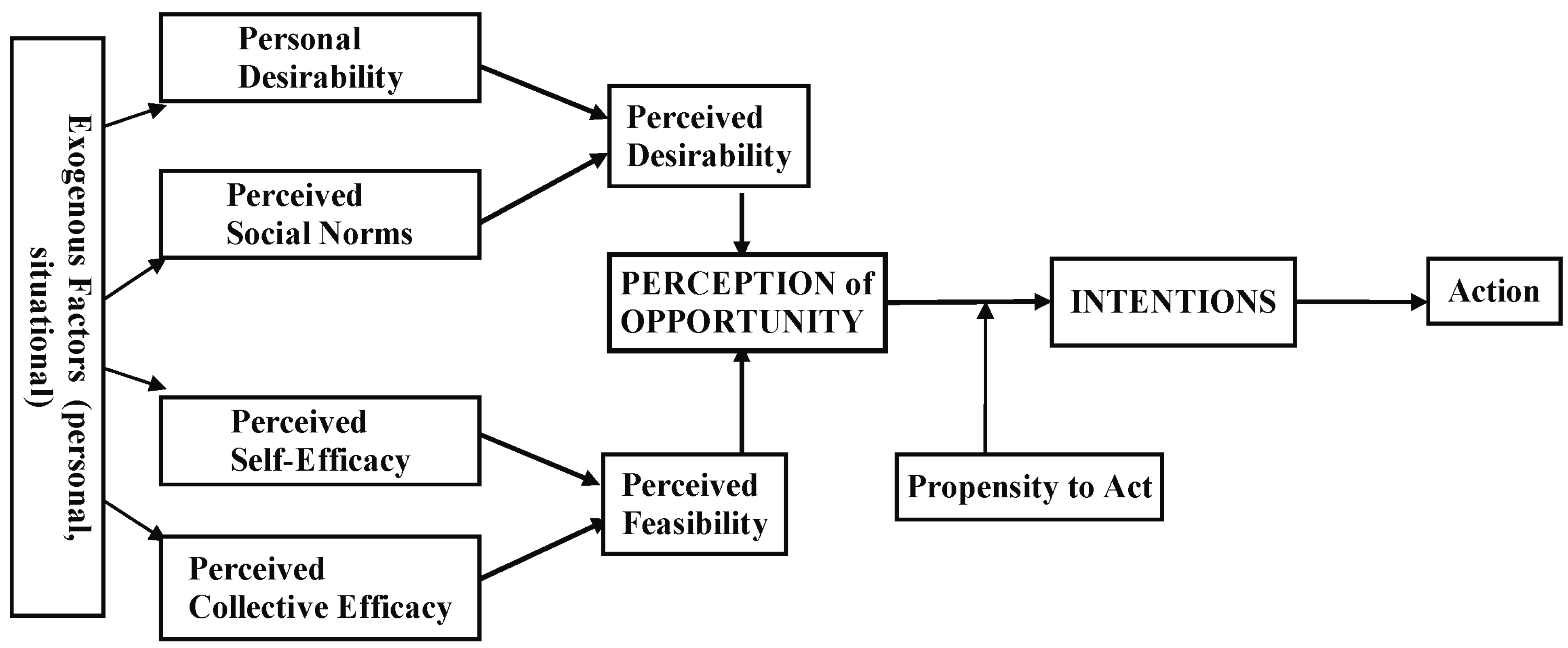
Shapero’s Entrepreneurial Event Model (EEM) offers a complementary and more contextually sensitive explanation of entrepreneurial intention. The model posits that entrepreneurial behavior is triggered by a “displacement event” that disrupts the status quo and prompts individuals to reconsider career choices. Entrepreneurial intention, in this framework, is determined by perceived desirability, perceived feasibility, and propensity to act (N. F. Krueger et al., 2000; Shapero & Sokol, 1982).
Perceived desirability reflects the attractiveness of entrepreneurship, shaped largely by social norms and cultural values. Perceived feasibility refers to an individual’s belief in their ability to successfully start a business, while propensity to act captures a personal disposition toward action in the face of opportunity. Unlike TPB, which emphasizes deliberate cognitive evaluation, EEM explicitly recognizes the role of contextual shocks, institutional environments, and social legitimacy in shaping entrepreneurial intentions.
Entrepreneurship education is particularly relevant within this framework because it can influence both desirability and feasibility perceptions (Pergelova et al., 2023). Educational programs that expose students to entrepreneurial role models, success stories, and experiential learning can enhance the perceived desirability of entrepreneurship, especially in contexts where entrepreneurial careers lack social prestige. At the same time, skill-based and experiential components of EE can increase perceived feasibility by reducing uncertainty and fear of failure.
From a moderation standpoint, EE can be understood as shaping the threshold at which displacement events translate into entrepreneurial intention. In environments characterized by economic uncertainty or limited employment opportunities—common in emerging economies—entrepreneurship education may strengthen the likelihood that such contextual triggers lead to entrepreneurial intention rather than withdrawal or risk avoidance. Conversely, weak or purely theoretical EE may fail to moderate these relationships, resulting in limited or inconsistent effects (Shapero & Sokol, 1982; Fayolle & Liñán, 2014; N. Krueger, 1993).

3.3. Social Cognitive Theory

Social Cognitive Theory (SCT), rooted in the work of Bandura (1986), provides an additional psychological foundation for understanding entrepreneurial intention. SCT emphasizes the role of self-efficacy, observational learning, and reciprocal interactions between personal factors, behavior, and environmental influences. Central to this theory is the notion that individuals’ beliefs about their capabilities significantly influence their motivation, persistence, and behavioral choices (Bandura, 1997; Zhao et al., 2005).
Entrepreneurial self-efficacy (Elbaz et al., 2025) has been consistently identified as a critical determinant of entrepreneurial intention, particularly in uncertain and resource-constrained environments. Individuals who believe they possess the skills and capabilities required for entrepreneurship are more likely to form entrepreneurial intentions and persist in the face of challenges. Social Cognitive Theory highlights the importance of learning environments in shaping these beliefs through mastery experiences, role modeling, feedback, and social persuasion (Bandura, 1997).
Entrepreneurship education is uniquely positioned to operationalize these mechanisms. Experiential learning, simulations, business plan development, and interaction with entrepreneurs provide opportunities for mastery experiences and vicarious learning, thereby enhancing self-efficacy (Al-Hattami et al., 2025). From a moderation perspective, EE may strengthen the relationship between perceived behavioral control and entrepreneurial intention by transforming abstract confidence into actionable competence.
Importantly, SCT also underscores the role of social context and institutional support. In collectivist societies, observational learning and social validation play a particularly strong role in shaping self-efficacy. Entrepreneurship education that incorporates culturally relevant role models and locally grounded examples may therefore exert stronger moderating effects on EI formation than standardized, context-neutral curricula.

3.4. Human Capital Theory

Human Capital Theory offers an economic and educational perspective on entrepreneurial intention by emphasizing the role of knowledge, skills, and competencies acquired through education and experience. From this perspective, individuals invest in education to enhance productivity and expand career opportunities, including entrepreneurship. Entrepreneurial intention emerges when individuals perceive that their human capital endowment makes entrepreneurial activity both feasible and rewarding (Unger et al., 2011; Davidsson & Honig, 2003).
Human capital theory provides a foundational justification for entrepreneurship education as a policy instrument aimed at enhancing entrepreneurial capacity. However, empirical evidence suggests that the mere accumulation of entrepreneurial knowledge does not automatically translate into entrepreneurial intention (Martin et al., 2013). Instead, the effectiveness of human capital investments depends on how they interact with cognitive, social, and institutional factors (Zhao et al., 2005).
This insight is particularly relevant for understanding entrepreneurship education as a moderating mechanism. EE may not directly generate entrepreneurial intention but may condition the returns to other forms of capital, such as attitudes, social support, or perceived control. For example, individuals with positive entrepreneurial attitudes may only translate those attitudes into intention when supported by relevant skills and competencies acquired through education. Similarly, family or social encouragement may be insufficient to foster EI in the absence of perceived entrepreneurial competence.
In emerging economies, where labor markets are often segmented and public-sector employment is highly valued, the moderating role of human capital becomes even more salient. Entrepreneurship education that fails to deliver context-specific and market-relevant skills may weaken, rather than strengthen, the intention formation process (Oosterbeek et al., 2010). Conversely, well-designed EE programs aligned with local economic realities may significantly enhance the effectiveness of existing entrepreneurial motivations (Welter, 2011).

Integrating Theories: Education-Based Moderation of Entrepreneurial Intention

While each of the above theories offers distinct insights, their integration provides a comprehensive foundation for conceptualizing entrepreneurship education as a moderating mechanism in entrepreneurial intention formation. TPB highlights the cognitive antecedents of intention, Shapero’s model emphasizes contextual triggers and social legitimacy, Social Cognitive Theory focuses on self-efficacy and learning processes, and Human Capital Theory underscores the role of skills and competencies. Taken together, these theories suggest that entrepreneurship education operates indirectly and conditionally, shaping the pathways through which attitudes, norms, perceived feasibility, and contextual factors influence entrepreneurial intention. This integrative perspective helps explain why EE exhibits inconsistent direct effects across studies and contexts. It also aligns with recent calls in the literature to move beyond simplistic input–output models of entrepreneurship education toward more nuanced, mechanism-based explanations. A sustainability perspective, this theoretical integration is particularly important (Naguib & Barbar, 2025; Foucrier & Wiek, 2019; Mabkhot et al., 2024). Sustainable entrepreneurship requires not only intention formation but also responsible decision-making, long-term orientation, and social legitimacy. Education-based moderation allows entrepreneurship education to align individual entrepreneurial aspirations with broader societal and sustainability objectives, including inclusive growth, innovation, and resilience.
The relevance of these theoretical foundations is amplified in emerging and collectivist economies, where entrepreneurial intention is shaped by strong social norms, family expectations, and institutional constraints (Welter, 2011; Fayolle & Liñán, 2014). In such contexts, entrepreneurship education may play a pivotal moderating role by reshaping cognitive evaluations, legitimizing entrepreneurial careers, and enhancing perceived feasibility. Rather than assuming universal effectiveness, the integrated theoretical framework advanced in this section underscores the need for context-sensitive, sustainability-oriented entrepreneurship education. By recognizing education as a moderator embedded within complex socio-cultural systems, this review provides a robust theoretical basis for subsequent empirical investigation and policy design.

4. Conceptualizations of Entrepreneurship Education

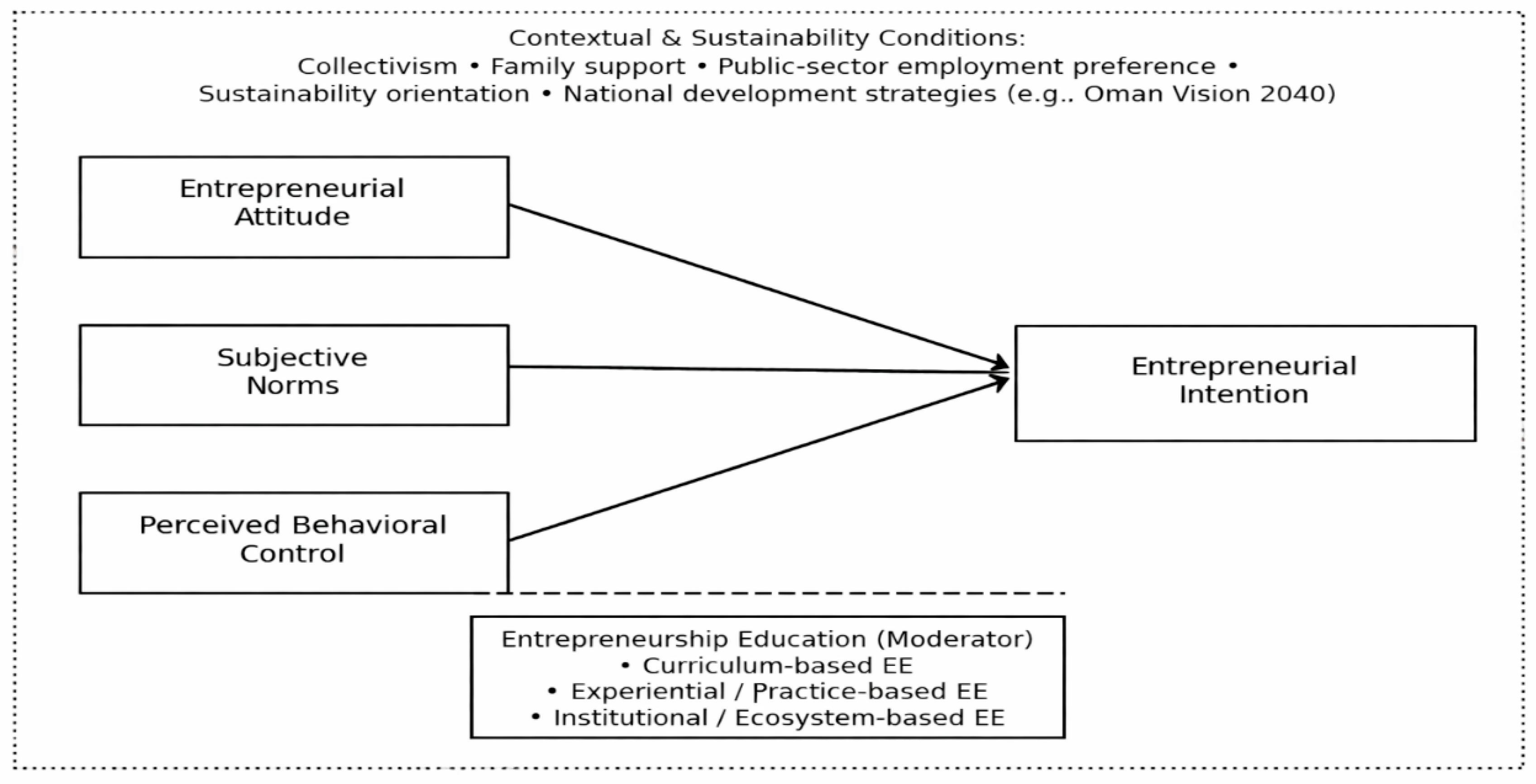
Entrepreneurship education (EE) has evolved substantially over the past three decades, transitioning from a marginal curricular component focused on small business management to a central pillar of higher education strategies aimed at innovation, employability, and sustainable development. Despite its growing prominence, EE remains a conceptually heterogeneous construct, characterized by wide variation in objectives, pedagogical design, institutional embedding, and measurement. This heterogeneity has contributed significantly to the inconsistent empirical findings observed in studies examining the relationship between entrepreneurship education and entrepreneurial intention. Understanding how EE is conceptualized is therefore essential for explaining why its effects are often contingent, context-dependent, and theoretically ambiguous (Figure 2). The conceptual framework presented in Figure 2 was inductively developed through the integrative synthesis of the 93 reviewed studies. First, empirical findings were categorized according to whether EE was treated as a direct predictor or a moderating variable. Second, studies were mapped against the three primary EI antecedents derived from the Theory of Planned Behavior. Third, contextual variables—such as cultural norms, family influence, institutional support, and sustainability orientation—were systematically coded and examined for interaction effects. The resulting framework therefore reflects cumulative evidence showing that EE does not uniformly increase EI but conditions the strength of cognitive and social pathways leading to intention. Each moderating pathway depicted in the model is grounded in recurring empirical patterns identified across multiple studies.
Figure 2. A Contextual–Sustainability Moderation Framework of Entrepreneurship Education and Entrepreneurial Intention (EE–EI). Note: The framework illustrates how entrepreneurship education conditionally moderates the translation of entrepreneurial attitudes, subjective norms, and perceived behavioral control into entrepreneurial intention under contextual and sustainability constraints.
This section critically examines dominant conceptualizations of entrepreneurship education in the literature, distinguishing among curriculum-based instruction, experiential and practice-based learning, and institutional and ecosystem support. It further reviews how EE has been operationalized and measured in prior studies and discusses how pedagogical intensity, duration, and delivery mode shape educational outcomes. Together, these dimensions provide the conceptual foundation for viewing entrepreneurship education as a moderating mechanism rather than a uniform or linear intervention.
Table 3 demonstrates that entrepreneurship education is not a homogeneous construct but encompasses multiple pedagogical and institutional configurations. Each conceptualization operates through distinct psychological and contextual mechanisms—shaping attitudes, perceived behavioral control, and subjective norms in different ways. This conceptual heterogeneity provides a compelling explanation for the inconsistent empirical findings reported in prior EE–EI research and supports the argument that entrepreneurship education functions more plausibly as a moderating mechanism rather than a direct antecedent of entrepreneurial intention.
Table 3. Dominant Conceptualizations and Pedagogical Dimensions of Entrepreneurship Education in Entrepreneurial Intention Research.

4.1. Entrepreneurship Education as Curriculum-Based Instruction

The earliest and most widespread conceptualization of entrepreneurship education frames it as formal, curriculum-based instruction delivered within higher education institutions (Magd & Kunjumuhammed, 2024; Justice et al., 2009). Under this model, EE typically takes the form of standalone courses or modules embedded within business, economics, or management programs. The primary objectives of such courses are to introduce students to entrepreneurial concepts, opportunity identification, business planning, and venture management (Table 3).
Curriculum-based EE is often grounded in cognitive and informational assumptions (Al Muniri et al., 2019), emphasizing the transmission of knowledge about entrepreneurship rather than the development of entrepreneurial behavior or identity. Teaching methods commonly include lectures, case studies, examinations, and written assignments. From a policy perspective, this approach has been attractive because it is scalable, relatively low-cost, and easy to integrate into existing academic structures.
Empirical evidence suggests that curriculum-based EE can positively influence students’ entrepreneurial awareness, knowledge (Igwe et al., 2022), and attitudes, particularly among individuals with limited prior exposure to entrepreneurship. However, its impact on entrepreneurial intention has been far less consistent. Several studies report modest or insignificant effects of traditional EE courses on EI, especially when courses are heavily theoretical and detached from real-world practice. In some cases, increased awareness of entrepreneurial risks and constraints has even been associated with a decline in entrepreneurial intention, a phenomenon often referred to as the “discouragement effect.”
From a moderation perspective, curriculum-based instruction may be insufficient to directly generate entrepreneurial intention but may still play an important conditioning role. By shaping cognitive frameworks, vocabulary, and mental models, formal instruction can influence how students interpret entrepreneurial opportunities, social norms, and perceived feasibility. In this sense, curriculum-based EE may moderate the relationship between attitudes and intention by providing the analytical tools needed to translate positive dispositions into more deliberate career intentions. However, when delivered in isolation or without experiential components, its moderating capacity remains limited.

4.2. Entrepreneurship Education as Experiential and Practice-Based Learning

In response to the limitations of purely theoretical instruction, a growing body of literature conceptualizes entrepreneurship education as experiential and practice-based learning (Hynes et al., 2010; Brush et al., 2015). This approach draws on constructivist learning theories and emphasizes learning through action, reflection, and interaction with real-world entrepreneurial contexts. Experiential EE includes pedagogical tools such as business simulations, startup projects, internships, incubator participation, mentoring, and engagement with practicing entrepreneurs.
Practice-based EE is widely regarded as more effective in fostering entrepreneurial competencies, self-efficacy, and opportunity recognition skills (Hynes et al., 2010). By exposing students to uncertainty, problem-solving, and iterative learning, experiential education aligns closely with the realities of entrepreneurial activity. Empirical studies consistently show stronger associations between experiential EE and entrepreneurial intention compared to traditional lecture-based courses.
Theoretically, experiential EE is particularly relevant for understanding education-based moderation. Through mastery experiences and social learning, experiential programs enhance perceived behavioral control and entrepreneurial self-efficacy (Koropogui et al., 2024), thereby strengthening the link between feasibility perceptions and entrepreneurial intention. Moreover, interaction with entrepreneurial role models can reshape subjective norms by increasing the social legitimacy of entrepreneurship, especially in collectivist or risk-averse societies.
However, experiential EE is not without challenges. Such programs are resource-intensive, require institutional commitment, and often depend on external partnerships. Their effectiveness also varies depending on design quality, supervision, and cultural alignment. Poorly structured experiential activities may fail to produce intended learning outcomes, contributing to further heterogeneity in empirical findings. This variability reinforces the argument that EE’s impact on EI is conditional, shaped by pedagogical design rather than mere participation.

4.3. Entrepreneurship Education as Institutional and Ecosystem Support

A more recent and holistic conceptualization views entrepreneurship education as part of a broader institutional and entrepreneurial ecosystem (Belitski & Heron, 2017). Under this perspective, EE extends beyond individual courses or programs to include the organizational, cultural, and infrastructural environment within which learning occurs. This includes university-level support structures such as entrepreneurship centers, incubators, accelerators, seed funding, networking events, and links with industry, government, and civil society.
Ecosystem-based conceptualizations emphasize that entrepreneurial learning is socially embedded and institutionally mediated (Khurana & Dutta, 2021). Students’ entrepreneurial intentions are shaped not only by what they learn in the classroom but also by the signals, incentives, and opportunities provided by their institutional environment. Universities that actively promote entrepreneurship through visible support mechanisms tend to create stronger entrepreneurial cultures, which can normalize risk-taking and innovation.
From a moderation standpoint, institutional and ecosystem support can significantly enhance the effectiveness of both curriculum-based and experiential EE. Supportive ecosystems may amplify the influence of entrepreneurial attitudes and social norms by reducing perceived barriers and increasing opportunity visibility (Ermawati, 2023). Conversely, weak or fragmented ecosystems may neutralize the potential benefits of even well-designed educational programs. This perspective is especially relevant for emerging economies, where institutional voids, regulatory uncertainty, and limited access to finance often constrain entrepreneurial activity. In such contexts, entrepreneurship education that is not embedded within a supportive ecosystem may have limited moderating power, underscoring the importance of aligning educational interventions with broader institutional reforms.

4.4. Measurement Approaches in Entrepreneurship Education Research

One of the most persistent challenges in EE–EI research lies in the measurement of entrepreneurship education. Prior studies employ a wide range of operationalizations, often with limited conceptual clarity. Common measurement approaches include binary indicators (e.g., participation vs. non-participation), self-reported exposure to entrepreneurship courses, perceived learning outcomes, and composite indices capturing multiple educational dimensions.
Binary measures, while simple, fail to capture variation in pedagogical quality, intensity, and content. As a result, they often obscure meaningful differences between educational experiences, contributing to inconsistent empirical findings. Self-reported measures of perceived EE quality or usefulness offer greater nuance but may be subject to recall bias and social desirability effects.
More sophisticated studies such as (Dhliwayo, 2008; Valerio et al., 2014; Mandel & Noyes, 2016) attempt to disaggregate EE into specific components, such as experiential learning, skills development, and institutional support. These approaches provide richer insights into how different dimensions of EE interact with entrepreneurial intention. However, they remain relatively rare, and there is little consensus on standardized measurement frameworks.
From a moderation perspective, the inadequate measurement of EE poses a significant threat to theoretical advancement. If entrepreneurship education is conceptualized broadly but measured narrowly, its conditional effects are likely to be underestimated or misinterpreted. This measurement gap reinforces the need for integrative frameworks that align conceptualization, operationalization, and theoretical purpose.

4.5. Pedagogical Intensity, Duration, and Delivery Mode

Beyond conceptualization and measurement, pedagogical intensity, duration, and delivery mode play a critical role in shaping the impact of entrepreneurship education (Nikou et al., 2023; Verduijn & Berglund, 2020; Iqbal et al., 2022). Pedagogical intensity refers to the depth and rigor of engagement, including workload, assessment complexity, and level of student involvement. Duration encompasses the length of exposure to EE, ranging from short workshops to multi-year programs. Delivery mode includes face-to-face, blended, and online formats.
Evidence suggests that short-term or low-intensity EE interventions are unlikely to produce lasting changes in entrepreneurial intention. While such programs may raise awareness, they often lack the sustained engagement required to influence deep-seated attitudes, norms, and self-efficacy. In contrast, longer and more intensive programs—particularly those combining theoretical instruction with experiential learning—are more likely to exert meaningful moderating effects.
Delivery mode has gained increasing attention in recent years, particularly with the expansion of digital and online education. While online EE offers scalability and accessibility, concerns remain regarding its ability to foster experiential learning and social interaction. Hybrid models that integrate digital content with in-person activities may offer a more effective balance, though empirical evidence remains mixed. These pedagogical dimensions further underscore the importance of moving beyond simplistic conceptualizations of entrepreneurship education. Without accounting for intensity, duration, and delivery mode, studies risk conflating fundamentally different educational experiences under a single label, thereby obscuring moderation effects.

4.6. Implications for Education-Based Moderation of Entrepreneurial Intention

The diversity of conceptualizations reviewed in this section highlights a central insight: entrepreneurship education is not a uniform treatment (Von Graevenitz et al., 2010; Farny et al., 2019). Its effects on entrepreneurial intention depend critically on how it is designed, delivered, measured, and embedded within institutional contexts. This diversity provides a compelling explanation for the inconsistent findings reported in the EE–EI literature and reinforces the need to reconceptualize EE as a moderating mechanism.
Curriculum-based instruction may shape cognitive evaluations, experiential learning may enhance self-efficacy and feasibility perceptions, and ecosystem support may legitimize entrepreneurship socially and institutionally. When these elements are aligned and sufficiently intense, entrepreneurship education is more likely to strengthen the relationships between attitudes, norms, perceived control, and entrepreneurial intention. When they are fragmented or superficial, moderation effects are likely to be weak or absent.
From a sustainability perspective, these insights carry important implications. Sustainable entrepreneurship education (Del Vecchio et al., 2021) must move beyond symbolic inclusion in curricula toward holistic, context-sensitive, and ecosystem-embedded models (Rosário & Raimundo, 2024). Such models are better positioned to support long-term entrepreneurial capacity building and align individual intentions with broader development objectives.

5. Entrepreneurship Education as a Moderator

A growing body of entrepreneurship research suggests that entrepreneurship education (EE) does not exert a uniform or linear influence on entrepreneurial intention (EI) (Bae et al., 2014; Oosterbeek et al., 2010). Instead, its effects are increasingly understood as conditional, shaping the strength and direction of relationships between established antecedents of entrepreneurial intention and the intention itself. This reconceptualization represents a significant departure from early input–output studies of entrepreneurship education such as (Fayolle et al., 2006), which implicitly assumed that exposure to entrepreneurship courses would automatically increase entrepreneurial intention among students.
Drawing on intention-based theories such as the Theory of Planned Behavior (TPB), Shapero’s Entrepreneurial Event Model, Social Cognitive Theory, and Human Capital Theory, this section positions entrepreneurship education as a moderating mechanism that influences how attitudes toward entrepreneurship, subjective norms, and perceived behavioral control translate into entrepreneurial intention. At the same time, it critically examines the contradictory findings reported in prior empirical studies and identifies key reasons for inconsistent moderation effects across contexts.
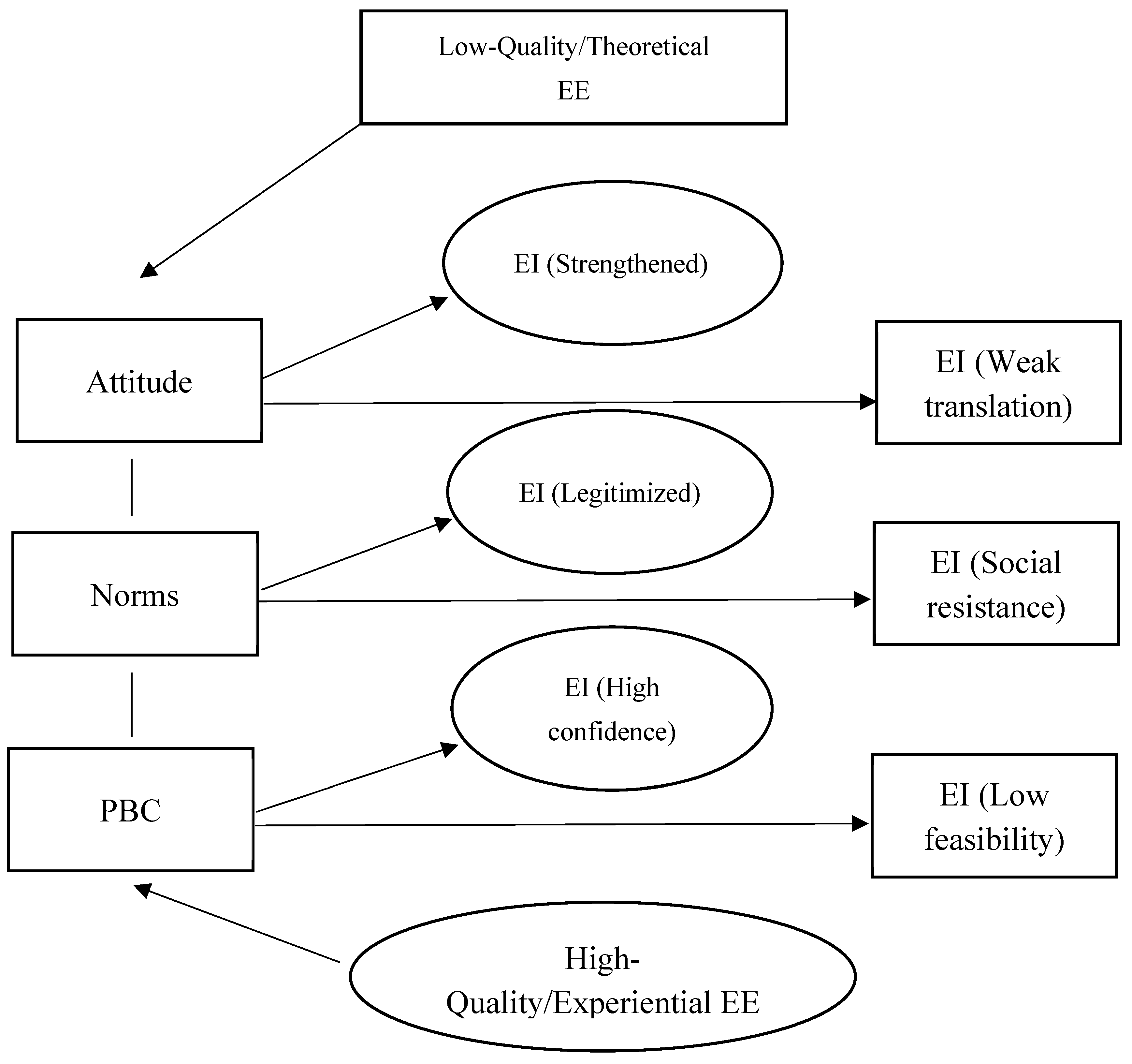
Figure 3 Illustrative mechanism explaining how entrepreneurship education strengthens or weakens the translation of entrepreneurial cognition into entrepreneurial intention depending on pedagogical quality and contextual alignment.
Figure 3. Mechanism of Entrepreneurship Education Moderation.

5.1. Entrepreneurship Education Moderating the Attitude → Entrepreneurial Intention Relationship

Entrepreneurial attitude reflects an individual’s overall evaluation of entrepreneurship as a desirable or undesirable career option. Across intention-based models, attitude has consistently emerged as one of the strongest predictors of entrepreneurial intention (Figure 3 and Figure 4) (Ajzen, 1991; N. F. Krueger et al., 2000). However, the strength of the attitude–intention relationship varies significantly across individuals and contexts, suggesting the presence of moderating influences (Liñán et al., 2011).
Figure 4. N. F. Krueger (2017). Entrepreneurial intentions are dead: Long live entrepreneurial intentions. In Revisiting the entrepreneurial mind: Inside the black box: An expanded edition (pp. 13–34). Cham: Springer International Publishing.
Entrepreneurship education plays a critical role in shaping this relationship by providing cognitive structure, interpretive frameworks, and experiential exposure that help individuals translate favorable attitudes into concrete entrepreneurial intentions (Fayolle & Gailly, 2015). Students may hold positive views of entrepreneurship due to societal narratives, media representations, or personal admiration of entrepreneurs, yet lack the knowledge or confidence required to seriously consider entrepreneurship as a career path. In such cases, entrepreneurship education can strengthen the attitude–intention link by converting abstract appreciation into informed commitment through opportunity recognition, skill development, and increased perceived feasibility (Souitaris et al., 2007).
Empirical studies provide partial support for this moderating role. Research shows that students who receive high-quality, experiential entrepreneurship education are more likely to act upon positive entrepreneurial attitudes, as such education enhances opportunity recognition, reduces ambiguity, and clarifies the entrepreneurial process (Souitaris et al., 2007; Rauch & Hulsink, 2015). In contrast, in the absence of meaningful educational engagement, positive attitudes may remain aspirational and fail to translate into entrepreneurial intention (Nabi et al., 2017).
However, moderation effects are not universally observed. Several studies report that entrepreneurship education does not significantly strengthen the attitude–entrepreneurial intention (EI) relationship, particularly when educational programs are highly theoretical, standardized, or detached from real-world entrepreneurial practice (Bae et al., 2014; Nabi et al., 2017). In such cases, entrepreneurship education may increase students’ awareness of entrepreneurial risks, bureaucratic constraints, and high failure rates, thereby neutralizing—or even offsetting—the motivational effect of positive entrepreneurial attitudes, a phenomenon sometimes described as a “discouragement effect”. This ambivalence underscores the importance of pedagogical quality in determining whether entrepreneurship education functions as an effective moderator of the attitude–EI relationship or merely as an informational intervention with limited motivational impact (Fayolle & Gailly, 2015).
From a sustainability perspective, this finding is especially important. Sustainable entrepreneurship requires long-term commitment, resilience, and value-driven motivation. Entrepreneurship education that strengthens the attitude–intention relationship through experiential and reflective learning is more likely to foster intentions aligned with sustainable development goals, whereas superficial instruction may weaken motivational pathways.

5.2. Entrepreneurship Education Moderating the Subjective Norms → Entrepreneurial Intention Relationship

Subjective norms (Table 4) capture perceived social pressure from significant others—such as family, peers, and society—regarding entrepreneurial career choices (Ajzen, 1991; Liñán et al., 2011). In many empirical studies, subjective norms exhibit weaker or more inconsistent direct effects on entrepreneurial intention compared to attitudes and perceived behavioral control (N. F. Krueger et al., 2000). Nevertheless, their role becomes significantly more pronounced in collectivist and family-oriented societies, where career decisions are deeply embedded in social expectations and family approval (Stephan & Pathak, 2016). Entrepreneurship education can moderate the relationship between subjective norms and entrepreneurial intention by reshaping how individuals interpret and respond to social influences. In contexts where entrepreneurship is viewed as risky, unstable, or socially inferior to salaried employment, particularly in the public sector, subjective norms may discourage entrepreneurial intention. In such cases, well-designed entrepreneurship education can act as a legitimizing force, signaling institutional endorsement of entrepreneurship and reducing social stigma.
Table 4. Entrepreneurship Education as a Moderator in Entrepreneurial Intention Formation.
Educational programs that involve family engagement, exposure to respected entrepreneurial role models, or endorsement by prestigious institutions can significantly alter the normative environment surrounding entrepreneurship (N. F. Krueger, 2007). By reframing entrepreneurship as a viable, respectable, and socially valuable career option, entrepreneurship education can weaken the constraining effect of negative subjective norms and, in some cases, transform them into supportive influences. Empirical evidence from emerging economies provides mixed but insightful findings. Some studies demonstrate that entrepreneurship education attenuates the negative impact of discouraging social norms, particularly when education emphasizes local success stories and culturally relevant entrepreneurial pathways (Urban & Kujinga, 2017). Other studies, however, find no significant moderating effect.
These contradictions suggest that entrepreneurship education moderates subjective norms only when it is culturally aligned and socially embedded. Generic curricula that ignore family expectations, collective decision-making, and social risk perceptions are unlikely to alter normative pressures (Urban & Kujinga, 2017). As a result, the moderating role of entrepreneurship education on subjective norms is highly context-dependent, reinforcing the need for localized and culturally sensitive program design (Fayolle & Gailly, 2015).

5.3. Entrepreneurship Education Moderating the Perceived Behavioral Control → Entrepreneurial Intention Relationship

Perceived behavioral control (PBC), closely related to entrepreneurial self-efficacy, reflects individuals’ beliefs about their ability to perform entrepreneurial tasks successfully (Ajzen, 1991). Among the Theory of Planned Behavior (TPB) antecedents, PBC is often the strongest and most consistent predictor of entrepreneurial intention, particularly in uncertain and resource-constrained environments (N. F. Krueger et al., 2000).
Entrepreneurship education is theoretically well positioned to moderate the PBC–entrepreneurial intention (EI) relationship. By developing entrepreneurial skills, competencies, and experiential knowledge, education enhances individuals’ confidence in their entrepreneurial capabilities, thereby strengthening perceived feasibility (Fayolle & Gailly, 2015). In doing so, entrepreneurship education strengthens the translation of perceived control into intention, making entrepreneurship appear not only desirable but also realistically attainable.
Experiential and practice-based entrepreneurship education is particularly effective in this regard. Through simulations, startup projects, mentoring, and real-world engagement, students acquire mastery experiences that reinforce entrepreneurial self-efficacy (Pittaway & Cope, 2007). Empirical studies consistently show that entrepreneurship education exerts its strongest moderating influence on the PBC–EI pathway when programs emphasize learning-by-doing rather than abstract or purely theoretical instruction (Nabi et al., 2017; Rauch & Hulsink, 2015).
Nevertheless, contradictory findings persist. Some studies report insignificant or weak moderation effects, particularly when entrepreneurship education is short-term, assessment-driven, or disconnected from actual entrepreneurial practice (Bae et al., 2014). In such cases, entrepreneurship education may increase awareness of entrepreneurial skill gaps without providing sufficient opportunities for competence development, thereby weakening perceived behavioral control and entrepreneurial intention.
From a sustainability standpoint, strengthening the PBC–EI relationship is crucial. Sustainable entrepreneurship requires confidence in managing long-term uncertainty, balancing economic, social, and environmental objectives, and navigating complex stakeholder environments (Shepherd & Patzelt, 2011). Entrepreneurship education that effectively moderates the PBC–EI relationship is therefore more likely to contribute to sustained and responsible entrepreneurial outcomes.

5.4. Contradictory Findings in Prior Literature

Despite strong theoretical justification, empirical findings on the moderating role of entrepreneurship education remain inconsistent. Some studies report significant moderation effects across one or more EI antecedents, while others find weak, partial, or no moderation at all. These contradictions have generated debate regarding the true role of entrepreneurship education and raised concerns about overestimating its effectiveness.
Rather than indicating theoretical failure, these inconsistencies reflect conceptual, pedagogical, and contextual variation in how entrepreneurship education is designed, delivered, and measured. Treating EE as a homogeneous intervention obscures meaningful differences across programs and settings, leading to mixed empirical results. Understanding the sources of inconsistency is therefore essential for advancing both theory and practice.

5.5. Reasons for Inconsistent Moderation Effects

One of the most frequently cited reasons for inconsistent moderation effects of entrepreneurship education is weak pedagogy. Entrepreneurship education programs that rely heavily on lectures, rote learning, and examination-oriented assessment often fail to influence deeper cognitive and motivational processes associated with entrepreneurial behavior (Nabi et al., 2017; Pittaway & Cope, 2007). Such programs may transmit declarative knowledge about entrepreneurship without fostering entrepreneurial thinking, self-efficacy, or opportunity recognition, which are critical mechanisms in intention formation (Neck & Greene, 2011). When pedagogy is weak, entrepreneurship education is unlikely to strengthen the relationships between entrepreneurial attitudes, subjective norms, perceived behavioral control, and entrepreneurial intention. Empirical evidence suggests that poorly designed entrepreneurship courses may even dilute motivational pathways by emphasizing risks, barriers, and constraints without providing students with practical tools or experiential learning opportunities to act entrepreneurially (Oosterbeek et al., 2010).
Cultural misalignment represents another major source of inconsistency in the moderating effects of entrepreneurship education. Many entrepreneurship education programs are grounded in Western, individualistic assumptions that emphasize autonomy, risk-taking, and rapid venture growth. When such models are transferred to collectivist or emerging-economy contexts, they may conflict with local cultural values that prioritize family approval, social harmony, employment stability, and gradual career progression (Hofstede, 2001; Liñán & Chen, 2009; Stephan & Uhlaner, 2010). Entrepreneurship education that fails to account for these cultural norms may be perceived as unrealistic or socially misaligned, thereby limiting its ability to moderate the relationships between attitudes, subjective norms, perceived behavioral control, and entrepreneurial intention (Liñán et al., 2011). Conversely, culturally grounded entrepreneurship education—one that integrates local narratives, socially legitimate role models, and institutional realities—is more likely to reshape entrepreneurial attitudes and normative beliefs in a meaningful way, thereby enhancing its moderating influence on entrepreneurial intention formation (Fayolle & Liñán, 2014).
The duration of entrepreneurship education interventions also plays a critical role in shaping moderation outcomes. Short-term workshops, single-course offerings, or brief exposure programs may increase entrepreneurial awareness but are unlikely to generate sustained changes in entrepreneurial attitudes, subjective norms, or perceived behavioral control (Nabi et al., 2017). Moderation effects—particularly those involving deeply embedded social norms or entrepreneurial self-efficacy—require prolonged engagement, experiential learning, and repeated reinforcement over time (Rauch & Hulsink, 2015; Bandura, 1997). Empirical studies that rely primarily on short-term or cross-sectional interventions may therefore underestimate the true moderating potential of entrepreneurship education. This methodological limitation has been identified as a key contributor to inconsistent and weak findings regarding the impact of entrepreneurship education on entrepreneurial intention formation (Bae et al., 2014).
Finally, over-theoretical curricula remain a persistent challenge. Programs that emphasize business planning models, financial projections, and theoretical constructs without experiential grounding may fail to resonate with students. Such curricula often privilege knowledge acquisition over competence development, limiting their ability to strengthen the attitude–EI or PBC–EI relationships. Over-theoretical approaches may also inadvertently discourage entrepreneurial intention by highlighting complexity and uncertainty without offering practical coping strategies. This effect is particularly pronounced among students with limited entrepreneurial exposure or risk tolerance.
Taken together, the evidence reviewed in this section supports a clear conclusion: entrepreneurship education functions as a moderator only under specific conditions. Its ability to strengthen the relationships between attitudes, subjective norms, perceived behavioral control, and entrepreneurial intention depends on pedagogical quality, cultural alignment, duration, and experiential depth. Recognizing these contingencies allows researchers to move beyond simplistic debates about whether entrepreneurship education “works” and toward a more nuanced understanding of how it works. For sustainability-oriented education and policy, this insight is critical. Effective entrepreneurship education must be designed not merely to inform but to transform cognitive and social pathways, enabling sustainable entrepreneurial intentions to emerge and persist.
Importantly, moderation effects rarely operate in isolation. Pedagogical quality, cultural alignment, and institutional support often interact multiplicatively rather than independently. For example, experiential pedagogy may strengthen the PBC–EI pathway, but its effectiveness is amplified when embedded within a supportive institutional ecosystem and culturally legitimate narrative. Conversely, even high-quality experiential programs may produce limited effects in environments characterized by strong public-sector employment norms or family resistance. This interactional perspective suggests that entrepreneurship education should be conceptualized as part of a layered moderation structure rather than a single independent moderator. Future empirical research should therefore examine moderated-moderation models and multi-level interaction effects to capture these complexities more accurately.

6. Contextual and Sustainability Dimensions

Entrepreneurial intention does not emerge in a social or institutional vacuum. Although intention-based theories provide strong cognitive explanations of entrepreneurial decision-making, their explanatory power is fundamentally shaped by contextual and sustainability-related factors. In emerging and collectivist economies—particularly within the Gulf Cooperation Council (GCC)—entrepreneurial intentions are embedded in family structures, cultural norms, labor market conditions, and national development strategies. Entrepreneurship education (EE), therefore, should be understood not merely as a pedagogical intervention, but as a contextually embedded and sustainability-oriented mechanism interacting with these broader forces. This section examines the contextual and sustainability dimensions most relevant to entrepreneurship education as a moderating mechanism, focusing on family support and collectivism, public-sector employment preferences, sustainability orientation, and institutional alignment with national development visions, with particular reference to Oman Vision 2040. Together, these dimensions explain why EE moderates entrepreneurial intention differently across contexts.

6.1. Family Support, Collectivism, and Entrepreneurial Intention

In collectivist societies, family plays a central role in shaping values, identity, and career decisions (Hofstede, 2001). Unlike individualistic contexts, where entrepreneurship is framed as a personal choice, entrepreneurial intentions in collectivist cultures are evaluated through family approval, social obligation, and collective well-being (Liñán & Chen, 2009). As a result, family support becomes a decisive factor determining whether entrepreneurial attitudes and perceived feasibility translate into intention. Empirical evidence shows that family encouragement strengthens entrepreneurial intention, while family skepticism can suppress it even among individuals with favorable entrepreneurial attitudes (Edelman et al., 2016). Entrepreneurship education interacts closely with this familial context. When entrepreneurship education is perceived as credible, institutionally endorsed, and socially legitimate, it can moderate family norms by reframing entrepreneurship as a respectable and viable career path. Programs emphasizing family business continuity, community contribution, or intergenerational success are particularly effective. Conversely, entrepreneurship education that promotes individualistic success narratives or high-risk startup models may conflict with family expectations, weakening its moderating influence (Autio et al., 2013). This helps explain inconsistent findings related to subjective norms in collectivist settings. From a sustainability perspective, family-supported entrepreneurship is especially important, as it is often associated with stronger ethical orientation, business continuity, and long-term value creation (Shepherd & Patzelt, 2011).

6.2. Collectivism, Risk Perception, and EE Moderation

Collectivism also shapes broader social attitudes toward risk, failure, and innovation. In many emerging economies, entrepreneurial failure is interpreted as a collective or reputational loss rather than an individual learning experience, which discourages entrepreneurial intention even when entrepreneurial attitudes are favorable. Such socially embedded perceptions of failure increase fear of social sanctions and constrain entrepreneurial action in collectivist contexts (C. K. Lee et al., 2021). Entrepreneurship education can moderate this effect by reframing risk and failure through culturally appropriate narratives that emphasize learning, resilience, and incremental experimentation (Nabi et al., 2017). By doing so, entrepreneurship education strengthens the perceived behavioral control–entrepreneurial intention relationship, enabling students to view entrepreneurship as manageable rather than socially perilous (Wibowo, 2016). Educational approaches that recognize alternative success metrics—such as community development, social contribution, or family enterprise sustainability—further reinforce socially embedded and sustainable entrepreneurial intentions (Fauziah et al., 2025).

6.3. Public-Sector Employment Preference in GCC Contexts

A defining feature of GCC economies is the strong preference for public-sector employment, driven by job security, income stability, and social prestige (Al Waqfi et al., 2025). This structural condition often positions entrepreneurship as a secondary or fallback option, suppressing entrepreneurial intention even among capable and motivated students. Entrepreneurship education’s moderating role becomes particularly salient in this context. EE can reduce public-sector bias by reframing entrepreneurship as complementary rather than competing, for example, through hybrid career models, part-time entrepreneurship, or public–private collaboration. When aligned with national diversification goals, EE can position entrepreneurship as a socially valued and development-oriented pathway (S. S. Lee, 2022). However, when entrepreneurship education ignores labor market realities or overemphasizes startup risk, it fails to counteract public-sector preference, contributing to weak or inconsistent moderation effects observed in GCC-based studies.

6.4. Sustainability Orientation and Institutional Alignment

Sustainability has become central to entrepreneurship discourse, shifting attention from startup quantity to long-term economic, social, and environmental value creation. Entrepreneurship education moderates entrepreneurial intention not only by influencing its strength but also by shaping its orientation and purpose. Sustainability-oriented EE integrates ethical reasoning, social innovation, and environmental responsibility, enhancing the attractiveness of entrepreneurship among students motivated by social impact, particularly in emerging economies.
Institutional alignment further conditions EE’s effectiveness. National development strategies—such as Oman Vision 2040—provide legitimacy by framing entrepreneurship as a nationally endorsed development pathway. When EE aligns with these visions, it strengthens subjective norms and feasibility perceptions. Conversely, misalignment between educational rhetoric and institutional support undermines EE’s credibility and moderating influence.

7. Propositions and Integrative Contribution

Drawing on this logic, the framework advances five propositions. First, entrepreneurship education strengthens the relationship between entrepreneurial attitude and intention when it is experiential and high quality. Second, EE moderates the influence of subjective norms by weakening constraining norms and reinforcing supportive ones, particularly in collectivist contexts. Third, EE strengthens the perceived behavioral control–intention relationship by enhancing skills, self-efficacy, and feasibility perceptions. Fourth, the moderating effectiveness of EE varies across socio-cultural and institutional contexts, with stronger effects under cultural alignment and institutional support. Fifth, sustainability-oriented entrepreneurship education strengthens entrepreneurial intention by aligning cognition with long-term social and developmental goals. Collectively, the framework offers a coherent explanation for inconsistent empirical findings and provides a robust foundation for future hypothesis testing in emerging and collectivist economies.
P1. High-quality and experiential entrepreneurship education strengthens the positive relationship between entrepreneurial attitude and entrepreneurial intention.
P2. Entrepreneurship education moderates the relationship between subjective norms and entrepreneurial intention by weakening constraining social pressures and reinforcing supportive norms, particularly in collectivist contexts.
P3. Entrepreneurship education strengthens the relationship between perceived behavioral control and entrepreneurial intention by enhancing entrepreneurial skills, self-efficacy, and feasibility perceptions.
P4. The moderating effectiveness of entrepreneurship education varies across socio-cultural and institutional contexts, with stronger effects observed under conditions of cultural alignment and institutional support.
P5. Sustainability-oriented entrepreneurship education strengthens entrepreneurial intention by aligning entrepreneurial cognition with long-term social, environmental, and developmental goals.

8. Research Gaps and Future Research Directions

Despite the rapid expansion of research on entrepreneurship education (EE) and entrepreneurial intention (EI), this systematic–integrative review identifies persistent theoretical, methodological, contextual, and sustainability-related gaps that help explain contradictory empirical findings. Much of the existing literature continues to model EE as a direct antecedent of EI, despite intention-based theories allowing for conditional and interaction effects. This oversimplification limits explanatory power and fails to capture how education shapes the translation of attitudes, norms, and perceived behavioral control into intention. Future research should reconceptualize EE as a moderating, mediating, or boundary mechanism and adopt multi-theoretical approaches that integrate cognitive, social, and institutional perspectives beyond dominant TPB-based models.
Methodological limitations further constrain progress. The predominance of cross-sectional survey designs obscures the dynamic and cumulative nature of entrepreneurial intention formation. Since educational effects often materialize over time, future studies should employ longitudinal, quasi-experimental, and panel designs to capture delayed and sustained moderation effects. Measurement practices also remain underdeveloped, with many studies relying on binary indicators of EE participation. Advancing the field requires multidimensional measures that capture pedagogical quality, experiential intensity, ecosystem engagement, and sustainability orientation, without which theoretical refinements remain empirically fragile.
Pedagogical design represents another underexplored dimension. Entrepreneurship education is frequently treated as a homogeneous intervention, overlooking variation in instructional methods, assessment practices, faculty capabilities, and institutional resources. Weak pedagogy and over-theoretical curricula substantially undermine EE’s moderating potential. Future research should incorporate pedagogical variables explicitly and compare lecture-based approaches with experiential, project-based, and ecosystem-embedded models, particularly in resource-constrained educational environments.
Finally, the literature exhibits a strong contextual bias toward Western, individualistic settings, limiting generalizability to emerging and collectivist economies. Family influence, social risk aversion, labor market structures, and public-sector employment preferences fundamentally shape entrepreneurial cognition in regions such as the GCC, South Asia, and Africa. Future studies should examine how family-sensitive and sustainability-oriented EE interacts with these contextual factors and aligns with national development strategies. Integrating sustainability and institutional alignment into EE–EI research would enhance both theoretical relevance and policy impact.

9. Conclusions and Implications

9.1. Conclusions

This systematic–integrative review advances our understanding of entrepreneurship education (EE) as a moderating mechanism in the formation of entrepreneurial intention (EI), with a particular emphasis on emerging and collectivist economies and the sustainability agenda. Moving beyond the dominant assumption that EE exerts a uniform direct effect on EI, the review integrates theoretical foundations, empirical evidence, contextual dynamics, and sustainability considerations to develop a conditional and explanatory framework.
In the context of Oman and similar GCC economies, actionable policy measures should include: (1) embedding experiential entrepreneurship modules across disciplines rather than limiting EE to business schools; (2) integrating family-engagement initiatives to enhance normative legitimacy; (3) aligning EE curricula with Oman Vision 2040 economic diversification priorities; and (4) establishing university–industry innovation platforms that provide early-stage mentoring and seed funding. These targeted interventions move beyond generic policy recommendations and respond directly to structural and cultural conditions shaping entrepreneurial cognition in the region.
The review confirms that entrepreneurial intention is best understood as a cognitively mediated and socially embedded construct, shaped by entrepreneurial attitudes, subjective norms, and perceived behavioral control. However, the strength and consistency of these relationships vary substantially across cultural contexts, educational designs, and institutional environments. Rather than acting as a simple causal input, entrepreneurship education functions as a context-sensitive conditioning force that shapes how these antecedents translate into entrepreneurial intention.
A key conclusion is that the inconsistent findings in the EE–EI literature do not reflect theoretical weakness but rather conceptual oversimplification, particularly the tendency to measure EE as a binary indicator of course exposure. Such approaches fail to capture variation in pedagogical quality, experiential depth, and institutional embedding, leading to underestimated or insignificant moderation effects.
The review demonstrates that EE moderates the attitude–EI relationship by converting favorable perceptions of entrepreneurship into informed and actionable career intentions, especially when education is experiential, reflective, and practice-oriented. EE also moderates the subjective norms–EI relationship, particularly in collectivist societies, by legitimizing entrepreneurship socially and institutionally and reducing normative resistance from families and communities. The strongest moderating influence is observed in the perceived behavioral control–EI pathway, where skills development, self-efficacy, and feasibility perceptions are most directly shaped through educational interventions.
Importantly, these moderation effects are highly contingent. Weak pedagogy, overly theoretical curricula, short-term interventions, and cultural misalignment systematically weaken EE’s influence. In contrast, well-designed, culturally grounded, sustainability-oriented, and ecosystem-embedded programs strengthen entrepreneurial intention formation in a durable and socially legitimate manner.
The review further highlights the salience of contextual and sustainability factors, particularly in GCC and emerging-economy settings. Family expectations, collectivist values, public-sector employment preferences, and national development strategies fundamentally shape how EE operates. In such environments, entrepreneurship education is effective as a moderator only when it aligns with family norms, labor market realities, and national visions such as Oman Vision 2040. Overall, these findings reposition EE from a generic policy tool to a strategic, context-sensitive, and sustainability-oriented mechanism for shaping entrepreneurial cognition.

9.2. Theoretical Implications

This review makes three key theoretical contributions. First, it advances intention-based theory by explicitly conceptualizing entrepreneurship education as a moderator, rather than merely an antecedent, in the EI formation process. While frameworks such as the Theory of Planned Behavior and Shapero’s Entrepreneurial Event Model allow for conditional effects, EE has rarely been operationalized in this manner.
Second, the review contributes to theoretical integration by demonstrating the complementary roles of TPB, Social Cognitive Theory, Human Capital Theory, and contextual–institutional perspectives. This multi-theoretical synthesis offers a more realistic and comprehensive account of entrepreneurial cognition than single-theory models.
Third, the review extends entrepreneurship education theory by emphasizing pedagogical quality, experiential intensity, and institutional embeddedness as core theoretical constructs. Education is conceptualized not as a uniform intervention but as a socially constructed process whose effects depend on design and context. By embedding sustainability explicitly into the framework, the review also contributes to sustainable entrepreneurship education, highlighting how EE shapes not only intention formation but also its orientation toward long-term social and environmental value creation.

Extending Intention-Based Models Toward Entrepreneurial Capital and Competence Frameworks

While this review primarily focuses on entrepreneurship education (EE) as a moderating mechanism in entrepreneurial intention (EI) formation, recent scholarship suggests that higher education institutions contribute to entrepreneurship in ways that extend beyond intention development alone. In particular, emerging research highlights the role of universities in fostering entrepreneurial capital—a multidimensional construct encompassing competencies, networks, institutional legitimacy, and transnational collaboration structures. Teodoro and Bernadó (2025), in their empirical examination of the “Start for Future” international university initiative, demonstrate how structured cross-border programs create entrepreneurial capital at the ecosystem level by strengthening collaboration, opportunity recognition capacity, and institutional embeddedness. Their findings suggest that entrepreneurship education operates simultaneously at individual, institutional, and network levels, thereby extending its influence beyond intention formation toward broader entrepreneurial system development.
Similarly, Teodoro (2025), through a systematic review on the development of the EICAA Competence Framework, advances a competence-based operational perspective on entrepreneurship education. Rather than conceptualizing EE primarily in terms of course exposure or participation, the competence framework identifies structured entrepreneurial capabilities—such as opportunity development, resource mobilization, strategic thinking, and value creation—as measurable educational outcomes. Integrating this competence-based lens strengthens the present review’s moderation framework by providing operational clarity regarding how pedagogical intensity, experiential depth, and institutional alignment translate into strengthened EI pathways.
Together, these contributions enrich intention-based approaches by situating entrepreneurship education within a broader institutional and ecosystem context. They reinforce the argument advanced in this review that EE is not merely an antecedent or moderator at the cognitive level, but also a structural mechanism through which higher education institutions generate entrepreneurial capital aligned with sustainability-oriented development goals. Incorporating competence-based and ecosystem-level perspectives therefore enhances the theoretical robustness and policy relevance of the moderation framework proposed in this study.

9.3. Implications for Educational Practice

For universities and educators, the findings underscore that entrepreneurship education cannot be effective through symbolic or superficial curricular inclusion. Merely offering entrepreneurship courses is insufficient to influence entrepreneurial intention meaningfully.
Educational programs should prioritize experiential, practice-based, and reflective pedagogies that expose students to uncertainty, opportunity recognition, and real-world problem-solving. Such approaches are critical for strengthening perceived behavioral control and translating positive attitudes into intention. Overreliance on lectures, examinations, and abstract business plans is unlikely to generate meaningful moderating effects.
In collectivist and emerging-economy contexts, educators must also account for family and social embeddedness. Incorporating culturally relevant role models, family business narratives, and development-oriented framing can strengthen normative legitimacy and enhance intention formation. Additionally, embedding sustainability principles—such as ethical reasoning, social innovation, and environmental responsibility—broadens the appeal of entrepreneurship and aligns education with national and global sustainability priorities.

9.4. Policy, Sustainability, and Future Research Implications

For policymakers, the review cautions against one-size-fits-all EE policies. Effective outcomes require attention to pedagogical quality, institutional coherence, and ecosystem support rather than program quantity alone. In GCC contexts, policies should address opportunity cost perceptions associated with public-sector employment and strengthen early-stage entrepreneurial support.
Recent ecosystem-oriented research further indicates that entrepreneurship education policy should move beyond isolated curricular interventions toward coordinated institutional platforms that build entrepreneurial capital across universities and regions. Cross-border and ecosystem-based initiatives—such as structured international university collaborations—demonstrate how coordinated educational architectures can foster transnational networks, competence development, and institutional legitimacy simultaneously. In addition, competence-based frameworks such as the EICAA model provide policymakers with operational tools to standardize learning outcomes, assess entrepreneurial capability development, and align entrepreneurship education with innovation and sustainability agendas. Future research should therefore examine how competence frameworks and ecosystem-level capital formation interact with intention-based mechanisms, particularly in emerging and collectivist economies where institutional signaling and legitimacy play central roles in shaping entrepreneurial cognition.
From a sustainability perspective, entrepreneurship education emerges as a developmental and societal instrument, capable of directing entrepreneurial intention toward inclusive, responsible, and environmentally conscious ventures. Sustainability-oriented EE can attract students otherwise disinclined toward conventional entrepreneurship and contribute meaningfully to long-term development goals.
Finally, future research should empirically test the proposed framework using longitudinal, multi-group, and mixed-method designs, particularly in underrepresented emerging economies. Scholars should measure EE multidimensionally and examine its interaction with attitudes, norms, and perceived behavioral control, while incorporating contextual moderators such as family support and institutional alignment.

Author Contributions

All authors contributed equally to the preparation and completion of the manuscript. All authors have read and agreed to the published version of the manuscript.

Funding

This review paper is part of a research project funded by Dhofar University Research Grant (DURG) under the approved project titled “Exploring the Impact of Entrepreneurship Education as a Moderator on the Formation of Entrepreneurial Intentions among Students from Dhofar Governorate” (Grant No. DU/AY/2024-25/DURG-003).

Institutional Review Board Statement

Not applicable.

Data Availability Statement

Data is contained within the article.

Conflicts of Interest

The authors declare no conflict of interest.

References

  1. Aga, M. K., & Singh, A. (2022). The role of entrepreneurship education on student entrepreneurial intentions: Mediating effect of attitude, subjective norms, and perceived behavioral control. Journal of Business and Management, 28(1), 31–65. [Google Scholar] [CrossRef]
  2. Ahmad, A., Albarrak, M. S., Akhtar, S., & Akram, H. W. (2023). Sustainable development and Saudi vision 2030: Entrepreneurial orientation of students toward e-businesses and proposed model of “virtual business incubator” for SEU. Education Research International, 2023(1), 6106580. [Google Scholar] [CrossRef]
  3. Ajzen, I. (1991). The theory of planned behavior. Organizational Behavior and Human Decision Processes, 50(2), 179–211. [Google Scholar] [CrossRef]
  4. Ajzen, I. (2002). Perceived behavioral control, self-efficacy, locus of control, and the theory of planned behavior 1. Journal of Applied Social Psychology, 32(4), 665–683. [Google Scholar] [CrossRef]
  5. Akram, H. W., & Sanyal, S. (2022). Women entrepreneurs in Ethiopia. In Women entrepreneurs in Sub-Saharan Africa: Historical framework, ecosystem, and future perspectives for the region (pp. 33–59). Springer International Publishing. [Google Scholar]
  6. Al Boinin, H. (2023). Women’s entrepreneurship in the GCC: A literature analysis from a socio-cultural perspective. Journal of Enterprising Communities: People and Places in the Global Economy, 17(5), 999–1021. [Google Scholar] [CrossRef]
  7. Al-Hattami, H. M., Al-Mukhaini, A. Z., Al-Badawi, E. A., Al-Najidiya, R. S., & Al-Hashmi, K. R. (2025). Assessing the role of entrepreneurship education in fostering innovation and new venture creation: The moderating role of financial literacy. Cogent Education, 12(1), 2572386. [Google Scholar] [CrossRef]
  8. Al Issa, H. E., Thai, M. T. T., & Saad, S. (2025). Empowering social entrepreneurial intentions through experiential learning and self-efficacy. The International Journal of Management Education, 23(2), 101154. [Google Scholar] [CrossRef]
  9. Al Lawati, E. H., Jumaan, I. A., Kohar, U. H. A., & Tarhini, A. (2026). Entrepreneurial intention revisited: The roles of entrepreneurship education, entrepreneurial culture, and social media usage. The International Journal of Management Education, 24(1), 101288. [Google Scholar] [CrossRef]
  10. Al-Lawati, E. H., Kohar, U. H. A., & Suleiman, E. S. B. (2021). Entrepreneurship studies in the Sultanate of Oman: A scoping review of 20 years publications. Studies of Applied Economics, 39(10). [Google Scholar] [CrossRef]
  11. Al Muniri, K. S. N., Hashim, M. W., & Al Aliyani, W. R. (2019). Undergraduate entrepreneurship education: An Oman perspective. The International Journal of Organizational Diversity, 19(2), 41. [Google Scholar] [CrossRef]
  12. Al Sawaey, S., Palalić, R., As-Saber, M. S. N., Al Riyami, S., & Backhirov, A. A. (2025). The impact of prosocial behavior on the social entrepreneurial intention of the youth: A theory of planned behavior perspective. Journal of Entrepreneurship and Public Policy. [Google Scholar] [CrossRef]
  13. Al Shabibi, I. (2020). Planning for entrepreneurialism in a rentier state economy: Entrepreneurship education for economic diversification in Oman [Doctoral dissertation, Cardiff University]. [Google Scholar]
  14. Al Waqfi, M., Ababneh, K., & Hussein, S. (2025). Perceived barriers to work in the private sector in the United Arab Emirates: Empirical evidence and policy implications. Management & Sustainability: An Arab Review, 1–26. [Google Scholar] [CrossRef]
  15. Ambusaidi, A., Al-Dayri, H., & Al-Sumari, M. (2024). The effect of sustainable environmental tourism training on the development of eighth-grade Omani students’ attitudes towards the environment and their inclination to engage in entrepreneurship in environmental tourism projects. Cogent Education, 11(1), 2400745. [Google Scholar] [CrossRef]
  16. Anjum, T., Díaz Tautiva, J. A., Zaheer, M. A., & Heidler, P. (2024). Entrepreneurial intentions: Entrepreneurship education programs, cognitive motivational factors of planned behavior, and business incubation centers. Education Sciences, 14(9), 983. [Google Scholar] [CrossRef]
  17. Anwar, I., Ahmad, A., Saleem, I., & Yasin, N. (2023). Role of entrepreneurship education, passion and motivation in augmenting Omani students’ entrepreneurial intention: A stimulus-organism-response approach. The International Journal of Management Education, 21(3), 100842. [Google Scholar] [CrossRef]
  18. Autio, E., Pathak, S., & Wennberg, K. (2013). Consequences of cultural practices for entrepreneurial behaviors. Journal of International Business Studies, 44(4), 334–362. [Google Scholar] [CrossRef]
  19. Ayad, T., Sobaih, A. E. E., & Elshaer, I. A. (2022). University incubator support and entrepreneurial intention among tourism graduates: Mediating role of personal attitude. Sustainability, 14(23), 16045. [Google Scholar] [CrossRef]
  20. Bae, T. J., Qian, S., Miao, C., & Fiet, J. O. (2014). The relationship between entrepreneurship education and entrepreneurial intentions: A meta–analytic review. Entrepreneurship Theory and Practice, 38(2), 217–254. [Google Scholar] [CrossRef]
  21. Bandura, A. (1986). Social foundations of thought and action. SAGE Publications Ltd. [Google Scholar] [CrossRef]
  22. Bandura, A. (1997). Self-efficacy: The exercise of control (Vol. 11). Freeman. [Google Scholar]
  23. Belitski, M., & Heron, K. (2017). Expanding entrepreneurship education ecosystems. Journal of Management Development, 36(2), 163–177. [Google Scholar] [CrossRef]
  24. Belwal, R., Al Balushi, H., & Belwal, S. (2015). Students’ perception of entrepreneurship and enterprise education in Oman. Education+ Training, 57(8/9), 924–947. [Google Scholar] [CrossRef]
  25. Ben Hassen, T. (2022). The GCC economies in the wake of COVID-19: Toward post-oil sustainable knowledge-based economies? Sustainability, 14(18), 11251. [Google Scholar] [CrossRef]
  26. Béchard, J. P., & Grégoire, D. (2005). Entrepreneurship education research revisited: The case of higher education. Academy of Management Learning & Education, 4(1), 22–43. [Google Scholar] [CrossRef]
  27. Bischoff, K., & Volkmann, C. K. (2018). Stakeholder support for sustainable entrepreneurship-a framework of sustainable entrepreneurial ecosystems. International Journal of Entrepreneurial Venturing, 10(2), 172–201. [Google Scholar] [CrossRef]
  28. Blenker, P., Trolle Elmholdt, S., Hedeboe Frederiksen, S., Korsgaard, S., & Wagner, K. (2014). Methods in entrepreneurship education research: A review and integrative framework. Education+ Training, 56(8/9), 697–715. [Google Scholar] [CrossRef]
  29. Brás, G. R., Daniel, A., & Fernandes, C. (2024). The effect of proximal personality traits on entrepreneurial intention among higher education students. International Journal of Innovation Science, 16(1), 114–137. [Google Scholar] [CrossRef]
  30. Brush, C., Neck, H., & Greene, P. (2015). A practice-based approach to entrepreneurship education. Evolving Entrepreneurial Education: Innovation in the Babson Classroom, 35, 35–54. [Google Scholar]
  31. Cardella, G. M., Hernández Sánchez, B. R., de Miranda Justo, J. M. R., & Sánchez García, J. C. (2024). Understanding social entrepreneurial intention in higher education: Does gender and type of study matter? Studies in Higher Education, 49(4), 670–689. [Google Scholar] [CrossRef]
  32. Cera, G., Mlouk, A., Cera, E., & Shumeli, A. (2020). The impact of entrepreneurship education on entrepreneurial intention. A quasi-experimental research design. Journal of Competitiveness, 12(1), 39–56. [Google Scholar] [CrossRef]
  33. Cronin, M. A., & George, E. (2023). The why and how of the integrative review. Organizational Research Methods, 26(1), 168–192. [Google Scholar] [CrossRef]
  34. Dalmarco, G., Hulsink, W., & Blois, G. V. (2018). Creating entrepreneurial universities in an emerging economy: Evidence from Brazil. Technological Forecasting and Social Change, 135, 99–111. [Google Scholar] [CrossRef]
  35. Davidsson, P., & Honig, B. (2003). The role of social and human capital among nascent entrepreneurs. Journal of Business Venturing, 18(3), 301–331. [Google Scholar] [CrossRef]
  36. Del Vecchio, P., Secundo, G., Mele, G., & Passiante, G. (2021). Sustainable entrepreneurship education for circular economy: Emerging perspectives in Europe. International Journal of Entrepreneurial Behavior & Research, 27(8), 2096–2124. [Google Scholar] [CrossRef]
  37. Dhliwayo, S. (2008). Experiential learning in entrepreneurship education: A prospective model for South African tertiary institutions. Education+ Training, 50(4), 329–340. [Google Scholar] [CrossRef]
  38. Ebabu, E. A., Yu, H., Weikang, Z., & Gong, H. (2025). Economic and social impacts of sustainable entrepreneurship: Systematic review and bibliometric study of global evidence. Sustainable Development, 33, 5890–5903. [Google Scholar] [CrossRef]
  39. Edelman, L. F., Manolova, T., Shirokova, G., & Tsukanova, T. (2016). The impact of family support on young entrepreneurs’ start-up activities. Journal of Business Venturing, 31(4), 428–448. [Google Scholar] [CrossRef]
  40. Elbaz, A. M., Sayed, B. S., Amjed, S., Salem, I. E., & Shamas, G. (2025). Entrepreneurship education, mindset and entrepreneurial intentions: The moderating effects of creativity and role models. The International Journal of Management Education, 23(3), 101240. [Google Scholar] [CrossRef]
  41. Elmonshid, L. B. E., & Sayed, O. A. (2024). The relationship between entrepreneurship and sustainable development in Saudi Arabia: A comprehensive perspective. Economies, 12(8), 198. [Google Scholar] [CrossRef]
  42. Entrialgo, M., & Iglesias, V. (2016). The moderating role of entrepreneurship education on the antecedents of entrepreneurial intention. International Entrepreneurship and Management Journal, 12(4), 1209–1232. [Google Scholar] [CrossRef]
  43. Ermawati, Y. (2023). Ecosystems for entrepreneurship: A study of supportive environments and their impact. Amkop Management Accounting Review (AMAR), 3(2), 58–74. [Google Scholar] [CrossRef]
  44. Farny, S., Frederiksen, S. H., Hannibal, M., & Jones, S. (2019). A CULTure of entrepreneurship education. In Institutionalization of entrepreneurship research (pp. 38–59). Routledge. [Google Scholar]
  45. Fauziah, D. A., Khoir, F., Sa’adah, U., Prastyo, D. H., Hermanto, B. A., & Lestari, L. T. (2025). Sustainable entrepreneurship: A family self-employment economic development model. Atestasi: Jurnal Ilmiah Akuntansi, 8(1), 14–34. [Google Scholar] [CrossRef]
  46. Fayolle, A., & Gailly, B. (2015). The impact of entrepreneurship education on entrepreneurial attitudes and intention: Hysteresis and persistence. Journal of Small Business Management, 53(1), 75–93. [Google Scholar] [CrossRef]
  47. Fayolle, A., Gailly, B., & Lassas-Clerc, N. (2006). Assessing the impact of entrepreneurship education programmes: A new methodology. Journal of European Industrial Training, 30(9), 701–720. [Google Scholar] [CrossRef]
  48. Fayolle, A., & Liñán, F. (2014). The future of research on entrepreneurial intentions. Journal of Business Research, 67(5), 663–666. [Google Scholar] [CrossRef]
  49. Fernández-Pérez, V., Montes-Merino, A., Rodríguez-Ariza, L., & Galicia, P. E. A. (2019). Emotional competencies and cognitive antecedents in shaping student’s entrepreneurial intention: The moderating role of entrepreneurship education. International Entrepreneurship and Management Journal, 15(1), 281–305. [Google Scholar] [CrossRef]
  50. Foucrier, T., & Wiek, A. (2019). A process-oriented framework of competencies for sustainability entrepreneurship. Sustainability, 11(24), 7250. [Google Scholar] [CrossRef]
  51. Günzel-Jensen, F., Siebold, N., Kroeger, A., & Korsgaard, S. (2020). Do the united nations’ sustainable development goals matter for social entrepreneurial ventures? A bottom-up perspective. Journal of Business Venturing Insights, 13, e00162. [Google Scholar] [CrossRef]
  52. Hassan, L. M., Shiu, E., & Parry, S. (2016). Addressing the cross-country applicability of the theory of planned behaviour (TPB): A structured review of multi-country TPB studies. Journal of Consumer Behaviour, 15(1), 72–86. [Google Scholar] [CrossRef]
  53. Higgs, M., & Dulewicz, V. (2014). Antecedents of well-being: A study to examine the extent to which personality and emotional intelligence contribute to well-being. The International Journal of Human Resource Management, 25(5), 718–735. [Google Scholar] [CrossRef]
  54. Hofstede, G. (2001). Culture’s consequences: Comparing values, behaviors, institutions and organizations across nations. International Educational and Professional. [Google Scholar]
  55. Hynes, B., Costin, Y., & Birdthistle, N. (2010). Practice-based learning in entrepreneurship education: A means of connecting knowledge producers and users. Higher Education, Skills and Work-Based Learning, 1(1), 16–28. [Google Scholar] [CrossRef]
  56. Igwe, P. A., Madichie, N. O., Chukwuemeka, O., Rahman, M., Ochinanwata, N., & Uzuegbunam, I. (2022). Pedagogical approaches to responsible entrepreneurship education. Sustainability, 14(15), 9440. [Google Scholar] [CrossRef]
  57. Ilomo, M., & Mwantimwa, K. (2023). Entrepreneurial intentions of undergraduate students: The moderating role of entrepreneurial knowledge. International Journal of Entrepreneurial Knowledge, 11(1), 14–34. [Google Scholar] [CrossRef]
  58. Iqbal, J., Yi, X., Ashraf, M. A., Chen, R., Ning, J., Perveen, S., & Imran, Z. (2022). How curriculum delivery translates into entrepreneurial skills: The mediating role of knowledge of information and communication technology. PLoS ONE, 17(5), e0265880. [Google Scholar] [CrossRef]
  59. Jena, R. K. (2020). Measuring the impact of business management Student’s attitude towards entrepreneurship education on entrepreneurial intention: A case study. Computers in human Behavior, 107, 106275. [Google Scholar] [CrossRef]
  60. Justice, C., Rice, J., Roy, D., Hudspith, B., & Jenkins, H. (2009). Inquiry-based learning in higher education: Administrators’ perspectives on integrating inquiry pedagogy into the curriculum. Higher Education, 58(6), 841–855. [Google Scholar] [CrossRef]
  61. Khalil, H., Hashim, K. F., Rababa, M., & Atallah, S. (2024). Shaping the entrepreneurial mindset: Exploring the impact of entrepreneurship education on entrepreneurial intentions among university students in the UAE: The mediating role of individual entrepreneurial orientation. International Journal of Educational Research, 127, 102430. [Google Scholar] [CrossRef]
  62. Khurana, I., & Dutta, D. K. (2021). From latent to emergent entrepreneurship in innovation ecosystems: The role of entrepreneurial learning. Technological Forecasting and Social Change, 167, 120694. [Google Scholar] [CrossRef]
  63. Klarin, A., & Suseno, Y. (2023). An integrative literature review of social entrepreneurship research: Mapping the literature and future research directions. Business & Society, 62(3), 565–611. [Google Scholar]
  64. Koropogui, S. T., St-Jean, É., & Zakariya, S. (2024). Usefulness of practice-based pedagogical approaches for nascent student entrepreneurs. Entrepreneurship Education and Pedagogy, 7(1), 22–61. [Google Scholar] [CrossRef]
  65. Krueger, N. (1993). The impact of prior entrepreneurial exposure on perceptions of new venture feasibility and desirability. Entrepreneurship Theory and Practice, 18(1), 5–21. [Google Scholar] [CrossRef]
  66. Krueger, N. F. (2017). Entrepreneurial intentions are dead: Long live entrepreneurial intentions. In Revisiting the entrepreneurial mind: Inside the black box: An expanded edition (pp. 13–34). Springer International Publishing. [Google Scholar] [CrossRef]
  67. Krueger, N. F., Jr. (2007). What lies beneath? The experiential essence of entrepreneurial thinking. Entrepreneurship Theory and Practice, 31(1), 123–138. [Google Scholar] [CrossRef]
  68. Krueger, N. F., Jr., Reilly, M. D., & Carsrud, A. L. (2000). Competing models of entrepreneurial intentions. Journal of Business Venturing, 15(5–6), 411–432. [Google Scholar] [CrossRef]
  69. Lee, C. K., Cottle, G. W., Simmons, S. A., & Wiklund, J. (2021). Fear not, want not: Untangling the effects of social cost of failure on high-growth entrepreneurship. Small Business Economics, 57(1), 531–553. [Google Scholar] [CrossRef]
  70. Lee, S. S. (2022). When entrepreneurship becomes a national enterprise: The case of the Arab gulf. Stanford University. [Google Scholar]
  71. Lihua, D. (2022). An extended model of the theory of planned behavior: An empirical study of entrepreneurial intention and entrepreneurial behavior in college students. Frontiers in Psychology, 12, 627818. [Google Scholar] [CrossRef] [PubMed]
  72. Liñán, F. (2004). Intention-based models of entrepreneurship education. Piccolla Impresa/Small Business, 3(1), 11–35. [Google Scholar]
  73. Liñán, F., & Chen, Y. W. (2009). Development and cross–cultural application of a specific instrument to measure entrepreneurial intentions. Entrepreneurship Theory and Practice, 33(3), 593–617. [Google Scholar] [CrossRef]
  74. Liñán, F., Urbano, D., & Guerrero, M. (2011). Regional variations in entrepreneurial cognitions: Start-up intentions of university students in Spain. Entrepreneurship and Regional Development, 23(3–4), 187–215. [Google Scholar] [CrossRef]
  75. Liu, X., Lin, C., Zhao, G., & Zhao, D. (2019). Research on the effects of entrepreneurial education and entrepreneurial self-efficacy on college students’ entrepreneurial intention. Frontiers in Psychology, 10, 869. [Google Scholar] [CrossRef] [PubMed]
  76. Mabkhot, H., Semlali, Y., Gelaidan, H. M., Abdelwahed, N. A. A., & Shaari, H. (2024). Green entrepreneurial intentions in Saudi youth: Cultural insights and implications. Discover Sustainability, 5(1), 480. [Google Scholar] [CrossRef]
  77. Madrid, D., Ahmed, U., & Kumar, R. (2019). Examining the impact of classroom environment on entrepreneurship education: Case of a private university in Bahrain. Journal of Entrepreneurship Education, 22(1), 1–8. [Google Scholar]
  78. Magd, H., & Kunjumuhammed, S. K. (2024). The effect of entrepreneurial education on entrepreneurial intention of undergraduate students. Global Business and Economics Review, 31(4), 455–484. [Google Scholar] [CrossRef]
  79. Mandel, R., & Noyes, E. (2016). Survey of experiential entrepreneurship education offerings among top undergraduate entrepreneurship programs. Education+ Training, 58(2), 164–178. [Google Scholar] [CrossRef]
  80. Martin, B. C., McNally, J. J., & Kay, M. J. (2013). Examining the formation of human capital in entrepreneurship: A meta-analysis of entrepreneurship education outcomes. Journal of Business Venturing, 28(2), 211–224. [Google Scholar] [CrossRef]
  81. Martínez-Gregorio, S., Badenes-Ribera, L., & Oliver, A. (2021). Effect of entrepreneurship education on entrepreneurship intention and related outcomes in educational contexts: A meta-analysis. The International Journal of Management Education, 19(3), 100545. [Google Scholar] [CrossRef]
  82. Melchor-Duran, I. L., Pinzon Castro, S. Y., Cheyne-Garcia, A., & Alvarado-Carrillo, A. (2024). It is not enough: The moderation effect of entrepreneurship education in Mexican university students. Administrative Sciences, 14(10), 235. [Google Scholar] [CrossRef]
  83. Michel, S., & Förster, M. (2025). Challenge-based learning for social entrepreneurship education in vocational schools—A promising learning environment to foster entrepreneurial intentions?! Empirical Research in Vocational Education and Training, 17(1), 21. [Google Scholar] [CrossRef]
  84. Mueller, H., & Pieperhoff, M. (2023). Necessity entrepreneurship: An integrative review and research agenda. Entrepreneurship & Regional Development, 35(9–10), 762–787. [Google Scholar] [CrossRef]
  85. Nabi, G., Liñán, F., Fayolle, A., Krueger, N., & Walmsley, A. (2017). The impact of entrepreneurship education in higher education: A systematic review and research agenda. Academy of Management Learning & Education, 16(2), 277–299. [Google Scholar] [CrossRef]
  86. Naguib, R., & Barbar, J. (2025). Factors shaping sustainability through female entrepreneurship in the GCC: A systematic review with multi-level and institutional perspective. Sustainability, 17(5), 2163. [Google Scholar] [CrossRef]
  87. Neck, H. M., & Greene, P. G. (2011). Entrepreneurship education: Known worlds and new frontiers. Journal of Small Business Management, 49(1), 55–70. [Google Scholar] [CrossRef]
  88. Ngo, T. V. N., Le, T. L., Pham, T. T. H., Nguyen, T. T. T., & Duong, C. D. (2024). Empowering entrepreneurs: Bridging the attitude-intention-behaviour gap through dynamic entrepreneurship education. Asia Pacific Journal of Innovation and Entrepreneurship, 18(4), 355–374. [Google Scholar] [CrossRef]
  89. Nikou, S., Brush, C., & Wraae, B. (2023). Entrepreneurship educators: A configurational analysis of factors influencing pedagogical choices. International Journal of Entrepreneurial Behavior & Research, 29(11), 81–108. [Google Scholar] [CrossRef]
  90. Oosterbeek, H., Van Praag, M., & Ijsselstein, A. (2010). The impact of entrepreneurship education on entrepreneurship skills and motivation. European Economic Review, 54(3), 442–454. [Google Scholar] [CrossRef]
  91. Page, M. J., McKenzie, J. E., Bossuyt, P. M., Boutron, I., Hoffmann, T. C., Mulrow, C. D., Shamseer, L., Tetzlaff, J. M., Akl, E. A., Brennan, S. E., Chou, R., Glanville, J., Grimshaw, J. M., Hróbjartsson, A., Lalu, M. M., Li, T., Loder, E. W., Mayo-Wilson, E., McDonald, S., … Moher, D. (2021). The PRISMA 2020 statement: An updated guideline for reporting systematic reviews. BMJ, 372, n71. [Google Scholar] [CrossRef]
  92. Pergelova, A., Angulo-Ruiz, F., Manolova, T. S., & Yordanova, D. (2023). Entrepreneurship education and its gendered effects on feasibility, desirability and intentions for technology entrepreneurship among STEM students. International Journal of Gender and Entrepreneurship, 15(2), 191–228. [Google Scholar] [CrossRef]
  93. Perreault, D., Mask, L., Morgan, M., & Blanchard, C. M. (2014). Internalizing emotions: Self-determination as an antecedent of emotional intelligence. Personality and Individual Differences, 64, 1–6. [Google Scholar] [CrossRef]
  94. Pittaway, L., & Cope, J. (2007). Entrepreneurship education: A systematic review of the evidence. International Small Business Journal, 25(5), 479–510. [Google Scholar] [CrossRef]
  95. Rauch, A., & Hulsink, W. (2015). Putting entrepreneurship education where the intention to act lies: An investigation into the impact of entrepreneurship education on entrepreneurial behavior. Academy of Management Learning & Education, 14(2), 187–204. [Google Scholar] [CrossRef]
  96. Rosário, A. T., & Raimundo, R. (2024). Sustainable entrepreneurship education: A systematic bibliometric literature review. Sustainability, 16(2), 784. [Google Scholar] [CrossRef]
  97. Sarkis-Onofre, R., Catalá-López, F., Aromataris, E., & Lockwood, C. (2021). How to properly use the PRISMA Statement. Systematic Reviews, 10(1), 117. [Google Scholar] [CrossRef]
  98. Shah, I. A., Amjed, S., & Jaboob, S. (2020). The moderating role of entrepreneurship education in shaping entrepreneurial intentions. Journal of Economic Structures, 9(1), 19. [Google Scholar] [CrossRef]
  99. Shapero, A., & Sokol, L. (1982). The social dimensions of entrepreneurship. In C. A. Kent, D. L. Sexton, & K. H. Vesper (Eds.), Encyclopedia of entrepreneurship (pp. 72–90). Prentice-Hall. [Google Scholar]
  100. Shepherd, D. A., & Patzelt, H. (2011). The new field of sustainable entrepreneurship: Studying entrepreneurial action linking “what is to be sustained” with “what is to be developed”. Entrepreneurship Theory and Practice, 35(1), 137–163. [Google Scholar] [CrossRef]
  101. Souitaris, V., Zerbinati, S., & Al-Laham, A. (2007). Do entrepreneurship programmes raise entrepreneurial intention of science and engineering students? The effect of learning, inspiration and resources. Journal of Business Venturing, 22(4), 566–591. [Google Scholar] [CrossRef]
  102. Stephan, U., & Pathak, S. (2016). Beyond cultural values? Cultural leadership ideals and entrepreneurship. Journal of Business Venturing, 31(5), 505–523. [Google Scholar] [CrossRef]
  103. Stephan, U., & Uhlaner, L. M. (2010). Performance-based vs. socially supportive culture: A cross-national study of descriptive norms and entrepreneurship. Journal of International Business Studies, 41(8), 1347–1364. [Google Scholar] [CrossRef]
  104. Suguna, M., Sreenivasan, A., Ravi, L., Devarajan, M., Suresh, M., Almazyad, A. S., Xiong, G., Ali, I., & Mohamed, A. W. (2024). Entrepreneurial education and its role in fostering sustainable communities. Scientific Reports, 14(1), 7588. [Google Scholar] [CrossRef]
  105. Teodoro, J. (2025). Systematic literature review (SLR) for the development of a competence framework on entrepreneurship: The case of the EICAA-competence framework. Open Research Europe, 5, 178. [Google Scholar] [CrossRef]
  106. Teodoro, J., & Bernadó, E. (2025). Entrepreneurial capital creation in higher education institutions: The case of the start for future program. Triple Helix, 11(3), 379–411. [Google Scholar] [CrossRef]
  107. Unger, J. M., Rauch, A., Frese, M., & Rosenbusch, N. (2011). Human capital and entrepreneurial success: A meta-analytical review. Journal of Business Venturing, 26(3), 341–358. [Google Scholar] [CrossRef]
  108. Urban, B., & Kujinga, L. (2017). The institutional environment and social entrepreneurship intentions. International Journal of Entrepreneurial Behavior & Research, 23(4), 638–655. [Google Scholar] [CrossRef]
  109. Valerio, A., Parton, B., & Robb, A. (2014). Entrepreneurship education and training programs around the world: Dimensions for success. World Bank Publications. [Google Scholar]
  110. Verduijn, K., & Berglund, K. (2020). Pedagogical invention in entrepreneurship education: Adopting a critical approach in the classroom. International Journal of Entrepreneurial Behavior & Research, 26(5), 973–988. [Google Scholar]
  111. Von Graevenitz, G., Harhoff, D., & Weber, R. (2010). The effects of entrepreneurship education. Journal of Economic Behavior & Organization, 76(1), 90–112. [Google Scholar] [CrossRef]
  112. Welter, F. (2011). Contextualizing entrepreneurship—Conceptual challenges and ways forward. Entrepreneurship Theory and Practice, 35(1), 165–184. [Google Scholar] [CrossRef]
  113. Wibowo, B. (2016). Relationship between entrepreneurial intention among undergraduates student and entrepreneurship education: Differences between gender. APMBA (Asia Pacific Management and Business Application), 5(1), 30–49. [Google Scholar] [CrossRef]
  114. Zhang, Y., Duysters, G., & Cloodt, M. (2014). The role of entrepreneurship education as a predictor of university students’ entrepreneurial intention. International Entrepreneurship and Management Journal, 10(3), 623–641. [Google Scholar] [CrossRef]
  115. Zhao, H., Seibert, S. E., & Hills, G. E. (2005). The mediating role of self-efficacy in the development of entrepreneurial intentions. Journal of Applied Psychology, 90(6), 1265. [Google Scholar] [CrossRef] [PubMed]
Disclaimer/Publisher’s Note: The statements, opinions and data contained in all publications are solely those of the individual author(s) and contributor(s) and not of MDPI and/or the editor(s). MDPI and/or the editor(s) disclaim responsibility for any injury to people or property resulting from any ideas, methods, instructions or products referred to in the content.

Article Metrics

Citations

Article Access Statistics

Multiple requests from the same IP address are counted as one view.