
Article

Digital Enablers of the Circular Economy: A Bibliometric and Gender-Inclusive Review of Business and Management Research (2015–2025)


by
Eleonora Tankova
1,
Iva Moneva
2,
Radosveta Krasteva-Hristova
3,*,
Miglena Pencheva
1 and
Antonina Ivanova
4
1
Department of Administration and Management, Varna Free University, 9007 Varna, Bulgaria
2
Department of Economics, Varna Free University, 9007 Varna, Bulgaria
3
Department of Accounting, Tsenov Academy of Economics, 5250 Svishtov, Bulgaria
4
Department of Computer Science, Varna Free University, 9007 Varna, Bulgaria
*
Author to whom correspondence should be addressed.
Adm. Sci. 2026, 16(2), 107; https://doi.org/10.3390/admsci16020107
Submission received: 19 January 2026 / Revised: 10 February 2026 / Accepted: 18 February 2026 / Published: 23 February 2026
(This article belongs to the Special Issue Strategic Management and Governance for Circular Economy Transitions)

Abstract

Digital transformation is central to circular economy (CE) strategies, yet the intersection between digital innovation and women’s entrepreneurship remains underexplored. We examine how IoT, AI, blockchain, data analytics and platform technologies are represented in CE-oriented management research and assess the visibility of gender-inclusive and women entrepreneurship perspectives. We merged Scopus and Web of Science records (2015–2025), removed duplicates, screened for relevance, and mapped themes and networks using bibliometrix (R) and VOSviewer. Digital-CE scholarship was found to rise after 2018, dominated by smart manufacturing, circular supply chains, digital product passports and blockchain traceability. Four clusters emerged: digital circular manufacturing, circular business model innovation, waste and resource management, and policy–social aspects. Gender-related terms appear in only 1.35% of the corpus, revealing a gap between academic research and EU policy priorities for inclusive digital and circular transitions. We integrate a gender-inclusive lens and outline an agenda positioning women entrepreneurs as critical yet overlooked actors in digital circular ecosystems. As a bibliometric review, this study maps scholarly attention rather than the prevalence of women-led circular ventures. Beyond mapping, we advance the paper’s primary contribution by proposing a governance-oriented synthesis that frames digital infrastructures as administrative mechanisms shaping who can participate in, benefit from, and influence digital circular ecosystems.

1. Introduction

The circular economy (CE) has become a central paradigm in business and public policy, aiming to keep materials “in use” and reduce waste. In practice, CE encourages the redesign of industrial activities and social practices to decouple economic growth from environmental degradation, favouring resource-efficient models that emphasize reduction, reuse, and recycling (Geissdoerfer et al., 2017). As a result, the CE concept has attracted growing attention from researchers, business leaders, and global institutions (Geissdoerfer et al., 2017; Voulgaridis et al., 2024). Notably, both EU and UN policy frameworks—such as the Sustainable Development Goals—explicitly promote circular production and gender equality, emphasizing the role of innovation in aligning environmental and social objectives.
Concurrently, the digital transformation of organizations has intensified. Technologies such as big data analytics, the Internet of Things (IoT), artificial intelligence (AI), blockchain, RFID, and cloud computing are redefining how firms design products, optimize operations, and engage stakeholders. Increasingly, these digital tools are viewed as strategic enablers of circularity (Chauhan et al., 2022), providing real-time data and connectivity that support material tracking, reverse logistics, and new business models like product-as-a-service. For example, recent studies highlight the role of IoT and AI in enhancing forecasting, automating resource flows, and boosting operational efficiency (Oncioiu et al., 2025). This convergence of digital and circular agendas transforms linear “take–make–waste” models into data-driven, regenerative systems where materials can be traced, recovered, and reused. In this context, prior research has demonstrated that ICT-driven transformation significantly reshapes business models and consumer behaviour in European markets, particularly in digitally intensive sectors such as retail and fashion (Petrova et al., 2023).
Among the most prominent digital innovations are digital product passports (DPPs), which store standardized information about a product’s composition, lifecycle, and disposal pathways (Voulgaridis et al., 2024). Such systems aim to increase supply-chain transparency and enable more effective reuse and recycling. Similarly, data platforms, open databases, and collaborative digital interfaces can foster circular supply chains and support servitization strategies by facilitating information sharing and coordination among multiple actors (Ghoreishi, 2023). As recent reviews increasingly note, digital technologies are transforming circular economy practices by enabling cross-actor traceability, shared responsibility, and dynamic asset utilization across value chains.
This digital–circular convergence is particularly relevant for the management and administrative sciences. Investment decisions regarding digital infrastructure, platforms, and service architectures directly shape the feasibility and performance of circular initiatives. For managers and public administrators, understanding which digital configurations support specific forms of circular value creation has become essential. Moreover, regulatory developments—especially within the European Union—have increasingly made digital compliance a prerequisite for circularity. Evidence from emerging European markets further indicates that sustainability reporting practices remain uneven and are strongly influenced by institutional and governance factors (Nikolov, 2023). Empirical cluster-based analyses reveal substantial heterogeneity in the level and structure of e-commerce development across EU member states, reflecting differences in digital readiness and institutional conditions (Ivanova, 2025). Complementary evidence from environmental economics further shows that environmental protection expenditure and economic capacity significantly affect emission outcomes across the EU, reinforcing the role of institutional investment patterns in shaping sustainability performance (Georgieva, 2024). Sector-specific studies likewise show that entrepreneurial ecosystems in emerging European contexts face distinct barriers and opportunities shaped by structural, institutional, and policy dynamics (Zhekova, 2024). The proposed Ecodesign for Sustainable Products Regulation introduces mandatory DPPs for product categories such as electronics, batteries, and textiles, while extended producer responsibility (EPR) schemes increasingly rely on digital reporting of product attributes to ensure traceability and accountability. Together, these developments underscore the need for a robust, evidence-based understanding of how digital enablers are operationalised within circular management strategies.
One crucial yet understudied intersection is the role of women’s entrepreneurship in digital CE. Emerging empirical evidence suggests that women entrepreneurs often prioritize social and environmental value, adopting sustainable business models at higher rates than their male counterparts (Sánchez-Limón et al., 2025). Digitalization can further empower such ventures by expanding access to markets and reducing structural barriers. E-commerce, online platforms, and mobile tools enable flexible business creation, often from home or community-based settings (United Nations Conference on Trade and Development [UNCTAD], 2025; World Bank Group, 2021). In contexts where women face constraints on mobility or financing, digital tools may facilitate more inclusive forms of circular entrepreneurship. However, the overlap between digital CE and women-led ventures remains sparsely examined, with most CE research treating firms as gender-neutral and women’s entrepreneurship studies rarely addressing circular models. Ignoring this intersection may obscure important opportunities for innovation and reinforce digital and economic inequalities.
From the perspective of administrative and organizational sciences, the digital–circular transition represents not only a technological shift, but also a profound transformation in governance structures, decision-making processes, and coordination mechanisms across organizations and value-chain ecosystems. Digital enablers of the circular economy increasingly shape how responsibilities are allocated, how information flows are governed, and how organizations align internal processes with external regulatory and stakeholder demands.
In this context, circular economy implementation depends on administrative capacities such as data governance, inter-organizational coordination, compliance management, and strategic decision-making under uncertainty. Digital technologies—such as IoT, blockchain, and data platforms—act as administrative infrastructures that mediate accountability, transparency, and control across circular ecosystems. Understanding how these technologies are conceptualized and operationalized in business and management research is therefore highly relevant for administrative sciences, particularly in relation to organizational governance, policy implementation, and inclusive innovation.
This article addresses that gap by providing a systematic bibliometric review of international literature (2015–2025) on digital technologies as enablers of CE in business and management. Specifically, it explores how the field has evolved in terms of publication patterns, technological focus, and regional distribution. Moreover, it interprets the findings through a gender lens, examining the presence and role of women’s entrepreneurship in the discourse. The analysis is guided by four research questions:
  • How has research on digital enablers of the circular economy in business and management evolved between 2015 and 2025 in terms of volume, outlets, geography and key themes?
  • What digital technologies and organizational configurations are most frequently studied as enablers of CE, and in which business/management contexts?
  • To what extent does existing research explicitly incorporate women’s entrepreneurship or gender perspectives, and what gaps can be identified?
  • What are the implications of these findings for administrative decision-making, organizational governance, and policy-makers seeking to advance a digitally enabled and gender-inclusive circular economy?
By addressing these questions, the article makes three core contributions to the administrative and organizational sciences. Conceptually, it clarifies how digital tools—such as IoT, AI, blockchain, and data platforms—are framed within CE scholarship, identifying dominant theoretical perspectives such as resource-based views, socio-technical systems theory, and systems thinking. Empirically, it presents a comprehensive evidence base on the digital–circular interface, mapping trends across industries, technologies, and regions. Normatively, it calls for the systematic integration of gender into CE and digitalization research. In doing so, it argues that inclusive innovation—particularly through women-led circular ventures—is critical to a sustainable and equitable transition.
To avoid dilution of the contribution, we state explicitly that the manuscript’s primary novelty lies in translating bibliometric evidence into a governance-oriented synthesis for administrative sciences (see Section 5). The mapping of digital CE technologies provides the empirical baseline, while the gender-inclusive lens quantifies the systematic invisibility of women’s entrepreneurship and motivates the governance focus on inclusion/exclusion mechanisms.
The remainder of the article is structured as follows. Section 2 presents the theoretical framework, drawing on research about digital CE and women’s entrepreneurship. Section 3 outlines the bibliometric methodology. Section 4 reports the results. Section 5 discusses findings and implications for management and policy. Section 6 concludes with key contributions and future directions.

2. Theoretical Framework

2.1. Digital Enablers of Circular Economy in Business and Management

The circular economy is commonly defined as an economic system that minimises resource inputs, waste, emissions and energy leakage by slowing, closing and narrowing material loops through strategies such as reuse, repair, refurbishment, remanufacturing and recycling (Geissdoerfer et al., 2017; Kirchherr et al., 2017; Korhonen et al., 2018). In the business and management literature, CE is operationalised through concepts such as circular business models, closed-loop supply chains and industrial symbiosis, which require firms to redesign products and processes, rethink value propositions and coordinate multiple stakeholders across the value chain (Bocken et al., 2016; Ghisellini et al., 2016; Tukker, 2015). These transformations are inherently information-intensive and place strong demands on monitoring, coordination and decision-making capabilities (Alharbi, 2025; Bocken et al., 2016; Dura & Wardana, 2024; Raman et al., 2022). In this context, recent evidence shows that digital transformation also alters the competency profiles and professional practices of accounting and control functions, requiring new digital, analytical, and governance-oriented skills (Pavlova & Petrova, 2023). Recent bibliometric research shows that sustainability reporting, ESG disclosure and circular economy scholarship increasingly converge into integrated thematic clusters, particularly after 2018 (Krasteva-Hristova et al., 2025). This consolidation highlights the importance of mapping digital–circular knowledge domains over time. In the context of evolving EU policy frameworks, the regulatory architecture for sustainability reporting—encompassing ESG indicators, integrated disclosures and digital traceability requirements—has been recognised as a central driver of corporate transparency and accountability, but remains unevenly operationalised across member states (Moneva, 2025).
Digital technologies provide critical capabilities to manage this complexity and are therefore widely regarded as key enablers of circular strategies. Internet of Things (IoT) sensors embedded in products, machinery and infrastructure generate real-time data on location, condition and usage, supporting predictive maintenance, product-as-a-service (PaaS) offerings and efficient reverse logistics (Cagno et al., 2021; Han et al., 2023). Artificial intelligence and advanced analytics enable firms to process large data streams to forecast demand for secondary materials, optimise routing of return flows and identify design improvements that increase durability, reparability and recyclability (Barba-Sánchez et al., 2024; Rosa et al., 2020). Blockchain and distributed ledger technologies provide tamper-proof records of product origin, composition and transaction history, which can underpin digital product passports, enhance traceability and support trust in secondary markets (Upadhyay et al., 2021). Beyond traceability, blockchain-based assets such as crypto-assets also pose emerging accounting and governance challenges that intersect with digital circular infrastructures (Moneva, 2024). Cloud computing, platforms and digital twins further allow firms to scale sharing, leasing and peer-to-peer resale models and to orchestrate multi-actor circular ecosystems across organisational and geographical boundaries (Cagno et al., 2021; Ranta et al., 2021). Such developments are closely aligned with the broader service transformation of industrial firms, where digital technologies enable advanced product–service systems and data-driven value propositions (Ardolino et al., 2018).
Over time, theoretical work has evolved from viewing these technologies primarily as efficiency tools to conceptualising them as strategic enablers of new value-creation logics in circular business models. Systematic reviews of Industry 4.0 and CE show how digital capabilities (IoT, cyber-physical systems, advanced analytics) are increasingly integrated into circular value propositions, revenue models and key resources, reshaping how firms create, deliver and capture value (Rajput & Singh, 2020; Rosa et al., 2020; Upadhyay et al., 2021). Multiple-case studies demonstrate how digital technologies catalyse business model innovation for CE—for example, by enabling pay-per-use models, product-service systems, reverse logistics platforms and data-driven service contracts (Ranta et al., 2021). From a theoretical standpoint, this literature draws on resource-based views, socio-technical systems and systems thinking to explain how digital infrastructures and capabilities support circular strategies at firm and ecosystem level (Cagno et al., 2021; Kristoffersen et al., 2020).
At the organisational level, the digital–CE nexus raises strategic, organisational and governance questions that are central for management and administrative sciences. Research on entrepreneurial ecosystems highlights that support activities for ecosystem actors can generate broader regional development outcomes beyond firm formation, underscoring the role of institutional and network support structures in shaping innovation-oriented environments (Flögel et al., 2024). Strategically, managers must decide which combinations of digital technologies to adopt and how to align them with CE ambitions, regulatory pressures and stakeholder expectations. Empirical studies emphasise that successful implementation requires not only technological investments but also new capabilities in data governance, cross-functional collaboration, experimentation and ecosystem orchestration (Cagno et al., 2021; Kristoffersen et al., 2020). Organisationally, digital-circular initiatives often entail new roles (e.g., data stewards, platform orchestrators), redesigned processes and performance indicators that capture both economic and circular outcomes (Centobelli et al., 2020a; Kristoffersen et al., 2020). Studies focusing on digital control practices show that information risk assessment and data reliability remain critical challenges when digital tools are integrated into control and reporting systems, particularly in emerging European contexts (Kostova & Zhelev, 2024). From a governance perspective, issues of data ownership, interoperability, transparency and accountability arise along circular value chains, calling for new forms of inter-organisational coordination and supportive policy frameworks (Barba-Sánchez et al., 2024; Upadhyay et al., 2021). Empirical evidence from Central and Eastern Europe further indicates that the adoption of digital tools for information management and control remains uneven and strongly shaped by institutional capacity and governance arrangements (Zhelev & Kostova, 2024). Furthermore, recent evidence from environmental auditing and public sector finance demonstrates that digital infrastructures are becoming structurally embedded in sustainability governance and risk oversight (Diaconu et al., 2025).
The integration of circular economy principles into accounting and reporting practices has already been recognised as a key prerequisite for transparent sustainability governance and organisational adaptation (Krasteva-Hristova & Papradanova, 2025). These conceptual and empirical insights provide the backdrop against which we interpret the bibliometric patterns identified in this study.

2.2. Women’s Entrepreneurship in the Digital Circular Economy Context

Women’s entrepreneurship research highlights the contribution of women-led ventures to economic development, social innovation and progress towards the Sustainable Development Goals (SDGs) (Filser et al., 2019; Raman et al., 2022). Bibliometric and review studies show that women entrepreneurs often pursue opportunity structures aligned with SDG-oriented missions and are more likely to embed social and environmental values into their business models than their male counterparts (Muñoz & Cohen, 2018; Raman et al., 2022). In parallel, work on sustainable and green entrepreneurship underscores that diverse entrepreneurial actors—including women—can act as catalysts for sustainable development by introducing new products, services and organisational forms that decouple growth from environmental degradation (Schaltegger & Wagner, 2011; Volkmann et al., 2021).
Digitalisation has opened additional pathways for women’s entrepreneurship. Digital platforms, e-commerce and social media reduce entry barriers by lowering fixed costs, expanding market reach and enabling more flexible work arrangements (Afawubo & Noglo, 2022; Herman, 2022). Empirical studies indicate that information and communication technologies (ICTs) can help mitigate constraints related to mobility, access to finance and networks, which disproportionately affect women in many contexts (Afawubo & Noglo, 2022; Herman, 2022). At the same time, research on digital sustainable entrepreneurship shows that digital tools can be leveraged to design business models that explicitly support SDGs—for example, by facilitating resource-efficient production, peer-to-peer sharing or community-based services (Singh et al., 2023). These insights suggest that women entrepreneurs, who already tend to prioritise social and environmental value, may be particularly well-positioned to use digital technologies for sustainability-oriented innovation.
However, a persistent gender gap remains in technology-intensive and high-growth entrepreneurship. Women are significantly under-represented among founders in ICT, digital and engineering-driven sectors and face greater barriers in accessing finance, high-value networks and legitimacy in tech-dominated ecosystems (Deng et al., 2024; Huang et al., 2025; Raman et al., 2022). These structural constraints limit women’s participation in domains where digital enablers of CE are actively developed and deployed, such as AI-based optimisation for supply chains, blockchain-enabled traceability or IoT-driven waste management solutions. From a circular-economy perspective, this implies that opportunities for women to shape the direction of digital circular innovation—and to benefit from emerging market niches—may be constrained unless targeted support is provided.
In the CE context more specifically, women often play central roles in household and community resource management and are active in grassroots sustainability initiatives, yet they remain under-represented in formal CE governance structures, innovation programmes and academic research (Raman et al., 2022; Volkmann et al., 2021). Scholars of sustainable entrepreneurship argue that integrating a gender lens is essential to avoid reproducing existing inequalities in new “green” sectors and to harness the full innovative potential of diverse actors (Muñoz & Cohen, 2018; Schaltegger & Wagner, 2011). Nevertheless, the intersection of women’s entrepreneurship, digital technologies and circular economy has not been systematically examined. Digital-CE studies typically treat firms and entrepreneurs as gender-neutral, while women entrepreneurship research rarely focuses on resource-based or circular business models.
Gender invisibility in this literature is not only an empirical gap but can be understood as a product of how the field is constituted. First, digital-CE research is strongly anchored in operations, engineering, and information-systems communities where gender is rarely treated as a core analytical category. Second, the dominant problem framing privileges technological efficiency and optimization (e.g., Industry 4.0, smart manufacturing), which tends to background questions of power, access, and representation. Third, publication and funding incentives often reward measurable technological outputs, while gender-related work is routed to separate journals and research communities, reinforcing disciplinary boundary effects. These mechanisms help explain why gender tends to remain ‘external’ to the core knowledge production of digital circular economy scholarship unless it is deliberately integrated into research design.
Theoretically, one can expect women entrepreneurs—given their strong sustainability orientations and creative use of digital platforms—to be important actors in developing and scaling circular business models in areas such as sustainable fashion, repair and reuse services, local sharing economies or circular food systems (Kalu et al., 2023; Raman et al., 2022). Yet without explicit attention to gender, digital circular tools and policies may be designed in ways that overlook women’s specific constraints and capabilities, thereby limiting adoption and reinforcing digital and economic divides. Understanding whether, how and to what extent the existing digital-CE literature reflects this potential is therefore central to the present study and motivates the women entrepreneurship lens applied in our bibliometric analysis.
To integrate these streams more explicitly, we conceptualise digital enablers as circular governance infrastructures that condition women’s entrepreneurial participation through access to data, platforms, traceability standards, skills and finance. In this view, gender outcomes are shaped not only by individual entrepreneurial traits but by the design of digital–circular ecosystems (e.g., onboarding rules, interoperability, and reporting burdens). This conceptual linkage provides the theoretical grounding for the interpretive framework developed in the Discussion section and guides the analysis of how digitalisation can either widen or reduce gendered barriers in circular transitions.

3. Materials and Methods

3.1. Data Sources and Search Strategy

We conducted a bibliometric analysis drawing on two major scientific databases: Scopus (Elsevier) and Web of Science Core Collection (Clarivate). These databases were selected because of their broad disciplinary coverage in business, management and sustainability and their established use in bibliometric studies. All searches were performed on 20 December 2025 and limited to the period 2015–2025.
The search strategy was designed to capture publications at the intersection of the circular economy, digital technologies, and business and management. We constructed Boolean search strings combining three groups of terms:
  • CE-related terms: “circular economy” OR “circular business model*” OR “closed-loop supply chain*” OR “industrial symbiosis”;
  • Digital-related terms: “digital*” OR “Industry 4.0” OR “Internet of Things” OR “IoT” OR “artificial intelligence” OR “AI” OR “blockchain” OR “big data” OR “smart*”;
  • Business and management terms: “business model” OR “management” OR “organisation” OR “organization” OR “supply chain” OR “operations” OR “entrepreneurship”.
In both databases, the combined query (CE terms) AND (digital terms) AND (business and management terms) was applied to titles, abstracts and author keywords. The search was restricted to English-language documents and to peer-reviewed journal articles and indexed conference proceedings. Book chapters, editorials, notes, letters and theses were excluded.
Book chapters and grey literature were excluded to ensure comparability of peer-review status, indexing quality, and metadata completeness across Scopus and Web of Science. Conference and proceedings papers were retained because digital circular economy scholarship has a strong applied-innovation and engineering–management inter-face where high-impact contributions frequently appear in indexed proceedings.
Because database indexing is updated on a rolling basis, the corpus represents the state of Scopus and Web of Science as of the retrieval date (20 December 2025). Citation-based indicators for the most recent years (especially 2023–2025) should therefore be interpreted in light of citation lag and indexing delays; recent publications may be undercounted in citations and in database coverage.
To operationalise the women entrepreneurship lens, we ran supplementary searches in each database by adding gender-related terms to the core query, namely: “women” OR “female” OR “gender” OR “women entrepreneur*” OR “female founder*”. These records were used to flag gender-focused contributions within the broader dataset and to identify whether and how women’s entrepreneurship appears in the digital-CE literature.
We acknowledge that the search strategy—while designed to capture the dominant technology–circularity interface—may systematically favour technology-centric work. Terms such as “Industry 4.0” and “smart*” are widely used in engineering and operations research and may under-represent socially oriented studies that discuss inclusion or women’s entrepreneurship without adopting this vocabulary. Moreover, the gender lens relies on the presence of explicit gender-related keywords in titles, abstracts, or author keywords; therefore, it is likely to produce false negatives where gender dynamics are discussed implicitly (e.g., through ‘inclusive entrepreneurship’, ‘community innovation’, or sectoral case evidence) without labelling the contribution as gender-focused. For this reason, the reported 1.35% share should be interpreted as a conservative lower-bound estimate of explicit gender visibility in the corpus rather than a definitive measure of gender relevance in the underlying research or practice.
All records retrieved from Scopus and Web of Science were exported (BibTeX/CSV format), merged into a single dataset and de-duplicated based on title, authors, year and DOI. We then conducted a relevance screening of titles and abstracts to exclude documents where terms such as “circular economy” or “digital” appeared only tangentially (for example, as peripheral examples or in unrelated contexts). The Scopus search returned 2894 records and the Web of Science Core Collection search yielded 2535 records for the period 2015–2025. After merging the two datasets and removing 1664 duplicate entries using the mergeDbSources function of the bibliometrix R package, we obtained a combined corpus of 3765 unique documents (journal articles and conference proceedings). They are published between 2015 and 2025, and formed the basis for the subsequent performance analysis and science-mapping procedures.
Relevance screening applied explicit inclusion and exclusion criteria. Records were included when (i) circular economy or a closely related circular business model construct was substantively addressed; (ii) a digital enabler (e.g., IoT, AI/analytics, blockchain, platforms, digital twins) was central to the study; and (iii) the contribution was situated in business, management, operations, entrepreneurship, or organisational and policy governance contexts. Records were excluded when ‘circular’ or ‘digital’ were used in unrelated senses, when the focus was purely technical without managerial or organisational implications, or when circularity and digitalisation appeared only as a peripheral example.
Screening was conducted on titles and abstracts by the author team as a joint, consensus-based process, with ambiguous cases discussed collectively. Given the specificity of the query and the database filters, no records were excluded at the screening stage beyond de-duplication (n = 0); screening therefore served primarily as a verification step and to document the applied criteria transparently. Figure 1 presents a PRISMA-style flow diagram summarising the database retrieval, de-duplication, and screening process.

3.2. Bibliometric Tools and Analytic Techniques

We used VOSviewer (version 1.6.x) and the bibliometrix R package (version 4.x) as complementary tools for performance analysis and science mapping (Aria & Cuccurullo, 2017; Van Eck & Waltman, 2010). Descriptive and performance analysis was conducted in bibliometrix, including annual publication output, document types, leading authors, institutions, countries and journals, as well as citation distributions and h-indices for sources and authors. We also identified the most cited documents in the corpus to outline the intellectual foundations of the field.
Science mapping involved several complementary techniques. First, we performed co-authorship analysis (at author, institution and country level) to visualise collaboration patterns and identify major research networks. Second, we conducted document co-citation analysis to detect influential works and underlying intellectual structures. Third, we used keyword co-occurrence analysis (author keywords and, where available, Keywords Plus) in VOSviewer to map thematic clusters associated with digital enablers of the circular economy and to highlight dominant and emerging topics.
For the main keyword co-occurrence maps, a minimum occurrence threshold of 10 was applied to reduce noise and ensure interpretability of the network structure in a large, interdisciplinary corpus. During exploratory mapping, alternative thresholds (5–15) were considered; the 10-occurrence setting provided the best balance between coverage and visual clarity, while preserving the same core cluster structure. To avoid marginal themes being lost solely due to thresholding, the study complements the global co-word maps with the dedicated women entrepreneurship lens (Section 3.3 and Section 4.5), which focuses specifically on gender-tagged publications and enables a more fine-grained qualitative interpretation beyond the co-occurrence network.
A brief sensitivity check was conducted by varying the minimum keyword frequency threshold. At lower thresholds (e.g., 5), the map becomes visually dense and dominated by idiosyncratic, low-frequency terms, reducing interpretability. At higher thresholds (e.g., 15), emerging topics are more likely to be suppressed. The 10-occurrence setting preserved the same high-level cluster structure while maintaining readability.
In addition, we applied thematic evolution analysis in bibliometrix, splitting the study period into three sub-periods (2015–2017; 2018–2020; 2021–2025) to trace how key themes evolve over time. Finally, we used burst detection of emerging terms (Kleinberg’s algorithm (Kleinberg, 2003), as implemented in bibliometrix) to identify keywords that experience sudden increases in usage and may represent research frontiers. Thresholds for inclusion in the maps (for example, minimum occurrences of a keyword or minimum number of citations for a document) were set iteratively in order to balance readability and comprehensiveness. All maps were interpreted jointly with the descriptive indicators to provide a coherent picture of the structure and dynamics of the field. Burst detection identifies terms whose usage exhibits a statistically notable surge over a short time window, signalling emerging fronts.
The three sub-periods were defined to reflect the field’s uneven growth trajectory: 2015–2017 captures the formative phase with low publication volume; 2018–2020 represents early consolidation as circular economy policy and Industry 4.0 research streams begin to converge; and 2021–2025 reflects the acceleration and diversification phase in which digital circular economy scholarship expands rapidly. This segmentation supports interpretability of thematic evolution in a fast-growing domain.

3.3. Women Entrepreneurship Lens

To apply a women entrepreneurship lens to the digital–CE corpus, we followed a multi-step procedure. First, we identified publications that included gender-related terms in their titles, abstracts or keywords (e.g., women, female, gender, women entrepreneur, female founder). These records were flagged within the combined Scopus–Web of Science dataset.
Second, we qualitatively examined the flagged documents to assess whether, and in what ways, they addressed gender or women’s entrepreneurship in relation to digital technologies and the circular economy. Particular attention was paid to whether gender appeared as a central analytical category, a descriptive characteristic or only a passing reference.
Third, we conducted a high-level examination of author gender among the most prolific researchers in the corpus, based on publicly available information and cautious name-based inference. This step was not intended to produce precise statistics but rather to provide an indicative picture of the representation of women among key contributors to the digital–CE literature.
Fourth, we contextualised the findings using insights from dedicated women entrepreneurship and sustainable entrepreneurship reviews and bibliometric studies. This comparison helped us interpret the near-absence of gender focus in mainstream digital–CE research and to position our results within the broader debates on gender, entrepreneurship and sustainable development.

4. Results

4.1. Descriptive Overview of the Field (2015–2025)

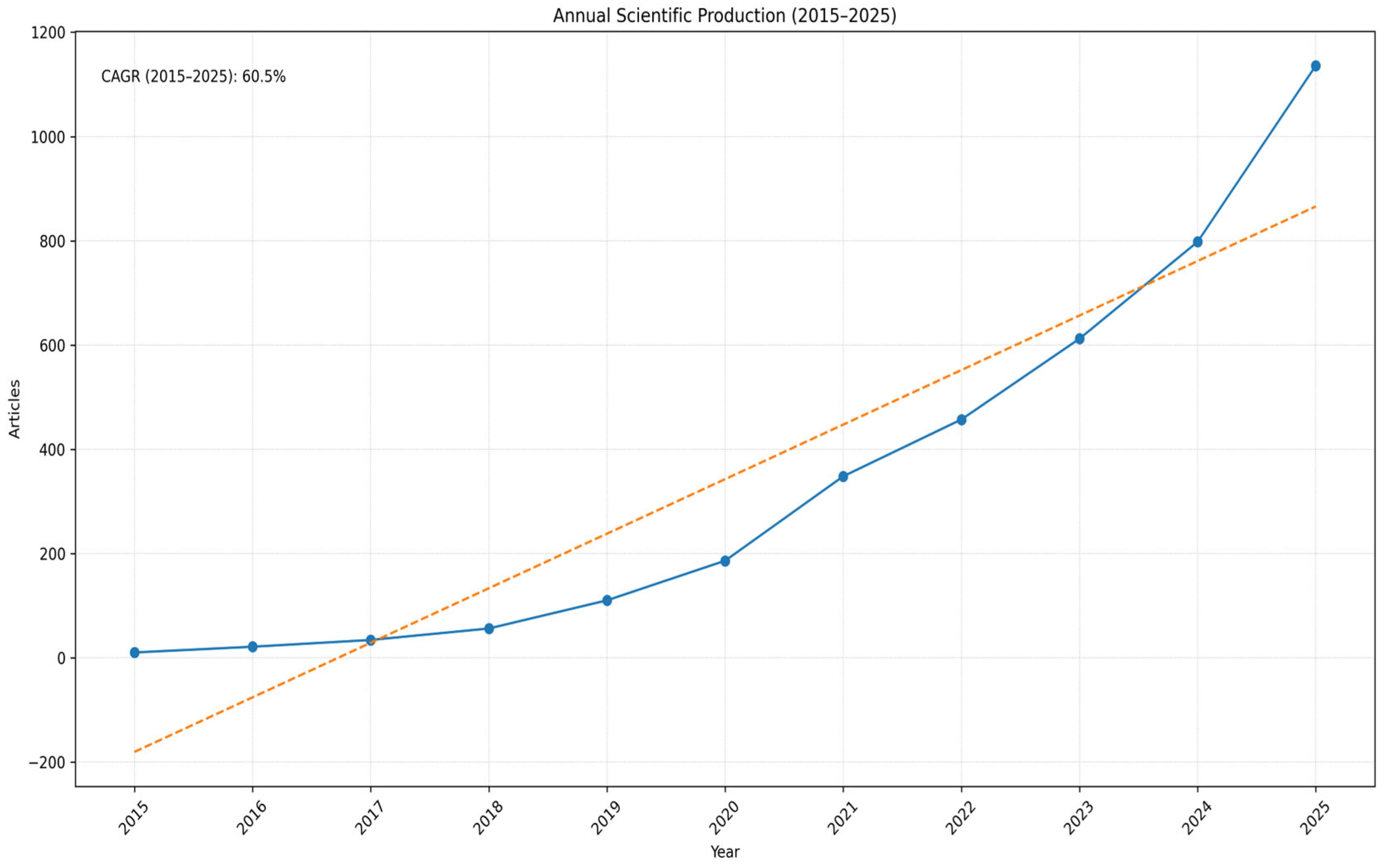
The merged corpus consisting of Scopus and Web of Science records includes 3765 unique publications indexed between 2015 and December 2025. Annual output shows a strong upward trajectory, with very limited activity in 2015–2016 and accelerated growth after 2019, culminating in a steep surge in 2022–2025 (see Figure 2). This pattern is consistent with earlier observations that the circular economy (CE) gained major policy relevance in the EU after 2018 and that digitalisation has become a central driver of research in sustainability-oriented management and operations (Camilleri, 2020; Murray et al., 2017; Okorie et al., 2018).
Journal articles represent the dominant document type in the corpus—approximately 75%—while conference and proceedings papers account for the remaining quarter of publications (see Table 1). Although both Scopus and Web of Science were queried using filters limited strictly to Articles and Conference/Proceedings Papers, the exported metadata include several secondary sub-types (e.g., “article; early access”, “article; book chapter”, “article; data paper”). These labels do not denote additional document categories but reflect database-specific indexing conventions, whereby accepted-but-unpaginated papers, conference papers published in edited volumes, or reclassified outputs receive auxiliary tags. Following established bibliometric practice, all secondary sub-types were normalised into their primary categories. Accordingly, all “article + sub-type” entries were classified as Articles, and all variants of conference outputs were grouped under Proceedings Papers. This harmonisation ensures a consistent distribution that aligns with prior studies emphasising the engineering–management duality of digital circular economy research (Centobelli et al., 2020b).
As shown in Table 1, the dominance of journal articles reflects the consolidation of digital circular economy research within established academic outlets, whereas the substantial share of proceedings papers highlights the strong presence of engineering, industrial technologies and applied innovation tracks in the field. This balanced distribution between journal and conference outputs is typical for research domains situated at the intersection of sustainability, digitalisation and operations management.
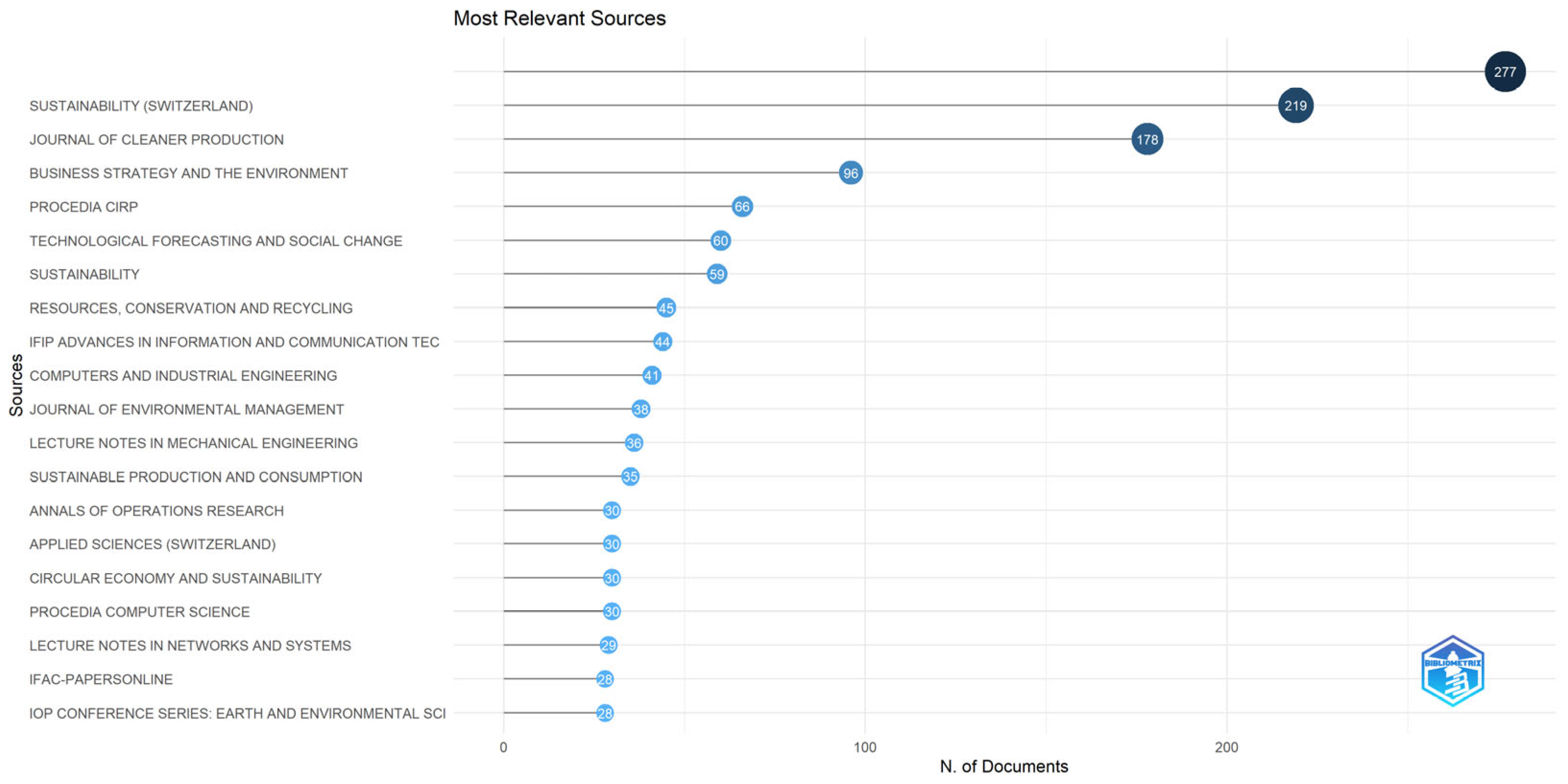
The 3765 documents are published across more than 1050 journals, reflecting the interdisciplinary nature of the field. The most prolific outlets include Sustainability (MDPI), Journal of Cleaner Production, Resources, Conservation & Recycling, Environmental Science and Pollution Research, and Technological Forecasting & Social Change (see Figure 3). These journals serve as intellectual anchors for work at the intersection of CE, digitalisation, and business research.
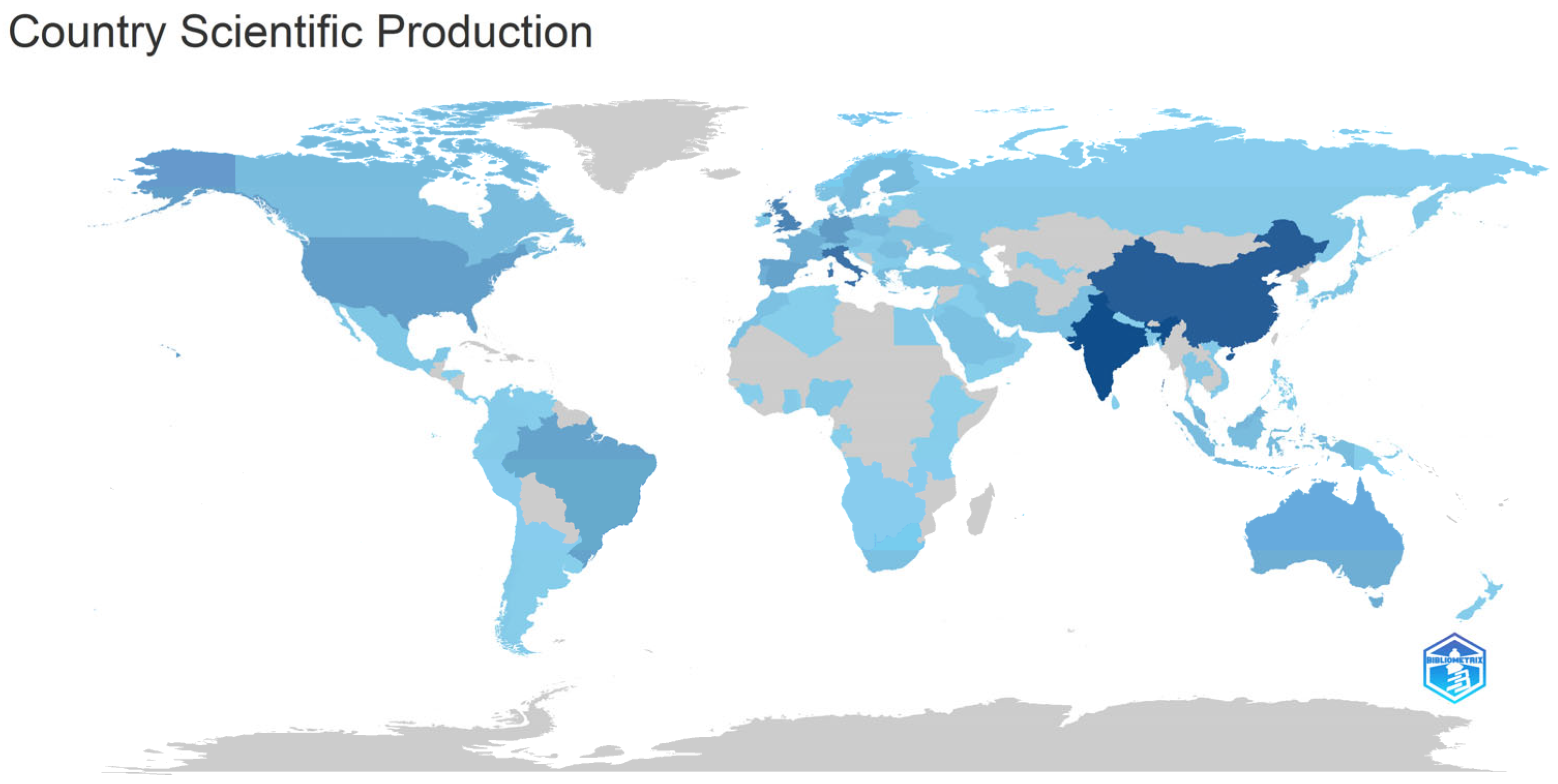
Geographical analysis reveals that India and China are the most productive countries in the field, followed by Italy, Spain, the United Kingdom, and other European contributors. Figure 4 visualises this pattern, while Table 2 reports the exact publication counts used for the country-level ranking. Notably, the concentration of publication output in India and China sits alongside strong European policy leadership in the digital and circular transition, indicating a potential mismatch between where policy frameworks are articulated and where the bulk of technology-centric research is produced.
The geographical distribution underscores the dual leadership of Asia and Europe in shaping digital circular economy research. India and China dominate in quantitative output, which aligns with their rapid industrial transformation and large-scale digital innovation ecosystems. At the same time, European countries—particularly Italy, the UK, Germany, Spain, France and Portugal—maintain strong positions consistent with the EU’s policy-driven emphasis on circularity and sustainable industry (Camilleri, 2020; Murray et al., 2017). The presence of Brazil and the United States further illustrates the broader international relevance of the field.
Finally, collaboration networks indicate a notable rise in international co-authorship over time. Although this is explored in more detail in Section 4.2, the descriptive overview highlights the increasingly global and networked nature of the field.
Overall, the descriptive analysis confirms that digital circular economy research is rapidly expanding, highly interdisciplinary, and strongly shaped by policy, technological, and organisational dynamics. These characteristics provide a robust foundation for the subsequent science-mapping analyses.

4.2. Top Journals and Influential Publications

Building on the descriptive overview presented in Section 4.1, this subsection examines the intellectual anchors of the field by analysing the top publication outlets and the most influential documents within the merged Scopus–WoS corpus (2015–2025). As shown in Figure 3, a relatively small group of journals accounts for a substantial share of the research output, reflecting the consolidation of digital circular economy scholarship within well-established outlets.
The leading sources—Sustainability, Journal of Cleaner Production, Business Strategy and the Environment, Technological Forecasting & Social Change, Resources, Conservation & Recycling, and Environmental Science and Pollution Research—span sustainability science, industrial engineering, operations management, and organisational research. Their dominance confirms earlier findings that digitalisation-driven circular economy studies tend to emerge at the intersection of environmental policy, industrial transformation and data-intensive innovation (Camilleri, 2020; Centobelli et al., 2020b; Okorie et al., 2018).
Beyond productivity rankings, the dominance of journals such as Sustainability, Journal of Cleaner Production, and Resources, Conservation & Recycling signals a strong institutional consolidation of digital circular economy research within environmentally and technologically oriented publication outlets. This concentration shapes prevailing research agendas by privileging techno-environmental framings of circularity, while social, organizational, and governance-oriented perspectives receive comparatively less visibility. As a consequence, research themes related to inclusion, diversity, and gender-sensitive entrepreneurship remain marginal within the most influential publication channels, despite their growing relevance for sustainable transitions.
To complement the journal-level analysis, Table 3 presents the Top 10 most cited publications in the merged corpus. These papers act as intellectual “hinge points,” establishing the foundational conceptual linkages between Industry 4.0 technologies, data analytics, supply-chain digitalisation and circular business models.
To construct Table 3, three standard citation-based indicators were used: Total Citations (TC), TC per Year, and Normalized TC. Total Citations capture the absolute impact of each paper within the merged corpus, whereas TC per Year adjusts for publication age by dividing total citations by the number of years since publication. Normalized TC further scales each paper’s citation count relative to the annual citation distribution of the dataset, highlighting contributions that perform substantially above the expected citation level for their publication year (Aria & Cuccurullo, 2017; Donthu et al., 2021). Together, these indicators provide a more balanced view of influence in a rapidly expanding research area such as the digital circular economy.
The ranking reported in Table 3 shows that Lopes de Sousa Jabbour et al. (2018) and Manavalan and Jayakrishna (2019) are the most globally cited papers, reflecting the early integration of Industry 4.0, sustainable operations and circular supply chains. Highly cited contributions by Kouhizadeh et al. (2021), Esmaeilian et al. (2020), Bag et al. (2021) and Centobelli et al. (2022) further consolidate the link between digital technologies (e.g., blockchain, smart manufacturing, advanced analytics) and circular business models in manufacturing and logistics contexts. More recent papers, such as Fatimah et al. (2020), Upadhyay et al. (2021) and Chauhan et al. (2022), score particularly high on TC per Year and Normalized TC, indicating that research on data-driven, platform-based and blockchain-enabled circular economy solutions has become a central and fast-moving topic within the field.
Overall, the evidence from Table 3 suggests that the intellectual core of digital circular economy research is shaped by a relatively cohesive set of highly cited conceptual and empirical contributions. These works predominantly frame digitally enabled circular transitions through the lenses of industrial efficiency, supply-chain optimization, and advanced technological integration.
This intellectual concentration reflects asymmetries in knowledge production, where research agendas are largely defined by engineering-driven and operations-focused paradigms. The absence of gender-sensitive or inclusive entrepreneurship perspectives among the most influential publications indicates that such themes have not yet penetrated the core knowledge base of the field, remaining peripheral rather than structurally embedded in dominant research trajectories.
In the next subsection, this intellectual structure is explored further through co-citation and keyword-based mapping, in order to identify the underlying thematic clusters and their evolution over time.

4.3. Leading Institutions and International Collaboration Patterns

Institution-level analysis provides insights into where scientific capacity on digital enablers of the circular economy is concentrated. The merged Scopus–WoS corpus (2015–2025) includes publications from more than 2000 institutions worldwide, yet research output is strongly uneven and clustered around several high-performing universities. As shown in Table 4, the Top 10 institutions reveal a pronounced concentration of activity in Europe, and particularly in Italy, which accounts for half of the leading affiliations. Politecnico di Milano ranks first with 91 publications, followed by Università degli Studi di Napoli Federico II (67 papers), Università degli Studi di Brescia (52 papers), Università degli Studi di Palermo (49 papers) and Parthenope University of Naples (44 papers). This strong Italian representation reflects the country’s long-standing academic leadership in industrial engineering, operations management and sustainability transitions—domains that naturally intersect with digital circular economy research.
This institutional concentration has important implications for agenda-setting and knowledge production within the field. The dominance of technically oriented European universities—particularly those with strong traditions in industrial engineering and operations management—suggests that digital circular economy research agendas are largely shaped by problem framings aligned with efficiency, optimization, and technological integration. As a result, alternative perspectives rooted in organizational diversity, social inclusion, or gender-sensitive entrepreneurship are less likely to emerge from the core institutional hubs that define mainstream research trajectories.
Outside Italy, several technically oriented institutions also stand out, including Khalifa University of Science and Technology (UAE), Norges Teknisk-Naturvitenskapelige Universitet (Norway), Delft University of Technology (Netherlands), University of Johannesburg (South Africa) and Technische Universität Braunschweig (Germany). Their presence highlights the increasingly global diffusion of circular economy frameworks and confirms that much of the scientific production in this domain is anchored in engineering-, technology- and data-driven research environments. These institutions operate as hubs that connect digital technologies with circular manufacturing, supply-chain innovation and data-centric governance, consistent with earlier findings on the technological foundations of digital circularity (Camilleri, 2020; Centobelli et al., 2020b; Okorie et al., 2018).
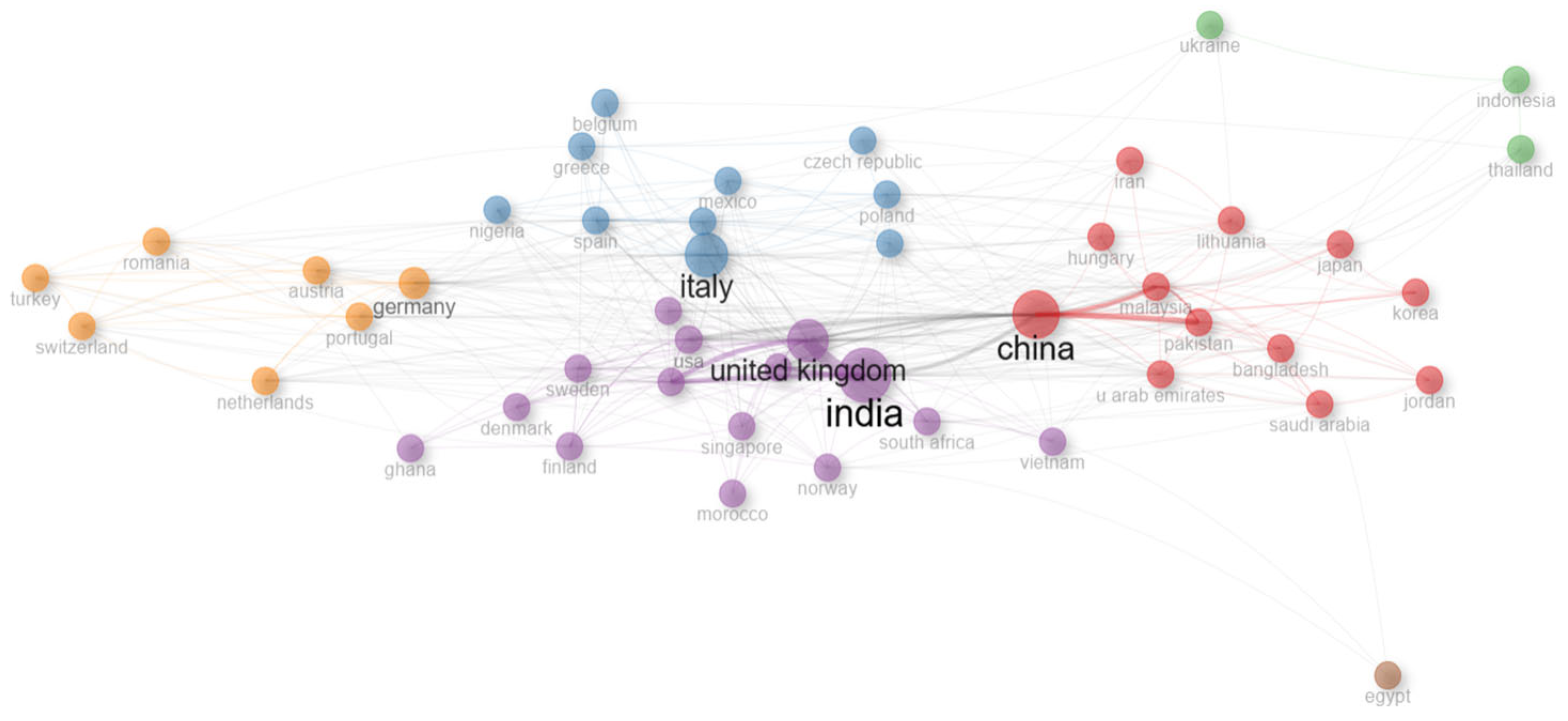
Beyond publication output, international co-authorship networks provide a complementary view of how expertise circulates across countries and regions. Figure 5 visualises the global collaboration structure and shows several highly connected communities centred on China, India, Italy, the United Kingdom and Germany. These countries occupy central positions in the network, indicating frequent participation in multinational research projects and sustained cross-regional engagement. European countries form a particularly dense collaboration core, with Italy, Germany, France, the Netherlands, Portugal and Switzerland closely interconnected through shared research initiatives, many of which are supported by EU framework programmes and digital-innovation funding schemes. Emerging links involving the UAE, Norway and South Africa further suggest that smaller but rapidly developing research systems play bridging roles that facilitate knowledge diffusion across continents.
While these dense international collaboration networks facilitate the rapid diffusion of technological knowledge and best practices, they may also contribute to the reinforcement of dominant research paradigms. Highly connected institutional hubs tend to privilege established methodological approaches and dominant problem framings—particularly those aligned with large-scale, data-driven, and engineering-oriented research agendas. As a result, alternative perspectives, including gender-sensitive research agendas and inclusive entrepreneurship approaches, remain weakly integrated into the core collaboration structure, reinforcing existing asymmetries in knowledge production.
Peripheral regions such as Southeast Asia, Eastern Europe and North Africa appear less integrated into the main structure, yet their increasing connectivity indicates growing participation in digital circular economy research. Overall, the observed institutional and collaboration patterns indicate that digital circular economy research is shaped by a relatively concentrated set of research-intensive universities embedded in transnational networks that privilege technological excellence and industrial applications. While this configuration has accelerated the consolidation of digital circular economy frameworks, it has also contributed to asymmetries in knowledge production, limiting the visibility of gender-sensitive and inclusive entrepreneurship perspectives within the core structure of the field.

4.4. Thematic Structure of the Field: Keyword Co-Occurrence Analysis

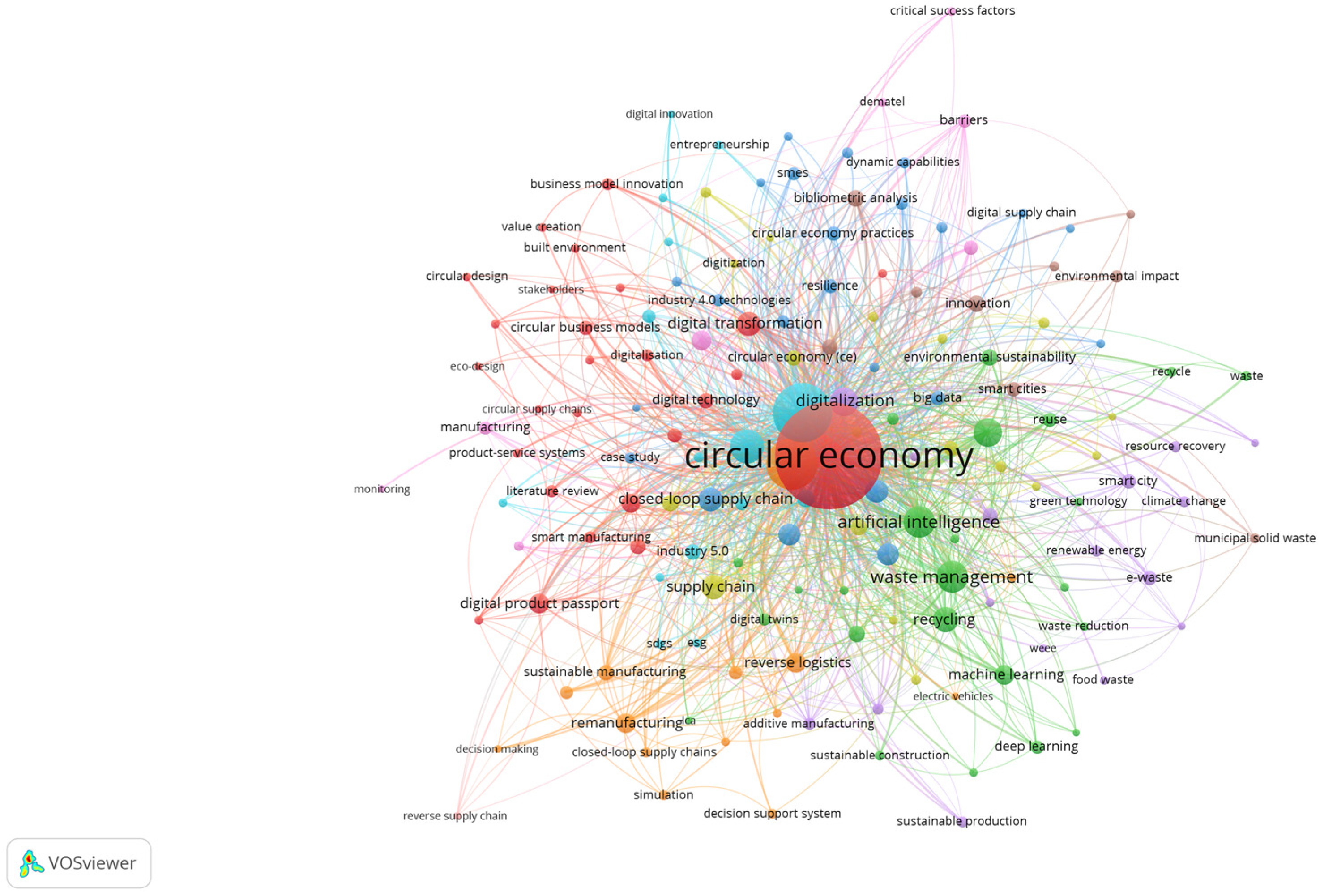
To deepen the understanding of the conceptual landscape, this subsection analyses the co-occurrence structure of author keywords across the merged Scopus–WoS corpus (2015–2025). Using VOSviewer’s co-occurrence mapping (threshold: ≥10 keyword occurrences), a network of 154 high-frequency terms was generated. The resulting map, presented in Figure 6, reveals the main thematic clusters shaping research on digital enablers of the circular economy.
The visualisation indicates a highly interconnected thematic space, structured around several core clusters. At the centre of the map, “circular economy” and “sustainability” function as the dominant anchoring concepts, confirming their role as the intellectual backbone of the field. Surrounding these core nodes are multiple thematic communities representing distinct yet complementary research directions.
A large green cluster captures themes related to waste management, recycling, resource recovery, sustainable production, municipal solid waste and environmental sustainability. This cluster reflects the operational and environmental dimensions of circularity, emphasising how digital technologies support waste valorisation, traceability and resource optimisation.
A prominent blue cluster groups topics associated with digital transformation, Industry 4.0, digitalisation, digital twins, AI, big data, smart manufacturing and advanced analytics. These keywords reveal the technological core of the field, highlighting that circularity increasingly relies on data-driven systems, automation, sensor integration and algorithmic decision-making. The presence of terms such as “predictive maintenance,” “simulation,” “digital product passport” and “smart supply chain” reinforces the centrality of digital infrastructures for enabling circular flows.
A distinct red cluster includes concepts related to supply chain management, reverse logistics, closed-loop systems, remanufacturing, resilience and optimisation. This cluster demonstrates that supply-chain redesign remains one of the most active research domains, especially in relation to digital enablers such as IoT-based tracking, blockchain-enabled transparency and machine-learning-driven forecasting.
A further yellow-orange cluster encompasses innovation management, dynamic capabilities, business model innovation, entrepreneurship and value creation, indicating a growing interest in organisational transformation and the strategic integration of digital tools into circular business models. The presence of terms related to barriers, critical success factors and stakeholder engagement suggests that implementation challenges and socio-technical conditions are also well-established research streams.
Despite the presence of keywords related to entrepreneurship and business model innovation within the yellow-orange cluster, the co-occurrence structure reveals a predominantly technology-centric and organization-neutral framing of entrepreneurial activity. Concepts explicitly related to gender, inclusion, women’s entrepreneurship, or diversity are notably absent from the high-frequency keyword network, indicating that entrepreneurial dynamics are largely conceptualized in abstract or firm-level terms rather than through socially differentiated actor perspectives. This suggests that while organizational transformation is acknowledged as an important dimension of the digital circular economy, it is primarily examined through strategic and managerial lenses that remain detached from questions of inclusivity and unequal access to digital resources.
Finally, several peripheral terms—such as “smart cities,” “green technology,” “energy transition,” “climate change,” and “urban sustainability”—demonstrate a broadening of the field toward systemic sustainability transitions and cross-sectoral digital applications.
Taken together, the dominance of technology-oriented and supply-chain-focused clusters reflects a thematic hierarchy in which research agendas are shaped primarily by engineering, industrial optimization, and data-driven efficiency paradigms. This thematic configuration mirrors the institutional concentration identified in Section 4.3 and suggests that knowledge production in the digital circular economy is structured around research priorities that privilege scalable technological solutions over socially embedded innovation processes. As a result, gender-sensitive perspectives and inclusive entrepreneurship frameworks remain weakly integrated into the core intellectual structure of the field, reinforcing existing asymmetries in how digital circular transitions are conceptualized and studied.
Overall, the keyword co-occurrence analysis shows that research on digital enablers of the circular economy is conceptually rich and multi-layered. It integrates environmental management, industrial engineering, supply-chain optimisation, digital innovation and strategic transformation into a coherent yet diversified thematic landscape. The strong interconnectedness among clusters confirms that the digital circular economy is emerging as an interdisciplinary research domain driven by the convergence of technological, organisational and environmental perspectives.

4.5. Women Entrepreneurship Lens on the Digital Circular Economy Literature

To address RQ3, a women entrepreneurship lens was applied to the merged Scopus–WoS corpus by identifying publications that contained at least one gender-related term (“women”, “female”, “gender”, “women entrepreneur*”, “female founder*”) in the title, abstract, or author keywords. After merging the gender-filtered subsets from Scopus and Web of Science and removing duplicates based on title, a total of 51 unique documents were identified for the period 2015–2025. This represents 1.35% of the full digital circular economy corpus (51 out of 3765 documents), indicating that explicit gender-related perspectives remain quantitatively marginal within the field. This procedure captures explicit gender visibility in academic metadata and should not be interpreted as evidence of the actual prevalence of women-led circular ventures in practice.
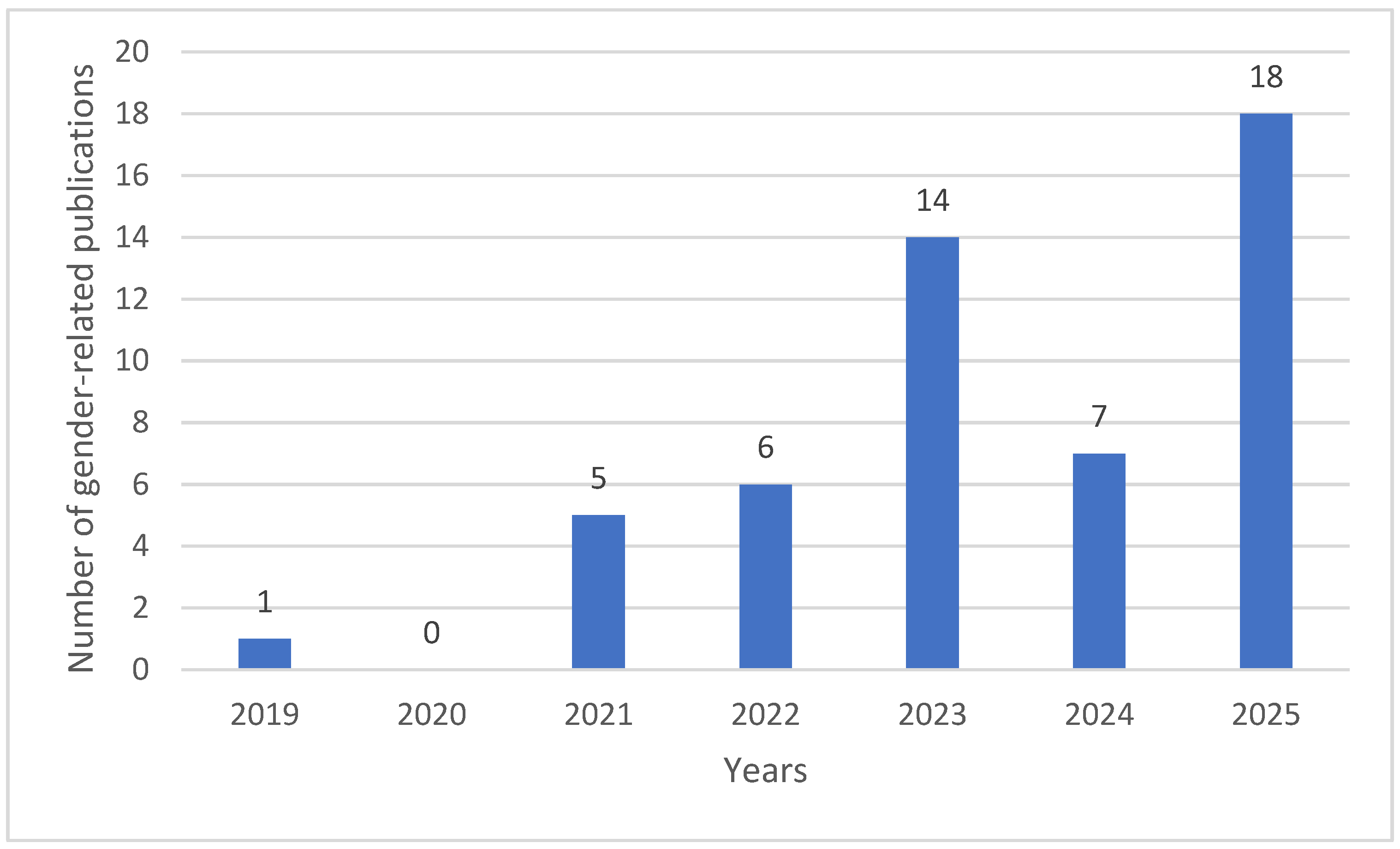
From a temporal perspective, gender-tagged publications appear only from 2019 onwards and display a modest but clearly upward trend over time (Figure 7). The dataset includes one publication in 2019, five in 2021, six in 2022, fourteen in 2023, seven in 2024, and eighteen in 2025, with no gender-tagged documents identified prior to 2019 or in 2020. The absence of gender-tagged publications in 2020 should be interpreted with caution. This result reflects the combined effects of strict intersectional keyword filtering, potential database indexing delays, and publication disruptions associated with the COVID-19 pandemic, which may have temporarily reduced both research output and the explicit use of gender-related terminology in titles, abstracts, or author keywords. Consequently, the zero count for 2020 does not indicate a substantive absence of gender-related research activity, but rather a limitation of keyword-based bibliometric detection under exceptional publication conditions. This pattern suggests that gender-related considerations have entered digital circular economy research relatively recently, with more visible growth occurring only in the last three to four years of the observation period.
A closer examination of titles and author keywords shows that most of these 51 publications address gender primarily through themes of equity, inclusion, social justice, or inequality, rather than through a direct focus on women entrepreneurs as economic actors. Frequently occurring keywords include “gender”, “gender equity”, “gender inequalities”, and “gender barriers”, whereas terms such as “women entrepreneurship” or “female entrepreneurship” appear only sporadically. Only a very small subset of publications (approximately four documents) explicitly examines entrepreneurial activity, including studies of women digital entrepreneurs or women-led sustainable ventures. In the majority of cases, women entrepreneurs are referenced illustratively within broader sustainability or digitalisation debates rather than analysed as a central unit of inquiry. To enhance transparency and move beyond narrative description, Table 5 provides a systematic classification of all 51 gender-tagged publications identified in the corpus.
The classification confirms the limited visibility of women’s entrepreneurship as a core analytical focus and the predominance of single-country, methodologically fragmented studies.
In terms of outlets, gender-tagged publications are dispersed across journals such as Environmental Science and Pollution Research, Sustainability, International Journal of Environmental Research and Public Health, and Environmental Education Research. These journals tend to emphasise social, environmental, or policy-oriented perspectives, while only a limited number are primarily focused on business, management, or entrepreneurship. This distribution partly explains why the intersection between digital circular economy research and women’s entrepreneurship remains weakly articulated in core management-oriented outlets, despite substantial evidence from the women’s and sustainable entrepreneurship literature that women-led ventures frequently integrate social and environmental objectives into their business models (Filser et al., 2019; Muñoz & Cohen, 2018; Raman et al., 2022; Volkmann et al., 2021).
Overall, the women entrepreneurship lens reveals that gender-related perspectives are present but remain peripheral and fragmented within the digital circular economy literature. Gender is more often treated as a cross-cutting social concern than as an analytical dimension shaping digital circular strategies, entrepreneurial agency, or ecosystem governance. These descriptive patterns provide the empirical basis for the interpretive discussion developed in Section 5, where the implications of this under-representation are examined in relation to theory, policy, and future research directions.
Interpreting this low visibility purely as an ‘absence of women entrepreneurs’ would be misleading. Instead, it likely reflects institutional and epistemic mechanisms in research production: technology- and operations-oriented funding streams, journal scopes, and reviewer expectations can prioritize measurable digital-technical outcomes, while gender and inclusion scholarship are often routed to separate outlets and communities. The result is a structural decoupling in which gender becomes an ‘add-on’ rather than a constitutive dimension of digital circular economy research.

5. Discussion

5.1. Field Evolution and Key Asymmetries

The bibliometric evidence presented in Section 4 points to a rapidly expanding and increasingly structured research domain at the intersection of digital technologies and the circular economy (CE). The strong growth in publication output, the consolidation of leading journals, and the emergence of a recognisable institutional core confirm that digitalisation has become a foundational architectural component of contemporary circular strategies. Similar patterns have been observed in adjacent domains such as green finance, where digitalisation increasingly intersects with sustainability-driven innovation, albeit with limited attention to gender-inclusive perspectives (Krastev & Krasteva-Hristova, 2024). These trends align with prior research identifying IoT, AI, blockchain, big data analytics, and digital platforms as key technological pillars enabling lifecycle redesign, traceability, and advanced service-oriented circular business models (Chauhan et al., 2022; Rosa et al., 2020; Upadhyay et al., 2021). Importantly, the patterns discussed here describe the configuration of scholarly discourse and research activity; they should not be read as a direct proxy for the maturity of real-world implementation or the prevalence of specific entrepreneur groups.
The prominence of engineering-oriented institutions and applied-science journals further indicates that digital CE research remains strongly anchored in industrial technologies and operations management. However, this focus increasingly extends beyond efficiency gains toward a socio-technical understanding of circularity that emphasises data governance, interoperability, organisational capabilities, and cross-actor coordination (Cagno et al., 2021; Kristoffersen et al., 2020). Dense international collaboration networks suggest that knowledge production in this field is progressively channelled through large, multi-institutional research consortia, reinforcing the role of organisational knowledge assets and intellectual capital in technology-intensive sustainability transitions (Huian et al., 2025). This anchoring produces a notable tension for administrative and organisational research: governance questions—such as accountability, equity, and inclusion—are often invoked at the level of policy rhetoric, yet they remain weakly operationalised in the dominant technology-centric research streams.

5.2. Digital Infrastructures as Circular Governance Mechanisms

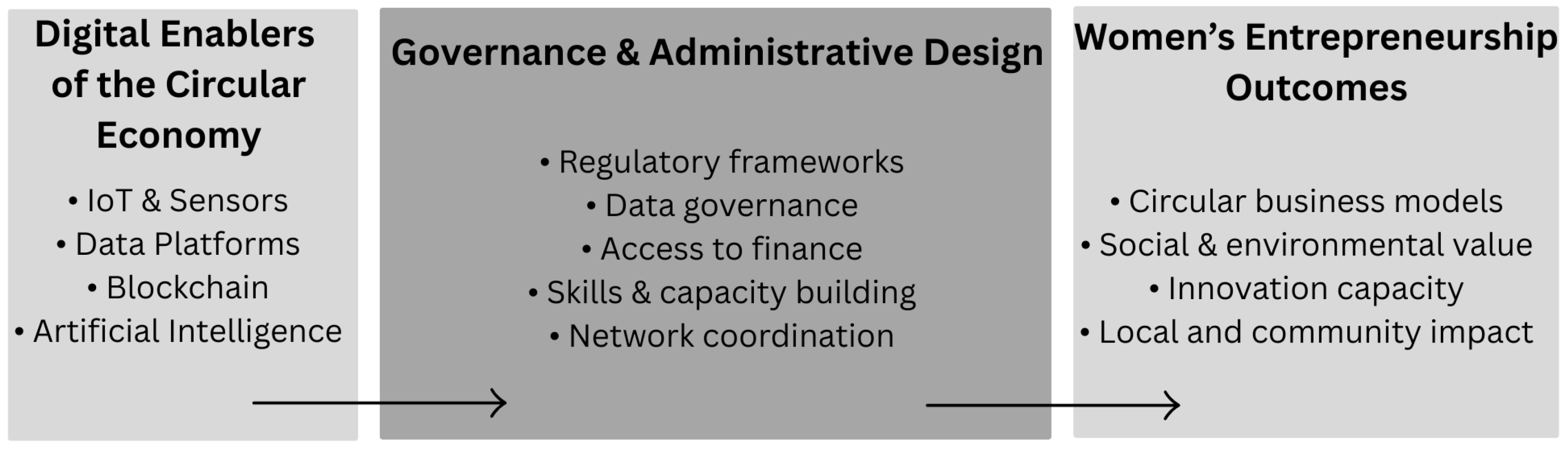
From an administrative sciences perspective, these findings highlight a conceptual shift: digital technologies in circular systems function not merely as operational tools, but as governance infrastructures shaping coordination, accountability, and decision-making across complex ecosystems. The increasing reliance on IoT systems, blockchain-based traceability, and data platforms reflects the emergence of administratively intensive circular arrangements that require new forms of organisational control and inter-organisational governance. This governance-mediated relationship between digital CE enablers and entrepreneurial outcomes is synthesised in Figure 8, which conceptualises digital infrastructures as institutional mechanisms influencing access to resources, skills development, finance, and innovation networks. The framework is intended as an analytical and governance-oriented tool rather than a normative prescription.

5.3. Gender Invisibility and the Gender-Responsive Digital Circular Economy Framework

Figure 8 synthesises three layers of evidence produced in this review—(i) the dominant technology clusters, (ii) the emerging policy–social stream, and (iii) the near-absence of explicit women entrepreneurship perspectives—into a governance lens that can guide future empirical work. It does not claim to represent a settled theory of gender in the circular economy; rather, it specifies where gender-responsiveness can be operationalised in digitally enabled circular systems (e.g., data governance rules, platform access, traceability standards, participation in decision-making, and financing of circular ventures). As such, the framework is offered as an interpretive and testable agenda-setting device for administrative sciences.
The thematic clusters identified through keyword co-occurrence analysis—digital circular manufacturing, circular business model innovation, waste and resource management, and policy–social dimensions—confirm that the intellectual structure of the field is stabilising around core technological and managerial domains. These clusters largely mirror those identified in earlier reviews of Industry 4.0-enabled circular economy frameworks (Chauhan et al., 2022; Rosa et al., 2020) and are consistent with broader evidence that environment- and climate-related innovations are increasingly shaped by data-driven digital infrastructures (Wang et al., 2020).
A central contribution of this review lies in its assessment of women’s entrepreneurship within the digital circular economy literature. Despite substantial evidence that women-led ventures disproportionately engage in sustainability-oriented innovation and social value creation (Muñoz & Cohen, 2018; Raman et al., 2022), gender-tagged publications represent only a marginal share of the corpus. The limited visibility of gender perspectives—both in author keywords and thematic clusters—suggests that digital CE research largely operates under an implicit gender-neutral actor model. Such neutrality risks obscuring how structural barriers, differential access to digital resources, and entrepreneurial ecosystems shape participation in digitally enabled circular innovation. These patterns resonate with broader findings on gender inequality in organisational and professional contexts, including Eastern Europe, where women’s advancement remains constrained by implicit bias and unequal access to high-value networks (Prodan & Manolescu, 2006). Recent empirical work further highlights that digital entrepreneurship outcomes depend jointly on external technological readiness and non-technological institutional change (Jahanbakht & Ahmadi, 2025), which supports interpreting ‘structural enablers’ in digital circular transitions as governance conditions rather than purely technical inputs.
By framing women’s entrepreneurship as an integral component of digitally enabled circular governance rather than a peripheral social issue, Figure 8 advances the literature toward a more systemic understanding of inclusion and exclusion mechanisms. The framework shifts analytical attention from individual entrepreneurial characteristics to the design of digital infrastructures, governance arrangements, and administrative systems through which gendered outcomes are produced. This perspective aligns with insights from inclusive innovation and feminist political economy, which emphasise that technological systems are socially embedded and tend to reproduce existing power relations unless inclusion is explicitly embedded in institutional design (George et al., 2012; Heeks et al., 2014; Rai et al., 2019; Wajcman, 2010).
Overall, the discussion indicates that while the digital circular economy has matured into a coherent and rapidly growing research field, it remains incomplete in its representation of entrepreneurial diversity. Integrating gender-responsive perspectives into digital CE scholarship is therefore not only a normative concern, but a matter of effective governance and organisational design. These insights provide a focused foundation for the implications and future research directions elaborated in Section 6.

6. Implications and Future Research Directions

6.1. Research Governance and Funding

  • Funding bodies and programme owners (e.g., CE, Industry 4.0, digitalisation calls) can reduce structural decoupling by making gender-responsiveness an explicit evaluation criterion—e.g., requiring applicants to specify how digital circular solutions affect access, participation, and benefits across gender and other dimensions;
  • Dedicated ‘bridge’ calls and interdisciplinary work packages can incentivise collaboration between operations/engineering teams and scholars in entrepreneurship, gender studies, and public administration, preventing gender from being relegated to a downstream dissemination activity;
  • Data-governance initiatives (including DPP and traceability infrastructures) could require gender-disaggregated indicators where relevant (e.g., participation in circular supply chains, access to finance and platforms), creating demand for research that can operationalise these measures.

6.2. Journals, Editors, and Scholarly Communities

  • Editors and reviewers can encourage authors to discuss inclusion implications of digital circular technologies (even when the study is technology-centric) by adding a short ‘equity and inclusion considerations’ prompt to reviewer forms and author guidelines;
  • Special issues or article collections that deliberately couple digital circular economy topics with inclusive entrepreneurship can help realign keyword ecologies and citation pathways, making gender-relevant work more discoverable in mainstream outlets;
  • Authors can improve retrieval and cumulative knowledge by using consistent keywords (e.g., “women entrepreneurship”, “gender”, “inclusive entrepreneurship”) when such dimensions are substantively addressed, reducing false negatives in future evidence syntheses.

6.3. Managerial and Policy Implications

  • Organisations implementing digital circular infrastructures (e.g., platforms for secondary materials, traceability systems, DPP compliance workflows) can embed inclusion by design: transparent onboarding rules, low-cost access tiers, and capacity-building for small and women-led suppliers to meet data/reporting requirements;
  • Public authorities can align circular-economy support instruments with inclusive entrepreneurship by combining technology grants (IoT, AI, blockchain, DPP readiness) with targeted finance, mentoring, and procurement pathways for women-led circular ventures;
  • Policy monitoring should distinguish between (i) technology adoption and (ii) distributive outcomes (who participates and who benefits), which requires data collection strategies that are compatible with privacy and administrative feasibility.
The targeted implications above are complemented below by broader theoretical, managerial, and policy reflections, followed by future research directions.

6.4. Theoretical Implications

The findings of this study have important implications for theory, managerial practice, and public policy. First, the rapid expansion and consolidation of research on digital enablers of the circular economy highlights a clear shift from technologically centred descriptions of Industry 4.0 tools toward more holistic socio-technical perspectives. The bibliometric evidence demonstrates that digitalisation is increasingly conceptualised not merely as a set of enabling technologies, but as an integrated architecture encompassing data governance, organisational capabilities, and multi-actor coordination mechanisms that shape how circular strategies are designed and implemented. This perspective complements and extends existing frameworks grounded in systems thinking, resource-based views, and socio-technical transition theories within circular economy scholarship (Kristoffersen et al., 2020; Rosa et al., 2020).

6.5. Managerial Implications

From a managerial standpoint, the results point to a dual challenge faced by organisations: developing digital infrastructures that support circularity while simultaneously aligning these infrastructures with new forms of value creation, stakeholder engagement, and inter-organisational collaboration. Consistent with prior research, the effective integration of digital technologies depends not only on technological readiness but also on organisational culture, institutional support, and learning-oriented environments (Ionescu et al., 2022). The concentration of advanced digital capabilities—such as interoperable data ecosystems, blockchain-enabled traceability, IoT-based monitoring, and AI-driven decision support—within a relatively small number of global research hubs suggests that firms may benefit from deeper collaboration with centres of excellence. Managers in manufacturing, logistics, energy, waste management, and service-oriented circular business models can use these insights to benchmark technological maturity, anticipate capability gaps, and design more coherent digital–circular strategies.

6.6. Policy Implications

The policy implications are equally significant. Despite strong policy emphasis on aligning digitalisation with sustainability—particularly within European Union circular economy and digital transition agendas—the findings reveal a structural misalignment between policy ambitions and academic knowledge production. The near absence of gender-related research within the digital circular economy literature poses a challenge for policy frameworks that explicitly promote inclusive innovation, women’s entrepreneurship, and gender-responsive sustainability transitions. Prior evidence indicates that persistent gender inequalities in organisational and innovation environments constrain women’s access to high-value networks, resources, and technology-intensive sectors (Prodan & Manolescu, 2006). As women-led ventures increasingly engage in sustainable fashion, repair services, local circular ecosystems, and digital micro-enterprises, overlooking gender dynamics risks obscuring important pathways for socially embedded and community-oriented circular innovation (Muñoz & Cohen, 2018; Raman et al., 2022).
These findings suggest that gender responsiveness should not be treated as an ex post corrective measure, but as an integral component of digital circular governance. Policymakers designing instruments such as digital product passports, extended producer responsibility regimes, or data-sharing standards may therefore need to incorporate gender-sensitive considerations that ensure equitable access to digital infrastructures, financing, skills development, and entrepreneurial ecosystems.

6.7. Future Research Directions

Future research can build on this study in several directions. Conceptually, deeper integration of gender theories, feminist economics, and inclusive entrepreneurship frameworks could broaden circular economy scholarship beyond its current technology- and operations-centric orientation. Empirically, mixed-method approaches combining bibliometric analysis with interviews, case studies, and comparative research could explore how digital tools are adopted and adapted by women-led ventures across sectors such as sustainable textiles, circular food systems, reuse platforms, and community repair initiatives. Methodologically, longitudinal science-mapping studies could assess whether gender-related themes gain prominence as digital circular policies and governance frameworks mature.
Finally, there is substantial scope for research examining how digital infrastructures—such as IoT networks, blockchain-based traceability systems, and data platforms—can be designed to lower structural barriers for under-represented entrepreneurial groups. Advancing this line of inquiry would not only address the gender gap identified in the present analysis, but also contribute to more inclusive, effective, and socially robust digital circular economy transitions.

7. Conclusions

This study provided a comprehensive bibliometric review of research on digital enablers of the circular economy in business and management over the period 2015–2025, complemented by a women entrepreneurship lens. By integrating Scopus and Web of Science records into a unified corpus of 3765 publications and applying performance analysis, co-authorship mapping, co-citation analysis and keyword clustering, the article offers the most up-to-date and systematic overview of the intellectual, geographical and thematic configuration of the field.
The analysis revealed four major findings. First, digital-CE research has expanded rapidly since 2018, driven by increasing policy relevance, technological maturity and the integration of digital infrastructures into sustainability transitions. Second, the field is anchored in a relatively small set of journals, led by Sustainability, Journal of Cleaner Production and Resources, Conservation & Recycling, while a concentrated group of European and Asian institutions—especially Italian technical universities, Chinese research hubs and innovation-oriented universities in the UAE, Norway and South Africa—shape global scientific output. Third, the intellectual structure is built around clusters associated with digital manufacturing, blockchain-enabled traceability, supply-chain optimisation, platform-based business models and circular resource recovery, indicating a strong convergence between operations management, industrial engineering and data-driven sustainability innovation.
Fourth, and most critically for the purpose of this article, gender-related research remains almost entirely absent from the digital CE literature. Despite global policy commitment to inclusive and gender-responsive innovation, only 51 publications in the merged corpus contain gender-related terms, and very few of these have women’s entrepreneurship as a substantive analytical focus. This absence suggests a conceptual blind spot: the dominant literature implicitly treats firms, entrepreneurs and digital infrastructures as gender-neutral, thereby overlooking the potential contributions of women-led ventures to circular innovation, sustainable business model experimentation and socially embedded digital transitions.
The findings have several implications. For scholars, the results highlight the need to expand conceptual frameworks toward gender-responsive theories of digital circularity, integrating insights from women’s entrepreneurship, feminist economics and inclusive innovation. For organisations, the study emphasises the importance of aligning digital investment strategies with circular objectives, data-governance capabilities and cross-sector collaboration. For policymakers, the evidence underscores the need to design digital-CE regulations—such as digital product passports, EPR reporting systems and data-sharing platforms—in ways that enable rather than constrain women’s participation in emerging circular sectors.

Limitations

As with most bibliometric reviews, these findings should be interpreted in light of several methodological and data-related limitations. First, the corpus is limited to Scopus and Web of Science and to English-language records; relevant studies indexed elsewhere or published in other languages may be omitted. Second, the exclusion of book chapters and grey literature increases metadata comparability but may underrepresent fields where edited volumes are influential. Third, keyword-based retrieval can introduce vocabulary bias: technology-centric terms (e.g., “Industry 4.0”, “smart*”) are more standardised than inclusion-related terminology, which may produce false negatives for gender-relevant work that is not explicitly tagged in titles/abstracts/keywords. Fourth, citation-based indicators are subject to citation lag, particularly for 2023–2025, and country/journal rankings may shift as indexing updates accumulate. Finally, any indicative author-gender discussion relies on cautious, publicly available information and (where applicable) name-based and automated gender inference and should not be interpreted as a precise demographic measure.
By positioning digital circular economy research within an administrative and organizational framework, this study underscores that successful circular transitions depend not only on technological innovation but also on governance capacity, inclusive decision-making, and effective coordination across digital ecosystems. Overall, the study contributes to academic and policy debates by mapping the contours of a fast-evolving research domain and identifying a neglected intersection at the heart of sustainable innovation—women’s entrepreneurship in digitally enabled circular economies. By foregrounding this gap, the article points to a promising and necessary avenue for future research, practice and policy, one that supports not only technological efficiency but also social inclusion and equitable participation in the transition toward circular and regenerative economic systems.

Author Contributions

Conceptualization, E.T. and R.K.-H.; methodology, E.T. and R.K.-H.; soft-ware, R.K.-H. and A.I.; validation, I.M.; formal analysis, M.P.; investigation, A.I.; resources, M.P.; data curation, M.P. and A.I.; writing—original draft preparation, E.T., I.M., R.K.-H., M.P. and A.I.; writing—review and editing, E.T., I.M., R.K.-H., M.P. and A.I.; visualization, R.K.-H. and A.I.; supervision, E.T. and M.P.; project administration, E.T. and I.M.; funding acquisition, E.T. and I.M. All authors have read and agreed to the published version of the manuscript.

Funding

This research was funded by the Interreg Programme Danube Region, co-funded by the European Union, under the project WE.Circular: Boosting digital and industrial capacity for sus-tainable circular transition of women entrepreneurs in the Danube Region, grant No. DRP0200020.

Institutional Review Board Statement

Not applicable. The study did not involve humans or animals.

Informed Consent Statement

Not applicable. The study did not involve humans.

Data Availability Statement

The bibliographic data used in this study were obtained from Scopus (Elsevier) and Web of Science Core Collection (Clarivate) databases under institutional subscription agreements. Due to licensing restrictions, the raw records cannot be shared publicly. Aggregated data and analysis scripts are available from the corresponding author upon reasonable request.

Conflicts of Interest

The authors declare no conflicts of interest.

References

  1. Afawubo, K., & Noglo, Y. A. (2022). ICT and entrepreneurship: A comparative analysis of developing, emerging and developed countries. Technological Forecasting and Social Change, 175, 121312. [Google Scholar] [CrossRef]
  2. Alharbi, M. D. (2025). Mapping the fashion entrepreneurship ecosystem in Saudi Arabia: Impacts on entrepreneurial orientation and business performance of micro, small, and medium enterprises [Ph.D. thesis, RMIT University]. [Google Scholar]
  3. Ardolino, M., Rapaccini, M., Saccani, N., Gaiardelli, P., Crespi, G., & Ruggeri, C. (2018). The role of digital technologies for the service transformation of industrial companies. International Journal of Production Research, 56(6), 2116–2132. [Google Scholar] [CrossRef]
  4. Aria, M., & Cuccurullo, C. (2017). bibliometrix: An R-tool for comprehensive science mapping analysis. Journal of Informetrics, 11(4), 959–975. [Google Scholar] [CrossRef]
  5. Bag, S., Pretorius, J., Gupta, S., & Dwivedi, Y. K. (2021). Role of institutional pressures and resources in the adoption of big data analytics powered artificial intelligence, sustainable manufacturing practices and circular economy capabilities. Technological Fore-casting and Social Change, 163, 120420. [Google Scholar] [CrossRef]
  6. Barba-Sánchez, V., Meseguer-Martínez, A., Gouveia-Rodrigues, R., & Raposo, M. L. (2024). Effects of digital transformation on firm performance: The role of IT capabilities and digital orientation. Heliyon, 10(6), e27725. [Google Scholar] [CrossRef] [PubMed]
  7. Bocken, N., De Pauw, I., Bakker, C., & Van Der Grinten, B. (2016). Product design and business model strategies for a circular economy. Journal of Industrial and Production Engineering, 33(5), 308–320. [Google Scholar] [CrossRef]
  8. Cagno, E., Neri, A., Negri, M., Bassani, C. A., & Lampertico, T. (2021). The role of digital technologies in operationalizing the circular economy transition: A systematic literature review. Applied Sciences, 11(8), 3328. [Google Scholar] [CrossRef]
  9. Camilleri, M. A. (2020). European environment policy for the circular economy: Implications for business and industry stakeholders. Sustainable Development, 28(6), 1804–1812. [Google Scholar] [CrossRef]
  10. Centobelli, P., Cerchione, R., Chiaroni, D., Del Vecchio, P., & Urbinati, A. (2020a). Designing business models in circular economy: A systematic literature review and research agenda. Business Strategy and the Environment, 29(4), 1734–1749. [Google Scholar] [CrossRef]
  11. Centobelli, P., Cerchione, R., & Esposito, E. (2020b). Pursuing supply chain sustainable development goals through the adoption of green practices and enabling technologies: A cross-country analysis of LSPs. Technological Forecasting and Social Change, 153, 119920. [Google Scholar] [CrossRef]
  12. Centobelli, P., Cerchione, R., Vecchio, P., Oropallo, E., & Secundo, G. (2022). Blockchain technology for bridging trust, traceability and transparency in circular supply chain. Information & Management, 59(7), 103508. [Google Scholar] [CrossRef]
  13. Chauhan, C., Parida, V., & Dhir, A. (2022). Linking circular economy and digitalisation technologies: A systematic literature review of past achievements and future promises. Technological Forecasting and Social Change, 177, 121508. [Google Scholar] [CrossRef]
  14. Deng, W., Orbes, I., & Ma, P. (2024). Necessity- and opportunity-based female entrepreneurship across countries: The configurational impact of country-level institutions. Journal of International Management, 30(4), 101160. [Google Scholar] [CrossRef]
  15. Diaconu, L., Krastev, B., Georgieva, E., & Krasteva-Hristova, R. (2025). Environmental auditing, public finance, and risk: Evidence from Moldova and Bulgaria. Journal of Risk and Financial Management, 18(12), 683. [Google Scholar] [CrossRef]
  16. Donthu, N., Kumar, S., Mukherjee, D., Pandey, N., & Lim, W. M. (2021). How to conduct a bibliometric analysis: An overview and guidelines. Journal of Business Research, 133, 285–296. [Google Scholar] [CrossRef]
  17. Dura, J., & Wardana, D. (2024). The sustainability role of women entrepreneurs through the digital financial literacy movement. Population and Economics, 8(3), 108–129. [Google Scholar] [CrossRef]
  18. Esmaeilian, B., Sarkis, J., Lewis, K., & Behdad, S. (2020). Blockchain for the future of sustainable supply chain man-agement in Industry 4.0. Resources, Conservation and Recycling, 163, 105064. [Google Scholar] [CrossRef]
  19. Fatimah, Y., Govindan, K., Murniningsih, R., & Setiawan, A. (2020). Industry 4.0 based sustainable circular economy approach for smart waste management system to achieve sustainable development goals: A case study of Indonesia. Journal of Cleaner Production, 269, 122263. [Google Scholar] [CrossRef]
  20. Filser, M., Kraus, S., Roig-Tierno, N., Kailer, N., & Fischer, U. (2019). Entrepreneurship as catalyst for sustainable development: Opening the black box. Sustainability, 11(16), 4503. [Google Scholar] [CrossRef]
  21. Flögel, F., Letonja, M., Meyer, K., Rabadjieva, M., Vilman, Z., Zhekova, R., Zlateva, M., & Butzin, A. (2024). Beyond start-up for-mation: Effects of entrepreneurial ecosystem support activities for developing lagging regions. Local Economy: The Journal of the Local Economy Policy Unit, 39(3–4), 127–146. [Google Scholar] [CrossRef]
  22. Geissdoerfer, M., Savaget, P., Bocken, N. M. P., & Hultink, E. J. (2017). The circular economy—A new sustainability paradigm? Journal of Cleaner Production, 143, 757–768. [Google Scholar] [CrossRef]
  23. George, G., McGahan, A. M., & Prabhu, J. (2012). Innovation for inclusive growth: Towards a theoretical framework and a re-search agenda. Journal of Management Studies, 49(4), 661–683. [Google Scholar] [CrossRef]
  24. Georgieva, V. (2024). Environmental investments and climate change: How environmental protection expenditure and gross domestic product affect emissions in the European Union. Journal of Sustainable Development of Energy, Water and Environment Systems, 12(4), 1–17. [Google Scholar] [CrossRef]
  25. Ghisellini, P., Cialani, C., & Ulgiati, S. (2016). A review on circular economy: The expected transition to a balanced interplay of environmental and economic systems. Journal of Cleaner Production, 114, 11–32. [Google Scholar] [CrossRef]
  26. Ghoreishi, M. (2023). The role of digital technologies in a data-driven circular business model: A systematic literature review. Journal of Business Models, 11(1), 78–81. [Google Scholar] [CrossRef]
  27. Han, Y., Shevchenko, T., Yannou, B., Ranjbari, M., Shams Esfandabadi, Z., Saidani, M., Bouillass, G., Bliumska-Danko, K., & Li, G. (2023). Exploring how digital technologies enable a circular economy of products. Sustainability, 15(3), 2067. [Google Scholar] [CrossRef]
  28. Heeks, R., Foster, C., & Nugroho, Y. (2014). New models of inclusive innovation for development. Innovation and Development, 4(2), 175–185. [Google Scholar] [CrossRef]
  29. Herman, E. (2022). The interplay between digital entrepreneurship and sustainable development in the context of the EU digital economy: A multivariate analysis. Mathematics, 10(10), 1682. [Google Scholar] [CrossRef]
  30. Huang, Y., Zhang, J., Xu, Y., Yuan, Y., Zhang, M., & Huang, L. (2025). Digital entrepreneurial ecosystem and female entrepreneurial activity. Humanities and Social Sciences Communications, 12(1), 162. [Google Scholar] [CrossRef]
  31. Huian, M. C., Bisogno, M., & Mironiuc, M. (2025). Managing intellectual capital components in technology transfer processes: The case of Romanian public research institutes. Journal of the Knowledge Economy, 16(3), 12664–12697. [Google Scholar] [CrossRef]
  32. Ionescu, A. M., Clipa, A.-M., Turnea, E.-S., Clipa, C.-I., Bedrule-Grigoruță, M. V., & Roth, S. (2022). The impact of innovation framework conditions on corporate digital technology integration: Institutions as facilitators for sustainable digital transformation. Journal of Business Economics and Management, 23(5), 1037–1059. [Google Scholar] [CrossRef]
  33. Ivanova, Z. (2025). Cluster analysis of e-commerce in the European Union countries. Business Management, 35(4), 85–101. [Google Scholar] [CrossRef]
  34. Jahanbakht, M., & Ahmadi, F. (2025). Empirical assessment of external enablers on new venture creation: The effect of technologies and non-technological change in Iran digital entrepreneurship. Journal of Entrepreneurship in Emerging Economies, 17(4), 819–850. [Google Scholar] [CrossRef]
  35. Kalu, E. U., Eleje, E. C., Okeke, A. N., & Nwokike, R. I. (2023). 6 Evolution, innovation and sustainable entrepreneurship in Africa’s fashion industry. In L.-P. Dana, R. Boardman, A. Salamzadeh, V. Pereira, & M. Brandstrup (Eds.), Fashion and Environmental Sustainability (pp. 51–68). De Gruyter. [Google Scholar] [CrossRef]
  36. Kirchherr, J., Reike, D., & Hekkert, M. (2017). Conceptualizing the circular economy: An analysis of 114 definitions. Resources, Conservation and Recycling, 127, 221–232. [Google Scholar] [CrossRef]
  37. Kleinberg, J. (2003). Bursty and hierarchical structure in streams. Data Mining and Knowledge Discovery, 7(4), 373–397. [Google Scholar] [CrossRef]
  38. Korhonen, J., Honkasalo, A., & Seppälä, J. (2018). Circular economy: The concept and its limitations. Ecological Economics, 143, 37–46. [Google Scholar] [CrossRef]
  39. Kostova, S., & Zhelev, Z. (2024). Application of digital tools assessing information risk in the control activity. Naše Gospo-darstvo/Our Economy, 70(2), 24–31. [Google Scholar] [CrossRef]
  40. Kouhizadeh, M., Saberi, S., & Sarkis, J. (2021). Blockchain technol-ogy and the sustainable supply chain: Theoretically exploring adop-tion barriers. International Journal of Production Economics, 231, 107831. [Google Scholar] [CrossRef]
  41. Krastev, B., & Krasteva-Hristova, R. (2024). Challenges and trends in green finance in the context of sustainable development—A bibliometric analysis. Journal of Risk and Financial Management, 17(7), 301. [Google Scholar] [CrossRef]
  42. Krasteva-Hristova, R., & Papradanova, D. (2025). Current aspects of accounting in the context of the circular economy and sustainable development: ESG reporting, integrated reporting and regulatory challenges (E. Georgieva, & V. Georgieva, Eds.). Tsenov Publishing House. [Google Scholar] [CrossRef]
  43. Krasteva-Hristova, R., Papradanova, D., & Vechev, V. (2025). Mapping the landscape of sustainability reporting: A bibliometric analysis across ESG, circular economy, and integrated reporting with sectoral perspectives. Journal of Risk and Financial Management, 18(8), 416. [Google Scholar] [CrossRef]
  44. Kristoffersen, E., Blomsma, F., Mikalef, P., & Li, J. (2020). The smart circular economy: A digital-enabled circular strategies framework for manufacturing companies. Journal of Business Research, 120, 241–261. [Google Scholar] [CrossRef]
  45. Lopes de Sousa Jabbour, A. B., Jabbour, C. J. C., Godinho Filho, M., & Roubaud, D. (2018). Industry 4.0 and the circular economy: A proposed research agenda and original roadmap for sustainable operations. Annals of Operations Research, 270, 273–286. [Google Scholar] [CrossRef]
  46. Manavalan, E., & Jayakrishna, K. (2019). A review of Internet of Things (IoT) embedded sustainable supply chain for industry 4.0 requirements. Computers & Industrial Engineering, 127, 925–953. [Google Scholar] [CrossRef]
  47. Moneva, I. (2024, June 7). Accounting treatment of crypto-assets [Conference Paper]. VFU. Available online: https://www.vfu.bg/assets/userfiles/преподаватели/сборници/Stopanski_nauki_1.pdf (accessed on 12 January 2026).
  48. Moneva, I. (2025, June 20). The European Union framework for sustainability reporting [Conference Paper]. VFU. Available online: https://www.vfu.bg/dokladi_ot_konferentsii/files/Stopanski_nauki_2025.pdf (accessed on 12 January 2026).
  49. Muñoz, P., & Cohen, B. (2018). Sustainable entrepreneurship research: Taking stock and looking ahead. Business Strategy and the Environment, 27(3), 300–322. [Google Scholar] [CrossRef]
  50. Murray, A., Skene, K., & Haynes, K. (2017). The circular economy: An interdisciplinary exploration of the concept and application in a global context. Journal of Business Ethics, 140(3), 369–380. [Google Scholar] [CrossRef]
  51. Nascimento, D., Alencastro, V., Quelhas, O., Caiado, R. G. G., Garza-Reyes, J. A., Rocha-Lona, L., & Tortorella, G. (2019). Exploring Industry 4.0 technologies to enable circular economy practices in a manufacturing context: A business model proposal. Journal of Manufacturing Technology Management, 30(3), 607–627. [Google Scholar] [CrossRef]
  52. Nikolov, E. (2023, October 4). Assessing the quality of sustainability reporting: A case study of Bulgarian SOFIX companies [Conference Paper]. Available online: https://www.esd-conference.com/upload/book_of_proceedings/Book_of_Proceedings_esdSvishtov2023_Online.pdf (accessed on 15 January 2026).
  53. Okorie, O., Salonitis, K., Charnley, F., Moreno, M., Turner, C., & Tiwari, A. (2018). Digitisation and the circular economy: A review of current research and future trends. Energies, 11(11), 3009. [Google Scholar] [CrossRef]
  54. Oncioiu, I., Mândricel, D. A., & Hojda, M. H. (2025). Artificial intelligence-enabled digital transformation in circular logistics: A structural equation model of organizational, technological, and environmental drivers. Logistics, 9(3), 102. [Google Scholar] [CrossRef]
  55. Page, M. J., McKenzie, J. E., Bossuyt, P. M., Boutron, I., Hoffmann, T. C., Mulrow, C. D., Shamseer, L., Tetzlaff, J. M., Akl, E. A., Brennan, S. E., Chou, R., Glanville, J., Grimshaw, J. M., Hróbjartsson, A., Lalu, M. M., Li, T., Loder, E. W., Mayo-Wilson, E., McDonald, S., … Moher, D. (2021). The PRISMA 2020 statement: An updated guideline for reporting systematic reviews. BMJ, n71. [Google Scholar] [CrossRef]
  56. Pavlova, M., & Petrova, R. (2023). The emerging changes in the accounting profession and the acconting practice under the influence of technology. Economic Archive, 1, 24–40. [Google Scholar] [CrossRef]
  57. Petrova, S., Ivanova, Z., & Marinov, I. (2023, October 4). Impact of information and communication technology on the retail industry: Changes in online clothing shopping in the European Union [Conference Paper]. Available online: https://www.esd-conference.com/upload/book_of_proceedings/Book_of_Proceedings_esdSvishtov2023_Online.pdf (accessed on 15 January 2026).
  58. Prodan, A., & Manolescu, I. (2006). Gender discrimination in Romania. Journal of Organizational Change Management, 19(6), 766–771. [Google Scholar] [CrossRef]
  59. Rai, S. M., Brown, B. D., & Ruwanpura, K. N. (2019). SDG 8: Decent work and economic growth—A gendered analysis. World Development, 113, 368–380. [Google Scholar] [CrossRef]
  60. Rajput, S., & Singh, S. P. (2020). Industry 4.0 Model for circular economy and cleaner production. Journal of Cleaner Production, 277, 123853. [Google Scholar] [CrossRef]
  61. Raman, R., Subramaniam, N., Nair, V. K., Shivdas, A., Achuthan, K., & Nedungadi, P. (2022). Women entrepreneurship and sustainable development: Bibliometric analysis and emerging research trends. Sustainability, 14(15), 9160. [Google Scholar] [CrossRef]
  62. Ranta, V., Aarikka-Stenroos, L., & Väisänen, J.-M. (2021). Digital technologies catalyzing business model innovation for circular economy—Multiple case study. Resources, Conservation and Recycling, 164, 105155. [Google Scholar] [CrossRef]
  63. Rosa, P., Sassanelli, C., Urbinati, A., Chiaroni, D., & Terzi, S. (2020). Assessing relations between circular economy and Industry 4.0: A systematic literature review. International Journal of Production Research, 58(6), 1662–1687. [Google Scholar] [CrossRef]
  64. Sánchez-Limón, M., Severino-González, P., Rebolledo-Aburto, G., Dote-Pardo, J., & Scott-Kinney, I. (2025). Female entrepreneurship and sustainability: Behavioral insights and sustainable development goals. Sustainable Futures, 9, 100695. [Google Scholar] [CrossRef]
  65. Schaltegger, S., & Wagner, M. (2011). Sustainable entrepreneurship and sustainability innovation: Categories and interactions. Business Strategy and the Environment, 20(4), 222–237. [Google Scholar] [CrossRef]
  66. Singh, S., Makkar, U., & Assadi, D. (2023). 3 Digital sustainable entrepreneurship business model and its contribution to sustainable development goals. In D. Matricano, L. Castaldi, W. E. Jackson Iii, & L. Marino (Eds.), Entrepreneurial processes in the era of digital transformation (pp. 35–44). De Gruyter. [Google Scholar] [CrossRef]
  67. Tukker, A. (2015). Product services for a resource-efficient and circular economy—A review. Journal of Cleaner Production, 97, 76–91. [Google Scholar] [CrossRef]
  68. United Nations Conference on Trade and Development [UNCTAD]. (2025). Breaking down barriers for women digital entrepreneurs: Insights from Africa. United Nations. Available online: https://unctad.org/system/files/official-document/tcsdtlinf2025d4_en.pdf (accessed on 14 December 2025).
  69. Upadhyay, A., Mukhuty, S., Kumar, V., & Kazancoglu, Y. (2021). Blockchain technology and the circular economy: Implications for sustainability and social responsibility. Journal of Cleaner Production, 293, 126130. [Google Scholar] [CrossRef]
  70. Van Eck, N. J., & Waltman, L. (2010). Software survey: VOSviewer, a computer program for bibliometric mapping. Scientometrics, 84(2), 523–538. [Google Scholar] [CrossRef]
  71. Volkmann, C., Fichter, K., Klofsten, M., & Audretsch, D. B. (2021). Sustainable entrepreneurial ecosystems: An emerging field of research. Small Business Economics, 56(3), 1047–1055. [Google Scholar] [CrossRef]
  72. Voulgaridis, K., Lagkas, T., Angelopoulos, C. M., Boulogeorgos, A.-A. A., Argyriou, V., & Sarigiannidis, P. (2024). Digital product passports as enablers of digital circular economy: A framework based on technological perspective. Telecommunication Systems, 85(4), 699–715. [Google Scholar] [CrossRef]
  73. Wajcman, J. (2010). Feminist theories of technology. Cambridge Journal of Economics, 34(1), 143–152. [Google Scholar] [CrossRef]
  74. Wang, H., Li, R., Zhang, N., Zhou, P., & Wang, Q. (2020). Assessing the role of technology in global manufacturing energy intensity change: A production-theoretical decomposition analysis. Technological Forecasting and Social Change, 160, 120245. [Google Scholar] [CrossRef]
  75. World Bank Group. (2021). Access to markets. World Bank Group. Available online: https://digitalforwomen.worldbank.org/access-markets (accessed on 14 December 2025).
  76. Zhekova, R. (2024). Perspectives for the entrepreneurial ecosystem in the agri-food sector in Bulgaria. In Conference of the Department of Agricultural Economics, University of Economics—Varna. “Science and Economics” Varna. Available online: https://ideas.repec.org/a/vrn/cfabre/y2024i1p52-57.html (accessed on 16 January 2026).
  77. Zhelev, Z., & Kostova, S. (2024). Investigating the application of digital tools for information management in financial control: Evidence from Bulgaria. Journal of Risk and Financial Management, 17(4), 165. [Google Scholar] [CrossRef]
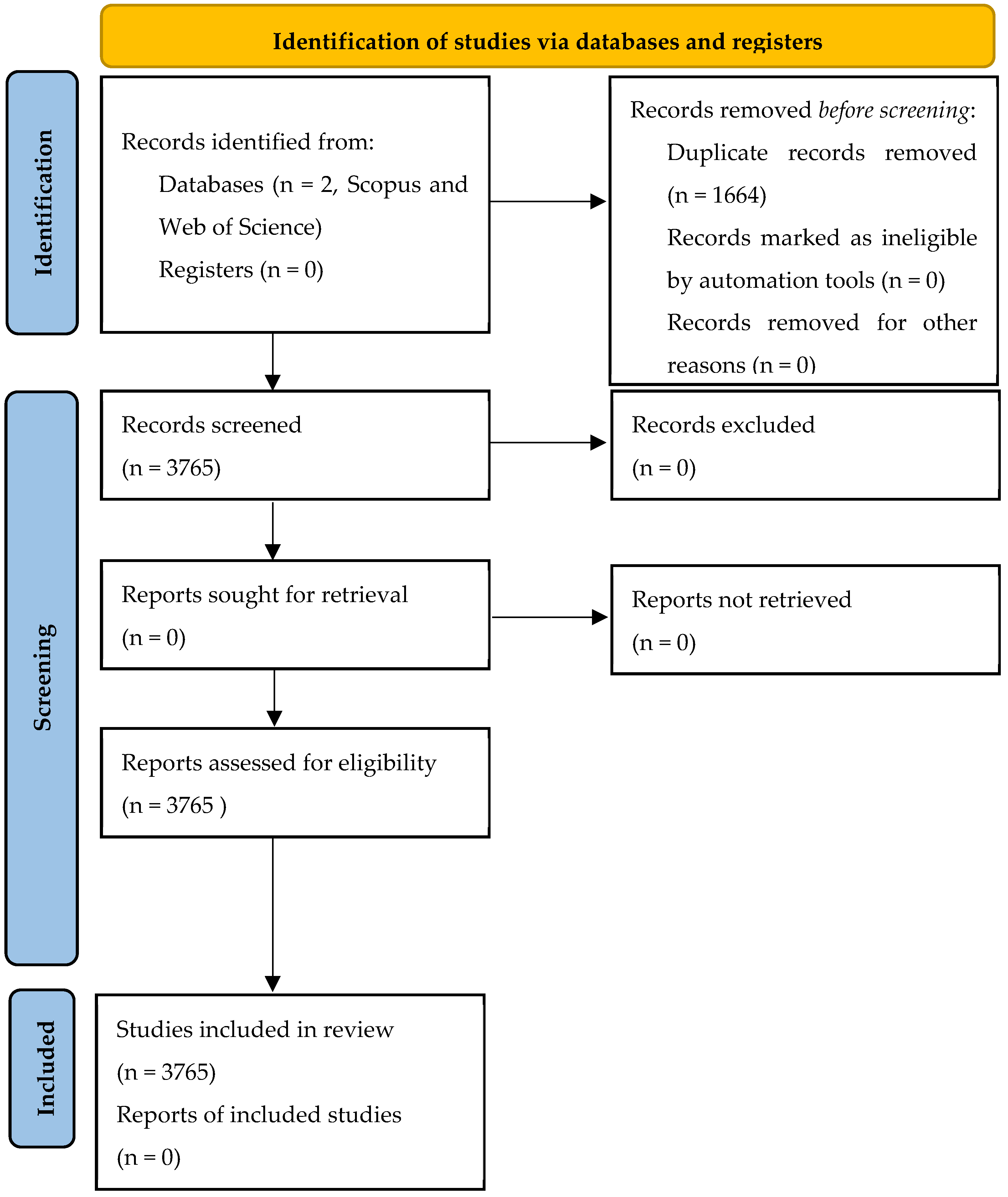
Figure 1. PRISMA 2020 flow diagram (Page et al., 2021) of database identification, de-duplication, screening, and inclusion of studies.
Admsci 16 00107 g001
Figure 2. Annual scientific production (2015–2025). (The blue solid line represents the annual number of publications, while the orange dashed line indicates the linear trend. CAGR (Compound Annual Growth Rate) for 2015–2025 is shown as annotation).
Admsci 16 00107 g002
Figure 3. Most relevant sources (top 20 journals).
Admsci 16 00107 g003
Figure 4. Scientific production by country (top countries). (The color gradient represents publication intensity, where darker blue corresponds to higher scientific output).
Admsci 16 00107 g004
Figure 5. International collaboration network. (Node size reflects publication volume, link thickness represents collaboration strength, and colors indicate collaboration clusters identified through network analysis).
Admsci 16 00107 g005
Figure 6. Author keyword co-occurrence network (VOSviewer, full counting, threshold ≥ 10).
Admsci 16 00107 g006
Figure 7. Evolution of gender-related publications in the digital circular economy corpus (2019–2025).
Admsci 16 00107 g007
Figure 8. Gender-responsive digital circular economy framework. (Interpretive synthesis derived from bibliometric evidence; intended as a heuristic rather than a normative model.) (The arrows indicate the directional linkage between digital enablers, governance design, and women’s entrepreneurship outcomes).
Admsci 16 00107 g008
Table 1. Distribution of document types in the merged Scopus–WoS corpus (2015–2025).
Document TypeCountShare (%)
Articles (all sub-types)282274.9%
Conference/Proceedings Papers 194325.1%
Total3765100%
1 Conference paper and proceedings paper categories were merged due to indexing harmonisation practices of Scopus and Web of Science.
Table 2. Publication output by country (top 10 countries).
CountryPublications
India600
China523
Italy422
UK341
Germany228
USA209
Spain190
Brazil189
France145
Portugal141
Table 3. Most cited documents in the merged Scopus–WoS corpus (2015–2025).
RankPaperTCTC/YearNormalized TC
1Lopes de Sousa Jabbour et al. (2018) 943117.8810.28
2Manavalan and Jayakrishna (2019)879125.5710.94
3Kouhizadeh et al. (2021)818163.6013.14
4Esmaeilian et al. (2020)752125.3310.26
5Bag et al. (2021)678135.6010.89
6Centobelli et al. (2022)631157.7514.45
7Nascimento et al. (2019)60886.867.57
8Fatimah et al. (2020)56594.177.71
9Upadhyay et al. (2021)536107.208.61
10Chauhan et al. (2022)524131.0012.00
Table 4. Top 10 most productive institutions in the merged Scopus–WoS corpus (2015–2025).
RankInstitutionCountryPublications
1Politecnico di MilanoItaly91
2Università Degli Studi di Napoli Federico IIItaly67
3Khalifa University of Science and TechnologyUAE58
4Università Degli Studi di BresciaItaly52
5Norges Teknisk-Naturvitenskapelige UniversitetNorway50
6Delft University of TechnologyNetherlands49
7Università Degli Studi di PalermoItaly49
8University of JohannesburgSouth Africa48
9Technische Universität BraunschweigGermany46
10Parthenope University of NaplesItaly 44
Table 5. Systematic classification of gender-tagged publications in the digital circular economy literature (n = 51).
DimensionCategoriesNumber of PublicationsShare (%)
MethodologyQuantitative empirical1223.5
Qualitative (case/interviews)35.9
Bibliometric/review35.9
Conceptual/theoretical35.9
Other/not explicitly stated3058.8
Geographic scopeSingle-country4282.4
Multi-country or global917.6
Gender focusGender equity or inequality2959.9
Women’s entrepreneurship (explicit)47.8
Gender as contextual reference1835.3
Disclaimer/Publisher’s Note: The statements, opinions and data contained in all publications are solely those of the individual author(s) and contributor(s) and not of MDPI and/or the editor(s). MDPI and/or the editor(s) disclaim responsibility for any injury to people or property resulting from any ideas, methods, instructions or products referred to in the content.