1. Introduction
The aviation industry has always been a trailblazer in embracing innovation, by constantly driving safer air travel through various technological revolutions from the early days of pioneer flights to the modern era. The latest frontier lies in the rise in artificial intelligence (AI) and its potential to reshape aviation in extraordinary ways from pre-flight arrangements to in-flight operations, and analysis of post-flight data. AI systems can optimize air traffic operations, supply chains, ground handling robotics, and airport security (
Dietrich & Cudney, 2011;
Soori et al., 2023). In real time, AI-powered cockpit assistants can analyze vast amounts of data to alert pilots of changing weather conditions and determine optimal flight routes. Moreover, AI can greatly improve business intelligence by predicting and mitigating potential delays, reducing congestion, and ensuring smoother operations and safety.
The development has accelerated in the last decade due to three concurrent factors: (1) Capacity to collect and store massive amounts of data; (2) Increase in computing power; and (3) Development of increasingly powerful algorithms and architectures (
European Union Aviation Safety Agency, 2023a). As AI continues to develop, policies regarding its role and application are likely to change as legislative and regulatory bodies work to harness its potential benefits and safeguard against associated risks. Therefore, the research question being addressed in our study is “How do AI regulations differ across geographies (i.e., the United States, the European Union, and China)?”
This paper comes at a time when deep-pocketed lobbyists and special interest groups are campaigning hard to influence AI legislation particularly in the United States and the European Union (
Henshall, 2024). This study serves as a valuable resource for researchers, practitioners, and industry leaders by providing them with a guide for decision making and the exploration of the benefits and challenges associated with the integration of artificial intelligence into existing business and operating models. Our research provides insights into the impact of varying AI regulations worldwide and on the application of AI in the aviation sector.
The structure of this paper is as follows: it begins with an introduction that provides a brief overview and outlines the research question, followed by the role and application of AI in the aviation industry and a description of the qualitative methods used. The results are then presented and discussed, along with their implications. The paper concludes with recommendations, directions for future research, and a discussion of the study’s limitations.
2. Role and Application of AI in the Aviation Industry
According to the
National Institute of Standards and Technology (
2023), an “AI system is an engineered or machine-based system that can, for a given set of objectives, generate outputs such as predictions, recommendations, or decisions influencing real or virtual environments. AI systems are designed to operate with varying levels of autonomy” (p. 1). Effective regulation seeks to leverage the benefits of AI systems while curbing risks. Concerns that regulatory efforts might stifle innovation are reasonable, but the aviation industry cannot risk compromising public safety for advancement. Hence, a deliberate and judicious approach to regulating AI systems is critical. The following discussion first considers the benefits and risks of AI in the aviation sector, followed by an exploration into the policy documents supportive of AI regulation in the United States, the European Union, and China. These economic powerhouses were selected due to their dominance in the world’s gross domestic product (GDP). China was the largest economy in the world in 2024 at 19.29 percent of world’s GDP. The United States was second at 14.84 percent, and the third largest economy was the European Union at 14.19 percent of the world’s GDP (
International Monetary Fund, 2025).
While artificial intelligence offers clear opportunities to improve efficiency and decision-making in aviation, its adoption also raises important governance and safety considerations at the global level. The International Civil Aviation Organization (ICAO) notes that many AI applications—especially those used in safety-critical areas such as air traffic management, flight operations, and oversight—introduce risks that differ from those associated with traditional software systems. These risks include limited transparency in algorithmic decision-making, dependence on data quality, and the potential for system behavior to change over time as models learn and adapt. Such characteristics make validation, accountability, and assurance more complex. In response, ICAO advocates a coordinated, risk-based approach to AI governance that balances innovation with the core principles of aviation safety. The ICAO approach includes human oversight, traceability, and clearly defined responsibility (
International Civil Aviation Organization, 2025). ICAO further argues that aviation is well-positioned to manage these challenges because of its mature safety management systems and long-standing tradition of international regulatory coordination. Aligning emerging AI practices with global aviation standards is therefore essential to maintaining safety, consistency, and trust across international airspace operations (
International Civil Aviation Organization, 2025). The following two subsections examine the key benefits that AI offers to aviation systems (
Section 2.1) and the operational, ethical, and regulatory challenges that continue to shape its responsible use (
Section 2.2).
2.1. Benefits of Using AI
The benefits of AI systems application in the aviation industry are boundless. Artificial intelligence is poised to revolutionize the aviation industry, offering a myriad of benefits that can improve safety, efficiency, and customer experience. The domains identified as having a huge impact are “(a) aircraft design and operation, (b) aircraft production and maintenance, (c) environment, (d) air traffic management, (e) aerodromes, (f) drones, u-space, and innovative air mobility, (g) cybersecurity, and (h) safety risk management” (
Bellamy, 2020;
European Union Aviation Safety Agency, 2023a, pp. 10–14). One of the primary benefits of AI in aviation is enhanced safety. AI algorithms can be utilized to analyze vast amounts of data collected from aircraft systems, weather stations, and air traffic control. This analysis can help predict mechanical failures, assess risks, and even suggest optimal flight paths, thus enhancing the safety and efficiency of flights (
Oehling & Barry, 2019). Maintenance schedules can also be optimized using AI-powered predictive analysis, allowing for potential issues to be addressed before they become critical. At airports, AI can be used to streamline operations and improve passenger flow. Facial recognition technology can expedite security checks and boarding, while prescriptive analytics can optimize baggage handling and minimize delays (
Lepenioti et al., 2020). AI can also be integrated into the cockpit, where it can assist pilots by automating routine tasks, monitoring systems, and providing real-time information about flight conditions. AI-powered autopilots have the potential to significantly reduce pilot workload, particularly in demanding situations, further enhancing safety. Drones and U-space air mobility sector can gain significantly from machine learning application by applying non-traditional tactics of development to detect and avoid, autonomous localization. The use of AI in safety risk management can increase safety by detecting potential risks, classifying risk occurrences and prioritizing issues. For staff retention issues, AI can be an asset to air traffic controllers in managing their heavy workload (
Imroz et al., 2022). Their jobs are highly specialized; therefore, AI cannot replace human intervention, but it can ease the load. In following a strict protocol, the aviation industry employs considerable care over safety-critical applications (
Imroz et al., 2022).
2.2. Challenges of Using AI
Even with all these safety benefits, there are heightened concerns about rolling out AI systems in the aviation industry, and this may be controversial, since interested parties supporting AI technological development are encouraging policymakers not to impede innovation through increased regulatory oversight (
Henshall, 2024). A few specific areas of concern are aircraft avionics safety and security, airport security, and original equipment manufacturer companies’ intellectual property risk. Further, a subset of AI systems is machine learning. Machine learning techniques are expected to be valuable to adversaries in exploiting vast amounts of data on improving the safety and operational performance in the aviation sector (
Federal Aviation Administration, 2024b). Although AI systems can process data and make decisions far more quickly than humans, they are not infallible. Determining responsibility when an AI system fails can be complex, especially in critical situations where lives may be at stake.
Certification and standardization in civil aviation are still under development. Because certifications require compliance with internationally recognized authorities, many potentially beneficial technologies have yet to be deployed (
Bellamy, 2020). There is also the risk of cyber threats when using digital systems. For example, aircraft systems can become targets for hackers who may manipulate AI algorithms or hijack digital control systems, potentially jeopardizing flight safety. Therefore, the development of cybersecurity certification and standardization programs would aid the industry in reducing these risks (
Bellamy, 2020).
3. Methodology
This study employed a structured, multi-stage qualitative document analysis (
Imroz, 2021) to compare the regulatory approaches to artificial intelligence in the aviation sector across the United States, the European Union, and China. Because aviation AI regulation is embedded in diverse administrative, legal, and political contexts, document analysis offered an appropriate method for systematically examining policy rationales, governance mechanisms, and enforcement structures reflected in official regulatory instruments. The goal of the methodology was not only to identify the content of each region’s policy landscape, but also to interpret how regulatory philosophies and administrative capacity shape the evolution of aviation AI governance. “learning” OR “deep learning”).
3.1. Research Design and Rationale
The study followed a comparative policy analysis design, a method commonly used to examine how different jurisdictions address similar governance challenges. AI regulation in aviation is a global concern, and the selected regions—United States, European Union, and China—represent the world’s most influential economic blocs and aviation markets. Each region also reflects a distinct administrative tradition: market-driven (U.S.), compliance-driven (EU), and sovereignty-driven (China). Comparing these approaches provides insight into how governance logic influences regulatory outcomes.
Document analysis was chosen because much of the regulatory architecture for AI in aviation exists in formal government publications, technical guidance, legislative texts, and agency strategy documents. This method enabled systematic collection, organization, and interpretation of written evidence relevant to AI governance.
3.2. Data Sources
This study analyzed a wide array of primary and secondary sources, including:
National statutes, executive orders, agency policies, and technical guidance (e.g., FAA, NIST, White House Executive Orders; European Commission regulations; Cybersecurity Law of the People’s Republic of China).
Aviation-specific regulatory documents and certification guidelines (e.g., FAA’s Roadmap for Artificial Intelligence Safety Assurance; European Union Aviation Safety Agency’s AI Roadmap versions 1.0 and 2.0).
International civil aviation and cybersecurity publications (e.g., ICAO, IATA).
Peer-reviewed academic articles on AI in aviation from Scopus-indexed journals.
The study also incorporated secondary sources such as government reports, think tank analyses, and industry white papers to contextualize economic, political, and safety considerations. This multi-source approach ensured a robust understanding of the regulatory ecosystems in each region.
3.3. Search Strategy
To identify relevant scholarly and policy documents, the study employed a multi-step search strategy:
Scopus database search.
Advanced search queries such as (“artificial intelligence” AND “aviation”) and (“aviation” AND “machine learning” OR “deep learning”) generated 1111 documents, of which 187 peer-reviewed articles met preliminary relevance criteria (
Zaoui et al., 2024). These articles provided empirical grounding for AI applications in aviation, such as predictive maintenance, autonomous systems, and safety risk management.
Targeted searches of regulatory repositories.
Searches were conducted across the Federal Aviation Administration (FAA), National Institute of Standards and Technology (NIST), U.S. Department of Defense (DoD), Cybersecurity and Infrastructure Security Agency (CISA), European Union Aviation Safety Agency (EASA), European Commission, International Civil Aviation Organization (ICAO), International Air Transport Association (IATA), and Chinese government ministries and administrative bureaus.
Inclusion of translated Chinese laws and regulations.
The study relied on authoritative translations from Stanford University’s DIGICHINA and official regional justice bureaus to ensure accuracy when analyzing China’s data governance and cybersecurity laws.
Cross-verification of regulatory updates.
3.4. Inclusion and Exclusion Criteria
The following criteria guided document selection:
3.4.1. Inclusion
Peer-reviewed academic articles (1984–2024) written in English and focused on AI applications in aviation systems, safety, regulation, or certification.
Government-issued regulations, directives, executive orders, strategy documents, technical guidance, and risk-management frameworks.
Publications from international aviation bodies addressing safety, cybersecurity, or AI governance.
Secondary analyses offering factual context for administrative, economic, or geopolitical influences on AI governance.
3.4.2. Exclusion
Non-English sources without a reliable translation.
Documents lacking relevance to AI in aviation or AI governance more generally.
Opinion-based commentaries not supported by empirical or regulatory evidence.
Materials outside the 1984–2024 window unless historically essential.
This filtering process ensured a dataset grounded in authoritative and high-quality sources directly relevant to the research question.
3.5. Analytical Approach
A structured qualitative content analysis was conducted in two major phases.
3.5.1. Phase 1: Coding and Thematic Classification
Documents were read and coded for recurring themes related to AI governance, including:
Risk-based regulatory frameworks
Certification and compliance mechanisms
Data governance and cybersecurity
Administrative capacity and institutional design
Enforcement models and oversight structures
Political-economic influences (e.g., lobbying, national strategies)
These codes were then grouped into higher-level categories organized around three guiding dimensions: (1) regulatory philosophy, (2) operational mechanisms, and (3) enforcement capacity.
3.5.2. Phase 2: Comparative Synthesis
The thematic findings were synthesized to identify:
Convergence and divergence across regions
Unique features of each governance model
Implications for aviation safety and global coordination
This cross-regional synthesis allowed the study to move beyond a descriptive catalog of regulations and toward a deeper analysis of governance logics and administrative consequences.
3.6. Ensuring Rigor and Credibility
Several measures were taken to enhance the trustworthiness of the analysis:
Triangulation across academic research, legal documents, and industry reports helped validate interpretations.
Cross-verification of regulations ensured accuracy when analyzing updates or revisions.
Use of authoritative translations reduced risk of misinterpretation in the Chinese policy review.
Transparent coding and classification procedures strengthened reliability.
Contextualization with external economic and political data (e.g., IMF GDP figures) provided additional analytical grounding.
While document analysis does not claim to capture every administrative nuance, the breadth of sources and structured analytic approach offer a comprehensive basis for comparing three complex regulatory environments.
3.7. Methodological Limitations
As with any qualitative document study, limitations arise from the availability and transparency of regulatory information. China’s regulatory environment often requires interpretation due to rapidly evolving laws and limited public consultation processes. U.S. documents sometimes lack specificity because several frameworks remain voluntary rather than binding. The EU, while transparent, produces dense regulatory texts that evolve through iterative negotiation. Despite these limitations, the methodology allows for a robust and meaningful comparison of the three regions’ AI governance structures, offering insights that can inform both aviation regulators and broader discussions of AI policy.
4. Results
As artificial intelligence (AI) technologies continue to rapidly grow in complexity, governments worldwide are under pressure to regulate these systems responsibly. Though perspectives on how this regulation should be implemented vary significantly in practice, distinct regulatory paradigms can be observed across major regions, including the United States, the European Union, and China. These differing approaches can have a profound impact on the deployment and advancement of AI in the global aviation sector. In the next sections, a detailed policy review of AI regulations in these regions is explored, followed by the results and analysis.
4.1. United States AI Regulations
Aviation is a driving force in the American economy, contributing significantly to the GDP, trade, and employment. Industries rely heavily on the effective operation of the nation’s airspace system. Alignment of policies is a huge undertaking, especially given the highly distributed nature of government agencies; even so, the Administration has outlined several policies and guidelines to responsibly navigate the design and deployment of AI systems.
Under the previous Biden Administration, two executive orders that specifically address AI systems are still in place under the Trump Administration: (1) Executive Order 13960, Promoting the Use of Trustworthy Artificial Intelligence in the Federal Government (
Federal Registrar, 2020); and (2) Executive Order 13859, Maintaining American Leadership in Artificial Intelligence (
Federal Registrar, 2019). In January 2025, after President Trump’s rescission of some of the Biden Administration’s Executive Orders, his Administration announced the Executive Order 14141, entitled Removing Barriers to American Leadership in Artificial Intelligence (
Federal Registrar, 2025a). Then, in April 2025, another Executive Order, 14277, titled “Advancing Artificial Intelligence Education for American Youth” (
Federal Registrar, 2025b), was issued. Together, these Executive Orders cover policies to safeguard societal rights, reinforce economic competitiveness and national security, support federal investment in research and development, provide guidance for rational federal regulation of AI applications, promote workforce education and development, and outline an action plan to protect the United States’ advantage in AI. At this time, there is no federal legislation that explicitly restricts the use of AI, or protects American citizens from harm, but the Blueprint for an AI Bill of Rights contains guidelines on the responsible design and use of AI, which is non-binding (
Office of Science and Technology Policy, 2022).
At the national security level, the United States Department of Defense has implemented the Responsible Artificial Intelligence Strategy and Implementation Pathway. This strategy employs AI to maintain a competitive edge over potential adversaries (
Department of Defense, 2022). The Cybersecurity and Infrastructure Security Agency provides valuable resources and services to reinforce cybersecurity measures and manage cyber risks (
Cybersecurity & Infrastructure Security Agency, 2025). The Partnering for Critical Infrastructure Security and Resilience risk management framework, designated by the Department of Homeland Security, serves as the key guide for the Transportation Systems Sector Specific Plan (
Department of Homeland Security, 2013).
For an overarching strategy, the Biden Administration’s national artificial intelligence strategies that still remain under the Trump Administration were established to bolster the country’s AI opportunities, while also addressing national security threats: (a) the National Science and Technology Council; (b) the National Standards Strategy for Critical and Emerging Technology; and (c) the Office of Science and Technology Policy (
National Science and Technology Council, 2023;
National Standards Strategy for Critical and Emerging Technology, 2023;
Office of Science and Technology Policy, 2023). Recently, the Trump Administration’s AI policy was laid out in a pair of memos issued on 3 April 2025. The first memo, entitled Accelerating Federal Use of AI through Innovation, Governance, and Public Trust (
Office of Management and Budget, 2025a), focuses on the acquisition of AI. The second memo, entitled Driving Efficient Acquisition of Artificial Intelligence in Government (
Office of Management and Budget, 2025b), addresses the federal use of AI. Overall, the Administration wants to empower executives by removing barriers to AI innovation rather than managing layers of bureaucracy.
National Airspace System
To improve the Federal Aviation Administration and other civil aviation programs, the
FAA Reauthorization Act of 2024 was reauthorized by Congress (
Federal Aviation Administration, 2024a). Then, for the use of Generative AI tools in the FAA,
Notice 1370.52, an interim policy on the use of Generative Artificial Intelligence was issued (
Federal Aviation Administration, 2025). Supporting these developments, the
Roadmap for Artificial Intelligence Safety Assurance was designed to explain the FAA’s approach to developing methods to assure both the safety of AI and the use of AI for safety (
Federal Aviation Administration, 2024a). For civilian aviation research and development activities, the
FAA Research and Development Act of 2023 reauthorizes through FY2028 (
Federal Aviation Administration, 2023). Further, the Research Landscape for the National Airspace System 2020–2030 report highlights the Federal Aviation Administration’s need to stay abreast of innovations like autonomous vehicles, space travel, and urban air mobility. This report outlines key research drivers and initiatives grouped into the following four categories: (1) Advances in new vehicles and new missions; (2) Advances in technology and materials; (3) Advances in data and processing power; and (4) System-wide advancements and improvements (
National Airspace System, 2020). For cybersecurity matters, the Federal Aviation Administration’s Cybersecurity Strategy 2020–2025 reiterates the agency’s commitment to safety and security (
Federal Aviation Administration, 2020;
Federal Aviation Administration & National Aeronautics and Space Administration, 2022).
In the United States, AI governance is based mainly on existing regulatory frameworks and voluntary initiatives, which has led to comparatively limited aviation-specific guidance relative to the European Union and China.
4.2. European Union AI Regulations
Taking the lead in regulating AI, the European Union Aviation Safety Agency is dedicated to leveraging the immense potential of AI in the aviation industry while maintaining stringent safety, security, and intellectual property protection standards. As part of its commitment, the European Union’s
AI Act initially began as a regulatory proposal that was published by the European Commission in April 2021 (
European Commission, 2021). It was updated in May 2023 (
European Parliament, 2023), and became law in March 2024 (
European Parliament, 2024). The
AI Act aims to create a harmonized framework for the development and use of AI across the European Union. The regulation distinguishes AI systems into four categories according to the level of risk they pose: (1) Unacceptable risk; (2) High risk; (3) Limited; and (4) Minimal risk. The
AI Act requires European Union Members to establish their own bodies for compliance with AI systems standards.
Through its
Horizon Europe and Digital Europe initiatives, the European Commission plans to invest one billion euros annually in AI development (
European Union Aviation Safety Agency, 2023a). This investment is an attempt to catalyze further contributions from private entities and Member States with the aim of achieving an annual investment volume of €20 billion over the forthcoming decade. This ambitious strategy complements the existing €2.16 billion per year allocation under the
Horizon Europe program (cluster 5), which has laid the groundwork for the
Single European Sky Air Traffic Management Research 3 Joint Undertaking and
Clean Aviation Joint Undertaking initiatives (
European Union Single European Sky, 2021). These combined programs significantly shape the trajectory of AI system investment within the aviation industry. It highlights the European Union’s strategic approach to AI, which balances technological progress with the paramount importance of safety and security standards. The European Union’s continued commitment to such substantial investment underscores its recognition of AI as a key driver of future innovation in the aviation sector.
4.2.1. AI Roadmap
To achieve these goals, the European Union Aviation Safety Agency has worked over the past several years with multiple stakeholders in the aviation industry. AI not only affects the products and services offered by the industry but also propels the adoption of new digital business and operating models. This impacts the agency’s mandate and its core processes, which affects the competency of agency staff. As a result, in October 2018, the Agency set up an internal task force on AI. The goal of the task force was to develop an AI Roadmap that identified key competencies for agency staff. It is also anticipated that as technology develops over the years, that many staff will adapt to an entirely new skill set. These new skills are a prerequisite to developing certifications for AI technologies (
European Union Aviation Safety Agency, 2023a). The work of the AI task force resulted in the publication of the
AI Roadmap 1.0 in February 2020 (
European Union Aviation Safety Agency, 2020). The implementation of the initial plan has already generated two major deliverables: the concept paper, and the newly proposed revision of that document. The concept paper was the first usable guidance for Level 1 machine learning applications in December 2021 (
European Union Aviation Safety Agency, 2021). The newly proposed revision of that document was released to the public for feedback in February 2023 and it provided guidance for
Level 1 & 2 machine learning applications (
European Union Aviation Safety Agency, 2023a).
Level 2 is the machine that monitors human performing the function. The
AI Roadmap 1.0 plans for delivery of the guidance for
Level 3 machine learning applications in 2028 that will feature full autonomy of machines with no human intervention.
According to
Bellamy (
2020), several research and development activities have been exploring the possibility of integrating machine learning into aircraft systems and air traffic management infrastructure in recent years. Since then, AI activity has evolved into a cross-domain AI program in which multiple specialists across the Agency are engaged in its development. This structure increased the capacity of the European Union Aviation Safety Agency and developed a more holistic strategy to address AI systems deployment at a much wider scale and scope than before, thus generating the
AI Roadmap 2.0 (
European Union Aviation Safety Agency, 2023b). This updated version communicates the Agency’s vision, the safe development of AI, and is a basis for interaction with industry stakeholders.
4.2.2. Part-IS
Additionally, the European Commission has released
Implementing Regulation 2023/203, which details guidelines for identifying and managing information security risks within aviation organizations and competent authorities, including the European Union Aviation Safety Agency (
European Commission, 2022b). This regulation supplements the previously released
Delegated Regulation 2022/1645, which is applicable to approved design and production organizations, as well as aerodrome operators and apron management service providers (
European Commission, 2022a).
The Part-IS lays out the framework for recognizing and handling information security risks that could potentially impact the information and communication technology systems and data used for civil aviation purposes. The regulation establishes criteria for detecting information security events, pinpointing those classified as information security incidents, and generating appropriate responses to these incidents, with recovery measures proportional to their influence on aviation safety. The provisions outlined in Part-IS came into effect on 16 October 2025, for organizations covered by the delegated act. Then, from 22 February 2026, for all other organizations and competent authorities.
To aid organizations and Member States in adhering to the comprehensive Part-IS regulatory package encompassed in the
Implementing Regulation 2023/203 (
European Commission, 2022b) and the
Delegated Regulation 2022/1645 (
European Commission, 2022a), the European Union Aviation Safety Agency has recently released the
Acceptable Means of Compliance and Guidance Material. This set of compliance and guidance material is divided into three documents. Each document is issued under different European Union Aviation Safety Agency ED Decisions: (1)
ED Decision 2023/008/R; (2)
ED Decision 2023/009/R; and (3)
ED Decision 2023/010/R (
European Union Aviation Safety Agency, 2023c,
2023d,
2023e). Both organizations and competent authorities are advised to consider the
Acceptable Means of Compliance and Guidance Material in conjunction with the broader regulations and sector-specific regulations.
The development of these crucial documents was carried out in close collaboration with the European Strategic Coordination Platform on cybersecurity in aviation. This organization consists of representatives from both the civil and military aviation community, who worked diligently over a two-year period to create these comprehensive resources (
European Strategic Coordination Platform, 2022). This effort is part of the European Union’s ongoing commitment to address the cybersecurity challenges in the aviation sector.
4.2.3. General Data Protection Regulation
For years, the European Union has taken a tough stance against foreign technology firms by administering fines and demonstrating to the global community how a country should protect the data of its citizenry. Since the mid-1990s, the European Union has become even more restrictive when it comes to the collection of online data and usage. The
General Data Protection Regulation is globally recognized to be the toughest privacy and security law (
General Data Protection Regulation, 2018). It was drafted and passed in the European Union, but if an organization collects data on any European Union individual, no matter where they are in the world, this regulation still applies. The
General Data Protection Regulation imposes harsh penalties on those who violate its rules, reaching tens of millions of euros. This regulation concerns data minimization, which has ramifications for AI systems, because AI systems rely heavily on large datasets. Even though, recently small language models (SLM) are being adopted by firms for multiple use cases. SLM’s are notably more efficient and offer greater accessibility to firms that otherwise may not have the capital to invest in the necessary infrastructure to process large language models (LLM). Further, SLM’s performance is superior to LLMs, with far greater privacy and security controls (
Caballar, 2024). Further citizen privacy protection is provided in the
Digital Services Act and
Digital Markets Act. Both are in place to protect the fundamental rights of users in digital space and prevent large digital platforms from abusing their power (
European Union, 2022a,
2022b).
4.2.4. Data4Safety
In 2015, a highly collaborative and centralized volunteer program named
Data4Safety began with a feasibility study (
European Union Aviation Safety Agency, 2024). The purpose was to identify data risks and how best to mitigate those risks. Its goal is to increase the capacity of safety intelligence in Europe by organizing and processing large amounts of aviation data, and its analytical capacity amongst all European Union industry stakeholders. The
Data4Safety program is currently in the development phase from mid-2022 to 2025 and is projected to grow to include a lot more industry-related organizations. The success of this program remains to be seen because it is heavily reliant on collaboration from the European Union Member States and the aviation industry. Collaboration at this scale has never been achieved before.
4.3. China AI Regulations
For the research results on AI regulations in China, the
International Air Transport Association (
2023) stated that “China is the second-largest economy in the world and represents over one-third of the global population” (para. 1). As a result, China’s responsibility towards global security of AI is just as important as the United States and the European Union. Recently, China proposed “…to form more than 50 national and industry-wide standards for AI by 2026 [as well as participating] in forming more than 20 international standards for AI by that time” (
Ye, 2024, para. 2). China has been actively establishing security protection measures for its critical infrastructure through the
Measures for the Management of Generative Artificial Intelligence Services that was released in April 2023 and contains 20 articles (
Huang et al., 2023). The articles stated the “
Measures apply to the research, development, and use of products with generative AI functions, and to the provision of services to the public within the [mainland] territory of the People’s Republic of China” (
Huang et al., 2023, article 2). The articles were formulated based on the following laws: (1) the
Cybersecurity Law of the People’s Republic of China, which was enacted to “…ensure cybersecurity; safeguard cyberspace sovereignty and national security, and social and public interests; protect the lawful rights and interests of citizens, legal persons, and other organizations; and promote the healthy development of the informatization of the economy and society” (
Creemers et al., 2018, article 1); (2) the
Data Security Law of the People’s Republic of China was established “…to standardize data handling activities, ensure data security, promote data development and use, protect the lawful rights and interests of individuals and organizations, and safeguard national sovereignty, security, and development interests” (
Digichina, 2021, article 1); and (3) the
Personal Information Protection Law of the People’s Republic of China was articulated “…on the basis of the Constitution, in order to protect personal information rights and interests, standardize personal information handling activities, and promote the rational use of personal information” (
Creemers & Webster, 2021, article 1).
Above all,
China’s Cybersecurity Law is a crucial legal framework for data protection, mainly regarding AI applications (
Creemers et al., 2018). It addresses network security, personal data protection, and critical information infrastructure protection. Under this law, AI systems operating in China, including aviation applications, must respect data sovereignty and the privacy rights of its citizens or suffer a wide array of sanctions and penalties for non-compliance. It mandates that all personal data collected within China must be stored within the country unless it undergoes a security assessment for overseas transfer.
4.3.1. Civil Aviation Law
Recently, the 14th Session of the Standing Committee of the 14th National People’s Congress received the draft amendment to the
Civil Aviation Law (
Civil Aviation Administration of China, 2025). The draft amendment of the existing
Civil Aviation Law consists of 15 chapters and 255 articles. The amendment is a comprehensive revision to promote the high-quality development of the civil aviation sector. The objective of the revision is to “…defend the nation’s airspace sovereignty and civil aviation rights, ensure safe and orderly implementation of civil aviation activities, protect the legitimate rights and interests of all parties involved in civil aviation activities...” (para. 1). The main revisions focus on guaranteeing the safety of civil aviation activities, reinforcement of airport fortification, and alignment to applicable global regulations.
4.3.2. Innovation Nation
As part of the broader push for AI development laid out in the
Next Generation Artificial Intelligence Development Plan. The plan goals are “…to seize the major strategic opportunity for the development of AI, to build China’s first-mover advantage in the development of AI, and to accelerate the construction of an innovative nation and global power in science and technology, in accordance with the requirements of the CCP Central Committee and the State Council” (
Webster et al., 2017, para. 1).
According to
Ma and Tan (
2025), “China’s Ministry of Industry and Information Technology and the Ministry of Finance have jointly established a 60 billion yuan (
$8.2 billion) national artificial intelligence fund to fast-track strategic investments in AI infrastructure and cutting-edge technologies” (para. 1). China’s provincial governments will develop eleven national AI innovation pilot zones. To date, “…central and local authorities have jointly built specialized manufacturing innovation centers for embodied AI robots, humanoid robots, and other next-gen technologies to drive the development of industrial clusters” (para. 1). Two well-established innovation hubs, Shanghai and Shenzhen, will propel China’s strategic initiatives by adhering to instituted
Regulations. The
Shanghai Regulations, formally known as the
Regulations for the Promotion of the Development of the Artificial Intelligence Industry in Shanghai Municipality, sets the stage for Shanghai to become the hub of innovation in China (
Center for Security and Emerging Technology, 2022;
Shanghai Municipal Bureau of Justice, 2024). Additional considerations addressed in the
Regulations are preventing parties from providing products and services that violate morality and public order.
The Shenzhen Special Economic Zone has adopted its own policy
Regulations for the Promotion of the Artificial Intelligence Industry. Since leading companies like Tencent and Huawei are based there, Shenzhen is often referred to as China’s Silicon Valley. The
Regulations on AI contain approvals of products and services, research and development undertakings, and procurement processes. To protect its citizenry, the Shenzhen Regulations prohibit parties from providing products and services that endanger physical and mental health and other acts in violation of ethical security norms (
Justice Bureau of Shenzhen Municipality, 2024).
After examining the regulations for these three regions, we will now compare the findings.
4.4. Comparative Assessment
Through comparing regional strategies, we can garner important insights into how different regulatory practices influence the evolution, advancement, and application of AI technologies.
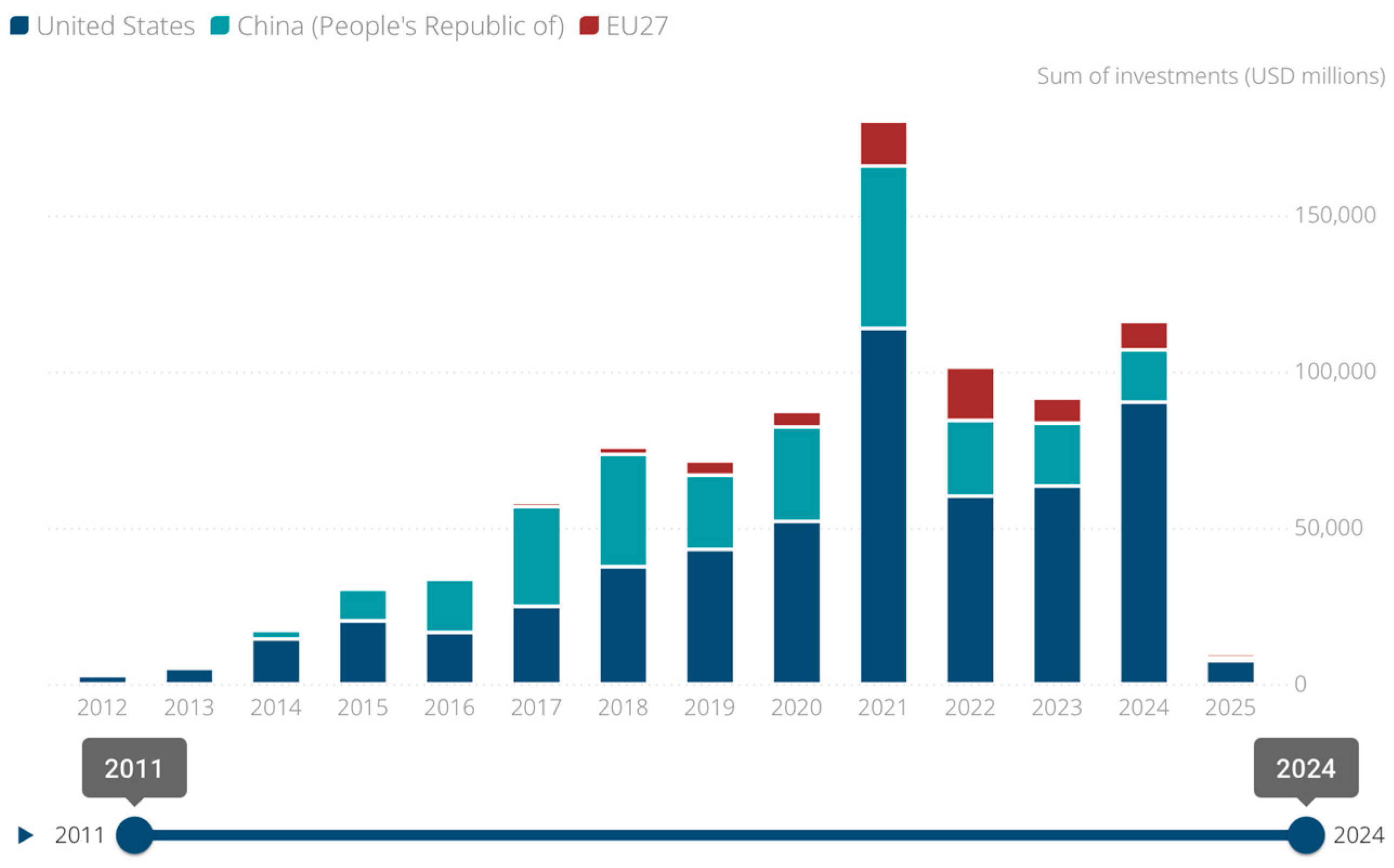
Investments in AI technologies are fundamental when it comes to influence on whether to have regulation or minimal government interference in any industry. Clearly, government is expected to invest, but what really champions innovation is the private sector. Private investment in AI has been significantly lower than in other leading regions in the world since 2012, as shown in
Figure 1. China had been competitive with the United States from 2015 until 2020, when the gap in investment began to widen. Then, commencing in 2021, the United States led by a huge margin. The lowest venture capital investment came from the European Union, with some initial investments starting in 2017. The United States and China rely substantially on private investment from their technology giants. But, despite the European Union having a strong AI public research community, it is far behind in the global race for AI supremacy (
Organisation for Economic Co-operation and Development, 2025b).
Through financing American start-ups and co-sponsoring government research programs, Microsoft, Google, and IBM are leading in research and investment. China notably benefits from its technology giants Alibaba, Baidu, Huawei, and Tencent. As a result, China may once again match the United States in venture capital investments. What is more, the
European Court of Auditors (
2024) reported that the European Union’s public and private investment goal over time is “…€20 billion in total over the 2018–2020 period and €20 billion per year over the following decade. The Commission is committed to increasing EU-funded investment in research and innovation to €1.5 billion in 2018–2020 and €1 billion per year in 2021–2027” (para. 3). A noteworthy point is that the share of firms using AI differs substantially between Member States, with some Member States without any AI development plans at all. Therefore, the European Union’s target of having 75 percent of its firms making use of AI applications may be too ambitious (
European Court of Auditors, 2024).
To examine regional differences on AI initiatives, a comparative assessment of topics on speed of innovation, private investments in data firms, and co-financing government programs; approaches to risk; regulation requirements; and methods to monitor citizens are summarized in
Table 1,
Table 2,
Table 3 and
Table 4:
Overall, the pace of innovation and private venture capital investment is led by the United States. There is no binding, risk-based framework or federal legislation that explicitly restricts the use of AI or protects American citizens from harm. There are no government enforcement bodies that impose bureaucratic restrictions on the use of AI systems, and emphasis is on self-monitoring. China rivals the United States in the speed of innovation, private investment in data firms, and co-financing government programs. China has a risk-based framework in place to safeguard the rights of its citizens. Regulatory requirements are accomplished with the binding, Shanghai and Shenzhen Regulations, along with several laws on cybersecurity, data and personal information. Furthermore, a draft amendment to the Civil Aviation Law is undergoing comprehensive revision. The European Union’s strategic approach to AI is one that balances the technological progress, with the paramount importance of safety and security. As a result, speed of innovation is slow and methodical. Of the three regions studied, the European Union venture capital investments are the lowest. Their approach to risk and regulatory requirements is insulated through its tough AI Act. Privacy and security are strengthened with its globally recognized General Data Protection Regulation, and the monitoring of citizens being enforced by the public sector.
Key Takeaways
U.S.: Aviation-specific AI policy via FAA; focus on safety and operational efficiency, less on general AI regulation.
EU: Comprehensive AI regulation via EU AI Act; aviation AI classified as high-risk, with strict conformity processes.
China: Broad AI governance with political oversight; strong focus on cybersecurity, data control, and content management, extending into aviation.
5. Discussion
This study compared how the United States, the European Union, and China regulate AI and identified three different governance logics that influence each region’s approach to the speed, purpose, and scope of AI oversight. Although all three regions recognize the growing use of AI in aviation (including safety, maintenance, cybersecurity, and air traffic control), their contrasting administrative traditions and regulatory tools create ongoing fragmentation in global aviation operations. This discussion section brings together the comparative findings, explains their significance for administrative practice, and outlines possible future directions for AI governance in this safety-critical sector.
5.1. Interpreting the Comparative Findings
The comparison across regions shows that although AI is viewed to strengthen aviation operations, it also creates regulatory challenges. In the United States, progress toward binding AI rules in aviation remains limited. The country relies mainly on voluntary or advisory guidance that stresses market flexibility and innovation. Tools such as NIST’s
AI Risk Management Framework (
National Institute of Standards and Technology, 2023), the FAA’s
Roadmap for Artificial Intelligence Safety Assurance (
Federal Aviation Administration, 2024b), and several Executive Orders provide direction for federal AI use but do not require compliance. This reflects long-standing U.S. preferences for decentralized governance and private-sector responsibility.
The European Union takes a very different path. It is building a detailed and rule-based system for AI governance in aviation supported by the
AI Act (
European Parliament, 2024). Most AI applications in aviation fall into the “high-risk” category, which triggers strict requirements for documentation, oversight, and conformity assessments. These obligations reinforce existing EU laws such as the
General Data Protection Regulation (
General Data Protection Regulation, 2018) and the
Digital Services Act (
European Union, 2022b), creating a comprehensive regulatory framework.
China blends rapid technological development with strong central authority. Its AI approach is grounded in national cybersecurity, data, and privacy legislation. This approach also includes the
Cybersecurity Law (
Creemers et al., 2018), the
Data Security Law (
Digichina, 2021), and the
Personal Information Protection Law (
Creemers & Webster, 2021). Newer rules, such as the
Measures for the Management of Generative Artificial Intelligence Services (
Huang et al., 2023) and amendments to the
Civil Aviation Law (
Civil Aviation Administration of China, 2025), reinforce a model focused on national security, public order, and state-led oversight. These cross-regional findings show that AI governance is shaped as much by political and administrative traditions as by technical needs. The United States emphasizes flexibility, the European Union emphasizes rights and safety, and China emphasizes centralized control.
5.2. Governance Logics Behind Regional Approaches
The variation across regions reflects three deeper governance logics—a market-driven logic in the United States, a compliance-driven logic in the European Union, and a sovereignty-driven logic in China. In the U.S., regulation tends to emerge through guidelines, executive direction, or sector-specific frameworks rather than sweeping federal mandates. This approach encourages innovation but creates significant variability across agencies and industries. The lack of centralized enforcement also magnifies the influence of powerful technology firms.
Henshall (
2024) notes that lobbying around AI regulation has increased sharply and raised concerns that the private sector may shape the U.S. regulatory landscape more than the public itself.
The EU treats AI governance as an extension of its long-standing commitment to risk regulation, privacy protections, and consumer rights. The
AI Act’s risk-tier system, combined with technical rules such as
Delegated Regulation 2022/1645 (
European Commission, 2022a) and
Implementing Regulation 2023/203 (
European Commission, 2022b), illustrates how the EU institutionalizes safety and accountability through structured administrative procedures. This model offers clarity but slows innovation, especially in industries like aviation, where technologies evolve faster than regulatory cycles.
China’s AI governance embeds technological development within broader national objectives. Policies supporting innovations such as the
Next Generation Artificial Intelligence Development Plan (
Webster et al., 2017) and major national funding initiatives (
Ma & Tan, 2025) operate alongside strict data, cybersecurity, and content controls. The result is a system where AI advances rapidly but must remain aligned with state priorities, particularly in sensitive sectors like aviation. These governance logics explain why convergence across regions may be difficult: each reflects not only a regulatory preference but a deeper administrative philosophy about the role of government, markets, and technology.
5.3. Points of Divergence and Consequences for Aviation Safety
While the three regions share concerns about safety, cybersecurity, and the reliability of AI systems, their regulatory divergence produces several operational challenges. First, certification pathways differ sharply. The EU’s high-risk classification treats many aviation AI applications as requiring extensive documentation and human oversight, whereas U.S. certification activities remain embedded in existing aviation safety processes. China’s model layers aviation requirements onto broader national cybersecurity and data-governance rules. These mismatches can slow the global deployment of emerging technologies and increase the cost of compliance for multinational firms.
Second, approaches to risk management diverge. The EU emphasizes precaution, the U.S. focuses on innovation, and China emphasizes control. These differences matter in aviation because aircraft, data systems, and air traffic management technologies operate globally. A fragmented approach to risk governance can lead to delays in harmonizing safety protocols, vulnerabilities in cybersecurity defenses, and uncertainty about liability in the event of an AI-related failure.
Third, political and economic forces shape the direction of regulatory development. The rapid expansion of lobbying in the U.S. (
Henshall, 2024), the EU’s concerns about market concentration among large technology firms (
Jones, 2023), and China’s push for national technological supremacy (
Ye, 2024) all influence how regulations evolve. These forces complicate efforts to develop shared international standards. Without mechanisms for coordination, regulatory divergence could ultimately compromise both innovation and safety in an industry that relies on global interoperability.
5.4. Administrative Implications for Global Aviation Regulators
Aviation has operated under global standardization for many decades, most notably through ICAO and IATA, but AI regulations show gaps in administrative coordination. For example, regulators need greater institutional capacity to evaluate AI systems. This includes technical understanding of machine-learning behaviors, staffing for certification workloads, and shared data infrastructures like the EU’s
Data4Safety program (
European Union Aviation Safety Agency, 2024). Without such capacity, regulators risk falling behind industry development. Next, public agencies must rethink private-sector engagement. In the U.S., where companies play a dominant role, the challenge is to ensure that reliance on voluntary frameworks does not weaken oversight. In the EU, regulators must balance the value of strict conformity assessments with the costs and speed limits they impose. In China, the central task is balancing transparency and accountability with rapid innovation.
Another noteworthy implication to consider is that aviation stakeholders may need new tools for cross-border governance. International data-sharing agreements, interoperable certification pathways, and common testing standards could help bridge domestic regulatory differences. Given the interconnected nature of global aviation, failure in one jurisdiction can have cascading effects elsewhere. Lastly, administrative leaders must prepare for the implications of AI on the workforce. As systems become more integrated into flight operations, maintenance, and air traffic management, regulators will need to consider training standards, human–machine teaming protocols, and the psychological effects of automation—issues highlighted in studies of air traffic controller workload (
Imroz et al., 2022). Overall, these challenges highlight a growing need for regulators to adopt a more strategic, anticipatory approach to AI oversight.
5.5. Future Scenarios for Global AI Governance in Aviation
From the comparative analysis, three scenarios for the future of global AI governance emerge:
Scenario 1: Regulatory convergence through international bodies. This approach would build on existing aviation governance institutions like ICAO and IATA to establish sector-specific AI standards analogous to the existing global norms for aircraft certification and other safety-critical processes. This would not require complete harmonization of general AI regulations but would create a common baseline for AI in aviation.
Scenario 2: Persistent fragmentation and competitive rivalry. If the United States, the European Union, and China continue to prioritize sovereignty, innovation competition, and domestic political imperatives, regulatory divergence could widen. This scenario risks duplicative certification costs and standards, inconsistent safety and liability expectations, and greater geopolitical conflict. Patterns already evident in data localization debates and broader AI supremacy issues (
Goldman & Egan, 2025;
Janakiram MSV, 2025) could intensify in aviation.
Scenario 3: Hybrid coordination. Under this model, regions maintain their distinctive AI policies but collaborate on high-risk aviation applications through joint working groups, shared safety intelligence, or mutual recognition agreements. This would preserve incentives for innovation but also reduce regulatory friction.
Given aviation’s history of close global coordination, the hybrid model may be the most likely to succeed. It allows each region to maintain its governance approach while still pursuing common safety goals. Across all three regions, AI governance in aviation is becoming a test case for understanding how governments can regulate an emerging technology that is powerful, opaque, and evolving faster than traditional oversight tools. The United States exemplifies the benefits and risks of market-driven governance; the European Union demonstrates the value—and the burden—of structured regulation; and China shows how centralized authority can both accelerate innovation and heighten concerns about transparency and rights. These systems reflect deeper administrative traditions that will continue to shape global AI trajectories.
The challenge for the international aviation community is finding a governance model that can protect safety without impeding innovation and that respects national sovereignty without sacrificing global interoperability. This will require sustained cooperation, new sources of administrative capacity, and a recognition that aviation, due to its long history of global standardization, is uniquely positioned to lead the development of responsible and harmonized AI practices worldwide.
6. Recommendations and Future Research
Twenty-first-century technological advancements present several challenges, including data intensity, opaqueness, and unpredictability, that traditional safety certification approaches cannot address. Investment in innovative AI is a future-focused action that brings positive return on investment due to vast cost reduction, faster response times, superior scalability, and increased assurance in security compared to the traditional legacy systems (
Iansiti & Lakhani, 2020). Technical safety standards for AI are only just emerging, and standard-setting bodies have primarily focused on less safety-critical applications such as route planning, predictive maintenance, and decision support. As a first mover in standard development, European Union Aviation and Safety Agency established “…an internal AI task force in October 2018 to identify staff competency, standards, protocols and methods to be developed ahead of moving forward with actual certification of new technologies” (
Bellamy, 2020, para. 2). First submissions for certification were confirmed to be for AI pilot assistance technology. Furthermore, documenting case studies for analysis, even within the transportation industry, is an important step in fieldwork investigations and safety protocol development (
Ellingsen & Aasland, 2019).
It is anticipated that machines will eventually learn from each other, and since no one fully understands all of AI’s inner workings enough to fully control its outputs or predict its evolution, the risks are too great for governments to counter alone. So, to strengthen global regulatory oversight, a more unified stance in sharing best practices is needed. A risk-based approach balances between the benefits and risks of AI systems. The European Aviation High-Level Group on AI provided seven key recommendations:
Data and AI-infrastructure framework. Establish a data foundation and AI infrastructure.
Research and Innovation. Strengthening innovation in AI through continued exploration.
Validation and Standards. AI validation methods and tools should be developed, along with set standards.
Deployment. Adoption of AI systems should be encouraged.
Communication and Dissemination. Enhanced communication and lessons learned community engagement.
Training and Change Management. Cultivating a culture of change and a willingness to be retrained.
Taking the lead in setting industry best practices is for the common good of all citizens. Currently, however, the United States seems to stand outside the emerging global consensus on AI safety, while the European Union and China are aligned with it. The European Union seems to overregulate AI, sacrificing innovation for safety, while China is catching up to the United States by combining strict, centralized safety regulations with flexible rules on innovation.
7. Conclusions
In conclusion, all three governments are concerned about the threats of cybersecurity, data privacy and governance, ethics and discrimination, and the necessity to explain and interpret AI systems. The European Union comes out on top with its binding, human rights-focused AI Act, followed by China and its no-tolerance penalty policy, then the United States with it hands-off approach, possibly influenced by a deluge of lobbyists. At this pivotal moment in the technology revolution, how the United States promotes rapid innovation without compromising safety is unclear. These economic powerhouses will undoubtedly continue to flex their dominance in advancing the global AI landscape. But, unfortunately, we have yet to see an international effort to protect global citizens from these threats.
Eventually, we believe that, since the aviation industry is global, governments will work together to bring greater scrutiny to the threats posed by AI systems through the collaboration and alignment of international standards and best practices. A limitation to accomplishing these goals is that it is difficult to get regulation right before or during the deployment of any new technology, because it is still evolving, and the long-term effects of its scale have yet to be felt. If we are too early in developing regulations, there is a risk of getting the focus wrong or even stifling innovation. But, if we are too late, then preventing the damaging excesses and embedded practices is difficult.
While AI holds enormous potential for improving efficiency and productivity across industries, its integration should be managed with utmost care through regulatory frameworks governing its use. Focus must remain on ensuring the safety, security, and reliability of these systems, along with engaging international collaboration and proactively investing in safety measures. The aviation industry is in an optimal position to lead governance efforts. So, by making this an international endeavor, we can unlock the transformative potential of AI without compromising global safety and security. As a way forward, we proposed a hybrid model approach so that regions can maintain their distinctive AI policies but collaborate on high-risk aviation applications through joint working groups, shared safety intelligence, or mutual recognition agreements. Therefore, this would preserve incentives for innovation but also reduce regulatory frictions.