Article

Transgenerational Entrepreneurial Orientation, Family Involvement, and Succession Planning as Drivers of Long-Term Family Business Sustainability

by
Arifin Djakasaputra
1,*,
Agustinus Purna Irawan
2 and
Sarwo Edy Handoyo
1
1
Department of Management, Faculty of Economics and Business, Universitas Tarumanagara, Jakarta 11440, Indonesia
2
Post Graduate Program, Universitas Tarumanagara, Jakarta 11440, Indonesia
*
Author to whom correspondence should be addressed.
Adm. Sci. 2026, 16(1), 10; https://doi.org/10.3390/admsci16010010
Submission received: 27 October 2025 / Revised: 8 December 2025 / Accepted: 16 December 2025 / Published: 25 December 2025
(This article belongs to the Special Issue Moving from Entrepreneurial Intention to Behavior)

Abstract

This study investigates the role of family involvement and succession planning in shaping the long-term sustainability of family businesses in Indonesia, with a specific focus on the mediating effect of transgenerational entrepreneurial orientation (TEO). This research responds to calls for integrative models that move beyond examining these factors in isolation. Indonesia offers a unique context due to its dominance of family-controlled firms and informal succession traditions, which shape entrepreneurial value transmission across generations. A quantitative approach was employed using survey data from 210 respondents representing active family businesses in Indonesia. Partial least squares structural equation modeling (PLS-SEM) with SmartPLS 4.0 was used to test reliability, validity, and structural relationships. Additional analyses included HTMT for discriminant validity, CVPAT for predictive relevance, and importance–performance map analysis (IPMA) to identify managerial priorities. The results reveal that family involvement and succession planning both exert significant positive effects on long-term family business sustainability, with TEO playing a mediating role. Family involvement strongly enhances both sustainability and entrepreneurial orientation, while succession planning contributes more indirectly through the development of TEO. The IPMA indicates that family leadership in governance and openness to innovation are highly important but underperforming drivers, suggesting key areas for improvement. The model explains 51.9% of the variance in TEO and 48.6% in long-term sustainability, with significant mediation paths (β = 0.092–0.104, p < 0.05). The cross-sectional design limits causal inference, and the focus on Indonesian firms may constrain generalizability to other cultural contexts. Future research could adopt longitudinal and cross-country comparative designs while also examining the role of digital transformation and generational differences in sustaining family firms. The findings highlight the need for Indonesian family firms to professionalize succession planning while strengthening transgenerational entrepreneurial orientation. Practical steps include formal mentoring, clear successor criteria, and embedding innovation and proactiveness in family governance. This study extends the family business literature by conceptualizing TEO as a dynamic capability that bridges family involvement, succession planning, and sustainability. By integrating these perspectives, it offers a more comprehensive understanding of how family firms can achieve resilience and continuity across generations.

1. Introduction

Family businesses are recognized as a fundamental pillar of economic growth and social stability worldwide, accounting for a significant proportion of both employment and GDP generation in many countries (Miroshnychenko et al., 2020; Nyabakora, 2024; Rivo-López et al., 2020; Zheng et al., 2025). However, the sustainability of family businesses across generations remains a persistent challenge, with a high rate of failure in succession processes, often attributed to inadequate planning and lack of entrepreneurial renewal. The intersection of transgenerational entrepreneurial orientation, family involvement, and robust succession planning is thus increasingly seen as critical to ensuring the long-term sustainability of family businesses in a rapidly evolving business landscape.
Family businesses are unique due to their dual identity, balancing business objectives with family values, legacy, and generational continuity (Erdogan et al., 2020; Suddaby & Jaskiewicz, 2020). Transgenerational entrepreneurial orientation refers to the capacity of family firms to foster entrepreneurial attitudes and practices that span multiple generations (Miller & Le Breton-Miller, 2021). Family involvement—characterized by participation in ownership, management, and governance—affects strategic decisions, resource allocation, and the preservation of socioemotional wealth (Berrone et al., 2020). Succession planning is widely recognized as a critical determinant of family business survival, yet it is often neglected or poorly managed, resulting in discontinuity and business decline (Chiang et al., 2021; Isichei, 2025; Magasi, 2022).
Despite extensive research on each of these variables, limited attention has been paid to how their interplay drives long-term sustainability in family businesses. In a dynamic global environment characterized by technological disruption and market volatility, understanding these relationships is more relevant than ever. This study advances existing research by positioning transgenerational entrepreneurial orientation (TEO) as a dynamic capability that enables continuity, renewal, and value transmission across generations—extending EO beyond firm-level behavior toward intergenerational capability development within family firms in emerging economies.
Prior research has largely examined family involvement, succession planning, and entrepreneurial orientation as independent predictors of family firm outcomes; however, such isolated examinations risk overlooking synergistic or suppressed effects that emerge only when these mechanisms are modeled simultaneously. In contexts with highly concentrated family ownership, restricted variance further attenuates observed relationships, suggesting that integrative models are necessary to reveal capability-based interactions that are not detectable through siloed analyses (LeCounte, 2020; Owusu-Acheampong et al., 2024; Calabrò et al., 2022).
By positioning TEO as a mediating capability that connects family involvement and succession to sustainability, this study responds to calls for multidimensional frameworks that explain how entrepreneurial values are preserved, enacted, and transferred across generations (Dou et al., 2021). The literature has primarily explored entrepreneurial orientation, family involvement, and succession planning as isolated factors influencing family business performance or continuity (Makumbe et al., 2025; Schmidt et al., 2025). Few studies have holistically examined their interconnections—especially with a focus on how transgenerational entrepreneurial orientation interacts with family involvement and succession planning to impact the long-term sustainability of family businesses. Moreover, empirical studies on this topic in emerging economies remain scarce, and most research is concentrated in Western contexts, limiting the generalizability of findings (Calabrò et al., 2022; Isichei, 2025).
Given the persistent challenges of succession and sustainability in family businesses, there is a pressing need to understand how entrepreneurial orientation across generations, coupled with effective family involvement and succession planning, can collectively foster business longevity. However, the specific mechanisms and relationships among these factors are not yet fully understood, particularly in developing non-Western economies. This research thus seeks to answer the following question: How do transgenerational entrepreneurial orientation, family involvement, and succession planning collectively influence the long-term sustainability of family businesses? This research aims to investigate and empirically validate the interplay between transgenerational entrepreneurial orientation, family involvement, and succession planning as key drivers of long-term family business sustainability.
The novelty of this research lies in its integrative approach, which moves beyond siloed examination of entrepreneurial orientation, family involvement, and succession planning. By conceptualizing and empirically testing their combined effects on long-term sustainability, this study offers a more comprehensive understanding of what truly drives enduring family businesses. Furthermore, it extends the scope of existing research by focusing on under-studied contexts (such as emerging economies) and by operationalizing the concept of transgenerational entrepreneurial orientation, a construct that captures the dynamic entrepreneurial capabilities transmitted and adapted across family generations. The findings are expected to inform both theory and practice, offering a robust model for scholars and actionable frameworks for family business practitioners.
Family businesses are the backbone of many national economies, including Indonesia, where they contribute significantly to employment and GDP. Despite their importance, these businesses face challenges in sustaining operations beyond the founding generation. Empirical evidence suggests that less than 30% of family businesses survive into the second generation, and only about 12% make it to the third (PWC, 2025). Key among the issues contributing to this challenge are poor succession planning and a lack of meaningful family involvement in governance. Therefore, this study explores how succession planning and family involvement function as strategic levers to enhance the sustainability of family businesses over the long term.
The resource-based view (RBV) posits that firms gain sustainable competitive advantage through resources that are valuable, rare, inimitable, and non-substitutable (Barney, 1991). In the context of family businesses, unique resources include family social capital, embedded values, and tacit knowledge passed through generations. TEO, family involvement, and succession planning represent critical internal resources and capabilities that drive long-term sustainability (Gimenez-Jimenez et al., 2020; Nallabathula & Doraiswamy, 2024). By leveraging and renewing these resources, family firms can sustain their competitive advantage over time.
Transgenerational entrepreneurial orientation (TEO) refers to the sustained entrepreneurial mindset and practices transmitted across family generations. Miller and Le Breton-Miller (2021) argue that TEO is characterized by risk-taking, innovativeness, and proactiveness, which enable family businesses to adapt and remain competitive over time. Zellweger (2020) and Zellweger & Sieger (2012) add that TEO is essential for family firms to avoid stagnation and foster organizational renewal, ensuring longevity beyond the founding generation. Empirical studies highlight that strong TEO leads to higher business resilience and long-term growth (Minola et al., 2016).
Family involvement encompasses ownership, governance, and active participation of family members in management and strategic decision-making (Berrone et al., 2020). High family involvement can enhance commitment, facilitate tacit knowledge transfer, and embed family values in the business culture. However, it may also lead to nepotism or resistance to change if not managed (Abaddi, 2025; Canovi et al., 2022; Gera et al., 2025). The degree and quality of family involvement have been linked to the ability to innovate and adapt across generations (Ahmad, 2025; Makumbe et al., 2025; Schmidt et al., 2025).
Succession planning is the deliberate and systematic process of preparing the next generation for leadership (Juliana et al., 2022; Temprano-García et al., 2023). Studies show that effective succession planning is positively associated with family business survival and performance (Haynes et al., 2020). Failure in succession planning often results in discontinuity and loss of legacy (Canovi et al., 2022; Darsana & Mananda, 2023; Sasaki et al., 2020). Research indicates that formal succession plans, mentorship, and early involvement of successors are best practices for sustainable transitions (Bergfeld & Bergfeld, 2022; Haynes et al., 2020).
Sustainability in the family business context refers to the firm’s capacity to survive, thrive, and transfer value across generations (De Las Heras-Rosas & Herrera, 2020; Häußler & Ulrich, 2024) It is influenced by the alignment of entrepreneurial orientation, strong family involvement, and structured succession (Varshney et al., 2024; Xu, 2025). The literature suggests that the interplay between these factors is critical in achieving transgenerational continuity (Gil et al., 2024; Tessema et al., 2024).
While each variable—TEO, family involvement, and succession planning—has been individually studied, few works examine their integrative effects on long-term sustainability (Nordqvist & Jack, 2020). Moreover, the dynamic mechanisms through which TEO interacts with family involvement and succession processes remain underexplored, especially in non-Western contexts (Nagy-Tóth & Nagy, 2025; Wu et al., 2025). Bibliometric mapping using VOSviewer version 1.6.20 highlights that research on family business has been dominated by classical themes such as succession, sustainability, corporate governance, and resilience (Ratten, 2020), while transgenerational entrepreneurial orientation (TEO) appears as a smaller and less connected cluster despite its theoretical relevance to long-term survival (Tessema et al., 2024) Although TEO is conceptually positioned between succession and entrepreneurship, the literature has not fully examined its role as a bridging mechanism that transforms succession into sustainable competitive advantage across generations (Calabrò et al., 2022). Moreover, TEO has rarely been integrated with emerging issues such as digital transformation, crisis resilience, creativity, and entrepreneurial self-efficacy of the next generation, which are increasingly salient in the post-pandemic era (Dou et al., 2021; Santos et al., 2023; Shore et al., 2024). This gap suggests a clear opportunity for novelty: investigating TEO not merely as an extension of entrepreneurial orientation but as a dynamic capability that links generational succession with innovation and long-term sustainability in family firms (Tessema et al., 2024).
This study’s contribution does not lie in proposing TEO as a new construct; instead, it advances the literature by refining TEO as an intergenerational capability that links succession processes with entrepreneurial value transmission. While TEO shares conceptual roots with entrepreneurial orientation (EO), it diverges by focusing on cross-generational mechanisms such as legacy formation, stewardship-driven socialization, and entrepreneurial capability transfer dimensions that are not captured in standard EO scales (Dou et al., 2021; Calabrò et al., 2022; Tessema et al., 2024). Furthermore, we introduce the ‘high-family-ownership/low-structuration paradox, a context-specific paradox prevalent in emerging economies in which strong family control coexists with informal governance, creating uneven succession outcomes. By identifying this paradox and theorizing the intergenerational transmission pathway through which succession leads to sustainability only when mediated by TEO, this study offers a mechanism-oriented and context-sensitive contribution that extends the existing family business literature.
While prior studies have examined family involvement, succession planning, and entrepreneurial orientation separately, the novelty of this study does not lie in identifying new direct relationships. Instead, we contribute to theory by reconceptualizing transgenerational entrepreneurial orientation (TEO) as a dynamic intergenerational capability that translates family influence and succession structures into long-term sustainability. The ‘high-family-involvement/low-structuration paradox’ mentioned above builds on the RBV and socioeconomical wealth perspectives and provides a previously underexplored explanation for why succession outcomes vary across contexts. Furthermore, we propose the mechanism of ‘succession–innovation alignment’, suggesting that succession enhances sustainability only when entrepreneurial values and legacy are successfully transmitted across generations through TEO. These additions extend existing theory by shifting the focus from isolated constructs to a capability-based and context-sensitive model of intergenerational continuity. Unlike prior EO-focused succession studies, this research conceptualizes transgenerational entrepreneurial orientation (TEO) not as a behavioral posture but as a dynamic capability that enables value transfer, entrepreneurial renewal, and intergenerational opportunity framing—offering a conceptual shift beyond standard EO dimensions under RBV and stewardship theory.
Most prior studies have examined entrepreneurial orientation (EO) as a firm-level behavioral posture linked to performance outcomes or have separately analyzed succession planning as a predictor of continuity. Classic EO–performance models focus on innovation, proactiveness, and risk-taking as contemporaneous behaviors, whereas succession studies emphasize governance structures and successor preparedness. In contrast, this study positions transgenerational entrepreneurial orientation (TEO) as an intergenerational dynamic capability that links family involvement and succession planning to long-term sustainability. By focusing on TEO as a capability embedded in cross-generational value transmission and entrepreneurial legacy, we extend EO research beyond short-term performance and complement succession research by theorizing a mechanism that connects succession processes to sustainability in emerging economy family firms.

2. Literature Review and Hypothesis Development

The seven hypotheses set out in this study do not stand in isolation but represent an interdependent capability/formation mechanism wherein family involvement and succession planning operate through TEO to influence sustainability. Thus, TEO is positioned as the relational bridge rather than an additive variable. In this study, long-term family business sustainability refers primarily to economic continuity and generational survival of the family firm, the ability to sustain ownership, control, and viable economic performance across generations. While the term ‘sustainability’ is often used in an ESG sense, our operationalization centers on financial resilience and intergenerational continuity outcomes (e.g., perceived likelihood of generational transfer, continuity of family control), consistent with (Bozer et al., 2017; Kurniawan, 2024) and (Lefebvre et al., 2020). In emerging economies, family firms often exhibit a ‘high-family-involvement/low-structuration paradox,’ wherein concentrated family control coexists with informal governance, weak professionalization, and tacit succession processes (Khurana et al., 2025; Samara, 2021; Shahzad et al., 2024).
While high involvement can provide commitment and socioemotional wealth, excessive centralization may limit strategic adaptability, innovation, and formal planning (Ratten, 2020). Informal institutions and kinship-based authority systems, which are prevalent in Asian family firms, often reinforce these dynamics by privileging trust and hierarchy over formal mechanisms (Nordqvist & Jack, 2020; Villalonga & Amit, 2020). Consequently, family businesses may experience strong relational cohesion but limited capability structuration, creating uneven succession outcomes and modest effect magnitudes despite meaningful theoretical relationships.

2.1. Family Business and Transgenerational Challenges

Family businesses represent a dominant form of enterprise worldwide and play a critical role in economic development (Basco et al., 2019). Unlike non-family firms, family businesses are characterized by the interplay between family, ownership, and management systems, which create both unique advantages and challenges (del Vecchio et al., 2024). One enduring challenge is ensuring long-term sustainability across generations, as many family firms struggle to survive beyond the second or third generation (Calabrò et al., 2022; del Vecchio et al., 2024). Succession planning has therefore received significant attention in literature as a critical determinant of survival and continuity. However, succession alone is insufficient without entrepreneurial orientation that fosters innovation and adaptation to changing environments (Tessema et al., 2024).

2.2. Transgenerational Entrepreneurial Orientation (TEO)

Transgenerational entrepreneurial orientation (TEO) extends the concept of entrepreneurial orientation by emphasizing the role of family values, vision, and entrepreneurial capabilities across generations (Dou et al., 2021). TEO reflects the family’s ability to nurture innovation, proactiveness, and risk-taking not only in the present but also through the effective transmission of entrepreneurial values to the next generation (Canovi et al., 2022). Bibliometric analyses reveal that although entrepreneurial orientation is widely studied, the specific construct of TEO remains underexplored, particularly as a bridging mechanism between succession and long-term sustainability (Calabrò et al., 2022). This suggests that firms with stronger TEO are more likely to sustain competitive advantage across generations by instilling entrepreneurial values into succession processes. In this study, TEO is conceptualized as a mediating capability rather than a higher-order EO construct. While grounded in EO attributes—innovativeness, proactiveness, and opportunity engagement—it extends beyond them through intergenerational value transmission, legacy continuity, and entrepreneurial stewardship.
Family involvement positively influences transgenerational entrepreneurial orientation. Family involvement represents the active participation of family members, often spanning multiple generations in ownership, management, and decision-making within the family firm. This involvement shapes the strategic direction of the business and is widely considered to be a source of unique socioemotional wealth, which drives the distinctive behaviors of family businesses (Mclarty et al., 2025). Contemporary research demonstrates that family involvement facilitates not only the preservation of family values but also the embedding of entrepreneurial orientation across generations (Hahn et al., 2021). When family members collectively engage in the business, it becomes easier to transfer entrepreneurial norms and foster an environment that encourages innovation, risk-taking, and proactive opportunity-seeking (Dessi et al., 2022; James et al., 2020).
Multi-generational engagement is critical in developing what has been termed transgenerational entrepreneurial orientation (TEO). Liew and Loo (2024) found that the presence of senior and next-generation family members in top management teams enhances knowledge transfer and nurtures entrepreneurial capabilities, leading to a stronger entrepreneurial orientation throughout the firm. Similarly, findings by Lefebvre et al. (2020) support the notion that deeply involved families develop stronger entrepreneurial legacies, making it more likely for innovative practices to be sustained across generations.
Recent global benchmarking by KPMG (2025) further indicates that family businesses with high levels of involvement across generations demonstrate greater adaptability, resilience, and a culture that promotes entrepreneurship. The report found that such firms are better positioned to pursue innovation, diversify strategically, and proactively respond to market shifts. This ongoing engagement not only encourages entrepreneurial activity but also ensures that new entrepreneurial behaviors align with both business needs and family values (del Vecchio et al., 2024; Suess-Reyes, 2016).
Given this evidence, it is reasonable to hypothesize that higher family involvement positively influences transgenerational entrepreneurial orientation by establishing a supportive context in which entrepreneurial attitudes and behaviors can thrive and be perpetuated across generations. This effect is expected to be robust, especially in family firms that prioritize structured involvement and succession across the family lineage (Rovelli et al., 2022).
H1. 
Family involvement positively influences transgenerational entrepreneurial orientation.

2.2.1. Succession Planning Positively Influences Transgenerational Entrepreneurial Orientation

Succession planning refers to the formal and informal processes by which family businesses prepare for the transfer of leadership and ownership from one generation to the next. Effective succession planning not only mitigates risks associated with generational transitions but also provides a critical channel for transmitting entrepreneurial vision and capabilities (Isichei, 2025). Studies show that planned succession increases the likelihood that entrepreneurial values such as innovation, risk-taking, and proactiveness are successfully passed down, supporting the development of transgenerational entrepreneurial orientation (del Vecchio et al., 2024; Suess-Reyes, 2016).
In a Nigerian study, Isichei (2025) empirically established a significant positive relationship between succession planning and entrepreneurial orientation across generations. The researchers found that structured succession processes, which included mentoring and leadership development, were vital for instilling entrepreneurial mindsets in successors. Additionally, a comprehensive review by (Paço, 2021) found that succession planning was not only linked to leadership continuity but also to the encouragement of innovative practices among the next generation.
Research in East Java, Indonesia, and Poland has echoed these findings, indicating that family firms with clear and transparent succession plans tend to demonstrate greater entrepreneurial vitality and innovative drive across generations (Orlitzky et al., 2021). Case studies from the KPMG global family business report (2025) illustrate how robust succession planning helps align the entrepreneurial ambitions of the next generation with the broader goals of family business sustainability. These findings support the hypothesis that well-executed succession planning positively influences transgenerational entrepreneurial orientation by equipping future leaders with the entrepreneurial knowledge, skills, and motivation needed to sustain innovation and proactive behavior in family enterprises.
H2. 
Succession planning positively influences transgenerational entrepreneurial orientation.

2.2.2. Transgenerational Entrepreneurial Orientation Positively Affects Long-Term Sustainability in Family Businesses

Transgenerational entrepreneurial orientation (TEO) encompasses a family firm’s persistent inclination toward innovation, proactiveness, and risk-taking across multiple generations. Research increasingly highlights TEO as a strategic capability that enables family businesses to adapt to environmental changes, maintain competitive advantage, and ensure continuity (Basco et al., 2019). For instance, Chiang et al. (2021) and Agnihotri and Bhattacharya (2024) reported that family firms with high levels of TEO were more likely to engage in innovation and market diversification, contributing to their long-term viability.
Empirical studies have demonstrated that TEO facilitates resilience in the face of disruption and crisis. Polish SMEs analyzed by (Paço, 2021) showed that entrepreneurial orientation significantly enhances both economic and non-economic performance, laying the groundwork for sustainability across generations. Additionally, a configurational study by Basco et al. (2019) and Clinton et al. (2020) revealed that TEO, combined with other family and business factors, increases the likelihood of transgenerational sustainability. The KPMG benchmarking report (2025) supports these findings, noting that family firms with sustained entrepreneurial orientation enjoy higher rates of succession success and business continuity. The literature indicates that transgenerational entrepreneurial orientation is associated not only with innovation and growth but also with the enduring survival and sustainability of family businesses, making it a core driver of long-term success.
H3. 
Transgenerational entrepreneurial orientation positively affects long-term family business sustainability.

2.2.3. Transgenerational Entrepreneurial Orientation Mediates the Relationship Between Family Involvement and Long-Term Family Business Sustainability

The mediating role of transgenerational entrepreneurial orientation in the relationship between family involvement and business sustainability is increasingly acknowledged in family business literature. When family involvement is high, entrepreneurial attitudes and practices are more likely to be cultivated and institutionalized across generations, indirectly contributing to sustainability (Ritter et al., 2025).
Ingram et al. (2022) argued that family involvement sets the stage for the development of entrepreneurial orientation, which in turn drives the innovation and adaptability necessary for long-term survival. Suess-Reyes (2016) observed that without a strong entrepreneurial culture, the positive effects of family involvement on continuity can be diminished, especially as business environments become more dynamic and complex.
Empirical work by Chiang et al. (2021) and Basco et al. (2019) found that entrepreneurial orientation serves as a key pathway by which family engagement enhances firm sustainability. These studies show that the benefits of multi-generational involvement are most fully realized when they are channeled into proactive, innovative, and risk-taking behaviors.
Therefore, it is posited that transgenerational entrepreneurial orientation fully or partially mediates the relationship between family involvement and long-term family business sustainability, providing the necessary behavioral mechanism for translating family engagement into lasting success.
H4. 
Transgenerational entrepreneurial orientation mediates the relationship between family involvement and long-term family business sustainability.

2.2.4. Transgenerational Entrepreneurial Orientation Mediates the Relationship Between Succession Planning and Long-Term Family Business Sustainability

Succession planning is widely recognized as a crucial driver of family business continuity, yet its impact is increasingly understood to be indirect, operating through mechanisms such as entrepreneurial orientation. Suess-Reyes (2016) found that structured succession planning strengthens the transmission of entrepreneurial values to the next generation, which then translates into greater business adaptability and sustainability.
Recent empirical research by Isichei (2025) established that succession planning alone does not guarantee sustainability; rather, it is the cultivation of transgenerational entrepreneurial orientation that mediates this relationship. Polish and Indonesian family business studies confirm that the effect of succession planning on survival and long-term growth is fully realized when successors are equipped with entrepreneurial skills and a proactive mindset (Paço, 2021).
Chiang et al. (2021) also report that firms with formalized and comprehensive succession are planning to achieve superior long-term outcomes primarily by embedding entrepreneurial orientation in the next generation of leaders. These findings are echoed by the 2025 KPMG family business benchmarking report, which links the success of succession to a culture of innovation and risk-taking. Therefore, the evidence supports the hypothesis that transgenerational entrepreneurial orientation is a critical mediator linking succession planning to long-term family business sustainability, acting as the behavioral bridge that translates preparation and planning into enduring business success (Ritter et al., 2025).
H5. 
Transgenerational entrepreneurial orientation mediates the relationship between succession planning and long-term family business sustainability.

2.2.5. Family Involvement and Long-Term Family Business Sustainability

Family involvement refers to the extent to which family members participate in the ownership, management, and governance of the firm (Pittino et al., 2021; Valentino et al., 2025) High levels of family involvement are often associated with strong family identity, socioemotional wealth preservation, and the transmission of shared values across generations (Brozovi, 2023; Lefebvre et al., 2020) This involvement can create stability, strengthen trust, and align the business with long-term objectives, which are crucial for sustainability (Block et al., 2011; Yilmaz et al., 2024).
Recent studies show that when families are actively engaged in strategic planning and decision-making, they are more likely to invest in innovation, foster resilience, and safeguard legacy, all of which contribute to long-term continuity (Calabrò et al., 2022; Hanson & Keplinger, 2020; Mikušová & Stanovská, 2025) However, family involvement can also lead to challenges such as nepotism or resistance to change if not balanced with professional governance (Ratten, 2020; Jaskiewicz et al., 2015; Schepers et al., 2020). Despite these risks, the literature largely supports the positive association between family involvement and long-term sustainability, particularly when family values are aligned with entrepreneurial orientation and succession planning (Basco et al., 2019; Tessema et al., 2024).
H6. 
Family involvement positively influences long-term family business sustainability.

2.2.6. Succession Planning and Long-Term Family Business Sustainability

Succession planning is widely recognized as one of the most critical processes for ensuring the continuity of family businesses across generations (Haynes et al., 2020). It refers to the deliberate preparation of leadership and ownership transfer from the incumbent to the next generation, often involving mentoring, training, and structured communication among family members (Brozovi, 2023; Lefebvre et al., 2020). Well-prepared succession plans reduce uncertainty, mitigate conflicts, and enhance strategic continuity, thereby supporting long-term sustainability (del Vecchio et al., 2024).
Recent studies emphasize that succession planning is not merely a formal mechanism but also a strategic process that fosters resilience and growth. Calabrò et al. (2022) highlight that firms with effective succession strategies are more likely to combine entrepreneurial orientation with family values, thereby improving adaptability in turbulent environments. Similarly, (Aldrich et al., 2023; Jocic et al., 2021) show that succession planning intertwined with value transmission ensures that entrepreneurial and sustainability-oriented mindsets are passed on to the next generation. Conversely, the absence of structured succession can lead to leadership voids, conflicts of interest, and business discontinuity, which are frequent causes of family firm failure (Basco et al., 2019; Capolupo et al., 2022). Thus, succession planning plays a pivotal role in shaping the trajectory of family business longevity and sustainability by integrating leadership continuity, knowledge transfer, and entrepreneurial orientation into future generations.
H7. 
Succession planning positively influences long-term family business sustainability.
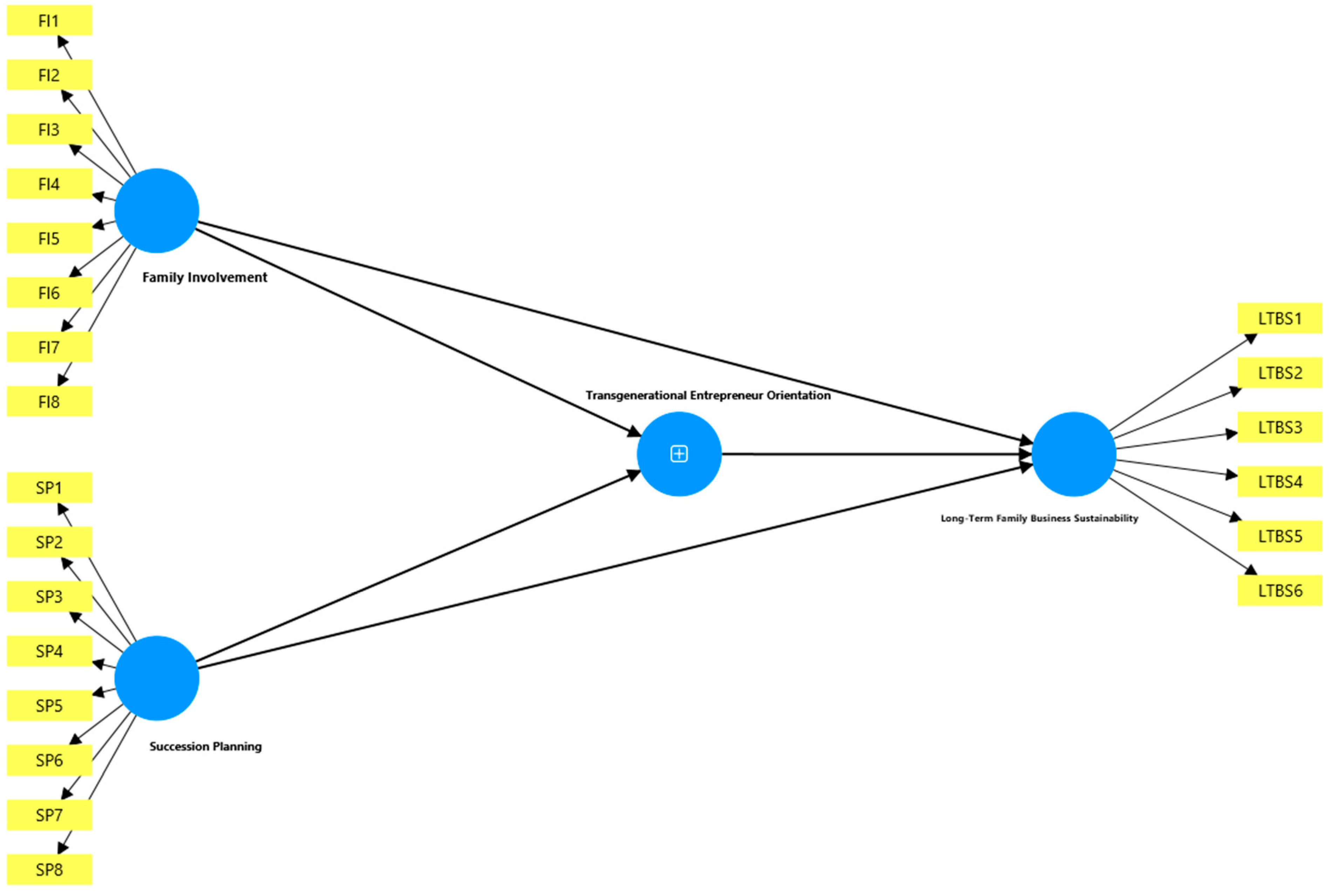
Rather than operating independently, the proposed hypotheses reflect an integrated capability/formation mechanism wherein family involvement and succession planning influence sustainability primarily through the mediating capacity of TEO. The hypotheses therefore represent sequential pathways rather than isolated relationships (Figure 1).

3. Methods

The methodology of this study employed a cross-sectional quantitative survey design to investigate the relationship between family involvement, succession planning, and long-term sustainability in Indonesian family businesses. This study employed a quantitative research design using a structured survey to investigate the relationships among transgenerational entrepreneurial orientation, family involvement, succession planning, and long-term family business sustainability. The quantitative, cross-sectional approach allowed for the systematic testing of hypotheses and supported statistical generalization to a broader population of family business respondents. By leveraging established quantitative techniques, this research aimed to provide empirical insights and robust evidence on the key drivers of sustainable family business practices (Creswell & Poth, 2023). The high concentration of family ownership in Indonesian enterprises—where most firms remain tightly controlled by first- or second-generation family members—creates a restricted-range distribution that naturally suppresses structural coefficients. This pattern does not indicate an absence of theoretical relationships but reflects the homogeneous governance characteristics of the population under study.
The target population comprises owners, managers, and next-generation members of family businesses located in Jakarta. Purposive sampling was utilized, ensuring that participants were drawn from firms that have either experienced or are actively planning for succession and have two or more generations involved in management or ownership roles. This targeted approach enhances the relevance and validity of the findings. To achieve sufficient statistical power for regression and structural equation modeling (SEM) analyses, this study aimed to collect data from at least 200–300 qualified respondents, following best-practice recommendations for quantitative research (Kock & Hadaya, 2018).
Data were gathered using a structured questionnaire consisting of items adapted from previously validated measurement scales for each variable. Responses were rated on a 5- or 6-point Likert scale (1 = Strongly Disagree, 6 = Strongly Agree), ensuring the consistency and comparability of the results. Data analysis was conducted using SPSS 16 and structural equation modeling (SEM) software SmartPLS 4. The analytical process included descriptive statistics, data screening, reliability analysis (Cronbach’s alpha, composite reliability), validity assessment (confirmatory factor analysis for convergent and discriminant validity), and hypothesis testing—encompassing direct, mediation, and moderation effects—to address the research objectives comprehensively. All measurement items were adapted from validated scales EO adapted from Dessi et al. (2022); TEO adapted from (Aldrich et al., 2023; Jocic et al., 2021); succession and involvement adapted from Cirillo et al. (2022) using a 5-point Likert scale (1 = strongly disagree, 5 = strongly agree). To assess common-method bias, Harman’s single-factor test was conducted and the first component accounted for only 31.4% of the variance, below the 50% threshold. Additionally, full collinearity VIF scores (1.351–2.077) confirmed no pathological collinearity. Harman’s single-factor test revealed that the first factor accounted for 31.4% of variance (<50% threshold), and collinearity VIF values ranged from 1.351 to 2.077, indicating no substantial common method bias. Transgenerational entrepreneurial orientation (TEO) was measured using seven items adapted from Dou et al. (2021) and Basco et al. (2019), which conceptualize TEO as an intergenerational extension of EO that emphasizes entrepreneurial legacy, cross-generational value transmission, and continuity of entrepreneurial behavior. Items capture the degree to which the family intentionally transfers entrepreneurial values to successors, maintains an entrepreneurial family identity, and encourages the next generation to pursue new opportunities (e.g., ‘Our family actively passes entrepreneurial values from one generation to the next’; ‘Successors are encouraged to identify and pursue new opportunities for the family business’).
A priori power analysis using G*Power 3.1 indicated that, for a multiple regression with three predictors (transgenerational entrepreneurial orientation, family involvement, and succession planning), a minimum sample of 77 respondents is required to detect a medium effect size (f2 = 0.15) at α = 0.05 with 80% power; however, to enhance statistical robustness for structural equation modeling (SEM), a target of 200–300 respondents was set (Kock & Hadaya, 2018).
Data analysis employed partial least squares structural equation modeling (PLS-SEM) using SmartPLS 4, which is well suited for complex predictive models and works effectively with small to medium samples. The analysis included assessment of the measurement model for reliability (Cronbach’s alpha, composite reliability), convergent validity (factor loadings, AVE > 0.5), and discriminant validity (Fornell–Larcker criterion, cross-loadings). Structural model evaluation involved estimating path coefficients with bootstrapping (5000 subsamples), examining R2 for explanatory power, f2 for predictor effect size, and Q2 for predictive relevance. Both direct and indirect (mediation/moderation) effects were tested, allowing comprehensive evaluation of reliability, validity, and all hypothesized relationships (Sarstedt et al., 2022a, 2022b).
Family involvement was assessed with eight items adapted from Pittino et al. (2021); Caldas and Dolz (2022), succession planning with eight items from Shahzad et al. (2024) and long-term business sustainability with eight items from Sharma (2020). The data were analyzed using partial least squares structural equation modeling (PLS-SEM) with SmartPLS 4.0. Measurement model evaluation included tests for reliability and validity using Cronbach’s alpha, composite reliability (CR), and average variance extracted (AVE). Structural model testing involved hypothesis evaluation through bootstrapping with 5000 resamples to assess path coefficients and statistical significance.

4. Results

This study involved 210 respondents, all representing family businesses with majority family ownership (71.4% holding ≥ 75% equity). Most respondents were owner/founders or co-owners (57.1%), followed by family members in top management (28.6%). Decision-making was collaborative, with over half of the businesses involving more than two family members in strategic processes. Generational leadership was dominated by the first (38.1%) and second (42.9%) generations, while a smaller proportion had transitioned to the third generation. The firms operated across diverse sectors, primarily trade/distribution (33.3%) and hospitality and tourism (19%), with nearly half classified as medium-sized enterprises (see Table 1).
Behavioral analysis shows that family businesses exhibit a strong transgenerational entrepreneurial orientation (mean = 4.8), emphasizing innovation, risk-taking, and proactiveness. Family involvement was the most dominant construct (mean = 5.1), reflecting deep engagement in ownership, management, and governance. Succession planning scored lower (mean = 4.3), indicating variation between firms with formalized strategies and those relying on informal processes. Long-term sustainability was rated high (mean = 4.7), showing strong commitment to maintaining profitability, growth, and generational continuity. Collectively, these findings show that Indonesian family firms are driven by strong family values and entrepreneurial spirit but require more structured succession planning to ensure enduring sustainability. To enhance readability, reliability reporting is consolidated into one column and model figures have been graphically simplified using uniform line-weights and label spacing.
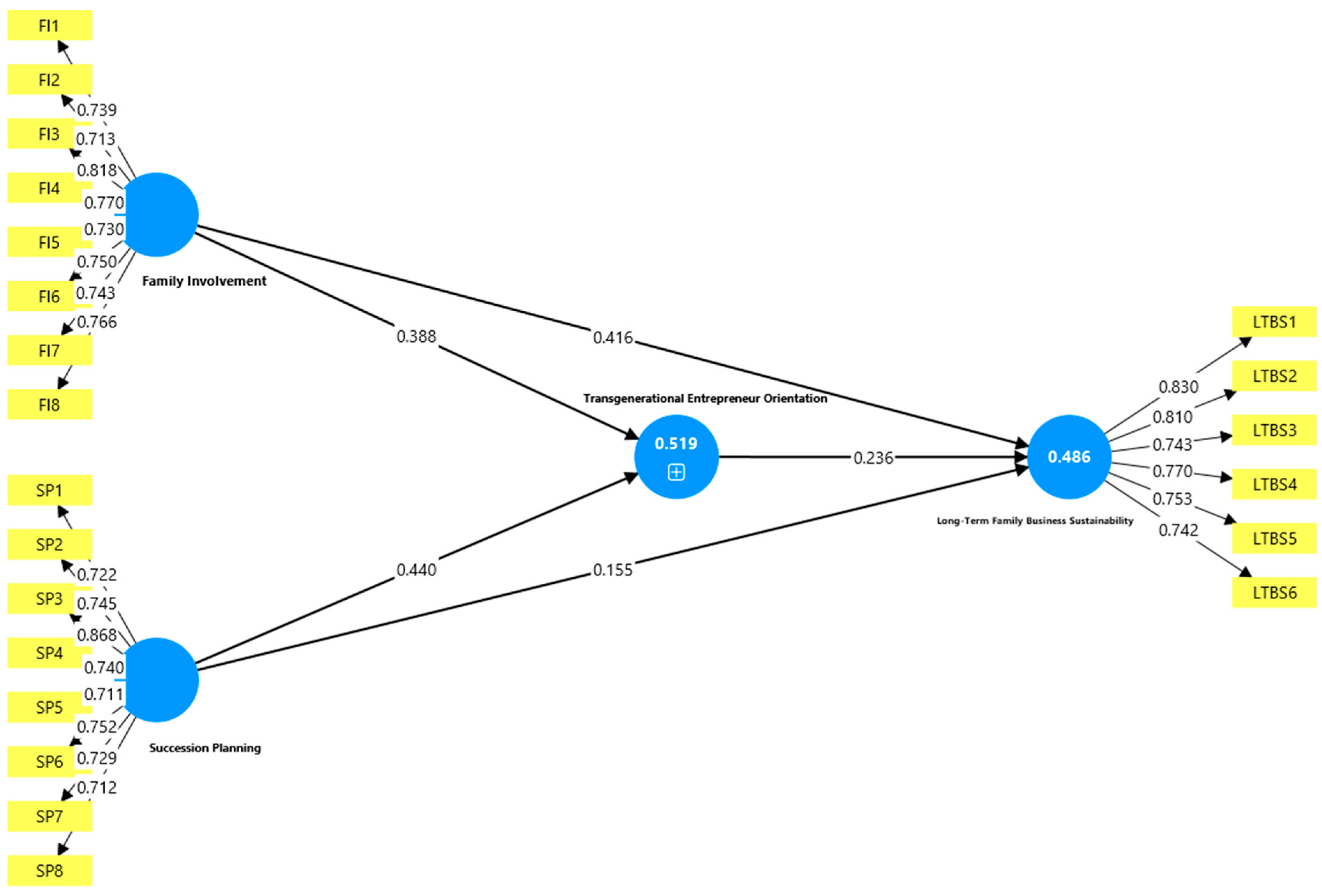
The measurement model demonstrates strong reliability and validity across all constructs. Cronbach’s alpha values for family involvement (0.892), long-term family business sustainability (0.867), succession planning (0.887), and transgenerational entrepreneurial orientation (0.909) all exceed the recommended threshold of 0.70, confirming internal consistency. Similarly, composite reliability (rho_a and rho_c) values for each construct are above 0.85, indicating robust construct reliability. The average variance extracted (AVE) values range from 0.561 to 0.610, all surpassing the 0.50 benchmark, which establishes convergent validity. Collectively, these results confirm that the measurement model is both reliable and valid, providing a strong foundation for subsequent structural model analysis (see Table 2 and Figure 2).
Although statistically significant, the path coefficients in this study (β = 0.065–0.094) reflect small effect sizes. This result is not unexpected given the restricted variance in family involvement, where 71.4% of sampled firms report ≥75% family ownership, creating a restricted-range condition that naturally attenuates correlations and suppresses structural coefficients even when underlying relationships exist (Thorndike, 1939, 1941, 2010).
Effect size indicators (f2) confirm this pattern, with succession planning → sustainability showing a very small effect (f2 = 0.027), TEO → sustainability showing a small effect (f2 = 0.052), and family involvement → sustainability and family involvement → TEO demonstrating moderate effects (f2 = 0.203 and 0.231, respectively). Notably, succession planning → TEO exhibits the strongest incremental effect (f2 = 0.298). Despite modest path coefficients, the R2 values indicate that the model possesses meaningful explanatory power, accounting for 48.6% of the variance in long-term family business sustainability and 51.9% of the variance in TEO. These findings suggest that while individual paths are modest due to sample homogeneity, the predictors collectively contribute substantial explanatory variance at the construct level.
The HTMT analysis confirms that discriminant validity is established among all constructs. The HTMT values between family involvement and long-term family business sustainability (0.721), succession planning (0.571), and transgenerational entrepreneurial orientation (0.676) are all below the conservative threshold of 0.85, indicating sufficient distinction between constructs. Similarly, the relationships between long-term family business sustainability and succession planning (0.586) and transgenerational entrepreneurial orientation (0.663) are also comfortably below the 0.85 criterion. The highest HTMT value is between succession planning and transgenerational entrepreneurial orientation (0.706), which still falls within acceptable limits, suggesting that although these constructs are conceptually related, they remain empirically distinct. Overall, the HTMT results confirm that discriminant validity is achieved, allowing confidence in the uniqueness of each construct within the model (see Table 3).
The R2 values indicate that the model possesses meaningful explanatory power. Long-term family business sustainability shows an R2 of 0.486 (adjusted R2 = 0.479), reflecting a moderate level of variance explained by transgenerational entrepreneurial orientation, family involvement, and succession planning. Similarly, transgenerational entrepreneurial orientation demonstrates substantial explanatory power with an R2 of 0.519 (adjusted R2 = 0.514), indicating that over half of the variance in TEO is attributable to family involvement and succession planning. These results suggest that while individual path coefficients are modest, the predictors collectively account for a meaningful proportion of variance. This pattern is consistent with the restricted-range conditions in the dataset—most firms exhibit high family ownership—which naturally suppresses individual coefficients. However, at the construct level, the model remains robust and theoretically informative (Table 4).
Variance inflation factor (VIF) values were examined to assess multicollinearity among predictors in the structural model. All VIF scores ranged from 1.351 to 2.077, falling well below the recommended thresholds of 3.3 and 5.0 (Hair et al., 2021; Shmueli et al., 2019).
These results indicate that multicollinearity is not a concern, and each predictor contributes unique variance to the endogenous constructs. The low VIF values also confirm the statistical distinctness of family involvement, succession planning, and transgenerational entrepreneurial orientation, supporting the stability and validity of the structural path estimates. Accordingly, the small path coefficients observed in the model cannot be attributed to multicollinearity but reflect true modest effects consistent with the restricted-range characteristics of the sample (Table 5).
The structural model testing provides five direct relationships, each estimated using PLS-SEM with bias-corrected bootstrapping. The table demonstrates statistically significant effects for all paths, as each 95% confidence interval (CI) does not include zero, confirming robust directional influence. Below is a detailed interpretation of each relationship. Family involvement has a positive and moderately strong effect on sustainability. The relatively high lower-bound CI (0.285) indicates stable significance across bootstrap replications. This suggests that increased involvement of family members in decision-making, ownership, and governance contributes meaningfully to long-term continuity, resilience, and generational business endurance. The effect size is among the strongest in the model, confirming family involvement as a central driver of sustainability in Indonesian family firms. Family involvement also positively influences TEO, with a confidence interval that fully supports the relationship. This implies that deeper engagement of family members in strategic roles and shared ownership fosters entrepreneurial learning, value transfer, and intergenerational opportunity perception. The path magnitude is moderately strong, indicating that highly involved families are more likely to cultivate entrepreneurial continuity over generations.
Succession planning exhibits a positive but comparatively smaller effect on sustainability. While the bootstrap CI indicates significant influence, the modest magnitude suggests that Indonesian family firms benefit from succession planning, but structured planning alone may not be sufficient to ensure long-term survival. Informal transition norms, founder dependence, or cultural hierarchy could explain why succession planning has a weaker direct impact than family involvement. This is the strongest path coefficient in the model, showing that well-prepared succession processes play a critical role in shaping entrepreneurial orientation across generations. The tight CI suggests a highly reliable effect. Firms that formalize successor grooming, skill transfer, and leadership preparation are more likely to build entrepreneurial continuity, making succession planning a major precursor of TEO capability formation. TEO has a positive, meaningful effect on sustainability, although weaker than the influence of family involvement. This indicates that entrepreneurial capability transmission enhances long-term resilience but requires supporting structures (e.g., shared vision, next-generation empowerment) to maximize impact. In combination with earlier paths, this confirms TEO as a mediating mechanism between succession/family involvement and sustainability outcomes.
Effect size analysis (f2) provides additional insight into the relative contribution of each predictor in the structural model. Family involvement exhibits medium effects on both sustainability (f2 = 0.203) and TEO (f2 = 0.231), indicating that its inclusion meaningfully increases the explanatory power of these constructs. Succession planning exhibits a small direct effect on sustainability (f2 = 0.027), but a medium-to-large effect on TEO (f2 = 0.298), suggesting that its primary influence operates through capability transmission rather than direct performance outcomes. TEO demonstrates a small but nontrivial effect on sustainability (f2 = 0.052), consistent with its role as a behavioral and intergenerational mechanism. These results complement the R2 findings and highlight that, despite the modest path coefficients, the predictors contribute meaningful incremental variance to the model (Table 6).
The CVPAT results demonstrate strong predictive relevance and model accuracy. The Q2 predicted values for long-term family business sustainability (0.446) and transgenerational entrepreneurial orientation (0.503) are both well above 0, indicating substantial predictive relevance of the model. In terms of accuracy, the root mean square error (RMSE) values are 0.751 and 0.711, respectively, while the mean absolute error (MAE) values are 0.577 and 0.541. These relatively low error values suggest that the model’s predictive performance is satisfactory and provides consistent estimation accuracy. Collectively, the Q2 predicted, RMSE, and MAE results confirm that the structural model not only explains variance effectively but also demonstrates good out-of-sample predictive power for both sustainability and transgenerational entrepreneurial orientation (see Table 7).
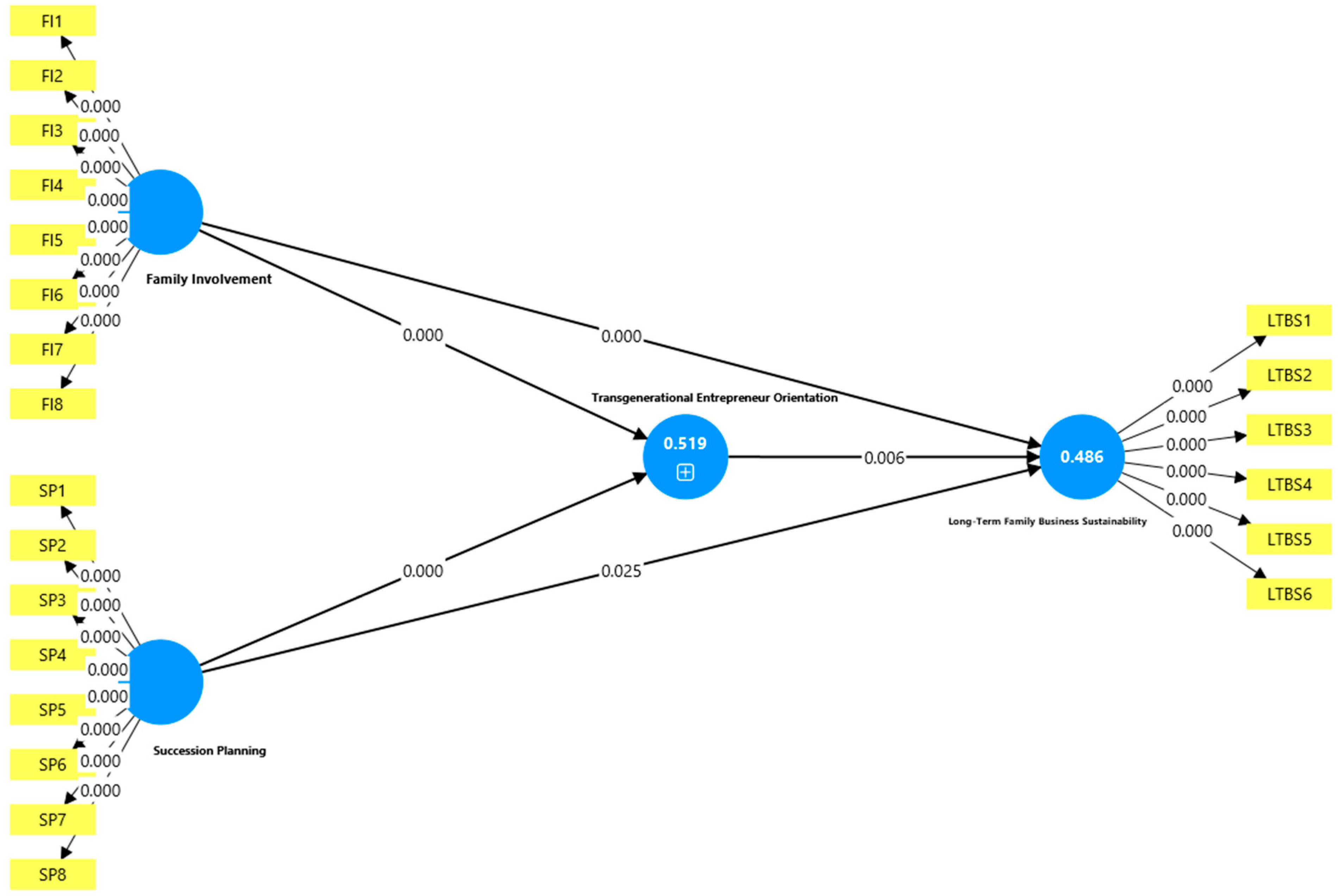
The hypothesis testing results confirm that all proposed relationships in the model are statistically significant. Family involvement is found to be a strong determinant of both long-term sustainability (β = 0.076, p < 0.001) and transgenerational entrepreneurial orientation (β = 0.065, p < 0.001), demonstrating the centrality of family engagement in shaping governance, decision-making, and entrepreneurial legacy. Succession planning also has a significant effect on both sustainability (β = 0.079, p = 0.025) and entrepreneurial orientation (β = 0.065, p < 0.001), though its direct contribution to sustainability is smaller, suggesting that its impact is more pronounced through fostering transgenerational entrepreneurship. Finally, transgenerational entrepreneurial orientation exerts a positive and significant influence on long-term family business sustainability (β = 0.094, p = 0.006), underscoring the importance of innovation, risk-taking, and proactiveness in ensuring continuity across generations. Overall, the results validate the model, indicating that family involvement and succession planning enhance sustainability both directly and indirectly through transgenerational entrepreneurial orientation (see Table 8 and Figure 3).
The mediation analysis shows that both family involvement and succession planning influence sustainability primarily through transgenerational entrepreneurial orientation (TEO). The specific indirect effects for FI → sustainability (β = 0.092, p = 0.014) and SP → sustainability (β = 0.104, p = 0.008) are significant and exceed the magnitude of their respective direct effects, indicating full mediation. Although the direct coefficients are small, the total effects reveal meaningful combined influence (FI → sustainability = 0.508; SP → sustainability = 0.259). These results suggest that governance mechanisms exert their impact on sustainability largely through the development of intergenerational entrepreneurial capabilities, highlighting TEO as a conceptual—but not dominant—mediating pathway. The modest magnitude of these effects is consistent with the restricted variance in family involvement observed in the sample (Table 9).
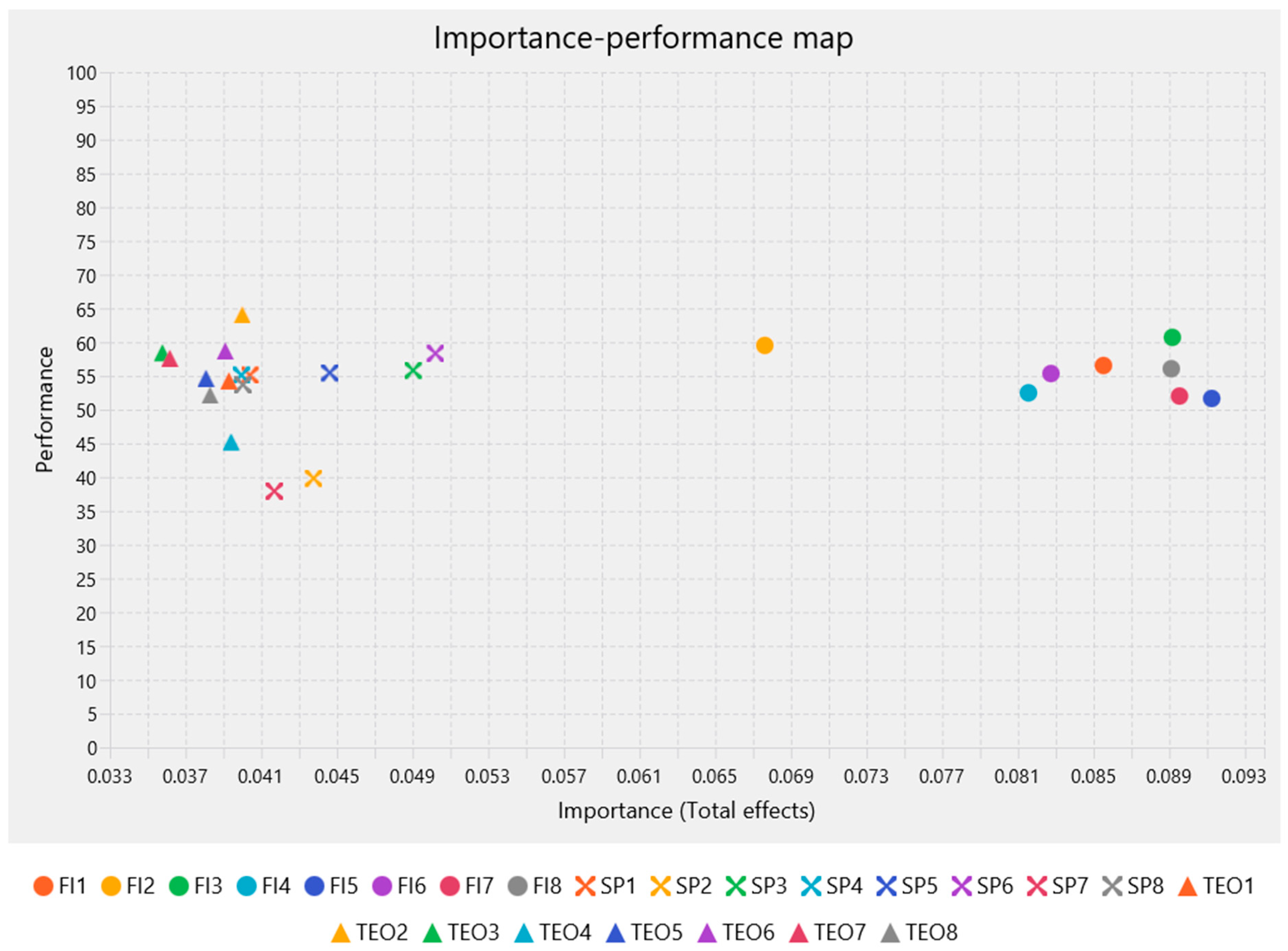
The importance–performance map analysis (IPMA) provides clear insights into which indicators (see Figure 4) most strongly drive long-term family business sustainability. Among all constructs, family involvement (FI2, FI3, FI8) and transgenerational entrepreneurial orientation (TEO1) emerge as the most critical yet underperforming drivers. This means that while family presence in management and decision-making, as well as openness to innovation, are highly influential, their current performance levels suggest room for significant improvement. Addressing these gaps can yield substantial gains in sustainability outcomes. In contrast, succession planning indicators (SP1–SP8) and several family involvements and TEO indicators show moderate importance and performance, indicating that they serve as stabilizers rather than key drivers. Meanwhile, indicators such as SP4 (engaging external advisors) already perform well and should be maintained as the best practice. Overall, the IPMA suggests that Indonesian family firms must focus on strengthening strategic family leadership and fostering an innovation-oriented culture, while maintaining balanced succession planning, to enhance transgenerational sustainability (see Figure 4).
The importance–performance map analysis (IPMA) was conducted with SmartPLS using long-term family business sustainability as the target construct. Importance was operationalized as the total effects of each construct and indicator on the target variable, while performance was measured on a rescaled 0–100 metric based on the average latent variable scores. This allows us to identify indicators that show relatively high importance but low performance and thus represent potential improvement priorities.
The IPMA results indicate that several family involvement indicators (e.g., FI2: involvement of multiple generations in strategic issues; FI3: structured family communication; and FI8: shared family vision) exhibit above-average importance (importance scores > 0.20) but below-average performance (performance scores between 55 and 62 on a 0–100 scale). Similarly, TEO1 (intentional transfer of entrepreneurial values) shows relatively high importance with moderate performance. These patterns suggest specific areas where family firms can focus developmental efforts.
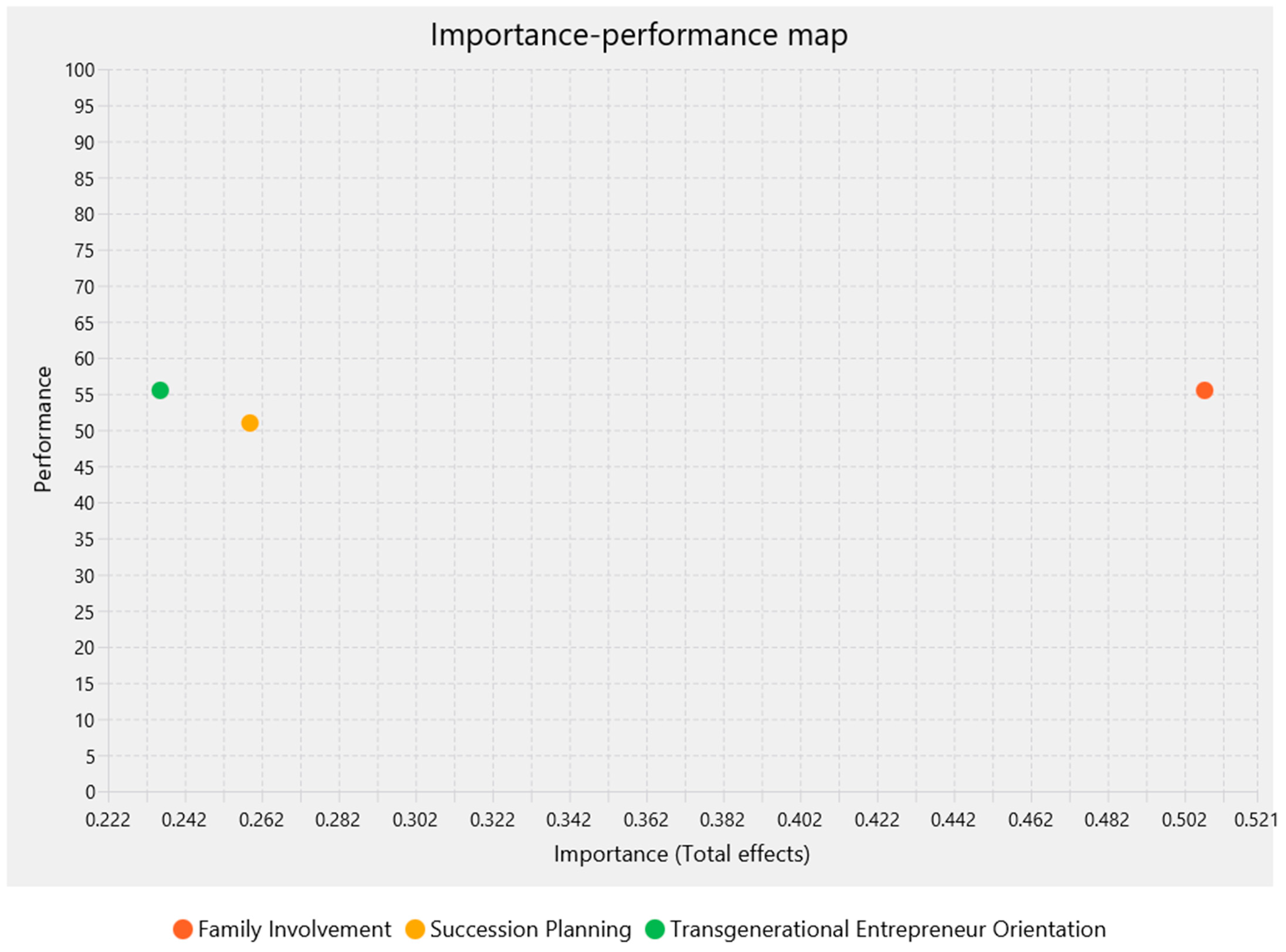
The construct-level IPMA (see Figure 5) indicates that family involvement is the most influential but only moderately performing driver of long-term sustainability, while succession planning and TEO show lower influence and comparable performance. These results suggest incremental improvement opportunities rather than high-impact strategic levers and should be interpreted within the restricted-range context of concentrated family ownership (see Figure 5). The IPMA results offer evidence supporting the broader argument that Indonesian family firms operate within a high-involvement but low-structuration context, where informal governance and strong relational ties maintain continuity but limit capability maturation. The findings illustrate that capability-driven mechanisms (e.g., TEO) have not fully translated into performance advantages, reinforcing the relevance of the high-family-involvement/low-structuration paradox proposed in the study. Family involvement shows the highest importance but only moderate performance, while succession planning and TEO exhibit moderate importance and performance, indicating relative, but not substantial, areas for improvement.

5. Discussion

This study provides evidence that family involvement and succession planning are significant drivers of long-term family business sustainability, both directly and indirectly through transgenerational entrepreneurial orientation (TEO). These findings contribute to ongoing debates in the family business literature by positioning TEO as a dynamic capability that bridges the gap between family influence, succession, and sustainability. The small coefficients observed in the model suggest that while family involvement, succession planning, and TEO are directionally related to sustainability, their practical influence is modest. This aligns with the restricted-range nature of the dataset, in which high family ownership reduces variability and suppresses statistical effects. Thus, the findings should be understood as conceptual and incremental rather than indicative of strong causal influence.
The modest effect sizes observed in this study illustrate the high-family-involvement/low-structuration paradox: family firms exhibit strong relational commitment but limited formal governance and structured succession, attenuating the translation of family influence into capability development (Khurana et al., 2025; Samara, 2021; Shahzad et al., 2024). The mediating role of TEO reflects this pattern, whereby entrepreneurial renewal is contingent on informal value transmission rather than institutionalized systems. The findings of this study reveal modest yet directionally consistent relationships among family involvement, succession planning, TEO, and long-term sustainability (Cesaroni et al., 2021; Carradus et al., 2020; Silitonga et al., 2025). While the statistical effects are small due to restricted-range characteristics of the sample, the results offer incremental theoretical insights into how intergenerational entrepreneurial tendencies may operate within highly family-dominated governance structures. The contribution of this research therefore lies in refining the conceptual understanding of TEO as a subtle mechanism—rather than a strong driver—through which governance and succession practices relate to sustainability, particularly in emerging economy contexts where family ownership is concentrated and formal structures are limited.
The weaker direct role of succession planning may reflect the informal, trust-based, and kinship-hierarchical governance typical in Indonesian family firms, where tacit transfer outweighs formal structure. This contrasts with findings from Europe and the U.S., where succession professionalism strongly predicts performance. This suggests cultural embeddedness and informality attenuate direct effects, placing greater weight on intergenerational entrepreneurial preparedness rather than procedural planning.
The modest direct effect of succession planning may reflect cultural norms in Indonesian family firms, where authority is inherited informally, and tacit knowledge transfer takes precedence over formal governance. In contrast to Western family firms—where structured succession systems strongly predict performance—Indonesian firms rely more heavily on relational continuity and kinship trust. This contextual distinction highlights TEO as a subtle mechanism shaped by culture rather than a dominant strategic driver.
Previous research emphasizes that family involvement creates socioemotional wealth (SEW) resources that foster long-term orientation (Berrone et al., 2020). Our results extend this argument by showing that family involvement not only enhances sustainability directly but also stimulates entrepreneurial renewal through TEO (Ferrari et al., 2022; Liew & Loo, 2023; Yasir et al., 2025).
Similarly, succession planning is shown to be more than a leadership continuity mechanism; it functions as a strategic process for instilling entrepreneurial values into the next generation (Isichei, 2025). This confirms emerging perspectives that succession must be conceptualized as an entrepreneurial capability-building process (Calabrò et al., 2022). By integrating these streams, our study answers calls for more holistic models that examine the interplay between family resources, succession, and entrepreneurial orientation in sustaining family firms (Dou et al., 2021; Basco et al., 2019).
For practitioners, the results highlight the importance of balancing deep family involvement with professional governance practices. Indonesian family firms already exhibit strong family presence in ownership and management, but the IPMA results show that critical areas such as family vision shaping (FI8), strategic decision-making (FI3), and openness to innovation (TEO1) require further development. Firms are encouraged to formalize succession planning through mentoring, clear successor criteria, and the involvement of external advisors while simultaneously fostering a culture of innovation and proactiveness among the next generation (Canovi et al., 2022). In practice, this means embedding entrepreneurial training in succession processes, encouraging cross-generational leadership teams, and leveraging external expertise to avoid insularity. Family businesses that adopt such approaches are more likely to achieve resilience and continuity across generations (Fuentes-Lombardo et al., 2023).
While the study advances understanding of family business sustainability, several limitations should be noted. First, the cross-sectional design precludes causal inference, and future longitudinal research could better capture the evolution of TEO, succession practices, and sustainability outcomes over time (Kiwia et al., 2019; Memili et al., 2018; Oke et al., 2025). Second, the focus on Indonesian family firms may limit generalizability to other contexts with different institutional environments or cultural settings (De Massis & Rondi, 2020). Third, the study relies on self-reported measures, which may be subject to social desirability bias. Employing multi-source data or qualitative case studies could enhance future insights.
Future research could explore how TEO interacts with digital transformation and crisis resilience, given that these are increasingly critical for family firms in the post-pandemic era (Varshney et al., 2024) Additionally, comparative studies across countries would help identify whether the mechanisms observed here hold in different institutional and cultural settings. Scholars may also examine intergenerational differences in entrepreneurial orientation, particularly how millennials and Gen Z shape innovation practices within family firms (Cirillo et al., 2022). Finally, future work could adopt a configurational approach (Basco et al., 2019; Juliana et al., 2022) to identify combinations of family involvement, succession planning, and governance practices that are most conducive to long-term sustainability.
The IPMA results must be interpreted with particular caution given the small effect sizes observed in the structural model. Although the analysis identifies certain indicators as relatively higher in importance, this importance is constrained by the modest total effects, which limit the substantive managerial significance of these findings. The IPMA in this context does not indicate strong predictors but rather highlights relative differences within a narrow range of effects. Therefore, the IPMA should be regarded as a descriptive diagnostic tool illustrating performance gaps rather than as evidence for prioritizing strategic interventions. Any managerial insights drawn from the IPMA should be considered exploratory and contingent on the restricted variance present in the sample.

6. Conclusions

This study set out to investigate the interplay of family involvement, succession planning, and transgenerational entrepreneurial orientation (TEO) in shaping the long-term sustainability of family businesses in Indonesia. Drawing upon stewardship theory, socioemotional wealth perspectives, and the resource-based view, the findings confirm that both family involvement and succession planning significantly contribute to sustainability, with TEO emerging as a critical mediating capability that translates family resources and planning into enduring business continuity. By empirically validating these relationships, this study contributes to advancing a more holistic understanding of what drives transgenerational continuity in family firms.
From a theoretical standpoint, the research enriches the family business literature by positioning TEO as a dynamic bridging mechanism that connects family influence and succession processes with sustainability outcomes. This extends existing work that has often treated family involvement, succession planning, and entrepreneurial orientation in isolation (Dou et al., 2021; Calabrò et al., 2022). The results demonstrate that sustainability is not solely a product of family presence or succession preparedness but rather the outcome of how entrepreneurial values are embedded and transmitted across generations. In doing so, this study answers calls for integrative frameworks that capture the complexity of family business continuity (Basco et al., 2019).
Managerially, the results suggest that Indonesian family businesses are already strongly rooted in family involvement and long-term orientation but must professionalize succession planning and cultivate entrepreneurial renewal to ensure resilience. The IPMA highlighted specific priorities—such as strengthening family vision in governance and fostering openness to innovation—that hold the greatest leverage for improving sustainability outcomes. Family firms should therefore embrace more formalized succession structures, mentoring, and external advisory mechanisms while simultaneously embedding innovation-oriented mindsets in successor generations.
The practical implications derived from this study should be interpreted with caution. Although several structural paths are statistically significant, their magnitudes are small, limiting the extent to which they can be translated into strong or prescriptive managerial recommendations. Accordingly, the IPMA results should be viewed as exploratory rather than as indicators of high-impact strategic priorities. Because importance in IPMA is derived from total effects, which are modest across all pathways, the IPMA does not provide a basis for asserting meaningful managerial leverage. Instead, the findings suggest incremental tendencies—for example, that modest improvements in transgenerational entrepreneurial behaviors may coincide with small gains in sustainability outcomes—but these patterns do not constitute robust strategic guidance. Practitioners should therefore treat these insights as contextual considerations rather than actionable directives. From a practical perspective, the IPMA suggests that Indonesian family firms would benefit from deliberately strengthening shared family vision (FI8) and the intentional transfer of entrepreneurial values (TEO1). This may involve formalizing family councils, articulating a written family vision that emphasizes entrepreneurial renewal, and creating mentorship structures where incumbent owners systematically coach successors on opportunity recognition and risk evaluation. Such interventions address indicators that are both important and underperforming, offering a focused pathway for enhancing long-term sustainability.


7. Limitations and Recommendations

This study is not without limitations. Its cross-sectional design limits causal inference, and the focus on Indonesian family firms may restrict generalizability to other cultural or institutional contexts. Nonetheless, these limitations open avenues for future research, including longitudinal studies of succession and TEO, cross-country comparative analyses, and explorations of how digital transformation and generational differences reshape family business dynamics in the post-pandemic era. Another major limitation of this study is the small magnitude of structural path coefficients. Although statistically significant, these effects are modest and reflect the limited variability in key predictors due to highly concentrated family ownership, a common feature of Indonesian family firms. Future studies should use stratified sampling across low-, medium-, and high-involvement firms to overcome this restriction-of-range bias. A further key limitation of this study is the restricted-range condition present in the sample. Because 71.4% of participating firms have ≥75% family ownership and 57.1% involve more than two family members in strategic decision-making, the variance in family involvement is structurally compressed. Restricted-range conditions are well known to attenuate correlations and path coefficients, even when true relationships exist (Thorndike, 1939, 1941, 2010).
As a result, the small β values observed in the structural model should be interpreted with caution and understood within the context of Indonesian family business governance, which is characterized by high ownership concentration and strong family presence. Despite this limitation, construct-level explanatory power remains meaningful, with R2 values of 0.486 for sustainability and 0.519 for TEO. Future research should employ stratified sampling across different ownership structures or cross-country comparative designs to mitigate restricted-range bias. Future studies should test cross-cultural generalizability by comparing Indonesian firms with Western or East Asian contexts using mixed or longitudinal designs. Qualitative approaches could also uncover tacit mechanisms behind entrepreneurial value transmission, succession rituals, and inheritance norms. Future studies should adopt stratified sampling across low-, medium-, and high-involvement firms to mitigate restricted-range bias and provide more precise estimates of structural relationships (Thorndike, 1939, 1941, 2010).
Because the effect sizes in the structural model are modest, the IPMA findings highlight relative differences in importance and performance within a restricted variance context, rather than substantial drivers of sustainability. Therefore, managerial recommendations derived from these results should be regarded as tentative and incremental improvements rather than definitive strategic interventions.
This research demonstrates that the long-term sustainability of family businesses depends not only on family involvement and succession planning but critically on the development of transgenerational entrepreneurial orientation. By integrating these factors, family firms can strengthen resilience, adaptability, and legacy across generations. This study thus provides both scholarly contributions and practical guidance, offering a roadmap for family businesses seeking to transform their unique family resources into an enduring competitive advantage and intergenerational continuity.

Author Contributions

Conceptualization, A.D., A.P.I. and S.E.H.; methodology, A.D.; software, A.D.; validation, A.D., A.P.I. and S.E.H.; formal analysis, A.D.; investigation, A.D.; resources, A.D.; data curation, A.D.; writing—original draft preparation, A.D., A.P.I. and S.E.H.; writing—review and editing, A.D., A.P.I. and S.E.H.; visualization, A.D.; supervision, A.D. and A.P.I.; project administration, A.D.; funding acquisition, A.D., A.P.I. and S.E.H. All authors have read and agreed to the published version of the manuscript.

Funding

This research was funded by Ministry of Higher Education, Science, and Technology Directorate General of Research and Development grant number [0488/C/DT.06.01/2025] and The APC was funded by [Ministry of Higher Education, Science, and Technology Directorate General of Research and Development].

Institutional Review Board Statement

Ethical review and approval were waived for this study due to it employed non-interventional methods survey using questionnaire that did not involve medical procedures, clinical interventions, or the collection of sensitive personal data. According to Faculty of Postgraduate Program institutional ethical research policy, studies of this type are exempt from formal ethical approval.

Informed Consent Statement

Informed consent was obtained from all subjects involved in the study.

Data Availability Statement

The original contributions presented in this study are included in the article. Further inquiries can be directed to the corresponding author.

Conflicts of Interest

The authors declare no conflict of interest.

References

  1. Abaddi, S. (2025). A new era of succession planning in family businesses. Management & Sustainability: An Arab Review, 4(4), 651–674. [Google Scholar] [CrossRef]
  2. Agnihotri, A., & Bhattacharya, S. (2024). How family businesses transfer their values across generation: A conceptual framework. International Journal of Organizational Analysis, 33(8), 1888–1915. [Google Scholar] [CrossRef]
  3. Ahmad, S. (2025). The role of family governance, identity and social capital in the transgenerational sustainability of family SMEs. Journal of Asia Business Studies, 19(2), 388–407. [Google Scholar] [CrossRef]
  4. Aldrich, H., Alvarez, S., Brumana, M., Campopiano, G., & Minola, T. (2023). Entrepreneurship in family firms: What’s next? Multilevel embeddedness and individuals’ cognition. Journal of Family Business Strategy, 14(3), 100583. [Google Scholar] [CrossRef]
  5. Barney, J. (1991). Firm resources and sustained competitive advantage. Journal of Management, 17, 99–120. [Google Scholar] [CrossRef]
  6. Basco, R., Calabrò, A., & Campopiano, G. (2019). Transgenerational entrepreneurship around the world: Implications for family business research and practice. Journal of Family Business Strategy, 10(4), 100229. [Google Scholar] [CrossRef]
  7. Bergfeld, A. F., & Bergfeld, M. (2022). Next-generation entrepreneurial identity in family business systems: The influence of role changing events on the understanding of legacy, individual identity, and transgenerational entrepreneurship of next-generation family business principals. Thunderbird International Business Review, 65(4), 399–408. [Google Scholar] [CrossRef]
  8. Berrone, P., Cruz, C., & Gomez-Mejia, L. R. (2020). Socioemotional wealth in family firms: New developments and future directions. Journal of Family Business Strategy, 11(2), 100326. [Google Scholar]
  9. Block, J. H., Jaskiewicz, P., & Miller, D. (2011). Ownership versus management effects on performance in family and founder companies: A Bayesian reconciliation. Journal of Family Business Strategy, 2(4), 232–245. Available online: https://ssrn.com/abstract=1622610 (accessed on 15 December 2025). [CrossRef]
  10. Bozer, G., Levin, L., & Santora, J. (2017). Succession in family business: Multi-source perspectives. Journal of Small Business and Enterprise Development, 24, 753–774. [Google Scholar] [CrossRef]
  11. Brozovi, D. (2023). Entrepreneurial resilience (ER) and family business: A perspective article. Journal of Family Business Management, 15(1), 3–9. [Google Scholar] [CrossRef]
  12. Calabrò, A., Torchia, M., Kallmuenzer, A., Yezza, H., & Feng, C. (2022). Transgenerational entrepreneurship in family firms: A configurational approach. Review of Managerial Science, 17(7), 2535–2554. [Google Scholar] [CrossRef]
  13. Caldas, C., & Dolz, C. (2022). Family involvement and ambidexterity: Balance between exploration and exploitation. Journal of Family Business Strategy, 13(3), 100487. [Google Scholar]
  14. Canovi, M., Succi, C., Labaki, R., & Calabrò, A. (2022). Motivating Next-generation Family Business Members to Act Entrepreneurially: A Role Identity Perspective. Journal of the Knowledge Economy, 14, 2187–2214. [Google Scholar] [CrossRef]
  15. Capolupo, P., Ardito, L., Petruzzelli, A. M., & De Massis, A. (2022). Opening up the black box of family entrepreneurship across generations: A systematic literature review. International Small Business Journal, 41, 734–773. [Google Scholar] [CrossRef]
  16. Carradus, A., Zozimo, R., & Discua Cruz, A. (2020). Entrepreneurial learning across generations in family firms. Journal of Family Business Management, 10(4), 361–379. [Google Scholar]
  17. Cesaroni, F. M., Denisse, G., Diaz, C., & Sentuti, A. (2021). Family firms and innovation from founder to successor. Administrative Sciences, 11(2), 54. [Google Scholar] [CrossRef]
  18. Chiang, H., He, L.-J., & Yu, H. J. (2021). Family firm’s succession and firm’s sustainability. Journal of Family and Economic Issues, 43, 637–646. [Google Scholar] [CrossRef]
  19. Cirillo, A., Romano, M., & Bettinelli, C. (2022). Family millennials’ involvement and transgenerational intentions. Journal of Family Business Strategy, 13(3), 100505. [Google Scholar]
  20. Clinton, E., McAdam, M., Gamble, J., & Brophy, M. (2020). Entrepreneurial learning: The transmitting and embedding of entrepreneurial behaviours within the transgenerational entrepreneurial family. Entrepreneurship & Regional Development, 33, 383–404. [Google Scholar] [CrossRef]
  21. Creswell, J. W., & Poth, C. N. (2023). Qualitative inquiry & research design: Choosing among five approaches (5th ed.). Sage. Available online: https://collegepublishing.sagepub.com/products/qualitative-inquiry-and-research-design-5-266033 (accessed on 15 December 2025).
  22. Darsana, I., & Mananda, I. S. (2023). Succession planning in maintaining the existence of family entrepreneurship hotel business in Bali. Jurnal IPTA, 2338, 8633. [Google Scholar] [CrossRef]
  23. De Las Heras-Rosas, C. J., & Herrera, J. (2020). Family firms and sustainability. A longitudinal analysis. Sustainability, 12, 5477. [Google Scholar] [CrossRef]
  24. del Vecchio, P., Secundo, G., & Garzoni, A. (2024). Digital transformation and resilience in family business: An exploratory study of generational dynamics. European Journal of Innovation Management, 28(7), 2815–2844. [Google Scholar] [CrossRef]
  25. De Massis, A., & Rondi, E. (2020). COVID-19 and the future of family business research. Journal of Family Business Strategy, 11(3), 100306. [Google Scholar] [CrossRef]
  26. Dessi, C., Dettori, A., & Floris, M. (2022). Exploring different configurations of entrepreneurial orientation in small artisan family firms: A multi-case study. Journal of Family Business Strategy, 14(3), 100503. [Google Scholar] [CrossRef]
  27. Dou, J., Su, E., Li, S., & Holt, D. T. (2021). Transgenerational entrepreneurship in entrepreneurial families: What is explicitly learned and what is successfully transferred? Entrepreneurship & Regional Development, 33(5–6), 427–441. [Google Scholar] [CrossRef]
  28. Erdogan, I., Rondi, E., & De Massis, A. (2020). Managing the tradition and innovation paradox in family firms: A family imprinting perspective. Entrepreneurship Theory and Practice, 44, 20–54. [Google Scholar] [CrossRef]
  29. Ferrari, A., Mucci, D., & Beck, F. (2022). Organizational culture, generational involvement and entrepreneurial orientation components: A replication study. Journal of Entrepreneurship in Emerging Economies, 16(4), 868–890. [Google Scholar] [CrossRef]
  30. Fuentes-Lombardo, G., Sanchez-Famoso, V., & Cano-Rubio, M. (2023). Reasons for internationalisation of family business. Journal of Family Business Strategy, 14(4), 100571. [Google Scholar] [CrossRef]
  31. Gera, S., Sabat, K., Perumandla, S., & Bhattacharyya, S. S. (2025). Family business succession in Indian micro and small technology business. International Journal of Organizational Analysis. [Google Scholar] [CrossRef]
  32. Gil, M., Thor, K., & Gemheden, A. (2024). Managing the tensions between tradition and innovation in family firms. Journal of Family Business Management, 15(5), 1420–1445. [Google Scholar] [CrossRef]
  33. Gimenez-Jimenez, D., Edelman, L., Minola, T., Calabrò, A., & Cassia, L. (2020). An intergeneration solidarity perspective on succession intentions in family firms. Entrepreneurship Theory and Practice, 45, 740–766. [Google Scholar] [CrossRef]
  34. Hahn, D., Spitzley, D., Brumana, M., Ruzzene, A., Bechthold, L., Prügl, R., & Minola, T. (2021). Founding or succeeding? Exploring how family embeddedness shapes the entrepreneurial intentions of the next generation. Technological Forecasting and Social Change, 173, 121182. [Google Scholar] [CrossRef]
  35. Hair, J. F., Astrachan, C. B., Moisescu, O. I., Radomir, L., Sarstedt, M., Vaithilingam, S., & Ringle, C. M. (2021). Executing and interpreting applications of PLS-SEM: Updates for family business researchers. Journal of Family Business Strategy, 12(3), 100392. [Google Scholar] [CrossRef]
  36. Hanson, S., & Keplinger, K. (2020). The balance that sustains benedictines: Family entrepreneurship across generations. Entrepreneurship & Regional Development, 33, 442–456. [Google Scholar] [CrossRef]
  37. Haynes, G., Marshall, M., Lee, Y., Zuiker, V., Jasper, C., Sydnor, S., Valdivia, C., Masuo, D., Niehm, L., & Wiatt, R. (2020). Family business research: Reviewing the past, contemplating the future. Journal of Family and Economic Issues, 42, 70–83. [Google Scholar] [CrossRef] [PubMed]
  38. Häußler, S., & Ulrich, P. (2024). Exploring strategic corporate sustainability management in family businesses: A systematic literature review. Review of Managerial Science, 1–16. [Google Scholar] [CrossRef]
  39. Ingram, T., Bratnicka-Myśliwiec, K., Kraśnicka, T., & Steinerowska-Streb, I. (2022). Entrepreneurial orientation as a determinant of sustainable performance in polish family and non-family organizations. Sustainability, 14(24), 16393. [Google Scholar] [CrossRef]
  40. Isichei, E. (2025). Succession planning and family business transgenerational orientation. Journal of Comprehensive Business Administration Research. [Google Scholar] [CrossRef]
  41. James, A., Hadjielias, E., Guerrero, M., Cruz, A. D., & Basco, R. (2020). Entrepreneurial families in business across generations, contexts and cultures. Journal of Family Business Management, 11(4), 355–367. [Google Scholar] [CrossRef]
  42. Jaskiewicz, P., Combs, J. G., & Rau, S. B. (2015). Entrepreneurial legacy: Toward a theory of how some family firms nurture transgenerational entrepreneurship. Journal of Business Venturing, 30(1), 29–49. [Google Scholar] [CrossRef]
  43. Jocic, M., Morris, M., & Kuratko, D. (2021). Familiness and innovation outcomes in family firms: The mediating role of entrepreneurial orientation. Journal of Small Business Management, 61, 1345–1377. [Google Scholar] [CrossRef]
  44. Juliana, J., Pramezwary, A., Lemy, D. M., Pramono, R., Muller, J., & Situmorang, H. (2022). What drives sustainable organizational citizenship behavior. International Journal of Sustainable Development and Planning, 17(5), 1403–1410. [Google Scholar] [CrossRef]
  45. Khurana, M., Miah, M. S., & Sharma, S. (2025). Financial decision-making beyond economic considerations: A strategic view for family firms in India. Journal of Risk and Financial Management, 18(8), 432. [Google Scholar] [CrossRef]
  46. Kiwia, R., Bengesi, K., & Ndyetabula, D. (2019). Succession planning and performance of family-owned small and medium enterprises in Arusha City—Tanzania. Journal of Family Business Management, 10, 213–230. [Google Scholar] [CrossRef]
  47. Kock, N., & Hadaya, P. (2018). Minimum sample size estimation in PLS-SEM: The inverse square root and gamma-exponential methods. Information Systems Journal, 28(1), 227–261. [Google Scholar] [CrossRef]
  48. KPMG. (2025). How are leading organizations redefining global mobility to drive business value in a rapidly shifting landscape? Available online: https://kpmg.com/xx/en/our-insights/workforce/global-mobility-benchmarking-report.html (accessed on 15 December 2025).
  49. Kurniawan, D. (2024). Navigating generational transitions: Leadership succession and sustainability in family businesses. MES Management Journal, 3(3), 693–705. [Google Scholar] [CrossRef]
  50. LeCounte, J. (2020). Founder-CEOs: Succession planning for the success, growth, and legacy of family firms. Journal of Small Business Management, 60, 616–633. [Google Scholar] [CrossRef]
  51. Lefebvre, V., Radu-Lefebvre, M., Gartner, W., & Clarke, J. (2020). Building multitemporal awareness and reflexivity in family business: A visual sensemaking exercise. Entrepreneurship Education and Pedagogy, 4, 251512742092138. [Google Scholar] [CrossRef]
  52. Liew, M. X., & Loo, Y. M. (2023). The family-level of generational involvement: Impact on the nexus between entrepreneurial orientation and business performance among small family businesses. Journal of Family Business Management, 14(3), 475–494. [Google Scholar] [CrossRef]
  53. Liew, M. X., & Loo, Y. M. (2024). Harnessing the power of generations through participative strategy: A study on Malaysia Small Family Firms. Journal of Small Business & Entrepreneurship, 37, 223–245. [Google Scholar] [CrossRef]
  54. Magasi, C. (2022). Management succession planning and family-owned manufacturing businesses survival. International Journal of Research in Business and Social Science, 10, 12–24. [Google Scholar] [CrossRef]
  55. Makumbe, W., Kamupini, A., & Jackson, L. (2025). The mediating role of organisational commitment on the relationship between succession planning practices and business performance. Acta Commercii-Independent Research Journal in the Management Sciences, 25(1), 1334. [Google Scholar] [CrossRef]
  56. Mclarty, B. D., Vardaman, J., Liguori, E., Marler, L. E., Mclarty, B. D., Vardaman, J., Liguori, E., Marler, L. E., Liguori, E., & Marler, L. E. (2025). Family business research: The next generation. Journal of Small Business Management, 1–20. [Google Scholar] [CrossRef]
  57. Memili, E., Fang, H., Koç, B., Yildirim-Öktem, Ö., & Sonmez, S. (2018). Sustainability practices of family firms: The interplay between family ownership and long-term orientation. Journal of Sustainable Tourism, 26, 9–28. [Google Scholar] [CrossRef]
  58. Mikušová, M., & Stanovská, K. (2025). Generations, technology and socioemotional wealth: A study of Czech family businesses. Journal of Family Business Management, 15(6), 1577–1599. [Google Scholar] [CrossRef]
  59. Miller, D., & Le Breton-Miller, I. (2021). Family governance, stewardship, and capabilities revisited. Journal of Family Business Strategy, 12(1), 100373. [Google Scholar]
  60. Minola, T., Brumana, M., Campopiano, G., Garrett, R., & Cassia, L. (2016). Corporate venturing in family business: A developmental approach of the enterprising family. Strategic Entrepreneurship Journal, 10, 395–412. [Google Scholar] [CrossRef]
  61. Miroshnychenko, I., De Massis, A., Miller, D., & Barontini, R. (2020). Family business growth around the world. Entrepreneurship Theory and Practice, 45, 682–708. [Google Scholar] [CrossRef]
  62. Nagy-Tóth, B., & Nagy, A. S. (2025, June 26–28). Navigating succession in european family businesses: A three-circle model reinterpretation of case studies. 11th BASIQ International Conference on New Trends in Sustainable Business and Consumption, Oradea, Romania. [Google Scholar] [CrossRef]
  63. Nallabathula, H. R., & Doraiswamy, A. (2024). Entrepreneurship orientation in family business: Decision process structure & succession planning. Multidisciplinary Reviews, 7(7), 2024149. [Google Scholar] [CrossRef]
  64. Nordqvist, M., & Jack, S. (2020). Resilience and family business: How lessons from family businesses can help all facets of society to bounce back. In Sweden through the crisis (pp. 229–242). Stock-holm School of Economics Institute for Research. Available online: https://www.hhs.se/en/research/sweden-through-the-crisis/Resilience-and-family-business/ (accessed on 15 December 2025).
  65. Nyabakora, W. I. (2024). The contribution of family businessesto economic growth: A bibliometric review. SAGE Open, 14, 21582440241301423. [Google Scholar] [CrossRef]
  66. Oke, A., Turla, M., Osobajo, O., & Koutsoukos, S. (2025). Resolving the paradox of green innovation across generations in family firms: An exploratory analysis of incumbents and successors perceptions. Journal of Family Business Management, 15(6), 1556–1576. [Google Scholar] [CrossRef]
  67. Orlitzky, M., Schmidt, F. L., & Rynes, S. L. (2021). Corporate social performance and financial performance in family firms: A meta-update. Journal of Family Business Strategy, 12(3), 100419. [Google Scholar]
  68. Owusu-Acheampong, E., Arkaifie, S. J., Afriyie, E., & Azu, T. (2024). Factors affecting succession planning in Sub-Saharan African family-owned businesses: A scoping review. Journal of Family Business Management, 14(6), 1099–1118. [Google Scholar] [CrossRef]
  69. Paço, A. (2021). Succession planning and strategies in family business: A multiple case study. International Entrepreneurship Journal, 25(1), 1–12. Available online: https://www.researchgate.net/publication/351839981_Succession_planning_and_strategies_in_Family_Business_a_multiple_case_study (accessed on 15 December 2025).
  70. Pittino, D., Visintin, F., Minichilli, A., & Compagno, C. (2021). Family involvement in governance and firm performance in industrial districts. The moderating role of the industry’s technological paradigm. Entrepreneurship & Regional Development, 33, 514–531. [Google Scholar] [CrossRef]
  71. PWC. (2025). How Indonesian family businesses are preparing their legacy, and how agile they are amidst uncertainty: PwC 2025 Global Family Business Survey. Available online: https://www.pwc.com/id/en/media-centre/press-release/2025/english/how-indonesian-family-businesses-are-preparing-their-legacy.html (accessed on 15 December 2025).
  72. Ratten, V. (2020). COVID-19 and entrepreneurship: Changing life and work landscape (implications for family firms). Journal of Small Business & Entrepreneurship, 32(5), 503–516. [Google Scholar] [CrossRef]
  73. Rivo-López, E., Villanueva-Villar, M., Vaquero-García, A., & Lago-Peñas, S. (2020). Do family firms contribute to job stability? Evidence from the great recession. Journal of Family Business Management, 12(1), 152–169. [Google Scholar] [CrossRef]
  74. Rovelli, P., Ferasso, M., Massis, A. D., & Kraus, S. (2022). Thirty years of research in family business journals: Status quo and future directions. Journal of Family Business Strategy, 13(3), 100422. [Google Scholar] [CrossRef]
  75. Samara, G. (2021). Family businesses in the Arab Middle East: What do we know and where should we go? Journal of Family Business Strategy, 12(3), 100359. [Google Scholar] [CrossRef]
  76. Santos, S., Liguori, E., & Garvey, E. (2023). How digitalization reinvented entrepreneurial resilience during COVID-19. Technological Forecasting and Social Change, 189, 122398. [Google Scholar] [CrossRef] [PubMed]
  77. Sarstedt, M., Hair, J., Pick, M., Liengaard, B., Radomir, L., & Ringle, C. (2022a). Progress in partial least squares structural equation modeling use in marketing research in the last decade. Psychology & Marketing, 39(5), 1035–1064. [Google Scholar] [CrossRef]
  78. Sarstedt, M., Ringle, C. M., & Hair, J. F. (2022b). Partial least squares structural equation modeling. In C. Homburg, M. Klarmann, & A. Vomberg (Eds.), Handbook of market research. Springer. [Google Scholar] [CrossRef]
  79. Sasaki, I., Kotlar, J., Ravasi, D., & Vaara, E. (2020). Dealing with revered past: Historical identity statements and strategic change in Japanese family firms. Strategic Management Journal, 41(3), 590–623. [Google Scholar] [CrossRef]
  80. Schepers, J., Voordeckers, W., & Steijvers, T. (2020). Long-term orientation as a resource for entrepreneurial orientation in private family firms: The need for participative decision making. Sustainability, 12(13), 5334. [Google Scholar] [CrossRef]
  81. Schmidt, J. L., Oro, I. M., Begnini, S., & Carvalho, C. (2025). Organizational ambidexterity and entrepreneurial orientation: The path to high performance in family businesses. Journal of Family Business Management. [Google Scholar] [CrossRef]
  82. Shahzad, F., Akhlaq, A., & Ghaffar, C. (2024). Exploring business succession dynamics in family-owned businesses: Lessons from Pakistani case studies. Journal of Family Business Management, 15(5), 1446–1473. [Google Scholar] [CrossRef]
  83. Sharma, A. (2020). Sustainability research in business-to-business markets: An agenda for inquiry. Industrial Marketing Management, 88, 323–329. [Google Scholar] [CrossRef]
  84. Shmueli, G., Sarstedt, M., Hair, J., Cheah, J., Ting, H., Vaithilingam, S., & Ringle, C. (2019). Predictive model assessment in PLS-SEM: Guidelines for using PLS predict. European Journal of Marketing, 53(11), 2322–2347. Available online: https://ssrn.com/abstract=3471205 (accessed on 15 December 2025). [CrossRef]
  85. Shore, A., Tiwari, M., Tandon, P., & Foropon, C. (2024). Building entrepreneurial resilience during crisis using generative AI: An empirical study on SMEs. Technovation, 135, 103063. [Google Scholar] [CrossRef]
  86. Silitonga, P., Juliana, J., Rini, G. P., & Sitohang, A. P. S. (2025). Unveiling the outcome of the implementation of experiential value co-creation on the behavioral intention of online travelers. Tourism and Hospitality, 6(3), 157. [Google Scholar] [CrossRef]
  87. Suddaby, R., & Jaskiewicz, P. (2020). Managing traditions: A critical capability for family business success. Family Business Review, 33, 234–243. [Google Scholar] [CrossRef]
  88. Suess-Reyes, J. (2016). Understanding the transgenerational orientation of family businesses: The role of family governance and business family identity. Journal of Business Economics, 87, 749–777. [Google Scholar] [CrossRef]
  89. Temprano-García, V., Pérez-Fernández, H., Rodríguez-Pinto, J., Rodríguez-Escudero, A. I., & Barros-Contreras, I. (2023). How to build a brand-oriented family firm: The impact of socioemotional wealth (SEW) dimensions. Journal of Business Research, 163, 113929. [Google Scholar] [CrossRef]
  90. Tessema, D. A., Brunninge, O., & Cestino, J. (2024). Transmission of entrepreneurial values in enterprising families: A systematic literature review. Journal of Family Business Management, 15(4), 1112–1156. [Google Scholar] [CrossRef]
  91. Thorndike, E. (1939). Familial resemblances in composites of desirable traits. Journal of Heredity, 30, 391–392. [Google Scholar] [CrossRef]
  92. Thorndike, E. (1941). Human nature and the social order. Routledge. [Google Scholar] [CrossRef]
  93. Thorndike, E. (2010). The psychology of arithmetic. Cambridge University Press. [Google Scholar] [CrossRef]
  94. Valentino, A., Matajira, L. D., & Szymanska, I. (2025). Crisis management in family firms: The combinations of family business involvement and directive leadership that influence business and social performance. Journal of Family Business Management, 15(5), 1293–1314. [Google Scholar] [CrossRef]
  95. Varshney, N., Agarwal, S., Dana, L. P., & Dwivedi, A. K. (2024). An investigation of factors towards family business sustainability: Perspective from India, a developing economy. Journal of Family and Economic Issues, 1–18. [Google Scholar] [CrossRef] [PubMed]
  96. Villalonga, B., & Amit, R. (2020). Family ownership. Oxford Review of Economic Policy, 36, 241–257. [Google Scholar] [CrossRef]
  97. Von Ritter, C., Kanbach, D. K., Maran, T. K., Kraus, S., & Dabic, M. (2025). Navigating long-term orientation, adaptability and crisis response: A strategic view on family. International Journal of Entrepreneurial Behavior & Research, 31(11), 194–213. [Google Scholar] [CrossRef]
  98. Wu, Q., Wang, Y., Chu, H., & Chen, J. (2025). Innovation in family firms: An intergenerational tale of symbol and substance. Management and Organization Review, 21, 1–32. [Google Scholar] [CrossRef]
  99. Xu, R. (2025). Power transfer, cultural integration, and professionalization in family business succession: A comparative study of metersbonwe and youngor. Highlights in Business, Economics and Management, 48, 7–14. [Google Scholar] [CrossRef]
  100. Yasir, N., Qin, X., Yi, S., Ying, W., Samad, S., Alhitmi, H., & Braithwaite, R. (2025). Environmental and sociological factors shape sustainable entrepreneurial intentions among Pakistani university students. Scientific Reports, 15, 39293. [Google Scholar] [CrossRef]
  101. Yilmaz, Y., Raetze, S., De Groote, J., & Kammerlander, N. (2024). Resilience in family businesses: A systematic literature review. Family Business Review, 37(1), 60–88. [Google Scholar] [CrossRef]
  102. Zellweger, T. (2020). Understand your family firm’s core strengths and weaknesses. Entrepreneur & Innovation Exchange. Available online: https://familybusiness.org/content/understand-your-family-firms-core-strengths-and-weaknesses (accessed on 15 December 2025). [CrossRef]
  103. Zellweger, T., & Sieger, P. (2012). Entrepreneurial orientation in long-lived family firms. Small Business Economics, 38, 67–84. [Google Scholar] [CrossRef]
  104. Zheng, X., Tham, J., & Khatibi, A. (2025). Financial awareness and business development cognition positively influence the sustainable development of rural family businesses. Frontiers in Sociology, 10, 1569713. [Google Scholar] [CrossRef] [PubMed]
Figure 1. Conceptual Framework.
Admsci 16 00010 g001
Figure 2. Outer model.
Admsci 16 00010 g002
Figure 3. Inner model.
Admsci 16 00010 g003
Figure 4. IPMA indicator.
Admsci 16 00010 g004
Figure 5. IPMA Construct.
Admsci 16 00010 g005
Table 1. Demographic analysis.
Demographic VariableCategoryFrequency (n)Percentage (%)
Business CategoryFamily business210100.0
Role in the BusinessOwner/Co-owner12057.1
Family in top management6028.6
Family operational staff209.5
Non-family/Consultant104.8
Family Ownership Proportion<25%52.4
25–49%157.1
50–74%4019.0
≥75%15071.4
Family Members Involved in Strategic Decisions052.4
12511.9
26028.6
>212057.1
Generation Leading the BusinessFirst generation8038.1
Second generation9042.9
Third generation3516.7
Fourth generation or more52.4
Business Age<3 years104.8
3–9 years4019.0
10–24 years10047.6
≥25 years6028.6
Main Business SectorTrade/Distribution7033.3
Hospitality and Tourism4019.0
Manufacturing/Production3014.3
Financial/Consulting Services209.5
Property/Construction157.1
Technology/Startups157.1
Education/Training104.8
Health and Beauty104.8
Business Scale (UU No. 20/2008)Micro157.1
Small6028.6
Medium9545.2
Large4019.0
Table 2. Construct reliability and validity.
Variable Cronbach’s AlphaComposite Reliability (rho_a)Composite Reliability (rho_c)Average Variance Extracted (AVE)
Family Involvement 0.892 0.894 0.913 0.569
Long-Term Family Business Sustainability 0.867 0.869 0.900 0.601
Succession Planning 0.887 0.891 0.911 0.561
Transgenerational Entrepreneurial Orientation 0.909 0.909 0.926 0.610
Table 3. Discriminant validity.
Family Involvement Long-Term Family Business Sustainability Succession Planning Transgenerational Entrepreneurial Orientation
Family Involvement
Long-Term Family Business Sustainability 0.721
Succession Planning 0.571 0.586
Transgenerational Entrepreneurial Orientation 0.676 0.663 0.706
Table 4. R2 values.
Table 4. R2 values.
R2R2 Adjusted
Long-Term Family Business Sustainability0.4860.479
Transgenerational Entrepreneurial Orientation0.5190.514
Table 5. VIF results.
Path AnalysisVIF
Family Involvement → Long-Term Family Business Sustainability1.664
Family Involvement → Transgenerational Entrepreneurial Orientation1.351
Succession Planning → Long-Term Family Business Sustainability1.754
Succession Planning → Transgenerational Entrepreneurial Orientation1.351
Transgenerational Entrepreneurial Orientation → Long-Term Family Business Sustainability2.077
Table 6. f2 values.
Table 6. f2 values.
Path Analysisf2
Family Involvement → Long-Term Family Business Sustainability 0.203
Family Involvement → Transgenerational Entrepreneurial Orientation 0.231
Succession Planning → Long-Term Family Business Sustainability 0.027
Succession Planning → Transgenerational Entrepreneurial Orientation 0.298
Transgenerational Entrepreneurial Orientation → Long-Term Family Business Sustainability 0.052
Table 7. Cross-validated prediction ability test (CVPAT analysis).
VariableQ2 Predicted RMSE MAE
Long-Term Family Business Sustainability 0.446 0.751 0.577
Transgenerational Entrepreneurial Orientation 0.503 0.711 0.541
Table 8. Hypothesis results.
HypothesesStandardized Path Coefficientp ValuesConfidence IntervalDecision
5%95%
Family Involvement Long-Term Family Business Sustainability 0.076 0.000 0.2850.534Hypothesis Supported
Family Involvement Transgenerational Entrepreneurial Orientation 0.065 0.000 0.2830.494Hypothesis Supported
Succession Planning Long-Term Family Business Sustainability 0.079 0.025 0.0330.291Hypothesis Supported
Succession Planning Transgenerational Entrepreneurial Orientation 0.065 0.000 0.3350.549Hypothesis Supported
Transgenerational Entrepreneurial Orientation Long-Term Family Business Sustainability 0.094 0.006 0.0850.392Hypothesis Supported
Table 9. Total effect, specific indirect effect, and total indirect effect.
Path AnalysisOriginal Sample (O) Standard Deviation (STDEV) T Statistics (|O/STDEV|)p Values Results
Family Involvement → Long-Term Family Business Sustainability 0.092 0.041 2.212 0.014 Full Mediation
Succession Planning → Long-Term Family Business Sustainability 0.104 0.043 2.391 0.008 Full Mediation
Family Involvement → Transgenerational Entrepreneurial Orientation → Long-Term Family Business Sustainability 0.092 0.041 2.212 0.014 Full Mediation
Succession Planning → Transgenerational Entrepreneurial Orientation → Long-Term Family Business Sustainability 0.104 0.043 2.391 0.008 Full Mediation
Family Involvement → Long-Term Family Business Sustainability 0.508 0.061 8.322 0.000 Full Mediation
Family Involvement → Transgenerational Entrepreneurial Orientation 0.388 0.065 5.982 0.000 Full Mediation
Succession Planning → Long-Term Family Business Sustainability 0.259 0.063 4.132 0.000 Full Mediation
Succession Planning → Transgenerational Entrepreneurial Orientation0.440 0.065 6.750 0.000 Full Mediation
Transgenerational Entrepreneurial Orientation → Long-Term Family Business Sustainability0.236 0.094 2.510 0.006 Full Mediation
Disclaimer/Publisher’s Note: The statements, opinions and data contained in all publications are solely those of the individual author(s) and contributor(s) and not of MDPI and/or the editor(s). MDPI and/or the editor(s) disclaim responsibility for any injury to people or property resulting from any ideas, methods, instructions or products referred to in the content.