Article

WHO–WHAT–HOW: A Product Operating Model for Agile, Technology-Enabled Digital Transformation


Faculty of Industrial Engineering, Robotics, and Production Management, Technical University of Cluj-Napoca, 400114 Cluj-Napoca, Romania
*
Author to whom correspondence should be addressed.
Adm. Sci. 2025, 15(9), 368; https://doi.org/10.3390/admsci15090368

Submission received: 23 July 2025 / Revised: 5 September 2025 / Accepted: 10 September 2025 / Published: 17 September 2025

Abstract

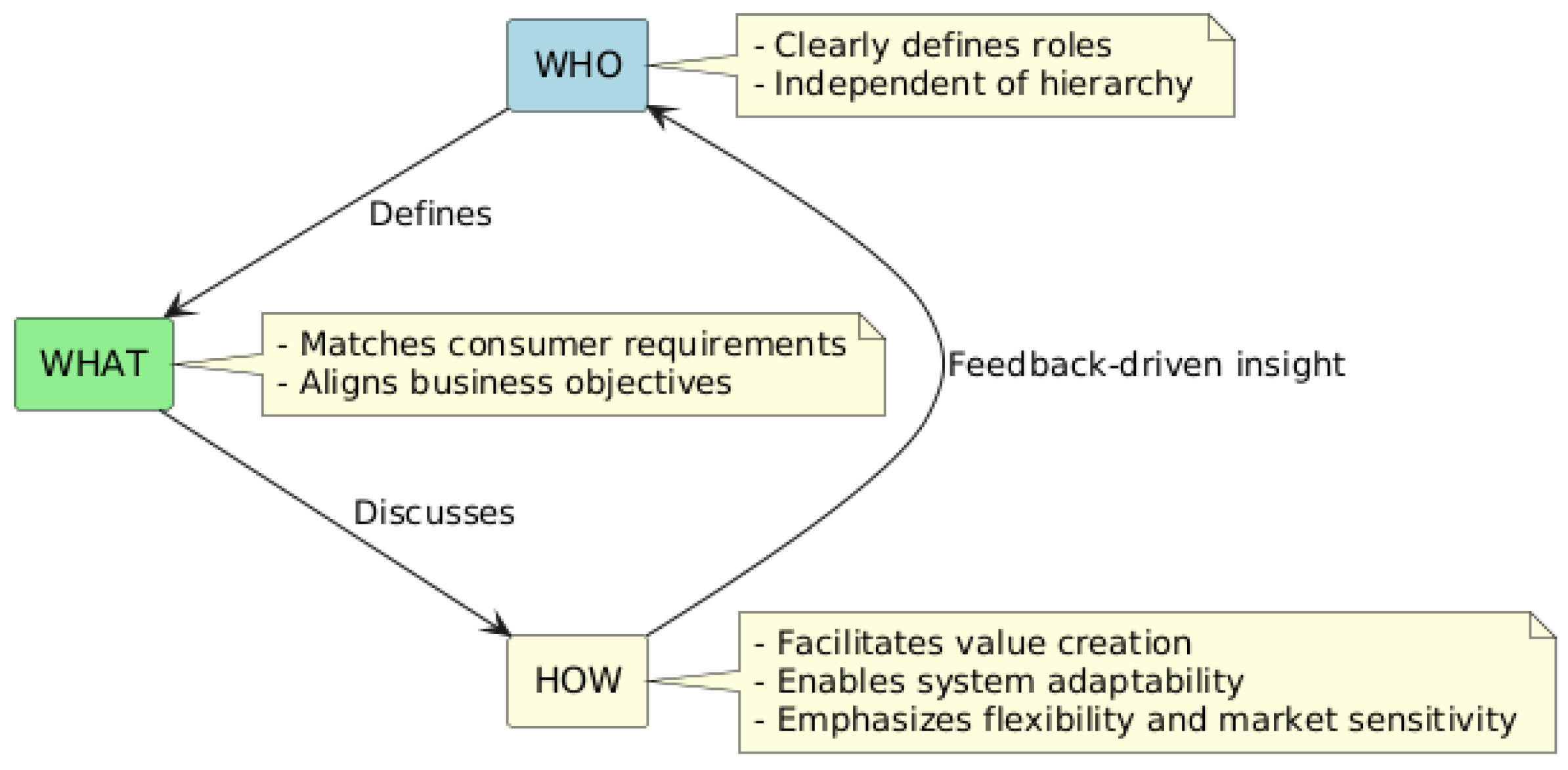
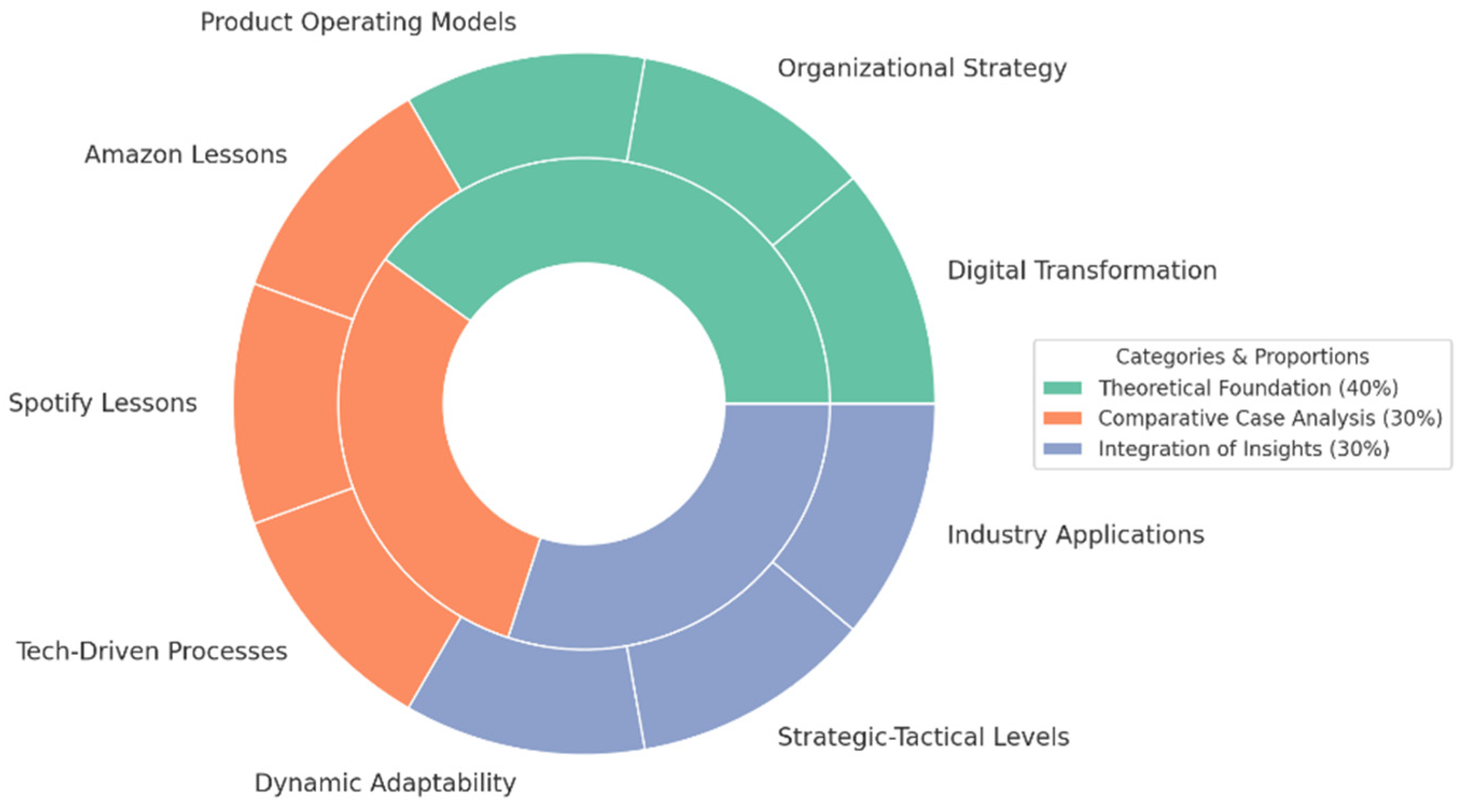
Organizations face rising market volatility, while legacy, plan-driven structures struggle to translate strategy into adaptive execution. Prior studies discuss product-centric operating models, yet typically treat decision rights, product definition, and technology-enabled execution separately. This paper introduces the WHO–WHAT–HOW framework, an authorial synthesis that links decision boundaries (WHO), product scope and value hypotheses (WHAT), and workflow and technology routines (HOW) into a single, operational model. A triangulated design is employed, comprising a systematic document analysis of 62 sources published between 2018 and 2024, illustrative case studies of Amazon and Spotify, and a scenario-based organizational illustration that contrasts a baseline hierarchy with a WHO–WHAT–HOW configuration. Rather than constituting empirical validation, these elements serve as illustrative demonstrations of conceptual plausibility. Indicative composite indices, synthetically constructed from document-coded constructs and simulated rules, suggest improvements in decision speed, cycle time, and coordination; these indices are heuristic and non-inferential. The contribution is threefold: First, it provides a pragmatic five-step implementation roadmap. Then, we make the mechanisms concrete via a construct-to-rule mapping and three rule-based vignettes (incident pathway, value-hypothesis experiment, cross-team dependency), showing how WHO–WHAT–HOW compresses decision time, cycle time, and coordination without introducing new measurement programs. Finally, the composite indices remain heuristic and non-inferential. Limitations include reliance on secondary evidence and a scenario-based, non-empirical illustration; robust validation requires longitudinal, multi-sector primary data and testing in regulated or low-automation settings.
Keywords: product operating model; strategic alignment; agile execution; digital transformation product operating model; strategic alignment; agile execution; digital transformation