Article

Congener-Specific Modulation of Humoral Effector Activity in Eisenia fetida Following PFAS Exposure


1
Department of Science and Technological Innovation, Università del Piemonte Orientale, 15121 Alessandria, Italy
2
Department of Translational Medicine (DiMeT), Università del Piemonte Orientlae, 28100 Novara, Italy
*
Authors to whom correspondence should be addressed.
Environments 2026, 13(6), 345; https://doi.org/10.3390/environments13060345
Submission received: 18 May 2026 / Revised: 12 June 2026 / Accepted: 16 June 2026 / Published: 18 June 2026
(This article belongs to the Special Issue Environmental Pollution Risk Assessment, 2nd Edition)

Abstract

Per- and polyfluoroalkyl substances (PFASs) are persistent environmental contaminants of growing concern for soil ecosystems, yet their effects on the humoral arm of innate immunity in soil invertebrates remain poorly characterized. Here, we used the earthworm Eisenia fetida to screen 31 legacy and emerging PFAS congeners for their ability to modulate the hemolytic activity of cell-free coelomic fluid, a functional readout of soluble immune effectors including the pore-forming toxin lysenin. Earthworms were exposed under OECD 207 contact-filter conditions at two concentrations (0.6 and 229 µM) for 72 h, after which decellularized coelomic fluid was tested against sheep erythrocytes. To dissect direct biochemical interference from organism-mediated regulation, the same panel was also applied ex vivo (2.5 µM) to coelomic fluid from unexposed earthworms. In vivo, PFASs produced markedly heterogeneous, congener-specific responses: PFBS, PFBA and PFMOPrA suppressed hemolytic activity, whereas PMDA, PFHxA and HFPO-DA enhanced it. In contrast, ex vivo exposure produced a consistent, broad inhibition of hemolysis, indicating a direct interaction of PFASs with soluble immune proteins. Proteomic profiling of the lysenin family under PFOA and HFPO-DA suggested isoform-level reweighting rather than uniform abundance shifts, although effects did not survive multiple-testing correction. Together, these data show that PFASs act as congener-specific immunomodulators of extracellular humoral defense in E. fetida and identify candidate congeners for confirmatory mechanistic studies.

1. Introduction

Approximately 4700 PFASs have been identified; however, the updated OECD definition [1], classifying PFAS as “any substance containing one or more fluorine atoms”, expanded this number to more than 15,000 compounds. These are now organized into two major categories, polymeric and non-polymeric PFASs, each further subdivided into functional subgroups [1]. PFASs display considerable heterogeneity in their chemical and physical properties. Their exceptional stability and functional versatility have supported widespread industrial use since the 1990s, primarily as emulsifiers and surfactants [2]. Yet the same stability underpins their environmental persistence and global dispersal. These compounds bioaccumulate and spread extensively across ecosystems [3], posing a significant challenge to environmental sustainability [2,4] and warranting their classification as persistent organic pollutants (POPs).
A substantial fraction of emerging organic contaminants, including many PFASs, raises concern due to their endocrine-disrupting capacities. Endocrine-disrupting chemicals (EDCs) perturb endocrine glands, their hormonal products, or hormone-regulated activities [5,6]. Acute toxicity studies on PFASs provide an initial framework for assessing their biological effects and form the basis for extrapolating risks associated with chronic exposure [7]. The innate immune system constitutes the body’s primary rapid-response defense against pathogens, operating through non-specific mechanisms [8,9]. Epidemiological and experimental evidence indicate that PFAS exposure alters both the abundance and functionality of innate immune cells [10]. Moreover, in higher systems, such as mammals, PFASs modulate key cytokines, including IL-1β, TNF-α and IFN-γ, via complex molecular mechanisms, and activate the AIM2 inflammasome, a central pathway mediating PFAS-induced inflammatory responses. This activation promotes cytokine release and pyroptosis, an inflammatory form of programmed cell death associated with tissue injury [11].
Annelids, including the species Eisenia fetida, play essential ecological roles in soil formation and fertility and are widely employed as bioindicator organisms due to their sensitivity and codified responses to environmental contaminants [12,13,14]. Coelomic fluid analysis provides a valuable biomonitoring tool, offering access to immune cells, enzymes and soluble factors without sacrificing the organism. This minimally invasive approach preserves biomolecular integrity and supports robust in vivo assessments of humoral immune parameters [15].
Innate immunity, present from birth and independent of specific immunological memory, represents the first line of defense in organisms lacking fully developed adaptive immune systems [16,17]. Consequently, studies of immune mechanisms in morphologically simple invertebrates provide important insights into conserved features of innate immunity in more evolutionary complex taxa, including vertebrates [17]. In earthworms, immune activity is mediated by coelomocytes, the principal immunocompetent cells found within the coelomic fluid. These cells execute core defensive functions such as phagocytosis, encapsulation of larger pathogens and cytotoxicity through humoral activities [14,16,17,18].
Investigating coelomocytes and earthworm-derived metabolites enables the identification of biomarkers capable of reflecting pollutant-induced immune perturbations, including alterations in immune cell populations [19]. Such biomarkers are critical for developing targeted strategies for environmental remediation and biodiversity conservation, and for advancing understanding of PFAS impacts at the organismal level. Among the humoral immune factors produced by earthworms, lysenin is a particularly well-characterized and functionally important molecule. Lysenin is a sphingomyelin-specific β-pore-forming toxin (β-PFT) secreted by coelomocytes in response to immune stimulation or tissue damage [20]. This 41 kDa protein specifically recognizes and binds to sphingomyelin, a major lipid component of target cell membranes, and oligomerizes to form a nonameric β-barrel structure that breaches the membrane, inducing cell lysis [21,22]. The structural mechanism of lysenin insertion has been elucidated by cryo-electron microscopy, revealing a β-barrel architecture conserved within the aerolysin family of pore-forming toxins [21], whose members are found across all kingdoms of life as both pathogenic virulence factors and immune effectors.
Within earthworm immune responses, lysenin functions alongside lectin-triggered proteolytic cascades and melanization chemistry as an extracellular effector. The expression of lysenin is regulated dynamically: it is upregulated during bacterial challenge [20] and during coelomocyte activation, making it a sensitive indicator of humoral immune mobilization. The earthworm lysenin family comprises multiple isoforms, whose relative expression can shift in response to physiological stressors, offering a window into post-transcriptional and network-level regulation of immunity [23].
Alongside lysenin, C-type lectin CCF-1 represents another critical humoral effector in earthworm immunity. CCF-1 functions as a pattern recognition receptor that binds pathogen-associated molecular patterns (PAMPs) and serves as a downstream target in immune cascade activation [24]. Like lysenin, CCF-1 expression is dynamically regulated in response to immune stimulation and environmental stress, providing a complementary biomarker for assessing immunological perturbations induced by xenobiotics.
Because lysenin activity can be measured functionally (via erythrocyte lysis assays), quantified at the transcriptional level (via qPCR), and characterized proteomically (via mass spectrometry), it serves as an ideal model for integrating functional, molecular, and mechanistic data on how environmental contaminants affect humoral immunity.
The mechanisms through which PFASs compromise humoral (extracellular) immunity in soil invertebrates remain incompletely understood, particularly regarding how structural variation among congeners, such as chain length, ether-containing moieties, and functional groups, influences immunological outcomes. To address this gap, we performed a broad functional screening of 31 legacy and emerging PFASs in E. fetida, using hemolytic activity of decellularized coelomic fluid as an integrative endpoint of soluble humoral effectors. Worms were exposed at two concentrations (0.6 and 229 µM) under the OECD 207 [25] contact-filter paper test, and the same panel was tested ex vivo on coelomic fluid from unexposed animals to distinguish direct biochemical interference from organism-mediated regulation. Two congeners showing contrasting in vivo phenotypes (PFOA, HFPO-DA) were further profiled by label-free LC-MS/MS to explore qualitative shifts within the lysenin protein family. Transcriptional context for these congeners is provided by our previously published qPCR data on lysenin and CCF-1 expression in the same exposure setting [26]. The combination of broad in vivo screening, ex vivo dissection and targeted proteomic profiling provides a system-level view of how structurally diverse PFASs reconfigure humoral effector output in a soil bioindicator species. Per- and polyfluorinated alkyl substances (PFASs) represent unique multitarget environmental toxins that simultaneously disrupt endocrine and immune system homeostasis through mechanistically interconnected pathways. While PFASs are well-established endocrine-disrupting chemicals that perturb thyroid hormone levels and alter reproductive hormone signaling [27,28], their capacity to modulate innate immune function has received less systematic attention. Recent evidence demonstrates that PFAS-induced immunotoxicity manifests across multiple life stages with significant population-level health implications [29] and directly perturbs inflammatory effector recruitment and immune response activation [30]. At the molecular level, in humans, PFASs also interfere with neurobiological signaling, particularly through disruption of GABAergic neurotransmission and related stress-responsive pathways [31], systems intimately coupled to neuroendocrine regulation and immune cell differentiation. The neuroendocrine–immune axis represents a conserved regulatory network wherein hormonal imbalances reprogram innate immunity and coordinate immune effector deployment. In terrestrial invertebrates such as earthworms, mechanistically analogous neuroendocrine–immune coupling mechanisms likely operate, though expressed through evolutionary divergent molecular architectures. Notably, the mechanistic underpinnings of PFAS-induced immune dysregulation in earthworms, spanning from direct molecular perturbation of immune effector proteins to systemic endocrine reprogramming, remain largely uncharted. Furthermore, whether PFASs modulate soluble immune molecules in body fluids through direct biochemical interference or indirect endocrine-mediated signaling remains unexplored in non-model soil organisms. Understanding the congener-specific capacity of PFASs to reprogram hemolytic immune effectors and modulate innate immunity through these dual pathways is essential for predicting the immunotoxicological consequences of PFAS soil contamination and bioaccumulation in terrestrial food webs.

2. Materials and Methods

2.1. Chemicals

A series of PFAS standards were employed, including: Heptafluorobutyric acid (PFBA, 375-22-4), Undecafluorohexanoic acid (PFHxA, 307-24-4), Perfluoroheptanoic acid (PFHpA, 375-85-9), Perfluoropentanoic acid (PFPeA, 2706-90-3), Perfluorodecanoic acid (PFDA, 335-76-2), Pentafluoropropionic acid (PFPrA, 422-64-0), Nonafluorobutane-1-sulfonic acid (PFBS, 375-73-5), Perfluorooctanoic acid (PFOA, 335-67-1), Perfluoroundecanoic acid (PFUnA, 2058-94-8), Pentadecafluorooctanoic acid ammonium salt (PFOA-NH4, 3825-26-1), Perfluorononanoic acid (PFNA, 375-95-1), Heptadecafluorooctanesulfonic acid potassium salt (PFOS K salt, 2795-39-3), Perfluorohexanesulfonic acid potassium salt (PFHxS K salt, 3871-99-6) from Merck (Darmstadt, Germany) 2,2-difluoro-2-(trifluoromethoxy)acetic acid (PFMOAA, 674-13-5) from Enamine Ltd., Kyiv, Ukraine, Perfluoro-2,5-dimethyl-3,6-dioxapentanoic acid (HFPO-TA, 13252-14-7), Perfluoro-3-methoxypropanoic acid (PFMOPrA, 377-73-1), Perfluoro-4-methoxybutanoic acid (PF4MOBA, 86390-89-5) from SynQuest Laboratories, Inc. (Alachua, FL, USA), Ammonium 2-perfluoropentoxy-2,3,3,3-tetrafluoropropanoate (PFoxaOA NH4, 96513-97-2), Perfluoro-2,5,8-trimethyl-3,6,9-trioxadodecanoic acid (HFPO-TeA, 65294-16-8), Perfluoro-3,6-dioxaheptanoic acid (PFO2HpA, 151772-58-6), Perfluoro-3,6-dioxadecanoic acid (PF02DA, 137780-69-9), Perfluoro-3,6,9-trioxadecanoic acid (PFO3-3-6-9-DoA, 151772-59-7), Perfluoro-3,6,9-trioxatridecanoic acid (PFO3-3-6-9-TriDoA, 330562-41-9), Methyl perfluoro-3,6,9-trioxatridecanoate (CH3-PFO3-3-6-9-Tri, 330562-42-0), Perfluoro(3-oxapentane-1-sulfonic acid) (PF2EOESA, 113507-82-7), Perfluoro(4-methyl-3,6-dioxaoctane)sulfonic acid (Nafion-B, 80043-98-7), 7H-Perfluoro-4-methyl-3,6-dioxaoctanesulfonic acid (Nafion-BP2, 749836-20-2), Potassium perfluoro(4-methyl-3,6-dioxaoctane)sulfonate (Nafion-B, 70755-50-9), Perfluoroheptanesulfonic acid (PFHpS, 375-92-8), Perfluoropentanesulfonic acid (PFPeS, 2706-91-4), Perfluoro-3,6-dioxa-4-methyl-7-octene-1-sulfonic acid (Nafion BP1/PFESA, 29311-67-9), Perfluoro-2,5-dimethyl-3,6-dioxaheptanoic acid (PMDA, 2479-73-4), 2,3,3,3-tetrafluoro-2-(heptafluoropropoxy)propanoic acid (HFPO-DA/GenX, 13252-13-6), and 11-chloroeicosafluoro-3-oxaundecane-1-sulfonic acid (8:2 Cl-PFESA, 763051-92-9) from Apollo Scientific (Bredbury, UK).
From these pure PFAS, a stock solution was prepared at 0.54 M to facilitate handling and ensure efficient execution of experimental procedures.

2.2. Earthworm Culture and Maintenance

Earthworms were cultured under controlled conditions (20 ± 2 °C, complete darkness) in a substrate composed of a 1:1 mixture of sphagnum peat and organic garden soil, moistened to approximately 50% of its maximum water-holding capacity with deionized water. Substrate pH was maintained at 6.0 ± 1.0 by periodic addition of calcium carbonate (CaCO3). Earthworms were fed weekly with manure from medication-free horses obtained from a local farm. A homogeneous population of adult earthworms (wet weight after gut content clearance: 0.58 ± 0.08 g, mean ± standard error) was established by allowing adults to lay cocoons in fresh substrate for 4 weeks, then removing the parent worms. The resulting juveniles were reared to adulthood (identified by the appearance of a visible clitellum) over approximately 16 weeks before use in experiments.
Prior to experimentation, individual adult earthworms were depurated for 16 h on moist filter paper to clear gut contents and ensure a standardized physiological state. Following depuration, individual earthworms were placed singularly in 7 cm plastic Petri dishes lined with 3M No. 3 filter paper and maintained at 20 ± 2 °C in complete darkness throughout the exposure period.

2.3. Test OECD 207

The experiment comprised both in vivo and ex vivo components. The in vivo phase began with the collection of E. fetida specimens. Only sexually mature individuals, identified by the presence of a well-developed clitellum, and in good physiological condition, were selected. Selection of PFAS concentrations: Two nominal PFAS concentrations were selected for the screening of all 31 congeners: 0.6 µM and 229 µM. The low concentration (0.6 µM) was derived from environmental measurements conducted in the contaminated hotspot from which E. fetida specimens were collected, as documented in Calcagnile et al. (2025) [32]. The high concentration (229 µM) was selected based on a systematic logarithmic scaling approach using the natural exponential (e) to generate biologically relevant concentration gradients, as detailed in Rotondo et al. (2025) [19]. Preliminary screening experiments revealed biphasic dose–response patterns for several PFAS congeners; therefore, we focused our efforts on the two extremes of the dose–response continuum (lowest and highest concentrations) to maximize detection of differential congener-specific effects. This two-point design aligns with OECD Test Guideline 207 for acute toxicity testing in terrestrial invertebrates and is further supported by parallel studies [19,26]. Worms were exposed to two PFAS-contaminated solutions following OECD Test Guideline 207, resulting in the following final exposure concentrations:
-
0.6 μM PFAS congener + 0.0005% solvent in Hanks’ Balanced Salt Solution (HBSS)
-
229 μM PFAS congener + 0.0005% solvent in HBSS
The choice of solvent, 2-propanol (IPA) or dimethylsulphoxide (DMSO) depended on the solubility of the specific PFAS congener. Most compounds were dissolved in IPA, whereas DMSO was used for PFOS, PFHxS, the Nafion-BP2 potassium salt analog, and 8:2 Cl-PFESA. Following preparation, 1 mL of each working solution was uniformly applied onto paper filters placed within Petri dishes, where earthworms were exposed under controlled conditions for 72 h.
For the ex vivo experiment, E. fetida specimens were handled according to the same preliminary procedures applied in the in vivo phase, up to the conclusion of the purging period. After 16 h of depuration, coelomic fluid was collected from the organisms; the samples were pooled to obtain a homogeneous coelomic fluid preparation. This pooled sample was subsequently exposed to a single PFAS concentration of 2.5 μM.

2.4. Selection of Ex Vivo PFAS Concentration: Bioaccumulation-Based Rationale

The ex vivo concentration of 2.5 µM was selected based on bioaccumulation data from terrestrial E. fetida exposures. Recent work demonstrated that PFAS bioaccumulation factors (BAFs) in earthworms range from 3.7 (PFOA) to 62.4 (PFHxS) when worms are exposed to soil contamination at 0.1–1 mg/kg [33]. For the low in vivo concentration used here (0.6 µM), the predicted tissue-level concentrations range from approximately 2.2 µM (PFOA, BAF 3.7) to 9 µM (PFBS, BAF 14.9), with a geometric mean around 2.5 µM. Thus, the selected ex vivo concentration of 2.5 µM is designed to approximate the internal PFAS concentration that coelomocytes and their secreted effector proteins would experience during realistic environmental exposure. Further, 2.5 µM represents a compromise between assay sensitivity (avoiding sub-micromolar concentrations where signal-to-noise is poor) and biological plausibility (avoiding supra-micromolar concentrations where protein denaturation becomes a confounding variable).

2.5. Coelomic Fluid Extraction and Sample Processing

2.5.1. In Vivo Experiment

After 72 h of exposure, the viability of E. fetida specimens was assessed, and any deceased individuals were excluded from further analyses. For each surviving worm, an Eppendorf tube was prepared containing 1 mL of HBSS supplemented with 2 μL of serine protease inhibitor per mL to prevent protein degradation. All coelomic fluid extraction procedures were conducted on ice to preserve protein integrity. The collected coelomic fluid was centrifuged at 4 °C for 10 min at 2000 Relative Centrifugation Force (RCF). Following centrifugation, the cellular fraction settled at the bottom of the tube, allowing recovery of the supernatant corresponding to the cell-free coelomic fluid.

2.5.2. Ex Vivo Experiment

For the ex vivo experiment, coelomic fluid was collected from untreated E. fetida specimens using the same extraction technique applied in the in vivo assay.

2.6. Protein Quantification

Protein quantification of decellularized coelomic fluid samples was performed immediately after extraction. For the coelomic fluid collected in the in vivo experiment, samples were diluted 1:8 by adding each aliquot to 2 mL Eppendorf tubes containing 1.5 mL of HBSS. In the ex vivo assay, pooled decellularized coelomic fluid was subjected to serial dilutions up to 10−3. In this case, protein quantification was not conducted, as the purpose of the dilution series was solely to ensure that samples fell within the optimal absorbance range for the subsequent hemolysis assay.
Protein concentration was determined using the Micro BCA Protein Assay Kit from Thermo Scientific Scientific (Waltham, MA, USA).

2.7. Testing of Hemolysis with Sheep Erythrocytes

To assess innate immune activity in earthworms exposed to toxicants such as PFASs, a hemolysis assay using sheep erythrocytes was performed [34]. Sheep erythrocytes were diluted in HBSS to a final concentration of 3%. Subsequently, 100 µL of decellularized coelomic fluid, either adjusted to contain 0.05 µg of protein (in vivo assay) or prepared using a 10−3 dilution (ex vivo assay), was dispensed into 96-well plates, with a minimum of four technical replicates per sample. To each well, 100 µL of the 3% erythrocyte suspension was added. For each plate, four wells containing 100 µL of HBSS and 100 µL of the erythrocyte suspension served as blanks for data normalization. In parallel, four wells containing 100 µL of Milli-Q water and 100 µL of the erythrocyte suspension were included to induce complete hemolysis, providing the positive control for maximal lysis.
In the ex vivo experiment, the addition of the PFAS solution resulted in a final concentration of 2.5 µM in the mixture consisting of decellularized coelomic fluid and diluted erythrocytes (1:1 ratio).
Following plate preparation, wells were covered and incubated for 10 min in the dark at room temperature. Plates were then centrifuged at 100× g for 10 min at 4 °C. After centrifugation, the supernatant was carefully collected and subjected to spectrophotometric measurement at 405 nm using a Tecan instrument (Tecan, Milano, Italy). Once absorbance values were acquired, hemolytic activity was calculated according to the following formula:
Hemolysis (%) = (mean sample absorbance × 100)/mean positive-control absorbance
The resulting data were analyzed using GraphPad Prism (version 8.0.2).

2.8. Proteomic Analysis

For sample preparation, an aliquot of 100 µL of decellularized coelomic fluid was precipitated overnight with acetone at −20 °C and then resuspended with UREA buffer and Ambic 100 mM. Reduction of the proteins was then carried out with 25 µL of 100 mM NH4HCO3 and 2.5 μL of 200 mM DTT (Merck, Darmstadt, Germany) at 60 °C for 45 min. Next, the proteins were alkylated with 10 μL 200 mM iodoacetamide (Merck, Darmstadt, Germany) for 1 h at RT in the dark. Then, 2.5 µL of 200 mM DTT was added again to the solution to remove excess iodoacetamide. After 1 h in the dark, trypsin was added to the solution with a of 7.8 for the overnight digestion at 37 °C. The obtained peptides were evaporated through a Speed Vacuum, then desalted, and reconstituted with mobile phase A (water with 0.1% formic acid) prior to LC-MS/MS analysis.
Briefly, 250 ng of peptides were separated through a reversed-phase C18 column (15 cm × 75 µm i.d., Thermo Fisher Scientific, Waltham, MA, USA) and analyzed with an Ultimate 3000 RSLC nano interfaced with an Orbitrap Exploris 480 (Thermo Fisher Scientific). The gradient of elution spanned from 6% to 95% mobile phase B for 51 min at a constant flow rate of 250 nL/min. The scan range of the mass spectrometry analysis was 375–1200 m/z at a resolution of 120.000 at m/z = 200. A resolution of 15.000 was selected for MS/MS scans, and the normalized collision energy was set to 30%. In addition, a dynamic exclusion of 45 ns and an isolation window of 2 m/z were used. After the acquisition, the raw MS data files were processed and analyzed through Proteome Discoverer (v3.0.0.757, Thermo Fisher Scientific). The spectra were searched against the E. fetida protein database using SequestHT as the search engine, with the following parameters: trypsin enzyme; oxidation (M) as dynamic modifications; precursor mass tolerance: 10 ppm; and fragment mass tolerance: 0.02 Da. An FDR value < 0.05 was selected as the cut-off for reporting peptides and proteins. The abundance of identified peptides was determined by label-free quantification (LFQ) using match between runs.

2.9. Statistical Analysis

All datasets were first assessed for normality using the Shapiro–Wilk test. Because the data did not meet the assumptions of a normal distribution, comparisons between each PFAS-treated group and the corresponding control were conducted using the non-parametric Mann–Whitney U test. Due to the exploratory nature of the screening across a large number of congeners, unadjusted p-values are reported to identify candidate functional patterns. Statistical significance was defined as p < 0.05. All statistical analyses were performed using GraphPad Prism (version 8.0.2) and Python 3. All custom scripts developed for statistical analysis, data processing, and visualization of proteomics data were deposited in a public GitHub (version 3.20.2) repository (https://github.com/DarotoPhD/Reproducibility-script-for-the-proteomic-shotgun-analysis/blob/53ffc4e0e456d74acb7082d1e9e5128db1ac5529/analysis_script.py, accessed on 7 May 2026).

3. Results

3.1. Hemolytic Assay

The data presented in Figure 1 illustrate the hemolytic activity of coelomic fluid collected from E. fetida exposed in vivo to 31 PFAS congeners. Hemolytic activity was expressed in hundredths, with values normalized to the control group, which was set at 100 arbitrary units. Measurements for each treatment were compared with the control, whose values remained stable at 100 arbitrary units, and statistical significance was evaluated using the Mann–Whitney test. Both vehicle-treated (IPA or DMSO) controls exhibited responses equivalent to the untreated control and are therefore represented in the graphs as overlapping with it.
Overall, the results indicate that PFAS exposure modulates hemolytic activity of coelomic fluid in a congener-specific manner, with some compounds suppressing and others enhancing the functional output of soluble immune effectors. Several PFASs induced a significant reduction in hemolytic activity relative to the control, including PFBS (0.6 μM and 229 μM), PFBA (0.6 μM), and PFMOPrA (0.6 μM and 229 μM). Conversely, certain PFASs induced a significant increase in hemolytic activity, as observed for PMDA (0.6 μM and 229 μM), PFHxA (229 μM), and HFPO-DA (229 μM).
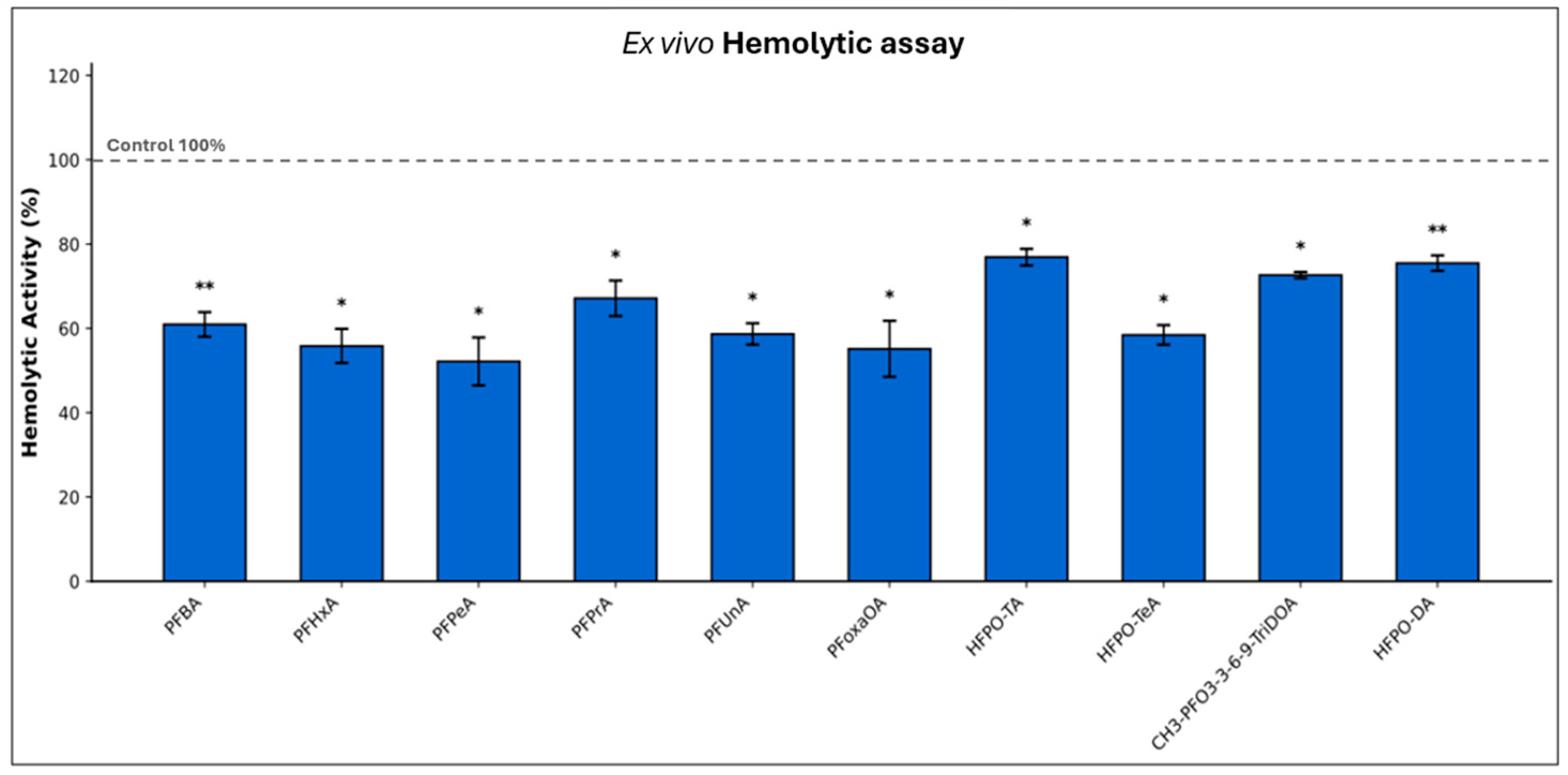
Figure 2 summarizes the hemolytic responses of coelomic fluid samples exposed ex vivo to 31 PFAS congeners. Several compounds elicited pronounced reductions in hemolytic activity relative to the control, with PFBA and HFPO-DA producing particularly marked decreases. These findings further support the interpretation that PFASs can directly compromise the function of soluble immune proteins within the coelomic fluid.
Statistical analyses corroborated the trends observed across experimental conditions. Because the datasets did not conform to a normal distribution, comparisons between PFAS treatments and the control were conducted using the Mann–Whitney U test. Multiple PFASs induced statistically significant reductions in hemolytic activity, whereas others produced significant increases (p < 0.05), as indicated in the corresponding figure.

3.2. Untargeted Proteomics Screening: Exploratory Identification of Candidate Immune Proteins

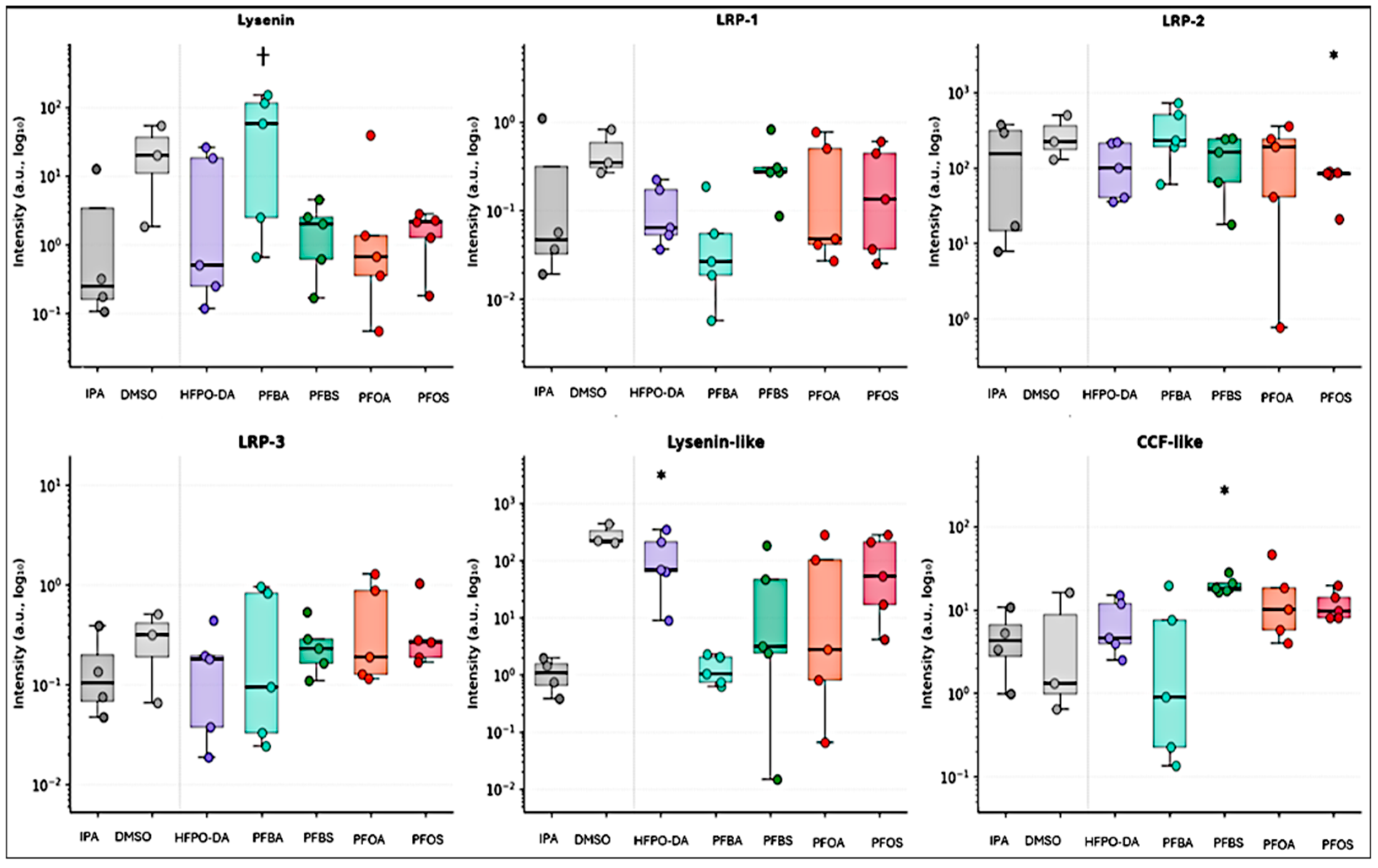
Untargeted proteomic profiling of decellularized coelomic fluid from E. fetida exposed to five focal PFAS congeners (HFPO-DA/GenX, PFBA, PFBS, PFOA at 0.6 µM dissolved in IPA; PFOS at 0.6 µM dissolved in DMSO) revealed congener-specific modulation of the lysenin family and the C-type lectin CCF-like (Figure 3). Group comparisons were performed using the two-sided Mann–Whitney U exact test on raw replicate values; the four IPA-soluble congeners were compared with the IPA-matched CTRL group (n = 4), whereas PFOS was compared with the DMSO-matched control (n = 3). Three congener-specific effects reached statistical significance, and one additional effect approached significance as a trend. The lysenin-like isoform (A0A2D1PJH7) was strongly induced under HFPO-DA (median fold-change ≈ 63×; log2 FC = 5.99; p = 0.016), and the C-type lectin CCF-like (Q3I6Z6) was selectively elevated under PFBS (median fold-change ≈ 4.2×; log2 FC = 2.08; p = 0.016). PFOS reduced Fetidin/LRP-2 (O18425) abundance against its DMSO-matched control (median fold-change ≈ 0.4×; log2 FC = −1.38; p = 0.036). Canonical lysenin (O18423) showed the largest median fold change in the dataset under PFBA (median fold-change ≈ 233×; log2 FC = 7.86) but did not reach the conventional significance threshold (p = 0.063, trend), reflecting the wide within-group dispersion typical of low-abundance pore-forming proteins. The remaining lysenin-related proteins (LRP-1, LRP-3) showed no significant change under any treatment. A complementary untargeted shotgun analysis of the full coelomic fluid proteome, presented in Section 3.3 below (Figure 4; Supplementary Table S1), placed these focal results within a broader humoral context and identified additional congener-specific effectors. Collectively, these data are consistent with a selective, congener-specific reweighting of humoral effectors rather than a broad-scale modulation of earthworm extracellular immunity.

3.3. Untargeted Shotgun Screening of the Coelomic Fluid Proteome

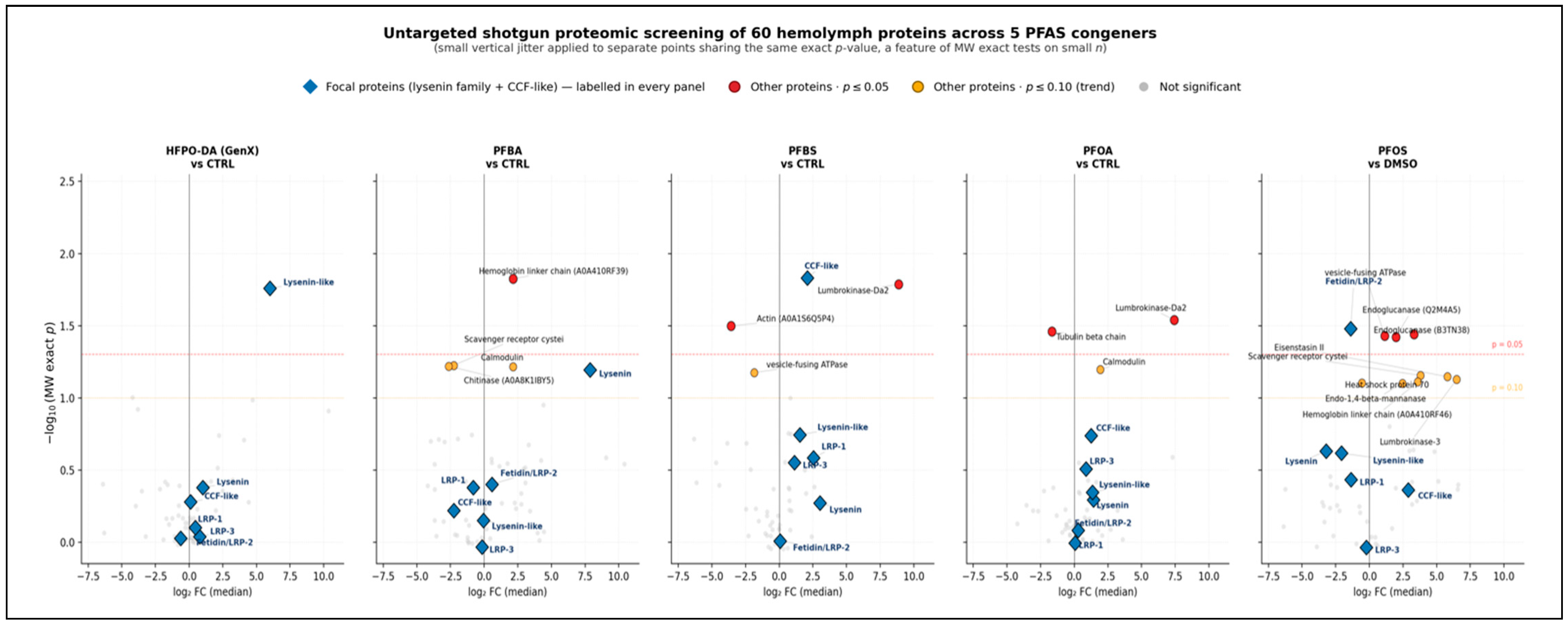
To complement the targeted profiling and place the lysenin-family signal within the broader humoral landscape, the complete proteome profile was investigated, quantifying 60 coelomic fluid proteins across the five focal PFAS congeners (300 protein × PFAS contrasts in total). Each contrast was tested with the two-sided Mann–Whitney U exact test against the corresponding vehicle-matched control (Figure 4; Supplementary Table S1). The screening recapitulated all four focal hits identified in the targeted analysis (Lysenin-like under HFPO-DA, CCF-like under PFBS, Fetidin/LRP-2 under PFOS, and Lysenin under PFBA as a trend) and additionally revealed several non-focal candidate effectors. The most striking observation was a marked induction of lumbrokinase-Da2 (B8ZZ03), a coelomocyte-secreted serine protease with antimicrobial and fibrinolytic activity, under both PFBS (median fold-change ≈ 470×; log2 FC = 8.88; p = 0.016) and PFOA (median fold-change ≈ 170×; log2 FC = 7.41; p = 0.032). Other congener-specific signals included an increase in a hemoglobin linker chain isoform (A0A410RF39) under PFBA, a decrease in actin (A0A1S6Q5P4) under PFBS and in tubulin beta chain under PFOA, and, under PFOS, the induction of two endoglucanase paralogs (B3TN38, Q2M4A5) and of a vesicle-fusing ATPase. None of these contrasts survived Benjamini–Hochberg correction at FDR < 0.10 within each PFAS, and they are therefore presented as exploratory candidates that warrant confirmation in larger cohorts. Notwithstanding this caveat, the convergence of the focal results with the shotgun pattern reinforces the central observation of this work: PFAS exposure does not produce a uniform suppression of earthworm humoral immunity but rather a congener-specific reconfiguration of the soluble effector pool, in which different PFASs recruit non-overlapping subsets of pore-forming, lectin-mediated, and proteolytic effectors.

4. Discussion

Composite Nature of Hemolytic Activity and Limitations of Interpretation

Hemolytic activity of coelomic fluid represents a composite functional readout influenced by multiple independent variables: (1) effector protein abundance, (2) catalytic activity independent of abundance, (3) protein stability and post-translational modification, (4) membrane-binding biophysics, and (5) regulatory cofactors or inhibitors. A change in hemolytic activity does not univocally indicate which variable has been perturbed. For example, a 50% reduction in hemolysis could reflect 50% downregulation of lysenin transcription (genuinely immunosuppressive), or alternatively, intact lysenin production paired with reduced catalytic efficiency or membrane binding (not necessarily immunosuppressive at the physiological level). Accordingly, we interpret all observed changes in hemolytic activity as modulation of the integrated humoral immune output, without claiming that increased hemolysis = enhanced immunity or decreased hemolysis = impaired immunity. Mechanistic clarification requires independent measurement of effector abundance (proteomics; accomplished in this study), effector catalytic activity (enzymatic assays in progress), and membrane-binding kinetics (proposed for future studies).
The study was structured as a tiered design. A broad functional screening of 31 PFAS congeners was first performed to identify distinct immunophenotypic patterns. Based on these results, four representative congeners were selected for mechanistic investigation, spanning legacy, short-chain ether replacements, suppressive, neutral, and stimulatory response phenotypes.
The results shown in Figure 1 provide insight into the interaction between environmental pollutants and extracellular bioactive proteins, represented here by the decellularized coelomic fluid of E. fetida, evaluated through biochemical assays. Exposure to different PFASs produced variable modulation of hemolytic activity, revealing a congener-specific reshaping of humoral effector output rather than a uniform toxic effect.
Most treatments, such as PFBS, PFBA, and PFMOPrA, reduced hemolytic capacity, indicating suppression of extracellular lytic activity. Conversely, other PFASs, including PMDA, PFHxA, and HFPO-DA, enhanced lytic activity, suggesting that specific structural features may favor increased effector availability or altered membrane effector interaction dynamics. Rather than being solely attributable to direct protein denaturation or oxidation [11], we hypothesize that these divergent responses may reflect the result of differential regulation at multiple biological levels, including potentially transcriptional priming, post-transcriptional modulation, and isoform-specific effector re-weighting.
Indeed, lysenin, the principal sphingomyelin-specific pore-forming toxin produced by coelomocytes, represents a central effector within the annelid humoral immune cascade. Structure-dependent effects of PFASs, including carbon-chain length and ether linkages, may influence how these compounds interact with immune regulatory pathways. Similar structure-dependent immunomodulatory effects have been observed in other invertebrate models; for instance, [30] demonstrated in Hirudo verbana that PFAS toxicity depends not only on chain length but also on molecular architecture, including ether motifs, which strongly influence inflammatory responses. These observations support the interpretation that structural variability among PFASs contributes to the heterogeneous immune phenotypes observed in E. fetida.
To further elucidate whether these effects reflected direct biochemical interference or organism-mediated regulation, an ex vivo experiment was performed in which decellularized coelomic fluid was directly exposed to PFASs. The results in Figure 2 confirm that many congeners reduce hemolytic activity under cell-free conditions, indicating that PFASs can interact directly with soluble immune components [35]. However, the predominance of inhibitory effects ex vivo, contrasted with the mixed stimulatory and suppressive responses observed in vivo, indicates that organism-level regulatory mechanisms substantially shape the final effector output.
This comparison reveals a partial decoupling between upstream immune priming and downstream functional cytolysis. In vivo exposure likely triggers transcriptional mobilization of immune genes, including lysenin and associated recognition molecules such as CCF-1 [26], while the functional outcome depends on additional layers of control. Proteomic observations from selected congeners indicate isoform-specific re-weighting within the lysenin family rather than uniform quantitative shifts, suggesting that effector composition, rather than total protein abundance alone, contributes to the final hemolytic phenotype. Such findings align with evidence that PFASs can alter oxidative balance, phenoloxidase activity, and immune gene expression in E. fetida [26].
The two-pronged experimental design, in vivo exposure followed by ex vivo biochemical interaction, permits the decoupling of organism-level regulatory responses from direct molecular effects. Based on bioaccumulation factor data [33], the ex vivo concentration of 2.5 µM approximates the internal tissue-level PFAS concentration that coelomocytes experience during in vivo exposure at the lower concentration (0.6 µM in soil). The observation that hemolytic activity changes in the ex vivo assay largely recapitulate those observed in vivo at low exposure (0.6 µM) suggests a dominant role of direct PFAS–effector protein interactions. Conversely, the divergence between ex vivo and in vivo responses at high concentration (229 µM in soil, estimated ~570 µM in tissue) likely reflects organism-level compensatory responses (e.g., altered coelomocyte transcription, synthesis of competing effectors, activation of stress-response pathways) that are absent in the cell-free ex vivo system.
Despite marked increases in lysenin and lysenin-like proteins under HFPO-DA and PFBA exposure (Figure 3), hemolytic activity remains suppressed in vivo (Figure 1) for PFBA. This apparent decoupling between protein abundance and lytic activity reveals the complexity of in vivo immune regulation. In the intact organism, lysenin expression is not isolated but embedded within a broader humoral immune network that includes regulatory checkpoints, cofactor availability, cellular priming signals, and coordinated activation of multiple effector pathways. The in vivo suppression of hemolytic activity despite elevated lysenin suggests that PFBA does not simply increase effector abundance but rather reshapes the immunological context in which lysenin operates, potentially through altered coelomocyte activation status, modified redox balance, or disrupted coordination with complementary immune mediators such as phenoloxidase or lectin cascades [26].
In stark contrast, the ex vivo results, where PFBA-exposed coelomic fluid also reduces hemolytic activity despite containing elevated lysenin levels, indicate that PFASs directly impair the functional capacity of the effector protein itself, independent of the cellular regulatory environment. This reveals that PFASs operate on two distinct biological levels: they modulate the humoral immune configuration at the organism level (affecting when and how strongly coelomocytes deploy effectors), and they simultaneously perturb the intrinsic biochemical properties of soluble immune proteins (affecting how efficiently those effectors function once deployed). HFPO-DA, conversely, enhances hemolytic activity both in vivo and ex vivo, and our proteomic profiling identified the lysenin-like isoform A0A2D1PJH7, rather than canonical lysenin O18423, as the protein selectively induced under this congener (Figure 3). This suggests that HFPO-DA promotes synthesis of a specific lysenin-family paralog and preserves or enhances its functional integration within the broader humoral immune response, providing a molecular correlate of the in vivo enhancement of hemolytic activity.
A parallel pattern emerged for PFBS, although in the opposite direction. PFBS reduced hemolytic activity in vivo (Figure 1), yet, at the proteomic level, selectively elevated the C-type lectin CCF-like (Q3I6Z6) (Figure 3) and produced the strongest non-focal signal of the entire shotgun screening, a marked induction of lumbrokinase-Da2 (B8ZZ03), a coelomocyte-secreted serine protease with antimicrobial and fibrinolytic activity (Figure 4). Lumbrokinase-Da2 induction was also detected, with by a smaller magnitude, under PFOA. Lumbrokinases are secreted by chloragocyte-derived coelomocytes and contribute to the proteolytic and antimicrobial arms of earthworm humoral defense; their induction alongside a recognition factor (CCF-like) and a concomitant suppression of lytic activity supports the interpretation that PFBS does not globally repress humoral immunity but rather redirects it, mobilizing the recognition and proteolytic effector arms while attenuating the pore-forming arm. The convergence of these signals across targeted (Figure 3) and untargeted (Figure 4) proteomic analyses strengthens the case for congener-specific reweighting of the soluble effector pool.
PFOS, the most-studied legacy PFAS, displayed a third distinct phenotype: a moderate but significant reduction in Fetidin/LRP-2 (O18425) abundance against its DMSO-matched control (Figure 3). Although Fetidin is not the principal hemolytic effector of the lysenin family, its selective decrease under PFOS extends the observation that legacy and emerging congeners do not act as a homogeneous functional class, but rather recruit non-overlapping subsets of the humoral effector pool. Taken together, the four focal phenotypes (Lysenin-like induction under HFPO-DA, lysenin trend under PFBA, CCF-like induction under PFBS, Fetidin/LRP-2 reduction under PFOS) and the strongest non-focal signal (lumbrokinase-Da2 under PFBS and PFOA) define an effector reweighting landscape that is structurally diverse and largely congener-specific. These proteomic observations should, however, be regarded as exploratory: with n ≤ 5 per group, the design has limited statistical power; none of the contrasts survived Benjamini–Hochberg FDR correction, and confirmation in larger cohorts will be necessary to consolidate individual findings.
These findings underscore that PFAS-induced immunotoxicity cannot be interpreted as simple suppression or enhancement of individual molecular markers, but rather as a reconfiguration of the humoral immune network architecture. The balance between effector availability, regulatory signaling, cofactor sufficiency, and effector–target interaction dynamics is disrupted in a congener-specific manner.
Although PFASs possess surfactant properties and may theoretically influence membrane interactions or ion availability, including calcium-dependent processes involved in lytic and agglutination reactions [36], the present data suggest that these physicochemical effects are not sufficient to explain the full range of in vivo responses. Instead, congener identity appears to govern the balance between redox regulation, effector mobilization, and membrane susceptibility. Although speculative, emerging evidence suggests that PFASs may induce epigenetic modifications, including altered DNA methylation [37], and disrupt metabolic pathways affecting cofactor availability and antioxidant systems [35,38,39], mechanisms that may indirectly influence humoral immune configuration. However, direct evidence for these pathways in E. fetida remains limited, and mechanistic confirmation is required.
Together, these findings demonstrate that PFASs are not uniform immunotoxicants but rather structure-dependent immune modulators in E. fetida, producing congener-specific responses that range from suppression to enhancement of humoral effector activity. This molecular structure–function relationship, evidenced by the differential effects of chain length and ether linkages, aligns with parallel studies [19,26], establishing that molecular architecture fundamentally governs PFAS immunological outcomes. The tiered experimental design employed here, combining broad functional screening with targeted mechanistic analyses, demonstrates that functional immunity reflects system configuration rather than the behavior of single molecular markers. The coelomic fluid of E. fetida thus represents a sensitive and biologically relevant model for functional environmental toxicology. The observed modulation of erythrolytic activity indicates that PFASs can differentially reconfigure humoral effector dynamics, with potential consequences for pathogen susceptibility and physiological homeostasis in contaminated environments.

5. Conclusions

Across a broad panel of 31 legacy and emerging compounds, PFASs produced congener-specific patterns of modulation of humoral effector activity in E. fetida coelomic fluid, ranging from suppression to enhancement of hemolytic capacity. The contrast between predominantly inhibitory ex vivo responses and the heterogeneous in vivo phenotypes indicates that the final functional output reflects both direct biochemical interaction with soluble effectors and organism-level regulatory processes. Targeted proteomic profiling of the lysenin family is consistent with isoform-level reweighting rather than uniform changes in abundance, although these observations remain preliminary and require confirmation in a larger sample. Overall, our data are consistent with the hypothesis that PFAS immunotoxicity is not uniformly suppressive, and structural features of individual congeners, chain length, ether linkages, sulfonic versus carboxylic head, may contribute to shaping both the direction and magnitude of the response. However, direct evidence for the role of specific structural determinants is limited, and further investigation with congener variants differing in single structural features would be required to establish causal relationships. The functional screening presented here identifies a set of candidate congeners (notably, PFBS, PFBA, PFMOPrA on the suppressive side and PMDA, PFHxA, HFPO-DA on the stimulatory side) that warrant confirmatory mechanistic studies. More broadly, it supports the use of cell-free coelomic fluid hemolytic activity as a sensitive, integrative readout for evaluating how persistent contaminants reshape humoral immunity in soil invertebrates.

Supplementary Materials

The following supporting information can be downloaded at: https://www.mdpi.com/article/10.3390/environments13060345/s1, Table S1: Shotgun proteomic screening: Mann–Whitney U exact two-sided test.

Author Contributions

D.R.: Writing—original draft, Investigation, Formal analysis, Validation, Methodology, Data curation, Writing—review and editing. D.G.: Writing—review and editing, Visualization. A.C.: Writing—review and editing. M.M.: Methodology, Writing—review and editing. F.D.: Formal analysis, Writing—original draft, Investigation, Methodology, Visualization, Writing—review and editing, Resources, Supervision, Project administration, Funding acquisition. All authors have read and agreed to the published version of the manuscript.

Funding

This project has received funding from the European Union’s Horizon 2020 research and innovation program under grant agreement No. 101037509 (SCENARIOS project).

Institutional Review Board Statement

Ethical review and approval were waived for this study because the experiments involved only the earthworm Eisenia fetida (an invertebrate). Under Directive 2010/63/EU, whose scope is limited to non-human vertebrates and cephalopods, invertebrates are not subject to ethical approval requirements.

Data Availability Statement

The data that support the findings of this study are available from the corresponding authors upon reasonable request.

Acknowledgments

The authors thank the anonymous reviewers for their constructive comments and suggestions, which greatly helped to improve the quality and clarity of the manuscript.

Conflicts of Interest

The authors declare no conflicts of interest.

References

  1. Wang, Z.; Buser, A.M.; Cousins, I.T.; Demattio, S.; Drost, W.; Johansson, O.; Ohno, K.; Patlewicz, G.; Richard, A.M.; Walker, G.W.; et al. A New OECD Definition for Per- and Polyfluoroalkyl Substances. Environ. Sci. Technol. 2021, 55, 15575–15578. [Google Scholar] [CrossRef] [PubMed]
  2. Glüge, J.; Scheringer, M.; Cousins, I.T.; DeWitt, J.C.; Goldenman, G.; Herzke, D.; Lohmann, R.; Ng, C.A.; Trier, X.; Wang, Z. An overview of the uses of per- and polyfluoroalkyl substances (PFAS). Environ. Sci. Process Impacts. 2020, 22, 2345–2373. [Google Scholar] [CrossRef] [PubMed]
  3. Sauvé, S.; Desrosiers, M. A review of what is an emerging contaminant. Chem. Cent. J. 2014, 8, 15. [Google Scholar] [CrossRef] [PubMed]
  4. Nguyen, V.H.; Smith, S.M.; Wantala, K.; Kajitvichyanukul, P. Photocatalytic remediation of persistent organic pollutants (POPs): A review. Arab. J. Chem. 2020, 13, 8309–8337. [Google Scholar] [CrossRef]
  5. Strincone, M.; Pellegrini, E. POPs: Una Nuova Sfida per l’Italia. Chim. E Ind. 2023, 105, 22. [Google Scholar]
  6. Flynn, R.W.; Hoover, G.; Iacchetta, M.; Guffey, S.; de Perre, C.; Huerta, B.; Li, W.; Hoverman, J.T.; Lee, L.; Sepúlveda, M.S. Comparative Toxicity of Aquatic Per- and Polyfluoroalkyl Substance Exposure in Three Species of Amphibians. Environ. Toxicol. Chem. 2022, 41, 1407–1415. [Google Scholar] [CrossRef] [PubMed] [PubMed Central]
  7. Pietropoli, E.; Bardhi, A.; Simonato, V.; Zanella, M.; Iori, S.; Barbarossa, A.; Giantin, M.; Dacasto, M.; De Liguoro, M.; Pauletto, M. Comparative toxicity assessment of alternative versus legacy PFAS: Implications for two primary trophic levels in freshwater ecosystems. J. Hazard. Mater. 2024, 477, 135269. [Google Scholar] [CrossRef] [PubMed]
  8. Arneth, B. Trained innate immunity. Immunol. Res. 2021, 69, 1–7. [Google Scholar] [CrossRef] [PubMed]
  9. van der Valk, F.M.; Bekkering, S.; Kroon, J.; Yeang, C.; Van den Bossche, J.; van Buul, J.D.; Ravandi, A.; Nederveen, A.J.; Verberne, H.J.; Scipione, C.; et al. Oxidized Phospholipids on Lipoprotein(a) Elicit Arterial Wall Inflammation and an Inflammatory Monocyte Response in Humans. Circulation 2016, 134, 611–624. [Google Scholar] [CrossRef] [PubMed]
  10. Phelps, D.W.; Connors, A.M.; Ferrero, G.; DeWitt, J.C.; Yoder, J.A. Per- and polyfluoroalkyl substances alter innate immune function: Evidence and data gaps. J. Immunotoxicol. 2024, 21, 2343362. [Google Scholar] [CrossRef] [PubMed]
  11. Wang, L.Q.; Liu, T.; Yang, S.; Sun, L.; Zhao, Z.Y.; Li, L.Y.; She, Y.C.; Zheng, Y.Y.; Ye, X.Y.; Bao, Q.; et al. Perfluoroalkyl substance pol-lutants activate the innate immune system through the AIM2 inflammasome. Nat. Commun. 2021, 12, 2915. [Google Scholar] [CrossRef] [PubMed]
  12. Akhila, A.; Entoori, K. Role of earthworms in soil fertility and its impact on agriculture: A review. Int. J. Fauna Biol. Stud. 2022, 9, 55–63. [Google Scholar] [CrossRef]
  13. Ahmed, N.; Al-Mutairi, K.A. Earthworms Effect on Microbial Population and Soil Fer-tility as Well as Their Interaction with Agriculture Practices. Sustainability 2022, 14, 7803. [Google Scholar] [CrossRef]
  14. Hanson, M.L.; Wolff, B.A.; Green, J.W.; Kivi, M.; Panter, G.H.; Warne, M.S.; Ågerstrand, M.; Sumpter, J.P. How we can make ecotoxicology more valuable to environmental protection. Sci. Total Environ. 2017, 578, 228–235. [Google Scholar] [CrossRef] [PubMed]
  15. Calisi, A.; Cappello, T.; Angelelli, M.; Maisano, M.; Rotondo, D.; Gualandris, D.; Semeraro, T.; Dondero, F. Non-Destructive Biomarkers in Non-Target Species Earthworm Lumbricus terrestris for Assessment of Different Agrochemicals. Environments 2024, 11, 276. [Google Scholar] [CrossRef]
  16. Engelmann, P.; Cooper, E.L.; Opper, B.; Németh, P. Earthworm Innate Immune System. In Biology of Earthworms; Karaca, A., Ed.; Springer: Berlin/Heidelberg, Germany, 2011; Volume 24, pp. 229–245. Available online: http://link.springer.com/10.1007/978-3-642-14636-7_14 (accessed on 17 November 2025).
  17. Wang, C.; Sun, Z.; Zheng, D.; Liu, X. Function of mucilaginous secretions in the antibac-terial immunity system of Eisenia fetida. Pedobiologia 2011, 54, S57–S62. [Google Scholar] [CrossRef]
  18. Homa, J. Earthworm coelomocyte extracellular traps: Structural and functional simi-larities with neutrophil NETs. Cell Tissue Res. 2018, 371, 407–414. [Google Scholar] [CrossRef] [PubMed]
  19. Rotondo, D.; Gualandris, D.; Lorusso, C.; Braeuning, A.; Calisi, A.; Dondero, F. Impact of Short-Chain Perfluoropropylene Oxide Acids on Biochemical and Behavioural Parameters in Eisenia fetida (Savigny, 1826). J. Xenobiotics 2024, 15, 2. [Google Scholar] [CrossRef] [PubMed]
  20. Opper, B.; Bognár, A.; Heidt, D.; Németh, P.; Engelmann, P. Revising lysenin expression of earthworm coelomocytes. Dev. Comp. Immunol. 2013, 39, 214–218. [Google Scholar] [CrossRef] [PubMed]
  21. Bokori-Brown, M.; Martin, T.G.; Naylor, C.E.; Basak, A.K.; Titball, R.W.; Savva, C.G. Cryo-EM structure of lysenin pore elucidates membrane insertion by an aerolysin family protein. Nat. Commun. 2016, 7, 11293. [Google Scholar] [CrossRef] [PubMed]
  22. Yilmaz, N.; Yamaji-Hasegawa, A.; Hullin-Matsuda, F.; Kobayashi, T. Molecular mechanisms of action of sphingomyelin-specific pore-forming toxin, lysenin. Semin. Cell Dev. Biol. 2018, 73, 188–198. [Google Scholar] [CrossRef] [PubMed]
  23. Swiderska, B.; Kedracka-Krok, S.; Panz, T.; Morgan, A.J.; Falniowski, A.; Grzmil, P.; Plytycz, B. Lysenin family proteins in earthworm coelomocytes—Comparative approach. Dev. Comp. Immunol. 2017, 67, 404–412. [Google Scholar] [CrossRef] [PubMed]
  24. Dvořák, J.; Mančíková, V.; Pižl, V.; Elhottová, D.; Šilerová, M.; Roubalová, R.; Škanta, F.; Procházková, P.; Bilej, M. Microbial Environment Affects Innate Immunity in Two Closely Related Earthworm Species Eisenia andrei and Eisenia fetida. PLoS ONE 2013, 8, e79257. [Google Scholar] [CrossRef] [PubMed][Green Version]
  25. OECD. Test No. 207: Earthworm, Acute Toxicity Tests. OECD; 1984 (OECD Guidelines for the Testing of Chemicals, Section 2). Available online: https://www.oecd.org/en/publications/test-no-207-earthworm-acute-toxicity-tests_9789264070042-en.html (accessed on 6 August 2025).
  26. Gualandris, D.; Rotondo, D.; Lorusso, C.; Audrito, V.; Calisi, A.; Dondero, F. Effects of Ether Perfluoro Carboxyl Acids (PFECAs) on Innate Immunity in Earthworms (Eisenia fetida). Environments 2025, 12, 430. [Google Scholar] [CrossRef]
  27. Drover, S.S.; Villanger, G.D.; Aase, H.; Skogheim, T.S.; Longnecker, G.P.; Zeiner, P.; Engel, S.M. Maternal Thyroid Function During Pregnancy or Neonatal Thyroid Function and Attention Deficit Hyperactivity Disorder: A Systematic Review. Epidemiology 2019, 30, 130–144. [Google Scholar] [CrossRef] [PubMed]
  28. Ding, N.; Harlow, S.D.; Randolph, J.F., Jr.; Loch-Caruso, R.; Park, S.K. Perfluoroalkyl and Polyfluoroalkyl Substances (PFAS) and Their Effects on the Ovary. Hum. Reprod. Update 2020, 26, 724–752. [Google Scholar] [CrossRef] [PubMed]
  29. Antoniou, E.E.; Dekant, W. Childhood PFAS Exposure and Immunotoxicity: A Systematic Review and Meta-Analysis of Human Studies. Syst. Rev. 2024, 13, 176. [Google Scholar] [CrossRef] [PubMed]
  30. Calisi, A.; Baranzini, N.; Marcolli, G.; Bon, C.; Rotondo, D.; Gualandris, D.; Pulze, L.; Grimaldi, A.; Dondero, F. Evaluation of per- and polyfluoroalkyl substances (PFAS) toxic effects on the acute inflammatory response in the medicinal leech Hirudo verbana. Chemosphere 2024, 366, 143519. [Google Scholar] [CrossRef] [PubMed]
  31. Lagostena, L.; Rotondo, D.; Gualandris, D.; Calisi, A.; Lorusso, C.; Magnelli, V.; Dondero, F. Impact of Legacy Perfluorooctane Sulfonate (PFOS) and Perfluorooctanoate (PFOA) on GABA Receptor-Mediated Currents in Neuron-Like Neuroblastoma Cells: Insights into Neurotoxic Mechanisms and Health Implications. J. Xenobiotics 2024, 14, 1771–1783. [Google Scholar] [CrossRef] [PubMed]
  32. Calcagnile, M.; Giuliano, A.; Tredici, M.S.; Gualandris, D.; Rotondo, D.; Calisi, A.; Leo, C.; Martelli, M.; Rocchi, A.; Klint, K.E.; et al. Per- and Polyfluoroalkyl Substances (PFAS) as Environmental Drivers of Antimicrobial Resistance: Insights from Genome Sequences of Klebsiella Grimontii and Citrobacter Braakii Isolated from Contaminated Soil. Environ. Sci. Adv. 2025, 4, 1444–1476. [Google Scholar] [CrossRef]
  33. Judy, J.D.; Gravesen, C.; Wilson, P.C.; Wilkie, A.; Sarchapone, J.; Hinz, F.; Yang, X.; Renwick, N. Uptake and Elimination of 7 Selected PFAS in Eisenia Fetida Exposed in Artificial Soil. Bull. Environ. Contam. Toxicol. 2026, 116, 92. [Google Scholar] [CrossRef] [PubMed]
  34. Sutili, F.J.; Voloski, A.P.S.; Frandoloso, R.; Baldisserotto, B.; Kreutz, L.C. Characterization of the spontaneous hemolytic activity of Rhamdia quelen serum. Pan-Am. J. Aquat. Sci. 2019, 14, 125–133. Available online: https://panamjas.org/artigos.php?id_publi=237 (accessed on 15 June 2026).
  35. Lankadurai, B.; Furdui, V.; Reiner, E.; Simpson, A.; Simpson, M. 1H NMR-Based Metabo-lomic Analysis of Sub-Lethal Perfluorooctane Sulfonate Exposure to the Earthworm, Eisenia fetida, in Soil. Metabolites 2013, 3, 718–740. [Google Scholar] [CrossRef] [PubMed]
  36. Kim, S.; Thapar, I.; Brooks, B.W. Epigenetic changes by per- and polyfluoroalkyl sub-stances (PFAS). Environ. Pollut. 2021, 279, 116929. [Google Scholar] [CrossRef] [PubMed]
  37. Roy, S.; Moran, J.; Danasekaran, K.; O’Brien, K.; Dakshanamurthy, S. Large-Scale Screening of Per- and Polyfluoroalkyl Substance Binding Interactions and Their Mixtures with Nuclear Receptors. Int. J. Mol. Sci. 2024, 25, 8241. [Google Scholar] [CrossRef] [PubMed]
  38. He, F.; Liu, R.; Tian, G.; Qi, Y.; Wang, T. Ecotoxicological evaluation of oxidative stress-mediated neurotoxic effects, genetic toxicity, behavioral disorders, and the corresponding mechanisms induced by fluorene-contaminated soil targeted to earthworm (Eisenia fetida) brain. Sci. Total Environ. 2023, 871, 162014. [Google Scholar] [CrossRef] [PubMed]
  39. Liu, C.; Zhou, B.; Huang, L.; Han, D.; He, M.; Zhou, M.; Xu, P.; Zhang, R. Perfluoroalkyl and Polyfluoro-alkyl Substances (PFAS) and Vitamin Metabolism: A Nutritional Perspective on an Emerging Environmental Health Issue. Nutrients 2025, 17, 1660. [Google Scholar] [CrossRef] [PubMed]
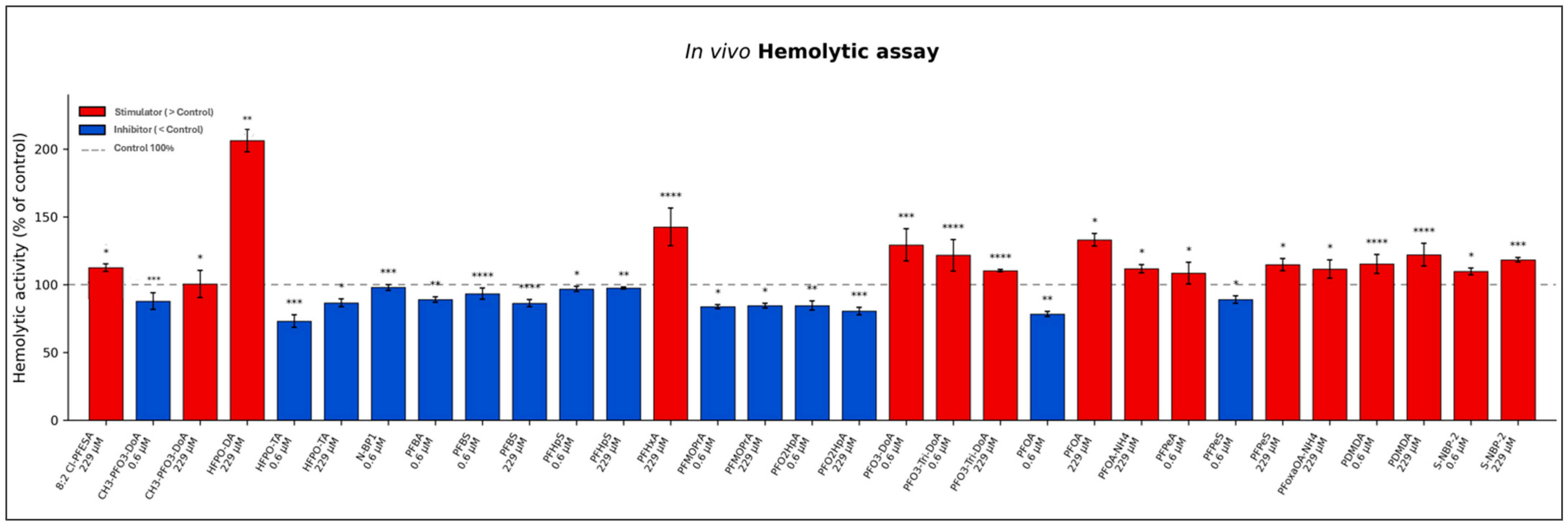
Figure 1. Percentage of hemolysis in sheep erythrocytes incubated in E. fetida coelomic fluid, expressed relative to the control (set at 100%). For each PFAS, two concentrations are tested: 0.6 µM and 229 µM. The gray threshold line represents the control condition, reflecting baseline hemolytic activity in the absence of PFAS. Red bars indicate treatments that caused a significant increase in hemolysis, suggesting a lytic or cytotoxic effect of specific PFAS congeners. Blue bars represent a significant decrease in hemolysis compared to the control, potentially indicating membrane-stabilizing effects or inhibition of the hemolytic process. Overall, this assay highlights the variable hemolytic responses induced by PFAS exposure and suggests potential interactions between these compounds and components of the earthworm coelomic environment. Statistical significance was assessed using the Mann–Whitney U test; differences from the control were considered significant at p < 0.05 (*), p < 0.01 (**), p < 0.001 (***), and p < 0.0001 (****), as indicated in the figures.
Environments 13 00345 g001
Figure 2. Absorbance values of hemolysis in sheep erythrocytes incubated with coelomic fluid collected from E. fetida not previously exposed to PFASs but treated ex vivo with different PFAS congeners. The gray threshold line represents the untreated control condition, corresponding to baseline hemolytic activity in the absence of PFASs. All ex vivo PFAS treatments led to a significant reduction in hemolysis, represented by the blue bars, suggesting inhibitory or membrane-stabilizing effects exerted directly by the compounds on the coelomic fluid protein fraction. Compared with the in vivo results (Figure 1), these findings indicate that under ex vivo conditions, PFASs predominantly shift the system toward reduced hemolytic activity. Statistical significance was assessed using the Mann–Whitney U test; differences from the control were considered significant at p < 0.05 (*), p < 0.01 (**), as indicated in the figures.
Environments 13 00345 g002
Figure 3. Proteomic profiling of lysenin-family members and the C-type lectin CCF-like in E. fetida coelomic fluid after 72 h exposure to five focal PFAS at 0.6 µM. Boxplots show the distribution of label-free LC-MS/MS intensities (a.u., log10 scale) for individual replicates, with overlaid strip points representing the single biological samples. Two vehicle-matched control groups are shown: CTRL (untreated, dissolved in 2-propanol; n = 4) for the four IPA-soluble congeners HFPO-DA/GenX, PFBA, PFBS and PFOA, and DMSO control (n = 3) for PFOS, which was dissolved in dimethylsulphoxide due to insufficient solubility in IPA. Treatment groups: n = 5 per congener. Proteins shown: pore-forming effectors Lysenin (O18423) and Lysenin-like (A0A2D1PJH7); lysenin-related proteins LRP-1 (O18424), Fetidin/LRP-2 (O18425) and LRP-3 (Q3LX99); and the pattern-recognition C-type lectin CCF-like (Q3I6Z6). Statistical significance versus the corresponding vehicle-matched control was determined by the Mann–Whitney U exact two-sided test: * p ≤ 0.05; † p ≤ 0.10 (trend). The lowest attainable p-value of the exact distribution is 0.016 (n = 4 vs. 5) for IPA-soluble congeners and 0.036 (n = 5 vs. 3) for PFOS; accordingly, only two significance levels are displayed. Three congener-specific effects reached p ≤ 0.05 (Lysenin-like under HFPO-DA, CCF-like under PFBS, Fetidin/LRP-2 under PFOS), and Lysenin under PFBA approached significance as a trend. None of the contrasts survived Benjamini–Hochberg correction across the focal-protein set, in line with the limited statistical power of the targeted design.
Environments 13 00345 g003
Figure 4. Untargeted shotgun proteomic screening of E. fetida coelomic fluid proteins (n = 60) across the five focal PFAS congeners. Each panel reports −log10 Mann–Whitney U exact two-sided p-value against log2 median fold-change versus the corresponding vehicle-matched control. HFPO-DA, PFBA, PFBS and PFOA were dissolved in IPA and compared to the IPA-matched CTRL group (n = 4); PFOS was dissolved in DMSO and compared to the DMSO-matched control (n = 3). Treatment groups: n = 5 each. All six focal proteins of the lysenin family and the C-type lectin CCF-like are labeled in every panel regardless of significance (Lysenin O18423, LRP-1 O18424, Fetidin/LRP-2 O18425, LRP-3 Q3LX99, Lysenin-like A0A2D1PJH7, CCF-like Q3I6Z6) and shown as blue diamonds. Other significant or trending proteins are labeled with their generic name; the UniProt accession is appended in parentheses whenever the same protein name is shared by multiple paralogs in the dataset (Hemoglobin linker chain, Endoglucanase, Lumbrokinase, Actin, Erythrocruorin, Fibrinolytic enzyme, Chitinase) so that each labeled point uniquely identifies a distinct protein. Red points: MW exact p ≤ 0.05; orange points: trend (p ≤ 0.10); gray points: not significant. Dashed red line: p = 0.05; dotted orange line: p = 0.10. A small vertical jitter (±0.05 on the −log10(p) axis) was applied to separate points sharing the same exact p-value, an inherent property of Mann–Whitney exact tests on small sample sizes. Full statistics, including Benjamini–Hochberg FDR-adjusted p-values per PFAS (m = 60), are reported in Supplementary Table S1.
Environments 13 00345 g004
Disclaimer/Publisher’s Note: The statements, opinions and data contained in all publications are solely those of the individual author(s) and contributor(s) and not of MDPI and/or the editor(s). MDPI and/or the editor(s) disclaim responsibility for any injury to people or property resulting from any ideas, methods, instructions or products referred to in the content.