
_S._Voudouris.png)
Determination of Methylphosphonofluoridic Acid in the Environment by Derivatization and LC/MS/MS Analysis


Abstract
1. Introduction
2. Materials and Methods
2.1. Materials and Reagents
2.2. Instrumentation
2.2.1. LC-ESI-HRMS/MS (Orbitrap Mass Spectrometry)
2.2.2. LC-ESI-LRMS/MS (QTRAP Mass Spectrometry)
2.2.3. LC–MS/MS MPFA Analysis Before and After Chemical Derivatization
2.3. Sample Preparation
2.3.1. Preparation of Soil Extract
2.3.2. Chemical Reaction of MPFA with 2-DMAMP-Derivatizing Agent in Environmental Samples
3. Results and Discussion
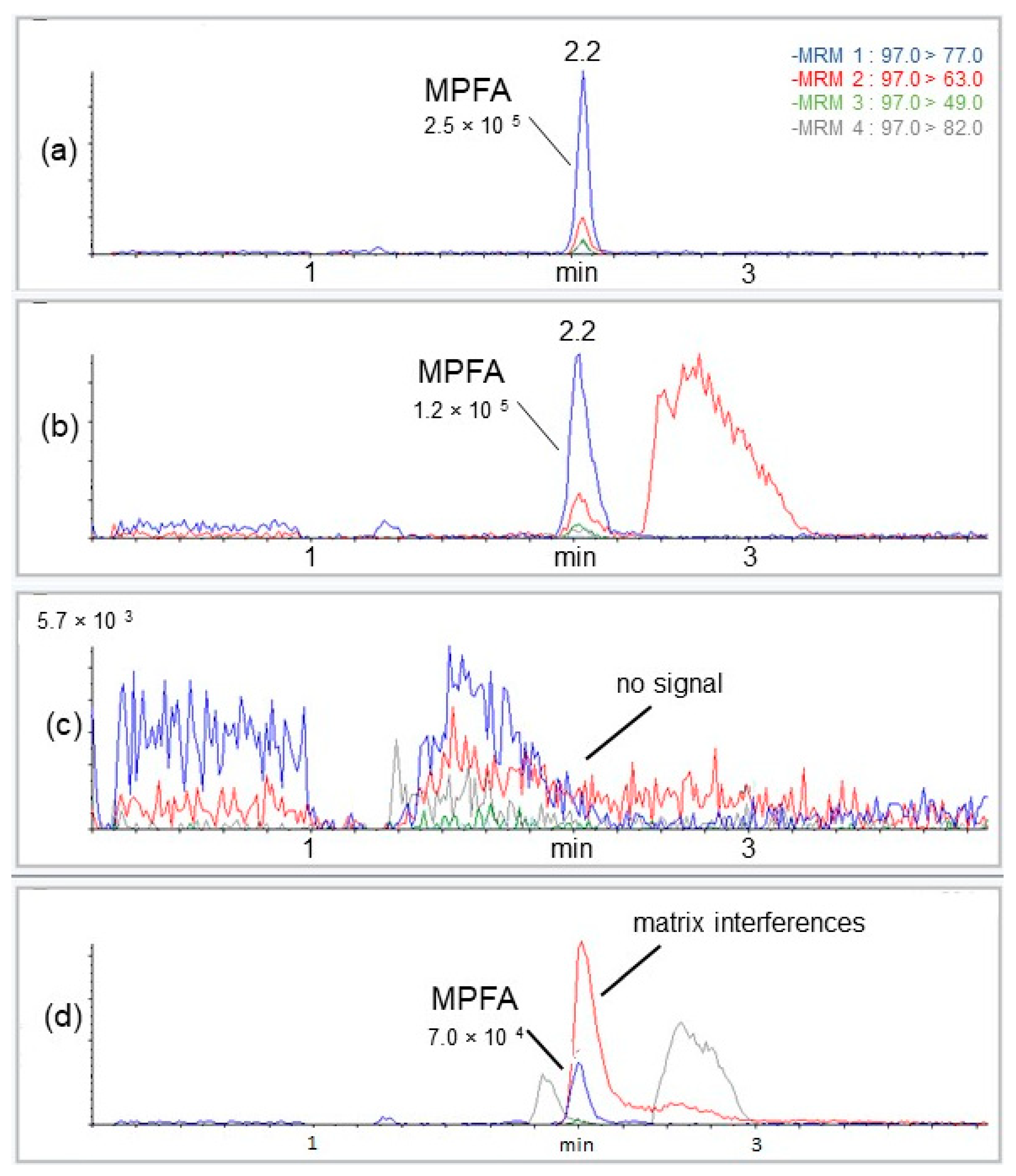
3.1. Evaluation of the Detection Sensitivity of Intact MPFA and Characterization of Its Chromatographic Behavior in Aqueous Media
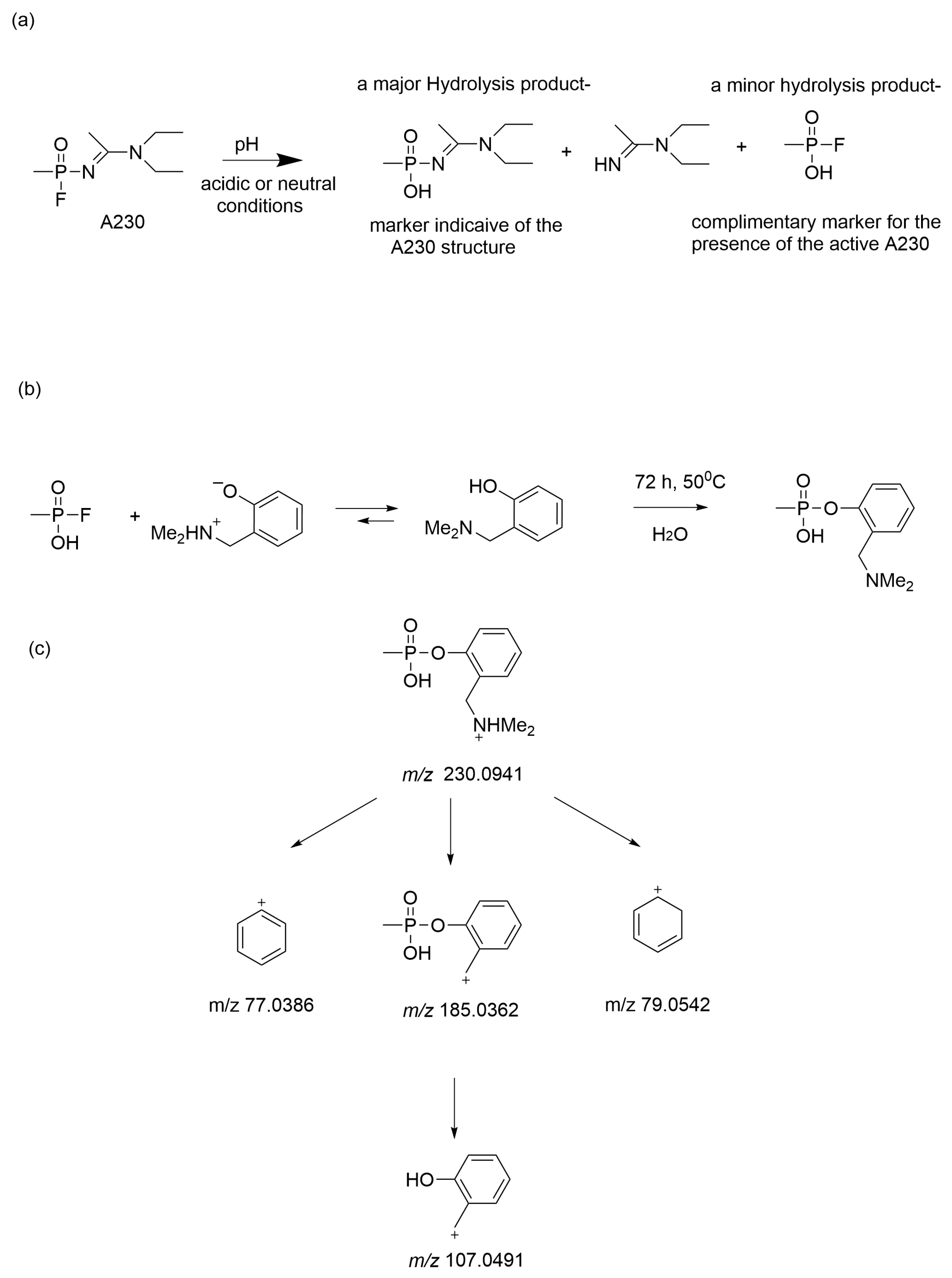
3.2. Derivatization Strategy
3.3. Optimization of the Derivatization Reaction
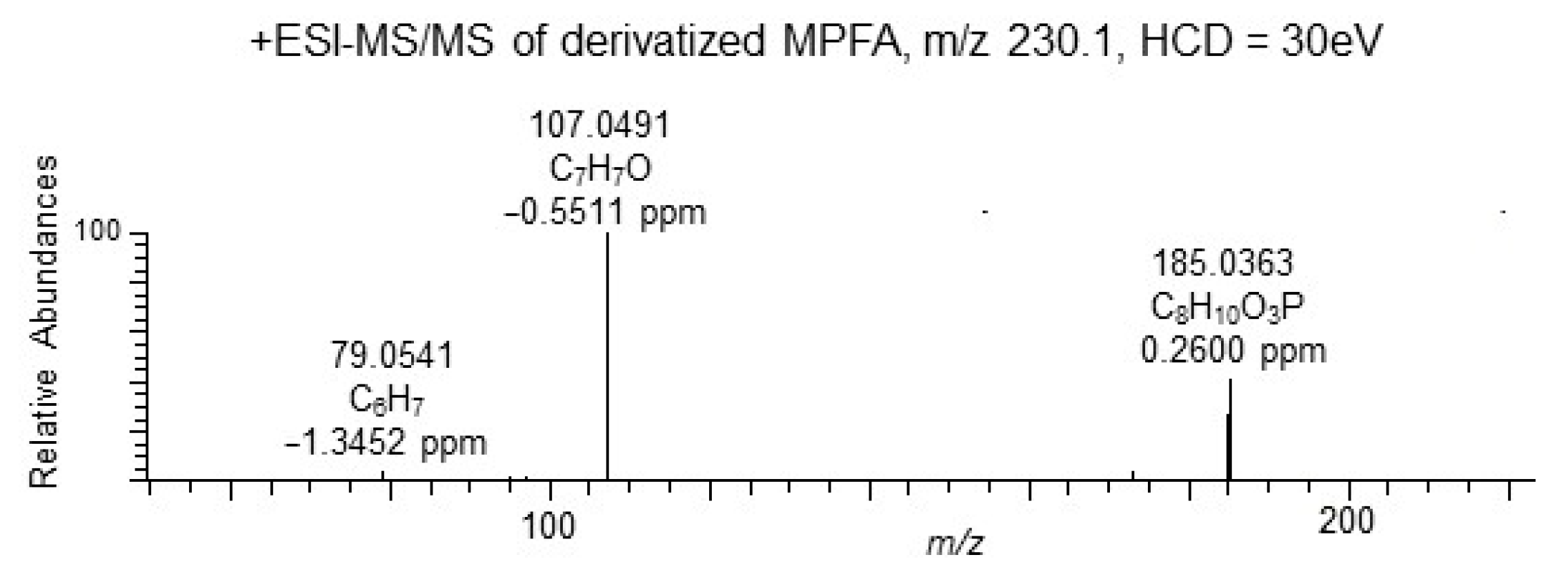
3.4. High-Resolution Orbitrap–MS/MS and Low-Resolution-MS/MS Analysis


3.5. Validation of Analytical Procedures
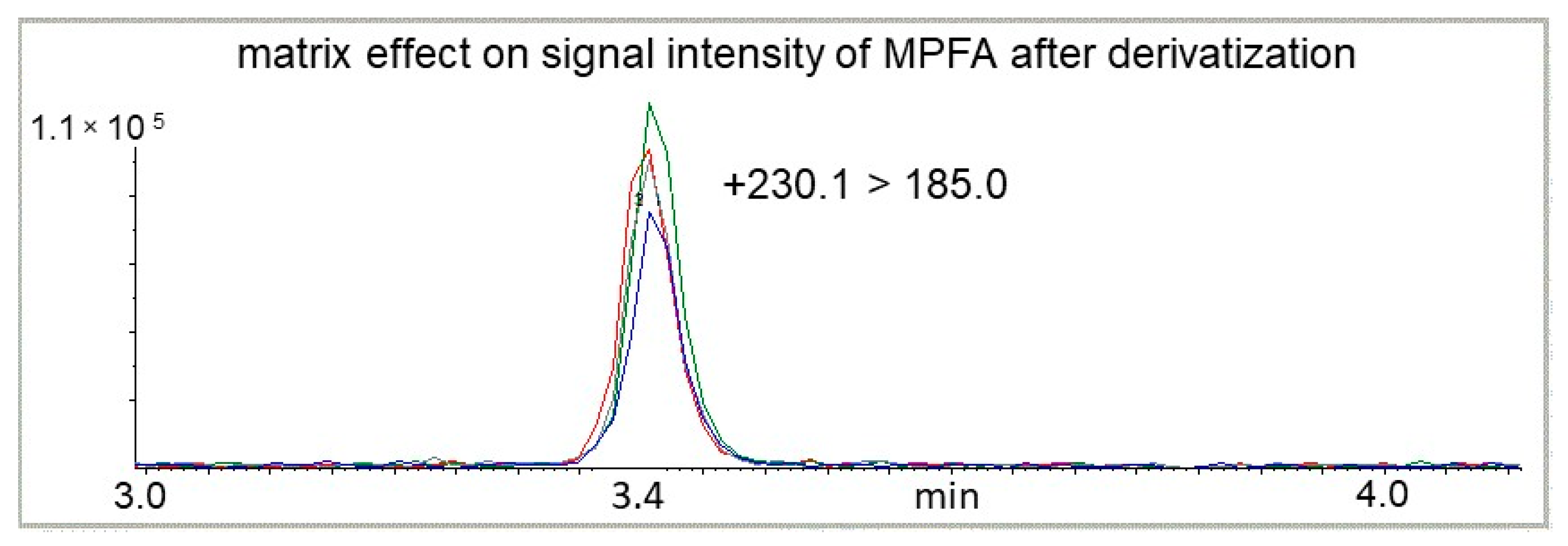
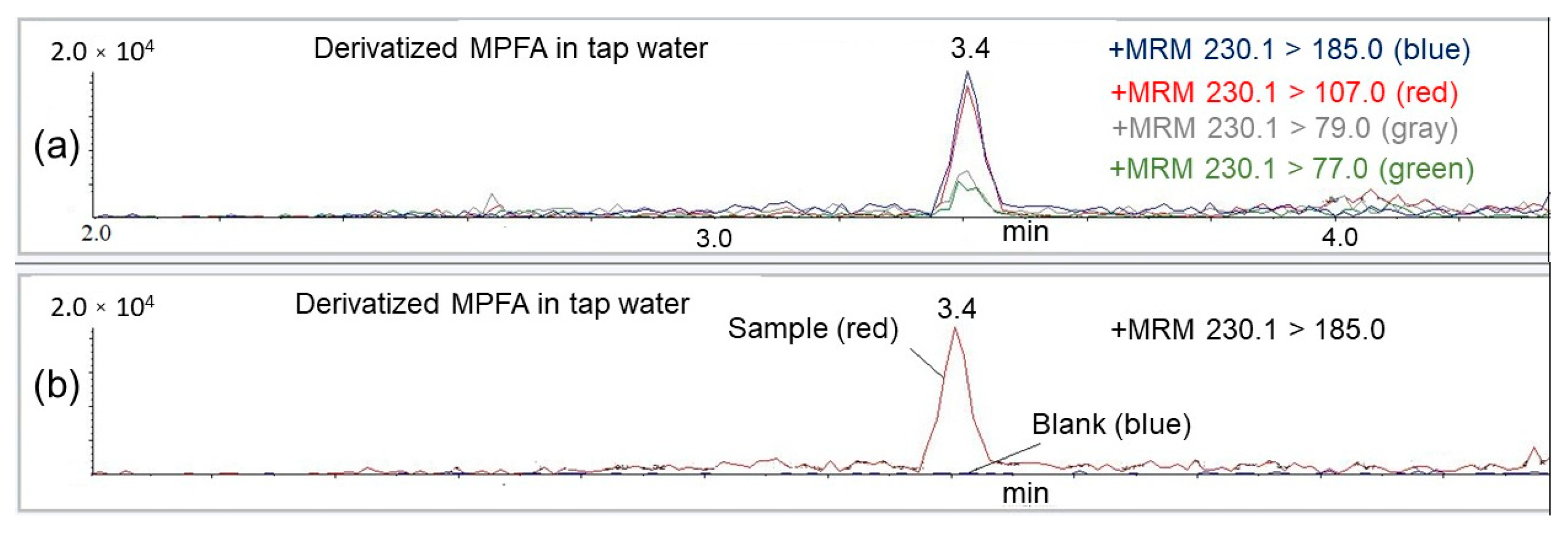
3.6. Analytical Performance of MPFA in Environmental Matrices (Tap Water, Saline, and Soil Extract)
4. Conclusions
Supplementary Materials
Author Contributions
Funding
Data Availability Statement
Conflicts of Interest
References
- Porteous, H. State secrets: An insider’s chronicle of the Russian chemical weapons program, by S. Vil Mirzayanov. J. Slav. Mil. Stud. 2010, 23, 537–539. [Google Scholar] [CrossRef]
- Kloske, M.; Witkiewicz, Z. Novichoks-the A group of organophosphorus chemical warfare agents. Chemosphere 2019, 221, 672–682. [Google Scholar] [CrossRef]
- Bauer, G.; Wildauer, A.; Povoden, G.; Menzi, B.; Curty, C. Crime scene Novichok—Optical detection of fourth-generation agents (FGAs) using handheld forensic light sources. Forensic Sci. 2023, 3, 231–244. [Google Scholar] [CrossRef]
- Yamaguchi, A.; Miyaguchi, H.; Tokeshi, M. Dimethoxytriadinylation LC-MS/MS of Novichok a-series degradation products in human urine. Anal. Chem. 2022, 94, 4658–4665. [Google Scholar] [CrossRef]
- Jeong, W.H.; Lee, J.Y.; Lim, K.C.; Kim, H.S. Identification and study of biomarkers from Novichok-inhibited butyrylcholinesterase in human plasma. Molecules 2021, 26, 3810. [Google Scholar] [CrossRef] [PubMed]
- Mirbabaei, F.; Mohammad-Khah, A.; Naseri, M.T.; Babri, M.; Faraz, S.M.; Hosseini, S.E.; Ashrafi, D. Unambiguous identification and determination of A234-Novichok nerve agent biomarkers in biological fluids using GC-MS/MS and LC-MS/MS. Anal. Bioanal. Chem. 2022, 414, 3429–3442. [Google Scholar] [CrossRef]
- Lee, J.Y.; Lim, K.C.; Kim, H.S. Characterization and study on fragmentation pathways of a novel nerve agent, ‘Novichok (A234)’, in aqueous solution by liquid chromatography-tandem mass spectrometry. Molecules 2021, 26, 1059. [Google Scholar] [CrossRef]
- Otsuka, M.; Yamaguchi, A.; Miyaguchi, H. Analysis of degradation products of Novichok agents in human urine by hydrophilic interaction liquid chromatography-tandem mass spectrometry. Forensic Toxicol. 2023, 41, 221–229. [Google Scholar] [CrossRef]
- Rozsypal, T.; Finger, V.; Prchal, L.; Dlabkova, A. Amidine and guanidine degradation products of A-Series Nerve Agents: Characterization and development of their alkyl isocyanate derivatization for GC and HPLC analysis. Microchem. J. 2025, 218, 115277. [Google Scholar] [CrossRef]
- Noort, D.; Fidder, A.; Riet-Van Oeveren, D.V.D.; Busker, R.; Van Der Schans, M.J. Verification of exposure to Novichok nerve agents utilizing a semitargeted human butyrylcholinesterase nonapeptide assay. Chem. Res. Toxicol. 2021, 34, 1926–1932. [Google Scholar] [CrossRef]
- Jacquet, P.; Remy, B.; Bross, R.P.T.; Van Grol, M.; Gaucher, F.; Chabriere, E.; De Koning, M.C.; Daude, D. Enzymatic decontamination of G-type, V-type and Novichok nerve agents. Int. J. Mol. Sci. 2021, 22, 8152. [Google Scholar] [CrossRef]
- Jung, H.; Heo, J.; Park, N.; Lim, K.C.; Jung, H.; Do Cao, V.; Joung, S. Elimination of A-234 from the environment: Effect of different decontaminants. J. Hazard. Mater. 2023, 451, 131150. [Google Scholar] [CrossRef]
- Stenzel, Y.P.; Henschel, J.; Winter, M.; Nowak, S. A new HILIC-ICP-SF-MS method for the quantification of organo(fluoro)phosphates as decomposition products of lithium ion battery electrolytes. RSC Adv. 2019, 9, 11413–11419. [Google Scholar] [CrossRef]
- De Koning, M.C.; Soares, C.V.; Van Grol, M.; Bross, R.P.T.; Maurin, G. Effective degradation of Novichok nerve agents by the zirconium metal-organic framework MOF-808. ACS Appl. Mater. Interfaces 2022, 14, 9222–9230. [Google Scholar] [CrossRef] [PubMed]
- Rozsypal, T. Persistence of A-234 nerve agent on indoor surfaces. Chemosphere 2024, 357, 141968. [Google Scholar] [CrossRef] [PubMed]
- Youngren, C.; Kiljunen, H.; Heikkinen, H.A.; Ullah, R.; Wiedmer, S.K.; Vanninen, P. Characterization of hydrolysis products and determination of the rate of hydrolysis of Novichok A-234 in different decontaminants. J. Chromatogr. Open 2025, 7, 100210. [Google Scholar] [CrossRef]
- Opravil, J.; Pejchal, J.; Finger, V.; Korabecny, J.; Rozsypal, T.; Hrabinova, M.; Muckova, L.; Hepnarova, V.; Konecny, J.; Soukup, O.; et al. A-Agents, Misleadingly Known as “Novichoks”: A Narrative Review. Arch. Toxicol. 2023, 97, 2587–2607. [Google Scholar] [CrossRef]
- Shi, R.; Zhang, L.; Ma, D.; Cao, Z. Elucidating the degradation mechanism of the nerve agent A-234 using various detergents: A theoretical investigation. Phys. Chem. Chem. Phys. 2024, 26, 15292–15300. [Google Scholar] [CrossRef]
- Harvey, S.P.; McMahon, L.R.; Berg, F.J. Hydrolysis and enzymatic degradation of Novichok nerve agents. Heliyon 2020, 6, e03153. [Google Scholar] [CrossRef]
- D’Agostino, P.A.; Chenier, C.L.; Hancock, J.R. Packed capillary liquid chromatography-electrospray mass spectrometry of snow contaminated with sarin. J. Chromatogr. A 2002, 950, 149–156. [Google Scholar] [CrossRef]
- Madmon, M.; Weissberg, A. Trace level detection and identification of tabun in aqueous media by derivatization and liquid chromatography tandem mass spectrometry analysis. Int. J. Mass Spectrom. 2020, 456, 116393. [Google Scholar] [CrossRef]
- Mishra, G.; Gupta, P.; Kumar, A.; Purohit, A.; Tak, V.; Pardasani, D. Gas chromatography tandem mass spectrometric analysis of alkylphosphonofluoridic acids as verification targets of nerve agents. J. Chromatogr. A 2024, 1716, 464645. [Google Scholar] [CrossRef]
- Mawhinney, D.B.; Hamelin, E.I.; Fraser, R.; Silva, S.S.; Pavlopoulos, A.J.; Kobelski, R.J. The determination of organophosphonate nerve agent metabolites in human urine by hydrophilic interaction liquid chromatography tandem mass spectrometry. J. Chromatogr. B 2007, 852, 235–243. [Google Scholar] [CrossRef] [PubMed]
- Weissberg, A.; Yamin, T.S.; Shifrovitch, A.; Tzadok, A.; Blanca, M.; Madmon, M. Enhancing the detection and identification sensitivity of organophosphorus pesticide-related phenols via derivatization and LC-ESI-MS/MS: A straightforward approach to identify the specific pesticide involved in exposure. Environments 2025, 12, 193. [Google Scholar] [CrossRef]
- Stolker, A.A.M.; Stephany, R.W.; Van Ginkel, L.A. Identification of residues by LC-MS. The application of new EU guidelines. Analusis 2000, 28, 947–951. [Google Scholar] [CrossRef]



| Analyte | Precursor Ion (m/z) | Fragment Ion | Declustering Potential (eV) | Collision Energy (eV) | Intensity Ratio | Retention Time (min) |
|---|---|---|---|---|---|---|
| MPFA | (−)97.0 | (−)82.0 | (−)50 | −36 | 1.0 | 2.2 |
| (−)77.0 | −22 | 15.0 | ||||
| (−)63.0 | −36 | 3.0 | ||||
| (−)49.0 | −60 | 1.0 | ||||
| Derivatized MPFA | (+)230.1 | (+)185.0 | (+)70 | +27 | 3.5 | 3.4 |
| (+)107.0 | +40 | 3.2 | ||||
| (+)79.0 | +55 | 1.0 | ||||
| (+)77.0 | +55 | 1.0 |
| Matrix | Dynamic Range (ng/mL) | R2 | LOQ A (ng/mL) (S/N ≥ 10) | LOI B (ng/mL) (S/N ≥ 3) | RSD (%) |
|---|---|---|---|---|---|
| Tap water | 0.1–10 | 0.999 | 0.1 | 0.1 | 13 |
| Saline | 0.1–10 | 0.999 | 0.1 | 0.1 | 15 |
| Soil extract | 0.1–10 | 0.999 | 0.1 | 0.1 | 15 |
Disclaimer/Publisher’s Note: The statements, opinions and data contained in all publications are solely those of the individual author(s) and contributor(s) and not of MDPI and/or the editor(s). MDPI and/or the editor(s) disclaim responsibility for any injury to people or property resulting from any ideas, methods, instructions or products referred to in the content. |
© 2025 by the authors. Licensee MDPI, Basel, Switzerland. This article is an open access article distributed under the terms and conditions of the Creative Commons Attribution (CC BY) license (https://creativecommons.org/licenses/by/4.0/).
Share and Cite
Belay, C.; Tzadok, A.; Madmon, M.; Yamin, T.S.; Sod-Moriah, G.; Nahum, V.; Weissberg, A. Determination of Methylphosphonofluoridic Acid in the Environment by Derivatization and LC/MS/MS Analysis. Environments 2025, 12, 468. https://doi.org/10.3390/environments12120468
Belay C, Tzadok A, Madmon M, Yamin TS, Sod-Moriah G, Nahum V, Weissberg A. Determination of Methylphosphonofluoridic Acid in the Environment by Derivatization and LC/MS/MS Analysis. Environments. 2025; 12(12):468. https://doi.org/10.3390/environments12120468
Chicago/Turabian StyleBelay, Chen, Adi Tzadok, Moran Madmon, Tamar Shamai Yamin, Gali Sod-Moriah, Victoria Nahum, and Avi Weissberg. 2025. "Determination of Methylphosphonofluoridic Acid in the Environment by Derivatization and LC/MS/MS Analysis" Environments 12, no. 12: 468. https://doi.org/10.3390/environments12120468
APA StyleBelay, C., Tzadok, A., Madmon, M., Yamin, T. S., Sod-Moriah, G., Nahum, V., & Weissberg, A. (2025). Determination of Methylphosphonofluoridic Acid in the Environment by Derivatization and LC/MS/MS Analysis. Environments, 12(12), 468. https://doi.org/10.3390/environments12120468