1. Introduction
The concept of cultural heritage has undergone a profound transformation over the past century, evolving from a narrow focus on the preservation of exceptional monuments and historical artifacts toward a broader understanding that encompasses places, landscapes, infrastructures, and associated cultural practices [
1]. Initially framed primarily in terms of material authenticity and historical continuity, immovable cultural heritage, including archaeological sites, historic buildings, and significant historical infrastructures, was treated as an object of preservation whose value resided in its physical fabric and in its capacity to transmit historical information across generations. Over time, however, this perspective expanded to recognize that heritage cannot be reduced to its material substrate alone. Rather, it can be understood as a dynamic interface between human societies and their environments, shaped by continuous interaction, reinterpretation, and use.
In parallel with this conceptual evolution, the rationale for heritage protection has also shifted. Initially motivated by the preservation of historical testimony and artistic value, heritage protection is now increasingly linked to broader societal goals, including sustainability, resilience, environmental stewardship, and community wellbeing [
2,
3]. This shift reflects the recognition that heritage structures and sites are not isolated artifacts but embedded components of larger environmental and social systems. Immovable cultural heritage interacts with ecological processes, may contribute to landscape stability, mediates human–environment relationships, and influences patterns of land use and environmental management. These interactions suggest that heritage may need to be interpreted not only through historical or aesthetic categories but also as part of the broader domain of environmental governance.
Within this context, the One Health paradigm provides a particularly relevant, yet still underexplored, integrative perspective. One Health recognizes the interdependence between human health, animal health, and environmental health, emphasizing the need to address complex systemic risks arising from interactions across these domains [
4]. Originally developed in response to zoonotic diseases and environmental health risks, it has progressively expanded to encompass broader concerns related to ecosystem stability, environmental sustainability, and the governance of human–environment interfaces [
5]. Despite this systemic scope, cultural heritage has rarely been considered within One Health beyond specific issues such as occupational health in museum settings [
6,
7] or the subjective effects of cultural participation on physical and mental wellbeing [
8,
9]. As a result, the possible role of immovable cultural heritage as a persistent component of coupled environmental, biological, and human systems remains largely unaddressed.
This absence can be interpreted as both a conceptual and a methodological gap. Immovable cultural heritage sites frequently occupy ecologically significant locations, influence environmental management practices, and mediate interactions between human populations and ecosystems. Moreover, their intangible dimensions, including ecological knowledge systems, land-use traditions, and culturally embedded environmental practices, can shape behavioral patterns and environmental outcomes over long temporal scales. Taken together, these characteristics suggest that immovable cultural heritage may have a broader functional relevance within coupled socio-ecological systems than is usually acknowledged. Yet this possibility has rarely been discussed in a coherent way within the One Health literature.
Against this background, the aim of this article is to advance an ecophysical perspective on immovable cultural heritage within the One Health paradigm. To designate this perspective, this article introduces the term HEROS (HERitage One Health System), intended here not as a fully operational tool but as a conceptual framework for rethinking immovable heritage as a persistent structural and informational component of the human niche, embedded within coupled environmental, biological, and human systems. On this basis, this paper discusses the scientific plausibility of such an interpretation, examines its relevance across environmental, animal, and human domains, and suggests that heritage may be reconsidered not only as a cultural asset but also as part of the broader system of functions and services that contribute to socio-ecological stability. In this sense, the perspective proposed here is intended as a conceptual basis for future formalization, empirical testing, and operational applications.
2. Beyond the Traditional Interpretation of Heritage
The evolution of cultural heritage theory has progressively moved beyond a narrow focus on preservation and representation, opening toward broader interpretations that recognize the embeddedness of heritage within territorial and environmental systems. However, despite this conceptual expansion, heritage is still predominantly interpreted through historical, aesthetic, and identity-based frameworks. Even when linked to sustainability or development, its role is often framed in terms of cultural value, social cohesion, or economic impact, rather than as a functional component of system dynamics.
This prevailing interpretation implicitly assumes that heritage acts primarily at the level of meaning, representation, and identity, while its material and spatial dimensions are treated as passive carriers of cultural significance. Such a view, while deeply rooted in heritage studies, tends to underestimate the fact that immovable cultural heritage consists of persistent physical structures embedded in landscapes, interacting continuously with environmental processes, ecological configurations, and human activities.
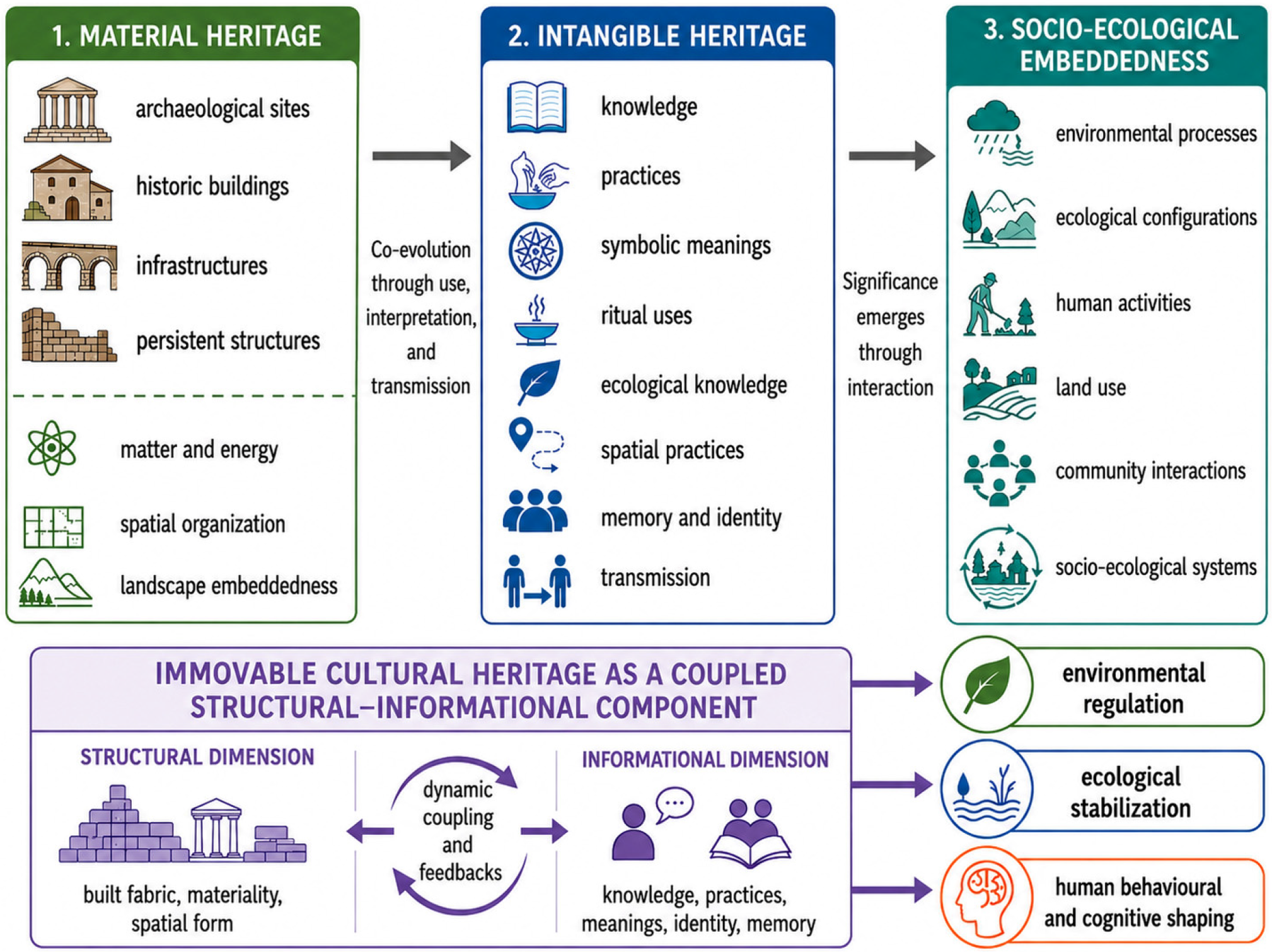
From this perspective, immovable cultural heritage can be reconsidered not only as a cultural asset but also as a component of socio-ecological systems characterized by both material and informational dimensions. On the one hand, heritage structures are composed of matter and energy, influence environmental conditions, and participate in physical processes such as heat exchange, moisture regulation, and spatial organization. On the other hand, they embody systems of knowledge, practices, and meanings that shape human behavior, perception, and interaction with the environment. These two dimensions are not independent but co-evolve through use, interpretation, and transmission. The conceptual transition from material heritage to intangible heritage and socio-ecological embeddedness involves several closely related layers. To make this passage more visually accessible,
Figure 1 schematically represents the relationship between persistent material structures, intangible knowledge systems, and the broader socio-ecological contexts in which heritage is embedded. The figure does not introduce an additional model but summarizes the interpretative step developed in this section: immovable cultural heritage is not treated as a passive material object but as a coupled structural–informational component whose material and intangible dimensions co-evolve through use, interpretation, and transmission. In detail, the diagram illustrates the transition from immovable cultural heritage as a set of persistent physical structures to heritage as a coupled structural–informational component of socio-ecological systems. Material heritage includes, among other elements, built fabric in its different forms. However, these structures can be described and quantified from a physical perspective considering the materials and energy involved in the construction, maintenance, and transformation processes occurring within time and a certain space. Thus, the spatial organization is described at different levels (from the shape of the structure to the site and landscape levels). Intangible heritage includes all the elements considered by UNESCO, among which practical (implicit) knowledge, practices, symbolic meanings, ritual uses, ecological knowledge, spatial practices, memory, identity, and intergenerational transmission can be considered. Their dynamic coupling through use, interpretation, and transmission supports the broader interpretation of heritage as a component interacting with environmental processes, ecological configurations, human activities, land use, and community relations. In this perspective, immovable cultural heritage may contribute to environmental regulation, ecological stabilization, and human behavioral and cognitive shaping.
This material–informational interpretation is consistent with the recognition that immovable cultural heritage is inseparable from its intangible dimension. Even when expressed through material structures, heritage embodies systems of knowledge, symbolic meanings, practices, and cultural relationships that persist through transmission and use. These intangible dimensions include ecological knowledge, spatial practices, ritual uses, and culturally embedded interactions with specific places. According to the UNESCO Convention for the Safeguarding of the Intangible Cultural Heritage, intangible cultural heritage includes “
practices, representations, expressions, knowledge and skills […] transmitted from generation to generation and constantly recreated by communities, providing them with a sense of identity and continuity” [
10]. Accordingly, immovable cultural heritage should not be understood as a static material object but as a material and symbolic product of a social-ecological system in which material and intangible components coexist and interact continuously [
11]. This integration becomes particularly evident in cultural landscapes, sacred sites, and historically significant natural locations, where environmental features such as forests, lakes, or geological formations acquire enduring symbolic, cultural, and functional significance. In such cases, the conventional distinction between “natural heritage” and “cultural heritage” may become analytically inadequate, because the significance of the site emerges from the interaction between physical environmental features and human cultural interpretation, use, and transmission.
Interpreting heritage as part of the human niche provides a useful conceptual step in this direction. Within this framework, built environments and cultural landscapes are not external to human systems but constitute part of the ecological and cognitive infrastructure through which human societies interact with their surroundings. Heritage sites, in particular, represent persistent configurations of this niche, in which long-term processes of environmental adaptation, resource use, and knowledge transmission are materially and symbolically embedded.
This reinterpretation has important implications. If heritage is understood as a persistent structural and informational component of socio-ecological systems, then its role cannot be confined to cultural or symbolic functions alone. Instead, it may contribute to the regulation of environmental conditions, the stabilization of ecological interactions, and the shaping of human behavioral and cognitive patterns. These potential functions are not yet systematically framed within heritage studies and are rarely addressed within broader integrative frameworks such as One Health. However, they can be approached through existing scientific knowledge, which provides a basis for assessing the plausibility of such interactions.
In this sense, the shift proposed here is not to replace existing interpretations of heritage but to extend them. By moving from a purely representational view toward an ecophysical one, immovable cultural heritage can be interpreted as an active component of coupled systems, capable of influencing processes that are directly relevant to environmental, biological, and human stability. This conceptual step provides the foundation for the following analysis, which examines the scientific plausibility of these interactions across different domains.
3. Scientific Plausibility of an Ecophysical Interpretation of Heritage
3.1. Heritage, Environmental Regulation and Planetary Stability
Immovable cultural heritage can be interpreted as a persistent organization of matter, energy, and information capable of influencing environmental stability across multiple scales. This interpretation is not merely conceptual but is consistent with established physical, thermodynamic, and ecological principles governing the interaction between persistent structures and their surrounding environment.
A first line of plausibility concerns resource conservation. The preservation of immovable cultural heritage contributes to environmental protection primarily through the retention of embodied energy and the avoidance of material-intensive reconstruction processes. From a life-cycle perspective, buildings and archaeological structures represent long-term accumulations of resource investments embedded in construction materials, structural systems, and site transformation. By contrast, demolition entails the irreversible loss of this embodied availability and requires renewed extraction, transformation, and high-dissipation industrial processes for replacement. Life-Cycle Assessment (LCA) research consistently shows that embodied energy constitutes a substantial share of total life-cycle energy demand in buildings [
12]. Comparative analyses demonstrate that adaptive reuse and conservation strategies generally lead to lower cumulative energy demand and greenhouse gas emissions than demolition-and-rebuild scenarios over equivalent service lifetimes [
13]. At the sectoral level, the building and construction domain accounts for approximately 37% of global energy-related CO
2 emissions when operational and embodied components are combined, indicating that avoided reconstruction can generate non-negligible environmental benefits [
14]. In this sense, heritage preservation can be interpreted as a strategy that reduces environmental throughput and limits repeated cycles of material and energetic reinvestment. Case studies have also begun to estimate the cumulative availability embedded in heritage structures, supporting the idea that built heritage can be understood as a long-term reservoir of organized resources [
15].
A second line of plausibility concerns thermodynamic and microclimatic effects. Persistent physical structures modify local boundary conditions by altering temperature gradients, radiative exchange, air-flow patterns, moisture transport, and surface energy balances. From a thermodynamic perspective, built structures affect local entropy production by redistributing heat fluxes and modifying exposure conditions. The thermodynamic analysis of built heritage has been extensively discussed in the literature, particularly with reference to the implications of spatial configurations and material properties for energy flows and dissipation mechanisms [
16]. Historic buildings and archaeological structures frequently exhibit high thermal inertia due to their mass distribution and material composition, such as stone, masonry, and earth-based materials. Studies in building physics and heritage microclimatology have shown that traditional constructions can buffer short-term temperature fluctuations [
17,
18,
19]. Historic buildings and archaeological structures frequently exhibit high thermal inertia due to their mass distribution and material composition, including stone, masonry, and earth-based materials. These buffering effects are particularly evident in historic urban fabrics, where dense morphology and massive envelopes contribute to reduced thermal amplitude compared with lightweight contemporary constructions.
Microclimate research in historic urban contexts further supports this interpretation. Studies on historic urban canyons and compact morphologies have demonstrated that traditional built environments can mitigate extreme thermal fluctuations and reduce localized heat stress, depending on material properties and spatial configuration [
20,
21]. These findings are directly relevant not only to environmental regulation but also to the long-standing historical recognition that urban form and environmental exposure affect human wellbeing, as already suggested in classical architectural thought, including Vitruvius’
De Architectura [
22,
23].
A third line of plausibility concerns landscape-scale stability. Similar stabilizing mechanisms have been documented in cultural landscapes and long-managed environments. Historical land-use systems associated with heritage sites often maintain mosaic structures that enhance ecological connectivity and reduce abrupt land-cover transitions [
24]. Landscape fragmentation and rapid land-use change are widely recognized as drivers of ecological instability and biodiversity decline [
25]. Where heritage sites anchor long-term land-use persistence, they may contribute to reduced structural disruption and lower ecological turnover intensity.
From a system ecology perspective, structural organization represents accumulated energetic investment embodied in material configuration [
26]. Such organization does not cease to exert influence after its initial construction. Rather, it continues to modulate energy flows and dissipation pathways over extended temporal scales. Persistent structures act as constraints on energy gradients, redistributing flows and altering the spatial pattern of entropy production. The presence of a high-mass, thermally stable structure within a landscape modifies the spatial distribution of energy fluxes, thereby influencing the stability of adjacent ecological processes.
These findings support the scientific plausibility of interpreting immovable cultural heritage as a contributor to environmental and planetary stability. The reduction in thermal variability, the mitigation of exposure extremes, the stabilization of land-use configurations, and the buffering of ecological interfaces are all experimentally or observationally documented phenomena. These effects, which are already acknowledged by the literature, could be reinterpreted within a coherent perspective that connects heritage to the broader dynamics of environmental regulation.
3.2. Heritage Structures as Ecological Supports and Animal Health Interfaces
A second area of plausibility concerns the role of heritage structures in shaping animal habitats and ecological interfaces. This is supported by a substantial body of ecological evidence showing that persistent built structures can function as habitat stabilizers across multiple taxa and landscape contexts.
Immovable cultural heritage structures frequently function as ecological refugia, providing shelter, nesting sites, and protection from environmental stressors [
27]. Archaeological ruins, historic buildings, bridges, stone walls, and other long-lasting anthropogenic structures create stable microhabitats characterized by reduced environmental variability, structural complexity, and buffered thermal conditions. Habitat structure is widely recognized in ecology as a key determinant of species persistence, reproductive success, and trophic stability [
28]. Structural heterogeneity increases niche availability and reduces competitive and environmental stress, contributing to biodiversity maintenance.
Numerous ecological studies have documented the role of anthropogenic structures in supporting biodiversity, particularly in landscapes where natural habitat availability has been reduced by urbanization or agricultural intensification. Historic buildings are known to provide essential roosting and breeding habitats for bats and birds [
29,
30]. Stone ruins and archaeological walls host reptile and invertebrate communities that would otherwise lack suitable microhabitats in modified landscapes [
31]. Traditional rural constructions and dry-stone walls have been shown to enhance local biodiversity by offering microclimatic buffering and structural complexity.
These habitat functions are not merely spatial but also energetic. At a smaller scale, recent studies on stone heritage conservation also show that heritage materials host complex microbial communities and that conservation strategies may increasingly rely on biologically based approaches, such as bacterial bioformulations for biocontrol and biocleaning [
32]. This further confirms that heritage structures are not inert supports but active interfaces between material conservation, biological colonization, and ecological management. Many such structures reduce thermal amplitude and exposure to extreme conditions, which is critical for species sensitive to temperature variability. Thermal stability within roosting or nesting sites reduces metabolic stress and lowers the energy expenditure required for thermoregulation, thereby directly influencing survival probabilities [
33]. More generally, environmental stress increases metabolic demand and accelerates resource depletion, whereas refuge conditions that reduce thermal and predation stress lower the energetic cost of persistence.
Heritage sites may also function as ecological nodes that enhance connectivity across fragmented landscapes. Landscape ecology research has shown that structural elements embedded within anthropogenic matrices can act as stepping stones, supporting dispersal and gene flow. Increased connectivity reduces local extinction probability and enhances metapopulation stability, thereby improving persistence across fragmented habitats [
34].
From a system ecology perspective, habitat structure can be interpreted as a form of accumulated organizational energy that constrains and channels biological flows. Structural complexity reduces disorder within biological subsystems by stabilizing interaction networks and lowering stochastic mortality pressures. In this sense, persistent built heritage modifies the energetic landscape experienced by organisms.
These lines of evidence support the interpretation of immovable heritage structures as stabilizing ecological components. The importance of heritage in this context lies not only in its cultural significance but in its capacity to provide habitat support, microclimatic refuge, and connectivity functions that are directly relevant to animal persistence and, more broadly, to One Health interface dynamics.
3.3. Heritage Environments, Cognition, and Human Health
A third area of plausibility concerns the human domain, where heritage may influence health and resilience through both structural and informational pathways. This interpretation is grounded in empirical research spanning environmental psychology, cognitive neuroscience, stress physiology, and cultural cognition.
Persistent physical environments, such as heritage buildings, historic buildings, and archaeological sites preserved because of their symbolic meaning for a given community, can function as externally anchored memory scaffolds at both individual and collective levels. According to distributed cognition theory, cognitive processes are not confined to neural substrates but extend into structured environmental supports that reduce cognitive load and uncertainty [
35,
36]. Temporally stable and spatially anchored informational cues can support orientation, meaning attribution, and behavioral predictability. By externalizing information into stable environmental forms, heritage reduces the energetic and cognitive cost associated with reconstructing environmental models and adaptive strategies.
From a neurobiological perspective, long-term memory is not a static archive but a dynamic and metabolically demanding process. Memory consolidation depends on repeated reactivation and progressive reorganization of neural representations across hippocampal–neocortical networks [
37,
38]. Stable environmental reference points can increase the probability of contextual reactivation by providing recurrent spatial cues that engage distributed memory networks. Repeated encounters with persistent landmarks facilitate pattern-completion processes within hippocampal–cortical circuits, lowering the activation threshold required for retrieval. In this sense, landmarks embedded in heritage environments may contribute to the long-term stabilization of memory through recurrent reactivation.
At the same time, long-term memory stabilization is not reducible to hippocampal encoding alone. It involves the dynamics of distributed engram ensembles—memory-related neuronal populations undergoing activity-dependent plastic changes during learning and reactivation—shaped by synaptic plasticity, competitive allocation mechanisms, and sustained neuron–astrocyte molecular interactions across multiple brain regions [
39,
40]. Without reactivation, synaptic connections weaken and memory persistence declines.
This perspective becomes particularly relevant when considering stress regulation. Sustained exposure to environmental unpredictability activates neuromodulatory systems responsible for vigilance and adaptive responsiveness, the locus coeruleus–noradrenaline system. Noradrenergic signaling modulates neural gain, attention, and synaptic plasticity [
41]. While moderate activation supports learning and memory consolidation, persistent tonic activation under chronic stress contributes to allostatic load and elevated metabolic expenditure [
42,
43]. Prolonged activation of the hypothalamic–pituitary–adrenal axis increases cortisol levels and physiological wear. Conversely, environments characterized by spatial continuity, symbolic coherence, and predictability can reduce baseline arousal demands [
44]. Therefore, persistent heritage landmarks, by reinforcing familiarity and contextual stability, may plausibly contribute to reduced chronic stress activation.
At the cellular level, long-term memory consolidation is metabolically constrained. Activity-dependent synaptic stabilization requires coordinated astrocyte–neuron metabolic coupling. Astrocyte-derived lactate has been shown to be necessary for long-term memory formation and activity-dependent gene expression [
45,
46]. Memory persistence thus depends on the availability of metabolic resources sufficient to sustain synaptic maintenance and transcriptional stabilization. Chronic stress increases metabolic demand and competes with these processes. Conversely, environments that reduce baseline stress may preserve resources that can be allocated to synaptic stabilization. Microglia also contribute to memory persistence through experience-dependent synaptic remodeling and extracellular-matrix regulation. Experimental evidence shows that microglial dynamics influence structural stabilization of engram networks through inflammatory and structural pathways [
47]. Long-term memory can therefore be understood as emerging from coordinated neuronal, glial, and metabolic processes that remain sensitive to environmental stability and physiological stress load [
48,
49].
Parallel support for this interpretation comes from environmental psychology. A growing literature shows that exposure to coherent and culturally meaningful environments is associated with improved psychological wellbeing, reduced stress markers, and enhanced cognitive performance [
50,
51]. Public-health syntheses further indicate that engagement with cultural and heritage environments correlates with lower stress biomarkers and improved self-reported health outcomes [
52]. These findings support the idea that culturally meaningful environmental contexts may reduce sustained physiological stress activation and contribute to human stabilization.
These lines of evidence suggest that immovable heritage environments may influence human health not only through symbolic value but also through structurally and cognitively mediated effects on orientation, memory, predictability, and stress regulation. This does not imply that heritage acts as therapy in a narrow sense. Rather, it suggests that persistent and meaningful environments may contribute to the conditions under which human physiological and cognitive stability are more likely to be maintained.
3.4. The Intangible Dimension of Heritage: Knowledge, Behavior, and Continuity
The intangible dimension of heritage adds a further layer of plausibility to this perspective. Beyond individual neurophysiology, intangible heritage can stabilize behavioral dynamics through the intergenerational transmission of environmental knowledge, practices, and adaptive strategies.
Knowledge systems embedded in cultural landscapes often encode practical forms of orientation, risk mitigation, and resource management [
53]. Informational continuity reduces behavioral turnover rates, limiting the energetic costs associated with repeated adaptive reorganization. From a system ecology perspective, informational organization represents accumulated availability embodied in structured knowledge systems [
54]. Information constrains state-space variability and reduces entropy production by guiding energy flows into structured pathways [
55].
Heritage sites also provide evidence of how human societies have historically interacted with the environment, not only through material remains but through associated practices, products, and techniques [
56,
57,
58]. Historical practices, as intangible counterparts, are also relevant for such a purpose [
59]. They can reveal long-term adaptive strategies coherent with the protection of environmental systems and the health of the biosphere. In addition, the study of heritage sites and historical buildings often documents circular practices such as material recovery and reuse [
60,
61]. These practices are not only culturally significant but potentially relevant for contemporary sustainability transitions.
Therefore, this intangible dimension is essential for any attempt to reinterpret heritage within coupled socio-ecological systems. Heritage is not only preserved matter; it is also preserved and transmitted organization. Through this lens, the informational dimension of heritage becomes directly relevant to environmental adaptation, behavioral continuity, and long-term resilience.
4. From Cultural Asset to One Health Relevance
4.1. Heritage and the Operational Extension of One Health
The possible inclusion of immovable cultural heritage within the One Health paradigm is not merely a theoretical refinement. It raises a substantive ethical and governance question. If planetary, animal, and human health are interdependent, as consistently affirmed within One Health, and if persistent cultural structures can measurably influence the stability of these domains, then the exclusion of cultural heritage from health-oriented governance represents a conceptual gap. In this regard, recent policy developments are particularly revealing. The joint action of the Italian Ministry of Health and the Italian Ministry of Culture, allowing the medical prescription of visits to heritage sites and museums, represents a pioneering institutional decision [
62]. This emerging line builds on experiences with “museum prescriptions” and broader “arts on prescription” programs. Several countries have piloted physician-prescribed visits to museums, galleries, and cultural institutions as adjunct interventions aimed at improving psychological wellbeing and quality of life. For example, a clinical study conducted in collaboration with the Montreal Museum of Fine Arts reported measurable improvements in wellbeing indicators among patients who received physician-prescribed museum visits [
63]. More broadly, systematic reviews of “Arts on Prescription” programs have shown consistent associations with reductions in anxiety, improvements in mood, enhanced social connectedness, and perceived health benefits [
64]. Although these interventions are primarily situated within psychosocial rather than biomedical frameworks, they demonstrate that cultural environments can already be formally integrated into care pathways.
At the same time, integrating heritage into One Health does not mean medicalizing cultural heritage or reducing it to a therapeutic instrument. Rather, it means recognizing that certain heritage environments historically emerged as infrastructures of wellbeing and that some of their stabilizing functions may remain relevant within contemporary socio-ecological systems. Historical and archaeological evidence supports this interpretation. In ancient Mediterranean cultures, healing was often embedded within environmental and architectural design. The sanctuaries of Asclepius, such as those at Epidaurus, Kos, and Pergamon, were spatially organized complexes integrating landscape orientation, water management, acoustic design, ritual practice, and communal gathering spaces in ways that facilitated physiological and psychological restoration [
65,
66]. These were not hospitals in the modern sense but carefully structured environments in which architecture, ecology, and symbolic coherence interacted to promote conditions conducive to recovery. Similarly, classical theatres combined spatial geometry, acoustic optimization, and collective experience in ways that regulated emotional and cognitive states at a community scale [
67,
68]. The integration of natural resources into healthcare sites was characteristic too. In Greco-Roman antiquity, mineral springs, sacred waters, and forested sanctuary landscapes were systematically integrated into therapeutic practices, functioning as environmental components of healing infrastructures rather than as purely symbolic settings [
69,
70]. Recent developments in the archaeology of medicine further suggest that integrated forms of human–animal–environmental care are not exclusively modern constructs but have deep historical precedents documented in material and archaeological records [
71]. These examples illustrate that the relationship between built form, environmental configuration, and health has long been recognized as structurally embedded rather than incidental.
Contemporary One Health frameworks emphasize prevention, environmental stewardship, and cross-sectoral governance, particularly in relation to zoonotic risk, biodiversity loss, and ecosystem degradation [
72]. However, in practice, they still predominantly focus on infectious-disease interfaces and environmental contamination, while largely overlooking the possible stabilizing structural and informational roles of cultural landscapes and built heritage.
From this perspective, heritage can be reconsidered as a relevant component of preventive and environmental health thinking—not because it cures disease, but because it may contribute to stabilizing environmental conditions, ecological interfaces, and human cognitive and behavioral dynamics. The ethical dimension of this integration is linked to intergenerational justice: if heritage embodies accumulated structural and informational organization that contributes to system stability, then its preservation may be interpreted not only as cultural responsibility but also as preventive ecological responsibility.
For this reason, integrating heritage into One Health may extend preventive health strategies beyond biomedical interventions to include long-term structural and informational regulators already embedded within landscapes. In this sense, the relevance of heritage within One Health is neither merely symbolic nor economically reductionist. It lies in the possibility that heritage contributes to conditions of stability across domains that One Health already recognizes as interconnected.
4.2. Ecophysical Foundations of the HEROS Perspective
The convergence of evidence discussed in the previous sections suggests that immovable cultural heritage may exert measurable influences across environmental, animal, and human domains. However, these effects are typically described within separate disciplinary frameworks, lacking a unifying representation capable of capturing their systemic interdependence. In this work, such integration is approached through an ecophysical perspective grounded in the thermodynamics of heterogeneous systems operating far from equilibrium [
17,
73,
74]. Following the framework originally developed by Prigogine, complex systems maintain their organization through continuous exchanges of matter and energy, where stability is not associated with equilibrium but with dynamically sustained structures characterized by regulated dissipation processes. Within this view, persistent spatial configurations—such as built environments and long-lived landscape structures—act as constraints that influence energy flows and entropy production.
This thermodynamic perspective finds a direct operational counterpart in system ecology, particularly in the tradition of Odum, where ecosystems are described through stock–flow structures and donor-side accounting of resource use [
75]. In this context, non-monetary accounting frameworks already provide a consistent theoretical basis and extensive applications in the representation of ecosystem services functioning, allowing a complete representation of direct, indirect, and existence services, including different health benefits, within a unified flow-based structure, explicitly linking system organization to resource use and transformation processes [
76]. Within this combined thermodynamic and ecological framework, immovable cultural heritage can be interpreted as a persistent stock of organized matter and information embedded within coupled environmental, animal, and human systems. Its associated intangible dimensions further extend this organization into the informational domain, influencing behavioral patterns, knowledge transmission, and adaptive strategies.
On this basis, HEROS (HERitage One Health System) is introduced as an ecophysical interpretative framework aimed at representing these interactions within a unified system perspective. HEROS does not propose a fully validated predictive model at this stage. Rather, it provides a conceptual structure through which heterogeneous empirical evidence can be reinterpreted coherently. Its primary function is to link observed stabilization phenomena, such as environmental buffering, habitat provision, and cognitive regulation, to underlying mechanisms of organization and dissipation. From an ecophysical standpoint, the stability of coupled systems depends on the balance between structural organization and dissipative processes. In this sense, heritage can be interpreted as contributing to system stability insofar as it modifies boundary conditions, constrains interaction pathways, and influences the rate at which available resources are transformed and dissipated across domains. This interpretation enables a reframing of heritage effects within a common analytical language, where environmental, biological, and human processes are not treated as independent domains but as interacting subsystems governed by shared physical principles. A preliminary formalization of this perspective, based on stock–flow representation, subsystem coupling, and dissipation terms, is provided in the
Supplementary Materials and is intended to support future developments toward quantitative modeling and empirical validation within sustainability and One Health-oriented analyses.
From a potential operational standpoint, this perspective implies that the variables introduced in the HEROS formalization, such as availability stocks and dissipation rates, should not be interpreted as abstract quantities detached from measurable phenomena. Rather, they provide a way to reorganize existing indicators already used in environmental assessment, ecology, and heritage science within a common physical framework. For instance, metrics related to land-use stability, habitat fragmentation, thermal buffering, or exposure variability can be interpreted as proxies influencing the rate at which environmental availability is dissipated. A similar interpretation applies to the human subsystem. The notion that heritage environments act as informational scaffolds can be further supported by research in environmental psychology and psycho-aesthetics. Human perception appears to be particularly responsive to structured spatial patterns, including fractal geometries and material configurations commonly found in traditional and historical built environments. These features are associated with reduced cognitive load and improved attentional recovery. According to Attention Restoration Theory (ART), environments characterized by coherent structure and “soft fascination” allow directed attention mechanisms to recover, reducing the cognitive effort required for environmental processing [
77,
78,
79]. Within the HEROS perspective, such effects can be interpreted as a reduction in the baseline activation of neuromodulatory systems, including the locus coeruleus–noradrenaline system, thereby lowering tonic arousal and associated energetic expenditure. In addition, the informational dimension of heritage is not limited to individual cognition. Intangible heritage can be understood as a shared informational stock that stabilizes collective behavioral patterns and social identity. When cultural knowledge, practices, and meanings are distributed across a community, the cost of maintaining coherent behavioral responses is reduced, leading to lower behavioral turnover and, consequently, reduced dissipation within the human subsystem. These interpretations reinforce the idea that heritage effects are not confined to symbolic or cultural domains but correspond to measurable modifications of system dynamics, which can be formally represented—at least at a conceptual level—through the variables introduced in the HEROS framework.
4.3. Conceptual Formalization and Operational Interpretation of HEROS
To translate the conceptual structure of HEROS into a formal representation, a simplified stock–flow formulation can be introduced. In line with non-equilibrium thermodynamics and system ecology, each subsystem (environmental, animal, human) can be described through a balance between incoming flows and dissipative processes:
where
represents the availability stock associated with subsystem
,
denotes the inflow of resources (material, energetic, or informational), and
represents the dissipation term, accounting for irreversible losses associated with system functioning. In this formulation, availability stocks represent measurable state variables of the system, corresponding to the quantity of organized resources associated with each subsystem, whereas flows represent rates of change. Also, the term dissipation requires clarification. In strict thermodynamic terms, dissipation refers to the irreversible degradation of organized energy into less available forms, typically associated with entropy production in systems operating far from equilibrium. When extended to ecological and socio-environmental systems, this concept can be interpreted more broadly as the loss of organized availability, that is, the progressive reduction in the capacity of a system to maintain its structure, functions, and adaptive responses.
Within the HEROS perspective, dissipation does not correspond to a single measurable quantity but to a class of processes that manifest differently across domains. In the environmental subsystem, dissipation can be associated with the loss of ecosystem structure and function, such as land degradation, fragmentation, or reduction in buffering capacity against environmental variability. In the animal subsystem, it may correspond to increased metabolic stress, reduced habitat suitability, or higher mortality and turnover rates. In the human subsystem, dissipation can be interpreted as the energetic and functional cost required to maintain cognitive, physiological, and behavioral stability under conditions of stress, uncertainty, or environmental incoherence. From a One Health perspective, these processes are not independent. Rather, they represent interconnected manifestations of system-level instability across environmental, biological, and human domains. In this sense, dissipation can be understood as a unifying concept that captures how degradation, stress, and loss of function propagate through coupled systems. This interpretation is consistent with non-monetary accounting approaches developed in ecosystem services research, where the focus is placed on the flows and transformations of resources and on the maintenance of system organization, rather than on monetary valuation alone. Within such approaches, the reduction in dissipation corresponds to the preservation of system functionality and the enhancement of long-term stability. Accordingly, the HEROS formalization should be interpreted as a way of expressing how different processes, ranging from environmental degradation to physiological stress, can be described within a common analytical framework, where the central question is not only how resources are used but how efficiently system organization is maintained over time.
Within this formulation, the contribution of heritage can be represented as a modulation of the dissipation term:
where
is the baseline dissipation in the absence of heritage, and
represents the reduction associated with heritage-related effects. In simple terms, heritage does not create new resources but influences how efficiently existing resources are used, reducing losses across subsystems.
This representation provides a common analytical language for interpreting a wide range of empirically observed effects. For instance, environmental stabilization mechanisms such as reduced land-use fragmentation or thermal buffering can be interpreted as lowering the rate at which environmental availability is dissipated. Similarly, the provision of ecological refugia by heritage structures reduces metabolic stress and mortality pressures in biological systems, thereby affecting dissipation in the animal subsystem. In the human domain, reductions in cognitive load, stress activation, and behavioral turnover can be interpreted as decreases in the energetic cost required to maintain adaptive functioning.
From an operational standpoint, the variables introduced in the HEROS formalization are not intended to replace existing indicators but to reorganize them within a coherent physical framework. Indicators commonly used in environmental assessment, ecology, and heritage science can be interpreted as proxies influencing dissipation rates and system organization.
Table 1 provides an indicative mapping between measurable indicators and the corresponding variables in the HEROS framework. The management implications reported here are illustrative and intended to show how the HEROS framework may support interpretation and decision-making, rather than to prescribe specific interventions.
A simplified illustrative example can clarify the operational meaning of this mapping. Consider a historic urban fabric characterized by low fragmentation and high material continuity. Empirical studies show that such configurations reduce thermal variability and stabilize microclimatic conditions. Within the HEROS perspective, this corresponds to a reduction in environmental dissipation , which can be associated with lower fragmentation indices and reduced thermal amplitude. Although a direct conversion of these indicators into physical units such as energy or exergy requires further methodological development, the directional relationship between observable metrics and dissipation terms can already be established and tested empirically.
This approach is consistent with non-monetary accounting methods used in system ecology and ecosystem services research, where indicators are used to represent flows and transformations of resources rather than to assign monetary values. In this sense, the HEROS formalization should be interpreted as a conceptual and operational bridge between measurable indicators and system-level dynamics, rather than as a fully parameterized predictive model.
Finally, the definition of system boundaries requires explicit consideration. While the primary unit of analysis is the physical heritage asset, its influence may extend beyond its immediate spatial limits through informational, cultural, and social processes. The relevant boundary is therefore not strictly limited to the physical structure but may include its broader socio-ecological footprint, encompassing the communities that interact with it and the landscapes it influences. This extended interpretation is consistent with the concept of intangible heritage and supports the view of heritage as a distributed regulatory component within coupled systems.
4.4. Simplified Literature-Based Procedural Example
To clarify how the HEROS perspective may be operationalized without converting the present Perspective article into an empirical validation study, a simplified procedural example is introduced. For such a purpose, the archaeological area of Paestum, in Southern Italy, is used, with an exemplificative purpose, using only published literature data as support. A complete empirical application of HEROS, including the quantitative estimation of availability stocks and heritage-related dissipation reductions, is not provided, being outside the scope of a perspective study. In particular, the aim here is not to report original experimental data or a fully validated case study but to show how the proposed perspective could be translated into a future operational assessment. Nevertheless, because a procedural example may help readers understand how the framework can be applied, Paestum is used here as a deliberately simplified and incomplete literature-based example.
The archaeological site of Paestum, within the National Archaeological Park of Paestum-Velia, is selected for two main reasons. First, the park is included in the list of UNESCO World Heritage sites, representing an internationally recognized immovable heritage context. Second, and more importantly for the present purpose, Paestum is supported by a relatively rich body of validated literature concerning its geomorphological substrate, archaeological structures, temple geometry, materials, geophysical evidence, and symbolic-cultural record. The example is therefore not proposed because all the data required for a full HEROS assessment are already available, but because it allows the procedural logic of the framework to be illustrated using documented and traceable evidence.
The first procedural step consists of defining the system boundary. In a narrow sense, the system includes the immovable heritage assets of the archaeological area, particularly the Doric temples, the urban structures, the walls, the sacred areas, and the associated archaeological remains. In a broader sense, the system also includes the travertine platform, the Sele coastal plain, the necropolis system, the symbolic and ritual evidence, and the cultural memory connected to the site. This corresponds to the HEROS notion of a socio-ecological footprint, in which the physical asset and its wider environmental and informational relations are considered together, as also defined in the
Supplementary Materials.
The second step consists of identifying the main HEROS stocks involved. The environmental stock can be associated with the geomorphological and geological substrate of Paestum, especially the travertine platform and the Sele coastal plain. The structural heritage stock can be associated with the persistent built structures, including temples, walls, urban remains, and stone materials. The informational heritage stock can be associated with geometric knowledge, symbolic meanings, ritual practices, iconography, and transmitted cultural memory. These stocks are not computed here as numerical quantities. Rather, the example shows which types of validated data could be used to describe them in a future empirical application.
The environmental component is supported by geological and geomorphological evidence. The Greek–Roman settlement of Poseidonia–Paestum was founded at the end of the seventh century BCE in the southern sector of the Sele River alluvial–coastal plain, close to the Tyrrhenian coast, on a travertine platform slightly raised above the surrounding plain. The city was enclosed by a rectangular-trapezoidal wall circuit and underwent several historical transformations, including Greek, Lucanian, Roman, and late-antique phases. Sedimentological studies distinguish Lower Paestum Travertines, formed between the Late Pleistocene, approximately 75,000 years BP, and the Early Holocene, and Upper Paestum Travertines, formed mainly during late Roman to Medieval times. The latter reached thicknesses of several meters in the southern and western sectors of the city and obstructed Porta Marina before later archaeological removal. These data do not directly quantify HEROS variables, but they provide validated evidence for defining the environmental stock , the geological boundary conditions, and the long-term coupling between settlement, carbonate-rich waters, travertine deposition, and landscape transformation.
The structural component can be illustrated by the Temple of Hera I, also known as the Basilica. Published data report that the temple was built around 550 BC using local travertine, with a stylobate measuring approximately 24.52 m × 54.30 m, a preserved colonnade of 9 × 18 columns, and an E–W orientation with the entrance on the eastern side. These measurable features do not yet constitute a quantitative assessment of , but they identify the kind of data from which the structural heritage stock could be operationalized in future work, for example through material class, dimensions, column count, exposed surfaces, material volume, mass, and embodied-resource proxies.
A further pathway concerns environmental buffering. A recent geometrical study of 41 Doric temples showed that temple proportions follow measurable modular relationships and proposed a geometrical interpretation of how colonnade configurations may attenuate wind- or sound-induced pressure waves depending on incidence angle. In the present procedural example, these data are not used to introduce a new HEROS equation. Rather, they are interpreted through the existing relation : temple geometry, orientation, and colonnade configuration may be treated as observable indicators supporting a possible heritage-related reduction , insofar as they may reduce exposure to environmental forcing compared with a baseline condition. The point is not to calculate here but to clarify how a measurable architectural feature could become part of a future HEROS-compatible assessment.
The Temple of Athena provides another example of how environmental and structural data can be connected. A multidisciplinary study combining archaeological, geomorphological, sedimentological, remote-sensing, GPR, electromagnetic, and ERT methods showed that the local landform played an important role in the selection and transformation of the sacred area. The same study identified subsoil anomalies probably corresponding to ancient structures and to anthropogenic cutting of travertine deposits around the temple. In HEROS terms, these data describe a coupling between and : the sacred architecture is not detached from the substrate but physically and historically embedded in a geomorphological setting shaped by natural and anthropogenic processes.
The animal-interface domain must be treated more cautiously, because the literature considered here does not provide a direct ecological survey of present animal populations within the archaeological area. For this reason, this part of the example is presented only as a future operational pathway. Stone blocks, column bases, crevices, walls, vegetated margins, and low-disturbance archaeological surfaces could be surveyed as potential microhabitats or refugia. Such indicators would not constitute stocks or flows by themselves. Rather, consistently with the
Supplementary Materials, they would function as measurable proxies helping to interpret whether heritage-related features contribute to
, for example, by reducing exposure stress, mortality pressure, or local turnover. This pathway would require dedicated ecological data, such as field surveys, species-presence records, or habitat-connectivity analyses.
Finally, the human and informational domain is supported by archaeological and iconographic evidence. The painted tombs of Paestum, dated between the end of the fifth and the fourth century BC, include frequent botanical and zoological representations. A multidisciplinary study analyzed 33 graves selected from 72 tombs and used iconographic analysis together with XRF and Raman techniques to study pigments and painted representations. The same study shows that animal and vegetal motifs were not merely decorative but carried symbolic meanings linked to social status, victory, heroic transfiguration, funerary ritual, and the journey to the afterlife. In HEROS terms, these elements can be interpreted as part of , because they encode and transmit structured relations among humans, animals, plants, ritual practices, and collective memory.
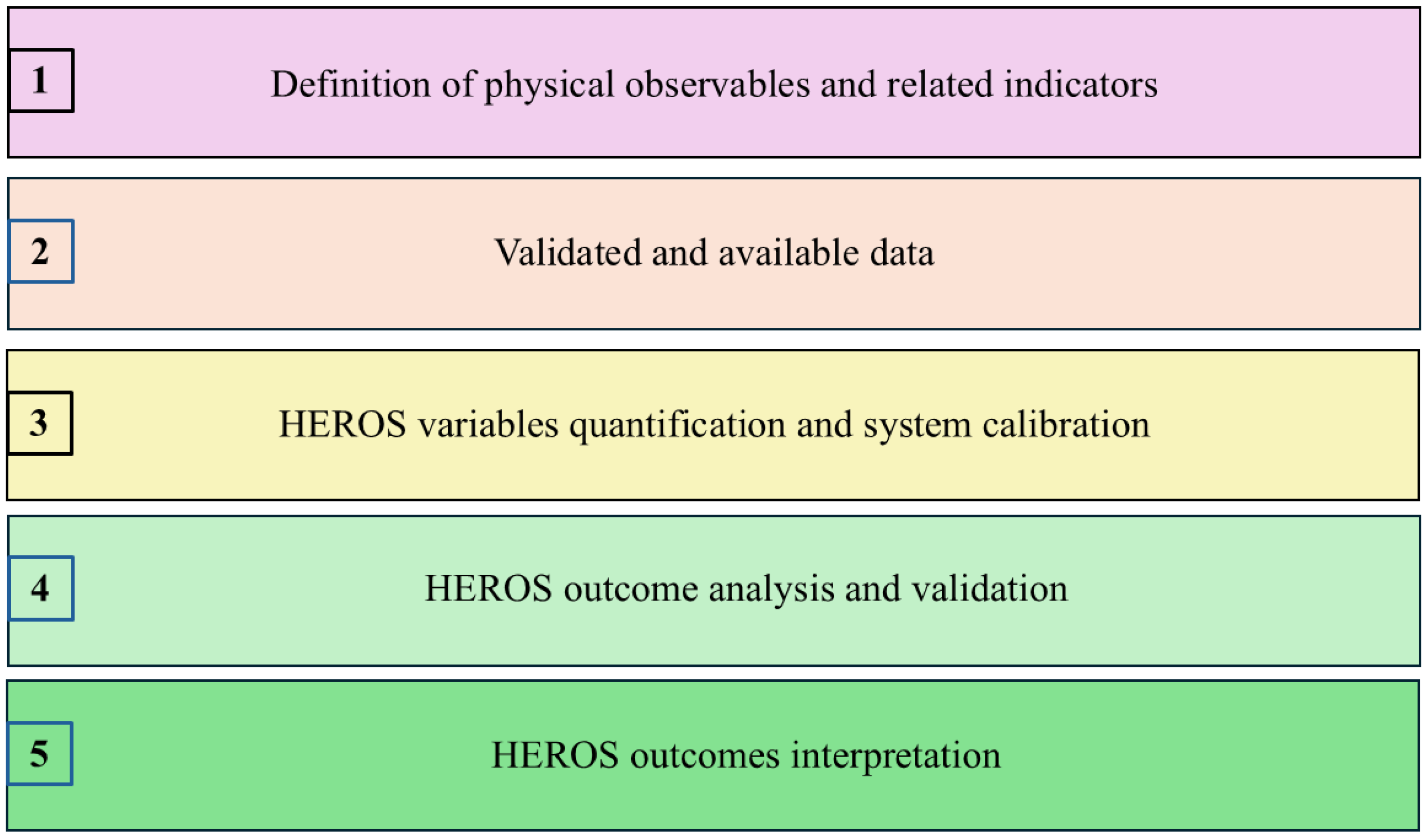
This simplified procedural example shows how HEROS could be operationalized from available evidence while remaining within the scope of a Perspective article. The aim is not to demonstrate that Paestum has already been fully assessed through HEROS but to show how a future assessment could proceed: first by defining the system boundary, then by identifying HEROS stocks, then by selecting observable indicators, and finally by interpreting whether these indicators plausibly support heritage-related reductions in dissipation terms. Quantitative implementation would require additional steps, including the definition of baselines, empirical measurement of indicators, calibration of the relation between indicators and , and validation against independent data.
Table 2 does not imply that these indicators are already converted into availability units or dissipation coefficients. It shows how validated literature data and public datasets can be organized into the HEROS structure. In this simplified procedural example, the indicators are used to identify possible directions of
, while quantitative estimation remains a task for future empirical calibration.
The procedural logic summarized in
Table 2 can be further clarified through a schematic representation.
Figure 2 does not introduce an additional model or a different formalization. Rather, it visualizes the same sequence described above: available and validated data are first translated into observable indicators; these indicators are then associated with HEROS stocks and dissipation terms; finally, they support a cautious interpretation of possible heritage-related reductions in dissipation,
, which would require future empirical calibration. The diagram is therefore intended as a guide to the operational pathway, not as a quantitative result.
4.5. Constraints, Methodological Challenges and Future Validation Needs
The HEROS perspective proposed in this article is intended to open a research direction rather than to provide a completed assessment method. For this reason, its constraints and methodological challenges must be explicitly acknowledged. The first limitation concerns empirical validation. The framework is theoretically grounded in system ecology, non-equilibrium thermodynamics, heritage studies, and One Health literature, but it has not yet been tested through a complete site-specific application. Consequently, HEROS should not be interpreted as a validated predictive model. Its current value lies in organizing heterogeneous evidence and in identifying plausible interaction pathways that can be tested in future empirical studies.
A second challenge concerns the definition of system boundaries. Immovable cultural heritage does not operate only within the physical limits of a building, monument, or archaeological site. Its potential effects may extend through landscape relations, ecological interfaces, practices, memory, visitor experience, and community use. This broader socio-ecological footprint is conceptually useful, but it also creates methodological difficulties. If the boundary is too narrow, relevant ecological and cultural interactions may be excluded. If it is too broad, the analysis may become difficult to operationalize, and the attribution of effects to heritage may become weak. Future applications will therefore need explicit boundary rules, depending on the scale of analysis, the available data, and the specific One Health question addressed.
A third limitation concerns the operationalization of availability and dissipation. In the HEROS perspective, availability is used as a physical proxy for organized resources, while dissipation represents the irreversible loss of organized availability, which may appear as environmental degradation, biological stress, loss of habitat function, physiological burden, cognitive overload, or behavioral instability. However, the translation of heterogeneous indicators into availability-related quantities is not automatic. Material stocks, ecological functions, symbolic meanings, and cognitive effects cannot be reduced to a single metric without careful assumptions. For this reason, the present article treats indicators as proxies that may support the interpretation of and , rather than as direct measurements of dissipation.
A fourth methodological challenge concerns calibration. In a future empirical application, the relation between observable indicators and heritage-related dissipation reductions would require baseline conditions, comparison scenarios, and empirical data. For example, interpreting a heritage structure as contributing to would require comparison with a baseline condition in which the structure is absent, degraded, replaced, or functionally disconnected from its landscape. Similarly, interpreting a heritage site as contributing to would require ecological evidence on refuge availability, species presence, connectivity, or reduced disturbance. In the human domain, interpreting heritage as contributing to would require psychological, behavioral, physiological, or socio-cultural indicators, ideally collected through reproducible protocols.
A fifth challenge concerns attribution. Environmental stability, animal persistence, and human wellbeing are influenced by many drivers, including climate, land-use policies, conservation practices, tourism pressure, socio-economic conditions, and ecological management. Heritage may contribute to these dynamics, but it is unlikely to act alone. Therefore, future HEROS applications should avoid deterministic interpretations and should treat heritage as one possible stabilizing component within a wider coupled system. Scenario analysis, sensitivity analysis, longitudinal monitoring, and comparative studies across similar sites may help distinguish heritage-related effects from other drivers.
A further risk concerns overextension of the One Health argument. The purpose of HEROS is not to medicalize cultural heritage, nor to claim that heritage directly produces health outcomes in a biomedical sense. Rather, the framework proposes that immovable heritage may influence some of the environmental, animal interface, and human conditions that One Health already recognizes as interdependent. This interpretation must remain cautious. The integration of heritage into One Health should be understood as a possible extension of preventive and environmental health thinking, not as a substitute for established public-health, ecological, or conservation approaches.
Finally, the framework requires interdisciplinary competence. A complete HEROS application would need inputs from heritage science, ecology, environmental physics, conservation, archaeology, geography, psychology, public health, and system modeling. This is both a strength and a constraint. The framework can promote integration across fields, but it also requires transparent assumptions, shared terminology, and careful communication among specialists. The simplified procedural example presented above illustrates a possible route, but it also shows that quantitative implementation remains a future task.
Considered together, these limitations do not invalidate the HEROS perspective. Instead, they define the conditions under which it can become scientifically useful. At the present stage, HEROS should be considered a conceptual and methodological scaffold. Its next development should include pilot applications, explicit baseline definitions, indicator selection protocols, uncertainty assessment, and empirical validation. Only through these steps can the proposed perspective move from theoretical plausibility to operational assessment without losing scientific transparency or overstating its present level of validation.
5. Implications for Research, Policy, and Sustainability
The perspective advanced in this paper has implications that extend across research, policy, sustainability, and broader societal interpretation of heritage. By proposing HEROS (HERitage One Health System) as an ecophysical perspective for rethinking heritage within coupled socio-ecological systems, the present work suggests that immovable heritage can be interpreted not only as a cultural asset but also as a persistent structural and informational component capable of influencing environmental, animal, and human stability.
A first implication concerns research. The perspective proposed here opens an interdisciplinary field at the intersection of heritage studies, system ecology, environmental health, neuroscience, and sustainability science. Its main contribution lies in offering a common interpretative language through which dispersed empirical findings may be brought into relation. Rather than remaining confined within separate studies—such as building physics, landscape ecology, environmental psychology, or public health—the effects associated with heritage can be discussed as part of a broader problem of system organization and stability. In this sense, HEROS may provide a conceptual basis for future developments, including more explicit formal representations, the construction of indicator systems, empirical case studies, and the integration of heritage-related variables into spatial, ecological, and health-oriented analyses.
A second implication concerns environmental and heritage policy. If heritage contributes, even indirectly, to the stabilization of environmental conditions, ecological interfaces, and human behavioral patterns, then its preservation may need to be reconsidered within broader governance strategies. This does not imply replacing existing heritage values, such as historical significance, aesthetic quality, or identity functions. Rather, it adds an additional layer of relevance: heritage may also matter because it participates in the long-term regulation of socio-ecological systems. From this perspective, conservation can be interpreted not only as cultural protection but also as a contribution to sustainability, environmental stewardship, and preventive approaches to systemic risk.
A third implication concerns economic interpretation. The perspective developed here supports a shift from viewing heritage primarily as a cost center or a tourism asset toward considering it as a form of long-term stability infrastructure. Preservation and adaptive reuse may, in many contexts, reduce material throughput, avoid repeated high-impact reconstruction cycles, and maintain forms of organization that continue to provide environmental, ecological, and social functions over time. This suggests that the economic significance of heritage could be discussed not only in terms of direct market value but also in relation to avoided environmental costs, reduced system volatility, and long-term resource efficiency.
A fourth implication concerns society more broadly. Heritage can be interpreted as a stabilizing component of collective continuity, not only because it preserves memory or identity, but because it contributes to the persistence of meaningful spatial references, behavioral coherence, and intergenerational knowledge transmission. From this perspective, the significance of heritage extends beyond symbolic representation: it includes the possibility that structural and informational continuity may contribute to resilience across multiple scales, from local ecological configurations to human cognitive and social stability.
Importantly, although the present article focuses primarily on immovable cultural heritage, the perspective outlined here is not limited to it. The same ecophysical logic may also apply to natural heritage, including forests, wetlands, rivers, geological formations, sacred natural sites, and other long-standing ecological structures that function as persistent environmental stocks. In this sense, heritage may be treated inclusively, encompassing cultural and natural, material and intangible dimensions, whenever they act as persistent structural or informational regulators of system stability. The mechanisms through which they operate may differ in empirical detail, but the underlying interpretative principle remains comparable.
This has a further conceptual consequence. The traditional separation between “natural” and “cultural” heritage appears increasingly artificial when viewed from the standpoint of coupled systems. Both may be better understood as parts of a broader structural–informational continuum shaped by long-term interactions between human societies and their environments. In parallel, the implicitly anthropocentric framing of One Health may also require refinement. A broader perspective might more coherently articulate the relation among abiotic subsystems, the biosphere, and the noosphere, within which both natural and cultural heritage could be interpreted as regulatory interfaces across planetary, biological, and cognitive domains.
These implications suggest that HEROS should not be understood simply as an additional heritage framework but as a possible shift in perspective. Its value lies in making visible a set of interactions that are already partially documented yet rarely interpreted within a unified logic. By doing so, it opens a path toward future work in which heritage may be more explicitly integrated into sustainability thinking, environmental governance, and health-oriented systemic approaches—without being reduced to either a purely economic category or a narrowly therapeutic one.
6. Conclusions
This article has proposed an ecophysical perspective for reinterpreting immovable cultural heritage within the broader context of coupled environmental, biological, and human systems. By bringing together evidence from building physics, landscape ecology, environmental psychology, and health-related research, it has argued that heritage may be more fruitfully understood not only as a cultural asset but also as a persistent structural and informational component of the human niche.
The perspective designated here as the HEROS (HERitage One Health System) framework does not aim, at this stage, to provide a fully operational model. Rather, it offers a conceptual framework for organizing a set of interactions that are already empirically documented but rarely interpreted within a unified logic. In this sense, its primary contribution lies in shifting the focus from heritage as representation toward heritage as a component of system organization, capable of influencing environmental regulation, ecological stability, and human cognitive and physiological dynamics.
This shift has broader implications for how heritage is positioned within sustainability and health-oriented frameworks. If heritage contributes to the stabilization of conditions across environmental, animal, and human domains, then its relevance extends beyond cultural policy into the domain of systemic governance. In this perspective, preservation can be interpreted not only as the protection of the past but also as a contribution to the long-term conditions under which socio-ecological systems maintain stability.
At the same time, the perspective developed here suggests the need to reconsider some of the conceptual boundaries that structure current debates. The distinction between “natural” and “cultural” heritage appears increasingly insufficient when both are understood as persistent configurations of matter, energy, and information interacting within the same system dynamics. Similarly, the One Health paradigm, while explicitly integrative, may benefit from a broader articulation that more clearly includes the abiotic domain alongside the biosphere and the sphere of human cognition and culture.
Within such an expanded view, heritage—both cultural and natural, material and intangible—can be interpreted as part of a regulatory interface linking planetary processes, biological systems, and human dynamics. In this sense, heritage does not stand outside health-related frameworks but may contribute to the conditions under which stability, resilience, and continuity emerge across scales.
Ultimately, the value of the perspective proposed here lies in opening a line of inquiry rather than closing it. Future research may further explore the formalization of these interactions, test their empirical relevance across different contexts, and investigate how heritage can be more explicitly integrated into sustainability strategies and One Health-oriented governance. By repositioning heritage within an ecophysical and system-oriented framework, this work aims to contribute to a more comprehensive understanding of its role in shaping long-term socio-ecological stability.