Review

PFAS in Aquatic Systems: Bioaccumulation Patterns and Implications of Advanced Water Treatment Limitations


by
Valentina-Andreea Petre
1,2,
Camelia Ungureanu
1,*,
Stefania Gheorghe
2 and
Florentina-Laura Chiriac
2,*
1
Faculty of Chemical Engineering and Biotechnologies, National University of Science and Technology Politehnica Bucharest, 313 Splaiul Independentei, Sector 6, 060042 Bucharest, Romania
2
Environmental Pollution Department, National Research and Development Institute for Industrial Ecology Ecoind, 57-73 Drumul Podu Dâmboviței, Sector 6, 060652 Bucharest, Romania
*
Authors to whom correspondence should be addressed.
Environments 2026, 13(6), 330; https://doi.org/10.3390/environments13060330
Submission received: 5 May 2026 / Revised: 5 June 2026 / Accepted: 8 June 2026 / Published: 10 June 2026

Abstract

Per- and polyfluoroalkyl substances (PFAS) are persistent contaminants of concern in aquatic environments because of their stability, mobility, and resistance to conventional degradation. This review examines PFAS remediation technologies in water and wastewater treatment, with emphasis on membrane filtration, advanced oxidation processes, and biological approaches. Although many studies have reported high removal efficiencies, the limitations of these techniques are numerous, including membrane fouling, high energy consumption, incomplete destruction, formation of short-chain transformation products, and the management of concentrated residual streams. As a result, PFAS remain bioavailable in receiving waters for biological uptake, leading to ecological consequences in aquatic systems. PFAS can enter organisms through water, diet, sediment contact, and maternal transfer, and their bioaccumulation is associated with growth inhibition, developmental toxicity, endocrine disruption, oxidative stress, immunotoxicity, neurobehavioral changes, and hepatic damage. These effects can persist even when treatment systems achieve reductions in water concentrations. Therefore, PFAS management should be assessed not only by removal efficiency but also by the capacity of treatment systems to reduce trophic exposure in food webs.

1. Introduction

Per- and polyfluoroalkyl substances (PFAS) are a broad class of synthetic organofluorine compounds used in many industrial and consumer products for decades. They are popular for their specific properties, including high thermal stability, resistance to chemical and biological degradation, and pronounced surfactant behavior [1,2]. A major factor in their environmental persistence is the strength of the carbon–fluorine (C-F) bond, which makes PFAS resistant to conventional degradation processes [1,3,4]. Once released into the environment, PFAS tend to remain highly mobile because of their chemical stability and low volatility. Many members of this compound class can also interact with organic tissues, promoting their bioaccumulation in aquatic organisms and generating concerns about their long-term environmental effect [1,5]. Consequently, the extensive occurrence of PFAS within aquatic environments has become a growing concern for regulatory authorities and the scientific community [6,7].
Beyond the European framework, significant regulatory developments have emerged across other major jurisdictions, revealing substantial inconsistencies in both approach and stringency. The United States Environmental Protection Agency (EPA) adopted legally enforceable Maximum Contaminant Levels (MCLs) for six PFAS in drinking water in April 2024, including 4 ppt for both PFOA and PFOS and 10 ppt for PFHxS, PFNA, and HFPO-DA (GenX), supplemented by a Hazard Index-based MCL for mixtures of PFHxS, PFNA, HFPO-DA, and PFBS [8]. These values are among the most stringent worldwide and are considerably lower than the EU parametric value of 100 ppt for the sum of 20 PFAS and 500 ppt for PFAS total under Directive (EU) 2020/2184, which entered into force across Member States in January 2026 [9]. Several European countries have adopted even stricter national limits: a 2 ppt threshold in Denmark for the sum of four PFAS, a 4 ppt recommended limit in Sweden, and a 20 ppt limit in Germany for PFAS-4 to take effect by 2028 [10]. In Canada, a drinking water objective of 30 ppt for the sum of 25 PFAS was established in 2024, while Australia revised its guideline values in June 2025 to 200 ppt for PFOA, 8 ppt for PFOS, and 30 ppt for PFHxS [11,12]. These disparities reflect divergent policy choices, differing interpretations of toxicological evidence, and varying analytical capabilities, creating a fragmented global regulatory landscape that complicates international trade and the consistent protection of aquatic ecosystems [10,12].
Several key challenges complicate the translation of these regulatory frameworks into effective risk assessment and management for aquatic environments. First, most current regulations target individual legacy PFAS (PFOA, PFOS, PFHxS) or a defined subset of compounds, while thousands of PFAS remain unregulated, and the industrial transition to short-chain and emerging alternatives (GenX, F-53B, ADONA) is outpacing regulatory updates [10]. This compound-by-compound approach enables regrettable substitution, where phased-out substances are replaced by structurally similar compounds with comparable or poorly characterized toxicological profiles. Second, the setting of health-based thresholds is hampered by fundamental data gaps: chronic toxicity data exist for fewer than 20 of the approximately 10,000 PFAS identified in commerce, and the mechanisms of mixture toxicity, particularly at the ng/L concentrations relevant to treated effluents, remain largely unknown [10,13]. Third, analytical limitations at ultra-trace levels complicate enforcement, as quantifying individual PFAS at single-digit ppt concentrations approaches the practical limits of current liquid chromatography-tandem mass spectrometry methods [8]. Fourth, a significant regulatory gap persists between industrialized and developing nations: many low- and middle-income countries lack comprehensive chemical management frameworks and have not ratified the Stockholm Convention amendments listing additional PFAS [10]. Addressing these challenges will require a shift toward class-based regulatory approaches, expanded international harmonization, and the integration of bioaccumulation metrics and adverse outcome pathways into regulatory risk assessment.
Current water treatment technologies encompass a range of physical, chemical, and biological processes designed to remove contaminants from water and wastewater. Conventional treatment methods, including coagulation, flocculation, sedimentation, and sand filtration, are generally ineffective against persistent trace contaminants such as PFAS. By contrast, advanced treatment technologies have been developed to address these limitations. Membrane filtration processes, particularly nanofiltration (NF) and reverse osmosis (RO), operate through size exclusion and electrostatic interactions to retain dissolved contaminants [14,15]. Adsorption onto activated carbon and ion-exchange resins is widely applied for the removal of organic micropollutants [16]. Advanced oxidation processes (AOPs), including photocatalysis, ozonation, and electrochemical oxidation, generate highly reactive radical species capable of degrading refractory compounds [17,18]. Biological treatment approaches, such as activated sludge and constructed wetlands, rely on microbial metabolism for contaminant transformation [19]. Each of these technologies presents distinct advantages and limitations regarding removal efficiency, energy consumption, operational complexity, and waste generation [4].
Municipal and industrial wastewater treatment plants represent the main pathways through which PFAS are released into rivers, lakes, estuaries, and coastal environments [20,21]. Conventional treatment processes were not designed to target PFAS, so their removal is limited for many compounds [22]. Even when advanced treatment technologies are implemented, removal is often incomplete, variable depending on the PFAS compounds, and in some cases can transform precursor species into more stable terminal PFAS [4,23]. As a result, PFAS are frequently detected in treated effluents, surface water, groundwater, sediments, and aquatic organisms in urbanized and industrial regions [1,5,24,25].
Within aquatic ecosystems, PFAS have been reported in a broad range of organisms, including plankton, aquatic invertebrates, fish, amphibians, birds, and mammals [5,6,26]. Their bioaccumulation profiles vary by species and tissue, depending on chain length, functional groups, protein affinity, and physiological processes [26,27]. Most research on PFAS-exposed organisms reports multiple biological effects, such as behavioral changes, reproductive and developmental impairments, immunotoxic responses, endocrine disturbances, and disruptions in energy metabolism [5,6,7].
A bibliometric analysis of PFAS-related aquatic research (2015–2026) is presented in the Supplementary Materials (Figures S1–S3), illustrating the evolution of research interest from occurrence and distribution toward treatment efficiency, degradation mechanisms, and ecological implications.
The connection between water treatment performance for PFAS and ecological outcomes in receiving waters is an area that requires additional exploration [4]. Existing research indicates that traditional treatment methods can remove a significant percentage of PFAS (80–85%) [4], while complete removal, especially of short-chain PFAS, remains a challenge [4]. Furthermore, standardized bioassays for toxicity assessment are still under development [4]. Despite these outcomes, a systematic analysis linking improved water treatment efficacy to lower bioaccumulation or reduced biological effects in the environment is largely missing from the literature.
The objective of this literature review is to integrate current knowledge on PFAS occurrence, bioaccumulation, and biological consequences in aquatic systems within the explicit context of the capabilities and limitations of current water and wastewater treatment technologies. Specifically, the review aims to: (i) summarize the physicochemical properties that control PFAS persistence, mobility, and partitioning in aquatic environments; (ii) synthesize available data on their occurrence in major aquatic compartments and the pathways governing their distribution; (iii) evaluate the performance and limitations of advanced treatment technologies for PFAS removal; (iv) examine how residual contamination contributes to bioaccumulation across aquatic organisms and trophic levels; and (v) compile the main biological and ecotoxicological responses associated with PFAS exposure.

2. Physicochemical Properties of PFAS

PFAS contain at least one perfluorinated carbon moiety (-CnF(2n+1)-) or (-CnF(2n)-) attached to a functional group, such as carboxylate (-COO) or sulfonate (-SO3) [28,29]. Major structural subclasses include perfluoroalkyl carboxylic acids (PFCAs) (e.g., PFOA) and perfluoroalkyl sulfonic acids (PFSAs), such as PFOS; together, these fully fluorinated acids are collectively referred to as perfluoroalkyl acids (PFAAs) [28]. Another major class comprises fluorotelomers, which transition from a perfluorinated segment to one or more non-fluorinated carbons and includes subclasses such as fluorotelomer alcohols (FTOHs) and fluorotelomer sulfonates (FTSAs) [29].
PFAS alternatives include ether- and chlorinated ether-based compounds (e.g., HFPO-DA/GenX, 6:2 Cl-PFESA), perfluoroalkyl ether carboxylic acids (PFECAs, e.g., ADONA), perfluoroalkyl ether sulfonates (e.g., Nafion byproducts), and fluorotelomer sulfonates (e.g., 6:2 FTS, F-53B), which have been introduced as replacements for legacy PFAS in industrial applications [29,30]. Ultrashort-chain PFAS (C2–C3: trifluoroacetic acid—TFA, perfluoropropanoic acid—PFPr) represent an additional class of increasing environmental concern due to their extreme mobility, high resistance to degradation, and potential for widespread atmospheric transport and deposition [31].
PFAS precursors, including sulfonamides, sulfonamidoethanols, and polyfluoroalkyl phosphate esters, are environmentally relevant because they can degrade to terminal PFAAs such as PFOS and PFOA in soils, sediments, and the atmosphere [30].
Despite their growing environmental relevance, the physicochemical properties and environmental fate of emerging PFAS alternatives and ultrashort-chain compounds remain poorly characterized compared to legacy PFAS (PFOA, PFOS). Key knowledge gaps include: (i) the partitioning behavior of ultrashort-chain PFAS in air-water-soil systems; (ii) the transformation pathways and terminal degradation products of emerging fluorinated alternatives under realistic environmental conditions; and (iii) the potential for additive or synergistic effects in PFAS mixtures, which are rarely addressed in current studies [31]. Carbon-chain length serves as a fundamental organizing principle. Long-chain PFAS, specifically perfluorocarboxylic acids (PFCAs) with seven or more fully fluorinated carbons and perfluorosulfonic acids (PFSAs) with six or more, exhibit lower water solubility, greater sorption, and increased bioaccumulation compared to their short-chain counterparts. Structural features such as ether and branched configurations, alternative halogen substitutions, and mixed perfluoro-/polyfluoro- segments further increase complexity and can substantially influence environmental behavior [29]. The introduction of ether linkages increases PFAS mobility by reducing sorption affinity. Branched isomers typically exhibit lower bioaccumulation than linear forms due to differences in partitioning and enzymatic recognition. The presence of chlorine or other halogen substitutions may enhance degradation potential under specific conditions, but these modifications can also alter partitioning and toxicity. Consequently, such structural variations result in significant differences in mobility, persistence, and environmental distribution among PFAS compounds [31,32,33].
The high electronegativity and small atomic radius of fluorine result in the carbon–fluorine (C-F) (531.5 kJ/mol) bond being among the strongest single bonds in organic chemistry [3]. Further substitution of carbon with fluorine atoms shortens the bond length and increases the bond energy. As a result, perfluoroalkyl acids are highly resistant to oxidants and elevated temperatures, nearly inert to hydrolysis and direct photolysis under environmental conditions, and poorly metabolized by most organisms, rendering them terminal products in many degradation pathways. This intrinsic stability underlines the designation of PFAS as “forever chemicals” [3,28]. Certain PFAS subclasses, particularly those containing chlorine substitutions or ether linkages, can be more prone to transformation under reductive conditions or during photochemically driven processes, depending on the environmental or treatment context. Additionally, emerging treatment approaches, such as advanced oxidation and reduction processes, demonstrate potential for the partial or complete degradation of selected PFAS compounds, particularly when driven by mechanisms involving photocatalysis, hydrated electrons, or high-energy irradiation [34]. Although these processes remain largely confined to laboratory-scale investigations, they define an active research area with implications for the development of more effective remediation strategies [35,36].
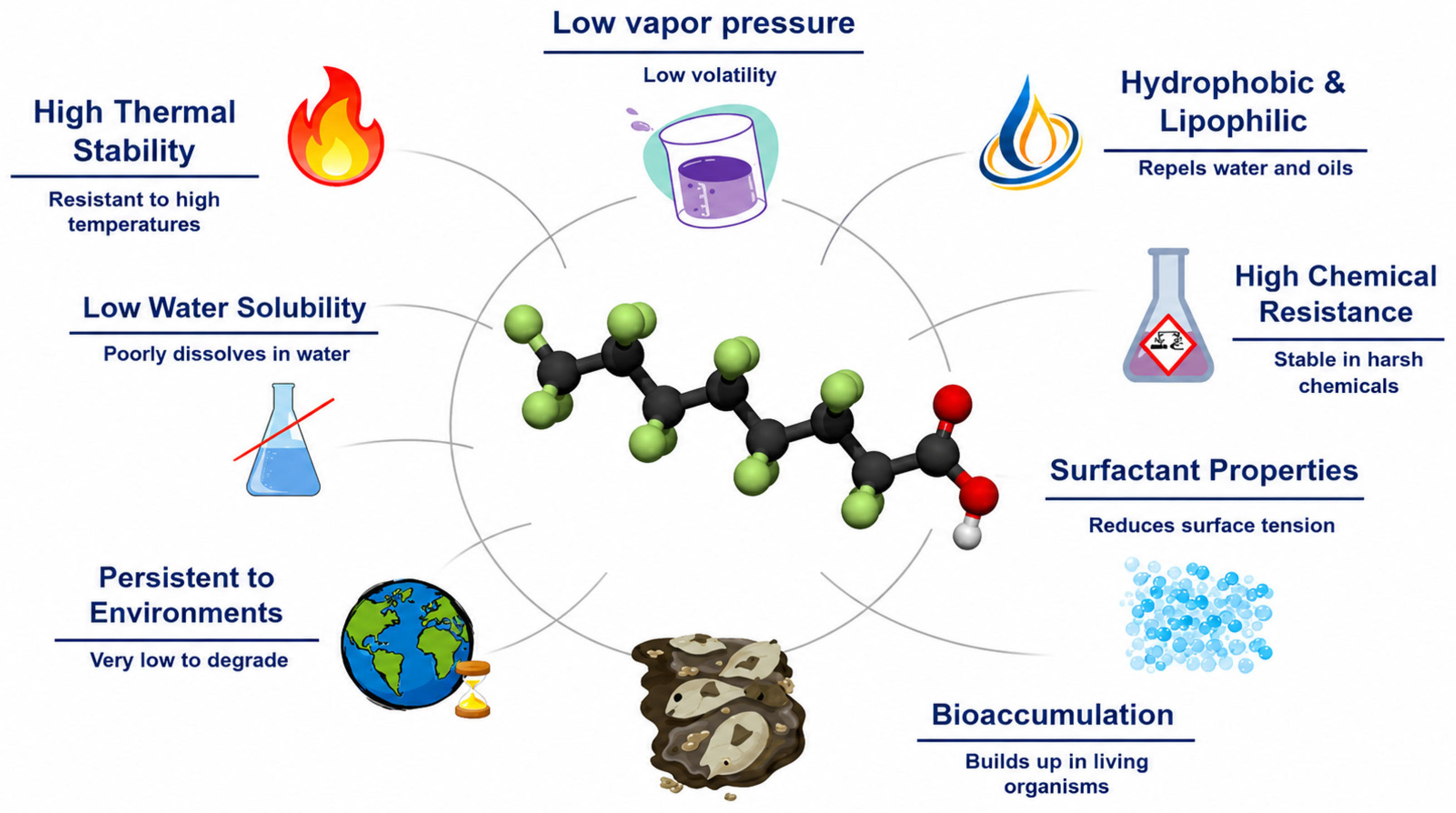
Most perfluoroalkyl acids (PFAAs), including perfluorocarboxylic acids (PFCAs) and perfluorosulfonic acids (PFSAs) are strong acids characterized by very low pKa values [37]. Consequently, they predominantly exist as anions in surface water, groundwater, and porewater within the typical environmental pH range of 5 to 9. In their anionic form, these compounds exhibit high aqueous solubility, particularly among short-chain congeners. Many per- and polyfluoroalkyl substances (PFAS) with polar headgroups demonstrate solubility exceeding 1000 mg/L [38]. Short-chain PFAs and many ionized PFASs therefore behave as highly mobile, largely waterborne contaminants. Increasing perfluorinated chain length reduces solubility and generally increases sorption to organic carbon and mineral surfaces [28,39]. Ionic strength and cation composition can also strongly affect solubility: PFOS, for example, shows reduced solubility in seawater and CaCl2 solutions relative to pure water, consistent with salting-out and cation bridging effects [40]. Amphiphilicity drives accumulation at air-water, oil-water, and solid-water interfaces and allows PFAS to form micelles or hemi-micelles at higher aqueous concentrations [39]. The main physicochemical properties that govern PFAS environmental distribution, including persistence, low volatility, chemical stability, and bioaccumulation potential, are illustrated in Figure 1.
Sorption coefficients (Kd, Koc) increase with the perfluoroalkyl chain length. Perfluoroalkyl sulfonic acids (PFSAs) exhibit stronger sorption than perfluoroalkyl carboxylic acids (PFCAs) of equivalent chain length [39]. PFAS carboxylates with chain lengths ≥ C10 are transported predominantly in association with suspended solids, whereas PFOA and PFHxS occur mainly in the aqueous phase [40,41]. Hydrophobic sulfonamides, including N-ethyl perfluorooctane sulfonamide (N-EtFOSA) and N-ethyl perfluorooctane sulfonamidoethanol (N-EtFOSE) are sorbed to particulates at rates exceeding 90%. Conversely, perfluorooctane sulfonic acid (PFOS), PFOA, and PFHxS remain largely in the aqueous phase [39]. These distinctions in sorption behavior have direct environmental implications. Compounds in the dissolved phase demonstrate increased mobility and may be transported across extensive distances within aquatic systems, thereby elevating the risk of diffuse contamination.
In contrast, strongly sorbed PFAS exhibit reduced mobility but may accumulate in sediments, contributing to long-term environmental persistence and posing challenges for remediation. Understanding these distribution patterns is essential for designing effective management and remediation strategies at PFAS-impacted sites.

3. Occurrence and Pathways of PFAS in Aquatic Environments

3.1. Occurrence in Surface Water and Groundwater

PFAS are frequently detected in both surface and groundwater, with concentrations varying with proximity to contamination sources and hydrological conditions. Global data show PFAS can be nearly undetectable in pristine groundwater (<0.003 ng/L), yet reach very high levels in contaminated aquifers (up to 51,000 ng/L) [42]. In river systems, typical concentrations are in the ng/L range; for example, the Naknong River Basin showed values between 9.28 and 171.40 ng/L, with the highest concentrations near industrial and wastewater-affected areas [43]. Moreover, in Romanian surface waters, PFAS concentrations reached approximately 35 ng/L upstream and 45 ng/L downstream, with PFOS, PFOA, and PFNuDA among the dominant compounds in downstream samples [25]. These results show the influence of contamination sources on PFAS levels [25,43].
Similarly, urban river systems in developing areas show consistent PFAS presence, with total concentrations ranging from 23.96 to 89.35 ng/L in surface waters, where perfluorooctanoic acid (PFOA) accounted for 34–59% of total PFAS due to its high solubility and continued industrial use [44]. In drinking water sources, multi-compound screening detected up to 32 PFAS, dominated by perfluoroalkyl carboxylic acids (PFCAs) and sulfonic acids (PFSAs), with spatial variability influenced by riverine inputs and local contamination sources such as airport runoff [45].
Thus, anthropogenic activities—industrial discharge, urban runoff, and wastewater effluents—are primary drivers of PFAS distribution in aquatic systems. Hydrological connectivity further enables PFAS to spread regionally, highlighting the close link between human actions and environmental PFAS occurrence [25,31,32,33].
Recent studies have increasingly detected ultrashort-chain PFAS in aquatic environments. Trifluoroacetic acid (TFA), the shortest perfluoroalkyl carboxylic acid (C2), has been found in surface waters at concentrations reaching several ug/L, often exceeding those of legacy PFAS, due to its extreme mobility and resistance to degradation [45]. Similarly, perfluoropropanoic acid (PFPr, C3) and perfluorobutanoic acid (PFBA, C4) have been identified as dominant PFAS in groundwater impacted by atmospheric deposition and industrial sources [39,42]. Despite these findings, monitoring data for ultrashort-chain and emerging alternative PFAS remain scarce, as most analytical methods are optimized for C4-C14 PFAS and may not capture these highly polar, low-molecular-weight compounds. The development of sensitive analytical protocols for ultrashort-chain PFAS is urgently needed to fully assess their environmental distribution and risks [31,37].

3.2. Occurrence in Wastewater Effluents and Point Sources

Wastewater treatment plants (WWTPs) are key nodes in the environmental cycling of PFAS because they receive contaminants from industrial production, consumer-product use, firefighting foams, and related urban sources, yet conventional treatment is not designed to fully remove these highly persistent compounds [43,45]. PFAS therefore remain detectable in influents, effluents, sludge, and downstream waters, and treated discharges can continue to act as a source of contamination for receiving aquatic systems [25,43]. Biosolids and wastewater residuals may further contribute to environmental dissemination, extending contamination beyond the treatment plant itself. In 19 Australian wastewater treatment plants, the 21 PFAS analyzed across four classes were detected in all samples. Mean total concentrations were 110 ng/L in aqueous matrices and 34 ng/g dw in solids. PFHxA, PFOA, and PFOS were among the dominant compounds, and PFBA reached 370 ng/L in the final effluent [46].
At the same time, in a Romanian WWTP study, nine PFAS were measured in five treatment plants, with PFOA and PFOS consistently dominating across matrices. Influent concentrations reached 105 to 316 ng/L, while effluents still contained 14.8 to 31.3 ng/L, indicating incomplete removal despite reported efficiencies above 80% for total PFAS in some plants. Sewage sludge also contained substantial burdens, with PFOA up to 35.8 ng/g dw (dry weight) and PFOS up to 27.8 ng/g dw, and downstream river waters generally showed higher concentrations than upstream sites, confirming WWTPs as an important source of PFAS to surface waters. The same study reported PFOA mass loading of up to 237 mg/day/1000 people and highlighted potential human-health concerns for surface waters used as drinking-water sources, particularly for PFOS and in children [25].

3.3. Occurrence in Sediments

Sediments act as both reservoirs and secondary sources of PFAS, especially for long-chain types that bind more easily. Reported sediment concentrations usually range from low to tens of ng/g dw. For example, values ranging from 2.18 to 11.67 ng/g were observed in urban rivers, with PFOS present largely due to its strong binding and persistence [44].
At larger scales, PFAS were detected in 86% of sediment samples, with concentrations up to 23 ng/g dw. Unidentified precursor compounds accounted for up to 58% of total PFAS, underscoring that transformation processes might delay PFAS release into water [47]. Sediment PFAS contamination is most severe near industrial and urban areas and is additionally influenced by activities such as airport operations, where fluorotelomer-based compounds are common [43]. This demonstrates clear patterns associated with human land use [47].

3.4. Occurrence in Marine Environments

PFAS are widely detected in marine environments, with the Romanian Black Sea showing a clear compartment-specific pattern: PFOA was dominant in seawater, reaching up to 112 ng/L, while PFOS prevailed in sediments and macroalgae, with maximum concentrations of 613 ng/g dw and 68.3 ng/g dw, respectively. This distribution indicates that more mobile short-chain compounds remain mainly in the dissolved phase, whereas more hydrophobic homologues preferentially partition to sediments and biota [48]. Spatially, the highest concentrations were recorded near the Danube outflow, supporting riverine discharge as a major pathway for PFAS input into the Black Sea. Overall, the sediment compartment remains particularly important, as it can act both as a sink and as a potential secondary source of PFAS, while the Black Sea, as a semi-enclosed basin, promotes contaminant retention and long-term exposure for benthic organisms and marine food webs [48].
The occurrence of emerging PFAS alternatives in marine ecosystems is still poorly documented. While GenX and ADONA have been detected in coastal waters and marine biota at low ng/L concentrations, data on their bioaccumulation and long-term fate in marine food webs are virtually nonexistent [49]. The presence of PFAS precursors in marine sediments adds further complexity, as these compounds may undergo transformation to terminal PFAAs, sustaining long-term contamination even after source reduction [46]. Future studies should include targeted monitoring of emerging PFAS and precursors in marine compartments to evaluate their contribution to the overall PFAS burden and potential ecological risks.

3.5. Transportation Pathways and Environmental Distribution

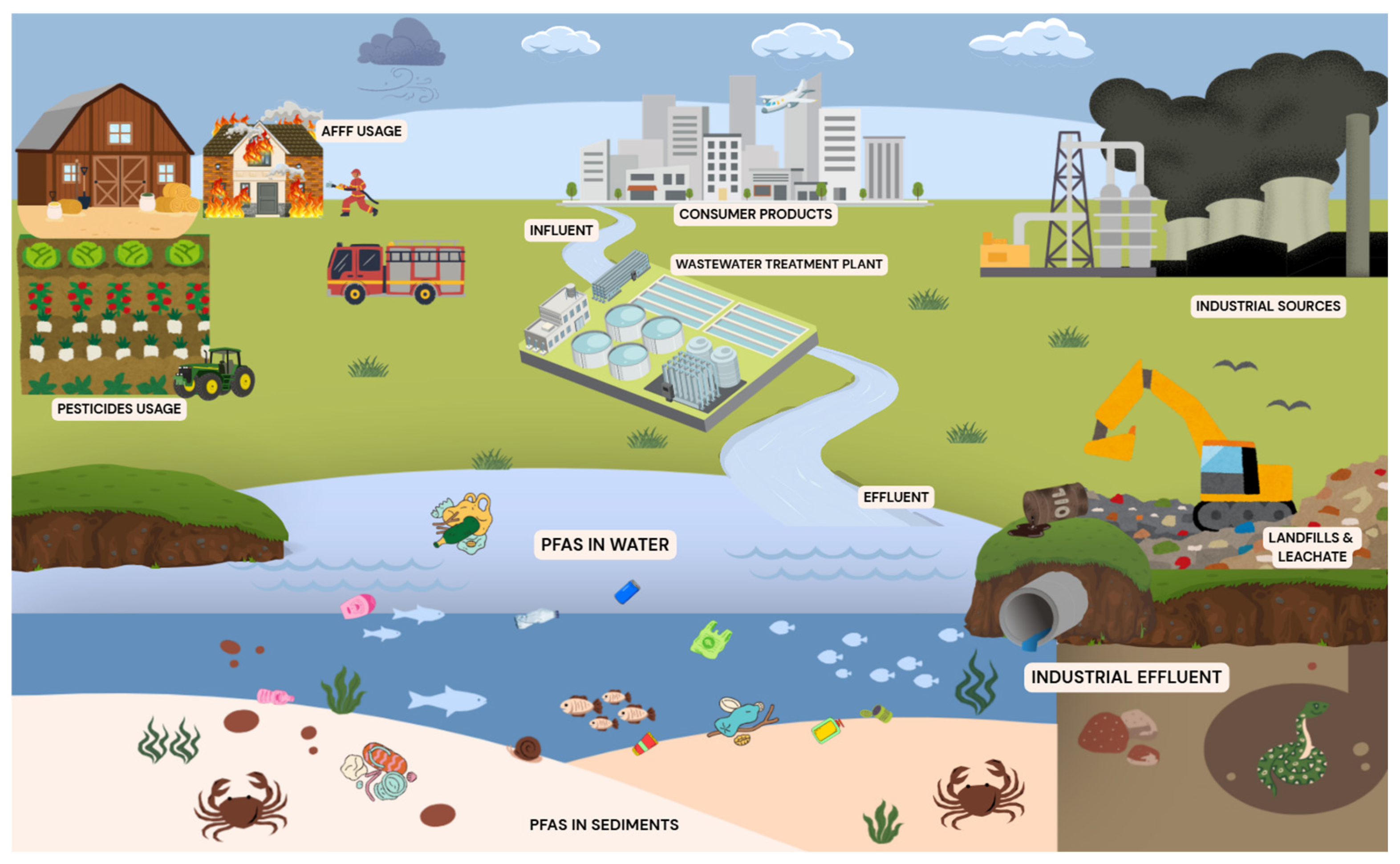
PFAS distribution within aquatic systems depends on direct emissions, environmental transport, and physicochemical partitioning [38]. Main pathways include wastewater discharge—continuous input from effluents into rivers and lakes, surface runoff—mobilization from urban areas, agricultural land, and contaminated soils, atmospheric deposition—long-range transport and subsequent deposition into water bodies, and groundwater flow—subsurface transport from contaminated sites, including landfills and industrial areas (Figure 2) [43,44].
These pathways result in widespread PFAS presence across connected water, sediment, and biota compartments. Notably, PFAS have high water mobility due to their amphiphilic nature, which allows them to travel long distances from point sources, reaching remote environments. This finding explains their global distribution [42,49,50].
Interactions with other environmental matrices additionally affect PFAS fate. For example, micro (nano) plastics can adsorb PFAS, acting as carriers that improve PFAS mobility in water [50,51]. Additionally, parameters such as pH, salinity, ionic strength, and temperature play key roles in PFAS occurrence and partitioning. This demonstrates the complex factors controlling PFAS distribution [49].

3.6. Link Between Occurrence and Bioaccumulation Pathways

The presence of PFAS in water and sediments is directly linked to their bioaccumulation in aquatic organisms through uptake from water, ingestion of contaminated sediments, and trophic transfer. Field data shows significant bioaccumulation, with fish tissue concentrations reaching up to 13,900 ng/g, demonstrating the environmental relevance of aquatic contamination [42]. In contaminated ecosystems, PFAS are transferred along food webs, leading to accumulation in higher trophic levels and long-term ecological risks [52].
PFAS presence in aquatic systems is driven by continuous anthropogenic inputs, inefficient removal during conventional treatment, and complex transport processes. Their persistence and mobility result in contamination across water, sediments, and biota, while precursor transformation complicates their environmental behavior [31,32]. These aspects point out the need for integrated monitoring approaches that account for both environmental concentrations and exposure pathways [42,43,44]. In this context, the link between incomplete removal and bioaccumulation illustrates the limitations of present treatment systems. Consequently, advanced water treatment technologies have gained increasing attention, although their effectiveness is assessed not only by removal efficiency but also limited by their ability to restrict residual concentrations that sustain bioaccumulation in aquatic ecosystems [33,37].
A particularly important knowledge gap concerns the bioaccumulation potential of ultrashort-chain PFAS and emerging alternatives. Due to their low log Kow values, ultrashort-chain PFAS are not expected to bioaccumulate in lipid-rich tissues; however, they may accumulate in protein-rich compartments or via specific transport mechanisms that remain poorly understood [32]. Furthermore, precursor compounds can act as a hidden source of PFAS exposure, as their biotransformation within organisms may generate more persistent and toxic terminal PFAS [27]. Investigating these indirect exposure pathways is critical for accurate risk characterization.

4. Advanced Water Treatment Technologies and Their Limitations

4.1. Membrane Filtration Technologies: Removal Performance and Limitations

Membrane filtration technologies, particularly nanofiltration (NF) and reverse osmosis (RO), are among the most effective approaches for reducing PFAS concentrations in contaminated waters [14]. These pressure-driven processes operate through semi-permeable membranes with defined molecular weight cut-offs (MWCO), enabling the separation of dissolved contaminants via steric exclusion and electrostatic interactions [15,34].
Reverse osmosis membranes, characterized by dense polymeric structures and high selectivity, typically achieve rejection efficiencies over 99% for a wide range of PFAS, including both long-chain (e.g., PFOA, PFOS) and short-chain compounds [15]. In contrast, nanofiltration membranes perform at lower pressures and short-chain compounds [15]. In contrast, NF membranes operate at lower pressure and exhibit more variable performance, with removal efficiencies generally ranging from approximately 60% to >99%, depending on membrane properties and water chemistry [53]. Low-pressure membranes (microfiltration and ultrafiltration) are largely ineffective for PFAS removal unless combined with adsorption processes [34].
Recent developments include modified and mixed-matrix membranes incorporating nanomaterials or functional polymers, which have displayed augmented PFAS removal (>99%) at the laboratory scale. However, their long-term reliability and scalability remain uncertain [15]. In particular, from the perspective of aquatic systems, membrane processes should be regarded as separation and concentration technologies rather than complete removal solutions, as PFAS are not degraded but redistributed between the effluent and membrane concentrate [15,34].
Membrane filtration has been tested for a wide variety of PFAS, covering concentration ranges from ng/L in drinking water to μg/L in contaminated groundwater. Pilot-scale studies treating aqueous film-forming foam (AFFF)—contaminated groundwater (total PFAS ~ 14.3 μg/L) reported rejection efficiencies greater than 99% for RO and 97.9–99.8% for NF across multiple PFAS classes, including carboxylates and sulfonates [14]. Building on this evidence, nanofiltration applied to drinking water reduced PFAS concentrations by approximately 98%, achieving permeate levels of ~1.4 ng/L [54]. Laboratory studies also indicate that nanofiltration can remove both legacy and emerging PFAS (e.g., perfluoroalkyl ether acids and fluorotelomer sulfonates) with efficiencies ranging from 66% to >99%, depending on membrane characteristics [55].
Despite these high removal efficiencies, residual PFAS concentrations in treated water often remain in the ng/L range [54]. Such levels are environmentally relevant, as they fall within the domain associated with chronic exposure and bioaccumulation in aquatic organisms. Moreover, removal efficiency is compound-dependent: long-chain PFAS are retained, while short-chain, emerging PFAS present lower rejection and higher mobility, leading to shifts in PFAS composition in treated effluents [15,56].
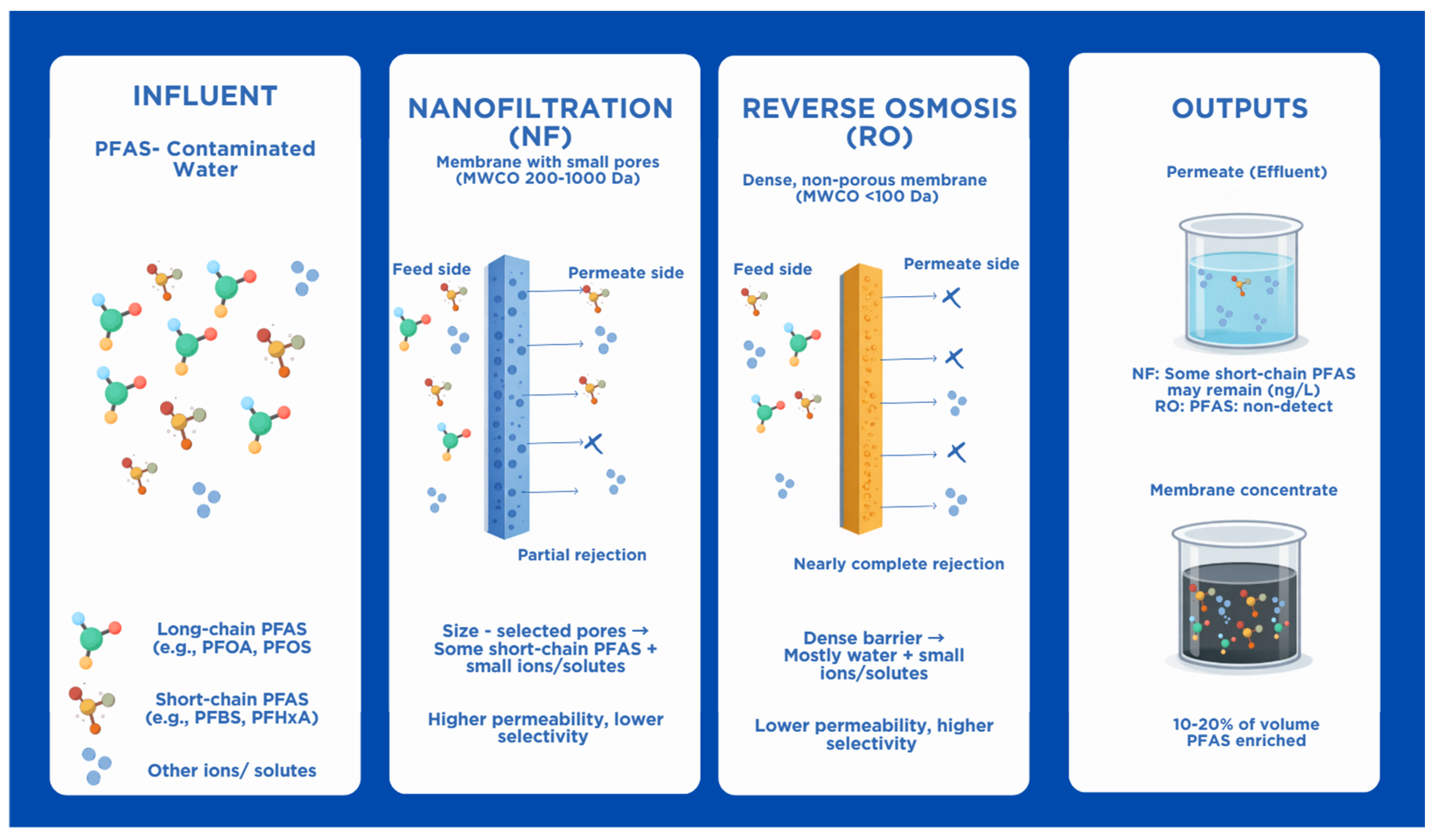
PFAS rejection by NF and RO membranes is governed by multiple physicochemical mechanisms. The primary mechanisms are steric obstruction and electrostatic exclusion, with additional contributions from hydrophobic interactions and adsorption onto membrane surfaces [15,53,56]. Exploring these mechanisms provides insight into how retention varies and informs the factors discussed below (Figure 3).
Retention efficiency is strongly influenced by PFAS molecular properties, including chain length, molecular weight, and functional group [14,55,56]. Long-chain PFAS and sulfonates generally display greater rejection than shorter-chain carboxylates [14]. Membrane characteristics such as MWCO, pore size distribution, permeability, and surface charge are equally important, with tighter membranes (RO and tight NF) providing superior selectivity [53,55,56].
The composition of the water matrix also plays an important role. Dissolved organic matter can promote fouling and reduce membrane performance, while ionic strength and divalent cations (e.g., Ca2+, Mg2+) can alter electrostatic interactions and influence PFAS rejection [53]. While these matrix effects are acknowledged, their impact is most pronounced in challenging real-world applications. In landfill leachate, characterized by high dissolved organic carbon (DOC > 1000 mg/L), elevated ionic strength, and complex contaminant mixtures, membrane fouling is significantly accelerated, leading to reduced flux, increased energy demand, and altered rejection characteristics over prolonged operation [53]. The high organic and inorganic load can cause both reversible and irreversible fouling, with organic fouling being particularly detrimental to PFAS rejection due to pore blockage and cake layer formation [53]. In seawater and brackish water, the high salinity and presence of divalent cations compress the electrical double layer of charged membrane surfaces, reducing electrostatic repulsion of anionic PFAS and potentially compromising rejection of short-chain compounds [40,53]. The competitive effects of co-existing anions (e.g., Cl, SO42−, HCO3) remain insufficiently characterized. In industrial wastewater, PFAS concentrations can span several orders of magnitude (ng/L to mg/L levels), and the presence of organic solvents, surfactants, and high suspended solids can affect both membrane integrity and separation performance [23]. Systematic studies evaluating membrane performance under realistic and variable feedwater conditions are urgently needed to guide technology selection and process optimization.
Operating parameters, including pressure, pH, and recovery rate, also influence performance, with higher recovery conditions leading to reduced rejection due to concentration polarization [14]. Although membrane filtration achieves substantial reductions in aqueous PFAS concentrations, several limitations constrain its potency in protecting water ecosystems [34]. A key challenge is the generation of PFAS-enriched concentrate streams, typically accounting for 10–20% of the treated volume and containing PFAS concentrations several times higher than those in the influent [54]. Without appropriate management, these streams act as secondary sources of contamination. The management of these concentrated streams remains an unresolved challenge. When membrane concentrates are subjected to further treatment, PFAS can be transferred to the solid phase and associated biosolids. The subsequent land application of PFAS-laden biosolids can reintroduce these contaminants into agricultural soils and receiving waters, creating a cycle of contamination that current technologies fail to fully address [25,46]. Integrated strategies combining membrane separation with downstream destructive technologies for concentrate treatment are essential to prevent secondary pollution and to close the PFAS loop in wastewater management [34,54].
In addition, membrane fouling and high-energy requirements, particularly in RO systems, increase operating costs and limit large-scale applicability [15]. The reduced removal efficiency for short-chain PFAS further contributes to their persistence in treated effluents [53,54].
From an ecological perspective, even though membrane filtration achieves high apparent removal efficiencies, the persistence of residual PFAS at ng/L levels and the incomplete removal of mobile compounds continue to allow exposure, trophic transfer, and bioaccumulation in aquatic organisms [54]. Thus, membrane filtration alone does not fully mitigate environmental risks [52]. These findings highlight a major gap between technological performance and ecological protection. Membrane filtration effectively reduces bulk PFAS concentrations but does not eliminate them, pointing out the need for integration with downstream destructive technologies to limit long-term accumulation in aquatic systems [52,54].
At these residual concentrations, long-chain PFAS that permeate the membrane can still activate peroxisome proliferator-activated receptor alpha (PPARa) in fish hepatocytes, triggering the lipid metabolism disruption and hepatocellular vacuolation documented at environmentally relevant internal doses [57,58]. Meanwhile, the preferential permeation of short-chain PFAS yields effluents enriched in compounds with higher mobility and affinity for liver fatty-acid-binding protein (LFABP), facilitating their distribution to protein-rich tissues and sustaining chronic exposure pathways even at ng/L levels [15,56,59].
Regarding the scalability, energy, and cost considerations, RO and NF are commercially mature technologies, with full-scale installations operational in drinking water treatment and desalination (TRL 9) [14,15]. Energy consumption typically ranges from 3 to 6 kWh/m3 for RO and 2–4 kWh/m3 for NF, constituting the primary operating cost [15]. Capital costs remain high relative to adsorption-based alternatives, and membrane replacement due to fouling can add 10–20% to annual operating expenses [53]. The management of PFAS-enriched concentrate streams (10–20% of feed volume) represents an additional cost burden that is often underestimated in economic assessments [54].
The removal of emerging PFAS alternatives and ultrashort-chain PFAS by membrane processes presents additional challenges. Short-chain PFAS, including PFBA, PFHxA, and the alternative HFPO-DA (GenX), exhibit lower rejection rates compared to long-chain compounds due to their smaller molecular dimensions and higher mobility, with reported removal efficiencies ranging from 20% to 80% for NF and above 90% for RO under optimized conditions [15,55]. The presence of multiple PFAS classes in real water matrices further complicates performance prediction, as competitive effects and membrane fouling can alter rejection behavior. Systematic studies evaluating membrane performance for the full spectrum of PFAS, including ultrashort-chain and emerging alternatives, are needed to guide technology selection and process optimization [56].

4.2. Advanced Oxidation Processes (AOPs)

Advanced oxidation processes (AOPs) operate through the in situ generation of highly electrophilic species, primarily hydroxyl (∙OH) and sulfate (SO4) radicals [42]. While these radicals possess sufficient redox potential to degrade a wide array of persistent organic pollutants, the perfluorinated chain of PFAS presents a unique kinetic challenge [60]. The extreme dissociation energy of the C-F bond generally precludes direct oxidative cleavage, necessitating degradation pathways dominated by electron transfer and sequential defluorination. This stepwise breakdown frequently results in the formation of short-chain perfluoroalkyl acids, which, due to their heightened water solubility and environmental mobility, pose sustained risks regarding bioavailability and aquatic bioaccumulation [61,62].
Comparative analysis of experimental data underscores the influence of matrix composition and molecular architecture on AOPs’ efficacy. Experimental evaluations reveal that standalone thermal or irradiation-based methods, such as microwave (MW) systems, lead to limited mineralization; for instance, PFOA degradation efficiencies remain restricted to a 3.1–5.2% range even under high-temperature conditions [63]. Similarly, sulfate radical-based oxidation without exogenous activation demonstrates poor performance in complex matrices, yielding only 12.7% degradation in landfill leachate [64]. These findings highlight that single-activation approaches are insufficient to effectively overcome the kinetic stability of the perfluorinated carbon structure. Similarly, despite the localized pyrolytic conditions (~5000 K) and high pressures (~500 atm) generated in ultrasonic systems, PFOS removal remains modest, with efficiencies of about 28% [65,66]. These outcomes suggest that single-mechanism oxidative approaches are clearly insufficient for the complete mineralization of perfluorinated structures.
In contrast, photocatalytic and electrochemical configurations show higher remediation efficiency. Systems utilizing UV/TiO2 have achieved up to 95% removal of long-chain PFAS; however, the reaction kinetics often favor partial oxidation over complete mineralization, leaving stable polyfluorinated intermediates in the effluent [17,67]. Electrochemical oxidation (EO), particularly when utilizing boron-doped diamond (BDD) electrodes, represents a superior technological alternative [18]. Removal efficiencies for PFOA in municipal wastewater range from 44% to 70%, while in more challenging matrices like landfill leachate, values reach 78–80% [68,69]. The combination of complementary mechanisms, such as EO-Fenton systems, further elevates performance to 97% [70]. Nevertheless, the transition to industrial scales is frequently hindered by the nature of these processes and the high cost of BDD materials [70].
Despite these promising results for legacy PFAS, the degradation of ultrashort-chain PFAS and emerging alternatives by AOPs is particularly challenging due to their high C-F bond strength and resistance to radical attack. While photocatalysis and electrochemical oxidation have shown promising results for PFOA and PFOS, their efficiency decreases substantially for shorter-chain compounds and fluorinated alternatives containing ether linkages [17,70]. Research on the degradation mechanisms and kinetics of ultrashort-chain PFAS (C2–C3) and emerging alternatives (e.g., GenX, ADONA, F-53B) under various AOP configurations remains limited, representing a critical barrier to the development of effective treatment strategies for these increasingly prevalent contaminants [61].
The performance of AOPs is strongly matrix-dependent, a factor often overlooked in studies using ideal aqueous solutions. In landfill leachate, high organic matter (DOC often >1000 mg/L) acts as a radical scavenger, competing with PFAS for reactive species and substantially reducing degradation efficiency. Electrochemical oxidation with BDD electrodes achieves 78–80% PFOA removal in leachate [68,69], but energy consumption and electrode fouling remain barriers to full-scale implementation. In industrial wastewater, co-contaminants (heavy metals, organic solvents, surfactants) interfere with radical production and PFAS degradation kinetics. The variability of industrial effluents precludes generalized treatment protocols, yet most published studies rely on synthetic wastewater formulations [71]. In seawater, high chloride concentration leads to competing radical reactions and potential formation of chlorinated by-products. The scavenging of hydroxyl radicals by Cl redirects the oxidation pathway from PFAS degradation toward less reactive chlorine radicals, reducing overall efficiency [42]. For biosolids and sludge, PFAS partitioning between solid and aqueous phases limits treatment efficiency. Ultrasonic and electrochemical processes show low degradation in sludge due to organic matrix protection and limited mass transfer [46]. Short-chain PFAS formation as degradation products is poorly documented. Future research should prioritize: (i) systematic AOP comparison across real matrices under standardized conditions; (ii) matrix-specific pretreatment to mitigate scavenging; (iii) investigation of transformation products in complex matrices; and (iv) pilot-scale energy and cost assessment for challenging matrices [71].
The most robust remediation outcomes are consistently associated with hybrid AOP configurations. Hybrid systems—including UV/persulfate, MW/persulfate, and UV/O3 demonstrate removal efficiencies between 76% and 100%. Specifically, the UV/S2O82− system has been documented to achieve 100% degradation of PFOA, while MW-assisted persulfate activation reaches 99.3% [64,72]. Further experimental details and a comparative overview of AOP performance are provided in Table 1.
The apparent reduction in PFAS concentrations in water does not automatically imply a decrease in ecological risk. A critical limitation of AOPs is their inability to influence the distribution of PFAS between water matrices and benthic organisms [42]. Furthermore, the emergence of mobile, short-chain transformation products—characterized by an affinity for hepatic and vascular compartments—supports chronic exposure pathways that are often overlooked by conventional elimination indicators [61].
Given their variable performance across different water matrices, AOPs are most effective when integrated into multi-stage treatment systems together with separation processes such as adsorption or membrane filtration. These approaches help limit the release of persistent fluorinated compounds, which may accumulate in aquatic organisms, induce biological effects, and contribute to long-term ecological risks in the receiving environment.
This is particularly important because the incomplete mineralization characteristic of AOPs generates short-chain perfluoroalkyl acids that, while more water-soluble, retain the ability to bind to transthyretin and liver fatty-acid-binding protein (LFABP), thereby interfering with thyroid hormone transport and hepatic fatty-acid homeostasis in exposed organisms [58,59,61]. Moreover, the formation of polyfluorinated intermediates during partial oxidation may introduce compounds with altered aryl hydrocarbon receptor (AhR) agonist activity, as demonstrated for PFOSA and PFHxS in zebrafish cardiac toxicity models, leading to arrhythmia and structural abnormalities [73]. Consequently, AOP-based treatment trains must be designed not only to maximize percentage removal but also to ensure that transformation products do not introduce new mechanisms of endocrine disruption or developmental toxicity in receiving waters [42,73].
Scalability, energy, and cost considerations. Most AOPs remain at laboratory to pilot scale for PFAS treatment (TRL 4–7), with electrochemical oxidation being closest to full-scale implementation for landfill leachate [63,64]. Energy demand varies widely: UV-based systems require approximately 0.5–2 kWh/m3, electrochemical oxidation 20–50 kWh/m3, and ultrasonic systems up to 100 kWh/m3 [66]. The high energy consumption, together with chemical reagents (persulfate, catalysts) and electrode replacement (BDD anodes), translates into operating costs substantially higher than membrane processes [70]. These factors currently constrain AOP deployment to niche applications such as concentrate treatment, leachate polishing, or final polishing of short-chain PFAS.
Table 1. Performance of advanced oxidation processes (AOPs) for PFAS removal under different experimental conditions.
AOP/SystemTarget PFASEfficiency (%)Process TypeExperimental Conditions/
Remarks
Water MatrixReference
Microwave (MW)PFOA5.2Degradation90 W, 130 °C, 12 hLandfill leachate[64]
PFOA3.1Degradation140 W, 130 °C, 8 hAqueous solutions[63]
UltrasoundPFOS28Degradation200 kHzAqueous solution[66]
PhotocatalysisPFAS16DegradationUVAqueous solution[17]
PFAS95DegradationUV/TiO2, 48 hAqueous solution[67]
OzonationPFOA85DegradationAlkaline conditionsAqueous solution[74]
PFOA33Degradation4 h, without pretreatment,
under alkaline conditions
Aqueous solution[74]
PFOS43
Electrochemical oxidation (EO)PFOA44–70DegradationBDD electrodes, 2.3–21.4 mA cm−2Wastewater[68]
Electrochemical oxidation (EO)PFOA80DegradationBDD electrodes, 75 mA cm−2Landfill leachate[69]
PFOS78[69]
Hybrid (MW/S2O82−)PFOA99.3Removal50 mM S2O82−, 70 W, 90 °CLandfill leachate[64]
Hybrid (MW/S2O82−)PFOA74.3Defluorination45–140 WAqueous solution[64]
Hybrid (EO-Fenton)PFOA97DegradationBDD anode, Fe10MnC cathode, 4 hAqueous solution[70]
Hybrid (S2O82−/UV)PFOA100Degradation50 mM S2O82−, 25 °C, 0.48 MPa, 12 hAqueous solution[59]
Hybrid (UV-Fenton)PFOA87.9Degradation1 hAqueous solution[63,75]

4.3. Biological Treatment Methods

Biological strategies complement conventional physicochemical PFAS remediation because they require modest energy inputs and can be deployed in situ. The principal categories applied to aquatic systems are microbial degradation, fungal transformation, algal and microalgal uptake, phytoremediation, and vermiremediation.
Microbial bioremediation of PFAS has been investigated using both aerobic and anaerobic bacterial systems. Aerobic mixed consortia of Pseudomonas spp. have demonstrated the capacity to degrade a broad spectrum of per- and polyfluoroalkyl acids, with mixed cultures performing greater than isolated strains [19,76]. Under anaerobic conditions, the Acidimicrobiaceae member Acidimicrobium sp. strain A6, employed in microbial electrolysis cells, achieves an average 77% reduction in PFOA; the process generates free fluoride ions and shorter-chain perfluoroalkyl acids while proceeding under iron-reducing conditions with ammonium or hydrogen serving as electron donors [77]. Regardless of these advances, the overall reaction kinetics remain slow, as PFAS bioremediation is characterized by prolonged reaction times and low degradation rates [71]. Moreover, to date, no single microorganism has been identified that can completely mineralize persistent PFAS compounds, underscoring the necessity of the integrated treatment strategies [78].
White-rot fungi, particularly Phanerochaete chrysosporium, produce extracellular ligninolytic enzymes that can oxidatively attack fluorotelomer alcohols. In aerobic incubations, 6:2 flurotelomer alcohol (6:2 FTOH) exposed to this fungus exhibited a ~45% decrease in concentration over 35 days, yielding shorter-chain perfluoroalkyl acids such as perfluorobutyric acid (PFBA) and perfluoropentanoic acid (PFPeA) [67]. Other white-rot species (e.g., Pseudeurotium sp., Geomyces sp.) have shown similar capacity for transforming PFOS and PFOA, though overall degradation efficiencies remain modest and additional optimization of fungal strains and reaction conditions is required [19].
Algal and microalgal degradation of PFAS is an emerging but still limited approach. Microalgae can transform PFAS either by direct metabolic degradation, in which the contaminant serves as a carbon source or an electron donor/acceptor, or by co-metabolism, where enzymes induced for other substrates also act on PFAS. Algae are more commonly employed as biosorbents rather than degraders—algal biomass has shown a 15.3% higher overall PFAS uptake compared with other biomasses and an 84.6% advantage over microbial biosorbents, highlighting its utility for sorptive removal [79,80]. Moreover, microalgae are capable of enhancing bacterial PFAS biodegradation within coupled systems such as high-rate algal ponds, where algal photosynthesis supplies oxygen for aerobic bacteria while bacterial CO2 production supports algal growth, as a result improving overall contaminant attenuation [81]. Collectively, these results indicate that although microalgae possess enzymatic capacities for PFAS transformation, their standalone biodegradation performance is limited, and their greatest practical contribution may lie in synergistic configurations with bacteria or as high-efficiency biosorbents [79].
PFAS phytoremediation exploits plant uptake, translocation, and in-plant transformation, with short-chain PFAS absorbed more readily while long-chain PFAS tend to remain adsorbed to roots due to their greater hydrophobicity [82]. Reported accumulation includes 3.8% PFOS in Festuca rubra, 42% PFPeA in Schedonorus arundinaceus, and 14.3 µg PFAS per hemp plant [83]. The primary mechanisms are phytofiltration (root uptake), phytovolatilization, and phytodegradation mediated by root exudates and rhizosphere microbes [79]. Advantages are low capital cost and sustainability, but the process is slow, may generate secondary toxicity, and poses food-chain risks when edible crops are used [84]. Hybrid systems, such as biochar combined with phytoremediation or constructed wetlands, can raise total PFAS removal to 40.7–99.6% [85].
Vermiremediation uses earthworms, whose gut microbial consortium degrades organic matter and can enhance PFAS attenuation in soils [16]. Meta-analyses report an average 128.5% increase in organic-pollutant degradation when earthworms are present, especially in soils abundant in organic matter or clay [86]. In a 21-day exposure experiment, earthworms survived PFAS-spiked soils except at extremely high levels (100 mg/kg) [87]. Adding modified clays or bentonite reduced PFAS bioaccumulation in Eisenia fetida by >95% and limited leaching [87]. Limitations include PFAS toxicity at high concentrations, sensitivity to soil texture, and the need for adsorbent amendments to protect worm health [86].
From a mechanistic perspective, the key limitation of biological treatment is that no single microbial or plant-based system achieves complete mineralization of PFAS [78]. Instead, these processes predominantly transform precursor and long-chain PFAS into shorter-chain perfluoroalkyl acids that retain the ability to bind to LFABP and to undergo entero-hepatic recirculation, facilitating maternal transfer to developing oocytes via yolk loading in fish [59,88,89]. The redistribution of PFAS into biosolids during anaerobic digestion creates a secondary exposure pathway: when PFAS-laden biosolids are applied to agricultural land, the accumulated compounds can enter terrestrial food webs through plant uptake and soil organisms, perpetuating the cycle of PPARa-mediated metabolic disruption and thyroid hormone interference documented in terrestrial vertebrates [57,84]. Additionally, the slow kinetics and partial transformation inherent to biological treatment mean that residual PFAS concentrations in effluent remain within ranges that sustain chronic oxidative stress (Nrf2 pathway activation) and immunotoxicity (AhR-mediated cytokine modulation) in downstream aquatic receptors [71,73,90]. Therefore, biological treatment should be viewed as a complementary polishing step within multi-barrier treatment trains rather than a standalone solution for ecological risk mitigation.
Beyond these soil-focused applications, biological treatment is particularly sensitive to aqueous matrix characteristics that are rarely captured in laboratory studies [71]. In landfill leachate bioreactors, high ammonia, inhibitory co-contaminants, and variable organic loading can suppress microbial activity, reducing PFAS biodegradation below laboratory-optimized rates [71]. For biosolids, anaerobic digestion does not achieve significant PFAS removal; instead, PFAS are redistributed between liquid and solid fractions, remaining primarily in the biosolid phase. The subsequent land application of PFAS-laden biosolids introduces a major knowledge gap, as the long-term fate, downward leaching, and plant uptake from amended soils are not yet well characterized [84].
From a scalability and operational perspective, biological treatment benefits from low energy requirements (aeration costs only, typically <1 kWh/m3) and the potential for in situ application but suffers from slow reaction kinetics and incomplete mineralization [71,78]. Constructed wetlands and vermiremediation are scalable at low capital cost but require large land areas and extended retention times [86]. Microbial electrolysis cells and fungal reactors remain at laboratory scale (TRL 3–4) [77,79]. The primary economic advantage of biological methods lies in their low operational expenditure, though this is offset by their inability to meet stringent discharge limits for PFAS as a standalone technology [71]. An overview of biological PFAS removal strategies, including their performance and associated challenges, is provided in Table 2.
Research priorities specific to biological treatment include: (a) long-term monitoring of full-scale biological treatment systems treating PFAS-impacted industrial and landfill leachate; (b) development of biosolid treatment technologies capable of PFAS destruction or permanent immobilization; and (c) isolation or engineering of matrix-specific microbial consortia that can sustain PFAS transformation activity under challenging field conditions [19,71].

4.4. Integrated Strategies for Complex Matrices

As Section 4.1, Section 4.2 and Section 4.3 demonstrate, no single technology can fully address PFAS contamination across all environmental matrices; therefore, integrated multi-barrier approaches tailored to specific matrix characteristics are increasingly necessary [71].
For landfill leachate, pretreatment (coagulation, filtration) to reduce organic load prior to membrane filtration or AOPs can significantly improve PFAS removal and reduce operational costs [71]. The effectiveness of such coupled systems has been demonstrated for leachate matrices under both electrochemical and thermal oxidation configurations, where upstream pretreatment enhances overall process performance [68,69].
For industrial wastewater, source segregation of high-PFAS streams combined with targeted pretreatment such as foam fractionation before biological treatment offers a promising strategy [22]. Although ion exchange is recognized in the broader literature as a complementary polishing step, dedicated studies on its integration within treatment trains for complex industrial effluents remain limited.
In seawater desalination, nanofiltration applied as a pretreatment for reverse osmosis can reduce PFAS loading and mitigate membrane fouling, while concentrate management through foam fractionation or electrochemical oxidation can address residual PFAS in the brine stream [14,15,54].
For biosolids, thermal treatment (pyrolysis, incineration) combined with wet air oxidation of sludge liquors is emerging as a potential PFAS destruction pathway, although cost, energy demand, and the potential release of volatile PFAS compounds during combustion require further investigation. Dedicated full-scale studies on biosolid destruction across the existing reference set remain scarce, highlighting this as a critical research gap.
Moving from laboratory demonstrations to robust, field-validated treatment trains tailored to specific matrix characteristics represents one of the most critical challenges in PFAS remediation research. Closing this gap is essential for reducing the residual PFAS loads that sustain bioaccumulation and ecological risks in receiving aquatic systems.
From a mechanistic standpoint, the design of these integrated multi-barrier strategies must also consider the pathways through which residual PFAS exert biological effects. An effective approach should pair a separation process (membrane filtration or adsorption) that removes long-chain PFAS and reduces the bulk protein-binding load with a destructive process (electrochemical oxidation or advanced reduction) targeting the short-chain and emerging PFAS that would otherwise evade steric exclusion and remain bioavailable for LFABP-mediated hepatic accumulation [15,54,59]. This sequential combination addresses the two dominant molecular initiating events of PFAS toxicity: PPARa activation (driven predominantly by long-chain PFAS) and thyroid hormone transport disruption (driven by both long- and short-chain compounds that compete for transthyretin binding) [57,73]. For matrix-specific challenges such as DOC scavenging in landfill leachate or chloride interference in seawater, pretreatment should preserve radical oxidation efficiency for PFAS destruction [42,71], while biosolid management requires thermal destruction to eliminate PFAS that would otherwise perpetuate transgenerational exposure through maternal transfer pathways [84,88]. Ultimately, the success of integrated treatment should be evaluated not by percentage removal alone but by the reduction in mechanistically defined adverse outcome pathways—specifically, the suppression of PPARa-mediated hepatotoxicity, LFABP-driven bioaccumulation, and AhR-related immunotoxicity in aquatic receptor organisms exposed to treated effluents.

5. Ecotoxicological Consequences of PFAS Bioaccumulation

The toxicological effects of PFAS in aquatic organisms arise from several well-characterized molecular mechanisms that operate across tissue types and taxonomic groups. The primary pathway involves activation of peroxisome proliferator-activated receptor alpha (PPARα), which disrupts lipid and energy metabolism and is considered a key initiating event for hepatotoxicity, growth impairment, and developmental effects [57]. Additional pathways include competitive binding to liver fatty-acid-binding protein (LFABP), disruption of thyroid hormone transport, induction of oxidative stress through mitochondrial dysfunction and Nrf2 pathway activation, and interference with aryl hydrocarbon receptor (AhR) signaling [73,78]. These mechanisms are not mutually exclusive and may act additively or synergistically depending on PFAS chain length, functional group, and internal dose. Where possible, the subsections below link the observed effects to these molecular pathways to move beyond descriptive reporting toward a mechanistic understanding of PFAS toxicity.

5.1. Uptake Mechanisms

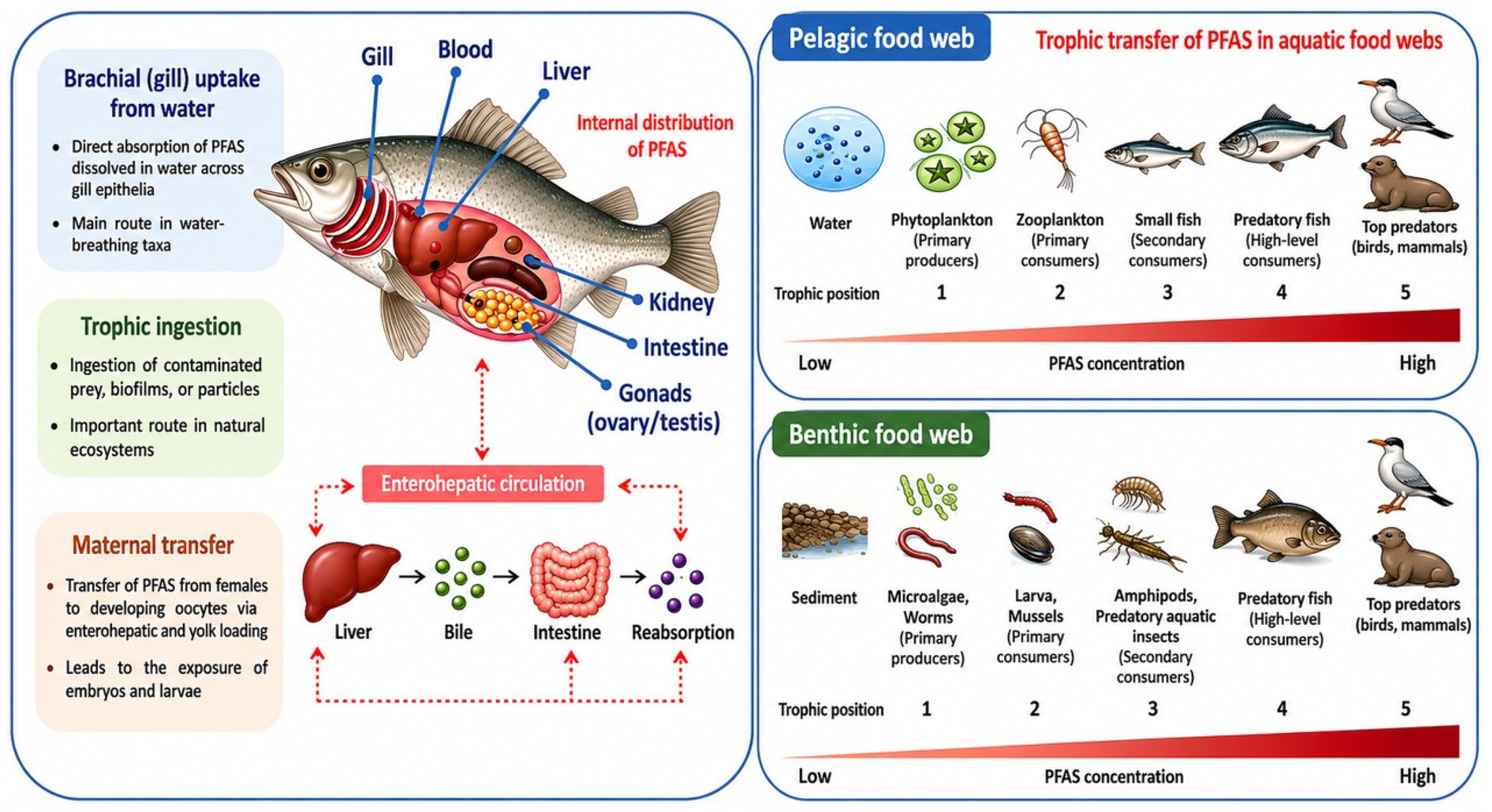
In aquatic organisms, PFAS enter the body through three main uptake pathways: branchial (gill) absorption from water, thropic ingestion of contaminated prey and particles, and maternal transfer to developing offspring. Bioaccumulation via gill uptake is classically described by the bioconcentration factor (BCF), which isolates respiratory uptake from water under controlled conditions and explicitly excludes dietary exposure, whereas the bioaccumulation factor (BAF) integrates all routes of exposure, including ingestion of food and water, and thus better reflects field conditions [32].
In water-breathing taxa, the large surface area and thin epithelia of gills make them a dominant interface for PFAS flux; after aqueous exposure, PFAS rapidly appear in blood, liver, kidney and intestine, and experimental work with PFOA has shown that branchial uptake is closely coupled to gill ventilation and followed by enterohepatic circulation between liver, bile and gut [59,88,89,90]. At the same time, gills are also a primary route of elimination, and efficient respiratory excretion in fish is thought to contribute to the relatively weak and inconsistent biomagnification patterns reported for many PFAS in gill-breathing food webs, compared with air-breathing predators [91].
In natural ecosystems, however, trophic ingestion frequently dominates the PFAS body burden: by definition, BAF and the biomagnification factor (BMF) incorporate dietary uptake, and field studies using carbon and nitrogen stable isotopes have shown that both trophic position and carbon source (e.g., pelagic vs. benthic prey, biofilm grazers vs. piscivores) are major determinants of PFAS concentrations in fish [47]. Benthic feeders and higher-trophic predators tend to accumulate higher PFAS levels where they consume contaminated invertebrates, biofilms or sediment-associated prey, highlighting the importance of sediment–biota transfer (captured by the biota–sediment accumulation factor, BSAF) alongside waterborne exposure [59]. A third, critical pathway is maternal transfer: in zebrafish exposed to radiolabeled PFOA, autoradiography revealed intense labeling not only in bile and intestine but also in vitellogenic oocytes, demonstrating that PFAS taken up by adults are redistributed to developing eggs via enterohepatic circulation and yolk loading [59,88]. Consistent with this, in carp, PFOA shows enterohepatic recirculation and binds to egg proteins, facilitating transfer from females to embryos, which provides a mechanistic basis for the developmental and early-life toxicity of PFAS observed in fish [88,89].
Figure 4 illustrates the integrated pathways of PFAS uptake, internal distribution, and trophic transfer across aquatic systems, highlighting the connectivity between benthic and pelagic food webs and the corresponding increase in concentrations with trophic level. Complementary to this conceptual framework, Table 3 summarizes the principal bioaccumulation and ecotoxicological metrics reported for PFAS in aquatic organisms, providing quantitative support for the observed patterns.
Bioaccumulation of PFAS in aquatic organisms links environmental contamination to a cascade of biological effects, from molecular and cellular disruption to altered growth and reproduction. The following section compiles and discusses quantitative data on effect thresholds, internal concentrations, and bioaccumulation metrics derived from both experimental and field studies.
Available evidence on the bioaccumulation of emerging PFAS alternatives in aquatic organisms is limited. Studies on GenX (HFPO-DA) report bioconcentration factors (BCFs) in fish that are generally one to two orders of magnitude lower than those of PFOA, consistent with its shorter chain length and greater water solubility [32,73]. However, some alternatives such as 6:2 Cl-PFESA (F-53B) exhibit bioaccumulation potentials comparable to or exceeding those of PFOS, raising concerns about their use as replacements for legacy PFAS [16,33]. For ultrashort-chain PFAS (C2–C3), bioaccumulation data are virtually absent, and the mechanisms governing their uptake, distribution, and elimination in aquatic organisms remain unknown. Given the increasing detection of these compounds in water resources, there is an urgent need for bioaccumulation studies covering the full molecular diversity of PFAS currently in use and their transformation products [50,57].

5.2. Internal Concentrations and Bioaccumulation Metrics

Across global freshwater and marine systems, PFAS burdens in biota span several orders of magnitude, reflecting both contamination level and trophic position. In a global review, log BAF values for plankton, fish and benthos ranged approximately from 0.64 to 5.90, 0.29 to 6.38 and 0.15 to 4.00, respectively, while benthic log BSAF values spanned 0.003–4.10. Mammalian BMF values ranged from 0.25 to 99, with TMF values for aquatic food webs between 0.03 and 11.7, underscoring substantial bioaccumulation and, for some PFAS, biomagnification potential [32].
In coastal and marine systems, PFOS and long-chain PFCAs are often dominant in higher trophic levels. For example, PFOS concentrations in fish from the Belgian North Sea reached up to 107 ng/g ww in the liver and 24 ng/g ww in muscle, while in an Arctic food web study from Svalbard, total PFAS in fish liver was 5.4 ± 0.87 µg/kg ww [91,92]. In marine mammals, PFAS burdens are markedly higher: bottlenose dolphins from the Adriatic Sea accumulated up to 62 973 ng/g ww total PFAS in liver [93], while finless porpoises and humpback dolphins from Chinese coastal waters contained 2.63–3.23 × 10³ ng/g dw total PFAS [94].
Freshwater systems show similarly elevated internal concentrations where local inputs are high. In Swedish lakes, C9–C14 PFCAs in fish were measured at 1.00–31.3 µg/kg ww, and PFOS in five of 36 German fish filets exceeded the EU environmental quality standard for PFOS in biota, indicating potential risk from consumption [95]. In benthic invertebrates, Swedish insect larvae contained 160–9200 ng/g dw of 24 PFAS, and Canadian benthic invertebrates had 12–466 ng/g total PFAS, confirming that primary consumers can achieve high body burdens [95].
At the organ level, PFAS are typically concentrated in the blood and liver. In crucian carp, blood, gonads and muscle together accounted for >90% of total PFAS, with long-chain PFAS showing the highest BAFs, and log BAF increasing with carbon chain length [95]. In an intensively sampled PFAS-impacted pond in the USA, mean surface-water concentrations of PFOS and PFHxS were 386 and 122 ng/L, respectively, while mean PFOS concentrations in fish tissues reached 557–1518 ng/g ww in muscle and 2952–4367 ng/g ww in liver [96]. Only PFOS met the common bioaccumulation criterion of log BAF > 3, with field-based log BAFs between 3.15 and 4.05 depending on species and tissue, while other PFSA and PFCA showed log BAFs up to ≈2–3 [96]. Moreover, in the experimental study conducted on Cyprinus carpio, PFOA demonstrated a pronounced tissue-specific bioconcentration capacity, with bioconcentration factors (BCFs) exceeding 1 in all analyzed organs. Overall BCF values ranged from 5.97 to 158 L/kg, with the highest levels observed in the gallbladder and kidneys, indicating preferential accumulation in organs associated with excretion processes and enterohepatic circulation [88].

5.3. Growth and Development

A systematic review and meta-analysis of 61 studies (53 laboratory trials, eight field studies) found that PFAS exposures up to 13.5 µg/L caused a statistically significant overall reduction in body size metrics (length, weight), with an aggregated standardized mean difference (SMD) of −0.321 (95% CI: −0.511 to −0.132), particularly in secondary consumers such as fish and macroinvertebrates [7].
Experimental data confirm strong developmental toxicity at higher concentrations. In algae and higher plants, PFAS reduce growth and root elongation in a chain-length-dependent manner. In Lactuca sativa, EC50 values for root elongation under exposure to PFBA, PFHxA, PFOA, PFNA and PFDA ranged from 0.14 to 4.19 mM, while photosynthesis inhibition in Pseudokirchneriella subcapitata occurred with EC50 values of 0.39–4.85 mM, with toxicity generally increasing with fluorinated chain length [97]. Similar trends were observed for Baltic Sea algae (Chlorella vulgaris, Skeletonema marinoi, Geitlerinema amphibium), where 72 h EC50 values for growth inhibition by PFHxA, PFHpA, PFOA, and PFNA ranged from 0.28 to 12.84 mM [98].
In fish, early-life stages are particularly sensitive. In Psetta maxima embryos, acute 96 h EC50 for PFOS was 0.11 mg/L to 11.9 mg/L for PFOA, indicating two orders of magnitude higher developmental toxicity for PFOS [99]. In zebrafish embryos and larvae exposed to PFOS, PFNA, and PFOA, sublethal concentrations caused decreased total body length, pericardial edema, spinal deformities and hyperactive locomotor responses, together with altered expression of muscle-development gene TFC3A and reduced expression of protein-transport gene AP1S; behavioral alterations persisted into adulthood [100].
Amphibians exhibit rapid uptake and growth effects at relatively low aqueous concentrations. In northern leopard frog (Rana pipiens) tadpoles, BCFs ranged from 19.6 to 119.3 for PFOS but <1 for other PFAS; PFOS half-lives were on the order of 1.2–3.3 days, yet repeated exposure yielded significant bioaccumulation, growth impairment and morphological changes [59].
Mechanistically, these developmental alterations are consistent with PPARα-mediated disruption of lipid metabolism, which restricts the energy supply available for embryonic growth and organogenesis [57]. In addition, the pericardial edema and spinal deformities observed in zebrafish suggest interference with retinoic acid signaling pathways that govern axial patterning and cardiac development [73,100].

5.4. Reproductive and Endocrine Effects

Reproductive outcomes are variably affected by PFAS, with clear effects at higher experimental concentrations and more subtle changes at environmental levels. In marine echinoderms, PFOS and its precursor POSF disrupted embryogenesis of Paracentrotus lividus: EC50/72 h values of 1.795 mg/L−1 (PFOS) and 1.074 mg L−1 (POSF) were associated with skeletal malformations, retarded pluteus formation and blocked gastrulation, with POSF more toxic than PFOS [96,101]. In Mytilus galloprovincialis, PFOS induced malformations in developing embryos with an EC50/96 h of 1.1 mg/L and an LC50/48 h of 1.07 mg/L, whereas PFOA was an order of magnitude less toxic (EC50/96 h = 12 mg/L; LC50/48 h = 9.98 mg/L) [59].
In freshwater invertebrates, Daphnia carinata exposed to PFOS and PFOA showed acute LC50/48 h values of 8.8 and 78.2 mg/L, respectively; chronic 21-day exposure to as low as 0.001 mg/L PFOS caused increased mortality and reproductive defects (reduced offspring number and delayed reproduction) [102]. In rotifers, reproductive bioassays showed that PFOS and PFOA inhibited population growth, egg production and hatching, again with PFOS exhibiting greater potency [103].
In fish, chronic PFOS and PFOA exposure is associated with altered gonad histology, reduced gonadosomatic indices and disrupted steroidogenesis, although quantitative thresholds vary among species and exposure designs. In rainbow trout, PFAS binding affinities to liver fatty-acid-binding protein (LFABP) are similar to those in humans, indicating that PFAS may interact with conserved endocrine and lipid-regulation pathways across vertebrates [104].
The meta-analysis by Banyoi et al. found no statistically robust effect of environmentally relevant PFAS concentrations (≤13.5 µg/L) on fecundity indices across evaluated studies, suggesting that growth and developmental endpoints may be more sensitive at low-to-moderate exposure and that reproduction may be affected only beyond certain internal-dose thresholds or under multi-stress conditions [7].
At the molecular level, PFAS can interfere with reproductive function through several pathways. Competitive binding to LFABP and transthyretin may disrupt the transport and homeostasis of thyroid hormones and fatty acids that are critical for gonadal development and steroidogenesis [57]. In fish, PFAS exposure has been associated with altered expression of steroidogenic enzymes such as CYP11A1 and CYP19A1, providing a mechanistic basis for the reduced gonadosomatic indices and disrupted hormone levels reported in chronic studies [32,59].

5.5. Hepatic, Metabolic and Digestive Toxicity

Because of their proteinophilic nature, PFAS accumulate preferentially in the liver and blood rather than adipose tissue. Field biomonitoring in European chub (Leuciscus cephalus) from a contaminated French river showed PFAS in plasma > liver > gills > gonads > muscle, with log BAF for PFDoA in plasma reaching 6.7 and in liver 5.7; a similar hierarchy has been observed in Alpine lake fish and Chinese crucian carp [59].
In zebrafish and other models, PFAS exposure causes pronounced hepatotoxicity. Sub-chronic exposure to PFOS, PFDA and FOSA in Chinook salmon disrupted liver mitochondrial function and energy metabolism [58]. In golden tilefish from the Gulf of Mexico, total PFAS in the liver averaged 10.4 ng/g ww, dominated by PFUnDA, and histopathology revealed hepatocellular vacuolation and degeneration consistent with PFAS-induced metabolic stress [104].
Bivalves and clams, which are often used as bioindicators, show clear digestive-gland effects. In blue mussels and freshwater clams, exposure to PFOS and PFOA at environmentally realistic µg/L levels led to the expansion of digestive tubule lumina, epithelial atrophy, necrosis, mild fibrosis and shifts in gut microbiota, alongside reduced filtration and altered nutrient assimilation [97].
The hepatic effects are primarily mediated by PPARα activation, which upregulates genes involved in peroxisomal and mitochondrial fatty acid β-oxidation, ultimately leading to peroxisome proliferation, hepatocellular vacuolation, and steatosis [57,58]. Mitochondrial dysfunction, characterized by impaired oxidative phosphorylation and increased reactive oxygen species (ROS) production represents a secondary mechanism that amplifies metabolic stress and contributes to the energy deficits underlying growth impairment [58]. The preferential accumulation of PFAS in protein-rich tissues such as liver and blood reflects their binding affinity for serum albumin and LFABP, which governs both internal distribution and tissue-specific toxicity [59].

5.6. Oxidative Stress, Immunotoxicity and Neurobehavioral Effects

Oxidative stress is a common response to PFAS exposure. In green mussel (Perna viridis), PFOS, PFOA, PFNA and PFDA induced DNA strand breaks and apoptosis, along with changes in antioxidant enzyme activities and gene expression related to lipid, amino-acid and carbohydrate metabolism; PFOS showed the strongest genotoxic and oxidative effects among the compounds tested [98]. Similar oxidative and biochemical alterations were reported in blue mussel (Mytilus galloprovincialis) exposed to PFOA alone and in combination with BDE-47 [105]. In crustaceans such as Siriella armata and Americamysis bahia, PFOS was more acutely toxic than PFOA (EC50/96 h = 6.9 vs. 15.5 mg L−1 and LC50/96 h = 5 vs. 24 mg L−1, respectively) and induced oxidative-stress biomarkers [59].
In zebrafish larvae, PFHxS and PFOSA impaired lipid homeostasis and induced cardiotoxicity through disruption of aryl-hydrocarbon-receptor (AhR) signaling, leading to arrhythmia, reduced stroke volume and cardiac output, and structural abnormalities such as pericardial edema [73]. PFOS, PFOA and PFHxS also caused hyperactivity, altered startle responses and persistent changes in swimming behavior, indicating neurodevelopmental toxicity [102].
Immunotoxicity has been documented in several species. In zebrafish, PFAS mixtures reduced pathogen resistance by lowering lysozyme activity and immunoglobulin levels [103]. In fathead minnow (Pimephales promelas), PFOS exposure modulated interleukin expression and immune-cell distribution, while in common carp, PFOA and PFNA altered the pattern and function of rod cells in immune organs and induced immunosuppression [32]. Neurotoxicity is reflected in altered neurotransmitter levels and impaired synaptic function. In zebrafish exposed to PFNA (0.01–100 µg/L), synaptogenesis signaling was disrupted, and locomotor activity patterns were significantly altered, with potential consequences for predator–prey interactions and energy budgets [32].
Oxidative stress arises from PFAS-induced mitochondrial dysfunction, which generates excess ROS that overwhelms antioxidant defenses [58]. The resulting activation of the Nrf2/Keap1 pathway leads to upregulation of detoxifying enzymes, but sustained oxidative damage ultimately triggers apoptosis through the intrinsic mitochondrial pathway involving cytochrome c release and caspase activation [98]. The immunotoxic effects are linked to PPARα- and AhR-mediated modulation of cytokine expression and immune cell differentiation, which reduces pathogen resistance and alters inflammatory responses [73,90]. Neurobehavioral changes, including hyperactivity and altered locomotor patterns, likely involve disruption of thyroid hormone signaling during critical developmental windows, as thyroid hormones are essential for synaptogenesis and myelination [32,57].

5.7. Genotoxicity and Transgenerational Effects

PFAS genotoxicity has been observed in several taxa. In Perna viridis, PFOS, PFOA, PFNA and PFDA caused DNA strand breaks, fragmentation and apoptosis in gill and hepatopancreas cells, with PFOS again being the most potent [98]. In Daphnia and rotifers, PFOS exposure increased mutation rates and induced chromosomal abnormalities, potentially affecting long-term population genetic structure [93].
Although transgenerational studies remain scarce, early-life exposure to PFOS, PFOA and GenX in fish and invertebrates has been shown to result in persistent changes in gene expression (including epigenetic regulators) and developmental pathways in offspring, suggesting potential multi-generation effects that are not fully captured by standard single-generation tests [32,87].
Genotoxicity is largely attributed to oxidative DNA damage, including 8-oxo-dG formation, resulting from PFAS-induced ROS production rather than direct DNA intercalation [106]. The persistence of epigenetic alterations, including changes in DNA methylation and histone modification patterns following early-life exposure, suggests that PFAS may reprogram gene expression profiles across generations, although transgenerational studies remain limited [100,107]. Such epigenetic changes could explain the long-term fitness consequences observed in offspring of exposed organisms even in the absence of direct contaminant transfer.
The ecotoxicological effects of emerging PFAS alternatives are even less characterized than their legacy counterparts. Preliminary studies indicate that GenX can induce oxidative stress, developmental abnormalities, and alterations in lipid metabolism in zebrafish at concentrations in the mg/L range, though species-specific and endpoint-specific differences exist [73]. For F-53B, hepatotoxicity and disruption of thyroid hormone homeostasis have been reported in fish models, suggesting mechanisms of action partially distinct from legacy PFAS [16,33]. Data on the chronic toxicity, reproductive effects, and transgenerational impacts of these emerging compounds are largely lacking. Furthermore, the ecotoxicological effects of PFAS mixtures, including combinations of legacy, emerging, and ultrashort-chain PFAS, have not been systematically investigated, despite being the most environmentally realistic exposure scenario [7,32]. Comprehensive ecotoxicological assessments covering a broader range of PFAS classes, exposure durations, and biological endpoints are urgently needed to support evidence-based regulation. An overview of PFAS bioaccumulation metrics alongside key ecotoxicological responses across aquatic organisms is provided in Table 4.

5.8. Link to Human Exposure and Risk

The ecotoxicological impacts described above are directly relevant to human health because of the dietary and drinking-water pathways that connect aquatic contamination to PFAS internal doses in people. In Tanzanian aquatic systems, PFAS in fish and shrimp were sufficiently high that preliminary risk assessment indicated both ecological and human-health concerns, especially for communities with high seafood consumption [95].
In European seafood, PFOS concentrations in sea bass and other species from Italy and the Netherlands were high enough that regular consumption could exceed EFSA tolerable intake values, particularly for children and high-consumption groups [59]. In Germany, PFOS in some freshwater fish filets exceeded the EU environmental quality standard, confirming that trophic transfer can elevate PFAS levels in edible tissues above regulatory thresholds [95].
Drinking-water exposure can be similarly important. In a Romanian case study, PFAS in surface waters used as drinking-water sources yielded estimated daily intake (EDI)/tolerable daily intake (TDI) ratios > 1 (risk index > 1) for PFOA, PFOS and PFNA across all age categories, with children showing the highest risk because of greater water consumption relative to body weight [13].
Given that conventional wastewater and drinking-water treatments do not fully remove PFAS, and that even advanced oxidation processes and membranes often only transform them or concentrate them into waste streams, the ecotoxicological consequences of PFAS bioaccumulation are likely to persist even as some legacy PFAS are phased out [42]. Integrating bioaccumulation and effect data into both ecological and human health risk assessment frameworks and regulating PFAS as a class rather than compound-by-compound are therefore critical steps to mitigate long-term impacts.

5.9. Quantitative Link Between Treatment Residuals and Ecotoxicological Thresholds

The residual PFAS concentrations documented in treated effluents (Section 4) can be evaluated against the effect thresholds and bioaccumulation metrics compiled in this section. Nanofiltration permeate levels of approximately 1.4 ng/L total PFAS [54] fall three orders of magnitude below the lowest observed effect concentration for growth reduction in fish (13.5 µg/L) reported in the meta-analysis by Banyoi et al. [7], suggesting that membrane treatment alone may reduce aqueous exposure below acute effect thresholds for single compounds. However, chronic exposure at ng/L levels remains relevant: the same meta-analysis found significant reductions in body size at concentrations as low as 0.001 mg/L PFOS in Daphnia carinata, corresponding to reproductive impairment and increased mortality after 21-day exposure [92]. Moreover, at a PFAS-impacted pond where surface-water PFOS reached 386 ng/L, fish tissue concentrations accumulated to 557–1518 ng/g ww in muscle and 2952–4367 ng/g ww in liver, with log BAF values of 3.15–4.05 [96]. These field data demonstrate that aqueous concentrations in the low ng/L range, comparable to those in treated effluents, sustain biomagnification through protein-mediated pathways (LFABP, serum albumin) that are not captured by percentage removal efficiency alone [57,59].
For advanced oxidation processes, the 78–80% PFOA removal achieved by electrochemical oxidation in landfill leachate [68,69] still leaves residual concentrations that exceed the bioconcentration factor (BCF) thresholds for protein-mediated accumulation in carp tissues, where PFOA BCF exceeded 1 in all analyzed organs [88]. Similarly, the formation of short-chain transformation products during AOP treatment, which retain the ability to bind to transthyretin and LFABP [57,61], introduces compounds whose chronic toxicity at ng/L levels remains poorly characterized, particularly for emerging alternatives such as GenX and F-53B [73]. The gap between treatment performance indicators (percentage removal) and mechanistically defined safety thresholds underscores the need for risk-based evaluation criteria that incorporate bioaccumulation metrics (BAF, BCF, TMF) and adverse outcome pathways rather than removal efficiency alone.

6. Conclusions

PFAS constitute a chemically diverse class of persistent contaminants whose environmental behavior is governed by chain length, functional group, and partitioning properties. Their widespread occurrence in surface waters, groundwater, seawater, wastewater effluents, and sediments—with total PFAS concentrations frequently ranging from <1 ng/L in remote areas to >100 ng/L in urban-influenced systems—reflects continuous anthropogenic inputs, limited removal by conventional treatment, and ongoing transport across connected aquatic compartments. These characteristics collectively explain why PFAS remain environmentally mobile, difficult to remediate, and highly relevant for long-term aquatic risk assessment.
The persistent regulatory fragmentation and the challenges of class-based risk assessment underscore the need for internationally harmonized PFAS management frameworks that integrate treatment performance data with bioaccumulation metrics and adverse outcome pathways.
PFAS distribution is not uniform across aquatic systems, but varies with source proximity, hydrology, salinity, and sediment interactions. Long-chain PFAS generally exhibit stronger sorption and greater accumulation potential, whereas short-chain compounds are more mobile and can disperse more readily through water columns and groundwater. As a result, aquatic contamination should be understood as a dynamic process in which emissions, transport, partitioning, and precursor transformation jointly determine exposure patterns.
Advanced water treatment technologies can substantially reduce PFAS concentrations, but they do not yet provide a complete barrier for environmental protection. Membrane processes such as nanofiltration (NF) and reverse osmosis (RO) achieve >99% rejection for long-chain PFAS, while NF permeate levels of approximately 1.4 ng/L remain within the range of chronic ecotoxicological concern [50]. Short-chain and emerging compounds show more variable removal, with reported rejection rates of 60–99% for NF and >90% for RO under optimized conditions, and energy consumption of 3–6 kWh/m3 for pressure-driven membrane processes represents a significant operational constraint [15,55]. Advanced oxidation and hybrid systems can achieve 78–80% degradation of PFOA under optimized conditions, but the formation of short-chain transformation products that retain biological activity—including the capacity to bind transthyretin and liver fatty-acid-binding protein—perpetuates exposure pathways even as bulk concentrations are reduced [57,68,69]. From a mechanistic perspective, the persistent ecological risk of PFAS in receiving waters stems from the specific molecular pathways through which residual concentrations, even at ng/L levels, initiate toxicity. Unlike classical lipophilic contaminants, PFAS exert their effects through protein-mediated mechanisms: PPARα activation disrupts lipid metabolism at internal doses achievable through continuous dietary exposure at ng/L water concentrations; LFABP binding facilitates hepatic accumulation and maternal transfer to developing oocytes via yolk loading; and transthyretin competition interferes with thyroid hormone transport during critical developmental windows [57,58,59,73]. These pathways operate at exposure levels well below acute toxicity thresholds and are sustained by the incomplete removal of short-chain and emerging PFAS during treatment. Furthermore, the partial transformation of precursor and long-chain PFAS during AOPs and biological treatment generates shorter-chain compounds that retain or alter their affinity for these protein targets, perpetuating chronic exposure pathways even as bulk PFAS concentrations are reduced [61,73]. Therefore, future remediation strategies should be designed and evaluated not only by their removal efficiency but also by their capacity to interrupt these mechanistically defined adverse outcome pathways: specifically, PPARα-mediated hepatotoxicity, LFABP-driven bioaccumulation, and AhR-related immunotoxicity in aquatic receptor organisms.
Accordingly, treatment performance should not be interpreted solely in terms of percentage removal but also in relation to its capacity to reduce persistent exposure pressure in receiving waters. Even when influent concentrations are lowered, residual PFAS in treated effluents and concentrate streams can sustain ecologically relevant exposure pathways and downstream contamination. Therefore, future remediation strategies should integrate separation, destruction, and waste-stream management rather than rely on a single treatment barrier.
Bioaccumulation represents the central mechanism linking PFAS contamination in aquatic media to biological and ecological effects. Across organisms and trophic levels, PFAS can accumulate through direct uptake, dietary exposure, sediment contact, and maternal transfer, with long-chain compounds such as PFOS often showing the strongest internal retention and biomagnification potential. Internal burdens are commonly highest in protein-rich tissues such as liver and blood, underscoring that PFAS behave differently from classical lipophilic contaminants and require bioaccumulation metrics such as BCF, BAF, BSAF, BMF, and TMF for proper interpretation.
The toxicological evidence further indicates that PFAS bioaccumulation is associated with growth impairment, developmental toxicity, reproductive disruption, immune dysfunction, neurobehavioral changes, oxidative stress, and hepatic injury in a wide range of aquatic taxa. These effects are not limited to single species but can propagate across food webs, thereby affecting ecosystem stability and potentially increasing human exposure through seafood consumption and drinking-water pathways. Consequently, bioaccumulation should be viewed not merely as a descriptive endpoint but as a mechanistic bridge between environmental contamination, organism-level toxicity, and broader ecological risk.
An important limitation of the current PFAS literature, which is reflected in the present review, is the predominant focus on legacy PFAS compounds (PFOA, PFOS) relative to emerging alternatives, ultrashort-chain PFAS, and precursor compounds. While data on legacy PFAS are relatively abundant, significant knowledge gaps persist regarding the environmental occurrence, fate, bioaccumulation, and toxicity of their replacements and transformation products. Given the ongoing regulatory phase-out of legacy PFAS and the rapid industrial transition to alternative chemistries, future research should prioritize: (i) comprehensive monitoring of emerging and ultrashort-chain PFAS across all aquatic compartments; (ii) systematic assessment of their bioaccumulation potential and toxicological profiles; (iii) investigation of PFAS precursor transformation in both environmental and treatment contexts; and (iv) development of analytical methods capable of detecting and quantifying the full spectrum of PFAS, including ultrashort-chain and highly polar compounds. These efforts are essential to prevent regrettable substitution and to ensure that emerging PFAS do not pose unforeseen risks to aquatic ecosystems and human health.
Future research should increasingly focus on integrated remediation strategies capable of addressing both legacy and emerging short-chain PFAS compounds under realistic environmental conditions. Greater attention is also needed for scalable treatment technologies that combine high removal efficiency with reduced energy consumption, minimal secondary waste generation, and long-term operational stability.
At the same time, environmental protection efforts should prioritize continuous monitoring of aquatic systems, improved regulation of industrial emissions, and the development of standardized methodologies for PFAS detection, toxicity evaluation, and treatment assessment. Importance should be given to the identification of transformation products formed during remediation processes, since these compounds may also contribute to long-term ecological risks.
From a practical perspective, the implementation of combined treatment approaches, together with stricter discharge control and source-reduction strategies, may represent one of the most effective pathways for limiting PFAS dissemination in aquatic environments. In parallel, interdisciplinary collaboration between environmental scientists, engineers, toxicologists, and regulatory authorities will be essential for developing sustainable and scientifically grounded management solutions for PFAS contamination.

Supplementary Materials

The following supporting information can be downloaded at: https://www.mdpi.com/article/10.3390/environments13060330/s1, Figure S1: Annual distribution of publications related to PFAS in aquatic systems retrieved from the WoS Core Collection for the 2015–2026 period; Figure S2: Keyword co-occurrence network of PFAS-related research in aquatic systems generated using VOSviewer 1.6.20 based on Web of Science records dating between 2015 and 2026; Figure S3: Overlay visualization of keyword co-occurrence in PFAS-related aquatic research based on Web of Science records published between 2015 and 2026.

Author Contributions

Conceptualization, V.-A.P. and F.-L.C. methodology, C.U. and F.-L.C.; software, C.U.; validation, F.-L.C., C.U. and S.G.; formal analysis, V.-A.P. and F.-L.C.; investigation, V.-A.P. and C.U.; resources, C.U. and S.G.; data curation, S.G. and C.U.; writing—original draft preparation, V.-A.P.; writing—review and editing, C.U., F.-L.C. and S.G.; visualization, V.-A.P. and C.U.; supervision, F.-L.C. and C.U.; project administration, V.-A.P. All authors have read and agreed to the published version of the manuscript.

Funding

This research received no external funding.

Data Availability Statement

No new data were created or analyzed in this study.

Acknowledgments

In the preparation of this manuscript, the authors utilized AI to aid in English language editing, as none of the authors are native English speakers. Following this assistance, the authors thoroughly reviewed and edited the content to ensure accuracy and integrity, taking full responsibility for the final version.

Conflicts of Interest

The authors declare no conflicts of interest.

Abbreviations

The following abbreviations are used in this manuscript:
PFASPer- and polyfluoroalkyl substances
POPsPersistent Organic Pollutants
PFOSPerfluorooctanesulfonic acid
PFOAPerfluorooctanoic acid
PFSAsPerfluoroalkyl sulfonic acids
PFAAsPerfluoroalkyl acids
FTOHsFluorotelomer alcohols
FTSAsFluorotelomer sulfonates
HFPO-DAPerfluoro-2-propoxypropanoic acid, hexafluoropropylene oxide dimer acid
6:2 Cl-PFESA6:2 chlorinated polyfluotoethersulfonic acid
PFCAsPerfluorocarboxylic acids
KdPartition coefficient
KocOrganic carbon/water distribution coefficient
PFHxSPerfluorohexanesulfonic acid
N-EtFOSAN-ethyl perfluorooctane sulfonamide
N-EtFOSEN-ethyl perfluorooctane sulfonamidoethanol
PFNuDAPerfluoroundecanoic acid
WWTPsWastewater treatment plants
PFHxAPerfluorohexanoic acid
PFBAPerfluorobutanoic acid
dwDry weight
NFNanofiltration
ROReverse osmosis
MWCOMolecular weight cut-offs
AFFFAqueous film-forming foam
AOPsAdvanced oxidation processes
MWMicrowave
EOElectrochemical oxidation
BDDBoron-doped diamond
6:2 FTOH6:2 flurotelomer alcohol
PFPeAPerfluoropentanoic acid
BCFBioconcentration factor
BAFBioaccumulation factor
BMFBiomagnification factor
BSAFBiota-Sediment Accumulation Factor
TMFTrophic Magnification Factor
EC50(Effective Concentration 50%)
LC50(Lethal Concentration 50%)
IC50Inhibitory Concentration 50%
NOECNon-Observed Effect Concentration
wwWet weight
SMDStandardized mean difference
PFNAPerfluorononanoic acid
PFDAPerfluorodecanoic acid
PFHpAPerfluoroheptanoic acid
POSFPerfluorooctane sulfonyl fluoride
LFABPLiver fatty-acid-binding protein
PFDoAPerfluorododecanoic acid
PFOSAPerfluorooctanesulfonamide
AhRAryl-hydrocarbon-receptor
EDIEstimated daily intake
TDITolerable daily intake

References

  1. Panieri, E.; Baralić, K.; Djukic-Cosic, D.; Buha Djordjevic, A.; Saso, L. PFAS Molecules: A Major Concern for Human Health and the Environment. Toxics 2022, 10, 44. [Google Scholar] [CrossRef]
  2. Itumoh, E.J.; Data, S.; Chen, J.L.Y.; Kah, M.; Padhye, L.P.; Leitao, E.M. Addressing the Persistence of Per- and Polyfluoroalkyl Substances (PFAS): Current Challenges and Potential Solutions. RSC Sustain. 2024, 2, 3183–3201. [Google Scholar] [CrossRef]
  3. Leung, S.C.E.; Wanninayake, D.; Chen, D.; Nguyen, N.T.; Li, Q. Physicochemical Properties and Interactions of Per-Fluoroalkyl Substances (PFAS): Challenges and Opportunities in Sensing and Remediation. Sci. Total Environ. 2023, 905, 166764. [Google Scholar]
  4. Alsadik, A.; Akintunde, O.O.; Habibi, H.R.; Achari, G. PFAS in Water Environments: Recent Progress and Challenges in Monitoring, Toxicity, Treatment Technologies, and Post-Treatment Toxicity. Environ. Syst. Res. 2025, 14, 18. [Google Scholar] [CrossRef]
  5. Nayak, S.; Sahoo, G.; Das, I.I.; Mohanty, A.K.; Kumar, R.; Sahoo, L.; Sundaray, J.K. Poly- and Perfluoroalkyl Substances (PFAS): Do They Matter to Aquatic Ecosystems? Toxics 2023, 11, 543. [Google Scholar] [CrossRef]
  6. Ma, T.; Ye, C.; Wang, T.; Li, X.; Luo, Y. Toxicity of Per- and Polyfluoroalkyl Substances to Aquatic Invertebrates, Planktons, and Microorganisms. Int. J. Environ. Res. Public Health 2022, 19, 16729. [Google Scholar] [CrossRef]
  7. Banyoi, S.-M.; Porseryd, T.; Larsson, J.; Grahn, M.; Dinnétz, P. The Effects of Exposure to Environmentally Relevant PFAS Concentrations for Aquatic Organisms at Different Consumer Trophic Levels: Systematic Review and Meta-Analyses. Environ. Pollut. 2022, 315, 120422. [Google Scholar] [CrossRef]
  8. U.S. Environmental Protection Agency. Final PFAS National Primary Drinking Water Regulation. Fed. Regist. 2024, 89, 32532–32791. [Google Scholar]
  9. European Parliament and Council of the European Union. Directive (EU) 2020/2184 of 16 December 2020 on the Quality of Water Intended for Human Consumption (Recast). Off. J. Eur. Union 2020, L435, 1–62. Available online: https://eur-lex.europa.eu/eli/dir/2020/2184/oj/eng (accessed on 29 April 2026).
  10. Yu, R.-S.; Yu, H.-C.; Yang, Y.-F.; Singh, S. A Global Overview of Per- and Polyfluoroalkyl Substance Regulatory Strategies and Their Environmental Impact. Toxics 2025, 13, 251. [Google Scholar] [CrossRef] [PubMed]
  11. Health Canada. Objective for Canadian Drinking Water Quality: Per- and Polyfluoroalkyl Substances (PFAS); Health Canada: Ottawa, ON, Canada, 2024; Available online: https://www.canada.ca/en/health-canada/services/publications/healthy-living/objective-drinking-water-quality-per-polyfluoroalkyl-substances.html (accessed on 5 June 2026).
  12. National Health and Medical Research Council (NHMRC). Australian Drinking Water Guidelines—PFAS Guideline Values; NHMRC: Canberra, ACT, Australia, 2025. Available online: https://www.nhmrc.gov.au/health-advice/environmental-health/water/PFAS-review (accessed on 5 June 2026).
  13. Cimpean, I.A.; Paun, I.; Pirvu, F.; Iancu, V.I.; Chiriac, F.L. Unregulated and Regulated PFASs in Bottled and Tap Water: Occurrence, Co-Occurrence Patterns, and Implications for Human Health and Regulatory Frameworks. J. Xenobiot. 2025, 15, 81. [Google Scholar] [CrossRef]
  14. Masters, N.A.; Marron, B.A.; Lau, A.; Bailey, W.G.; Richardson, S.D.; Bellona, C.L. Investigation of PFAS Rejection by Closed-Circuit Reverse Osmosis and Nanofiltration and Sorption to Treatment Materials during Groundwater Treatment: A Pilot Demonstration. Sep. Purif. Technol. 2025, 382, 134308. [Google Scholar] [CrossRef]
  15. Hasan, R.; Chen, J.; Mojahednia, P.; Samaei, S.H.A.; Xue, J. Comparative Analysis of Commercial and Novel High-Pressure Membranes for Perfluoroalkyl and Polyfluoroalkyl Substances (PFAS) Removal. Water Environ. Res. 2025, 97, e70157. [Google Scholar] [CrossRef]
  16. Hamid, N.; Junaid, M.; Sultan, M.; Yoganandham, S.T.; Chuan, O.M. The Untold Story of PFAS Alternatives: Insights into the Occurrence, Ecotoxicological Impacts, and Removal Strategies in the Aquatic Environment. Water Res. 2024, 250, 121044. [Google Scholar] [CrossRef] [PubMed]
  17. Dai, X.; Xie, Z.; Dorian, B.; Gray, S.; Zhang, J. Comparative Study of PFAS Treatment by UV, UV/Ozone, and Fractionations with Air and Ozonated Air. Environ. Sci. Process. Impacts 2019, 21, 1897–1907. [Google Scholar] [CrossRef]
  18. Rao, U.; Su, Y.; Khor, C.M.; Jung, B.; Ma, S.; Cwiertny, D.M.; Wong, B.M.; Jassby, D. Structural Dependence of Reductive Defluorination of Linear PFAS Compounds in a UV/Electrochemical System. Environ. Sci. Technol. 2020, 54, 10668–10677. [Google Scholar] [CrossRef]
  19. Tang, K.H.D.; Kristanti, R.A. Bioremediation of Perfluorochemicals: Current State and the Way Forward. Bioprocess Biosyst. Eng. 2022, 45, 1093–1109. [Google Scholar] [CrossRef]
  20. Hamid, H.; Li, L.Y. Role of Wastewater Treatment Plant (WWTP) in Environmental Cycling of Poly- and Perfluoroalkyl (PFAS) Compounds. Ecocycles 2016, 2, 43–53. [Google Scholar] [CrossRef]
  21. Gobelius, L.; Glimstedt, L.; Olsson, J.; Wiberg, K.; Ahrens, L. Mass Flow of Per- and Polyfluoroalkyl Substances (PFAS) in a Swedish Municipal Wastewater Network and Wastewater Treatment Plant. Chemosphere 2023, 336, 139182. [Google Scholar] [CrossRef]
  22. Smith, S.J.; Wiberg, K.; McCleaf, P.; Ahrens, L. Pilot-Scale Continuous Foam Fractionation for the Removal of Per- and Polyfluoroalkyl Substances (PFAS) from Landfill Leachate. ACS EST Water 2022, 2, 841–851. [Google Scholar] [CrossRef] [PubMed]
  23. Barisci, S.; Suri, R. Occurrence and Removal of Poly/Perfluoroalkyl Substances (PFAS) in Municipal and Industrial Wastewater Treatment Plants. Water Sci. Technol. 2021, 84, 3442–3468. [Google Scholar] [CrossRef]
  24. Kim, J.; Xin, X.; Hawkins, G.L.; Huang, Q.; Huang, C.-H. Occurrence, Fate, and Removal of Per- and Polyfluoroalkyl Substances (PFAS) in Small- and Large-Scale Municipal Wastewater Treatment Facilities in the United States. ACS EST Water 2024, 4, 5428–5436. [Google Scholar] [CrossRef]
  25. Chiriac, F.L.; Pirvu, F.; Paun, I.; Petre, V.A. Perfluoroalkyl Substances in Romanian Wastewater Treatment Plants: Transfer to Surface Waters, Environmental and Human Risk Assessment. Sci. Total Environ. 2023, 892, 164576. [Google Scholar]
  26. Zhang, J.; Liu, J.; Jin, R.; Qiao, Y.; Mao, J.; Wang, Z. Prevalent Per- and Polyfluoroalkyl Substances (PFASs) Pollution in Freshwater Basins in China: A Short Review. Toxics 2025, 13, 135. [Google Scholar] [CrossRef] [PubMed]
  27. Glaser, D.; Lamoureux, E.; Opdyke, D.; LaRoe, S.; Reidy, D.; Connolly, J. The Impact of Precursors on Aquatic Exposure Assessment for PFAS: Insights from Bioaccumulation Modeling. Integr. Environ. Assess. Manag. 2021, 17, 705–715. [Google Scholar] [CrossRef] [PubMed]
  28. Meegoda, J.N.; Kewalramani, J.A.; Li, B.; Marsh, R.W. A Review of the Applications, Environmental Release, and Remediation Technologies of Per- and Polyfluoroalkyl Substances. Int. J. Environ. Res. Public Health 2020, 17, 8117. [Google Scholar] [CrossRef] [PubMed]
  29. Richard, A.M.; Lougee, R.; Adams, M.; Hidle, H.; Yang, C.; Rathman, J.; Patlewicz, G. A New CSRML Structure-Based Fingerprint Method for Profiling and Categorizing Per- and Polyfluoroalkyl Substances (PFAS). Chem. Res. Toxicol. 2023, 36, 508–534. [Google Scholar] [CrossRef]
  30. Kurwadkar, S.; Dane, J.; Kanel, S.R.; Nadagouda, M.N.; Cawdrey, R.W.; Ambade, B.; Wilkin, R. Per- and Polyfluoroalkyl Substances in Water and Wastewater: A Critical Review of Their Global Occurrence and Distribution. Sci. Total Environ. 2022, 809, 151003. [Google Scholar]
  31. Londhe, K.; Lee, C.S.; McDonough, C.A.; Venkatesan, A.K. The Need for Testing Isomer Profiles of Perfluoroalkyl Substances to Evaluate Treatment Processes. Environ. Sci. Technol. 2022, 56, 15207–15219. [Google Scholar] [CrossRef]
  32. Wang, C.; Magnuson, J.T.; Zheng, C.; Qiu, W. Incidence of Pollution, Bioaccumulation, Biomagnification, and Toxic Effects of Per- and Polyfluoroalkyl Substances (PFAS) in Aquatic Ecosystems: A Review. Aquat. Toxicol. 2025, 286, 107469. [Google Scholar] [CrossRef]
  33. Shi, Y.; Vestergren, R.; Xu, L.; Zhou, Z.; Li, C.; Liang, Y.; Cai, Y. Human Exposure and Elimination Kinetics of Chlorinated Polyfluoroalkyl Ether Sulfonic Acids (Cl-PFESAs). Environ. Sci. Technol. 2016, 50, 2396–2404. [Google Scholar] [CrossRef]
  34. Tow, E.W.; Ersan, M.S.; Kum, S.; Lee, T.; Speth, T.F.; Owen, C.; Ladner, D.A. Managing and Treating Per- and Polyfluoroalkyl Substances (PFAS) in Membrane Concentrates. AWWA Water Sci. 2021, 3, e1233. [Google Scholar] [CrossRef]
  35. Bao, Y.; Qu, Y.; Huang, J.; Cagnetta, G.; Yu, G.; Weber, R. First Assessment on Degradability of Sodium p-Perfluorous Nonenoxybenzene Sulfonate (OBS), a High-Volume Alternative to Perfluorooctane Sulfonate in Fire-Fighting Foams and Oil Production Agents in China. RSC Adv. 2017, 7, 46948–46957. [Google Scholar]
  36. Liu, Z.; Chen, Z.; Gao, J.; Yu, Y.; Men, Y.; Gu, C.; Liu, J. Accelerated Degradation of Perfluorosulfonates and Perfluorocarboxylates by UV/Sulfite + Iodide: Reaction Mechanisms and System Efficiencies. Environ. Sci. Technol. 2022, 56, 3699–3709. [Google Scholar] [CrossRef] [PubMed]
  37. Balasuryia, D.; Queral-Beltran, A.; Vick, T.; Simpson, S.; Lacorte, S.; Aga, D.S.; Hoepker, A.C. Experimental Determination of pKa for 10 PFAS, Mono-, Di-, and Trifluoroacetic Acid by ^19F-NMR. Environ. Sci. Technol. Lett. 2025, 12, 1238–1246. [Google Scholar]
  38. Gkika, I.S.; Xie, G.; van Gestel, C.A.M.; Ter Laak, T.L.; Vonk, J.A.; van Wezel, A.P.; Kraak, M.H.S. Research Priorities for the Environmental Risk Assessment of Per- and Polyfluorinated Substances. Environ. Toxicol. Chem. 2023, 42, 2302–2316. [Google Scholar] [CrossRef] [PubMed]
  39. McGarr, J.T.; Mbonimpa, E.G.; McAvoy, D.C.; Soltanian, M.R. Fate and Transport of Per- and Polyfluoroalkyl Substances (PFAS) at Aqueous Film Forming Foam (AFFF) Discharge Sites: A Review. Soil Syst. 2023, 7, 53. [Google Scholar] [CrossRef]
  40. Batikh, A.; Colombano, S.; Cochennec, M.; Davarzani, D.; Perrault, A.; Lions, J.; van Hullebusch, E.D. Mobilization of Poly- and Perfluoroalkyl Substances (PFAS) from Heterogeneous Soils: Desorption by Ethanol/Xanthan Gum Mixture. J. Hazard. Mater. 2025, 481, 136496. [Google Scholar] [PubMed]
  41. Okwuosa, R.; Nomngongo, P.N.; Petrik, L.; Olatunji, O.S.; Okonkwo, O.J. Understanding PFAS Behavior: Analysing Contamination Patterns in Surface Water and Sediment of the Apies River, South Africa. Bull. Environ. Contam. Toxicol. 2025, 114, 54. [Google Scholar] [CrossRef]
  42. Mojiri, A.; Zhou, J.L.; Ozaki, N.; KarimiDermani, B.; Razmi, E.; Kasmuri, N. Occurrence of Per- and Polyfluoroalkyl Substances in Aquatic Environments and Their Removal by Advanced Oxidation Processes. Chemosphere 2023, 330, 138666. [Google Scholar] [CrossRef]
  43. Lee, C.; Kim, S.; Kim, L.; Lee, H.; Kim, T.; Yang, M. Occurrence, Distribution, Source Apportionment, and Health Risks of Per- and Polyfluoroalkyl Substances (PFAS) in the Nakdong River Basin, South Korea. J. Anal. Sci. Technol. 2025, 16, 43. [Google Scholar] [CrossRef]
  44. Habibullah-Al-Mamun, M.; Islam, M.M.; Sakib, S.; Islam, S.; Ali, M.M.; Faruque, M.H. Occurrence, Sources and Ecological Risk Assessment of Per- and Polyfluoroalkyl Substances (PFASs) in Water and Sediment from Urban Rivers in Dhaka, Bangladesh. J. Environ. Expo. Assess. 2025, 4, 33. [Google Scholar] [CrossRef]
  45. Ceballos, I.M.; Terro, H.; Barbeau, B.; McQuaid, N.; Sauvé, S.; Dorner, S. Characterization of Per- and Polyfluoroalkyl Substances in Drinking Water Sources in the Greater Montreal Area, Quebec, Canada. ACS EST Water 2025, 5, 5509–5522. [Google Scholar]
  46. Coggan, T.L.; Moodie, D.; Kolobaric, A.; Szabo, D.; Shimeta, J.; Crosbie, N.D.; Clarke, B.O. An Investigation into Per- and Polyfluoroalkyl Substances (PFAS) in Nineteen Australian Wastewater Treatment Plants (WWTPs). Heliyon 2019, 5, e02316. [Google Scholar] [CrossRef]
  47. Macorps, N.; Labadie, P.; Lestremau, F.; Assoumani, A.; Budzinski, H. Per- and Polyfluoroalkyl Substances (PFAS) in Surface Sediments: Occurrence, Patterns, Spatial Distribution and Contribution of Unattributed Precursors in French Aquatic Environments. Sci. Total Environ. 2023, 874, 162493. [Google Scholar] [CrossRef]
  48. Chiriac, F.L.; Paun, I.; Iancu, V.I.; Vasilache, N.; Pirvu, F. Perfluoroalkyl Acids and Perfluorooctane Sulfonate in the Romanian Black Sea: Occurrence and Risk Assessment. Microchem. J. 2026, 224, 117767. [Google Scholar] [CrossRef]
  49. Ohoro, C.R.; Amaku, J.F.; Conradie, J.; Olisah, C.; Akpomie, K.G.; Malloum, A.; Omotola, E.O. Effect of Physicochemical Parameters on the Occurrence of Per- and Polyfluoroalkyl Substances (PFAS) in Aquatic Environment. Mar. Pollut. Bull. 2024, 208, 117040. [Google Scholar] [CrossRef] [PubMed]
  50. Kumar, R.; Rose, P.K.; Sharma, P.K.; Lamba, J.; Kumar, M.; Bhattacharya, P. Micro (Nano) Plastic and Per- and Polyfluoroalkyl Substances in Soil/Sediment-Water Ecosystems: Sources, Transport, Interactions, and Challenges. Curr. Opin. Chem. Eng. 2025, 48, 101125. [Google Scholar] [CrossRef]
  51. Cimpean, I.A.; Stefan, D.S.; Chiriac, F.L. Interactions Between Microplastics and Organic Pollutants in Aquatic Systems: Impacts on Environmental Fate, Transport, and Risk Assessment. Environments 2026, 13, 238. [Google Scholar] [CrossRef]
  52. Witt, C.C.; Gadek, C.R.; Cartron, J.L.E.; Andersen, M.J.; Campbell, M.L.; Castro-Farías, M.; Dunnum, J.L. Extraordinary Levels of Per- and Polyfluoroalkyl Substances (PFAS) in Vertebrate Animals at a New Mexico Desert Oasis: Multiple Pathways for Wildlife and Human Exposure. Environ. Res. 2024, 249, 118229. [Google Scholar] [CrossRef] [PubMed]
  53. Casella, G.S.; Miranda, M.M.; Drumond, G.P.; e Silva, G.O.R.; Zouaoui, F.; Arcanjo, G.S.; Moreira, V.R. Recent Developments in Membrane Treatment Technologies for PFAS Removal from Surface and Groundwater. J. Environ. Chem. Eng. 2025, 14, 120598. [Google Scholar] [CrossRef]
  54. McCleaf, P.; Stefansson, W.; Ahrens, L. Drinking Water Nanofiltration with Concentrate Foam Fractionation—A Novel Approach for Removal of Per- and Polyfluoroalkyl Substances (PFAS). Water Res. 2023, 232, 119688. [Google Scholar] [CrossRef]
  55. Zhi, Y.; Zhao, X.; Qian, S.; Faria, A.F.; Lu, X.; Wang, X.; Liu, C. Removing Emerging Perfluoroalkyl Ether Acids and Fluorotelomer Sulfonates from Water by Nanofiltration Membranes: Insights into Performance and Underlying Mechanisms. Sep. Purif. Technol. 2022, 298, 121648. [Google Scholar] [CrossRef]
  56. Safulko, A.; Cath, T.Y.; Li, F.; Tajdini, B.; Boyd, M.; Huehmer, R.P.; Bellona, C. Rejection of Perfluoroalkyl Acids by Nanofiltration and Reverse Osmosis in a High-Recovery Closed-Circuit Membrane Filtration System. Sep. Purif. Technol. 2023, 326, 124867. [Google Scholar] [CrossRef]
  57. Cheng, W.; Doering, J.A.; LaLone, C.; Ng, C. Integrative Computational Approaches to Inform Relative Bioaccumulation Potential of Per- and Polyfluoroalkyl Substances across Species. Toxicol. Sci. 2021, 180, 212–223. [Google Scholar] [CrossRef]
  58. Yeh, A.; Marcinek, D.J.; Meador, J.P.; Gallagher, E.P. Effect of Contaminants of Emerging Concern on Liver Mitochondrial Function in Chinook Salmon. Aquat. Toxicol. 2017, 190, 21–31. [Google Scholar] [CrossRef]
  59. Savoca, D.; Pace, A. Bioaccumulation, Biodistribution, Toxicology and Biomonitoring of Organofluorine Compounds in Aquatic Organisms. Int. J. Mol. Sci. 2021, 22, 6276. [Google Scholar] [CrossRef]
  60. Podder, A.; Sadmani, A.H.M.A.; Reinhart, D.; Chang, N.-B.; Goel, R. Per- and Poly-Fluoroalkyl Substances (PFAS) as a Contaminant of Emerging Concern in Surface Water: A Transboundary Review of Their Occurrences and Toxicity Effects. J. Hazard. Mater. 2021, 419, 126361. [Google Scholar] [CrossRef] [PubMed]
  61. Li, F.; Duan, J.; Tian, S.; Ji, H.; Zhu, Y.; Wei, Z.; Zhao, D. Short-Chain Per- and Polyfluoroalkyl Substances in Aquatic Systems: Occurrence, Impacts and Treatment. Chem. Eng. J. 2020, 380, 122506. [Google Scholar] [CrossRef]
  62. Mojiri, A.; Zhou, J.L.; Robinson, B.; Ohashi, A.; Ozaki, N.; Kindaichi, T.; Farraji, H.; Vakili, M. Pesticides in Aquatic Environments and Their Removal by Adsorption Methods. Chemosphere 2020, 253, 126646. [Google Scholar] [CrossRef] [PubMed]
  63. Chou, Y.-C.; Lo, S.-L.; Kuo, J.; Yeh, C.-J. A Study on Microwave Oxidation of Landfill Leachate—Contributions of Microwave-Specific Effects. J. Hazard. Mater. 2013, 246–247, 79–86. [Google Scholar] [CrossRef]
  64. Lee, Y.-C.; Lo, S.-L.; Chiueh, P.-T.; Chang, D.-G. Efficient Decomposition of Perfluorocarboxylic Acids in Aqueous Solution Using Microwave-Induced Persulfate. Water Res. 2009, 43, 2811–2816. [Google Scholar] [CrossRef] [PubMed]
  65. Chen, D.; Sharma, S.K.; Mudhoo, A. (Eds.) Handbook on Applications of Ultrasound; CRC Press: Boca Raton, FL, USA, 2011. [Google Scholar]
  66. Verma, S.; Lee, T.; Sahle-Demessie, E.; Ateia, M.; Nadagouda, M.N. Recent Advances on PFAS Degradation via Thermal and Nonthermal Methods. Chem. Eng. J. Adv. 2023, 13, 100421. [Google Scholar] [CrossRef]
  67. Chowdhury, N.; Prabakar, S.; Choi, H. Dependency of the Photocatalytic and Photochemical Decomposition of Per- and Polyfluoroalkyl Substances (PFAS) on Their Chain Lengths, Functional Groups, and Structural Properties. Water Sci. Technol. 2021, 84, 3738–3754. [Google Scholar] [CrossRef]
  68. Uwayezu, J.N.; Carabante, I.; Lejon, T.; van Hees, P.; Karlsson, P.; Hollman, P.; Kumpiene, J. Electrochemical Degradation of Per- and Poly-Fluoroalkyl Substances Using Boron-Doped Diamond Electrodes. J. Environ. Manag. 2021, 290, 112573. [Google Scholar] [CrossRef] [PubMed]
  69. Pierpaoli, M.; Szopińska, M.; Wilk, B.K.; Sobaszek, M.; Łuczkiewicz, A.; Bogdanowicz, R.; Fudala-Książek, S. Electrochemical Oxidation of PFOA and PFOS in Landfill Leachates at Low and Highly Boron-Doped Diamond Electrodes. J. Hazard. Mater. 2021, 403, 123606. [Google Scholar] [CrossRef]
  70. Wang, Q.; Liu, M.; Zhao, H.; Chen, Y.; Xiao, F.; Chu, W.; Zhao, G. Efficient Degradation of Perfluorooctanoic Acid in Synergic Electrochemical Process Combining Cathodic Electro-Fenton and Anodic Oxidation. Chem. Eng. J. 2019, 378, 122071. [Google Scholar] [CrossRef]
  71. Garg, S.; Wang, J.; Kumar, P.; Mishra, V.; Arafat, H.; Sharma, R.S.; Dumée, L.F. Remediation of Water from Per-/Poly-Fluoroalkyl Substances (PFAS)—Challenges and Perspectives. J. Environ. Chem. Eng. 2021, 9, 105784. [Google Scholar]
  72. Hori, H.; Yamamoto, A.; Hayakawa, E.; Taniyasu, S.; Yamashita, N.; Kutsuna, S.; Kitagawa, H.; Arakawa, R. Efficient Decomposition of Environmentally Persistent Perfluorocarboxylic Acids by Use of Persulfate as a Photochemical Oxidant. Environ. Sci. Technol. 2005, 39, 2383–2388. [Google Scholar] [CrossRef]
  73. Gaballah, S.; Swank, A.; Sobus, J.R.; Howey, X.M.; Schmid, J.; Catron, T.; McCord, J.; Hines, E.; Strynar, M.; Tal, T. Evaluation of Developmental Toxicity, Developmental Neurotoxicity, and Tissue Dose in Zebrafish Exposed to GenX and Other PFAS. Environ. Health Perspect. 2020, 128, 047005. [Google Scholar]
  74. Lin, A.Y.-C.; Panchangam, S.C.; Chang, C.-Y.; Hong, P.K.A.; Hsueh, H.-F. Removal of Perfluorooctanoic Acid and Perfluorooctane Sulfonate via Ozonation under Alkaline Condition. J. Hazard. Mater. 2012, 243, 272–277. [Google Scholar] [CrossRef] [PubMed]
  75. Tang, H.; Xiang, Q.; Lei, M.; Yan, J.; Zhu, L.; Zou, J. Efficient Degradation of Perfluorooctanoic Acid by UV-Fenton Process. Chem. Eng. J. 2012, 184, 156–162. [Google Scholar] [CrossRef]
  76. Chiriac, F.L.; Stoica, C.; Iftode, C.; Pirvu, F.; Petre, V.A.; Paun, I.; Nita-Lazar, M. Bacterial Biodegradation of Perfluorooctanoic Acid (PFOA) and Perfluorosulfonic Acid (PFOS) Using Pure Pseudomonas Strains. Sustainability 2023, 15, 14000. [Google Scholar] [CrossRef]
  77. Ruiz-Urigüen, M.; Shuai, W.; Huang, S.; Jaffé, P.R. Biodegradation of PFOA in Microbial Electrolysis Cells by Acidimicrobiaceae sp. Strain A6. Chemosphere 2022, 292, 133506. [Google Scholar] [CrossRef] [PubMed]
  78. Lim, X. Can Microbes Save Us from PFAS? ACS Cent. Sci. 2021, 7, 3–6. [Google Scholar] [CrossRef]
  79. Douna, B.K.; Yousefi, H. Removal of PFAS by Biological Methods. Asian Pac. J. Environ. Cancer 2023, 6, 53–68. [Google Scholar] [CrossRef]
  80. Kanamarlapudi, S.L.R.K.; Chintalpudi, V.K.; Muddada, S. Application of Biosorption for Removal of Heavy Metals from Wastewater. In Biosorption; IntechOpen: London, UK, 2018. [Google Scholar]
  81. Sutherland, D.L.; Ralph, P.J. Microalgal Bioremediation of Emerging Contaminants—Opportunities and Challenges. Water Res. 2019, 164, 114921. [Google Scholar] [CrossRef]
  82. Zhang, L.; Sun, H.; Wang, Q.; Chen, H.; Yao, Y.; Zhao, Z.; Alder, A.C. Uptake Mechanisms of Perfluoroalkyl Acids with Different Carbon Chain Lengths (C2–C8) by Wheat (Triticum aestivum L.). Sci. Total Environ. 2019, 654, 19–27. [Google Scholar] [CrossRef]
  83. Huff, D.K.; Morris, L.A.; Sutter, L.; Costanza, J.; Pennell, K.D. Accumulation of Six PFAS Compounds by Woody and Herbaceous Plants: Potential for Phytoextraction. Int. J. Phytoremediat. 2020, 22, 1538–1550. [Google Scholar] [CrossRef]
  84. Wen, B.; Li, L.; Zhang, H.; Ma, Y.; Shan, X.; Zhang, S. Field Study on the Uptake and Translocation of Perfluoroalkyl Acids (PFAAs) by Wheat (Triticum aestivum L.) Grown in Biosolids-Amended Soils. Environ. Pollut. 2014, 184, 547–554. [Google Scholar] [CrossRef]
  85. Zhang, Q.; Kong, W.; Wei, L.; Wang, Y.; Luo, Y.; Wang, P.; Liu, J.; Schnoor, J.L.; Jiang, G. Uptake, Phytovolatilization, and Interconversion of 2,4-Dibromophenol and 2,4-Dibromoanisole in Rice Plants. Environ. Int. 2020, 142, 105888. [Google Scholar] [CrossRef] [PubMed]
  86. Chao, H.; Sun, M.; Wu, Y.; Xia, R.; Yuan, S.; Hu, F. Quantitative Relationship between Earthworms’ Sensitivity to Organic Pollutants and the Contaminants’ Degradation in Soil: A Meta-Analysis. J. Hazard. Mater. 2022, 429, 128286. [Google Scholar] [CrossRef]
  87. Karnjanapiboonwong, A.; Deb, S.K.; Subbiah, S.; Wang, D.; Anderson, T.A. Perfluoroalkylsulfonic and Carboxylic Acids in Earthworms (Eisenia fetida): Accumulation and Effects Results from Spiked Soils at PFAS Concentrations Bracketing Environmental Relevance. Chemosphere 2018, 199, 168–173. [Google Scholar] [CrossRef]
  88. Petre, V.A.; Chiriac, F.L.; Lucaciu, I.E.; Paun, I.; Pirvu, F.; Iancu, V.I.; Gheorghe, S. Tissue Bioconcentration Pattern and Biotransformation of Perfluorooctanoic Acid (PFOA) in Cyprinus carpio (European Carp)—An Extensive In Vivo Study. Foods 2023, 12, 1423. [Google Scholar]
  89. Macorps, N.; Le Menach, K.; Pardon, P.; Guérin-Rechdaoui, S.; Rocher, V.; Budzinski, H.; Labadie, P. Bioaccumulation of Per- and Polyfluoroalkyl Substances in Fish from an Urban River: Occurrence, Patterns and Investigation of Potential Ecological Drivers. Environ. Pollut. 2022, 303, 119165. [Google Scholar] [CrossRef]
  90. Chen, H.; Zou, Y.; Kang, X.; Yang, G.; Yang, X.; Yao, Y.; Magnuson, J.T.; Cao, X.; Qiu, W.; Xu, E.G.; et al. Perfluorooctane Sulfonamide Induced Autotoxic Effects on the Zebrafish Immune System. Environ. Sci. Technol. 2024, 58, 13205–13216. [Google Scholar] [CrossRef] [PubMed]
  91. Cara, B.; Teunen, L.; Gobert, T.; Leroy, R.; Bervoets, L. Bioaccumulation and Trophic Transfer of Perfluorinated Alkyl Substances (PFAS) in Marine Biota from the Belgian North Sea: Distribution and Human Health Risk Implications. Environ. Pollut. 2022, 311, 119907. [Google Scholar] [CrossRef]
  92. Ali, A.M.; Langberg, H.A.; Hale, S.E.; Kallenborn, R.; Hartz, W.F.; Mortensen, Å.-K.; Ciesielski, T.M.; McDonough, C.A.; Jenssen, B.M.; Breedveld, G.D. The Fate of Poly- and Perfluoroalkyl Substances in a Marine Food Web Influenced by Land-Based Sources in the Norwegian Arctic. Environ. Sci. Process. Impacts 2021, 23, 588–604. [Google Scholar] [CrossRef] [PubMed]
  93. Sciancalepore, G.; Pietroluongo, G.; Centelleghe, C.; Milan, M.; Bonato, M.; Corazzola, G.; Mazzariol, S. Evaluation of Per- and Polyfluorinated Alkyl Substances (PFAS) in Livers of Bottlenose Dolphins (Tursiops truncatus) Found Stranded along the Northern Adriatic Sea. Environ. Pollut. 2021, 291, 118186. [Google Scholar] [CrossRef]
  94. Wang, Q.; Ruan, Y.; Jin, L.; Zhang, X.; Li, J.; He, Y.; Wei, S.; Lam, J.C.W.; Lam, P.K.S. Target, Nontarget, and Suspect Screening and Temporal Trends of Per- and Polyfluoroalkyl Substances in Marine Mammals from the South China Sea. Environ. Sci. Technol. 2021, 55, 1045–1056. [Google Scholar] [CrossRef]
  95. Chen, X.; Qadeer, A.; Liu, M.; Deng, L.; Zhou, P.; Mwizerwa, I.T.; Jiang, X. Bioaccumulation of Emerging Contaminants in Aquatic Biota: PFAS as a Case Study. In Emerging Aquatic Contaminants; Elsevier: Amsterdam, The Netherlands, 2023; pp. 347–374. [Google Scholar]
  96. Brown, A.S.; Yun, X.; McKenzie, E.R.; Heron, C.G.; Field, J.A.; Salice, C.J. Spatial and Temporal Variability of Per- and Polyfluoroalkyl Substances (PFAS) in Environmental Media of a Small Pond: Toward an Improved Understanding of PFAS Bioaccumulation in Fish. Sci. Total Environ. 2023, 880, 163149. [Google Scholar] [CrossRef] [PubMed]
  97. Ding, G.; Wouterse, M.; Baerselman, R.; Peijnenburg, W.J.G.M. Toxicity of Polyfluorinated and Perfluorinated Compounds to Lettuce (Lactuca sativa) and Green Algae (Pseudokirchneriella subcapitata). Arch. Environ. Contam. Toxicol. 2012, 62, 49–55. [Google Scholar] [CrossRef] [PubMed]
  98. Latała, A.; Nędzi, M.; Stepnowski, P. Acute Toxicity Assessment of Perfluorinated Carboxylic Acids towards the Baltic Microalgae. Environ. Toxicol. Pharmacol. 2009, 28, 167–171. [Google Scholar] [CrossRef]
  99. Mhadhbi, L.; Rial, D.; Pérez, S.; Beiras, R. Ecological Risk Assessment of Perfluorooctanoic Acid (PFOA) and Perfluorooctanesulfonic Acid (PFOS) in Marine Environment Using Isochrysis galbana, Paracentrotus lividus, Siriella armata and Psetta maxima. J. Environ. Monit. 2012, 14, 1375–1382. [Google Scholar] [CrossRef] [PubMed]
  100. Jantzen, C.E.; Annunziato, K.M.; Cooper, K.R. Behavioral, Morphometric, and Gene Expression Effects in Adult Zebrafish (Danio rerio) Embryonically Exposed to PFOA, PFOS, and PFNA. Aquat. Toxicol. 2016, 180, 123–130. [Google Scholar] [CrossRef]
  101. Gunduz, G.; Parlak, H.; Arslan, O.; Boyacioglu, M.; Karaaslan, M. Embryotoxic Effects of Perfluorooctane Sulfonate Compounds in Sea Urchin Paracentrotus lividus. Fresenius Environ. Bull. 2013, 22, 171–177. [Google Scholar]
  102. Hayman, N.T.; Rosen, G.; Colvin, M.A.; Conder, J.; Arblaster, J.A. Aquatic Toxicity Evaluations of PFOS and PFOA for Five Standard Marine Endpoints. Chemosphere 2021, 273, 129699. [Google Scholar] [CrossRef]
  103. Zhang, L.; Niu, J.; Wang, Y.; Shi, J.; Huang, Q. Chronic Effects of PFOA and PFOS on Sexual Reproduction of Freshwater Rotifer Brachionus calyciflorus. Chemosphere 2014, 114, 114–120. [Google Scholar] [CrossRef] [PubMed]
  104. Pulster, E.L.; Wichterman, A.E.; Snyder, S.M.; Fogelson, S.; Da Silva, B.F.; Costa, K.A.; Aufmuth, J.; Deak, K.L.; Murawski, S.A.; Bowden, J.A. Detection of Long-Chain Per- and Polyfluoroalkyl Substances (PFAS) in the Benthic Golden Tilefish (Lopholatilus chamaeleonticeps) and Their Association with Microscopic Hepatic Changes. Sci. Total Environ. 2022, 809, 151143. [Google Scholar] [CrossRef]
  105. Geng, Q.; Guo, M.; Wu, H.; Peng, J.; Zheng, G.; Liu, X.; Zhai, Y.; Tan, Z. Effects of Single and Combined Exposure to BDE-47 and PFOA on Distribution, Bioaccumulation, and Toxicity in Blue Mussel (Mytilus galloprovincialis). Ecotoxicol. Environ. Saf. 2021, 228, 113014. [Google Scholar] [CrossRef]
  106. Liu, C.; Chang, V.W.C.; Gin, K.Y.-H.; Nguyen, V.T. Genotoxicity of Perfluorinated Chemicals (PFCs) to the Green Mussel (Perna viridis). Sci. Total Environ. 2014, 487, 117–122. [Google Scholar] [CrossRef]
  107. Wasel, O.; Thompson, K.M.; Gao, Y.; Godfrey, A.E.; Gao, J.; Mahapatra, C.T.; Lee, L.S.; Sepúlveda, M.S.; Freeman, J.L. Comparison of Zebrafish In Vitro and In Vivo Developmental Toxicity Assessments of Perfluoroalkyl Acids (PFAAs). J. Toxicol. Environ. Health A 2021, 84, 125–136. [Google Scholar] [CrossRef] [PubMed]
Figure 1. Physicochemical properties and environmental fate of PFAS.
Environments 13 00330 g001
Figure 2. Sources, pathways, and environmental distribution of PFAS in aquatic systems.
Environments 13 00330 g002
Figure 3. Nanofiltration and reverse osmosis processes for PFAS removal and their separation performance.
Environments 13 00330 g003
Figure 4. Integrated pathways of PFAS uptake, internal distribution, and trophic transfer in aquatic systems: coupling pelagic and benthic food web.
Environments 13 00330 g004
Table 2. Biological approaches for PFAS removal and their main performance characteristics.
Process TypeTarget PFASEfficiency/
Removal
Key MechanismMain LimitationsReferences
Microbial
degradation
PFOA, PFAAsup to ~77%Aerobic/anaerobic
biodegradation
Slow kinetics; incomplete mineralization; formation of shorter-chain PFAS[19,77]
Fungal
transformation
FTOH, PFOS, PFOAup to ~45%Enzymatic oxidationLow efficiency; long treatment time; partial transformation[19,79]
Algal systemsPFAS (general)Not quantifiedBiosorption;
co-metabolism
No complete degradation; risk of biomass contamination[80,81]
PhytoremediationPFOS, PFPeA, PFAS3.8–42% uptakePlant uptake and translocationSlow process; food-chain transfer risk; incomplete removal[82,83]
Hybrid plant-based systemsPFAS (general)40.7–99.6%Combined sorption
and uptake
Biomass management; variable efficiency[85]
VermiremediationPFAS (general)>95%Microbial-assisted degradation + sorptionToxicity at high concentrations; requires amendments[86,87]
Table 3. Indicators of accumulation dynamics and toxicological responses in aquatic biota.
MetricCategoryDefinition/EquationInterpretationReferences
BCF (Bioconcentration factor)BioaccumulationBCF = Cbiota/CwaterDirect uptake from water; lab-based; excludes diet[32]
BAF (Bioaccumulation factor)BioaccumulationBAF = Cbiota/CallUptake from all routes, water + diet; field-based[32]
BSAF (Biota-Sediment Accumulation Factor)BioaccumulationBSAF =
Cbiota/(Csediment/FOC)
Biota-to-sediment accumulation; relevant for benthic species[32]
BMF (Biomagnification Factor)Trophic TransferBMF = Cpredator/CpreyBiomagnification between contiguous trophic levels[32]
TMF (Trophic Magnification Factor)Trophic TransferTMF = 10bRegression slope of concentration vs. trophic level; TMF > 1 indicates biomagnification[32]
EC50 (Effective Concentration 50%)ToxicityObserved effect endpointConcentration causing a specific effect in 50% of organisms[59]
LC50 (Lethal Concentration 50%)ToxicityMortality endpointConcentration causing 50% mortality[59]
IC50 (Inhibitory Concentration 50%)ToxicityInhibition endpointConcentration inhibiting a biological process by 50%[59]
NOEC (Non-Observed Effect Concentration)ToxicitySafety thresholdHighest tested concentration with no statistically significant adverse effect[59]
Note: In the context of PFAS, log10BCF of BAF values > 3.0 are generally considered bioaccumulative, while values > 3.7 indicate high bioaccumulation potential [32,59].
Table 4. Synthesis of PFAS bioaccumulation patterns and associated biological effects in aquatic organisms.
SectionMain ModelsKey FindingsSynthesisReferences
BioaccumulationPlankton, fish, benthos, marine mammalsLog BAF up to 6.38 (fish) and 4.10 (benthos); BMF up to 99; TMF up to 11.7; very high burdens in fish and dolphinsBioaccumulation and biomagnification vary widely across taxa and trophic levels.[32]
Growth and developmentPlants, algae, fish larvaeReduced body size; inhibition of root elongation and photosynthesis; developmental toxicity in fish; PFOS more toxic than PFOAGrowth and early development are sensitive endpoints, often dependent on chain length[7,59]
Amphibian bioaccumulationRana pipiens tadpolesPFOS BCF: 19.6–119.3; half-life: 1.2–3.3 days; other PFAS BCF < 1PFOS—higher retention compared to other PFAS[59]
Reproductive and endocrine effectsParacentrotus lividus, Mytilus galloprovincialisEmbryotoxicity (sea urchin); malformations and higher lethality for PFOS vs. PFOA in musselsEarly life and reproductive toxicity are pronounced, especially for PFOS-related compounds[59]
Freshwater invertebratesDaphnia carinata, rotifersReduced survival, reproduction, egg production and hatching; PFOS more potent than PFOAInvertebrates show strong sensitivity to PFOS under acute and chronic exposure[103]
Hepatic and digestive toxicityEuropean chub, golden tilefishPreferential accumulation in plasma and liver; dominance of long-chain PFAS (e.g., PFUnDA)Liver and blood represent primary accumulation compartments[59,104]
Oxidative stress and neurobehaviorSiriella armata, Americamysis bahia, Danio rerioPFOS more toxic than PFOA; PFNA alters synaptogenesis and locomotion at low µg/L levelsOxidative stress and neurotoxicity occur even at relatively low exposure levels[59,100]
Genotoxicity and transgenerational effectsPerna viridis, Daphnia, rotifers, fishDNA damage, apoptosis, chromosomal abnormalities and altered gene expression after early-life exposurePFAS can compromise genome integrity and induce multigenerational effects[59,100,103]
Disclaimer/Publisher’s Note: The statements, opinions and data contained in all publications are solely those of the individual author(s) and contributor(s) and not of MDPI and/or the editor(s). MDPI and/or the editor(s) disclaim responsibility for any injury to people or property resulting from any ideas, methods, instructions or products referred to in the content.