
Article

Long-Term Effect of Oral Exposure to Hexavalent Chromium on Gastrointestinal Cancer Mortality—An Ecological Study in Greece


by
Konstantinos Katsas
1,*,
Aristotelis Bamias
2,
Theodora Psaltopoulou
3,4 and
Konstantinos Triantafyllou
5
1
Department of Nutrition and Dietetics, Attikon University General Hospital, Rimini Street, 12462 Athens, Greece
2
Second Department of Internal Medicine–Propaedeutic, Medical School, Attikon University Hospital, National and Kapodistrian University of Athens, Rimini Street, 12462 Athens, Greece
3
Department of Hygiene, Epidemiology and Medical Statistics, University of Athens School of Medicine, 11527 Athens, Greece
4
Department of Clinical Therapeutics, Medical School, Alexandra Hospital, National and Kapodistrian University of Athens, 11528 Athens, Greece
5
Second Department of Gastroenterology, Medical School, Attikon University General Hospital, National and Kapodistrian University of Athens, Rimini Street, 12426 Athens, Greece
*
Author to whom correspondence should be addressed.
Environments 2026, 13(3), 172; https://doi.org/10.3390/environments13030172
Submission received: 24 January 2026 / Revised: 6 March 2026 / Accepted: 17 March 2026 / Published: 19 March 2026
(This article belongs to the Special Issue Environmental Pollution Exposure and Its Human Health Risks)

Abstract

Hexavalent chromium (Cr(VI)) is a highly toxic and carcinogenic trace element. While carcinogenicity through inhalation is well-established, gastrointestinal (GI) carcinogenicity via oral ingestion remains contentious. This study aimed to measure GI cancer mortality at Oinofyta, Greece, where the toxic waste of industries was discarded in the village’s water source for a long time. An ecological study was carried out at the Oinofyta municipal unit, where the primary water supply had been contaminated with Cr(VI) for approximately three decades. Mortality data of all residents of Oinofyta for the period 2000–2021 were obtained from the Hellenic Statistical Authority, and causes of death were classified according to the ICD-10. Standardized Mortality Ratios (SMRs) were computed, stratified by five-year age groups, biological sex, and calendar year, using the population of the entire Voiotia regional unit as the reference population. A higher all GI cancer SMR was observed during the second decade (SMR = 1.44; 95%CI = 1.03, 1.95), but not the first (SMR = 0.98; 95%CI = 0.64, 1.44). Overall, the SMR was evidently higher for males (SMR = 1.35; 95%CI = 1.0, 1.8), but not for females (SMR = 0.97; 95%CI = 0.6, 1.49). A borderline higher SMR was also observed for colorectal cancer in males (SMR = 1.63; 95%CI = 0.93, 2.65; p = 0.08). Additionally, the SMR for all GI cancers demonstrated a significant increasing trend from 2000–2009 to 2010–2021 (0.98;95%CI = 0.64,1.44 to 1.44;95%CI = 1.03, 1.95). This ecological study presents a population-level association between Cr(VI)-contaminated drinking water with certain GI cancers, suggesting further research for etiological associations.

1. Introduction

Toxic elements, metals, and metalloids are long-lasting environmental contaminants that cannot be broken down by microorganisms, resulting in their accumulation in ecosystems with potential serious implications on human health [1]. Hexavalent chromium (Cr(VI)) is a highly toxic trace metal, and a carcinogenic form of chromium that has become a significant concern in environmental science, occupational health, and public health domains. Chromium exists in various oxidation states, but Cr(VI) poses the greatest risk due to its high solubility in water, mobility in the environment, and ability to penetrate biological membranes [2]. When toxic elements are not properly disposed of, they are found in high concentrations in soil and dust samples, surface water, and groundwater sources, leading to spillover in communities [3]. This long-term exposure significantly increases the Cr(VI) levels in people’s urine, blood, and serum, which are associated with adverse health outcomes, including cancer. It is important to note that the incidence and mortality rate of cancer is significantly associated with higher Cr(VI) concentration and exposure time [4].
The widespread presence of Cr(VI) in water, soil, and air is a serious public health concern and has raised concerns regarding its potential long-term effects on ecosystems and human health, particularly concerning those who either work in specific occupational settings or those who reside in communities with a large industrial presence due to its association with poor health outcomes such as cancer and respiratory diseases [5]. Evidence suggests that exposure through inhalation, dermal contact, or ingestion (via polluted water sources) increases the risk for different cancers, most commonly lung and potentially gastrointestinal cancer, specifically gastric cancer [4,6,7].
Gastrointestinal (GI) cancers, including malignancies of the esophagus, stomach, colorectum, pancreas, and liver, represent a significant global health challenge due to their high prevalence and mortality rates. These cancers collectively account for nearly one-third of all cancer-related deaths worldwide, underscoring their profound burden on individuals and healthcare systems [8]. Additionally, direct healthcare costs for diagnostics, surgery, chemotherapy, and palliative care are substantial, while indirect costs due to lost productivity further exacerbate the financial strain on households and societies [9].
The global regulatory landscape currently lacks a universally established international cap specifically for Cr(VI) in drinking water, leading to varying approaches by local authorities. Most organizations, such as the World Health Organization and the U.S. Environmental Protection Agency, only set limits for total chromium (typically between 50 and 100 μg/L) [10,11,12]. Similarly, the European Union (EU) regulates total chromium rather than Cr(VI) specifically, recently updating its Drinking Water Directive to lower the total chromium limit from 50 μg/L to a stricter 25 μg/L [13]. Currently, only the California Environmental Protection Agency (CEPA) and the Australian National Health and Medical Research Council (NHMRC) have established specific guidelines for Cr(VI), suggesting that concentrations be maintained below 0.06 mg/L [14,15]. The exact permissible thresholds have been the subject of ongoing debate; for instance, CEPA proposed an even stricter cut-off of 0.06 μg/L in 2009 following toxicological evaluations [14].
In Greece, similar to EU, there is currently no specific regulatory threshold for Cr(VI) in drinking water. This regulatory gap becomes particularly significant when examining the case of the Oinofyta municipal unit, an area with an approximate population of 4100 people, located 50 km north of Athens within the Voiotia regional unit, a broader area with a reference population of approximately 106,000 people [16,17]. Originally a rural area, Oinofyta underwent a massive industrial transformation during the 1970s, driven by a historical legislative framework (FEK33/A/21-3-1984) that imposed strict restrictions on industrial activity within the mainland part of the Prefecture of Attica [18]. This legislation banned most new industrial establishments in Attica, restricted the expansion of existing units, and allowed relocation only under strict conditions. The ecological burden was drastically exacerbated within the neighboring Attica prefecture. As a result, growing medium- and large-scale industries seeking more lenient regulations began relocating to Oinofyta. Additionally, in 1969, a ministerial directive officially authorized the disposal of industrial waste into the Asopos River, which flows directly through the Oinofyta region. This authorization was further reinforced by a 1979 presidential decree that allowed for the unrestricted discharge of industrial waste into the river [19]. By 2009, the Technical Chamber of Greece reported that the Oinofyta region hosted approximately 700 industrial facilities, of which 500 were involved in generating liquid industrial waste with an approximate daily volume of 0.3–3000 m3 [20]. These industrial wastes were identified by multiple sources as the main cause of the high concentrations of Cr(VI) detected in the main drinking water supply of Oinofyta, reaching up to 156 μg/L [21,22,23]. Consequently, this unique industrial and legislative history created an unprecedented setting of long-term environmental oral exposure to Cr(VI) for the local community, underscoring the vital need to investigate its specific impacts on gastrointestinal cancer mortality.
Public concern over environmental degradation first emerged when Oinofyta residents noticed changes in their drinking water, including discoloration and increased turbidity [24,25]. Public concern first emerged as early as 1982, when dead fish appeared at the river’s mouth, leading to repeated protests starting in the 1990s. Despite these early warnings, state intervention was delayed and largely ineffective due to inadequate environmental monitoring, a lack of stringent regulatory enforcement, and the failure of planned infrastructure projects [26]. In response to growing public outcry, the Greek Ministry of Environment, Regional Planning, and Public Works imposed fines in 2007 on 20 industries for releasing wastewater containing high Cr(VI) levels into the Asopos River [27]. This marked an important acknowledgment of the environmental and public health risks associated with industrial pollution in the region.
The literature prioritizes understanding the health impacts of Cr(VI) exposure in adults, as an occupational hazard, which is mostly associated with lung cancer [4,6,7], while the literature on environmental Cr(VI) oral exposure and cancer mortality in a community setting is scarce [28,29,30], because areas with high Cr(VI) concentrations in drinking water are relatively rare. Additionally, considering the oral pathway of Cr(VI) exposure, occupational studies are not designed to detect gastrointestinal effects related to Cr(VI) exposure [31]. This study aimed to describe population-level gastrointestinal cancer mortality patterns in a community historically exposed to Cr(VI)-contaminated drinking water (Oinofyta, Greece), generating preliminary evidence that may inform future analytical epidemiological research.

2. Methods

2.1. Study Design and Setting

The study was conducted in the Oinofyta municipal unit, with approximately 4100 residents, located approximately 50 km north of Athens, Greece. Administratively, Oinofyta belongs to the Tanagra municipality within the Voiotia regional unit, near the border of the Attica prefecture [16,17]. Originally a rural area, Oinofyta underwent a massive industrial transformation beginning in the 1970s. By 2009, the region hosted approximately 700 industrial facilities, the vast majority of which generated significant volumes of liquid industrial waste [20]. Historically, much of this industrial waste was discharged directly into the Asopos River, which flows through the region. Importantly, Oinofyta’s municipal drinking water was sourced from local groundwater wells, which became heavily contaminated by the infiltration of this surface-level industrial runoff and river pollution.
Since 2007, various sources have provided data regarding the high concentration of Cr(VI) in Oinofyta’s water. From November 2007 to February 2008, the Institute of Geology and Mineral Exploration (IGME) found Cr(VI) levels between 10 μg/L and 156 μg/L in 35 out of 87 samples extracted from wells [21]. Also, the University of Athens’ Geology and Geo-Environment Department recorded concentrations of 41 μg/L to 53 μg/L in three samples of Oinofyta drinking water from September to December 2008 [22]. Finally, the Oinofyta municipality measured Cr(VI) levels in drinking water multiple times, with values varying between 10 μg/L and 51 μg/L [23]. Thus, all measurements were consistently above 8 μg/L, as observed in Table 1. According to official Oinofyta municipality authorities, after 2008, the main drinking water supply was changed to Mornos Lake, which belonged to the Athens drinking water system. Consequently, oral exposure to Cr(VI) in the Oinofyta community halted in June 2009, with more recent measures of Cr(VI) in drinking water reporting relatively low levels of Cr(VI) (<0.01–1.53 μg/L) [23].
This ecological design was selected because individual-level historical exposure data were not available, and long-term community-level contamination constituted the primary exposure of interest. Ecological studies are particularly appropriate for investigating an association between population-level exposure to risk factors and health impacts (i.e., widespread environmental contamination events with cancers, especially when exposure is geographically defined and affects the entire community) [32]. Therefore, this study was designed to evaluate population-level mortality patterns rather than individual causal risk.

2.2. Study Population

Our study population consisted of all residents in the Oinofyta municipal unit, stratified by biological sex, age (in five-year groups), and calendar year. Given the small geographic area and centralized municipal water supply prior to 2009, exposure misclassification is likely to be non-differential. While individual consumption patterns (i.e., bottled water use) could not be assessed, available records indicate that the majority of households were connected to the contaminated supply network during the exposure period [22]. Consequently, residence in Oinofyta during the contamination period represents a reasonable proxy for community-level oral exposure.
For the purposes of mortality attribution, the study area was strictly defined by these administrative boundaries; the study population included all officially registered residents of the Oinofyta municipal unit, utilizing mortality records obtained from the Hellenic Statistical Authority. In more detail, mortality rates and death numbers for each GI cancer in the residents of the Oinofyta municipal unit were obtained from the Hellenic Statistical Authority, where all deaths of Oinofyta residents are recorded, for the time period 2000–2021 [33]. All causes of deaths, as reported in all death certificates, were classified according to the 10th revision of the International Classification of Diseases (ICD-10) [34]. The expected number of deaths was estimated according to the annual mortality statistics of the entire Voiotia regional unit. Voiotia consists of 6 municipalities (including Tanagra municipality, where Oinofyta municipal unit belongs), with a population of approximately 106,000 people [17]. Voiotia was selected as a reference population due to the similar geographical, population density, socioeconomic, and ethnic origin characteristics of the population. Demographic data regarding the Voiotia population (raw numbers, stratified by sex, age, and calendar year), as well as the number of deaths by each GI cancer, stratified by sex, age, and calendar year, were obtained from the Hellenic Statistical Authority [33]. By acquiring this information, we could estimate the corresponding GI cancer mortality and mortality for esophageal, gastric, colorectal, liver, and pancreatic cancer, stratified by sex, age, and calendar year.

2.3. Statistical Analysis

Standardized mortality ratios (SMRs) were calculated, stratified by age (in five-year age groups), biological sex, and calendar year, dividing the observed number of deaths by the “expected” number of deaths. The expected deaths were obtained by multiplying the corresponding Oinofyta age-sex-year population group with the cause-specific mortality rate of the Voiotia prefecture population. The estimated age-specific cancer mortality in Voiotia was used as the reference. The 95% confidence intervals (95%CI) of SMRs were estimated based on the exact Poisson distribution [35,36]. SMRs are considered statistically significant if the value 1 is not included in their respective 95% confidence interval. Since cancer rates are significantly and positively associated with age, standardization takes into consideration whether our sample has a different age distribution compared with the reference population. Linear trend tests were conducted (using the Chi-square distribution) after calculating cause-specific SMRs for each year of follow-up, adjusted for age and sex [37]. Because individual cumulative exposure measurements were unavailable, calendar time was used as an indirect proxy for cumulative exposure and latency. Although this approach does not allow for the quantification of internal chromium dose, temporal trend analyses can provide supportive evidence consistent with dose–response relationships at the population level, particularly in environmental contamination scenarios characterized by prolonged exposure and delayed disease manifestation. Thus, the rationale was to treat the duration of follow-up in years as a surrogate measure of exposure level (dose). Consequently, any observed linear trend would be consistent with a dose–response relationship while also accounting for the latency period. STATA 16.1 (Stata Corp LLC, College Station, TX, USA) was used for all statistical analyses. Significance level a = 0.05 was defined for all analyses.
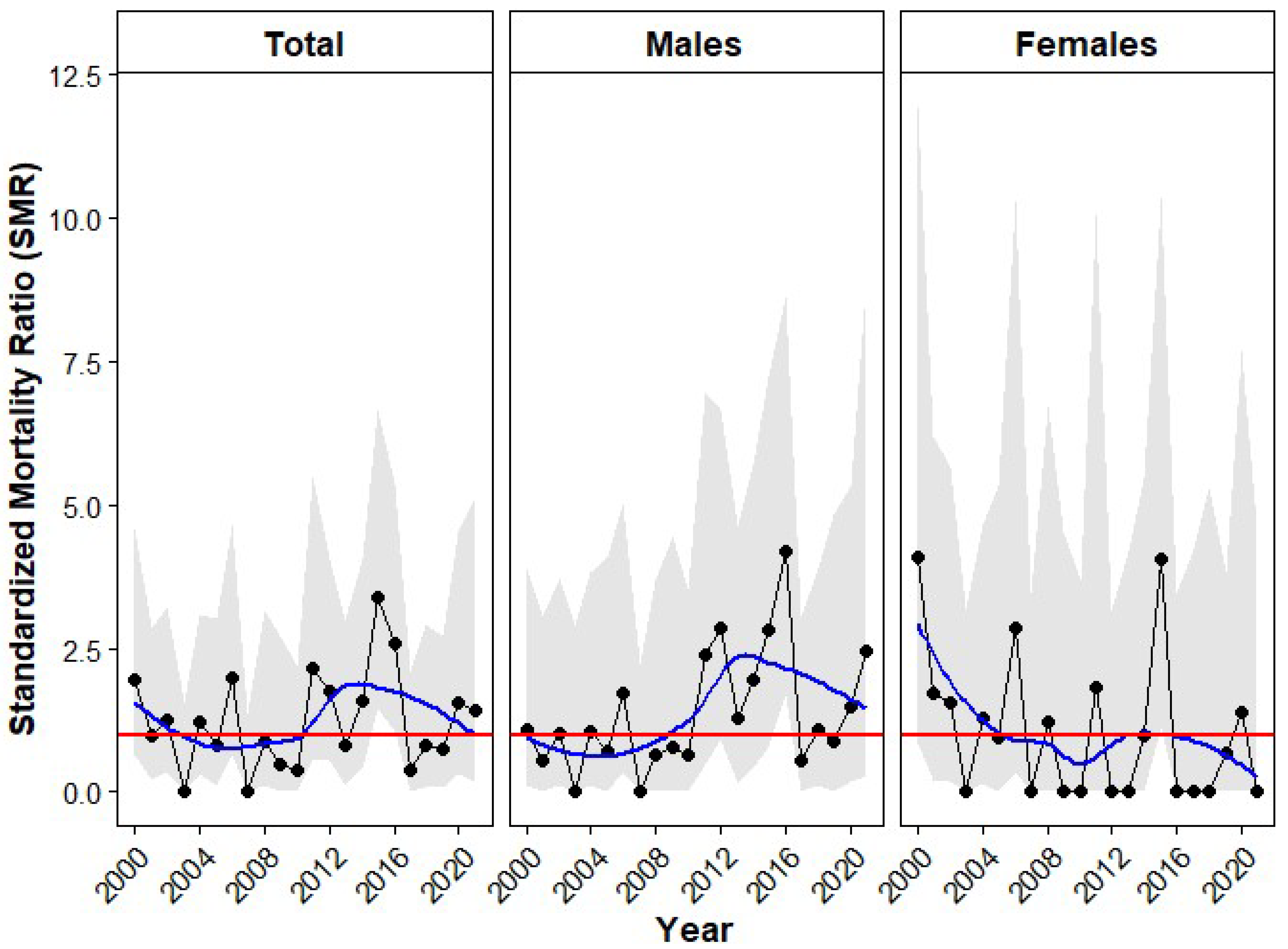
Additionally, annual and 3-year SMRs for all GI cancers were plotted over the study period (2000–2021) to reduce the statistical noise inherent in annual mortality rates within a small population. This aggregation improved the statistical stability of the estimates while maintaining sufficient temporal granularity to observe medium-term trends and disease latency effects. For each calendar year, point estimates of the SMR were displayed together with their corresponding 95%CI, which were visualized as shaded ribbons to reflect statistical uncertainty. A continuous line connecting annual SMR estimates was used to illustrate year-to-year variation in mortality risk relative to the reference population. To evaluate and visually summarize long-term temporal trends while reducing the influence of short-term fluctuations, a locally estimated scatterplot smoothing (LOESS) curve was overlaid on the annual SMR series [38]. LOESS is a non-parametric, locally weighted polynomial regression method that provides a flexible, data-driven representation of trends without imposing a predefined functional form. A horizontal reference line at SMR = 1 was included to indicate equivalence between the observed and expected mortality, facilitating the interpretation of periods with elevated or reduced mortality risk. All graphical analyses were conducted using the ggplot2 package in R (R Foundation for Statistical Computing, Vienna, Austria) [39].

3. Results

Table 2 presents the 22-year SMRs and their respective 95% confidence interval (95% CI) for GI cancers in adult residents of the Oinofyta municipal unit, whereas the expected deaths were estimated from the estimated cancer-specific mortality in Voiotia. Sixty-seven deaths from GI cancer were reported (2 from esophageal, 13 from gastric, 26 from colorectal, 9 from hepatocellular and 17 from pancreatic cancer). Although 22-year mortality from GI cancer was not significantly higher in the Oinofyta population compared with the reference population (SMR = 1.22; 95%CI = 0.94, 1.55), this difference was borderline statistically significant in males, with the Oinofyta male population reporting a 1.35 times higher mortality rate (SMR = 1.35; 95%CI = 1.0, 1.8), which was not the case in females (SMR = 0.97; 95%CI = 0.6, 1.49). Borderline but not significantly higher SMR was also observed for colorectal cancer in the male population (SMR = 1.63; 95%CI = 0.93, 2.65; p = 0.08), but not for the female group (SMR = 1.12; 95%CI = 0.54, 2.07; p = 0.797). Mortality was not significantly higher compared with the reference population for esophageal (SMR = 1.11; 95%CI = 0.13, 4.01), gastric (SMR = 1.54; 95%CI = 0.82, 2.63), pancreatic (SMR = 1.28; 95%CI = 0.74, 2.04), and hepatocellular cancer (SMR = 0.71; 95%CI = 0.32, 1.34).
Additionally, the annual SMRs (Figure 1) of all GI cancers were estimated to evaluate any time-trend effect on cancer deaths in the Oinofyta population overall and in males and females. The SMR trends over the study period showed year-to-year fluctuations, with no significant time effect being observed (p = 0.526). The LOESS curve suggested a modest but non-significant increase in SMRs during the early to mid-2010s, followed by a decline toward the end of the study period. Sex-stratified analyses revealed similar temporal variability, with males showing more pronounced elevations.
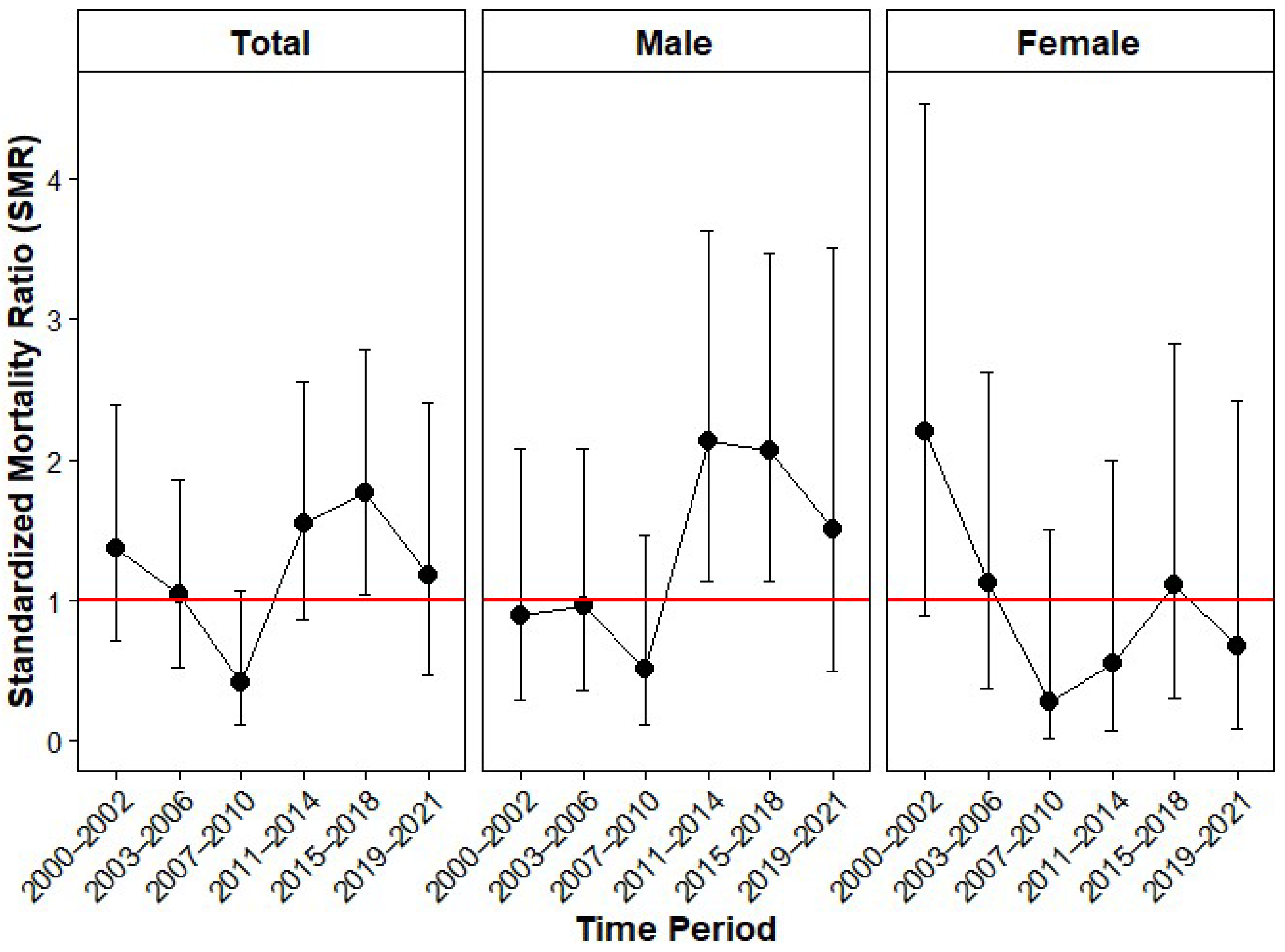
SMRs were then grouped into small year time intervals (2000–2002, 2003–2006, 2007–2010, 2011–2014, 2015–2018, and 2019–2021), with the respective results shown in Figure 2. The SMR for the total population demonstrated an oscillatory pattern, reducing from 2000–2002 (SMR = 1.36; 95%CI = 0.7, 2.38) to 2007–2010 (SMR = 0.41; 95%CI = 0.11, 1.06) and then significantly increasing until 2015–2018 (SMR = 1.76; 95%CI = 1.04, 2.78). Additionally, when the SMRs were grouped into 2 decades (2000–2009, 2010–2021), a significantly increased SMR was observed during the second decade (SMR = 1.44; 95%CI = 1.03, 1.95), which was not the case for the first decade (SMR = 0.98; 95%CI = 0.64, 1.44). Among males, a similar pattern was evident, with pronounced significant increases during 2011–2014 (SMR = 2.12; 95%CI = 1.13, 3.63) and 2015–2018 (SMR = 2.07; 95%CI = 1.13, 3.47), both of which were statistically significant. Following a decline in the subsequent period, the SMRs again increased in 2019–2021, suggesting a possible upward shift in recent years. This was also evident when the SMR was split into two decades (2000–2009: SMR = 0.8; 95%CI = 0.42, 1.36 vs. 2010–2021: SMR = 1.85; 95%CI = 1.28, 2.6). On the contrary, for females, the SMR displayed a non-significant small oscillatory pattern over time. The absence of pronounced peaks highlights a relatively consistent mortality pattern for females over the studied periods. No significant time trends were observed in each type of GI cancer (all p’s > 0.05).

4. Discussion

There are two major mechanisms by which Cr(VI) may contribute to cancer development. Upon Cr(VI)’s entry into the cell, its reducers convert Cr(VI) to trivalent chromium (Cr(III)), with the primary reducer being ascorbate in cells in vivo [40]. DNA subsequently binds to Cr(III) and Cr(III)–ligand complexes to form binary and ternary adducts, damaging the DNA [40]. In response, most cells undergo apoptosis, while those with inadequate levels of mismatch repair proteins proliferate and acquire mutations that induce cancer [41]. In addition to this pathway, the reduction of Cr(VI) to Cr(III) is accompanied by the production of reactive oxygen species, which damage DNA in replicating cells, resulting in mutations that may induce cancer [6,42,43].
Compared with other epidemiological studies of cohorts exposed to Cr(VI), our study is the first to present results from a 22-year cohort environmental study evaluating the ecological association between environmental Cr(VI) oral exposure and GI cancer mortality. Whereas the 22-year SMR for all GI cancer mortality was not significantly higher in the Oinofyta population compared to the reference population of Voiotia regional unit, the mortality rate was significantly higher in the Oinofyta population during the second decade (2010–2021: SMR = 1.44; 95%CI = 1.03, 1.95). Males also exhibited significantly higher excess SMR during 2010–2021 (SMR = 1.85; 95%CI = 1.28, 2.6), with this excess being non-evident for females. Higher SMR for all GI cancers was shown only in the male population with borderline significance, and was also borderline non-significant for colorectal cancer. Additionally, an oscillatory pattern with an increasing trend in SMRs for GI cancer over 3-year intervals was evident in the total and male population, with females showing a stable pattern.
Adverse health effects of Cr(VI) exposure via ingestion remain a topic of significant debate. In 1999, the California Environmental Protection Agency (CEPA) established a maximum drinking water cut-off of 0.2 μg/L for Cr(VI) according to the available data, whereas this guideline was rescinded in 2001 following a review of the existing evidence, which concluded that “non-sufficient data are available to classify Cr(VI) as a carcinogen via oral exposure” [44]. In response to the lack of conclusive evidence, the California Congressional Delegation, CEPA, and California Department of Health Services recommended the evaluation of Cr(VI) toxicity by the National Toxicology Program (NTP). Findings from the NTP revealed that rats and mice orally exposed to Cr(VI) developed cancer in the oral cavity and small intestine, along with hyperplasia and significant histiocytic cell infiltration in the duodenum, jejunum, liver, and lymph nodes (mesenteric and pancreatic) [45]. These findings supported CEPA’s 2009 proposal to establish a stricter cut-off of 0.06 μg/L for Cr(VI) in drinking water [46,47]. Furthermore, the International Agency for Research on Cancer and the European Union consider Cr(VI)-containing compounds as carcinogens [48,49].
More recent evidence debates the carcinogenic effects of Cr(VI) on GI cancers. In their recent systematic review, den Braver et al. (2021) reported that exposure to Cr(VI) increases the risk for lung, nose, and nasal sinus cancer, with no convincing evidence that Cr(VI) causes any GI cancer [6]. This finding is also supported by Suh et al. (2019) and Donato et al. (2016) in their meta-analyses [50,51]. On the other hand, a higher meta-SMR and meta-SIR due to exposure to Cr(VI) was evident for gastric Ca (meta-SMR = 1.39; 95%CI [1.28, 1.51]; meta-SIR = 1.17 (95%CI [1.09, 1.27]) in another meta-analysis [52], while Cohen et al. (2014) highlighted a significantly increased incidence rate and non-significant mortality rate for colorectal cancer but not for gastric cancer [53]. A meta-analysis involving 47 studies on occupational Cr(VI) exposure found a meta-SIR and meta-SMR of 1.06 (95%CI = 1.04, 1.09) and 1.07 (95%CI = 1.01, 1.15), respectively, for all cancers combined [4]. The same meta-analysis also highlighted a significantly higher incidence for GI cancers (meta-SIR = 1.05; 95%CI = 1.00, 1.11), but not mortality (meta-SMR = 0.97; 95%CI = 0.92, 1.01). Another recent systematic review reported weak to no evidence of increased mortality for GI cancers, discussing a potentially elevated incidence and mortality for gastric and colorectal cancer after Cr(VI) exposure, lacking substantiated empirical evidence [7].
In our study, we observed a higher mortality for all GI cancers in the Oinofyta population during the second decade of our study, serving as an indication of the possibility that environmental exposure to Cr(VI) through oral ingestion for decades may increase the risk of cancer mortality. The majority of the existing literature focuses on occupational exposure to Cr(VI) rather than environmental exposure, which is a common limitation that hinders the ability to demonstrate a statistically significant effect of Cr(VI) exposure for GI cancer mortality. While workers are primarily exposed via inhalation and dermal contact, the broader public is likely exposed to Cr(VI) via drinking contaminated water, which was the case for those living in Oinofyta [43]. Considering that the oral pathway of Cr(VI) exposure is most affiliated with gastrointestinal symptoms, occupational studies may be less suited than ours to detect Cr(VI) exposure’s gastrointestinal effects [31]. One environmental study in Spain aiming to investigate any correlation between Cr(VI) topsoil levels and cancer mortality highlighted a significant impact on upper GI tract cancer mortality, breast cancer mortality, and non-Hodgkin’s lymphomas mortality, only in females [30].
To date, no studies have evaluated the longitudinal changes in SMRs for GI cancer as a consequence of Cr(VI) exposure. This represents a critical gap in public health research and should be addressed in all environmental studies, given the latency period of risk factor effects. Understanding this latency is essential to determining the appropriate duration of the study and ensure a comprehensive assessment of exposure-related outcomes. A significant increase in the 10-year SMR was prevalent in our study, underscoring the importance of selecting an appropriate time of observation in analyses. The latency period between exposure to Cr(VI) and the manifestation of cancer explains the observed time-trend, as exposure to Cr(VI) in earlier decades may take decades to result in increased cancer mortality [54]. The aging population could also play a role in the increasing SMR. Cancer incidence and mortality tend to rise with age, and an aging population may amplify observed trends in cancer-related mortality [8].
The biological sex disparity observed in GI cancer mortality, with higher and significant rates in males compared to females in the Oinofyta population, aligns with broader epidemiological patterns. Historically, males have been more likely to be employed in industries with higher exposure to carcinogens, such as chromium processing. This trend is evident in sectors like construction and manufacturing, which are predominantly male-dominated and involve significant exposure to hazardous substances [55]. Additionally, in industrial areas in Greece, like Oinofyta, the vast majority of employees are males who work in occupations with higher exposure to Cr(VI) and other carcinogens (i.e., 21.3% of employed males in Greece works in industry, encompassing sectors such as mining, manufacturing, construction, and public utilities) [56].

Study Design Limitation

Although this is the first ecological study exploring the impact of environmental exposure to Cr(VI) through oral ingestion on GI cancer mortality with a 22-year period follow-up, our findings’ credibility may be limited by its design (ecological fallacy). The observed relationships cannot be directly translated into individual-level risk. Consequently, although an increased SMR for GI cancers was observed during the second decade, this pattern alone cannot establish a causal relationship between chronic oral exposure to Cr(VI) and cancer mortality. A study design incorporating individual-level data (i.e., a cohort study design) would be better suited to address this, as it would allow adjustment for important confounding and modifying variables (i.e., age, occupational exposures, cigarette smoking, nutritional habits, etc.).
Exposure assessment in the present study was defined by residence within the affected area, assuming that all residents consumed local tap water and were therefore exposed to Cr(VI). Although private well water is infrequently used for drinking in Greece and groundwater contamination levels are generally similar within the area, variability in individual water consumption patterns, particularly the use of bottled water, may have resulted in differential exposure and the potential underestimation of risk. Additionally, the absence of systematic water monitoring data prior to 2007 limits the precision of exposure reconstruction. The elevated Cr(VI) concentrations recorded during 2007–2008 were therefore used as a proxy indicator of long-term community exposure resulting from decades of industrial waste disposal since 1969. While the observed mortality patterns between 2000 and 2021 are broadly compatible with the long latency periods typical of many cancers, the lack of continuous historical measurements precludes an accurate estimation of cumulative individual exposure.
Another important limitation is the inability to conduct a dose–response analysis. Our study did not include individual-level exposure metrics, such as detailed water consumption data or biomonitoring indicators (i.e., chromium levels in blood, urine, or tissue), preventing direct linkage between environmental concentrations and internal exposure. Such analyses would require prospective biomonitoring and individual-level epidemiological data collection beyond the scope of the present investigation. Furthermore, the potential presence of additional water contaminants cannot be excluded and may have contributed to the observed outcomes.
Given these limitations, the findings should be interpreted cautiously. As emphasized in peer review, the methodological constraints of the ecological design may materially influence the results, and the current data cannot definitively support causal conclusions. Accordingly, the study should be considered as providing preliminary, observational evidence, and interpretation should remain limited to descriptive population-level patterns. Nevertheless, ecological investigations remain useful for identifying potential public health signals and generating hypotheses in environmental epidemiology, particularly in situations where long-term community-wide contamination has occurred.

5. Conclusions

This ecological study observed an increased GI cancer mortality in the Oinofyta population, specifically during the second decade of follow-up (2010–2021), whereas no significant increase was observed during the first decade or across the total 22-year study period. While this delayed temporal pattern aligns with the expected latency period following historical, community-level exposure to Cr(VI)-contaminated drinking water, the ecological design of this study precludes definitive causal attribution. This pattern should also be interpreted cautiously and may reflect multiple factors, including chance variation, population structure, or uncontrolled confounding. These findings suggest a potential, localized long-term health concern associated with historical industrial waste disposal. Future research should incorporate analytical epidemiological designs, including cohort or case–control studies with individual-level exposure assessment. Systematic environmental monitoring of Cr(VI) in groundwater and soil matrices, together with the biomonitoring of exposed populations, would allow for the estimation of internal chromium burden and a more rigorous evaluation of exposure–outcome relationships. Particular emphasis should be placed on assessing chromium biomarkers in individuals diagnosed with gastrointestinal malignancies to strengthen biological plausibility and causal inference. In the interim, these observations support the necessity of the continued, precautionary environmental monitoring of drinking water sources in heavily industrialized regions.

Author Contributions

All authors read, critically reviewed, and approved the final manuscript. Conceptualization, K.K. and K.T.; methodology, K.K.; software, K.K.; validation, K.K.; formal analysis, K.K.; investigation, K.K.; resources, K.K.; data curation, K.K.; writing—original draft, K.K.; writing—review & editing, K.T., A.B. and T.P.; visualization, K.K.; supervision, K.T. All authors have read and agreed to the published version of the manuscript.

Funding

This research received no external funding.

Institutional Review Board Statement

The study was conducted in accordance with the Declaration of Helsinki, and approved by the Institutional Review Board (or Ethics Committee) of Athens Medical School (Protocol No 626, 6 June 2022).

Informed Consent Statement

Patient consent was waived because the study did not involve primary/individual data collection, surveys, or direct interaction with participants. The analysis was based exclusively on anonymized secondary grouped data obtained from the Hellenic Statistical Authority.

Data Availability Statement

The data presented in this study are available from the corresponding author upon reasonable request. Access is subject to restrictions, as the data are based exclusively on anonymized secondary/grouped data obtained from the Hellenic Statistical Authority under a Confidential Data Agreement.

Acknowledgments

The authors would like to thank the Hellenic Statistical Authority for providing valuable data for this publication.

Conflicts of Interest

The authors declare no conflicts of interest.

Abbreviations

NHMRCAustralian National Health and Medical Research Council
CEPACalifornia Environmental Protection Agency
CIConfidence Interval
GIGastrointestinal
Cr(VI)Hexavalent Chromium
LOESSLocally Estimated Scatterplot Smoothing
NTPNational Toxicology Program
Cr(III)Trivalent Chromium

References

  1. Chen, Q.Y.; DesMarais, T.; Costa, M. Metals and Mechanisms of Carcinogenesis. Annu. Rev. Pharmacol. Toxicol. 2019, 59, 537–554. [Google Scholar] [CrossRef] [PubMed]
  2. Baruthio, F. Toxic Effects of Chromium and Its Compounds. Biol. Trace Elem. Res. 1992, 32, 145–153. [Google Scholar] [CrossRef] [PubMed]
  3. Xu, X.; Yekeen, T.A.; Liu, J.; Zhuang, B.; Li, W.; Huo, X. Chromium Exposure among Children from an Electronic Waste Recycling Town of China. Environ. Sci. Pollut. Res. Int. 2015, 22, 1778–1785. [Google Scholar] [CrossRef] [PubMed]
  4. Deng, Y.; Wang, M.; Tian, T.; Lin, S.; Xu, P.; Zhou, L.; Dai, C.; Hao, Q.; Wu, Y.; Zhai, Z.; et al. The Effect of Hexavalent Chromium on the Incidence and Mortality of Human Cancers: A Meta-Analysis Based on Published Epidemiological Cohort Studies. Front. Oncol. 2019, 9, 24. [Google Scholar] [CrossRef]
  5. Heck, J.E.; Park, A.S.; Qiu, J.; Cockburn, M.; Ritz, B. An Exploratory Study of Ambient Air Toxics Exposure in Pregnancy and the Risk of Neuroblastoma in Offspring. Environ. Res. 2013, 127, 1–6. [Google Scholar] [CrossRef]
  6. den Braver-Sewradj, S.P.; van Benthem, J.; Staal, Y.C.M.; Ezendam, J.; Piersma, A.H.; Hessel, E.V.S. Occupational Exposure to Hexavalent Chromium. Part II. Hazard Assessment of Carcinogenic Effects. Regul. Toxicol. Pharmacol. 2021, 126, 105045. [Google Scholar] [CrossRef]
  7. Katsas, K.; Diamantis, D.V.; Linos, A.; Psaltopoulou, T.; Triantafyllou, K. The Impact of Exposure to Hexavalent Chromium on the Incidence and Mortality of Oral and Gastrointestinal Cancers and Benign Diseases: A Systematic Review of Observational Studies, Reviews and Meta-Analyses. Environments 2024, 11, 11. [Google Scholar] [CrossRef]
  8. Sung, H.; Ferlay, J.; Siegel, R.L.; Laversanne, M.; Soerjomataram, I.; Jemal, A.; Bray, F. Global Cancer Statistics 2020: GLOBOCAN Estimates of Incidence and Mortality Worldwide for 36 Cancers in 185 Countries. CA Cancer J. Clin. 2021, 71, 209–249. [Google Scholar] [CrossRef]
  9. Mariotto, A.B.; Yabroff, K.R.; Shao, Y.; Feuer, E.J.; Brown, M.L. Projections of the Cost of Cancer Care in the United States: 2010-2020. J. Natl. Cancer Inst. 2011, 103, 117–128. [Google Scholar] [CrossRef]
  10. US EPA Chromium in Drinking Water. Available online: https://www.epa.gov/sdwa/chromium-drinking-water (accessed on 23 February 2026).
  11. WHO Chromium in Drinking-Water. Background Document for Development of WHO Guidelines for Drinking-Water Quality; WHO Chromium in Drinking-Water: Geneva, Switzerland, 2003.
  12. Health Canada. GOC Guidelines for Canadian Drinking Water Quality: Guideline Technical Document—Chromium; Health Canada: Ottawa, ON, Canada, 2016; ISBN 978-0-660-06563-2. [Google Scholar]
  13. European Parliament and of the Council. EUR-Lex Directive (EU) 2020/2184 of the European Parliament and of the Council of 16 December 2020 on the Quality of Water Intended for Human Consumption (Recast); European Parliament and of the Council: Strasbourg, France, 2020; pp. 1–62. [Google Scholar]
  14. Sedman, R.; Beaumont, J.; Budroe, J.; Vidair, C. Public Health Goal for Chemicals in Drinking Water: Hexavalent Chromium; OEHHA: Sacramento, CA, USA, 2011. [Google Scholar]
  15. NHMRS. Australian Drinking Water Guidelines; Australian Government: Canberra, Australia, 2025. [Google Scholar]
  16. Tanagra Municipality Δημοτική Ενότητα Oινοφύτων. ΔHΜOΣ ΤAΝAΓΡAΣ. Available online: https://tanagra.gr/de-oinofytwn/ (accessed on 23 February 2026).
  17. ELSTAT Population-Housing Census 2021—ELSTAT. Available online: https://www.statistics.gr/el/2021-census-pop-hous (accessed on 18 December 2025).
  18. ELINYAE Π.Δ. 84/1984 (ΦΕΚ 33/A’ 21.3.1984). Available online: https://www.elinyae.gr/ethniki-nomothesia/pd-841984-fek-33a-2131984 (accessed on 17 December 2025).
  19. ELINYAE Aποφ. Υ.Γ. 179182/656/1979 (ΦΕΚ 582/Β’ 2.7.1979)|ΕΛΙΝΥAΕ. Available online: https://www.elinyae.gr/ethniki-nomothesia/apof-yg-1791826561979-fek-582b-271979 (accessed on 23 February 2026).
  20. TCG. The Problem of the Asopos River Proposals for Dealing with It; Technical Chamber of Greece: Athens, Greece, 2009. [Google Scholar]
  21. IGME. Hydrogeological Hydrochemical Reconaissance Study of Underground Waters Quality of the Wider Asopos Basin. Inst. Geol. Miner. Explor. 2008, 80, 818. [Google Scholar]
  22. Vasilatos, C.; Megremi, I.; Economou-Eliopoulos, M.; Mitsis, I. Hexavalent Chromium and Other Toxic Elements in Natural Waters in the Thiva-Tanagra-Malakasa Basin, Greece. Hell. J. Geosci. 2008, 43, 57–66. [Google Scholar]
  23. Linos, A.; Petralias, A.; Christophi, C.A.; Christoforidou, E.; Kouroutou, P.; Stoltidis, M.; Veloudaki, A.; Tzala, E.; Makris, K.C.; Karagas, M.R. Oral Ingestion of Hexavalent Chromium through Drinking Water and Cancer Mortality in an Industrial Area of Greece--an Ecological Study. Environ. Health 2011, 10, 50. [Google Scholar] [CrossRef] [PubMed]
  24. Panagiotidis, T. The Prosecutor Proposed the Conviction of Four Industrialists for the Pollution of the Asopos River|Pandora’s Box. Available online: https://www.koutipandoras.gr/article/tin-katadiki-tessaron-megaloviomihanon-proteine-o-eisaggeleas-gia-tin-rypansi-toy/ (accessed on 18 December 2025).
  25. SKAI. The Ecological Crime in Asopos Continues. Available online: https://www.skai.gr/news/environment/synexizetai-to-oikologiko-egklima-ston-asopo (accessed on 18 December 2025).
  26. Γέρου, Β. Μελέτη της ρύπανσης του Aσωπού ποταμού. H επίδρασή της στο περιβάλλον και την κοινωνία. Ph.D. Thesis, Αριστοτέλειο Πανεπιστήμιο Θεσσαλονίκης, Thessaloniki, Greece, 2022. [Google Scholar]
  27. IGPA. Audit Report: The Audit of the Legality and Completeness of Supporting Documents of the Wastewater Disposal Permits of 19 Companies Operating in the Asopos River Area; General Inspector of Public Administration: Athens, Greece, 2007. [Google Scholar]
  28. Bednar, C.M.; Kies, C. Inorganic Contaminants in Drinking Water Correlated with Disease Occurrence in Nebraska1. JAWRA J. Am. Water Resour. Assoc. 1991, 27, 631–635. [Google Scholar] [CrossRef]
  29. Chen, K.; Liao, Q.L.; Ma, Z.W.; Jin, Y.; Hua, M.; Bi, J.; Huang, L. Association of Soil Arsenic and Nickel Exposure with Cancer Mortality Rates, a Town-Scale Ecological Study in Suzhou, China. Environ. Sci. Pollut. Res. Int. 2015, 22, 5395–5404. [Google Scholar] [CrossRef] [PubMed]
  30. Núñez, O.; Fernández-Navarro, P.; Martín-Méndez, I.; Bel-Lan, A.; Locutura, J.F.; López-Abente, G. Arsenic and Chromium Topsoil Levels and Cancer Mortality in Spain. Environ. Sci. Pollut. Res. 2016, 23, 17664–17675. [Google Scholar] [CrossRef]
  31. ATSDR Toxicological Profile for Chromium. Available online: https://wwwn.cdc.gov/TSP/ToxProfiles/ToxProfiles.aspx?id=62&tid=17 (accessed on 25 July 2025).
  32. Levin, K.A. Study Design VI—Ecological Studies. Evid. Based Dent. 2006, 7, 108. [Google Scholar] [CrossRef]
  33. ELSTAT [ELSTAT]. Available online: https://www.statistics.gr/el/home (accessed on 18 December 2025).
  34. ICD ICD-10 Version: 2019. Available online: https://icd.who.int/browse10/2019/en (accessed on 27 July 2025).
  35. Dobson, A.J.; Kuulasmaa, K.; Eberle, E.; Scherer, J. Confidence Intervals for Weighted Sums of Poisson Parameters. Stat. Med. 1991, 10, 457–462. [Google Scholar] [CrossRef]
  36. Ulm, K. A Simple Method to Calculate the Confidence Interval of a Standardized Mortality Ratio (SMR). Am. J. Epidemiol. 1990, 131, 373–375. [Google Scholar] [CrossRef]
  37. Armitage, P.; Berry, G. Statistical Methods in Medical Research, 3rd ed.; Blackwell Scientific Publications: Oxford, UK, 1994. [Google Scholar]
  38. Cleveland, W.S. Robust Locally Weighted Regression and Smoothing Scatterplots. J. Am. Stat. Assoc. 1979, 74, 829–836. [Google Scholar] [CrossRef]
  39. Wickham, H.; Chang, W.; Henry, L.; Pedersen, T.L.; Takahashi, K.; Wilke, C.; Woo, K.; Yutani, H.; Dunnington, D.; Van Den Brand, T. Ggplot2: Create Elegant Data Visualisations Using the Grammar of Graphics, Version 4.0.1; R Foundation for Statistical Computing: Vienna, Austria, 2007; Available online: https://cran.r-project.org/web/packages/ggplot2/index.html (accessed on 18 December 2025).
  40. Krawic, C.; Zhitkovich, A. Chapter Two—Chemical Mechanisms of DNA Damage by Carcinogenic Chromium(VI). In Advances in Pharmacology; Environmental Carcinogenesis; Costa, M., Ed.; Academic Press: Cambridge, MA, USA, 2023; Volume 96, pp. 25–46. [Google Scholar]
  41. Peterson-Roth, E.; Reynolds, M.; Quievryn, G.; Zhitkovich, A. Mismatch Repair Proteins Are Activators of Toxic Responses to Chromium-DNA Damage. Mol. Cell. Biol. 2005, 25, 3596–3607. [Google Scholar] [CrossRef]
  42. Waris, G.; Ahsan, H. Reactive Oxygen Species: Role in the Development of Cancer and Various Chronic Conditions. J. Carcinog. 2006, 5, 14. [Google Scholar] [CrossRef] [PubMed]
  43. VonHandorf, A.; Zablon, H.A.; Puga, A. Hexavalent Chromium Disrupts Chromatin Architecture. Semin. Cancer Biol. 2021, 76, 54–60. [Google Scholar] [CrossRef] [PubMed]
  44. Proctor, D.M.; Otani, J.M.; Finley, B.L.; Paustenbach, D.J.; Bland, J.A.; Speizer, N.; Sargent, E.V. Is Hexavalent Chromium Carcinogenic via Ingestion? A Weight-of-Evidence Review. J. Toxicol. Environ. Health A 2002, 65, 701–746. [Google Scholar] [CrossRef]
  45. Stout, M.D.; Herbert, R.A.; Kissling, G.E.; Collins, B.J.; Travlos, G.S.; Witt, K.L.; Melnick, R.L.; Abdo, K.M.; Malarkey, D.E.; Hooth, M.J. Hexavalent Chromium Is Carcinogenic to F344/N Rats and B6C3F1 Mice after Chronic Oral Exposure. Environ. Health Perspect. 2009, 117, 716–722. [Google Scholar] [CrossRef] [PubMed]
  46. Agency CEP Public Health. Goal for Hexavalent Chromium (Cr VI) in Drinking Water; Agency CEP Public Health: Sacramento, CA, USA, 2011. [Google Scholar]
  47. OEHHA Hexavalent Chromium (Chromium-6)|California State Water Resources Control Board. Available online: https://www.waterboards.ca.gov/drinking_water/certlic/drinkingwater/Chromium6.html (accessed on 19 December 2025).
  48. IARC Working Group on the Evaluation of Carcinogenic Risks to Humans. Arsenic, Metals, Fibres and Dusts; International Agency for Research on Cancer: Lyon, France, 2012; ISBN 978-92-832-1320-8. [Google Scholar]
  49. Hartwig, A.; Klein, C.; Kromhout, H.; Levy, L.; Papameletiou, D.; Heederik, D. SCOEL/REC/386 Chromium VI Compounds: Recommendation from the Scientific Committee on Occupational Exposure Limits; Publications Office: Luxembourg, 2017. [Google Scholar]
  50. Donato, F.; Garzaro, G.; Pira, E.; Boffetta, P. Mortality and Cancer Morbidity among Cement Production Workers: A Meta-Analysis. Int. Arch. Occup. Environ. Health 2016, 89, 1155–1168. [Google Scholar] [CrossRef]
  51. Suh, M.; Wikoff, D.; Lipworth, L.; Goodman, M.; Fitch, S.; Mittal, L.; Ring, C.; Proctor, D. Hexavalent Chromium and Stomach Cancer: A Systematic Review and Meta-Analysis. Crit. Rev. Toxicol. 2019, 49, 140–159. [Google Scholar] [CrossRef]
  52. Welling, R.; Beaumont, J.J.; Petersen, S.J.; Alexeeff, G.V.; Steinmaus, C. Chromium VI and Stomach Cancer: A Meta-Analysis of the Current Epidemiological Evidence. Occup. Environ. Med. 2015, 72, 151–159. [Google Scholar] [CrossRef]
  53. Cohen, S.S.; Sadoff, M.M.; Jiang, X.; Fryzek, J.P.; Garabrant, D.H. A Review and Meta-Analysis of Cancer Risks in Relation to Portland Cement Exposure. Occup. Environ. Med. 2014, 71, 796–802. [Google Scholar] [CrossRef]
  54. Costa, M.; Klein, C.B. Toxicity and Carcinogenicity of Chromium Compounds in Humans. Crit. Rev. Toxicol. 2006, 36, 155–163. [Google Scholar] [CrossRef]
  55. Scarselli, A.; Corfiati, M.; Di Marzio, D.; Marinaccio, A.; Iavicoli, S. Gender Differences in Occupational Exposure to Carcinogens among Italian Workers. BMC Public Health 2018, 18, 413. [Google Scholar] [CrossRef]
  56. World Bank Greece. Employees, Industry, Male (% of Male Employment)—2024 Data 2025 Forecast 1981–2022 Historical 2024; World Bank Greece: Athens, Greece, 2024. [Google Scholar]
Figure 1. Annual SMR and the respective locally estimated scatterplot smoothing (LOESS) curve for all gastrointestinal (GI) cancers (C15–C22, C25) in the total Oinofyta population and between males and females. Expected deaths were estimated from the estimated cancer-specific mortality in Voiotia. Note. SMRs were considered statistically significant if the value 1 (red line) was not included in their respective 95% confidence interval (shadow area).
Environments 13 00172 g001
Figure 2. Temporal trends in SMR for all gastrointestinal (GI) cancers (C15-C22, C25), in the total Oinofyta population and between males and females. Expected deaths were estimated from the estimated cancer-specific mortality in Voiotia. Note. SMRs were considered statistically significant if the value 1 (red line) was not included in their respective 95% confidence interval.
Environments 13 00172 g002
Table 1. Measurements of Cr(VI) levels in different sites of the public drinking water supply of the Oinofyta municipality during July 2007–June 2008.
SampleDateSiteCr(VI) Levels (μg/L)
124 July 2007143
224 July 2007251
324 July 2007350
424 July 2007447.9
524 July 2007526.2
624 July 2007627.9
726 October 2007728
826 October 2007810
98 November 2007143
108 November 2007910
1129 November 2007839
126 December 2007911
136 December 2007144
146 December 20071012
1516 June 20081142.8
1626 June 2008128.3
Source: [23]. The original source data from Oinofyta municipality are currently unavailable.
Table 2. The 22-year SMRs and 95%CI for GI cancers in adult residents of the Oinofyta municipal unit. Expected deaths were estimated from the estimated cancer-specific mortality in Voiotia.
Cause of Death (ICD-10)TotalMalesFemales
ObsExpSMR (95% CI)ObsExpSMR (95% CI)ObsExpSMR (95% CI)
All GI cancers (C15–C22, C25)67551.22 (0.94, 1.55)4625.61.35 (1.0, 1.8) **2121.60.97 (0.6, 1.49)
Esophageal (C15)21.81.11 (0.13, 4.01)21.41.49 (0.18, 5.37)00.5-
Gastric (C16)138.41.54 (0.82, 2.63)85.91.36 (0.59, 2.68)52.81.8 (0.58, 4.2)
Colorectal (C18–C21)2618.71.39 (0.91, 2.04)169.81.63 (0.93, 2.65) *108.91.12 (0.54, 2.07)
Hepatocellular (C22)912.80.71 (0.32, 1.34)78.90.79 (0.32, 1.63)240.5 (0.06, 1.8)
Pancreatic (C25)1713.31.28 (0.74, 2.04)138.31.57 (0.84, 2.69)45.40.74 (0.2, 1.89)
Notes. SMRs were considered statistically significant if the value 1 was not included in their respective 95% confidence interval. * p < 0.1; ** p ≤ 0.05. Abbreviations. Observed number of cases (Obs); Standardized Mortality Ratio (SMR); 95% Confidence Interval (95%CI); Expected (Exp); Gastrointestinal (GI).
Disclaimer/Publisher’s Note: The statements, opinions and data contained in all publications are solely those of the individual author(s) and contributor(s) and not of MDPI and/or the editor(s). MDPI and/or the editor(s) disclaim responsibility for any injury to people or property resulting from any ideas, methods, instructions or products referred to in the content.