
Article

Association Between Traffic Noise and Cognitive Function: A Cross-Sectional Study in a Mid-Sized City in Northern Colombia

by
Maria Taboada-Alquerque
1,
Felipe Figueroa
2,
Juan Valdelamar-Villegas
1 and
Jesus Olivero-Verbel
1,*
1
Environmental and Computational Chemistry Group, School of Pharmaceutical Sciences, Zaragocilla Campus, Research Institute for Climate Change and Sustainable Development, University of Cartagena, Cartagena 130014, Colombia
2
Laboratorio de Acústica Ambiental, Instituto de Acústica, Universidad Austral de Chile, Valdivia 5111187, Chile
*
Author to whom correspondence should be addressed.
Environments 2026, 13(4), 204; https://doi.org/10.3390/environments13040204
Submission received: 29 December 2025 / Revised: 5 February 2026 / Accepted: 6 February 2026 / Published: 6 April 2026
(This article belongs to the Special Issue Environmental Pollution Exposure and Its Human Health Risks)

Abstract

Exposure to road traffic noise is an increasing public health concern in developing countries. However, limited research has explored its effect on children’s cognitive function in contexts with common lifestyles and socioeconomic conditions in these countries. This study aims to evaluate the association between residential outdoor traffic noise exposure in Sincelejo, Colombia, the multidimensional poverty index (MPI) and the effects on cognitive functions in children with a cross-sectional deisgn. Noise levels were estimated using the CNOSSOS model and spatially linked to selective attention and working memory of children, assessed with standardized cognitive tests. Associations were estimated with logistic regression models adjusted for sociodemographic and school characteristics and stratified by MPI. Sensitivity analyses were conducted to evaluate the consistency of the associations. The results indicated a statistically significant yet weak association between a 1 dBA increase in noise levels and reduced processing speed (≤95) in selective attention tasks, particularly in the area with the highest prevalence of MPI < 50. However, sensitivity analyses did not corroborate these findings, and the observed association should therefore be interpreted with caution as exploratory and hypothesis generating.

1. Introduction

Traffic noise has become a public health problem that affects the quality of life and health of millions of people around the world [1,2,3]. According to the European Environment Agency (EEA), approximately 113 million people in the European Union are exposed to traffic noise levels of at least 55 dBA, which have been associated with significant health problems [4]. This exposure is estimated to cause 48,000 new cases of ischemic heart disease annually, annoyance in 22 million people, sleep disturbance in 6.5 million, and learning disabilities in 12,500 children due to environmental noise exposure [5]. However, although the adverse effects of traffic noise are extensively documented in Europe, studies examining its impact on public health in Latin America are still limited.
In the Latin American context, most of the existing studies have focused on the creation of noise maps in urban areas and the methods for their construction [6,7,8,9]. In addition, the effects of noise on hearing health [10], subjective annoyance [11], sleep quality [12], and cardiovascular and cerebrovascular mortality risks in the adult population have been examined [13]. Although several studies have shown that noise exposure can affect cognitive functions in children [14,15,16], little is known about the specific impact of this exposure among Latin American children. A study in São Paulo, Brazil, for example, suggests that community noise levels above a Lden (day-evening-night noise level) of 70 dB and a Lnight (night-time noise level) of 60 dB may affect the behavioral and cognitive development of preschool children [17].
Childhood is a particularly vulnerable period to the effects of noise [18]. During this stage, children undergo significant cognitive development, and their limited capacity for adaptation makes them especially susceptible to external stressors such as environmental noise [19]. According to Jean Piaget’s theory, children between the ages of 7 and 12 go through a critical period of cognitive development [20], and previous studies suggest that noise can negatively impact their working memory [21], concentration performance [22], math performance in easier problems [23], and reading and listening comprehension skills [24]. These effects may be mediated by decreased auditory discrimination and language perception [25], as well as by chronic stress responses and increased physiological arousal [26]. The cognitive response to noise, associated with reduced selective attention and working memory, is potentially related to hyperactivity of the hypothalamic-pituitary-adrenal axis, decreased neuronal density, and reduced volume of the hippocampus, prefrontal cortex, and amygdala [27,28,29].
Memory and attention are key components of cognitive ability and contribute significantly to learning, especially during childhood [30,31]. These skills are fundamental for the successful completion of educational activities and are therefore considered predictors of academic performance [32,33]. Although the relationship between cognitive ability and academic performance is complex, memory has been proposed to play a key role in the development of skills such as recitation and proficiency in subjects such as mathematics and interacts with information processing ability to improve reading comprehension [34]. This perspective is supported by information processing theory, which suggests that a robust consolidation of cognitive functions enables efficient and accurate encoding of information into memory, thus facilitating academic success [35]. Selective attention also plays a critical role in higher academic achievement in areas such as language, literacy, and mathematics [36].
Globally, the academic performance of students has shown a deterioration in recent years, according to the Programme for International Student Assessment (PISA), especially in Latin America, where results in mathematics, science, and reading are below OECD standards [37]. According to the data, approximately 75% of students assessed in these countries perform below the basic level in mathematics, and 55% are below basic level in reading comprehension [37]. In Colombia, the quality of education in schools is assessed regionally and departmentally through the Pruebas Saber for grades 3, 5, 7, 9, and 11 [38]. In 2022, fifth-grade results showed that Colombia’s Caribbean region had the second-lowest average performance in mathematics among all regions nationwide [38]. Similarly, its scores in reading, natural sciences, and citizenship skills remained below the national average [38]. At the departmental level, Sucre, with Sincelejo as its capital, was among the three lowest-performing regions across all assessed domains, including mathematics, reading, writing, natural sciences, and citizenship skills [38].
This cross-sectional study aims to examine the association between road traffic noise exposure in the home environment and selective attention (concentration, processing speed, and accuracy), as well as working memory, in children aged 8 to 12 years living in Sincelejo, Colombia. Traffic noise levels were estimated outside each child’s residence using a noise mapping approach, allowing the assessment of residential exposure. This focus is particularly relevant for understanding how chronic exposure to traffic noise in the home environment may influence cognitive development in children living in urban Latin American settings.

2. Materials and Methods

2.1. Population and Study Design

This cross-sectional study was conducted in Sincelejo, the capital of Sucre Department in northern Colombia (09°18′17′′ N, 075°23′52′′ W). The city covers an area of approximately 25 km2 and is administratively divided into nine communes. According to the most recent census data [39], the projected population for 2023 was 273,124, with 48.32% females and 51.67% males. Sincelejo is known for its significant influx of people from rural areas and neighboring municipalities, often resulting from forced displacement or the search for better employment, education, and healthcare opportunities. This migration has contributed to an increasing demand for urban mobility, with a significant number of motorcycles serving both as a primary mode of public transportation and as private vehicles. Motorcycles play a key role in providing residents with access to essential services and opportunities within the city.
This project collected sociodemographic, health, and noise exposure information from 187 children aged 8–12 years who lived in the urban area of Sincelejo. Participants were enrolled from both public and private schools across different socioeconomic strata through parental questionnaires. Children with cognitive, visual, or auditory impairments, as well as those who could not be contacted, refused participation, were unavailable at the time of the visit, or had relocated, were excluded from the cognitive assessments. Finally, a total of 98 participants were included in the analysis. See flow chart in Figure S1. The study was conducted in accordance with the Declaration of Helsinki, and the protocol was approved by the Ethics Committee of the University of Cartagena and registered under approval No. 133 on 8 August 2023 (Figure S2). Prior to data collection, written informed consent was obtained from the parents.

2.2. Noise Exposure Assessment

To evaluate noise exposure in Sincelejo, a noise map of the area was constructed using the CNOSSOS model, based on the categorization of roads and in situ acoustic measurements. The CNOSSOS model is widely used for noise mapping in areas that include motorcycles in the traffic flow. This model requires various inputs, including geographic coordinates, traffic volume per roadway categorized by vehicle type, traffic speed, lane width, building height, and road surface type.
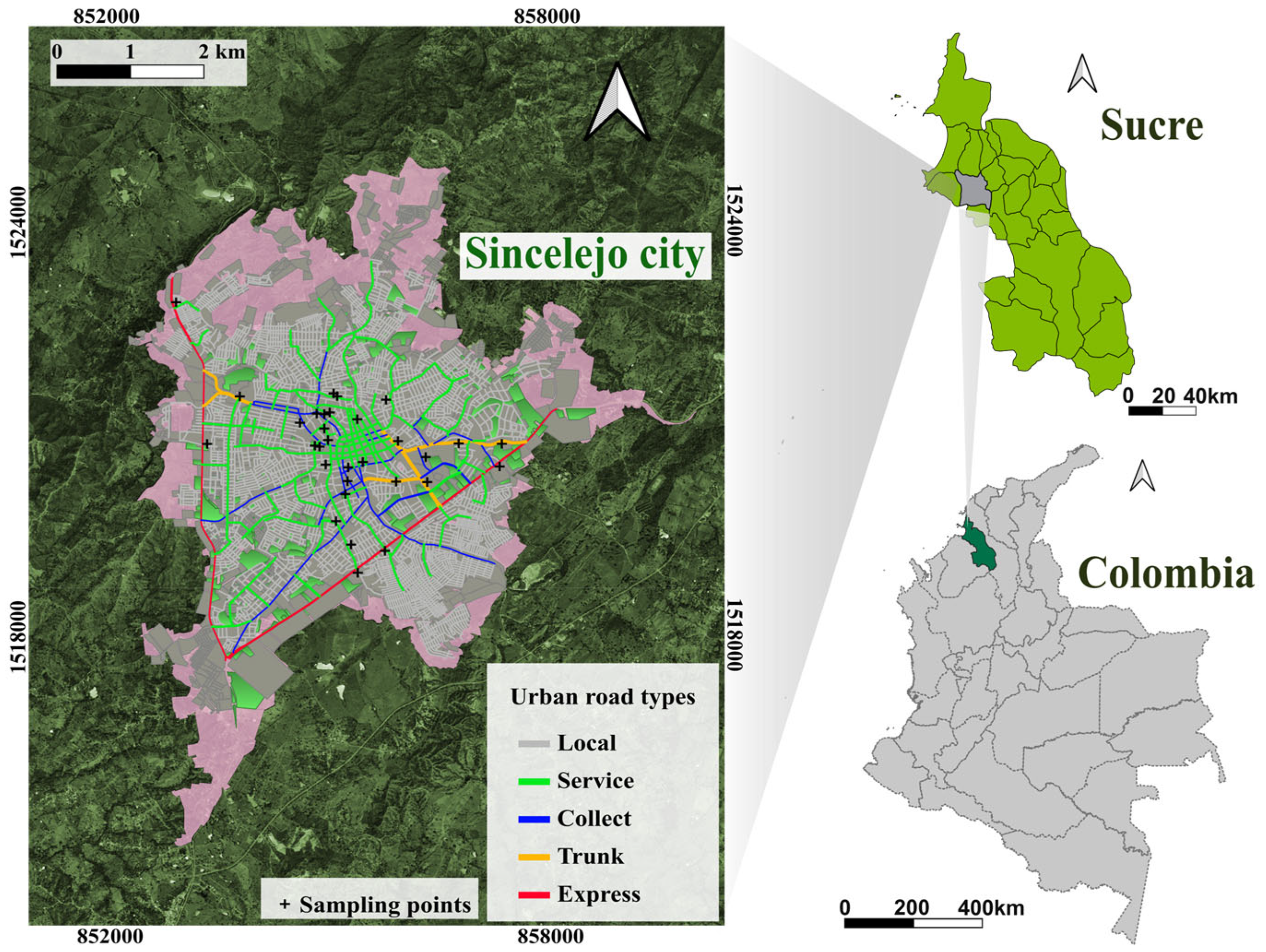
The roads were classified into 5 categories according to their functionality, based on previously applied methodologies [40], as indicated below:
  • Express: Roads used for intermunicipal connections.
  • Trunk roads: Roads used to connect with the main nodes of the city or as alternatives to express roads.
  • Collector roads: Roads that connect expressways and trunk roads with each other and with centers of interest.
  • Service roads: The rest of the roads connect express, trunk and collector roads with the main streets of the neighborhoods.
  • Local roads: Include all residential streets that were not included in the previous classifications.
Road functionality was determined based on available cartographic information and on-site observations of the roads. In total, 31 monitoring sites were selected to perform the noise level assessments. Five were located on express roads, six on trunk roads, eight on collector roads, six on service roads, and six on local roads. The coordinates of the monitored sites are described in Table S1. The categorized roads and noise monitoring sites are presented in Figure 1.

2.3. Sampling and Data Collection

Acoustic measurements and input data for creating the noise map model were collected simultaneously at the thirty-one monitored sites. All measurements were taken over 15 min, during off-peak hours in the morning and afternoon (08:00 to 11:30 and 14:00 to 17:00) on weekdays (Monday to Friday).

2.4. Input Data to Create the Noise Map

The input data for generating the noise map were defined according to the CNOSSOS model [41]. Traffic flow for each road was recorded through manual vehicle counts, categorized according to the typification defined in the model. Land cover information was obtained from OpenStreetMap® under the Open Database License, while buildings were modeled using simplified methodologies that grouped households within blocks. Building heights were estimated based on simplifying assumptions, with 4 m for blocks containing single-story buildings and 10 m for those with two-story or taller buildings. Meteorological data were obtained from Institute of Hydrology, Meteorology, and Environmental Studies (IDEAM) records (www.ideam.gov.co (accessed on 24 June 2024)).

2.5. Acoustic Measurements

Acoustic measurements were conducted using a 3M QUEST Soundpro integrating-averaging sound level meter (Quest Technologies, Oconomowoc, WI, USA), calibrated before each session according to the manufacturer’s guidelines. The instrument, installed on a tripod 1.5 m above the ground (approximating human ear level), was positioned with the microphone directed toward the noise source, ensuring a 1.5-m distance from the nearest reflective surface. The sound level meter was configured to frequency weighting A, in slow response mode, and measured the 1/3 octave band spectrum. The equivalent continuous sound level (Leq) was recorded for noise analysis. Data were collected from 5 February to 9 February 2024. Measurements influenced by extraneous noise or adverse weather, such as wind, were excluded to maintain data integrity.

2.6. Noise Mapping

Noise mapping was conducted to analyze the spatial distribution of noise levels in Sincelejo using the open-source tool, Noise Modelling V4.0, which operates based on the CNOSSOS model [42]. Simulations were performed using previously collected input data, including traffic flow. Receivers were deployed in two configurations: first, arranged in grids to map noise distribution, and second, positioned around buildings to validate the simulated data against in situ measurements [43]. The average vehicle count per hour was estimated as the median flow of heavy vehicles, light vehicles, and motorcycles for each road type. The noise map was generated using the parameter values shown in Table S2.

2.7. Participants

Data collection was conducted between August 2023 and August 2024. During this period, elementary schools across the city were invited to participate. In participating schools, a statement was distributed to fourth- and fifth-grade students, aged 8 to 12, to be shared with their parents. This statement provided an explanation of the study’s purpose and details and allowed parents to provide their contact information. Participation in the study was voluntary. Exclusion criteria included children with cognitive, motor, auditory, or visual impairments.

2.8. Cognitive Functions Assessment

Cognitive functions were assessed at a single time point by a trained and experienced psychologist following standardized administration procedures. Assessments were conducted individually in the home of the children, in a quiet environment with minimal noise and distractions. Cognitive domains such as working memory, processing speed, accuracy, and concentration were evaluated using tests validated for these ages in other populations. The digit span, number-letter sequencing, and arithmetic subtests of the WISC-IV test were used to assess global working memory performance, considering the Working Memory Index (WMI) value as the score of interest [44]. The D2-R test was implemented to assess the ability to maintain selective attention and concentration, and indicators of processing speed and accuracy of responses in simple tasks [45]. The value of the transformed score was set as the outcome of interest. All scores were standardized to a mean of 100 and a standard deviation (SD) of 15. The total duration of the cognitive assessment ranged from 25 to 60 min per child.

2.9. Assignment of Exposure to Outdoor Residential Noise

The residential addresses of all participating children were geocoded and mapped within the noise model using a geographic information system (GIS). Each child was assigned an outdoor residential noise exposure value by spatially intersecting their home location with the modeled road traffic noise map. Noise exposure was defined as the equivalent continuous sound level (LAeq) estimated at the exterior of the dwelling, representing road traffic noise exposure in the home environment.

2.10. Statistical Analysis

Statistical analysis was conducted to validate the modeled noise levels and examine their relationship with cognitive variables.

2.10.1. Validation of Modeled Noise Levels

The normality of both the monitored and modeled noise level data was assessed using the Shapiro-Wilk test at a 95% confidence level. Both datasets were compared using the Wilcoxon test for paired samples. The relationship between the datasets was evaluated using linear regression analysis.

2.10.2. Cognitive Effects of Noise

Logistic regression analyses were used to determine odds ratios (OR) and their 95% confidence intervals (CI). The association between the cognitive variables, including concentration, processing speed, accuracy, and working memory, and daytime equivalent continuous noise level, were evaluated by unadjusted logistic regression and adjusted for school type, sex, age, income of parents and grade level. Noise level and age were considered continuous variables. Concentration, accuracy, and processing speed were analyzed as categorical variables, using as baseline score of 95 defined based on previous studies [46]. Working memory, school type, sex, parents’ income and grade level were also analyzed as categorical variables. Working memory was classified as inferior (<80 points) when the child’s score fell into the very inferior and inferior categories, and as average (≥80) when it fell into the lower average, average and high average categories, based on previous studies [47]. Associations were considered statistically significant at the p-value < 0.05 level. p-values were adjusted using the Benjamini–Hochberg method to control the false discovery rate (FDR). Analyses were performed using glm function in R (version 4.0.0) [48].

2.11. Stratified Analysis

To reduce the risk of sample heterogeneity, due to the diversity of the participants’ sociodemographic characteristics, all children were grouped into two zones based on the multidimensional poverty index (MPI) presented by DANE [49]. The MPI is an indicator ranging from 0 to 100 that reflects household deprivations across five components, including education, childhood conditions, health, employment, and access to public services. An MPI value close to 100 indicates severe poverty conditions, while a value of 0 signifies the absence of deprivation across all five components. Zone 1 consisted mostly of areas with MPI values above 50, and in Zone 2, most blocks had values below this threshold (Figure S3).
Sensitivity analyses were performed using continuous measures of residential outdoor noise exposure, concentration, processing speed, accuracy, and working memory, stratified by zone. Associations were examined using unadjusted and adjusted generalized additive models, with adjustment for age, school type, sex, and household income, implemented with the mgcv package in R (version 4.0.0) [48]. Results are reported as p-values and adjusted R2 for each cognitive outcome and zone.

3. Results

3.1. Noise Assessment and Noise Level Validation

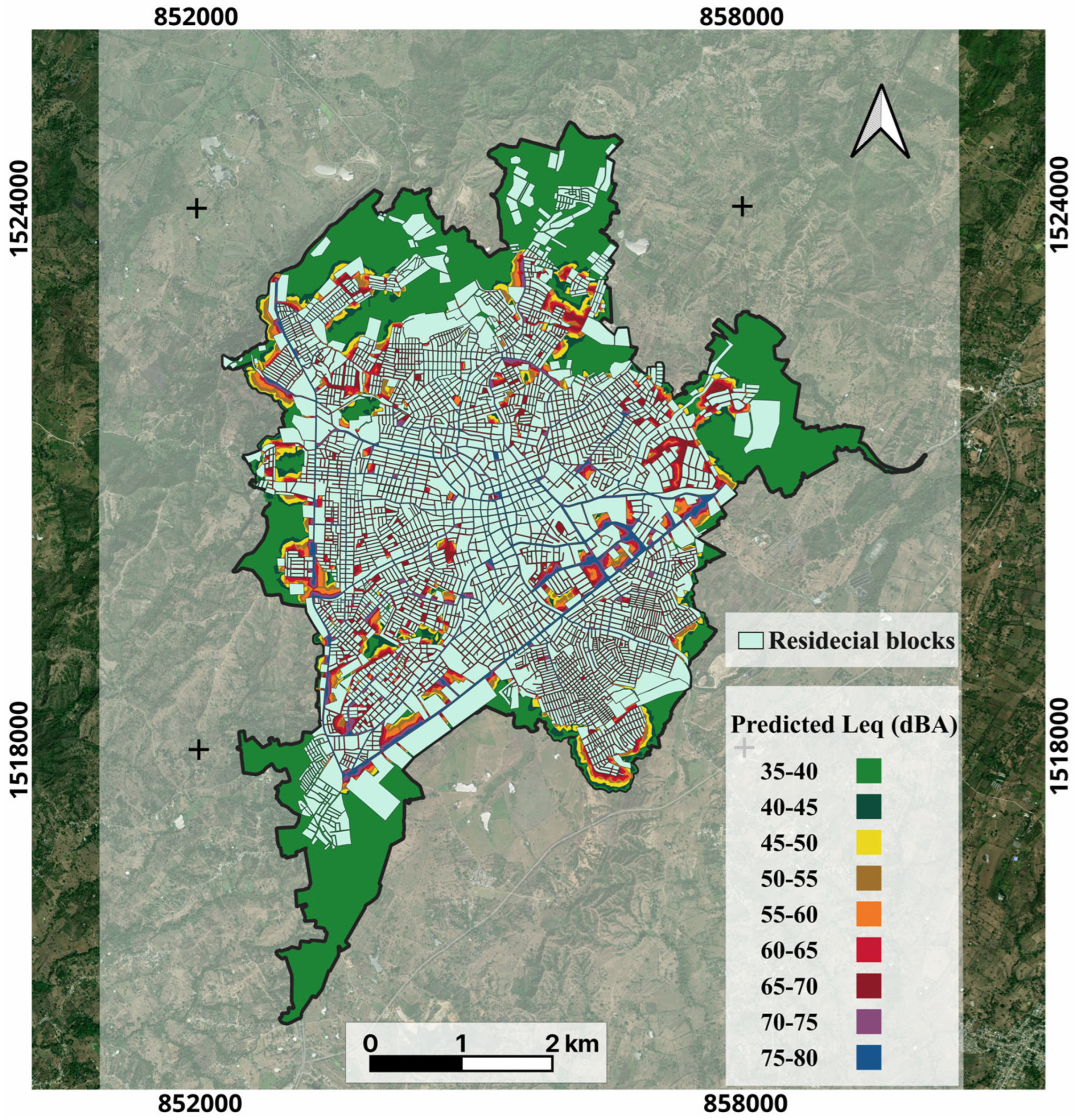
The noise levels were assessed using the NoiseModelling tool, which incorporates key traffic flow characteristics (Table S3), road surface type, and building height, based on field-collected data. A noise map was generated to visually represent the acoustic environment of the study area (Figure 2). The model was validated using in situ noise measurements taken at 31 predetermined monitoring sites within the study area. The comparison between the modeled and measured in situ noise levels is shown in Table 1. The monitored noise levels ranged from 49.6 dBA to 76.4 dBA across all roadway types. All express and collector roads, as well as more than 50% of trunk roads, recorded noise levels above 70 dBA, while service roads had noise levels between 68 and 69.9 dBA. The mean modeled noise level was 68.78 dBA, compared to 68.40 dBA for the monitored data.
The normality test revealed that both the modeled and monitored noise levels deviated from a normal distribution. A comparison of the two datasets showed no significant differences. The absolute error between them ranged from 0.17 to 2.95. Furthermore, linear regression analysis (r2 = 0.93) demonstrated a strong correlation between both measurements.

3.2. Noise Impact Analysis

3.2.1. Baseline Characteristics

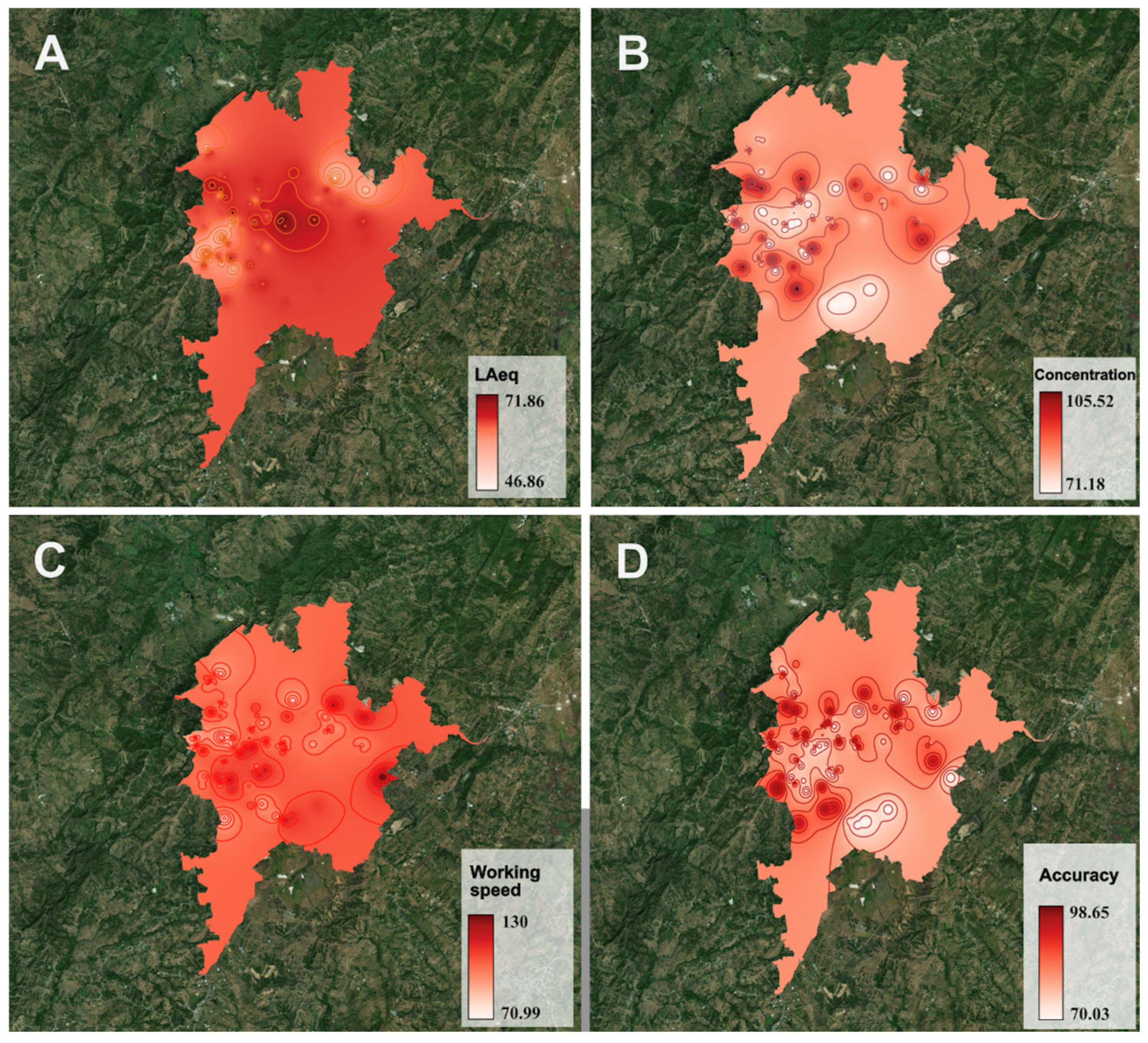
A total of 164 adults were surveyed to collect information from children between 8 and 12 years of age, selected by voluntary non-probabilistic sampling. Information was obtained from 187 children (101 girls and 86 boys). After applying the exclusion criteria, a total of 98 children completed the cognitive assessment. A comparative summary of included and excluded children is presented in Table S4. All children attended schools with a standard 6-h daily schedule and lived in residences mainly constructed with concrete blocks, which generally had access to basic public services, regardless of the residential area. Overall, 45% of the participants resided in Zone 1, while 55% lived in Zone 2. Interpolation maps of the spatial distribution of children’s noise exposure levels and cognitive variables (concentration, processing speed, and accuracy) are presented in Figure 3.
In terms of noise exposure, the entire group of children was exposed to an average noise level of 64.03 dBA. In Zone 1, the mean exposure level was 62.22 dBA, while in Zone 2 it was 65.50 dBA. The highest noise levels in Zone 2 were observed in neighborhoods close to downtown. The main variables included in the study, stratified according to the level of concentration, processing speed, accuracy (≤95 points and >95 points), and working memory (lower and average), considering all the children and their distribution by zones are shown in Table 2.
In global terms, 78% of all children obtained scores below 95 in concentration, while 87% had accuracy below this threshold and only 33% showed a processing speed within this category. Regarding working memory, 52% of the children were at the lower level. In Zone 1, 77% of the children obtained a concentration score below 95, 39% registered a processing speed score below this threshold and 89% presented a similarly lower accuracy score. Concentration performance in Zone 2 (78%) was remarkably close to Zone 1 while processing speed (28%) and accuracy (85%) varied slightly.
In both the overall group and Zone 1, children with accuracy scores above 95 were exposed to higher noise levels compared to those with lower accuracy. In addition, children in Zone 1 with average working memory experienced noise levels 4 dBA higher than those with low working memory. On the other hand, in terms of processing speed, children in Zone 2 with lower scores were exposed, on average, to noise levels 3 dBA higher than those scoring above 95.

3.2.2. Association Between Sociodemographic and School Characteristics, Road Traffic Noise and Cognitive Variables

The regression models between the cognitive variables, including concentration, processing speed, accuracy, and working memory, and the noise exposure level, both unadjusted and adjusted for each sociodemographic and school variable independently (type of school, sex, age, parental income, and school grade) for all children, are presented in Table S5. Logistic regression analysis showed that concentration, processing speed and working memory were not significantly associated with noise levels, either in the unadjusted or in the adjusted models. However, accuracy (category ≤ 95) was significantly associated with noise levels, with odds ratios below 1 in almost all models, especially when adjusted for age; however, most confidence intervals were close to 1.
Due to the low significance of the models assessing the relationship between cognitive variables and noise levels across all children, potentially attributed to sociodemographic heterogeneity and the limitation of performing multiple adjustments due to the small sample size, separate regression models were conducted for zones 1 and 2.
The regression models between cognitive variables and noise level, stratified by zones, are presented in the unadjusted and adjusted version for sociodemographic and school characteristics in Table 3. Strong associations were identified between low accuracy (category ≤ 95) in children in Zone 1 and noise level in all models, mainly in the unadjusted model (OR = 0.59, 95% CI, 0.38–0.83) and adjusted for school type (OR = 0.59, 95% CI, 0.38–0.83). Concentration, processing speed, and working memory in children from Zone 1 showed no significant associations in any of the models. In contrast, low processing speed in children from Zone 2 was significantly associated with noise levels in the unadjusted model (OR = 1.22, 95% CI, 1.02–1.52) and the model adjusted for school type (OR = 1.25 95% CI, 1.03–1.59) and age (OR = 1.22, 95% CI, 1.02–1.52); however, most confidence intervals remained close to 1. In Zone 2, the models assessing the associations between concentration, accuracy, working memory, and noise levels did not reveal any significant associations.
Generalized additive models stratified by zone are presented in Figure S4, and the corresponding significance values are detailed in Table S6. In most cases, p-values were above the conventional threshold for statistical significance (p < 0.05) in both adjusted and unadjusted models. The only exception was the unadjusted model for concentration in Zone 1, which yielded a p-value marginally below this threshold. In this model, the association between environmental noise exposure and concentration exhibited a non-linear U-shaped pattern.

4. Discussion

This study examined the relationship between residential outdoor road traffic noise exposure and cognitive performance in children from Sincelejo, Colombia, focusing on working memory and selective attention, assessed through concentration, processing speed and accuracy. We initially constructed a city noise map model based on traffic flow. This model revealed that most of the commercial roads (express, trunk and collector roads) evaluated in Sincelejo exceeded the maximum permitted daytime weighted noise level standards for commercial areas (70 dBA) and half of the residential roads (service and local) were above the recommended daytime acoustic comfort level (65 dBA) for these areas according to the Colombian Ministry of Environment, Housing and Territorial Development (Resolution 0627 of 2006). Areas with noise levels that exceeded the acoustic comfort for residential areas (65 dBA) were coded on the modeled noise map with the burgundy, purple and blue colors. These zones were identified as the areas with the highest potential exposure to noise pollution among residents, and thus, may present a greater likelihood of promoting adverse health effects in children. Similar findings were found by [50], to our knowledge, the only reported public study of noise levels in Sincelejo. That study found that noise levels in most of the evaluated hospital area exceeded 65 dBA, with all measurement points surpassing the permissible limit for hospital environments (55 dBA).
Although noise exposure in school environments may influence children’s cognitive performance during learning activities, the present study focused on residential road traffic noise exposure. This choice was based on the fact that children typically spend a larger proportion of their daily time at home than at school [51]. Moreover, in Sincelejo, several classrooms are located at a distance from major traffic sources, as observed during field visits, which could reduce direct noise exposure during school hours and differ from the levels estimated in noise maps. In contrast, residential dwellings are often situated near roadways, making the home environment a more relevant setting for assessing chronic road traffic noise exposure in Sincelejo based on noise mapping. Nevertheless, potential exposure misclassification should be considered, since noise levels were estimated based on residential location and may therefore not adequately reflect spatiotemporal variability in individual mobility and time activity patterns, such as daily time spent at school, in other residences, or outdoors. This potential imprecision in exposure assignment could lead to attenuation bias in the associations with cognitive functions, which depend on long-term and cumulative exposure.
Regarding the effects of residential outdoor road traffic noise on children’s cognitive health, no statistically significant associations were observed between noise exposure and most of the cognitive functions evaluated in the full sample of participants. These findings should be interpreted with caution, as the analyses were exploratory in nature and do not allow for causal or confirmatory inferences. Overall, the results suggest the absence of a clear relationship between increasing daytime equivalent continuous noise levels and poorer performance in working memory, concentration, and processing speed when all children are evaluated collectively, without considering contextual or individual factors.
Previous studies have reported heterogeneous associations between noise exposure and cognitive functions in both cross-sectional and longitudinal designs [52,53]. A cross-sectional study conducted in the western region of São Paulo found no significant association between average daytime noise levels and cognition in children aged 3 to 6 years, as assessed using the PRIDI and IDELA indicators; however, longitudinal analyses showed that a 10 dB increase was associated with a decline in cognitive performance [17]. Similarly, a more recent study including children of ages comparable to those in our study reported a positive correlation between road traffic noise levels at schools and difficulties in listening and classroom communication, suggesting a detrimental effect of elevated noise on cognitive tasks [54].
Recent evidence suggests that the effects of road traffic noise on cognition are strongly influenced by individual susceptibility, simultaneous exposure to multiple pollutants, and socioeconomic and demographic factors [55,56,57]. For example, perceived annoyance from environmental noise has been shown to have a significant impact on cognitive function in school-aged children [58]. Consistently, a longitudinal study of the Greater London SCAMP cohort demonstrated that noise exposure was significantly associated with slower development of executive function after adjustment for ozone, as well as with lower fluid intelligence after adjustment for ozone, NO2, PM2.5, and PM10 [59]. Another study found that associations between air pollutants and cognitive function were significantly mediated by neighborhood socioeconomic status (N-SES), represented by components such as income, education, employment, and housing characteristics [60]. Failure to account for these interrelationships may lead to attenuated or inconsistent associations, which could partly explain the absence of statistically significant associations in the overall analysis of the present study.
Given the absence of statistically significant associations in the overall analysis and the variability in socioeconomic context, an exploratory stratified analysis was conducted using the Multidimensional Poverty Index (MPI) estimated by DANE to examine potential effect modification by socioeconomic context [49,61]. This approach was adopted as a hypothesis-generating strategy to assess whether the associations between residential outdoor road traffic noise and cognitive outcomes differed across distinct social contexts.
In the stratified analyses, children residing in Zone 1 who were exposed to higher noise levels showed a lower probability of being classified in the low-accuracy category for selective attention tasks compared with children exposed to lower noise levels. This finding should be interpreted with caution and cannot be considered causal, as it is not consistent with most of the previous evidence on the effects of environmental noise on cognitive function, which has generally reported either negative impacts or null associations [62,63,64]. For example, studies conducted in occupationally exposed adult populations have found no association between noise exposure and accuracy in attentional tasks [65]. It is likely that the observed results in this study were influenced by factors not fully controlled for, such as residual confounding related to individual or contextual characteristics, limitations inherent to the sample size, and potential selection or measurement biases. In this context, this finding should be interpreted as a preliminary signal that may reflect unmeasured heterogeneity not captured in the analysis.
The study identified a significant association for processing speed in Zone 2, with a higher probability of having processing speed scores below 95 points for each 1 dBA increase in road traffic noise exposure. Differences in the statistical significance of the logistic regression analyses between Zone 1 and Zone 2 may be influenced by heterogeneity in social determinants, health status, income, lifestyle, and other environmental exposures affecting children residing in areas with higher MPI. An additional explanation may relate to the greater variability in traffic noise levels observed between low and high processing speed categories, as Zone 2 concentrates the highest noise levels due to the inclusion of the city center, where commercial activity and dense traffic flow are predominant. This finding should be interpreted with caution and considered exploratory and hypothesis-generating, as the association was of small magnitude and the statistical significance was borderline, which may reflect random variability or residual confounding.
Slow processing speed results in delayed perception, processing, and response to stimuli, which leads to slightly slower performance in cognitive tasks such as solving mental numerical problems or following a pattern [66]. Evidence on the association between noise exposure and processing speed varies depending on the type of noise, duration of exposure, and social context. A study conducted in Irish adults over 54 years old exposed to an average of 51.4 dBA found no association between road traffic noise and processing speed [67]. Similarly, studies in child cohorts from Spain (INMA-Sabadell) and the Netherlands (Generation R Study) reported no association between traffic noise exposure and processing speed after adjusting for socioeconomic and lifestyle variables [9]. However, studies that have simultaneously assessed noise exposure and reaction time have shown that traffic noise prolongs reaction time in both men and women, which is a related indicator of processing speed [68]. This reinforces the exploratory nature of our findings, especially considering that the sample size limited the ability to adjust for potential confounders.
The sensitivity analysis did not support the potential associations observed between residential outdoor noise exposure and processing speed in Zone 2. In addition, this analysis strengthens concerns regarding a possible bias in the statistically significant association identified between accuracy and noise exposure. Among the main sources of confounding inherent to the study are unmeasured confounding and classification bias. Unmeasured confounding may arise from unavailable or unconsidered variables, such as other concurrent environmental factors or characteristics of the family environment, which could influence both noise exposure and cognitive outcomes. Furthermore, exposure misclassification remains a possibility, as noise levels were estimated based on point measurements and may not adequately reflect habitual individual exposure.
Moreover, in the sensitivity analysis using an unadjusted generalized additive model, a statistically significant but marginal U-shaped association was observed between environmental noise levels and concentration scores. The p-value, which was just below the significance threshold, may have been influenced by greater variability at the extremes of exposure and by the small sample size in areas with low noise levels, thereby limiting the stability and robustness of the estimates.
The absence of confirmation of the associations identified in the dichotomous logistic regression through sensitivity analyses suggests that the observed findings may be influenced by limitations inherent to the dichotomization of cognitive variables. This approach may have increased the standard error and affected effect size estimation, thereby reducing the precision of statistical significance testing and potentially leading to biased estimates and the identification of spurious associations [69,70].
These results should be interpreted with considerable caution, as they correspond to exploratory findings. Overall, they suggest an association between increased residential outdoor road traffic noise and reduced processing speed in selective attention tasks among children living in areas with an MPI < 50. However, these findings should be regarded as hypothesis generating rather than confirmatory conclusions. Future studies, preferably longitudinal in design, with larger sample sizes and greater control of sociodemographic, health, and environmental variables are required to better understand the nature of the relationship between road traffic noise exposure and processing speed in Latin American contexts. This preliminary evidence may serve as a foundation for designing subsequent investigations aimed at determining the effects of environmental noise on the child population of Sincelejo.

5. Conclusions

In the overall analysis, residential outdoor road traffic noise exposure was not significantly associated with concentration, processing speed in selective attention tasks, or working memory in the full sample of children. Given the absence of significant associations and the potential influence of socioeconomic context on the relationship between environmental exposures and cognitive outcomes, stratified analyses were conducted as an exploratory strategy to identify possible differences according to the level of multidimensional poverty. Within this framework, an association was observed between higher noise levels and a lower probability of low accuracy in selective attention tasks; however, this finding is inconsistent with previous evidence and is likely to reflect residual confounding, selection bias, or random variability. Additionally, a weak and borderline statistically significant association was identified between a 1 dBA increase in noise levels and reduced processing speed in areas with an MPI < 50. Given the limited sample size, these results may also be influenced by uncontrolled factors, selection bias, or chance and should therefore be interpreted as exploratory and hypothesis generating, precluding causal inference. Future studies incorporating noise mapping, multiparametric models, and larger samples in similar socio-environmental contexts are required to validate these findings. Furthermore, noise emitted by loudspeakers from commercial establishments should be considered as another relevant source of exposure, given its cultural prevalence in this type of city and its potential contribution to the combined effects of multiple noise sources on health.

Supplementary Materials

The following supporting information can be downloaded at: https://www.mdpi.com/article/10.3390/environments13040204/s1, Figure S1. The STROBE flow chart of the study. Figure S2. Approval statement of the study by the Research Ethics Committee of the University of Cartagena. Figure S3. Map delineating the study area into two zones based on the Multidimensional Poverty Index (MPI). Figure S4. Smoothed associations between environmental noise exposure and cognitive variables from generalized additive models, stratified by zone. Table S1. Monitoring point information. Table S2. Modeling parameters for noise map building. Table S3. Median traffic flow stratified by type of vehicle and roadway. Table S4. Comparative table of included and excluded children. Table S5. Logistic regression analysis of low concentration, processing speed, and accuracy in selective attention tasks and working memory, per 1 dBA increase in noise levels. Table S6. Significance values from generalized additive models for cognitive variables by zone.

Author Contributions

M.T.-A. conducted data collection, data processing, methodology development, and formal analysis. J.V.-V. contributed to the statistical analysis of the data. F.F. contributed to the review and final editing of the manuscript. J.O.-V. contributed to the overall study design, provided resources, and critically reviewed the manuscript. All authors have read and agreed to the published version of the manuscript.

Funding

This research was funded by the Ministry of Science, Technology and Innovation (Minciencias) with the National Program for Doctoral Formation under Grant number [BPIN 2020000100364]; UniCartagena, Grants to support Research Groups and Doctoral Programs (2024-2026).

Institutional Review Board Statement

The study was conducted in accordance with the Declaration of Helsinki, and the protocol was approved by the Ethics Committee of the University of Cartagena and registered under approval number 133 on 8 August 2023.

Informed Consent Statement

Informed consent was obtained from all subjects involved in the study.

Data Availability Statement

The datasets used and analyzed during the current study are available from the corresponding author on reasonable request.

Acknowledgments

The authors would like to thank the research team at the Laboratorio de Acústica Ambiental (LABACAM) for their valuable guidance during the training process involved in the construction of the environmental noise map. We also extend our sincere gratitude to the participants, their families, and the schools for their generous participation in this study.

Conflicts of Interest

The authors declare no conflicts of interest.

References

  1. Islam, R.; Sultana, A.; Reja, M.S.; Seddique, A.A.; Hossain, M.R. Multidimensional analysis of road traffic noise and probable public health hazards in Barisal city corporation, Bangladesh. Heliyon 2024, 10, e35161. [Google Scholar] [CrossRef]
  2. Zhang, N.; Liu, C.; Zhang, M.; Guan, Y.; Wang, W.; Liu, Z.; Gao, W. Effects of traffic noise on the psychophysiological responses of college students: An EEG study. Build. Environ. 2025, 267, 112171. [Google Scholar] [CrossRef]
  3. Havyarimana, E.; Gangrekar, R.; Gong, X.; Jephcote, C.; Johnson, S.; Suri, S.; Xie, W.; Clark, C.; Hansell, A.; Cai, Y.S. Associations between road, rail and aircraft traffic noise with cognitive function in the UK Biobank cohort. Environ. Int. 2025, 206, 109941. [Google Scholar] [CrossRef]
  4. European Environment Agency. Available online: https://www.eea.europa.eu/en/analysis/publications/environmental-noise-in-europe (accessed on 14 May 2025).
  5. Münzel, T.; Sørensen, M.; Daiber, A. Transportation noise pollution and cardiovascular disease. Nat. Rev. Cardiol. 2021, 18, 619–636. [Google Scholar] [CrossRef] [PubMed]
  6. Rendón, J.; Gómez, D.M.M.; Colorado, H.A. Useful tools for integrating noise maps about noises other than those of transport, infrastructures, and industrial plants in developing countries: Casework of the Aburra Valley, Colombia. J. Environ. Manag. 2022, 313, 114953. [Google Scholar] [CrossRef] [PubMed]
  7. Montenegro, A.L.; Rey-Gozalo, G.; Arenas, J.P.; Suárez, E. Streets classification models by urban features for road traffic noise estimation. Sci. Total Environ. 2024, 932, 173005. [Google Scholar] [CrossRef]
  8. Wosniacki, G.G.; Zannin, P.H.T. Framework to manage railway noise exposure in Brazil based on field measurements and strategic noise mapping at the local level. Sci. Total Environ. 2021, 757, 143721. [Google Scholar] [CrossRef]
  9. Andrade, E.D.L.; de Lima, E.A.; Martins, A.C.G.; Zannin, P.H.T.; da Cunha e Silva, D.C. Urban noise assessment in hospitals: Measurements and mapping in the context of the city of Sorocaba, Brazil. Environ. Monit. Assess. 2024, 196, 267. [Google Scholar] [CrossRef]
  10. Sierra, J.A.; Montaña, L.M.; Rugeles, K.Y.; Sandoval, M.T.; Sandoval, W.; Delgado, K.J.; Abella, J.J. Hearing health and noise exposure in population between 18 to 64 years old in Bogotá, Colombia, 2014–2018. Biomédica 2024, 44, 168–181. [Google Scholar] [CrossRef]
  11. Zamorano-González, B.; Pena-Cardenas, F.; Velázquez-Narváez, Y.; Parra-Sierra, V.; Vargas-Martínez, J.I.; Monreal-Aranda, O.; Ruíz-Ramos, L. Traffic noise annoyance in the population of North Mexico: Case study on the daytime period in the city of Matamoros. Front. Psychol. 2021, 12, 657428. [Google Scholar] [CrossRef]
  12. Lee, S.; Chung, J.H. Association Between Perceived Noise Pollution and Sleep Quality: Findings from the 2018 Community Health Survey. Noise Health 2024, 26, 346–353. [Google Scholar] [CrossRef]
  13. Roca-Barceló, A.; Nardocci, A.; de Aguiar, B.S.; Ribeiro, A.G.; Failla, M.A.; Hansell, A.L.; Cardoso, M.R.; Piel, F.B. Risk of cardiovascular mortality, stroke and coronary heart mortality associated with aircraft noise around Congonhas airport, São Paulo, Brazil: A small-area study. Environ. Health 2021, 20, 59. [Google Scholar] [CrossRef]
  14. Baek, K.; Park, C.; Sakong, J. The impact of aircraft noise on the cognitive function of elementary school students in Korea. Noise Health 2023, 25, 83–91. [Google Scholar] [CrossRef]
  15. Pérez-Crespo, L.; López-Vicente, M.; Valentín, A.; Burgaleta, M.; Foraster, M.; Tiemeier, H.; Guxens, M. Association between residential exposure to road traffic noise and cognitive and motor function outcomes in children and preadolescents. Environ. Int. 2024, 183, 108414. [Google Scholar] [CrossRef] [PubMed]
  16. Fernández-Quezada, D.; Martínez-Fernández, D.E.; Fuentes, I.; García-Estrada, J.; Luquin, S. The Influence of Noise Exposure on Cognitive Function in Children and Adolescents: A Meta-Analysis. NeuroSci 2025, 6, 22. [Google Scholar] [CrossRef] [PubMed]
  17. Raess, M.; Brentani, A.V.M.; Flückiger, B.; de Campos, B.L.D.A.; Fink, G.; Röösli, M. Association between community noise and children’s cognitive and behavioral development: A prospective cohort study. Environ. Int. 2022, 158, 106961. [Google Scholar] [CrossRef]
  18. Arregi, A.; Lertxundi, A.; Vegas, O.; García-Baquero, G.; Ibarluzea, J.; Anabitarte, A.; Barroeta, Z.; Jimeno-Romero, A.; Subiza-perez, M.; Lertxundi, N. Environmental noise exposure and sleep habits among children in a cohort from Northern Spain. Int. J. Environ. Res. Public Health 2022, 19, 16321. [Google Scholar] [CrossRef] [PubMed]
  19. Nilsen, F.M.; Ruiz, J.D.; Tulve, N.S. A meta-analysis of stressors from the total environment associated with children’s general cognitive ability. Int. J. Environ. Res. Public Health 2020, 17, 5451. [Google Scholar] [CrossRef]
  20. Huitt, W.; Hummel, J. Piaget’s theory of cognitive development. Educ. Psychol. Interact. 2003, 3, 1–5. [Google Scholar]
  21. Foraster, M.; Esnaola, M.; López-Vicente, M.; Rivas, I.; Álvarez-Pedrerol, M.; Persavento, C.; Sebastian-Galles, N.; Pujol, J.; Dadvand, P.; Sunyer, J. Exposure to road traffic noise and cognitive development in schoolchildren in Barcelona, Spain: A population-based cohort study. PLoS Med. 2022, 19, e1004001. [Google Scholar] [CrossRef]
  22. Tangermann, L.; Vienneau, D.; Saucy, A.; Hattendorf, J.; Schäffer, B.; Wunderli, J.M.; Röösli, M. The association of road traffic noise with cognition in adolescents: A cohort study in Switzerland. Environ. Res. 2023, 218, 115031. [Google Scholar] [CrossRef]
  23. Caviola, S.; Visentin, C.; Borella, E.; Mammarella, I.; Prodi, N. Out of the noise: Effects of sound environment on maths performance in middle-school students. J. Environ. Psychol. 2021, 73, 101552. [Google Scholar] [CrossRef]
  24. Clark, C.; Head, J.; Haines, M.; van Kamp, I.; van Kempen, E.; Stansfeld, S.A. A meta-analysis of the association of aircraft noise at school on children’s reading comprehension and psychological health for use in health impact assessment. J. Environ. Psychol. 2021, 76, 101646. [Google Scholar] [CrossRef]
  25. Xue, Z.; Ling, X.; Zhao, X.; Geng, L. Neural Mechanisms of Nonauditory Effects of Noise Exposure on Special Populations. Noise Health 2024, 26, 70–81. [Google Scholar] [CrossRef]
  26. Dohmen, M.; Braat-Eggen, E.; Kemperman, A.; Hornikx, M. The effects of noise on cognitive performance and helplessness in childhood: A review. Int. J. Environ. Res. Public Health 2022, 20, 288. [Google Scholar] [CrossRef] [PubMed]
  27. Hahad, O.; Jimenez, M.T.B.; Kuntic, M.; Frenis, K.; Steven, S.; Daiber, A.; Muenzel, T. Cerebral consequences of environmental noise exposure. Environ. Int. 2022, 165, 107306. [Google Scholar] [CrossRef] [PubMed]
  28. Zhang, Y.; Zhu, M.; Sun, Y.; Tang, B.; Zhang, G.; An, P.; Cheng, Y.; Shan, Y.; Merzenich, M.M.; Zhou, X. Environmental noise degrades hippocampus-related learning and memory. Proc. Natl. Acad. Sci. USA 2020, 118, e2017841117. [Google Scholar] [CrossRef] [PubMed]
  29. Baquedano, L.E.; Bernal, E.G.; Carrion, D.J.; Delgado, A.D.; Gavidia, C.M.; Kirwan, D.E.; Gilman, R.H.; Verastegui, M.R. Impaired spatial working memory and reduced hippocampal neuronal density in a rat model of neurocysticercosis. Front. Cell. Neurosci. 2023, 17, 1183322. [Google Scholar] [CrossRef]
  30. Kolling, T. Memory Development from Infancy to Childhood: Cross-cultural Perspectives. In The Development of Memory in Infancy and Childhood; Psychology Press: Abingdon, UK, 2022; pp. 286–296. [Google Scholar]
  31. Burstein, O.; Sabag, M.; Kurtzman, L.; Geva, R. The role of focused attention in learning from early childhood to late adolescence: Implications of neonatal brainstem compromise following preterm birth. Child Dev. 2025, 96, 269–285. [Google Scholar] [CrossRef]
  32. Gallen, C.L.; Schaerlaeken, S.; Younger, J.W.; Anguera, J.A.; Gazzaley, A. Contribution of sustained attention abilities to real-world academic skills in children. Sci. Rep. 2023, 13, 2673. [Google Scholar] [CrossRef]
  33. Shvartsman, M.; Shaul, S. The role of working memory in early literacy and numeracy skills in kindergarten and first grade. Children 2023, 10, 1285. [Google Scholar] [CrossRef]
  34. Shi, Y.; Qu, S. Cognition and academic performance: Mediating role of personality characteristics and psychology health. Front. Psychol. 2021, 12, 774548. [Google Scholar] [CrossRef]
  35. Liu, J.; Wang, H.L. Application of information processing learning theory in educational technology. Inserv. Educ. Train Sch. Teach. 2000, 12, 51–52. [Google Scholar]
  36. Wilkey, E.D. The domain-specificity of domain-generality: Attention, executive function, and academic skills. Mind Brain Educ. 2023, 17, 349–361. [Google Scholar] [CrossRef]
  37. OECD. PISA 2022 Results (Volume I): The State of Learning and Equity in Education; PISA, OECD Publishing: Paris, France, 2023. [Google Scholar]
  38. Instituto Colombiano para la Evaluación de la Educación (ICFES). Informe Nacional de Resultados de las Pruebas Saber 3°, 5°, 7º y 9°. 2022. Available online: https://www.icfes.gov.co (accessed on 14 May 2025).
  39. Departamento Administrativo Nacional de Estadística. Censo Nacional de Población y Vivienda 2018: Resultados Generales. Available online: https://www.dane.gov.co (accessed on 14 May 2025).
  40. Morillas, J.M.B.; Gozalo, G.R.; Montes-González, D.; Vílchez-Gómez, R.; Escobar, V.G. Variability of traffic noise pollution levels as a function of city size variables. Environ. Res. 2021, 199, 111303. [Google Scholar] [CrossRef] [PubMed]
  41. Morley, D.W.; De Hoogh, K.; Fecht, D.; Fabbri, F.; Bell, M.; Goodman, P.S.; Elliott, P.; Hodgson, S.; Hansell, A.L.; Gulliver, J. International scale implementation of the CNOSSOS-EU road traffic noise prediction model for epidemiological studies. Environ. Pollut. 2015, 206, 332–341. [Google Scholar] [CrossRef] [PubMed]
  42. Bocher, E.; Guillaume, G.; Picaut, J.; Petit, G.; Fortin, N. Noisemodelling: An open source GIS based tool to produce environmental noise maps. ISPRS Int. J. Geo-Inf. 2019, 8, 130. [Google Scholar] [CrossRef]
  43. Baclet, S.; Venkataraman, S.; Rumpler, R.; Billsjö, R.; Horvath, J.; Österlund, P.E. From strategic noise maps to receiver-centric noise exposure sensitivity mapping. Transp. Res. D Transp. Environ. 2022, 102, 103114. [Google Scholar] [CrossRef]
  44. Wechsler, D. Wechsler Intelligence Scale for Children; The Psychological Corporation: New York, NY, USA, 1949. [Google Scholar]
  45. Brickenkamp, R.; Schmidt-Atzert, L.; Liepmann, D. Test d2-Revision: Aufmerksamkeits-und Konzentrationstest; Hogrefe: Göttingen, Germany, 2010; Volume 1. [Google Scholar]
  46. Hanc, E.; Koller, K.; Herold, R.; Erim, Y.; Morawa, E. Cognitive impairment, depression, and fatigue in post-COVID and post-vaccination syndrome: A large-scale cross-sectional study. Eur. Arch. Psychiatry Clin. Neurosci. 2025, 276, 221–234. [Google Scholar] [CrossRef]
  47. Direk, M.Ç.; Makharoblidze, K.; Sevimli, E.; Çelik, Y.; Taşdelen, B.; Kömür, M.; Okuyaz, C. Long-term cognitive outcomes of prematurely born infants: A longitudinal follow-up of Denver II, Bayley III and WISC-IV Tests. Pediatr. Int. 2021, 63, 1504–1509. [Google Scholar] [CrossRef]
  48. R Core Team. R: A Language and Environment for Statistical Computing, versión 4.0.0; [Software]; R Foundation for Statistical Computing: Vienna, Austria, 2020. Available online: https://www.R-project.org (accessed on 25 July 2025).
  49. Departamento Administrativo Nacional de Estadística. Pobreza Multidimensional. Available online: https://www.dane.gov.co/index.php/estadisticas-por-tema/pobreza-y-condiciones-de-vida/pobreza-multidimensional (accessed on 21 January 2026).
  50. Ramos Orozco, A.A. Análisis de la Asociación de los Niveles de Presión Sonora y Tráfico Vehicular en los Alrededores de la Clínica Santa María de la Ciudad de Sincelejo–Sucre. Master’s Thesis, Universidad del Norte, Barranquilla, Colombia, 2019. [Google Scholar]
  51. Yu, X.; Jarvis, I.; van den Bosch, M.; Guhn, M.; Sbihi, H.; Davies, H. Residential exposure to noise, green space, and children’s language acquisition. Environ. Int. 2025, 200, 109524. [Google Scholar] [CrossRef]
  52. Jafari, M.J.; Khosrowabadi, R.; Khodakarim, S.; Mohammadian, F. The effect of noise exposure on cognitive performance and brain activity patterns. Open Access Maced. J. Med. Sci. 2019, 7, 2924. [Google Scholar] [CrossRef] [PubMed]
  53. Thompson, R.; Smith, R.B.; Karim, Y.B.; Shen, C.; Drummond, K.; Teng, C.; Toledano, M.B. Noise pollution and human cognition: An updated systematic review and meta-analysis of recent evidence. Environ. Int. 2022, 158, 106905. [Google Scholar] [CrossRef] [PubMed]
  54. Shukla, A.; Tandel, B.N. Cognitive task and ambient noise-based investigation on cognitive development of roadside school children. Cogn. Tech. Work 2024, 26, 555–567. [Google Scholar] [CrossRef]
  55. Gao, W.; Kang, J.; Ma, H.; Wang, C. The effects of environmental sensitivity and noise sensitivity on soundscape evaluation. Build. Environ. 2023, 245, 110945. [Google Scholar] [CrossRef]
  56. Ogurtsova, K.; Soppa, V.J.; Weimar, C.; Jöckel, K.H.; Jokisch, M.; Hoffmann, B. Association of long-term air pollution and ambient noise with cognitive decline in the Heinz Nixdorf Recall study. Environ. Pollut. 2023, 331, 121898. [Google Scholar] [CrossRef]
  57. Peris, E.; Arguelles, M. Small-area analysis of social inequalities in exposure to environmental noise across four urban areas in England. Sustain. Cities Soc. 2023, 95, 104603. [Google Scholar] [CrossRef]
  58. Shukla, A.; Tandel, B.N. Association of road traffic noise exposure and school childrens’ cognition: A structural equation model approach. Environ. Res. 2024, 240, 117388. [Google Scholar] [CrossRef] [PubMed]
  59. Thompson, R.; Stewart, G.; Vu, T.; Jephcote, C.; Lim, S.; Barratt, B.; Smith, R.B.; Bou Karim, Y.; Mussa, A.; Mudway, I.; et al. Air pollution, traffic noise, mental health, and cognitive development: A multi-exposure longitudinal study of London adolescents in the SCAMP cohort. Environ. Int. 2024, 191, 108963. [Google Scholar] [CrossRef]
  60. Li, Z.; Christensen, G.M.; Lah, J.J.; Marcus, M.; Russell, A.G.; Ebelt, S.; Waller, L.A.; Hüls, A. Neighborhood characteristics as confounders and effect modifiers for the association between air pollution exposure and subjective cognitive functioning. Environ. Res. 2022, 212, 113221. [Google Scholar] [CrossRef]
  61. Wei, J.; Mozumder, S.I.; Li, L.; Xi, D.; Xu, J.; Lin, R.; Sverdlov, C.; Chipman, J.J. Current practice on covariate adjustment and stratified analysis—Based on survey results by ASA oncology estimand working group conditional and marginal effect task force. BMC Med. Res. Methodol. 2025, 25, 249. [Google Scholar] [CrossRef]
  62. Weyde, K.V.; Krog, N.H.; Oftedal, B.; Magnus, P.; Øverland, S.; Stansfeld, S.; Nieuwenhuijsen, M.J.; Vrijheid, M.; Pascual, M.C.; Aasvang, G.M. Road traffic noise and children’s inattention. Environ. Health 2017, 16, 127. [Google Scholar] [CrossRef] [PubMed]
  63. Julvez, J.; López-Vicente, M.; Warembourg, C.; Maitre, L.; Philippat, C.; Gützkow, K.B.; Guxens, M.; Evandt, J.; Andrusaityte, S.; Burgaleta, M.; et al. Early life multiple exposures and child cognitive function: A multi-centric birth cohort study in six European countries. Environ. Pollut. 2021, 284, 117404. [Google Scholar] [CrossRef]
  64. Breuer, C.; Schmitt, R.J.; Leist, L.; Fremerey, S.; Raake, A.; Klatte, M.; Fels, J. The influence of complex classroom noise on auditory selective attention. Sci. Rep. 2025, 15, 32926. [Google Scholar] [CrossRef]
  65. Irgens-Hansen, K.; Gundersen, H.; Sunde, E.; Baste, V.; Harris, A.; Bråtveit, M.; Moen, B.E. Noise exposure and cognitive performance: A study on personnel on board Royal Norwegian Navy vessels. Noise Health 2015, 17, 320–327. [Google Scholar] [CrossRef]
  66. Braaten, E.B.; Ward, A.K.; Forchelli, G.; Vuijk, P.J.; Cook, N.E.; McGuinness, P.; Lee, B.A.; Samkavitz, A.; Lind, H.; O’Keefe, S.M.; et al. Characteristics of child psychiatric outpatients with slow processing speed and potential mechanisms of academic impact. Eur. Child Adolesc. Psychiatry 2020, 29, 1453–1464. [Google Scholar] [CrossRef]
  67. Mac Domhnaill, C.; Douglas, O.; Lyons, S.; Murphy, E.; Nolan, A. Road traffic noise and cognitive function in older adults: A cross-sectional investigation of The Irish Longitudinal Study on Ageing. BMC Public Health 2021, 21, 1814. [Google Scholar] [CrossRef]
  68. Alimohammadi, I.; Zokaei, M.; Sandrock, S. The Effect of Road Traffic Noise on Reaction Time. Health Promot. Perspect. 2015, 5, 207–214. [Google Scholar] [CrossRef] [PubMed]
  69. Li, L.; Rysavy, M.A.; Bobashev, G.; Das, A. Comparing methods for risk prediction of multicategory outcomes: Dichotomized logistic regression vs. multinomial logit regression. BMC Med. Res. Methodol. 2024, 24, 261. [Google Scholar] [CrossRef] [PubMed]
  70. Hemelstrand, S.; Inoue, T. Stop splitting hairs: The problems with dichotomizing continuous data in language research. Res. Methods Appl. Linguist. 2025, 4, 100272. [Google Scholar] [CrossRef]
Figure 1. Locations of sampling points and categorization of roads. The urban area is shown in pink and gray polygons represent urban blocks.
Environments 13 00204 g001
Figure 2. Acoustic map of the study area according to the characteristics of road traffic.
Environments 13 00204 g002
Figure 3. Interpolation maps of the spatial distribution of children’s noise exposure levels and cognitive variables. (A) LAeq. (B) Concentration. (C) Processing speed. (D) Accuracy.
Environments 13 00204 g003
Table 1. Comparison between modeled and monitored noise values.
TypeCodeSectors NameModeled Value (Leq, dBA)Monitored Value (Leq, dBA)Absolute Error (Leq, dBA)
Express1Tolú Avenue 71.0372.21.17
272.2870.8−1.48
3Troncal de occidente73.7572.1−1.65
470.9371.10.17
570.6372.41.77
Trunk6Las Peñitas Avenue72.1571.0−1.15
7Ocala Avenue70.2771.71.43
8San Carlos Avenue69.5970.20.61
9Luis Carlos Galán Avenue71.3770.8−0.57
10Sincelejito Avenue68.9267.0−1.92
11Sincelejito Avenue68.1768.0−0.17
Collector12Narcisa-Carrera 15a71.4571.50.05
13Carrera 25B70.0370.30.27
14Majagual-Carrera 25C71.7770.6−1.17
15Majagual-Carrera 1773.772.6−1.1
16Cruz de Mayo Street73.4576.42.95
17Chacurí Street71.8271.0−0.82
18Downtown-Carrera 20 72.0170.8−1.21
19Downtown-Carrera 1872.4971.7−0.79
Service20Ford–Carrera 1970.5369.9−0.63
21Ford–13 Street69.1469.60.46
22Ford–Carrera 2172.3369.6−2.73
23Los libertadores–Carrera 1467.3068.00.7
24Nuevo majagual–Carrera 14e70.0568.3−1.75
25Puerto escondido–16a Street71.0069.5−1.5
Local26Ford-12 Street62.3564.21.85
27Ford-12 Street51.8949.6−2.29
2820 de julio–Carrera 1363.2460.8−2.44
29San José-Carrera 1562.4863.61.12
30Los libertadores–Carrera 13e57.4855.7−1.78
31Mochila–23a Street58.5559.40.85
Table 2. Characteristics of participants according to cognitive scores.
Baseline CharacteristicsConcentrationProcessing SpeedAccuracyWorking Memory
Con > 95Con ≤ 95PS > 95PS ≤ 95ACC > 95ACC ≤ 95AverageLower
N
All2276663213854751
Zone 1103427175391727
Zone 2124239158463024
Lday (dBA) (mean  ±  SD)
All64.4 ± 6.463.9 ± 6.763.9 ± 6.2 64.4 ± 7.567.3 ± 3.863.5 ± 6.965.0 ± 3.863.1 ± 8.4
Zone 163.7 ± 8.661.8 ± 8.062.6 ± 7.561.7 ± 9.169.3 ± 2.861.3 ± 8.264.7 ± 4.460.7 ± 9.6
Zone 264.9 ± 3.565.9 ± 4.864.7 ± 4.967.4 ± 2.966.0 ± 3.865.4 ± 4.765.2 ± 3.465.9 ± 5.7
Age (mean ± SD)
All11.3 ± 1.110.8 ± 1.010.8 ± 1.111.1 ± 1.011.4 ± 1.010.8 ± 1.111.1 ± 0.910.7 ± 1.2
Zone 111.4 ± 1.010.8 ± 1.110.8 ± 1.111.3 ± 0.911.4 ± 1.010.9 ± 1.111.2 ± 1.010.9 ± 1.1
Zone 211.3 ± 1.210.7 ± 1.010.8 ± 1.110.8 ± 1.111.4 ± 1.010.7 ± 1.111.0 ± 0.910.6 ± 1.3
Level of education
All2° and 3°214124115511
4° and 5°1458472511613438
64731982
Zone 12° and 3°14500523
4° and 5°72920165311323
21210321
Zone 22° and 3°1107411038
4° and 5°7292796302115
43521661
Socieconomic status
All1–21860542410683642
3–4416128317119
Zone 11–2103327265381726
3–401010101
Zone 21–28272785301916
3–4415127316118
School type
AllPublic95843248593037
Private13182385261714
Zone 1Public63021154321422
Private44621735
Zone 2Public3282294271615
Private914176419149
Data is count or means ± standard deviation (SD). Con = Concentration, PS = Processing speed and ACC = Accuracy.
Table 3. Logistic regression models for cognitive variables and 1 dBA noise level increases, stratified by zones.
Unadjusted ModelAdjusted Model for
School TypeSexAgeIncomeEducation
Cognitive
Variables
OR (95% CI)
p-Value
Adjusted p-Value
Concentration
Con > 95Reference group
Con ≤ 95Zone 10.97
(0.86–1.06)
0.533
0.533
0.97
(0.86–1.06)
0.589
0.599
0.97
(0.86–1.06)
0.599
0.599
0.96
(0.84–1.05)
0.391
0.391
0.96
(0.85–1.05)
0.415
0.552
0.94
(0.81–1.05)
0.347
0.347
Zone 21.03
(0.89–1.18)
0.650
0.865
1.03
(0.91–1.19)
0.584
0.660
1.03
(0.89–1.18)
0.648
0.891
1.03
(0.89–1.18)
0.660
0.660
1.01
(0.87–1.17)
0.866
0.990
1.05
(0.88–1.22)
0.530
0.760
Processing speed
PS > 95Reference group
PS ≤ 95Zone 10.99
(0.92–1.07)
0.726
0.881
0.99
(0.92–1.07)
0.758
0.883
1.00
(0.92–1.08)
0.970
0.970
1.00
(0.92–1.08)
0.965
0.964
0.98
(0.90–1.06)
0.612
0.877
0.99
(0.91–1.07)
0.749
0.941
Zone 21.22
(1.02–1.52)
0.047 *
0.047
1.25
(1.03–1.59)
0.040 *
0.060
1.21
(1.02–1.51)
0.057
0.086
1.22
(1.02–1.52)
0.047 *
0.080
1.23
(1.02–1.55)
0.053
0.132
1.21
(1.00–1.52)
0.079
0.157
Accuracy
ACC > 95Reference group
ACC ≤ 95Zone 10.59
(0.38–0.83)
0.006 *
0.006
0.59
(0.38–0.83)
0.006 *
0.009
0.56
(0.32–0.81)
0.009 *
0.013
0.58
(0.36–0.83)
0.007 *
0.010
0.59
(0.38–0.84)
0.007 *
0.015
0.58
(0.31–0.85)
0.016 *
0.041
Zone 20.97
(0.79–1.13)
0.727
0.727
0.97
(0.79–1.13)
0.757
0.757
0.98
(0.80–1.13)
0.780
0.780
0.97
(0.79–1.13)
0.729
0.729
0.98
(0.80–1.14)
0.797
0.995
0.95
(0.77–1.12)
0.626
0.993
Working memory
AverageReference group
LowerZone 10.93
(0.82–1.01)
0.140
0.139
0.92
(0.81–1.01)
0.139
0.210
0.93
(0.82–1.02)
0.167
0.250
0.92
(0.81–1.00)
0.103
0.154
0.93
(0.82–1.02)
0.167
0.334
0.91
(0.79–1.00)
0.091
0.230
Zone 21.04
(0.92–1.19)
0.562
0.562
1.04
(0.92–1.21)
0.532
0.532
1.04
(0.92–1.19)
0.574
0.574
1.04
(0.92–1.20)
0.589
0.663
1.04
(0.91–1.20)
0.602
0.722
1.03
(0.90–1.20)
0.684
0.684
* Significant relationship at p < 0.05. Con = Concentration; PS = Processing speed; ACC = Accuracy.
Disclaimer/Publisher’s Note: The statements, opinions and data contained in all publications are solely those of the individual author(s) and contributor(s) and not of MDPI and/or the editor(s). MDPI and/or the editor(s) disclaim responsibility for any injury to people or property resulting from any ideas, methods, instructions or products referred to in the content.