
Article

Long-Term Change in Volatile Organic Compounds in Taiwan (2006–2024)—An Analytical Review

1
Department of Marine Environment and Engineering, National Sun Yat-sen University, Kaohsiung 804201, Taiwan
2
School of Environmental Sciences, University of East Anglia, Norwich NR4 7TJ, UK
3
National Institute for Environmental Studies (NIES), 16-2 Onogawa, Tsukuba 305-8506, Ibaraki, Japan
*
Author to whom correspondence should be addressed.
Environments 2026, 13(2), 94; https://doi.org/10.3390/environments13020094
Submission received: 5 November 2025 / Revised: 31 January 2026 / Accepted: 4 February 2026 / Published: 10 February 2026
(This article belongs to the Special Issue Advances in Urban Air Pollution: 2nd Edition)

Abstract

This review examines 14 volatile organic compounds (VOCs) across nine Taiwanese Photochemical Assessment Monitoring Station sites over nearly two decades from 2006 to 2024, categorised as aromatic compounds, alkanes, and alkenes. Aromatic compounds and alkenes declined significantly (47.2–82.2%), reflecting regulatory success, while alkanes showed variable trends, including a 2023 Tainan spike (ethane: 9.12 ppbC, propane: 9.10 ppbC). Urban sites (Wanhua and Tucheng) exhibited high VOC levels from traffic, industrial sites (Xiaogang, Qiaotou) showed petrochemical influences, and rural sites (Chaozhou, Puzi, Taixi) were more alkane-dominated. Winter peaks and rush-hour diurnal patterns were meteorologically driven, with isoprene peaking in summer due to biogenic emissions. Cluster analysis of raw and standardised data separated urban–industrial from rural sites and early (2006–2010) from later (2018–2024) years, revealing compositional shifts. Benzene posed cancer risks (range 2.2 × 10⁻⁶–7.8 × 10⁻⁶) across sites and periods; as an illustrative example, prior to 2010 the risk at industrial Xiaogang was 6.2 × 10⁻⁶, but since 2020 has halved to 3.2 × 10⁻⁶. Taken together, these long-term observations demonstrate how declining anthropogenic VOC emissions can coexist with compositional shifts and an increasing relative influence of biogenic compounds, while also highlighting the ongoing challenge of ozone. This shows the value of monitoring networks as tools for understanding evolving atmospheric chemical regimes, rather than solely for reporting trends.

Graphical Abstract

1. Introduction

Volatile organic compounds (VOCs) are a diverse class of carbon-based gases that have high vapour pressures under ambient conditions. In the atmospheric sciences these are typically acyclic and aromatic compounds and biological volatiles such as isoprene and the terpenes. Some VOCs are oxygenated (e.g., formaldehyde, acetone and ethanol), while others are for example halogenated (e.g., chloroform, trichloroethene and 1,1,1,2-tetrafluoroethane) or contain other substituents. This paper will focus on the hydrocarbons and include the alkanes, alkenes and some single ring aromatic compounds, along with acetylene and isoprene.
Many VOCs are photochemically reactive, so they act as precursors to tropospheric ozone and the formation of smog, reduced visibility and contribute to respiratory disorders, neurotoxicity, and carcinogenicity [1,2,3]. Due to their high reactivity, alkenes contribute approximately 30–40% of the ozone formation potential in urban atmospheres, and their photochemical oxidation also plays an important role in the formation of secondary organic aerosols. Alkanes and alkenes have low acute toxicity from inhalation, so at atmospheric concentrations these do not pose a severe threat and with little evidence of any carcinogenicity. However, the International Agency for Research on Cancer (IARC) has classified benzene as Group 1, carcinogenic to humans, with ethylbenzene in Group 2B, i.e., probably carcinogenic to humans. The carcinogenicity of toluene and xylene to humans has not been classifiable as there has been no clear evidence of carcinogenic potential.
Elevated ozone pollution and its VOC and nitrogen oxide (NOx) precursors have been a focus of air quality research and policy worldwide for decades. Numerous long-term studies across North America, Europe and Asia have documented significant declines in ambient VOC levels following the introduction of emission control measures. For instance, vehicle-related VOC concentrations in the Los Angeles Basin have plummeted by around 98% since the 1960s, despite fuel use tripling [NOAA CSL: 2012 News & Events: 50-year decline in some Los Angeles vehicle-related pollutants]. Similarly, continuous monitoring in the United Kingdom (1993–2012) shows that concentrations of most C2–C8 hydrocarbons fell to around one-tenth of their levels in the 1990s [4]. However, these reductions in precursors have not consistently resulted in lower O3 concentrations. There is increasing evidence that, in VOC-limited urban regimes, NOx reductions can suppress ozone titration and lead to stable or rising O3 trends despite declining VOCs [5,6]. Recent advances in monitoring and analysis, particularly multi-decadal Photochemical Assessment Monitoring Station (PAMS) datasets, have enabled more robust VOC source apportionment using receptor models such as positive matrix factorisation. This has revealed the growing importance of non-vehicular sources as traffic emissions decline [Changing Volatile Organic Compound Emissions in Urban Environments: Many Paths to Cleaner Air]. Together, these findings refine the VOC–NOx–O3 sensitivity framework and emphasise that effective ozone mitigation requires coordinated, regime-specific precursor control strategies rather than uniform emission reductions. In East Asia, long-term data have only recently begun to reveal trends, and the picture is more complex. Some Asian urban centres still experience rising ozone levels despite precursor controls due to non-linear ozone chemistry and transboundary influences.
Taiwan’s VOC monitoring effort and emissions are concentrated in its densely populated industrial and urban areas (Figure 1), and resembles the situation in China’s Pearl River Delta, where industrial sources also predominate [7,8,9]. In contrast, VOC profiles in Japan and Malaysia are more strongly influenced by vehicular emissions [10,11,12]. Additionally, Taiwan’s subtropical climate results in an important biogenic contribution to VOCs and tropospheric ozone formation in rural regions, which complicates regional air quality management [13].
Concentrations of VOCs in Taiwan increase under stable boundary layer conditions, during winter especially, posing potential threats to air quality. Despite having a relatively advanced air quality monitoring network, Taiwan lacks an integrated, long-term VOC dataset spanning multiple land use categories, particularly in terms of background sites. This data gap constrains our ability to characterise spatial and temporal variability, identify persistent emission sources, and assess the real-world effectiveness of regulatory intervention. Additionally, region-specific phenomena, such as nighttime VOC accumulation and the atypical behaviour of isoprene, need to be investigated.
Taiwan increasingly regulates the emission of air pollutants, relevantly under the VOC Air Pollution Control and Emission Standards promulgated in 1997 [14,15,16]. The Taiwan Environmental Protection Administration (EPA) has imposed emission standards of 0.5 parts per million (ppm) for benzene, and 2 ppm for toluene and ethylbenzene, for certain stationary sources of emissions. In 2007, Taiwan’s Environmental Protection Bureau changed the Air Pollution Control Fee from a fixed rate to a progressive rate for nitrogen oxides and sulfur oxides. Following the global financial crisis in 2009, Taiwan’s Environmental Protection Agency selected the Linyuan Petrochemical Industrial Zone as a pilot area for the air pollutant cap-and-trade (C&T) policy in 2012. The emission reduction targets required by the policy were calculated based on the average emissions of the previous year (2011), but they temporarily increased emissions from the previous year to avoid emission reduction standards and purchase or exchange emission rights from other sources [17]. The relocation of factories and the formation of new industrial zones were effective in emission reduction [18]. Regulations required permits for stationary sources under the Air Pollution Control Act to achieve a VOC removal <90% partly to meet the 8 h ozone standard and reduce PM2.5. Taiwan’s 2020 air quality standards under the control of VOC Amendments in 2023 introduced further restrictions; no tanks open during ozone alerts and minimised flaring.
A long-running campaign against the Chinese Petroleum Corporation’s 70-year-old Kaohsiung refinery, located in the major industrial city of Kaohsiung in southern Taiwan, led to demolition in three stages: 1991–1995 (15%), 1996–2005 (23%) and finally 2006–2015 (62%). The PAH concentrations in Kaohsiung (at the Nanzih monitoring area, northern Kaohsiung) showed a decrease of 0.17 ng m−3 immediately after closure (2015). Emissions from equipment components in the petrochemical sites in Kaohsiung account for more than 60% of the total VOC emissions from the industry [19]. The stricter standards for emission control in the Kaohsiung industrial region took effect on 28 November 2012, specifically tightening the allowable leak concentration thresholds used in component-level leak detection and repair (LDAR) programmes. Under these regulations, the criterion defining a leaking component was lowered from 10,000 ppm to 2000 ppm, thereby making the inspection standard more stringent, and aimed at more frequent self-inspection, enhanced maintenance, the use of higher-quality leak-resistant equipment, and the installation of infrared leak detection monitors. The leakage rate before and after the implementation of stricter standards decreased from 1.33% to 0.82%. Kaohsiung’s stricter control standards and pressure to upgrade the plant have been effective in encouraging businesses to reduce emissions from leaks.
This review examines 18 years (2006–2024) of hourly volatile organic compounds (VOCs) data collected from nine Photochemical Assessment Monitoring Stations (PAMSs) strategically located across Taiwan (Figure 1). It extends the earlier study [20] of the Taipei area to all of Taiwan. These stations represent land use types in urban, industrial, rural, and coastal areas. This research builds upon six previous case studies [21,22,23,24,25] that focused on key VOC groups, such as single ring aromatic compounds, acetylene, ethylene-propylene, isoprene, ethane-propane, n-butane, n-pentane and isobutane. We offer an assessment of long-term VOC trends, emission source characteristics and implications for air quality management and public health policy.
The specific objectives of this work are to (i) characterise the long-term spatiotemporal variability of ambient VOC concentrations across different emission environments in Taiwan, (ii) elucidate the influence of industrial sources, seasonal biogenic activity and episodic events on VOC profiles, paying particular attention to diurnal changes under subtropical conditions and (iii) consider the relevance of these patterns for air quality management and public health. This review is one of the first to provide an 18-year, comprehensive assessment of VOCs across urban, industrial, and rural sites in Taiwan. We also highlight recent advances in the field, such as improvements in VOC control technology. The results can be used as a reference tool for future environmental management and urban planning, as well as for assessing exposure to environmental health risks.

2. Materials and Methods

2.1. Sample Analysis and Monitoring Site Description

This review examines the concentrations of volatile organic compounds (VOCs) at nine PAMSs in western Taiwan, which are operated by the Taiwan Ministry of Environment (Figure 1). The stations in Taiwan are strategically located in eight urban areas: Taipei (Wanhua), New Taipei (Tucheng), Taichung (Zhongming), Tainan (Tainan), Kaohsiung (Xiaogang Qiaotou), Chiayi (Puzi), Yunlin (Taixi) and Pingtung (Chaozhou). However, new stations were added at Taoyuan Pingzhen Station in November 2017 and Dachen Station in Changhua County in March 2021. These stations were not included in the present analysis because it focuses on long-term (2006–2024) trends based on stations with continuous records over the full study period, ensuring consistency and comparability across sites. The placement of each station takes account of regional meteorology, where wind patterns influencing pollutant transport, e.g., Taixi experiences frequent north–northeast winds, particularly in winter, which affect VOC dispersion from nearby industrial sources [21]. Taipei and New Taipei form a major metropolitan area characterised by a high population, heavy traffic, along with many factories, and a dense network of petrol stations. Kaohsiung and Tainan are industrialised, with major manufacturing and port-related activities. In contrast, Chiayi, Yunlin and Pingtung, on the southwest plain of Taiwan, represent secondary urban and suburban areas with lower population densities and reduced industrial activity. In contrast, Chiayi, Yunlin and Pingtung, on the southwest plain of Taiwan, represent secondary urban and suburban areas with lower population densities and reduced industrial activity.
The location, population (Pop.), number of factories, and general characteristics are listed in Table 1 [13,26,27].
For clarity, the terms ‘urban’, ‘industrial’ and ‘rural/suburban’ used in this review refer to the dominant land use and emission characteristics in the immediate vicinity of each PAMS monitoring station, rather than referring to administrative boundaries or the broader metropolitan region. Urban sites are those located within densely populated residential or commercial areas, where traffic emissions and mixed urban activities dominate the local VOC signal. Industrial sites are situated in close proximity to major petrochemical, refinery or heavy industrial facilities where industrial emissions dominate. Rural/suburban sites are characterised by lower population density and limited local industrial activity. They are intended to represent background conditions influenced by regional transport. This classification is therefore based on the location of the stations, the surrounding land use and the dominant local emission sources, which is consistent with the intended design of the PAMS network. It is not based on the total number of industrial parks within the wider city boundary.
The PAMS characteristics of the VOC analyser, including quality assurance and quality control, can be found on the Taiwan Air Quality Network (https://airtw.moenv.gov.tw/ENG/default.aspx, accessed on 25 October 2025). Detailed calibration and QA/QC procedures are described in a previous study [20]. The PAMS sites measure VOC concentrations at hourly intervals using an automated gas chromatography system (PerkinElmer, Shelton, CT 06484, USA). This system comprises a thermal desorber (TurboMatrix 300 TD, PerkinElmer) and a Clarus 500 GC (PerkinElmer). Samples were concentrated in an electronically cooled trap containing an appropriate adsorbent to quantitatively capture C2–C11 VOCs. Flame ionisation provided detection limits ranging less than 3 ppbC [20], which are suitable for urban and suburban VOC concentrations. The auto-GC systems were calibrated every five days using standard gas mixtures, achieving correlation coefficients greater than 0.995 for calibration curves. Seven replicate measurements of calibration gas enabled checks that kept precision <10%, as recommended by the Taiwan EPA [28].
Concentrations are typically expressed as ppbC because this means that concentrations decline less rapidly with molecular weight and thus are more readily represented in the figures. Where necessary for establishing relationships between compounds, then concentrations are expressed as a mixing ratio (ppb).

2.2. Data Analysis

At each PAMS site, the auto-GC system is configured to detect 54 ozone precursor species, including 28 alkanes, nine alkenes, one alkyne and 16 aromatic compounds. This review focuses on 14 VOCs categorised into four groups: (i) alkanes (ethane, propane, n-butane, n-pentane and isobutane), (ii) aromatic compounds (benzene, toluene, ethylbenzene, m-xylene, p-xylene and o-xylene), (iii) alkenes (ethylene, propylene, and acetylene) and (iv) isoprene as a biogenic compound. These compounds were selected due to their prevalence in urban and industrial atmospheres, their role in ozone formation and their impact on health [13].
A combination of AWK (a text-processing scripting language) [29], Python (version 3.10) and Microsoft Excel (Microsoft 365) were used to compile and analyse hourly VOC concentration data from 2006 to 2024 across the nine PAMS sites. Analysis examined temporal trends and spatial variation: from rural areas through to industrial and urban areas. Further data processing and statistical analysis were carried out using Python, with a particular emphasis on the open-source Pandas library [30], while Microsoft Excel was used to facilitate rapid exploratory data analysis through Pivot Tables for rapid summarisation, classification and filtering.
The parameters x ¯ and σ represent the mean and standard deviation of the concentrations of compounds within each category. The coefficient of variation (CV) was determined as σ/ x ¯ . The low-molecular weight alkane average was found by adding together the values for ethane, propane, isobutane, n-butane and n-pentane, and then dividing this sum by the number of samples. Similarly, the alkene average was calculated from acetylene, propylene, and ethylene and the aromatic average from benzene, toluene, ethylbenzene, m-xylene, p-xylene, and o-xylene. Isoprene as a biological volatile was examined as a separate category.
The Kendall test [31,32] was used to assess the presence and significance of the trends. This test is used to evaluate monotonic trends in non-normally distributed data. Kendall’s tau-b (τ) was used to quantify the tie-corrected strength and direction of the trend, using Microsoft Excel custom VBA scripts. The Sen slope (as a non-parametric statistic for the rate of change in time series) and p-value were calculated via NORM.S.DIST. Seasonal-trend decomposition used the LOESS routines in Wessa Free Statistics Software (version 1.2.1) [33].
Principal component analysis and cluster analysis were employed to identify patterns and group similarities within environmental datasets using two widely accepted techniques: Ward’s hierarchical method and K-means clustering [34]. Initially, hierarchical clustering using Ward’s method was employed to determine the optimal number of clusters, as it is particularly effective at identifying compact, spherical clusters [35].

2.3. Health Risk Assessment of BTEX

The potential health threat posed by BTEX was determined from toxicity criteria on chemicals evaluated by the Office of Environmental Health Hazard Assessment (OEHHA) in the database from the State of California health. Here we used the chronic reference exposure level, which reflects a concentration where no adverse health effects are anticipated in a human population, exposed continuously for a lifetime. This was then expressed as a hazard ratio, which is calculated by dividing measured site concentrations by the reference exposure level. It represents non-carcinogenic risk only and is the sum of the hazard ratios for non-carcinogenic BTEX compounds. The lifetime cancer risk estimates for benzene are based on the U.S. Environmental Protection Agency Integrated Risk Information System (USEPA IRIS) assessment (https://iris.epa.gov/ChemicalLanding/&substance_nmbr=276, accessed on 9 September 2025). The increased cancer risk on continuous lifetime exposure to benzene at 1 µg m−3 is estimated by the USEPA to lie in the range 2.2 × 10⁻⁶–7.8 × 10⁻⁶.

3. Results

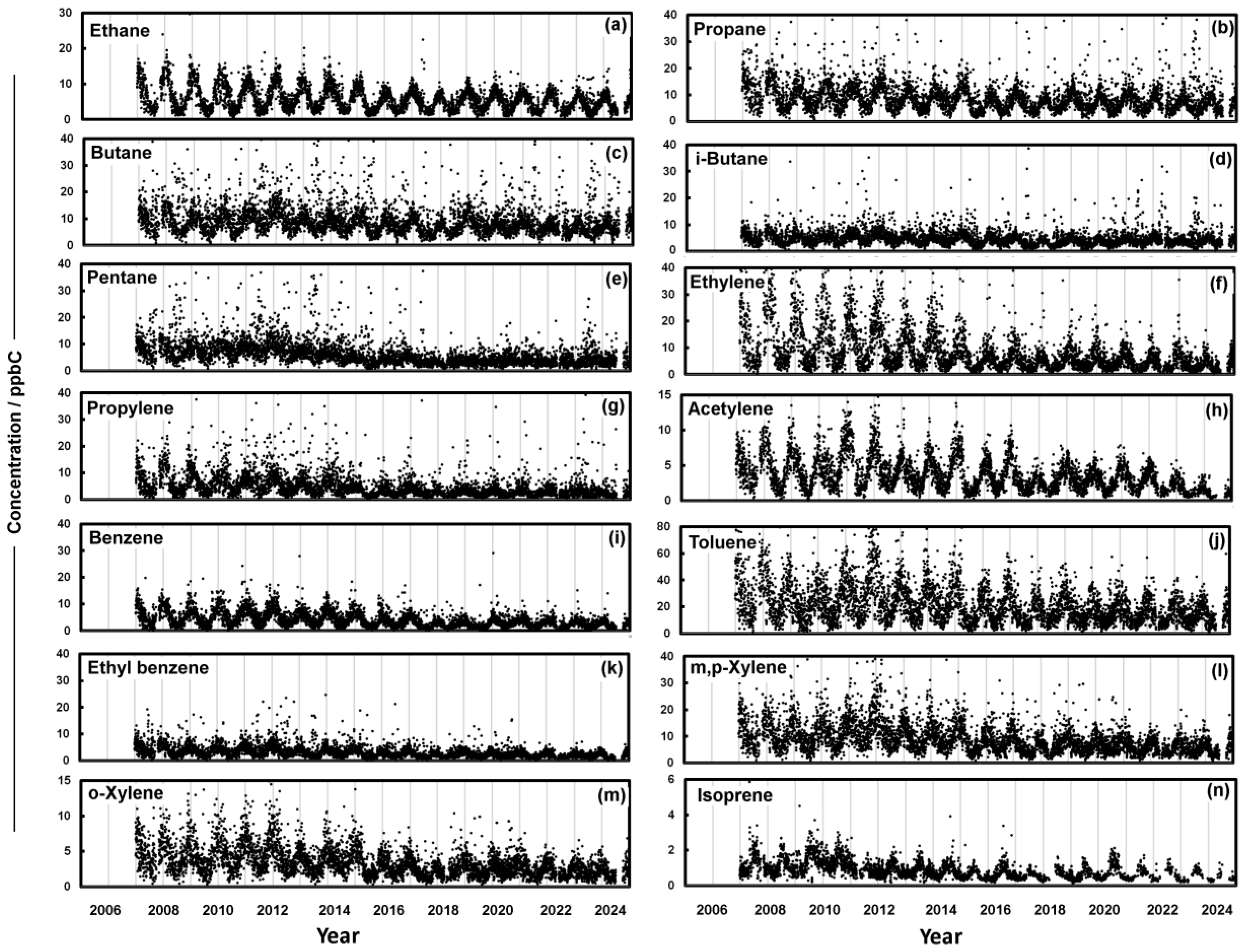
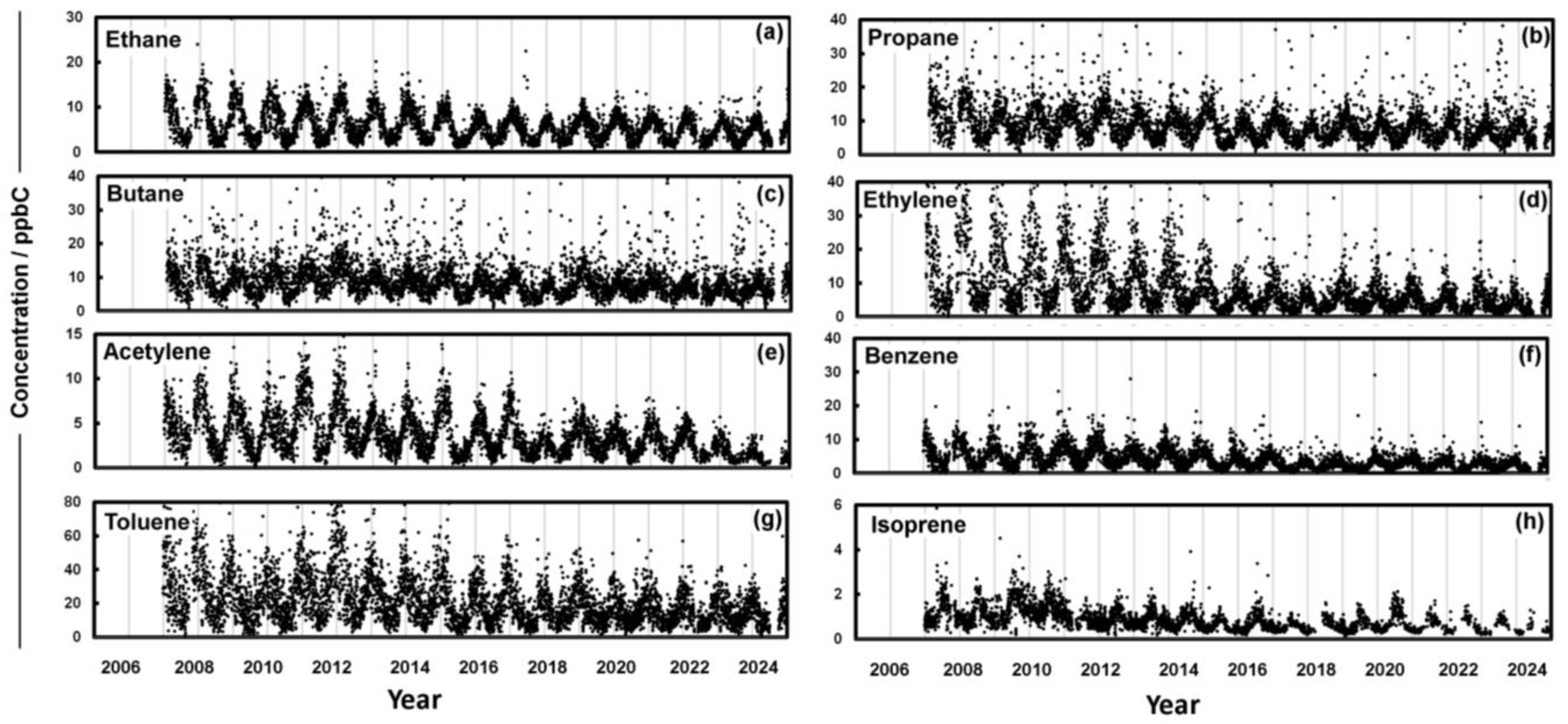
The daily concentrations of VOCs from Xiaogang, an industrial site in the south of Taiwan are shown in Figure 2 (detailed with more VOCs as Appendix A Figure A1). This is representative of data typically used by the current study. The individual VOCs show a distinctive seasonal pattern with the highest concentrations in the winter, except for isoprene. As a biological volatile from vegetation, isoprene concentrations are higher in summer due to higher temperatures and increased plant and crop growth, despite a potential for increased photodegradation. There is a general decline (significant at p ≤ 0.0001) in annual isoprene concentrations over time, with Sen slopes for ethane and butane at −0.16 ± 0.04 and −0.18 ± 0.05 ppbC a−1. The aromatic compounds benzene and toluene also showed a decline −0.24 ± 0.06 and −0.98 ± 0.21 ppbC a−1, which seems slightly greater than for the two alkanes, but this is due to the higher concentrations found for toluene.

3.1. Outline of VOC Concentrations and Trends

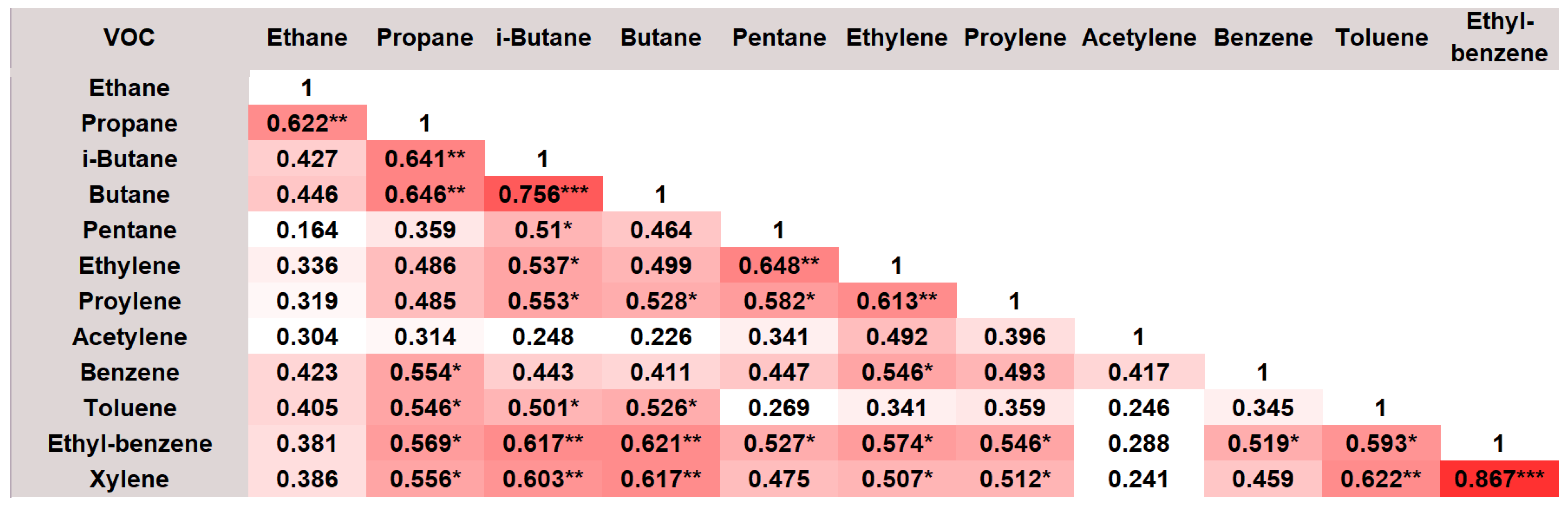
The monthly concentration of the 13 VOCs that were the focus of this review, calculated using the combined dataset from all nine stations, were all positively correlated with each other (Figure 3), except for isoprene, which was dominated by biogenic emissions and strong seasonal variability and showed a negative correlation with the non-biological VOCs. We also calculated Spearman’s rank correlations in parallel to confirm that results were robust to non-normality, indeed, the correlation pattern was essentially the same using Spearman’s rho, so for simplicity we report Pearson’s R for linear correlation visualisation. All these relationships were all statistically significant (p ≲ 0.01), except for ethane and pentane (p~0.08). Station-specific correlation matrices were examined for consistency and showed broadly similar correlation structures across sites. Differences were mainly in correlation strength rather than in the pattern of inter-VOC relationships. The highest correlations (Pearson’s R~0.87) were between (i) butane with i-butane and (ii) xylene with ethyl benzene compounds of identical molecular weight and similar structure.
The alkane concentrations tend to be intercorrelated, although ethane shows the weakest of these correlations, especially notable is the lack of correlation with pentane (Pearson’s R = 0.164). Acetylene shows rather low correlation coefficients. The aromatic compounds also tend to be well intercorrelated, but the weakest is with the parent benzene. The unsaturated compounds are also reasonably intercorrelated, and additionally correlate with aromatic compounds, except for toluene.
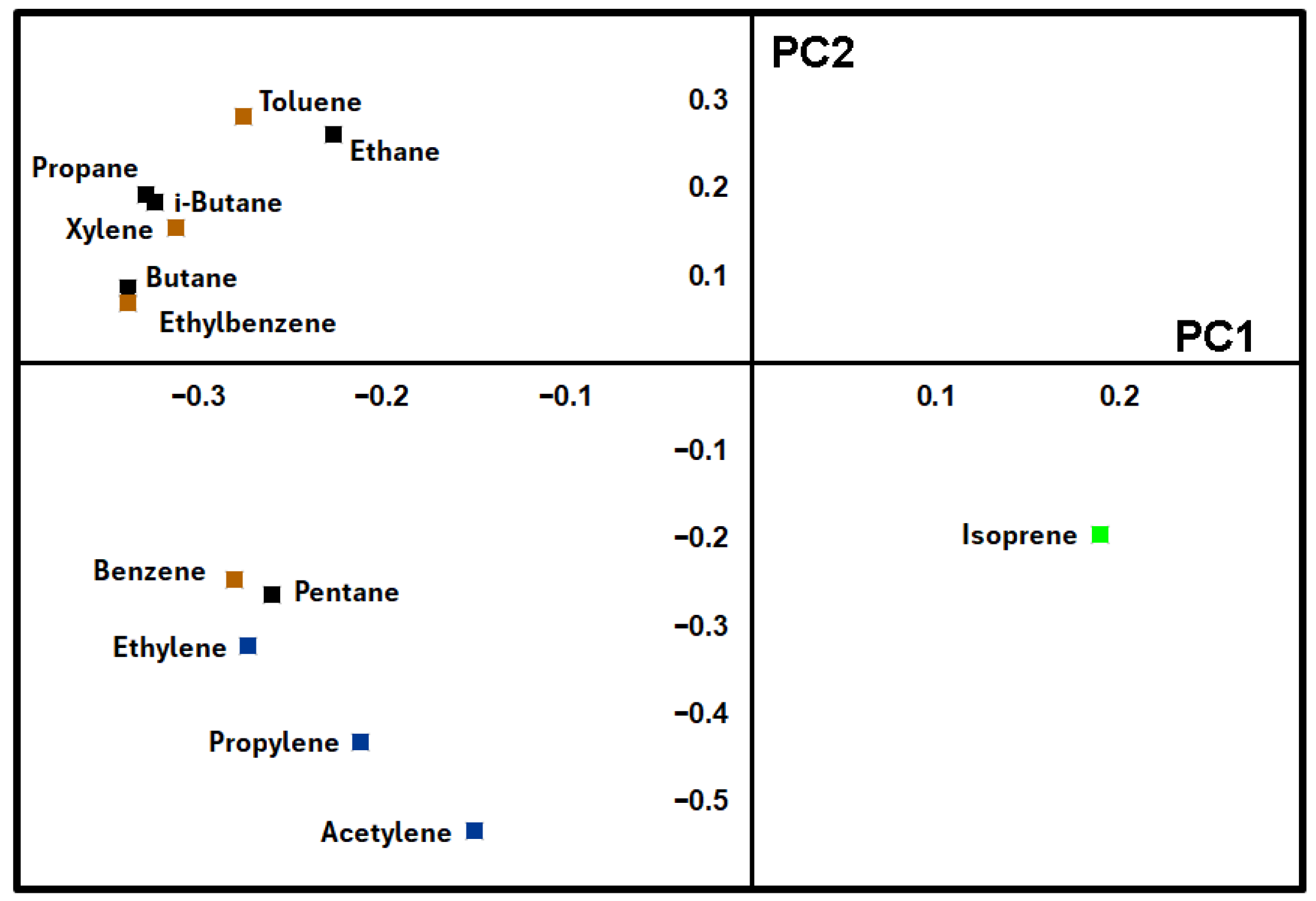
Figure 4 shows a principal component analysis (PCA) of the monthly concentration data from all sites for the period 2020–2024. This five-year period was chosen in order to characterise the current composition of VOCs under current emission conditions, and to avoid conflating short-term patterns with long-term concentration trends observed over the entire dataset. In this representation, the first principal component of compounds reveals that isoprene is very distinct from the other VOCs. Most of the variation (53%) is embodied in this first component, with just 16% in the second. The alkenes and acetylene form a small group with second principal components <−0.3. The alkanes show a decrease in the second principal components with molecular weight. The aromatic compounds show positive second principal components, apart from benzene, which likely reflect different source profiles [36]. This analysis suggests the VOC presence in the atmosphere can with some validity be separated into (i) alkanes, (ii) aromatic compounds, (iii) alkenes and acetylene, and (iv) isoprene.

3.1.1. Alkanes

Alkane concentrations exhibit a negative trend through the period 2006–2024 as seen in an earlier study of Taipei [20]. The highest annual average concentrations from all sites, for all available years, were observed at the beginning of the records: propane (7.07 ± 2.23 ppbC) and n-butane (6.39 ± 2.32 ppbC). Ethane and isobutane followed, with averages of 6.03 ± 2.71 and 3.62 ± 1.28 ppbC. The concentrations of n-pentane were smaller than the other alkanes, with the highest concentration at just 3.12 ± 2 ppbC. These differences reflect variations in emission sources. Aggregated annual averages by site category exhibit interannual variability, peaking in the mid-2000s and declining from 2020 to 2022. Maximum annual values occurred at the Wanhua station (ethane: 16.49 ppbC in 2010; propane: 15.07 ppbC in 2007), and at Xiaogang (n-pentane: 11.17 ppbC; n-butane: 14.77 ppbC, both in 2011). The minimum values were recorded at the Chaozhou (ethane: 2.95 ppbC in 2006), Taixi (propane: 3.17 ppbC in 2022), and Puzi stations (n-pentane: 0.77 ppbC in 2022).
Appendix A Table A1a provides summaries for the alkanes at each station. Most alkanes exhibited significant declines, as indicated by negative slopes and p-values less than 0.05. For example, propane declined by −0.348 ppbC a−1 at Wanhua and n-pentane by −0.423 ppbC a−1 at Xiaogang. Ethane showed a substantial decline at Xiaogang, decreasing from an annual average of 11.30 ppbC in 2006 to 4.88 ppbC in 2024, a 57% decrease. The trend (Sen slope) was −0.166 ppbC a−1 with a τ of −0.72 and a Kendall p-value < 0.001. In contrast, the trend at Wanhua was weaker and not statistically significant. Additionally, fuel-related alkanes (e.g., n-butane and n-pentane) exhibited significant reductions, ranging from 50% to 76%. However, Chaozhou, Taixi, and Puzi exhibited lower levels and variation in the trends, potentially due to the remoteness of industrial sources and lower vehicle densities. Outliers include abnormally high ethane and propane concentrations in Tainan in 2023 (ethane 9.12 ppbC and propane 9.10 ppbC, respectively), which may be linked to industrial incidents or meteorological conditions. However, most declining trends exhibit a good fit (R2 > 0.7).

3.1.2. Aromatic Compounds

The aromatic compounds (benzene, toluene, ethylbenzene, and the xylenes, i.e., BTEX) are key VOCs and notable ozone precursors. Benzene is often linked to industrial processes, while toluene and xylenes are associated with transportation emissions and solvent use [36]. Overall (see Appendix A Table A1b), toluene exhibited the highest annual average concentration (20.07 ± 10.65 ppbC), followed by m,p-xylene (6.64 ± 3.52 ppbC), o-xylene (2.64 ± 1.42 ppbC), benzene (2.99 ± 1.23 ppbC) and ethylbenzene (2.24 ± 1.19 ppbC). This distribution pattern aligns with the typical urban BTEX composition, in which toluene and xylenes dominate due to solvent and fuel evaporation.
The highest annual concentrations of aromatic compounds were found at Xiaogang (Kaohsiung industrial zone): benzene (4.44 ppbC), ethylbenzene (3.49 ppbC), meta-/para-xylene (9.70 ppbC), and o-xylene (3.70 ppbC), with the exception of toluene which was 32.23 ppbC at Tucheng. More rural or suburban stations, such as Taixi (1.88 ppbC) and Chaozhou, Pingtung (2.38 ppbC), exhibited the lowest average concentrations and for benzene, likely due to fewer local emission sources.
Detailed summaries for each station and alkane are presented in Appendix A Table A1b. Most monitoring stations exhibited significant downward trends for all BTEX compounds (negative slope, p < 0.05) with good fits (R2 > 0.7). Percentage changes in benzene concentrations were negative at all stations, indicating widespread decreases ranging from 33.6% to 70.3% over the record. Xiaogang exhibited the steepest decline (−70.3%, Sen slope = −0.259 ppbC a−1, τ = −0.77, p < 0.001). In contrast, the smallest reduction occurred at Puzi (−33.6%, Sen slope = −0.102 ppbC a−1, τ = −0.78, p < 0.001). This station is located in an agricultural area of Chiayi County. Pollution sources here primarily arise from agricultural activities and seasonal burning as emissions are typically lower than in metropolitan and industrial areas.
Toluene has high emissions, so at Tucheng and Wanhua, located in the Taipei Basin, elevated concentrations are apparent (32.23 and 21.87 ppbC). However, the steepest decline rate was observed at Zhongming in Taichung City Centre (Sen slope = −2.123 ppbC a−1, τ = −0.91 p < 0.001, 57.9% reduction), hinting at effective control measures. Taichung City implemented the Air Pollution Prevention Plan and guided industrial enterprises in lowering their VOC emissions and used advanced environmental monitoring technology to help achieve the emission standards. Specific factories were required to install continuous emission monitoring systems, such that between 2019 and 2021, VOC emissions declined ~762.3 t (https://www.taichung.gov.tw/1983179/post, accessed on 9 September 2025). In the transportation sector, the government more broadly subsidised the replacement of gasoline-powered motorcycles and buses with electric models and required the installation of vapour recovery systems at gas stations to reduce emissions of toluene-containing VOCs (https://english.taichung.gov.tw/2452663/post, accessed on 9 September 2025).

3.1.3. Alkenes and Acetylene

Summary statistics of the alkenes and acetylene are shown in Appendix A Table A1c. Unsurprisingly, the average concentrations of the alkenes were highest at industrial Xiaogang (ethylene, 9.277 ppbC and propylene 5.375 ppbC), with acetylene high at Wanhua (5.454 ppbC) and low concentrations at Taixi and Puzi. Acetylene concentrations showed significant negative trends (p < 0.05) at most sites, with the strongest reductions occurring in Xiaogang and Qiaotou (−0.206 and −0.225 ppbC a−1). The exceptions were rural Chaozhou (0.066 ppbC a−1) and Taixi (−0.049 ppbC a−1), neither of which were significant, perhaps affected by a range of more distant sources. Ethylene followed similar patterns, with steep declines at Xiaogang (−0.730 ppbC a−1) and consistent reductions across urban sites (−0.269 ppbC a−1 at Wanhua, for example). Taixi and Puzi also declined significantly. Chaozhou exhibited a moderate decrease of −0.151 ppbC a−1. Propylene concentrations declined universally (p < 0.001), with steeper slopes observed at Xiaogang (−0.340 ppbC a−1) and Taixi (−0.179 ppbC a−1). Widespread reductions (>50% change) occurred at the Tucheng, Wanhua, Xiaogang, and Qiaotou sites, reflecting reduced fossil fuel combustion and petrochemical emissions. At the more rural Chaozhou, Taixi, and Puzi, however, the situation is different, lower concentrations and shallower slopes reveal a less noticeable influence from the controls.

3.1.4. Isoprene

The annual average concentration of isoprene was 1.12 ± 0.468 ppbC, ranging from a maximum of 2.42 ppbC in Wanhua in 2007 to a minimum of 0.36 ppbC in Tainan in 2023 (as presented in Appendix A Table A1c). Isoprene primarily originates from vegetation and correlates with air temperature and land use. Rural southern regions, such as Chaozhou, have higher initial concentrations, averaging 1.65 ppbC. This contrasts with urban areas, such as Zhongmin, which average 0.95 ppbC. No outliers were detected, though a significant fluctuation occurred at Qiaotou in 2023 (1.395 ppbC). Most monitoring stations exhibited a negative trend (e.g., Wanhua: −0.075 ppbC a−1; p < 0.001), which may be due to reduced urban green spaces. However, slight increases were observed in Zhongming (+0.025 ppbC a−1) and Taixi (+0.045 ppbC a−1). This may have arisen through an expansion of green spaces. For instance, in 2014, Zhongming (Taichung City) had a per capita green space area of 4.27 m2, with a planned increase the led to 5.24 m2 [37] and then 9.56 m2 under the “Melody Plan” for 2021 [38]. Puzi (Chiayi City) established a new 1470 ha forest park in 2012 by integrating wetland and lowland afforestation areas [39].

3.2. Spatial Distribution—Differences Between Sites

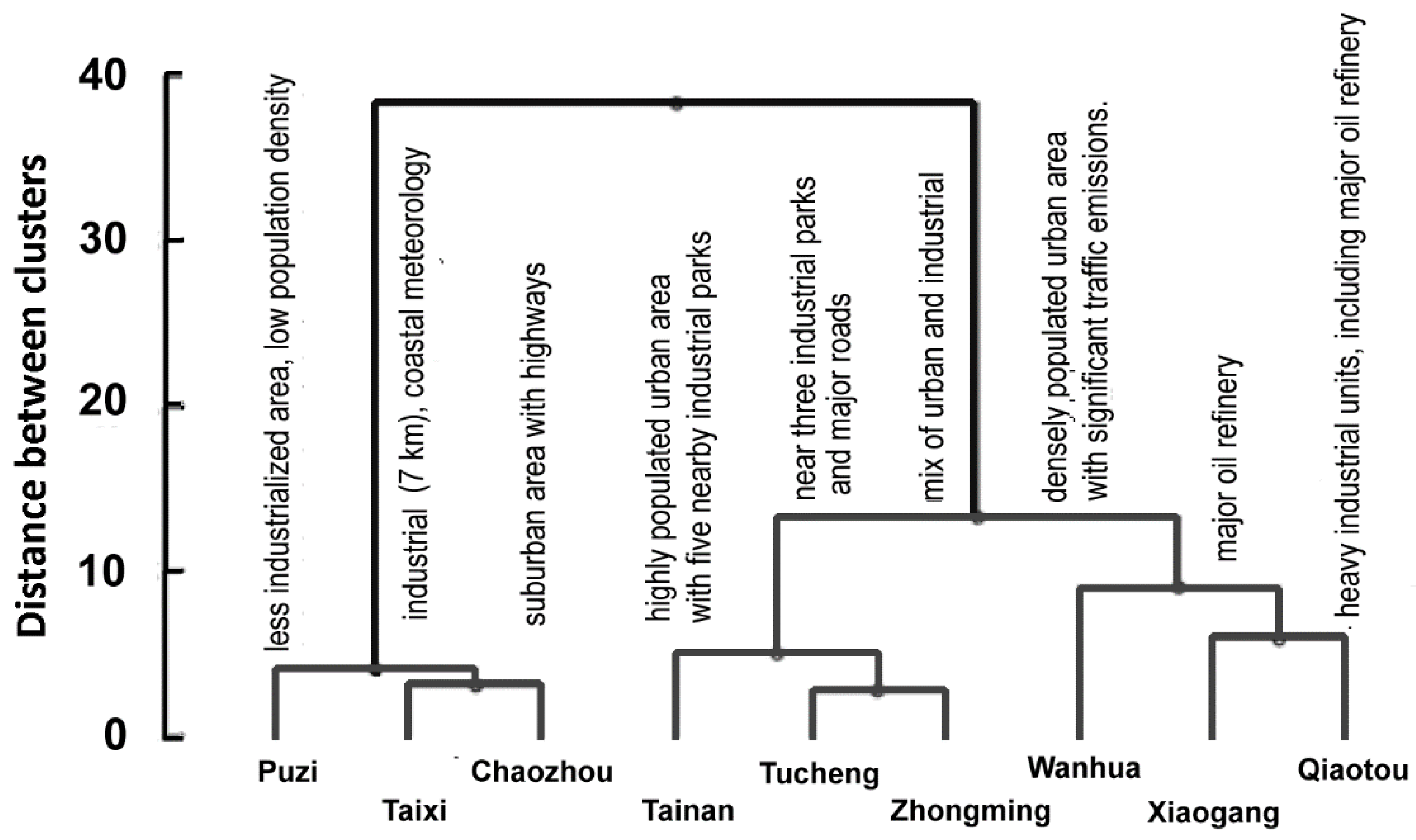
Figure 3 showed that the non-biogenic VOC species were typically correlated with each other. However, it seemed while not discounting the correlations there would be a distinctiveness between the sites. The average concentrations across the period 2020–2024 for the nine sites were used in a cluster analysis (Figure 5) to assess if they were different. It is immediately clear that the six urban/industrial stations (Wanhua, Tucheng, Zhongming, Tainan, Qiaotou and Xiaogang) are quite distinct from the more rural sites at Puzi, Taixi and Chaozhou. The “fingerprints” of the VOCs at the various monitoring sites are likely a product of their location and emission sources in the region. Additionally, there seems to be a slight distinction between the urban sites at Tainan, Tucheng and Zhongming, and those at Wanhua, Qiaotou and Xiaogang.
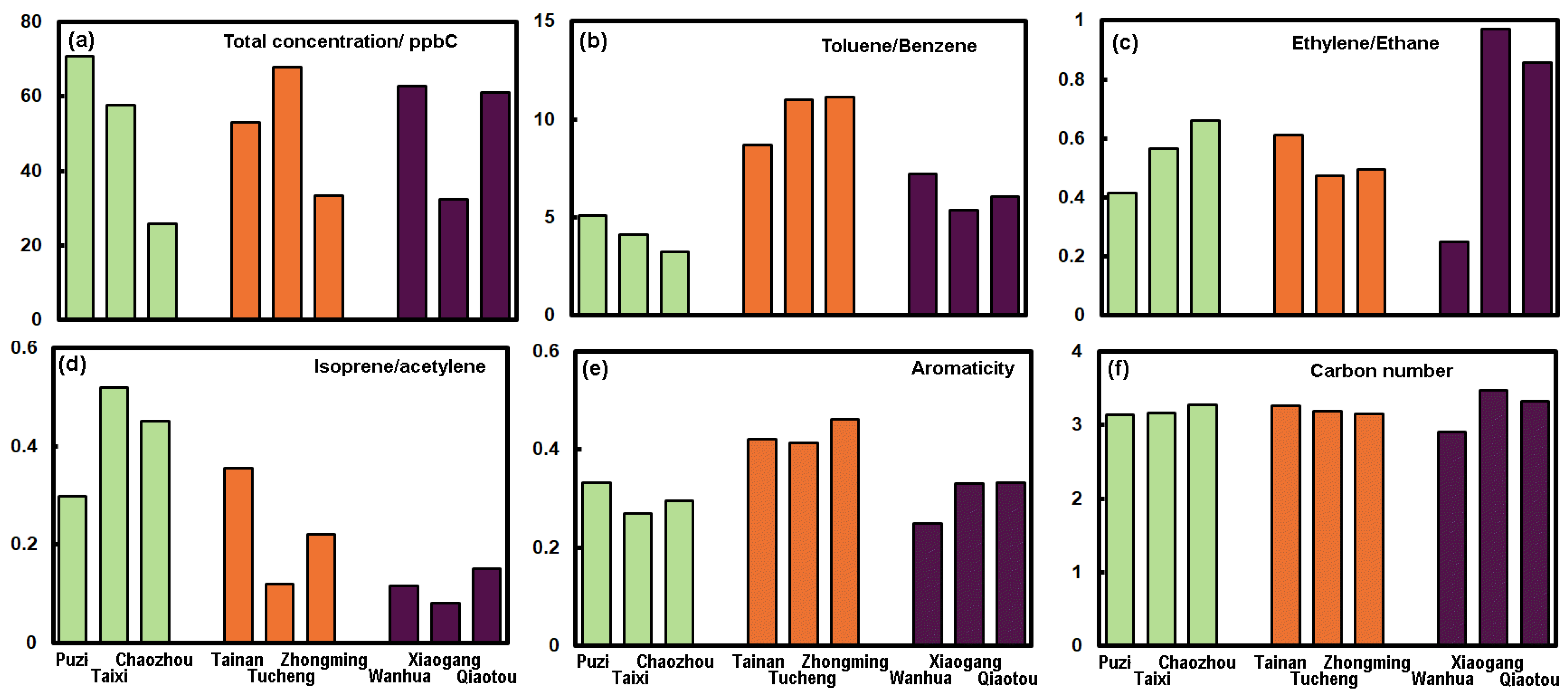
When extended to the entire dataset (2006–2024), the cluster analysis gave similar results, again splitting the sites to those with an urban–industrial character and rural stations. Unfortunately, the cluster analysis as displayed in Figure 5 offers no clue as to the underlying nature of the difference between the VOC components. Initially one might imagine that these differences would be driven by differences in overall concentration. Figure 6a shows the sum of the average concentrations of the twelve non-biological VOCs studied here for the period 2020–2024. There is no obvious coherence in differences among the overall VOC concentrations from the three clusters. An ANOVA test, although rather inadequate for just three values in the three classes, suggests p > 0.05, but there is also no statistical difference when comparing the six urban and three rural concentrations (t-test, p ~0.25).
The situation becomes more interesting if we compare the toluene:benzene ratio for the three clusters (Figure 6b). The toluene-to-benzene ratio can be a diagnostic indicator of the source of aromatic compounds [40,41,42,43] and is typically <1 for biomass/biofuel/coal burning, 1–10 for vehicle emissions and gasoline evaporation, and >1 to more than 100 for industrial processes [44]. As we can see, higher values are found in the Tainan–Tucheng–Zhongming cluster, with lower values found in the rural Puzi–Taixi–Chaozhou cluster. This perhaps reflects less industrial and more vehicle influence at these sites, where aromatic VOCs from automotive fuel are key to dominating. The ratios at the six urban sites are significantly different to those found in the rural locations (t = 4.86; p2 < 0.002) as a result of different emission characteristics.
Another potential diagnostic ratio is ethylene:ethane, which reflects the amount of a reactive compound with a high ozone creation potential to that of ethane which is rather less reactive [45]. The picture here is unclear (Figure 6c) and an ANOVA suggests no significant difference (p~0.67) among the values for the clusters. However, both Qiaotou and Xiaogang have large values for the ethylene:ethane ratio.
The ratio of isoprene:acetylene is likely to balance the biologically generated compound against acetylene, here largely a low-reactivity automotive emission. In line with this, the values of the three rural sites are typically higher than those of the six urban sites (t = 43.37; p2 < 0.012). The highest aromaticity (i.e., mixing fraction of BTEX/alkanes: C2–C8) is found at the Tainan–Tucheng–Zhongming sites, so, rather like the toluene/benzene ratio, it likely derives from high vehicle emissions. The carbon number for the alkanes from C-2 up to C-8 appears even across all the sites (Figure 6e), showing that the proportion of alkanes does not change greatly.

3.3. Seasonal Distribution

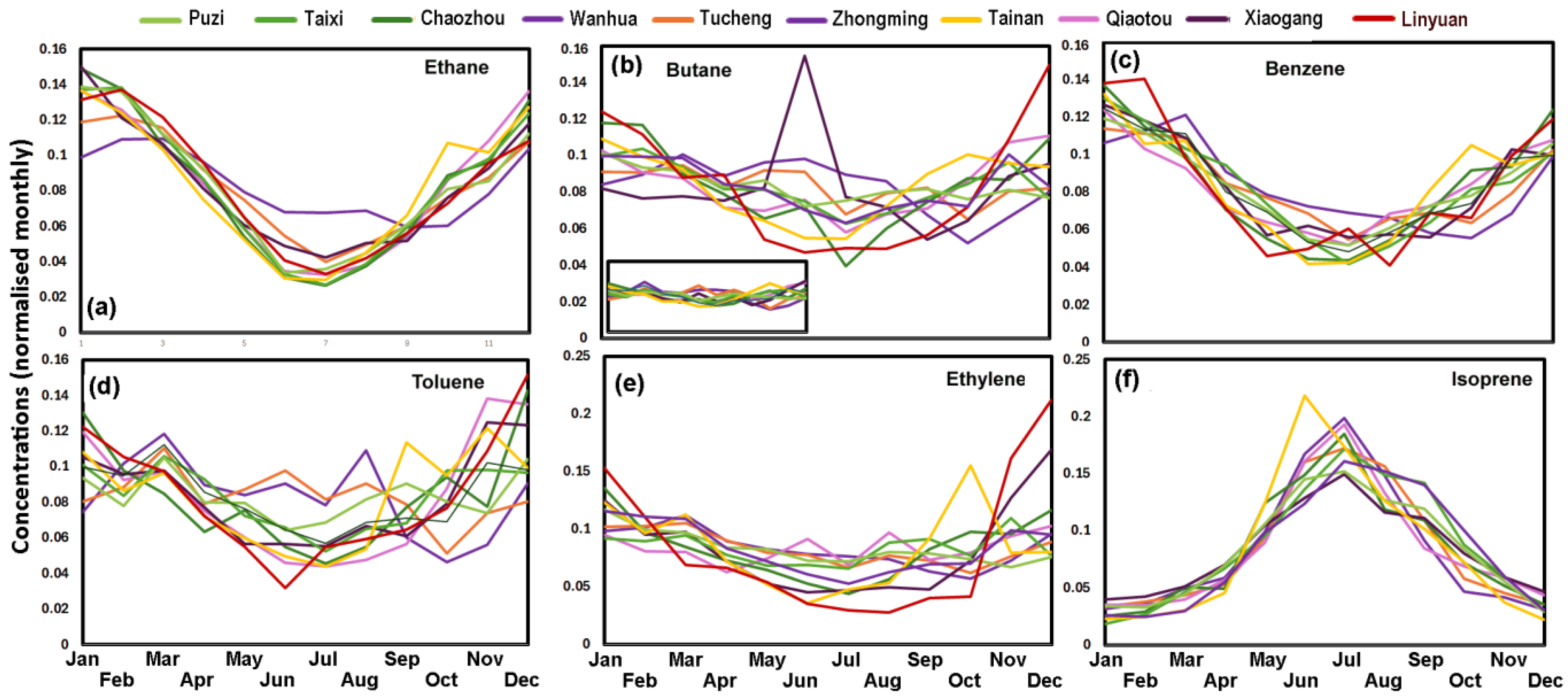
This review further reveals that VOC concentrations exhibit pronounced seasonal variation (Appendix A Figure A2) that is especially clear when the data is normalised to the annual sum of the monthly values. The concentration data are tabulated in Appendix A Table A2. Alkanes, aromatic compounds, and alkenes typically peak in winter (e.g., Xiaogang’s alkanes at 8.82 ± 0.21 ppbC) and decline in summer (e.g., Zhongming’s alkanes at 3.54 ± 0.31 ppbC). The Linyuan data originate from a mobile monitoring station located within a petrochemical industrial complex, meaning they are not directly comparable to long-term fixed sites. Nevertheless, the seasonal variation observed at Linyuan closely resembles that of established industrial stations, with elevated concentrations in winter. This pattern is consistent with reduced atmospheric dispersion in winter due to lower boundary layer heights and weaker wind speeds, which facilitate the accumulation of pollutants in industrial areas. Conversely, summer concentrations decrease due to enhanced photochemical degradation and improved atmospheric dilution [46]. The seasonal changes are shown in Appendix A Figure A2, where the profiles at the nine sites are very dramatic in the case of ethane: high in winter and low in summer (Appendix A Figure A2a). This seasonality appears weaker in the case of butane (Appendix A Figure A2b) and is almost absent in the case of heptane as shown in the inset.
Benzene (Appendix A Figure A2c) shows a clear seasonal cycle, which is somewhat less obvious for toluene (Appendix A Figure A2d). Ethylene shows a cycle with an increase that is notable in the final months of the year (Appendix A Figure A2e), which can also be found for propylene and acetylene (not shown here but reported in Table A1 in the Appendix A). Aromatic compounds exhibited elevated concentrations at northern urban stations (e.g., Tucheng: 12.00 ± 0.97 ppbC in spring and Wanhua: 9.25 ± 0.91 ppbC in summer), which deviates from the typical pattern of higher concentrations in the winter. This may be related to increased evaporation losses from solvents and fuels at high temperatures, perhaps amplified by the urban heat island.
Alkanes and alkenes generally have higher concentrations at heavily industrialised Xiaogang and Qiaotou, while more rural Chaozhou and Taixi have markedly lower levels. Xiaogang recorded the highest CV value for alkenes (CV = 0.32), suggesting event-driven emissions from large industrial releases. As an example, a catastrophic explosion occurred in Kaohsiung, Taiwan, on 31 July 2014. when a propylene leak from underground pipelines ignited, triggering a petrochemical gas explosion that killed 32 people, including seven firefighters, and injured 321 others. Beyond direct casualties and infrastructure damage, the explosion raised significant environmental concerns, particularly regarding the release and dispersion of VOCs [47,48]. Isoprene as biogenic volatile has a cycle with a distinct summer maximum (Appendix A Figure A2f), peaking in summer (Tainan: 3.28 ± 0.25 ppbC). This can be attributed to biogenic emissions from vegetation, which increase with rising temperatures and solar radiation intensity.

3.4. Diurnal Distribution

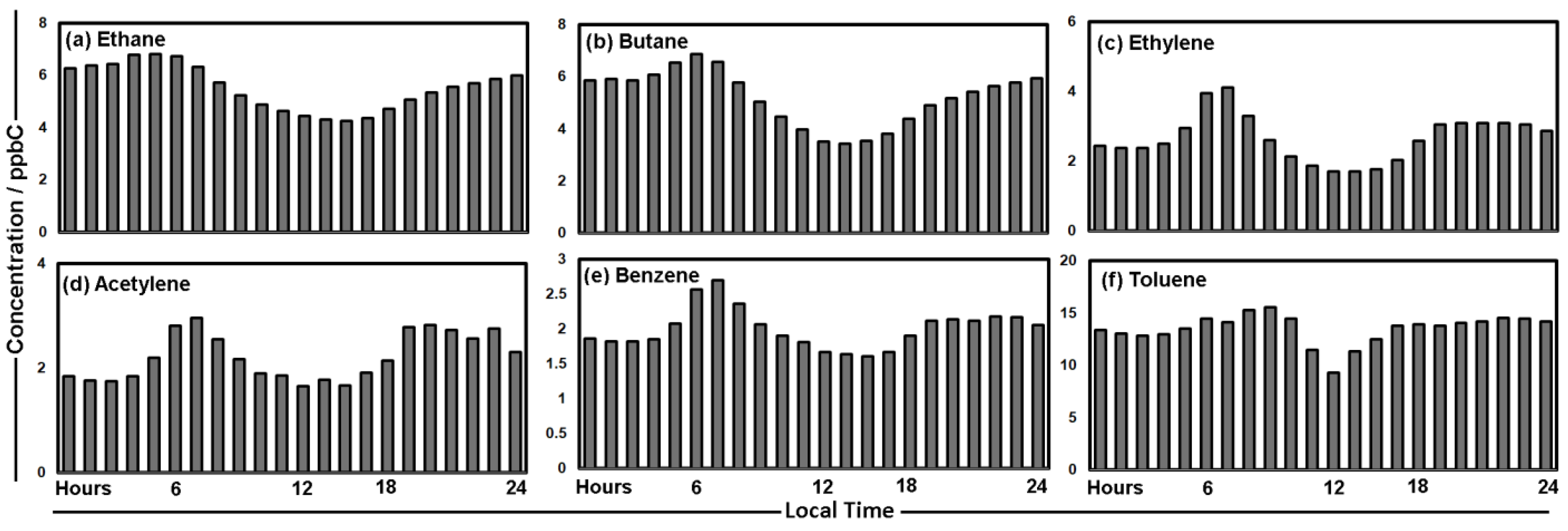
In order to provide context for the short-term variability, it should be noted that hourly VOC concentrations occasionally reached several hundred ppbC at industrial sites, whereas the maximum concentrations at rural sites were typically an order of magnitude lower. Minimum concentrations at all sites were close to background levels during summer afternoons. The distribution of anthropogenic emissions is typically bimodal. However, ethane has a morning peak between 06:00 and 09:00 (Figure 7a), which is rather shallow compared to butane and butane is perhaps an hour delayed (Figure 7b). Ethylene and acetylene (Figure 7c,d) show clear morning peaks (07:00–10:00), and a very broad peak from 18:00 onwards. Benzene follows these two VOCs (Figure 7e) and shows a distinct morning peak at 07:00–10:00. Toluene (Figure 7f) hardly has any morning or evening peaks, but a prominent and rather symmetrical dip about 13:00. Isoprene has fewer hourly data, but there are indications in terms of limited hourly data it exhibits a midday peak.
Table 2 summarises the average concentration ranges of various VOC categories. Morning concentration peaks predominantly occurred between 07:00 and 08:00, which is closely associated with urban traffic emissions. Alkanes and alkenes averaged 6.46 ± 1.84 and 5.99 ± 2.12 ppbC at 07:00. Aromatic hydrocarbons averaged 7.83 ± 6.37 ppbC at 08:00. The maximum VOC concentrations were 13.71 ppbC for aromatic compounds in Tucheng at 18:00 (the highest among all VOCs) and 9.53 ppbC for alkenes in Xiaogang at 07:00. Interestingly, the maximum alkane concentration was 9.35 ppbC in Xiaogang at midnight, perhaps due to late-night industrial discharges. The lowest values consistently occurred in Taixi (1.46 ppbC for alkenes and 1.66 ppbC for aromatic compounds).
Isoprene exhibits distinct diurnal variation. Its concentration gradually increases with daytime temperature and sunlight-driven plant emissions, peaking at midday. The highest concentration (3.78 ppbC) was recorded in Chaozhou at 12:00, while the average peak value (1.97 ± 0.90 ppbC) occurred at 11:00. The lowest value (0.34 ppbC) was recorded in Taixi at 23:00.

4. Discussion

4.1. Spatial and Temporal Distributions

A key issue in the field of regional air quality research is whether long-term regulatory efforts result in sustained reductions in ambient VOC levels, or if these reductions are counterbalanced by economic growth, emission relocation or changes in source structures. Long-term observations of VOCs across Taiwan demonstrate that sustained regulatory controls have effectively reduced total VOC concentrations while amplifying the contrast between urban–industrial and rural environments. The urban–industrial sites prove to have the highest monthly concentrations, with Wanhua notably high in ethane and propane and Xiaogang in terms of n-butane and n-pentane. The lowest values are found at the more rural sites in Chaozhou, Taixi and Puzi. The aromatic compounds were found at their highest annual concentrations at Xiaogang in Kaohsiung’s industrial zone: benzene, ethylbenzene and xylene (9.70 ppbC), a pattern commonly reported for petrochemical-affected areas in East Asia [49,50], with the exception of toluene which proved highest at the Tucheng site. Less urbanised sites, such as Taixi and Chaozhou exhibited the lowest levels.
In general, the concentration of VOCs declines over time, which is consistent with the long-term reduction in emissions reported from other industrialised regions. However, there are a few exceptions, notably the rise in acetylene at Chaozhou might be attributed to agricultural burning activities [51]. Although there was an increase in acetylene at Taixi, the rate of increase declined over time. This decline was linked to the decreasing influence of petrochemical facilities and improved dispersion conditions [52]. Such site-dependent responses highlight the heterogeneous effectiveness of emission control measures across different source environments, which is an important consideration for policy makers. Rising ethane and propane concentrations in urban areas such as Wanhua and Tainan are associated with increased liquefied petroleum gas and natural gas usage, a trend similarly observed in other Asian cities undergoing fuel transitions [49]. Holland et al. (2023) also reported a similar long-term decline in VOC levels in the United Kingdom, accompanied by an increase in the relative importance of ethane and propane [53]. Although legislative controls have successfully reduced traffic-related VOC emissions, they have not limited emissions from natural gas leaks sufficiently [53]. Overall, Taiwan exhibits VOC trends characteristic of East Asian regions that have entered a post-peak emission phase, with most emissions having decreased from their peak values. This contrasts with regions where anthropogenic VOC emissions continue to grow [54,55]. Additionally, meteorological factors, such as typhoon-induced dispersion effects and monsoons, may cause temporal and spatial variations in VOC concentrations [56,57]. In terms of biogenic volatiles there is a notable increase in isoprene at Zhongming linked to increased green spaces in Taichung City, suggesting a growing relative importance of biogenic contributions under subtropical urban conditions. The seasonal profiles show higher concentrations in winter months, although the seasonal changes are very subtle for higher alkanes (Inset to Appendix A Figure A2b).
When considered within a broader regional context, the observed trends in VOC emissions suggest that Taiwan shares key characteristics with other East Asian regions that implemented air pollution control policies relatively early. Regional emission inventories show that Japan, South Korea and Taiwan experienced sustained declines earlier than many other Asian regions [58]. In line with this, satellite-derived formaldehyde trends reveal predominantly negative anthropogenic VOC signals over cities in Taiwan and Japan. This is in contrast to the positive trends observed over southern and southeastern Asia, where VOC regulation remains more limited [54].
Despite the overall decline in total VOC concentrations, the persistence or increase in light alkanes, such as ethane and propane, at urban sites indicates a structural shift in emission sources rather than a failure of emission control measures. Similar behaviour has been widely reported in Europe and North America. Changes in the butane-to-pentane ratio, which were associated with shifts in fuel composition and emissions from the oil and gas sector, had also been documented across the United States [59]. Natural gas leakage and liquefied petroleum gas usage have become dominant sources as traffic-related emissions have declined [53,60].

4.2. VOC and Ozone Production

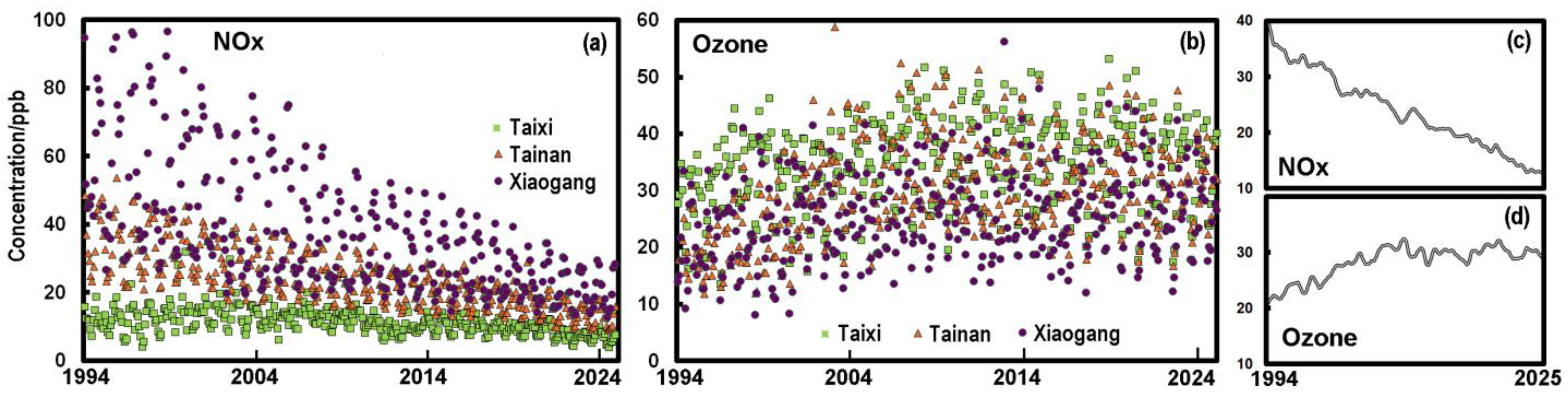
Long-term datasets, such as those analysed here, offer valuable insights into decadal-scale shifts in VOC composition and contribute to a better understanding of their impact on ozone levels. These findings complement the numerous short-term observational studies conducted elsewhere. In Taiwan, some of the VOCs, especially the aromatic compounds and alkenes, play an important role, along with the nitrogen oxides in the formation of tropospheric ozone. Data presented here, typified by Figure 2, have shown the anthropogenic VOCs have universally been in decline for almost two decades. At the same time the nitrogen oxide concentrations have also decreased as shown from the TEPA data shown in Figure 8a for typical rural (Taixi), urban (Tainan) and industrial sites. The Sen slope for the period from the last months of 1993 to 2024 at the industrial site of Xiaogang shows NOx declining at −1 ppb a−1 and the rural site in Puzi at −0.4 ppb a−1. Over the period of the VOC measurements studied here (2007–2024) the results are broadly similar, with an average change of around −1 ppb a−1 observed at urban sites, and a value roughly one third of this observed at rural sites, reflecting spatial differences in emission intensity and control effectiveness.
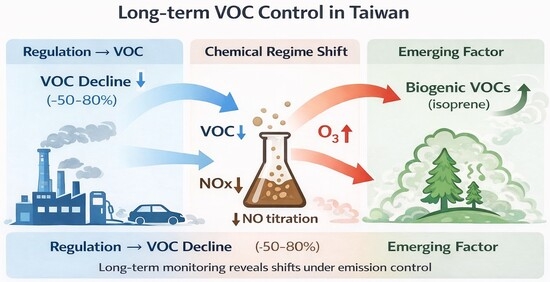
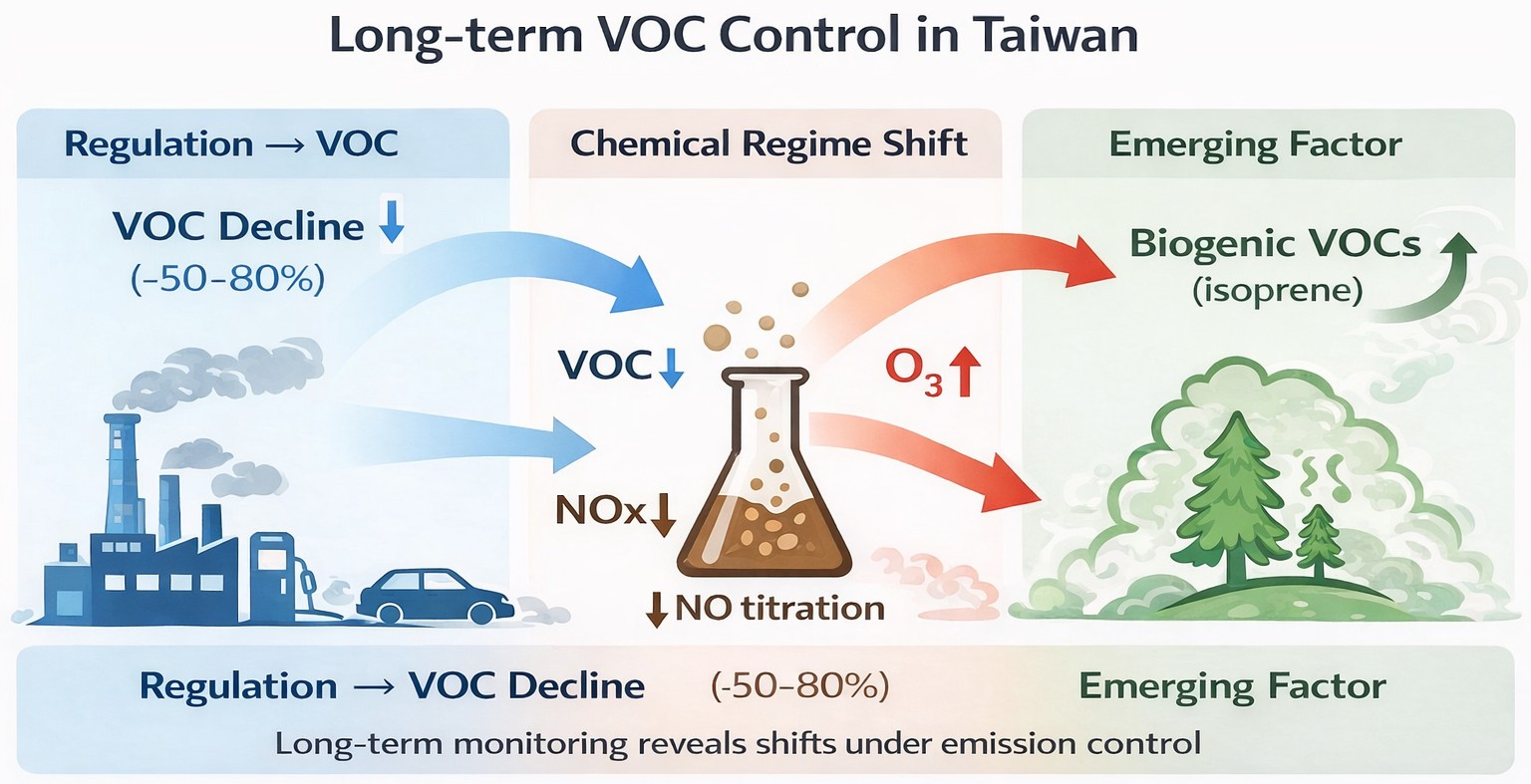
Although the precursor NOx and the VOCs are all in decline the concentrations of ozone have increased over the different sites (Figure 8b, Taixi, Tainan and Xiaogang for representation) and the Sen slopes at the nine sites range from 0.17 to 0.37 ppb a−1 significant at p < 0.0005. This seemingly odd behaviour is due to the way in which ozone is produced, and in this case a decline in NOx concentration might be seen as reducing the amount NO, meaning less reactions with ozone, so ozone could increase in concentration. The dominance of light alkanes and aromatics at industrial sites in Taiwan is consistent with findings from observation-based modelling studies of petrochemical-influenced regions, which indicate enhanced in situ ozone production under NOx-sensitive conditions. [61]. Similar responses have been reported in other industrialised regions of East Asia, where reductions in primary pollutants have coincided with ongoing ozone deterioration. This phenomenon is often referred to as the ‘ozone penalty’ or the ‘VOC–NOx control dilemma’ [49,50,55].
However, despite this apparent increase over the full length of the record in recent years the concentrations have changed much less, with slopes being both positive and negative. Similar behaviour has been widely reported in other urban and industrialised regions where long-term reductions in volatile organic compounds (VOC) and nitrogen oxide (NOx) emissions have not led to proportional decreases in ozone concentrations. Instead, increases or stagnation in O3 have been observed despite declining precursor emissions, reflecting the non-linear nature of VOC–NOx–O3 chemistry [5,6]. Many studies have demonstrated that urban atmospheres often operate under VOC-limited (NOx-saturated) conditions. In such conditions, reductions in NOx can decrease ozone titration by NO, leading to higher ambient ozone levels unless VOC emissions are sufficiently reduced. For instance, long-term analyses in North America and East Asia have documented rising or stable summertime ozone levels alongside substantial reductions in precursor emissions, particularly in cities where traffic-related NOx emissions have declined rapidly [62,63]. These observations highlight that declining precursor trends alone do not guarantee ozone reduction, emphasising the importance of diagnosing local ozone formation regimes when interpreting long-term trends. Overall, the declining precursor concentrations over recent decades have not led to any profound decrease in the ozone concentrations, although as previously observed the past increases seem to have levelled out [64] as shown in Figure 9d.
Recent long-term studies have provided important insights into the nonlinear behaviour of ozone under sustained reductions in precursors, placing the observed ozone response within a broader chemical and regional context. Using two decades of satellite and surface observations, Jin et al. (2020) demonstrated that transitions between volatile organic compound (VOC)-limited and nitrogen oxide (NOx)-limited ozone production regimes occur gradually and at higher HCHO/NO2 ratios than previously inferred [63]. This indicates that NOx reductions alone can enhance ozone under VOC-limited conditions. Similar long-term ozone responses have been reported across Europe and North America, where increases in lower ozone quantiles have coincided with declining extreme values. This reflects shifts in baseline ozone rather than episodic pollution events [5]. However, surface ozone levels have continued to rise in several East Asian regions, including China. This is driven by a combination of VOC-limited chemistry, reduced PM2.5 scavenging, and meteorological influences [62]. Studies reviewing VOC characteristics in China have also found that reductions in total VOC abundance do not necessarily lead to effective ozone mitigation unless changes in VOC composition, chemical regimes, and meteorological drivers are addressed simultaneously [49,55]. Taken together, these findings suggest that the ozone trends observed in Taiwan are consistent with broader regional and global trends, reflecting a common transition in urban atmospheric chemistry under long-term emission control measures. Rather than reiterating these findings, the Taiwanese observations offer a practical testing ground for evaluating the manifestation of these mechanisms under sustained emission controls.

4.3. Health Effects

The potential health threat posed by BTEX was evaluated using hazard ratio metrics, which were derived from established toxicity benchmarks as described in Section 2.3 (Materials and Methods). In brief, the results presented here focus on interpreting the non-carcinogenic health risks associated with long-term outdoor exposure to BTEX compounds. It should be noted, however, that our analysis is restricted to outdoor exposure, while it is possible that much of the population received substantial VOC exposure indoors.
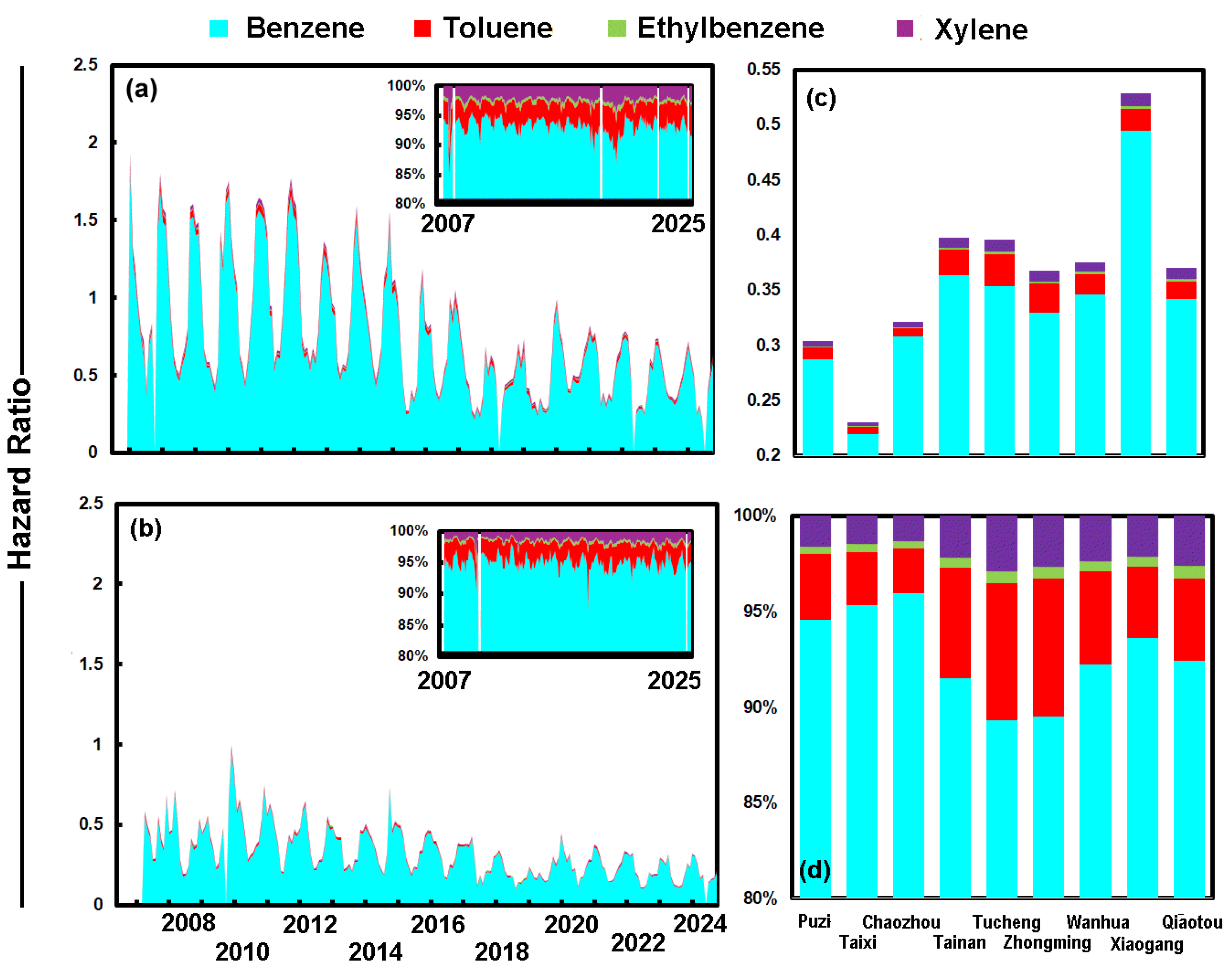
The sum of the hazard ratios for outdoor BTEX at Xiaogang 2007–2024 is shown in Figure 9a. The health effects are for a lifetime so the rapid seasonal changes and long-term trend would be integrated in terms of a health response. Nevertheless, the changes displayed give a sense of a declining threat, especially from benzene. Additionally Figure 9a shows strong seasonal variations in risk that reflect the high concentrations found in winter months. Benzene poses the greatest risk, especially as the additional cancer risk that is likely is not shown in this diagram, leading to a greater threat than represented by the conventional toxicity data. Toluene, ethylbenzene and xylene represent a much smaller toxicological risk threat, typically 6% of the total as shown in the inset to Figure 9a. However, the proportional contribution made by these VOCs varies seasonally and is higher in the summer, occasionally exceeding 10%.
The hazard ratio at Taixi (2007–2024) is shown in Figure 9b and suggests a reduced toxicological risk at this rural site compared with heavily industrialised Xiaogang. Despite this difference there are similarities in terms of a strong seasonality and negative trend in the hazard ratio across the period. The proportion of toluene, ethylbenzene and xylene is just under 6% of the total BTEX risk, so similar to that found at the industrial site.
Figure 9c shows the average hazard ratio at all the sites for the period 2020–2024 and further emphasises the lower risk that is typical of the more rural sites (Puzi, Taxi and Chaozhou). The proportional risks are shown in Figure 9d and suggest that the proportion assigned to toluene–ethylbenzene–xylene is lower at the rural sites. The toluene risk is particularly noticeable at the three more urban sites of Tainan, Tucheng and Zhongming.
Estimates of lifetime cancer risk associated with benzene exposure, derived from established regulatory assessments (USEPA IRIS), are discussed here in the context of long-term concentration trends rather than methodological derivation. Prior to 2010 the risk averaged at Xiaogang was 6.2 × 10⁻⁶, though since 2020 it had almost halved to 3.2 × 10⁻⁶; a reduction across the record that shows parallel and benzene concentrations which have declined by 53 ± 10%.

4.4. Limitations

While this review provides a comprehensive analysis of long-term volatile organic compound (VOC) concentration trends across multiple site types in Taiwan, some limitations should be acknowledged.
Firstly, the present analysis focuses on temporal trends, correlations, and comparative patterns and does not include formal receptor modelling-based source apportionment. However, given the richness of the multi-site, multi-year PAMS dataset, advanced receptor models such as positive matrix factorisation (PMF) could be applied in future studies to quantitatively determine the contributions of traffic, petrochemical, solvent-related and biogenic sources. Such analyses would complement the trend-based findings presented here by converting qualitative source inferences into quantitative, source-resolved contributions that can be evaluated over time and across site types.
Secondly, the health risk assessment presented in this review is based on ambient outdoor VOC concentrations and standard exposure assumptions. In particular, lifetime cancer risk estimates for benzene assume continuous exposure to measured outdoor concentrations over a lifetime, in line with established screening-level approaches. Consequently, these estimates should be interpreted as indicative rather than individual-specific risks. As personal exposure is influenced by time–activity patterns and indoor environments, which may exhibit different VOC levels, outdoor measurements alone are likely to provide an underestimate of total personal exposure in some settings and a potential overestimate in others. Future studies integrating indoor measurements, personal exposure data or microenvironmental modelling would enable a more complete assessment of population-level health risks. Recognising these limitations does not detract from the core findings of this review; rather, it highlights opportunities to further exploit long-term VOC monitoring datasets to improve our understanding of emission sources, exposure pathways and air quality management outcomes.
Thirdly, this work does not explicitly incorporate meteorological parameters or emissions inventory data. Seasonal variations and spatial differences in VOC concentrations are interpreted in the context of well-established atmospheric processes, such as reduced boundary layer heights and weaker dispersion in winter, as well as the known differences between industrial and traffic-dominated environments. However, as no collocated meteorological observations (e.g., boundary layer height, wind speed or direction) or quantitative emissions data were analysed in this work, these interpretations are qualitative and inferential. Consequently, it is not possible to demonstrate direct causal attribution of the observed patterns to specific meteorological drivers or emission sources. Future studies integrating long-term VOC measurements with meteorological data, emissions inventories, and chemical transport or receptor modelling would be necessary in order to quantitatively assess the relative roles of atmospheric dispersion and source contributions.
Recognising these limitations does not detract from the core findings of this review; rather, it clarifies specific research gaps and motivates the targeted future work outlined in the Conclusions to strengthen source attribution, exposure characterisation, and causal interpretation of long-term VOC and ozone responses.

5. Conclusions

The concentrations of most low-molecular weight alkanes, ethylene, propylene, acetylene and BTEX have been in decline for nearly two decades. This is largely due to the regulation of emissions. In contrast, isoprene concentrations have increased in some cases, which is consistent with its predominantly biogenic origin, as well as with changes in vegetation and local environmental conditions. During much of the study period, ground-level ozone concentrations have increased in parallel with the decrease in hydrocarbons that act as ozone precursors. This seemingly contradictory behaviour is consistent with reduced ozone titration under declining NO concentrations, reflecting the nonlinear nature of VOC–NOx–O3 chemistry reported in other urban and industrialised regions. Therefore, the observations presented here align with established chemical understanding under changing precursor regimes rather than implying new mechanisms. Concentrations of aromatic compounds at the sites are now reduced, so the health risks are typically lowered. Nevertheless, there may be brief episodic periods of high concentrations, potentially unacceptable, close to emission sources. Overall, the situation with regard to VOCs is much improved.
From a review perspective, these long-term observations demonstrate how regulatory-driven reductions in emissions, changes in VOC composition and non-linear atmospheric chemistry work together to shape the evolution of air quality in urban and industrial areas. At the same time, the review highlights research gaps that limit the ability to translate observed trends into quantitative, actionable insights for source-specific control and health protection. These gaps include: (i) the lack of quantitative source apportionment to attribute trends to specific emission components, (ii) the reliance on outdoor ambient concentrations and screening-level assumptions in health risk estimation, and (iii) the absence of explicit integration with meteorology and emissions information needed for causal attribution of seasonal and spatial patterns and for diagnosing ozone responses under changing precursor regimes.
To close these gaps, several complementary lines of future work are recommended. First, receptor modelling (e.g., PMF), applied consistently across the multi-site, multi-year dataset, would provide quantitative source apportionment and enable source-resolved trend attribution. This would directly address the current limitation that source influences are inferred primarily from compound patterns and site comparisons, and it would allow the effectiveness of source-specific regulations (e.g., traffic, petrochemical operations and solvent use) to be evaluated more explicitly over time. Where possible, receptor modelling should be supported by updated source profiles and emission inventory information to improve interpretability and to connect statistical factors with real-world emission categories.
Second, health risk assessment should be expanded from an ambient outdoor screening framework toward population-relevant exposure characterisation. This could be achieved by integrating outdoor monitoring with indoor measurements, time–activity data, personal exposure monitoring and/or microenvironmental modelling. Such efforts would reduce uncertainty in interpreting ambient trends in terms of health impacts, identify exposure-critical microenvironments and vulnerable groups, and clarify the extent to which indoor sources contribute to total VOC exposure. In this way, future work would convert the present “indicative” risk estimates into more refined assessments suitable for prioritising interventions and evaluating co-benefits of outdoor emission controls.
Third, strengthening causal interpretation of temporal and spatial variability would better diagnose ozone behaviour under sustained emission controls. Long-term VOC observations should be analysed together with collocated meteorological parameters (e.g., wind fields, boundary layer dynamics) and quantitative emissions information, supported by chemical transport modelling and/or observation-constrained photochemical analyses. This integration would allow the relative roles of emissions changes versus meteorology-driven dispersion and mixing to be quantified, thereby moving beyond qualitative attribution. It would also enable a clearer interpretation of how changes in NOx and VOC composition shift chemical sensitivity regimes and influence ozone production, helping to inform control strategies that explicitly consider non-linear VOC–NOx–O3 chemistry.
In addition, photochemical and regional transport modelling could be used to evaluate the influence of precursor transport across the Taiwan Strait on local ozone and secondary oxidation products, and to explore how longer-term climate change, land-cover change and biogenic emissions might modify regional VOC impacts. The increased sophistication of artificial intelligence and neural networks can further help to exploit the extensive long-term dataset by detecting regime shifts, identifying drivers of episodic concentration spikes near sources, and revealing latent structures in multi-site observations that may not be captured by conventional trend analysis alone.
This review illustrated the effectiveness of regulation in reducing the risks to health and environment posed by VOCs. It is always important to assess the success of regulation. However, the balance of threats may change with time as emissions, technologies and atmospheric processes evolve. These knowledge gaps, which were identified through this review, highlight the need for widening both the scope of the pollutants monitored and the types of sites investigated, along with vigilance over novel pollutants that could pose risks. More broadly, the Taiwan case demonstrates that long-term monitoring networks can be used not only to track concentration trends, but also to diagnose shifts in the chemical state of the atmosphere. Under sustained emission controls, ozone responses are increasingly influenced by VOC composition, biogenic factors and non-linear chemistry; consequently, effective control strategies should be formulated in a systems framework that accounts for both precursor composition and atmospheric chemical regime dynamics.

Author Contributions

Conceptualisation, M.-T.H., P.B. and Y.L.; methodology, M.-T.H., P.B. and Y.L.; formal analysis, M.-T.H. and P.B.; data curation, M.-T.H.; writing—original draft preparation, M.-T.H. and P.B.; writing—review and editing, P.B. and Y.L.; visualisation, P.B.; project administration, Y.L. All authors have read and agreed to the published version of the manuscript.

Funding

This research received no external funding.

Data Availability Statement

Data is available at the links provided.

Conflicts of Interest

Authors have no conflicts of interest.

Appendix A

Table A1. Summary of (a) alkane, (b) aromatic compound, and (c) alkene trends by site (2006–2024), including average concentrations ( c ¯ , percent changes, slopes (ppbC a−1), Kendall τ or R2, and p-values (examples retained for detail). Data coverage varied, with most sites spanning the full period, though Zhongming began in 2011 and some rural sites in 2007. Sen analyses revealed predominantly negative slopes, indicating declines, Kendall τ values assessing fit quality, and p-values for significance (p < 0.05). Percent changes were computed as ((final − initial)/initial) × 100, and annual anomalies defined as deviations exceeding ±2 standard deviations from site means.
(a) Alkanes
SiteAlkane c ¯ /ppbC% ChangeTrend/ppbC a−1R2p-ValueSen Slope/ppbC a−1Kendall Tau (τ)Mann–Kendall (Z)Anomalies (Year, ppbC)
TuchengEthane6.624.0−0.0660.3080.014−0.057−0.43Significant (Z = −2.52)(2010, 8.50)
TuchengPropane8.53−31.0−0.2180.7270.000−0.192−0.72Significant (Z = −4.27)(2007, 11.96)
TuchengIsobutane4.55−33.4−0.1230.7470.000−0.123−0.72Significant (Z = −4.27)None
Tuchengn-Butane8.03−38.2−0.2120.7550.000−0.215−0.70Significant (Z = −4.13)None
Tuchengn-Pentane3.15−72.9−0.2000.9150.000−0.204−0.86Significant (Z = −5.11)None
WanhuaEthane12.3955.50.0090.0010.908−0.014−0.06Not Significant (Z = −0.35)(2006, 8.10); (2010, 16.49)
WanhuaPropane9.05−44.2−0.4190.7940.000−0.348−0.82Significant (Z = −4.90)(2007, 15.07)
WanhuaIsobutane4.85−47.4−0.2280.8550.000−0.201−0.86Significant (Z = −5.11)None
Wanhuan-Butane8.01−49.0−0.3370.8750.000−0.315−0.89Significant (Z = −5.32)(2007, 12.64)
Wanhuan-Pentane3.31−76.2−0.2470.9490.000−0.246−0.91Significant (Z = −5.39)None
TainanEthane5.3430.70.0270.0150.625−0.037−0.12Not Significant (Z = −0.68)(2023, 9.12)
TainanPropane7.101.00.0010.0000.9800.0010.01Not Significant (Z = 0.00)(2022, 5.24); (2023, 9.10)
TainanIsobutane3.78−31.9−0.0730.5310.001−0.080−0.56Significant (Z = −3.18)None
Tainann-Butane6.67−19.0−0.1040.4460.002−0.087−0.49Significant (Z = −2.80)(2022, 4.50)
Tainann-Pentane3.50−75.5−0.2990.9250.000−0.298−0.90Significant (Z = −5.15)None
ZhongmingEthane6.56−20.9−0.1700.6530.000−0.171−0.63Significant (Z = −3.07)(2011, 8.36)
ZhongmingPropane7.47−19.8−0.2060.8060.000−0.199−0.82Significant (Z = −4.05)(2012, 9.58)
ZhongmingIsobutane3.44−20.2−0.0790.5890.001−0.077−0.63Significant (Z = −3.07)None
Zhongmingn-Butane5.57−9.0−0.1280.6160.001−0.137−0.60Significant (Z = −2.96)None
Zhongmingn-Pentane2.40−56.6−0.1980.8480.000−0.193−0.78Significant (Z = −3.83)None
XiaogangEthane6.10−56.8−0.2230.6430.000−0.166−0.72Significant (Z = −4.27)(2006, 11.30)
XiaogangPropane9.58−45.9−0.2640.5600.000−0.227−0.52Significant (Z = −3.08)(2006, 14.69); (2007, 13.56)
XiaogangIsobutane5.10−34.8−0.1080.5080.001−0.104−0.49Significant (Z = −2.87)(2011, 7.06)
Xiaogangn-Butane9.76−29.0−0.2200.5140.001−0.197−0.70Significant (Z = −4.13)(2011, 14.77)
Xiaogangn-Pentane6.71−60.1−0.4220.7820.000−0.423−0.64Significant (Z = −3.78)None
QiaotouEthane5.0031.10.0340.1890.0630.0250.26Not Significant (Z = 1.54)(2006, 4.02); (2008, 4.09)
QiaotouPropane6.94−3.0−0.0200.0240.526−0.019−0.10Not Significant (Z = −0.56)None
QiaotouIsobutane3.725.9−0.0050.0030.810−0.014−0.10Not Significant (Z = −0.56)None
Qiaotoun-Butane6.7215.70.0200.0110.6740.0060.03Not Significant (Z = 0.14)None
Qiaotoun-Pentane3.32−59.6−0.1560.7300.000−0.179−0.70Significant (Z = −4.13)None
ChaozhouEthane4.0027.4−0.0400.1940.059−0.064−0.44Significant (Z = −2.59)(2006, 2.95)
ChaozhouPropane4.8513.1−0.0400.1750.075−0.058−0.33Not Significant (Z = −1.96)None
ChaozhouIsobutane2.477.2−0.0290.2120.047−0.034−0.33Not Significant (Z = −1.96)(2011, 3.30)
Chaozhoun-Butane4.3310.0−0.0450.1730.076−0.045−0.32Not Significant (Z = −1.89)(2011, 5.93)
Chaozhoun-Pentane2.00−41.7−0.1040.7570.000−0.099−0.67Significant (Z = −3.99)None
PuziEthane4.248.7−0.0070.0050.776−0.063−0.44Significant (Z = −2.50)None
PuziPropane5.77−4.0−0.0540.0820.250−0.101−0.75Significant (Z = −4.32)None
PuziIsobutane2.65−26.8−0.0750.5270.001−0.056−0.62Significant (Z = −3.56)None
Puzin-Butane4.69−18.8−0.1270.4830.001−0.082−0.61Significant (Z = −3.48)None
Puzin-Pentane1.94−63.9−0.1360.8560.000−0.087−0.86Significant (Z = −4.92)None
TaixiEthane3.886.3−0.0590.2520.034−0.021−0.15Not Significant (Z = −0.83)(2010, 5.15); (2011, 5.59)
TaixiPropane4.18−35.3−0.1030.8000.000−0.078−0.24Not Significant (Z = −1.36)(2007, 5.52)
TaixiIsobutane1.84−41.2−0.0570.7000.000−0.079−0.57Significant (Z = −3.26)(2007, 2.60)
Taixin-Butane3.24−33.0−0.0840.6450.000−0.150−0.46Significant (Z = −2.65)(2007, 4.64)
Taixin-Pentane1.44−59.6−0.0890.8890.000−0.157−0.83Significant (Z = −4.77)None
(b) Aromatic Compounds (BTEX)
SiteAromatics (BTEX) c ¯ /ppbC% ChangeTrend/ppbC a−1R2p-ValueSen Slope/ppbC a−1Kendall Tau (τ)Mann–Kendall (Z)Anomalies (Year, ppbC)
TuchengBenzene3.08−53.8−0.1740.8720.000−0.169−0.87Significant (Z = −5.18)(2007, 5.22)
TuchengToluene32.23−57.6−1.7090.7670.000−1.552−0.78Significant (Z = −4.62)(2007, 54.53)
TuchengEthylbenzene2.98−71.6−0.1940.7970.000−0.167−0.82Significant (Z = −4.90)(2006, 5.95); (2007, 5.38)
Tuchengm,p-Xylene9.23−62.7−0.5000.8710.000−0.484−0.84Significant (Z = −4.97)None
Tuchengo-Xylene3.71−61.5−0.2120.8220.000−0.211−0.79Significant (Z = −4.69)None
WanhuaBenzene3.49−60.8−0.2130.8950.000−0.213−0.84Significant (Z = −4.97)(2007, 6.11)
WanhuaToluene21.87−68.0−1.2600.8880.000−1.246−0.86Significant (Z = −5.11)(2007, 37.61)
WanhuaEthylbenzene2.78−76.0−0.2090.8930.000−0.199−0.91Significant (Z = −5.39)(2007, 5.39)
Wanhuam,p-Xylene8.86−74.7−0.6360.9300.000−0.619−0.91Significant (Z = −5.39)None
Wanhuao-Xylene3.42−76.2−0.2680.9130.000−0.258−0.87Significant (Z = −5.18)(2007, 6.62)
TainanBenzene3.21−47.2−0.1450.8360.000−0.137−0.83Significant (Z = −4.77)(2009, 4.95); (2022, 1.52)
TainanToluene27.15−55.4−1.2400.8880.000−1.283−0.86Significant (Z = −4.92)None
TainanEthylbenzene2.57−53.5−0.1480.8350.000−0.150−0.80Significant (Z = −4.62)(2008, 4.34)
Tainanm,p-Xylene7.89−50.8−0.4510.8930.000−0.504−0.83Significant (Z = −4.77)None
Tainano-Xylene3.21−49.7−0.2020.8300.000−0.220−0.80Significant (Z = −4.62)(2009, 5.51)
ZhongmingBenzene2.81−58.2−0.2040.9550.000−0.197−0.93Significant (Z = −4.60)None
ZhongmingToluene30.17−57.9−2.1480.9520.000−2.123−0.91Significant (Z = −4.49)None
ZhongmingEthylbenzene2.31−57.9−0.1340.9620.000−0.133−0.98Significant (Z = −4.82)None
Zhongmingm,p-Xylene7.63−57.2−0.5060.9640.000−0.501−0.93Significant (Z = −4.60)None
Zhongmingo-Xylene3.01−59.5−0.2220.9350.000−0.221−0.87Significant (Z = −4.27)None
XiaogangBenzene4.44−70.3−0.2790.8170.000−0.259−0.77Significant (Z = −4.55)(2006, 8.68)
XiaogangToluene22.93−68.2−1.2400.7590.000−1.061−0.82Significant (Z = −4.90)(2006, 45.41)
XiaogangEthylbenzene3.49−72.2−0.2320.8160.000−0.193−0.84Significant (Z = −4.97)(2006, 6.93); (2007, 6.42)
Xiaogangm,p-Xylene9.70−70.3−0.5620.8210.000−0.506−0.80Significant (Z = −4.76)(2006, 18.33)
Xiaogango-Xylene3.70−73.0−0.2340.8160.000−0.208−0.78Significant (Z = −4.62)(2006, 7.49)
QiaotouBenzene3.12−53.2−0.1570.7580.000−0.155−0.64Significant (Z = −3.78)None
QiaotouToluene18.66−50.3−0.7120.7440.000−0.804−0.72Significant (Z = −4.27)(2023, 8.69)
QiaotouEthylbenzene2.40−33.2−0.0720.8000.000−0.075−0.73Significant (Z = −4.34)(2006, 3.33); (2023, 1.53)
Qiaotoum,p-Xylene7.00−22.5−0.1890.6500.000−0.187−0.54Significant (Z = −3.22)None
Qiaotouo-Xylene2.79−27.3−0.0830.7040.000−0.082−0.60Significant (Z = −3.57)None
ChaozhouBenzene2.38−51.0−0.1020.8150.000−0.104−0.68Significant (Z = −4.06)None
ChaozhouToluene9.70−44.9−0.4360.4930.001−0.415−0.63Significant (Z = −3.71)(2013, 17.74)
ChaozhouEthylbenzene1.31−50.4−0.0460.5110.001−0.048−0.57Significant (Z = −3.36)None
Chaozhoum,p-Xylene3.28−48.9−0.0810.1720.078−0.104−0.45Significant (Z = −2.66)(2019, 6.23)
Chaozhouo-Xylene1.39−49.2−0.0450.3460.008−0.049−0.50Significant (Z = −2.94)(2019, 2.29)
TaixiBenzene1.88−54.3−0.1000.8480.000−0.101−0.73Significant (Z = −4.17)None
TaixiToluene7.69−63.3−0.4500.8830.000−0.416−0.83Significant (Z = −4.77)(2007, 12.96)
TaixiEthylbenzene0.92−51.9−0.0340.8010.000−0.036−0.75Significant (Z = −4.32)(2007, 1.35)
Taixim,p-Xylene2.26−45.4−0.0680.7160.000−0.069−0.66Significant (Z = −3.79)None
Taixio-Xylene0.95−49.8−0.0360.7190.000−0.038−0.62Significant (Z = −3.56)None
PuziBenzene2.40−33.6−0.1100.7020.000−0.102−0.78Significant (Z = −4.47)(2009, 4.05)
PuziToluene12.23−44.3−0.5390.7970.000−0.574−0.71Significant (Z = −4.09)None
PuziEthylbenzene1.33−54.3−0.0680.8830.000−0.065−0.80Significant (Z = −4.62)None
Puzim,p-Xylene3.87−48.8−0.1770.8290.000−0.186−0.79Significant (Z = −4.55)None
Puzio-Xylene1.52−52.0−0.0800.8280.000−0.079−0.74Significant (Z = −4.24)None
(c) Alkenes
SiteAlkene c ¯ /ppbC% ChangeTrend/ppbC a−1R2p-ValueSen Slope/ppbC a−1Kendall Tau (τ)Mann–Kendall (Z)Anomalies (Year, ppbC)
TuchengAcetylene3.302−60.73−0.1640.4730.001−0.144−0.52Significant (Z = −3.08)None
TuchengEthylene3.709−57.00−0.1840.8090.000−0.184−0.77Significant (Z = −4.55)None
TuchengIsoprene1.017−71.29−0.0510.4740.001−0.044−0.52Significant (Z = −3.08)None
TuchengPropylene2.559−53.47−0.1100.8540.000−0.106−0.82Significant (Z = −4.90)None
WanhuaAcetylene5.454−52.02−0.3160.5780.000−0.306−0.64Significant (Z = −3.78)(2007, 12.77)
WanhuaEthylene4.873−58.80−0.2860.8880.000−0.269−0.88Significant (Z = −5.25)None
WanhuaIsoprene1.165−76.70−0.0850.6250.000−0.075−0.51Significant (Z = −3.01)None
WanhuaPropylene2.958−58.03−0.1600.8900.000−0.169−0.86Significant (Z = −5.11)None
TainanAcetylene3.241−54.79−0.1200.3400.011−0.089−0.42Significant (Z = −2.42)None
TainanEthylene3.759−34.42−0.1430.6210.000−0.158−0.63Significant (Z = −3.64)None
TainanIsoprene1.542−76.85−0.0530.2830.023−0.071−0.33Not Significant (Z = −1.89)None
TainanPropylene2.488−48.12−0.1060.8380.000−0.121−0.80Significant (Z = −4.62)None
ZhongmingAcetylene3.896−60.34−0.3070.9110.000−0.292−0.89Significant (Z = −4.38)None
ZhongmingEthylene3.640−50.51−0.2450.9150.000−0.240−0.89Significant (Z = −4.38)None
ZhongmingIsoprene0.95183.310.0220.1900.1190.0250.32Not Significant (Z = 1.53)None
ZhongmingPropylene2.160−53.06−0.1350.8890.000−0.143−0.85Significant (Z = −4.16)None
XiaogangAcetylene3.713−82.19−0.2060.8390.000−0.198−0.79Significant (Z = −4.69)None
XiaogangEthylene9.277−80.54−0.8100.8860.000−0.730−0.94Significant (Z = −5.60)None
XiaogangIsoprene0.827−36.03−0.0400.5270.000−0.034−0.60Significant (Z = −3.57)None
XiaogangPropylene5.375−69.32−0.3540.8240.000−0.340−0.74Significant (Z = −4.41)None
QiaotouAcetylene2.825−80.41−0.2250.7040.000−0.209−0.71Significant (Z = −4.20)None
QiaotouEthylene4.860−49.40−0.1680.6000.000−0.216−0.61Significant (Z = −3.64)None
QiaotouIsoprene0.871−49.11−0.0050.0240.526−0.011−0.23Not Significant (Z = −1.33)None
QiaotouPropylene2.569−71.59−0.1470.8970.000−0.150−0.80Significant (Z = −4.76)None
ChaozhouAcetylene3.038123.670.0820.3580.0070.0660.30Not Significant (Z = 1.75)None
ChaozhouEthylene3.104−42.62−0.1330.7910.000−0.151−0.74Significant (Z = −4.41)None
ChaozhouIsoprene1.646−59.71−0.0620.6470.000−0.068−0.57Significant (Z = −3.36)None
ChaozhouPropylene1.848−71.48−0.0910.6720.000−0.103−0.71Significant (Z = −4.20)None
TaixiAcetylene1.24145.49−0.0250.0820.251−0.049−0.19Not Significant (Z = −1.06)None
TaixiEthylene2.292−53.53−0.1300.8580.000−0.122−0.84Significant (Z = −4.85)None
TaixiIsoprene1.014−13.080.0340.4230.0030.0450.58Significant (Z = 3.33)None
TaixiPropylene2.394−86.20−0.2140.7510.000−0.179−0.78Significant (Z = −4.47)None
PuziAcetylene2.005−68.60−0.1700.4840.001−0.116−0.53Significant (Z = −3.03)None
PuziEthylene2.509−68.94−0.1310.5510.000−0.177−0.56Significant (Z = −3.18)None
PuziIsoprene0.984−44.60−0.0090.0430.410−0.008−0.08Not Significant (Z = −0.45)None
PuziPropylene1.817−71.90−0.1030.8590.000−0.104−0.82Significant (Z = −4.70)None
Table A2. Seasonal mean VOC concentrations by category and station, along with the annual coefficient of variation (CV = σ/ x ¯ ) values for stations over four seasons. Note: winter is December–February, spring is March–May, summer is June–August, and autumn September–November. The x ¯ and σ represent the mean and standard deviation of the concentrations of compounds within each category, respectively. σ: root of the variance of monthly means.
SiteSeasonAlkanes
x ¯ ± σ/ppbC
Aromatics   x ¯ ± σ/ppbCAlkenes
x ¯ ± σ/ppbC
Isoprene
x ¯ ± σ/ppbC
TuchengSpring7.03 ± 0.5612.00 ± 0.973.64 ± 0.310.74 ± 0.24
TuchengSummer5.51 ± 0.6811.37 ± 0.902.87 ± 0.311.91 ± 0.41
TuchengAutumn5.24 ± 0.557.90 ± 1.052.66 ± 0.310.87 ± 0.36
TuchengWinter7.02 ± 0.449.73 ± 0.803.55 ± 0.160.49 ± 0.05
CV0.160.150.140.52
WanhuaSpring8.21 ± 0.718.89 ± 0.544.62 ± 0.450.96 ± 0.26
WanhuaSummer7.48 ± 0.959.25 ± 0.914.52 ± 0.712.08 ± 0.18
WanhuaAutumn6.13 ± 0.446.47 ± 0.463.84 ± 0.280.99 ± 0.33
WanhuaWinter8.44 ± 0.717.83 ± 0.534.82 ± 0.210.59 ± 0.06
CV0.140.130.090.45
TainanSpring5.18 ± 0.928.79 ± 1.453.10 ± 0.461.12 ± 0.74
TainanSummer3.66 ± 0.296.29 ± 0.432.48 ± 0.163.28 ± 0.25
TainanAutumn5.48 ± 0.949.95 ± 2.353.44 ± 0.621.33 ± 0.66
TainanWinter6.70 ± 0.1410.92 ± 1.833.90 ± 0.220.51 ± 0.08
CV0.240.20.190.62
ZhongmingSpring5.31 ± 0.919.96 ± 1.323.26 ± 0.520.76 ± 0.33
ZhongmingSummer3.54 ± 0.316.80 ± 0.692.40 ± 0.191.56 ± 0.11
ZhongmingAutumn4.78 ± 0.878.83 ± 1.732.98 ± 0.581.13 ± 0.36
ZhongmingWinter6.37 ± 0.389.94 ± 0.683.96 ± 0.260.46 ± 0.04
CV0.240.120.150.38
XiaogangSpring7.09 ± 0.687.71 ± 1.625.49 ± 1.290.73 ± 0.15
XiaogangSummer6.58 ± 0.665.90 ± 0.373.30 ± 0.111.20 ± 0.08
XiaogangAutumn6.57 ± 1.248.53 ± 2.595.69 ± 2.110.84 ± 0.12
XiaogangWinter8.82 ± 0.2111.42 ± 1.408.74 ± 0.620.68 ± 0.04
CV0.150.250.320.21
QiaotouSpring4.97 ± 0.936.48 ± 1.303.19 ± 0.330.66 ± 0.22
QiaotouSummer3.53 ± 0.184.35 ± 0.293.32 ± 0.231.42 ± 0.06
QiaotouAutumn5.22 ± 1.337.40 ± 2.223.47 ± 0.460.87 ± 0.19
QiaotouWinter6.93 ± 0.428.91 ± 1.463.87 ± 0.340.47 ± 0.04
CV0.270.270.110.36
ChaozhouSpring3.42 ± 0.963.43 ± 0.962.50 ± 0.441.44 ± 0.70
ChaozhouSummer1.89 ± 0.101.95 ± 0.121.66 ± 0.022.97 ± 0.32
ChaozhouAutumn3.34 ± 1.173.23 ± 1.392.95 ± 0.751.56 ± 0.70
ChaozhouWinter5.53 ± 0.365.85 ± 1.083.56 ± 0.330.52 ± 0.09
CV0.420.420.320.47
PuziSpring4.08 ± 0.614.56 ± 0.392.15 ± 0.220.74 ± 0.35
PuziSummer2.86 ± 0.083.55 ± 0.051.81 ± 0.041.56 ± 0.17
PuziAutumn3.79 ± 0.514.39 ± 0.562.27 ± 0.230.93 ± 0.38
PuziWinter4.91 ± 0.214.66 ± 0.642.37 ± 0.110.35 ± 0.04
CV0.220.110.120.41
TaixiSpring3.16 ± 0.542.99 ± 0.402.31 ± 0.220.69 ± 0.29
TaixiSummer2.00 ± 0.102.04 ± 0.091.72 ± 0.201.45 ± 0.12
TaixiAutumn2.81 ± 0.302.92 ± 0.352.10 ± 0.310.98 ± 0.46
TaixiWinter3.66 ± 0.092.97 ± 0.471.94 ± 0.150.32 ± 0.06
CV0.240.160.130.43
Figure A1. The daily average concentrations in the record from Xiaogang through to the end of 2024 for (a) ethane, (b) propane, (c) butane, (d) i-butane, (e) pentane, (f) ethylene, (g) propylene, (h) acetylene, (i) benzene, (j) toluene, (k) ethylbenzene, (l) m,p-xylene, (m) o-xylene and (n) isoprene. Note: the grey vertical lines mark the beginning–end of the year.
Environments 13 00094 g0a1
Figure A2. Seasonal profiles from the sites for the period 2020–2024 for (a) ethane, (b) butane, (c) benzene, (d) toluene, (e) ethylene and (f) acetylene. Inset to (b) shows normalised heptane for the nine sites with the same span to the axes. Note: Linyuan is included in panels (ae) as a mobile monitoring station situated at a petrochemical industrial site. It is included for the purpose of comparison with the fixed industrial stations.
Environments 13 00094 g0a2

References

  1. Seinfeld, J.H.; Pandis, S.N. Atmospheric Chemistry and Physics: From Air Pollution to Climate Change, 3rd ed.; John Wiley & Sons: Hoboken, NJ, USA, 2016. [Google Scholar]
  2. Zhou, X.; Zhou, X.; Wang, C.; Zhou, H. Environmental and human health impacts of volatile organic compounds: A perspective review. Chemosphere 2023, 313, 137489. [Google Scholar] [CrossRef] [PubMed]
  3. Bolden, A.L.; Kwiatkowski, C.F.; Colborn, T. New look at BTEX: Are ambient levels a problem? Environ. Sci. Technol. 2015, 49, 5261–5276. [Google Scholar] [CrossRef]
  4. Derwent, R.G.; Dernie, J.I.; Dollard, G.J.; Dumitrean, P.; Mitchell, R.F.; Murrells, T.P.; Telling, S.P.; Field, R.A. Twenty years of continuous high time resolution volatile organic compound monitoring in the United Kingdom from 1993 to 2012. Atmos. Environ. 2014, 99, 239–247. [Google Scholar] [CrossRef]
  5. Nelson, B.S.; Drysdale, W.S. Urban ozone trends in Europe and the USA (2000–2021). Atmos. Chem. Phys. 2025, 25, 16009–16026. [Google Scholar] [CrossRef]
  6. Vazquez Santiago, J.; Hata, H.; Martinez-Noriega, E.J.; Inoue, K. Ozone trends and their sensitivity in global megacities under the warming climate. Nat. Commun. 2024, 15, 10236. [Google Scholar] [CrossRef] [PubMed]
  7. Zhang, T.; Xiao, S.; Wang, X.; Zhang, Y.; Pei, C.; Chen, D.; Jiang, M.; Liao, T. Volatile Organic Compounds Monitored Online at Three Photochemical Assessment Monitoring Stations in the Pearl River Delta (PRD) Region during Summer 2016: Sources and Emission Areas. Atmosphere 2021, 12, 327. [Google Scholar] [CrossRef]
  8. Cai, C.; Geng, F.; Tie, X.; Yu, Q.; An, J. Characteristics and source apportionment of VOCs measured in Shanghai, China. Atmos. Environ. 2010, 44, 5005–5014. [Google Scholar] [CrossRef]
  9. Hui, L.; Liu, X.; Tan, Q.; Feng, M.; An, J.; Qu, Y.; Zhang, Y.; Jiang, M. Characteristics, source apportionment and contribution of VOCs to ozone formation in Wuhan, Central China. Atmos. Environ. 2018, 192, 55–71. [Google Scholar] [CrossRef]
  10. Hosaini, P.N.; Khan, M.F.; Mustaffa, N.I.; Amil, N.; Mohamad, N.; Jaafar, S.A.; Nadzir, M.S.; Latif, M.T. Concentration and source apportionment of volatile organic compounds (VOCs) in the ambient air of Kuala Lumpur, Malaysia. Nat. Hazards 2017, 85, 437–452. [Google Scholar] [CrossRef]
  11. Tsai, W.-T. Toxic volatile organic compounds (VOCs) in the atmospheric environment: Regulatory aspects and monitoring in Japan and Korea. Environments 2016, 3, 23. [Google Scholar] [CrossRef]
  12. Yamada, H. Contribution of evaporative emissions from gasoline vehicles toward total VOC emissions in Japan. Sci. Total Environ. 2013, 449, 143–149. [Google Scholar] [CrossRef]
  13. Huang, Y.S.; Hsieh, C.C. VOC characteristics and sources at nine photochemical assessment monitoring stations in western Taiwan. Atmos. Environ. 2020, 240, 117741. [Google Scholar] [CrossRef]
  14. Tsai, W.-T. A comparative study on the statutory and technical regulations for controlling indoor volatile organic compounds in Taiwan and Japan. Atmosphere 2018, 9, 195. [Google Scholar] [CrossRef]
  15. Tsai, W.-T. A survey on toxic volatile organic compounds (VOCs): Toxicological profiles, health exposure risks, and regulatory strategies for mitigating emissions from stationary sources in Taiwan. Atmosphere 2023, 14, 242. [Google Scholar] [CrossRef]
  16. Yen, C.H.; Horng, J.J. Volatile organic compounds (VOCs) emission characteristics and control strategies for a petrochemical industrial area in middle Taiwan. J. Environ. Sci. Health Part A 2009, 44, 1424–1429. [Google Scholar] [CrossRef]
  17. Goulder, L.H.; Hafstead, M.A.; Dworsky, M. Impacts of alternative emissions allowance allocation methods under a federal cap-and-trade program. J. Environ. Econ. Manag. 2010, 60, 161–181. [Google Scholar] [CrossRef]
  18. Hsieh, M.-T.; Chung, W.-Y.; Tseng, S.-M.; Shih, P.-C.; Huang, S.-K.; Lee, C.-L. Backward and forward simulation of polycyclic aromatic hydrocarbons by the grid-scale model: Validation and applications for environmental management. Atmos. Environ. 2024, 325, 120419. [Google Scholar] [CrossRef]
  19. Chen, J.-D.; Chen, L.-H. Kaohsiung City Air Pollution Reduction Control Strategy. The Chinese Institute of Environmental Engineering, Taiwan. 2013. Available online: http://www.cienve.org.tw/ (accessed on 15 March 2025). (In Chinese)
  20. Ou-Yang, C.-F.; Hsieh, H.; Cheng, F.; Lin, N.; Chang, S.; Wang, J. Decadal trends of speciated non-methane hydrocarbons in Taipei. J. Geophys. Res. Atmos. 2020, 125, e2019JD031578. [Google Scholar] [CrossRef]
  21. Chen, C.H.; Chuang, Y.C.; Hsieh, C.C.; Lee, C.S. VOC characteristics and source apportionment at a PAMS site near an industrial complex in central Taiwan. Atmos. Pollut. Res. 2019, 10, 1060–1074. [Google Scholar] [CrossRef]
  22. Hsieh, C.C.; Tsai, J.H. VOC concentration characteristics in southern Taiwan. Chemosphere 2003, 50, 545–556. [Google Scholar] [CrossRef]
  23. Hung-Lung, C.; Jiun-Horng, T.; Shih-Yu, C.; Kuo-Hsiung, L.; Sen-Yi, M. VOC concentration profiles in an ozone non-attainment area: A case study in an urban and industrial complex metroplex in southern Taiwan. Atmos. Environ. 2007, 41, 1848–1860. [Google Scholar] [CrossRef]
  24. Liu, P.W.; Yao, Y.C.; Tsai, J.H.; Hsu, Y.C.; Chang, L.P.; Chang, K.H. Source impacts by volatile organic compounds in an industrial city of southern Taiwan. Sci. Total Environ. 2008, 398, 154–163. [Google Scholar] [CrossRef] [PubMed]
  25. Yuan, C.S.; Cheng, W.H.; Huang, H.Y. Spatiotemporal distribution characteristics and potential sources of VOCs at an industrial harbor city in southern Taiwan: Three-year VOCs monitoring data analysis. J. Environ. Manag. 2022, 303, 114259. [Google Scholar] [CrossRef] [PubMed]
  26. Taiwan Ministry of the Interior (TMotI). Monthly Bulletin of Interior Statistics. Available online: https://ws.moi.gov.tw/001/Upload/OldFile/site_stuff/321/1/month/month_en.html (accessed on 23 August 2025).
  27. Taiwan Ministry of Economic Affairs (TMoEA). Industrial Production, Shipment & Inventory Statistics Survey. Available online: https://service.moea.gov.tw/EE520/investigate/InvestigateDB.aspx?lang=E (accessed on 23 August 2025).
  28. MOENV. Introduction to Photochemical Monitoring Station Instruments. Available online: https://airtw.moenv.gov.tw/CHT/TaskMonitoring/Photochemical/PhotochemicalInstruments.aspx (accessed on 21 September 2025).
  29. Robbins, A.D. Effective AWK Programming, 3rd ed.; Free Software Foundation: Boston, MA, USA, 2004. [Google Scholar]
  30. McKinney, W. Data structures for statistical computing in Python. In Proceedings of the 9th Python in Science Conference, Austin, TX, USA, 28 June–3 July 2010; pp. 51–56. [Google Scholar] [CrossRef]
  31. Mann, H.B. Non-parametric tests against trend. Econometrica 1945, 13, 245–259. [Google Scholar] [CrossRef]
  32. Kendall, M.G. Rank Correlation Methods, 4th ed.; Griffin: London, UK, 1975. [Google Scholar]
  33. Wessa, P. Free Statistics Software, version 1.2.1; Office for Research Development and Education: Leuven, Belgium, 2025; Available online: https://www.wessa.net/ (accessed on 28 September 2025).
  34. MacQueen, J. Some methods for classification and analysis of multivariate observations. In Proceedings of the 5th Berkeley Symposium on Mathematical Statistics and Probability; University of California Press: Berkeley, CA, USA, 1965; pp. 281–297. [Google Scholar]
  35. Ward, J.H., Jr. Hierarchical grouping to optimize an objective function. J. Am. Stat. Assoc. 1963, 58, 236–244. [Google Scholar] [CrossRef]
  36. Zuiderveen, E.A.; Caldeira, C.; de Vries, T.; Schenk, N.J.; Huijbregts, M.A.; Sala, S.; Hanssen, S.V.; van Zelm, R. Evaluating the environmental sustainability of alternative ways to produce benzene, toluene, and xylene. ACS Sustain. Chem. Eng. 2024, 12, 5092–5104. [Google Scholar] [CrossRef]
  37. Taichung City Government (TCG). The Average Green Space per Resident in Taichung City Will Be Increased to 5.24 Square Metres. 2014. Available online: https://www.taichung.gov.tw/955693 (accessed on 4 September 2025).
  38. Taichung City Government (TCG). Melody Plan Upgrades and Adds Value Taichung’s Per Capita Green Space Ratio Leaps to Second Nationally. 2020. Available online: https://www.taichung.gov.tw/1523281 (accessed on 4 September 2025).
  39. Taiwan Ministry of Agriculture (TMoAP). Planning and Implementation Outcomes for Wetland Forest Parks. 2012. Available online: https://www.moa.gov.tw/ws.php?id=2446687 (accessed on 5 September 2025).
  40. Hartmann, R.; Vogt, U.; Baumbach, G.; Seyfioglu, R.; Muezzinoglu, A. Results of emission and ambient air measurements of VOC in Izmir. Environ. Res. Forum 1997, 7–8, 107–112. [Google Scholar]
  41. Pfeffer, H.U.; Breuer, L. BTX measurements with diffusive samplers in the vicinity of a cokery: Comparison between ORSA-type samplers and pumped sampling. J. Environ. Monit. 2000, 2, 483–486. [Google Scholar] [CrossRef]
  42. Muezzinoglu, A.; Odabasi, M.; Onat, L. Volatile organic compounds in the air of Izmir, Turkey. Atmos. Environ. 2001, 35, 753–760. [Google Scholar] [CrossRef]
  43. Fernandes, M.B.; Brickus, L.S.R.; Moreira, J.C.; Cardoso, J.N. Atmospheric BTX and polyaromatic hydrocarbons in Rio de Janeiro, Brazil. Chemosphere 2002, 47, 417–425. [Google Scholar] [CrossRef]
  44. Zhang, Z.; Zhang, Y.; Wang, X.; Lü, S.; Huang, Z.; Huang, X.; Yang, W.; Wang, Y.; Zhang, Q. Spatiotemporal patterns and source implications of aromatic hydrocarbons at six rural sites across China’s developed coastal regions. J. Geophys. Res. Atmos. 2016, 121, 6669–6687. [Google Scholar] [CrossRef]
  45. Carter, W.P.L. Development of ozone reactivity scales for volatile organic compounds. Air Waste 1994, 44, 881–899. [Google Scholar] [CrossRef]
  46. Hsieh, M.-T.; Peng, C.Y.; Chung, W.Y.; Lai, C.H.; Huang, S.K.; Lee, C.L. Simulating the spatiotemporal distribution of BTEX with an hourly grid-scale model. Chemosphere 2020, 246, 125722. [Google Scholar] [CrossRef]
  47. CNN. Taiwan Gas Blasts Rip Apart City Streets. 1 August 2014. Available online: http://edition.cnn.com/videos/world/2014/08/01/pkg-coren-taiwan-gas-explosions-wrap.cnn (accessed on 21 September 2025).
  48. CNN. Dozens Dead as Taiwan Gas Explosions Tear Up Streets, Updated 4 September 2014. Available online: http://edition.cnn.com/2014/07/31/world/asia/taiwan-explosions/ (accessed on 21 September 2025).
  49. Guo, H.; Ling, Z.H.; Cheng, H.R.; Simpson, I.J.; Lyu, X.P.; Wang, X.M.; Blake, D.R. Tropospheric volatile organic compounds in China. Sci. Total Environ. 2017, 574, 1021–1043. [Google Scholar] [CrossRef]
  50. Kang, S.; An, C.; Lee, D.; Jung, D.-H.; Jeong, E.; Jeong, J.; Seong, J. Analysis of air quality based on national monitoring networks in the Republic of Korea, 2023—Annual trends in air quality over two decades in South Korea. Asian J. Atmos. Environ. 2025, 19, 28. [Google Scholar] [CrossRef]
  51. Chen, J.; Li, C.; Ristovski, Z.; Milic, A.; Gu, Y.; Islam, M.S.; Wang, S.; Hao, J.; Zhang, H.; He, C.; et al. A review of biomass burning: Emissions and impacts on air quality, health and climate in China. Sci. Total Environ. 2017, 579, 1000–1034. [Google Scholar] [CrossRef] [PubMed]
  52. Taiwan MOEnv. Marine Air Quality Monitoring Cooperation between EPA and OAC. 2023. Available online: https://www.moenv.gov.tw/en/news/press-releases/28522.html (accessed on 23 September 2025).
  53. Holland, R.; Khan, A.H.; Derwent, R.G.; Lynch, J.; Ahmed, F.; Grace, S.; Shallcross, D.E. Gas-phase kinetics, POCPs, and an investigation of the contributions of VOCs to urban ozone production in the UK. Int. J. Chem. Kinet. 2023, 55, 350–364. [Google Scholar] [CrossRef]
  54. Bauwens, M.; Verreyken, B.; Stavrakou, T.; Müller, J.F.; Smedt, I.D. Spaceborne evidence for significant anthropogenic VOC trends in Asian cities over 2005–2019. Environ. Res. Lett. 2022, 17, 015008. [Google Scholar] [CrossRef]
  55. Mozaffar, A.; Zhang, Y.-L. Atmospheric Volatile Organic Compounds (VOCs) in China: A Review. Curr. Pollut. Rep. 2020, 6, 250–263. [Google Scholar] [CrossRef]
  56. Lin, C.Y.; Sheng, Y.F.; Chen, W.C.; Chou, C.C.K.; Chien, Y.Y.; Chen, W.M. Air quality deterioration episode associated with a typhoon over the complex topographic environment in central Taiwan. Atmos. Chem. Phys. 2021, 21, 16893–16910. [Google Scholar] [CrossRef]
  57. Wu, E.M.-Y.; Kuo, S.-L. Characteristics of photochemical reactions with VOCs using multivariate statistical techniques on data from photochemical assessment monitoring stations. Atmosphere 2022, 13, 1489. [Google Scholar] [CrossRef]
  58. Kurokawa, J.; Ohara, T. Long-term historical trends in air pollutant emissions in Asia: Regional Emission inventory in ASia (REAS) version 3. Atmos. Chem. Phys. 2020, 20, 12761–12793. [Google Scholar] [CrossRef]
  59. Rossabi, S.; Helmig, D. Changes in Atmospheric Butanes and Pentanes and Their Isomeric Ratios in the Continental United States. J. Geophys. Res. Atmos. 2018, 123, 3772–3790. [Google Scholar] [CrossRef]
  60. Derwent, R.G.; Field, R.A.; Dumitrean, P.; Murrells, T.P.; Telling, S.P. Origins and trends in ethane and propane in the United Kingdom from 1993 to 2012. Atmos. Environ. 2017, 156, 15–23. [Google Scholar] [CrossRef]
  61. Mu, J.; Zhang, Y.; Xia, Z.; Fan, G.; Zhao, M.; Sun, X.; Xue, L. Two-year online measurements of volatile organic compounds (VOCs) at four sites in a Chinese city: Significant impact of petrochemical industry. Sci. Total Environ. 2023, 858, 159951. [Google Scholar] [CrossRef] [PubMed]
  62. Li, K.; Jacob, D.J.; Shen, L.; Lu, X.; De Smedt, I.; Liao, H. Increases in surface ozone pollution in China from 2013 to 2019: Anthropogenic and meteorological influences. Atmos. Chem. Phys. 2020, 20, 11423–11433. [Google Scholar] [CrossRef]
  63. Jin, X.; Fiore, A.; Boersma, K.F.; Smedt, I.; Valin, L. Inferring Changes in Summertime Surface Ozone-NO(x)-VOC Chemistry over U.S. Urban Areas from Two Decades of Satellite and Ground-Based Observations. Environ. Sci. Technol. 2020, 54, 6518–6529. [Google Scholar] [CrossRef] [PubMed]
  64. Chen, S.P.; Chang, C.C.; Liu, J.J.; Chou, C.C.; Chang, J.S.; Wang, J.L. Recent improvement in air quality as evidenced by the island-wide monitoring network in Taiwan. Atmos. Environ. 2014, 96, 70–77. [Google Scholar] [CrossRef]
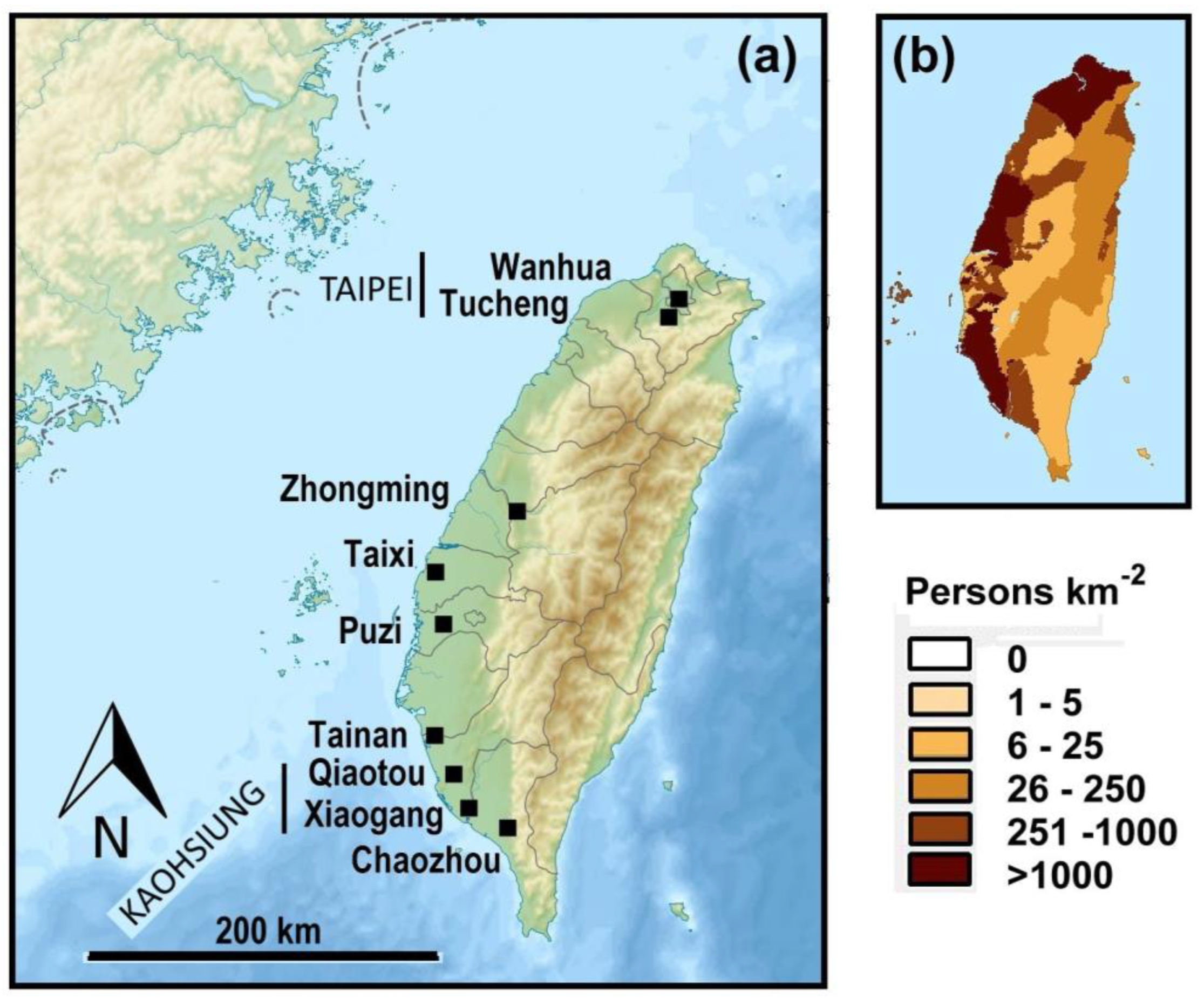
Figure 1. (a) Map of Taiwan showing the location of Wanhua, Tucheng, Zhongming Taixi Puzi Tainan, Qiaotou, Xiaogang and Chaozhou. (b) Population density map of Taiwan, here adapted from maps generated by Columbia University Centre for International Earth Science Information Network, CIESIN (https://commons.wikimedia.org/wiki/File:Taiwan_Population_Density,_2000_(6172450782).jpg, accessed on 23 May 2025).
Environments 13 00094 g001
Figure 2. The daily average concentrations in the record from Xiaogang through to the end of 2024 for (a) ethane, (b) propane, (c) butane, (d) ethylene, (e) acetylene, (f) benzene, (g) toluene, and (h) isoprene. Note: the grey vertical lines mark the beginning–end of the year.
Environments 13 00094 g002
Figure 3. Correlation matrix with values of Pearson’s R. The shading denotes the level of correlation with the darkest red > 0.7 and white < 0.3 with pink in between. The p-values of less than 0.05 are *, while ** indicates <0.01 and *** indicates <0.001.
Environments 13 00094 g003
Figure 4. The first (x-axis) and second (y-axis) principal components of the monthly data from all sites for the period 2020–2024. Note alkanes—black, aromatic compounds—brown, alkenes and acetylene—blue, and isoprene—green.
Environments 13 00094 g004
Figure 5. Hierarchical cluster analysis of the sites using annual data for the VOCs for the period 2020–2024, with site descriptions (vertical text) taken from the TEPA [26,27]. Note: the vertical height of the branches represents the dissimilarity based on the Euclidean distance between clusters.
Environments 13 00094 g005
Figure 6. Average values at the nine sites for the period 2020–2024: (a) Average total VOC concentration (ppbC). (b) Average toluene-to-benzene ratio. (c) Average ethylene:acetylene ratio. (d) Average isoprene:acetylene ratio. (e) Aromaticity (aromatic compounds/alkenes). (f) The average carbon number of alkanes (C2–C8). Rural sites are shown in green, urban sites in orange, and industrial sites in purple.
Environments 13 00094 g006
Figure 7. Average hourly (02:00–24:00) concentrations (ppbC) from all nine sites for the period 2020–2024 for (a) ethane, (b) butane, (c) ethylene, (d) acetylene, (e) benzene and (f) toluene.
Environments 13 00094 g007
Figure 8. Concentration profiles and long-term evolution for the period 1994–2024: (a) Monthly average NOx concentrations for Taixi, Tainan and Xiaogang. (b) Monthly average ozone concentrations for Taixi, Tainan and Xiaogang. (c) Monthly mean NOx concentrations averaged across all nine PAMS sites, illustrating the long-term evolution of NOx. (d) Trend of monthly ozone for all sites with seasonality removed using LOESS smoothing.
Environments 13 00094 g008
Figure 9. Hazard ratios for BTEX at (a) Xiaogang and (b) Taixi where the inset shows ratios as a proportion (scales 80–100%). (c) Hazard ratios for BTEX at the sites averaged for the period 2020–2024. (d) Hazard ratios expressed as a proportion (scale 80–100%).
Environments 13 00094 g009
Table 1. Characteristics of Taiwan’s PAMS monitoring sites.
SiteRegion (City/County)CoordinatesPopulation (City)No. of FactoriesSurrounding Characteristics and Dominant Influences
TuchengNew Taipei24.98° N, 121.45° E3.99 × 10618,304Within the Taipei basin, surrounded by mountains to the north and east, and near three industrial parks and major roads, including a freeway to the south. This captures high VOC emissions from urban and industrial sources.
WanhuaTaipei25.05° N, 121.51° E2.68 × 1061053Situated in central Taipei, close to a major bus transit-station and within 10 km of industrial parks, monitoring VOCs in a densely populated urban area with significant traffic emissions.
ZhongmingTaichung24.15° N, 120.64° E2.79 × 10618,281Within a basin surrounded by tablelands and mountains, near five industrial parks and major roads, reflecting a mix of urban and industrial influences. Although there are industrial parks in the wider Taichung area, the Zhongming PAMS itself is located in a densely populated urban area dominated by traffic and residential activity. It is therefore treated as an urban site in this study.
TaixiYunlin23.72° N, 120.20° E0.69 × 1061866Approximately 5 km from the coast and 7 km southeast of a major petrochemical complex, monitors VOCs influenced by industrial emissions and coastal meteorology.
PuziChiayi23.47° N, 120.25° E0.78 × 1061953A highly populated urban area with five nearby industrial parks and two provincial roads, capturing VOC emissions from urban and industrial activities. Despite the presence of industrial parks elsewhere within the municipal boundary, the Tainan PAMS is located within a residential–commercial urban environment, and its classification reflects the dominant local influence of traffic and urban activities.
TainanTainan22.98° N, 120.20° E1.89 × 1068932A highly populated urban area with five nearby industrial parks and two provincial roads, capturing VOC emissions from urban and industrial activities. Despite the presence of industrial parks elsewhere within the municipal boundary, the Tainan PAMS is located within a residential–commercial urban environment, and its classification reflects the dominant local influence of traffic and urban activities.
QiaotouKaohsiung22.76° N, 120.31° E2.78 × 1067413Near heavy industrial units, including a major oil refinery (which closed in 2016), close to a freeway and expressway; capturing high VOC concentrations from industrial and traffic sources.
XiaogangKaohsiung22.57° N, 120.34° E2.78 × 1067413Approximately 10.5 km southeast of a major oil refinery and near a harbour, it monitors VOCs from industrial, traffic and port-related activities.
ChaozhouPingtung22.52° N, 120.56° E0.83 × 1061367A suburban area with a freeway and expressway nearby. Monitoring VOCs from scattered smaller factories and long-range transport.
Table 2. Ranges of diurnal mean concentrations and extremes of various VOCs across different hours. The x ¯ and σ represent the mean and standard deviation of the concentrations of compounds within each category. σ: root of the variance of diurnal site means.
VOC CategoryMaximum/ppbC Highest Mean/ppbC
x ¯     ± σ (Time)
Lowest Mean/ppbC
x ¯  ± σ (Time)
Minimum/ppbC
Alkanes9.35 (Xiaogang, 00:00)6.46 ± 1.84 (07:00)3.73 ± 0.97 (14:00)2.26 (Taixi, 19:00)
Aromatics13.71 (Tucheng, 18:00)7.83 ± 6.37 (08:00)4.54 ± 3.00 (13:00)1.66 (Taixi, 13:00)
Alkenes9.53 (Xiaogang, 07:00)5.99 ± 2.12 (07:00)1.46 ± 0.64 (20:00)1.46 (Taixi, 20:00)
Isoprene3.78 (Chaozhou, 12:00)1.97 ± 0.90 (11:00)0.45 ± 0.07 (03:00)0.34 (Taixi, 23:00)
Disclaimer/Publisher’s Note: The statements, opinions and data contained in all publications are solely those of the individual author(s) and contributor(s) and not of MDPI and/or the editor(s). MDPI and/or the editor(s) disclaim responsibility for any injury to people or property resulting from any ideas, methods, instructions or products referred to in the content.