


Abstract
The growing demand for sustainable fertilization practices has stimulated interest in circular fertilizers derived from agro-industrial and agricultural wastes. This study assessed the agronomic and biological performance of several waste-based fertilizers—produced through composting, vermicomposting, and sulfur–bentonite enrichment—on chemical and microbiological soil properties. Composts and vermicomposts were prepared from olive pomace, citrus residues, wood sawdust, and straw, with or without elemental sulfur obtained from petroleum gas desulfurization. Field trials were conducted on a sandy loam soil (Motta San Giovanni, Italy) to compare the different formulations. After six months, soils amended with waste-based fertilizers exhibited significant improvements in key parameters relative to both the control and mineral fertilizer treatment. Vermicompost applications (SV1, SV2) increased total organic carbon by 20–30% (up to 2.1%), total nitrogen by 35–45% (0.22–0.23%), microbial biomass carbon by ~25% (≈1090 µg C g−1), and dehydrogenase and fluorescein diacetate activities by 10–20% compared with compost or sulfur–bentonite treatments. Compost amendments (SC1, SC2) raised soil pH (8.2–8.3) and organic matter content (≈3.3–3.6%), while sulfur–bentonite formulations lowered pH to 7.1–7.3 and increased water-soluble phenols (up to 40 µg TAE g−1 d.s). The highest cation exchange capacity (22–23 cmol (+) kg−1) was observed in vermicompost-amended soils. Microbial community analysis revealed greater fungal abundance under sulfur–bentonite treatments, whereas bacteria and actinomycetes predominated in compost-amended soils. Principal Component Analysis (explaining 76% of variance) identified two main functional pathways: vermicompost treatments clustered with indicators of high biological activity (TOC, TN, MBC, and enzyme activities), while compost and sulfur–bentonite treatments were associated with pH, phenolic compounds, and fungal biomass, reflecting slower but more stable organic matter turnover. Overall, vermicompost-based fertilizers proved most effective in enhancing short-term nutrient availability and microbial activation, whereas composts favored long-term soil carbon accumulation and stability. These results highlight the potential of circular fertilizers derived from agro-industrial wastes to restore soil health, close nutrient cycles, and reduce dependence on synthetic fertilizers—thereby advancing sustainable and circular agriculture.
1. Introduction
Modern agriculture faces two interconnected challenges: sustaining crop productivity while preserving soil functionality and environmental quality. Intensive reliance on synthetic fertilizers has substantially increased yields but has also led to nutrient imbalances, soil degradation, and greenhouse gas emissions [1,2]. In contrast, circular fertilizers—produced by recycling agro-industrial and agricultural wastes—represent a sustainable strategy to restore soil fertility, close nutrient loops, and reduce dependency on finite mineral resources [3,4].
Among waste-recycling strategies, composting and vermicomposting are particularly effective in transforming organic residues such as food waste, wood sawdust, straw, olive pomace, and citrus residues into nutrient-rich soil amendments [5,6]. These processes enhance organic matter stability, improve nutrient availability, and stimulate beneficial microbial communities that sustain key soil biogeochemical cycles [7]. The integration of such waste-derived fertilizers into agricultural systems is consistent with the circular economy paradigm and promotes both agronomic efficiency and environmental sustainability [8].
Elemental sulfur was included in this study as a complementary mineral amendment, rather than a primary focus. Its use is particularly relevant in Mediterranean and calcareous soils, where sulfur deficiency and high pH frequently limit nutrient availability and microbial-mediated oxidation processes [9,10]. Sulfur enrichment can increase the solubility of phosphorus and micronutrients (Fe, Zn, and Mn) and stimulate specific microbial groups involved in sulfur oxidation, thereby enhancing soil biochemical functionality [11,12]. This rationale justified the inclusion of sulfur–bentonite formulations alongside composts and vermicomposts in our comparative assessment.
In this study, soil functionality was assessed through a comprehensive set of chemical, biochemical, and microbiological indicators. Chemical parameters included total organic carbon (TOC), total nitrogen (TN), cation exchange capacity (CEC), and pH (chemical indicators); biochemical indicators encompassed enzymatic activities (dehydrogenase and fluorescein diacetate hydrolysis) and water-soluble phenols; while microbiological indicators comprised microbial biomass carbon (MBC) and the abundance of fungi, bacteria, and actinomycetes. Together, these parameters provided an integrative assessment of soil health rather than isolated “single-index” measurements.
The objectives of this study were to: (i) evaluate the effects of compost-, vermicompost-, and sulfur-enriched fertilizers derived from mixed agro-industrial wastes on soil functionality under field conditions; (ii) compare their performance with that of conventional mineral (NPK) and traditional organic (manure) fertilizers; and (iii) identify the interrelationships among soil chemical, biochemical, and microbial properties that underpin improvements in soil health.
We hypothesized that circular fertilizers, particularly those obtained by vermicomposting and sulfur–bentonite enrichment, would enhance soil nutrient availability, microbial biomass, and enzymatic activity more effectively than conventional fertilizers, while simultaneously promoting long-term carbon sequestration and soil resilience.
The innovation of this work lies in the integration of multiple elements: (i) the use of circular waste streams derived from diverse agro-industrial biomass sources; (ii) mineral enrichment through elemental sulfur applied synergistically with organic inputs; (iii) a direct comparison with both mineral and traditional organic fertilizers; and (iv) a comprehensive evaluation of soil biological, biochemical, and chemical indicators of ecosystem functionality under real field conditions.
By combining these components, the study provides an integrated framework for evaluating whether waste-derived and sulfur-enriched fertilizers can effectively close nutrient cycles, restore soil health, and deliver agronomic performance comparable to—or surpassing—that of conventional or organic fertilizers. This approach advances the transition toward a more sustainable, circular model of agriculture.
2. Materials and Methods
2.1. Feeding Materials
Two distinct organic mixtures were prepared as feedstocks for composting:
- Compost 1 (C1): This mixture was composed of 90% olive pomace obtained from the traditional three-phase olive oil extraction process and 10% wheat straw as a bulking agent. The olive pomace contained approximately 43% lignin, 11.29% hemicellulose, and 9.55% cellulose.
- Compost 2 (C2): This mixture consisted of 90% orange-processing residues from the citrus industry, combined with 8% straw and 2% buffalo manure as a structural and nutrient supplement. Orange waste was characterized by 19% lignin, 7% hemicellulose, and 35% cellulose.
2.2. Composting Process Setup
Composting was conducted in electrically operated, temperature-controlled composters engineered to optimize aerobic decomposition. Each composter featured separate chambers to prevent the mixing of fresh and maturing material, allowing independent temperature regulation and promoting optimal microbial activity. The composting process was carried out using community composters (model “10 BASIC” Satriani snc design–manufacturing–startup–maintenance, Potenza, Italy) with an average treatment capacity of approximately 8 tons per year. Each unit was constructed from AISI 304 stainless steel and had approximate dimensions of 2 × 1 × 1 m. The system was equipped with mechanical mixing arms to ensure proper aeration and homogenization of the material, and an integrated heater with forced aeration to maintain optimal thermophilic conditions. Process control was managed through an electromechanical control panel, allowing for automated operation and temperature regulation. Each composter included a daily inspection door for monitoring and sample collection. The equipment was CE-certified in accordance with the EU Machinery Directive, ensuring compliance with European safety and performance standards. Each compost mixture was processed in triplicate following a defined thermal regime: an initial mesophilic phase of 8 days at 29 °C, a thermophilic phase of 20 days at 50 °C, and a secondary mesophilic phase of 92 days at 27 °C [9]. This was followed by a 30-day stabilization period at 20 °C to ensure compost maturity. Moisture content was maintained at approximately 50%, oxygen levels remained above 15%, and pH was 6.8. Temperature, moisture, and oxygen were continuously monitored using a multi-parameter probe (models EXP-421, EXP-422, EXP-831, and EXP-486; LSI Lastem, Settala, Milan, Italy), with data recorded via the manufacturer’s RS485 or wireless logging system. Water was added as needed to maintain moisture, and daily turning ensured adequate aeration and uniform decomposition [10].
Upon completion, the composts were air-dried, sieved (<2 mm), and homogenized to obtain uniform samples. Both compost formulations reached full maturity within approximately six months [10].
2.3. Vermicomposting Process Setup
Vermicomposting was performed in 50 L bins (Vevor 5-Tray Worm Composter, model WB25101, Shanghai Vevor Industrial Co., Ltd., Shanghai, China). Two formulations were prepared:
- Vermicompost 1 (V1): 45% olive waste, 45% pine sawdust, and 10% wheat straw, with 20% earthworm inoculum.
- Vermicompost 2 (V2): 45% orange waste, 45% pine sawdust, and 10% wheat straw, with 20% earthworm inoculum.
Each bin was initially loaded with 20 kg of feedstock mixture, distributed in three uniform layers of approximately equal thickness to promote aeration and uniform decomposition. The bedding material was kept loose to facilitate oxygen diffusion and maintained in a slightly moist condition (50–60% humidity), avoiding waterlogging [11].
Red wigglers (Eisenia fetida) were introduced at a density of approximately 1000 individuals (≈1 lb) per square foot of surface area. During the four-month vermicomposting period, the feed was added weekly in thin layers (≈3–4 cm) to maintain a continuous supply of degradable material and stimulate worm activity. Moisture and temperature were monitored throughout the process to maintain optimal conditions for earthworm metabolism. At the end of the cycle, the worms had fully processed the substrate into mature vermicompost, characterized by a dark color, earthy odor, and fine granular texture [11].
2.4. Production of Sulfur–Bentonite Pellets with Composted Orange Waste and Olive Pomace
Pellet production (3–4 mm diameter) was carried out by Steel Belt System s.r.l. (Venegono Inferiore, Italy) using a proprietary pastillation technology. Formulation stage: The base mixture was prepared by blending 80% sulfur, 10% bentonite, and 10% organic additive derived from either composted orange-processing residues SBOWC2 or olive pomace SBOPC1.
Pelletizing stage: The molten mixtures were fed into a patented rotary pastillator system that distributed the material as droplets onto a continuously moving, cooled steel belt. This process enabled rapid solidification of the droplets into uniform spherical or lentil-shaped pellets.
Finishing and packaging: Once solidified, the pellets were collected via conveyor and elevator systems, transferred to storage silos, and subsequently weighed and packaged for use. The bentonite proportion—maintained at approximately 10% of the sulfur mass—was selected empirically to ensure optimal binding, structural integrity, and nutrient dispersion [12,13].
Before its application in the field, the SBOPC1 and SBOWC2 products were analyzed to ensure compliance with environmental and agricultural safety standards. Tests were performed to detect possible pathogenic microorganisms (total and fecal coliforms, Salmonella spp., and Escherichia coli) and heavy metals. Pathogen and heavy metal analysis was performed by a specialized and accredited laboratory, GEOLAB S.r.l., located in Via Trieste, 38–87036 RENDE (CS). The analytical results confirmed that the product was free of pathogens and heavy metal contamination, confirming its suitability for use as a soil amendment [14].
Prior to use, the SBOPC1 and SBOWC2 products were subjected to quality and safety analyses to ensure their suitability for agricultural application. Tests for pathogenic microorganisms (total coliforms, fecal coliforms, Salmonella spp., and Escherichia coli) and heavy metals were carried out. Pathogen and heavy metal analysis was performed by a specialized and accredited laboratory, B S.r.l., located in Via Trieste, 38–87036 RENDE (CS).
2.5. Sulfur–Bentonite Enriched with Vermicompost Produced with Orange Waste and Olive Pomace
The sulfur–bentonite, supplied as 3–4 mm pads by Steel Belt System s.r.l. (Venegono Inferiore, Italy), was mixed with orange waste-based vermicompost (SBOWV2) or olive waste-based vermicompost (SBOPV1). The mixture consisted predominantly of sulfur (80%), with bentonite (10%) and vermicompost (10%). Prior to use, the mixture was tested for potential pathogen and heavy metal contamination by the specialized and accredited laboratory GEOLAB S.r.l., located at Via Trieste 38, 87036 Rende (CS).
2.6. Soil Experiments
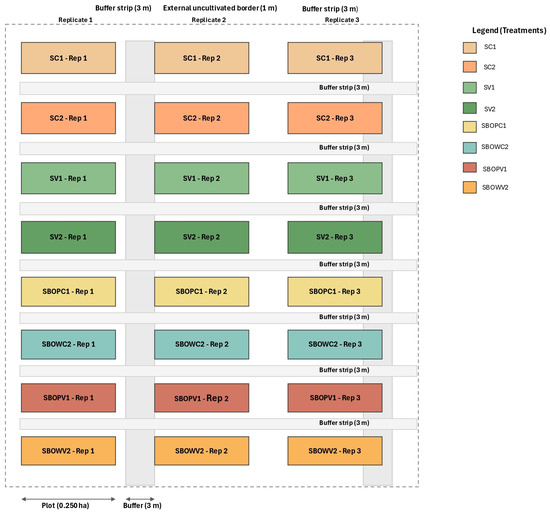
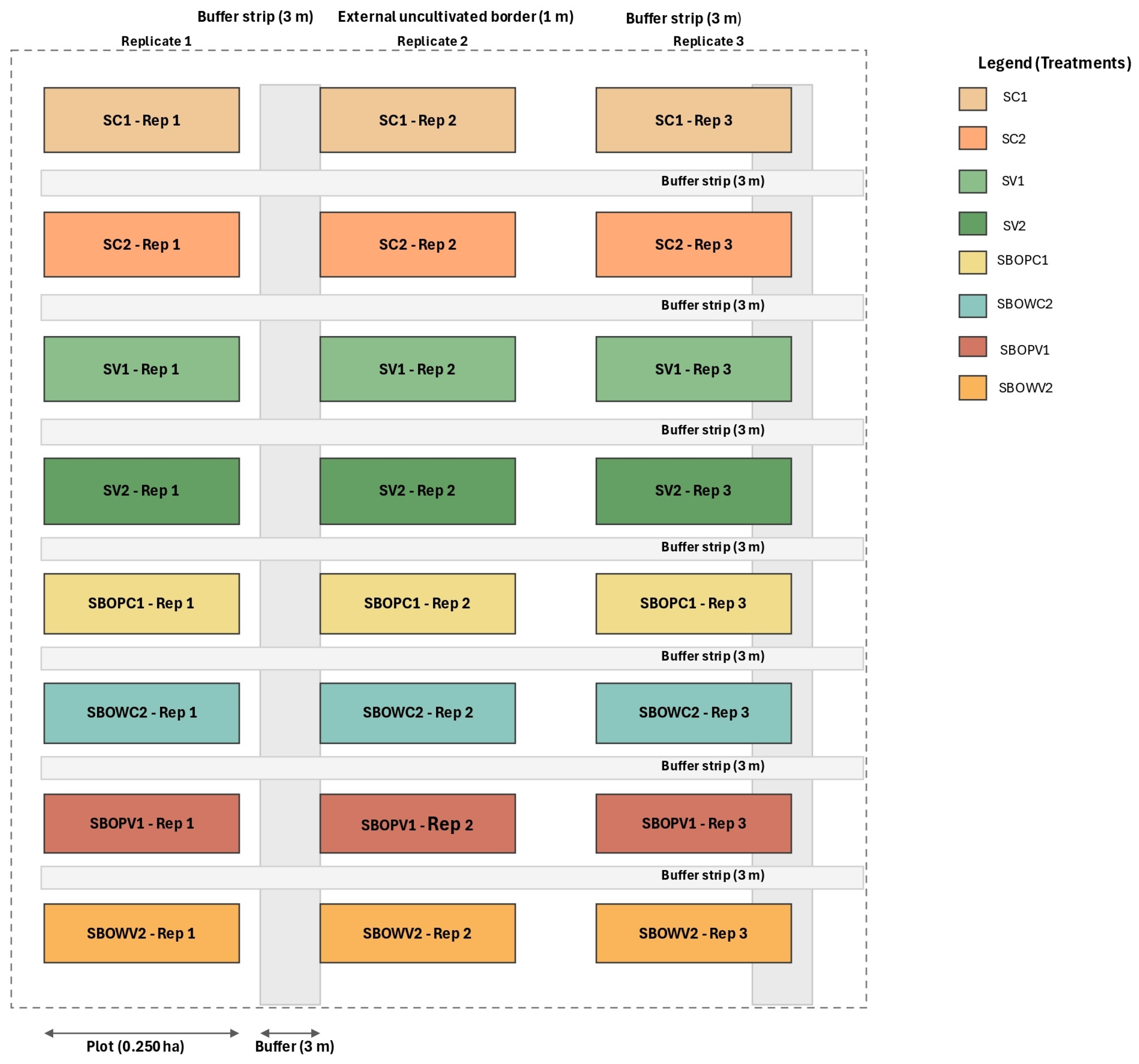
A sandy loam soil (11.85% clay, 23.21% silt, and 64.94% sand) located in Orfei farm, Motta San Giovanni, Loc. Liso, Italy (37.9991° N, 15.6999° E), was used for the trial, which was conducted from December to June. The area is characterized by a Mediterranean climate, with mild and rainy winters and warm, dry springs. During the experimental period, the average air temperature ranged from approximately 10–14 °C in winter to 18–24 °C in late spring, while total rainfall was mainly concentrated in the winter months, with limited precipitation occurring from April to June. The experimental field was divided into plots of 0.250 hectares each for the application of different fertilizer treatments. For each treatment, three replicates were used. The experiment was replicated for two consecutive years (Figure 1). Organic amendments (compost and vermicompost) and sulfur–bentonite formulations were surface-applied uniformly to each plot and subsequently incorporated into the top 0–20 cm of soil by mechanical tillage prior to crop establishment. Fertilizers were applied at the beginning of the growing season (December).
Figure 1.
Schematic representation of the experimental field layout showing the spatial arrangement of fertilizer treatments. Each rectangle represents a plot of 0.250 ha. Eight fertilization treatments (SC1, SC2, SV1, SV2, SBOPC1, SBOWC2, SBOPV1, and SBOWV2) were arranged with three spatial replicates per treatment. Plots were separated by uncultivated buffer strips (≈3 m) to minimize cross-treatment interference, while an external uncultivated border surrounded the experimental area. The layout is representative of each experimental year.
Soil sampling was carried out at the end of the growing season (June), approximately six months after amendment application, to evaluate the effects of the different fertilization treatments on soil chemical, biochemical, and microbiological properties. Fertilizer application rates were selected according to common agricultural practices adopted by local farmers in Mediterranean environments of southern Italy (Calabria). The applied doses accounted for the different nutrient concentrations, physical properties, and agronomic roles of composts, vermicomposts, and sulfur–bentonite formulations, in order to reproduce realistic field conditions.
The following fertilization treatments were applied:
- Sulfur–bentonite plus olive pomace compost (SBOPC1) or vermicompost (SBOPV1); or sulfur–bentonite orange compost or vermicompost was used at 200 kg per 0.250 ha;
- Olive or orange compost was used at 2123 kg per 0.250 ha;
- Olive or orange vermicompost was used at 1769 kg per 0.250 ha.
Soil samples were analyzed for their physical and biological properties. Various soil parameters were measured, including pH, electrical conductivity (EC) [15], organic carbon (OC) content [16], total nitrogen (TN) content [17], water-soluble phenols (WSPs) [18], and cation exchange capacity (CEC) [19]. Cations and anions were detected as reported in Muscolo et al. [13].
2.7. Chemical and Biological Properties of Soils
Enzyme activities, specifically fluorescein diacetate (FDA) hydrolysis [20] and dehydrogenase (DH) [21], have been detected. Microbial biomass carbon (MBC) was assessed using the chloroform-fumigation extraction procedure [22]. Fumigated and unfumigated soil extracts were analyzed for soluble organic carbon [16], with MBC calculated from the difference in organic C between the fumigated and unfumigated samples, applying an extraction efficiency coefficient of 0.38 [22]. To detect bacteria, fungi, and actinomycetes, 10 g of each soil sample was extracted with 95 mL of 0.1% (w/v) solution of sodium pyrophosphate. Soil extract solutions were diluted (10−1 to 10−7), and the shares were plated on agarized culture media, each specific for bacteria, fungi, or actinomycetes [13]. Colony-forming units (CFU) for each microorganism were counted as reported in Maffia et al. [10]. The relative abundance of each microbial group was calculated as:
where:
- CFU of the group = colony-forming units of fungi, bacteria, or actinomycetes.
- Total CFU = .
The biomass of each microbial group (MBC) (in µg C g−1) was calculated using the fraction of that group within the total microbial population:
where:
2.8. Statistical Analysis
Data are expressed as means of three analyses for each treatment. To analyze the effect of different fertilizers on various parameters measured, a two-way analysis of variance (ANOVA) with Tukey’s Honestly Significant Difference (HSD) test was conducted with IBM SPSS Statistics (version 24, IBM Corp., Armonk, NY, USA). This statistical approach allows for comparison across treatments while accounting for potential interaction between the types of organic waste and the transformation processes. The analyses were carried out using JMP software (version 14, SAS Institute Inc., Cary, NC, USA) with significance differences at p ≤ 0.05. To explore relationships among the different fertilizer formulations and their effects on soil chemical parameters, Principal Component Analysis (PCA) was performed using JMP software.
3. Results
3.1. Characteristics of Composts, Vermicomposts, and Sulfur–Bentonite-Enriched with Composts and Vermicomposts
The results showed significant differences in pH values among the various fertilizer formulations. The pH ranged from 6.5 and 6.8 in C1 and SBOPC1, or C2 and SBOPC2, respectively, to 7.4 and 7.6 in V1 and SBOPV1 or V2 and SBOWV2, respectively (Table 1).
Table 1.
Chemical characteristics of fertilizers: C1 (90% olive pomace + 10% straw); C2 (90% orange waste and 10% of straw); SBOPC1 (sulfur–bentonite plus composted olive pomace); SBOWC2 (sulfur–bentonite plus composted orange waste); V1 (vermicomposted olive pomace: sawdust: straw (45:45:10) earthworm 20%); V2 (vermicomposted orange waste: sawdust: straw (45:45:10) earthworm 20%); SBOPV1 (sulfur–bentonite plus vermicomposted olive pomace); and SBOWV2 (sulfur–bentonite plus vermicomposted orange waste).
The electrical conductivity (EC) showed the greatest values in fertilizers containing both vermicomposts (ranging from 2.4 to 3.18).
In general, composts and vermicomposts exhibited higher moisture content (averaging 45%) compared with sulfur-based fertilizer (in media 6.2). They also contained higher total carbon (averaging 50%) and total nitrogen (averaging 2.5), whereas the sulfur-based formulations had only 6.5% total carbon and 0.7% total nitrogen. Both composts were richer in potassium and calcium, while vermicomposts were comparatively richer in sodium and phosphate. As expected, sulfate concentrations were markedly higher in the sulfur-based fertilizers (Table 1). Moreover, water-soluble phenolic compounds were lower in compost and vermicompost derived from orange waste, including the sulfur-enriched variants. All produced fertilizers were free of pathogens and heavy metals, validating their environmental safety and suitability for soil application [14].
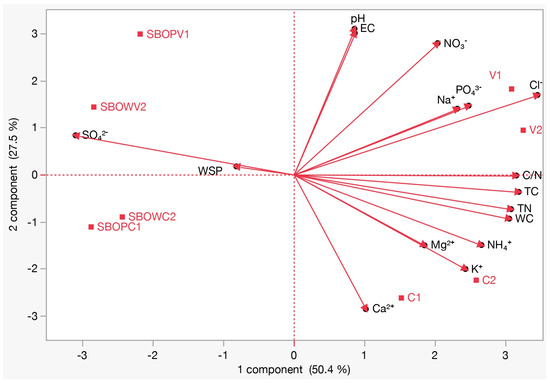
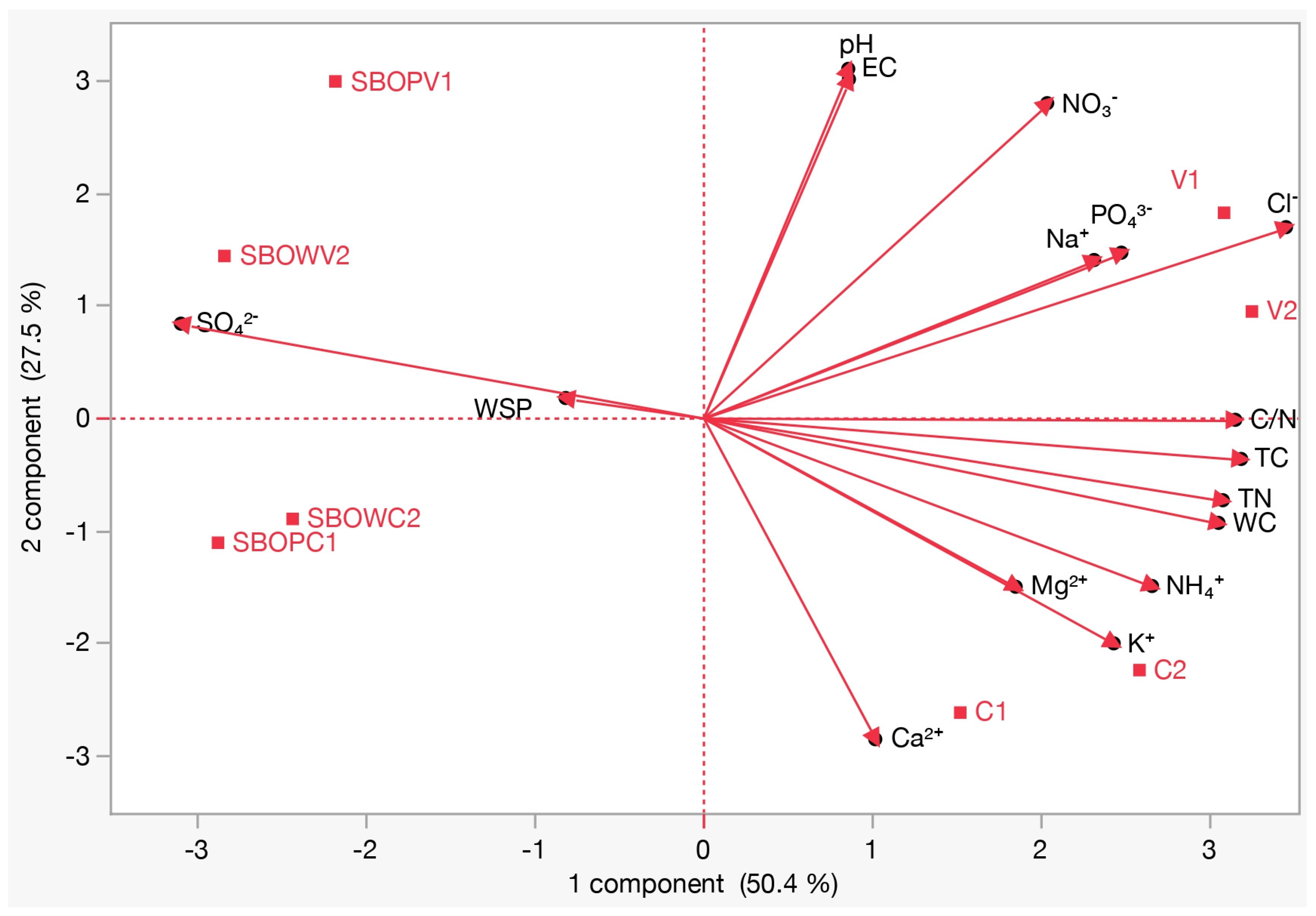
The Principal Component Analysis (PCA) of the fertilizer chemical parameters explained 77.9% of the total variance, with PC1 accounting for 50.4% and PC2 for 27.5%. The score plot (Figure 1) revealed a clear separation among fertilizer groups according to their chemical composition. Along PC1, composts and vermicomposts (C1, C2, V1, and V2) were positioned on the right side of the biplot and positively associated with total carbon (TC), total nitrogen (TN), C/N ratio, electrical conductivity (EC), NO3−, and PO43−, reflecting higher nutrient content and organic matter quality. In contrast, sulfur–bentonite-enriched formulations (SBOPC1, SBOWC2, SBOPV1, and SBOWV2) clustered on the left, correlating with higher SO42− and water-soluble phenols (WSPs) and slightly lower pH, indicative of the acidifying effect of elemental sulfur oxidation. PC2 further differentiated the sulfur–bentonite formulations according to the organic feedstock used. Those enriched with vermicompost (SBOPV1, SBOWV2) were characterized by higher levels of SO42− and WSPs, while formulations containing compost (SBOPC1, SBOWC2) showed lower values of these parameters and a more balanced composition. The distribution pattern indicates that the addition of sulfur–bentonite modifies the chemical signature of the organic materials, shifting them toward a more mineralized and sulfur-rich profile compared to pure compost or vermicompost (Figure 2).
Figure 2.
Principal Component Analysis of chemical characteristic of fertilizers: C1 (90% olive pomace + 10% straw); C2 (90% orange waste and 10% of straw); SBOPC1 (sulfur–bentonite plus composted olive pomace); SBOWC2 (sulfur–bentonite plus composted orange waste); V1 (vermicomposted olive pomace: sawdust: straw (45:45:10) earthworm 20%); V2 (vermicomposted orange waste: sawdust: straw (45:45:10) earthworm 20%); SBOPV1 (sulfur–bentonite plus vermicomposted olive pomace); and SBOWV2 (sulfur–bentonite plus vermicomposted orange waste).
3.2. Chemical and Biological Soil Properties of Fertilized Soils
Soil pH was the highest in both compost-treated soils (8.2 in SC1 and 8.3 in SC2). The electrical conductivity (EC) values indicated that, following fertilizer application, the soils were non-saline, ranging from 220 to 335 µS cm−1 (Table 2). No significant differences in soil moisture content were observed among the treatments. The total organic carbon (TOC) content was the highest in SC2, as well as in SV1 and SV2, while the total nitrogen (TN) content reached its maximum in SV1 and SV2. FDA was the lowest in soil amended with both composts. The highest DH activity was found in soil treated with V2. The highest microbial biomass carbon (MBC) was recorded in soils treated with both vermicomposts, which also exhibited the greatest fluorescein diacetate (FDA) hydrolysis and dehydrogenase (DH) enzymatic activities. Cation exchange capacity was the highest in soil amended with fertilizers that contained both vermicomposts. The distribution of soil microbial groups relative to total microbial biomass carbon (MBC) revealed the highest fungal abundance in soils treated with sulfur–bentonite (SB) combined with either compost or vermicompost (Table 2).
Table 2.
Chemical properties of soils treated with different composts and vermicomposts. Treatments: C1—compost from 90% olive pomace + 10% straw; C2—compost from 90% orange waste + 10% straw; V1—vermicompost from olive pomace, sawdust, and straw (45:45:10) with 20% earthworm biomass; V2—vermicompost from orange waste, sawdust, and straw (45:45:10) with 20% earthworm biomass; SBOPC1—sulfur–bentonite with composted olive pomace; SBOWC2—sulfur–bentonite with composted orange waste; SBOPV1—sulfur–bentonite with vermicomposted olive pomace; and SBOWV2—sulfur–bentonite with vermicomposted orange waste. Data are means of three replicates ± standard deviation. Different letters in the same column indicate significant differences (Tukey’s test, p ≤ 0.05).
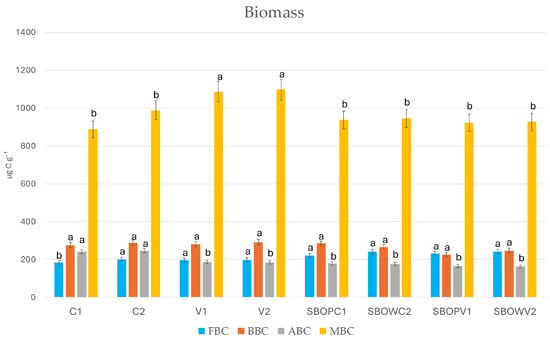
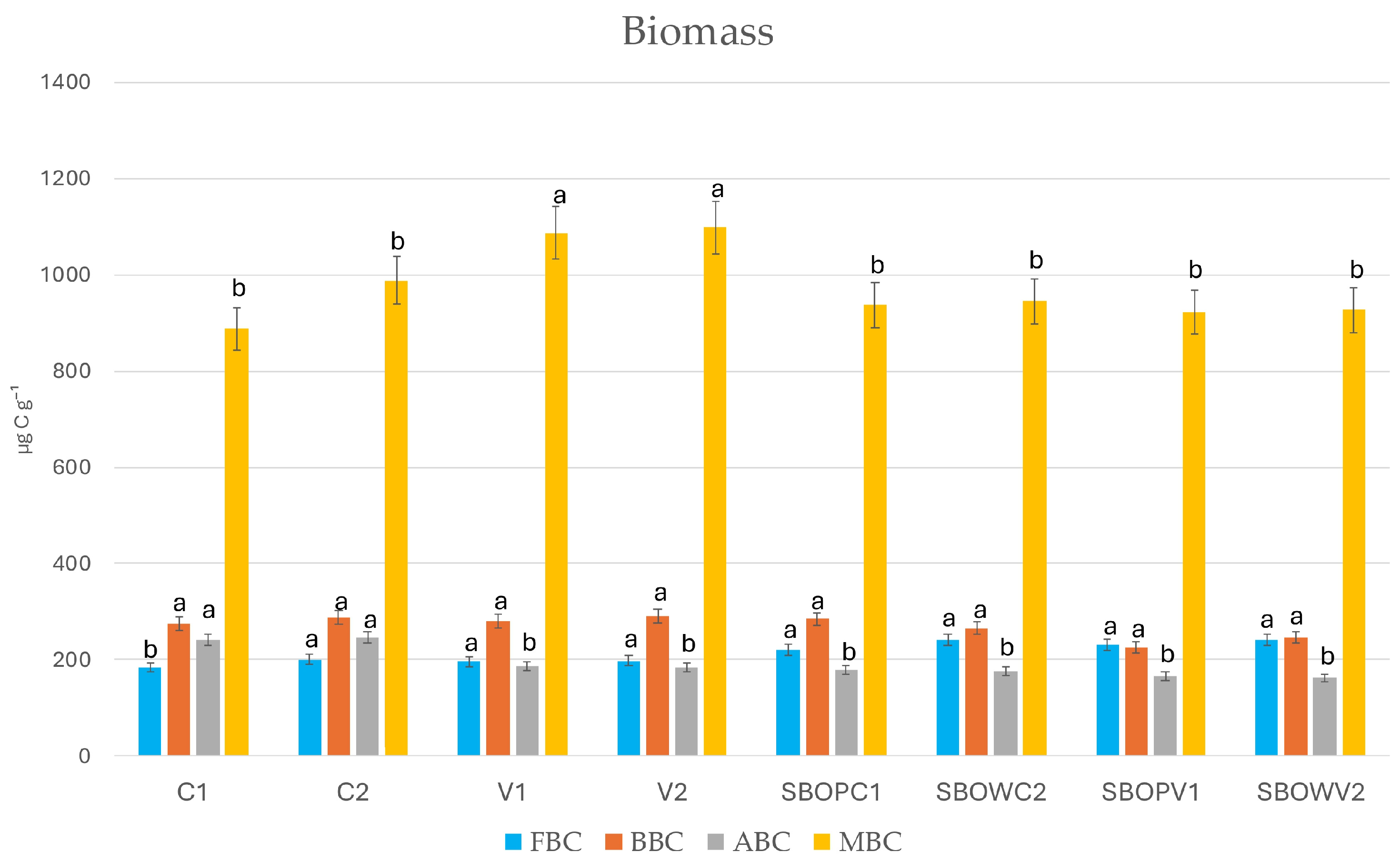
Conversely, bacterial dominance was highest in soils treated with composts or with sulfur–bentonite formulations containing both composts. Actinomycetes were more abundant in compost-amended soils than in soil amended with vermicomposts or sulfur-based fertilizers.
The biomass of fungi, bacteria, and actinomycetes (expressed as µg C g−1 dry soil) mirrored their relative proportions within the total MBC (Figure 3). Colony-forming units (CFU g−1 dry soil) of fungi, bacteria, and actinomycetes also varied with treatment. Fungal colonies were most numerous in soils treated with SBOWC2 and SBOWV2, followed by SBOPV1 = C1 > C2 > V1 = V2. Bacterial colonies were most abundant in C1, C2, and V2, followed by V1 = SBOPC1 > SBOWC2 > SBOWV2 > SBOPV1. Actinomycete colonies were most numerous in C1 and C2, and least abundant in SBOPV1 and SBOPV2.
Figure 3.
Fungi Biomass C (FBC, µg C g−1); Bacteria Biomass C (BBC, µg C g−1); and Actinomycete Biomass C (ABC, µg C g−1). Data are the means of three replicates ± standard deviation (Different letters indicate significant differences. Tukey’s test, p ≤ 0.05).
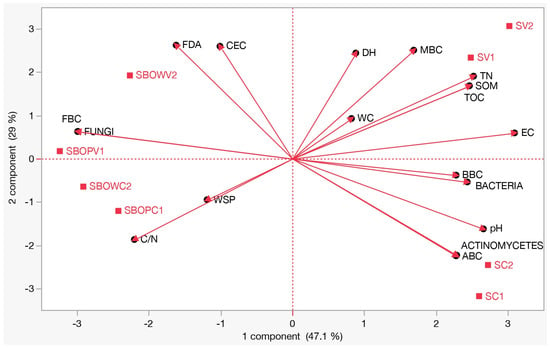
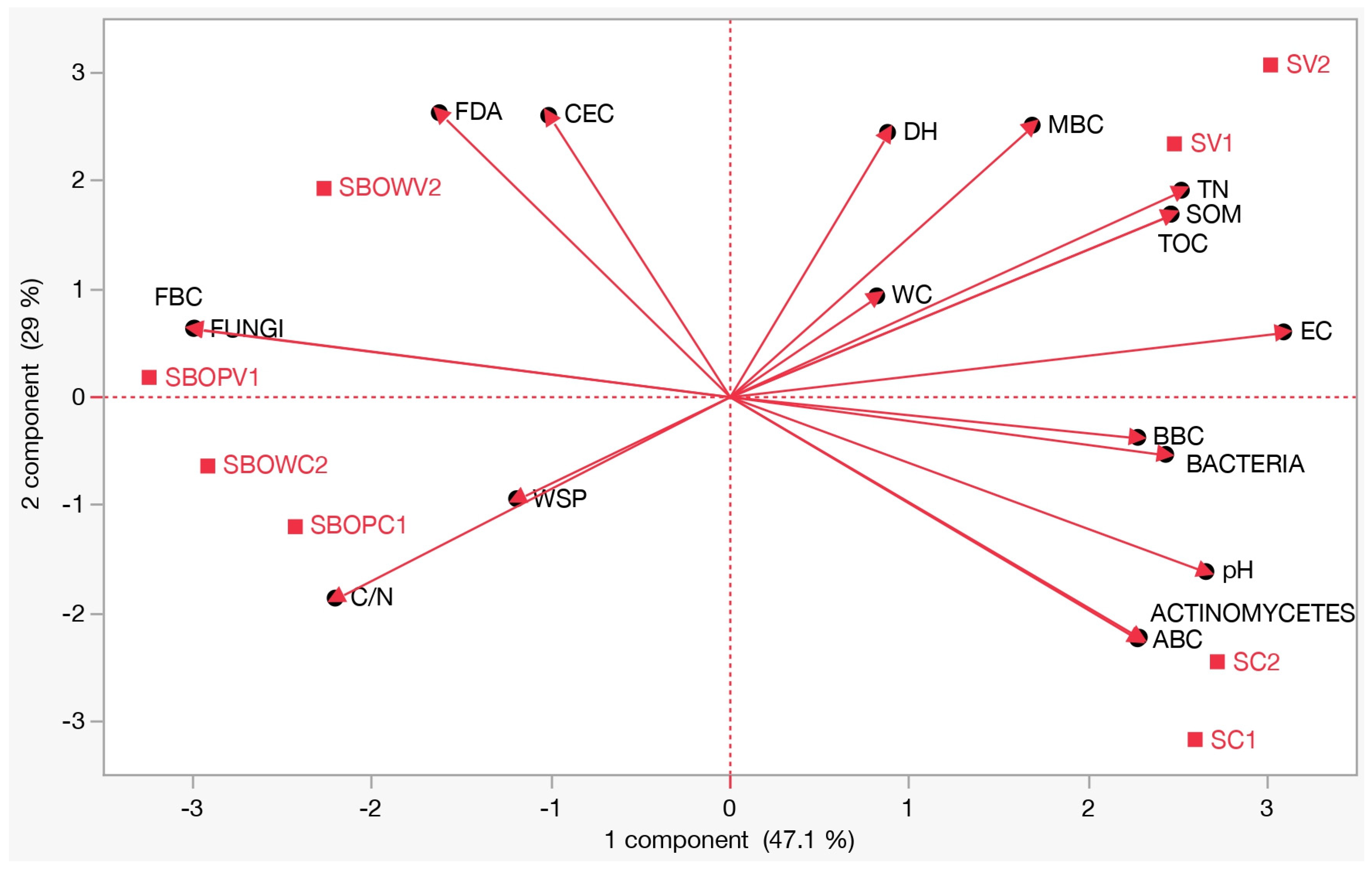
The Principal Component Analysis (PCA) performed on the chemical and microbiological soil parameters explained a total variance of 76.1%, with PC1 and PC2 accounting for 47.1% and 29.0%, respectively (Figure 4). The distribution of treatments along PC1 clearly separated the organic fertilizers (SC1, SC2, SV1, and SV2) positioned on the right side of the biplot from the sulfur–bentonite-enriched formulations (SBOPC1, SBOWC2, SBOPV1, and SBOWV2), which clustered on the left side.
Figure 4.
PCA of chemical and biological properties of soil treated with: SC1 (90% olive pomace + 10% straw); SC2 (90% orange waste and 10% of straw); SV1 vermicompost (olive pomace: sawdust: straw (45:45:10) earthworm 20%); SV2 vermicompost (orange waste: sawdust: straw (45:45:10) earthworm 20%); and sulfur–bentonite plus composted olive pomace (SBOPC1) and orange waste (SBOWC2).
Samples SV1 and SV2 were strongly associated with TOC, TN, SOM, MBC, FDA, DH, and CEC, indicating that soils treated with vermicompost exhibited higher organic matter content, total nitrogen, microbial biomass, and enzymatic activities, as well as greater cation exchange capacity. These parameters characterize a condition of enhanced biological and chemical fertility, confirming the beneficial effects of vermicompost on soil quality.
In contrast, treatments SBOPC1, SBOWC2, and SBOPV1 were located in the lower left quadrant and correlated with C/N and WSPs, suggesting a higher content of soluble phenolic compounds and a larger C/N ratio, indicative of less decomposed organic matter and slower microbial activity. Treatments SC1 and SC2 showed positive correlations with pH, EC, BBC, and actin, reflecting a more balanced microbial composition dominated by bacteria and actinomycetes and a slight alkalinizing effect typical of mature compost.
4. Discussion
4.1. Characteristics of Composts, Vermicomposts, and Sulfur–Bentonite-Enriched Amendments
The significant differences in pH among the various fertilizer formulations (ranging from 6.5–6.8 in C1 and SBOPC1 to 7.4–7.6 in V1, SBOPV1, and V2, SBOWV2) reflect the influence of amendment type and feedstock on soil reaction. The higher pH observed in the vermicompost-based formulations is consistent with previous findings indicating that vermicomposting typically produces more mineralized organic matter, enhances base cation release, and results in higher pH compared with traditional composting [23]. The progressive increase in electrical conductivity (EC) from compost and sulfur–compost treatments to vermicompost and sulfur–vermicompost treatments also supports evidence that vermicomposts accumulate greater amounts of soluble salts and nutrients due to intensified biological transformation processes [24]. Earthworm activity alters the substrate composition, leading to higher concentrations of certain nutrients and organic matter compared with conventional composts [25]. Vermicompost differs from traditional compost in its composition and its influence on soil properties and plant performance. Unlike conventional compost, vermicompost is typically richer in readily available nutrients, plant growth-promoting substances (such as auxins and cytokinins), and beneficial microorganisms that can directly stimulate plant growth, enhance yields, and improve fruit quality and stress tolerance [25,26]. The presence of earthworms in the vermicomposting process also leads to improved soil aggregation and aeration, creating a more favorable environment for root development. In contrast, traditional compost primarily functions as a soil conditioner, adding organic matter that enhances soil structure and fertility over time [27]. Its primary role is to serve as a long-term nutrient source and enhance the overall quality of the growing medium. Both compost and vermicompost typically exhibit higher moisture content and greater concentrations of total carbon and nitrogen than sulfur-based formulations, reflecting their superior capacity for organic enrichment [28,29,30]. This observation is consistent with broader reviews indicating that organic amendments contribute significant amounts of organic matter and nitrogen, leading to improved soil fertility [31]. The observation that composts contained high potassium and calcium [32], whereas vermicomposts were richer in sodium and phosphate, suggests distinct nutrient release patterns: vermicomposting may favor P-solubilization and Na retention depending on feedstock and process conditions [33], and also the earthworm digestive process concentrates nutrients and breaks down complex organic matter into more plant-available forms for the gut microbiome rich in bacteria. The markedly higher sulfate concentrations in sulfur-based fertilizers are expected, given the added sulfur–bentonite matrix. Interestingly, the lower content of water-soluble phenolic compounds in the orange-waste-derived compost, its vermicompost, and in sulfur–vermicompost orange waste formulations may be beneficial. Phenolic compounds are known to inhibit microbial activity or seedling growth [34]. Lower phenolic loads could thus support improved microbial and soil responses. Taken together, these compositional distinctions provide a sound basis for interpreting the divergent soil responses observed in subsequent sections.
4.2. Soil Chemical and Biological Responses to Amendments
After fertilizer application, the soils treated with compost (SC1, SC2) exhibited the highest pH (8.2 and 8.3). Such an increase in pH may reflect the buffering capacity and release of base cations (e.g., Ca2+, Mg2+) from the compost material, in line with literature showing that mature composts can raise soil pH in neutral to alkaline soils [35]. The fact that EC values remained in the 220–335 µS cm−1 range confirms that none of the treatments induced salinity stress, despite the higher soluble salt indices of some vermicomposts [36]. The highest total organic carbon (TOC) in SC2 and in SV1/SV2 implies that both compost and vermicompost amendments effectively increase soil organic matter. Vermicomposts reaching high total nitrogen (TN) in the SV treatments align with evidence that vermicompost enhances nitrogen availability more than raw compost [31]. The highest cation exchange capacity (CEC) in soils treated with vermicompost-containing fertilizers supports the view that increased organic matter and microbial by-products contribute additional exchange sites and improve soil ionic retention.
Microbial Biomass, Enzyme Activity, and Implications for Soil Fertility and Sustainability
The highest microbial biomass carbon (MBC) and enhanced enzyme activities (fluorescein diacetate (FDA) hydrolysis and dehydrogenase (DH)) in soils treated with vermicompost coming from orange wastes underscore the strong stimulation of microbial functioning by these amendments. Orange waste tends to have higher pectin and soluble carbohydrate content and generally a more favorable short-term C:N for microbial growth after precomposting. This can explain the different effect it has on soil with respect to vermicompost from olive pomace [37]. Olive pomace often has higher levels of refractory lipids, certain polyphenols, and compounds that increase the recalcitrant fraction. Substrates that are easier to depolymerize promote faster microbial turnover and a broader niche space for different microbes. This corresponds with research showing that vermicompost with high soluble carbohydrate content promotes microbial biomass, metabolic activity, and enzyme function in soils [31]. The differential distribution of microbial groups is also of particular interest. The greatest fungal abundance (relative to MBC) in soils treated with sulfur–bentonite plus either compost or vermicompost suggests that the bentonite–sulfur matrix may favor fungal colonization—perhaps by enhancing micro-aggregates, creating moisture/structural niches, or modulating pH. Hammerschmiedt et al. (2024) [3] showed that fungal abundance was significantly affected by elemental sulfur. While some bacteria thrive and the total microbial biomass can increase, the oxidation of sulfur can also create a more favorable environment for fungal growth, particularly in terms of biomass. By contrast, bacterial dominance in compost-oriented treatments (and sulfur–bentonite + compost) is consistent with higher pH, greater labile carbon, and base cations favoring bacterial growth [35]. The elevated actinomycete populations in compost-amended soils reflect the role of actinomycetes in decomposing recalcitrant organic matter and their affinity for more mature compost substrates [38]. These patterns are corroborated by high-throughput studies showing that compost amendments increase Actinobacteria and Chloroflexi abundance [35]. Colony-forming unit (CFU) data further reinforce these biomass observations: the highest number of fungal colonies in SBOWC2 and SBOWV2; the highest bacterial colonies in C1, C2, and V2; and the highest actinomycete colonies in C1 and C2, with the lowest in SBOPV1/2. The alignment of CFU and biomass trends strengthens the biological inference. Overall, the vermicompost treatments appear superior in stimulating microbial biomass and activity, which is known to support rapid nutrient cycling, improved root–soil interactions, and enhanced fertility [31].
Although crop growth, yield, or quality parameters were not directly measured in the present study, the observed increases in total nitrogen, microbial biomass carbon, enzymatic activities, and cation exchange capacity are widely recognized as functional indicators of improved soil fertility and nutrient-use efficiency. These soil attributes are strongly associated with enhanced root development, nutrient availability, and crop productivity in agricultural systems. Therefore, the soil responses observed here suggest a clear agronomic potential of the tested circular fertilizers, particularly vermicompost-based formulations, which should be validated in future yield-oriented trials.
From the integrated perspective, vermicompost-based treatments (SV1, SV2, and vermicompost-containing sulfur–bentonite amendments) appear particularly effective in promoting microbial activation, nitrogen enrichment, and improved CEC. These traits support enhanced short- to medium-term soil fertility, nutrient availability, and likely crop productivity. The compost treatments (SC1, SC2) are especially effective in building TOC and raising soil pH—which may promote long-term soil structure, aggregation, and resilience, although microbial activity may lag relative to vermicompost. The sulfur–bentonite-enriched formulations add structural/chemical complexity and may serve special purposes (e.g., in soils needing sulfur or bentonite’s retention properties), but their incremental benefits must be weighed against input cost and upstream footprint. In a production system context (especially Mediterranean-type soils where orange waste compost and sulfur–bentonite amendments are feasible), a strategic approach may be to use vermicompost amendments when rapid fertility enhancement and microbial activation are required, and compost amendments when the focus shifts to long-term soil carbon build-up and structural resilience. Moreover, the sulfur–bentonite options may offer added value where sulfur deficiency or moisture/retention issues prevail. From a green economy perspective, these results carry several implications. Vermicompost, by enhancing TN, microbial biomass, enzyme activity, and soil ionic retention, offers potential to reduce reliance on synthetic fertilizers, thus lowering upstream energy and greenhouse gas emissions associated with fertilizer manufacture and application [33]. Furthermore, increased microbial efficiency implies improved nutrient use efficiency and potentially reduced losses (leaching/volatilization).
The Principal Component Analysis (PCA) integrated soil chemical and biological parameters, explaining 76.1% of the total variance (PC1: 47.1%; PC2: 29.0%). The first principal component (PC1) was mainly driven by variables related to soil fertility and biological activity, including total organic carbon (TOC), total nitrogen (TN), soil organic matter (SOM), microbial biomass carbon (MBC), enzymatic activities (FDA and DH), and cation exchange capacity (CEC). This axis, therefore, represents a gradient of biologically mediated nutrient availability and microbial activation (Figure 4).
Vermicompost treatments (SV1 and SV2) clustered positively along PC1, indicating enhanced short-term fertility, accelerated nutrient cycling, and increased microbial functioning. In contrast, compost-based treatments (SC1 and SC2) were positioned toward higher pH, electrical conductivity (EC), and bacterial and actinomycete biomass, suggesting greater chemical buffering capacity and more stable, slower-decomposing organic matter pools.
The second principal component (PC2) was associated with variables describing organic matter quality and mineralization dynamics, including the C/N ratio and water-soluble phenols (WSPs). Sulfur–bentonite formulations (SBOP and SBOW) were negatively associated with PC2, reflecting higher C/N ratios and WSP content, indicative of slower mineralization rates and more recalcitrant organic substrates.
Overall, the PCA highlights two main functional pathways: vermicompost-based amendments promote rapid biological activation and short-term soil fertility enhancement, whereas compost and sulfur–bentonite formulations are associated with slower nutrient turnover and potentially greater long-term soil stability.
Finally, while microbial biomass, enzyme activity, and CFU-based plate counts provide robust functional indicators of soil microbial responses, they do not capture the diversity of unculturable microorganisms. High-throughput sequencing or metagenomic approaches (e.g., 16S rRNA and ITS analyses) could therefore elucidate key functional microbial groups (e.g., nitrifiers, P-solubilizing bacteria, and mycorrhizal fungi) and link microbial community structure to nutrient cycling more directly [39]. Finally, economic cost–benefit and scalability analyses for green economy implementation (e.g., local vermicompost production, use of waste streams, and regulatory incentives) should be integrated. The use of orange-waste-derived composts or vermicomposts aligns with circular economy principles (waste valorization, nutrient recycling, and local bio-fertilizer production), which bolster green economy outcomes. However, the embodied energy and emissions involved in processing (vermicomposting, sulfur–bentonite production) must be weighed: the net system benefit is a function of both amendment performance and upstream footprint. Therefore, selecting vermicompost-based amendments appears to offer the optimum trade-off between performance, circularity, and sustainability in many situations—but site-specific economic and environmental assessments remain advisable. The use of orange-waste-derived composts or vermicomposts aligns with circular economy principles through waste valorization, nutrient recycling, and local bio-fertilizer production. The environmental relevance of these practices has been quantitatively documented in previous studies, which reported that one ton of untreated wet orange waste may emit approximately 0.130 kg CH4, 30.9 kg CO2, and 0.069 kg N2O, while one ton of wet olive pomace can generate up to 1162.3 kg CO2, 122 kg CH4, and 0.12 kg N2O when improperly disposed of [40]. Landfilling further exacerbates these impacts, with emissions ranging between 2603 and 2708 t CO2e per dry ton of waste and CH4 emissions of about 54 kg dry t−1 [41], and has been identified as a major contributor to global warming and photochemical ozone formation in life cycle assessment studies [42,43].
Additional studies have highlighted that compost production may require 1500–2000 MJ t−1 and involve average costs of approximately 130 € t−1 [44], whereas alternative recycling pathways based on low-input organic–mineral formulations may reduce both energy demand and production costs. Moreover, the partial replacement of mineral fertilizers with organic–mineral amendments has been associated with a reduction in greenhouse gas emissions of about 20% and a concurrent increase in soil organic matter by up to 50% [45].
Within this literature-based framework, the increases in soil organic carbon, total nitrogen, microbial biomass, and enzymatic activity observed in the present study provide functional evidence that supports the environmental and circular economy benefits reported by previous authors, although a direct quantification of emission savings and economic performance was beyond the scope of this work.
5. Conclusions
In conclusion, the results clearly demonstrate that the type of amendment plays a crucial role in determining soil quality outcomes. And vermicompost-based formulations stand out for their ability to enhance microbial activity and soil fertility, increasing microbial biomass, biological activity, and nutrient availability. In contrast, compost-based formulations provide significant benefits for organic matter accumulation and long-term soil resilience. Vermicompost is particularly effective for improving short-term fertility, whereas compost and sulfur–bentonite contribute to long-term soil structure and carbon stability. Although based on a two-growing-season study, the study shows clear short- to medium-term improvements in soil functionality after the application of circular fertilizers. Multi-year field trials are required to evaluate the long-term persistence of these effects, particularly regarding soil carbon stability and microbial succession.
Within the broader context of sustainable production systems and green economy objectives, vermicompost offers the most favorable balance between soil health improvement, nutrient cycling, and circular economy principles. Orange residue appears to be a more suitable feedstock for amendment production than olive pomace, although the latter also contributes positively to soil fertility. Overall, a balanced strategy integrating both compost and vermicompost—potentially supplemented with sulfur–bentonite where appropriate—may deliver the most resilient and sustainable outcomes.
Author Contributions
Conceptualization, A.M. (Adele Muscolo) and A.M. (Angela Maffia); methodology, F.A.M.; software, A.M. (Angela Maffia); validation, A.M. (Adele Muscolo) and C.M.; formal analysis, F.A.M.; investigation, S.B.; data curation, F.A.M.; writing—original draft preparation, A.M. (Angela Maffia); writing—review and editing, A.M. (Angela Maffia); visualization, A.M. (Adele Muscolo); project administration, A.M. (Adele Muscolo); funding acquisition, A.M. (Adele Muscolo). All authors have read and agreed to the published version of the manuscript.
Funding
This work was supported by the Agritech National Research Center and received funding from the European Union Next-Generation EU (PIANO NAZIONALE DI RIPRESA E RESILIENZA (PNRR)—MISSIONE 4 COMPONENTE 2, INVESTIMENTO 1.4—D.D. 1032 17 June 2022, CN00000022).
Data Availability Statement
The original contributions presented in this study are included in thearticle. Further inquiries can be directed to the corresponding author.
Conflicts of Interest
The authors declare no conflicts of interest.
References
- Zhang, X.; Davidson, E.A.; Mauzerall, D.L.; Searchinger, T.D.; Dumas, P.; Shen, Y. Managing nitrogen for sustainable development. Nature 2015, 528, 51–59. [Google Scholar] [CrossRef] [Scilit]
- Chen, Y.; Sun, Z.; Zhou, Y.; Yang, W.; Ma, Y. The future of sustainable farming: An evolutionary game framework for the promotion of agricultural green production technologies. J. Clean. Prod. 2024, 460, 142606. [Google Scholar] [CrossRef] [Scilit]
- Hammerschmiedt, T.; Holatko, J.; Bytesnikova, Z.; Skarpa, P.; Richtera, L.; Kintl, A.; Pekarkova, J.; Kucerik, J.; Jaskulska, I.; Radziemska, M.; et al. The impact of single and combined amendment of elemental sulfur and graphene oxide on soil microbiome and nutrient transformation activities. Heliyon 2024, 10, e38439. [Google Scholar] [CrossRef] [Scilit]
- Voss, M.; Valle, C.; Gaudino, E.C.; Tabasso, S.; Forte, C.; Cravotto, G. Unlocking the potential of agrifood waste for sustainable innovation in agriculture. Recycling 2024, 9, 25. [Google Scholar] [CrossRef] [Scilit]
- Badagliacca, G.; Testa, G.; La Malfa, S.G.; Cafaro, V.; Lo Presti, E.; Monti, M. Organic Fertilizers and Bio-Waste for sustainable soil management to support crops and control greenhouse gas emissions in Mediterranean agroecosystems: A review. Horticulturae 2024, 10, 427. [Google Scholar] [CrossRef] [Scilit]
- Malik, K.M.; Khan, K.S.; Billah, M.; Akhtar, M.S.; Rukh, S.; Alam, S.; Munir, A.; Aulakh, A.M.; Rahim, M.; Qaisrani, M.M.; et al. Organic Amendments and Elemental Sulfur Stimulate Microbial Biomass and Sulfur Oxidation in Alkaline Subtropical Soils. Agronomy 2021, 11, 2514. [Google Scholar] [CrossRef] [Scilit]
- Iqbal, A.; Ali, I.; Yuan, P.; Khan, R.; Liang, H.; Wei, S.; Jiang, L. Combined Application of Manure and Chemical Fertilizers Alters Soil Environmental Variables and Improves Soil Fungal Community Composition and Rice Grain Yield. Front. Microbiol. 2022, 13, 856355. [Google Scholar] [CrossRef] [Scilit]
- Wang, J.; Xiao, S.; Hayat, K.; Liao, X.; Chen, J.; Zhang, L.; Xie, Y. Investigating the Effects of Elevation on Microbial Communities and Soil Properties at Fanjing Mountain, China. Forests 2024, 15, 1980. [Google Scholar] [CrossRef] [Scilit]
- Liang, C.; Das, K.C.; McClendon, R.W. The influence of temperature and moisture contents regimes on the aerobic microbial activity of a biosolids composting blend. Bioresour. Technol. 2002, 86, 131–137. [Google Scholar] [CrossRef] [Scilit] [PubMed]
- Maffia, A.; Marra, F.; Celano, G.; Oliva, M.; Mallamaci, C.; Hussain, M.I.; Muscolo, A. Exploring the Potential and Obstacles of Agro-Industrial Waste-Based Fertilizers. Land 2024, 13, 1166. [Google Scholar] [CrossRef] [Scilit]
- Maffia, A.; Marra, F.; Canino, F.; Battaglia, S.; Mallamaci, C.; Oliva, M.; Muscolo, A. Humic Substances from Waste-Based Fertilizers for Improved Soil Fertility. Agronomy 2024, 14, 2657. [Google Scholar] [CrossRef] [Scilit]
- Muscolo, A.; Papalia, T.; Settineri, G.; Mallamaci, C.; Panuccio, M.R. Sulfur bentonite-organic-based fertilizers as tool for improving bio-compounds with antioxidant activities in red onion. J. Sci. Food Agric. 2019, 100, 785–793. [Google Scholar] [CrossRef] [Scilit]
- Muscolo, A.; Romeo, F.; Marra, F.; Mallamaci, C. Recycling agricultural, municipal and industrial pollutant wastes into fertilizers for a sustainable healthy food production. J. Environ. Manag. 2021, 300, 113771. [Google Scholar] [CrossRef] [Scilit] [PubMed]
- European Compost Network (ECN). ECN-QAS Quality Manual: Quality Assurance Scheme for Compost and Digestate, 3rd ed.; European Compost Network e.V.: Köln, Germany, 2018; Volume 82, ISBN 978-3-9820826-0-2. Available online: https://www.compostnetwork.info/wordpress/wp-content/uploads/180711_ECN-QAS-Manual_3rd-edition_keyed-1.pdf (accessed on 12 December 2025).
- AOAC. Official Methods of Analysis, 18th ed.; Association of Official Analytical Chemists: Arlington, VA, USA, 2005. [Google Scholar]
- Walkley, A.; Black, I.A. An examination of the Degtjareff method for determining soil organic matter and a proposed modification of the chromic acid titration method. Soil Sci. 1934, 37, 29–38. [Google Scholar] [CrossRef] [Scilit]
- Kjeldahl, J. Neue Methode zur Bestimmung des Stickstoff in organishen Kopern. Anal. Chem. 1883, 22, 354–358. [Google Scholar] [CrossRef] [Scilit]
- Box, J.D. Investigation of the Folin-Ciocalteau phenol reagent for the determination of polyphenolic substances in natural waters. Water Res. 1983, 17, 511–525. [Google Scholar] [CrossRef] [Scilit]
- Mehlich, A. Rapid Determination of Cation and Anion Exchange Properties and pHe of Soils. J. Assoc. Off. Agric. Chem. 1953, 36, 445–457. [Google Scholar] [CrossRef] [Scilit]
- Adam, G.; Duncan, H. Development of a sensitive and rapid method for the measurement of total microbial activity using fluorescein diacetate (FDA) in a range of soils. Soil Biol. Biochem. 2001, 33, 943–951. [Google Scholar] [CrossRef] [Scilit]
- Von Mersi, W.; Schinner, F. An improved and accurate method for determining the dehydrogenase activity of soils with iodonitrotetrazolium chloride. Biol. Fertil. Soils 1991, 11, 216–220. [Google Scholar] [CrossRef] [Scilit]
- Vance, E.D.; Brookes, P.C.; Jenkinson, D.S. An extraction method for measuring soil microbial biomass C. Soil Biol. Biochem. 1987, 19, 703–707. [Google Scholar] [CrossRef] [Scilit]
- Majlessi, M.; Eslami, A.; Saleh, H.N.; Mirshafieean, S.; Babaii, S. Vermicomposting of food waste: Assessing the stability and maturity. Iran. J. Environ. Health Sci. Eng. 2012, 9, 25. [Google Scholar] [CrossRef] [Scilit]
- Manzoor, A.; Naveed, M.S.; Ali, R.M.A.; Naseer, M.A.; Ul-Hussan, M.; Saqib, M.; Hussain, S.; Farooq, M. Vermicompost: A potential organic fertilizer for sustainable vegetable cultivation. Sci. Hortic. 2024, 336, 113443. [Google Scholar] [CrossRef] [Scilit]
- Arancon, N.Q.; Edwards, C.A.; Bierman, P.; Welch, C.; Metzger, J.D. Influences of vermicomposts on field strawberries: 1. Effects on growth and yields. Bioresour. Technol. 2004, 93, 145–153. [Google Scholar] [CrossRef] [Scilit]
- Lazcano, C.; Revilla, P.; Malvar, R.A.; Domínguez, J. Yield and fruit quality of four sweet corn hybrids (Zea mays) under conventional and integrated fertilization with vermicompost. J. Sci. Food Agric. 2011, 91, 1244–1253. [Google Scholar] [CrossRef] [Scilit] [PubMed]
- Bernal, M.P.; Sommer, S.G.; Chadwick, D.; Qing, C.; Guoxue, L.; Michel, F.C. Current Approaches and Future Trends in compost Quality Criteria for agronomic, environmental, and Human Health benefits. In Advances in Agronomy; Elsevier: Amsterdam, The Netherlands, 2017; pp. 143–233. [Google Scholar] [CrossRef] [Scilit]
- Edwards, C.A.; Arancon, N.Q.; Sherman, R.L. Vermiculture Technology; CRC Press: Boca Raton, FL, USA, 2010. [Google Scholar] [CrossRef] [Scilit]
- Edwards, C.A.; Arancon, N.Q. Biology and Ecology of Earthworms; Springer: Berlin/Heidelberg, Germany, 2022. [Google Scholar] [CrossRef] [Scilit]
- Vyas, P.; Sharma, S.; Gupta, J. Vermicomposting with microbial amendment: Implications for bioremediation of industrial and agricultural waste. BioTechnologia 2022, 103, 203–215. [Google Scholar] [CrossRef] [Scilit]
- Rehman, S.U.; De Castro, F.; Aprile, A.; Benedetti, M.; Fanizzi, F.P. Vermicompost: Enhancing Plant Growth and Combating Abiotic and Biotic Stress. Agronomy 2023, 13, 1134, Correction in Agronomy 2024, 14, 1256. https://doi.org/10.3390/agronomy14061256. [Google Scholar] [CrossRef] [Scilit]
- Geremu, T.; Hailu, H.; Diriba, A. Evaluation of Nutrient Content of Vermicompost Made from Different Substrates at Mechara Agricultural Research Center on Station, West Hararghe Zone, Oromia, Ethiopia. Ecol. Evol. Biol. 2020, 5, 125. [Google Scholar] [CrossRef] [Scilit]
- Oyege, I.; Bhaskar, M.S.B. Effects of vermicompost on soil and plant health and promoting sustainable agriculture. Soil Syst. 2023, 7, 101. [Google Scholar] [CrossRef] [Scilit]
- Gudeta, K.; Kumar, V.; Bhagat, A.; Julka, J.M.; Bhat, S.A.; Ameen, F.; Qadri, H.; Singh, S.; Amarowicz, R. Ecological adaptation of earthworms for coping with plant polyphenols, heavy metals, and microplastics in the soil: A review. Heliyon 2023, 9, e14572. [Google Scholar] [CrossRef] [Scilit]
- Xu, D.; Yu, X.; Chen, J.; Li, X.; Chen, J.; Li, J. Effects of compost as a soil amendment on bacterial community diversity in saline–alkali soil. Front. Microbiol. 2023, 14, 1253415. [Google Scholar] [CrossRef] [Scilit]
- Ismayilov, A.I.; Mamedov, A.I.; Fujimaki, H.; Tsunekawa, A.; Levy, G.J. Soil Salinity Type Effects on the Relationship between the Electrical Conductivity and Salt Content for 1:5 Soil-to-Water Extract. Sustainability 2021, 13, 3395. [Google Scholar] [CrossRef] [Scilit]
- Borazan, A.A.; Değirmenci, L.; Değirmenci, Ö.C. Investigation of the effects of waste olive pomace on vermicompost. Bilge Int. J. Sci. Technol. Res. 2024, 8, 104–114. [Google Scholar] [CrossRef] [Scilit]
- Sonia, M.-T.; Naceur, J.; Abdennaceur, H. Studies on the ecology of actinomycetes in an agricultural soil amended with organic residues: I. identification of the dominant groups of Actinomycetales. World J. Microbiol. Biotechnol. 2011, 27, 2239–2249. [Google Scholar] [CrossRef] [Scilit]
- Wu, X.; Peng, J.; Liu, P.; Bei, Q.; Rensing, C.; Li, Y.; Yuan, H.; Liesack, W.; Zhang, F.; Cui, Z. Metagenomic insights into nitrogen and phosphorus cycling at the soil aggregate scale driven by organic material amendments. Sci. Total Environ. 2021, 785, 147329. [Google Scholar] [CrossRef] [Scilit] [PubMed]
- Manfredi, S.; Tonini, D.; Christensen, T.H.; Scharff, H. Landfilling of waste: Accounting of greenhouse gases and global warming contributions. Waste Manag. Res. J. A Sustain. Circ. Econ. 2009, 27, 825–836. [Google Scholar] [CrossRef] [Scilit] [PubMed]
- Lee, C.T.; Hashim, H.; Ho, C.S.; Van Fan, Y.; Klemeš, J.J. Sustaining the low-carbon emission development in Asia and beyond: Sustainable energy, water, transportation and low-carbon emission technology. J. Clean. Prod. 2016, 146, 1–13. [Google Scholar] [CrossRef] [Scilit]
- Damgaard, A.; Manfredi, S.; Merrild, H.; Stensøe, S.; Christensen, T.H. LCA and economic evaluation of landfill leachate and gas technologies. Waste Manag. 2011, 31, 1532–1541. [Google Scholar] [CrossRef] [Scilit] [PubMed]
- Manfredi, S.; Tonini, D.; Christensen, T.H. Environmental assessment of different management options for individual waste fractions by means of life-cycle assessment modelling. Resour. Conserv. Recycl. 2011, 55, 995–1004. [Google Scholar] [CrossRef] [Scilit]
- Pergola, M.; Persiani, A.; Pastore, V.; Palese, A.M.; D’Adamo, C.; De Falco, E.; Celano, G. Sustainability Assessment of the Green Compost Production Chain from Agricultural Waste: A Case Study in Southern Italy. Agronomy 2020, 10, 230. [Google Scholar] [CrossRef] [Scilit]
- Liu, H.; Li, J.; Li, X.; Zheng, Y.; Feng, S.; Jiang, G. Mitigating greenhouse gas emissions through replacement of chemical fertilizer with organic manure in a temperate farmland. Sci. Bull. 2015, 60, 598–606. [Google Scholar] [CrossRef] [Scilit]

Disclaimer/Publisher’s Note: The statements, opinions and data contained in all publications are solely those of the individual author(s) and contributor(s) and not of MDPI and/or the editor(s). MDPI and/or the editor(s) disclaim responsibility for any injury to people or property resulting from any ideas, methods, instructions or products referred to in the content. |
© 2026 by the authors. Licensee MDPI, Basel, Switzerland. This article is an open access article distributed under the terms and conditions of the Creative Commons Attribution (CC BY) license.