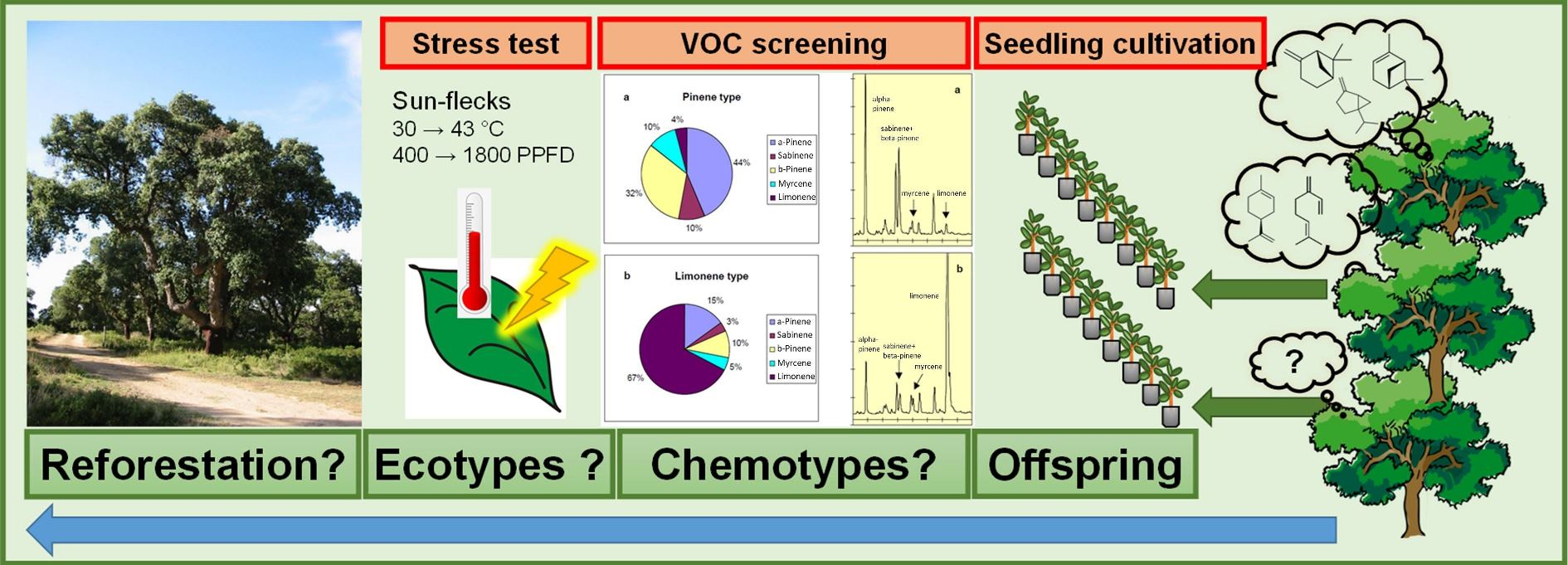


Selecting Non-VOC Emitting Cork Oaks—A Chance to Reduce Regional Air Pollution
Abstract
1. Introduction
2. Materials and Methods
2.1. Plant Culture
2.2. Screening for VOC Emissions
2.3. Stress Resistance Experiment
2.4. Calculations and Statistics
3. Results
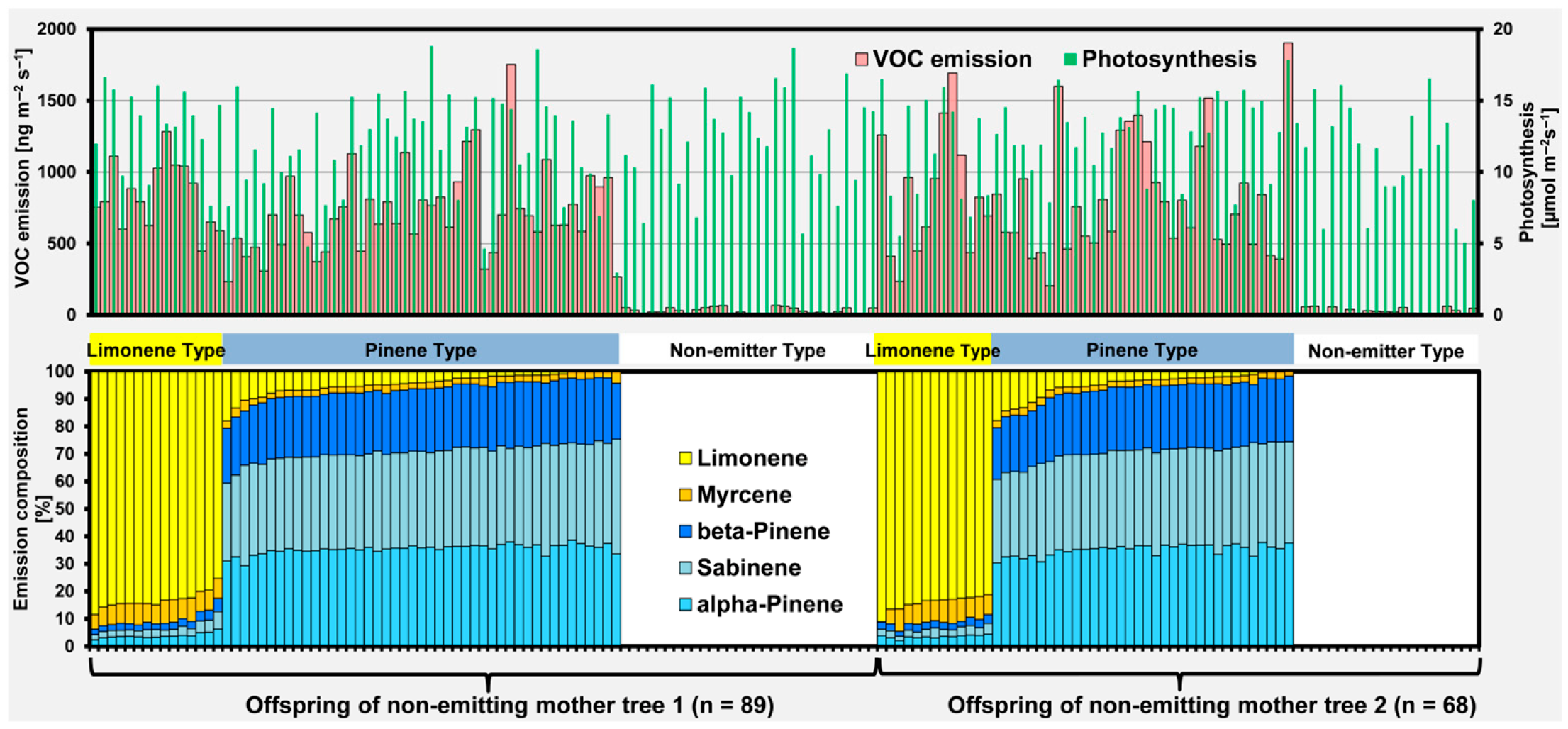
3.1. VOC Emissions of the Half-Sib Populations
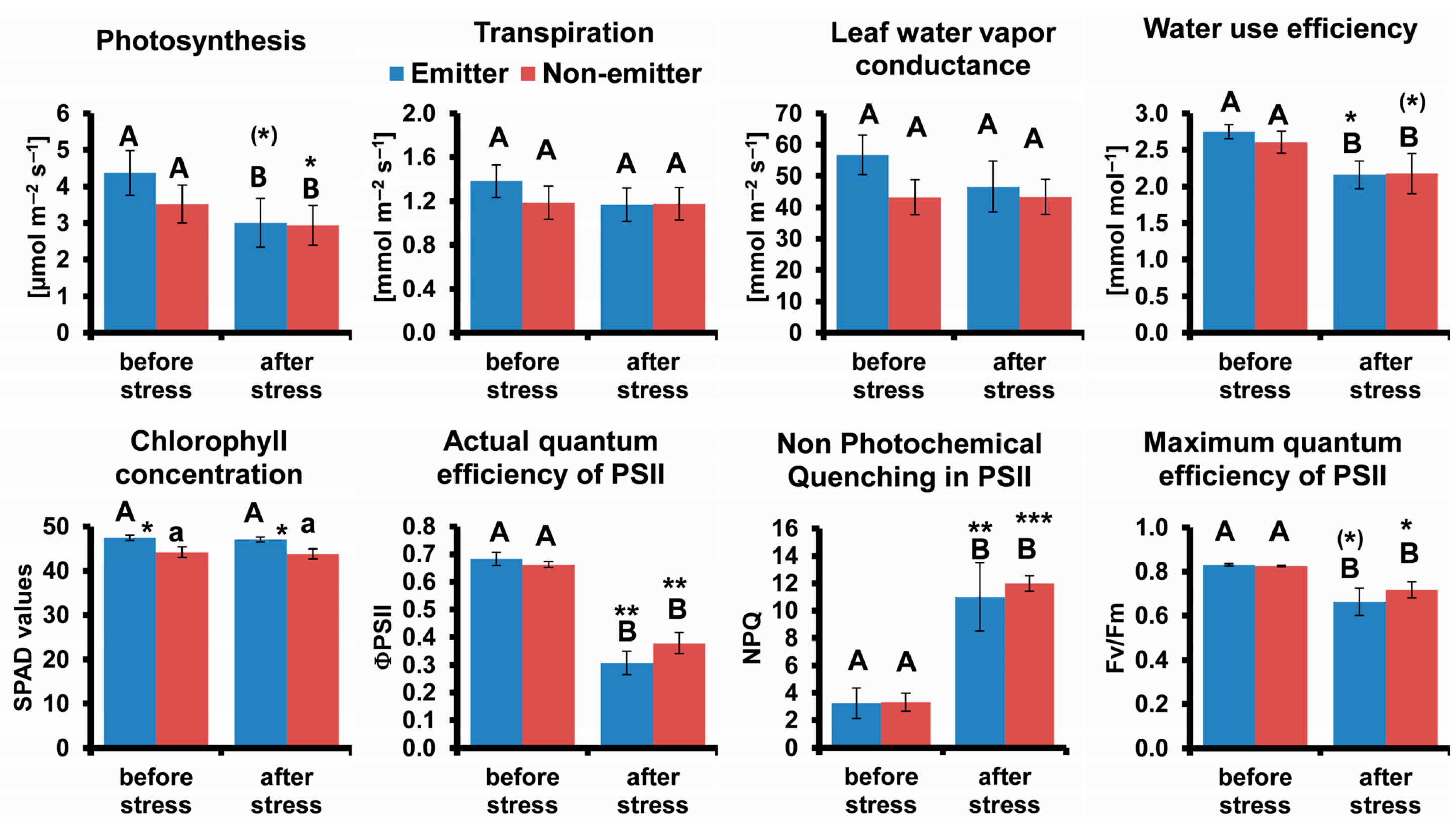
3.2. Resistance to Simulated Sun-Flecks
4. Discussion
4.1. Inheritance Mode
4.2. Do Chemotypes Differ in Their Fitness?
5. Conclusions
Supplementary Materials
Author Contributions
Funding
Data Availability Statement
Acknowledgments
Conflicts of Interest
References
- Guenther, A.B.; Jiang, X.; Heald, C.L.; Sakulyanontvittaya, T.; Duhl, T.; Emmons, L.K.; Wang, X. The Model of Emissions of Gases and Aerosols from Nature version 2.1 (MEGAN2.1): An extended and updated framework for modeling biogenic emissions. Geosci. Model Dev. 2012, 5, 1471–1492. [Google Scholar] [CrossRef] [Scilit]
- Borbon, A.; Fornaro, A.; Oliveira, A.P.; Souza, S.R.; de Brito, J.F.; Jaffrezo, J.-L.; Staudt, M.; Ynoue, R.Y.; Codato, G.; Sánchez, M.P.; et al. The BIOMASP+ project on biosphere-atmosphere exchanges and their role in air pollution in the subtropical megacity of São Paulo: Motivations, methods and preliminary observations. Bull. Am. Meteorol. Soc. 2025; in press. [CrossRef] [Scilit]
- WHO. WHO Global Air Quality Guidelines. Particulate Matter (PM2.5 and PM10), Ozone, Nitrogen Dioxide, Sulfur Dioxide and Carbon Monoxide; World Health Organization: Geneva, Switzerland, 2021; ISBN 978-92-4-003422-8. [Google Scholar]
- Burnett, R.; Chen, H.; Szyszkowicz, M.; Fann, N.; Hubbell, B.; Pope, C.A., 3rd; Apte, J.S.; Brauer, M.; Cohen, A.; Weichenthal, S.; et al. Global estimates of mortality associated with long-term exposure to outdoor fine particulate matter. Proc. Natl. Acad. Sci. USA 2018, 115, 9592–9597. [Google Scholar] [CrossRef] [Scilit]
- Zhang, J.; Wei, Y.; Fang, Z. Ozone Pollution: A Major Health Hazard Worldwide. Front. Immunol. 2019, 10, 2518. [Google Scholar] [CrossRef] [Scilit]
- Boy, M.; Zhou, P.; Kurtén, T.; Chen, D.; Xavier, C.; Clusius, P.; Roldin, P.; Baykara, M.; Pichelstorfer, L.; Foreback, B.; et al. Positive feedback mechanism between biogenic volatile organic compounds and the methane lifetime in future climates. npj Clim. Atmos. Sci. 2022, 5, 72. [Google Scholar] [CrossRef] [Scilit]
- Dada, L.; Stolzenburg, D.; Simon, M.; Fischer, L.; Heinritzi, M.; Wang, M.; Xiao, M.; Vogel, A.L.; Ahonen, L.; Amorim, A.; et al. Role of sesquiterpenes in biogenic new particle formation. Sci. Adv. 2023, 9, eadi5297. [Google Scholar] [CrossRef] [Scilit] [PubMed]
- Thornhill, G.; Collins, W.; Olivié, D.; Skeie, R.B.; Archibald, A.; Bauer, S.; Checa-Garcia, R.; Fiedler, S.; Folberth, G.; Gjermundsen, A.; et al. Climate-driven chemistry and aerosol feedbacks in CMIP6 Earth system models. Atmos. Chem. Phys. 2021, 21, 1105–1126. [Google Scholar] [CrossRef] [Scilit]
- Masson-Delmotte, V.P.; Zhai, A.; Pirani, S.L.; Connors, C.; Péan, S.; Berger, N.; Caud, Y.; Chen, L.; Goldfarb, M.I.; Gomis, M.; et al. (Eds.) IPCC, 2021: Climate Change 2021: The Physical Science Basis; Contribution of Working Group I to the Sixth Assessment Report of the Intergovernmental Panel on Climate Change; Cambridge University Press: Cambridge, UK; New York, NY, USA, 2021; 2391p. [Google Scholar] [CrossRef] [Scilit]
- Behnke, K.; Grote, R.; Brüggemann, N.; Zimmer, I.; Zhou, G.; Elobeid, M.; Janz, D.; Polle, A.; Schnitzler, J.-P. Isoprene emission-free poplars—A chance to reduce the impact from poplar plantations on the atmosphere. New Phytol. 2012, 194, 70–82. [Google Scholar] [CrossRef] [Scilit]
- Chang, T.-W.; Tokiwa, S.; Masui, N.; Tani, A. Quantifying variabilities in monoterpene emission among natural individuals of an urban-greening species (Quercus phylliraeoides) using a rapid measuring method. Urban For. Urban Green. 2024, 94, 128245. [Google Scholar] [CrossRef] [Scilit]
- Kesselmeier, J.; Staudt, M. Biogenic volatile organic compounds (VOC): An overview on emission, physiology and ecology. J. Atmos. Chem. 1999, 33, 23–88. [Google Scholar] [CrossRef] [Scilit]
- Monson, R.K.; Jones, R.T.; Rosenstiel, T.N.; Schnitzler, J.-P. Why only some plants emit isoprene. Plant Cell Environ. 2013, 36, 503–516. [Google Scholar] [CrossRef] [Scilit]
- Staudt, M.; Rivet, C.; Erdogan, M. Diversity of Volatile Emissions From Cork Oak: Quantity and Quality Vary Independently Across Its Range. Ecol. Evol. 2025, 15, e72093. [Google Scholar] [CrossRef] [Scilit]
- Ikezaki, Y.; Kudo, S.N.; Nakata, T.; Koita, S.; Munakata, R.; Yazaki, K.; Torimaru, T.; Tomaru, N.; Isobe, S.; Hirakawa, H.; et al. Molecular evolution of terpene synthase underlying the diversification of isoprene emission in Fagaceae. bioRxiv 2025. [Google Scholar] [CrossRef] [Scilit]
- Delwiche, C.F.; Sharkey, T.D. Rapid appearance of 13C in biogenic isoprene when 13CO2 is fed to intact leaves. Plant Cell Environ. 1993, 16, 587–591. [Google Scholar] [CrossRef] [Scilit]
- Loreto, F.; Ciccioli, P.; Cecinato, A.; Brancaleoni, E.; Frattoni, M.; Fabozzi, C.; Tricoli, D. Evidence of the photosynthetic origin of monoterpenes emitted by Quercus ilex L. leaves by 13C labeling. Plant Physiol. 1996, 110, 1317–1322. [Google Scholar] [CrossRef] [Scilit] [PubMed]
- Singsaas, E.L.; Sharkey, T.D. The regulation of isoprene emission responses to rapid leaf temperature fluctuations. Plant Cell Environ. 1998, 21, 1181–1188. [Google Scholar] [CrossRef] [Scilit]
- Behnke, K.; Loivamäki, M.; Zimmer, I.; Rennenberg, H.; Schnitzler, J.-P.; Louis, S. Isoprene emission protects photosynthesis in sunfleck exposed Grey poplar. Photosynth. Res. 2010, 104, 5–17. [Google Scholar] [CrossRef] [Scilit] [PubMed]
- Zuo, Z.; Weraduwage, S.M.; Huang, T.; Sharkey, T.D. How volatile isoprenoids improve plant thermotolerance. Trends Plant Sci. 2025, 30, 1237–1250. [Google Scholar] [CrossRef] [Scilit]
- Pio, C.; Nunes, T.; Brito, S. Volatile hydrocarbon emissions from common and native species of vegetation in Portugal. In Air Pollution Report 47; Slanina, J., Angeletti, G., Beilke, S., Eds.; Guyot SA: Brussels, Belgium, 1993; pp. 291–298. [Google Scholar]
- Pio, C.A.; Silva, P.A.; Cerqueira, M.A.; Nunes, T.V. Diurnal and seasonal emissions of volatile organic compounds from cork oak (Quercus suber) trees. Atmos. Environ. 2005, 39, 1817–1827. [Google Scholar] [CrossRef] [Scilit]
- Staudt, M.; Mir, C.; Joffre, R.; Rambal, S.; Bonin, A.; Landais, D.; Lumaret, R. Isoprenoid emissions of Quercus spp. (Q. suber and Q. ilex) in mixed stands contrasting in interspecific genetic introgression. New Phytol. 2004, 163, 573–584. [Google Scholar] [CrossRef] [Scilit] [PubMed]
- Pausas, J.G.; Pereira, J.S.; Aronson, J. The Tree. In Cork Oak Woodlands on the Edge; Aronson, J., Pereira, J.S., Pausas, J.G., Eds.; Island Press: Washington, DC, USA, 2009; pp. 11–21. [Google Scholar]
- Welter, S.; Bracho-Nunez, A.; Mir, C.; Zimmer, I.; Kesselmeier, J.; Lumaret, R.; Schnitzler, J.-P.; Staudt, M. The diversification of terpene emissions in Mediterranean oaks: Lessons from a study of Quercus suber, Quercus canariensis and its hybrid Quercus afares. Tree Physiol. 2012, 32, 1082–1091. [Google Scholar] [CrossRef] [Scilit]
- Steinbrecher, R.; Hauff, K.; Rabong, R.; Steinbrecher, J. Isoprenoid emission of oak species typical for the Mediterranean area: Source strength and controlling variables. Atmos. Environ. 1997, 31, 79–88. [Google Scholar] [CrossRef] [Scilit]
- Csiky, O.; Seufert, G. Terpenoid emissions of mediterranean oaks and their relation to taxonomy. Ecol. Appl. 1999, 9, 1138–1146. [Google Scholar] [CrossRef]
- Boavida, L.C.; Silva, J.P.; Feijo, J.A. Sexual reproduction in the cork oak (Quercus suber L). II. Crossing intra- and interspecific barriers. Sex. Plant Reprod. 2001, 14, 143–152. [Google Scholar] [CrossRef] [Scilit]
- Bohlmann, J.; Meyer-Gauen, G.; Croteau, R. Plant terpenoid synthases: Molecular biology and phylogenetic analysis. Proc. Natl. Acad. Sci. USA 1998, 95, 4126–4133. [Google Scholar] [CrossRef] [Scilit] [PubMed]
- Fischbach, R.J.; Zimmer, W.; Schnitzler, J.-P. Isolation and functional analysis of a cDNA encoding a myrcene synthase from holm oak (Quercus ilex L.). Eur. J. Biochem. 2001, 268, 5633–5638. [Google Scholar] [CrossRef] [PubMed]
- Ramos, A.M.; Usié, A.; Barbosa, P.; Barros, P.M.; Capote, T.; Chaves, I.; Simões, F.; Abreu, I.; Carrasquinho, I.; Faro, C.; et al. The draft genome sequence of cork oak. Sci. Data 2018, 5, 180069. [Google Scholar] [CrossRef] [Scilit] [PubMed]
- Staudt, M.; Joffre, R.; Rambal, S. How growth conditions affect the capacity of Quercus ilex leaves to emit monoterpenes. New Phytol. 2003, 158, 61–73. [Google Scholar] [CrossRef] [Scilit]
- Staudt, M.; Daussy, J.; Ingabire, J.; Dehimeche, N. Growth and actual leaf temperature modulate CO2 responsiveness of monoterpene emissions from holm oak in opposite ways. Biogeosciences 2022, 19, 4945–4963. [Google Scholar] [CrossRef] [Scilit]
- Maxwell, K.; Johnson, G.N. Chlorophyll fluorescence—A practical guide. J. Exp. Bot. 2000, 51, 659–668. [Google Scholar] [CrossRef]
- von Caemmerer, S.; Farquhar, G.D. Some relationships between the biochemistry of photosynthesis and the gas exchange of leaves. Planta 1981, 153, 376–387. [Google Scholar] [CrossRef] [Scilit]
- Koo, H.J.; Vickery, C.R.; Xu, Y.; Louie, G.V.; O’Maille, P.E.; Bowman, M.; Nartey, C.M.; Burkart, M.D.; Noel, J.P. Biosynthetic potential of sesquiterpene synthases: Product profiles of Egyptian Henbane premnaspirodiene synthase and related mutants. J. Antibiot. 2016, 69, 524–533. [Google Scholar] [CrossRef] [Scilit] [PubMed]
- Niinemets, Ü.; Rasulov, B.; Talts, E. CO2-responsiveness of leaf isoprene emission: Why do species differ? Plant Cell Environ. 2021, 44, 3049–3063. [Google Scholar] [CrossRef] [Scilit]
- Sahu, A.; Mostofa, M.G.; Weraduwage, S.M.; Sharkey, T.D. Hydroxymethylbutenyl diphosphate accumulation reveals MEP pathway regulation for high CO2-induced suppression of isoprene emission. Proc. Natl. Acad. Sci. USA 2023, 120, e2309536120. [Google Scholar] [CrossRef] [Scilit] [PubMed]
- Fischbach, R.J.; Staudt, M.; Zimmer, I.; Rambal, S.; Schnitzler, J.P. Seasonal pattern of monoterpene synthase activities in leaves of the evergreen tree Quercus ilex. Physiol. Plant. 2002, 114, 354–360. [Google Scholar] [CrossRef] [Scilit] [PubMed]
- Rasulov, B.; Bichele, I.; Laisk, A.G.U.; Niinemets, Ü. Competition between isoprene emission and pigment synthesis during leaf development in aspen. Plant Cell Environ. 2014, 37, 724–741. [Google Scholar] [CrossRef] [Scilit] [PubMed]
- Sánchez-Osorio, I.; Robles, D.; Tapias, R. Presence of Quercus suber Soft-Leaf Defoliators on Trees with Distinct Foliar Monoterpene Emission Profiles. Appl. Sci. 2024, 14, 1112. [Google Scholar] [CrossRef] [Scilit]
- Staudt, M.; Mandl, N.; Joffre, R.; Rambal, S. Intraspecific variability of monoterpene composition emitted by Quercus ilex leaves. Can. J. For. Res. 2001, 31, 174–180. [Google Scholar] [CrossRef] [Scilit]
- Staudt, M.; Visnadi, I. High chemodiversity in the structural and enantiomeric composition of volatiles emitted by Kermes oak populations in Southern France. Elem. Sci. Anth. 2023, 11, 00043. [Google Scholar] [CrossRef] [Scilit]
- Katoh, S.; Croteau, R. Individual variation in constitutive and induced monoterpene biosynthesis in grand fir. Phytochemistry 1998, 47, 577–582. [Google Scholar] [CrossRef] [Scilit]
- Fischedick, J.T. Identification of Terpenoid Chemotypes Among High (-)-trans-Δ9-Tetrahydrocannabinol-Producing Cannabis sativa L. Cultivars. Cannabis Cannabinoid Res. 2017, 2, 34–47. [Google Scholar] [CrossRef] [Scilit]
- Clancy, M.V.; Mamin, M.; Flückiger, G.; Quijano-Medina, T.; Pérez-Nino, B.; Abdala-Roberts, L.; Turlings, T.C.J.; Bustos-Segura, C. Terpene chemotypes in Gossypium hirsutum (wild cotton) from the Yucatan Peninsula, Mexico. Phytochemistry 2023, 205, 113454. [Google Scholar] [CrossRef] [Scilit] [PubMed]
- Geron, C.; Rasmussen, R.; Arnts, R.R.; Guenther, A. A review and synthesis of monoterpene speciation from forests in the United States. Atmos. Environ. 2000, 34, 1761–1781. [Google Scholar] [CrossRef] [Scilit]
- Owen, S.; Boissard, C.; Hewitt, C.N. Volatile organic compounds (VOCs) emitted from 40 Mediterranean plant species: VOC speciation and extrapolation to habitat scale. Atmos. Environ. 2001, 35, 5393–5409. [Google Scholar] [CrossRef] [Scilit]
- Malik, T.G.; Gajbhiye, T.; Pandey, S.K. Some insights into composition and monoterpene emission rates from selected dominant tropical tree species of Central India: Plant-specific seasonal variations. Ecol. Res. 2019, 34, 821–834. [Google Scholar] [CrossRef] [Scilit]
- Zeng, J.; Song, W.; Zhang, Y.; Mu, Z.; Pang, W.; Zhang, H.; Wang, X. Emissions of isoprenoids from dominant tree species in subtropical China. Front. For. Glob. Change 2022, 5, 1089676. [Google Scholar] [CrossRef] [Scilit]
- Chen, X.; Gong, D.; Lin, Y.; Xu, Q.; Wang, Y.; Liu, S.; Li, Q.; Ma, F.; Li, J.; Deng, S.; et al. Emission characteristics of biogenic volatile organic compounds in a subtropical pristine forest of southern China. J. Environ. Sci. 2025, 148, 665–682. [Google Scholar] [CrossRef] [Scilit] [PubMed]
- Yáñez-Serrano, A.M.; Nölscher, A.C.; Bourtsoukidis, E.; Gomes Alves, E.; Ganzeveld, L.; Bonn, B.; Wolff, S.; Sa, M.; Yamasoe, M.; Williams, J.; et al. Monoterpene chemical speciation in a tropical rainforest:variation with season, height, and time of dayat the Amazon Tall Tower Observatory (ATTO). Atmos. Chem. Phys. 2018, 18, 3403–3418. [Google Scholar] [CrossRef] [Scilit]
- Liu, Y.; Schallhart, S.; Taipale, D.; Tykkä, T.; Räsänen, M.; Merbold, L.; Hellén, H.; Pellikka, P. Seasonal and diurnal variations in biogenic volatile organic compounds in highland and lowland ecosystems in southern Kenya. Atmos. Chem. Phys. 2021, 21, 14761–14787. [Google Scholar] [CrossRef] [Scilit]
- Borsdorf, H.; Bentele, M.; Müller, M.; Rebmann, C.; Mayer, T. Comparison of Seasonal and Diurnal Concentration Profiles of BVOCs in Coniferous and Deciduous Forests. Atmosphere 2023, 14, 1347. [Google Scholar] [CrossRef] [Scilit]
- Rowen, E.; Kaplan, I. Eco-evolutionary factors drive induced plant volatiles: A meta-analysis. New Phytol. 2016, 210, 284–294. [Google Scholar] [CrossRef] [Scilit]
- Douma, J.C.; Ganzeveld, L.N.; Unsicker, S.B.; Boeckler, G.A.; Dicke, M. What makes a volatile organic compound a reliable indicator of insect herbivory? Plant Cell Environ. 2019, 42, 3308–3325. [Google Scholar] [CrossRef] [Scilit]
- Zribi, L.; Chaar, H.; Khaldi, A.; Henchi, B.; Mouillot, F.; Gharbi, F. Estimate of biomass and carbon pools in disturbed and undisturbed oak forests in Tunisia. For. Syst. 2016, 25, e060. [Google Scholar] [CrossRef] [Scilit]



| Descendants/Chemotype | VOC Emission | Photosynthesis | C-Loss | Transpiration | GH2O | WUE | LMA | Chlorophyll Content | Foliage Mass | Ramification | Budburst |
|---|---|---|---|---|---|---|---|---|---|---|---|
| (No of Trees) | ng m−2 s−1 | µmol m−2 s−1 | % | mmol m−2 s−1 | mmol m−2 s−1 | mmol mol−1 | g m−2 | SPAD | No of Leaves | No of Twigs | Day of Year |
| D1/Limonene (15) | 846 ± 60 | 13.3 ± 0.7 | 0.57 ± 0.04 | 4.6 ± 0.2 | 259 ± 25 | 3.0 ± 0.2 | 123 ± 3.4 | 38.3 ± 0.6 | 115 ± 12 | 7.3 ± 1.1 | 82.7 ± 1.6 |
| D2/Limonene (13) | 857 ± 121 | 11.3 ± 1.1 | 0.66 ± 0.06 | 3.8 ± 0.4 | 246 ± 35 | 3.1 ± 0.2 | 111 ± 2.3 | 37.9 ± 0.7 | 154 ± 14 | 9.3 ± 1.3 | 79.5 ± 2.8 |
| D1/Pinene (45) | 725 ± 45 | 11.9 ± 0.5 | 0.56 ± 0.04 | 4.0 ± 0.2 | 218 ± 11 | 3.0 ± 0.1 | 113 ± 1.9 | 37.3 ± 0.5 | 120 ± 11 | 7.4 ± 0.8 | 82.7 ± 0.8 |
| D2/Pinene (34) | 820 ± 70 | 12.9 ± 0.4 | 0.56 ± 0.04 | 4.2 ± 0.1 | 235 ± 12 | 3.1 ± 0.1 | 112 ± 2.5 | 38.2 ± 0.6 | 152 ± 10 | 9.4 ± 0.8 | 81.6 ± 1.0 |
| D1/Non (29) | 33 ± 5 | 12.4 ± 0.6 | 0.02 ± 0.004 | 4.5 ± 0.2 | 227 ± 13 | 2.8 ± 0.1 | 117 ± 2.2 | 38.3 ± 0.6 | 125 ± 12 | 6.1 ± 0.9 | 84.6 ± 1.3 |
| D2/Non (21) | 28 ± 5 | 11.1 ± 0.8 | 0.02 ± 0.004 | 3.8 ± 0.3 | 202 ± 15 | 2.9 ± 0.1 | 119 ± 3.1 | 37.6 ± 0.9 | 176 ± 25 | 10.1 ± 1.4 | 81.6 ± 1.1 |
| D1 total (89) | 520 ± 44 | 12.3 ± 0.4 | 0.39 ± 0.03 | 4.3 ± 0.1 | 228 ± 8 | 2.9 ± 0.1 | 116 ± 1.3 | 37.8 ± 0.3 | 121 ± 7 | 7.0 ± 0.5 | 83.1 ± 0.6 |
| D2 total (68) | 582 ± 61 | 12.1 ± 0.4 | 0.41 ± 0.04 | 4.0 ± 0.1 | 227 ± 10 | 3.1 ± 0.1 | 114 ± 1.6 | 38.0 ± 0.4 | 160 ± 9 | 9.6 ± 0.7 | 81.8 ± 0.8 |
| Limonene total (28) | 851 ± 64 | 12.4 ± 0.6 | 0.61 ± 0.04 | 4.2 ± 0.2 | 253 ± 20 | 3.1 ± 0.1 | 117 ± 2.4 | 38.1 ± 0.4 | 133 ± 10 | 8.3 ± 0.9 | 81.3 ± 1.5 |
| Pinene total (79) | 766 ± 40 | 12.4 ± 0.4 | 0.56 ± 0.03 | 4.1 ± 0.1 | 225 ± 8 | 3.0 ± 0.1 | 113 ± 1.5 | 37.7 ± 0.4 | 134 ± 8 | 8.2 ± 0.6 | 82.2 ± 0.6 |
| Non total (50) | 31 ± 4 | 11.9 ± 0.5 | 0.02 ± 0.003 | 4.2 ± 0.2 | 217 ± 10 | 2.9 ± 0.1 | 118 ± 1.8 | 38.0 ± 0.5 | 146 ± 13 | 7.8 ± 0.8 | 83.3 ± 0.9 |
| Statistics | *** | NS | *** | NS | NS | NS | * | NS | * | (*) | NS |
| Descendant | NS | NS | NS | NS | NS | NS | NS | NS | D1 < D2 ** | D1 < D2 ** | D1 > D2 * |
| Chemotype | N < L, P *** | NS | N < L, P *** | NS | NS | NS | N > P (*) | NS | NS | NS | NS |
| D × C | NS | NS | NS | NS | NS | NS | D1L > D2L (*) | NS | NS | NS | NS |
Disclaimer/Publisher’s Note: The statements, opinions and data contained in all publications are solely those of the individual author(s) and contributor(s) and not of MDPI and/or the editor(s). MDPI and/or the editor(s) disclaim responsibility for any injury to people or property resulting from any ideas, methods, instructions or products referred to in the content. |
© 2026 by the authors. Licensee MDPI, Basel, Switzerland. This article is an open access article distributed under the terms and conditions of the Creative Commons Attribution (CC BY) license.
Share and Cite
Staudt, M.; Erdogan, M.; Rivet, C. Selecting Non-VOC Emitting Cork Oaks—A Chance to Reduce Regional Air Pollution. Environments 2026, 13, 70. https://doi.org/10.3390/environments13020070
Staudt M, Erdogan M, Rivet C. Selecting Non-VOC Emitting Cork Oaks—A Chance to Reduce Regional Air Pollution. Environments. 2026; 13(2):70. https://doi.org/10.3390/environments13020070
Chicago/Turabian StyleStaudt, Michael, Meltem Erdogan, and Coralie Rivet. 2026. "Selecting Non-VOC Emitting Cork Oaks—A Chance to Reduce Regional Air Pollution" Environments 13, no. 2: 70. https://doi.org/10.3390/environments13020070
APA StyleStaudt, M., Erdogan, M., & Rivet, C. (2026). Selecting Non-VOC Emitting Cork Oaks—A Chance to Reduce Regional Air Pollution. Environments, 13(2), 70. https://doi.org/10.3390/environments13020070