
Review

Enantioselective Chromatographic Methods for Detection of Fungicides in Complex Environmental Matrices: Advances and Applications

by
Beatriz Suordem
1,2,3,
Ana M. Gorito
1,
Marta O. Barbosa
1,
Maria Elizabeth Tiritan
4,5,
Cláudia Ribeiro
3,6,* and
Ana Rita L. Ribeiro
1,*
1
LSRE-LCM, ALiCE, Faculty of Engineering, University of Porto, Rua Dr. Roberto Frias, 4200-465 Porto, Portugal
2
Department of Public Health and Forensic Sciences, and Medical Education, Faculty of Medicine, University of Porto, 4169-007 Porto, Portugal
3
Associate Laboratory i4HB—Institute for Health and Bioeconomy, University Institute of Health Sciences—CESPU, 4585-116 Gandra, Portugal
4
Laboratório de Química Orgânica e Farmacêutica, Departamento de Ciências Químicas, Faculdade de Farmácia, University of Porto, 4050-313 Porto, Portugal
5
CIIMAR/CIMAR LA, Interdisciplinary Centre of Marine and Environmental Research, University of Porto, 4460-314 Matosinhos, Portugal
6
UCIBIO—Applied Molecular Biosciences Unit, Translational Toxicology Research Laboratory, University Institute of Health Sciences (1H-TOXRUN, IUCS-CESPU), 4585-116 Gandra, Portugal
*
Authors to whom correspondence should be addressed.
Environments 2026, 13(2), 109; https://doi.org/10.3390/environments13020109
Submission received: 6 January 2026 / Revised: 6 February 2026 / Accepted: 9 February 2026 / Published: 15 February 2026

Abstract

Many organic fungicides are chiral and are used in diverse application areas, including pharmaceuticals, personal care products, agrochemicals, and industry. Fungicides have valuable effects such as preventing fungal infestations and the treatment of diseases, but their generalized use resulted in their occurrence in diverse environmental compartments which is an increasing environmental concern with negative impact on non-target organisms and human health risks. Besides, enantiomers of chiral fungicides may exhibit distinct bioactivity including toxicity and degradation profiles. Therefore, monitoring their enantioselective occurrence in the environment is essential to accurately assess enantioselective (eco)toxicity and establish environmental quality standard levels. This review provides the first comprehensive and critically interpretative assessment of enantioselective chromatographic methods for the determination of fungicides, with a primary focus on azole compounds, in complex environmental matrices (e.g., soil, sediment, plants, earthworms, sewage sludge, water, wastewater) due to their regulatory relevance in the EU Watch Lists, frequent occurrence in environmental matrices, and specific analytical challenges associated with their chiral nature. Other fungicide classes are also included, since other fungicides (either chiral or achiral) reported in the articles retrieved by the literature search, were also evaluated, integrating methodological, analytical and regulatory dimensions. Liquid chromatography was identified as the predominant analytical technique, with polysaccharide-based chiral stationary phases being the most frequently used, while sample preparation was mainly based on solid-phase extraction and QuEChERS-based approaches for complex environmental matrices. Analytical performance parameters were compared to highlight strengths and limitations of reported methods, while environmental monitoring data were reviewed, identifying soil and water as matrices with the highest reported chiral fungicide levels. The urgent need to develop robust enantioselective analytical methods to recognize the distinctive biological and toxicological properties of individual enantiomers are critically discussed. By revealing persistent gaps in enantioselective workflows and regulatory differentiation between enantiomers, it highlights the need for robust analytical approaches and reliable monitoring strategies to contribute for future enantiomer-specific environmental risk assessment frameworks.

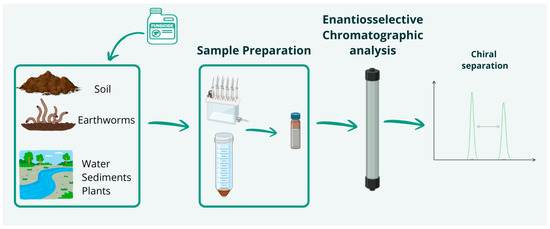
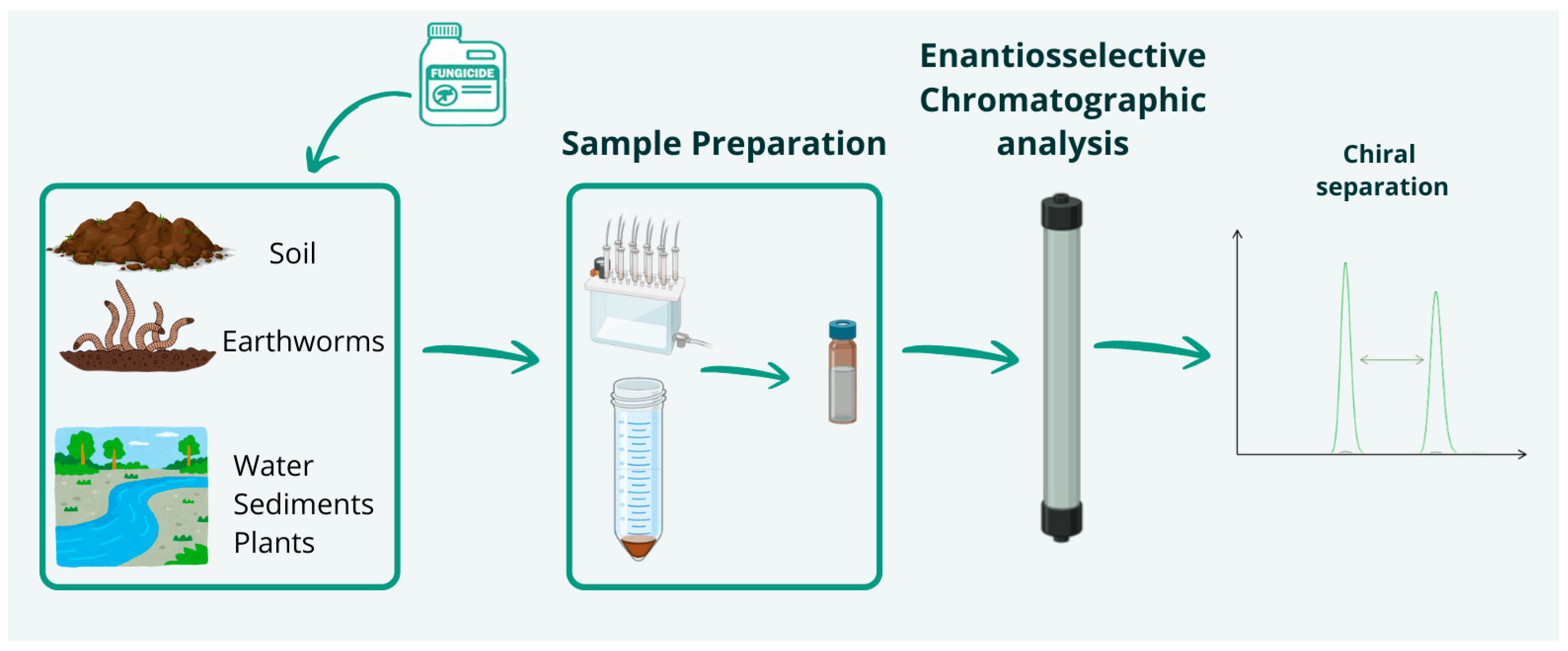
Graphical Abstract

1. Introduction

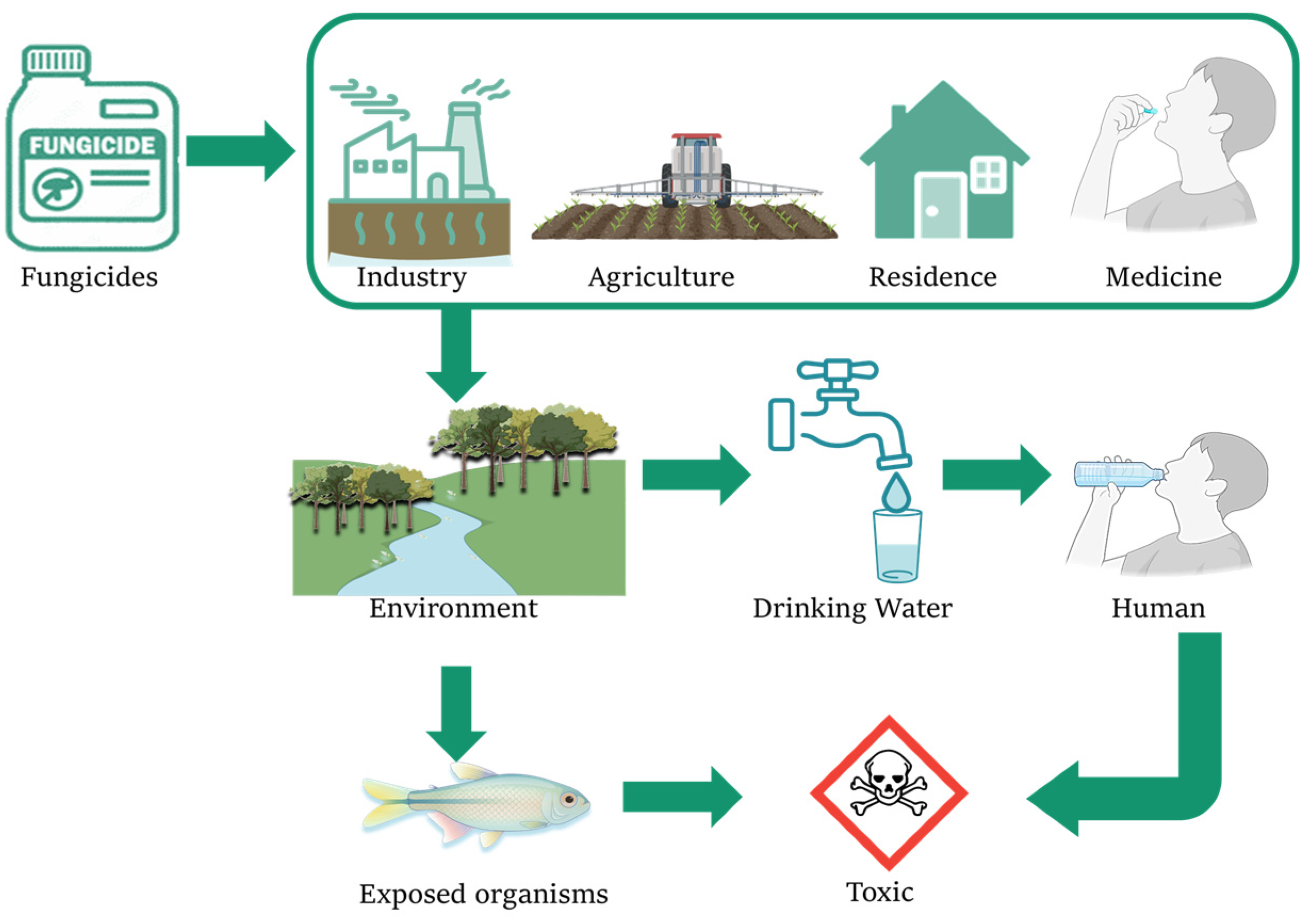
The aquatic environment hosts a wide range of organic micropollutants (typically found at μg–ng L−1 levels) that may pose significant risks to ecosystems and human health [1,2]. In fact, due to the poor efficiency of established wastewater treatment plants (WWTPs) in removing these contaminants, WWTPs effluents are one of the main sources of contaminants of emerging concern (CECs) in the environment (e.g., pesticides, pharmaceutical and personal care products, industrial compounds, among others), contributing to their presence in surface waters, groundwaters and soils [3] (Figure 1). Moreover, agricultural runoff plays a pivotal role in the contamination of groundwater, particularly by pesticides. As surface waters and groundwaters are often used as sources of drinking water, the occurrence of CECs in aquatic ecosystems represents a serious public health issue [4]. This highlights the need for advanced analytical methods able to detect these contaminants even at trace levels to assess their risk for non-target organisms, while supporting the implementation of efficient treatment processes to ensure water safety for human consumption [4].
Among aquatic contaminants, fungicides are of great concern. They can be either organic or inorganic chemicals and are widely used as pharmaceuticals, in personal care products, and as pesticides to control fungal infestation. Their steady and increasing usage has been contributing to their continuous release and rise in the environment [3,5,6]. Indeed, over the last 20 years, global pesticide use, including fungicides, has grown exponentially, reaching 3.73 million tons in 2023, which represents an increase of around 14% in a decade. In 2023, an average of 2.40 kg of pesticides was used per hectare of crops, although a negligible 2% decrease was achieved in comparison to 2022 [7]. Future scenarios were targeted to be achieved by 2023 on the use of pesticides linked to specific pesticide use and risk-reduction, which have been drawn by the European Commission (EC) Directorate General for Health and Food Safety for sustainable pesticide use and risk mitigation [8].
Fungicides are typically classified based on their mode of action or chemical group [9]. These substances act through diverse biochemical mechanisms depending on their chemical class. Broadly, these compounds can inhibit sterol biosynthesis, disrupt mitochondrial respiration and energy production, interfere with cell division, or block specific enzymatic pathways involved in amino acid or protein synthesis [10,11]. Regarding azoles, they inhibit lanosterol 14α-demethylase (CYP51/ERG11), a cytochrome P450 enzyme essential for ergosterol biosynthesis, thereby compromising fungal membrane integrity and cell proliferation [10,11]. The main mechanisms of resistance involve mutations in the CYP51 gene that reduce azole binding or mutations in its promoter region, leading to enzyme overexpression [10,11,12]. In addition, azoles can also interfere with cytochrome P450-dependent pathways in mammals, potentially affecting the metabolism of other compounds [12]. The most common classes of fungicides used in agriculture are strobilurins and triazoles, while the class of azoles is predominantly employed in pharmaceutical products for the treatment and prevention of mycosis. In addition to azoles, there are other chemical groups into which fungicides can also be classified, such as acylamides, allylamines, isoxazolines, morpholines, dicarboximides, spiroketalamines, and piperidines.
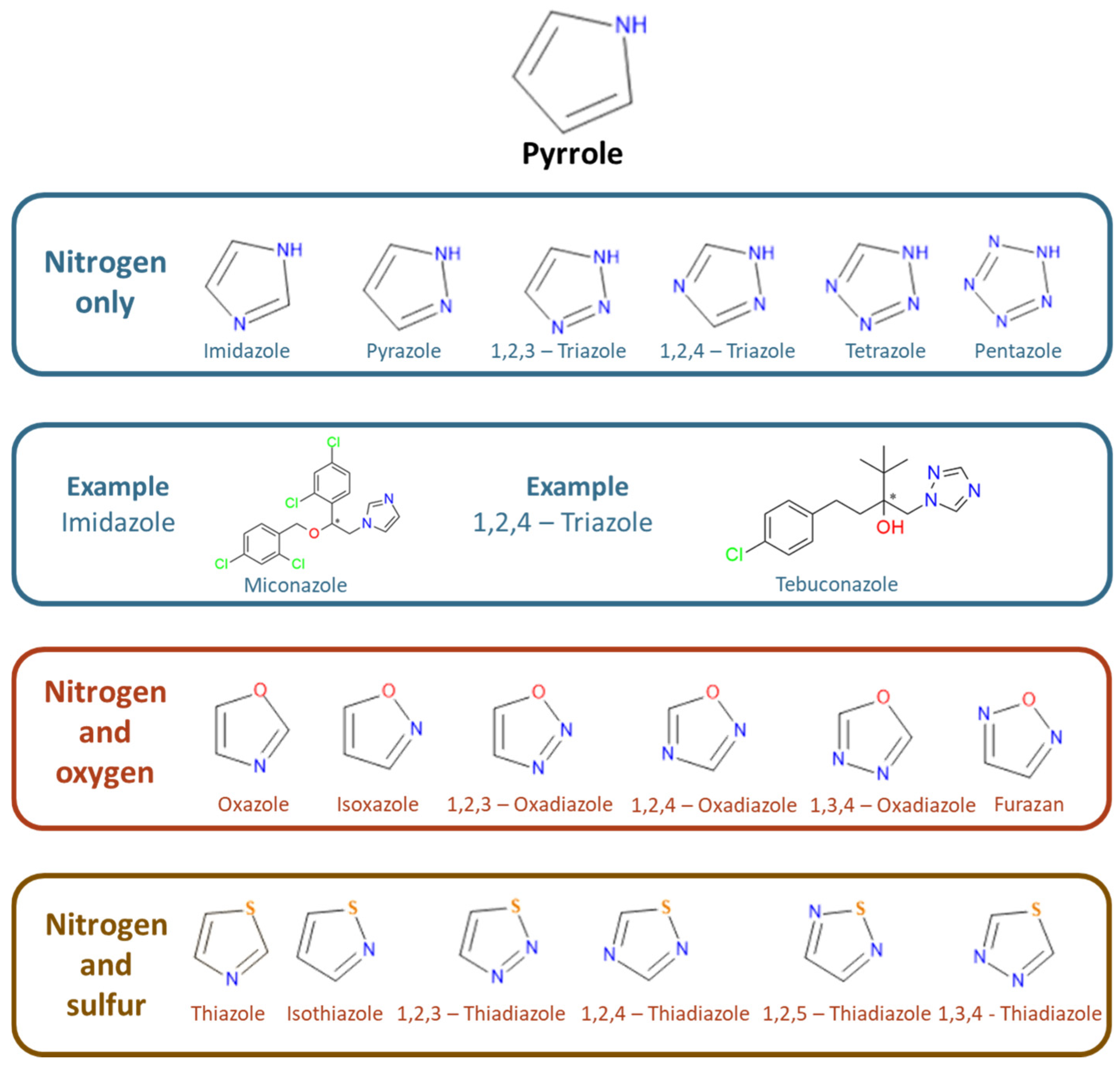
Azole fungicides play a leading role in combating fungal infections [3,5,6,13,14] and include imidazole and triazole derivatives, which are distinguished by the presence of two and three nitrogen atoms in their heterocyclic rings (Figure 2). These compounds exhibit broad-spectrum antifungal activity [15]. Specifically, azoles target a cytochrome P450 enzyme responsible for converting lanosterol into ergosterol [15]. Due to their properties, azole fungicides are used for various purposes, including the following: (i) antifungal pharmaceuticals for human and veterinary medicine; (ii) antimycotic agents for plant protection; (iii) biocides for fruit and vegetable preservation; (iv) anti-icing fluids; (v) corrosion inhibitors in the aviation industry [16]; (vi) ingredients in washing powders [17]; (vii) personal care products such as shampoos (e.g., anti-dandruff ketoconazole), creams (e.g., anti-aging climbazole), foams, and toothpastes [18].
Once in aquatic environments, fungicides undergo transformation and transport processes influenced by environmental factors such as temperature, precipitation, wind, and evapotranspiration [6]. These factors can either accelerate their dissipation or enhance their persistence, influencing their distribution, accumulation, and overall risk to both aquatic and terrestrial ecosystems [6]. The environmental impact of azoles is further intensified by their high persistence and tendency to accumulate in soils and sediments. Many of these compounds are considered ‘legacy’ contaminants, as they remain detectable in the environment for years after their agricultural use has ceased [21]. For instance, regulatory data indicate that several azole fungicides, such as epoxiconazole and propiconazole, are no longer approved as active substances under EU plant protection legislation, nevertheless, they may still be detected in environmental matrices due to their persistence and historical use, underscoring the legacy of these compounds in the environment [22]. Both compounds were detected in water samples from the United Kingdom in a study published in 2021, when the UK belonged to the EU. Their use had been banned by the EU at the end of 2018 [23], with a grace period until 2020 for propiconazole. Its detection despite the ban suggests this compound is either persistent in the environment or resulted from illegal use [22]. Epoxiconazole was banned in April 2020 [24], with a grace period until October 2021, which may explain why this compound was detected, since the article was published in May 2021 [22]. Furthermore, due to their moderate-to-high lipophilicity, azoles have the potential to bioaccumulate in aquatic organisms and biomagnify through the food web, leading to chronic exposure risks for higher-level predators and humans [18]. Therefore, fungicides are recognized as CECs, and many of them are included in the EC fourth and fifth Watch Lists for surface waters monitoring (Decision 2022/1307 [25] and Decision 2025/439 [26]), showing the concern of policymakers about their potential environmental and public health impacts. In fact, their presence in the environment poses harmful effects to non-target organisms, such as endocrine disruption, and contributes to the development of fungal resistance, which can have serious consequences for human health, such as infections caused by Candida auris and Aspergillus fumigatus [27]. Although their role in antimicrobial resistance is not yet fully understood, the widespread use of fungicides in agriculture and the use of over-the-counter azoles for the treatment of minor infections have raised concerns about cross-resistance [14]. To mitigate this problem, different treatment strategies have been evaluated. While conventional methods, such as activated sludge and sand filtration, show limited efficiency in removing several fungicides, advanced technologies like activated carbon adsorption, membrane bioreactors, and advanced oxidation processes have demonstrated higher removal rates [28]. However, the latter often leads to the formation of transformation products (TPs), which can exhibit similar or even higher toxicity than the parent compounds [29]. This technological shift directly drives the evolution of analytical methods, which must be sensitive enough to monitor both parent fungicides and their TPs across diverse environmental matrices.
Despite the high use of fungicides, their environmental occurrence and potential ecotoxicity remain poorly explored. Yet, some studies have reported their occurrence. For instance, in a study carried out by Calvo et al. (2021), seven fungicides (carbendazim, imazalil, prochloraz, propiconazole, tebuconazole, thiabendazole and tricyclazole) were quantified in water and sediment samples from rice fields [30]. The concentrations ranged from 0.8 mg/L and 21.6 µg/L in the water samples from the rice fields of Lake Albufera and the water outlets of the Albufera Natural Park (Spain), respectively, and between 0.3 and 739 ng/g in the sediment samples, both of which were taken during rice cultivation [30]. In a study carried out in a creek in northern Australia near an area of extensive agriculture, two azole fungicides, pyrimethanil and triadimenol, were measured at concentrations of 0.09 μg/L and 1.5 μg/L, respectively [31]. Wattanayon et al. (2021) monitored the presence of various fungicides in surface waters [22], some of which were included in the current (2025) [26] and in the previous (2022) [25] Watch Lists, namely ketoconazole, tebuconazole, fluconazole, propiconazole, prochloraz, miconazole, epoxiconazole, and clotrimazole. Although some of them were not detected, fluconazole, propiconazole, epoxiconazole, and tebuconazole were measured from 13.2 ng/L (epoxiconazole) to 927.5 ng/L (tebuconazole) [22]. Regarding the ecotoxicity of fungicides, there are also some studies on their effects. For example, hatching inhibition was observed in zebrafish embryos exposed to triadimefon, triadimenol and 1,2,4-triazole, with triadimefon exhibiting the greatest effect [32]. A decrease in swimming capacity was observed in amphibians exposed to triadimefon [33]. Other studies have been carried out to assess the kinetic behavior and toxicity in animal tissues (plasma and organs), particularly in rats [34,35,36,37,38,39,40], rabbits [41,42,43,44], and zebrafish [45,46], but also in lizard tissues [47]. Uptake by the food web is also a concern, and studies on food samples have also been reported. For example, triadimefon and triadimenol were monitored in vegetable oil samples from several supermarkets, with both being found up to 0.5 µg/kg [48].
Many fungicides are chiral, containing one or more stereogenic centers that lead to the formation of stereoisomers. Indeed, approximately 44% of chiral agrochemicals introduced in the market are fungicides. Among the 11 fungicides launched between 2018 and 2023, seven are chiral, representing about 64% of the total [49]. These stereoisomers can be either mirror images, known as enantiomers, or non-mirror images, referred to as diastereomers [50,51,52,53]. In the case of enantiomers, they have similar chemical and physical properties in achiral environments but may behave differently in chiral environments as biological systems [50,52,53]. These substances, like other chiral compounds, are typically administered or used as racemates rather than as enantiomerically pure forms, even though the desired biological activity is usually assigned to only one enantiomer. Generally, the other enantiomer is less active or inactive, has a different type of activity, or can be associated with toxic effects [54,55]. In the environment, the occurrence of chiral pharmaceuticals and agrochemicals has been reported in racemic form, single or enriched-enantiomer and in complex mixtures of diastereoisomers [5,51,56]. To accurately assess the environmental impact caused by these contaminants, including their ecological risk, it is important to understand the environmental behavior of each enantiomer separately [54,56,57,58]. Beyond risk assessment, the enantioselective monitoring of fungicides in the environment is equally important to determine their occurrence and to establish mitigation/preventive strategies. It might also provide useful information on the legacy of its use [54]. Therefore, chiral separation techniques are essential to discriminate between stereoisomers of fungicides in environmental matrices. Although a comprehensive review on analytical methods for the analysis of chiral fungicides was published in 2011 by Pérez-Fernández et al. [9], enantioselective analysis of environmental samples has highly evolved in the last decade due to the huge advances in the sample preparation and detection approaches. Moreover, a recent review by Bielská et al. (2021) [50] focused on the toxicity of fungicides, including the enantiotoxicity. More recently, Abad Gil et al. (2023) conducted a review with a focus on enantiomeric analysis of fungicides, focusing only on different chromatographic techniques [59]. Therefore, the current information on the analytical methods available for environmental samples and the data obtained in monitoring programs reported in the literature, using the contemporary analytical techniques (e.g., LC-MS/MS (liquid chromatography tandem mass spectrometry)) have not been analyzed in an informative and critical way.
Building on these review articles, this study aims to provide an updated overview of the recent chiral analytical chromatographic methodologies used for the enantioselective determination of azole fungicides listed in the fourth and fifth Watch Lists for surface waters monitoring (Decision 2022/1307 [25] and Decision 2025/439 [26]) in environmental matrices (e.g., soil, sediments, sewage sludge, water, plants). This review presents the most recent advancements in analytical chromatographic methods, detailing innovations in sample preparation and instrumental conditions. For that, an exhaustive bibliographic search was carried out on the existing literature focused on azole fungicides listed in the fourth and fifth Watch Lists for surface waters monitoring (Decision 2022/1307 [25] and Decision 2025/439 [26]), using PubMed (US National Library of Medicine), ScienceDirect and Scopus databases, with a focus on articles published in the last decade to provide a critical overview of the most recent trends beyond those reviewed by Pérez-Fernández et al., 2011 [9]. The following keywords were used for the search in the title, abstract or keywords of the reports (fungicides with * are chiral): “environmental contaminants” and (“fungicide”; or the name of each azole fungicide azole listed in the fourth Watch List (Decision 2022/1307), i.e., “clotrimazole” or “fluconazole” or “miconazole*” or “imazalil*” or “ipconazole*” or “metconazole*” or “penconazole*” or “prochloraz” or “tebuconazole*” or “tetraconazole*”; or the name of each azole fungicide listed in the fifth monitoring Watch List (Decision 2025/439) [26], i.e., “bromuconazole” or “climbazole*” or “cyazofamid” or “ difenoconazole” or “epoxiconazole*” or “itraconazole” or “ketoconazole*” or “mefentrifluconazole” or “propiconazole*” or “triticonazole”), and (“chiral” or “enantiomer” or “enantioselective” or “stereoselective”) and (“water” or “wastewater” or “soil” or “sediment” or “sludge” or “plant”). Although few azole compounds listed in the fourth and fifth Watch Lists for surface waters monitoring (Decision 2022/1307 [25] and Decision 2025/439 [26]) are not chiral, those were also targeted in the search since many studies deal with chiral and achiral compounds. The bibliography cited in the articles selected was also considered to enhance understanding and deepen the knowledge on the subject. Moreover, the data on other fungicides (either chiral or achiral) targeted in the articles retrieved by the literature search were also evaluated. Table S1 presents the molecular structures and chemical characteristics of the target fungicides reviewed herein, as well as those retrieved during the literature search for this review. All chiral compounds reviewed are highlighted in Table S1. On the other hand, considering that “fungicide” is one of the keywords used aiming to avoid missing any study not reporting explicitly the names of our target compounds in the title, abstract or keywords, some of the retrieved studies comprised also other fungicides not listed in the Watch Lists that were found in environmental matrices using chiral chromatography, although most are chiral (represented by an *) and three of them are achiral: cyproconazole*, diniconazole*, econazole*, fenbuconazole*, flutriafol*, hexaconazole*, N-deacetylketoconazole*, mycobutanil*, paclobutrazol*, prothiconazole*, hydroxy-tebuconazole*, triadimefon*, triadimenol*, triazolone*, voriconazole*, metalaxyl*, benalaxyl*, naftifine, terbinafine, N-desmethyl-carboxyterbinafine, pyrisoxazole*, oxathiapiprolin*, amorolfine*, fenpropimorph*, vinclozolin*, spiroxamine*, and fenpropidin*. These reports are also included in the data analysis (Tables S1 and S2) of the present review.
To the best of our knowledge, this review provides the first comprehensive and critical assessment of enantioselective chromatographic methods for fungicide determination in complex environmental matrices, integrating methodological advances from the last decade with environmental monitoring data and regulatory perspectives.
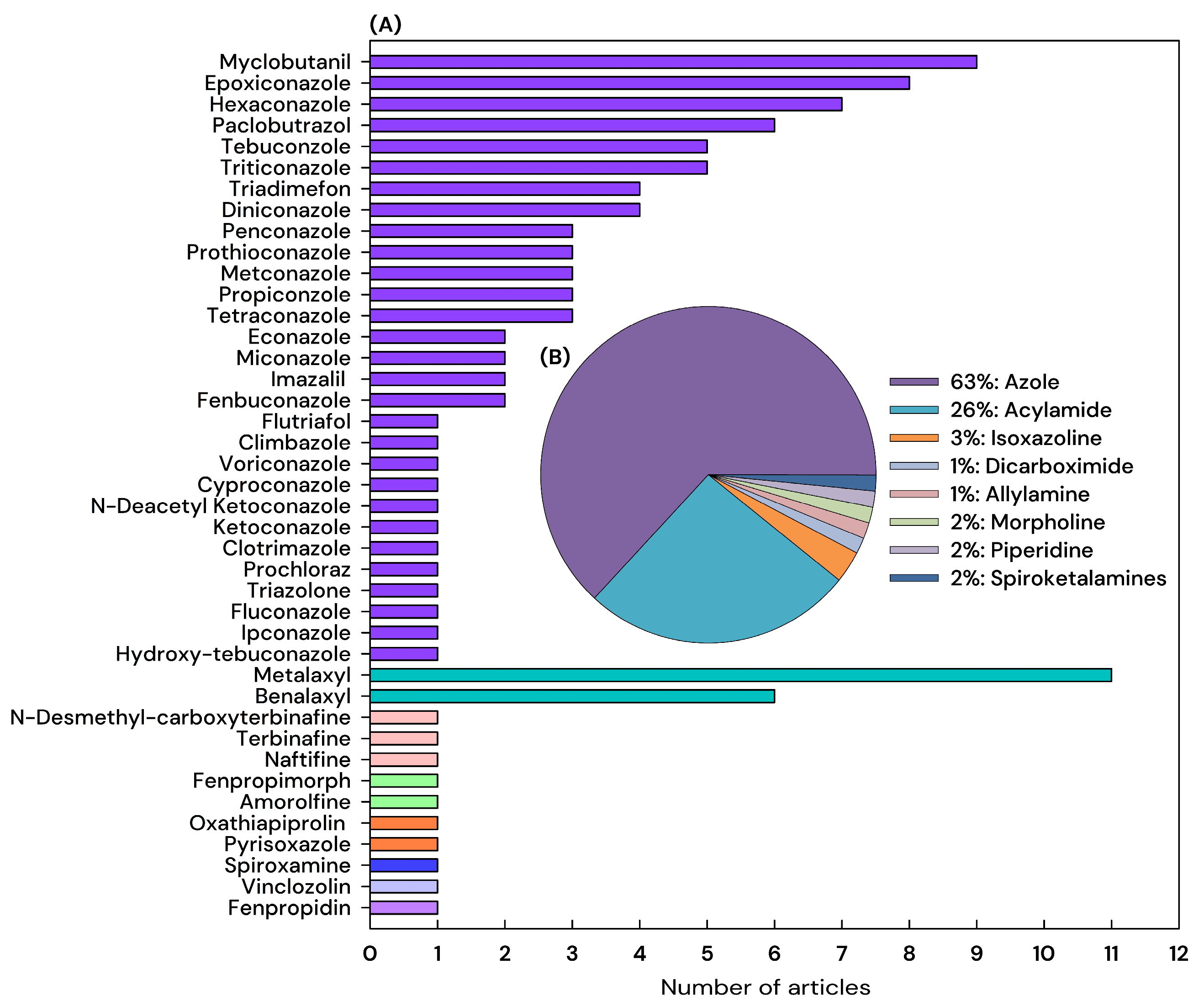
Across the 57 articles analyzed, 41 fungicides from eight different classes were studied: azoles, acylamides, isoxazolines, dicarboximides, morpholines, allylamines, piperidines, and spiroketalamines. In our search, no studies were found for cyazofamid, bromuconazole, difenoconazole, itraconazole, and mefentrifluconazole, reporting either the development of a chiral chromatography method or their presence in environmental matrices. Azoles were the most frequently studied class, reported in 63% of the articles. Within this group, myclobutanil was reported in nine articles. Acylamides were the second-most studied class of fungicides, reported in 26% of the articles. Despite their lower representation compared to other classes, such as azoles, the acylamide metalaxyl was the most studied fungicide overall, present in 11 reports. The remaining fungicide classes were less studied; isoxazolines were investigated in 3% of the articles, dicarboximides and allylamines in 1% each, and morpholines, piperidines, and spiroketalamines in only 2% of the studies reviewed (Figure 3).

2. Analytical Methodologies for Chiral Analysis: Critical Overview

2.1. Sample Preparation

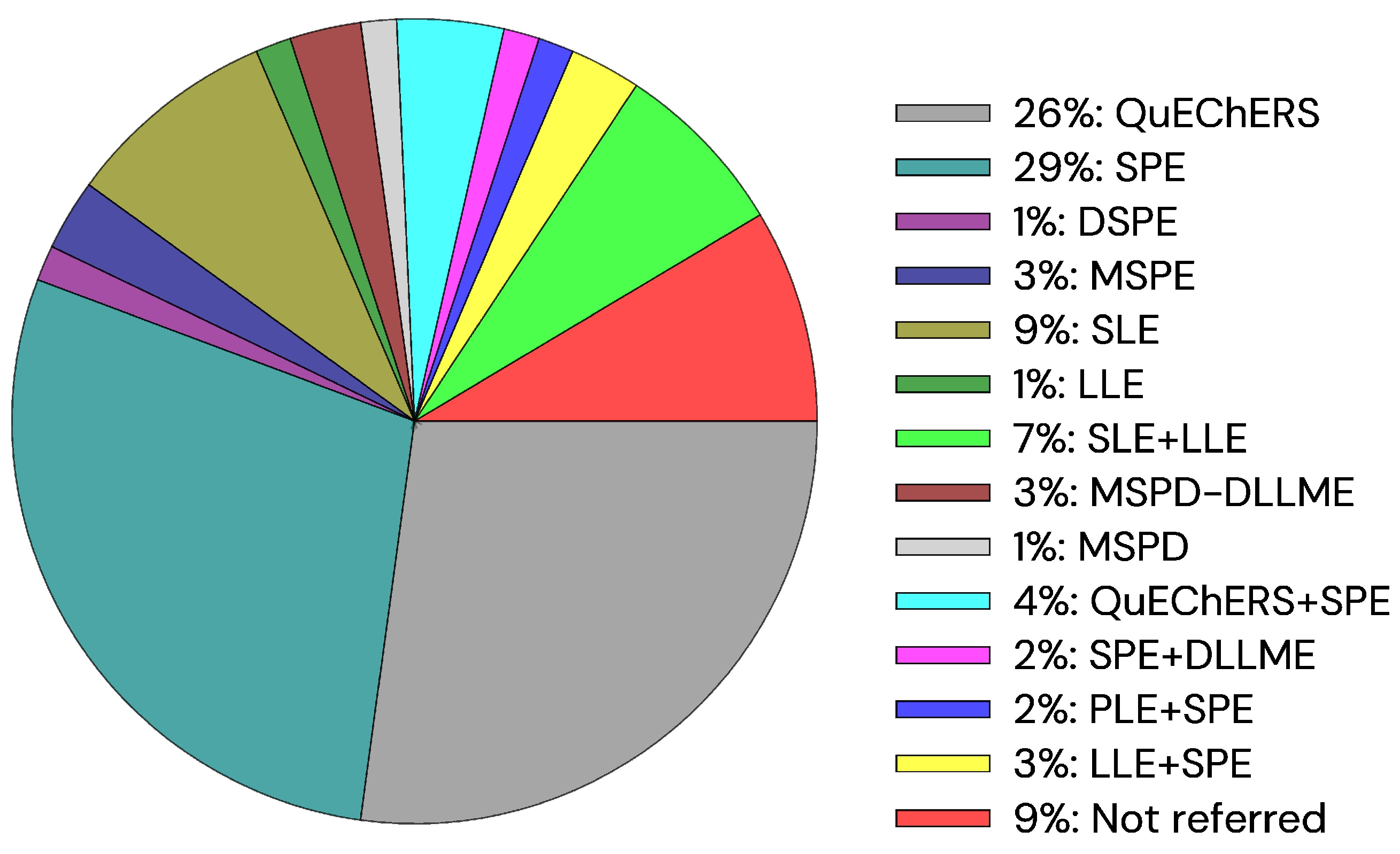
Determining fungicides in environmental matrices is challenging due to their low concentrations and the presence of naturally occurring interferences. Thus, direct analysis of such samples is mostly unsuitable. In general, a prior sample preparation step is mandatory to isolate and preconcentrate the target analytes before chromatographic analysis, aiming to achieve higher sensitivity and selectivity. The selection of sample preparation procedures depends on the type of matrix, the physicochemical properties of the analytes, their concentration in the matrix, the analytical method, as well as the cost, time of analysis, and possibility of automation. Table S2 summarizes the reviewed enantioselective analytical methods for the determination of fungicides in environmental samples, detailing the compounds analyzed, the environmental matrices, the sample preparation and recoveries, the analytical chromatographic methods, conditions, and obtained resolutions, and the concentrations measured. Figure 4 summarizes the most used sample preparation procedures grouped by their frequency, considering the studies reviewed in Table S2, providing an overview of current methodological trends in the sample preparation procedures for chiral fungicides.
The most commonly used sample preparation techniques were Solid-Phase Extraction (SPE; 29%) [22,51,60,61,62,63,64,65,66,67,68,69,70,71,72,73,74,75] and QuEChERS (Quick, Easy, Cheap, Effective, Rugged, and Safe; 26%) [51,76,77,78,79,80,81,82,83,84,85,86,87,88,89,90,91,92], accounting for more than 55% of the reported sample preparation procedures (Table S2) [22,51,60,61,62,63,64,65,66,67,68,69,70,71,72,73,74,75,76,77,78,79,80,81,82,83,84,85,86,87,88,89,90,91,92] for environmental samples. QuEChERS is typically used for solid samples and SPE for aqueous samples. These were followed by Solid–Liquid Extraction (SLE; 9%) [72,93,94,95,96] and by a combined extraction preparation method coupling SLE to Liquid–Liquid Extraction (LLE) (7%) [47,69,75,97,98,99].
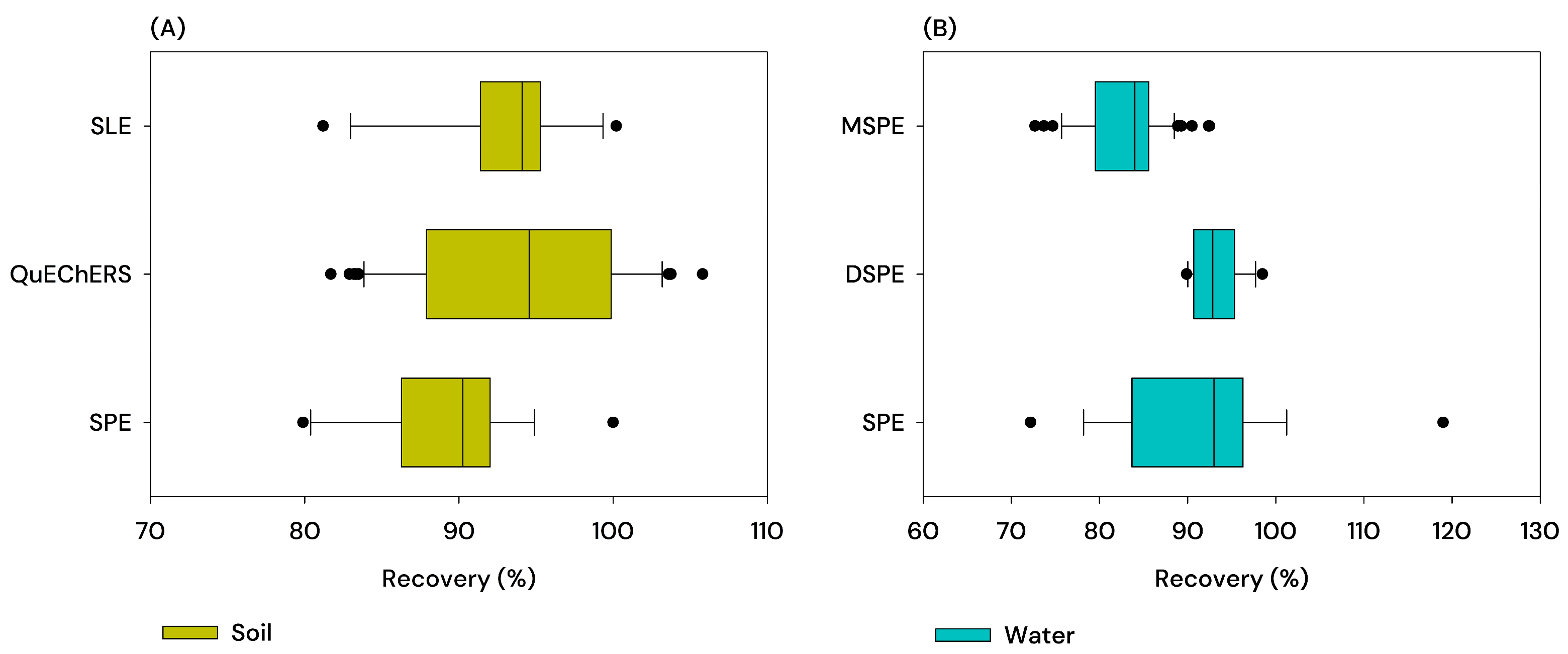
QuEChERS is the most used sample preparation procedure for analyzing fungicides in soil samples [51,77,78,79,80,81,82,83,84,85,86,87,88,89,90,91,92]. Developed in 2003, it was designed to provide a rapid, efficient, and cost-effective sample preparation procedure for analyzing large numbers of pesticide residues in food samples, taking into account the so-called green chemistry principles [100]. This procedure avoids the use of chlorinated solvents and requires small volumes of solvent and sample [50,100]. Its principle is based on an LLE procedure for the extraction of pesticides from vegetables and fruit (aqueous homogenates) with acetonitrile or another extracting solvent and the addition of salts, such as magnesium sulphate and sodium chloride, followed by a dispersive SPE clean up with primary secondary amine or another sorbent [101]. This procedure and other modified QuEChERS-based procedures have been successfully applied to the analysis of fungicides, mainly in environmental matrices, such as soil samples. Among the reviewed studies, 18 reports applied QuEChERS for the extraction of fungicides: 17 in soil samples [51,77,78,79,80,81,82,83,84,85,86,87,88,89,90,91,92], one of each in earthworms [77], and another one in wheat [76]. Fungicides recoveries in soil samples varied between 73.4 and 113.6% (Figure 5) and those studied were imazalil [81], ipconazole [79], metconazole [80,85,92], tebuconazole [51,84], myclobutanil [84,85], tetraconazole [91], benalaxyl [82,90], fenbuconazole [85,86,87], metalaxyl [85,91,92], propiconazole [78], pyrisoxazole [77], paclobutrazol [82], triadimefon [83,85], triadimenol [83], and triticonazole [85,92]. Regarding wheat, this procedure was used for the extraction of amorolfine, fenpropimorph, fenpropidin and spiroxamine, but the recoveries of these compounds were not reported [76]. Pyrisoxazole was studied in earthworms, with recoveries varying from 82.3 to 99.5%, similar to those observed in soils in the same study [77].
SPE is a widely used sample preparation procedure for liquid samples [102]. However, its environmental sustainability has been questioned due to the quantities of solvents used and the plastic waste produced [102,103]. Nevertheless, SPE remains a highly effective procedure due to the high diversity of sorbents and because it allows high recoveries and enrichment factors together with an efficient removal of matrix interferences, allowing the detection of compounds even at trace levels in complex matrices. Therefore, SPE has been reported for the analysis of fungicides in diverse matrices, particularly those that require high enrichment factors, such as water [22,60,61,63,67,68,69,73,75] and soil after a preliminary SLE step [62,63,64,68,70,71,73,74]. For example, an SPE procedure using Oasis® HLB SPE cartridges with recoveries ranging from 80% to 119% was reported for the extraction of various fungicides, such as fluconazole, voriconazole, epoxiconazole, propiconazole, prochloraz, prothioconazole, prothioconazole-desthio, tebuconazole, hydroxy-tebuconazole, clotrimazole, econazole, miconazole, ketoconazole, N-deacetyl ketoconazole, naftifine, terbinafine and N-desmethyil-carboxyterbinafine in surface water [22]. Florisil SPE cartridges were applied in another work for analysis of flutriafol in vegetables, fruits, wheat, soil, and water, with recoveries ranging from 91.8% to 101.2% [7].
The presence of penconazole in soil samples was reported by using GCB SPE cartridges and recoveries ranged between 70.5% and 91.7% [74]. Similarly, benalaxyl was extracted from earthworms using SPE, with recoveries ranging from 81% to 95%, although a preliminary solid–liquid and liquid–liquid separation was required [72]. These examples demonstrate that SPE can be effective for soil samples and other solid samples if preceded by an appropriate pretreatment step, depending on the analyte, sample matrix, and SPE protocol (Figure 5).
SLE is a physical–chemical procedure in which analytes are transferred from a solid sample to an appropriate solvent [104]. In a typical SLE procedure, the solid sample is first dried and ground into a powder, then stirred or shaken with an extraction solvent to facilitate the release of target analytes [88]. The extraction is often performed in multiple steps and using increasing volumes of solvent to maximize recovery. After extraction, solid–liquid separation is achieved through filtration or centrifugation, and the resulting solution is further processed for analysis [104]. Although less commonly used than QuEChERS or SPE, this procedure has been effectively applied to the extraction of several fungicides from soil samples [72,93,94,95,96]. For example, triadimefon and triadimenol were extracted from soil using acetonitrile and sodium chloride, followed by centrifugation and evaporation. The residue was reconstituted in methanol and analyzed by LC-MS/MS, with recoveries ranging from 85.2% to 106.8% [96]. Similarly, myclobutanil, hexaconazole, diniconazole, epoxiconazole, and tetraconazole were extracted from soil using acetonitrile and analyzed by LC-MS/MS, with recoveries ranging from 81.2% to 100.2% [93] (Figure 5).
LLE is an extraction technique based on partitioning the analytes between two immiscible solvents, usually an aqueous sample and an organic extraction solvent [105]. The miniaturization of LLE was developed to overcome some limitations of the original procedure, such as the long time spent, the low extraction efficiency, and the high consumption of high-cost solvents [106]. The so-called liquid phase microextraction (LPME) uses sample and solvent volumes in the microliter range [106]. This sample preparation procedure was used in only one study reviewed [79], in which two matrices (earthworms and soil) were analyzed, but LLE was used only for the extraction of ipconazole from earthworms, by using acetonitrile and sodium chloride. The extracts were analyzed by LC-MS/MS, and the recoveries ranged from 82.5% to 88.4% [79].
In some studies, sample preparation was carried out using a combination of two techniques, with SPE being the most used technique in combination, namely with QuEChERS (4%) [70,107,108], LLE (3%) [109,110], Pressurized Liquid Extraction (PLE, 1%) [60] and Dispersive Liquid–Liquid Microextraction (DLLME, 2%) [111].
Other sample preparation procedures as DSPE (Dispersive Solid-Phase Extraction, 1%) [112], MSPE (Magnetic Solid-Phase Extraction, 3%) [113,114], Matrix Solid-Phase Dispersion (MSPD)-DLLME (2%) [115,116] and MSPD (1%) [117] were also used for the analysis of fungicides in environmental matrices. DSPE was reported in a single study reviewed for the extraction of diniconazole, hexaconazole, and paclobutrazol in water samples, with recoveries ranging from 86.7% to 105.8% [112]. MSPE was used in two studies dealing with water samples, one reporting the extraction of ketoconazole, econazole, miconazole, butoconazole, sertaconazole, fenticonazole, and isoconazole, with recoveries between 70% and 92% [114], and another reporting the extraction of penconazole, paclobutrazol, triazolone, tebuconazole, hexaconazole, triticonazole, and epoxiconazole, with recoveries between 77.8% and 93.2% [113] (Figure 5). The modern sample preparation for chiral fungicides is increasingly governed by Green Analytical Chemistry (GAC) principles, aiming to reduce toxic solvent consumption and waste [118]. According to the literature reviewed, various sample preparation procedures were used to analyze 43 fungicides using chiral chromatography across different matrices, including earthworms, straw, wheat, plants, sediments, sludge, soil, and several types of water (drinking, purified, distilled, rainwater, wastewater, and surface water). The choice of sample preparation varies greatly depending on the matrix being used. For example, SPE was used mainly for water samples [22,60,61,63,67,68,69,73,75], while QuEChERS was used only for soil samples [51,77,78,79,80,81,82,83,84,85,86,87,88,89,90,91,92].
SPE achieved the highest recoveries, although its derivatives as MSPE and DSPE, also present good recoveries (Figure 5). For soils, QuEChERS presents the highest recoveries, although both SPE (with prior liquid–liquid separation) and SLE also present good recoveries. Overall, the consistently higher recoveries obtained with QuEChERS suggest that it may represent the most effective extraction approach for soil matrices. Indeed, QuEChERS relies on acetonitrile extraction followed by a partitioning with salts, which may help and increase the efficient extraction of a broad range of moderately to polar fungicides from soils.

2.2. Chromatographic Techniques

The separation of enantiomers presents a significant challenge in various fields of analytical chemistry. This is particularly critical in the biomedical, pharmaceutical and environmental fields, where there is a high demand for pure enantiomeric forms. Chiral resolution can be achieved using either direct or indirect approaches. The indirect method involves reacting the enantiomeric mixture with an enantiomerically pure reagent to form a pair of diastereoisomers. Due to their different physicochemical properties, these diastereoisomers can be separated using achiral techniques, and the original enantiomers may be subsequently recovered by reversing the derivatization process [54,119,120].
Direct enantioselective methods employ chiral selectors, offering several advantages such as eliminating the need for derivatization and reducing sample handling. The chiral selector can either be an additive in the mobile phase (chiral mobile phase additive—CMPA) or a component of the stationary phase, known as a chiral stationary phase (CSP). In this case, the selector interacts with the enantiomers to form transient diastereomeric complexes with differing stability, leading to distinct retention times. The enantiomer forming the less stable complex elutes first. Due to the limitations of CMPA, such as high consumption of chiral additives and detection interferences, among others, CSPs have become the preferred choice for enantioseparation, determining enantiomeric composition, monitoring asymmetric reactions, and conducting environmental and biological studies [121].
Enantioselective environmental analyses are reported mainly by liquid chromatography (LC), gas chromatography (GC), supercritical fluid chromatography (SFC), and, to a lesser extent, capillary electrophoresis (CE). Among these techniques, LC is the most widely applied; however, an increasing trend toward SFC methods has been observed, driven by the use of the same CSPs as in LC, the simplicity of the mobile phase, and the availability of multi-column screening systems for selecting appropriate chiral selectors in the development of multi-residue methods [122,123].
Evaluating the proportion of enantiomers in environmental studies is crucial. The most used parameter for this purpose is enantiomeric fraction (EF), which describes the relative amounts of two enantiomers in a mixture. EF represents the fraction of an enantiomer in an enantiomeric mixture and is calculated using the following equation [124]:
E F = S   R +   S
when the elution order is known. When the elution order is unknown, the first eluted enantiomer is used in the numerator, and the sum of both is in the denominator:
E F = E 1   E 1   +   E 2
The EF values range from 0 to 1, with 0 and 1 corresponding to pure enantiomers and 0.5 to a racemic mixture. Values between 0 and 0.5 and between 0.5 and 1 refer to chiral compounds with one of their enantiomers enriched.
Another proxy less used in environmental studies is the enantiomeric excess (ee) that expresses the excess of one enantiomer over the other and is calculated using the following equation [54,119]:
e e = E R E S E R + E S × 100
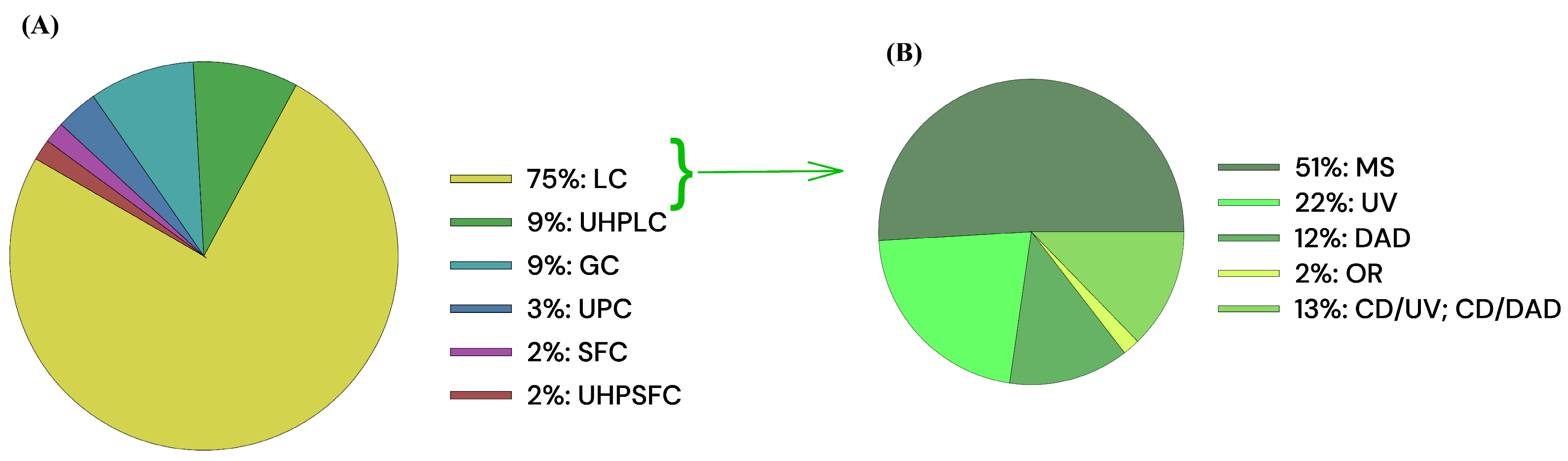
The most employed methodologies for the enantioseparation of fungicides include GC, LC, and SFC, but CE may also be used (Figure 6). LC emerges as the leading method (~84%) (including ultra-high performance LC (UHPLC)) [22,60,62,63,64,65,66,68,69,70,71,72,73,74,75,77,79,80,81,82,83,84,85,86,87,88,89,92,93,94,95,96,99,107,108,110,111,112,113,114,115,116,117,125,126,127,128], followed by GC (~9%) [67,76,97,98,109], ultra performance convergence chromatography (UPC2) (3%) [90,91], SFC (~2%) [78], and ultra-high performance SFC (UHPSFC) (2%) [61] as detailed in Figure 6 and Table S2.
In the following sections, LC and GC techniques, the most widely used chromatographic methods (accounting for more than 90%, as shown in Figure 6), will be discussed in detail.

2.2.1. Liquid Chromatography

Unsurprisingly, LC is the most widely used technique for the enantioselective separation of chiral fungicides (~84%). This predominance is fundamentally linked to the physicochemical properties of modern fungicides, such as most azoles and acylamides, which are typically polar, non-volatile, or thermally labile. The primary advantage of LC is its ability to analyze these compounds directly in the liquid phase without the risk of thermal degradation. According to our literature search, only five fungicides were not analyzed by LC and were instead analyzed by GC, namely cyproconazole [109], amorolfine [76], fenpropimorph [76], fenpropidin [76], and spiroxamine [76]. Indeed, the success of LC in chiral analysis is largely attributed to the diversity and versatility of CSPs available, which allow for direct resolution of enantiomers without the need for derivatization [129]. Even using CSPs in GC, this chromatography technique has the disadvantage of requiring derivatization in many cases to increase volatility. This additional step not only increases sample handling and potential for error but can also lead to incomplete reactions. The high temperatures required in GC can represent a limitation when analytes are non-volatile or when chiral compounds are susceptible to racemization, enantiomerization, or decomposition. Additionally, the number of available CSPs for GC is limited compared to LC. In this sense, this section will provide a detailed overview of CSPs classification, the most common types, modes of operation, current trends in column particle size, and associated detection techniques.
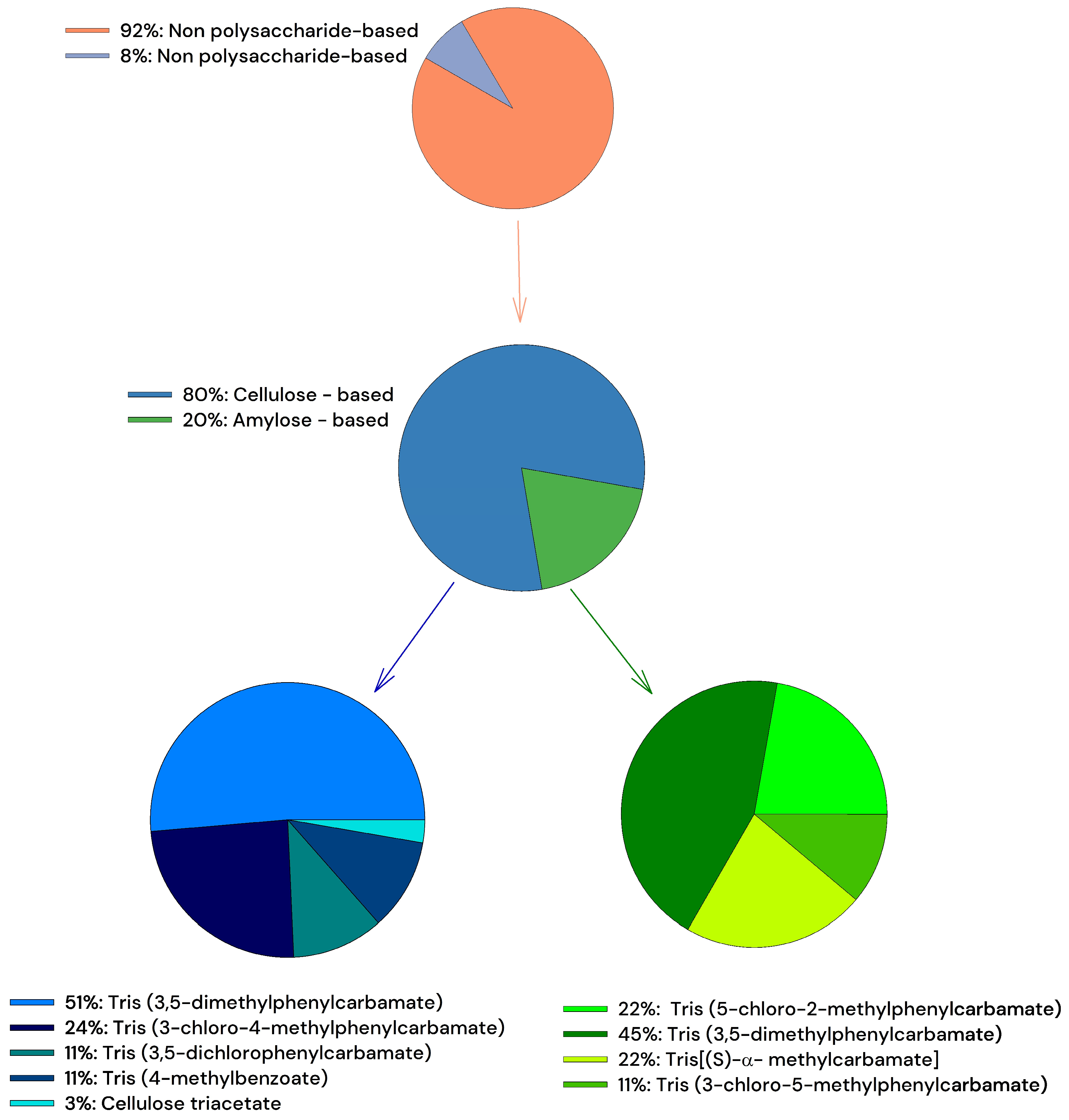
CSPs can be classified according to the components and their interactions between the target analytes and the stationary phase, namely the following: (i) type I when the solute–CSP complex is formed by attractive interactions; (ii) type II when the complex is formed by attractive interactions but inclusion complexes play an important role; (iii) type III when the solute enters the chiral cavities of the CSP and forms chiral complexes; (iv) type IV when the solute is part of the diastereomeric–metallic complex; (v) type V when the CSP is protein-based and the complex formation relies on hydrophobic and polar interactions [129]. Among these, polysaccharide-based CSPs, classified as type II, are the most widely used columns (92%) for analysis of the fungicides reviewed in environmental matrices (Figure 7), particularly cellulose-based (~80%) [22,51,62,64,68,69,70,71,72,73,74,77,79,80,81,83,84,85,86,87,88,89,92,93,94,95,96,107,108,110,111,113,114,115,116,125,127] and amylose-based (~20%) [60,75,78,82,84,99,112,126,128]. Different chiral selectors have been used for both types of polysaccharide-based CSPs. In the case of cellulose-based columns, 51% used tris-(3,5-dimethylphenylcarbamate) [68,69,70,72,80,83,84,85,86,87,93,94,96,107,110,111,116,125,127], 24% tris-(3-chloro-4-methylphenylcarbamate) [22,71,73,74,81,88,89,92,108], 11% tris-(3,5-dichlorophenylcarbamate) [51,79,113,115], 11% tris-(4-methylbenzoate) [62,64,77,114] and 3% cellulose triacetate [95]. Regarding amylose-based columns, 45% used tris-(3,5-dimethylphenylcarbamate) [75,78,82,126], 22% tris-(5-chloro-2-methylphenylcarbamate) [60,84], 22% tris-[(S)-α-methylbenzylcarbamate] [99,112] and 11% tris-(3-chloro-5-methylphenylcarbamate) [128]. It should be noted that the most used chiral selector in the studies reviewed is the tris-(3,5-dimethylphenylcarbamate) selector, whether in cellulose-based or amylose-based columns. The remaining studies (8%) use Whelk-01 and Pirkle type Chirex 3020 [117], which are non-polysaccharide-based columns (Figure 7).
Polysaccharide-based CSPs are very versatile. Indeed, polysaccharide-based CSPs are among the most widely used for enantioseparation due to their exceptional chiral recognition ability and broad applicability [130,131]. Their effectiveness arises from the multiple non-covalent interactions they can form, such as hydrogen bonding, π–π interactions, and van der Waals forces, allowing them to separate a wide range of chiral compounds with high selectivity [131]. However, a notable limitation of these phases, particularly the traditional coated versions, is their restricted solvent compatibility, as certain organic modifiers can dissolve the chiral selector. However, modern immobilized polysaccharide CSPs also offer excellent stability, enabling the use of diverse solvent systems across normal, reversed, and polar-organic elution modes. These features, combined with their proven reproducibility and availability in both analytical and preparative formats, make polysaccharide-based CSPs the most versatile and reliable option for chiral chromatography [130]. In normal elution mode, examples include the separation of metalaxyl in a Chiralcel OJ with n-hexane/isopropanol (85:15, v/v) [64]. Yet, reverse elution modes are more frequently used. For instance, fenbuconazole was resolved in Chiralcel OD-RH with acetonitrile/water containing 2 mM ammonium acetate (60:40, v/v) [86], and hexaconazole was separated using a Lux Cellulose-2 with a mobile phase consisting of acetonitrile/0.1% aqueous formic acid solution (60:40, v/v) [71]. Applications under polar-organic/highly organic conditions are also reported, for example, the separation of triadimefon and triadimenol on Lux Cellulose-1 using methanol-enriched mobile phases, where the methanol content was adjusted to optimize enantioresolution [96]. Finally, a polar-ionic elution mode was also described for multiple triazole fungicides in Chiralcel OZ-RH with 99% methanol and 1% of a 10 mM ammonium acetate solution [22]. These examples demonstrate how polysaccharide-based CSPs can be flexibly adapted to different elution modes, depending on the analyte and the objective of the study.
In some reported studies, CSPs were screened to determine the most suitable selector for the enantioseparation of the target compounds. For example, in the study performed by He et al. (2018) [80], four columns were tested to evaluate the enantioseparation of metconazole. An amylose-based column (Enantiopak AD) and a cellulose-based column (Enantiopak OD) were tested, both containing the tris-(3,5-dimethylphenylcarbamate) selector, an Enantiopak AS, which is an amylose-based column with the tris-[(S)-α-methylbenzylcarbamate] and an Enantiopak OJ that is a cellulose-based column with the selector tris(4-methylbenzoate). Enantiopak OD achieved the higher resolution values, varying between 2.37 and 4.55, while Enantiopak AD varied between 1.51 and 3.91. In contrast, Enantiopak AS and OJ showed insufficient enantioseparation, although resolution values were not reported [80]. In the study performed by Tong et al. (2019) [89], two CSPs, amylose tris-(3,5-dimethylphenylcarbamate) and cellulose tris-(4-chloro-3-methylphenylcarbamate), were tested to determine the most suitable for the enantioseparation of tetraconazole. Resolution values were respectively 1.32 and 1.75, leading to the selection of cellulose tris-(4-chloro-3-methylphenylcarbamate) [89].
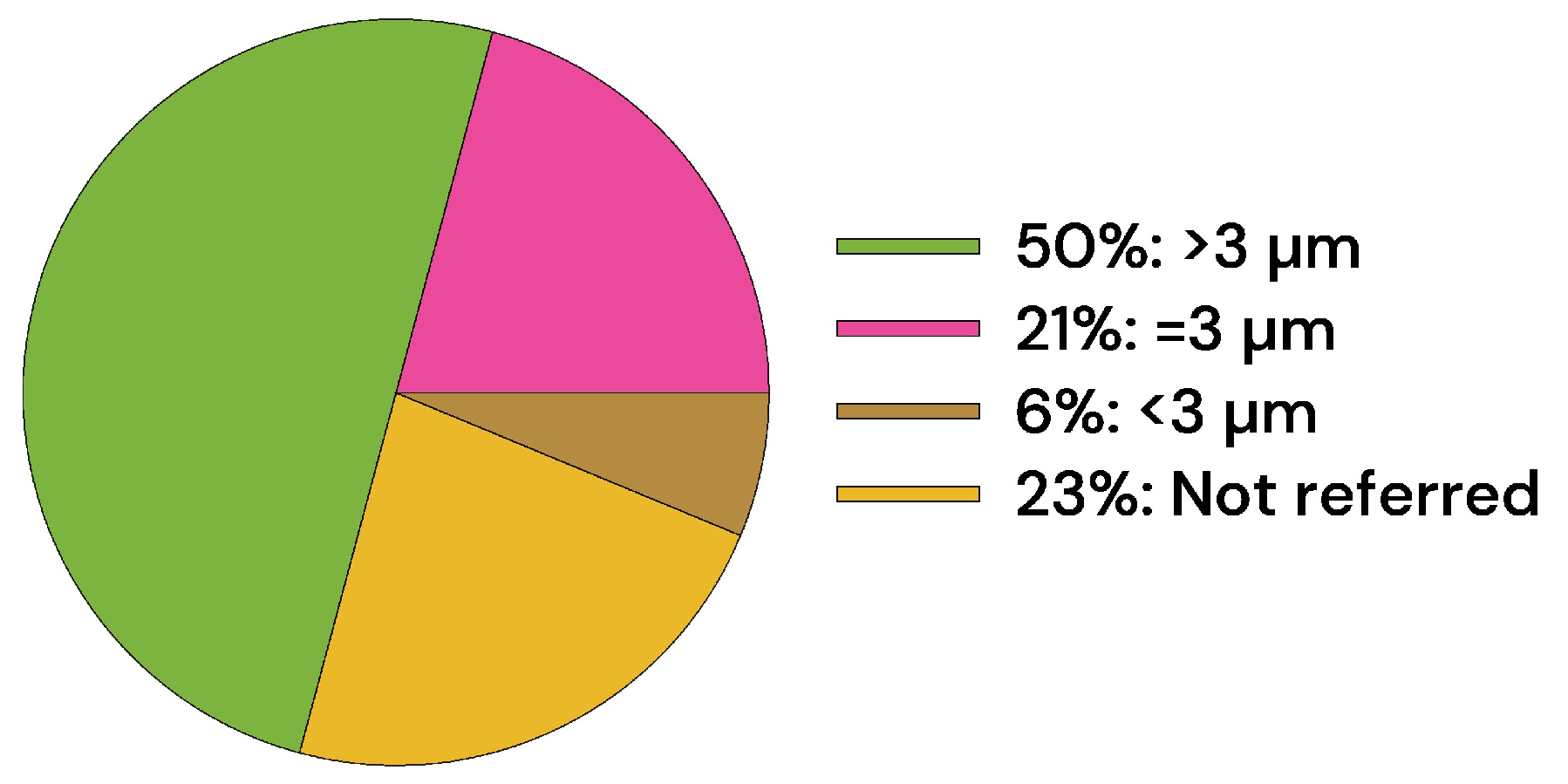
The most common particle size of the CSPs used for analysis of chiral fungicides in environmental samples is above 3.0 µm (Figure 8). Although a sub-2 µm particle size provides higher resolution and is preferred in UHPLC, its use is still limited in LC. Most reported studies were carried out using columns with a particle size greater than 3 µm (~50%) [22,51,62,65,66,70,79,80,82,83,85,86,87,89,95,96,99,107,111,112,113,114,116,117], whereas only 21% of the studies use columns with a particle size equal to 3 µm [60,71,74,77,81,84,93,108,110,128]. It is important to note that 23% of the studies do not mention the particle size of the column [63,64,68,69,72,73,75,94,115,125,126] (Figure 8). Only 3 studies use columns with a particle size lower than 3 µm, namely 1.7 µm [88,92] and 2 µm [127]. The Lux Cellulose-1 column based on cellulose tris-(3,5-dimethylphenylcarbamate) (150 mm × 2 mm i.d., 2 µm particle size) was used to separate the enantiomers of prothioconazole by LC-tandem Mass Spectrometry (LC-MS/MS), with a resolution of 1.59 [127]. Both studies that reported the use of columns with a particle size of 1.7 µm, used LC-MS/MS and the Lux Cellulose-4 column based on cellulose tris-(3-chloro-4-methylphenylcarbamate (2.0 mm × 150 mm, 1.7 μm particle size) to separate the enantiomers of metalaxyl, metconazole, and triticonazole, but the resolutions of these compounds were not reported in either study [88,92]. Despite the technological improvements offered by new silica supports for CSPs (such as sub-2 µm particles and superficially porous silica), which can enhance efficiency, peak shape, resolution, and analysis time, and help achieve low limits of quantification, the use of sub-2 µm silica remains limited, and superficially porous silica has not been reported in the reviewed studies. These columns offer shorter diffusion paths, allowing for faster separations and higher efficiency without the extreme backpressure associated with sub-2 µm particles, which is particularly beneficial for high-throughput monitoring [132].
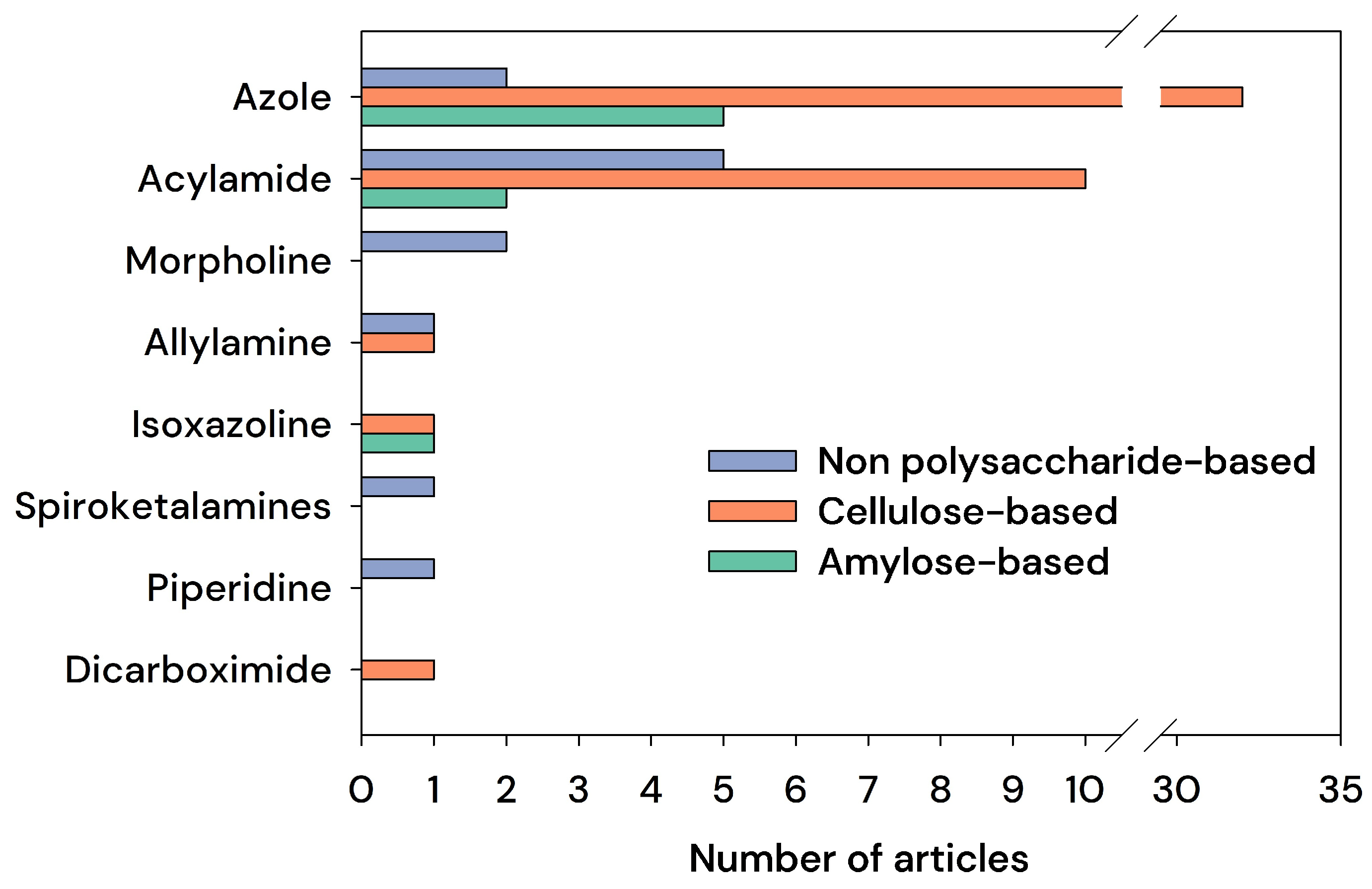
Interestingly, a relationship was observed between the types of CSPs and the classes of fungicides analyzed, with most azoles and acylamides being separated in cellulose-based columns. These classes of fungicides were also analyzed using the other two types of CSP, non-polysaccharide and amylose-based columns (Figure 9). In contrast, there were no reports of morpholines, spiroketalamines, or piperidines separated using polysaccharide CSPs. Specifically, morpholines, spiroketalamines, and piperidine were separated using non-polysaccharide CSPs. On the other hand, isoxazolines were analyzed using polysaccharide-based CSPs (Figure 9).
There are a few applications of chiral nano-LC for antifungal analysis. For example, Dal Bosco et al. describe the use of a lab-made silica capillary column packed with a polysaccharide-based CSP [133]. However, the downscaling of conventional chromatographic columns to capillary formats is limited for trace analysis because it requires injection volumes on the order of tens of nanoliters. Although this approach offers advantages such as higher peak efficiency and reduced chromatographic dilution, its sensitivity constraints remain a challenge.
An interesting strategy to enhance the resolution of multiple fungicides (both chiral and achiral) in a single analysis is the use of two-dimensional liquid chromatography (2D-LC). For instance, a recent study developed an online comprehensive 2D-LC method for separating pesticides of both types, including several fungicides [134]. Although this work primarily focused on method development, it involved using a chiral column in the first dimension (where three polysaccharide-based CSPs and various elution conditions were tested), combined with an achiral column in the second dimension (LC × LC), where both the stationary phase and organic modifiers were optimized. The study also highlighted the importance of factors such as orthogonality and shift gradients in influencing the peak capacity in two-dimensional separations.
Regarding the detection techniques used in LC, MS is the most commonly (~51%) [22,60,70,71,74,77,79,81,82,83,84,85,86,87,88,89,92,93,96,107,110,111,113,114,116,125,127,128]. This preference is driven by its superior sensitivity and selectivity, which are crucial for environmental trace analysis (at μg–ng L−1 levels) and for distinguishing analytes from complex matrix interferences. MS is followed by UV (~22%) [63,64,68,72,73,77,80,95,108,112,117,126], DAD (~12%) [51,62,65,66,69,94,99,115], circular dichroism (CD) (~13%) [63,68,69,73,75,99,115] and optical rotatory dispersion (ORD) detector (~2%) [108] (Figure 6B). While UV and DAD are more cost-effective, they often lack the necessary detection limits for monitoring programs in complex environmental matrices. CD and OR were always used in combination with other detectors. For example, CD was used with UV [63,68,73,75] and DAD [69,99,115], whereas ORD was used with UV [108].
While tandem MS remains the workhorse for quantification, there is an increasing shift towards High-Resolution Mass Spectrometry (HRMS), such as Orbitrap or Q-ToF. The advantage of HRMS lies in its ability to perform non-target screening and provide accurate mass measurements, which is critical for identifying unknown TPs in complex environmental matrices where reference standards are unavailable [135].

2.2.2. Gas Chromatography (GC)

Chiral GC remains a viable technique for the enantioseparation of certain fungicides, although its use is less common than LC (~9%). The primary advantage of GC is its high efficiency and peak capacity for relatively small, volatile, and thermally stable molecules. However, its use for fungicide analysis is often hindered by the need for a derivatization step to increase volatility and improve peak shape, which adds complexity to the sample preparation and may introduce experimental errors. Only 5 studies employing GC for chiral analysis were reviewed [67,76,97,98,109]. In these studies, GC was always coupled with MS detection. This coupling is essential to achieve the sensitivity required for environmental monitoring, although GC-MS can be more susceptible to matrix interferences in certain solid samples compared to LC-MS/MS Different chiral GC columns were used across the studies, most of them are based on cyclodextrin (CD) derivatives, which are the most common chiral selectors for GC due to their ability to form inclusion complexes with volatile enantiomers. Examples include the PS086 and 25% (w/w) of octakis-[bis-tert-butyl-dimethylsilyl]-CD column (12 m × 0.25 mm i.d., 0.08 µm film thickness) for the analysis of epoxiconazole and cyproconazole [109], the OV1701- BSCD column (20 m × 0.25 mm i.d.) for the analysis of metalaxyl [67], and the PS086-BSCD (tert-butyldimethylsilyl-CD) column (25 m) for the analysis of metalaxyl [99]. OV1701 and 25% of octakis (bis-tert-butyldimethylsilyl)-CD column (16 m × 0.25 mm i.d.,0.25 µm film thickness) was used for metalaxyl [97] and BGB-172–20% tert-butyldimethylsilyl-beta-cyclodextrin dissolved in BGB-15 (15% phenyl-, 85% methyl polysiloxane) (15 m × 0.25 mm i.d., 0.12 μm film thickness) was used to analyze amorolfine, fenpropimorph, fenpropidin, and spiroxamine [76]. Despite the high resolution offered by these CD-based columns, their thermal stability remains a limitation, as high temperatures can lead to column bleed or loss of chiral selectivity over time.
Both liquid chromatography (LC) and gas chromatography (GC) have been applied in the determination of chiral fungicides in environmental matrices. GC-based methods are less common and generally restricted to volatile analytes. Although these approaches can offer high chromatographic efficiency and instrumental robustness, their limited applicability and, in some cases, the need for derivatization increase the complexity of sample preparation and analytical uncertainty. In contrast, LC-based methods are more widely applicable to a broader range of chiral fungicides and generally achieve lower limits of detection (LOD) and quantification (LOQ), making them more suitable for trace-level analysis in complex environmental samples. According to the literature reviewed, only one study using GC-MS applies the developed method to real samples [67], which shows that environmental monitoring using GC-MS is not as widely used as LC-MS/MS. This may be related to the need for derivatization, although the reported relative Standard deviation (RSD) in the GC-MS studies reviewed is <10%, which shows that the developed method is precise. The GC-MS method also reported sensitivity since it allows the detection of the analytes at concentrations between 2 and 120 ng/L [67].
According to the studies reviewed in our literature search, it may be suggested that those that report the entire development of the analytical process, from the extraction procedure to the chromatographic method, and which apply the validated method for environmental monitoring, have less analytical uncertainty and greater sensitivity, i.e., lower LODs and LOQs, which allows the authors to apply to the real scenario since the lower the limits, the straightforward is the detection of the target compounds and more suitable is the method for trace environmental analysis [22,51,61,67,71,73,82,85,86,88,90,91,92,108,111,112,113,114,115,116].

3. Environmental Monitoring

Enantioselective analytical data enable a more precise environmental risk assessment by identifying which specific enantiomers are present. Based on the knowledge of their biological activity or toxicity, this shift from total concentration to isomer-specific information supports the development of environmental quality standards that reflect the distinct behavior of each enantiomer. Ultimately, such detail facilitates regulatory differentiation, allowing authorities to prioritize the most hazardous forms of a compound and implement targeted mitigation strategies.
Although analytical methodologies for the detection and quantification of fungicides in environmental matrices have been developed, it is noteworthy that most of them have not been applied to real samples, i.e., those studies focus on method development and the application consists of using spiked samples under controlled conditions, without extending their application to monitoring campaigns. Yet, soil was the most studied environmental sample [51,62,63,64,65,66,68,70,71,72,73,74,75,77,78,79,80,81,82,83,84,85,86,87,88,89,90,91,92,93,94,95,96,97,98,107,108,109,110,116,117,127,128]. This section summarizes the application of chiral chromatographic methodologies in real environmental samples, focusing on the detection and quantification of fungicides. Table 1 summarizes the main findings of these monitoring studies, including the target fungicides, matrices, and concentration levels. All the details of these studies and those studies not dealing with comprehensive monitoring are given in Table S2, including the analytical methodology.
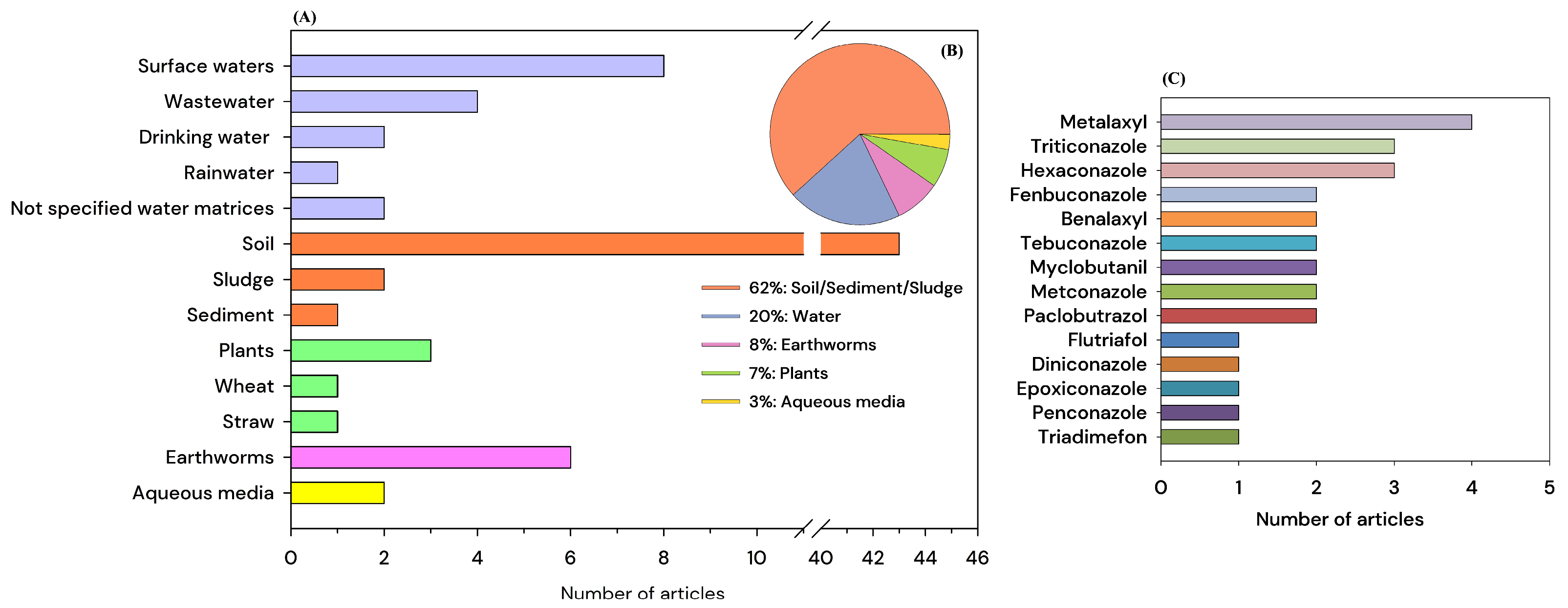
From the 43 studies carried out on soil samples, only 13 conducted environmental monitoring [22,51,61,81,92,107,111,113,114,115,116,125,127], while the remaining studies only developed extraction and analysis methods without applying them in monitoring studies for the target compounds in real samples. Similarly, from the 15 studies focused on water samples, which included matrices such as drinking water, rainwater, wastewater, and surface waters, only nine monitored fungicides in real water samples [22,61,67,73,111,112,113,114,115]. Only one study was recorded using sediments as the environmental matrix, reporting both analytical method development and environmental monitoring of fungicides [116] (Figure 10A). Four studies were conducted on plant matrices, but only two performed monitoring [77,90]. A total of six reports on chromatographic methodologies were also found for fungicides analysis in earthworms, but only one conducted a monitoring campaign [51,70,72,77,79,93]. Other methods were developed using matrices such as sludge, wheat, straw, aqueous medium, to evaluate degradation, toxicity, and biological responses, rather than environmental monitoring (Figure 10B).
In the studies reviewed involving the monitoring of soil samples, metalaxyl [88,90,92,116], triticonazole [88,92,108], hexaconazole [71,115,116], fenbuconazole [85,86], benalaxyl [82,90], tebuconazole [51,115], myclobutanil [85,116], metconazole [88,92], paclobutrazol [82,116], flutriafol [73], diniconazole [116], penconazole [115], epoxiconazole [116], and triadimefon [85,90,115] were monitored (Figure 10C). The compound most frequently detected and quantified in the soil was metalaxyl, which was quantified in four studies (Figure 10C). This was also the compound detected at the highest concentrations, ranging from 0.86 to 1.62 mg/kg and 1.05 to 1.58 mg/kg for (R)-form and (S)-form, respectively [91]. Some fungicides, such as tebuconazole [115], flutriafol [73] and penconazole [115], were not detected. Other fungicides as hexaconazole, in two studies [71,115], and triadimefon, in another study, were also not detected [115]. Yet, in another study, both enantiomers of hexaconazole were quantified in soil samples [116], as well as triadimefon enantiomers [85].
Both benalaxyl enantiomers were detected in soils and measured at levels between 0.84 and 1.24 mg/kg for (R)-form and 0.85–1.01 for (S)-form [90]. This compound was found at much lower levels in another study, which also quantified paclobutrazol [82]. Another study has also determined paclobutrazol in soils [116], with (2R,3R)-paclobutrazol being reported between 0.0029 and 0.116 mg/kg and (2S,3S)-paclobutrazol between 0.003 and 0.1148 mg/kg [116]. In this same study, both enantiomers of diniconazole (ND–0.0503 mg/kg), epoxiconazole (ND–0.0301 mg/kg), hexaconazole (ND–0.0154 mg/kg), myclobutanil, and metalaxyl (ND–0.0414 mg/kg) were also detected in the soils. All of them were quantified at least once, except for myclobutanil, which was present in concentrations below the method quantification limit (MQL) [116]. In another study, the two enantiomers of fenbuconazole, myclobutanil, and triadimefon were quantified in the soil [85]. Fenbuconazole was detected in concentrations varying between 0.01197 and 0.02354 mg/kg, and 0.01049 and 0.02107 mg/kg for (+)-fenbuconazole and for (−)-fenbuconazole, respectively [85]. Myclobutanil was detected, with concentrations varying between 0.01260 and 0.01856 mg/kg for (+)-myclobutanil and 0.01253–0.01774 mg/kg for (−)-myclobutanil [85]. Triadimefon was detected at concentrations between 0.00879 and 0.01583 mg/kg for (+)-triadimefon and 0.00962–0.01716 mg/kg for (−)-triadimefon [85].
From these 15 studies dealing with the determination of fungicides in waters, environmental monitoring was carried out in only nine [22,61,67,73,111,112,113,114,115], while only the analysis methodology was developed in the remaining six studies [60,63,68,69,75,95]. Some environmental monitoring studies report EF values [22,61,82,85,86,88,111,113,114,116]. In general, EF values close to racemic composition are often observed in water matrices, reflecting limited enantioselective transformation. However, changes in EF between wastewater influent and effluent indicate that enantioselective processes can occur during wastewater treatment. Comparisons between wastewater, surface water, and other environmental matrices reveal matrix-dependent trends, suggesting that enantiomeric composition in the environment reflects a combination of source-related characteristics and subsequent transformation processes. Such enantioselective transformations are important because they may influence the environmental fate, persistence, and potential ecological effects of individual enantiomers, highlighting the need to consider chirality in environmental monitoring and risk assessment [136].
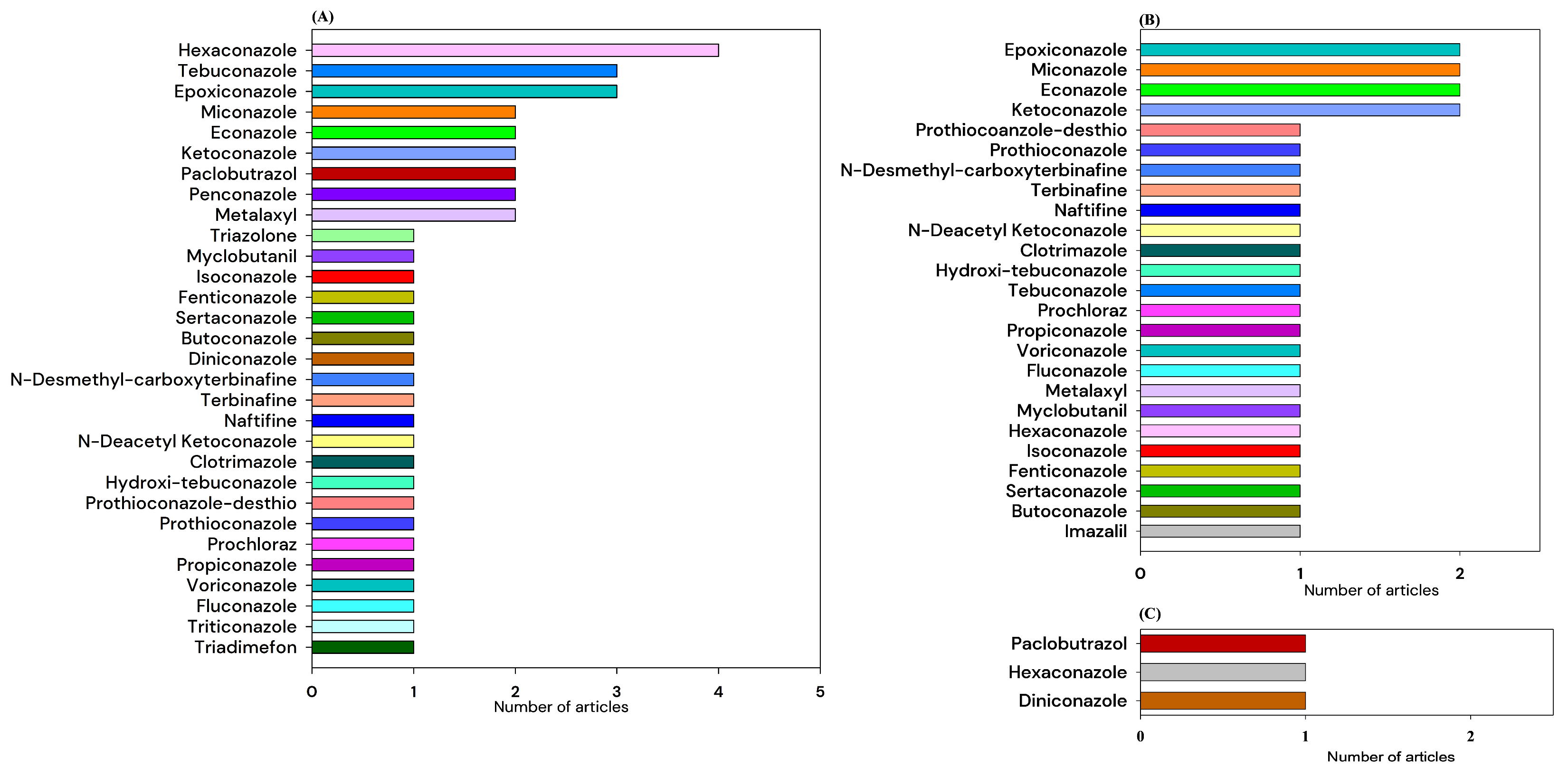
Within aqueous matrices, surface waters are the most studied, with seven monitoring studies of various fungicides having been conducted in this type of matrix [22,67,111,112,113,114,115]. Hexaconazole [111,112,113,115], epoxiconazole [22,111,113], tebuconazole [22,113,115], metalaxyl [67,111], penconazole [113,115], paclobutrazol [112,113], ketoconazole [22,114], econazole [22,114], miconazole [22,114], triadimefon [115], triticonazole [113], fluconazole [22], voriconazole [22], propiconazole [22], prochloraz [22], prothioconazole [22], prothioconazole-desthio [22], hydroxi-tebuconazole [22], clotrimazole [22], N-deacetyl ketoconazole [22], naftifine [22], terbinafine [22], N-desmethyl-carboxyterbinafine [22], diniconazole [112], butoconazole [114], sertaconazole [114], fenticonazole [114], isoconazole [114], myclobutanil [111], and triazolone [113], were monitored in surface water samples (Figure 11A). Hexaconazole, penconazole, tebuconazole, and triadimefon were not detected in the surface waters analyzed in rivers located in China [115], voriconazole, prochloraz, both enantiomers of prothioconazole, prothioconazole-desthio, clotrimazole, both enantiomers of econazole, both enantiomers of miconazole, both enantiomers of ketoconazole, N-deacetyl-ketoconazole E2, and naftifine were not detected in the surface waters analyzed in South West England river water [22]. In another study, a monitoring campaign was carried out for diniconazole, hexaconazole, and paclobutrazol in surface waters, and for all compounds, it was not possible to confirm their presence as they were below the method detection limit (MDL) [112]. In a study monitoring river water for the two enantiomers of various fungicides, such as penconazole, paclobutrazol, triazolone, tebuconazole, hexaconazole, triticonazole, and epoxiconazole, all the fungicides were detected in the samples at concentrations up to 57.7 ng/L [113]. The compound most frequently detected and quantified in surface waters was hexaconazole, which was quantified in four studies (Figure 11A). Tebuconazole was the compound detected at the highest concentrations, ranging from 182.2 to 322.6 ng/L [22].
Metalaxyl [111], myclobutanil [111], hexaconazole [111], epoxiconazole [22,111], isoconazole [114], fenticonazole [114], sertaconazole [114], butoconazole [114], miconazole [22,114], econazole [22,114], ketoconazole [22,114], fluconazole [22], voriconazole [22], propiconazole [22], prochloraz [22], prothioconazole [22], prothioconazole-desthio [22], tebuconazole [22], hydroxy-tebuconazole [22], clotrimazole [22], N-deacetyl ketoconazole [22], naftifine [22], terbinafine [22], N-desmethyl-carboxyterbinafine [22] and imazalil [61] were monitored in wastewater (Figure 11B). Epoxiconazole [22,111], miconazole [22,114], ketoconazole [22,114], and econazole [22,114] were the most frequently monitored compounds in wastewater, having been studied in two studies. The compound detected at highest concentrations was tebuconazole, which was detected between 923.4 and 929.9 ng/L [22] in a study that also monitored the presence of fluconazole, prochloraz, voriconazole, clotrimazole, hydroxy-tebuconazole, naftifine, terbinafine, N-desmethyl-carboxyterbinafine, prothioconazole-desthio, and the two enantiomers of propiconazole, prothioconazole, epoxiconazole, econazole, miconazole ketoconazole, and N-deacetyl ketoconazole. Some were quantified at lower concentrations than tebuconazole and some were not even detected, such as voriconazole, epoxiconazole, propiconazole, prochloraz, prothioconazole, prothioconazole-desthio, hydroxy-tebuconazole, clotrimazole, econazole, miconazole, ketoconazole, naftifine, terbinafine, and N-desmethyl-carboxyterbinafine. (Table 1) [22]. The concentrations decreased considerably from influent to effluent wastewater, since most of these compounds were no longer detected in the effluents, except in the cases of fluconazole, N-deacetyl ketoconazole (DAK) E1, and tebuconazole. It is interesting to note that fluconazole and N-deacetyl ketoconazole (DAK) E1 were not detected in the influent but were detected in the effluent, while the concentration of tebuconazole increased from the influent where the concentrations varied between 77.5 and 152. 7 ng/L to the effluent where they were quantified between 923.4 and 929.9 ng/L [22], the authors suggesting future studies to evaluate tebuconazole transformation during treatment. In another wastewater monitoring study, the two enantiomers of ketoconazole, econazole, miconazole, butoconazole, sertaconazole, fenticonazole, and isoconazole were monitored in influent and effluent wastewaters [114]. Only the two enantiomers of econazole and miconazole were detected in the effluents, but at concentrations much lower than those detected in influent wastewater. In fact, econazole was detected between 4.9 and 6.3 ng/L for enantiomer 1 and between 4.7 and 5.7 ng/L for enantiomer 2 in the effluent wastewater, and between 16.7 and 18.5 ng/L for enantiomer 1 and between 16.9 and 19.3 ng/L for enantiomer 2 in the influent wastewater. Miconazole was detected in effluent wastewater between 3.1 and 3.7 ng/L for enantiomer 1 and between 1.5 and 3.1 ng/L for enantiomer 2, while it was detected in influent wastewater between 21. 3 and 22.9 ng/L for enantiomer 1 and between 20.8 and 21.8 ng/L for enantiomer 2 [114].
Only one monitoring study was conducted on drinking water (Figure 11C). In that study, hexaconazole, paclobutrazol, and diniconazole were monitored, but all compounds were below the MDL [112].
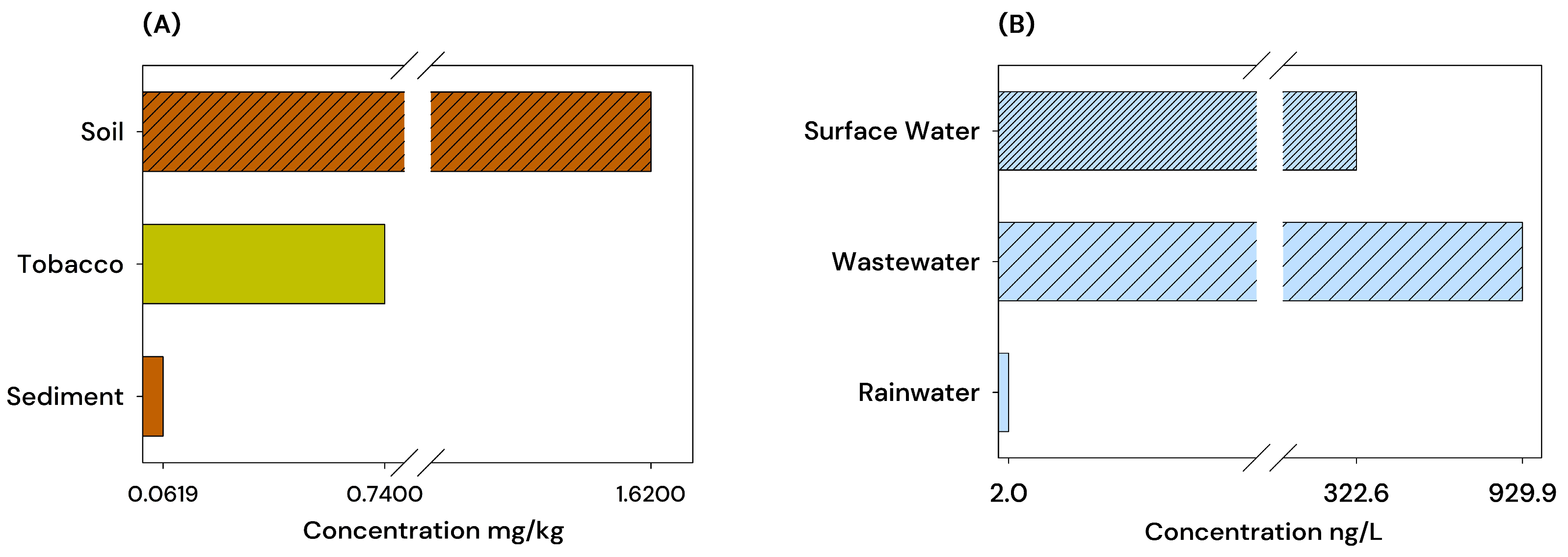
Two monitoring studies were conducted to quantify metalaxyl [77] and benalaxyl [90] in tobacco plants, and found only (R)-metalaxyl at concentrations up to 0.74 mg/kg [77] and the (R)-form of benalaxyl at concentrations up to 0.50 mg/kg [90]. In sediments, both enantiomers of diniconazole, epoxiconazole, hexaconazole, myclobutanil, paclobutrazole, and metalaxyl were detected and measured [116]. Diniconazole was quantified at 0.0558 mg/kg for the (R)-form and 0.0553 mg/kg for the (S)-form, epoxiconazole was quantified at 0.0256 mg/kg for enantiomer 1 and 0.0244 mg/kg for enantiomer 2, hexaconazole and metalaxyl were detected below the MQL, (S)-myclobutanil was quantified at 0.0055 mg/kg and the (R)-form at 0.0066 mg/kg, (2R,3R)-paclobutrazol was quantified at 0.0611 mg/kg and the (2S,3S)-form at 0.0619 mg/kg, being the latter the highest concentration quantified in sediments [116]. As for earthworms, only one study was found that monitored the fungicide tebuconazole, but it was not detected in any of the samples [51] (Table 1). In brief, the maximum concentration of fungicides was 1.62 mg/kg of (R)-metalaxyl in soil [91], 0.74 mg/kg of (R)-metalaxyl in tobacco plants [91], 0.0619 mg/kg of (2S,3S)-paclobutrazol in sediments [116], 322.6 ng/L of tebuconazole in surface water [22], 929.9 ng/L of tebuconazole in effluent wastewater [22], and 2.0 ng/L of metalaxyl in rainwater [67] (Figure 12).
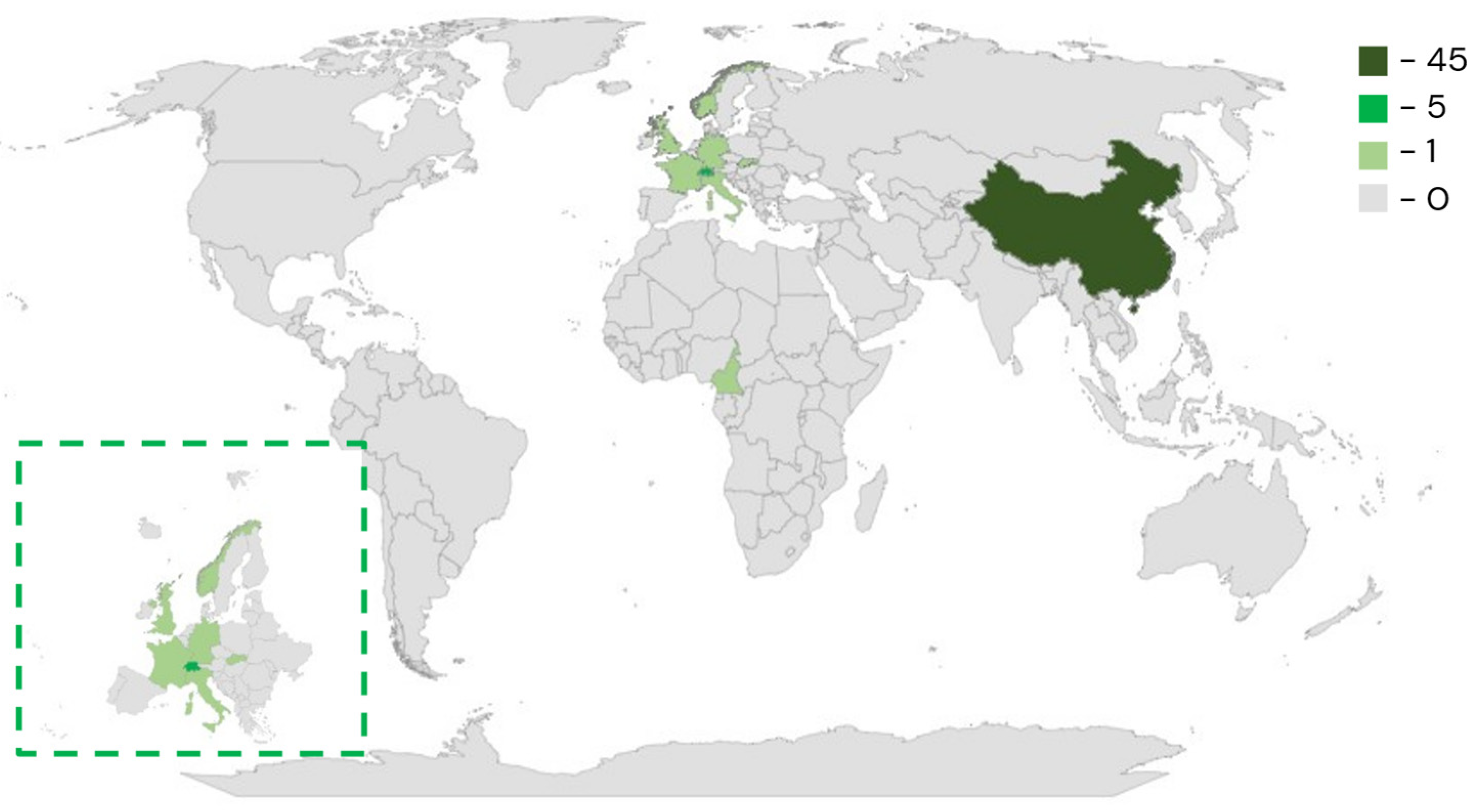
The studies analyzed were conducted across seven countries and span a period from 1985 to 2025. Most of these studies were carried out in China (n = 45), only 11 studies were carried out in Europe, spread across Switzerland, the United Kingdom, Germany, France, Italy, Norway and Slovakia, and only one study was conducted in the African continent, specifically Cameroon (Figure 13).
The uneven geographical distribution of studies highlights a significant knowledge gap regarding the development of enantioselective methods to assess the occurrence and fate of chiral fungicides in environmental matrices. The predominance of studies conducted in China likely reflects intensive agricultural activity and advanced enantioselective analytical capabilities rather than a globally representative picture. Although there are only 11 studies in Europe, it should be noted that these reports refer to different countries, including Switzerland, France, Germany, Italy, Norway, Slovakia, and the United Kingdom, which demonstrate a cross-cutting scientific interest, albeit developed by isolated research groups, in contrast to the strong concentration observed in China. No studies from American countries were included in the review, which may reflect the limited research focus on enantioselective analysis of these compounds in environmental matrices within laboratories in these regions. Given that fungicide enantiomers may exhibit distinct mechanisms of action, toxicological profiles, and environmental behaviors, the limited geographical coverage of enantioselective monitoring studies hampers a comprehensive assessment of enantiomer-specific environmental risks and underscores the need for broader, globally representative enantioselective investigations.
These data show there is a huge knowledge gap about the presence of chiral fungicides in environmental matrices. This shows the relevance of the present study, because different enantiomers can have different mechanisms of action and toxicities, which makes the chiral analysis of these compounds in the environment increasingly relevant.

4. Challenges and Future Perspectives

Chiral analysis by LC is the most used chromatographic method for enantioselective separation and quantification of fungicides. Despite significant progress in this area, several limitations in the current analytical methodology persist and there is still substantial room to evolve. Although nano-LC provides high efficiency, its practical application is constrained by limited injection volumes, underscoring the need for more sensitive detection strategies. Advances such as sub-2 µm chiral columns and comprehensive 2D-LC offer promising avenues for simultaneously resolving chiral and achiral fungicides, though further optimization of peak capacity and orthogonality is required. Continued development in miniaturized, high-efficiency separations and enhanced detection techniques will be key to advancing the field. One approach to overcoming limitations in the present analytical methodologies is to use CSPs with particle diameters smaller than the commonly used 5.0 and 3.0 μm. Specifically, more CSPs with sub-2 μm particle size should be developed for UHPLC to improve the resolution, peak shape, time of analysis and to overcome high limits of quantification. Since most chiral stationary phases used in LC can also be used in SFC, both techniques will benefit from these advances. It would be important to develop online analytical methods using LC for the analysis of fungicides in environmental matrices, since there are already studies using online SFC for the analysis of fungicides in food matrices [137], and methodologies using online LC in environmental matrices, but for another type of compounds, like, for instance, fluoroquinolones [138].
Regarding GC, the main challenge lies in the low volatility of chiral fungicides and the difficulty of derivatization, which limits their enantioseparation. Yet, the development of novel chiral columns remains essential to expand the available options for GC-based enantioseparation.
The application of enantioselective methods to real environmental monitoring remains limited, despite the development and analytical validation of many techniques. In most cases, studies focus on method optimization using standards or spiked matrices rather than actual field samples, which restricts the availability of occurrence data and limits conclusions regarding the environmental relevance of enantiomers. Enantioselective indicators, such as EF, are frequently reported without biological or ecological interpretation, reducing their practical value for environmental assessment and regulatory decision-making. Addressing these limitations requires applying validated methods to diverse environmental samples, interpreting EF values in a biological context, and generating consistent datasets that can support robust conclusions and regulatory applications.
The attribution of EF variations to biological processes requires the prior demonstration that the analytical methodology behaves equally for stereoisomers, which includes verification that sample extraction, cleanup, and instrumental analysis do not introduce enantioselective bias, typically assessed using racemic standards and matrix-matched spiking samples that show comparable recoveries and precision for both enantiomers. Moreover, the use of appropriate abiotic or sterilized controls is essential when microorganisms are present. The absence of EF changes in sterilized or biologically inactive controls, contrasted with measurable EF shifts in biotically active samples, provides strong evidence that observed enantiomeric enrichment is driven by biological activity rather than analytical or matrix-related artifacts.
The EF is often ignored in environmental fate studies, even though enantiomers may differ markedly in fate, degradation, and/or toxicity. The situation is more mature in food and biological matrices. Despite substantial progress in chiral separation techniques in pharmaceutical, food and biological matrices, the environmental dimension remains significantly underdeveloped. Although several methods for chiral fungicides in food exist, the literature for environmental compartments (e.g., soils, sediments, surface water, biota) remains sparse. This absence likely reflects the greater complexity and variability of environmental matrices, which impose greater demands on sample preparation, cleanup and matrix-effect control; thus, discouraging routine automation and method standardization. In fact, the broader field of chiral separations in environmental matrices did not follow analogous developments in food and biological sample analysis. A major missing point is the automation and high-throughput implementation of enantioselective analytical workflows for chiral fungicides in environmental matrices. In the context of chiral analysis, matrix interferences present an added layer of complexity, since each enantiomer may interact differently with the matrix, leading to a different matrix effect. Therefore, it is important to evaluate these effects for each enantiomer in chiral analyses [54]. The methodological gap (e.g., fewer validated methods, lower throughput, less automation) in fact limits our ability to assess enantiomer-specific fate and effects of chiral agrochemicals in the environment. This gap is particularly problematic for fungicides, where stereoselective transformation and ecotoxicity may be significant (e.g., the chiral triazole fungicide fenbuconazole showed enantioselective degradation in soils) [87].
The environmental chirality field must transition from incremental method development (one-compound/one-matrix) to integrated, automated chiral workflows tailored to environmental matrices. Such workflows should couple efficient sample preparation (including automation of extraction/cleanup), enantioselective chromatographic separation (ideally using immobilized polysaccharide CSPs) and high-throughput MS detection, enabling routine monitoring of EF for multiple chiral agrochemicals. This will help close the methodological gap between environmental and food domains for fungicides and provide the data needed for enantiomer-specific risk assessment. In addition, method standardization, inter-laboratory validation and reference materials for chiral pesticides are urgently needed. A clear path towards routine enantio-specific environmental monitoring will support the scientific community to better address the stereochemical dimension of agrochemical fate and toxicity.
Considering that enantiomers of the same chiral fungicide can have different biological activity, either qualitatively or quantitatively, a given pair of enantiomers can originate different ecotoxicological effects even when present at the same concentration. For this reason, it is important to study the environmental behavior of each enantiomer separately when assessing ecological risks. Given this particularity of chiral compounds, it is important that environmental regulations include different limit values for enantiomers and for racemates. However, the European Union’s environmental regulations (Directive 2020/2184) only consider the racemic mixture, since it does not differentiate between the enantiomers [139]. This lack of differentiation may underestimate the environmental and health risks associated with individual enantiomers. Enantioselective monitoring allows identification of individual enantiomers that may persist longer, bioaccumulate, or exhibit higher toxicity than the racemic mixture. Incorporating this information could lead to the following: (i) enantiomer-specific EQS values determined, (ii) adjustment of risk assessments that currently rely on racemic concentrations, and (iii) refinement of regulatory measures such as discharge limits and monitoring priorities. In practice, this means that EQS based only on racemates may underestimate environmental risk, whereas enantioselective data provide a more accurate and protective standard for aquatic ecosystems. In this context, regulatory frameworks should consider setting separate environmental quality standards and permissible exposure limits for individual enantiomers, particularly for those compounds with well-documented enantioselective effects. For instance, the reported environmental concentrations of metalaxyl and tebuconazole across soil, plant tissues, surface waters, effluent wastewater, and even rainwater clearly indicate that these fungicides are mobile and persistent. Tebuconazole, in particular, was included in a prior EU Water Framework Directive Watch List, and in fact, the observed concentrations in surface water (322.6 ng L−1) and effluent wastewater (929.9 ng L−1) suggest its environmental occurrence is high and widespread [22]. Meanwhile, metalaxyl, although less represented in public regulatory discussions, is detected at concerning levels in soil, tobacco plants, and rainwater [67], indicating mobility and persistence that justify its prioritization for inclusion in water monitoring programs. Considering the EU Watch List criteria, targeting substances suspected of posing a risk to or via surface waters and where monitoring data are insufficient, both fungicides clearly meet the definition of CECs. However, tebuconazole was removed from the List since any CEC cannot be listed for more than 4 years, but it may be targeted as a priority substance. Their detection across the environment signals potential ecological impacts and the need to collect more systematic monitoring data, which would support risk assessments under the WFD and perhaps lead to regulatory management measures such as environmental quality standards (EQS), revised use conditions under pesticide regulations, and inclusion in discharge monitoring requirements. Therefore, both metalaxyl and tebuconazole warrant heightened regulatory scrutiny and should be prioritized for surface water monitoring under EU frameworks and similar regulatory systems elsewhere. Future research should prioritize enantioselective studies to unravel the isomer-specific behavior of these contaminants. Priority should be given mainly to the azole class, as these compounds are not only widely used and environmentally persistent but also already preconized in EU-monitoring Watch Lists due to the lack of data on their occurrence and their potential hazardous effects, making them critical targets for monitoring programs and risk assessments.

5. Conclusions

Fungicides are compounds that are increasingly detected in terrestrial and aquatic environments, in food, air, biota and other environmental matrices, highlighting an exponential increase in their use, which makes their analysis a priority subject given the urgent concern about growing antifungal resistance. The studies analyzed cover various fungicides from different groups and the most widely used analytical methodology is LC coupled to MS, typically using polysaccharide-based CSPs, particularly cellulose-based ones. Based on the studies analyzed, it is important to emphasize that relatively few studies actually monitor fungicides in environmental samples, i.e., most published studies focus on developing analytical methods rather than applying them to environmental monitoring. Regarding the studies that carried out environmental monitoring, the most studied matrix was soil, and it was also the matrix that presented the highest concentrations of fungicides.
In fact, metalaxyl and tebuconazole enantiomers stand out due to their high levels in some environmental matrices, respectively in soils/plants and water matrices (surface and wastewater). More studies should be developed in this field as the environmental occurrence of fungicides has a significant impact on ecosystems and human health, particular the development of the antifungal resistance that is among one of the most concerning issues nowadays for health and environmental researchers, professionals and regulators.

Supplementary Materials

The following supporting information can be downloaded at: https://www.mdpi.com/article/10.3390/environments13020109/s1.

Author Contributions

Conceptualization, A.M.G., M.O.B., C.R., A.R.L.R.; methodology:, A.M.G.; validation, M.E.T., C.R., A.R.L.R.; formal analysis, B.S.; investigation, B.S.; resources, C.R., A.R.L.R.; data curation, B.S.; writing—original draft preparation, B.S.; writing—review and editing, A.M.G., M.O.B., M.E.T., C.R., A.R.L.R.; viualization, B.S., A.M.G.; supervision, C.R., A.R.L.R.; project administration, C.R., A.R.L.R.; funding acquisition, M.E.T., C.R., A.R.L.R. All authors have read and agreed to the published version of the manuscript.

Funding

This work was supported by Project ERA-ARE (ERC-2021-STG) funded by the European Commission under the Grant Agreement 101039270 of the European Research Council Executive Agency. Views and opinions expressed are those of the author(s) only and do not necessarily reflect those of the European Union or ERC Executive Agency. Neither the European Union nor the granting authority can be held responsible for them. This work was also supported by national funds through the Fundação para a Ciência e a Tecnologia, I.P. (FCT)/MCTES (PIDDAC), under the project 2022.02842.PTDC–STAR—STereoselective environmental processes in Antibiotics: role for Resistance, with https://doi.org/10.54499/2022.02842.PTDC. This research was also supported by FCT/MECI through national funds: LSRE-LCM, UID/50020/2025 (https://doi.org/10.54499/UID/50020/2025); ALiCE, sLA/P/0045/2020 (https://doi.org/10.54499/LA/P/0045/2020); UCIBIO (https://doi.org/10.54499/LA/P/0140/2020)–Associated Laboratory i4HB. This work was also supported through the annual funding of 1H-TOXRUN (IUCS-CESPU). ARLR and MOB acknowledge the FCT funding 2022.00184.CEECIND, with https://doi.org/10.54499/2022.00184.CEECIND/CP1733/CT0001) and 2023.07147.CEECIND, with https://doi.org/10.54499/2023.07147.CEECIND/CP2834/CT0003, respectively.

Data Availability Statement

No new data were created or analyzed in this study. Data sharing is not applicable to this article.

Conflicts of Interest

The authors declare no conflicts of interest. The funders had no role in the design of the study; in the collection, analyses, or interpretation of data; in the writing of the manuscript; or in the decision to publish the results.

Abbreviations and Acronyms List

CD—Circular Dichroism; CE—Capillary Electrophoresis; CEC—Contaminants of Emerging Concern; CMPA—Chiral Mobile Phase Additive; CSP—Chiral Stationary Phase; DAD—Diode Array Detector; DLLME—Dispersive Liquid—Liquid Microextraction; DSPE—Dispersive Solid-Phase Extraction; ee—Enantiomeric Excess; EF—Enantiomeric Fraction; GAC—Green Analytical Chemistry; GC—Gas Chromatography; GCB—Graphitized Carbon Black; HPLC—High Performance Liquid Chromatography; IPA—Isopropanol; LC—Liquid Chromatography; LLE—Liquid—Liquid Extraction; LOD—Limit Of Detection; LOQ—Limit Of Quantification; LPME—Liquid Phase Microextraction; MDL—Method Detection Limit; MQL—Method Quantification Limit; MS—Mass Spectrometry; MSPD—Matrix Solid-Phase Dispersion; MSPE—Magnetic Solid-Phase Extraction; NA—Not Available; ND—Not Detected; ORD—Optical Rotatory Dispersion; PLE—Pressurized Liquid Extraction; QuEChERS—Quick, Easy, Cheap, Effective, Rugged, and Safe; RSD—Relative Standard Deviation; SFC—Supercritical Fluid Chromatography; SLE—Solid—Liquid Extraction; SPE—Solid-Phase Extraction; UHPLC—Ultra High Performance Liquid Chromatography; UPC2—Ultra Performance Convergence Chromatography; UV—Ultraviolet; WWTPs—Wastewater Treatment Plants.

References

  1. Dong, Z.; Cui, K.; Liang, J.; Guan, S.; Fang, L.; Ding, R.; Wang, J.; Li, T.; Zhao, S.; Wang, Z. The widespread presence of triazole fungicides in greenhouse soils in Shandong Province, China: A systematic study on human health and ecological risk assessments. Environ. Pollut. 2023, 328, 121637. [Google Scholar] [CrossRef]
  2. Zhang, H.; Shen, N.; Li, Y.; Hu, C.; Yuan, P. Source, transport, and toxicity of emerging contaminants in aquatic environments: A review on recent studies. Environ. Sci. Pollut. Res. Int. 2023, 30, 121420–121437. [Google Scholar] [CrossRef]
  3. Wang, Y.; Wan, Y.; Li, S.; He, Z.; Xu, S.; Xia, W. Occurrence, spatial variation, seasonal difference, and risk assessment of neonicotinoid insecticides, selected agriculture fungicides, and their transformation products in the Yangtze River, China: From the upper to lower reaches. Water Res. 2023, 247, 120724. [Google Scholar] [CrossRef]
  4. Liu, J.; Xia, W.; Wan, Y.; Xu, S. Azole and strobilurin fungicides in source, treated, and tap water from Wuhan, central China: Assessment of human exposure potential. Sci. Total Environ. 2021, 801, 149733. [Google Scholar] [CrossRef]
  5. Ji, C.; Song, Z.; Tian, Z.; Feng, Z.; Fan, L.; Shou, C.; Zhao, M. Enantioselectivity in the toxicological effects of chiral pesticides: A review. Sci. Total Environ. 2023, 857, 159656. [Google Scholar] [CrossRef]
  6. Zhu, J.; Ouyang, W.; Guo, Z.; Liu, X.; He, M.; Li, Q.; Liu, H.; Lin, C. Occurrence, spatiotemporal dynamics, and ecological risk of fungicides in a reservoir-regulated basin. Environ. Int. 2023, 171, 107697. [Google Scholar] [CrossRef] [PubMed]
  7. FAO. Pesticides Use and Trade—1990–2023; FAOSTAT Analytical Briefs, No. 109; FAO: Rome, Italy, 2025. [Google Scholar]
  8. Commission, E.; Health, D.G.F.; Safety, F.; Feijao, C.; d’Angelo, C.; Flanagan, I. Development of Future Scenarios for Sustainable Pesticide Use and Achievement of Pesticide-Use and Risk-Reduction Targets Announced in the Farm to Fork and Biodiversity Strategies by 2030; Publications Office of the European Union: Brussels, Belgium, 2020. [Google Scholar]
  9. Pérez-Fernández, V.; García, M.Á.; Marina, M.L. Chiral separation of agricultural fungicides. J. Chromatogr. A 2011, 1218, 6561–6582. [Google Scholar] [CrossRef] [PubMed]
  10. Pintye, A.; Bacsó, R.; Kovács, G.M. Trans-kingdom fungal pathogens infecting both plants and humans, and the problem of azole fungicide resistance. Front. Microbiol. 2024, 15, 1354757. [Google Scholar] [CrossRef]
  11. Shafiei, M.; Peyton, L.; Hashemzadeh, M.; Foroumadi, A. History of the development of antifungal azoles: A review on structures, SAR, and mechanism of action. Bioorganic Chem. 2020, 104, 104240. [Google Scholar] [CrossRef] [PubMed]
  12. Karnaš Babić, M.; Majić, I.; Dandić, A.; Rastija, V. The Future of Azoles in Agriculture—Balancing Effectiveness and Toxicity. Appl. Sci. 2025, 15, 12902. [Google Scholar] [CrossRef]
  13. Škulcová, L.; Chandran, N.N.; Bielská, L. Chiral conazole fungicides—(Enantioselective) terrestrial bioaccumulation and aquatic toxicity. Sci. Total Environ. 2020, 743, 140821. [Google Scholar] [CrossRef] [PubMed]
  14. Kane, A.; Carter, D.A. Augmenting Azoles with Drug Synergy to Expand the Antifungal Toolbox. Pharmaceuticals 2022, 15, 482. [Google Scholar] [CrossRef]
  15. Giavini, E.; Menegola, E. Are azole fungicides a teratogenic risk for human conceptus? Toxicol. Lett. 2010, 198, 106–111. [Google Scholar] [CrossRef]
  16. McNeill, K.S.; Cancilla, D.A. Detection of triazole deicing additives in soil samples from airports with low, mid, and large volume aircraft deicing activities. Bull. Environ. Contam. Toxicol. 2009, 82, 265–269. [Google Scholar] [CrossRef]
  17. Janna, H.; Scrimshaw, M.D.; Williams, R.J.; Churchley, J.; Sumpter, J.P. From dishwasher to tap? Xenobiotic substances benzotriazole and tolyltriazole in the environment. Environ. Sci. Technol. 2011, 45, 3858–3864. [Google Scholar] [CrossRef] [PubMed]
  18. Bhagat, J.; Singh, N.; Nishimura, N.; Shimada, Y. A comprehensive review on environmental toxicity of azole compounds to fish. Chemosphere 2021, 262, 128335. [Google Scholar] [CrossRef]
  19. Teixeira, M.M.; Carvalho, D.T.; Sousa, E.; Pinto, E. New Antifungal Agents with Azole Moieties. Pharmaceuticals 2022, 15, 1427. [Google Scholar] [CrossRef] [PubMed]
  20. Jimenez-Falcao, S.; Mendez-Arriaga, J.M. Recent Advances in Metal Complexes Based on Biomimetic and Biocompatible Organic Ligands against Leishmaniasis Infections: State of the Art and Alternatives. Inorganics 2024, 12, 190. [Google Scholar] [CrossRef]
  21. Silva, V.; Mol, H.G.J.; Zomer, P.; Tienstra, M.; Ritsema, C.J.; Geissen, V. Pesticide residues in European agricultural soils—A hidden reality unfolded. Sci. Total Environ. 2019, 653, 1532–1545. [Google Scholar] [CrossRef]
  22. Wattanayon, R.; Kasprzyk-Hordern, B. A multi-residue chiral liquid chromatography coupled with tandem mass spectrometry method for analysis of antifungal agents and their metabolites in aqueous environmental matrices. Anal. Methods 2021, 13, 2466–2477. [Google Scholar] [CrossRef]
  23. EU. Commission Implementing Regulation (EU) 2018/1865 of 28 November 2018 Concerning the Non-Renewal of Approval of the Active Substance Propiconazole, in Accordance with Regulation (EC) No 1107/2009 of the European Parliament and of the Council Concerning the Placing of Plant Protection Products on the Market, and Amending Commission Implementing Regulation (EU) No 540/2011; Official Journal of the European Union 29.11.2018; EU: Brussels, Belgium, 2018. [Google Scholar]
  24. EU. Commission Delegated Regulation (EU) 2020/1068 of 15 May 2020 Amending Annexes I and V to Regulation (EU) No 649/2012 of the European Parliament and of the Council Concerning the Export and Import of Hazardous Chemicals; Official Journal of the European Union 21.7.2020; EU: Brussels, Belgium, 2020; Volume 21.7. [Google Scholar]
  25. EU. Commission Implementing Regulation (EU) 2022/1317 of 27 July 2022 Providing for Derogations from Regulation (EU) 2021/2115 of the European Parliament and of the Council as Regards the Application of the Standards for Good Agricultural and Environmental Conditions of Land (GAEC Standards) 7 and 8 for Claim Year 2023; Official Journal of the European Union 28.7.2022; EU: Brussels, Belgium, 2022. [Google Scholar]
  26. EU. Commission Implementing Decision (EU) 2025/439 of 28 February 2025 Establishing a Watch List of Substances for Union-Wide Monitoring in the Field of Water Policy Pursuant to Directive 2008/105/EC of the European Parliament and of the Council; Official Journal of the European Union 3.3.2025; EU: Brussels, Belgium, 2025. [Google Scholar]
  27. Draskau, M.K.; Svingen, T. Azole Fungicides and Their Endocrine Disrupting Properties: Perspectives on Sex Hormone-Dependent Reproductive Development. Front. Toxicol. 2022, 4, 883254. [Google Scholar] [CrossRef] [PubMed]
  28. Wroński, M.; Trawiński, J.; Skibiński, R. Antifungal drugs in the aquatic environment: A review on sources, occurrence, toxicity, health effects, removal strategies and future challenges. J. Hazard. Mater. 2024, 465, 133167. [Google Scholar] [CrossRef]
  29. Alampanos, V.D.; Lambropoulou, D.A. Liquid chromatography-high resolution mass spectrometry methods for the identification of antifungal azoles’ transformation products through suspect and non-target analysis. Trends Environ. Anal. Chem. 2025, 45, e00252. [Google Scholar] [CrossRef]
  30. Calvo, S.; Romo, S.; Soria, J.; Picó, Y. Pesticide contamination in water and sediment of the aquatic systems of the Natural Park of the Albufera of Valencia (Spain) during the rice cultivation period. Sci. Total Environ. 2021, 774, 145009. [Google Scholar] [CrossRef]
  31. Laicher, D.; Benkendorff, K.; White, S.; Conrad, S.; Woodrow, R.L.; Butcherine, P.; Sanders, C.J. Pesticide occurrence in an agriculturally intensive and ecologically important coastal aquatic system in Australia. Mar. Pollut. Bull. 2022, 180, 113675. [Google Scholar] [CrossRef]
  32. De la Paz, J.F.; Beiza, N.; Paredes-Zúñiga, S.; Hoare, M.S.; Allende, M.L. Triazole Fungicides Inhibit Zebrafish Hatching by Blocking the Secretory Function of Hatching Gland Cells. Int. J. Mol. Sci. 2017, 18, 710. [Google Scholar] [CrossRef]
  33. Zhang, W.; Deng, Y.; Chen, L.; Zhang, L.; Wang, Z.; Liu, R.; Diao, J.; Zhou, Z. Effect of triadimefon and its metabolite on adult amphibians Xenopus laevis. Chemosphere 2020, 243, 125288. [Google Scholar] [CrossRef] [PubMed]
  34. Du, Y.; Luo, L.; Sun, S.; Jiang, Z.; Guo, X. Enantioselective separation and determination of miconazole in rat plasma by chiral LC-MS/MS: Application in a stereoselective pharmacokinetic study. Anal. Bioanal. Chem. 2017, 409, 6315–6323. [Google Scholar] [CrossRef]
  35. Hao, W.; Hu, X.; Zhu, F.; Chang, J.; Li, J.; Li, W.; Wang, H.; Guo, B.; Li, J.; Xu, P.; et al. Enantioselective Distribution, Degradation, and Metabolite Formation of Myclobutanil and Transcriptional Responses of Metabolic-Related Genes in Rats. Environ. Sci. Technol. 2018, 52, 8830–8837. [Google Scholar] [CrossRef]
  36. Ma, S.; Lun, J.; Liu, Y.; Jiang, Z.; Guo, X. Enantioseparation and Determination of Penconazole in Rat Plasma by Chiral LC-MS/MS: Application to a Stereoselective Toxicokinetic Study. Molecules 2020, 25, 2964. [Google Scholar] [CrossRef]
  37. Yan, J.; Zhang, P.; Wang, X.; Wang, Y.; Zhou, Z.; Zhu, W. Stereoselective degradation of chiral fungicide myclobutanil in rat liver microsomes. Chirality 2014, 26, 51–55. [Google Scholar] [CrossRef]
  38. Zhang, J.; Liu, B.; Jiang, Z.; Cui, Y.; Guo, X. Enantioselective determination of econazole in rat plasma and its application to a pharmacokinetic study. Anal. Biochem. 2020, 602, 113791. [Google Scholar] [CrossRef] [PubMed]
  39. Zhang, P.; Dang, Z.; Shen, Z.; Zhu, W.; Xu, X.; Liu, D.; Zhou, Z. Enantioselective degradation of hexaconazole in rat hepatic microsomes in vitro. Chirality 2012, 24, 283–288. [Google Scholar] [CrossRef] [PubMed]
  40. Zhang, Z.; Gao, B.; He, Z.; Li, L.; Shi, H.; Wang, M. Enantioselective metabolism of four chiral triazole fungicides in rat liver microsomes. Chemosphere 2019, 224, 77–84. [Google Scholar] [CrossRef]
  41. Qiu, J.; Wang, Q.; Wang, P.; Jia, G.; Li, J.; Zhou, Z. Enantioselective degradation kinetics of metalaxyl in rabbits. Pestic. Biochem. Physiol. 2005, 83, 1–8. [Google Scholar] [CrossRef]
  42. Qiu, J.; Wang, Q.; Zhu, W.; Jia, G.; Wang, X.; Zhou, Z. Stereoselective determination of benalaxyl in plasma by chiral high-performance liquid chromatography with diode array detector and application to pharmacokinetic study in rabbits. Chirality 2007, 19, 51–55. [Google Scholar] [CrossRef]
  43. Sun, M.; Liu, D.; Qiu, X.; Zhou, Q.; Shen, Z.; Wang, P.; Zhou, Z. Acute toxicity, bioactivity, and enantioselective behavior with tissue distribution in rabbits of myclobutanil enantiomers. Chirality 2014, 26, 784–789. [Google Scholar] [CrossRef]
  44. Zhu, W.; Qiu, J.; Dang, Z.; Lv, C.; Jia, G.; Li, L.; Zhou, Z. Stereoselective degradation kinetics of tebuconazole in rabbits. Chirality 2007, 19, 141–147. [Google Scholar] [CrossRef]
  45. Chang, W.; Nie, J.; Geng, Y.; Zhang, D.; Wang, Q.; Farooq, S. Etoxazole stereoselective determination, bioaccumulation, and resulting oxidative stress in Danio rerio (zebrafish). Ecotoxicol. Environ. Saf. 2020, 192, 110287. [Google Scholar] [CrossRef]
  46. Wang, Y.; Xu, L.; Li, D.; Teng, M.; Zhang, R.; Zhou, Z.; Zhu, W. Enantioselective bioaccumulation of hexaconazole and its toxic effects in adult zebrafish (Danio rerio). Chemosphere 2015, 138, 798–805. [Google Scholar] [CrossRef] [PubMed]
  47. Chen, L.; Li, R.; Diao, J.; Tian, Z.; Di, S.; Zhang, W.; Cheng, C.; Zhou, Z. Tissue distribution and toxicity effects of myclobutanil enantiomers in lizards (Eremias argus). Ecotoxicol. Environ. Saf. 2017, 145, 623–629. [Google Scholar] [CrossRef]
  48. Yao, Z.; Li, X.; Miao, Y.; Lin, M.; Xu, M.; Wang, Q.; Zhang, H. Simultaneous enantioselective determination of triadimefon and its metabolite triadimenol in edible vegetable oil by gel permeation chromatography and ultraperformance convergence chromatography/tandem mass spectrometry. Anal. Bioanal. Chem. 2015, 407, 8849–8859. [Google Scholar] [CrossRef]
  49. Jeschke, P. The continuing significance of chiral agrochemicals. Pest. Manag. Sci. 2025, 81, 1697–1716. [Google Scholar] [CrossRef] [PubMed]
  50. Bielská, L.; Hale, S.E.; Škulcová, L. A review on the stereospecific fate and effects of chiral conazole fungicides. Sci. Total Environ. 2021, 750, 141600. [Google Scholar] [CrossRef]
  51. Cui, N.; Xu, H.; Yao, S.; He, Y.; Zhang, H.; Yu, Y. Chiral triazole fungicide tebuconazole: Enantioselective bioaccumulation, bioactivity, acute toxicity, and dissipation in soils. Environ. Sci. Pollut. Res. Int. 2018, 25, 25468–25475. [Google Scholar] [CrossRef]
  52. Deng, Y.; Liu, R.; Wu, D.; Chen, L.; Zhang, W.; Wang, Z.; He, R.; Diao, J.; Zhou, Z. Stereoselective Physiological Effects of Metconazole on Seed Germination and Seedling Growth of Wheat. J. Agric. Food Chem. 2020, 68, 11672–11683. [Google Scholar] [CrossRef] [PubMed]
  53. Liu, H.; Liu, D.; Shen, Z.; Sun, M.; Zhou, Z.; Wang, P. Chiral separation and enantioselective degradation of vinclozolin in soils. Chirality 2014, 26, 155–159. [Google Scholar] [CrossRef]
  54. Ribeiro, C.; Ribeiro, A.R.; Maia, A.S.; Tiritan, M.E. Occurrence of Chiral Bioactive Compounds in the Aquatic Environment: A Review. Symmetry 2017, 9, 215. [Google Scholar] [CrossRef]
  55. Pérez-Pereira, A.; Carrola, J.S.; Ribeiro, C.; Tiritan, M.E. Chapter One—Fundamentals of chirality: Enantioselective behavior and ecotoxicity of environmental chiral pollutants. In Comprehensive Analytical Chemistry; Aparicio, I., Alonso, E., Santos, J.L., Eds.; Elsevier: Amsterdam, The Netherlands, 2025; Volume 111, pp. 1–42. [Google Scholar]
  56. Vashistha, V.K.; Sethi, S.; Mittal, A.; Das, D.K.; Pullabhotla, R.V.S.R.; Bala, R.; Yadav, S. Stereoselective analysis of chiral pesticides: A review. Environ. Monit. Assess. 2024, 196, 153. [Google Scholar] [CrossRef]
  57. Ribeiro, A.R.L.; Maia, A.S.; Ribeiro, C.; Tiritan, M.E. Analysis of chiral drugs in environmental matrices: Current knowledge and trends in environmental, biodegradation and forensic fields. TrAC Trends Anal. Chem. 2020, 124, 115783. [Google Scholar] [CrossRef]
  58. Pérez-Pereira, A.; Carrola, J.S.; Tiritan, M.E.; Ribeiro, C. Enantioselectivity in ecotoxicity of pharmaceuticals, illicit drugs, and industrial persistent pollutants in aquatic and terrestrial environments: A review. Sci. Total Environ. 2024, 912, 169573. [Google Scholar] [CrossRef]
  59. Abad-Gil, L.; Marina, M.L. Enantioselective analysis of pesticides in food, biological, and environmental samples by chromatographic techniques and capillary electrophoresis. J. Chromatogr. Open 2023, 4, 100099. [Google Scholar] [CrossRef]
  60. Brienza, M.; Chiron, S. Enantioselective reductive transformation of climbazole: A concept towards quantitative biodegradation assessment in anaerobic biological treatment processes. Water Res. 2017, 116, 203–210. [Google Scholar] [CrossRef]
  61. Camacho-Muñoz, D.; Kasprzyk-Hordern, B.; Thomas, K.V. Enantioselective simultaneous analysis of selected pharmaceuticals in environmental samples by ultrahigh performance supercritical fluid based chromatography tandem mass spectrometry. Anal. Chim. Acta 2016, 934, 239–251. [Google Scholar] [CrossRef]
  62. Li, J.; Dong, F.; Xu, J.; Liu, X.; Li, Y.; Shan, W.; Zheng, Y. Enantioselective determination of triazole fungice tetraconazole by chiral high-performance liquid chromatography and its application to pharmacokinetic study in cucumber, muskmelon, and soils. Chirality 2012, 24, 294–302. [Google Scholar] [CrossRef]
  63. Liu, D.; Wang, P.; Zhou, W.; Gu, X.; Chen, Z.; Zhou, Z. Direct chiral resolution and its application to the determination of fungicide benalaxyl in soil and water by high-performance liquid chromatography. Anal. Chim. Acta 2006, 555, 210–216. [Google Scholar] [CrossRef]
  64. Marucchini, C.; Zadra, C. Stereoselective degradation of metalaxyl and metalaxyl-M in soil and sunflower plants. Chirality 2002, 14, 32–38. [Google Scholar] [CrossRef] [PubMed]
  65. Monkiedje, A.; Spiteller, M. Degradation of metalaxyl and mefenoxam and effects on the microbiological properties of tropical and temperate soils. Int. J. Environ. Res. Public Health 2005, 2, 272–285. [Google Scholar] [CrossRef] [PubMed]
  66. Monkiedje, A.; Spiteller, M.; Bester, K. Degradation of racemic and enantiopure metalaxyl in tropical and temperate soils. Environ. Sci. Technol. 2003, 37, 707–712. [Google Scholar] [CrossRef] [PubMed]
  67. Mueller, M.D.; Buser, H.R. Environmental behavior of acetamide pesticide stereoisomers. 2. Stereo- and enantioselective degradation in sewage sludge and soil. Environ. Sci. Technol. 1995, 29, 2031–2037. [Google Scholar] [CrossRef] [PubMed]
  68. Tian, Q.; Zhou, Z.; Lv, C.; Huang, Y.; Ren, L. Simultaneous determination of paclobutrazol and myclobutanil enantiomers in water and soil using enantioselective reversed-phase liquid chromatography. Anal. Methods 2010, 2, 617–622. [Google Scholar] [CrossRef]
  69. Wang, P.; Jiang, S.; Liu, D.; Zhang, H.; Zhou, Z. Enantiomeric Resolution of Chiral Pesticides by High-Performance Liquid Chromatography. J. Agric. Food Chem. 2006, 54, 1577–1583. [Google Scholar] [CrossRef] [PubMed]
  70. Wang, X.; Liu, Y.; Xue, M.; Wang, Z.; Yu, J.; Guo, X. Enantioselective degradation of chiral fungicides triticonazole and prothioconazole in soils and their enantioselective accumulation in earthworms Eisenia fetida. Ecotoxicol. Environ. Saf. 2019, 183, 109491. [Google Scholar] [CrossRef]
  71. Wang, X.; Zhang, H.; Xu, H.; Wang, X.; Wu, C.; Yang, H.; Li, Z.; Wang, Q. Enantioselective residue dissipation of hexaconazole in cucumber (Cucumis sativus L.), head cabbage (Brassica oleracea L. var. caulorapa DC.), and soils. J. Agric. Food Chem. 2012, 60, 2212–2218. [Google Scholar] [CrossRef]
  72. Xu, P.; Liu, D.; Diao, J.; Lu, D.; Zhou, Z. Enantioselective acute toxicity and bioaccumulation of benalaxyl in earthworm (Eisenia fedtia). J. Agric. Food Chem. 2009, 57, 8545–8549. [Google Scholar] [CrossRef]
  73. Zhang, Q.; Tian, M.; Wang, M.; Shi, H.; Wang, M. Simultaneous enantioselective determination of triazole fungicide flutriafol in vegetables, fruits, wheat, soil, and water by reversed-phase high-performance liquid chromatography. J. Agric. Food Chem. 2014, 62, 2809–2815. [Google Scholar] [CrossRef]
  74. Zhang, X.; Wang, X.; Luo, F.; Sheng, H.; Zhou, L.; Zhong, Q.; Lou, Z.; Sun, H.; Yang, M.; Cui, X.; et al. Application and enantioselective residue determination of chiral pesticide penconazole in grape, tea, aquatic vegetables and soil by ultra performance liquid chromatography-tandem mass spectrometry. Ecotoxicol. Environ. Saf. 2019, 172, 530–537. [Google Scholar] [CrossRef] [PubMed]
  75. Wang, P.; Liu, D.; Gu, X.; Jiang, S.; Zhou, Z. Quantitative Analysis of Three Chiral Pesticide Enantiomers by High-Performance Column Liquid Chromatography. J. AOAC Int. 2019, 91, 1007–1012. [Google Scholar] [CrossRef]
  76. Buerge, I.J.; Krauss, J.; López-Cabeza, R.; Siegfried, W.; Stüssi, M.; Wettstein, F.E.; Poiger, T. Stereoselective Metabolism of the Sterol Biosynthesis Inhibitor Fungicides Fenpropidin, Fenpropimorph, and Spiroxamine in Grapes, Sugar Beets, and Wheat. J. Agric. Food Chem. 2016, 64, 5301–5309. [Google Scholar] [CrossRef] [PubMed]
  77. Cang, T.; Diao, Z.; Di, S.; Liu, Z.; Wang, Z.; Zhao, H.; Xu, H.; Zhang, C.; Qi, P.; Wang, X. Stereoselective bioaccumulation and dissipation of pyrisoxazole in earthworm-soil microcosm. Sci. Total Environ. 2022, 852, 158472. [Google Scholar] [CrossRef]
  78. Cheng, Y.; Zheng, Y.; Dong, F.; Li, J.; Zhang, Y.; Sun, S.; Li, N.; Cui, X.; Wang, Y.; Pan, X.; et al. Stereoselective Analysis and Dissipation of Propiconazole in Wheat, Grapes, and Soil by Supercritical Fluid Chromatography-Tandem Mass Spectrometry. J. Agric. Food Chem. 2017, 65, 234–243. [Google Scholar] [CrossRef]
  79. Fan, J.; Li, P.; Zhao, F.; Zheng, L.; Wang, P.; Liu, D.; Zhou, Z.; Liu, X. Enantioseparation, bioactivity, environmental fate and toxicity of chiral triazole fungicide ipconazole in soil and earthworm. J. Hazard. Mater. 2025, 485, 136921. [Google Scholar] [CrossRef]
  80. He, R.; Fan, J.; Tan, Q.; Lai, Y.; Chen, X.; Wang, T.; Jiang, Y.; Zhang, Y.; Zhang, W. Enantioselective determination of metconazole in multi matrices by high-performance liquid chromatography. Talanta 2018, 178, 980–986. [Google Scholar] [CrossRef] [PubMed]
  81. Li, R.; Dong, F.; Xu, J.; Liu, X.; Wu, X.; Pan, X.; Tao, Y.; Chen, Z.; Zheng, Y. Enantioseparation of Imazalil and Monitoring of Its Enantioselective Degradation in Apples and Soils Using Ultrahigh-Performance Liquid Chromatography-Tandem Mass Spectrometry. J. Agric. Food Chem. 2017, 65, 3259–3267. [Google Scholar] [CrossRef] [PubMed]
  82. Li, Y.; Dong, F.; Liu, X.; Xu, J.; Chen, X.; Han, Y.; Liang, X.; Zheng, Y. Development of a multi-residue enantiomeric analysis method for 9 pesticides in soil and water by chiral liquid chromatography/tandem mass spectrometry. J. Hazard. Mater. 2013, 250–251, 9–18. [Google Scholar] [CrossRef]
  83. Li, Y.; Dong, F.; Liu, X.; Xu, J.; Han, Y.; Zheng, Y. Chiral fungicide triadimefon and triadimenol: Stereoselective transformation in greenhouse crops and soil, and toxicity to Daphnia magna. J. Hazard. Mater. 2014, 265, 115–123. [Google Scholar] [CrossRef] [PubMed]
  84. Li, Y.; Dong, F.; Liu, X.; Xu, J.; Han, Y.; Zheng, Y. Enantioselectivity in tebuconazole and myclobutanil non-target toxicity and degradation in soils. Chemosphere 2015, 122, 145–153. [Google Scholar] [CrossRef]
  85. Li, Y.; Dong, F.; Liu, X.; Xu, J.; Li, J.; Kong, Z.; Chen, X.; Liang, X.; Zheng, Y. Simultaneous enantioselective determination of triazole fungicides in soil and water by chiral liquid chromatography/tandem mass spectrometry. J. Chromatogr. A 2012, 1224, 51–60. [Google Scholar] [CrossRef]
  86. Li, Y.; Dong, F.; Liu, X.; Xu, J.; Li, J.; Kong, Z.; Chen, X.; Song, W.; Wang, Y.; Zheng, Y. Simultaneous enantioselective determination of fenbuconazole and its main metabolites in soil and water by chiral liquid chromatography/tandem mass spectrometry. J. Chromatogr. A 2011, 1218, 6667–6674. [Google Scholar] [CrossRef]
  87. Li, Y.; Dong, F.; Liu, X.; Xu, J.; Li, J.; Kong, Z.; Chen, X.; Zheng, Y. Environmental Behavior of the Chiral Triazole Fungicide Fenbuconazole and Its Chiral Metabolites: Enantioselective Transformation and Degradation in Soils. Environ. Sci. Technol. 2012, 46, 2675–2683. [Google Scholar] [CrossRef]
  88. Shen, Y.; Yao, X.; Jin, S.; Yang, F. Enantiomer/stereoisomer-specific residues of metalaxyl, napropamide, triticonazole, and metconazole in agricultural soils across China. Environ. Monit. Assess. 2021, 193, 773. [Google Scholar] [CrossRef]
  89. Tong, Z.; Dong, X.; Yang, S.; Sun, M.; Gao, T.; Duan, J.; Cao, H. Enantioselective effects of the chiral fungicide tetraconazole in wheat: Fungicidal activity and degradation behavior. Environ. Pollut. 2019, 247, 1–8. [Google Scholar] [CrossRef]
  90. Yang, F.; Tang, G.; Li, Z.; Fan, Z.; Wang, Y.; Liu, S.; Bian, Z.; Deng, H. An environmentally friendly method for the enantioseparation and determination of benalaxyl in tobacco and soil by ultra-performance convergence chromatography with tandem mass spectrometry. J. Sep. Sci. 2018, 41, 4233–4240. [Google Scholar] [CrossRef]
  91. Yang, F.; Wang, Y.; Liu, S.; He, C.; Tao, X.; Deng, H.; Tang, G.; Bian, Z.; Fan, Z. A green and effective method for the determination of metalaxyl enantiomers in tobacco and soil by supercritical fluid chromatography–tandem mass spectrometry. Chirality 2020, 32, 505–514. [Google Scholar] [CrossRef] [PubMed]
  92. Yao, X.; Yang, F.; Liu, W.; Jin, S. Determination of Four Chiral Pesticides in Soil by QuEChERS-Ultra Performance Liquid Chromatography-Tandem Mass Spectrometry. Wuhan Univ. J. Nat. Sci. 2018, 23, 369–375. [Google Scholar] [CrossRef]
  93. Chen, J.-H.; Wang, H.-L.; Guo, B.-Y.; Li, J.-Z. LC-MS/MS method for simultaneous determination of myclobutanil, hexaconazole, diniconazole, epoxiconazole and tetraconazole enantiomers in soil and earthworms. Int. J. Environ. Anal. Chem. 2014, 94, 791–800. [Google Scholar] [CrossRef][Green Version]
  94. Gu, X.; Wang, P.; Liu, D.; Lv, C.; Lu, Y.; Zhou, Z. Stereoselective degradation of benalaxyl in tomato, tobacco, sugar beet, capsicum, and soil. Chirality 2008, 20, 125–129. [Google Scholar] [CrossRef] [PubMed]
  95. Hutta, M.; Rybár, I.; Chalányová, M. Liquid chromatographic method development for determination of fungicide epoxiconazole enantiomers by achiral and chiral column switching technique in water and soil. J. Chromatogr. A 2002, 959, 143–152. [Google Scholar] [CrossRef] [PubMed]
  96. Liang, H.; Qiu, J.; Li, L.; Li, W.; Zhou, Z.; Liu, F.; Qiu, L. Stereoselective separation and determination of triadimefon and triadimenol in wheat, straw, and soil by liquid chromatography-tandem mass spectrometry. J. Sep. Sci. 2012, 35, 166–173. [Google Scholar] [CrossRef]
  97. Buerge, I.J.; Poiger, T.; Müller, M.D.; Buser, H.R. Enantioselective degradation of metalaxyl in soils: Chiral preference changes with soil pH. Environ. Sci. Technol. 2003, 37, 2668–2674. [Google Scholar] [CrossRef]
  98. Buser, H.R.; Müller, M.D.; Poiger, T.; Balmer, M.E. Environmental behavior of the chiral acetamide pesticide metalaxyl: Enantioselective degradation and chiral stability in soil. Environ. Sci. Technol. 2002, 36, 221–226. [Google Scholar] [CrossRef]
  99. Chen, S.; Liu, W. Enantioselective degradation of metalaxyl in anaerobic activated sewage sludge. Bull. Environ. Contam. Toxicol. 2009, 82, 327–331. [Google Scholar] [CrossRef]
  100. Veiga-del-Baño, J.M.; Andreo-Martínez, P.; Pérez-Lucas, G.; Navarro, S. Overview of the Evolution and Trends of the QuEChERS Sample Preparation Procedure. Rev. Environ. Contam. Toxicol. 2024, 262, 22. [Google Scholar] [CrossRef]
  101. Dmitrienko, S.G.; Apyari, V.V.; Tolmacheva, V.V.; Gorbunova, M.V.; Furletov, A.A.; Tsizin, G.I.; Zolotov, Y.A. Methods for Extraction of Organic Compounds from Solid Samples: 2. Sub- and Supercritical Extraction. Matrix Solid-Phase Dispersion. QuEChERS Method. Review of Reviews. J. Anal. Chem. 2024, 79, 1167–1187. [Google Scholar] [CrossRef]
  102. Badawy, M.E.I.; El-Nouby, M.A.M.; Kimani, P.K.; Lim, L.W.; Rabea, E.I. A review of the modern principles and applications of solid-phase extraction techniques in chromatographic analysis. Anal. Sci. 2022, 38, 1457–1487. [Google Scholar] [CrossRef]
  103. Mahdavijalal, M.; Petio, C.; Staffilano, G.; Mandrioli, R.; Protti, M. Innovative Solid-Phase Extraction Strategies for Improving the Advanced Chromatographic Determination of Drugs in Challenging Biological Samples. Molecules 2024, 29, 2278. [Google Scholar] [CrossRef]
  104. Dmitrienko, S.G.; Apyari, V.V.; Tolmacheva, V.V.; Gorbunova, M.V.; Furletov, A.A.; Zolotov, Y.A. Methods for the Extraction of Organic Compounds from Solid Samples: 1. Solvent Extraction. Review of Reviews. J. Anal. Chem. 2024, 79, 999–1010. [Google Scholar] [CrossRef]
  105. Pramanik, S.; Islam, A.S.M.; Ghosh, I.; Ghosh, P. Supramolecular chemistry of liquid-liquid extraction. Chem. Sci. 2024, 15, 7824–7847. [Google Scholar] [CrossRef] [PubMed]
  106. Yamini, Y.; Rezazadeh, M.; Seidi, S. Liquid-phase microextraction—The different principles and configurations. TrAC Trends Anal. Chem. 2019, 112, 264–272. [Google Scholar] [CrossRef]
  107. Dong, F.; Cheng, L.; Liu, X.; Xu, J.; Li, J.; Li, Y.; Kong, Z.; Jian, Q.; Zheng, Y. Enantioselective analysis of triazole fungicide myclobutanil in cucumber and soil under different application modes by chiral liquid chromatography/tandem mass spectrometry. J. Agric. Food Chem. 2012, 60, 1929–1936. [Google Scholar] [CrossRef]
  108. Zhang, Q.; Gao, B.; Tian, M.; Shi, H.; Hua, X.; Wang, M. Enantioseparation and determination of triticonazole enantiomers in fruits, vegetables, and soil using efficient extraction and clean-up methods. J. Chromatogr. B Anal. Technol. Biomed. Life Sci. 2016, 1009–1010, 130–137. [Google Scholar] [CrossRef] [PubMed]
  109. Buerge, I.J.; Poiger, T.; Müller, M.D.; Buser, H.-R. Influence of pH on the Stereoselective Degradation of the Fungicides Epoxiconazole and Cyproconazole in Soils. Environ. Sci. Technol. 2006, 40, 5443–5450. [Google Scholar] [CrossRef]
  110. Zhang, X.; Luo, F.; Lou, Z.; Lu, M.; Chen, Z. Simultaneous and enantioselective determination of cis-epoxiconazole and indoxacarb residues in various teas, tea infusion and soil samples by chiral high performance liquid chromatography coupled with tandem quadrupole-time-of-flight mass spectrometry. J. Chromatogr. A 2014, 1359, 212–223. [Google Scholar] [CrossRef] [PubMed]
  111. Zhao, P.; Lei, S.; Xing, M.; Xiong, S.; Guo, X. Simultaneous enantioselective determination of six pesticides in aqueous environmental samples by chiral liquid chromatography with tandem mass spectrometry. J. Sep. Sci. 2018, 41, 1287–1297. [Google Scholar] [CrossRef]
  112. Zhang, C.; Tang, J.; Huang, Y.; Fan, R.; Zhou, L. Dispersive solid phase extraction based on cross-linked hydroxypropyl β-cyclodextrin polymers for simultaneous enantiomeric determination of three chiral triazole fungicides in water. Microchim. Acta 2024, 191, 18. [Google Scholar] [CrossRef]
  113. Wang, Z.; Wang, X.; Li, S.; Jiang, Z.; Guo, X. Magnetic solid-phase extraction based on carbon nanosphere@Fe3O4 for enantioselective determination of eight triazole fungicides in water samples. Electrophoresis 2019, 40, 1306–1313. [Google Scholar] [CrossRef]
  114. Wang, Z.; Zhao, P.; Yu, J.; Jiang, Z.; Guo, X. Experimental and molecular docking study on graphene/Fe3O4 composites as a sorbent for magnetic solid-phase extraction of seven imidazole antifungals in environmental water samples prior to LC-MS/MS for enantiomeric analysis. Microchem. J. 2018, 140, 222–231. [Google Scholar] [CrossRef]
  115. Luo, M.; Liu, D.; Zhou, Z.; Wang, P. A new chiral residue analysis method for triazole fungicides in water using dispersive liquid-liquid microextraction (DLLME). Chirality 2013, 25, 567–574. [Google Scholar] [CrossRef]
  116. Zhao, P.; Zhao, J.; Lei, S.; Guo, X.; Zhao, L. Simultaneous enantiomeric analysis of eight pesticides in soils and river sediments by chiral liquid chromatography-tandem mass spectrometry. Chemosphere 2018, 204, 210–219. [Google Scholar] [CrossRef] [PubMed]
  117. Li, Z.-Y.; Zhang, Z.-C.; Zhou, Q.-L.; Wang, Q.-M.; Gao, R.-Y.; Wang, Q.-S. Stereo- and Enantioselective Determination of Pesticides in Soil by Using Achiral and Chiral Liquid Chromatography in Combination with Matrix Solid-Phase Dispersion. J. AOAC Int. 2019, 86, 521–528. [Google Scholar] [CrossRef]
  118. Pereira, M.V.S.; Ribeiro, I.S.; da Silva, A.R.V.; Silva, J.P.P.; Aquino, W.C.P.; Lopes Júnior, C.A.; de Jesus, J.R. Sample preparation for environmental monitoring under the perspective of white analytical chemistry: Green, sustainable and, effective. Microchem. J. 2025, 215, 114444. [Google Scholar] [CrossRef]
  119. Sanganyado, E.; Lu, Z.; Fu, Q.; Schlenk, D.; Gan, J. Chiral pharmaceuticals: A review on their environmental occurrence and fate processes. Water Res. 2017, 124, 527–542. [Google Scholar] [CrossRef] [PubMed]
  120. Tiritan, M.; Ribeiro, A.R.L.; Fernandes, C.; Pinto, M. Chiral Pharmaceuticals. In Kirk-Othmer Encyclopedia of Chemical Technology; Wiley-Interscience: Hoboken, NJ, USA, 2016. [Google Scholar]
  121. Barreiro, J.C.; Tiritan, M.E.; Cass, Q.B. Challenges and innovations in chiral drugs in an environmental and bioanalysis perspective. TrAC Trends Anal. Chem. 2021, 142, 116326. [Google Scholar] [CrossRef]
  122. Hofstetter, R.K.; Hasan, M.; Eckert, C.; Link, A. Supercritical fluid chromatography. ChemTexts 2019, 5, 13. [Google Scholar] [CrossRef]
  123. Roskam, G.; van de Velde, B.; Gargano, A.; Kohler, I. Supercritical Fluid Chromatography for Chiral Analysis, Part 2: Applications. LCGC Eur. 2022, 35, 118–128. [Google Scholar] [CrossRef]
  124. Tiritan, M.E.; Fernandes, C.; Maia, A.S.; Pinto, M.; Cass, Q.B. Enantiomeric ratios: Why so many notations? J. Chromatogr. A 2018, 1569, 1–7. [Google Scholar] [CrossRef]
  125. Cheng, C.; Di, S.; Chen, L.; Zhang, W.; Diao, J.; Zhou, Z. Enantioselective Bioaccumulation, Tissue Distribution, and Toxic Effects of Myclobutanil Enantiomers in Pelophylax nigromaculatus Tadpole. J. Agric. Food Chem. 2017, 65, 3096–3102. [Google Scholar] [CrossRef]
  126. Cheng, C.; Huang, L.; Diao, J.; Zhou, Z. Enantioselective toxic effects and degradation of myclobutanil enantiomers in Scenedesmus obliquus. Chirality 2013, 25, 858–864. [Google Scholar] [CrossRef]
  127. Zhang, Z.; Gao, B.; Li, L.; Zhang, Q.; Xia, W.; Wang, M. Enantioselective degradation and transformation of the chiral fungicide prothioconazole and its chiral metabolite in soils. Sci. Total Environ. 2018, 634, 875–883. [Google Scholar] [CrossRef]
  128. Zhou, L.; Wu, Q.; Gao, Y.; Shi, H.; Wang, M. Enantioselective aquatic toxicity and degradation in soil of the chiral fungicide oxathiapiprolin. Sci. Total Environ. 2022, 836, 155632. [Google Scholar] [CrossRef]
  129. Tarafder, A.; Miller, L. Chiral chromatography method screening strategies: Past, present and future. J. Chromatogr. A 2021, 1638, 461878. [Google Scholar] [CrossRef]
  130. Papp, L.A.; Szabó, Z.I.; Hancu, G.; Farczádi, L.; Mircia, E. Comprehensive Review on Chiral Stationary Phases in Single-Column Simultaneous Chiral–Achiral HPLC Separation Methods. Molecules 2024, 29, 1346. [Google Scholar] [CrossRef]
  131. Chankvetadze, B. Recent developments on polysaccharide-based chiral stationary phases for liquid-phase separation of enantiomers. J. Chromatogr. A 2012, 1269, 26–51. [Google Scholar] [CrossRef]
  132. Hayes, R.; Ahmed, A.; Edge, T.; Zhang, H. Core–shell particles: Preparation, fundamentals and applications in high performance liquid chromatography. J. Chromatogr. A 2014, 1357, 36–52. [Google Scholar] [CrossRef]
  133. Dal Bosco, C.; Bonoli, F.; Gentili, A.; Fanali, C.; D’Orazio, G. Chiral Nano-Liquid Chromatography and Dispersive Liquid-Liquid Microextraction Applied to the Analysis of Antifungal Drugs in Milk. Molecules 2021, 26, 7094. [Google Scholar] [CrossRef]
  134. Díaz Merino, M.E.; Acquaviva, A.; Padró, J.M.; Castells, C.B. Comprehensive two-dimensional liquid chromatographic method (Chiral × Achiral) for the simultaneous resolution of pesticides. J. Chromatogr. A 2022, 1673, 463126. [Google Scholar] [CrossRef] [PubMed]
  135. Schymanski, E.L.; Singer, H.P.; Slobodnik, J.; Ipolyi, I.M.; Oswald, P.; Krauss, M.; Schulze, T.; Haglund, P.; Letzel, T.; Grosse, S.; et al. Non-target screening with high-resolution mass spectrometry: Critical review using a collaborative trial on water analysis. Anal. Bioanal. Chem. 2015, 407, 6237–6255. [Google Scholar] [CrossRef] [PubMed]
  136. Zhang, J.; Li, Y.; Tan, Y.; Zhang, Y.; Li, R.; Zhou, L.; Wang, M. The enantioselective environmental fate of mandipropamid in water-sediment microcosms: Distribution, degradation, degradation pathways and toxicity assessment. Sci. Total Environ. 2023, 891, 164650. [Google Scholar] [CrossRef]
  137. Yang, H.; Geng, Y.; Lin, S.; Wang, L.; Peng, Y.; Xu, Y.; Jing, W.; Wei, J.; He, Z.; Liu, X. Online SFE-SFC-MS/MS analysis of pyraclostrobin and chiral mefentrifluconazole residues in mango and mango juice. Food Chem. 2025, 464, 141731. [Google Scholar] [CrossRef] [PubMed]
  138. Mejías, C.; Luis Santos, J.; Martín, J.; Aparicio, I.; Alonso, E. Automatised on-line SPE-chiral LC-MS/MS method for the enantiomeric determination of main fluoroquinolones and their metabolites in environmental water samples. Microchem. J. 2023, 185, 108217. [Google Scholar] [CrossRef]
  139. EU. Directive 2020/2184 European Parliament and the Council of 16 December 2020 on the Quality of Water Intended for Human Consumption (Recast); Official Journal of the European Union 23.12.2020.435; EU: Brussels, Belgium, 2020. [Google Scholar]
Figure 1. Sources, distribution and impact of fungicides.
Environments 13 00109 g001
Figure 2. Chemical structure of pyrrole and azole rings containing N, N and O, and N and S; one representative of each of the two most common azole fungicides, imidazoles (two N atoms) and triazoles (three N atoms), namely miconazole and tebuconazole, respectively. * Chiral Center. Blue box shows the chemical structure of azole rings containing only N and two examples of fungicides; red box shows the chemical structure of azole rings containing N and O; brown box shows chemical structures of azole rings containing N and S. Adapted from [19,20], under the Creative Commons Attribution (CC BY) 4.0 license.
Environments 13 00109 g002
Figure 3. Distribution of fungicide studies across the 57 articles analyzed, considering: (A) Number of studies in which each fungicide was analyzed; (B) percentage of studies analyzing each class of fungicides. Note: Some articles evaluate more than one fungicide.
Environments 13 00109 g003
Figure 4. Percentage of the sample preparation procedures reported in the manuscripts analyzed for this review: Quick, Easy, Cheap, Effective, Rugged, and Safe (QuEChERS), Solid-Phase Extraction (SPE); Dispersive Solid-Phase Extraction (DSPE), Magnetic Solid-Phase Extraction (MSPE), Solid–Liquid Extraction (SLE), Liquid–Liquid Extraction (LLE); Matrix Solid-Phase Dispersion (MSPD); Dispersive Liquid–Liquid Microextraction (DLLME), and Pressurized Liquid Extraction (PLE).
Environments 13 00109 g004
Figure 5. Recovery range of fungicides from soils using SPE and QuEChERS (A), and from aqueous samples using SPE, DSPE, and MSPE (B). The dot represents values that are outliers.
Environments 13 00109 g005
Figure 6. (A) Frequency (%) of the different enantioselective chromatographic analytical methods reported for fungicide analysis; (B) frequency (%) of the different detection modes used coupled to LC.
Environments 13 00109 g006
Figure 7. Frequency (%) of use of polysaccharide- and non-polysaccharide-based columns, polysaccharide cellulose- and amylose-based columns and different chiral selectors for cellulose- and amylose-based in the studies reviewed using LC.
Environments 13 00109 g007
Figure 8. Frequency (%) of use of different particle sizes in LC studies.
Environments 13 00109 g008
Figure 9. Number of studies reported for each fungicide class, using each type of CSP. Note: Some of the reports evaluate more than one CSP.
Environments 13 00109 g009
Figure 10. (A) Number of studies reviewed grouped by each type of environmental matrix; (B) frequency (%) of studies reviewed that reported each category of environmental matrices; (C) fungicides studied in soil samples and the number of articles in which each fungicide was monitored. Note: Some of the reports evaluate more than one matrix type or category.
Environments 13 00109 g010
Figure 11. Fungicides studied in water samples and the number of articles in which each was monitored: (A) surface water; (B) wastewater; (C) drinking water. Note: Some of the reports evaluate more than one fungicide.
Environments 13 00109 g011
Figure 12. Maximum concentration of fungicides detected in different environmental matrices: (A) soil (mg/kg), tobacco plants (mg/kg), and sediments (mg/kg); (B) surface water (ng/L), wastewater (ng/L), and rainwater (ng/L).
Environments 13 00109 g012
Figure 13. Distribution of studies analyzed by country.
Environments 13 00109 g013
Table 1. Environmental monitoring of fungicides in water, tobacco, soil, sediments and earthworms: target fungicide, matrix analyzed, concentration found and enantiomeric fraction (EF) (ND—not detected; NR—not referred).
FungicideMatrixConcentrationEFRef.
Imazalil E1
Imazalil E2
Effluent wastewaterND
ND
-[61]
Imazalil E1
Imazalil E2
Influent wastewater<MDL
30 ng/L
0.0 *[61]
TebuconazoleEarthwormsND-[51]
TebuconazoleSoilND-[51]
R-Benalaxyl
S-Benalaxyl
Soil0.84–1.24 mg/kg
0.85–1.01 mg/kg
NR[90]
R-Benalaxyl
S-Benalaxyl
TobaccoND–0.50 mg/kg
ND
NR[90]
FenbuconazoleSoil 0.009–0.14 mg/kg 0.51–0.63[86]
Flutriafol SoilND -[73]
FlutriafolWater ND-[73]
Hexaconazole Soil ND-[71]
R-Metalaxyl
S-Metalaxyl
Soil0.86–1.62 mg/kg
1.05–1.58 mg/kg
NR[91]
R-Metalaxyl
S-Metalaxyl
TobaccoND–0.74 mg/kg
ND
NR[91]
MetalaxylSurface water <2–120 ng/LNR[67]
MetalaxylRainwater<2 ng/LNR[67]
Triticonazole Soil 0.011–0.124 mg/kgNR[108]
Benalaxyl Soil0.00694–0.04173 mg/kg 0.503–0.671 [82]
PaclobutrazolSoil0.01032–0.03466 mg/kg0.485–0.524[82]
Diniconazole
Hexaconazole
Paclobutrazol
Surface water ND
ND
ND
-
-
-
[112]
Diniconazole
Hexaconazole
Paclobutrazol
Drinking waterND
ND
ND
-
-
-
[112]
Metalaxyl
Metconazole
Triticonazole
Soil0.0000075 mg/kg
NA
0.082331 mg/kg
NR[92]
(+)-Fenbuconazole
(−)-Fenbuconazole
Soil0.01197–0.02354 mg/kg
0.01049–0.02107 mg/kg
0.517–0.531
[85]
(+)-Myclobutanil
(−)-Myclobutanil
Soil0.01260–0.01856 mg/kg
0.01253–0.01774 mg/kg
0.501–0.511
[85]
(+)-Triadimefon
(−)-Triadimefon
Soil0.00879–0.01583 mg/kg
0.00962–0.01716 mg/kg
0.445–0.480[85]
Hexaconazole
Penconazole
Tebuconazole
Triadimefon
Soil
ND
ND
ND
ND
-
-
-
-
[115]
Hexaconazole
Penconazole
Tebuconazole
Triadimefon
Surface waterND
ND
ND
ND
-
-
-
-
[115]
R-Metalaxyl
S-Metalaxyl
SoilND–0.01667 mg/kg
ND–0.07183 mg/kg
<0.5[88]
Metconazole E1
Metconazole E2
Metconazole E3
Metconazole E4
SoilND–0.06441 mg/kg
ND–0.00384 mg/kg
ND–0.00853 mg/kg
ND–0.03134 mg/kg
<0.5[88]
R-Triticonazole
S-Triticonazole
SoilND–0.072 mg/kg
ND–0.13540 mg/kg
<0.5[88]
Ketoconazole E1
Ketoconazole E2
Surface water (river)22.3–22.9 ng/L
22.5–23.5 ng/L
0.49 ± 0.04
[114]
Econazole E1
Econazole E2
Surface water (river)14.4–16.0 ng/L
15.8–17.0 ng/L
0.48 ± 0.03[114]
Miconazole E1
Miconazole E2
Surface water (river)17.4–19.6 ng/L
17.0–18.8 ng/L
0.51 ± 0.02[114]
Butoconazole E1
Butoconazole E2
Surface water (river)1.1–1.5 ng/L
1.2–1.8 ng/L
0.46 ± 0.03[114]
Sertaconazole E1
Sertaconazole E2
Surface water (river)7.3–10.7 ng/L
8.8–10.8 ng/L
0.48 ± 0.05
[114]
Fenticonazole E1
Fenticonazole E2
Surface water (river)4.8–6.4 ng/L
5.7–6.7 ng/L
0.46 ± 0.08[114]
Isoconazole E1
Isoconazole E2
Surface water (river)3.7–4.1 ng/L
2.9–3.9 ng/L
0.53 ± 0.02[114]
Ketoconazole E1
Ketoconazole E2
Influent wastewater26.8–27.4 ng/L
25.3–26.3 ng/L
0.52 ± 0.03
[114]
Econazole E1
Econazole E2
Influent wastewater16.7–18.5 ng/L
16.9–19.3 ng/L
0.49 ± 0.04
[114]
Miconazole E1
Miconazole E2
Influent wastewater21.3–22.9 ng/L
20.8–21.8 ng/L
0.51 ± 0.02
[114]
Butoconazole E1
Butoconazole E2
Influent wastewater1.4–1.8 ng/L
0.9–1.9 ng/L
0.53 ± 0.05
[114]
Sertaconazole E1
Sertaconazole E2
Influent wastewater13.0–13.4 ng/L
14.0–14.8 ng/L
0.48 ± 0.04
[114]
Fenticonazole E1
Fenticonazole E2
Influent wastewater7.7–8.7 ng/L
7.1–8.3 ng/L
0.52 ± 0.05
[114]
Isoconazole E1
Isoconazole E2
Influent wastewater5.3–5.7 ng/L
5.7–6.7 ng/L
0.47 ± 0.03
[114]
Ketoconazole E1
Ketoconazole E2
Effluent wastewaterND
ND
-[114]
Econazole E1
Econazole E2
Effluent wastewater4.9–6.3 ng/L
4.7–5.7 ng/L
0.52 ± 0.02[114]
Miconazole E1
Miconazole E2
Effluent wastewater3.1–3.7 ng/L
1.5–3.1 ng/L
0.59 ± 0.04[114]
Butoconazole E1
Butoconazole E2
Effluent wastewaterND
ND
-[114]
Sertaconazole E1
Sertaconazole E2
Effluent wastewaterND
ND
-[114]
Fenticonazole E1
Fenticonazole E2
Effluent wastewaterND
ND
-[114]
Isoconazole E1
Isoconazole E2
Effluent wastewaterND
ND
-[114]
(+)-Penconazole
(−)-Penconazole
Surface water23.5–34.2 ng/L
24.1–36.8 ng/L
0.47–0.53[113]
(+)-Paclobutrazol
(−)-Paclobutrazol
Surface waterND–30.3 ng/L
ND–29.8 ng/L
0.47–0.53[113]
S-Triazolone
R-Triazolone
Surface waterND–25.9 ng/L
ND–27.1 ng/L
0.47–0.53[113]
S-Tebuconazole
R-Tebuconazole
Surface water32.5–45.9 ng/L
34.8–48.8 ng/L
0.47–0.53[113]
S-Hexaconazole
R-Hexaconazole
Surface water25.2–55.6 ng/L
27.8–57.7 ng/L
0.47–0.53[113]
S-Triticonazole
R-Triticonazole
Surface waterND–22.4 ng/L
ND–19.9 ng/L
0.47–0.53[113]
(−)-Epoxiconazole
(+)-Epoxiconazole
Surface water18.8–37.9 ng/L
13.5–28.2 ng/L
0.47–0.53[113]
FluconazoleSurface water (river)<MQL NR [22]
VoriconazoleSurface water (river)ND- [22]
Epoxiconazole E1
Epoxiconazole E2
Surface water (river)40.8–93.8 ng/L
8.8–17.6 ng/L
NR [22]
Propiconazole E1
Propiconazole E2
Surface water (river)30.2–34.2 ng/L
40.4–42.2 ng/L
NR [22]
ProchlorazSurface water (river)ND- [22]
Prothioconazole E1
Prothioconazole E2
Surface water (river)ND
ND
- [22]
Prothioconazole-desthioSurface water (river)ND- [22]
TebuconazoleSurface water (river)182.2–322.6 ng/LNR [22]
Hydroxy-tebuconazoleSurface water (river)174.1–283.7 ng/LNR [22]
ClotrimazoleSurface water (river)ND- [22]
Econazole E1
Econazole E2
Surface water (river)ND
ND
- [22]
Miconazole E1
Miconazole E2
Surface water (river)ND
ND
- [22]
Ketoconazole E1
Ketoconazole E2
Surface water (river)ND
ND
- [22]
N-Deacetyl ketoconazole E1
N-Deacetyl ketoconazole E2
Surface water (river)ND
ND
- [22]
NaftifineSurface water (river)ND- [22]
Terbinafine Surface water (river)43.7–56.7ng/LNR [22]
N-Desmethyl -carboxyterbinafineSurface water (river)ND - [22]
FluconazoleInfluent wastewaterND- [22]
VoriconazoleInfluent wastewaterND- [22]
Epoxiconazole E1
Epoxiconazole E2
Influent wastewaterND
ND
- [22]
Propiconazole E1
Propiconazole E2
Influent wastewaterND
ND
- [22]
ProchlorazInfluent wastewaterND- [22]
Prothioconazole E1
Prothioconazole E2
Influent wastewaterND
ND
- [22]
Prothioconazole-desthioInfluent wastewaterND- [22]
TebuconazoleInfluent wastewater77.5–152.7 ng/LNR [22]
Hydroxy-tebuconazoleInfluent wastewaterND- [22]
ClotrimazoleInfluent wastewaterND- [22]
Econazole E1
Econazole E2
Influent wastewaterND
ND
- [22]
Miconazole E1
Miconazole E2
Influent wastewaterND
ND
- [22]
Ketoconazole E1
Ketoconazole E2
Influent wastewaterND
ND
- [22]
N-Deacetyl ketoconazole E1
N-Deacetyl ketoconazole E2
Influent wastewaterND
ND
- [22]
NaftifineInfluent wastewaterND- [22]
Terbinafine Influent wastewater28.1–32.9 ng/LNR [22]
N-Desmethyl -carboxyterbinafineInfluent wastewaterND- [22]
FluconazoleEffluent wastewater65.4–136.6 ng/LNR [22]
VoriconazoleEffluent wastewaterND- [22]
Epoxiconazole E1
Epoxiconazole E2
Effluent wastewaterND
ND
- [22]
Propiconazole E1
Propiconazole E2
Effluent wastewaterND
ND
- [22]
ProchlorazEffluent wastewaterND- [22]
Prothioconazole E1
Prothioconazole E2
Effluent wastewaterND
ND
-[22]
Prothioconazole-desthioEffluent wastewaterND- [22]
TebuconazoleEffluent wastewater923.4–929.9 ng/LNR [22]
Hydroxy-tebuconazoleEffluent wastewaterND- [22]
ClotrimazoleEffluent wastewaterND- [22]
Econazole E1
Econazole E2
Effluent wastewaterND
ND
- [22]
Miconazole E1
Miconazole E2
Effluent wastewaterND
ND
- [22]
Ketoconazole E1
Ketoconazole E2
Effluent wastewaterND
ND
- [22]
N-Deacetyl ketoconazole E1
N-Deacetyl ketoconazole E2
Effluent wastewater179.6–256.8 ng/L
ND
NR [22]
NaftifineEffluent wastewaterND- [22]
Terbinafine Effluent wastewaterND- [22]
N-Desmethyl -carboxyterbinafineEffluent wastewaterND- [22]
R-Diniconazole
S-Diniconazole
SoilND–0.05 mg/kg
ND–0.0503 mg/kg
0.50[116]
Epoxiconazole E1
Epoxiconazole E2
SoilND–0.0301 mg/kg
ND–0.0288 mg/kg
0.51
[116]
S-Hexaconazole
R-Hexaconazole
SoilND–0.014 mg/kg
ND–0.0154 mg/kg
0.52
[116]
S-Myclobutanil
R-Myclobutanil
Soil<MQL
<MQL
NR
[116]
2R,3R-Paclobutrazol
2S,3S-Paclobutrazol
Soil0.0029–0.116 mg/kg
0.003–0.1148 mg/kg
0.50
[116]
S-Metalaxyl
R-Metalaxyl
SoilND–0.0414 mg/kg
ND–0.0391 mg/kg
0.49[116]
R-Diniconazole
S-Diniconazole
Sediment0.0558 mg/kg
0.0553 mg/kg
0.51[116]
Epoxiconazole E1
Epoxiconazole E2
Sediment0.0256 mg/kg
0.0244 mg/kg
NR
[116]
S-Hexaconazole
R-Hexaconazole
Sediment<MQL
<MQL
0.51
[116]
S-Myclobutanil
R-Myclobutanil
Sediment0.0055 mg/kg
0.0066 mg/kg
0.50[116]
2R,3R-Paclobutrazol
2S,3S-Paclobutrazol
Sediment0.0611 mg/kg
0.0619 mg/kg
0.50[116]
S-Metalaxyl
R-Metalaxyl
Sediment<MQL
<MQL
NR[116]
(−)-Epoxiconazole
(+)-Epoxiconazole
Influent Wastewater44.2–51.8 ng/L
45.5–52.3 ng/L
0.50 ± 0.02[111]
(+)-Hexaconazole
(−)-Hexaconazole
Influent Wastewater11.6–12.2 ng/L
11.8–12.8 ng/L
0.49 ± 0.01
[111]
(+)-Myclobutanil
(−)-Myclobutanil
Influent Wastewater14.4–16.0 ng/L
13.4–16.2 ng/L
0.50 ± 0.03
[111]
(+)-Metalaxyl
(−)-Metalaxyl
Influent Wastewater22.2–25.4 ng/L
20.6–24.8 ng/L
0.51 ± 0.01[111]
(−)-Epoxiconazole
(+)-Epoxiconazole
Effluent Wastewater
17.6–18.8 ng/L
16.6–19.2 ng/L
0.50 ± 0.05
[111]
(+)-Hexaconazole
(−)-Hexaconazole
Effluent Wastewater9.4–14 ng/L
9.2–13 ng/L
0.50 ± 0.04
[111]
(+)-Myclobutanil
(−)-Myclobutanil
Effluent Wastewater1.1–5.9 ng/L
1.4–5.8 ng/L
0.49 ± 0.03
[111]
(+)-Metalaxyl
(−)-Metalaxyl
Effluent Wastewater6.0–10.0 ng/L
5.8–9.2 ng/L
0.52 ± 0.01
[111]
(−)-Epoxiconazole
(+)-Epoxiconazole
Surface water14.9–17.1 ng/L
13.2–17.2 ng/L
0.49 ± 0.02[111]
(+)-Hexaconazole
(−)-Hexaconazole
Surface water7.4–9.2 ng/L
8.1–9.1 ng/L
0.50 ± 0.02[111]
(+)-Myclobutanil
(−)-Myclobutanil
Surface water2.5–4.1 ng/L
2.2–4.8 ng/L
0.48 ± 0.03[111]
(+)-Metalaxyl
(−)-Metalaxyl
Surface water4.7–8.9 ng/L
4.8–7.8 ng/L
0.52 ± 0.03[111]
* This is the EF reported in the article. Since E1 is below the MDL, the authors consider that the EF is 1. We calculated the EF for the worst-case scenario, i.e., using the MDL for E1, and in this case, the EF would be 0.15.
Disclaimer/Publisher’s Note: The statements, opinions and data contained in all publications are solely those of the individual author(s) and contributor(s) and not of MDPI and/or the editor(s). MDPI and/or the editor(s) disclaim responsibility for any injury to people or property resulting from any ideas, methods, instructions or products referred to in the content.