Article

Combined Application of Commercial Hydroxyapatite and a Straw-Derived Organic Fertilizer Immobilizes Cadmium in an Alkaline-Contaminated Soil

1
State Key Laboratory of Intelligent Construction and Healthy Operation and Maintenance of Deep Underground Engineering, China University of Mining and Technology, Xuzhou 221116, China
2
Jiangsu Vocational Institute of Architectural Technology, Xuzhou 221116, China
3
School of Mechanics and Civil Engineering, China University of Mining and Technology, Xuzhou 221116, China
4
State Key Laboratory of Geomechanics and Geotechnical Engineering, Institute of Rock and Soil Mechanics, Chinese Academy of Sciences, Wuhan 430071, China
5
Jiangsu Institute of Zoneco Co., Ltd., Yixing 214200, China
*
Author to whom correspondence should be addressed.
Environments 2026, 13(2), 110; https://doi.org/10.3390/environments13020110
Submission received: 21 January 2026 / Revised: 8 February 2026 / Accepted: 12 February 2026 / Published: 15 February 2026

Abstract

A highly effective and economical method to immobilize cadmium in alkaline agricultural soil is urgently needed. Using adsorption kinetic and isotherm experiments, soil incubation tests, and cadmium leaching assays, this study aimed to evaluate the applicability of hydroxyapatite–organic fertilizer composite amendment (HO), individual hydroxylapatite (HA), individual organic fertilizer (OF), sepiolite (SP), and diatomite (DE) to passivate soil cadmium and their passivating effect. In the aqueous phase, HO successfully adsorbed Cd2+ onto the surface and has superior potential Cd2+ adsorption capacity than OF, DE, and SP, with its adsorption capacity closely approaching that of HA, enabling its use as a passivator in field Cd-contaminated soils. In Cd-contaminated soil, HO effectively lowered the pH from 9.22 to 8.59 at a 5% application rate and changed the aggregate-size distribution of the soil. The increase in the amount of passivator also significantly increased the soil aggregate size. Moreover, the addition of HO significantly improved the extractable contents of Cd in the soil. Compared with the control, the combined amendment decreased TCLP (toxicity leaching procedure test)-extractable Cd by 30.95%, 42.86%, 59.52%, and 69.05% at application rates of 0.5%, 1%, 3%, and 5% (w/w), respectively. These results demonstrate that HO is a highly efficient and low-cost organic–inorganic composite passivator for cadmium-contaminated soils.

1. Introduction

Intense industrial production and agricultural activities have led to widespread cadmium contamination of agricultural soils [1,2]. Cadmium ions, emanating from industrial emissions, are dispersed through airborne particles that ultimately settle in the soil [3]. Furthermore, in regions where water is scarce, cadmium-laden industrial wastewater is sometimes used for irrigation [4], frequently contaminating farmland in proximity to industrial areas [5]. Additionally, impurities containing cadmium are often present in pesticides and fertilizers. The extensive application of these materials can result in the accumulation of cadmium in the soil, thereby polluting farmlands [6]. Such contamination poses significant health risks to humans; indeed, the United States Environmental Protection Agency (USEPA) has classified cadmium as a “Group B1 probable human carcinogen” [7]. This classification underscores the urgency of addressing heavy metal contamination in agricultural soils, a challenge that has emerged as a critical environmental issue.
Cadmium contamination affects both acidic and alkaline soils. In acidic environments, cadmium predominantly occurs in its free ionic form [8]. Here, passivating agents such as sepiolite and diatomite can immobilize cadmium effectively through adsorption and precipitation processes [9,10]. These passivators also contribute to an increase in soil pH, thereby promoting cadmium precipitation and ultimately reducing its mobility and bioavailability in soil [11]. However, in alkaline soils already contaminated with cadmium, the metal often forms relatively unstable precipitates such as cadmium carbonate (CdCO3) [12,13], compared to more stable forms such as cadmium phosphate [14]. This instability presents significant obstacles to passivation. In contrast to acidic conditions, although passivators in alkaline soils can adsorb free cadmium ions or assist in co-precipitation, they struggle to stabilize sub-stable precipitates that can readily remobilize with fluctuations in external pH levels. This reactivity poses a formidable challenge in treating contaminated alkaline soils to transform sub-stable cadmium compounds into stable forms. In addition, most passivators are inherently alkaline and can be introduced to acidic soils without adverse effects [15], but their use in alkaline soils often requires larger quantities to achieve effective passivation. Such excessive use raises the risk of soil compaction [16], which can impede soil reuse. Therefore, the selection of appropriate passivators tailored for alkaline soils is a critical step towards successful remediation.
Passivators commonly employed to treat cadmium contamination in soils include clay minerals, organic materials, phosphorus-containing substances, and so on [17,18]. Clay minerals, known for their adsorption and ion exchange capabilities, effectively reduce the mobility and bioavailability of cadmium in soil [19]. Organic materials, either form insoluble metal–organic complexes with cadmium ions or enhance adsorption capacities through ion exchange [20]. For phosphorus-containing substances, they are adept at precipitating cadmium as phosphates in addition to adsorbing cadmium ions directly [21,22,23]. Among them, hydroxyapatite, notable for its high specific surface area and formidable adsorption capacity for heavy metals, has emerged as a material of significant interest in recent research [24,25,26]. In addition to these passivators, organic fertilizers, which are abundant in organic matter and nutrients, contribute to the improvement in soil physical properties [27,28,29]. They enhance aggregate stability and contribute to a decrease in soil bulk density [30]. Furthermore, organic fertilizers play a regulatory role in soil nutrient content and pH levels to counterbalance excessive soil alkalinity [31].
Accordingly, we developed a hydroxylapatite and organic fertilizer combination as an amendment to remediate alkaline cadmium-contaminated soil. The aim of this study was to (1) to compare the Cd2+ adsorption capacities and elucidate the adsorption mechanisms of hydroxyapatite–organic fertilizer composite (HO) against individual amendments (HA (hydroxylapatite), OF (organic fertilizer), SP (sepiolite), and DE (diatomite)) in aqueous solutions; (2) to assess the influence of these passivators on both the pH levels and aggregate properties of cadmium-contaminated soil; and (3) to elucidate the passivation effects and underlying mechanisms of these passivators on cadmium contaminated soil.

2. Materials and Methods

2.1. Soil and Passivators

Soil was collected from cadmium-polluted farmland in Anxin County, Hebei Province, China. Cadmium contamination sites arise from intense industrial and agricultural activities. After air-drying, the soil was ground and passed through a 2 mm nylon sieve. Hydroxylapatite, organic fertilizer (straw-derived), sepiolite, and diatomite were obtained from Yanhang Mineral Products Processing Plant (Lingshou, Hebei, China). Hydroxyapatite and organic fertilizer were co-applied to soil rather than pre-forming hydroxyapatite–organic matter complexes. Hydroxyapatite and straw fertilizer were pre-mixed before soil application at an organic:mineral mass ratio of 1:1. The basic physicochemical properties of the soil and passivators are listed in Table 1.

2.2. Kinetic and Isotherm Experiments of Aqueous-Phase Passivator Adsorption

A total of 100 mg passivators and 40 mL of 80 mg/L cadmium chloride were added into 50 mL plastic centrifuge tubes. Subsequently, the samples were sealed and shaken at 160 rpm under 25 ± 3 °C using an orbital shaker (THZ-82, Jintan Jingda Instrument Manufacturing Co., Ltd., Changzhou, Jiangsu, China). The adsorption solution was sampled at different contact time intervals (10–1440 min). It was centrifuged at 4000 rpm for 15 min and filtered through a 0.45 μm microporous membrane. The supernatant was determined for Cd2+ concentration using inductively coupled plasma mass spectrometry (ICP-MS) (Agilent 7900, Agilent Technologies, Santa Clara, CA, USA). In addition, an adsorption thermodynamic experiment was performed. A total of 100 mg passivators was mixed with 40 mL of cadmium chloride solution with a concentration ranging between 5 and 80 mg/L in a 50 mL centrifuge tube. Similarly, samples were sealed and shaken for 24 h at 25 ± 3 °C and 160 rpm. After being centrifuged at 4000 rpm for 15 min and filtered through a 0.45 μm filter (Millipore, Burlington, MA, USA), the Cd2+ concentration in supernatant was determined.
The adsorption kinetic results were fitted with a pseudo-first-order (Equation (1)) and pseudo-second-order equation (Equation (2)). The kinetic model equations are as follows:
ln Q e     Q t = ln Q e     k 1 t
t Q t = 1 k 2 Q e 2 + t Q e
where Qe (mg/g) and Qt (mg/g) represent the Cd uptake capacity at time (min) and after reaching equilibrium, respectively; k1 and k2 are the rate constants of two models.
The isotherm experiment results were fitted using the Langmuir model (Equation (3)) and Freundlich model (Equation (4)):
C e Q e   = C e   Q m   +   1 K L Q m
ln Q e = ln K F + 1 n ln C e
KL (L/mg) is the Langmuir adsorption constant, which reflects the affinity between the adsorbent and the adsorbate and is related to the binding energy of adsorption. KF ((mg/kg)·(L/mg)1/n) is the Freundlich adsorption constant, representing the adsorption capacity of the adsorbent.
The linearized form of the Langmuir equation and the logarithmic form of the Freundlich equation were adopted to facilitate parameter estimation by linear regression and to ensure consistency with commonly used approaches in adsorption isotherm studies.

2.3. Passivation Experiment

HO, HA, OF, SP, and DE were used as passivators for Cd(II) in contaminated soils. The application rates of the passivators were 0.5%, 1%, 3%, and 5% (w/w) of the soil mass. The passivators were added to a basin containing 20 g of air-dried soil and thoroughly mixed for each test. Deionized water (Merck Millipore, Darmstadt, Germany) was added to adjust the soil moisture content to 25%. The soil treatment without a passivator was set as the blank control. The treated soil sample was incubated at a constant temperature of 25 ± 3 °C. Samples were taken out on day 7 and freeze-dried (Shanghai Lichen Instrument Technology Co., Ltd., Shanghai, China) for 48 h. The freeze-dried samples were then ground and passed through 2 mm and 0.149 mm nylon sieves for subsequent analyses. Samples sieved to <2 mm were used for adsorption experiments, while the finer fraction passing through a 0.149 mm nylon sieve was used for subsequent chemical extractions (e.g., TCLP and DTPA), physicochemical characterization, and elemental analysis to ensure sample homogeneity and a large specific surface area for analysis.

2.4. Leachability of Cd

The Cd leachability of soil samples was determined by the toxicity characteristic leaching procedure (TCLP), DTPA-CaCl2-TEA (DTPA), and solubility bioavailability research consortium (SBRC). The Cd2+ concentration was determined by ICP-MS. The Cd leachability of soil samples was assessed using three widely applied extraction methods: the toxicity characteristic leaching procedure (TCLP) (Environmental Protection Agency Method 1311), DTPA–CaCl2–TEA extraction [32], and the solubility bioavailability research consortium (SBRC) method [33]. These methods were selected to evaluate Cd mobility under landfill leaching conditions, plant-available Cd fractions, and human oral bioaccessibility, respectively. Specifically, TCLP simulates acidic leaching conditions relevant to waste disposal and landfill environments, reflecting the potential environmental leaching toxicity of Cd, whereas DTPA extraction estimates the labile and plant-available fraction of Cd in soil under near-neutral conditions. The SBRC method simulates gastric conditions to estimate the oral bioaccessibility of Cd following inadvertent soil ingestion, which is a recognized exposure pathway, particularly for children and populations living in contaminated areas.
The preparation of chemical extracts involved three distinct methods. For the TCLP, the extract was prepared by diluting with glacial acetic acid and deionized water, followed by a pH adjustment to 2.88 ± 0.05 using 1 M HNO3 and 1 M NaOH. In this process, 2 g of soil sample was combined with 40 mL of the TCLP extract in a plastic centrifuge tube, shaken at 180 r/min for 18 h, and subsequently filtered through a 0.45 µm microporous membrane for collection. The DTPA extract consisted of 0.1 M triethanolamine (TEA), 0.01 M CaCl2, and 0.005 M diethylenetriaminepentaacetic acid (DTPA), with its pH adjusted to 7.3 ± 0.2 using a 1:1 (V:V) HCl solution. For the DTPA extraction, 1 g of soil sample and 25 mL of extract were added to a plastic centrifuge tube, oscillated at 180 r/min for 2 h at 25 ± 1 °C, and filtered through a 0.45 µm microporous membrane. Lastly, the SBRC extract, which emulates gastric juice, was prepared with a 0.4 M glycine solution and pH adjusted to 1.5 ± 0.05 using 1:1 (V:V) HCl. The SBRC extraction involved adding 1.0 g of soil sample to 100 mL of the extract in a plastic centrifuge tube, shaking at 40 r/min in a 37 ± 1 °C water bath for 1 h, and filtering through a 0.45 µm microporous membrane.

2.5. Statistical Analysis

All data were expressed as mean ± standard deviation (SD) based on three independent replicates (n = 3). Differences among treatments were evaluated using one-way analysis of variance (ANOVA), followed by Tukey’s multiple comparison test. Statistical significance was determined at p < 0.05 and p < 0.01.
Table 1. Basic physicochemical properties of the soil and soil amendment raw materials.
ParameterUnitSoilHydroxyapatiteStraw-Derived Organic FertilizerSepioliteDiatomiteMethod
Supplier/Grade Reagent gradeComposted agricultural gradeIndustrial grade fibrous clayFilter-aid gradeInformation provided by supplier
Particle size rangeμm0.1–20000.1–2000250–20001–210–200Laser diffraction particle size analysis
Plastic limit%16.5 Atterberg limits test (ASTM D4318)
Liquid limit%28.4 Atterberg limits test (ASTM D4318)
Plasticity index/11.9 Atterberg limits test (ASTM D4318)
pH/9.27.36.839.58.1Soil-Determination of pH-Potentiometry (HJ 962-2018)
Electrical conductivitymS·cm−120.32.812.690.4Soil quality-Determination of conductivity-Electrode method (HJ 802-2016)
Organic matterg·kg−18.6 504 Soil-Determination of organic carbon-Potassium dichromate oxidation spectrophotometric method (HJ 615-2011)
Cation exchange capacitycmol(+)/kg9.615327427Ammonium acetate method (NH4OAc, pH 7.0)
Major elements (wt%)wt%SiO2: 65; Al2O3: 19Ca: 36; P: 18C: 52; O: 37SiO2: 56; MgO: 29SiO2: 84; Al2O3: 5X-ray fluorescence spectroscopy (XRF)
Total cadmiummg·kg−15.05<0.010.008–0.1<0.5<0.5Acid digestion (HNO3–HClO4) followed by ICP-MS

3. Results

3.1. Adsorption Capacity of Passivators

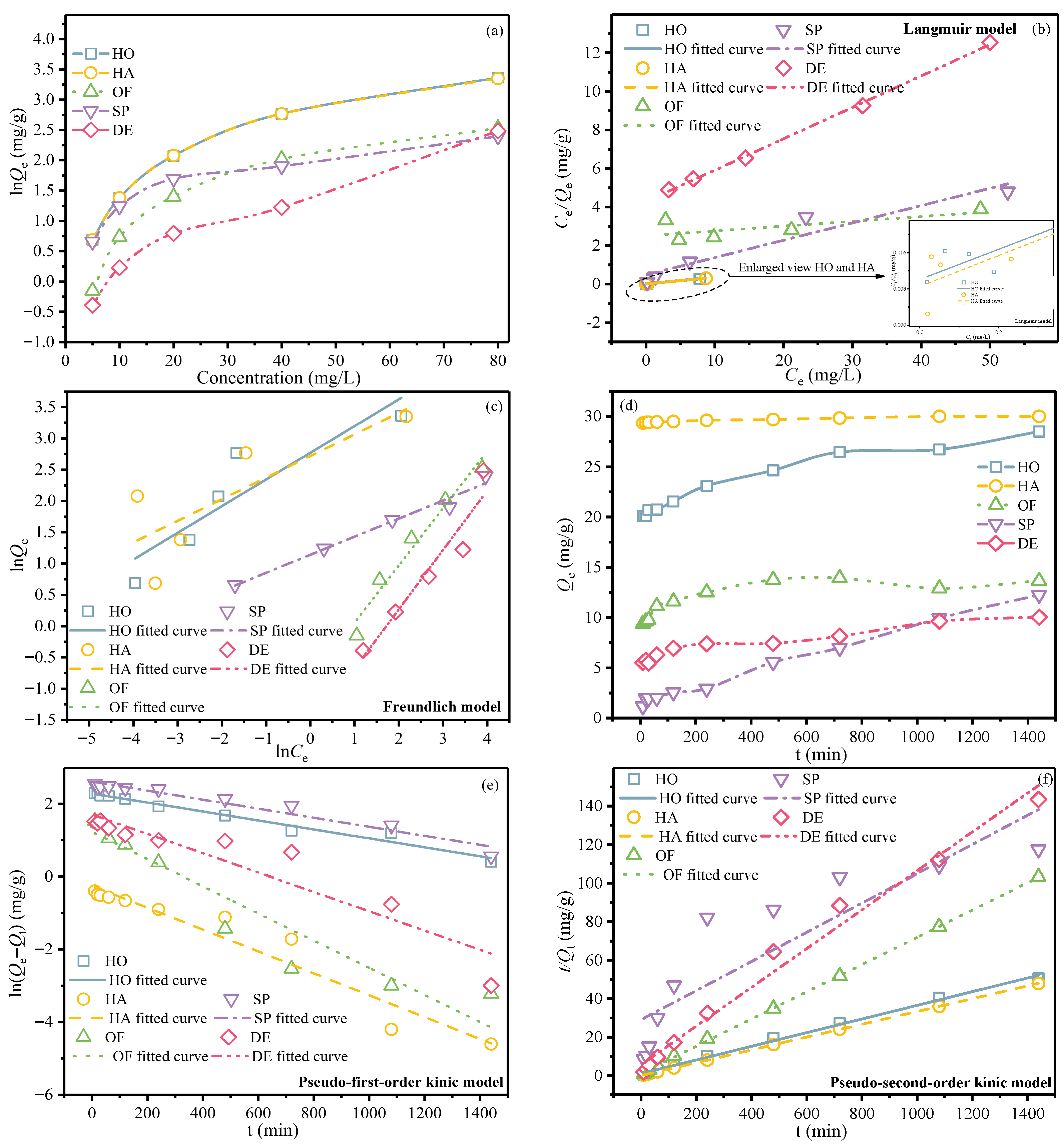
The influence of varying initial Cd2+ concentrations on the adsorption efficiency of the five passivators is shown in Figure 1a. Increasing the initial Cd2+ concentration generally led to enhanced adsorption capacities across all passivators, with HO and HA exhibiting better performance than the other passivators. The adsorption capacities of HA, OF, and DE increased rapidly at low initial Cd concentrations and began to level off at Cd concentrations of approximately 20 mg/L, indicating that their adsorption sites gradually approached saturation. In contrast, the adsorption capacity to increase across the entire concentration range, and no clear adsorption plateau was observed, suggesting a greater contribution from multilayer adsorption and/or surface heterogeneity.
To further understand the adsorption equilibrium under different conditions, both Langmuir and Freundlich adsorption isotherms were applied (Figure 1b,c), with the derived parameters presented in Table 2. The fitting results showed that the Langmuir model provided a better fit for HA, SP, and DE, as indicated by higher R2 values, suggesting predominantly monolayer adsorption on relatively homogeneous surfaces. In contrast, the Freundlich model better described the adsorption behavior of OF, implying heterogeneous surface adsorption and possible multilayer interactions. Notably, for HO and HA, the equilibrium Cd concentrations were mainly distributed in the low-concentration range, which resulted in closely spaced data points. Therefore, an enlarged view of the low-concentration region is provided in Figure 1b to clearly show all data points.
Figure 1d illustrates the impact of contact time on the adsorption of Cd2+ ions by five passivators, revealing a two-phase process characterized by a rapid initial stage followed by a slower one. During the adsorption process, HO and OF reached equilibrium at approximately 720 min, with the equilibrium adsorption capacities recorded at 26.46 mg/g and 13.92 mg/g, respectively. In contrast, DE and SP did not reach equilibrium within the experimental timeframe. HA demonstrated a remarkable adsorption capacity, approaching equilibrium at 1080 min with a capacity of 30 mg/g. Pseudo-first-order and pseudo-second-order kinetic models were used to study the adsorption kinetics of passivators, with the corresponding parameters detailed in Table 3 and the fit curves depicted in Figure 1e,f. The analysis indicated that the pseudo-second-order model provided a superior fit for the adsorption kinetics of Cd2+ on the passivators and calculated the equilibrium adsorption capacities for HO, OF, and HA at 28.14 mg/g, 14.12 mg/g, and 30.01 mg/g, respectively. This suggests that the pseudo-second-order kinetic model more accurately described/explained the experimental observations, revealing that the adsorption mechanism was predominantly governed by chemisorption.

3.2. Effect of Passivators Addition on Soil pH and Aggregates

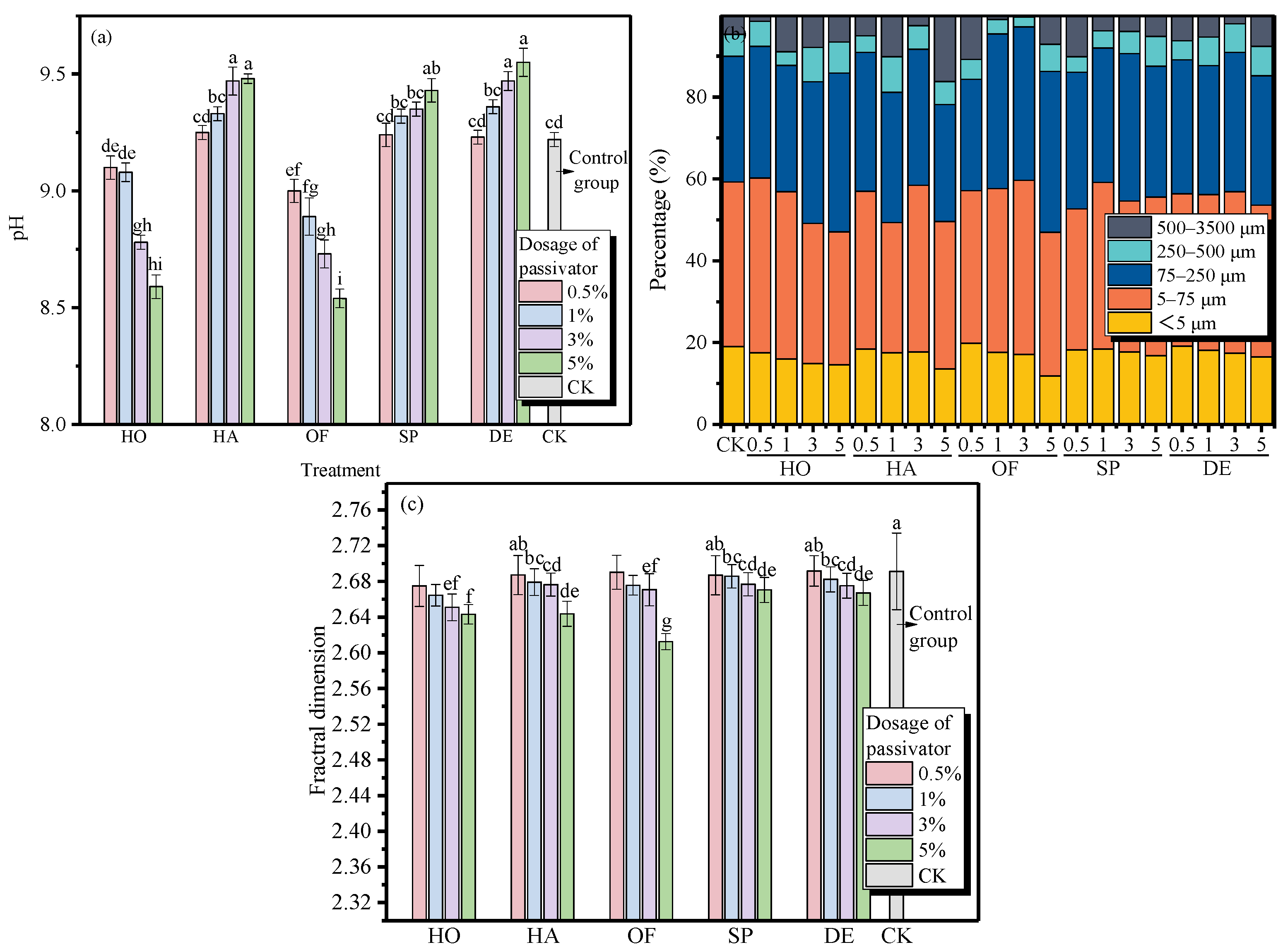
As shown in Figure 2, soil pH and the fractal dimension varied significantly among different passivator treatments and dosages. One-way ANOVA indicated that both passivator type and application rate had significant effects on soil properties (p < 0.05).
Soil pH is a significant factor affecting the distribution and mobility of heavy metal ions. The untreated soil exhibited alkalinity with a pH of 9.22, represented by the gray bars in Figure 2a. After the addition of five different passivators, except for the HO and OF, there were varying degrees of increase in pH with increased passivator dosage. Notably, HA, SP, and DE considerably raised the pH from 9.22 to 9.48, 9.43, and 9.55 at dosages of 5%, respectively. This increase may be partly attributed to the inherent pH of agents being relatively higher than that of the soil, which naturally rises with increasing dosages. Furthermore, HA, SP, and DE consume H+ in the soil, leading to a rise in pH. This in turn charges soil colloids with more negative charges [34], promoting that the agents can adsorb more Cd2+ or transform them into hydroxide precipitates [35]. For the HO and OF, with the contained organic fertilizer being derived from plant materials like straw, it generates organic acids (e.g., malic acid, tartaric acid, and citric acid) during decomposition [36], thereby reducing the soil pH as the dosage increases [20]; at 3% and 5% dosages, the soil pH decreased by 0.26 and 0.45 compared with CK, respectively. Both HO and OF decreased the soil pH significantly and pH decreased with the amount of HO and OF. After this decrease, the soil pH was more suitable for the growth of most plants.
Aggregates are the fundamental units of soil structure, comprising minerals and organic matter, and they effectively modulate conditions of water, nutrients, air, and temperature within the soil [37]. The quantity of aggregates of varying sizes determines soil structural properties, with aggregate distribution significantly impacting soil stability, nutrient storage and erosion, soil carbon cycling, and water retention capacity [38]. Aggregates serve as one of the crucial indicators for assessing soil fertility and quality.
Figure 2b reveals that the distribution pattern of aggregate mass percentage is consistent across six treatment groups. Aggregate sizes of less than 5–75 μm and 75–250 μm constituted the largest mass percentage, whereas those sized 250–500 μm and 500–3500 μm were the least. Compared to HO, HA, and OF, the influence of SP and DE on aggregate distribution was minor. However, the proportion within the <5 μm aggregates gradually decreased with an increase in passivator dosage. The addition of HO, HA, OF, SP, and DE showed a reduction of 23.49%, 28.51%, 37.65%, 11.46%, and 13.13% compared to the CK at a passivator dosage of 5%, respectively. Moreover, aggregates sized 5–75 μm also mostly decreased to varying degrees after passivator addition with a 5% dosage, causing reductions of 19.29%, 10.60%, 12.83%, 3.82%, and 7.87% compared to the CK. Accordingly, passivator addition led to increases in aggregates sized 75–250 μm, 250–500 μm, and 500–3500 μm. In general, soil aggregates larger than 0.25 mm are considered optimal for soil fertility, as they contribute to improved soil structure, aeration, water retention, and organic matter stabilization [39,40,41]. Therefore, the observed increase in aggregates sized 250–500 μm and 500–3500 μm after passivator addition indicates an improvement in soil structural quality and fertility potential. Similar conclusions can be drawn from the fractal dimensions (Figure 2c), which decreased with increasing passivator dosage, indicating that passivators promote inter-aggregate connectivity. The gray bars in Figure 2c represent the fractal dimension of the untreated control group (CK). The fractal dimensions of HO and OF treatments were generally lower than the other three groups, particularly when dosages were at 5%, with decreases from 2.69 to 2.64 and 2.61, respectively. The combination of soil with HO and OF transforms organic fertilizer to organic matter, which can not only adsorb Cd2+ but also the organic matter acts as a crucial binder for aggregates, binding particles together. The addition of these passivators leads to an increase in aggregate size [42], which is conducive to the crops growing.

3.3. Leaching of Cd

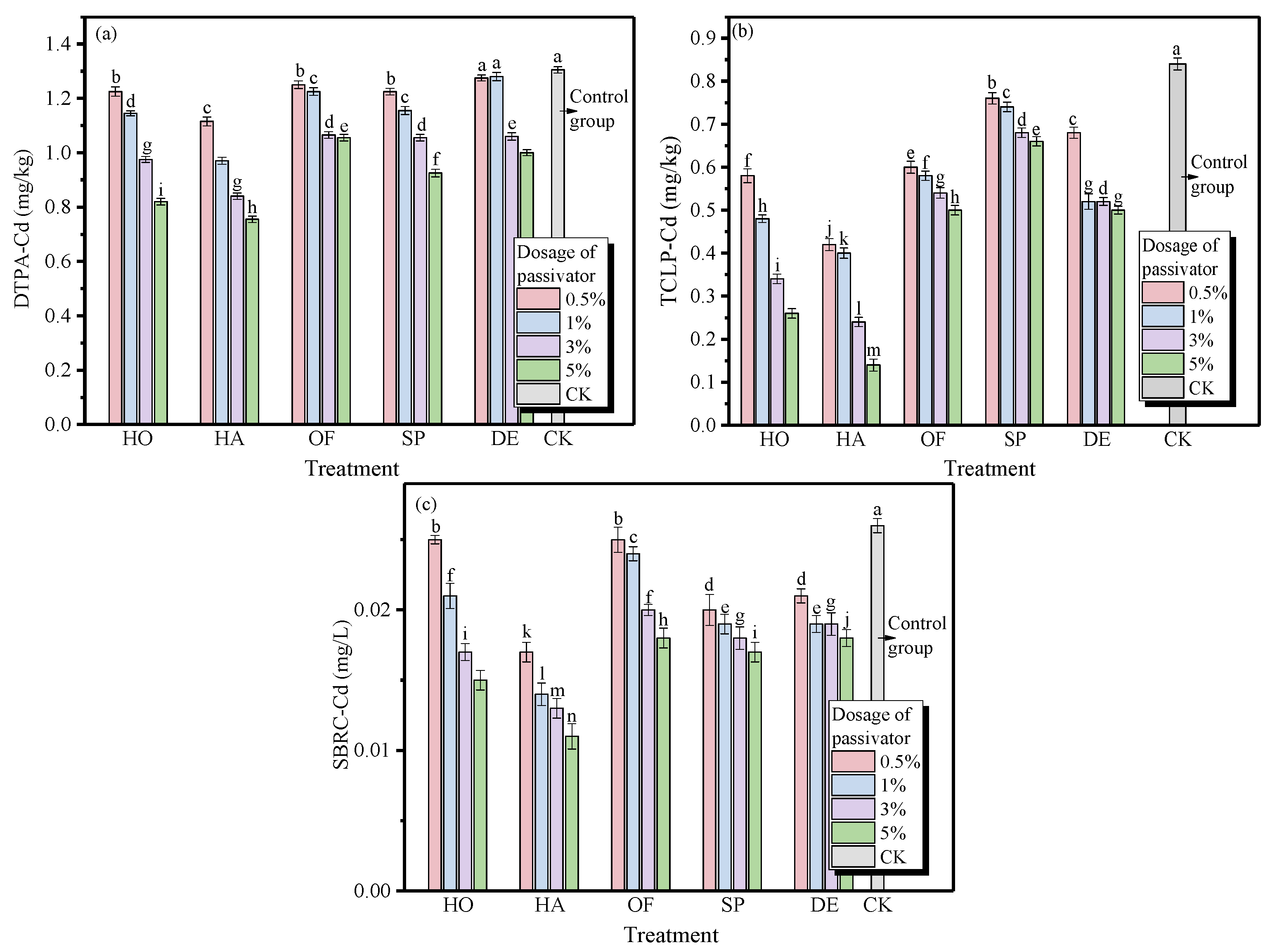
The contents of DTPA-extractable Cd, TCLP-extractable Cd, and SBRC-extractable Cd were significantly influenced by the application of different passivators (Figure 3). Statistical analysis confirmed significant differences among treatments at p < 0.05.
Passivator types and dosages had varying effects on the bioavailable and leachable states of Cd2+ in cadmium-contaminated soil. The gray bars in Figure 3 represent the leachable states of Cd2+ of the untreated control group (CK) The DTPA extraction method is often used to analyze the potential availability of heavy metals in soil to plants. As illustrated in Figure 3a, the DTPA-Cd concentration in the CK group was 1.305 mg/kg. After the addition of five passivators, the concentration of DTPA-Cd decreased to varying extents. HA exhibited the highest soil passivation efficiency at all dosages, with reductions of 14.22%, 25.67%, 35.63%, and 42.14%, respectively. Similarly, the cadmium immobilization capacity of HO approached that of HA; the reduction was 6.13%, 12.26%, 25.29%, and 37.16%. OF also reduced part of the DTPA-Cd concentrations, with a 3% and 5% dosage resulting in reductions of 18.39% and 19.16%. At the 5% dosage, SP and DE decreased bioavailable cadmium by 29.12% and 23.37%, respectively. The increase in the amount of HO and HA also significantly reduced the DTPA-Cd content in the soil.
As the latest statutory heavy metal pollution evaluation method in the U.S.A., TCLP is mainly used to detect the dissolution and migration of heavy metal elements in solid media. Figure 3b shows the results of the TCLP-extractable Cd concentrations. The TCLP-Cd concentration of the untreated soil was 0.84 mg/kg. After the addition of five passivators, the TCLP-Cd concentration of the soil decreased. Consistent with DTPA results, HA-treated soil showed the lowest concentrations at all dosages; with the addition of 3% and 5%, the TCLP-Cd concentration decreased by 71.43% and 83.33% compared to the CK, respectively. HO, OF, SP, and DE produced similar reductions in the TCLP-Cd concentration at a 5% dosage, with decreases of 69.05%, 40.48%, 21.43%, and 40.48%, respectively. With an increase in the amount of the passivating agent, the soil DTPA-Cd content decreased significantly.
The SBRC in vitro simulation method, which models the environment of gastric and intestinal fluids to leach Cd2+ from soil, was used to assess the bioavailability of cadmium in the soil. As shown in Figure 3c, the SBRC-Cd content in the CK group was 0.026 mg/L. Among the passivator treatments, HA showed the reduction was the largest; with the addition of 3% and 5%, the reduction was 50% and 57.69%. The reduction resulting from the HO treatment was also greater, i.e., 34.62% and 42.31% under 3% and 5% addition, respectively. The reductions under OF, SP, and DE treatments were slightly lower than that under the HA and HO treatment, i.e., by 30.77%, 34.62%, and 30.77%, respectively. An increase in the amount of the passivating agent contributes to a decrease in the soil SBRC-Cd concentration.

4. Discussion

In acidic soils, heavy metals such as Cd2+ tend to be more soluble and mobile, resulting in higher bioavailability and greater environmental risk. In contrast, in alkaline soils, Cd is more likely to be retained through precipitation, adsorption, or complexation processes, although its long-term stability may still be influenced by soil properties and management practices.
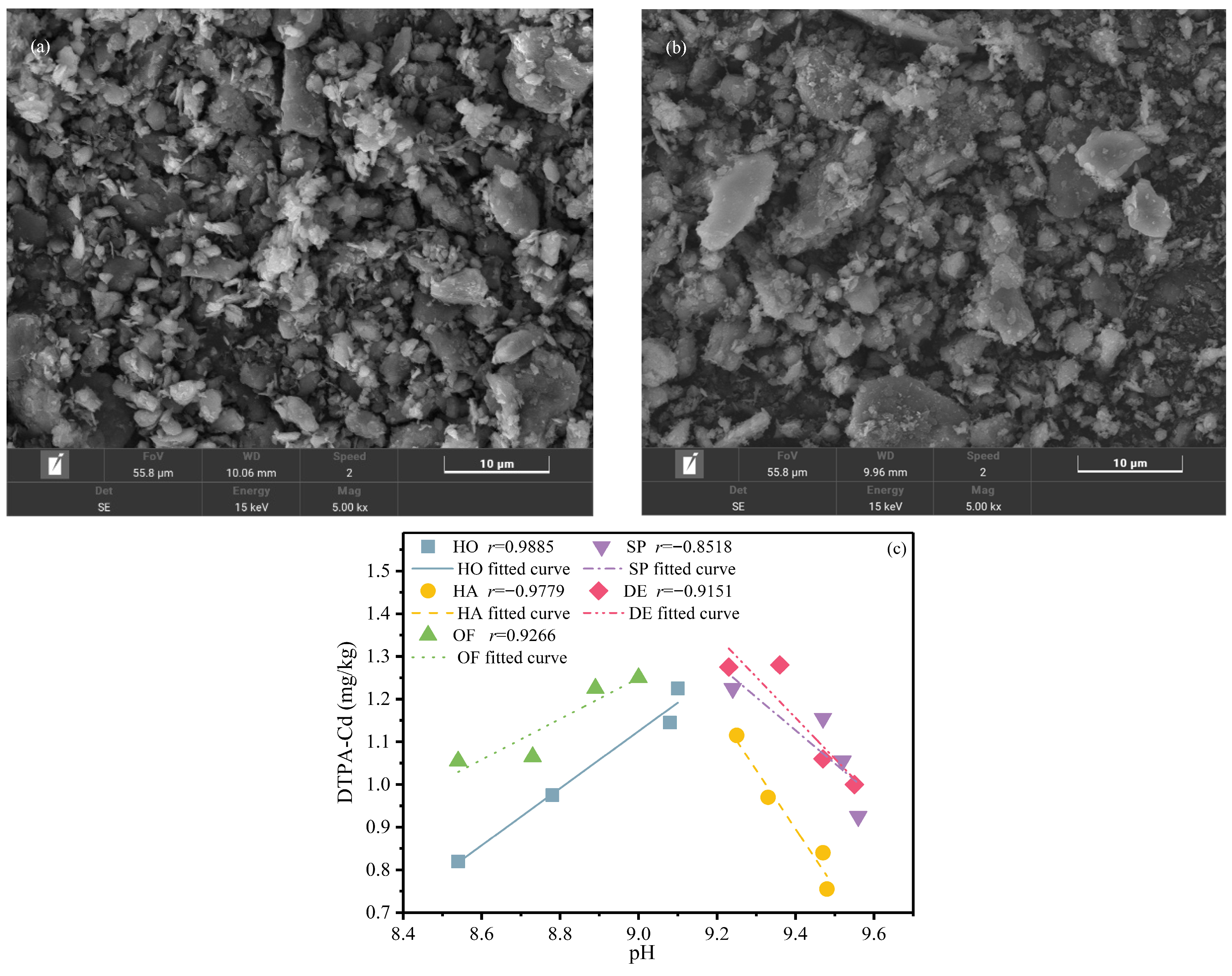
The immobilization of Cd2+ by HA in soil is generally attributed to ion exchange, surface complexation on phosphate-bearing surfaces, partial dissolution of phosphate phases, and the precipitation of Cd-containing phosphates. Compared with the control, HA application increased soil pH markedly (Figure 4), highlighting the important role of pH in Cd2+ immobilization. However, in alkaline soils, an additional pH increase induced by the amendments may exacerbate soil hardening/compaction and thus adversely affect subsequent agricultural practices. Therefore, a complementary amendment that moderates the pH increase is desirable.
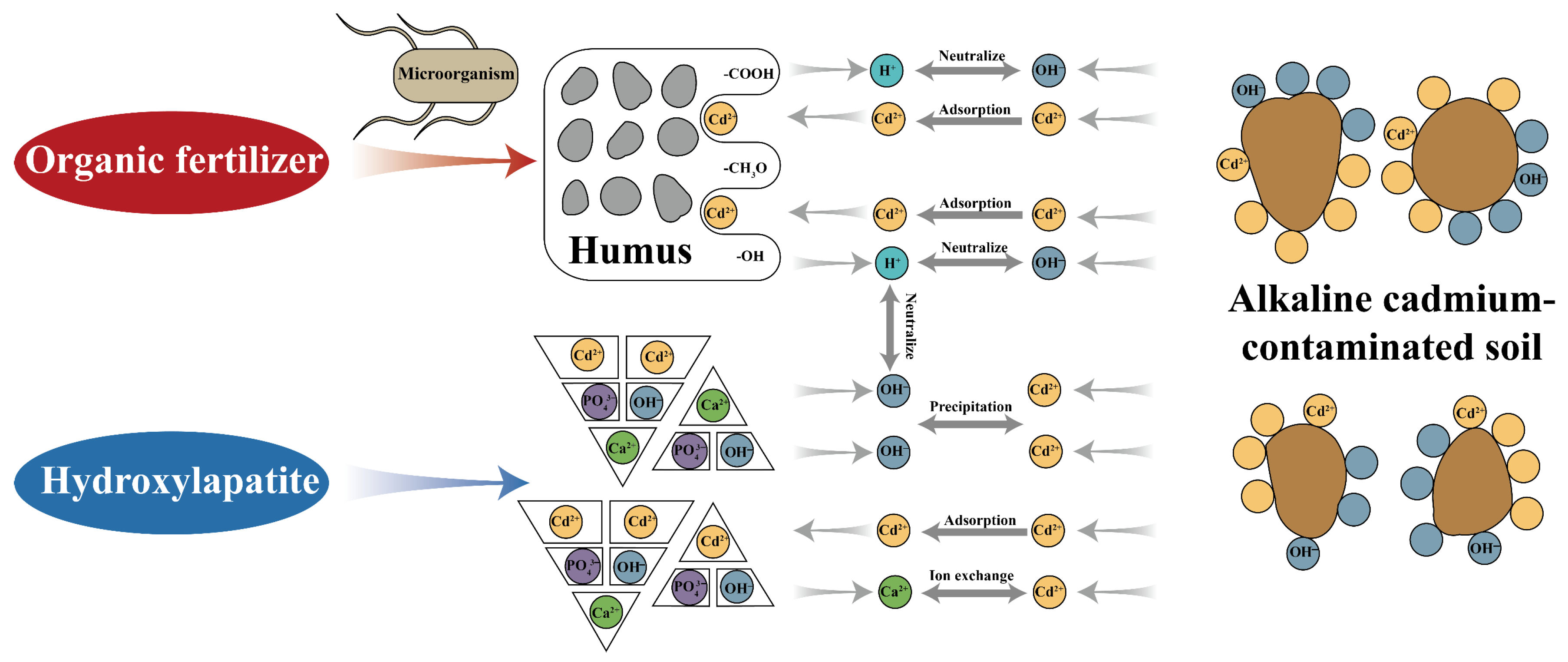
In this study, HA and organic fertilizer were co-applied rather than being prepared as hydroxyapatite–organic matter complexes. The HA used was a commercial calcium hydroxyapatite. The organic amendment was a straw-derived organic fertilizer. HA and straw fertilizer were pre-mixed and then incorporated into soil at an organic: mineral mass ratio of 1:1. During humification and microbial transformation (Figure 5), the dissociation of oxygen-containing functional groups (e.g., –COOH and –OH) can release H+, partially counteracting the alkalinization induced by HA. In addition, humic substances provide functional groups capable of binding Cd2+ via complexation and cation exchange. Notably, organic matter may also occupy some adsorption sites on mineral surfaces; thus, we interpret the improved performance of the combined treatment primarily as a system-level complementary effect (pH buffering plus additional Cd binding by organic ligands), rather than as an inherent “synergistic adsorption” mechanism on HA.
In recent years, a variety of organic–inorganic combined passivation strategies have been proposed for Cd-contaminated soils, including biochar–apatite systems and zeolite–organic matter composites. Biochar–apatite combinations have been reported to effectively immobilize Cd through a combination of phosphate precipitation, surface adsorption, and the high specific surface area of biochar while also improving soil structure and carbon sequestration (e.g., reference). However, biochar is often alkaline and may further increase soil pH, which can be undesirable in already alkaline soils.
Zeolite–organic matter systems rely primarily on cation exchange within zeolite frameworks and complexation by organic ligands, and have shown good performance in neutral to slightly acidic soils. Nevertheless, their Cd immobilization capacity can be limited by competition with other cations (e.g., Ca2+ and Mg2+) in alkaline environments.
Compared with these systems, the co-application of hydroxyapatite and straw-derived organic fertilizer used in this study offers a complementary mechanism particularly suited for alkaline soils. Hydroxyapatite provides a stable phosphate source for Cd precipitation, while the organic fertilizer contributes pH buffering and additional complexation capacity without excessively increasing soil alkalinity. In addition, the relatively low cost and wide availability of agricultural organic fertilizers enhance the practical feasibility of HO compared with more engineered materials, such as biochar or synthetic zeolites.
Overall, although HO does not rely on a deliberately engineered organic–inorganic composite structure, its system-level complementarity and cost-effectiveness make it a competitive alternative among combined passivation approaches for alkaline Cd-contaminated agricultural soils.
From a practical perspective, commercial HA is generally much more expensive than straw-derived organic fertilizers, which are typically produced from agricultural residues at substantially lower cost. Accordingly, combined application can reduce remediation costs while promoting the recycling of agricultural organic wastes. Overall, the co-application of commercial HA and straw-derived organic fertilizer shows promise for remediating alkaline, Cd-contaminated agricultural soils.
Although the present study demonstrates the effectiveness of HO in immobilizing Cd under controlled experimental conditions, several limitations should be acknowledged. First, the experiments were conducted over a relatively short time scale, and therefore the long-term stability of Cd immobilization by HO remains uncertain. In particular, environmental factors such as pH fluctuations and wet–dry cycles, which commonly occur in natural soil systems, may influence the persistence of Cd stabilization. Future studies should investigate the long-term behavior of Cd immobilized by HO under dynamic environmental conditions to better assess its practical applicability and environmental sustainability in field scenarios.

5. Conclusions

This study compared a combined amendment of commercial calcium hydroxyapatite and a straw-derived organic fertilizer (HO; pre-mixed at an organic:mineral mass ratio of 1:1) with four individual amendments (HA, OF, SP, and DE) for Cd immobilization in alkaline Cd-contaminated soil. Based on batch adsorption tests and soil incubation/leaching assessments, the following conclusions can be drawn:
  • In aqueous solution, HO exhibited a high Cd2+ adsorption capacity, comparable to HA and higher than OF, SP, and DE under the tested conditions, and the adsorption behavior differed among materials (e.g., OF was better described by the Freundlich model, whereas HA/SP/DE were better described by the Langmuir model).
  • In the alkaline soil (initial pH 9.22), HO (and OF) moderated soil alkalinity, decreasing the pH to 8.59 at a 5% application rate, while HA, SP, and DE increased soil pH. The addition of amendments also shifted aggregate-size distribution toward larger aggregates (>0.25 mm), indicating improved soil structural quality.
  • All amendments reduced Cd extractability to varying extents. Relative to the untreated control, HO reduced TCLP-extractable Cd by 30.95%, 42.86%, 59.52%, and 69.05% at application rates of 0.5%, 1%, 3%, and 5%, respectively, and also decreased DTPA- and SBRC-extractable Cd at higher application rates.
Overall, HO provided a practical combined strategy for alkaline Cd-contaminated soils by coupling phosphate-driven immobilization with organic matter-driven pH buffering and additional Cd binding. However, the present results are based on short-term controlled experiments; further field-scale and long-term studies (e.g., under wet–dry cycles and pH fluctuations) are needed to evaluate the persistence of Cd stabilization and potential agronomic impacts.

Author Contributions

Conceptualization, B.R. and W.W.; methodology, W.W. and M.W.; investigation, B.R.; resources, G.Z.; data curation, B.R., W.W., M.W. and G.Z.; writing—original draft preparation, G.Z.; writing—review and editing, B.R., W.W. and M.W.; supervision, G.Z.; funding acquisition, G.Z. All authors have read and agreed to the published version of the manuscript.

Funding

This research was funded by the National Natural Science Foundation of China General Program, grant number 52478388; the Open Fund Project of Jiangsu Collaborative Innovation Center for Building Energy Saving and Construction Technology, grant number SJXTBS2113; the Industry–University–Research Collaborative Project of Jiangsu Province (2025), grant number BY20251569, and the Natural Science Foundation of Jiangsu Province (grant number BK20231153).

Data Availability Statement

Dataset available on request from the authors.

Conflicts of Interest

Author Mingli Wei was employed by the company Jiangsu Institute of Zoneco Co., Ltd. The remaining authors declare that the research was conducted in the absence of any commercial or financial relationships that could be construed as potential conflicts of interest.

Abbreviations

The following abbreviations are used in this manuscript:
DEDiatomite
DTPADiethylenetriaminepentaacetic acid
HA Hydroxylapatite
HO Hydroxyapatite–organic fertilizer composite amendment
ICP-MSInductively coupled plasma mass spectrometry
ANOVAOne-way analysis of variance
OF Organic fertilizer
SP Sepiolite
SBRCSolubility bioavailability research consortium
SDStandard deviation
TCLPToxicity leaching procedure test
TEATriethanolamine
USEPAUnited States Environmental Protection Agency

References

  1. Ballabio, C.; Jones, A.; Panagos, P. Cadmium in topsoils of the European Union–An analysis based on LUCAS topsoil database. Sci. Total Environ. 2024, 912, 168710. [Google Scholar] [CrossRef] [PubMed]
  2. Song, L.P.; Zhou, J.H.; Xu, X.Y.; Na, M.; Xu, S.Q.; Huang, Y.J.; Zhang, J.; Li, X.P.; Zheng, X.Q. Inoculation of cadmium-tolerant bacteria to regulate microbial activity and key bacterial population in cadmium-contaminated soils during bioremediation. Ecotoxicol. Environ. Saf. 2024, 271, 115957. [Google Scholar] [CrossRef] [PubMed]
  3. Huang, X.H.; Li, X.Z.; Zheng, L.P.; Zhang, Y.; Sun, L.; Feng, Y.H.; Du, J.Y.; Lu, X.S.; Wang, G.Q. Comprehensive assessment of health and ecological risk of cadmium in agricultural soils across China: A tiered framework. J. Hazard. Mater. 2024, 465, 133111. [Google Scholar] [CrossRef] [PubMed]
  4. Bashir, S.; Ali, U.; Shaaban, M.; Gulshan, A.B.; Iqbal, J.; Khan, S.; Husain, A.; Ahmed, N.; Mehmood, S.; Kamran, M.; et al. Role of sepiolite for cadmium (Cd) polluted soil restoration and spinach growth in wastewater irrigated agricultural soil. J. Environ. Manag. 2020, 258, 110020. [Google Scholar] [CrossRef]
  5. Wei, X.D.; Yang, D.; Yin, X.H.; Yang, H.Q.; Fang, Y.Y.; Chen, N.; Zhang, H.; Hu, Z.Y. Comparative study of efficiencies of purification of cadmium contaminated irrigation water by different purification systems. Sci. Total Environ. 2024, 907, 167941. [Google Scholar] [CrossRef]
  6. Chen, L.; Ma, J.; Xiang, S.; Jiang, L.; Wang, Y.; Li, Z.; Liu, X.; Duan, S.; Luo, Y.; Xiao, Y. Promotion of rice seedlings growth and enhancement of cadmium immobilization under cadmium stress with two types of organic fertilizer. Environ. Pollut. 2024, 346, 123619. [Google Scholar] [CrossRef]
  7. Huang, F.Y.; Li, Z.M.; Yang, X.; Liu, H.J.; Chen, L.; Chang, N.; He, H.R.; Zeng, Y.; Qiu, T.Y.; Fang, L.C. Silicon reduces toxicity and accumulation of arsenic and cadmium in cereal crops: A meta-analysis, mechanism, and perspective study. Sci. Total Environ. 2024, 918, 170663. [Google Scholar] [CrossRef]
  8. Zhu, Z.Q.; Liu, H.K.; Yang, Y.H.; Zhou, X.B.; Tang, S.; Zhang, L.H.; Zhu, Y.N.; Fan, Y.M. Remediation characteristics and effects of electrokinetic-citric acid system on karst soil contaminated by arsenic and cadmium. Environ. Technol. Innov. 2024, 33, 103483. [Google Scholar] [CrossRef]
  9. Huang, C.Y.; Huang, H.L.; Qin, P.F. In-situ immobilization of copper and cadmium in contaminated soil using acetic acid-eggshell modified diatomite. J. Environ. Chem. Eng. 2020, 8, 103931. [Google Scholar] [CrossRef]
  10. Qu, J.; Li, Y.; Sun, H.; Liu, R.; Han, Y.; Bi, F.; Fan, H.; Zhang, G.; Zhang, Y.; Wang, Y. Ball-milled sepiolite/phosphate rock for simultaneous remediation of cadmium-contaminated farmland and alleviation of phosphorus deficiency symptoms in pepper. Chem. Eng. J. 2024, 488, 150925. [Google Scholar] [CrossRef]
  11. Piri, M.; Sepehr, E.; Samadi, A.; Farhadi, K.H.; Alizadeh, M. Contaminated soil amendment by diatomite: Chemical fractions of zinc, lead, copper and cadmium. Int. J. Environ. Sci. Technol. 2021, 18, 1191–1200. [Google Scholar] [CrossRef]
  12. Wen, J.W.; Wu, C.; Bi, X.Y.; Zhang, S.L.; Ouyang, H.; Ye, J.X.; Ohnuki, T.; Yu, Q.Q. Soil pH change induced by smelting activities affects secondary carbonate production and long-term Cd activity in subsoils. Appl. Geochem. 2023, 152, 105663. [Google Scholar] [CrossRef]
  13. Zhang, Y.N.; Zhang, Y.J.; Wu, A.G. Remediation effects and mechanisms of typical minerals combined with inorganic amendment on cadmium-contaminated soil: A field study in wheat. Environ. Sci. Pollut. Res. 2023, 30, 38605–38615. [Google Scholar] [CrossRef] [PubMed]
  14. Yue, J.; Li, T.; Tian, J.; Ge, F.; Li, F.; Liu, Y.; Zhang, D.; Li, J. Penicillium oxalicum induced phosphate precipitation enhanced cadmium (Cd) immobilization by simultaneously accelerating Cd biosorption and biomineralization. J. Hazard. Mater. 2024, 470, 134306. [Google Scholar] [CrossRef] [PubMed]
  15. Zhou, Y.; Cui, Y.; Yang, J.; Chen, L.; Qi, J.; Zhang, L.; Zhang, J.; Huang, Q.; Zhou, T.; Zhao, Y. Roles of red mud in remediation of contaminated soil in mining areas: Mechanisms, advances and perspectives. J. Environ. Manag. 2024, 356, 120608. [Google Scholar] [CrossRef]
  16. Feng, Y.; Yang, J.J.; Aminu, D.; Han, H.; Yan, Y.B.; Wang, Y.H.; Liu, J.; Wang, X.D. Effects of hydroxyapatite on safe wheat production and soil microbial functional genes in an alkaline soil contaminated with heavy metals. Environ. Res. 2023, 220, 115183. [Google Scholar] [CrossRef]
  17. Hamid, Y.; Tang, L.; Hussain, B.; Usman, M.; Lin, Q.; Rashid, M.S.; He, Z.L.; Yang, X.E. Organic soil additives for the remediation of cadmium contaminated soils and their impact on the soil-plant system: A review. Sci. Total Environ. 2020, 707, 136121. [Google Scholar] [CrossRef]
  18. Zhang, Y.N.; Zhang, Y.J.; Akakuru, O.U.; Xu, X.W.; Wu, A.G. Research progress and mechanism of nanomaterials-mediated in-situ remediation of cadmium-contaminated soil: A critical review. J. Environ. Sci. 2021, 104, 351–364. [Google Scholar] [CrossRef]
  19. Wang, Z.L.; Zhang, T.T.; Zhao, Y.L.; Miao, Y.H.; Zhang, L.J.; Sarocchi, D.; Song, S.X.; Zhang, Q.W. Immobilization of Cd in contaminated soil by mechanically activated calcite: Sustained release activity-depended performance and mechanisms. Chem. Eng. J. 2024, 482, 149024. [Google Scholar] [CrossRef]
  20. Liu, Z.T.; Ning, X.; Long, S.; Wang, S.L.; Li, S.G.; Dong, Y.W.; Nan, Z.R. Arsenic and cadmium simultaneous immobilization in arid calcareous soil amended with iron-oxidizing bacteria and organic fertilizer. Sci. Total Environ. 2024, 920, 170959. [Google Scholar] [CrossRef]
  21. Jiang, W.; Li, D.A.; Yang, J.L.; Ye, Y.Y.; Luo, J.W.; Zhou, X.J.; Yang, L.; Liu, Z.Z. A combined passivator of zeolite and calcium magnesium phosphate fertilizer: Passivation behavior and mechanism for Cd (II) in composting. Environ. Res. 2023, 231, 116306. [Google Scholar] [CrossRef] [PubMed]
  22. Wang, H.Y.; Liu, H.; Li, J.H.; Chen, S.N.; Zaman, Q.U.; Sultan, K.; Rehman, M.; Saud, S.; El-Kahtany, K.; Fahad, S.; et al. Combined passivators regulate physiological, antioxidant potential and metals accumulation in potato grown in metals contaminated soil. Sci. Total Environ. 2024, 912, 168956. [Google Scholar] [CrossRef] [PubMed]
  23. Zhang, J.X.; Dai, L.M.; Li, J.H.; Zeng, Q.Y.; Zhou, M.; Hou, H.B. Phosphate tailings-based slow-release heavy metal passivation materials: Mechanism, environmental risk, and microbial community evolution. J. Clean. Prod. 2024, 434, 139931. [Google Scholar] [CrossRef]
  24. Han, L.W.; Zhao, Z.J.; Li, J.; Ma, X.B.; Zheng, X.; Yue, H.Y.; Sun, G.H.; Lin, Z.Y.; Guan, S.Q. Application of humic acid and hydroxyapatite in Cd-contaminated alkaline maize cropland: A field trial. Sci. Total Environ. 2023, 859, 160315. [Google Scholar] [CrossRef]
  25. Jia, L.J.; Zhou, Y.L.; Su, Y.X.; Zhao, P.; Zhang, J.L.; Fan, W.; Yang, S.C.; Long, G.Q. Coupling raw material cultivation with nano-hydroxyapatite application to utilize and remediate severely Cd-containing soil. Process Saf. Environ. 2024, 184, 96–104. [Google Scholar] [CrossRef]
  26. Yan, Y.B.; Du, M.; Jing, L.Q.; Zhang, X.X.; Li, Q.; Yang, J.J. Green synthesized hydroxyapatite for efficient immobilization of cadmium in weakly alkaline environment. Environ. Res. 2023, 223, 115445. [Google Scholar] [CrossRef]
  27. Iqbal, A.; Ligeng, J.; Mo, Z.W.; Adnan, M.; Lal, R.; Zaman, M.; Usman, S.; Hua, T.; Imran, M.; Pan, S.G.; et al. Substation of vermicompost mitigates Cd toxicity, improves rice yields and restores bacterial community in a Cd-contaminated soil in Southern China. J. Hazard. Mater. 2024, 465, 133118. [Google Scholar] [CrossRef]
  28. Miao, T.L.; Jin, Z.H.; Kong, L.H.; Jin, Y.; Liu, X.S.; Qu, J.J. Effect of composite organic amendment on Cd(II) ions stabilization and microbial activity under various ammonium sulfate levels. Environ. Res. 2024, 247, 118194. [Google Scholar] [CrossRef]
  29. Yang, W.T.; Jing, H.N.; Yang, L.Y.; Li, X.X.; Chen, M.Z.; Xu, M.Q.; Chen, Y.L.; Wu, P.; Liu, H.Y.; Wang, P. Effects of rapeseed residue organic fertilizer on cadmium toxicity in soil and its uptake and transfer by rice plants (Oryza sativa L.). Land Degrad. Dev. 2023, 34, 2791–2802. [Google Scholar] [CrossRef]
  30. Liu, T.; Wang, Q.; Li, Y.; Chen, Y.; Jia, B.; Zhang, J.; Guo, W.; Li, F.Y. Bio-organic fertilizer facilitated phytoremediation of heavy metal (loid) s-contaminated saline soil by mediating the plant-soil-rhizomicrobiota interactions. Sci. Total Environ. 2024, 922, 171278. [Google Scholar] [CrossRef]
  31. Li, J.; Zhang, P.Y.; Ye, J.P.; Zhang, G.M.; Cai, Y.J. Simultaneous in-situ remediation and fertilization of Cd-contaminated weak-alkaline farmland for wheat production. J. Environ. Manag. 2019, 250, 109528. [Google Scholar] [CrossRef] [PubMed]
  32. Lindsay, W.L.; Norvell, W. Development of a DTPA soil test for zinc, iron, manganese, and copper. Soil Sci. Soc. Am. J. 1978, 42, 421–428. [Google Scholar] [CrossRef]
  33. Ruby, N.F.; Burns, D.E.; Heller, H.C. Circadian rhythms in the suprachiasmatic nucleus are temperature-compensated and phase-shifted by heat pulses in vitro. J. Neurosci. 1999, 19, 8630–8636. [Google Scholar] [CrossRef] [PubMed]
  34. Li, X.Y.; Zhang, M.J.; Li, S.Y.; Wei, W. Humic acid-mediated transport of a typical soil passivation remediation product (chloropyromorphite) in saturated porous media. J. Environ. Sci. 2024, 141, 51–62. [Google Scholar] [CrossRef]
  35. Wei, B.L.; Peng, Y.C.; Jeyakumar, P.; Lin, L.X.; Zhang, D.L.; Yang, M.Y.; Zhu, J.N.; Lin, C.S.K.; Wang, H.L.; Wang, Z.T.; et al. Soil pH restricts the ability of biochar to passivate cadmium: A meta-analysis. Environ. Res. 2023, 219, 115110. [Google Scholar] [CrossRef]
  36. Singh, C.; Amberger, A. Organic acids and phosphorus solubilization in straw composted with rock phosphate. Bioresour. Technol. 1998, 63, 13–16. [Google Scholar] [CrossRef]
  37. Wang, Q.Y.; Wang, Q.R.; Wang, T.Y.; Zhang, S.Q.; Yu, H.W. Impacts of polypropylene microplastics on the distribution of cadmium, enzyme activities, and bacterial community in black soil at the aggregate level. Sci. Total Environ. 2024, 917, 170541. [Google Scholar] [CrossRef]
  38. Huang, X.; Tang, S.T.; Zeng, M.; Wu, Y.; Liang, J.L.; Yuan, Y.; Yu, F.M.; Li, Y. Soil aggregate size mediates the impact of different fertilization patterns on the diazotrophic community of mine soils. Appl. Soil Ecol. 2024, 193, 105173. [Google Scholar] [CrossRef]
  39. Bronick, C.J.; Lal, R. Soil structure and management: A review. Geoderma 2005, 124, 3–22. [Google Scholar] [CrossRef]
  40. Six, J.; Elliott, E.T.; Paustian, K. Soil macroaggregate turnover and microaggregate formation: A mechanism for C sequestration under no-tillage agriculture. Soil Biol. Biochem. 2000, 32, 2099–2103. [Google Scholar] [CrossRef]
  41. Tisdall, J.M.; Oades, J.M. Organic matter and water-stable aggregates in soils. J. Soil Sci. 1982, 33, 141–163. [Google Scholar] [CrossRef]
  42. Zhang, Y.; Li, Y.; Xu, Y.; Huang, Q.; Sun, G.; Qin, X.; Wang, L. Effects of mercapto-palygorskite application on cadmium accumulation of soil aggregates at different depths in Cd-contaminated alkaline farmland. Environ. Res. 2023, 216, 114448. [Google Scholar] [CrossRef]
Figure 1. Effect of initial Cd2+ concentration on Cd2+ adsorption (a); Langmuir model (the dashed box indicates the densely clustered data points of HO and HA, which are shown in an enlarged view for clarity) (b) and Freundlich model (c); and the effect of contact time on Cd2+ adsorption (d), pseudo-first-order (e), and pseudo-second-order (f).
Environments 13 00110 g001
Figure 2. Influence of passivators on contaminated soil as a function of the pH (a), aggregate distribution of treated soil and raw soil (b), and fractal dimension of treated soil and raw soil (c). Values are means ± SD (n = 3). Different letters above bars indicate significant differences among treatments according to one-way ANOVA followed by Tukey’s test at p < 0.05.
Environments 13 00110 g002
Figure 3. Effects of different passivators and application dosages on Cd extractability in contaminated soil. (a) DTPA-extractable Cd; (b) TCLP-extractable Cd; and (c) SBRC-extractable Cd under different passivator treatments and dosages. Values are means ± SD (n = 3). Different letters above bars indicate significant differences among treatments according to one-way ANOVA followed by Tukey’s test at p < 0.05.
Environments 13 00110 g003
Figure 4. Scanning electron microscopy images of the soil improved by the passivators: (a) soil, (b) soil + 5%HO, and (c) the relationship between DTPA-Cd and pH.
Environments 13 00110 g004
Figure 5. The mechanism of alkaline cadmium-contaminated agriculture soil passivation by the combination of hydroxylapatite and organic fertilizer. Arrows illustrate the key immobilization processes: arrows represent transformation or degradation pathways (e.g., organic matter to humus); and effects or interactions (e.g., pH neutralization, adsorption, precipitation, ion exchange).
Environments 13 00110 g005
Table 2. Parameters of Langmuir and Freundlich adsorption isotherms.
PassivatorLangmuir ModelFreundlich Model
Qm (mg/g)KL (L/mg)R21/nKF ((mg/kg)·(L/mg)1/n)R2
HA29.9943.3141150.99920.4262815.958160.8183
HO29.325513.9976550.99870.3449915.158480.6448
OF40.128410.0099260.51460.914210.4239970.9662
SP11.133380.1869690.92920.288643.1301780.9805
DE6.1353460.0380740.99870.948630.1962470.9236
Table 3. Parameters of pseudo-first-order and pseudo-second-order kinetic models.
PassivatorPseudo-First-OrderPseudo-Second-Order
Qe (mg/g)K1 (min−1)R2Qe (mg/g)K2 (g/(mg·min))R2
HA9.8032110.001230.975228.137310.001240.997
HO0.7811020.003010.936730.0120.0185810.9999
OF3.4156570.003730.911414.124290.0045790.9997
SP13.632680.001240.949613.183920.0001980.755
DE5.4974810.002650.8829.9196510.0018330.984
Disclaimer/Publisher’s Note: The statements, opinions and data contained in all publications are solely those of the individual author(s) and contributor(s) and not of MDPI and/or the editor(s). MDPI and/or the editor(s) disclaim responsibility for any injury to people or property resulting from any ideas, methods, instructions or products referred to in the content.