Article

Effect of Organic Soil Amendments and Vineyard Topographic Position on the Chemical Composition of Syrah, Trincadeira, Alicante Bouschet, and Antão Vaz Grapes (Vitis vinifera L.) in the Alentejo Wine Region


by
Matteo Pierini
1,†,
Shrika G. Harjivan
1,†,
Nicolò Sieli
1,
Maria João Cabrita
2,3,
Sérgio Prats
2,4,
Sofia Catarino
1,5,6,7 and
Jorge M. Ricardo-da-Silva
1,5,6,*
1
Instituto Superior de Agronomia, Universidade de Lisboa, Tapada da Ajuda, 1349-017 Lisboa, Portugal
2
MED—Mediterranean Institute for Agriculture, Environment and Development & CHANGE—Global Change and Sustainability Institute, Universidade de Évora, Pólo da Mitra, Ap. 94, 7006-554 Évora, Portugal
3
Departamento de Fitotecnia, Escola de Ciências e Tecnologia, Universidade de Évora, Pólo da Mitra, Ap. 94, 7006-554 Évora, Portugal
4
Misión Biológica de Galicia—National Spanish Research Council (MBG-CSIC), 36143 Salcedo, Pontevedra, Spain
5
LEAF—Linking Landscape Environment Agriculture and Food—Research Center, Instituto Superior de Agronomia, Universidade de Lisboa, Tapada da Ajuda, 1349-017 Lisboa, Portugal
6
Associate Laboratory TERRA, Instituto Superior de Agronomia, Universidade de Lisboa, Tapada da Ajuda, 1349-017 Lisboa, Portugal
7
CeFEMA—Centre of Physics and Engineering of Advanced Materials, Instituto Superior Técnico, Universidade de Lisboa, Av. Rovisco Pais, 1, 1049-001 Lisboa, Portugal
*
Author to whom correspondence should be addressed.
These authors contributed equally to this work.
Environments 2026, 13(1), 44; https://doi.org/10.3390/environments13010044
Submission received: 4 December 2025 / Revised: 23 December 2025 / Accepted: 4 January 2026 / Published: 9 January 2026

Abstract

Climate change and unsustainable agricultural practices are triggering land degradation in semi-arid Mediterranean regions. Organic amendments, such as mulching materials, have shown promising potential to mitigate these impacts by improving soil chemical, physical, and biological properties, while enhancing grapevine growth and productivity. This study evaluated the effects of wheat straw mulch (M) and wheat straw combined with biochar (MB), together with vineyard topography (bottom vs. top), on grape chemical and phenolic composition in four Vitis vinifera L. cultivars (Syrah, Trincadeira, Alicante Bouschet, and Antão Vaz) grown in the Alentejo wine region. Grapes were sampled separately at top and bottom topographic positions, and classical and phenolic parameters were analyzed. The application of M and MB significantly modified must composition, mainly through changes in nitrogen and sugar levels across topographic positions. Only MB exhibited stronger effects, enhancing must quality, while MB and M reduced bottom–top variability. Similar patterns and positional effects were observed for phenolic and color parameters. Both organic treatments lowered total monomeric anthocyanin concentrations, although positional differences with wheat straw mulch were found. The results highlight that combining soil management with topography and variety response can optimize grape phenolic composition and promote sustainable viticulture through targeted, site-specific mulching strategies.

1. Introduction

The European Commission has reported that, under the present conditions, if gas emissions are not reduced, global drylands will expand by about 10% by the end of this century [1]. The steady rise in temperature and the increasing frequency of extreme weather events, combined with unsustainable agricultural practices (such as excessive tillage, the absence of cover crops, and deforestation), are reducing food availability by compromising soil fertility, soil biodiversity, the land’s natural resilience, and water quality [2]. Moreover, desertification is a process that, once it occurs, cannot be reversed except over hundreds of years (500 years for 2.5 cm of soil to form) [3].
The management of agricultural practices has a direct impact on preserving fertile soils, combating desertification, and mitigating climate change, an essential task for ensuring our food supply [4]. In this context, “sustainable agriculture” has been developed to promote agricultural practices that produce collective benefits beyond the final product, for the environment and human health [5]. One practice is soil organic mulching, in which organic materials are applied and retained on the soil surface. This application leads to an increase in soil organic matter (SOM), soil coverage, and carbon sequestration depending on the organic material used. SOM is a vast mixture of carbon compounds that helps maintain soil fertility and participates in nutrient, water, and biological cycles [4]. Moreover, soil cover with organic materials can control weed growth, minimize water loss, improve soil infiltration, decrease soil compaction, buffer extreme temperatures, and increase vine health [6]. Instead, carbon sequestration occurs when carbon-rich industrial by-products are used as mulch or organic amendments, consequently increasing soil carbon pool in place of the atmospheric carbon pool, which is the main cause of climate change [7].
A representative example is biochar, a carbon-rich organic amendment (70–80% carbon) obtained from slow pyrolysis of organic waste in an oxygen-limited environment process that makes it a slow carbon-releasing material. By applying it to the soil, the soil C pool is increased. Large-scale application programs estimate that biochar could sequester up to 9.50 billion tons of CO2 in the soil by 2100 [8]. Lippi et al., 2025 [8], provided an excellent summary of the effects of biochar on soil and its influence on grapevines. Their findings highlight that the impact of biochar on soil and plants varies significantly depending on its characteristics, soil type and condition, application rate and frequency, and other factors. Biochar has been reported to positively affect several soil properties: (i) it promotes the formation of stable soil aggregates and reduces soil erosion [9]; (ii) it improves soil water-holding capacity and increases water retention [10,11]; and (iii) it enhances the soil’s cation exchange capacity and reduces soil phytotoxicity [8]. Overall, biochar contributes to carbon sequestration by increasing soil organic carbon, is capable of improving soil habitat and fertility, and can immobilize heavy metals, limiting their mobility and potential toxicity in the soil system [12].
Biochar has been shown to increase root growth and mitigate drought stress in plants, enhancing their resilience under water-limited conditions [13]. Despite these positive effects, no significant impact on grape quality and wine sensory attributes has been observed [14]. In certain cases, biochar application has also led to increases in vegetative growth and, occasionally, improvements in yield.
A comprehensive review by Diacono and Montemurro (2010) [15] examined various crops, not just vines, summarizing different scientific studies that evaluate the impact of organic amendments on plant yield. In some cases, yields increased; in others, they decreased or showed no differences between control and amended soil, highlighting the importance of the other factors involved. Other studies, using mulch in the vineyard, observed increases in yield and vine growth [16], as well as increases in leaf N and K content. These results are normally observed starting from the third year of application [6].
A study published by Pinamonti et al. (1998) [17] reported an increase in the content of K and tartaric acid; a decrease in P, Ca, and Mg; and unchanged content of N, Fe, and Mn in grapes obtained from vineyards with OA treatment. This was attributed to the different depths at which roots absorb nutrients, with deeper root absorption occurring in treatments without amendments [17]. The mineral composition of wine after OA application changes extremely depending on the type of amendment used; however, it does not seem to cause any issues [18]. Some authors have reported an increase in total acidity after soil mulching, but only in dry years was an increase in total soluble solids (TTS) obtained [19], while in other conditions, a decrease in TSS was observed and total acidity remained constant [20]. Also, in a study conducted in New Zealand, researchers observed an increase in grape K and yeast assimilable nitrogen (YAN) after mulching with compost made from vineyards and winery waste [21]. It is believed that favorable thermal environment induced by a mulch layer can stimulate K uptake by the vine roots [6], which can explain the increase in K content registered by different authors after mulch application. Moreover, research on phenol composition following mulching revealed different responses depending on the terroir. In particular, the initial soil conditions and the type of OAs used were the major cause of variability on the responses [11]. Other studies investigating the effects of mulching on berry phenolic composition have reported contrasting results: some observed reductions or no changes [20,22,23,24], while others noted increases [25]. Most existing studies have focused on the nutrient improvement due to OA application, a few of them on soil temperature and almost none on the different water availability due to mulching.
This study aims to evaluate the combined effects of two organic treatments, wheat straw alone (M) and wheat straw combined with commercial biochar (MB), and vineyard topography (bottom vs. top hillslope position) on the chemical composition of grapes from four Vitis vinifera L. cultivars (Syrah, Trincadeira, Alicante Bouschet, and Antão Vaz), which were monitored over one harvest in Portuguese vineyards located in the Alentejo wine region. The specific objectives were the following: (a) to evaluate the classical chemical analyses (pH, total acidity, TSS, and YAN), to determine color parameters (color intensity and tonality), and to quantify phenolic compounds (total phenols, non-flavonoids, flavonoids, monomeric/oligomeric/polymeric proanthocyanidins, and total anthocyanins) of grapes collected separately from the top (t) and the bottom (b) topographic positions for each cultivar, and (b) to quantify monoglucosylated anthocyanins and their derivatives present in the samples by high-performance liquid chromatography (HPLC).
By assessing how two different soil organic treatments (M and MB) and vineyard topographic position interact to influence grape chemical composition, this study aims to provide new insights into soil–landscape features, with promising implications for both wine quality enhancement and the long-term sustainability of viticulture in Mediterranean and other water-limited regions.

2. Materials and Methods

2.1. Vineyard Locations and Harvest

In this study, four different cultivars of Vitis vinifera L.—three red varieties (Syrah (224 m above sea level; masl), Trincadeira (219 masl), and Alicante Bouschet (215 masl)) and one white grape variety (Antão Vaz (222 masl))—were present in two different vineyards, Fundação Eugénio de Almeida and Herdade do Mouchão, both located in the Alentejo wine region (Portugal) and separated by around 40 kms.
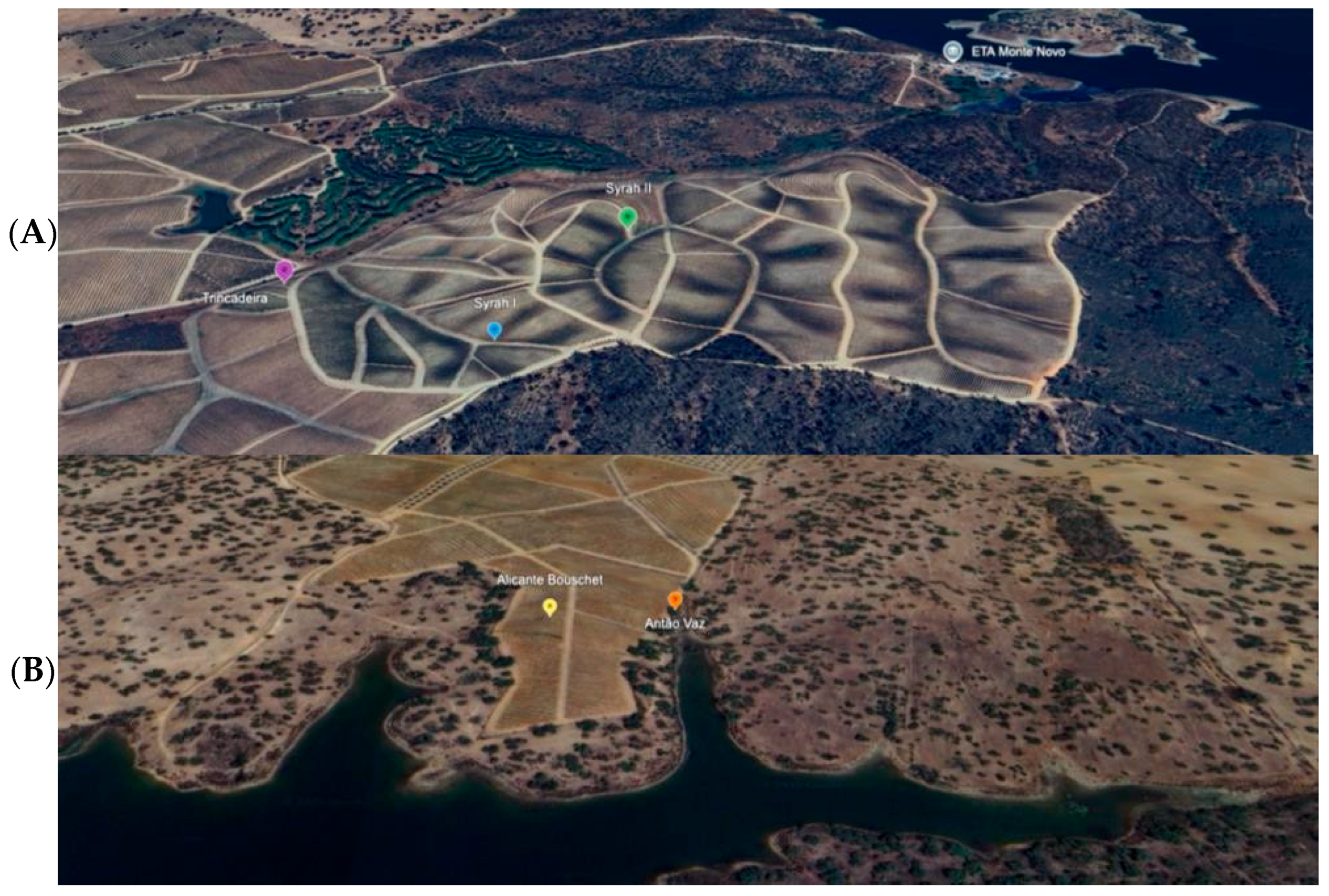
The first study area, Fundação Eugénio de Almeida (FEA), is in the municipality of Évora, São Manços. It lies between latitudes 38 and 39° (GPS coordinates 38°31′03″ N 7°44′17″ W). The soils are classified as Leptosol sandy-loam with 66% rock content (World Reference Base for Soil Resources, WRB), 10 cm soil depth, topsoil pH of 6.7, WHCmax of 47.7 mL (maximum water-holding capacity), and soil organic carbon (SOC) content of 5.5%. The climate is classified as Csa (temperate, with dry, hot summers). The average annual precipitation is 609 mm, mainly from October to April. The average annual temperature is 16 °C, with a minimum temperature above 5.8 °C (January) and a maximum temperature of 32.3 °C (August). Significant temperature variations are expected between day and night and between winter and summer. The vineyards were planted with Syrah (two sites, Syrah I and II) and Trincadeira (Trincadeira site), both grapevines grafted on 1103P, SO4, and 110R rootstocks in 2018, trained to an ascending vertical system with 2.5 m spacing (in-row). The vines were trained using a spur pruning system. Vine rows were oriented south–southwest for Syrah I (N200E), east–southeast for Syrah II (N100E), and northwest for Trincadeira (N300E). The steepness was 11° for Syrah I, 14° for Syrah II, and 15° for the Trincadeira site. Winter pruning was performed with mechanical pre-pruning, followed by manual finishing. Drip irrigation was performed during the summer. The harvest was manual, conducted on 5 September 2024 (Figure 1).
The second study area, Herdade do Mouchão (MOU), is in the municipality of Sousel, Casa Branca. It lies between latitudes 38 and 39° (38°55′03″ N 7°47′20″ W). The soils are classified as Cambisol, a more developed soil compared to Leptosol (WRB), deeper, and characterized by a cambic horizon (Bw) with 58% of rock content, 10 cm soil depth, topsoil pH of 8.1, WHCmax of 48.5 mL, and soil organic carbon (SOC) content of 5.7%. The climate is classified as Csa (temperate, with dry, hot summers). The vineyard’s proximity to a reservoir creates a meso-climate, which could influence their growing conditions (Figure 1). Alicante Bouschet and Antão Vaz grapevines were grafted on 99R rootstocks in 1995, trained to an ascending vertical system with 2.5 m spacing (in-row). The grapevines were trained using a bilateral cordon. Vine rows are faced east–southeast for the Alicante Bouschet site (N100E) and west–northwest for the Antão Vaz site (N2900E), and the steepness was 14° and 11° (for Alicante Bouschet and for Antão Vaz, respectively). The difference in altitude between the Antão Vaz top and bottom positions in the hillslope was 10 m. Winter pruning was performed with mechanical pre-pruning, followed by manual finishing. Drip irrigation was performed during the summer. The harvest was manual, conducted on 19 September 2024.
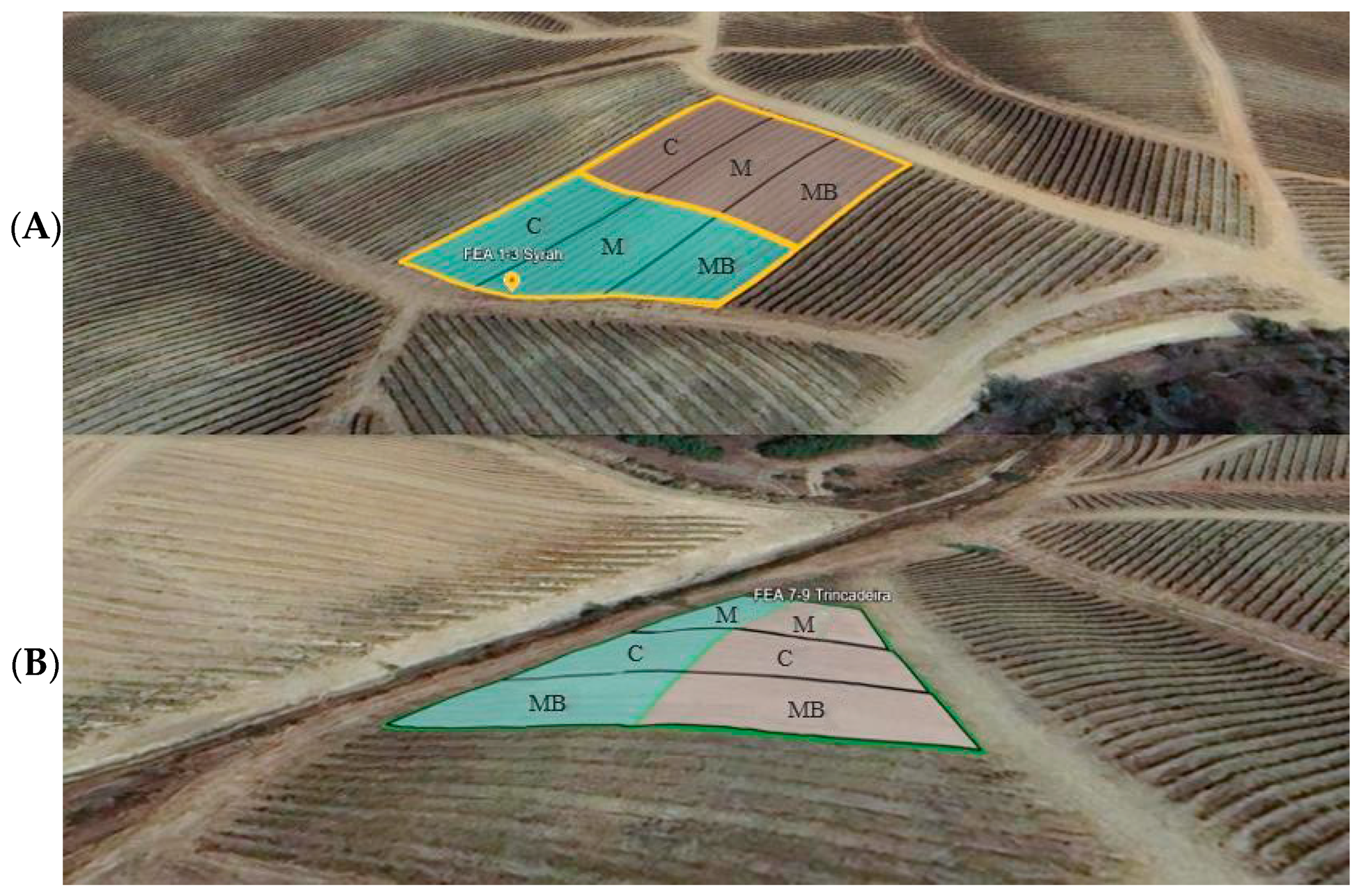
A total of 5 sites were divided into three test plots with different organic amendments: no organic treatment (C), wheat straw mulch (M treatment), and wheat straw combined with biochar (MB treatment). Each plot was further divided into two sections corresponding to the bottom (b) and top (t) topographic positions within the hillslope, with a 10 m difference in altitude between them (Figure 2).

2.2. Treatments

This study used wheat straw from Agriloja (Évora, Portugal) and “Ecochar”, a commercial biochar from Ibero Massa Florestal, produced from shredded wood of invasive Acacia species (A. dealbata Link and A. melanoxylon R. Br), that are of significant ecological concern in Portugal. The detailed properties of both organic amendments are listed in Table 1. The mulch treatment (M) consisted in the manual application of a layer of wheat straw mulch over the soil surface, without incorporation into the soil, at an application rate of 200 g m−2. The mulch and biochar treatment (MB) consisted of manual application, without incorporation into the soil, of a layer of biochar over the soil surface (1000 g of biochar per m2), which was subsequently covered by a layer of straw mulch (200 g m−2), in order to prevent biochar mobilization [26]. The treatments were applied between 9–10 November 2023 for the FEA and MOU sites.

2.3. Sampling

Grape samples (200 berries per sample) were collected for each variety and treatment from six distinct vines. Sampling was stratified by hillslope position, with two grapes samples picked separately from the top (t) and another two from the bottom (b) of the vine row to account for the different heights and levels of sunlight exposure. The grape samples were stored at −4 °C until further processing. Samples were organized and designated according to their treatments and hillslope locations: C b (control bottom position), C t (control top position), M b (mulch bottom position), M t (mulch top position), MB b (mulch–biochar bottom position), and MB t (mulch–biochar top position). A single composite collection was performed for each treatment and topographic position, and all analyses were conducted on those corresponding samples.

2.4. Grape Preparation for Analysis

According to the methodology proposed by Carbonneau and Champagnol (1993) [27], the grape extracts were obtained after maceration of seeds and skins in an ethanol and buffer solution at pH 3.20 for 24 h at 25 °C, followed by clarification of the suspension by centrifugation. The extracts were used to measure phenolic composition, while the classical analysis was performed on the must obtained from the pulp. The analyses were conducted in triplicate for each sample. For samples prepared for HPLC analysis, 2 mL of the clarified solution was filtered with a Whatman-Cytiva Europe (Velizy-Villacoublay, France) cellulose filter with a pore diameter of 0.45 μm and frozen at −4 °C until processing.

2.5. Classical Chemical Analysis

The basic chemical parameters were obtained directly from the corresponding must of each sample using an analytical method recommended by the OIV: weight berry, pH using pH meter (Orion Star A211, Thermocientific, Waltham, MA, USA) following reference protocol OIV-MA-AS313-15, titratable acidity (OIV-MA-AS313-01), and total soluble solid compounds (TSSs) measured using a digital refractometer (Atal PAL-1, Atago Co., Ltd., Tokyo, Japan). The instrument was calibrated with distilled water prior to analysis, and measurements were performed at room temperature. Results are expressed in °Brix. The determination of yeast assimilable nitrogen (YAN) was obtained according to an adapted methodology proposed by Gump et al. (2002) [28], which takes into account the quantity of the total nitrogen derived from free amino acids and ammonium forms. All the chemical analyses were performed in triplicate.

2.6. Global Phenolic Compounds and Chromatic Characteristics

In this study, the global phenolic compounds (total phenols, non-flavonoids, flavonoids, and anthocyanins) and chromatic characteristics (color and tonality) in the red grape varieties (Syrah I, Syrah II, Trincadeira, and Alicante Bouschet) were measured.
Total phenolic compounds were determined by measuring at 280 nm a diluted sample of the clarified extract prepared as previously described in Section 2.4, according to the protocol described by Ribéreau-Gayon (1970) [29]. Non-flavonoids were quantified by measuring the absorbance at 280 nm after the precipitation of flavonoids by reaction with formaldehyde over 72 h at specific conditions (at low pH, at room temperature, and in darkness) as reported by Kramling and Singleton (1969) [30]. Flavonoids were obtained by subtracting non-flavonoids from the total phenols. Total anthocyanins were evaluated using the protocol developed by Ribéreau-Gayon and Stonestreet (1965) [31] based on the SO2 bleaching method. The color intensity (Abs 420 + 520 + 620 nm) and tonality (ratio of Abs 420 nm and 520 nm) were estimated according to OIV methods (OIV, 2014) [32].

2.7. Separation and Quantification of Individual Monomeric Anthocyanins by HPLC

To identify and quantify the individual monomeric anthocyanins present in the skin and seeds extract, a LC 300 HPLC system (PerkinElmer, Waltham, MA, USA) was used. The PerkinElmer LC 300 HPLC was equipped with a high-pressure quaternary pump with an adjustable flow rate of 0.001 to 10 mL/min, an autosampler, a reverse phase column, and an automatic injector coupled with photodiode array (PDA) detector covering a wavelength ranging from 190 to 700 nm. The separation occurred on a column C18 (150 × 4.6 mm), Gemini® NX-C18 110A with internal particles of 3 μm purchased from Phenomenex (Torrance, CA, USA). The oven temperature was maintained at 30 °C, the injection volume was 40 μL (the extracts and solvents were previously filtered through a 0.45 μm membrane), and the flow rate was 0.7 mL/min. The solvents were A (40% formic acid and 60% bi-distilled water), B (acetonitrile PA), and C (bi-distilled water). Methanol– water (50:50, v:v) was used to wash the column after the analyses. The initial conditions used were 25% A, 6% B, and 69% C for 15 min, followed by a 25% linear gradient of A, 25.5% B, and 49.5% C for 70 min, finishing with 20 min of 25% A 25.5% B and 49.5% C. The PDA was set at 520 nm, and the chromatographic runs were performed in triplicate. Data collection and analyses were carried out using SimplicityChrom software (version 1.0, PerkinElmer, Waltham, MA, USA). Identification followed the method described by Roggero et al. (1986) [33], and quantification was based on the corresponding calibration curves of six anthocyanin standards: delfinidin 3-O-glucoside, cyanin 3-O-glucoside, petunin 3-O-glucoside, pelargonidin 3-O-glucoside, peonidin 3-O-glucoside, and malvidin 3-O-glucoside curve. For each anthocyanin standard, a calibration curve was prepared using five standard solutions (25, 50, 75, 100, and 250 mg/L), which were obtained from successive dilutions of a stock solution of the anthocyanin (1.25 mg dissolved in 5 mL of 0.1% HCl in MeOH). The six anthocyanin standards were purchased from Extrasynthese. All the chemical analyses were performed in triplicate.

2.8. Separation and Quantification of Proanthocyanidins According to Their Degree of Polymerization

The separation of monomeric flavanols and oligomeric/polymeric proanthocyanidin fractions were carried out using a Sep-Pak® C18 solid-phaser extraction cartridge (Waters, Milford, MA, USA) based on their size according to the methodology proposed by Sun et al. (1998a) [34]. The content of each fraction was determined using the vanillin assay according to the method of Sun et al. (1998b) [35]. The quantification was carried out using standard curves prepared from monomeric flavanols and oligomeric- and polymeric-proanthocyanidin of grape-seed isolates as described by Sun et al. (2001) [36]. Extractions on the C18 cartridge and the readings after reactions with vanillin were performed in triplicate. All the chemical analyses were performed in triplicate.

2.9. Statistical Analysis

A two-way analysis of variance (ANOVA) was performed to evaluate the effects of the soil management treatment (factor 1: three levels—control, mulch, and mulch+ biochar treatments) and topographic position (factor 2: two levels—top and bottom positions), as well as their interaction. Where the ANOVA indicated significant effects, post hoc comparisons were conducted using Tukey’s Honest Significant Difference (HSD) test at a 5% significance level. All analyses were performed using RStudio software 2025 (version 4.4.3).

3. Results

3.1. Classical Chemical Parameters

Significant differences in must composition parameters were obtained across grape varieties (Syrah, Trincadeira, Alicante Bouschet, and Antão Vaz), topographic positions (bottom—b or top—t), and organic treatments (control—C, wheat straw mulch—M treatment, or wheat mulch + biochar—MB treatment). The main classical parameters measured from musts were pH, total acidity, total soluble solids (TSSs) expressed in °Brix, and yeast assimilable nitrogen (YAN). The mean values and standard errors for each cultivar, including the interaction between organic treatments and vineyard topographic positions, are summarized in Table 2.
For Syrah I, significant differences for pH, total acidity, and TSS values were shown for both factors, while YAN concentrations were only affected by treatment. The pH values ranged from 4.01 (M b) to 4.40 (C t), with higher values under mulch top position (M t 4.24) and mulch-biochar bottom position (MB b 4.21). Total acidity varied between 3.78 and 4.58 g tartaric acid/L, and TSS ranged from 24.83 to 26.93 °Brix. TSS increased under M t when compared to the control top position (C t 24.83 vs. M t 26.20 °Brix). YAN ranged from 102 to 207 mg/L, with higher concentration shown for MB b.
For Syrah II, treatment factor had a significant effect on all parameters (Table 2). The pH values ranged from 4.17 to 4.24, with higher values under MB treatments at both positions. Total acidity varied from 2.98 to 3.70 g tartaric acid/L and TSS content ranged from 25.67 to 27.30 °Brix. YAN concentrations were between 61.25 and 195.42 mg/L, with the highest values observed in MB t.
The classical analysis of Trincadeira, shown in Table 2, indicated that pH, TSS, and YAN concentrations differed mainly between the two vineyard topographic positions, while treatment effects on these parameters were limited. The pH values ranged from 3.90 to 4.04, with higher pH values shown in the M b sample. Total acidity varied from 3.80 to 4.38 g tartaric acid/L, with highest value obtained for MB b treatments. YAN concentrations were between 70.00 and 102.08 mg/L, with increases observed under M t and MB b when compared to the control (C t = 70.00 vs. M t = 90.42 mg/L; C b = 96.25 vs. MB b = 102.08 mg/L).
For Alicante Bouschet grapes, the pH levels differed significantly by both position and treatment, ranging from 4.16 to 4.00, with higher values shown for the MB b sample. Total acidity values were similar across treatments and positions, varying from 3.28 to 3.38 g tartaric acid/L. TSS concentrations ranged from 25.87 to 29.40 °Brix, and the highest TSS concentrations were observed at the bottom positions (C b = 29.40; M b = 27.50° and MB b = 29.27 °Brix). YAN concentrations in the must differed significantly for both position and treatment factors, ranging from 191.04 to 246.46 mg/L, with the highest values shown for M t (246.46 mg/L) and MB b (211.46 mg/L).
In Antão Vaz, the pH values, ranging from 3.95 to 4.16, were significantly different by both position and treatment, with no position × treatment interaction. The M b sample accounted for the highest pH level when compared to MB-treated samples. Total acidity ranged from 3.03 to 3.24 g tartaric acid/L across all samples. Treated samples yielded slightly higher values of total acidity (M t = 3.24, MB b = 3.20 and MB t = 3.23 g tartaric acid/L), when compared to the corresponding control samples (C b = 3.15 and C t = 3.18 g tartaric acid/L) with the exception of M b (3.03 g tartaric acid/L). TSS concentrations varied between 20.85 and 23.18°Brix. YAN concentrations differed significantly by treatment and by position × treatment interaction, ranging from 126.90 to 159.70 mg/L, with the highest values shown in MB t in treated samples (MB t = 132.0 mg/L).

3.2. Chromatic Characteristics and General Phenolic Composition Assessment

Considering the results summarized in Table 3, the color parameters and total phenolic content for Syrah I samples were significantly affected by both treatment and vineyard topographic position factors, with the exception of monomeric flavan-3-ol content.
The total phenol content exhibited significant differences between treatments and topographic positions. Control samples displayed total phenol contents of 1438.58 mg/L at C b and 984.03 mg/L at C t. In treated samples, the highest concentration was found in MB t (1265.54 mg/L), followed by M t (1225.54 mg/L), while the lowest was observed in MB b (989.09 mg/L). The non-flavonoid content exhibited the highest concentration in MB b (72.40 mg/L) and the lowest in MB t (59.49 mg/L). Control samples showed values of 60.83 mg/L (C b) and 55.65 (C t), while for samples with M treatment, ranged from 63.46 (M b) to 62.64 (M t). The non-flavonoid content exhibited the highest concentration in MB b (72.40 mg/L) and the lowest in MB t (59.49 mg/L). Control samples showed values of 60.83 mg/L (C b) and 55.65 (C t), while samples with M treatment were in the range from 63.46 (M b) to 62.64 (M t). Flavonoid content values ranged from 1378.44 mg/L in C b to 917.55 mg/L in MB b. C t and MB t samples showed values of 927.87 mg/L and of 1206.38 mg/L, respectively, while samples treated with M showed values of 930.48 mg/L (M b) and 1162.03 (M t). Total anthocyanin concentration displayed the highest concentration in C b (610.72 mg/L of malvidin-3-glucoside equiv.) and the lowest in MB b (460.10 mg/L of malvidin-3-glucoside equiv.). C t and MB t samples showed values of 463.23 mg/L and of 481.69 mg/L of malvidin-3-glucoside equiv., respectively, while samples treated with M showed values of 545.03 and 560.65 mg/L of malvidin-3-glucoside equiv. for M b and M t, respectively.
Color intensity displayed significant differences between treatments and positions. The highest color intensity was shown in C t (1.446), while the lowest was observed in MB b (0.914). For treated samples, the values ranged from 1.178 to 1.168 under M treatment and from 0.914 to 0.992 under MB treatment. Tonality values ranged from 0.473 in M b to 0.568 in MB t. No significant differences were observed for monomeric flavan-3-ol content across position and interaction between both factors. Control samples ranged from 43.40 (C b) to 38.12 (C t). In treated samples, the highest concentration was found in M t (64.76 mg/L), followed by M b (62.96 mg/L), while the lowest values were observed in MB b (44.67 mg/L) and MB t (54.94 mg/L). The oligomeric proanthocyanidin content showed moderate significant positional differences after treatment, with the lowest value observed in samples treated with wheat straw mulch (M b 59.46 and M t 86.30). Control samples ranged from 131.41 (C b) to 34.78 (C t), while samples treated with MB showing concentrations that varied from 121.30 and 120.11 mg/L for MB b and MB t, respectively. Polymeric anthocyanins were significantly affected, with the highest level observed for C b (1405.41 mg/L) and lowest shown for MB b (764.86 mg/L). C t and MB t samples showed values of 993.93 mg/L and of 1174.32 mg/L, respectively, while samples treated with M displayed values of 817.57 mg/L (Mb) and 1243.24 (Mt).
Considering the results summarized in Table 3 for Syrah II, the color parameters (color intensity and tonality), total phenols, and total anthocyanins were significantly affected by position and treatment, with significant position × treatment interaction in all four parameters. In contrast, non-flavonoids and flavonoids only varied by treatment. No significant differences were shown for monomeric flavan-3-ol content and oligomeric proanthocyanins.
The total phenol content exhibited significant differences between treatments and vineyard topographic positions. Control samples displayed total phenol contents of 823.89 mg/L at C b and 812.59 mg/L at C t. In treated samples, the highest concentration was found in MB b (900.27 mg/L), followed by M b (865.67 mg/L), while the lowest was observed in M t (698.67 mg/L). The non-flavonoid content displayed the highest concentration in MB t (111.91 mg/L) and the lowest in M t (79.26 mg/L). Control samples showed values of 80.08 mg/L (C b) and 80.34 (C t), while bottom samples treated with MB and Mb showed values of 97.34 and 89.42 mg/L, respectively. Flavonoid content showed significant differences between treatments and positions and no significant differences in the vineyard topographic positions, ranging from 802.93 mg/L in MB b to 619.45 mg/L in M t. Control samples showed values of 743.81 mg/L (C b) and 732.25 mg/L (C t), while M b and MB t showed values of 776.25 mg/L and 748.53 mg/L, respectively. Total anthocyanin concentration exhibited the highest concentration in MB b (506.05 mg/L of malvidin-3-glucoside equiv.) and the lowest in M t (393.74 mg/L of malvidin-3-glucoside equiv.). Control samples showed values of 485.67 mg/L (C b) and 491.18 mg/L of malvidin-3-glucoside equiv. (C t), while M b and MB t showed values of 514.46 and 459.41 mg/L of malvidin-3-glucoside equiv., respectively. The color intensity displayed significant differences between treatments and positions. The highest color intensity was shown in MB b (1.081), while the lowest was observed in M t (0.827). For control samples, the values ranged from 0.956 (C b) to 0.987 (C t), while the values for samples in M b and MB t were 1.032 and 1.020, respectively. Tonality values ranged from 0.507 in C t to 0.572 in MB t. No significant differences were observed for monomeric flavan-3-ol content across vineyard topographic position and interaction between both factors. Control samples ranged from 50.8 (C b) to 44.5 (C t). In treated samples, the highest concentration was found in M t (48.62 mg/L) followed by M b (43.51 mg/L), while the lowest values were observed in MB b (37.34 mg/L) and MB t (36.31 mg/L). The oligomeric proanthocyanidin content showed no significant positional, treatment, and position × treatment differences, with the lowest value observed in control samples (C b = 30.03 and C t = 26.34). Treated samples ranged from 48.91 (M b) to 35.22 (M t) under M treatment, while samples treated with MB had concentrations that varied from 36.03 and 30.53 mg/L for MB b and MB t, respectively. Polymeric anthocyanin concentrations were not significantly affected, with the highest level observed for MB b (704.42 mg/L) and lowest shown for C b (404.51 mg/L). C t and MB t samples showed values of 445.54 mg/L and of 576.21 mg/L, respectively, while samples treated with M showed values of 511.81 mg/L (M b) and 440.73 (M t).
Considering the results summarized in Table 3 for Trincadeira, the color parameters (color intensity and tonality), total phenols, and total anthocyanins were significantly affected by position and treatment, with significant vineyard topographic position × treatment interaction in all four parameters. In contrast, non-flavonoids only varied by treatment. No significant differences were shown for monomeric flavan-3-ol content.
Total phenol content showed significant effects of both vineyard topographic position and treatment. The highest concentration was shown for MB b (1110.23 mg/L), followed by MB t (928.58 mg/L), while the lowest value was found in C b (446.05 mg/L). Non-flavonoid content ranged from 106.13 mg/L (MB t) to 67.67 mg/L (M t). Control samples ranged from 84.74 (C t) to 100.50 (C b), while the values for samples in M b and MB b were 89.35 and 72.30 mg/L, respectively. Flavonoid content ranged from 345.53 (C b) to 1037.11 mg/L (MB b). For control and MB top samples, the values were 595.53 mg/L and 825.56 mg/L, respectively, while for M-treated samples, were 372.44 mg/L (M b) and 399.98 mg/L (M t). Total anthocyanin concentration exhibited the highest concentration in C t (312.77 mg/L of malvidin-3-glucoside equiv.) and the lowest in MB t (172.33 mg/L of malvidin-3-glucoside equiv). In M-treated samples, the concentrations varied from 239.59 (M b) to 230.62 mg/L of malvidin-3-glucoside equiv. (M t), while for C b and MB b, the values were 194.46 and 249.38 mg/L of malvidin-3-glucoside equiv., respectively. Color intensity values for Trincadeira differed significantly among topographic positions and treatments. The highest values were shown for C t (0.603), while the lowest was obtained in MB t (0.337). In treated samples, the values ranged from 0.386 in M b to 0.445 in MB b. Tonality values varied significantly between treatment, with the highest value observed in MB t (0.681) and the lowest in M b (0.585). Control samples ranged from 0.595 (C t) to 0.631 (C b). Monomeric flavan-3-ols showed significant treatment effects, with concentrations ranging from 6.96 mg/L in M t to 20.03 mg/L in MB b. The highest values were shown in samples with MB treatment at both positions (MB t 18.86 mg/L), while control samples ranged from 12.65 (C t) to 16.67 mg/L (C b). Oligomeric proanthocyanins varied between 14.87 mg/L (C b) and 44.78 mg/L (M t). MB-treated samples ranged from 40.39 (MB t) to 44.13 (MB b). Polymeric proanthocyanidins were also significantly affected by position and treatment, ranging from 287.16 mg/L in M b to 584.46 mg/L in Ct. The highest values were shown for C t and MB t (484.19 mg/L), while the lowest were correlated with M b.
Considering the results summarized in Table 3 for Alicante Bouschet, the color parameters (color intensity and tonality), total phenols, and total anthocyanins were significantly affected by vineyard topographic position and treatment, with significant position × treatment interaction in all four parameters. In contrast, non-flavonoids only varied by treatment. Significant differences were shown for monomeric flavan-3-ol content by position × treatment interaction.
Total phenol content showed significant effects of both factors. The highest values were shown for treated samples at the bottom position with M (M b 1312.13 mg/L) and with MB (MB b1656.30 mg/L). Non-flavonoid content ranged from 66.68 mg/L (M b) to 96.46 mg/L (MB b). Control samples ranged from 68.09 (C t) to 83.53 (C b), while the values for treated samples in M t and MB t were 72.42 and 75.37 mg/L, respectively. Flavonoid content ranged from 1245.39 (M b) to 1872.25 mg/L (C b). At the top position, the concentrations were 1570.71 mg/L in C t, 1281.16 mg/L in M t, and 1348.43 mg/L in MB t. Total anthocyanin concentration exhibited the highest concentration in C b (1017.92 mg/L of malvidin-3-glucoside equiv.) and the lowest in MB t (662.77 mg/L of malvidin-3-glucoside equiv.). In mulch-treated samples, the concentrations varied from 751.46 mg/L of malvidin-3-glucoside equiv. (M b) to 732.96 mg/L of malvidin-3-glucoside equiv. (M t), while for C t and MB b, the values were 898.46 and 757.90 mg/L of malvidin-3-glucoside equiv., respectively. Monomeric flavan-3-ols showed significant topographic position and treatment effects, with concentrations ranging from 24.56 mg/L in C t to 60.19 mg/L in C b. In MB-treated samples, the concentrations varied from 30.34 mg/L (MB b) to 34.73 mg/L (MB t), while for M b and M t, the values were 45.83 and 25.76 mg/L, respectively. Oligomeric proanthocyanins varied between 46.83 mg/L (MB t) and 152.76 mg/L (M b). In control samples, the concentrations varied from 60.51 mg/L (C t) to 146.38 mg/L (C b), while for M t and MB b, the values were 46.52 and 80.68 mg/L, respectively. Polymeric proanthocyanidins were also significantly affected by position and treatment, ranging from 837.84 mg/L in MB t to 1497.75 mg/L in C b. The highest concentrations displayed for M-treated samples were M b (1098.65 mg/L) and M t (1043.92 mg/L), while C t and MB b were 1261.26 and 1400.90 mg/L, respectively.

3.3. Individual Monomeric Anthocyanins in Skin and Seed Extracts

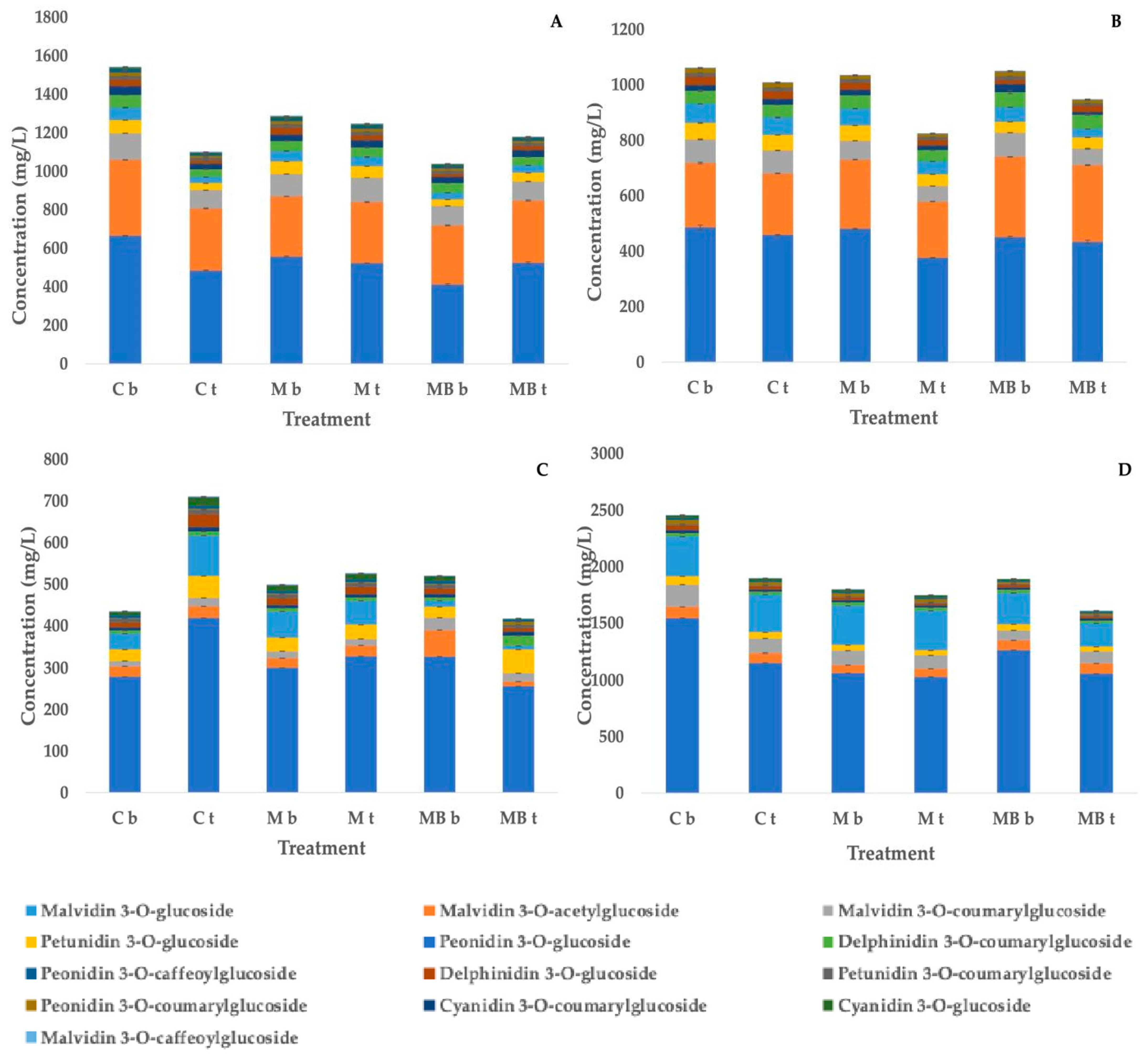
The HPLC data for individual monomeric anthocyanins obtained for Syrah I, Syrah II, Trincadeira, and Alicante Boushet cultivars are presented in Figure 3. In all cases, differences in monomeric anthocyanins profile were significantly affected between treatments and positions. Six of the fourteen monomeric anthocyanins identified were at higher concentration in all treated samples and controls in the following order: Malvidin 3-O-glucoside, Malvidin 3-O-acetylglucoside, Malvidin 3-O-coumarylglucoside, Peonidin 3-O-glucoside, Petunidin 3-O-glucoside, and Delfinidin 3-O-coumarylglucoside. The quantification of anthocyanins within each group (monoglucosylated, monoacetylated, monocoumarylated, and monocaffeoylated) is expressed as milligrams per liter (mg/L) of the corresponding monoglucosylated anthocyanin equivalent per liter. However, for simplicity, the results below are presented as mg/L.
In Syrah I, Malvidin 3-O-glucoside ranged from 663.8 mg/L in C b to 411.0 mg/L in MB b. Peonidin 3-O-glucoside ranged from 31.9 mg/L (C t) to 65.5 mg/L (C b), Petunidin 3-O-glucoside displayed the maximum value in C b (68.4 mg/L) and the minimum in MB b (33.0 mg/L). Malvidin 3-O-acetylglucoside exhibited significant differences among treatments. The highest concentration was found in C b (395.1 mg/L), while the lowest was obtained in MB b (307.2 mg/L). Malvidin 3-O-coumarylglucoside ranged from 138.0 mg/L in C b to 95.5 mg/L in C t and delphinidin 3-O-coumarylglucoside from 40.3 mg/L (C t) to 65.1 mg/L (C b). Total monomeric anthocyanin content ranged from 1038.6 mg/L (MB b) to 1543.3 mg/L (C b). (Figure 3A) The amounts for other monomeric anthocyanins obtained for all varieties are presented in the Supporting Materials.
In Syrah II, Malvidin 3-O-glucoside ranged from 485.1 mg/L in C b to 376.1 mg/L in M t. Peonidin 3-O-glucoside ranged 40.8 mg/L (MB t) and 69.1 mg/L (C b), while Petunidin 3-O-glucoside ranged from 30.6 mg/L (MB t) to 59.5 mg/L (C b). Malvidin 3-O-acetylglucoside exhibited significant differences among treatments and positions. The highest concentration was shown in MB b (289.8 mg/L), while the lowest was obtained in M t (202.5 mg/L). Malvidin 3-O-coumarylglucoside ranged from 55.7 mg/L in M t to 86.6 mg/L in MB b and delphinidin 3-O-coumarylglucoside from 40.1 mg/L (C t) to 54.8 mg/L (C b). Total monomeric anthocyanin content ranged from 824.9 mg/L (M t) to 1056.2 mg/L (C b). Control bottom samples (C b) consistently showed the highest overall concentration of anthocyanins, followed by MB b (1037.5 mg/L) and M b (1035.9 mg/L) (Figure 3B).
In Trincadeira, Malvidin 3-O-glucoside ranged from 256.0 mg/L in MB t to 418.4 mg/L in C t. Peonidin 3-O-glucoside varied between 55.3 mg/L (MB t) and 97.4 mg/L (C t), while Petunidin 3-O-glucoside ranged from 24.6 mg/L (MB t) to 52.7 mg/L (C t). Malvidin 3-O-acetylglucoside exhibited significant differences among treatments and positions. The highest concentration was shown in to 28.3 mg/L in Ct (28.3 mg/L), while the lowest was found in MB t (20.1 mg/L). Malvidin 3-O-coumarylglucoside ranged from 8.5 mg/L (MB t) to 20.2 mg/L (C t), and Delphinidin 3-O-coumarylglucoside varied between 7.4 mg/L (C b) and 9.8 mg/L (C t). Total monomeric anthocyanin content ranged from 417.5 mg/L in MB t to 724.2 mg/L in C t. Control top samples (C t) consistently exhibited the highest total anthocyanin concentrations, and MB t (417.45 mg/L) and M b (498.90 mg/L) presented the lowest levels (Figure 3C).
In Alicante Bouschet, Malvidin 3-O-glucoside ranged from 1057.4 mg/L in MB t to 1542.7 mg/L in C b. Peonidin 3-O-glucoside varied between 208.1 mg/L (MB t) and 351.4 mg/L (C b), while Petunidin 3-O-glucoside ranged from 40.6 6 mg/L (MB t) to 74.6 mg/L (C b). Malvidin 3-O-acetylglucoside exhibited significant differences among treatments and positions. The highest concentration was shown in C b (99.7 mg/L), while the lowest was found in M b (71.8 mg/L). Malvidin 3-O-coumarylglucoside ranged from 87.6 mg/L (MB b) to 196.5 mg/L (C b), and Delphinidin 3-O-coumarylglucoside varied between 22.9 mg/L (MB t) and 30.0 mg/L (C b). Total monomeric anthocyanin content ranged from 1615.7 mg/L in MB t to 2466.3 mg/L in C b. Control top samples (C b) consistently exhibited the highest total anthocyanin concentrations, and MB t (1615.71 mg/L) and M t (1749.59 mg/L) presented the lowest levels (Figure 3D).

4. Discussion

4.1. Classical Chemical Parameters

4.1.1. Total Acidity and pH

The pH values observed among all cultivars appeared relatively high; however, this may also be associated with sample treatment, as the freezing and subsequent defrosting of the grapes—required due to the large number of samples analyzed—cannot be excluded as a factor affecting berry cell integrity and the distribution of organic acids, potentially influencing the measured pH values [28].
The mulch treatment significantly influenced grape must chemical composition, most notably in the Syrah I vines, where a reduction in pH was observed. This decrease in pH was generally associated with slightly higher total acidity, a relationship commonly reported in previous studies investigating the effects of organic amendments on grape must composition. Such responses have been attributed to delayed ripening and modified nutrient dynamics, as a response to higher yield and increased nitrogen availability [37]. This could indicate that reduced pH observed in Syrah I is related to increased nitrogen availability. However, in this study, no consistent increase in YAN was observed under both treatments when compared with the corresponding controls at the same topographic position, with the exception of MB b. Differences in the composition of nitrogen sources between the control and treated samples may influence the buffering capacity of the must and, consequently, affect pH and total acidity.
Other studies have reported increased potassium concentration following mulch application [17,21], which can neutralize juice acids and increase pH. This may be explained by mulch’s ability to regulate soil temperature, as potassium uptake is temperature-dependent [6]. Conversely, lower acidity might result from a microclimatic change in the canopy, where warmer conditions in treated vines could enhance the consumption of organic acids, reducing their concentration at harvest. These effects could be linked to changes in soil surface properties following organic amendment application.
In Alicante Bouschet, pH values decreased under M b and increased under MB b, while total acidity remained relatively stable. These findings may reflect modifications in cation concentration (K+ and Ca2+) rather than changes in acid concentration. For Trincadeira and Antão Vaz, a decrease in pH and a corresponding increase in total acidity was observed under M treatment at the top position (M t), indicating that mulch is probably capable of modifying soil conditions differently along the topographic gradient by reducing acidity at the bottom position while increasing at the top position. This bottom–top variation pattern was not evident in MB treatment, supporting previous reports that biochar may buffer or decrease the effects of mulch, likely due to its high surface area and capacity to stabilize nutrient and moisture dynamics. The reduction in positional differences in total acidity shown for M treatment suggests that this amendment might have a potential role in homogenizing vine response across the vineyard topographic position.

4.1.2. Total Soluble Solids (TSSs)

There were no significant main effects of treatments on TSS °Brix values across the vineyard, indicating that the amendments did not systematically delay sugar accumulation, although they showed significant differences for the position factor under MB treatment in all varieties. Positional differences in TSS concentrations were reduced when treatment was applied, particularly following MB treatment, which yielded higher TSSs in the bottom samples for Syrah I. Similar patterns were found in Trincadeira, Alicante Bouschet, and Antão Vaz grapes treated with mulch. These results suggest a possible interaction between amendment type and soil water distribution, which are in line with previous reports describing a general reduction in TSSs following amendment treatments [37], while others observed these effects only during dry-year conditions [19]. The reduction in positional differences might suggest improved soil water-holding capacity and structure after organic treatment, whereby the bottom topographic position is able to retain more water that would otherwise leach down in the absence of organic amendments and promote more balanced moisture conditions at both topographic positions in the vineyard.

4.1.3. Yeast Assimilable Nitrogen (YAN)

Yeast assimilable nitrogen (YAN) was the most dynamic parameter in response to the treatments. A significant treatment × topographic position interaction for the overall varieties revealed that the effect of each amendment on nitrogen availability was highly dependent on its topographic position. In most cases, grapes treated with MB reported higher YAN values than controls or grapes treated with M, suggesting a treatment-dependent improvement in nitrogen availability. The amendments applied in this study were not particularly rich in nutrients compared to other organic amendments, such as manure, sludge, or green manure. However, biochar can be conceptualized as a highly porous “ion sponge”, able to absorb and release surrounding nutrients depending on soil chemical conditions. This property contributes to an increase in cation exchange capacity (CEC) and improves nutrient retention [12].
For Syrah II, a similar pattern of the classical parameters was observed as in Syrah I, except for the YAN parameter. Syrah II displayed low YAN values in control samples (61.25 mg/L) and the highest values in MB t (195.42 mg/L). The Syrah II plots were likely nitrogen-deficient, and the application of M or MB treatment may have contributed to the much higher assimilable nitrogen levels observed in the must when compared to the control plot at both topographic positions. The variation in YAN values between Syrah I and Syrah II may be related to differences in the vineyard orientation and microclimate as the two plots were placed in opposite vineyard directions [38]. Other local factors such canopy of the vines, soil temperature, and sun exposure could have contributed to yielding significant YAN variations between both Syrah plots [38]. Slight but significant changes in YAN between both positions were also found in other varieties, suggesting a different mineral composition not only between vineyards but also within the same vineyard. Given the slow nutrient release of the OA applied (due to their chemical characteristics) and the limited observation period (first year), a large increase in total nitrogen supply was not expected. However, the observed reduction in positional differences under M treatment for all grape varieties except for Alicante Bouschet suggests that mulching contributed to a more balanced distribution at both topographic positions in the vineyard.

4.1.4. General Trends of Position and Treatment Effects on Classical Parameters

Overall, the application of M and MB treatment promoted considerable shifts in the must chemical composition mainly associated with nitrogen accumulation and sugar concentration, particularly at different topographic positions, while changes in pH levels were less evident. The reduction in positional differences obtained under M treatment suggests improved soil structure and water retention at the top topographic position, potentially favoring a more balanced nutrient uptake at both topographic positions for some varieties. Although the observed treatment effects are discussed in relation to potential changes in soil water and nutrient dynamics, direct measurements of soil moisture, temperature, and nutrient availability were not collected during the growing season; therefore, future studies integrating detailed soil monitoring are necessary to better elucidate the mechanisms driving these responses. The MB treatment yielded the strongest effects, highlighting its potential as a sustainable soil management strategy for reducing bottom–top variability and enhancing must quality parameters. Further analysis of the phenolic composition and chromatic characteristics was performed to better understand how these parameters were affected by topographic position and treatment.

4.2. Color and Global Phenolic Composition

In this study, clear effects of vineyard topographic position and soil management practices were observed for the global phenolic composition and color parameters (color intensity and tonality) of the grape varieties examined. Significant differences were observed with grapes samples treated with mulch or mulch combined with biochar, affording the highest phenolic concentrations in some cultivars when compared with control samples. Despite the strong and consistent influence of treatment, the level and trend of the response varied among cultivars, given the intrinsic varietal characteristics and site-specific environmental conditions. These variations are discussed in detailed and structured according to the main analytical parameters evaluated.

4.2.1. Total Phenols, Non-Flavonoids, and Flavonoids

Total phenol content was significantly influenced by both treatment and position across all grape varieties. In Syrah I and Alicante Bouschet, the highest values were observed in the control (untreated) bottom samples (1438.58 and 2006.56 mg/L, respectively), while in Syrah II and Trincadeira, the highest levels were mostly shown with MB treatment, particularly at the bottom position (900.27 and 1110.23 mg/L). These results indicated a consistent enrichment of total phenols under MB treatment, yielding the highest values. Across all cultivars, M and MB treatments reduced the positional differences when compared to controls, suggesting a homogenizing effect of the amendments in grape phenolic composition. This effect was more pronounced for all cultivars except Syrah II under M treatment, where phenolic concentrations increased at the bottom and decreased at the top (Syrah II: M b 865.67 and M t 698.67 mg/L; C b 823.89 and C t 812.59 mg/L).
Non-flavonoid concentrations showed smaller but significant differences among treatments. The highest values were consistently found in MB treatment samples of Syrah I (72.40 mg/L), Syrah II (111.91 mg/L), and Alicante Bouschet (96.46 mg/L). While these patterns varied slightly among cultivars, when biochar was used in organic treatment, non-flavonoid content seemed to increase regardless of position. These evidences underline the sensitivity of non-flavonoids to soil organic amendment type and highlights the influence of biochar on the accumulation of small phenolic compounds.
Flavonoid content followed the same overall pattern as shown for total phenols. The highest concentration was observed in treated samples for all cultivars except Alicante Bouschet (C b 1872.25 mg/L), MB t for Syrah I—1206.38 mg/L, MB b for Syrah II—802.93 mg/L, and MB b for Trincadeira—1037.11 mg/L. In contrast, control and M-treated samples displayed lower levels of flavonoid, suggesting that biochar enrichment intensified treatment effects. Across all varieties, positional differences in flavonoid content were reduced when organic treatment was applied, which was also seen for total phenols.

4.2.2. Total Anthocyanins, Color Intensity, and Tonality

Total anthocyanin concentrations demonstrated clear varietal and treatment-related significant differences. In Syrah I and Alicante Bouschet, the highest anthocyanin concentration was shown in C b (610.72 and 1017.92 mg/L of malvidin-3-glucoside equiv., respectively), whereas in Syrah II, MB treatment displayed comparable or, in some cases, higher values than controls. The positional differences were reduced under M and MB treatment, suggesting that organic treatments weakened bottom–top variability. In Trincadeira, the top control sample (C t) exhibited the highest anthocyanin content, while MB treatment increased total polyphenols and flavonoids but not anthocyanins, suggesting compositional adjustments within the phenolic profile.
Color intensity followed the same general trend as shown for total phenols and anthocyanins, with significant effects of both factors (position and treatment). These highest color intensity values were observed in control samples of Syrah I (1.446) and Alicante Bouschet (2.322), while in Syrah II and Trincadeira, MB treatments yielded higher color intensities compared to controls (1.081 and 0.445, respectively). Tonality displayed significant differences among treatment and position. The highest tonality was consistently found in top samples treated with MB across varieties, 0.568 in Syrah I, 0.572 in Syrah II, 0.681 in Trincadeira, and 0.531 in Alicante Bouschet, suggesting that treatment had a considerable impact on color balance.

4.2.3. Monomeric Flavan-3-Ols, Oligomeric, and Polymeric Proanthocyanidins

Monomeric flavan-3-ols exhibited minor variation compared with other phenolic parameters. Slight increases were found in samples treated with M for Syrah I and MB for Trincadeira, while Syrah II and Alicante Bouschet showed no consistent trend. The highest concentrations were shown in M t in Syrah I (64.76 mg/L) and MB b in Trincadeira (20.03 mg/L), suggesting that organic treatment enhanced this fraction in some varieties.
Oligomeric and polymeric proanthocyanidins displayed more distinct treatment responses. In Syrah I and Trincadeira, the highest level of oligomeric proanthocyanidins were shown in MB b (121.30 and 44.13 mg/L, respectively), while polymeric forms peaked in C b for Syrah I (1405.4 mg/L) and in C t for Trincadeira (584.46 mg/L). In Syrah II and Alicante Bouschet, M b treatments afforded higher oligomeric fractions while polymeric proanthocyanidins were highest in MB b t for Syrah II (704.42 mg/L) and for Alicante Bouschet (1400.90 mg/L).

4.2.4. General Trends of Position and Treatment Effects on Global Phenolic Parameters

Across all varieties, Alicante Bouschet and Syrah I exhibited the highest overall phenolic concentrations, followed by Trincadeira and Syrah II. The MB treatment consistently improved total phenol, non-flavonoid, and flavonoid content across varieties, while positional effects were reduced compared with the control. In contrast, anthocyanins and color parameters displayed more distinct responses, suggesting varietal differences in sensitivity to soil and microclimatic conditions.
These patterns are in line with previous studies reporting that soil water availability, temperature, and nutrient status are the main factors for regulating grape polyphenol biosynthesis [24,37,39,40,41,42,43,44,45,46,47]. Given the limited differences in YAN content shown for both treatments within each cultivar, which can serve as an indicator of nitrogen supply, nitrogen availability played a limited role in the observed differences between positions and treatments. Water supply probably represented the leading factor influencing variation across treatments and positions. Several authors suggest that under water stress conditions, the final polyphenol concentration in grapes tends to increase [39,45]. Some studies have found reductions or no changes in polyphenol concentrations following treatment, while others reported increases [11,23]. Additionally, the same mulching treatment applied in different vineyards within the same study generated divergent responses: an increase in one site and no change in the other site [11,22,23]. However, none of these studies reported responses to the same OA mulching depending on vine topographic position within the same vineyard, as shown in this study.
Mulch and biochar applications are known to reduce runoff and enhance soil moisture retentions [8,48], thus moderating vine water stress and homogenizing berry development along the topographic gradient. However, the response varies depending on the intensity and timing of water stress, as well as variety and vintage, highlighting the complexity of the mechanism and its dependence on additional terroir factors [6,8,39,49,50].
Considering the cultivars studied, Syrah I and Alicante Bouschet exhibited the richest phenolic profile probably due to warmer or drier vineyard site conditions, which promoted smaller berry size and higher skin-juice ratios, and may have increased pigment concentration. In contrast, Syrah II and Trincadeira displayed lower phenolic levels, probably related to variations in the microclimate and different vineyard environments.
Differences between M and MB treatments further suggested that biochar contributed additional effects beyond those of straw mulch alone. MB treatment afforded higher total phenol and flavonoid content across most varieties, likely reflecting its enhanced capacity to improve soil physical properties and water-holding potential, although further studies are necessary to confirm soil structure and moisture. When M treatment was used, minor positional differences were observed, suggesting significant improvements in soil structure and water retention at the top position, potentially favoring more balanced nutrient uptake at both topographic positions for some grape varieties. Future studies on soil monitoring are necessary to better elucidate the mechanisms driving these responses. However, local differences in soil texture, slope inclination, and microclimate probably modulated treatment effects.
Overall, the results confirm that vineyard topographic position and organic treatment jointly affect grape phenolic composition. The consistent enhancement of total phenols, flavonoids, total anthocyanins, and color characteristics under MB treatment demonstrates the potential of biochar-enriched mulches as sustainable vineyard practices for improving grape quality. Additionally, M treatment is beneficial in improving the phenolic composition at the top topographic position, thereby reducing bottom–top variability. This could be particularly important for certain cultivars planted in specific sites that lack optimal conditions for producing high-quality grapes. However, subsequent years of study are necessary to further highlight some of the trends identified here.

4.3. Individual Monomeric Anthocyanins in Skin and Seed Extract HPLC

4.3.1. General Trends in Anthocyanin Variation

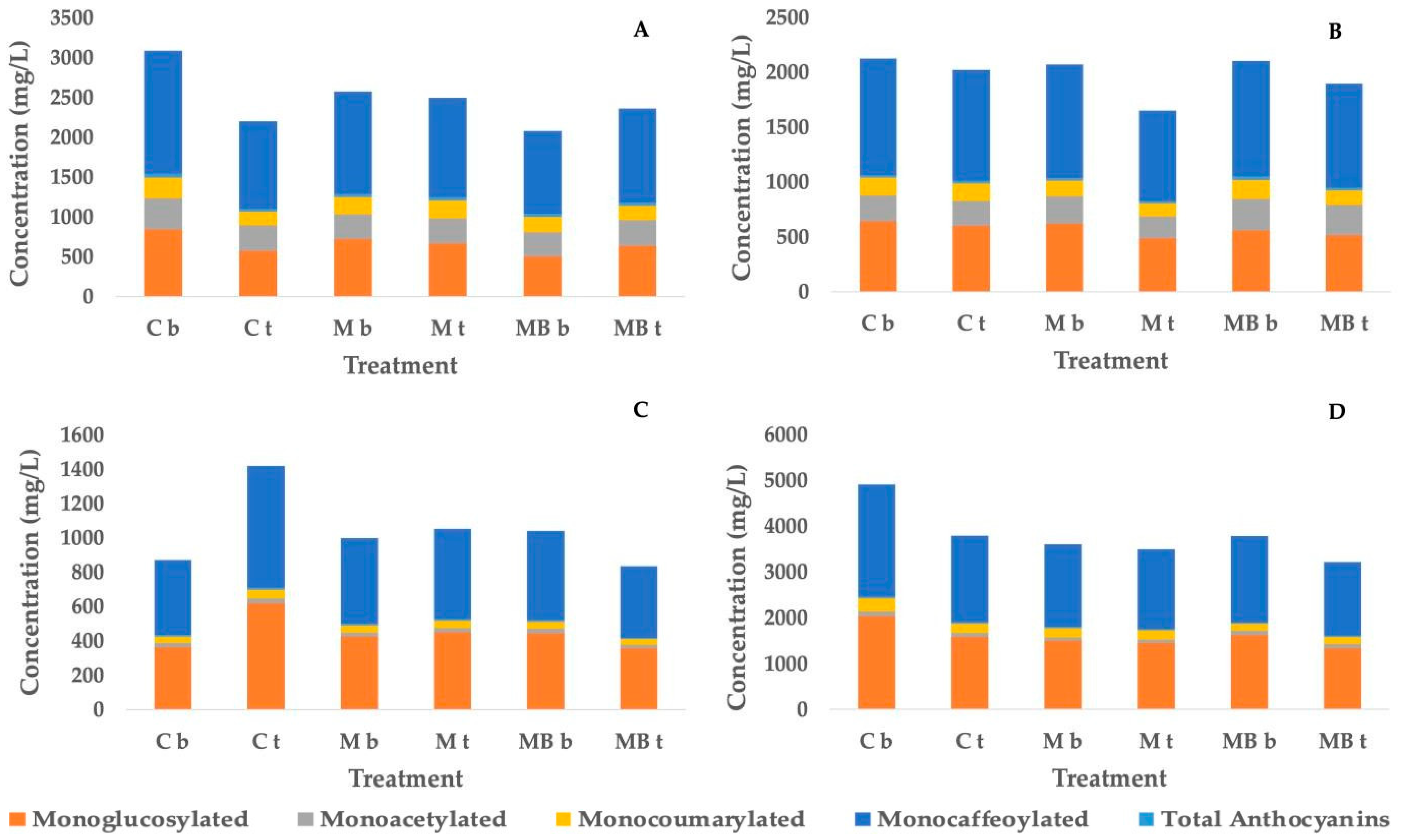
The composition and concentration of anthocyanins varied significantly among treatments and topographic positions across all cultivars. Overall, control samples displayed the highest total anthocyanin content, while MB-treated samples, particularly at the bottom position, consistently presented lower levels (Figure 4). The total anthocyanin concentration were in the ranges of approximately 1000–1500 mg/L in Syrah I, 800–1100 mg/L in Syrah II, 400–700 mg/L in Trincadeira, and 1600–2400 mg/L in Alicante Bouschet. These variations might result from both the cultivar’s intrinsic genetic capacity for anthocyanin biosynthesis and site-specific factors, such as microclimates, topographic exposure, and soil water availability. Despite these differences, a consistent pattern was observed among cultivars; organic treatment, especially MB treatments, reduced positional differences and probably homogenized anthocyanin distribution at both topographic positions.
In Syrah I, the total anthocyanin concentrations measured spectrophotometrically in control bottom position samples was 610.72 mg/L expressed as malvidin-3-O-glucoside equivalents, while HPLC quantifications for the same sample yielded 1543.4 mg/L, with malvidin 3-O-glucoside accounting for 663.8 mg/L. This apparent divergence results from methodological differences between the two approaches. In this study, HPLC quantification was performed using individual calibration curves for each monoglucoside anthocyanin (in total, six calibration curves), providing compound-specific response factors and accurately reflecting the contribution of each pigment. On contrary, the Ribéreau-Gayon and Stonestreet method uses a single calibration based on malvidin-3-O-glucoside and considers identical molar absorptivity for all anthocyanins. This generalization, combined with the fixed wavelength measurement at 520 nm, can reduce analytical precision and may underestimate pigments with higher molar extinction coefficients, such as delfinidin or petunidin derivatives. Although previous studies have used individual calibrations curves for anthocyanin quantification by HPLC, none have directly compared such data with Ribéreau-Gayon results. Considering that compound-specific calibration improves analytical accuracy, it is reasonable to consider that the values obtained represent the real anthocyanin concentrations in grape extracts for each cultivar studied [51,52,53,54].

4.3.2. Effects of Treatments on Anthocyanin Concentration

Across the four grape varieties, clear differences in monomeric anthocyanin composition and concentration were observed among treatments and individual monomeric anthocyanins classes (monglucosylated, monoacetylated, monocoumaroylated, and monocaffeoylated). Variations between positions (bottom vs. top) and treatments (C, M, and MB) indicated that both factors significantly influenced anthocyanin biosynthesis and accumulation.
Monoglucosylated anthocyanins consistently controlled the pigment profile; particularly, Malvidin 3-O-glucoside showed the highest concentrations across all treatments, followed by petunidin, peonidin, delphinidin, and cyanidin derivatives. The highest levels of these compounds were consistently observed in control bottom samples, while lower concentrations were displayed under M and MB treatments. In Syrah I and Alicante Bouschet, malvidin 3-glucoside accounted for more than half of total anthocyanins, which confirms the importance of this pigment in color expression. In general, the decrease in monoglucosylated forms under MB treatments suggests that mulch and biochar may influence grape metabolism due to modifications in soil moisture and temperature that can affect anthocyanin biosynthesis and degradation processes.
Monoacetylated and monocoumaroylated anthocyanins displayed similar treatment-related trends but with larger variations among cultivars. Malvidin 3-O-acetylglucoside concentrations were highest in control samples for Syrah I and Alicante Bouschet, while MB treatments showed slightly lower concentrations but with reduced positional differences. Coumaroylated anthocyanin forms, including delfinidin, peonidin, and malvidin 3-O-coumarylglucoside, exhibited clear positional and treatment effects, with higher content observed in controls and M-treated samples compared to MB. These anthocyanin derivatives are related to increased pigment and color stability. MB-treated samples reported lower levels, suggesting that soil water retention conditions might have increased due to biochar in the soil amendment, consequently promoting a shift towards less acylated anthocyanins profiles.
Monocaffeoylated anthocyanins typically represented less than 3% of total anthocyanins, although they followed a similar pattern as described previously for monoglycosylated anthocyanins. In Syrah I and Trincadeira, minor increases were observed in MB-treated top samples, possibly related to varietal differences in phenolic metabolism or microclimatic conditions between topographic positions.

4.3.3. Comparative Cultivar Responses

Despite strong treatment effects, the level of anthocyanin response differed considerably among cultivars. Alicant Bouschet exhibited the highest total anthocyanin content, which is consistent with its known high anthocyanin profile and teinturier nature. Syrah I displayed clear positional differences, which were reduced under organic treatment. Syrah II showed lower concentrations overall compared to Syrah I, probably due to differences in orientation and local microclimate. Trincadeira reported the lowest anthocyanin concentrations but had the most pronounced relative increase at the treated top position, likely due to its delayed ripening.

4.3.4. Implications for Vineyard Management

Across all cultivars with M and MB treatments, a decrease in anthocyanin content was consistently observed, suggesting that organic treatment may influence secondary metabolism by influencing environmental stress. While control bottom samples showed highest pigment concentrations when compared to Ct, this effect may also reflect local hydric and nutritional imbalances. Likewise, the more balanced anthocyanin pattern in treated samples may suggest improved homogeneity at both topographic vineyard positions. Therefore, the use of mulch and biochar may enhance vineyard uniformity and stability, while leading to a modest decrease in anthocyanin concentration. The level of these effects depends on the cultivar-specific physiology, topographic position, and microclimatic factors, highlighting the importance of designing soil management strategies to site conditions and production goals.
The cultivar-specific responses observed highlight the importance of evaluating grape varieties individually under semi-arid conditions. Differences among cultivars indicate that organic amendments and vineyard topographic position can differentially influence technologically relevant parameters, including acidity, sugar accumulation, nitrogen availability, and phenolic potential, supporting the need for site- and cultivar-specific soil management strategies.

5. Conclusions

The conclusions into the effects of straw mulch and mulch+ biochar treatment effects on grape composition, with particular emphasis on global phenolic compounds across vineyard topographic position (bottom vs. top), were as follows:
  • Classical chemical parameters showed significant variation across all varieties, although no consistent trend was observed among them. In some varieties, mulching decreased pH and increased total acidity, while YAN was primarily driven by topographic position rather than soil treatment. The most notable observation in some cultivars concerns TSS content, which closely followed the anthocyanin trend, reinforcing that these responses may reflect shifts in ripening progression across treatments and topographic positions.
  • Total phenols, flavonoids, total anthocyanins, and color characteristics were consistently enhanced under MB treatment, which demonstrates the potential of biochar-enriched mulches as sustainable vineyard practices for improving grape quality due to its capacity to improve soil physical properties and water-holding potential. Additionally, M treatment is beneficial in improving the phenolic composition at the top topographic position, thereby reducing bottom–top variability.
  • Total tannins were slightly reduced by both M and MB treatments and were higher on the bottom topographic position, although no consistent pattern was observed among cultivars. In some cases, samples treated with MB showed higher levels at the bottom position, while in other cultivars tannins, concentrations increased under M treatment.
  • Total anthocyanins determined by HPLC were consistently reduced on M and MB treatments and were higher on bottom topographic positions. The treated samples frequently showed reduced total anthocyanin content relative to control samples, although reduced positional differences within the same organic treatment were observed.
In conclusion, even after a single season, mulch, and mulch and biochar emerge as powerful drivers of grape quality, with the potential to reshape topography-related patterns in berry composition. Long-term investigations are necessary to assess the stability of these effects over multiple vintages. Beyond its immediate impact on grape chemistry, mulching offers valuable insights into the interplay between organic soil management and vineyard landscape features, with promising implications for both wine quality enhancement and the long-term sustainability of viticulture in Mediterranean and other water-limited environments.

Supplementary Materials

The following supporting information can be downloaded at https://www.mdpi.com/article/10.3390/environments13010044/s1, Table S1: Concentration of individual monomeric anthocyanins (mg/L) identified and quantified by HPLC-DAD in Syrah I grape samples; Table S2: Concentration of individual monomeric anthocyanins (mg/L) identified and quantified by HPLC-DAD in Syrah II grape samples; Table S3: Concentration of individual monomeric anthocyanins (mg/L) identified and quantified by HPLC-DAD in Trincadeira grape samples; Table S4: Concentration of individual monomeric anthocyanins (mg/L) identified and quantified by HPLC-DAD in Alicante Bouschet grape samples; Table S5: Mean grape yield (kg plant−1) and standard deviation for grapevines under different soil management treatments at the Fundação Eugénio de Almeida (FEA) and Herdade do Mouchão (MOU) vineyards. Treatments include control (U), wheat straw mulch (M), and wheat straw mulch combined with biochar (MB).

Author Contributions

Conceptualization, J.M.R.-d.-S., S.C., S.P. and M.J.C.; methodology, J.M.R.-d.-S., S.C., S.P. and M.J.C.; validation, J.M.R.-d.-S., S.C., S.P., M.J.C. and. S.G.H.; formal analysis, M.P., S.G.H. and N.S.; investigation, M.P., S.G.H. and N.S.; resources, J.M.R.-d.-S., S.P. and M.J.C.; writing—original draft preparation, M.P. and S.G.H.; writing—review and editing, J.M.R.-d.-S., S.C., S.P., M.J.C. and S.G.H.; supervision, J.M.R.-d.-S., S.C. and S.G.H.; project administration, J.M.R.-d.-S.; funding acquisition, S.P. All authors have read and agreed to the published version of the manuscript.

Funding

This research was funded by the European Union—PRR (Plano de Recuperação e Resiliência), under the project SOLVIT (Vine & Wine Portugal C644866286-00000011). This work was also supported by FCT—Fundação para a Ciência e Tecnologia, I.P. through projects UID/04129/2025 (https://doi.org/10.54499/UID/04129/2025) of LEAF-Linking Landscape, Environment, Agriculture and Food, and LA/P/0092/2020 (TERRA).

Data Availability Statement

Data are contained within this article and its Supplementary Materials.

Acknowledgments

The authors acknowledge the R&D unit MED—Mediterranean Institute for Agriculture, Environment and Development (https://doi.org/10.54499/UIDB/05183/2020) and the Associate Laboratory CHANGE—Global Change and Sustainability Institute (https://doi.org/10.54499/LA/P/0121/2020). We gratefully acknowledge Filipa Cachapa, João Canedo, Luisa Coelho, Vasilis Daimonakos, Bernardo Lameira, Hyo Ju Mendez Pinto, and Elmar Stoutjesdijk for their assistance in implementing the treatments and collecting the samples. The authors extend their sincere gratitude to the vineyard managers Iain Reynolds, Carolina Sardinha, Ana Sampaio, and André Pilirito for their support and invaluable assistance with site selection and monitoring. We thank the staff of the Laboratory of Enology of Instituto Superior de Agronomia, namely Ana Catarina Mendes and Joana Granja-Soares for their administrative and technical support. Sergio Prats was supported by the Portuguese Science Foundation (FCT) through the research contract CEECIND/01473/2020 and the Spanish Ministry of Science, Innovation and Universities through the research contract RYC2022-035489-I. The author thank Fundação Eugénio de Almeida and Herdade do Mouchão for the contribution in the present study. The authors have reviewed and edited the output and take full responsibility for the content of this publication.

Conflicts of Interest

The authors declare no conflicts of interest. The funders had no role in the design of this study; in the collection, analyses, or interpretation of data; in the writing of the manuscript; or in the decision to publish the results.

Abbreviations

The following abbreviations are used in this manuscript:
SOMSoil organic matter
OAsOrganic amendments
TSSTotal soluble solids
YANYeast assimilable nitrogen
CECCation exchange capacity

References

  1. World Atlas of Desertification (WAD). Aridity Projections European Commission Joint Research Centre. Available online: https://wad.jrc.ec.europa.eu/aridityprojections (accessed on 14 January 2025).
  2. FAO. The State of Food and Agriculture 2025-Addressing Land Degradation Across Landholding Scales; FAO: Rome, Italy, 2025. [Google Scholar] [CrossRef]
  3. European Court of Auditors. Desertification in the EU Background Paper; European Union: Luxembourg, 2018. [Google Scholar]
  4. Komatsuzaki, M.; Ohta, H. Soil management practices for sustainable agro-ecosystems. Sustain. Sci. 2007, 2, 103–120. [Google Scholar] [CrossRef]
  5. Tilman, D.; Cassman, G.K.; Matson, A.P.; Naylor, R.; Polasky, S. Agricultural sustainability and intensive production practices. Nature 2002, 418, 671–677. [Google Scholar] [CrossRef]
  6. Steenwerth, K.; Guerra, B. Influence of floor management technique on grapevine growth, disease pressure, and juice and wine composition: A review. Am. J. Enol. Vitic. 2012, 63, 149–164. [Google Scholar]
  7. Lal, R. Carbon management in agricultural soils. Mitig. Adapt. Strateg. Glob. Change 2007, 12, 303–322. [Google Scholar] [CrossRef]
  8. Lippi, P.; Mattii, G.B.; Cataldo, E. Biochar, properties, and skills with a focus on implications for vineyard land and grapevine performance. Phyton-Int. J. Exp. Bot. 2025, 94, 33–64. [Google Scholar] [CrossRef]
  9. Gholamahmadi, B.; Jeffery, S.; Gonzalez-Pelayo, O.; Prats, S.A.; Bastos, A.C.; Keizer, J.J.; Verheijen, F.G.A. Biochar impacts on runoff and soil erosion by water: A systematic global scale meta-analysis. Sci. Total Environ. 2023, 871, 161860. [Google Scholar] [CrossRef]
  10. Canedo, J.N.G.V.; Coelho, L.; Castro, L.; Verheijen, F.G.A.; Prats, S. Biochar and mulch: Hydrologic, erosive, and phytotoxic responses across different application strategies and agricultural soils. Agronomy 2025, 15, 926. [Google Scholar] [CrossRef]
  11. Mairata, A.; Valls-Fonayet, J.; Labarga, D.; Puelles, M.; Cluzet, S.; Portu, J.; Pou, A. Influence of organic mulches and soil properties on the phenolic profile of leaves, canes, and grape skins in grapevine (Vitis vinifera L.). J. Sci. Food Agric. 2025, 105, 4893–4904. [Google Scholar] [CrossRef]
  12. Campos, P.; Miller, A.Z.; Prats, S.A.; Knicker, H.; Hagemann, N.; De la Rosa, J.M. Biochar amendment increases bacterial diversity and vegetation cover in trace element-polluted soils: A long-term field experiment. Soil Biol. Biochem. 2020, 150, 108014. [Google Scholar] [CrossRef]
  13. Coelho, L.; Canedo, J.N.G.V.; Custódio, M.; Flores, D.; Mourão, P.; Palma, P.; Prats, S.A. Feedstock and pyrolysis conditions of biochars: Influence on soil phytotoxicity and water ecotoxicity. Soil Biol. Biochem. 2025, 211, 109935. [Google Scholar] [CrossRef]
  14. Verheijen Frank, G.A.; Bastos, A.C.; Santos, M.; Khodaparast, Z.; Oliveira, F.J.; Silva, F.R.; Martins, M.A.S.; Almeida, C.; Rocha, S.M. Biochar had no detrimental effects on markers linked to grape and wine sensory attributes: The case study of a Portuguese Appellation. Vitis 2025, 64, 13. [Google Scholar]
  15. Diacono, M.; Montemurro, F. Long-term effects of organic amendments on soil fertility. A review. Agron. Sustain. Dev. 2010, 30, 401–422. [Google Scholar] [CrossRef]
  16. Botelho, M.; Cruz, A.; Ricardo-Da-Silva, J.; De Castro, R.; Ribeiro, H. Mechanical pruning and soil fertilization with distinct organic amendments in vineyards of syrah: Effects on vegetative and reproductive growth. Agronomy 2020, 10, 1090. [Google Scholar] [CrossRef]
  17. Pinamonti, F. Compost mulch effects on soil fertility, nutritional status and performance of grapevine. Nutr. Cycl. Agroecosyst. 1998, 51, 239–248. [Google Scholar] [CrossRef]
  18. Botelho, M.; Ribeiro, H.; Cruz, A.; Martins, M.; Khairnar, K.S.; Pardal, R.; Catarino, S.; De Castro, R.; Ricardo-Da-Silva, J. Mechanical pruning, and soil organic amendments in vineyards of Syrah: Effects on wine mineral composition. Cienc. Tec. Vitivinic. 2021, 36, 151–162. [Google Scholar] [CrossRef]
  19. Varga, P.; Májer, J. The use of organic waste for soil-covering of vineyards. Acta Hortic. 2004, 652, 191–197. [Google Scholar] [CrossRef]
  20. Botelho, M.; Ribeiro, H.; Cruz, A.; Duarte, D.F.; Faria, D.L.; de Castro, R.; Ricardo-Da-Silva, J. Mechanical pruning, and soil organic amendments in vineyards of Syrah: Effects on grape composition. Oeno One 2021, 55, 267–277. [Google Scholar] [CrossRef]
  21. Mundy, D.C.; Agnew, R.H. Effects of mulching with vineyard and winery waste on soil fungi and botrytis bunch rot in Marlborough vineyards. N. Z. Plant Prot. 2002, 55, 135–138. [Google Scholar] [CrossRef]
  22. Mairata, A.; Pou, A.; Martínez, J.; Puelles, M.; Labarga, D.; Portu, J. Organic mulches slightly influence the wine phenolic profile and sensory evaluation. Food. Chem. 2024, 457, 140045. [Google Scholar] [CrossRef]
  23. Buesa, I.; Mirás-Avalos, J.M.; De Paz, J.M.; Visconti, F.; Sanz, F.; Yeves, A.; Guerra, D.; Intrigliolo, D.S. Soil management in semi-arid vineyards: Combined effects of organic mulching and no-tillage under different water regimes. Eur. J. Agron. 2021, 123, 126198. [Google Scholar] [CrossRef]
  24. Botelho, M.; Ribeiro, H.; Cruz, A.; Duarte, D.F.; Faria, D.L.; Khairnar, K.S.; Pardal, R.; Susini, M.; Correia, C.; Catarino, S.; et al. Mechanical pruning, and soil organic amending in two terroirs. effects on wine chemical composition and sensory profile. Am. J. Enol. Vitic. 2022, 73, 26–38. [Google Scholar] [CrossRef]
  25. Cataldo, E.; Salvi, L.; Sbraci, S.; Storchi, P.; Mattii, G.B. Sustainable viticulture: Effects of soil management in Vitis vinifera. Agronomy 2020, 10, 1949. [Google Scholar] [CrossRef]
  26. Prats, S.A.; Merino, A.; Gonzalez-Perez, J.A.; Verheijen, F.G.A.; De la Rosa, J.M. Can straw-biochar mulching mitigate erosion of wildfire-degraded soils under extreme rainfall? Sci. Total Environ. 2021, 761, 143219. [Google Scholar] [CrossRef]
  27. Carbonneau, A.; Champagnol, F. Nouveaux Systèmes de Culture Integré du Vignoble. Programme AIR-3-CT 93. 1993; Unpublished Protocol. [Google Scholar]
  28. Gump, H.B.; Zoecklein, W.B.; Fugelsang, C.K.; Whiton, S.R. Comparison of analytical methods for prediction of prefermentation nutritional status of grape juice. Am. Soc. Enol. Vitic. 2002, 53, 325–329. [Google Scholar] [CrossRef]
  29. Ribéreau-Gayon, P. Le dosage de composes phenoliques totaux dans les vin rouges. Anal. Chim. Acta 1970, 52, 627–631. [Google Scholar]
  30. Kramling, T.E.; Singleton, V.L. An estimate of the nonflavonoid phenols in wines. Am. J. Enol. Vitic. 1969, 20, 86–92. [Google Scholar] [CrossRef]
  31. Ribéreau-Gayon, P.; Stonestreet, E. Le dosage des anthocyanes dans le vin rouge. Bull. Soc. Chim. Fr. 1965, 9, 2649–2652. [Google Scholar] [PubMed]
  32. Somers, T.C.; Evans, M.E. Spectral evaluation of young red wines: Anthocyanin equilibria, total phenolics, free and molecular SO2, “chemical age”. J. Sci. Food Agric. 1977, 28, 279–287. [Google Scholar] [CrossRef]
  33. Roggero, J.P.; Coen, S.; Ragonnet, B. High performance liquid chromatography survey on changes in pigment content in ripening grapes of Syrah. an approach to anthocyanin metabolism. Am. J. Enol. Vitic. 1986, 37, 77–83. [Google Scholar] [CrossRef]
  34. Sun, B.; Leandro, C.; Ricardo da Silva, J.M.; Spranger, I. Separation of grape and wine proanthocyanidins according to their degree of polymerization. J. Agric. Food Chem. 1998, 46, 1390–1396. [Google Scholar] [CrossRef]
  35. Sun, B.; Ricardo-da-Silva, J.M.; Spranger, I. Critical factors of vanillin assay for catechins and proanthocyanidins. J. Agric. Food Chem. 1998, 46, 4267–4274. [Google Scholar] [CrossRef]
  36. Sun, B.; Ricardo-Da-Silva, J.M.; Spranger, M.I. Quantification of catechins and proanthocyanidins in several portuguese grapevine varieties and red wines. Cienc. Tec. Vitivinic. 2001, 16, 23–34. [Google Scholar]
  37. Mondini, C.; Fornasier, F.; Sinicco, T.; Sivilotti, P.; Gaiotti, F.; Mosetti, D. Organic amendment effectively recovers soil functionality in degraded vineyards. Eur. J. Agron. 2018, 101, 210–221. [Google Scholar] [CrossRef]
  38. Bell, S.J.; Henschke, P.A. Implications of nitrogen nutrition for grapes, fermentation, and wine. Aust. J. Grape Wine Res. 2005, 11, 242–295. [Google Scholar] [CrossRef]
  39. Van Leeuwen, C.; Roby, J.P.; De Rességuier, L. Soil-related terroir factors: A review. Oeno One 2018, 52, 173–188. [Google Scholar] [CrossRef]
  40. Keller, M. The Science of Grapevines, 3rd ed.; Academic Press: London, UK, 2015. [Google Scholar]
  41. Hilbert, G.; Soyer, J.P.; Molot, C.; Giraudon, J.; Milin, S.; Gaudillere, J.P. Effects of nitrogen supply on must quality and anthocyanin accumulation in berries of cv. Merlot. Am. J. Enol. Vitic. 2003, 54, 150–154. [Google Scholar]
  42. Delgado, R.; Martín, P.; Del Álamo, M.; González, M.R. Changes in the phenolic composition of grape berries during ripening in relation to vineyard nitrogen and potassium fertilisation rates. J. Sci. Food Agric. 2004, 84, 623–630. [Google Scholar] [CrossRef]
  43. Heimler, D.; Romani, A.; Ieri, F. Plant polyphenol content, soil fertilization and agricultural management: A review. Eur. Food Res. Technol. 2017, 243, 1107–1115. [Google Scholar] [CrossRef]
  44. Pérez-Álvarez, E.P.; Martínez-Vidaurre, J.M.; Garde-Cerdán, T. Anthocyanin composition of grapes from three different soil types in cv. Tempranillo A.O.C. Rioja vineyards. J. Sci. Food Agric. 2019, 99, 4833–4841. [Google Scholar] [CrossRef]
  45. Teixeira, A.; Eiras-Dias, J.; Castellarin, S.D.; Gerós, H. Berry phenolics of grapevine under challenging environments. Int. J. Mol. Sci. 2013, 14, 18711–18739. [Google Scholar] [CrossRef]
  46. Cortell, J.M.; Halbleib, M.; Gallagher, A.V.; Righetti, T.L.; Kennedy, J.A. Influence of vine vigor on grape (Vitis vinifera L. Cv. Pinot Noir) anthocyanins. 2. Anthocyanins and pigmented polymers in wine. J. Agric. Food. Chem. 2007, 55, 6585–6595. [Google Scholar] [CrossRef]
  47. Downey, M.O.; Dokoozlian, N.K.; Krstic, M.P. Cultural practice and environmental impacts on the flavonoid composition of grapes and wine: A review of recent research. Am. J. Enol. Vitic. 2006, 57, 257–268. [Google Scholar] [CrossRef]
  48. Seguin, G. “Terroirs” and pedology of wine growing. Experientia 1986, 42, 861–873. [Google Scholar] [CrossRef]
  49. Davis, J.G.; Wilson, C.R. Choosing a Soil Amendment; Colorado State University Extension: Fort Collins, CO, USA, 2005. [Google Scholar]
  50. Asadullayev, R.; Abasova, K.; Mammadova, K.; Guliyeva, A. Assessment of grape cultivar traits and environmental adaptation in the Absheron Peninsula, Azerbaijan. Dysona Appl. Sci. 2025, 6, 51–59. [Google Scholar]
  51. Gonzalo-Rivas, J.C.; Gutierrez, E.; Hebrero, E.; Santos-Buelga, C. Comparisons of methods for determination of anthocyanins in red wines. Am. J. Enol. Vitic. 1992, 43, 210–214. [Google Scholar] [CrossRef]
  52. Hohnová, B.; Šťavíková, L.; Karásek, P. Determination of anthocyanins in red grape skin by pressurised fluid extraction and HPLC. Czech J. Food Sci. 2008, 26, 39–44. [Google Scholar] [CrossRef]
  53. Custodio-Mendoza, E.; Bonilla-Cruz, J.; González-Hernández, M.D.; Sánchez-Pérez, Y.; Hernández-Guerrero, C. A review of quantitative and topical analysis of anthocyanins in food. Molecules 2024, 29, 1735. [Google Scholar] [CrossRef]
  54. Mattioli, R.; Francioso, A.; Mosca, L.; Silva, P. Anthocyanins: A comprehensive review of their chemical structure, occurrence and quantitative analysis by hplc and spectrophotometry. Molecules 2020, 25, 5141. [Google Scholar]
Figure 1. Location of the vineyard study areas: (A) Fundação Eugénio de Almeida (FEA) in the São Manços, accounting for the Syrah I (blue), Syrah II (green), and Trincadeira sites (purple), and (B) Herdade do Mouchão in the Casa Branca, including the Alicante Bouschet (yellow) and Antão Vaz (orange) sites. The view in the picture is oriented to the north.
Environments 13 00044 g001
Figure 2. Example of the experimental design for Syrah (A) and Trincadeira (B) cultivars at FEA: bottom (blue part of the hill); top (brown part of the hill). M (mulched), C (control, untreated), and MB (mulched and biochar). The view of the picture is oriented to the north.
Environments 13 00044 g002
Figure 3. Concentration of individual monomeric anthocyanins (mg/L) determined with HPLC in grape samples from control (C), M treatment, and MB treatment and topographic positions (bottom—b and top—t): C b, C t, M b, Mt, MB b, and MB t. Each color represents a distinct anthocyanin compound, including delphinidin, cyanidin, peonidin, petunidin, and malvidin derivatives. Bars represent mean values for each compound and treatment. All monoglucosylated, monoacetylated, monocoumarylated, and monocaffeoylated are expressed as milligrams per liter (mg/L) of the corresponding monoglucosylated anthocyanin equivalent per liter: (A) Syrah I, (B) Syrah II, (C) Trincadeira, and (D) Alicante Bouschet.
Environments 13 00044 g003
Figure 4. Total concentrations of monomeric anthocyanin groups (monoglucosylated, monoacetylated, monocoumaroylated, and monocaffeoylated) determined with HPLC in grape samples from different treatments and topographic positions (C b, C t, M b, M t, MB b, and MB t). Each bar color represents a different group of anthocyanins. Mean values of all monomeric anthocyanin groups are expressed as milligrams per liter (mg/L) of the corresponding monoglucosylated anthocyanin equivalent per liter: (A) Syrah I, (B) Syrah II, (C) Trincadeira, and (D) Alicante Bouschet.
Environments 13 00044 g004
Table 1. Specific characteristics of the treatments applied in soils of FEA and MOU vineyards. Values between brackets are the standard deviation over the mean values (n = 3); polycyclic aromatic hydrocarbons (PAHs); water drop penetration time (WDPT) [10].
MaterialApplication Rate (g m−2)Cover Distribution (%)Layer Thickness (mm)Organic Matter Content (%)Water-Holding Capacity
(mL)
Bulk Density (g/cm−3)pHElectrical Conductivity
(mS cm−1)
PAH Content (mg kg−1)Repellency WDPT (s)
Biochar1000 (0)100 (0)5 (2)93.8 (5)50 (0)0.6 (0.1)9 (0.3)0.5 (0.1)14.93 (2)
Straw200 (0)100 (0)40 (10)92.5 (5)50 (0)0.3 (0.1)5.5 (0.2)0.3 (0)<0.046 (4)
Table 2. General classical chemical parameters of Syrah I, Syrah II, Trincadeira, Alicante Bouschet, and Antão Vaz grapes. Control (C), wheat straw mulch (M), and wheat straw mulch + biochar (MB). Bottom topographic position (b) and top topographic position (t); total soluble solid (TSS), yeast assimilable nitrogen (YAN).
Analytical ParameterC bC tM bM tMB bMB tPositionTreatmentPosition-Treatment
Syrah IpH4.35 b ± 0.024.40 a ± 0.054.01 f ± 0.004.24 c ± 0.004.21 d ± 0.004.15 e ± 0.01*********
Total acidity4.58 a ± 0.084.30 b ± 0.044.10 bc ± 0.123.83 de ± 0.004.03 cd ± 0.043.78 e ± 0.16******n.s.
TSS (°Brix)26.93 a ± 0.0624.83 e ± 0.0624.90 e ± 0.0026.20 b ± 0.0025.83 c ± 0.1225.20 d ± 0.00*********
YAN (mg/L)137.08 c ± 0.06188.13 b ± 0.05102.08 d ± 0.06123.96 c ± 0.03207.08 a ± 0.08135.63 c ± 0.05n.s.******
Syrah IIpH4.19 b ± 0.014.19 b ± 0.014.17 c ± 0.014.18 bc ± 0.014.24 a ± 0.014.24 a ± 0.01n.s.***n.s.
Total acidity3.03 c ± 0.043.05 c ± 0.162.98 c ± 0.043.00 c ± 0.003.70 a ± 0.093.40 b ± 0.04******
TSS (°Brix)26.97 b ± 0.0625.67 d ± 0.0626.60 c ± 0.1025.73 d ± 0.0626.5 c ± 0.9627.3 a ± 0.06*********
YAN (mg/L)61.25 d ± 0.0061.25 d ± 0.0080.21 c ± 2.5386.04 c ± 2.53135.63 b ± 0.00195.42 a ± 6.70*********
TrincadeirapH3.94 c ± 0.014.04 a ± 0.013.99 b ± 0.003.95 c ± 0.013.95 c ± 0.013.90 d ± 0.01***n.s.***
Total acidity4.30 a ± 0.043.80 d ± 0.043.93 c ± 0.044.13 b ± 0.004.38 a ± 0.043.83 d ± 0.00********
TSS (°Brix)20.90 d ± 0.0022.10 b ± 0.0020.73 e ± 0.0621.20 c ± 0.0022.40 a ± 0.0020.63 f ± 0.06***n.s.***
YAN (mg/L)96.25 a ± 0.0070.00 b ± 0.0087.51 ab ± 0.0090.42 ab ± 0.03102.08 a ± 0.0387.50 ab ± 0.00*n.s.*
Alicante BouschetpH4.06 b ± 0.004.00 d ± 0.014.04 c ± 0.024.06 bc ± 0.014.16 a ± 0.014.00 d ± 0.01*********
Total acidity3.30 a ± 0.083.33 a ± 0.093.33 a ± 0.043.38 a ± 0.083.28 a ± 0.113.35 a ± 0.04n.s.n.s.n.s.
TSS (°Brix)29.40 a ± 0.0026.40 e ± 0.0027.50 c ± 0.0026.90 d ± 0.0029.27 b ± 0.0625.87 f ± 0.06*********
YAN (mg/L)191.04 c ± 0.03192.50 c ± 0.00195.42 c ± 0.03246.46 a ± 0.03211.46 b ± 0.03208.54 b ± 0.03*********
Antão VazpH4.16 a ± 0.064.06 ab ± 0.084.15 a ± 0.073.95 b ± 0.054.03 ab ± 0.143.95 b ± 0.02*****n.s.
Total acidity3.15 a ± 0.093.18 a ± 0.263.03 a ± 0.333.24 a ± 0.133.20 a ± 0.363.23 a ± 0.20n.s.n.s.n.s.
TSS (°Brix)23.18 a ± 0.9722.40 ab ± 1.3121.53 bc ± 0.6320.95 c ± 0.1422.55 ab ± 0.0520.85 c ± 0.57******n.s.
YAN (mg/L)159.72 ab ± 0.10139.31 b ± 0.00126.92 ab ± 2.51128.33 a ± 2.53129.82 ab ± 0.00132.01 ab ± 6.70n.s.**
Means followed by the same letter in the lines did not differ by Tukey’s test at 5% (p ≤ 0.05). Standard deviation of triplicate analysis; n.s. (not significant); * (significant differences at a 95% confidence level); ** (significant differences at a 99.9% confidence level); *** (significant differences at a 99.99% confidence level); total acidity expressed as g of tartaric acid per liter.
Table 3. General phenolic composition, color parameters, and condensed tannins in skin and seed extracts of Syrah I, Syrah II, Trincadeira, and Alicante Bouschet.
Analytical ParameterSyrah I
C bC tM bM tMB bMB tPositionTreatmentPosition–Treatment
Color and global phenolic compounds
Total phenols (mg/L)1438.58 a ± 7.88984.03 c ± 8.41992.63 c ± 0.901225.54 b ± 1.61989.09 c ± 2.331265.54 b ± 14.86********
Non-flavonoids (mg/L)60.83 bc ± 1.8555.65 c ± 1.1763.46 b ± 2.7262.64 b ± 3.7672.40 a ± 1.5459.49 bc ± 0.56********
Flavonoids (mg/L)1378.44 a ± 9.89927.87 c ± 9.51930.48 c ± 1.241162.03 b ± 6.49917.55 c ± 2.891206.38 b ± 14.93n.s.*****
Total anthocyanins (mg/L of malvidin)610.72 a ± 8.4463.23 c ± 5.55545.03 ab ± 7.17560.65 b ± 12.67460.10 c ± 7.51481.69 bc ± 6.96*******
Color intensity (u.a)1.446 a ± 0.010.960 c ± 0.0081.178 b ± 0.0041.168 b ± 0.020.914 d ± 0.0070.992 c ± 0.007*********
Tonality (u.a)0.530 c ± 0.0010.518 d ± 0.0010.473 e ± 0.0010.541 b ± 0.0060.535 bc ± 0.0040.568 a ± 0.004*********
Condensed tannins
Monomeric Flavan-3-ols (mg/L)43.43 bc ± 5.738.12 c ± 1.8862.96 a ± 5.1564.76 a ± 0.9544.67 bc ± 0.5554.94 ab ± 3.22n.s.***n.s.
Oligomeric proanthocyanidins (mg/L)131.41 a ± 3.2334.78 c ± 10.7659.46 bc ± 9.6886.30 b ± 2.15121.30 a ± 3.69120.11 a ± 8.45********
Polymeric proanthocyanidins (mg/L)1405.41 a ± 38.2993.92 c ± 8.60817.57 c ± 28.671243.24 b ± 0.00764.86 e ± 64.901174.32 b ± 24.84*********
Total tannins (mg/L)1580.21 a ± 40.671066.82 c ± 21.24948.99 d ± 13.831394.30 b ± 3.88838.95 e ± 0.681349.38 b ± 36.52*********
Analytical ParameterSyrah II
C bC tM bM tMB bMB tPositionTreatmentPosition–Treatment
Color and global phenolic compounds
Total phenols (mg/L)823.89 b ± 10.41812.59 b ± 15.52865.67 ab ± 1 7.01698.67 c ± 25.41900.27 a ± 10.42860.44 ab ± 33.31*********
Non-flavonoids (mg/L)80.08 c ± 1.2280.34 c ± 1.4389.42 b ± 3.1279.26 c ± 3.0197.34 b ± 3.60111.91 a ± 4.01n.s.******
Flavonoids (mg/L)743.81 b ± 6.81732.25 b ± 31.53776.25 ab ± 17.64619.45 c ± 26.21802.93 a ± 9.62748.53 ab ± 15.53n.s.******
Total anthocyanins (mg/L of malvidin)485.67 ab ± 14.41491.18 ab ± 4.53514.46 a ± 12.31393.74 c ± 17.61506.05 ab ± 8.40459.41 b ± 31.32********
Color intensity (u.a)0.956 d ± 0.0100.987 c ± 0.0041.032 b ± 0.0060.827 e ± 0.0041.081 a ± 0.0101.020 b ± 0.004*********
Tonality (u.a)0.515 d ± 0.0010.507 e ± 0.0010.518 cd ± 0.0010.531 b ± 0.0030.524 bc ± 0.0020.572 a ± 0.004*********
Condensed tannins
Monomeric Flavan-3-ols (mg/L)50.84 a ± 0.9144.53 a ± 8.8343.51 a ± 8.6248.62 a ± 10.9137.34 a ± 9.0236.31 a ± 7.23n.s.*n.s.
Oligomeric proanthocyanidins (mg/L)30.03 a ± 0.8226.34 a ± 8.8148.91 a ± 24.2135.22 a ± 18.6036.03 a ± 3.2230.53 a ± 1.10n.s.n.s.n.s.
Polymeric proanthocyanidins (mg/L)404.51 a ± 74.90445.54 a ± 171.14511.81 a ± 38.92440.73 a ± 67.12704.42 a ± 156.01576.21 a ± 67.02n.s.n.s.n.s.
Total tannins (mg/L)485.49 a ± 74.98516.29 a ± 131.10604.25 a ± 6.23524.48 a ± 37.66771.37 a ± 150.10642.99 a ± 60.84n.s.n.s.n.s.
Analytical ParameterTrincadeira
C bC tM bM tMB bMB tPositionTreatmentPosition–Treatment
Color and global phenolic compounds
Total phenols (mg/L)446.05 d ± 0.90678.58 c ± 1.07461.79 d ± 6.84468.58 d ± 12.711110.23 a ± 5.73928.58 b ± 4.12********
Non-flavonoids (mg/L)100.50 ab ± 1.6584.74 cd ± 4.5389.35 bc ± 0.5967.67 e ± 8.0572.30 de ± 1.45106.13 a ± 6.77n.s.******
Flavonoids (mg/L)345.53 e ± 3.22595.53 c ± 5.97372.44 de ± 7.12399.98 d ± 1.561037.11 a ± 5.28825.56 b ± 9.94*******
Total anthocyanins (mg/L of malvidin)194.46 cd ± 7.19312.77 a ± 11.48239.59 b ± 3.80230.62 bc ± 9.67249.38 bc ± 3.48172.33 d ± 5.04*******
Color intensity (u.a)0.348 e ± 0.0000.603 a ± 0.0010.386 d ± 0.0020.431 c ± 0.0100.445 b ± 0.0010.337 f ± 0.001*********
Tonality (u.a)0.631 c ± 0.0000.595 e ± 0.0010.585 f ± 0.0010.614 d ± 0.0100.656 b ± 0.0030.681 a ± 0.002*********
Condensed tannins
Monomeric Flavan-3-ols (mg/L)16.67 ab ± 0.6812.65 bc ± 1.288.44 c ± 2.116.96 c ± 0.6820.03 a ± 1.7918.86 ab ± 5.20n.s.***n.s.
Oligomeric proanthocyanidins (mg/L)14.87 ab ± 0.4621.20 b ± 3.2328.20 ab ± 0.8344.78 a ± 1.2344.13 a ± 4.6140.39 ab ± 2.71*****n.s.
Polymeric proanthocyanidins (mg/L)413.24 cd ± 0.96584.46 a ± 4.78287.16 e ± 0.96339.19 de ± 7.64451.35 bc ± 34.40484.19 b ± 22.36*********
Total tannins (mg/L)446.60 c ± 0.07617.60 a ± 1.07322.58 d ± 1.52390.93 c ± 5.73516.55 b ± 29.81543.44 b ± 24.86********
Analytical ParameterAlicante Bouschet
C bC tM bM tMB bMB tPositionTreatmentPosition–Treatment
Color and global phenolic compounds
Total phenols (mg/L)2006.56 a ± 32.041627.19 b ± 21.051312.13 d ± 27.031406.81 c ± 27.751656.30 b ± 10.531424.28 c ± 3.76*********
Non-flavonoids (mg/L)83.53 ab ± 4.6368.09 c ± 1.9666.68 c ± 7.7072.42 bc ± 7.6896.46 a ± 1.2175.37 bc ± 0.89n.s.*****
Flavonoids (mg/L)1872.25 a ± 9.891570.71 b ± 9.511245.39 d ± 1.241281.16 cd ± 6.491559.64 b ± 2.891348.43 c ± 14.93*********
Total anthocyanins (mg/L of malvidin)1017.92 a ± 46.45898.46 b ± 10.23751.46 c ± 27.31732.96 cd ± 1.47757.90 c ± 14.48662.77 d ± 18.06*******
Color intensity (u.a)2.322 a ± 0.0011.839 c ± 0.0411.684 d ± 0.0101.691 d ± 0.0101.933 b ± 0.0211.562 e ± 0.022*********
Tonality (u.a)0.477 d ± 0.0020.483 cd ± 0.0100.499 b ± 0.0010.490 bc ± 0.0020.531 a ± 0.0010.493 bc ± 0.011*********
Condensed tannins
Monomeric Flavan-3-ols (mg/L)60.19 a ± 0.2924.56 c ± 0.1043.25 a ± 3.9925.76 bc ± 0.6430.34 a ± 11.9234.73 bc ± 0.15*****n.s.
Oligomeric proanthocyanidins (mg/L)146.38 b ± 7.1760.51 d ± 3.59152.76 a ± 0.7146.52 cd ± 1.2380.68 bc ± 3.9945.83 d ± 5.38*********
Polymeric proanthocyanidins (mg/L)1497.75 bc ± 47.781261.26 c ± 31.851098.65 a ± 17.201043.92 ab ± 4.781400.90 c ± 25.48837.84 d ± 6.37*******
Total tannins (mg/L)1704.31 a ± 40.311346.33 c ± 28.161294.66 c ± 13.911116.20 d ± 5.371512.04 b ± 7.93918.40 e ± 11.60*******
Means followed by the same letter in the lines did not differ by Tukey’s test at 5% (p ≤ 0.05). Standard deviation of triplicate analysis. Total phenols, non-flavonoids, and flavonoids expressed as mg L−1 of gallic acid; u.a (absorbance unit); n.s. (not significant); * (significant differences at a 95% confidence level); ** (significant differences at a 99.9% confidence level); *** (significant differences at a 99.99% confidence level). Control (C), mulched (M), and biochar and mulched (MB). Bottom topographic position (b) and top topographic position (t).
Disclaimer/Publisher’s Note: The statements, opinions and data contained in all publications are solely those of the individual author(s) and contributor(s) and not of MDPI and/or the editor(s). MDPI and/or the editor(s) disclaim responsibility for any injury to people or property resulting from any ideas, methods, instructions or products referred to in the content.