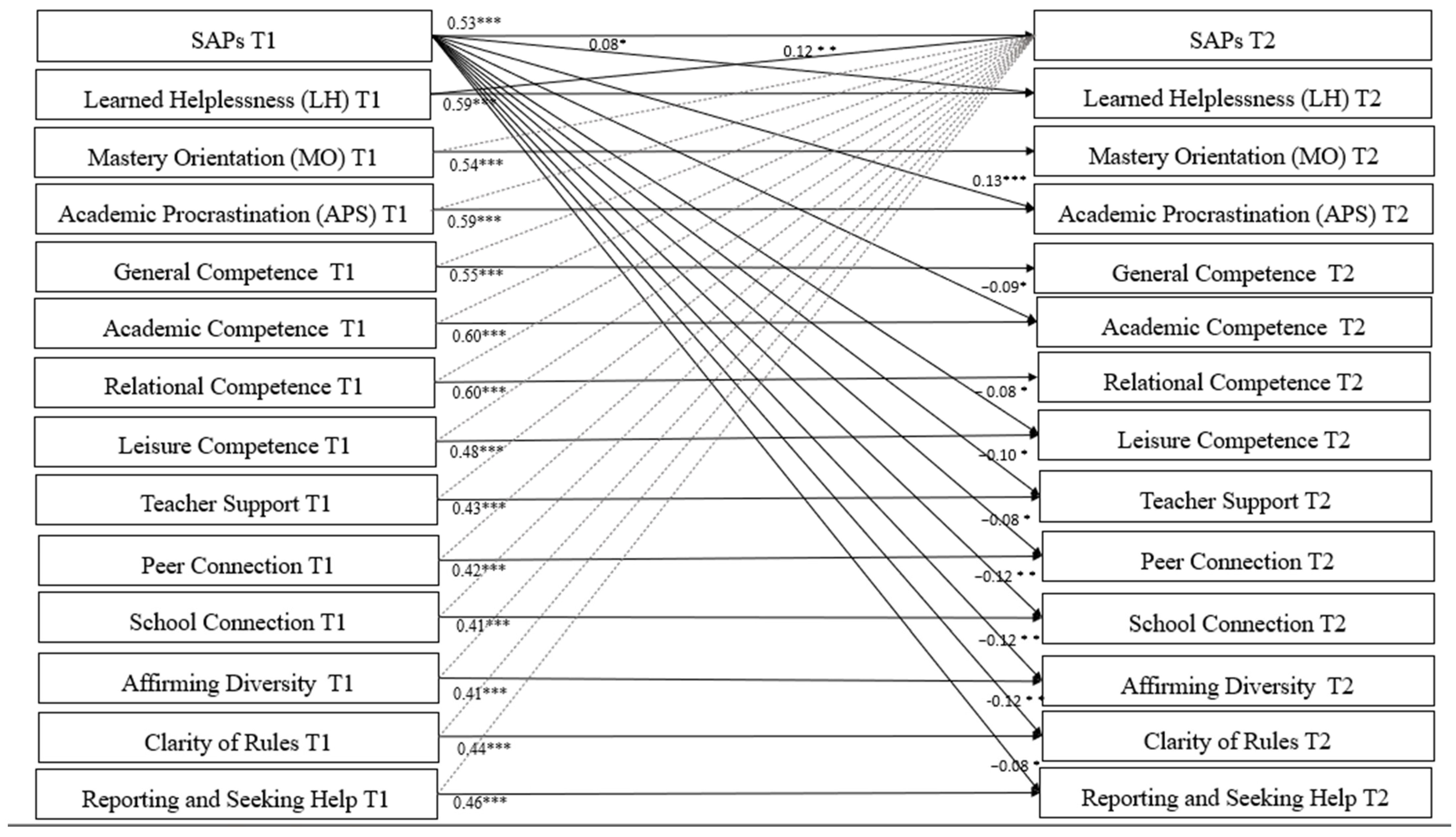
Exploratory Longitudinal Associations Between SAPs and Individual and Contextual Variables: Toward the Development of Educational Guidelines

 , , , and
Abstract
1. Introduction
2. Present Study
3. Methods
3.1. Participants
3.2. Instruments
3.3. Procedure
3.4. Data Analysis
4. Results
4.1. Descriptive and Correlational Analyses
4.2. Cross Lagged Model
4.3. Implications for Educational Programs
5. Discussion
5.1. Temporal Stability and Longitudinal Associations Between SAPs, Individual Factors, and School Climate
5.2. Educational Guidelines for the Prevention and Intervention of SAPs
6. Conclusions
7. Limitation
Author Contributions
Funding
Institutional Review Board Statement
Informed Consent Statement
Data Availability Statement
Acknowledgments
Conflicts of Interest
References
- Abramson, L. Y., Metalsky, G. I., & Alloy, L. B. (1989). Hopelessness depression: A theory-based subtype of depression. Psychological Review, 96, 358–372. [Google Scholar] [CrossRef]
- AGIA. (2022). La dispersione scolastica in Italia: Un’analisi multifattoriale. Roma, giugno 2022. Available online: https://www.garanteinfanzia.org/sites/default/files/2022-06/dispersione-scolastica-2022.pdf (accessed on 10 June 2026).
- Aldridge, J., & Ala’i, K. (2013). Assessing students’ views of school climate: Developing and validating the What’s Happening In This School? (WHITS) questionnaire. Improving Schools, 16(1), 47–66. [Google Scholar] [CrossRef] [Scilit]
- Allison, M. A., Attisha, E., AAP Council On School Health, Lerner, M., De Pinto, C. D., Beers, N. S., Gibson, E. J., Gorski, P., Kjolhede, C., O’Leary, S. C., Schumacher, H., & Weiss-Harrison, A. (2019). The link between school attendance and good health. Pediatrics, 143(2), e20183648. [Google Scholar] [CrossRef] [Scilit] [PubMed]
- Ames, C., & Archer, J. (1988). Achievement goals in the classroom: Students’ learning strategies and motivation process. Journal of Educational Psychology, 80, 260–267. [Google Scholar] [CrossRef]
- Andrade, H. L. (2019). A critical review of research on student self-assessment. Frontiers in Education, 4, 468374. [Google Scholar] [CrossRef] [Scilit]
- Ansari, A., & Pianta, R. C. (2019). School absenteeism in the first decade of education and outcomes in adolescence. Journal of School Psychology, 76, 48–61. [Google Scholar] [CrossRef] [Scilit] [PubMed]
- Balfanz, R., Herzog, L., & Mac Iver, D. J. (2007). Preventing student disengagement and keeping students on the graduation path in urban middle-grades schools: Early identification and effective interventions. Educational Psychologist, 42(4), 223–235. [Google Scholar] [CrossRef] [Scilit]
- Bianchi, D., Cavicchiolo, E., Manganelli, S., Lucidi, F., Chirico, A., Girelli, L., Cozzolino, M., & Alivernini, F. (2022). School absenteeism and self-efficacy in very-low-income students in Italy: Cross-lagged relationships and differential effects of immigrant background. Children and Youth Services Review, 136, 106446. [Google Scholar] [CrossRef] [Scilit]
- Bronfenbrenner, U. (1994). Ecological models of human development. International Encyclopedia of Education, 3(2), 37–43. [Google Scholar]
- Bronfenbrenner, U. (2005). Making human beings human: Bioecological perspectives on human development. SAGE Publications. [Google Scholar]
- Bronfenbrenner, U., & Morris, P. A. (2007). The bioecological model of human development. In Handbook of child psychology. John Wiley & Sons. [Google Scholar] [CrossRef] [Scilit]
- Cameron, C., Villadsen, A., Roberts, A., Evans, J., Hill, V., Hurry, J., Johansen, T., Van Herwegen, J., & Wyse, D. (2025). School absence and (primary) school connectedness: Evidence from the millennium cohort study. London Review of Education, 23(1), 5. [Google Scholar] [CrossRef] [Scilit]
- Caparello, C., Sorrenti, L., & Filippello, P. (2025). Protocols for action to combat school attendance problems in Italy. Observatory SOS-Attendance. Available online: https://www.sosattendance.eu (accessed on 9 September 2026).
- Carless, D., & Boud, D. (2018). The development of student feedback literacy: Enabling uptake of feedback. Assessment & Evaluation in Higher Education, 43(8), 1315–1325. [Google Scholar] [CrossRef] [Scilit]
- Cecchi, S. (2013). “Lesser citizens”: Poverty and social exclusion among the Juvenile Italian and European Population. Italian Sociological Review, 3(2), 59. [Google Scholar]
- Cheung, C. S. S., & Pomerantz, E. M. (2011). Parents’ involvement in children’s learning in the United States and China: Implications for children’s academic and emotional adjustment. Child Development, 82(3), 932–950. [Google Scholar] [CrossRef] [Scilit] [PubMed]
- Credé, M., Roch, S. G., & Kieszczynka, U. M. (2010). Class attendance in college: A meta-analytic review of the relationship of class attendance with grades and student characteristics. Review of Educational Research, 80(2), 272–295. [Google Scholar]
- Crown, D. (2024). Unlearning helplessness: A guide to reclaiming your power. Dan Anghel. [Google Scholar]
- Daily, S. M., Smith, M. L., Lilly, C. L., Davidov, D. M., Mann, M. J., & Kristjansson, A. L. (2020). Using school climate to improve attendance and grades: Understanding the importance of school satisfaction among middle and high school students. Journal of School Health, 90(9), 683–693. [Google Scholar] [CrossRef] [Scilit] [PubMed]
- Dan, O., & Benovich, Y. (2023). Academic procrastination and perceptions of academic success in Israeli high-school students. Psychology, 14, 1413–1425. [Google Scholar] [CrossRef]
- Daraganova, G. (2014). Attendance in primary school: Factors and consequences. SSRN Electronic Journal, 51, 1–80. [Google Scholar]
- Davis, K. A., Allen-Milton, S., & Coats-Boynton, S. (2019). Making the case for results-based accountability as an intervention for chronic absenteeism in schools to improve attendance. Race and Justice, 9(1), 46–59. [Google Scholar] [CrossRef] [Scilit]
- Deptuła, M., & Borucka, A. (2020). School risk factors in developing a sense of competence by Polish pupils: Their fourth and fifth year of learning at primary school–longitudinal studies. Przegląd Badań Edukacyjnych (Educational Studies Review), 2(31), 23–42. [Google Scholar] [CrossRef] [Scilit]
- Dickhäuser, O., Reinhard, M.-A., & Englert, C. (2011). “Of course I will …”: The combined effect of certainty and level of expectancies on persistence and performance. Social Psychology of Education, 14, 519–528. [Google Scholar] [CrossRef] [Scilit][Green Version]
- Di Martino, V., Pellegrini, M., & Vegliante, R. (2026). Contrastare l’abbandono scolastico. Evidenze, politiche e interventi in Italia. Teoria e Ricerca in Educazione, 41, 1–181. [Google Scholar]
- Fernández-Montalvo, J., & Echeburúa, E. (2006). Uso y abuso de los autoinformes en la evaluación de los trastornos de personalidad. Revista de Psicopatología y Psicología Clínica, 11(1), 1–12. [Google Scholar] [CrossRef] [Scilit]
- Ferrari, J. R., Johnson, J. L., & McCown, W. G. (1995). Procrastination and task avoidance: Theory, research, and treatment. Springer Science & Business Media. [Google Scholar]
- Filippello, P., Buzzai, C., Costa, S., Orecchio, S., & Sorrenti, L. (2020). Teaching style and academic achievement: The mediating role of learned helplessness and mastery orientation. Psychology in the Schools, 57, 5–16. [Google Scholar] [CrossRef] [Scilit]
- Filippello, P., Sorrenti, L., Larcan, R., & Rizzo, A. (2013). Academic underachievement, self-esteem and self-efficacy in decision making. Mediterranean Journal of Clinical Psychology, 3, 1–11. [Google Scholar] [CrossRef] [Scilit]
- Finkel, S. E. (1995). Causal analysis with panel data. Sage. [Google Scholar] [CrossRef] [Scilit]
- Finn, J. D., & Zimmer, K. S. (2012). Student engagement: What is it? Why does it matter? In Handbook of research on student engagement (pp. 97–131). Springer US. [Google Scholar]
- Gottfried, M. A. (2011). The detrimental effects of missing school: Evidence from urban siblings. American Journal of Education, 117(2), 147–182. [Google Scholar] [CrossRef] [Scilit] [PubMed]
- Green, J., Liem, G. A. D., Martin, A. J., Colmar, S., Marsh, H. W., & McInerney, D. (2012). Academic motivation, self-concept, engagement, and performance in high school: Key processes from a longitudinal perspective. Journal of Adolescence, 35, 1111–1122. [Google Scholar] [CrossRef] [Scilit] [PubMed]
- Gubbels, J., Van der Put, C. E., & Assink, M. (2019). Risk factors for school absenteeism and dropout: A meta-analytic review. Journal of Youth and Adolescence, 48(9), 1637–1667. [Google Scholar] [CrossRef] [Scilit] [PubMed]
- Guz, S., & Irsheid, S. (2024). Expansive ecological model for attendance and engagement interventions. In The school services sourcebook: A guide for school-based professionals (Vol. 311). Oxford University Press. [Google Scholar]
- Hamaker, E. L., Kuiper, R. M., & Grasman, R. P. (2015). A critique of the cross-lagged panel model. Psychological Methods, 20(1), 102–116. [Google Scholar] [CrossRef] [Scilit] [PubMed]
- Hamlin, D. (2021). Can a positive school climate promote student attendance? Evidence from New York City. American Educational Research Journal, 58(2), 315–342. [Google Scholar] [CrossRef] [Scilit]
- Havik, T., Bru, E., & Ertesvåg, S. K. (2015). Assessing reasons for school non-attendance. Scandinavian Journal of Educational Research, 59(3), 316–336. [Google Scholar] [CrossRef] [Scilit]
- Havik, T., & Ingul, J. M. (2021). How to understand school refusal. Frontiers in Education, 6, 715177. [Google Scholar] [CrossRef] [Scilit]
- Hawkrigg, S. L., & Payne, D. (2014). Prolonged school nonattendance in adolescence: A practical approach. Archives of Disease in Childhood: Education and Practice Edition, 99(10), 954–957. [Google Scholar] [CrossRef] [Scilit] [PubMed]
- Hendron, M., & Kearney, C. A. (2016). School climate and student absenteeism and internalizing and externalizing behavioral problems. Children & Schools, 38(2), 109–116. [Google Scholar] [CrossRef] [Scilit]
- Henneberger, A. K., Rose, B. A., Feng, Y., Johnson, T., Register, B., Stapleton, L. M., Sweet, T., & Woolley, M. E. (2023). Estimating student attrition in school-based prevention studies: Guidance from state longitudinal data in Maryland. Prevention Science, 24(5), 1035–1045. [Google Scholar] [CrossRef] [Scilit] [PubMed]
- Heyne, D., Gren-Landell, M., Melvin, G., & Gentle-Genitty, C. (2019). Differentiation between school attendance problems: Why and how? Cognitive and Behavioral Practice, 26(1), 8–34. [Google Scholar] [CrossRef] [Scilit]
- Kearney, C. A. (2008). School absenteeism and school refusal behavior in youth: A contemporary review. Clinical Psychology Review, 28(3), 451–471. [Google Scholar] [CrossRef] [Scilit] [PubMed]
- Kearney, C. A., & Albano, A. M. (2018). When children refuse school: Therapist guide. Oxford University Press. [Google Scholar]
- Kearney, C. A., Childs, J., & Burke, S. (2023a). Social forces, social justice, and school attendance problems in youth. Contemporary School Psychology, 27(1), 136–151. [Google Scholar] [CrossRef] [Scilit]
- Kearney, C. A., Dupont, R., Fensken, M., & Gonzálvez, C. (2023b). School attendance problems and absenteeism as early warning signals: Review and implications for health-based protocols and school-based practices. Frontiers in Education, 8, 1253595. [Google Scholar] [CrossRef] [Scilit]
- Kearney, C. A., & Graczyk, P. A. (2014). A response to intervention model to promote school attendance and decrease school absenteeism. Child & Youth Care Forum, 43(1), 1–25. [Google Scholar] [CrossRef] [Scilit]
- Kearney, C. A., Lemos, A., & Silverman, J. (2004). The functional assessment of school refusal behavior. The Behavior Analyst Today, 5(3), 275. [Google Scholar] [CrossRef] [Scilit]
- Kearney, C. A., & Silverman, W. K. (1993). Measuring the function of school refusal behavior: The school refusal assessment scale. Journal of Clinical Child Psychology, 22(1), 85–96. [Google Scholar] [CrossRef] [Scilit] [PubMed]
- Kim, M., Shin, K., & Park, S. (2023). Academic helplessness and life satisfaction in Korean adolescents: The moderated mediation effects of leisure time physical activity. Healthcare, 11(3), 298. [Google Scholar] [CrossRef] [Scilit] [PubMed]
- Kline, R. B. (2015). Principles and practice of structural equation modeling. Guilford Publications. [Google Scholar]
- Kraft, M. A., Blazar, D., & Hogan, D. (2018). The effect of teacher coaching on instruction and achievement: A meta-analysis of the causal evidence. Review of Educational Research, 88, 547–588. [Google Scholar] [CrossRef] [Scilit]
- Larsen, H. A., Heyne, D., & Van Royen, K. (2022). School attendance problems across the spectrum: Differentiating school withdrawal, school refusal, and truancy. Children and Youth Services Review, 139, 106495. [Google Scholar] [CrossRef] [Scilit]
- Li, D., Singh, S., Jeldi, N., Chang, S., Zhu, M., Dailey, K., Karabukayeva, A., & Cai, C. (2026). What works to keep students in school? A meta-analysis of interventions to reduce school absenteeism. Behavioral Sciences, 16(5), 697. [Google Scholar] [CrossRef] [Scilit] [PubMed]
- Linnenbrink, E. A., & Pintrich, P. R. (2002). Motivation as an enabler for academic success. School Psychology Review, 31(3), 313–327. [Google Scholar] [CrossRef] [Scilit]
- Little, T. D. (2024). Longitudinal structural equation modeling. Guilford Publications. [Google Scholar]
- Losier, G. F., Vallerand, R. J., & Blais, M. R. (1993). Construction et validation de l’Échelle des Perceptions de Compétence dans les Domaines de Vie (EPCDV). Science et Comportement, 23(1), 1–16. [Google Scholar]
- Lucas, R. E. (2023). Why the cross-lagged panel model is almost never the right choice. Advances in Methods and Practices in Psychological Science, 6(1), 25152459231158378. [Google Scholar] [CrossRef] [Scilit]
- Mahoney, J. L., Vandell, D. L., Simpkins, S., & Zarrett, N. (2009). Adolescent out-of-school activities. In R. M. Lerner, & L. Steinberg (Eds.), Handbook of adolescent psychology: Vol. 2. Contextual influences on adolescent development (3rd ed., pp. 228–269). John Wiley & Sons. [Google Scholar]
- Martínez-Maireles, D., Naranjo-Llanos, M., & Tort-Bardolet, A. (2022). Aportaciones y dificultades valoradas por las personas participantes en un proceso de innovación educativa de infantil a secundaria obligatoria. Revista de Investigación Educativa, 40(2), 495–512. [Google Scholar] [CrossRef] [Scilit]
- Meduri, C. F., Imbesi, M., Gonzálvez, C., & Sorrenti, L. (2026a). Psychological and contextual predictors of school attendance problems (SAPs). Journal of Clinical & Developmental Psychology, 8(1), 5–21. [Google Scholar] [CrossRef]
- Meduri, C. F., Sorrenti, L., & Costa, S. (2026b). Investigating school refusal in the italian context: SCREEN validation and its associations with resilient coping and affect. Psychology in the Schools, 63, 1279–1293. [Google Scholar] [CrossRef] [Scilit]
- Melvin, G. A., Heyne, D., Gray, K. M., Hastings, R. P., Totsika, V., Tonge, B. J., & Freeman, M. M. (2019). The Kids and Teens at School (KiTeS) framework: An inclusive bioecological systems approach to understanding school absenteeism and school attendance problems. Frontiers in Education, 4, 61. [Google Scholar] [CrossRef] [Scilit]
- Middleton, A., Watson, M., & Anderson, J. K. (2025). What school-based interventions work to improve attendance in secondary school students with persistent absence? A systematic review. Frontiers in Child and Adolescent Psychiatry, 4, 1603680. [Google Scholar] [CrossRef] [Scilit] [PubMed]
- Ministero dell’Istruzione e del Merito. (2026). Rilevazione ISTAT sulla dispersione scolastica: Valditara, per l’Italia risultati estremamente positivi, superato l’obiettivo di Agenda 2030 con 5 anni di anticipo. Ministero dell’Istruzione e del Merito. [Google Scholar]
- Nerstad, C. G., Roberts, G. C., & Richardsen, A. M. (2016). Person–situation dynamics and well-being at work: An achievement goal theory perspective. In The fulfilling workplace (pp. 121–138). Routledge. [Google Scholar]
- Nieuwoudt, J. E. (2020). Investigating synchronous and asynchronous class attendance as predictors of academic success in online education. Australasian Journal of Educational Technology, 36(3), 15–25. [Google Scholar] [CrossRef] [Scilit]
- Niknam, M., Zand Karimi, G., & Amiri, F. (2023). Effectiveness of training to overcome the learned helplessness on academic procrastination and self-efficacy of adolescent girls. Journal of Adolescent and Youth Psychological Studies, 4(4), 71–80. [Google Scholar] [CrossRef] [Scilit]
- Orth, U., Clark, D. A., Donnellan, M. B., & Robins, R. W. (2021). Testing prospective effects in longitudinal research: Comparing seven competing cross-lagged models. Journal of Personality and Social Psychology, 120(4), 1013. [Google Scholar] [CrossRef] [Scilit] [PubMed]
- Pérez-Marco, M., Fuster, A., Caparello, C., Filippello, P., Seçer, İ., Sorrenti, L., Sunay, C., Tatlı, E., Ulaş, S., Vicent, M., & Gonzálvez, C. (2026a). Comparative review of action protocols to combat the school attendance problems in Italy, Spain, and Türkiye. Preventing School Failure: Alternative Education for Children and Youth, 70(2), 80–89. [Google Scholar] [CrossRef] [Scilit]
- Pérez-Marco, M., Fuster, A., & Gonzálvez, C. (2025). School non-attendance and learned helplessness: Latent profiles and ROC curves. Frontiers in Psychology, 16, 1557915. [Google Scholar] [CrossRef] [Scilit] [PubMed]
- Pérez-Marco, M., Melvin, G., Gonzálvez, C., & Vicent, M. (2026b). Adolescent school absenteeism profiles and basic psychological needs: A self-determination theory perspective. Social Psychology of Education, 29(1), 76. [Google Scholar] [CrossRef] [Scilit]
- Pianta, R. C., Mashburn, A. J., Downer, J. T., Hamre, B. K., & Justice, L. (2008). Effects of web-mediated professional development resources on teacher–child interactions in pre-kindergarten classrooms. Early Childhood Research Quarterly, 23, 431–451. [Google Scholar] [CrossRef] [Scilit] [PubMed]
- Piscitello, J., Kim, Y. K., Orooji, M., & Robison, S. (2022). Sociodemographic risk, school engagement, and community characteristics: A mediated approach to understanding high school dropout. Children and Youth Services Review, 133, 106347. [Google Scholar] [CrossRef] [Scilit]
- Raufelder, D., & Kulakow, S. (2022). The role of social belonging and exclusion at school and the teacher–student relationship for the development of learned helplessness in adolescents. British Journal of Educational Psychology, 92(1), 59–81. [Google Scholar] [CrossRef] [Scilit] [PubMed]
- Raufelder, D., Regner, N., & Wood, M. A. (2017). Test anxiety and learned helplessness is moderated by student perceptions of teacher motivational support. Educational Psychology, 38(1), 54–74. [Google Scholar] [CrossRef] [Scilit]
- Sälzer, C., Ricking, H., & Feldhaus, M. (2024). Addressing school absenteeism through monitoring: A review of evidence-based educational policies and practices. Education Sciences, 14(12), 1365. [Google Scholar] [CrossRef] [Scilit]
- Selig, J. P., & Little, T. D. (2012). Autoregressive and cross-lagged panel analysis for longitudinal data. The Guilford Press. [Google Scholar]
- Seligman, M. E. (1975). Helplessness (pp. 166–188). Freeman. [Google Scholar]
- Seligman, M. E., & Maier, S. F. (1967). Failure to escape traumatic shock. Journal of Experimental Psychology, 74, 1–9. [Google Scholar] [CrossRef] [Scilit] [PubMed]
- Sletten, M. A., Tøge, A. G., & Malmberg-Heimonen, I. (2023). Effects of an early warning system on student absence and completion in Norwegian upper secondary schools: A cluster-randomised study. Scandinavian Journal of Educational Research, 67(7), 1151–1165. [Google Scholar] [CrossRef] [Scilit]
- Sorrenti, L., Caparello, C., Meduri, C. F., & Filippello, P. (2024). The mediating role of school refusal in the relationship between students’ perceived school atmosphere and underachievement. European Journal of Investigation in Health Psychology and Education, 15(1), 1. [Google Scholar] [CrossRef] [Scilit] [PubMed]
- Sorrenti, L., Caparello, C., Meduri, C. F., & Filippello, P. (2026). Understanding school non-attendance in adolescence: Perceived competence, psychological and social barriers, and educational vulnerability. Education Sciences, 16(7), 1074. [Google Scholar] [CrossRef] [Scilit]
- Sorrenti, L., Filippello, P., Buzzai, C., Buttò, C., & Costa, S. (2018). Learned helplessness and mastery orientation: The contribution of personality traits and academic beliefs. Nordic Psychology, 70(1), 71–84. [Google Scholar] [CrossRef] [Scilit]
- Sorrenti, L., Filippello, P., Buzzai, C., & Costa, S. (2015a). Tolleranza alla frustrazione e benessere psicologico: Quale relazione? Psicologia Della Salute: Quadrimestrale di Psicologia e Scienze Della Salute, 3, 65–86. [Google Scholar] [CrossRef] [Scilit]
- Sorrenti, L., Filippello, P., Costa, S., & Buzzai, C. (2015b). A psychometric examination of the Learned Helplessness Questionnaire in a sample of Italian school students. Psychology in the Schools, 52(9), 923. [Google Scholar] [CrossRef] [Scilit]
- Sorrenti, L., Filippello, P., Orecchio, S., & Buzzai, C. (2016). Learned helplessness and learning goals: Role played in school refusal. A study on Italian students. Mediterranean Journal of Clinical Psychology, 4(2), 1–16. [Google Scholar] [CrossRef] [Scilit]
- Steel, P. (2007). The nature of procrastination: A meta-analytic and theoretical review of quintessential self-regulatory failure. Psychological Bulletin, 133(1), 65–94. [Google Scholar] [CrossRef] [Scilit] [PubMed]
- Sutherland, K. S., Singh, N. N., Sutherland, K. S., Conroy, M., & Stichter, J. P. (2004). Learned helplessness and students with emotional or behavioral disorders: Deprivation in the classroom. Behavioral Disorders, 29(2), 169–181. [Google Scholar] [CrossRef] [Scilit]
- Swargiary, K. (2025). Breaking the chains: A multifaceted analysis of learned helplessness in human experience. LAP Lambert Academic Publishing. Available online: https://books.google.it/books?id=2hx1EQAAQBAJ (accessed on 9 September 2026).
- Tabachnick, B. G., Fidell, L. S., & Ullman, J. B. (2007). Using multivariate statistics (Vol. 5, pp. 481–498). Pearson. [Google Scholar]
- Tafet, G. E., & Ortiz Alonso, T. (2025). Learned helplessness and learned controllability: From neurobiology to cognitive, emotional and behavioral neurosciences. Frontiers in Psychiatry, 16, 1600165. [Google Scholar] [CrossRef] [Scilit] [PubMed]
- The Jamovi Project. (2024). Jamovi (Version 2.6) [Computer Software]. Available online: https://www.jamovi.org (accessed on 9 September 2026).
- Thomas, S. A. (2019). A quantitative study on school safety: Examining the relationship between school climate and chronic absenteeism [Doctoral dissertation, Northcentral University]. ProQuest Dissertations & Theses Global. [Google Scholar]
- Tice, D. M., & Baumeister, R. F. (1997). Longitudinal study of procrastination, performance, stress, and health: The costs and benefits of dawdling. Psychological Science, 8, 454–458. [Google Scholar] [CrossRef] [Scilit]
- UNESCO. (2020). Global education monitoring report, 2020: Inclusion and education: All means all. UNESCO. Available online: https://unesdoc.unesco.org/ark:/48223/pf0000373718 (accessed on 9 September 2026).
- Valkov, P., & Lavrentsova, E. (2019). The effects of student-teacher and student-student relationship on school engagement: An empirical research in Bulgaria. Pedagogy, 91(3), 320–331. [Google Scholar]
- Weiner, B. (1986). An attributional theory of motivation and emotion. Springer. [Google Scholar]
- Winterflood, H., & Climie, E. A. (2020). Learned helplessness. In The Wiley encyclopedia of personality and individual differences: Personality processes and individual differences (pp. 269–274). Wiley. [Google Scholar]
- Ydo, Y. (2020). Inclusive education: Global priority, collective responsibility. Prospects, 49(3–4), 97. [Google Scholar] [CrossRef] [Scilit] [PubMed]
- Yockey, R. D. (2016). Validation of the short form of the academic procrastination scale. Psychological Reports, 118(1), 171–179. [Google Scholar] [CrossRef] [Scilit] [PubMed]


| Skewness | Kurtosis | |||||||
|---|---|---|---|---|---|---|---|---|
| Means | SD | Min | Max | Skewness | SE | Kurtosis | SE | |
| SAPs T1 | 0.70 | 0.45 | 0.00 | 2.15 | 0.70 | 0.10 | −0.01 | 0.21 |
| General Competence T1 | 4.60 | 1.45 | 1.00 | 7.00 | −0.34 | 0.10 | −0.76 | 0.21 |
| Academic Competence T1 | 4.95 | 1.31 | 1.25 | 7.00 | −0.48 | 0.10 | −0.29 | 0.21 |
| Relational Competence T1 | 5.08 | 1.36 | 1.00 | 7.00 | −0.63 | 0.10 | −0.15 | 0.21 |
| Leisure Competence T1 | 4.84 | 1.19 | 1.50 | 7.00 | −0.24 | 0.10 | −0.46 | 0.21 |
| Academic Procrastination T1 | 2.79 | 1.09 | 1.00 | 5.00 | 0.21 | 0.10 | -0.93 | 0.21 |
| Mastery Orientation T1 | 3.54 | 0.69 | 1.86 | 5.00 | −0.14 | 0.10 | −0.34 | 0.21 |
| Learned Helplessness T1 | 2.69 | 0.99 | 1.00 | 5.00 | 0.34 | 0.10 | −0.69 | 0.21 |
| Teacher Support T1 | 3.00 | 0.86 | 1.25 | 5.00 | 0.13 | 0.10 | −0.58 | 0.21 |
| Peer Connection T1 | 3.73 | 0.80 | 1.00 | 5.00 | −0.59 | 0.10 | 0.09 | 0.21 |
| School Connection T1 | 3.31 | 0.83 | 1.00 | 5.00 | −0.14 | 0.10 | −0.37 | 0.21 |
| Affirming Diversity T1 | 3.77 | 0.86 | 1.00 | 5.00 | −0.75 | 0.10 | 0.24 | 0.21 |
| Clarity of Rules T1 | 3.78 | 0.80 | 1.00 | 5.00 | −0.41 | 0.10 | −0.40 | 0.21 |
| Reporting and Seeking Help T1 | 3.56 | 1.02 | 1.00 | 5.00 | −0.38 | 0.10 | −0.68 | 0.21 |
| SAPs T2 | 0.77 | 0.47 | 0.00 | 2.31 | 0.62 | 0.10 | 0.03 | 0.21 |
| General Competence T2 | 4.59 | 1.40 | 1.00 | 7.00 | −0.29 | 0.10 | −0.65 | 0.21 |
| Academic Competence T2 | 4.85 | 1.30 | 1.25 | 7.00 | −0.42 | 0.10 | −0.38 | 0.21 |
| Relational Competence T2 | 4.92 | 1.35 | 1.00 | 7.00 | −0.40 | 0.10 | −0.55 | 0.21 |
| Leisure Competence T2 | 4.84 | 1.12 | 1.75 | 7.00 | −0.05 | 0.10 | −0.49 | 0.21 |
| Academic Procrastination T2 | 3.01 | 1.04 | 1.00 | 5.00 | 0.00 | 0.10 | −0.78 | 0.21 |
| Mastery Orientation T2 | 3.39 | 0.73 | 1.43 | 5.00 | −0.04 | 0.10 | −0.49 | 0.21 |
| Learned Helplessness T2 | 2.76 | 0.93 | 1.00 | 5.00 | 0.17 | 0.10 | −0.54 | 0.21 |
| Teacher Support T2 | 3.09 | 0.83 | 1.00 | 5.00 | 0.02 | 0.10 | −0.48 | 0.21 |
| Peer Connection T2 | 3.62 | 0.79 | 1.00 | 5.00 | −0.33 | 0.10 | −0.23 | 0.21 |
| School Connection T2 | 3.24 | 0.78 | 1.00 | 5.00 | −0.01 | 0.10 | −0.26 | 0.21 |
| Affirming Diversity T2 | 3.71 | 0.84 | 1.00 | 5.00 | −0.34 | 0.10 | −0.56 | 0.21 |
| Clarity of Rules T2 | 3.57 | 0.82 | 1.00 | 5.00 | −0.10 | 0.10 | −0.47 | 0.21 |
| Reporting and Seeking Help T2 | 3.43 | 0.92 | 1.00 | 5.00 | −0.17 | 0.10 | −0.41 | 0.21 |
| 1 | 2 | 3 | 4 | 5 | 6 | 7 | 8 | 9 | 10 | 11 | 12 | 13 | 14 | 15 | 16 | 17 | 18 | 19 | 20 | 21 | 22 | 23 | 24 | 25 | 26 | 27 | 28 | |
|---|---|---|---|---|---|---|---|---|---|---|---|---|---|---|---|---|---|---|---|---|---|---|---|---|---|---|---|---|
| 1. SAPs (T1) | — | |||||||||||||||||||||||||||
| 2. General Competence (T1) | −0.28 *** | — | ||||||||||||||||||||||||||
| 3. Academic Competence (T1) | −0.28 *** | 0.44 *** | — | |||||||||||||||||||||||||
| 4. Relational Competence (T1) | −0.07 | 0.41 *** | 0.22 *** | — | ||||||||||||||||||||||||
| 5. Leisure Competence (T1) | −0.17 *** | 0.48 *** | 0.33 *** | 0.49 *** | — | |||||||||||||||||||||||
| 6. Academic Procrastination (T1) | 0.36 *** | −0.25 *** | −0.45 *** | −0.09 * | −0.22 *** | — | ||||||||||||||||||||||
| 7. Mastery Orientation (T1) | −0.19 *** | 0.14 ** | 0.46 *** | 0.15 *** | 0.29 *** | −0.45 *** | — | |||||||||||||||||||||
| 8. Learned Helplessness (T1) | 0.29 *** | −0.58 *** | −0.48 *** | −0.35 *** | −0.38 *** | 0.26 *** | −0.19 *** | — | ||||||||||||||||||||
| 9. Teacher Support (T1) | −0.18 *** | 0.12 ** | 0.27 *** | 0.13 ** | 0.11 ** | −0.29 *** | 0.31 *** | −0.13 ** | — | |||||||||||||||||||
| 10. Peer Connectedness (T1) | −0.14 ** | 0.29 *** | 0.13 ** | 0.64 *** | 0.29 *** | −0.08 | 0.15 *** | −0.28 *** | 0.21 *** | — | ||||||||||||||||||
| 11. School Connectedness (T1) | −0.23 *** | 0.34 *** | 0.39 *** | 0.40 *** | 0.25 *** | −0.27 *** | 0.32 *** | −0.35 *** | 0.59 *** | 0.56 *** | — | |||||||||||||||||
| 12. Affirming Diversity (T1) | −0.15 *** | 0.12 ** | 0.27 *** | 0.21 *** | 0.16 *** | −0.18 *** | 0.25 *** | −0.16 *** | 0.39 *** | 0.36 *** | 0.57 *** | — | ||||||||||||||||
| 13. Rule Clarity (T1) | −0.18 *** | 0.09 * | 0.21 *** | 0.15 *** | 0.13 ** | −0.30 *** | 0.26 *** | −0.11 ** | 0.48 *** | 0.27 *** | 0.54 *** | 0.54 *** | — | |||||||||||||||
| 14. Reporting and Seeking Help (T1) | −0.17 *** | 0.17 *** | 0.21 *** | 0.22 *** | 0.19 *** | −0.22 *** | 0.20 *** | −0.16 *** | 0.56 *** | 0.33 *** | 0.57 *** | 0.49 *** | 0.65 *** | — | ||||||||||||||
| 15. SAPs (T2) | 0.59 *** | −0.27 *** | −0.33 *** | −0.07 | −0.16 *** | 0.30 *** | −0.21 *** | 0.35 *** | −0.14 ** | −0.12 ** | −0.23 *** | −0.15 *** | −0.10 * | −0.10 * | — | |||||||||||||
| 16. General Competence (T2) | −0.15 *** | 0.61 *** | 0.34 *** | 0.31 *** | 0.42 *** | −0.19 *** | 0.12 ** | −0.46 *** | 0.10 * | 0.21 *** | 0.22 *** | 0.04 | 0.05 | 0.12 ** | −0.26 *** | — | ||||||||||||
| 17. Academic Competence (T2) | −0.24 *** | 0.34 *** | 0.69 *** | 0.14 ** | 0.26 *** | −0.35 *** | 0.39 *** | −0.43 *** | 0.16 *** | 0.11 ** | 0.32 *** | 0.22 *** | 0.14 ** | 0.16 *** | −0.36 *** | 0.47 *** | — | |||||||||||
| 18. Relational Competence (T2) | −0.08 | 0.37 *** | 0.19 *** | 0.66 *** | 0.39 *** | −0.09 * | 0.16 *** | −0.32 *** | 0.03 | 0.48 *** | 0.29 *** | 0.13 ** | 0.15 *** | 0.13 ** | −0.10 * | 0.39 *** | 0.25 *** | — | ||||||||||
| 19. Leisure Competence (T2) | −0.15 *** | 0.36 *** | 0.22 *** | 0.37 *** | 0.56 *** | −0.16 *** | 0.18 *** | −0.28 *** | 0.03 | 0.19 *** | 0.15 *** | 0.08 * | 0.09 * | 0.10 * | −0.16 *** | 0.49 *** | 0.32 *** | 0.53 *** | — | |||||||||
| 20. Academic Procrastination (T2) | 0.33 *** | −0.18 *** | −0.37 *** | −0.03 | −0.08 * | 0.66 *** | −0.34 *** | 0.25 *** | −0.25 *** | −0.00 | −0.20 *** | −0.12 ** | −0.20 *** | −0.18 *** | 0.41 *** | −0.25 *** | −0.46 *** | −0.04 | −0.10 * | — | ||||||||
| 21. Mastery Orientation (T2) | −0.14 *** | 0.08 * | 0.38 *** | 0.04 | 0.14 *** | −0.33 *** | 0.60 *** | −0.20 *** | 0.18 *** | 0.05 | 0.21 *** | 0.18 ** | 0.7 *** | 0.10 * | −0.25 *** | 0.09 * | 0.50 *** | 0.08 | 0.19 ** | −0.41 *** | — | |||||||
| 22. Learned Helplessness (T2) | 0.23 *** | −0.49 *** | −0.41 *** | −0.22 *** | −0.36 *** | 0.15 *** | −0.19 *** | 0.67 *** | −0.10 * | −0.18 *** | −0.27 *** | −0.08 * | −0.06 | −0.12 ** | 0.37 *** | −0.60 *** | −0.54 *** | −0.3 *** | −0.37 *** | 0.28 *** | −0.18 *** | — | ||||||
| 23. Teacher Support (T2) | −0.16 *** | 0.12 ** | 0.24 *** | 0.01 | 0.07 | −0.23 *** | 0.24 *** | −0.18 *** | 0.51 *** | 0.07 | 0.39 *** | 0.27 *** | 0.36 *** | 0.39 *** | −0.22 *** | 0.13 ** | 0.31 *** | 0.07 | 0.12 ** | −0.34 *** | 0.34 ** | −0.16 *** | — | |||||
| 24. Peer Connectedness (T2) | −0.13 ** | 0.22 *** | 0.13 ** | 0.39 *** | 0.26 *** | −0.11 ** | 0.21 *** | −0.24 *** | 0.11 ** | 0.48 *** | 0.28 *** | 0.25 *** | 0.19 *** | 0.14 *** | −0.14 ** | 0.24 *** | 0.22 *** | 0.54 *** | 0.33 *** | −0.08 * | 0.23 *** | −0.24 *** | 0.25 *** | — | ||||
| 25. School Connectedness (T2) | −0.21 *** | 0.27 *** | 0.28 *** | 0.25 *** | 0.19 *** | −0.22 *** | 0.28 *** | −0.26 *** | 0.36 *** | 0.30 *** | 0.50 *** | 0.33 *** | 0.38 *** | 0.35 *** | −0.26 *** | 0.27 *** | 0.38 *** | 0.35 *** | 0.26 *** | −0.30 *** | 0.37 *** | −0.27 *** | 0.62 *** | 0.57 *** | — | |||
| 26. Affirming Diversity (T2) | −0.17 *** | 0.05 | 0.23 *** | 0.05 | 0.10 * | −0.14 ** | 0.26 *** | −0.11 ** | 0.20 *** | 0.15 *** | 0.24 *** | 0.48 *** | 0.35 *** | 0.24 *** | −0.22 *** | 0.07 | 0.28 *** | 0.14 *** | 0.19 *** | −0.17 *** | 31 *** | −0.11 ** | 0.37 *** | 0.43 *** | 0.52 *** | — | ||
| 27. Rule Clarity (T2) | −0.19 *** | 0.08 | 0.20 *** | 0.05 | 0.07 | −0.24 *** | 0.26 *** | −0.04 | 0.32 *** | 0.09 * | 0.32 *** | 0.31 *** | 0.54 *** | 0.41 *** | −0.15 *** | 0.06 | 0.25 *** | 0.09 * | 15 *** | −0.27 * | 0.33 *** | −0.03 | 0.54 *** | 0.33 ** | 0.60 *** | 0.53 *** | — | |
| 28. Reporting and Seeking Help (T2) | −0.15 *** | 0.15 *** | 0.16 *** | 0.14 ** | 0.12 * | −0.18 *** | 0.22 *** | −0.07 | 0.39 *** | 0.18 *** | 0.37 *** | 0.33 *** | 0.43 *** | 0.54 *** | −0.15 *** | 0.13 ** | 0.23 *** | 0.16 *** | 0.14 *** | −0.23 ** | 0.26 *** | −0.09 * | 0.60 *** | 0.33 *** | 0.60 *** | 0.48 *** | 0.66 *** | — |
Disclaimer/Publisher’s Note: The statements, opinions and data contained in all publications are solely those of the individual author(s) and contributor(s) and not of MDPI and/or the editor(s). MDPI and/or the editor(s) disclaim responsibility for any injury to people or property resulting from any ideas, methods, instructions or products referred to in the content. |
© 2026 by the authors. Licensee MDPI, Basel, Switzerland. This article is an open access article distributed under the terms and conditions of the Creative Commons Attribution (CC BY) license.
Share and Cite
Meduri, C.F.; Caparello, C.; Imbesi, M.; Gonzálvez, C.; Sorrenti, L. Exploratory Longitudinal Associations Between SAPs and Individual and Contextual Variables: Toward the Development of Educational Guidelines. Behav. Sci. 2026, 16, 1664. https://doi.org/10.3390/bs16091664
Meduri CF, Caparello C, Imbesi M, Gonzálvez C, Sorrenti L. Exploratory Longitudinal Associations Between SAPs and Individual and Contextual Variables: Toward the Development of Educational Guidelines. Behavioral Sciences. 2026; 16(9):1664. https://doi.org/10.3390/bs16091664
Chicago/Turabian StyleMeduri, Carmelo Francesco, Concettina Caparello, Maria Imbesi, Carolina Gonzálvez, and Luana Sorrenti. 2026. "Exploratory Longitudinal Associations Between SAPs and Individual and Contextual Variables: Toward the Development of Educational Guidelines" Behavioral Sciences 16, no. 9: 1664. https://doi.org/10.3390/bs16091664
APA StyleMeduri, C. F., Caparello, C., Imbesi, M., Gonzálvez, C., & Sorrenti, L. (2026). Exploratory Longitudinal Associations Between SAPs and Individual and Contextual Variables: Toward the Development of Educational Guidelines. Behavioral Sciences, 16(9), 1664. https://doi.org/10.3390/bs16091664