The Moderating Role of Virtual Arm Embodiment for Upper Limb Rehabilitation in Stroke Patients with Proprioceptive Deficit: A Pilot Study

 , ,
, ,  and
and
Abstract
1. Introduction
2. Materials and Methods
2.1. Participants
2.2. Assessment
2.2.1. Motor Assessment
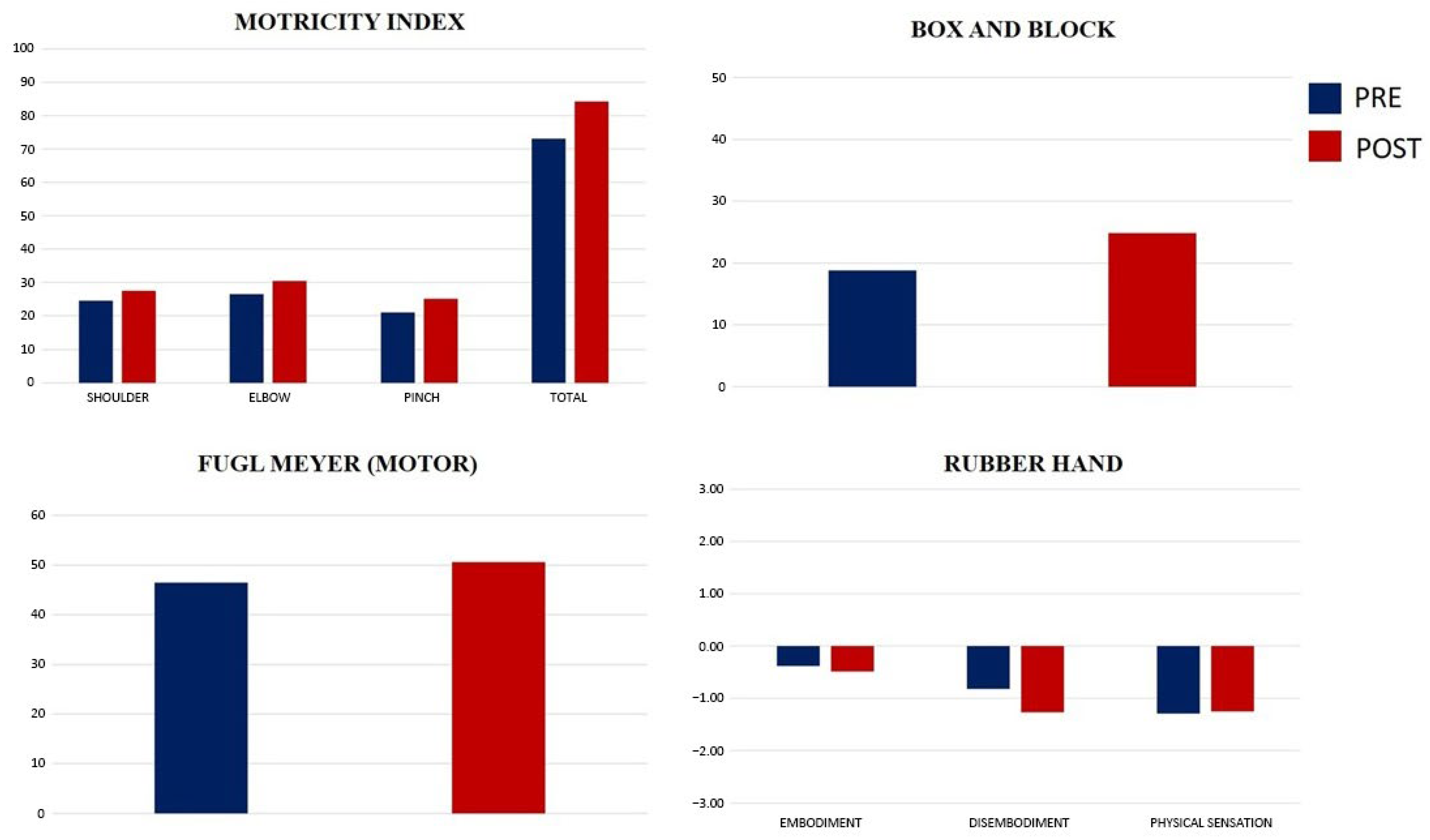
- Fugl–Meyer (Platz et al., 2005). This was used to evaluate upper limb sensorimotor function. The scale includes 33 items rated on a 3-point ordinal scale (0–2), yielding a maximum score of 66, with higher scores indicating better motor recovery.
- Motricity Index (Bohannon, 1999). This is a test for upper limbs with scores ranging from 0 to 100. The test evaluated the shoulder abduction, the elbow flexion, and the “grip and pinch” abilities.
- Box and Blocks test (Mathiowetz et al., 1985). This contains 150 wooden cube blocks (1 inch). The participants were told to move one-by-one blocks as many as possible from a rectangular box container to the other of equal size within 60 s. Both hands’ scores of the BBT were calculated, respectively, by the number of blocks transferred.
2.2.2. Proprioception Assessment
- Thumb Location Test (Rand, 2018). This evaluates the ability of individuals to accurately locate their thumbs without visual cues. During the test, the individual typically closes their eyes or is blindfolded, and the examiner moves the person’s thumb to different positions. The individual is then asked to indicate the location of their thumb by pointing to it with their other hand or verbally describing its position and it is scored from 0 = not accurate to 2 = completely accurate.
- Rubber Hand Illusion (Romano et al., 2021). This is a self-report questionnaire that evaluates the participants’ ability to perceive a rubber hand as his/her own in terms of ownership, location, and agency. The test is administered after the rubber hand induction by a professional with patient’s injury limb. The scale is score from −3 (not at all) to +3 (completely).
2.2.3. Neuropsychological Assessment
- Short screening test for ideo-motor apraxia (STIMA) (Tessari et al., 2015). This was used to screen for ideomotor apraxia, a disorder characterized by impaired gesture imitation. The assessment includes two sets of gestures: meaningful (intransitive) actions and meaningless gestures, which are presented separately. Participants are asked to reproduce each gesture as accurately as possible. Performance is scored according to the number of attempts required for correct imitation, with higher scores reflecting the need for additional attempts.
- Raven progressive matrices (Carpenter et al., 1990) were administered to assess abstract reasoning abilities and non-verbal intellectual functioning. The test comprises a set of progressively more complex visual stimuli in which participants must infer the underlying relationships among elements and select the option that correctly completes the missing part of each matrix.
- Trials Making Test (A and B) (Tombaugh, 2004) to evaluate patient’s attention. This was administered to evaluate attentional processes and executive control. Part A assesses visual scanning and processing speed through a sequential number-connecting task, whereas Part B additionally requires set-shifting abilities by asking participants to alternate between numerical and alphabetical sequences. Faster completion times indicate better performance.
- The Attentional Matrices Test (Abbate et al., 2007) is a neuropsychological test used to assess selective and sustained attention, visual scanning, and processing speed. Participants are required to identify target numbers within structured matrices under time constraints, providing a measure of attentional efficiency and concentration abilities.
- Corsi Test (visuospatial) (Piccardi et al., 2013) was administered to evaluate visuospatial short-term memory and spatial span. Participants were required to reproduce a series of block sequences presented by the examiner, maintaining the same order of presentation. The task becomes progressively more challenging as the number of blocks within each sequence increases. The primary outcome measure is the longest sequence accurately reproduced, which reflects the individual’s visuospatial memory capacity.
- Monaco Test (or digit span forward and backward) (Monaco et al., 2013). This evaluates short-term memory (Digit Span Forward) and working memory capacity (Digit Span Backward). Participants were presented with sequences of digits and asked to reproduce them either in the same order (forward condition) or in reverse order (backward condition). Sequence length gradually increased, and administration was terminated following two consecutive incorrect responses at the same span level.
- Token Test (De Renzi & Vignolo, 1962) to evaluate the language comprehension. The task requires participants to execute verbally delivered commands by selecting and manipulating simple geometric tokens according to specific rules. The complexity of the instructions increases progressively across trials, incorporating different linguistic structures and syntactic relationships. Performance is evaluated on the basis of the accuracy with which participants understand and carry out the requested operations.
- Barrage (Albert, 1973) peripersonal neglect and measures the patient’s spatial and selective attention abilities.
- Visual Object and Space Perception (VOSP) battery (Quental et al., 2013) to evaluate distinct components of visual processing, including object recognition and spatial analysis. The object perception subtests measure the ability to identify, match, and discriminate visual stimuli, including degraded or fragmented figures. The spatial perception subtests assess higher-order visuospatial skills such as orientation judgment, spatial relationship processing, and pattern analysis within a visual field.
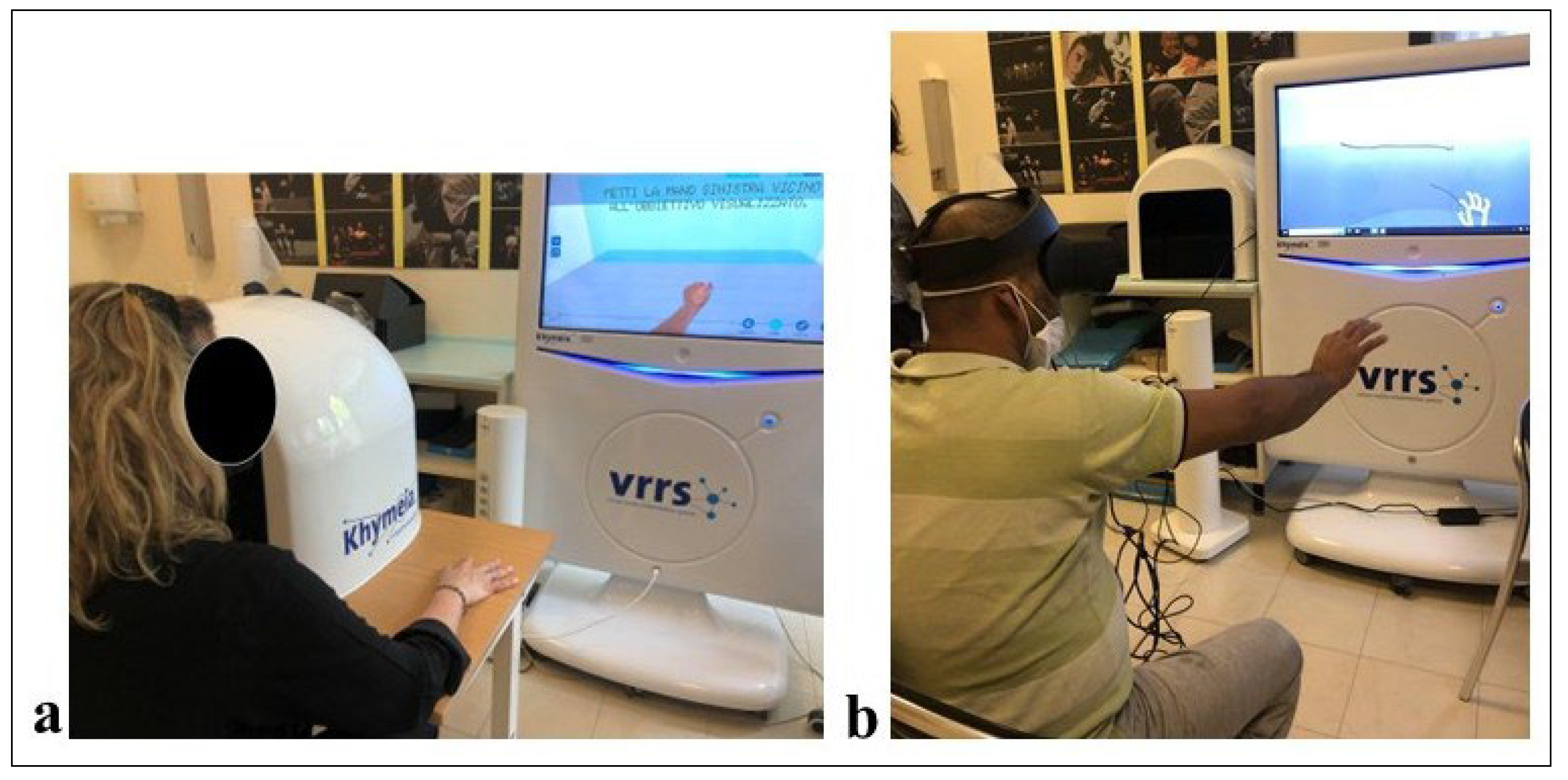
2.3. Apparatus
2.4. Intervention
3. Data Analysis
4. Results
4.1. Difference on Time on Motor Abilities
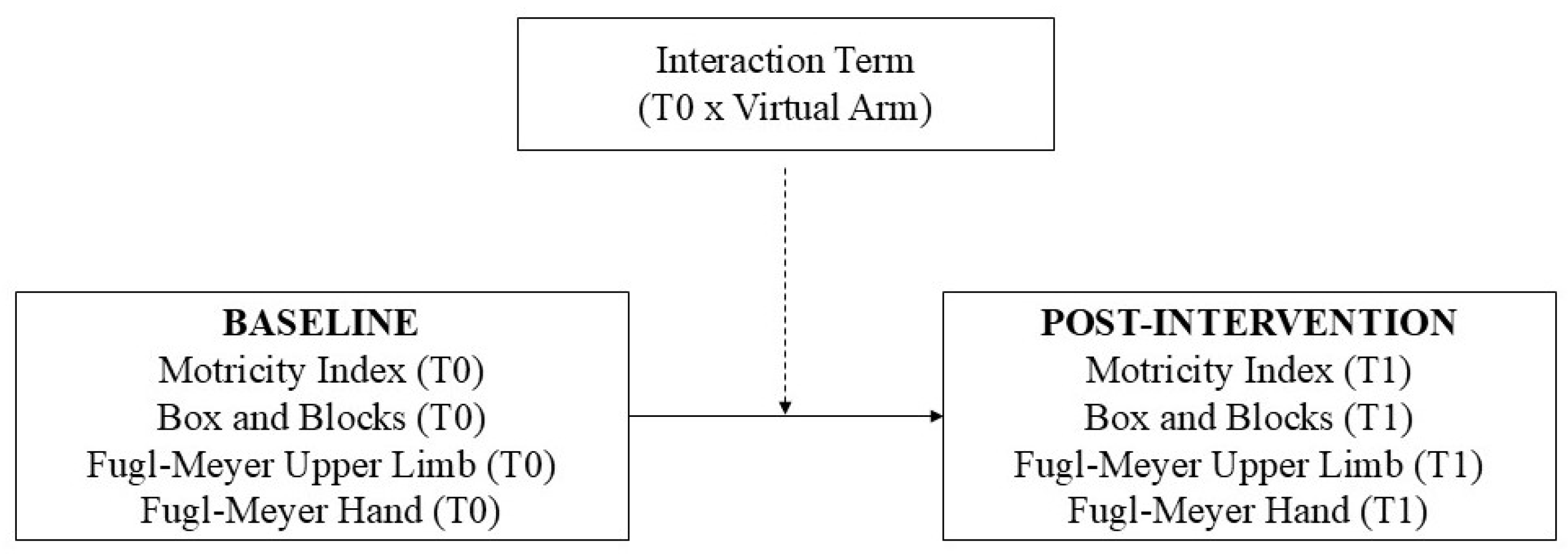
4.2. Embodied the Virtual Arm Moderates Change on Motor Abilities
5. Discussion
6. Conclusions
Author Contributions
Funding
Institutional Review Board Statement
Informed Consent Statement
Data Availability Statement
Acknowledgments
Conflicts of Interest
References
- Abbate, C., Luzzatti, C., & Vergani, C. (2007). Test delle matrici: Velocità e accuratezza della ricerca visiva nel corso dell’invecchiamento. Giornale di Gerontologia, 55, 11–20. [Google Scholar]
- Albert, M. L. (1973). A simple test of visual neglect. Neurology, 23(6), 658–664. [Google Scholar] [CrossRef] [Scilit] [PubMed]
- Alia, C., Spalletti, C., Lai, S., Panarese, A., Lamola, G., Bertolucci, F., & Caleo, M. (2017). Neuroplastic changes following brain ischemia and their contribution to stroke recovery: Novel approaches in neurorehabilitation. Frontiers in Cellular Neuroscience, 11, 76. [Google Scholar] [CrossRef] [Scilit] [PubMed]
- Aprile, I., Germanotta, M., Cruciani, A., Loreti, S., Pecchioli, C., Cecchi, F., & Carrozza, M. C. (2020). Upper limb robotic rehabilitation after stroke: A multicenter, randomized clinical trial. Journal of Neurologic Physical Therapy, 44(1), 3–14. [Google Scholar] [CrossRef] [Scilit] [PubMed]
- Bellelli, G., Morandi, A., Davis, D. H., Mazzola, P., Turco, R., Gentile, S., Ryan, T., Cash, H., Guerini, F., Torpilliesi, T., Del Santo, F., Trabucchi, M., Annoni, G., & MacLullich, A. M. (2014). Validation of the 4AT, a new instrument for rapid delirium screening: A study in 234 hospitalised older people. Age Ageing, 43, 496–502. [Google Scholar] [CrossRef] [Scilit] [PubMed]
- Bohannon, R. W. (1999). Motricity index scores are valid indicators of paretic upper extremity strength following stroke. Journal of Physical Therapy Science, 11(2), 59–61. [Google Scholar] [CrossRef] [Scilit]
- Burin, D., Livelli, A., Garbarini, F., Fossataro, C., Folegatti, A., Gindri, P., & Pia, L. (2015). Are movements necessary for the sense of body ownership? Evidence from the rubber hand illusion in pure hemiplegic patients. PLoS ONE, 10(3), e0117155. [Google Scholar] [CrossRef] [Scilit] [PubMed]
- Carpenter, P. A., Just, M. A., & Shell, P. (1990). What one intelligence test measures: A theoretical account of the processing in the raven progressive matrices test. Psychological Review, 97(3), 404. [Google Scholar] [CrossRef] [PubMed]
- Carruthers, G. (2008). Types of body representation and the sense of embodiment. Consciousness and Cognition, 17(4), 1302–1316. [Google Scholar] [CrossRef] [Scilit] [PubMed]
- Cha, K., Wang, J., Li, Y., Shen, L., Chen, Z., & Long, J. (2021). A novel upperlimb tracking system in a virtual environment for stroke rehabilitation. Journal of NeuroEngineering and Rehabilitation, 18, 166. [Google Scholar] [CrossRef] [Scilit] [PubMed]
- De Renzi, A., & Vignolo, L. A. (1962). Token test: A sensitive test to detect receptive disturbances in aphasics. Brain, 85(4), 665–678. [Google Scholar] [CrossRef] [Scilit] [PubMed]
- Dijkerman, C., & Lenggenhager, B. (2018). The body and cognition: The relation between body representations and higher level cognitive and social processes. Cortex, 104, 133–139. [Google Scholar] [CrossRef] [Scilit] [PubMed]
- Duncan, P. W., Zorowitz, R., Bates, B., Choi, J. Y., Glasberg, J. J., Graham, G. D., & Reker, D. (2005). Management of adult stroke rehabilitation care: A clinical practice guideline. Stroke, 36(9), e100–e143. [Google Scholar] [CrossRef] [Scilit] [PubMed]
- Errante, A., Saviola, D., Cantoni, M., Iannuzzelli, K., Ziccarelli, S., Togni, F., & De Tanti, A. (2022). Effectiveness of action observation therapy based on virtual reality technology in the motor rehabilitation of paretic stroke patients: A randomized clinical trial. BMC Neurology, 22(1), 109. [Google Scholar] [CrossRef] [Scilit] [PubMed]
- Feigin, V. L., Brainin, M., Norrving, B., Martins, S. O., Pandian, J., Lindsay, P., & Rautalin, I. (2025). World stroke organization: Global stroke fact sheet 2025. International Journal of Stroke, 20(2), 132–144. [Google Scholar] [CrossRef] [Scilit] [PubMed]
- Fregna, G., Schincaglia, N., Baroni, A., Straudi, S., & Casile, A. (2022). A novel immersive virtual reality environment for the motor rehabilitation of stroke patients: A feasibility study. Frontiers in Robotics and AI, 9, 906424. [Google Scholar] [CrossRef] [Scilit] [PubMed]
- Hao, J., Crum, G., & Siu, K. C. (2024). Effects of virtual reality on stroke rehabilitation: An umbrella review of systematic reviews. Health Science Reports, 7(9), e70082. [Google Scholar] [CrossRef] [Scilit] [PubMed]
- Holden, M. K., Dyar, T. A., & Dayan-Cimadoro, L. (2007). Telerehabilitation using a virtual environment improves upper extremity function in patients with stroke. IEEE Transactions on Neural Systems and Rehabilitation Engineering, 15(1), 36–42. [Google Scholar] [CrossRef] [Scilit] [PubMed]
- Hsu, H. Y., Kuo, L. C., Lin, Y. C., Su, F. C., Yang, T. H., & Lin, C. W. (2022). Effects of a virtual reality–based mirror therapy program on improving sensorimotor function of hands in chronic stroke patients: A randomized controlled trial. Neurorehabilitation and Neural Repair, 36(6), 335–345. [Google Scholar] [CrossRef] [Scilit] [PubMed]
- Jack, D., Boian, R., Merians, A. S., Tremaine, M., Burdea, G. C., Adamovich, S. V., Recce, M., & Poizner, H. (2001). Virtual reality-enhanced stroke rehabilitation. IEEE Transactions on Neural Systems and Rehabilitation Engineering, 9(3), 308–318. [Google Scholar] [CrossRef] [Scilit] [PubMed]
- Kilteni, K., Bergstrom, I., & Slater, M. (2013). Drumming in immersive virtual reality: The body shapes the way we play. IEEE Transactions on Visualization and Computer Graphics, 19, 597–605. [Google Scholar] [CrossRef] [Scilit] [PubMed]
- Kim, W. S., Cho, S., Ku, J., Kim, Y., Lee, K., Hwang, H. J., & Paik, N. J. (2020). Clinical application of virtual reality for upper limb motor rehabilitation in stroke: Review of technologies and clinical evidence. Journal of Clinical Medicine, 9(10), 3369. [Google Scholar] [CrossRef] [Scilit] [PubMed]
- Langhorne, P., Coupar, F., & Pollock, A. (2009). Motor recovery after stroke: A systematic review. The Lancet Neurology, 8(8), 741–754. [Google Scholar] [CrossRef] [Scilit] [PubMed]
- Laver, K. E., Lange, B., George, S., Deutsch, J. E., Saposnik, G., Chapman, M., & Crotty, M. (2025). Virtual reality for stroke rehabilitation. Cochrane Database of Systematic Reviews, 49(6), CD008349. [Google Scholar] [CrossRef] [Scilit]
- Lo, T. L. T., Lee, J. L. C., & Ho, R. T. H. (2023). Recovery beyond functional restoration: A systematic review of qualitative studies of the embodied experiences of people who have survived a stroke. BMJ Open, 13(2), e066597. [Google Scholar] [CrossRef] [Scilit] [PubMed]
- Matamala-Gomez, M., Malighetti, C., Cipresso, P., Pedroli, E., Realdon, O., Mantovani, F., & Riva, G. (2020). Changing body representation through full body ownership illusions might foster motor rehabilitation outcome in patients with stroke. Frontiers in Psychology, 11, 557057. [Google Scholar] [CrossRef] [Scilit] [PubMed]
- Mathiowetz, V., Volland, G., Kashman, N., & Weber, K. (1985). Adult norms for the box and block test of manual dexterity. The American Journal of Occupational Therapy, 39(6), 386–391. [Google Scholar] [CrossRef] [Scilit] [PubMed]
- Meyer, S., Karttunen, A. H., Thijs, V., Feys, H., & Verheyden, G. (2014). How do somatosensory deficits in the arm and hand relate to upper limb impairment, activity, and participation problems after stroke? A systematic review. Physical Therapy, 94(9), 1220–1231. [Google Scholar] [CrossRef] [Scilit] [PubMed]
- Monaco, M., Costa, A., Caltagirone, C., & Carlesimo, G. A. (2013). Forward and backward span for verbal and visuo-spatial data: Standardization and normative data from an Italian adult population. Neurological Sciences, 34, 749–754. [Google Scholar] [CrossRef] [Scilit] [PubMed]
- Perez-Marcos, D., Chevalley, O., Schmidlin, T., Garipelli, G., Serino, A., Vuadens, P., & Millan, J. D. R. (2017). Increasing upper limb training intensity in chronic stroke using embodied virtual reality: A pilot study. Journal of NeuroEngineering and Rehabilitation, 14, 119. [Google Scholar] [CrossRef] [Scilit] [PubMed]
- Pia, L., Fossataro, C., Burin, D., Bruno, V., Spinazzola, L., Gindri, P., & Garbarini, F. (2020). The anatomo-clinical picture of the pathological embodiment over someone else’s body part after stroke. Cortex, 130, 203–219. [Google Scholar] [CrossRef] [Scilit] [PubMed]
- Piccardi, L., Bianchini, F., Argento, O., De Nigris, A., Maialetti, A., Palermo, L., & Guariglia, C. (2013). The Walking Corsi Test (WalCT): Standardization of the topographical memory test in an Italian population. Neurological Sciences, 34, 971–978. [Google Scholar] [PubMed]
- Platz, T., Pinkowski, C., van Wijck, F., Kim, I., di Bella, P., & Johnson, G. (2005). Reliability and validity of arm function assessment with standardized guidelines for the Fugl-Meyer test, action research arm test and box and block test: A multicentre study. Clinical Rehabilitation, 19(4), 404–411. [Google Scholar] [CrossRef] [Scilit] [PubMed]
- Pollock, A., Farmer, S. E., Brady, M. C., Langhorne, P., Mead, G. E., Mehrholz, J., & Van Wijck, F. (2014). Interventions for improving upper limb function after stroke. Cochrane Database of Systematic Reviews, 2014(11), CD010820. [Google Scholar] [CrossRef] [Scilit] [PubMed]
- Pyasik, M., Tieri, G., & Pia, L. (2020). Visual appearance of the virtual hand affects embodiment in the virtual hand illusion. Scientific Reports, 10(1), 5412. [Google Scholar] [CrossRef] [Scilit] [PubMed]
- Quental, N. B., Brucki, S. M. D., & Bueno, O. F. A. (2013). Visuospatial function in early Alzheimer’s disease—The use of the visual object and space perception (VOSP) battery. PLoS ONE, 8(7), e68398. [Google Scholar] [CrossRef] [Scilit] [PubMed]
- Raghavan, P. (2015). Upper limb motor impairment post stroke. Physical Medicine and Rehabilitation Clinics of North America, 26(4), 599. [Google Scholar] [CrossRef] [Scilit] [PubMed]
- Rand, D. (2018). Proprioception deficits in chronic stroke-upper extremity function and daily living. PLoS ONE, 13(3), e0195043. [Google Scholar] [CrossRef] [Scilit] [PubMed]
- Rohde, M., Di Luca, M., & Ernst, M. O. (2011). The rubber hand illusion: Feeling of ownership and proprioceptive drift do not go hand in hand. PLoS ONE, 6(6), e21659. [Google Scholar] [CrossRef] [Scilit] [PubMed]
- Romano, D., Maravita, A., & Perugini, M. (2021). Psychometric properties of the embodiment scale for the rubber hand illusion and its relation with individual differences. Scientific Reports, 11(1), 5029. [Google Scholar] [CrossRef] [Scilit] [PubMed]
- Saini, V., Guada, L., & Yavagal, D. R. (2021). Global epidemiology of stroke and access to acute ischemic stroke interventions. Neurology, 97(20 Suppl. S2), S6–S16. [Google Scholar] [CrossRef] [Scilit] [PubMed]
- Saposnik, G., Levin, M., & Stroke Outcome Research Canada (SORCan) Working Group. (2011). Virtual reality in stroke rehabilitation: A meta-analysis and implications for clinicians. Stroke, 42(5), 1380–1386. [Google Scholar] [CrossRef] [Scilit] [PubMed]
- Singh, N., Saini, M., Kumar, N., Srivastava, M. P., & Mehndiratta, A. (2021). Evidence of neuroplasticity with robotic hand exoskeleton for post-stroke rehabilitation: A randomized controlled trial. Journal of NeuroEngineering and Rehabilitation, 18(1), 76. [Google Scholar] [CrossRef] [Scilit] [PubMed]
- Sousa, M., Vieira, J., Medeiros, D., Arsenio, A., & Jorge, J. (2016, March). SleeveAR: Augmented reality for rehabilitation using realtime feedback. In Proceedings of the 21st international conference on intelligent user interfaces (pp. 175–185). Association for Computing Machinery (ACM). [Google Scholar]
- Tambone, R., Giachero, A., Calati, M., Molo, M. T., Burin, D., Pyasik, M., Cabria, F., & Pia, L. (2021). Using body ownership to modulate the motor system in stroke patients. Psychological Science, 32(5), 655–667. [Google Scholar] [CrossRef] [Scilit] [PubMed]
- Tessari, A., Mengotti, P., Faccioli, L., Tuozzi, G., Boscarato, S., Taricco, M., & Rumiati, R. I. (2021). Effect of body-part specificity and meaning in gesture imitation in left hemisphere stroke patients. Neuropsychologia, 151, 107720. [Google Scholar] [CrossRef] [Scilit] [PubMed]
- Tessari, A., Toraldo, A., Lunardelli, A., Zadini, A., & Rumiati, R. I. (2015). STIMA: A short screening test for ideo-motor apraxia, selective for action meaning and bodily district. Neurological Sciences, 36, 977–984. [Google Scholar] [CrossRef] [Scilit] [PubMed]
- Thieme, H., Mehrholz, J., Pohl, M., Behrens, J., & Dohle, C. (2013). Mirror therapy for improving motor function after stroke. Stroke, 44(1), e1–e2. [Google Scholar] [CrossRef] [Scilit] [PubMed]
- Tombaugh, T. N. (2004). Trail making test a and B: Normative data stratified by age and education. Archives of Clinical Neuropsychology, 19(2), 203–214. [Google Scholar] [CrossRef] [Scilit] [PubMed]
- Turolla, A., Dam, M., Ventura, L., Tonin, P., Agostini, M., Zucconi, C., Kiper, P., Cagnin, A., & Piron, L. (2013). Virtual reality for the rehabilitation of the upper limb motor function after stroke: A prospective controlled trial. Journal of NeuroEngineering and Rehabilitation, 10(1), 85. [Google Scholar] [CrossRef] [Scilit] [PubMed]
- Ventura, S., Marchetti, P., Baños, R., & Tessari, A. (2023). Body ownership illusion through virtual reality as modulator variable for limbs rehabilitation after stroke: A systematic review. Virtual Reality, 27(3), 2481–2492. [Google Scholar] [CrossRef] [Scilit]
- Wang, S. C. Y., & Kassavou, A. (2023). Digital health behavioural interventions to support physical activity and sedentary behaviour in adults after stroke: A systematic literature review with meta-analysis of controlled trials. Behavioral Sciences, 13(1), 62. [Google Scholar] [CrossRef] [Scilit] [PubMed]
- Weber, L. M., Nilsen, D. M., Gillen, G., Yoon, J., & Stein, J. (2019). Immersive virtual reality mirror therapy for upper limb recovery following stroke: A pilot study. American Journal of Physical Medicine & Rehabilitation, 98(9), 783. [Google Scholar] [CrossRef] [Scilit]
- Zepeda, A., Troncoso, A., Pizarro, D., Baquedano, C., Gomez, R., Barria, S., & Martínez-Pernía, D. (2025). The spectrum of embodied intersubjective synchrony in empathy: From fully embodied to externally oriented engagement in Parkinson’s disease. Frontiers in Psychology, 16, 1570124. [Google Scholar] [CrossRef] [Scilit] [PubMed]
- Zhang, J. J., Fong, K. N., Welage, N., & Liu, K. P. (2018). The activation of the mirror neuron system during action observation and action execution with mirror visual feedback in stroke: A systematic review. Neural Plasticity, 2018(1), 2321045. [Google Scholar] [CrossRef] [Scilit] [PubMed]
- Zhang, Y., Xing, Y., Li, C., Hua, Y., Hu, J., Wang, Y., Ya, R., Meng, Q., & Bai, Y. (2022). Mirror therapy for unilateral neglect after stroke: A systematic review. European Journal of Neurology, 29(1), 358–371. [Google Scholar] [PubMed]



| Patients’ Abilities | Test | T0 | T1 |
|---|---|---|---|
| Motor | Fugl–Meyer (Platz et al., 2005) | x | x |
| Motricity Index (Bohannon, 1999) | x | x | |
| Box and Blocks (Mathiowetz et al., 1985) | x | x | |
| Proprioception | Thumb Location Test (Rand, 2018) | x | x |
| Rubber Hand Illusion (Romano et al., 2021) | x | x | |
| Apraxia | Short screening test for ideo-motor apraxia (STIMA) (Tessari et al., 2015) | x | |
| Intelligence | Raven progressive matrices (Carpenter et al., 1990) | x | |
| Attention | Trials Making Test (A and B) (Tombaugh, 2004) Attentional Matrices (Abbate et al., 2007) | x | |
| Memory | Corsi Test (visuospatial) (Piccardi et al., 2013) | x | |
| Monaco Test (span forward and backward) (Monaco et al., 2013) | x | ||
| Language comprehension | Token Test (De Renzi & Vignolo, 1962) | x | |
| Visuo-spatial | Barrage (Albert, 1973) | ||
| Visual object and space perception (VOSP) (Quental et al., 2013) | x | ||
| M (SD) N = 12 | Median | IQR | |
|---|---|---|---|
| Clinical Variables | |||
| Age (years) | 52.08 (16.03) | 58 | 18 |
| Sex | |||
| Female | 4 | ||
| Male | 8 | ||
| Time since stroke (months) | 12 (11) | 6.50 | 14.25 |
| Side most affected | |||
| Right hemiplegia | 8 | ||
| Left hemiplegia | 4 | ||
| Neuropsychological Variables | |||
| Token Test | 3 (1.28) * | ||
| Stima | 3.92 (0.29) * | ||
| Raven | 2.67 (1.44) * | ||
| Attentional Matrices | 2.08 (1.38) * | ||
| Trial Making Test A | 2.83 (1.12) * | ||
| Trial Making Test B | 2.58 (0.99) * | ||
| Corsi | 2.92 (1.44) * | ||
| Digit Span Forward | 2.83 (1.11) * | ||
| Digit Span Backward | 2.92 (1.38) * | ||
| Vosp Shape Detection | 19.58 (0.79) | ||
| Vosp Object Decision | 15.08 (3.05) | ||
| Barrage | 20 (0) | ||
| Proprioception | |||
| Thumb Location | 0.92 (1.50) | ||
| Pre-Intervention M (SD) | Post-Intervention M (SD) | |
|---|---|---|
| Motricity Index | ||
| Shoulder | 24.58 (5.80) | 27.58 (6.47) |
| Elbow | 26.50 (6.97) | 30.50 (4.76) |
| Pinch | 21.08 (6.29) | 25.17 (9.10) |
| Fugl–Meyer | ||
| Motor Function (A–D) | 46.50/66 (13.89) | 50.58 (12.66) |
| A. Upper Limbs | 27.08/36 (7.80) | 30.92 (5.48) |
| B. Wrist | 7.92/10 (2.02) | 8.08 (1.83) |
| C. Hand | 8.33/14 (3.65) | 9.92 (3.60) |
| D. Coordination and Speed | 3.42/6 (1.73) | 4.17 (1.75) |
| Sensory Function | 8.42/12 (3) | 9.17 (2.66) |
| Pain | 19.33/24 (5) | 20.75 (4.37) |
| Joint Function | 20.92/24 (3.20) | 21.33 (2.54) |
| Box and Block | 18.83 (11.82) | 24.83 (14.72) |
| Rubber Hand | ||
| Embodiment | −0.38 (1.88) | −0.48 (2.03) |
| Disembodiment | −0.82 (1.61) | −1.26 (1.79) |
| Physical sensations | −1.29 (.83) | −1.25 (1.28) |
Disclaimer/Publisher’s Note: The statements, opinions and data contained in all publications are solely those of the individual author(s) and contributor(s) and not of MDPI and/or the editor(s). MDPI and/or the editor(s) disclaim responsibility for any injury to people or property resulting from any ideas, methods, instructions or products referred to in the content. |
© 2026 by the authors. Licensee MDPI, Basel, Switzerland. This article is an open access article distributed under the terms and conditions of the Creative Commons Attribution (CC BY) license.
Share and Cite
Ventura, S.; Lullini, G.; Castaldini, S.; Russo, C.; Triberti, S.; Tessari, A. The Moderating Role of Virtual Arm Embodiment for Upper Limb Rehabilitation in Stroke Patients with Proprioceptive Deficit: A Pilot Study. Behav. Sci. 2026, 16, 1180. https://doi.org/10.3390/bs16071180
Ventura S, Lullini G, Castaldini S, Russo C, Triberti S, Tessari A. The Moderating Role of Virtual Arm Embodiment for Upper Limb Rehabilitation in Stroke Patients with Proprioceptive Deficit: A Pilot Study. Behavioral Sciences. 2026; 16(7):1180. https://doi.org/10.3390/bs16071180
Chicago/Turabian StyleVentura, Sara, Giada Lullini, Sara Castaldini, Cristina Russo, Stefano Triberti, and Alessia Tessari. 2026. "The Moderating Role of Virtual Arm Embodiment for Upper Limb Rehabilitation in Stroke Patients with Proprioceptive Deficit: A Pilot Study" Behavioral Sciences 16, no. 7: 1180. https://doi.org/10.3390/bs16071180
APA StyleVentura, S., Lullini, G., Castaldini, S., Russo, C., Triberti, S., & Tessari, A. (2026). The Moderating Role of Virtual Arm Embodiment for Upper Limb Rehabilitation in Stroke Patients with Proprioceptive Deficit: A Pilot Study. Behavioral Sciences, 16(7), 1180. https://doi.org/10.3390/bs16071180