The Double-Edged Sword Effects of Teacher–AI Collaboration on Work Engagement: A Self-Determination Theory Perspective


Abstract
1. Introduction
2. Literature Review and Hypothesis Materials
2.1. Teacher–AI Collaboration and Work Engagement
2.2. Mediating Role of Psychological Availability
2.3. Mediating Role of Work Alienation
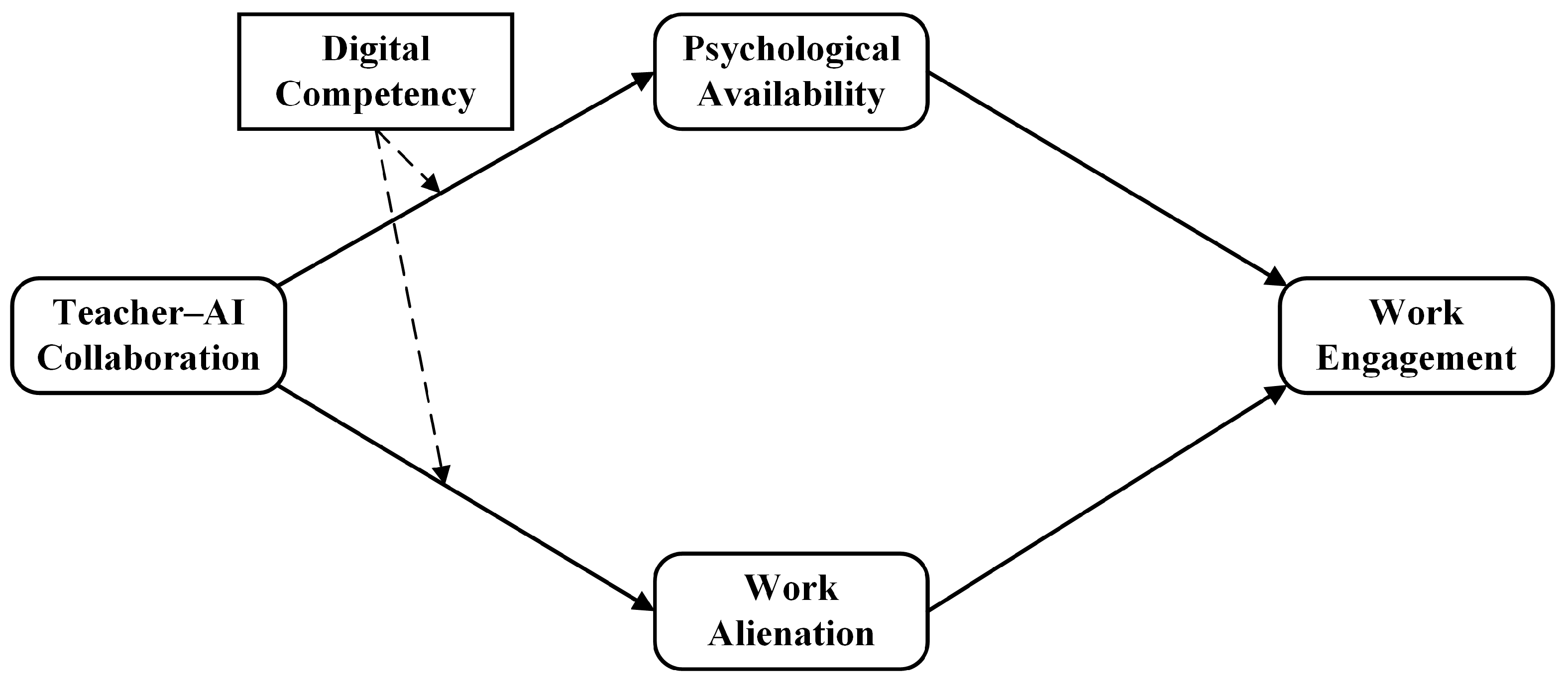
2.4. Moderating Role of Digital Competency
3. Research Methods
3.1. Sampling and Data Collection
3.2. Measures
3.3. Data Analysis
4. Results
4.1. Measurement Model
4.2. Descriptive Statistics and Correlations
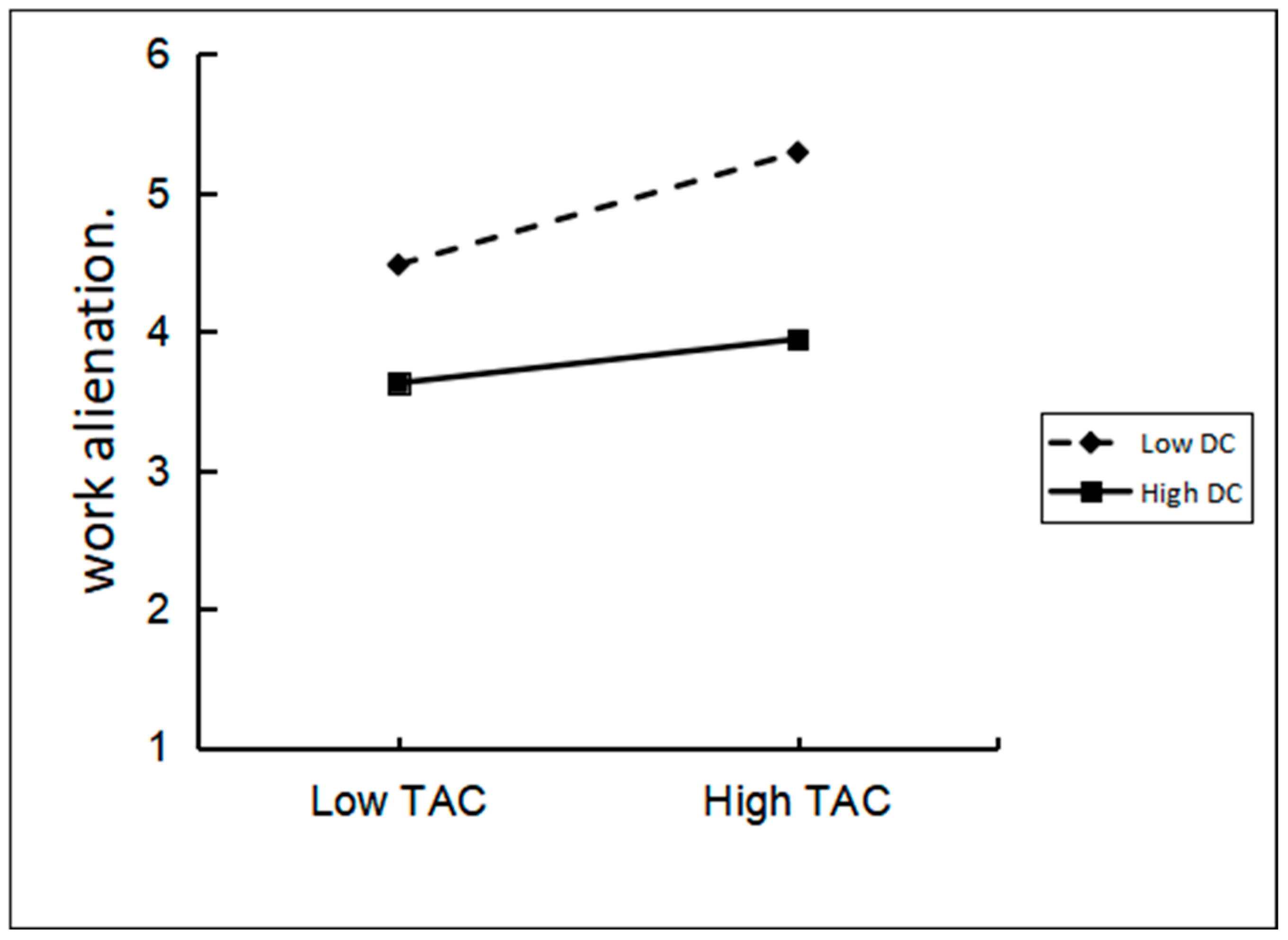
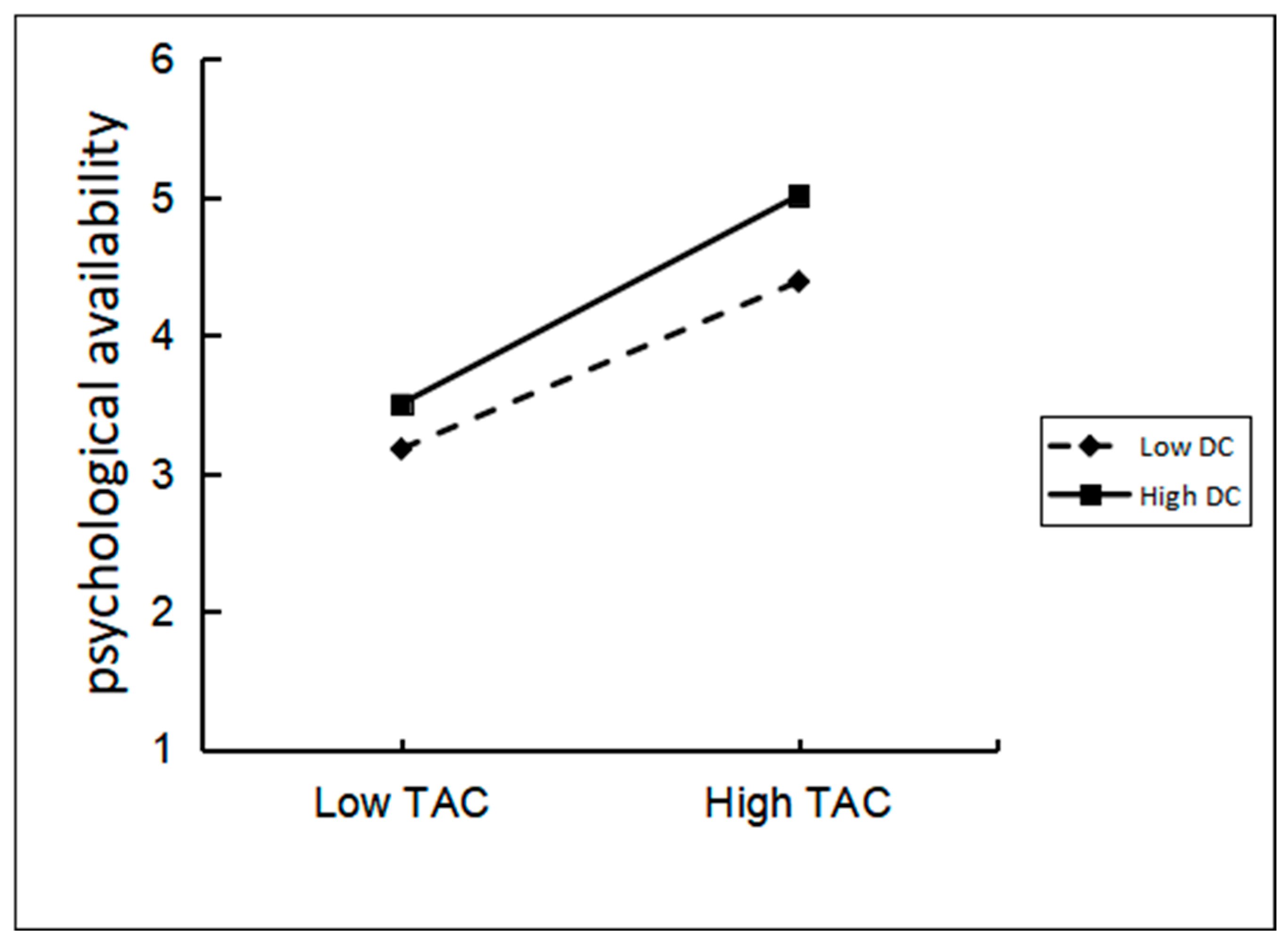
4.3. Hypothesis Testing
5. Discussion
5.1. Theoretical Contributions
5.2. Practical Implications
5.3. Limitations and Future Directions
6. Conclusions
Author Contributions
Funding
Institutional Review Board Statement
Informed Consent Statement
Data Availability Statement
Conflicts of Interest
References
- Albrecht, S. L., Furlong, S., & Leiter, M. P. (2023). The psychological conditions for employee engagement in organizational change: Test of a change engagement model. Frontiers in Psychology, 14, 1071924. [Google Scholar] [CrossRef] [PubMed]
- Ansari, A. N., Ahmad, S., & Bhutta, S. M. (2024). Mapping the global evidence around the use of ChatGPT in higher education: A systematic scoping review. Education and Information Technologies, 29(9), 11281–11321. [Google Scholar]
- Bankins, S., & Formosa, P. (2023). The ethical implications of artificial intelligence (AI) for meaningful work. Journal of Business Ethics, 185(4), 725–740. [Google Scholar] [CrossRef]
- Budhwar, P., Malik, A., De Silva, M. T. T., & Thevisuthan, P. (2022). Artificial intelligence–challenges and opportunities for international HRM: A review and research agenda. The International Journal of Human Resource Management, 33(6), 1065–1097. [Google Scholar]
- Byrne, Z. S., Peters, J. M., & Weston, J. W. (2016). The struggle with employee engagement: Measures and construct clarification using five samples. Journal of Applied Psychology, 101(9), 1201–1227. [Google Scholar] [CrossRef] [PubMed]
- Celik, I. (2023). Towards intelligent-TPACK: An empirical study on teachers’ professional knowledge to ethically integrate artificial intelligence (AI)-based tools into education. Computers in Human Behavior, 138, 107468. [Google Scholar]
- Chang, P. C., Liu, S., Guo, Y., & Cai, Q. (2025). Coping with job resources for female employees’ thriving at work: A mediated moderation model of benevolent sexism and self-efficacy. Behavioral Sciences, 15(5), 640. [Google Scholar] [CrossRef] [PubMed]
- Chang, P. C., Zhang, W., Cai, Q., & Guo, H. (2024). Does AI-driven technostress promote or hinder employees’ artificial intelligence adoption intention? A moderated mediation model of affective reactions and technical self-efficacy. Psychology Research and Behavior Management, 17, 413–427. [Google Scholar] [CrossRef] [PubMed]
- Claro, M., Castro-Grau, C., Ochoa, J. M., Hinostroza, J. E., & Cabello, P. (2024). Systematic review of quantitative research on digital competences of in-service school teachers. Computers & Education, 215, 105030. [Google Scholar] [CrossRef]
- Ding, L.-J., Li, J.-M., & Hui, B.-H. (2025). Will teacher-AI collaboration enhance teaching engagement? Behavioral Sciences, 15(7), 866. [Google Scholar] [CrossRef] [PubMed]
- Gagné, M., & Deci, E. L. (2005). Self-determination theory and work motivation. Journal of Organizational Behavior, 26(4), 331–362. [Google Scholar]
- Guo, Y., Chang, P. C., Liu, S., & Cai, Q. (2025). How role overload impacts nurses’ work engagement in healthcare emergencies: A moderated mediation model. International Nursing Review, 72(4), e70125. [Google Scholar] [CrossRef] [PubMed]
- Hai, S., Long, T., Honora, A., Japutra, A., & Guo, T. (2025). The dark side of employee-generative AI collaboration in the workplace: An investigation on work alienation and employee expediency. International Journal of Information Management, 83, 102905. [Google Scholar] [CrossRef]
- Huang, M.-H., & Rust, R. T. (2018). Artificial intelligence in service. Journal of Service Research, 21(2), 155–172. [Google Scholar] [CrossRef]
- Jarrahi, M. H. (2018). Artificial intelligence and the future of work: Human-AI symbiosis in organizational decision making. Business Horizons, 61(4), 577–586. [Google Scholar] [CrossRef]
- Kahn, W. A. (1990). Psychological conditions of personal engagement and disengagement at work. Academy of Management Journal, 33(4), 692–724. [Google Scholar] [CrossRef]
- Kim, J. (2024). Types of teacher-AI collaboration in K-12 classroom instruction: Chinese teachers’ perspective. Education and Information Technologies, 29(13), 17433–17465. [Google Scholar] [CrossRef]
- Koehler, M. J., & Mishra, P. (2009). What is technological pedagogical content knowledge? Contemporary Issues in Technology and Teacher Education, 9(1), 60–70. [Google Scholar]
- Kong, H., Yin, Z., Baruch, Y., & Yuan, Y. (2023). The impact of trust in AI on career sustainability: The role of employee–AI collaboration and protean career orientation. Journal of Vocational Behavior, 146, 103928. [Google Scholar] [CrossRef]
- Küçükuncular, A., & Ertugan, A. (2025). Teaching in the AI era: Sustainable digital education through ethical integration and teacher empowerment. Sustainability, 17(16), 7405. [Google Scholar] [CrossRef]
- Li, J.-M., Wu, H.-Y., Zhang, R.-X., & Wu, T.-J. (2025). How employee-generative AI collaboration affects employees work and family outcomes? The relationship instrumentality perspective. The International Journal of Human Resource Management, 36(8), 1431–1457. [Google Scholar] [CrossRef]
- Li, J.-M., Wu, T.-J., Wu, Y. J., & Goh, M. (2023). Systematic literature review of human–machine collaboration inorganizations using bibliometric analysis. Management Decision, 61(10), 2920–2944. [Google Scholar]
- May, D. R., Gilson, R. L., & Harter, L. M. (2004). The psychological conditions of meaningfulness, safety and availability and the engagement of the human spirit at work. Journal of Occupational and Organizational Psychology, 77(1), 11–37. [Google Scholar] [CrossRef]
- Memon, T. D., & Kwan, P. (2025). A collaborative model for integrating teacher and GenAI into future education. TechTrends, 69(6), 1192–1206. [Google Scholar] [CrossRef]
- Mottaz, C. J. (1981). Some determinants of work alienation. The Sociological Quarterly, 22(4), 515–529. [Google Scholar] [CrossRef]
- Nair, N., & Vohra, N. (2010). An exploration of factors predicting work alienation of knowledge workers. Management Decision, 48(4), 600–615. [Google Scholar] [CrossRef]
- Qin, K., Yu, Z., Cai, Q., Jiang, N., & Chung, K. S. (2025). How workplace telepressure fuels job burnout among educators: Mediated by work-related rumination and moderated by perceived organizational support. Behavioral Sciences, 15(8), 1109. [Google Scholar] [CrossRef] [PubMed]
- Raisch, S., & Krakowski, S. (2021). Artificial intelligence and management: The automation–augmentation paradox. Academy of Management Review, 46(1), 192–210. [Google Scholar] [CrossRef]
- Rich, B. L., Lepine, J. A., & Crawford, E. R. (2010). Job engagement: Antecedents and effects on job performance. Academy of Management Journal, 53(3), 617–635. [Google Scholar] [CrossRef]
- Ryan, R. M., & Deci, E. L. (2000). Self-determination theory and the facilitation of intrinsic motivation, social development, and well-being. American Psychologist, 55(1), 68–78. [Google Scholar] [CrossRef] [PubMed]
- Schaufeli, W. B., Salanova, M., González-romá, V., & Bakker, A. B. (2002). The measurement of engagement and burnout: A two sample confirmatory factor analytic approach. Journal of Happiness Studies, 3(1), 71–92. [Google Scholar] [CrossRef]
- Schwarz, S., Bieg, T., Svecnik, E., Schmölz, A., Geppert, C., & Gerdenitsch, C. (2024). Digital competencys scale (DCS): A short self-assessment instrument for measuring digital competencys. Nordic Journal of Digital Literacy, 19(3), 127–143. [Google Scholar]
- Seeman, M. (1959). On the meaning of alienation. American Sociological Review, 24(6), 783–791. [Google Scholar] [CrossRef]
- Shantz, A., Alfes, K., & Truss, C. (2014). Alienation from work: Marxist ideologies and twenty-first-century practice. The International Journal of Human Resource Management, 25(18), 2529–2550. [Google Scholar]
- Song, Z., Qin, J., Jin, F., Cheung, W. M., & Lin, C.-H. (2025). A case study of teachers’ generative artificial intelligence integration processes and factors influencing them. Teaching and Teacher Education, 165, 105157. [Google Scholar] [CrossRef]
- Sun, L., Hu, R., & Su, H. (2026). Unlocking human potential in the AI age: How employee-AI collaboration transforms work engagement through dual psychological pathways. Frontiers in Psychology, 16, 1705671. [Google Scholar] [CrossRef] [PubMed]
- Tan, Q. (2025). Reimagining teacher development in the era of generative AI: A scoping review. Teaching and Teacher Education, 168, 105236. [Google Scholar] [CrossRef]
- Wan, J., Zhou, W., Qin, M., & Zhou, H. (2024). The effect of perceived professional benefits on health professionals’ job engagement: The role of psychological availability and future perceived professional benefits. BMC Health Services Research, 24(1), 227. [Google Scholar] [CrossRef] [PubMed]
- Wilson, H. J., & Daugherty, P. R. (2018). Collaborative intelligence: Humans and AI are joining forces. Harvard Business Review, 96(4), 114–123. [Google Scholar]
- Wu, T.-J., Liang, Y., & Wang, Y. (2024). The buffering role of workplace mindfulness: How job insecurity of human-artificial intelligence collaboration impacts employees’ work–life-related outcomes. Journal of Business and Psychology, 39(6), 1395–1411. [Google Scholar]
- Wu, T.-J., Zhang, R.-X., & Li, J.-M. (2025). When employees meet digital-intelligence transformation: Unveiling the role of employee intentions. International Journal of Information Management, 84, 102912. [Google Scholar] [CrossRef]
- Xia, Q., Yang, Y., Weng, X., Cilsalar-Sagnak, H., Cheng, W. K., & Chiu, T. K. (2026). Generative artificial intelligence competency self-efficacy scale for teachers and researchers (GAICS-TR) in higher education. Journal of Computers in Education, 13, 769–793. [Google Scholar]
- Zhou, J., Shen, L., & Chen, W. (2024). How ChatGPT transformed teachers: The role of basic psychological needs in enhancing digital competency. Frontiers in Psychology, 15, 1458551. [Google Scholar] [CrossRef] [PubMed]



| Measurement Model | χ2 | df | χ2/df | IFI | TLI | CFI | RMSEA |
|---|---|---|---|---|---|---|---|
| The hypothesized five-factor model | 1246.94 | 655 | 1.9 | 0.94 | 0.93 | 0.94 | 0.04 |
| Four-factor model (combining TAC and DC) | 2120.08 | 659 | 3.22 | 0.85 | 0.84 | 0.85 | 0.07 |
| Three-factor model (combining TAC, PA, and DC) | 2721.48 | 662 | 4.11 | 0.78 | 0.77 | 0.78 | 0.08 |
| Two-factor model (combining TAC, PA, WA, and DC) | 4493.75 | 664 | 6.77 | 0.6 | 0.57 | 0.6 | 0.11 |
| One-factor model (combining TAC, PA, WA, WE, and DC) | 5809.8 | 665 | 8.74 | 0.46 | 0.43 | 0.46 | 0.13 |
| Component | Total | % of Variance | Cumulative % |
|---|---|---|---|
| 1 | 11.96 | 31.46 | 31.46 |
| 2 | 6.35 | 16.71 | 48.17 |
| 3 | 4.02 | 10.58 | 58.75 |
| 4 | 1.92 | 5.05 | 63.79 |
| 5 | 1.05 | 2.76 | 66.55 |
| Variable | M | SD | 1 | 2 | 3 | 4 | 5 | 6 | 7 | 8 | 9 |
|---|---|---|---|---|---|---|---|---|---|---|---|
| 1. Gender | 0.47 | 0.50 | — | ||||||||
| 2. Age | 3.71 | 1.47 | −0.08 | — | |||||||
| 3. Teaching year | 2.82 | 1.55 | −0.05 | 0.40 ** | — | ||||||
| 4. Academic rank | 2.30 | 0.88 | −0.096 * | 0.32 ** | 0.66 ** | — | |||||
| 5. Teacher–AI collaboration | 4.80 | 1.47 | 0.03 | −0.08 | 0.06 | 0.006 | — | ||||
| 6. Digital competency | 5.06 | 1.11 | −0.04 | −0.02 | 0.08 | 0.02 | 0.51 ** | — | |||
| 7. Psychological availability | 3.87 | 1.32 | 0.04 | −0.06 | 0.06 | 0.03 | 0.74 ** | 0.48 ** | — | ||
| 8. Work alienation | 4.27 | 0.86 | −0.01 | −0.06 | −0.10 * | −0.10 * | 0.23 ** | −0.27 ** | 0.09 | — | |
| 9. Work engagement | 3.40 | 0.99 | −0.01 | 0.01 | 0.08 | 0.06 | 0.35 ** | 0.28 ** | 0.45 ** | −0.18 ** | — |
| Variables | Model 1 X → Y | Model 2 X → M1 | Model 3 X → M2 | Model 4 X, M1, M2 → Y | Model 5 XW → M1 | Model 6 XW → M2 |
|---|---|---|---|---|---|---|
| Control variables | ||||||
| Gender | −0.02 | 0.04 | −0.04 | −0.04 | 0.05 | −0.07 |
| Age | 0.01 | −0.01 | 0.01 | 0.02 | −0.01 | 0.01 |
| Teaching year | 0.02 | −0.01 | −0.05 | 0.01 | −0.02 | −0.03 |
| Academic rank | 0.04 | 0.06 | −0.05 | 0.01 | 0.06 | −0.06 |
| Independent variable | ||||||
| TAC | 0.24 *** | 0.66 *** | 0.14 *** | 0.08 * | 0.31 * | 0.75 *** |
| Mediators | ||||||
| PA(M1) | — | — | — | 0.29 *** | — | — |
| WA(M2) | — | — | — | −0.27 *** | — | — |
| Moderator | ||||||
| DC | — | — | — | — | −0.09 | 0.01 |
| TAC*DC | — | — | — | — | 0.06 * | −0.09 *** |
| R2 | 0.13 | 0.55 | 0.07 | 0.26 | 0.57 | 0.29 |
| F | 13.67 *** | 112.91 *** | 6.56 *** | 23.41 *** | 86.74 *** | 27.04 *** |
| Effect | BootSE | BootLLCI | BootULCI | |
|---|---|---|---|---|
| Total effect: TAC → WE | 0.24 | 0.03 | 0.18 | 0.3 |
| Direct effect: TAC → WE | 0.08 | 0.04 | 0 | 0.16 |
| Total indirect effect | 0.16 | 0.03 | 0.09 | 0.22 |
| TAC → PA → WE | 0.19 | 0.03 | 0.13 | 0.25 |
| TAC → WA → WE | −0.03 | 0.01 | −0.06 | −0.02 |
| DC Level | Effect | SE | LLCI | ULCI | |
|---|---|---|---|---|---|
| TAC → PA | DC Low (M − 1SD) | 0.54 | 0.04 | 0.47 | 0.62 |
| DC Mean | 0.61 | 0.03 | 0.55 | 0.67 | |
| DC High (M + 1SD) | 0.68 | 0.05 | 0.58 | 0.77 | |
| TAC → WA | DC Low (M − 1SD) | 0.38 | 0.03 | 0.31 | 0.44 |
| DC Mean | 0.27 | 0.03 | 0.22 | 0.33 | |
| DC High (M + 1SD) | 0.17 | 0.04 | 0.09 | 0.24 |
| DC level | Effect | BootSE | BootLLCI | BootULCI | |
|---|---|---|---|---|---|
| TAC → PA → WE | DC Low (M−1SD) | 0.16 | 0.03 | 0.11 | 0.21 |
| DC Mean | 0.18 | 0.03 | 0.12 | 0.24 | |
| DC High (M+1SD) | 0.20 | 0.03 | 0.13 | 0.26 | |
| TAC → WA → WE | DC Low (M−1SD) | −0.10 | 0.02 | −0.14 | −0.07 |
| DC Mean | −0.07 | 0.01 | −0.10 | −0.05 | |
| DC High (M+1SD) | −0.05 | 0.01 | −0.07 | −0.02 |
Disclaimer/Publisher’s Note: The statements, opinions and data contained in all publications are solely those of the individual author(s) and contributor(s) and not of MDPI and/or the editor(s). MDPI and/or the editor(s) disclaim responsibility for any injury to people or property resulting from any ideas, methods, instructions or products referred to in the content. |
© 2026 by the authors. Licensee MDPI, Basel, Switzerland. This article is an open access article distributed under the terms and conditions of the Creative Commons Attribution (CC BY) license.
Share and Cite
Sun, J.; Xing, Y.; Yuan, G.; Cai, Q. The Double-Edged Sword Effects of Teacher–AI Collaboration on Work Engagement: A Self-Determination Theory Perspective. Behav. Sci. 2026, 16, 1118. https://doi.org/10.3390/bs16071118
Sun J, Xing Y, Yuan G, Cai Q. The Double-Edged Sword Effects of Teacher–AI Collaboration on Work Engagement: A Self-Determination Theory Perspective. Behavioral Sciences. 2026; 16(7):1118. https://doi.org/10.3390/bs16071118
Chicago/Turabian StyleSun, Jingsong, Yingyu Xing, Guipeng Yuan, and Qihai Cai. 2026. "The Double-Edged Sword Effects of Teacher–AI Collaboration on Work Engagement: A Self-Determination Theory Perspective" Behavioral Sciences 16, no. 7: 1118. https://doi.org/10.3390/bs16071118
APA StyleSun, J., Xing, Y., Yuan, G., & Cai, Q. (2026). The Double-Edged Sword Effects of Teacher–AI Collaboration on Work Engagement: A Self-Determination Theory Perspective. Behavioral Sciences, 16(7), 1118. https://doi.org/10.3390/bs16071118