
The Influence of Format Familiarity on the Word Segmentation Effect in Tibetan Reading

Abstract
1. Introduction
1.1. Research Rationale
1.2. Theoretical and Practical Implications
1.3. Research Purpose and Experimental Design
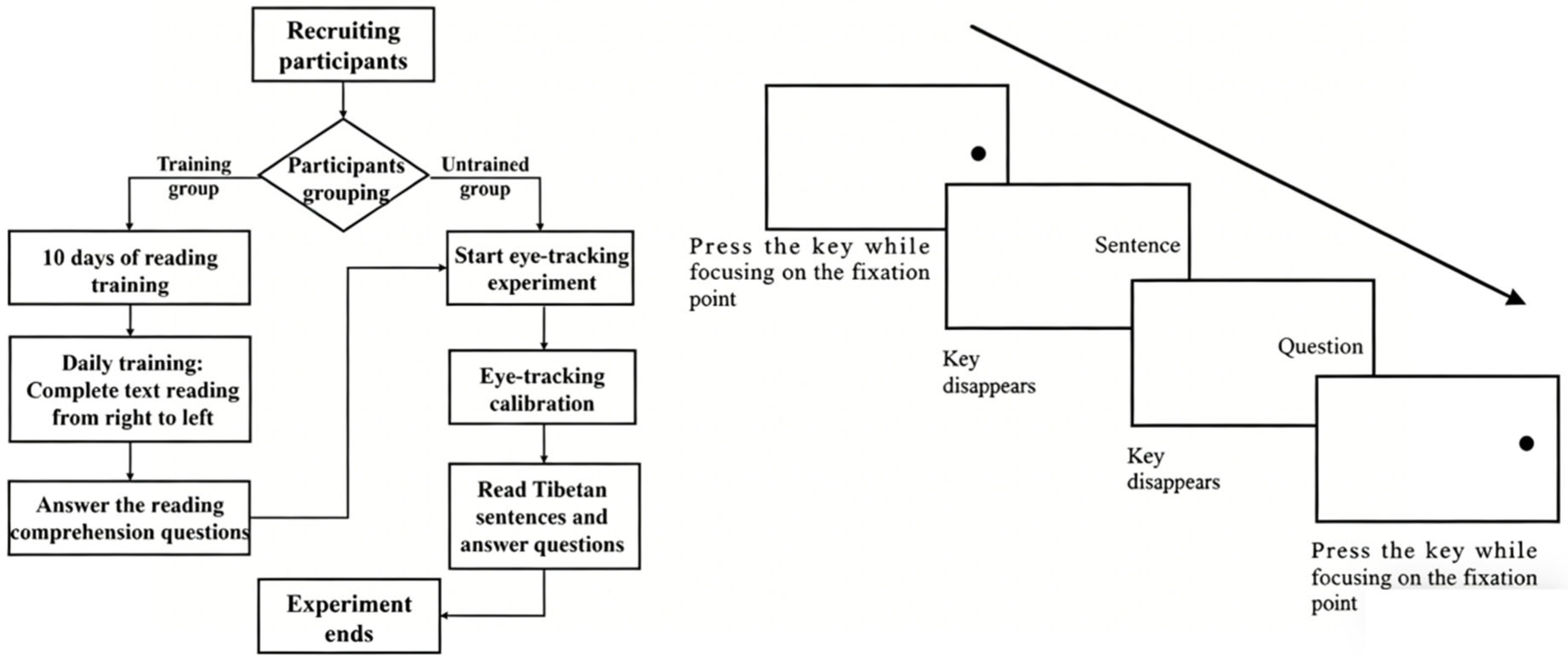
- Unfamiliar reading context: We created reversed right-to-left Tibetan text to reduce format familiarity, and set four visual spacing conditions: unspaced, inter-word spaced, inter-character spaced, non-word spaced, to observe spacing facilitation under low familiarity.
- Familiarity training procedure: Participants received 10 consecutive days of reversed reading training (30 min per day). Post-training reading tests under identical spacing treatments represented the familiar format condition.
1.4. Research Hypotheses
2. Materials and Methods
2.1. Experimental Design
2.2. Participants
2.3. Experimental Materials
2.4. Experimental Apparatus
- Eye tracker model: EyeLink 1000Plus (SR Research, Canada).
- Sampling rate: 1000 Hz.
- Saccade detection thresholds (Liao et al., 2022; D. H. Wang et al., 2023):
- (1)
- Saccade velocity threshold: 30°/s.
- (2)
- Saccade acceleration threshold: 8000°/s2.
- (3)
- Saccade amplitude threshold: 0.1°.
- Display monitor: 24.5-inch DELL monitor (Dell Technologies, Round Rock, TX, USA):
- (1)
- Refresh rate: 240 Hz.
- (2)
- Screen resolution: 1920 × 1080 pixels.
- (3)
- Fixed viewing distance: 65 cm from participants’ eyes to screen.
2.5. Experimental Procedure
2.6. Measures
3. Results
4. Discussion
4.1. Verification and Analysis of Hypothesis H1
4.2. Verification and Analysis of Hypothesis H2
4.3. Supplementary Experimental Findings
4.4. Expanded Practical Applications of Research Findings
4.5. Research Limitations
4.6. Future Research Directions
4.7. General Summary of Discussion
5. Conclusions
Author Contributions
Funding
Institutional Review Board Statement
Informed Consent Statement
Data Availability Statement
Conflicts of Interest
References
- Baayen, R. H., Davidson, D. J., & Bates, D. M. (2008). Mixed-effects modeling with crossed random effects for subjects and items. Journal of Memory and Language, 59(4), 390–412. [Google Scholar] [CrossRef]
- Baayen, R. H., & Milin, P. (2010). Analyzing reaction times. International Journal of Psychological Research, 3(2), 12–28. [Google Scholar] [CrossRef]
- Bai, X., Gao, X., Gao, L., & Wang, Y. (2017). Eye movement study on perceptual span in Tibetan reading. Acta Psychologica Sinica, 49(5), 569–576. (In Chinese) [Google Scholar]
- Bai, X., Guo, Z., Gu, J., Cao, Y., & Yan, G. (2011). Effect of word segmentation cues on Japanese-Chinese bilingual’s Chinese reading: Evidence from eye movements. Acta Psychologica Sinica, 43(11), 1273–1282. (In Chinese) [Google Scholar]
- Bai, Y., Yan, G., Liversedge, S. P., Zang, C., & Rayner, K. (2008). Reading spaced and unspaced Chinese text: Evidence from eye movements. Journal of Experimental Psychology: Human Perception and Performance, 34(5), 1277–1287. [Google Scholar] [CrossRef] [PubMed]
- Cao, H., Lan, Z., Gao, F., Yu, H., Li, P., & Wang, J. (2023). The role of character positional frequency on word recognition during Chinese reading: Lexical decision and eye movements studies. Acta Psychologica Sinica, 55(2), 159–176. (In Chinese) [Google Scholar] [CrossRef]
- Chantavarin, S., & Leung, T. T. C. (2025). The effects of interword spacing and morphological complexity in reading Thai: An eye-tracking study. Language and Cognition, 17, e69. [Google Scholar] [CrossRef]
- Chen, M., Wang, Y., Zhao, B., Li, X., & Bai, X. (2022). The role of Chinese text familiarity in word segmentation and lexical recognition. Acta Psychologica Sinica, 54(10), 1151–1166. (In Chinese) [Google Scholar]
- Cho, W., & Gordon, P. C. (2014). Reading spaced and unspaced Korean text: Evidence from eye-tracking. Vision Research, 96, 58–65. [Google Scholar]
- Christofalos, A. L., Arco, N. M., Laks, M., & Sheridan, H. (2024). The impact of interword spacing on inference processing during text reading: Evidence from eye movements. Discourse Processes, 62, 1–15. [Google Scholar] [CrossRef]
- Cohen, J. (1988). Statistical power analysis for the behavioral sciences (2nd ed.). Lawrence Erlbaum Associates. [Google Scholar]
- Drieghe, D., Fitzsimmons, G., & Liversedge, S. P. (2017). Parafoveal preview effects in reading unspaced text. Psychonomic Bulletin & Review, 24(2), 496–503. [Google Scholar]
- Faul, F., Erdfelder, E., Buchner, A., & Lang, A.-G. (2009). Statistical power analyses using G*Power 3.1: Tests for correlation and regression analyses. Behavior Research Methods, 41(4), 1149–1160. [Google Scholar] [CrossRef] [PubMed]
- Gao, L., Li, T., Dou, H., Chen, W., & Chen, C. (2024). The effect of word segmentation on Chinese reading of Tibetan-Chinese readers: The moderating role of language proficiency. Journal of Liaoning Normal University (Social Science Edition), 47(4), 60–68. (In Chinese) [Google Scholar]
- Gao, L., Li, T., & Zhang, T. (2022). An eye movement study on the effect of word segmentation on Chinese reading of Tibetan-Chinese readers. Journal of Liaoning Normal University (Social Science Edition), 45(4), 7–12. (In Chinese) [Google Scholar]
- Gao, X. L., Li, X. W., Sun, M., Bai, X. J., & Gao, L. (2020). The word frequency effect of fovea and its effect on the preview effect of parafovea in Tibetan reading. Acta Psychologica Sinica, 52(10), 1143–1155. [Google Scholar] [CrossRef]
- Gao, X. L., Niu, D., Yang, X., & Zhang, Y. (2024). The effect of morpheme positional probability information on word segmentation in Chinese reading. Journal of Liaoning Normal University (Social Science Edition), 47(4), 53–59. (In Chinese) [Google Scholar]
- Gao, X. L., Wang, D., & Wang, Y. (2022). The role of visual word segmentation cues in text reading. Journal of Liaoning Normal University (Social Science Edition), 45(4), 1–6. (In Chinese) [Google Scholar]
- Gavril, L., Roșan, A., & Szamosközi, Ș. (2021). The role of visual-spatial attention in reading development: A meta-analysis. Cognitive Neuropsychology, 38(6), 407–433. [Google Scholar] [CrossRef]
- Haeuser, K. I., & Kray, J. (2024). Age differences in context use during reading and downstream effects on recognition memory. Journal of Experimental Child Psychology, 239, 105826. [Google Scholar]
- Kajii, N., Nazir, T. A., & Osaka, N. (2001). Eye movement control in reading unspaced text: The case of the Japanese script. Vision Research, 41(19), 2503–2510. [Google Scholar] [CrossRef] [PubMed]
- Koriat, A., & Greenberg, S. N. (1994). The extraction of phrase structure during reading: Evidence from letter detection errors. Psychological Research, 56(3), 190–199. [Google Scholar]
- Kuperberg, G. R., & Jaeger, T. F. (2016). What do we mean by prediction in language comprehension? Language, Cognition and Neuroscience, 31(1), 32–59. [Google Scholar] [PubMed]
- Li, L., Ji, Y., Wang, J., & Paterson, K. B. (2025). The impact of color cues on word segmentation by L2 Chinese readers: Evidence from eye movements. Behavioral Sciences, 15(7), 904. [Google Scholar] [CrossRef] [PubMed]
- Li, S., Wang, Y., Lan, Z., Yuan, X., Zhang, L., & Yan, G. (2022). Effects of word spacing on children’s reading: Evidence from eye movements. Reading and Writing, 35, 1019–1033. [Google Scholar]
- Li, X., Bai, X., Yan, G., Zang, C., & Liang, F. (2010). The role of space during reading. Advances in Psychological Science, 18(9), 1377–1385. (In Chinese) [Google Scholar]
- Li, X., & Pollatsek, A. (2020). An integrated model of word processing and eye-movement control during Chinese reading. Psychological Review, 127(6), 1070–1099. [Google Scholar] [CrossRef]
- Li, X., Zeng, M., Gao, L., Li, S., Niu, Z., Wang, D., Li, T., Bai, X., & Gao, X. (2022). The mechanism of word satiation in Tibetan reading: Evidence from eye movements. Journal of Eye Movement Research, 15(5), 3. [Google Scholar] [CrossRef]
- Liang, F., Wang, Y., Yang, W., & Bai, X. (2017). Reading proficiency modulates the development of children’s eye movement fixation patterns during reading: Evidence from 9- to 11-year-old children. Acta Psychologica Sinica, 49(4), 450–459. (In Chinese) [Google Scholar]
- Liao, W., Li, S. T. K., & Hsiao, J. H. (2022). Music reading experience modulates eye movement pattern in English reading but not in Chinese reading. Scientific Reports, 12(1), 9144. [Google Scholar] [CrossRef] [PubMed]
- Liversedge, S. P., Rayner, K., White, S. J., Vergilino-Perez, D., Findlay, J. M., & Kentridge, R. W. (2004). Eye movements when reading disappearing text: Is there a gap effect in reading? Vision Research, 44(10), 1013–1024. [Google Scholar] [CrossRef] [PubMed]
- Lu, X., & Gao, L. (Eds.). (2007). Modern Tibetan frequency dictionary. The Ethnic Publishing House. (In Chinese) [Google Scholar]
- Ma, G., Li, X., & Rayner, K. (2014). Word segmentation of overlapping ambiguous strings during Chinese reading. Journal of Experimental Psychology: Human Perception and Performance, 40(3), 1046–1059. [Google Scholar] [CrossRef] [PubMed]
- Maxwell, S. E., Delaney, H. D., & Kelley, K. (2017). Designing experiments and analyzing data: A model comparison perspective (3rd ed.). Routledge. [Google Scholar]
- Pan, J., Liu, M., Li, H., & Yan, M. (2021). Chinese children benefit from alternating-color words in sentence reading. Reading and Writing, 34, 355–369. [Google Scholar]
- Perea, M., & Acha, J. (2009). Space information is important for reading. Vision Research, 49(15), 1994–2000. [Google Scholar] [CrossRef] [PubMed]
- Pickering, M. J., & Gambi, C. (2018). Predicting while comprehending language: A theory and review. Psychological Bulletin, 144(10), 1002–1044. [Google Scholar] [CrossRef] [PubMed]
- Pollatsek, A., Bolozky, S., Well, A. D., & Rayner, K. (1981). Asymmetries in the perceptual span for Israeli readers. Bulletin of the Psychonomic Society, 18(2), 66–68. [Google Scholar]
- Pollatsek, A., & Rayner, K. (1982). Eye movement control in reading: The role of word boundaries. Journal of Experimental Psychology: Human Perception and Performance, 8(6), 817–833. [Google Scholar] [CrossRef]
- Rayner, K. (1998). Eye movements in reading and information processing: 20 years of research. Psychological Bulletin, 124(3), 372–422. [Google Scholar] [CrossRef] [PubMed]
- Rayner, K. (2009). Eye movements and attention in reading, scene perception, and visual search. Quarterly Journal of Experimental Psychology, 62(8), 1457–1506. [Google Scholar] [CrossRef]
- Rayner, K., Fischer, M. H., & Pollatsek, A. (1998). Unspaced text interferes with both word identification and eye movement control. Vision Research, 38(8), 1129–1144. [Google Scholar] [CrossRef] [PubMed]
- Rayner, K., Liversedge, S. P., White, S. J., & Vergilino-Perez, D. (2003). Reading disappearing text: Cognitive control of eye movements. Psychological Science, 14(4), 385–389. [Google Scholar] [PubMed]
- Rayner, K., Reichle, E. D., Stroud, M. J., Williams, C. C., & Pollatsek, A. (2006). The effect of word frequency, word predictability, and font difficulty on the eye movements of young and older readers. Psychology and Aging, 21(3), 448–465. [Google Scholar] [CrossRef] [PubMed]
- Rayner, K., Yang, J., Schuett, S., & Slattery, T. J. (2013). Eye movements of older and younger readers when reading unspaced text. Experimental Psychology, 60(5), 354–361. [Google Scholar] [CrossRef] [PubMed]
- R Core Team. (2021). R: A language and environment for statistical computing. R Foundation for Statistical Computing. Available online: https://www.R-project.org/ (accessed on 11 May 2026).
- Rosenthal, R., Rosnow, R. L., & Rubin, D. B. (2000). Contrasts and effect sizes in behavioral research: A correlational approach. Cambridge University Press. [Google Scholar]
- Sainio, M., Hyönä, J., Bingushi, K., & Bertram, R. (2007). The role of interword spacing in reading Japanese: An eye movement study. Vision Research, 47(18), 2575–2584. [Google Scholar] [CrossRef] [PubMed]
- Schotter, E. R., Angele, B., & Rayner, K. (2012). Parafoveal processing in reading. Attention, Perception, & Psychophysics, 74(1), 5–35. [Google Scholar]
- Shen, D., Liversedge, S. P., Tian, J., Zang, C., Cui, L., Bai, X., Yan, G., & Hyönä, J. (2012). Eye movements of second language learners when reading spaced and unspaced Chinese text. Journal of Experimental Psychology: Applied, 18(2), 192–202. [Google Scholar] [CrossRef] [PubMed]
- Sheridan, H., Rayner, K., & Reingold, E. M. (2013). Unsegmented text delays word identification: Evidence from a survival analysis of fixation durations. Visual Cognition, 21(1), 38–60. [Google Scholar] [CrossRef]
- Sun, F., Morita, M., & Stark, L. W. (1985). Comparative patterns of reading eye movement in Chinese and English. Attention, Perception, & Psychophysics, 37(6), 502–506. [Google Scholar] [CrossRef]
- Sweller, J. (2011). Cognitive load theory. In J. P. Mestre, & B. H. Ross (Eds.), The psychology of learning and motivation: Cognition in education (Vol. 55, pp. 37–76). Academic Press. [Google Scholar]
- Tournadre, N. (2014). The Tibetic languages and their classification. In T. Owen-Smith, & N. Hill (Eds.), Trans-Himalayan linguistics: Historical and descriptive linguistics of the Himalayan area (pp. 105–129). De Gruyter Mouton. [Google Scholar]
- Veldre, A., Drieghe, D., & Andrews, S. (2017). Spelling ability selectively predicts the magnitude of disruption in unspaced text reading. Journal of Experimental Psychology: Human Perception and Performance, 43(9), 1612–1628. [Google Scholar] [CrossRef] [PubMed]
- Wang, D. H., Niu, D. Y., Li, T. Z., & Gao, X. L. (2024). The effect of visual word segmentation cues in Tibetan reading. Brain Sciences, 14(10), 964. [Google Scholar] [CrossRef] [PubMed]
- Wang, D. H., Zeng, M., Zhao, H., Gao, L., Li, S., Niu, Z. B., Bai, X. J., & Gao, X. L. (2023). Effects of syllable boundaries in Tibetan reading. Scientific Reports, 13, 314. [Google Scholar] [CrossRef] [PubMed]
- Wang, Y., Han, Y., Luo, Y., He, L., Li, X., & Bai, X. (2022). Interword spacing facilitates reading of Chinese text presented from right to left. Psychological Science, 45(4), 826–832. (In Chinese) [Google Scholar]
- Yan, G., Xiong, J., Zang, C., Yu, L., Cui, L., & Bai, X. (2013). Review of eye-movement measures in reading research. Advances in Psychological Science, 21(4), 589–605. (In Chinese) [Google Scholar] [CrossRef]
- Yan, G., Zhang, L., Zhang, X., & Sun, S. (2012). The processing of psychological word in Chinese reading. Studies of Psychology and Behavior, 10(3), 183–189. (In Chinese) [Google Scholar]
- Zang, C., Liang, F., Bai, X., Yan, G., & Liversedge, S. P. (2013). Interword spacing and landing position effects during Chinese reading in children and adults. Journal of Experimental Psychology: Human Perception and Performance, 39(3), 720–734. [Google Scholar] [CrossRef] [PubMed]
- Zhou, W., Wang, A., Shu, H., Kliegl, R., & Yan, M. (2018). Word segmentation by alternating colors facilitates eye guidance in Chinese reading. Memory & Cognition, 46, 729–740. [Google Scholar] [CrossRef]


| Word Segmentation | Sentence Example |
|---|---|
| Unspaced | རྒྱས།ཡོན་ཤེས་པས་བཀླགས་པ་གསར་དེབ་ཀྱི་བོད་མས་སློབ |
| Inter-word spaced | རྒྱས ཡོན་ཤེས པས་བཀླགས པ་གསར དེབ ཀྱི་བོད མས་སློབ |
| Inter-character spaced | རྒྱས ཡོན ཤེས པས བཀླགས པ གསར དེབ ཀྱི བོད མས སློབ |
| Non-word spaced | རྒྱས།ཡོན ཤེས་པས བཀླགས པ གསར་དེབ་ཀྱི བོད་མས སློབ |
| Eye Movement Measures | Unfamiliar Format | Familiar Format | ||||||
|---|---|---|---|---|---|---|---|---|
| Unspaced | Inter-Word Spaced | Inter-Character Spaced | Non-Word Spaced | Unspaced | Inter-Word Spaced | Inter-Character Spaced | Non-Word Spaced | |
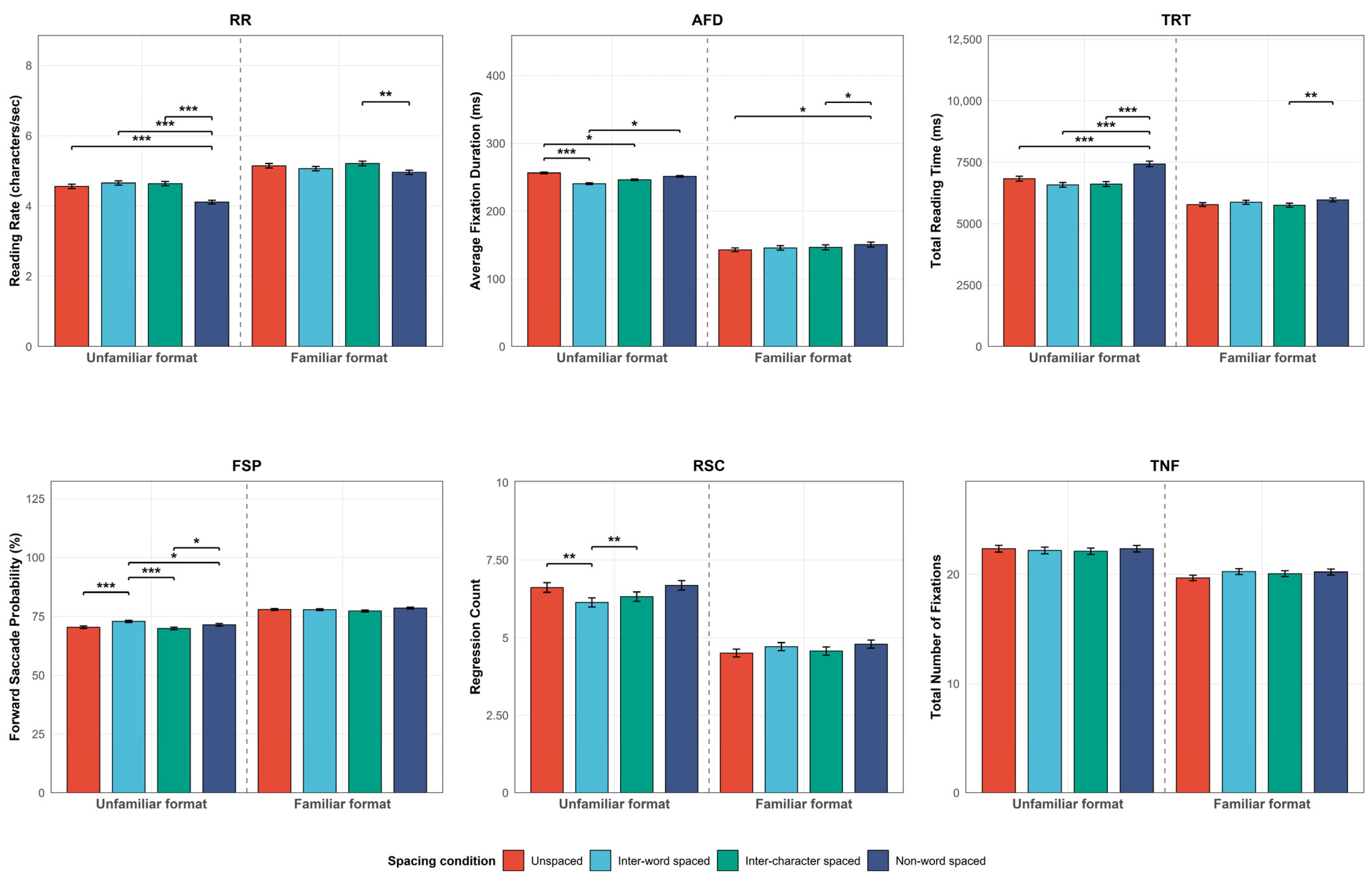
| RR | 4.56 (1.77) | 4.65 (1.68) | 4.64 (1.66) | 4.11 (1.45) | 5.15 (1.65) | 5.07 (1.63) | 5.21 (1.66) | 4.96 (1.58) |
| AFD | 256.31 (32.76) | 240.45 (34.21) | 246.18 (33.09) | 251.31 (34.18) | 142.72 (66.59) | 145.64 (77.34) | 146.49 (87.65) | 150.61 (82.43) |
| TRT | 6829 (2904) | 6581 (2659) | 6612 (2754) | 7430 (3080) | 5777 (1951) | 5869 (2059) | 5750 (2023) | 5966 (2753) |
| FSP | 70.43% (0.16) | 72.91% (0.13) | 69.90% (0.16) | 71.49% (0.16) | 77.83% (0.11) | 77.76% (0.10) | 77.19% (0.11) | 78.45% (0.11) |
| RSC | 6.61 (4.50) | 6.13 (4.16) | 6.32 (4.31) | 6.68 (4.35) | 4.51 (3.26) | 4.71 (3.39) | 4.57 (3.46) | 4.80 (3.35) |
| TNF | 22.35 (8.77) | 22.19 (8.53) | 22.11 (8.30) | 22.35 (8.53) | 19.67 (6.62) | 20.25 (6.79) | 20.06 (6.62) | 20.21 (6.68) |
| Eye Movement Measures | Intercept | Format-Familiarity | Word Segmentation 1 | Word Segmentation 2 | Word Segmentation 3 | Interaction 1 | Interaction 2 | Interaction 3 | Comparison 1 | Comparison 2 | Comparison 3 | Comparison 4 | Comparison 5 | Comparison 6 | |
|---|---|---|---|---|---|---|---|---|---|---|---|---|---|---|---|
| RR | b | 1.45 | 0.14 | 0.03 | 0.02 | −0.1 | −0.05 | −0.01 | 0.06 | −0.03 | −0.02 | 0.10 | 0.02 | −0.01 | 0.04 |
| SE | 0.04 | 0.05 | 0.01 | 0.01 | 0.01 | 0.02 | 0.02 | 0.02 | 0.01 | 0.01 | 0.01 | 0.01 | 0.01 | 0.01 | |
| t | 38.67 *** | 2.67 ** | 2.30 * | 1.76 | −7.81 *** | −2.38 * | −0.56 | 3.38 *** | −2.31 | −1.76 | 7.81 *** | 1.11 | −0.84 | 2.55 | |
| AFD | b | 5.54 | −0.69 | −0.07 | −0.04 | −0.02 | 0.08 | 0.05 | 0.08 | 0.07 | 0.04 | 0.02 | −0.02 | −0.01 | −0.05 |
| SE | 0.03 | 0.04 | 0.02 | 0.02 | 0.02 | 0.02 | 0.02 | 0.02 | 0.01 | 0.01 | 0.01 | 0.02 | 0.02 | 0.02 | |
| t | 205.93 *** | −17.00 *** | −4.43 *** | −2.80 ** | −1.48 | 3.45 *** | 1.94 | 3.18 ** | 4.43 *** | 2.80 * | 1.47 | −0.84 | 1.00 | −2.90 * | |
| TRT | b | 8.75 | −0.14 | −0.03 | −0.02 | 0.09 | 0.04 | 0.01 | −0.05 | 0.03 | 0.02 | −0.09 | −0.01 | 0.01 | −0.03 |
| SE | 0.04 | 0.05 | 0.01 | 0.01 | 0.01 | 0.02 | 0.02 | 0.02 | 0.01 | 0.01 | 0.01 | 0.01 | 0.01 | 0.01 | |
| t | 224.26 *** | −2.58 * | −2.22 * | −1.96 | 6.84 *** | 2.12 * | 0.75 | −2.79 ** | 2.22 | 1.96 | −6.84 *** | −0.84 | 0.77 | −2.47 | |
| FSP | b | 0.95 | 0.42 | 0.13 | −0.02 | 0.07 | −0.13 | −0.03 | −0.03 | 1.13 | 1.05 | 0.98 | 0.99 | 1.03 | 0.96 |
| SE | 0.08 | 0.12 | 0.03 | 0.03 | 0.03 | 0.04 | 0.04 | 0.04 | 0.03 | 0.02 | 0.02 | 0.03 | 0.03 | 0.03 | |
| t | 11.57 *** | 3.52 *** | 4.50 *** | −0.77 | 2.42 * | −3.15 ** | −0.65 | −0.69 | 5.05 *** | 2.13 | −0.91 | −0.44 | 0.84 | −1.31 | |
| RSC | b | 1.85 | −0.32 | −0.05 | −0.04 | 0.02 | 0.08 | 0.03 | 0.03 | 0.95 | 0.98 | 1.00 | 0.96 | 0.96 | 0.98 |
| SE | 0.06 | 0.09 | 0.02 | 0.02 | 0.02 | 0.03 | 0.03 | 0.03 | 0.01 | 0.01 | 0.01 | 0.01 | 0.01 | 0.01 | |
| t | 29.60 *** | −3.54 *** | −2.11 * | −1.63 | 1.06 | 2.39 * | 0.90 | 0.84 | −3.70 ** | −0.27 | −1.24 | −2.52 | −1.60 | −2.56 | |
| TNF | b | 3.09 | −0.10 | 0.00 | 0.01 | −0.01 | 0.03 | 0.02 | 0.02 | 0.01 | 0.01 | −0.01 | −0.03 | −0.02 | −0.03 |
| SE | 0.04 | 0.05 | 0.01 | 0.01 | 0.01 | 0.02 | 0.02 | 0.02 | 0.01 | 0.01 | 0.01 | 0.01 | 0.01 | 0.01 | |
| t | 86.20 *** | −2.07 * | −0.04 | −0.22 | 0.26 | 1.64 | 1.15 | 1.32 | 0.04 | 0.22 | −0.25 | −2.18 | −1.35 | −2.02 | |
Disclaimer/Publisher’s Note: The statements, opinions and data contained in all publications are solely those of the individual author(s) and contributor(s) and not of MDPI and/or the editor(s). MDPI and/or the editor(s) disclaim responsibility for any injury to people or property resulting from any ideas, methods, instructions or products referred to in the content. |
© 2026 by the authors. Licensee MDPI, Basel, Switzerland. This article is an open access article distributed under the terms and conditions of the Creative Commons Attribution (CC BY) license.
Share and Cite
Liang, H.; Zhang, C.; Xie, Z.; Gao, L.; Gao, X. The Influence of Format Familiarity on the Word Segmentation Effect in Tibetan Reading. Behav. Sci. 2026, 16, 1119. https://doi.org/10.3390/bs16071119
Liang H, Zhang C, Xie Z, Gao L, Gao X. The Influence of Format Familiarity on the Word Segmentation Effect in Tibetan Reading. Behavioral Sciences. 2026; 16(7):1119. https://doi.org/10.3390/bs16071119
Chicago/Turabian StyleLiang, Hongyu, Chenxu Zhang, Zijian Xie, Lei Gao, and Xiaolei Gao. 2026. "The Influence of Format Familiarity on the Word Segmentation Effect in Tibetan Reading" Behavioral Sciences 16, no. 7: 1119. https://doi.org/10.3390/bs16071119
APA StyleLiang, H., Zhang, C., Xie, Z., Gao, L., & Gao, X. (2026). The Influence of Format Familiarity on the Word Segmentation Effect in Tibetan Reading. Behavioral Sciences, 16(7), 1119. https://doi.org/10.3390/bs16071119