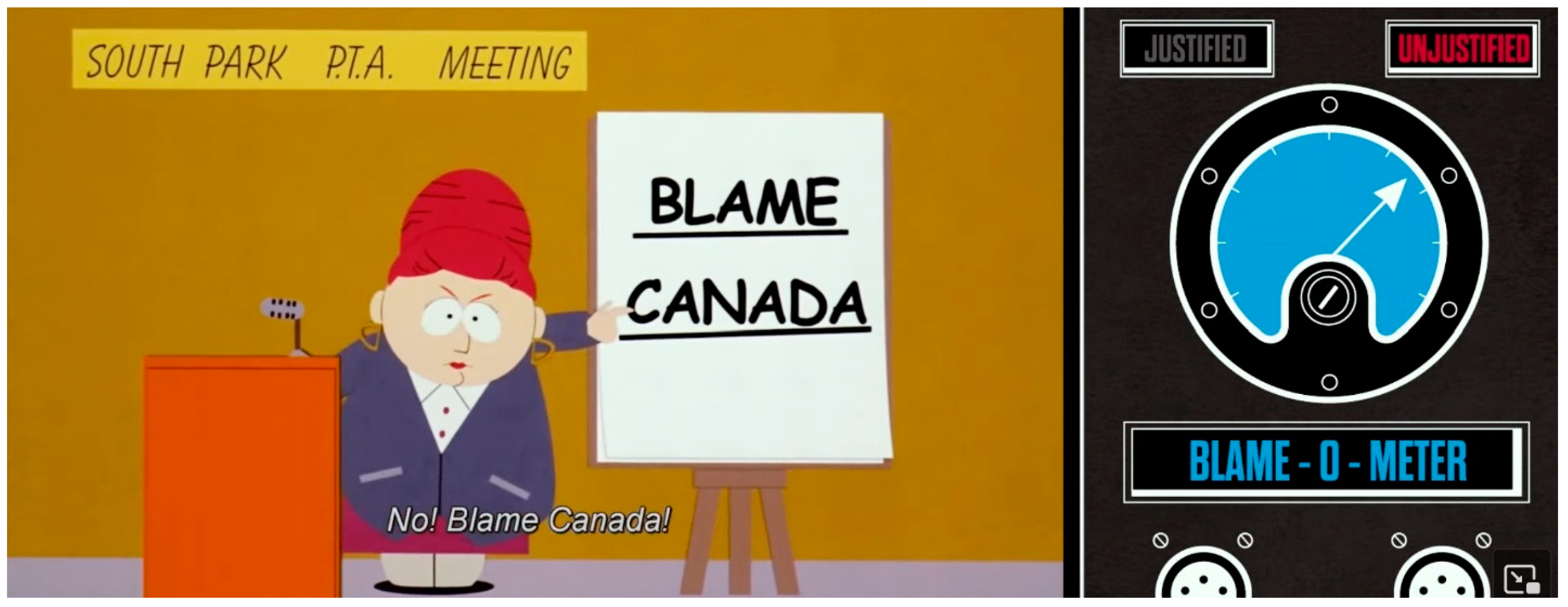
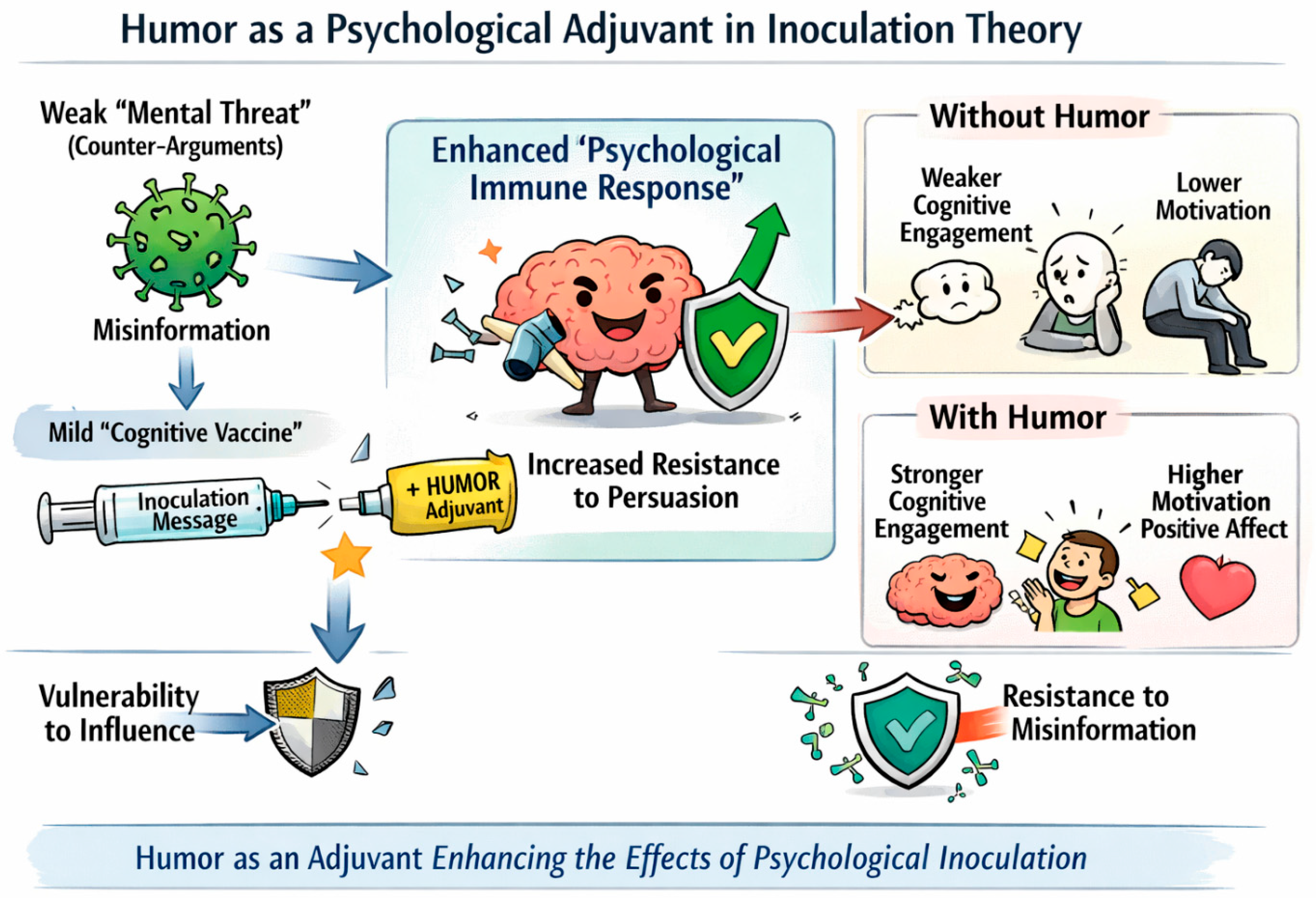
The Role of Humor in Inoculation Theory


Abstract
1. Introduction
2. Inoculation Theory
3. Humor in Inoculation Theory
4. Humor and Inoculation Theory
5. New Directions for Humor and/in Inoculation Theory
5.1. Humor, Inoculation, and the Need for Conceptual and Empirical Validation
5.2. Humor, Inoculation, and Therapeutic Versus Prophylactic Uses
5.3. Humor, Inoculation Theory, and Duration of Effect
5.4. Humor, Laughter, and Inoculation Theory
Humor is predominantly a cognitive process, often involving perceptions of funniness, occurring alone or socially. It can be created, appreciated, reminisced, arise spontaneously, or be enacted, e.g., clowns, and serves diverse personal development functions including social bonding. It may be induced by a range of emotions, playfulness, and/or laughter, or induce these. It is influenced by motives, circumstances, and cultural and individual differences.(p. 4)
Laughter is predominantly a physical behavior, occurring alone or socially. It is often used as a form of verbal expression or communication. It can be spontaneous, provoked, or self-induced, and serves diverse personal development functions including social bonding. It may be induced by a range of emotions, playfulness, and/or humor, or induce these. It is influenced by motives, circumstances, and cultural and individual differences.(pp. 4–5)
6. Conclusions
Author Contributions
Funding
Institutional Review Board Statement
Informed Consent Statement
Data Availability Statement
Conflicts of Interest
References
- Banas, J. A., & Bessarabova, E. (2026). Inoculation theory and counterarguing. In B. Ivanov, K. A. Parker, & J. Compton (Eds.), The handbook of inoculation theory and practice (pp. 43–55). Wiley. [Google Scholar] [CrossRef] [Scilit]
- Banas, J. A., Bessarabova, E., Penkauskas, M. C., & Talbert, N. (2024). Inoculating against anti-vaccination conspiracies. Health Communication, 39(9), 1760–1768. [Google Scholar] [CrossRef] [Scilit]
- Banas, J. A., & Miller, G. (2013). Inducing resistance to conspiracy theory propaganda: Testing inoculation and metainoculation strategies. Human Communication Research, 39(2), 184–207. [Google Scholar] [CrossRef] [Scilit]
- Banas, J. A., & Rains, S. A. (2010). A meta-analysis of research on inoculation theory. Communication Monographs, 77(3), 281–311. [Google Scholar] [CrossRef] [Scilit]
- Barbati, J. L. (2026). The use of humor and narratives in the inoculation process. In B. Ivanov, K. A. Parker, & J. Compton (Eds.), The handbook of inoculation theory and practice (pp. 151–163). Wiley. [Google Scholar] [CrossRef] [Scilit]
- Basol, M., Roozenbeek, J., Berriche, M., Uenal, F., McClanahan, W. P., & van der Linden, S. (2021). Towards psychological herd immunity: Cross-cultural evidence for two prebunking interventions against COVID-19 misinformation. Big Data & Society, 8(1), 1–18. [Google Scholar] [CrossRef] [Scilit]
- Bennett, M. P., & Lengacher, C. (2009). Humor and laughter may influence health IV. Humor and immune function. Evidence-Based Complementary and Alternative Medicine, 6(2), 159–164. [Google Scholar] [CrossRef] [Scilit] [PubMed]
- Berk, L. S., Felten, D. L., Tan, S. A., Bittman, B. B., & Westengard, J. (2001). Modulation of neuroimmune parameters during the eustress of humor-associated mirthful laughter. Alternative Therapies in Health and Medicine, 7(2), 62–76. [Google Scholar] [PubMed]
- Blanc, N., & Brigaud, E. (2014). Humor in print health advertisements: Enhanced attention, privileged recognition, and persuasiveness of preventive messages. Health Communication, 29(7), 669–677. [Google Scholar] [CrossRef] [Scilit]
- CDC. (2024, December 20). Adjuvants and vaccines. U.S. Centers for Disease Control and Prevention. Available online: https://www.cdc.gov/vaccine-safety/about/adjuvants.html (accessed on 23 March 2026).
- Clayton, R. B., Compton, J., Reynolds-Tylus, T., Neumann, D., & Park, J. (2023). Revisiting the effects of an inoculation treatment on psychological reactance: A conceptual replication and extension with self-report and psychophysiological measures. Human Communication Research, 49(1), 104–111. [Google Scholar] [CrossRef] [Scilit]
- Clyne, L., Fellers, M., & Richards, A. S. (2020). Metacognitive inoculation reduces the persuasiveness of sarcastic attack messages. Communication Reports, 33(2), 68–81. [Google Scholar] [CrossRef] [Scilit]
- Compton, J. (2004). Late night political comedy, candidate image, and inoculation: A unique test of inoculation theory [Ph.D. dissertation, University of Oklahoma]. [Google Scholar]
- Compton, J. (2013). Inoculation theory. In J. P. Dillard, & L. Shen (Eds.), The SAGE handbook of persuasion: Developments in theory and practice (2nd ed., pp. 220–236). SAGE. [Google Scholar] [CrossRef] [Scilit]
- Compton, J. (2018). Inoculation against/with political humor. In J. Baumgartner, & A. B. Becker (Eds.), Political humor in a changing media landscape: A new generation of research (pp. 95–114). Lexington Books. [Google Scholar]
- Compton, J. (2019). Inoculation at play: Happiness, funniness, types of play, and inoculation theory. Journal of the Speech and Theatre Association of Missouri, 49, 1–16. [Google Scholar]
- Compton, J. (2020). Prophylactic versus therapeutic inoculation treatments for resistance to influence. Communication Theory, 30(3), 330–343. [Google Scholar] [CrossRef] [Scilit]
- Compton, J. (2021). Threat and/in inoculation theory. International Journal of Communication, 15, 4294–4306. [Google Scholar]
- Compton, J. (2025). Inoculation theory. Review of Communication, 25(1), 1–13. [Google Scholar] [CrossRef] [Scilit]
- Compton, J., & Ivanov, B. (2012). Untangling threat during inoculation-conferred resistance to influence. Communication Reports, 25(1), 1–13. [Google Scholar] [CrossRef] [Scilit]
- Compton, J., & Pfau, M. (2005). Inoculation theory of resistance to influence at maturity: Recent progress in theory development and application and suggestions for future research. Annals of the International Communication Association, 29(1), 97–146. [Google Scholar] [CrossRef] [Scilit]
- Compton, J., & Pfau, M. (2009). Spreading inoculation: Inoculation, resistance to influence, and word-of-mouth communication. Communication Theory, 19(1), 9–28. [Google Scholar] [CrossRef] [Scilit]
- Compton, J., van der Linden, S., Cook, J., & Basol, M. (2021). Inoculation theory in the post-truth era: Extant findings and new frontiers for contested science, misinformation, and conspiracy theories. Social and Personality Psychology Compass, 15(6), e12602. [Google Scholar] [CrossRef] [Scilit]
- Cook, J. (2020). Cranky uncle vs. climate change: How to understand and respond to climate science deniers. Citadel Press. [Google Scholar]
- Cook, J., Ecker, U. K., Trecek-King, M., Schade, G., Jeffers-Tracy, K., Fessmann, J., Kim, S. C., Kinkead, D., Orr, M., Vraga, E., Roberts, K., & McDowell, J. (2023). The cranky uncle game—Combining humor and gamification to build student resilience against climate misinformation. Environmental Education Research, 29(4), 607–623. [Google Scholar] [CrossRef] [Scilit]
- Dagnes, A. (2012). A conservative walks into a bar: The politics of political humor (p. 165). Palgrave Macmillan. [Google Scholar]
- Godbold, L. C., & Pfau, M. (2000). Conferring resistance to peer pressure among adolescents: Using inoculation theory to discourage alcohol use. Communication Research, 27(4), 411–437. [Google Scholar] [CrossRef] [Scilit]
- Gonot-Schoupinsky, F. N., Garip, G., & Sheffield, D. (2020). Laughter and humour for personal development: A systematic scoping review of the evidence. European Journal of Integrative Medicine, 37, 101144. [Google Scholar] [CrossRef] [Scilit]
- Han, J.-Y., Kim, H., Yoon, H. J., & Seo, J. K. (2024). How do individuals with conspiracy beliefs respond to humorous public service announcements promoting COVID-19 vaccination? The role of scientific consensus and vaccine confidence. International Journal of Communication, 18, 2456–2478. [Google Scholar]
- Holbert, R. L. (2005). A typology for the study of entertainment television and politics. American Behavioral Scientist, 49(3), 436–453. [Google Scholar] [CrossRef] [Scilit]
- Ivanov, B. (2017). Inoculation theory applied in health and risk messaging. In The Oxford encyclopedia of health and risk message design and processing. Oxford University Press. [Google Scholar] [CrossRef] [Scilit]
- Ivanov, B., Parker, K. A., & Compton, J. (Eds.). (2026). The handbook of inoculation theory and practice. Wiley. [Google Scholar] [CrossRef] [Scilit]
- Jackson, B., Compton, J., Thornton, A. L., & Dimmock, J. A. (2017). Re-Thinking anxiety: Using inoculation messages to reduce and reinterpret public speaking fears. PLoS ONE, 12(1), e0169972. [Google Scholar] [CrossRef] [Scilit]
- Kfrerer, M. L., Bell, E., & Schermer, J. A. (2021). The politics of being funny: Humor styles, trait humorousness, and political orientations. Personality and Individual Differences, 182, 111073. [Google Scholar] [CrossRef] [Scilit]
- Khoury, L., Shwartz Naddam, I., Paz Tzruia, M., Shehadeh, S., Konopnicki, M., Hamad Saied, M., Meiri, N., Livnat, G., & Yaacoby-Bianu, K. (2025). Medical clown intervention shortens length of hospitalization in children with pneumonia. Scientific Reports, 15, 19498. [Google Scholar] [CrossRef] [Scilit]
- Kuru, O. (2025). Literacy training vs. psychological inoculation? Explicating and comparing the effects of predominantly informational and predominantly motivational interventions on the processing of health statistics. Journal of Communication, 75(1), 64–78. [Google Scholar] [CrossRef] [Scilit]
- Leder, J., Schellinger, L. V., Maertens, R., van der Linden, S., Chryst, B., & Roozenbeek, J. (2024). Feedback exercises boost discernment of misinformation for gamified inoculation interventions. Journal of Experimental Psychology: General, 153(8), 2068. [Google Scholar] [CrossRef] [Scilit]
- Lim, J. S., & Ki, E.-J. (2007). Resistance to ethically suspicious parody video on YouTube: A test of inoculation theory. Journalism & Mass Communication Quarterly, 84(4), 713–728. [Google Scholar] [CrossRef] [Scilit]
- Limbu, Y. B., McKinley, C., & Huhmann, B. A. (2026). Health message outcomes of humor appeals: A systematic review. Health Communication, 1–19. [Google Scholar] [CrossRef] [Scilit]
- Liu, S., & Chen, L. (2024). Funny enough: Incorporating humor into health messages to promote breast self-examination behavior. International Journal of Communication, 18, 4441–4467. [Google Scholar]
- Lockwood, N. L., & Yoshimura, S. M. (2014). The heart of the matter: The effects of humor on well-being during recovery from cardiovascular disease. Health Communication, 29(4), 410–420. [Google Scholar] [CrossRef] [Scilit]
- Lu, C., Hu, B., Li, Q., Bi, C., & Ju, X. D. (2023). Psychological inoculation for credibility assessment, sharing intention, and discernment of misinformation: Systematic review and meta-analysis. Journal of Medical Internet Research, 25, e49255. [Google Scholar] [CrossRef] [Scilit]
- Lu, J. G. (2023). Cultural differences in humor: A systematic review and critique. Current Opinion in Psychology, 53, 101690. [Google Scholar] [CrossRef] [Scilit]
- Lull, P. E. (1940). The effectiveness of humor in persuasive speech. Communications Monographs, 7(1), 26–40. [Google Scholar] [CrossRef] [Scilit]
- Maertens, R., Roozenbeek, J., Simons, J. S., Lewandowsky, S., Maturo, V., Goldberg, B., Xu, R., & van der Linden, S. (2025). Psychological booster shots targeting memory increase long-term resistance against misinformation. Nature Communications, 16(1), 2062. [Google Scholar] [CrossRef] [Scilit] [PubMed]
- Matig, J. J. (2026). Exploring the interplay of temporal factors and resistance within inoculation theory. In B. Ivanov, K. A. Parker, & J. Compton (Eds.), The handbook of inoculation theory and practice (pp. 97–107). Wiley. [Google Scholar] [CrossRef] [Scilit]
- McGuire, W. J. (1964). Inducing resistance to persuasion: Some contemporary approaches. Advances in Experimental Social Psychology, 1, 191–229. [Google Scholar] [CrossRef] [Scilit]
- Miczo, N. (2019). A review of communication approaches to the study of humor. Annals of the International Communication Association, 43(4), 257–272. [Google Scholar] [CrossRef] [Scilit]
- Montero, D. A., Vidal, R. M., Velasco, J., Carreño, L. J., Oñate, Á. A., Benachi, M. A., Tovar-Rosero, Y.-Y., Torres, J. P., & O’Ryan, M. (2024). Two centuries of vaccination: Historical and conceptual approach and future perspectives. Frontiers in Public Health, 11, 1326154. [Google Scholar] [CrossRef] [Scilit]
- Moyer-Gusé, E., Robinson, M. J., & McKnight, J. (2018). The role of humor in messaging about the MMR vaccine. Journal of Health Communication, 23(6), 514–522. [Google Scholar] [CrossRef] [Scilit]
- Nabi, R. L., Moyer-Gusé, E., & Byrne, S. (2007). All joking aside: A serious investigation into the persuasive effect of funny social issue messages. Communication Monographs, 74(1), 29–54. [Google Scholar] [CrossRef] [Scilit]
- Petty, R. E. (2024). What is unique about acceptance and correction of misinformation? Insights from work on attitudes, persuasion, and beyond. American Psychologist, 79(9), 1275–1288. [Google Scholar] [CrossRef] [Scilit] [PubMed]
- Pfau, M., & Burgoon, M. (1988). Inoculation in political campaign communication. Human Communication Research, 15(1), 91–111. [Google Scholar] [CrossRef] [Scilit]
- Pfau, M., Semmler, S. M., Deatrick, L., Mason, A., Nisbett, G., Lane, L., Craig, E., Underhill, J., & Banas, J. (2009). Nuances about the role and impact of affect in inoculation. Communication Monographs, 76(1), 73–98. [Google Scholar] [CrossRef] [Scilit]
- Pfau, M., Szabo, A., Anderson, J., Morrill, J., Zubric, J., & H-Wan, H.-H. (2001). The role and impact of affect in the process of resistance to persuasion. Human Communication Research, 27(2), 216–252. [Google Scholar] [CrossRef]
- Reed, S. G., Orr, M. T., & Fox, C. B. (2013). Key roles of adjuvants in modern vaccines. Nature Medicine, 19(12), 1597–1608. [Google Scholar] [CrossRef] [Scilit]
- Richards, A. S., Banas, J. A., & Magid, Y. (2017). More on inoculating against reactance to persuasive health messages: The paradox of threat. Health Communication, 32(7), 890–902. [Google Scholar] [CrossRef] [Scilit]
- Rizzolo, M., & Gray, N. A. (2025). Health, heartache, and humor: A practical framework for approaching humor in serious illness. Journal of Palliative Medicine, 28(10), 1296–1301. [Google Scholar] [CrossRef] [Scilit]
- Roozenbeek, J., & van der Linden, S. (2019). Fake news game confers psychological resistance against online misinformation. Palgrave Communications, 5(1), 65. [Google Scholar] [CrossRef] [Scilit]
- Roozenbeek, J., van der Linden, S., Goldberg, B., Rathje, S., & Lewandowsky, S. (2022). Psychological inoculation improves resilience against misinformation on social media. Science Advances, 8(34), eabo6254. [Google Scholar] [CrossRef] [Scilit]
- Simchon, A., Zipori, T., Teitelbaum, L., Lewandowsky, S., & Van Der Linden, S. (2025). A signal detection theory meta-analysis of psychological inoculation against misinformation. Current Opinion in Psychology, 67, 102194. [Google Scholar] [CrossRef] [Scilit]
- Symons, M., Rahmani, M. H., Rudnicki, K., Cutello, C. A., Poels, K., & Vandebosch, H. (2024). Cognitive fatigue, humor, and physical activity: A field experiment testing whether humorous messages promote walking in cognitively fatigued individuals. Health Communication, 39(15), 1869–1883. [Google Scholar] [CrossRef] [Scilit]
- Traberg, C. S., Roozenbeek, J., & Van Der Linden, S. (2022). Psychological inoculation against misinformation: Current evidence and future directions. The ANNALS of the American Academy of Political and Social Science, 700(1), 136–151. [Google Scholar] [CrossRef] [Scilit]
- van der Linden, S. (2023). Foolproof: Why misinformation infects our minds and how to build immunity. WW Norton & Company. [Google Scholar]
- van der Linden, S. (2024). Countering misinformation through psychological inoculation. In Advances in experimental social psychology (Vol. 69, pp. 1–58). Elsevier. [Google Scholar] [CrossRef] [Scilit]
- van der Linden, S., Leiserowitz, A., Rosenthal, S., & Maibach, E. (2017). Inoculating the public against misinformation about climate change. Global Challenges, 1(2), 1600008. [Google Scholar] [CrossRef] [Scilit] [PubMed]
- van der Linden, S., & Roozenbeek, J. (2021). Psychological inoculation against fake news. In R. Greifeneder, M. Jaffe, E. Newman, & N. Schwarz (Eds.), The psychology of fake news: Accepting, sharing, and correcting misinformation (1st ed., pp. 147–169). Routledge. [Google Scholar] [CrossRef] [Scilit]
- Wagner, A., & Temmann, L. (2025). Memefying mental illness: A qualitative content analysis of mental illness portrayals in #depressionmemes on Instagram. International Journal of Communication, 19, 1311–1336. [Google Scholar]
- Walter, N., Cody, M. J., Xu, L. Z., & Murphy, S. T. (2018). A priest, a rabbi, and a minister walk into a bar: A meta-analysis of humor effects on persuasion. Human Communication Research, 44(4), 343–373. [Google Scholar] [CrossRef] [Scilit]
- Warner, B. R., Hawthorne, H. J., & Hawthorne, J. (2015). A dual-processing approach to the effects of viewing political comedy. Humor, 28(4), 541–558. [Google Scholar] [CrossRef] [Scilit]
- Wilson, G. D. (1990). Ideology and humor preferences. International Political Science Review, 11(4), 461–472. [Google Scholar] [CrossRef] [Scilit]
- Yamakoshi, T., Sakamoto, R., Fukuda, T., Kanatome, A., Koyama, A., & Ano, Y. (2025). Effects of laughter on focus and stress in middle-aged adults: A single-blind, randomized controlled trial. BMC Complementary Medicine and Therapies, 25, 123. [Google Scholar] [CrossRef] [Scilit]
- Young, D. G. (2020). Irony and outrage: The polarized landscape of rage, fear, and laughter in the United States. Oxford University Press. [Google Scholar]


Disclaimer/Publisher’s Note: The statements, opinions and data contained in all publications are solely those of the individual author(s) and contributor(s) and not of MDPI and/or the editor(s). MDPI and/or the editor(s) disclaim responsibility for any injury to people or property resulting from any ideas, methods, instructions or products referred to in the content. |
© 2026 by the authors. Licensee MDPI, Basel, Switzerland. This article is an open access article distributed under the terms and conditions of the Creative Commons Attribution (CC BY) license.
Share and Cite
Compton, J.; van der Linden, S. The Role of Humor in Inoculation Theory. Behav. Sci. 2026, 16, 502. https://doi.org/10.3390/bs16040502
Compton J, van der Linden S. The Role of Humor in Inoculation Theory. Behavioral Sciences. 2026; 16(4):502. https://doi.org/10.3390/bs16040502
Chicago/Turabian StyleCompton, Josh, and Sander van der Linden. 2026. "The Role of Humor in Inoculation Theory" Behavioral Sciences 16, no. 4: 502. https://doi.org/10.3390/bs16040502
APA StyleCompton, J., & van der Linden, S. (2026). The Role of Humor in Inoculation Theory. Behavioral Sciences, 16(4), 502. https://doi.org/10.3390/bs16040502