Trait Emotional Intelligence in Childhood: Factorial Structure of the TEIQue–Child Form (CF) and Child Short Form (CSF)

Abstract
1. Introduction
2. Study 1
2.1. Method
2.1.1. Participants
2.1.2. Measure
2.1.3. Procedure
2.1.4. Statistical Analyses and Factor Retention Criteria
2.2. Results
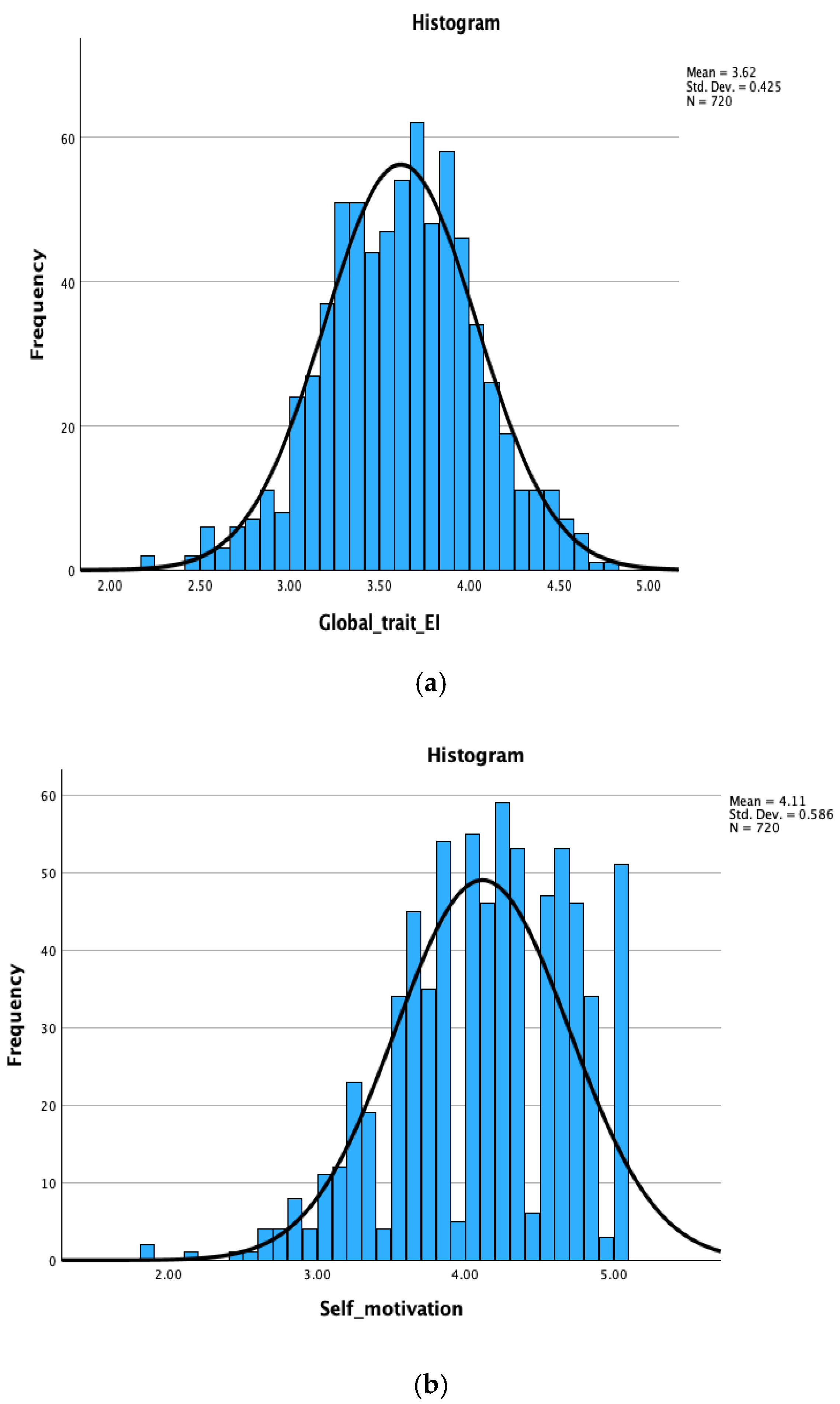
2.2.1. Score Distributions and Internal Consistencies
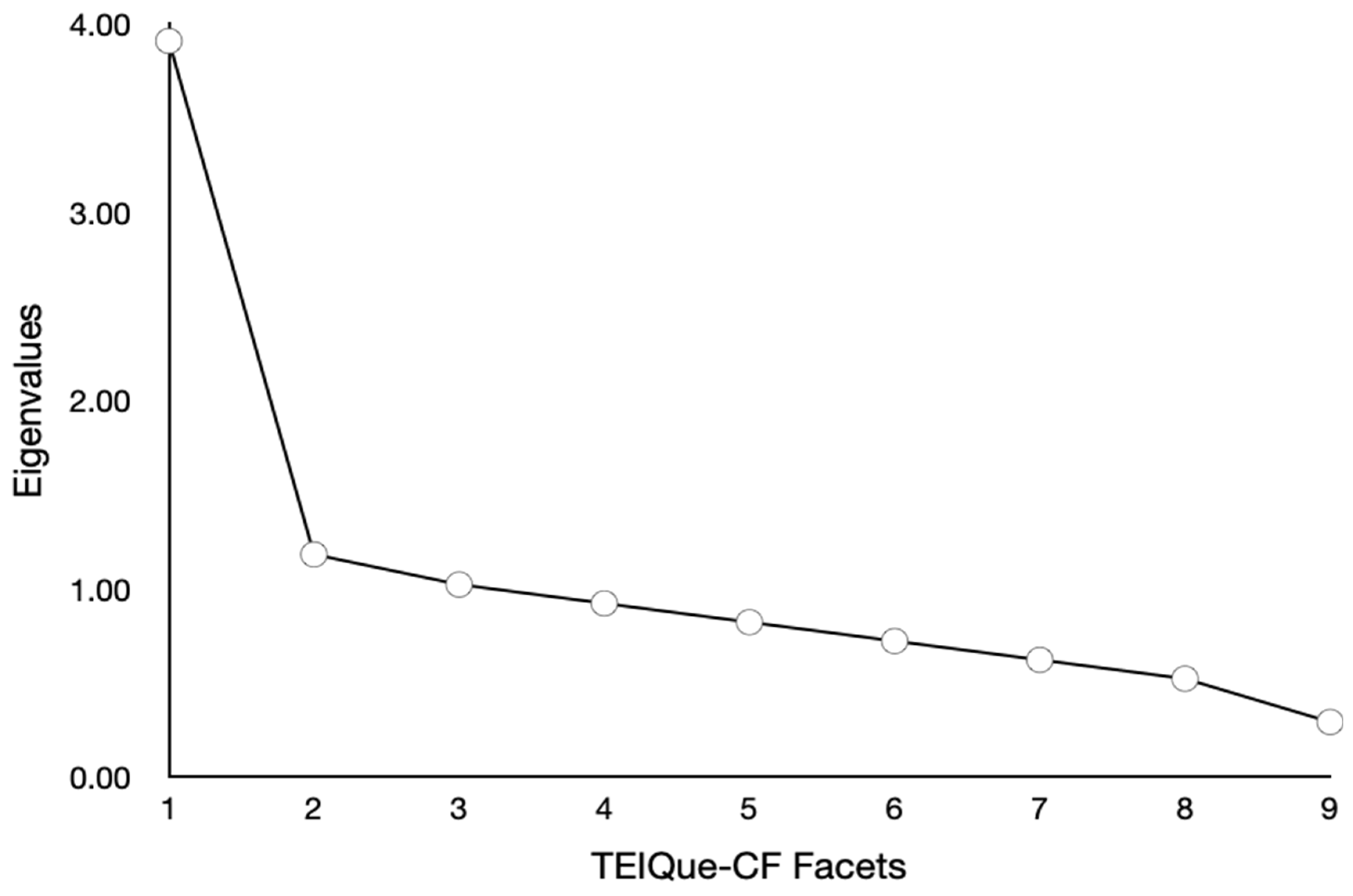
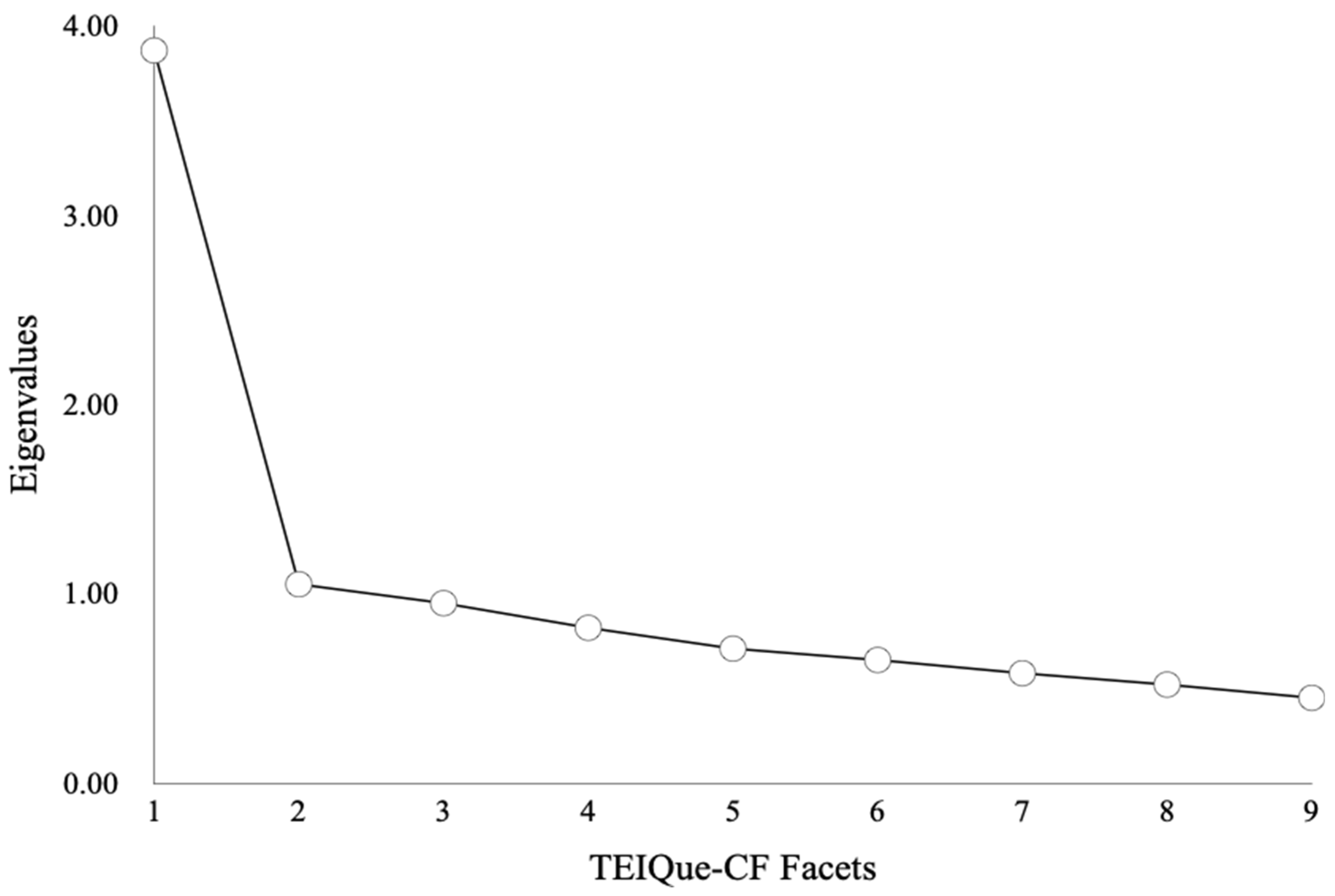
2.2.2. Factor Analysis
Total Sample
2.2.3. Subgroup Analyses by Gender
2.2.4. Subgroup Analyses by Age
2.3. Discussion
3. Study 2
3.1. Method
3.1.1. Participants
3.1.2. Measure
3.1.3. Procedure
3.1.4. Statistical Analysis
3.2. Results
3.2.1. Score Distributions and Internal Consistency
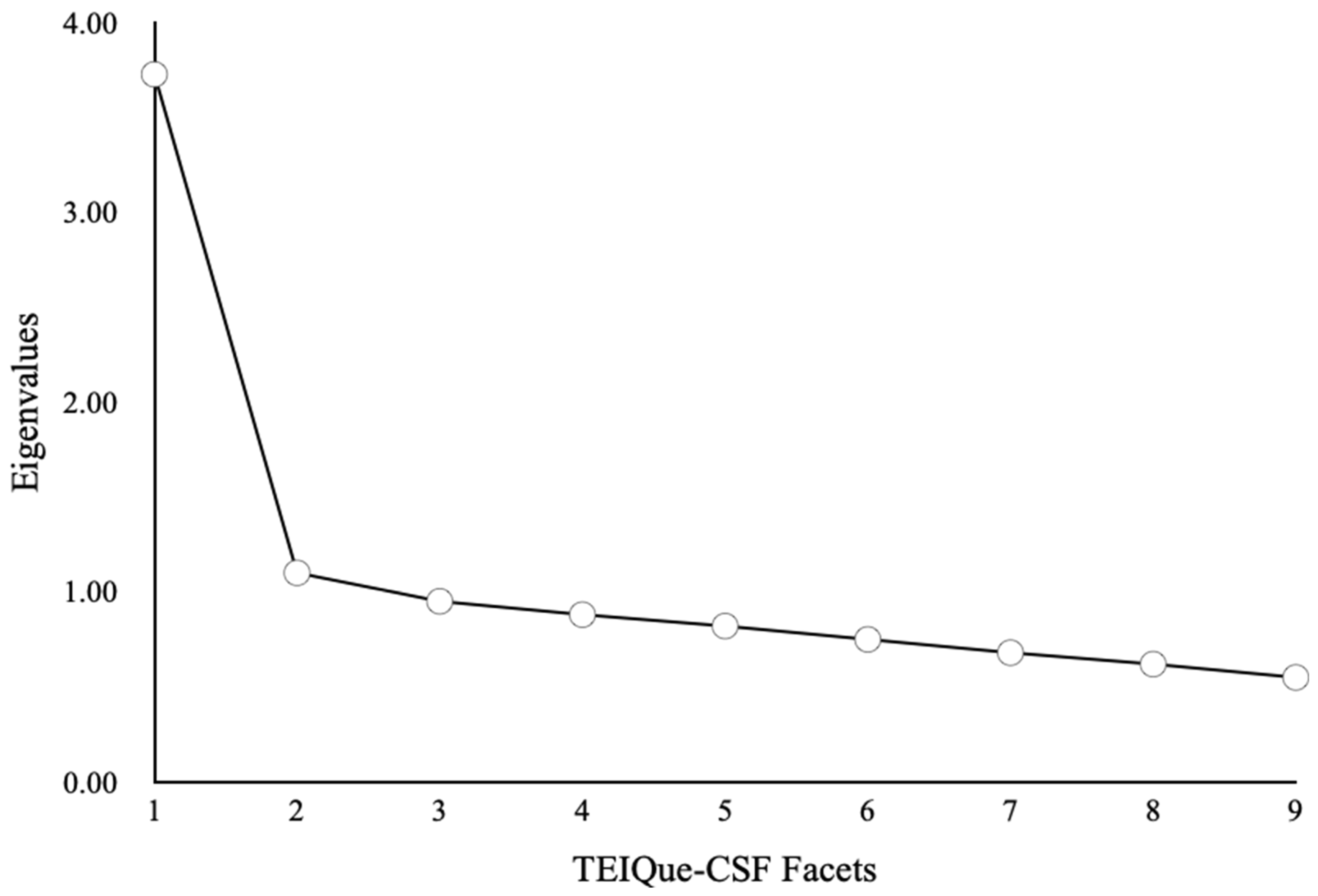
3.2.2. Factor Analysis
Total Sample
3.2.3. Subgroup Analyses by Gender
Gender Differences
3.3. Discussion
4. General Discussion
4.1. Developmental Differentiation of Trait EI
4.2. Cross-Cultural Consistency and Validation
4.3. Theoretical Implications and Underlying Mechanisms
4.4. Methodological Considerations
4.5. Practical Applications
4.6. Limitations and Future Directions
5. Conclusions
Author Contributions
Funding
Institutional Review Board Statement
Informed Consent Statement
Data Availability Statement
Acknowledgments
Conflicts of Interest
References
- Agnoli, S., Mastria, S., Mancini, G., Corazza, G. E., Franchin, L., & Pozzoli, T. (2023). The dynamic interplay of affective, cognitive and contextual resources on children’s creative potential: The modulatory role of trait emotional intelligence. Journal of Intelligence, 11(1), 11. [Google Scholar] [CrossRef]
- Aluja, A., Blanch, A., & Petrides, K. V. (2016). Psychometric properties of the Catalan version of the Trait Emotional Intelligence (TEIQue): Comparison between Catalan and English data. Personality and Individual Differences, 99, 133–139. [Google Scholar] [CrossRef]
- Banjac, S., Hull, L., Petrides, K. V., & Mavroveli, S. (2016). Validation of the Serbian adaptation of the trait emotional intelligence questionnaire-child form (TEIQue-CF). Psihologija, 49, 375–392. [Google Scholar] [CrossRef]
- Barenboim, C. (1981). The development of person perception from childhood to adolescence: From behavioral comparisons to psychological constructs to psychological comparisons. Child Development, 52(1), 129–144. [Google Scholar] [CrossRef]
- Beyazit, U., Yurdakul, Y., & Ayhan, A. B. (2020). The psychometric properties of the Turkish version of the trait emotional intelligence questionnaire–child form. Sage Open, 10, 2158244020922904. [Google Scholar] [CrossRef]
- Crone, E. A., & van Drunen, L. (2024). Development of self-concept in childhood and adolescence: How neuroscience can inform theory and vice versa. Human Development, 68(5–6), 255–271. [Google Scholar] [CrossRef] [PubMed]
- Erasmus, S., Van Eeden, R., & Ferns, I. (2022). Classroom factors that contribute to emotional intelligence in the case of primary school learners. South African Journal of Childhood Education, 12(1), a1072. [Google Scholar] [CrossRef]
- Garnefski, N., Rieffe, C., Jellesma, F., Terwogt, M. M., & Kraaij, V. (2007). Cognitive emotion regulation strategies and emotional problems in 9–11-year-old children: The development of an instrument. European Child & Adolescent Psychiatry, 16(1), 1–9. [Google Scholar] [CrossRef]
- Grosse, G., Streubel, B., Gunzenhauser, C., & Saalbach, H. (2021). Let’s talk about emotions: The development of children’s emotion vocabulary from 4 to 11 years of age. Affective Science, 2(4), 150–162. [Google Scholar] [CrossRef]
- Harter, S. (2012). The construction of the self: Developmental and sociocultural foundations (2nd ed.). Guilford Press. [Google Scholar]
- Li, D., Liu, T., Zhang, X., Wang, M., Wang, D., & Shi, J. (2017). Fluid intelligence, emotional intelligence, and the Iowa Gambling Task in children. Intelligence, 62, 167–174. [Google Scholar] [CrossRef]
- Li, D., Wu, M., Zhang, X., Wang, M., & Shi, J. (2020). The roles of fluid intelligence and emotional intelligence in affective decision-making during the transition to early adolescence. Frontiers in Psychology, 11, 574903. [Google Scholar] [CrossRef] [PubMed]
- Loewenthal, K. M. (2001). An introduction to psychological tests and scales (2nd ed.). Psychology Press. [Google Scholar]
- Marsh, H. W., & Ayotte, V. (2003). Do multiple dimensions of self-concept become more differentiated with age? The differential distinctiveness hypothesis. Journal of Educational Psychology, 95, 687–706. [Google Scholar] [CrossRef]
- Mikolajczak, M., Luminet, O., Leroy, C., & Roy, E. (2007). Psychometric properties of the trait emotional intelligence questionnaire: Factor structure, reliability, construct, and incremental validity in a French-speaking population. Journal of Personality Assessment, 88(3), 338–353. [Google Scholar] [CrossRef]
- Mitchell, W. J., Tepfer, L. J., Henninger, N. M., Perlman, S. B., Murty, V. P., & Helion, C. (2022). Developmental differences in affective representation between prefrontal and subcortical structures. Social Cognitive and Affective Neuroscience, 17(3), 311–322. [Google Scholar] [CrossRef]
- Nook, E. C., Stavish, C. M., Sasse, S. F., Lambert, H. K., Mair, P., McLaughlin, K. A., & Somerville, L. H. (2020). Charting the development of emotion comprehension and abstraction from childhood to adulthood using observer-rated and linguistic measures. Emotion, 20(5), 773–792. [Google Scholar] [CrossRef]
- Pauletto, M., Grassi, M., Passolunghi, M. C., & Penolazzi, B. (2021). Psychological well-being in childhood: The role of trait emotional intelligence, regulatory emotional self-efficacy, coping and general intelligence. Clinical Child Psychology and Psychiatry, 26(4), 1284–1297. [Google Scholar] [CrossRef]
- Perez-Diaz, P. A., & Petrides, K. V. (2021). The spanish–chilean trait emotional intelligence questionnaire–short form: The adaptation and validation of the TEIQue-SF in Chile. Journal of Personality Assessment, 103(1), 67–79. [Google Scholar] [CrossRef] [PubMed]
- Petrides, K. V. (2009). Psychometric properties of the trait emotional intelligence questionnaire. In C. Stough, D. H. Saklofske, & J. D. Parker (Eds.), Advances in the assessment of emotional intelligence. Springer. [Google Scholar]
- Petrides, K. V., Mikolajczak, M., Mavroveli, S., Sánchez-Ruiz, M. J., Furnham, A., & Pérez-González, J. C. (2016). Developments in trait emotional intelligence research. Emotion Review, 8(4), 335–341. [Google Scholar] [CrossRef]
- Petrides, K. V., Pita, R., & Kokkinaki, F. (2007). The location of trait emotional intelligence in personality factor space. British Journal of Psychology, 98, 273–289. [Google Scholar] [CrossRef]
- Piqueras, J. A., Mateu-Martínez, O., Cejudo, J., & Pérez-González, J.-C. (2019). Pathways into psychosocial adjustment in children: Modeling the effects of trait emotional intelligence, social-emotional problems, and gender. Frontiers in Psychology, 10, 507. [Google Scholar] [CrossRef]
- Pons, F., Harris, P. L., & de Rosnay, M. (2004). Emotion comprehension between 3 and 11 years: Developmental periods and hierarchical organization. European Journal of Developmental Psychology, 1(2), 127–152. [Google Scholar] [CrossRef]
- Roebers, C. M. (2017). Executive function and metacognition: Towards a unifying framework of cognitive self-regulation. Developmental Review, 45, 31–51. [Google Scholar] [CrossRef]
- Russo, P. M., Mancini, G., Trombini, E., Baldaro, B., Mavroveli, S., & Petrides, K. V. (2011). Trait emotional intelligence and the big five: A study on Italian children and preadolescents. Journal of Psychoeducational Assessment, 30(3), 274–283. [Google Scholar] [CrossRef]
- Sanchez-Ruiz, M. J., Mavroveli, S., & Petrides, K. V. (2021). The trait emotional intelligence questionnaire in lebanon and the UK: A comparison of the psychometric properties in each country. International Journal of Psychology, 56(2), 304–313. [Google Scholar] [CrossRef]
- Shiner, R. L., Soto, C. J., & De Fruyt, F. (2021). Personality assessment of children and adolescents. Annual Review of Developmental Psychology, 3, 113–137. [Google Scholar] [CrossRef]
- Sorlie, M.-A., Hagen, K. A., & Nordahl, K. B. (2020). Development of social skills during middle childhood: Growth trajectories and school-related predictors. International Journal of School & Educational Psychology, 8(3), 233–247. [Google Scholar] [CrossRef]
- Stassart, C., Dardenne, B., & Etienne, A.-M. (2017). The role of parental anxiety sensitivity and learning experiences in children’s anxiety sensitivity. British Journal of Developmental Psychology, 35(3), 359–375. [Google Scholar] [CrossRef] [PubMed]
- Stevens, J. P. (2002). Applied multivariate statistics for the social sciences (4th ed.). Lawrence Erlbaum Associates. [Google Scholar]
- Thomaes, S., Brummelman, E., & Sedikides, C. (2017). Why most children think well of themselves. Child Development, 88(6), 1873–1884. [Google Scholar] [CrossRef]
- Thompson, B., & Daniel, L. G. (1996). Factor analytic evidence for the construct validity of scores: A historical overview and some guidelines. Educational and Psychological Measurement, 56, 197–208. [Google Scholar] [CrossRef]
- van der Cruijsen, R., Blankenstein, N. E., Spaans, J. P., Peters, S., & Crone, E. A. (2023). Longitudinal self-concept development in adolescence. Social Cognitive and Affective Neuroscience, 18(1), nsac062. [Google Scholar] [CrossRef]
- Watkins, M. W. (2000). Monte carlo PCA for parallel analysis (Original Version) [Computer software]. Ed & Psych Associates.
- Willner, C. J., Hoffmann, J. D., Bailey, C. S., Harrison, A. P., Garcia, B., Ng, Z. J., Cipriano, C., & Brackett, M. A. (2022). The development of cognitive reappraisal from early childhood through adolescence: A systematic review and methodological recommendations. Frontiers in Psychology, 13, 875964. [Google Scholar] [CrossRef] [PubMed]



| Facet | Brief Description | Example Item |
|---|---|---|
| Adaptability | Children’s perceptions of how well they adapt to new situations and people. | “I find it hard to get used to a new school year.” |
| Affective disposition | Children’s perceptions of the frequency and intensity with which they experience emotions. | “I’m a very happy kid.” |
| Emotion expression | Children’s perceptions of how effectively they can express their emotions. | “I always find the words to show how I feel.” |
| Emotion perception | Children’s perceptions of how accurately they identify their own and others’ emotions. | “It’s easy for me to understand how I feel.” |
| Emotion regulation | Children’s perceptions of how well they can control their emotions. | “I can control my anger.” |
| Impulse control | Children’s perceptions of how effectively they can control themselves. | “I don’t like waiting to get what I want.” |
| Peer relations | Children’s perceptions of the quality of their relationships with their classmates. | “I listen to other children’s problems.” |
| Self-esteem | Children’s perceptions of their self-worth. | “I feel great about myself.” |
| Self-motivation | Children’s perceptions of their drive and motivation. | “I always try to become better at school.” |
| Facet | Skewness | Kurtosis | α | 1 | 2 | 3 | 4 | 5 | 6 | 7 | 8 | 9 |
|---|---|---|---|---|---|---|---|---|---|---|---|---|
| 1. Adaptability | −0.15 | −0.26 | 0.59 | - | ||||||||
| 2. Affective disposition | −0.67 | 0.39 | 0.77 | 0.31 | - | |||||||
| 3. Emotion expression | −0.12 | 0.00 | 0.59 | 0.28 | 0.33 | - | ||||||
| 4. Emotion perception | −0.18 | −0.06 | 0.57 | 0.32 | 0.35 | 0.36 | - | |||||
| 5. Emotion regulation | −0.22 | −0.08 | 0.61 | 0.25 | 0.44 | 0.36 | 0.37 | - | ||||
| 6. Impulse control | −0.21 | 0.17 | 0.65 | 0.17 | 0.39 | 0.31 | 0.31 | 0.50 | - | |||
| 7. Peer relations | −0.52 | 0.28 | 0.63 | 0.45 | 0.46 | 0.42 | 0.40 | 0.46 | 0.32 | - | ||
| 8. Self-esteem | −0.55 | 0.35 | 0.70 | 0.25 | 0.48 | 0.41 | 0.36 | 0.34 | 0.23 | 0.53 | - | |
| 9. Self-motivation | −0.53 | 0.01 | 0.62 | 0.30 | 0.33 | 0.27 | 0.38 | 0.40 | 0.40 | 0.41 | 0.35 | - |
| Mean | - | - | - | 3.58 | 3.66 | 3.24 | 3.70 | 3.43 | 3.30 | 3.77 | 3.69 | 4.11 |
| SD | - | - | - | 0.67 | 0.78 | 0.63 | 0.59 | 0.67 | 0.70 | 0.53 | 0.70 | 0.59 |
| N items | - | - | - | 8 | 8 | 8 | 8 | 8 | 8 | 12 | 7 | 8 |
| Facet | Number of Items | Years 3–4 n = 342 | Years 5–6 n = 331 |
|---|---|---|---|
| TEIQue-CF | 75 | 0.89 | 0.91 |
| 1. Adaptability | 8 | 0.51 | 0.67 |
| 2. Affective disposition | 8 | 0.74 | 0.79 |
| 3. Emotion expression | 8 | 0.55 | 0.62 |
| 4. Emotion perception | 8 | 0.54 | 0.61 |
| 5. Emotion regulation | 8 | 0.57 | 0.63 |
| 6. Impulse control | 8 | 0.61 | 0.69 |
| 7. Peer relations | 12 | 0.61 | 0.65 |
| 8. Self-esteem | 7 | 0.69 | 0.72 |
| 9. Self-motivation | 8 | 0.61 | 0.62 |
| Factor Loadings | ||
|---|---|---|
| Facet | Socioemotionality | Emotion Control |
| 1. Self-esteem | 0.72 | |
| 2. Peer relations | 0.79 | |
| 3. Adaptability | 0.75 | |
| 4. Emotion expression | 0.58 | |
| 5. Emotion perception | 0.50 | |
| 6. Affective disposition | 0.46 | |
| 7. Impulse control | 0.90 | |
| 8. Emotion regulation | 0.71 | |
| 9. Self-motivation | 0.52 | |
| Eigenvalues | 3.74 | 1.04 |
| % of variance explained | 41.56 | 11.50 |
| Factor Loadings | ||
|---|---|---|
| Facet | Socioemotionality | Emotion Control |
| 1. Self-esteem | 0.76 | |
| 2. Adaptability | 0.79 | |
| 3. Peer relations | 0.76 | |
| 4. Affective disposition | 0.59 | |
| 5. Emotion expression | 0.56 | |
| 6. Emotion perception | 0.35 | |
| 7. Impulse control | 0.86 | |
| 8. Self-motivation | 0.70 | |
| 9. Emotion regulation | 0.60 | |
| Eigenvalues | 3.87 | 1.05 |
| % of variance explained | 43.01 | 11.65 |
| Factor Loadings | ||
|---|---|---|
| Facet | Socioemotionality | Emotion Control |
| 1. Adaptability | 0.79 | |
| 2. Peer relations | 0.75 | |
| 3. Self-esteem | 0.70 | |
| 4. Emotion expression | 0.55 | |
| 5. Affective disposition | 0.52 | |
| 6. Emotion perception | 0.51 | |
| 7. Impulse control | 0.88 | |
| 8. Emotion regulation | 0.72 | |
| 9. Self-motivation | 0.65 | |
| Eigenvalues | 3.73 | 1.10 |
| % of variance explained | 41.5 | 12.3 |
| Factor Loadings | ||
|---|---|---|
| Facet | Socioemotionality | Emotion Control |
| 1. Peer relations | 0.81 | |
| 2. Emotion expression | 0.71 | |
| 3. Adaptability | 0.70 | |
| 4. Self-esteem | 0.61 | |
| 5. Affective disposition | 0.50 | |
| 6. Emotion perception | 0.49 | |
| 7. Impulse control | 0.86 | |
| 8. Self-motivation | 0.71 | |
| 9. Emotion regulation | 0.71 | |
| Eigenvalues | 3.73 | 1.10 |
| % of variance explained | 41.44 | 12.24 |
| Factor Loadings | ||
|---|---|---|
| Facet | Socioemotionality | Emotion Control |
| 1. Adaptability | 0.81 | |
| 2. Peer relations | 0.73 | |
| 3. Self-esteem | 0.72 | |
| 4. Affective disposition | 0.56 | |
| 5. Emotion perception | 0.51 | |
| 6. Emotion expression | 0.46 | |
| 7. Impulse control | 0.89 | |
| 8. Emotion regulation | 0.67 | |
| 9. Self-motivation | 0.59 | |
| Eigenvalues | 3.71 | 1.09 |
| % of variance explained | 41.21 | 12.08 |
Disclaimer/Publisher’s Note: The statements, opinions and data contained in all publications are solely those of the individual author(s) and contributor(s) and not of MDPI and/or the editor(s). MDPI and/or the editor(s) disclaim responsibility for any injury to people or property resulting from any ideas, methods, instructions or products referred to in the content. |
© 2026 by the authors. Licensee MDPI, Basel, Switzerland. This article is an open access article distributed under the terms and conditions of the Creative Commons Attribution (CC BY) license.
Share and Cite
Mavroveli, S.; Petrides, K.V.; Sanchez-Ruiz, M.-J. Trait Emotional Intelligence in Childhood: Factorial Structure of the TEIQue–Child Form (CF) and Child Short Form (CSF). Behav. Sci. 2026, 16, 501. https://doi.org/10.3390/bs16040501
Mavroveli S, Petrides KV, Sanchez-Ruiz M-J. Trait Emotional Intelligence in Childhood: Factorial Structure of the TEIQue–Child Form (CF) and Child Short Form (CSF). Behavioral Sciences. 2026; 16(4):501. https://doi.org/10.3390/bs16040501
Chicago/Turabian StyleMavroveli, Stella, Konstantinos V. Petrides, and Maria-Jose Sanchez-Ruiz. 2026. "Trait Emotional Intelligence in Childhood: Factorial Structure of the TEIQue–Child Form (CF) and Child Short Form (CSF)" Behavioral Sciences 16, no. 4: 501. https://doi.org/10.3390/bs16040501
APA StyleMavroveli, S., Petrides, K. V., & Sanchez-Ruiz, M.-J. (2026). Trait Emotional Intelligence in Childhood: Factorial Structure of the TEIQue–Child Form (CF) and Child Short Form (CSF). Behavioral Sciences, 16(4), 501. https://doi.org/10.3390/bs16040501