Psychometric Properties of the Greek Apathy Evaluation Scale Clinician Version (AES-C) in MCI Patients and Cognitively Healthy Older Adults

 ,
,  ,
,
Abstract
1. Introduction
1.1. Existing Measures of Apathy
1.2. Aim of the Study
2. Materials and Methods
2.1. Design
2.2. Ethics
2.3. Participants
2.4. Inclusion Criteria
2.5. Procedure
2.6. Measures
2.6.1. Apathy Evaluation Scale—Clinician Version
2.6.2. Greek Adaptation of AES-C
2.6.3. Beck Depression Inventory
2.7. Statistical Analysis
3. Results
3.1. Descriptive Statistics
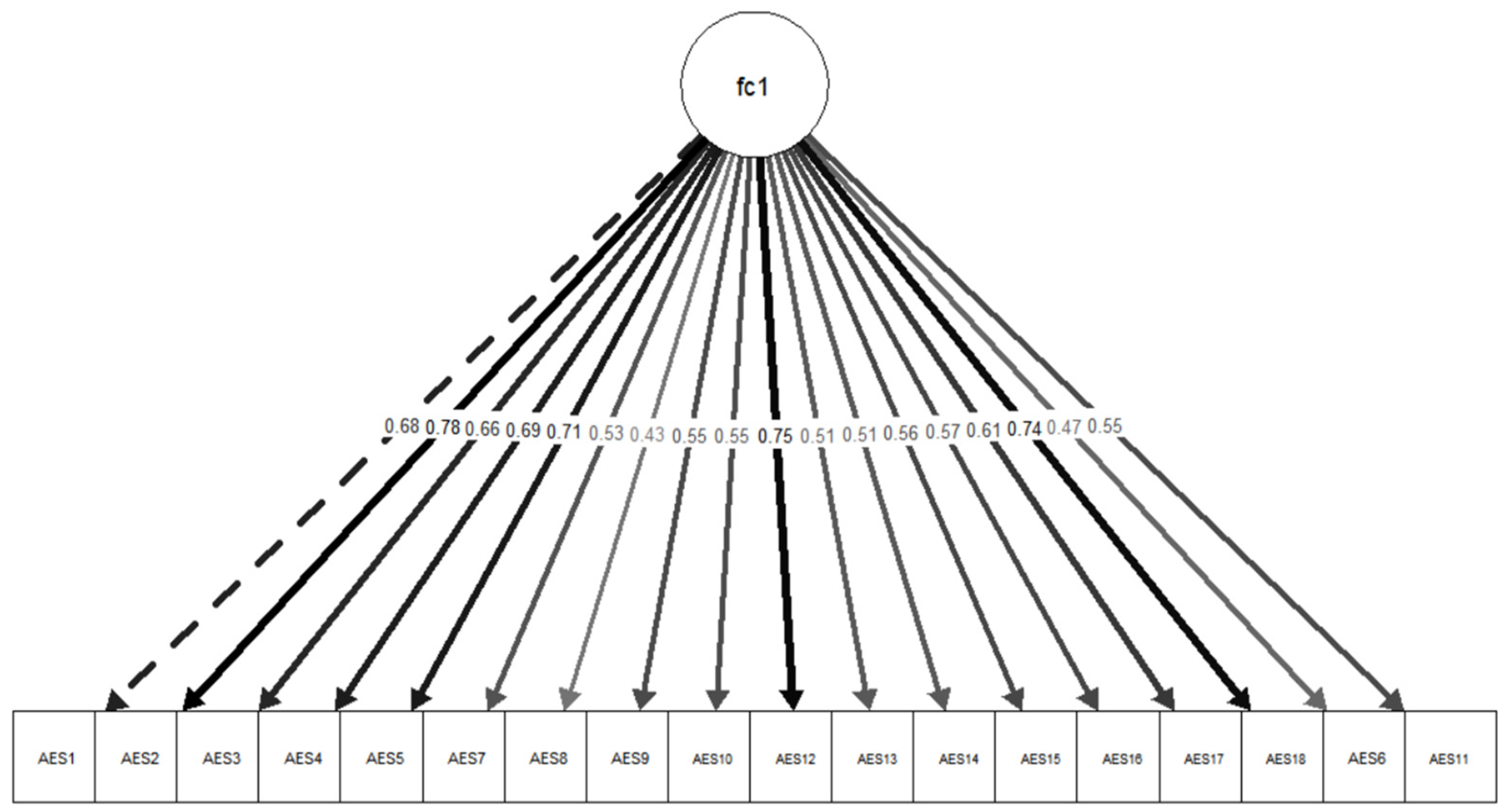
3.2. Factor Analysis
3.3. Test–Retest Reliability
3.4. Structural Validity
4. Discussion
Limitations
5. Conclusions
Author Contributions
Funding
Institutional Review Board Statement
Informed Consent Statement
Data Availability Statement
Acknowledgments
Conflicts of Interest
Appendix A
- Καθόλου χαρακτηριστικό
- Λίγο χαρακτηριστικό
- Aρκετά χαρακτηριστικό
- Πολύ χαρακτηριστικό
- Ενδιαφέρεται για πράγματα. + C Q*
- Κάνει πράγματα κατά την διάρκεια της ημέρας. + B Q
- Το να ξεκινάει πράγματα μόνος του/μόνη της είναι σημαντικό για αυτόν/αυτήν. + C SE
- Ενδιαφέρεται να έχει νέες εμπειρίες. + C Q
- Ενδιαφέρεται να μαθαίνει νέα πράγματα. + C Q
- Καταβάλλει λίγη προσπάθεια σε οτιδήποτε. − B
- Προσεγγίζει την ζωή με ένταση. + E
- Το να φέρει μια δουλειά εις πέρας είναι σημαντικό για αυτόν/αυτήν. + C SE
- Ξοδεύει χρόνο κάνοντας πράγματα που τον/την ενδιαφέρουν. + B
- Κάποιος πρέπει να του/της λέει τι να κάνει κάθε μέρα. − B
- Aνησυχεί λιγότερο για τα προβλήματα του/της από ότι θα έπρεπε. − C
- Έχει φίλους. + B Q
- Το να συναντιέται με φίλους είναι σημαντικό για αυτόν/αυτήν. + C SE
- Όταν κάτι καλό συμβαίνει, ενθουσιάζεται. + E
- Έχει ακριβή κατανόηση των προβλημάτων του/της. + O
- Το να κάνει πράγματα μέσα στη μέρα είναι σημαντικό για αυτόν/αυτήν. + C SE
- Έχει πρωτοβουλία. + O
- Έχει κίνητρο. + O
References
- American Psychiatric Association. (2013). Diagnostic and statistical manual of mental disorders (5th ed.). American Psychiatric Publishing. [Google Scholar]
- Andrade, C. (2021). The inconvenient truth about convenience and purposive samples. Indian Journal of Psychological Medicine, 43(1), 86–88. [Google Scholar] [CrossRef]
- Azermai, M., Kane, J., Liperoti, R., Tsolaki, M., Landi, F., Passmore, A. P., Petrovic, M., & Cruz-Jentoft, A. J. (2013). Management of behavioural and psychological symptoms of dementia: Belgium, Greece, Italy, United Kingdom. European Geriatric Medicine, 4(1), 50–58. [Google Scholar] [CrossRef]
- Beam, C. R., Kaneshiro, C., Jang, J. Y., Reynolds, C. A., Pedersen, N. L., & Gatz, M. (2018). Differences between women and men in incidence rates of dementia and Alzheimer’s disease. Journal of Alzheimer’s Disease, 64(4), 1077–1083. [Google Scholar] [CrossRef]
- Beck, A. T., Steer, R. A., & Brown, G. (1996). Beck depression inventory–II. APA PsycTests. [CrossRef]
- Benton, A. L., & Hamsher, K. D. (1976). Multilingual aphasia examination manual. University of Iowa. [Google Scholar]
- Caeiro, L., Silva, T., Ferro, J., Pais-Ribeiro, J., & Figueira, M. L. (2012). Metric properties of the Portuguese version of the apathy evaluation scale. Psicologia, Saúde & Doenças, 13(2), 266–282. [Google Scholar]
- Choi, Y. R., Lee, Y. N., Jeong, E., & Chang, S. O. (2020). Validity and reliability of the Korean version of the apathy evaluation dcale dhort form for patients with dementia. Journal of Korean Academy of Fundamentals of Nursing, 27(2), 164–175. [Google Scholar] [CrossRef]
- Christmann, A., & Van Aelst, S. (2006). Robust estimation of Cronbach’s alpha. Journal of Multivariate Analysis, 97(7), 1660–1674. [Google Scholar] [CrossRef]
- Connors, M. H., Teixeira-Pinto, A., Ames, D., Woodward, M., & Brodaty, H. (2023). Distinguishing apathy and depression in dementia: A longitudinal study. Australian & NewZealand Journal of Psychiatry, 57(6), 884–894. [Google Scholar] [CrossRef]
- Cummings, J. L. (1997). The neuropsychiatric inventory: Assessing psychopathology in dementia patients. Neurology, 48, 10S–16S. [Google Scholar] [CrossRef] [PubMed]
- DeJong, R., Osterlund, M., & Roy, G. (1989). Measurement of quality-of-life changes in patients with Alzheimer’s disease. Clinical Therapeutics, 11(4), 545–554. [Google Scholar]
- Ducharme, S., Price, B. H., Larvie, M., Dougherty, D. D., & Dickerson, B. C. (2015). Clinical approach to the differential diagnosis between behavioral variant frontotemporal dementia and primary psychiatric disorders. American Journal of Psychiatry, 172(9), 827–837. [Google Scholar] [CrossRef]
- Economou, A., Konsolaki, E., Kalsi, I. A., & Psychountaki, M. (2024). The beck depression inventory-II in community-dwelling middle-aged and older Greeks: Factor structure and demographic associations. SAGE Open, 14(2), 21582440241252264. [Google Scholar] [CrossRef]
- Epskamp, S. (2015). semPlot: Unified visualizations of structural equation models. Structural Equation Modeling: A Multidisciplinary Journal, 22(3), 474–483. [Google Scholar] [CrossRef]
- Folstein, M. F., Folstein, S. E., & McHugh, P. R. (1975). “Mini-mental state”: A practical method for grading the cognitive state of patients for the clinician. Journal of Psychiatric Research, 12(3), 189–198. [Google Scholar] [CrossRef] [PubMed]
- Fountoulakis, K. N., Tsolaki, M., Chantzi, H., & Kazis, A. (2000). Mini mental state examination (MMSE): A validation study in Greece. American Journal of Alzheimer’s Disease & Other Dementias, 15(6), 342–345. [Google Scholar] [CrossRef]
- Fountoulakis, K. N., Tsolaki, M., Iacovides, A., Yesavage, J., O’Hara, R., Kazis, A., & Ierodiakonou, C. (1999). The validation of the geriatric depression scale (GDS) in Greece. Aging Clinical and Experimental Research, 11(6), 367–372. [Google Scholar] [CrossRef]
- Furneri, G., Platania, S., Privitera, A., Martelli, F., Smeriglio, R., Razza, G., Maci, T., Castellano, S., Drago, F., Santagati, M., Caponnetto, P., Caraci, F., & Di Nuovo, S. (2021). The apathy evaluation scale (AES-C): Psychometric properties and invariance of Italian version in mild cognitive impairment and Alzheimer’s disease. International Journal of Environmental Research and Public Health, 18(18), 9597. [Google Scholar] [CrossRef]
- Geddes, M. R., O’Connell, M. E., Fisk, J. D., Gauthier, S., Camicioli, R., Ismail, Z., & Alzheimer Society of Canada Task Force on Dementia Care Best Practices for COVID-19. (2020). Remote cognitive and behavioral assessment: Report of the alzheimer society of Canada task force on dementia care best practices for COVID-19. Alzheimer’s & Dementia: Diagnosis, Assessment & Disease Monitoring, 12(1), e12111. [Google Scholar] [CrossRef]
- Giannakou, M., Roussi, P., Kosmides, M. E., Kiosseoglou, G., Adamopoulou, A., & Garyfallos, G. (2013). Adaptation of the beck depression inventory-II to Greek population. Hellenic Journal of Psychology, 10, 120–146. [Google Scholar]
- Grossman, H. T., Sano, M., Aloysi, A., Elder, G. A., Neugroschl, J., Schimming, C., Soleimani, L., & Zhu, C. W. (2021). Prevalent, persistent, and impairing: Longitudinal course and impact of apathy in Alzheimer’s disease. Alzheimer’s & Dementia: Diagnosis, Assessment & Disease Monitoring, 13(1), e12169. [Google Scholar] [CrossRef]
- Guercio, B. J., Donovan, N. J., Munro, C. E., Aghjayan, S. L., Wigman, S. E., Locascio, J. J., Amariglio, R. E., Rentz, D. M., Johnson, K. A., Sperling, R. A., & Marshall, G. A. (2015). The apathy evaluation scale: A comparison of subject, informant, and clinician report in cognitively normal elderly and mild cognitive impairment. Journal of Alzheimer’s Disease, 47(2), 421–432. [Google Scholar] [CrossRef] [PubMed]
- Hambleton, R. K. (2001). The next generation of the ITC test translation and adaptation guidelines. European Journal of Psychological Assessment, 17(3), 164–172. [Google Scholar] [CrossRef]
- Hu, L. T., & Bentler, P. M. (1999). Cutoff criteria for fit indexes in covariance structure analysis: Conventional criteria versus new alternatives. Structural Equation Modeling: A Multidisciplinary Journal, 6(1), 1–55. [Google Scholar] [CrossRef]
- Johansson, M., Johansson, P., Stomrud, E., Hagell, P., & Hansson, O. (2017). Psychometric testing of a Swedish version of the apathy evaluation scale. Nordic Journal of Psychiatry, 71(6), 477–484. [Google Scholar] [CrossRef] [PubMed]
- Kounti, F., Tsolaki, M., & Kiosseoglou, G. (2006). Functional cognitive assessment scale (FUCAS): A new scale to assess functional decline in dementia. International Journal of Geriatric Psychiatry, 21(3), 266–271. [Google Scholar] [CrossRef]
- Kyriazos, T., & Poga-Kyriazou, M. (2023). Applied psychometrics: Estimator considerations in commonly encountered conditions in CFA, SEM, and EFA practice. Psychology, 14(5), 799–828. [Google Scholar] [CrossRef]
- Leung, V. P., Lam, L. C. W., Chiu, H. F. K., Cummings, J. L., & Chen, Q. L. (2001). Validation study of the Chinese version of the neuropsychiatric inventory (CNPI). International Journal of Geriatric Psychiatry, 16(8), 789–793. [Google Scholar] [CrossRef] [PubMed]
- Levy, R., & Dubois, B. (2006). Apathy and the functional anatomy of the prefrontal cortex-basal ganglia circuits. Cerebral Cortex, 16(7), 916–928. [Google Scholar] [CrossRef] [PubMed]
- Lueken, U., Seidl, U., Völker, L., Schweiger, E., Kruse, A., & Schröder, J. (2007). Development of a short version of the Apathy Evaluation Scale specifically adapted for demented nursing home residents. The American Journal of Geriatric Psychiatry, 15(5), 376–385. [Google Scholar] [CrossRef] [PubMed]
- Lyrakos, G., Ypofandi, M., & Tzanne, P. (2020). Psychometric and clinimetric properties of the montreal cognitive assessment (MoCA) in a Greek sample. European Psychiatry, 63(S1), S197. [Google Scholar] [CrossRef]
- Marin, R. S., Biedrzycki, R. C., & Firinciogullari, S. (1991). Reliability and validity of the apathy evaluation scale. Psychiatry Research, 38(2), 143–162. [Google Scholar] [CrossRef]
- Martínez-Cao, C., García-Álvarez, L., Bobes-Bascarán, T., De la Fuente-Tomas, L., Fernández-Egea, E., Velasco, A., González-Blanco, L., Zurrón-Madera, P., Fonseca-Pedrero, E., Sáiz-Martínez, P. A., García-Portilla, M. P., & Bobes, J. (2022). Validation of a European Spanish adaptation of the apathy evaluation scale-self-rated version (AES-S) in patients with schizophrenia. Revista de Psiquiatría y Salud Mental (English Edition), 15(1), 22–28. [Google Scholar] [CrossRef] [PubMed]
- Messinis, L., Tsakona, I., Malefaki, S., & Papathanasopoulos, P. (2007). Normative data and discriminant validity of Rey’s suditory verbal learning test for the Greek adult population. Archives of Clinical Neuropsychology, 22(6), 739–752. [Google Scholar] [CrossRef]
- Mielke, M. M., Vemuri, P., & Rocca, W. A. (2014). Clinical epidemiology of Alzheimer’s disease: Assessing sex and gender differences. Clinical Epidemiology, 6, 37–48. [Google Scholar] [CrossRef]
- Nasreddine, Z. S., Phillips, N. A., Bédirian, V., Charbonneau, S., Whitehead, V., Collin, I., Cummings, J. L., & Chertkow, H. (2005). The montreal cognitive assessment (MoCA): A brief screening tool for mild cognitive impairment. Journal of the American Geriatrics Society, 53(4), 695–699. [Google Scholar] [CrossRef] [PubMed]
- Nichols, E., Steinmetz, J. D., Vollset, S. E., Fukutaki, K., Chalek, J., Abd-Allah, F., Abdoli, A., Abualhasan, A., Abu-Gharbieh, E., Akram, T. T., & Al Hamad, H. (2022). Estimation of the global prevalence of dementia in 2019 and forecasted prevalence in 2050: An analysis for the global burden of disease study 2019. The Lancet Public Health, 7(2), e105–e125. [Google Scholar] [CrossRef]
- Nobis, L., & Husain, M. (2018). Apathy in Alzheimer’s disease. Current Opinion in Behavioral Sciences, 22, 7–13. [Google Scholar] [CrossRef] [PubMed]
- Osterrieth, P. A. (1944). Le test de copie d’une figure complexe; contribution à l’étude de la perception et de la mémoire [Test of copying a complex figure; contribution to the study of perception and memory]. Archives de Psychologie, 30, 206–356. [Google Scholar]
- Petersen, R. C., Smith, G. E., Waring, S. C., Ivnik, R. J., Tangalos, E. G., & Kokmen, E. (1999). Mild cognitive impairment: Clinical characterization and outcome. Archives of Neurology, 56(3), 303–308. [Google Scholar] [CrossRef]
- Polit, D. F., & Beck, C. T. (2008). Nursing research: Generating and assessing evidence for nursing practice. Lippincott Williams & Wilkins. [Google Scholar]
- Politis, A. M., Mayer, L. S., Passa, M., Maillis, A., & Lyketsos, C. G. (2004). Validity and reliability of the newly translated hellenic neuropsychiatric inventory (H-NPI) applied to Greek outpatients with Alzheimer’s disease: A study of disturbing behaviors among referrals to a memory clinic. International Journal of Geriatric Psychiatry, 19(3), 203–208. [Google Scholar] [CrossRef] [PubMed]
- Poptsi, E., Moraitou, D., Eleftheriou, M., Kounti-Zafeiropoulou, F., Papasozomenou, C., Agogiatou, C., Bakoglidou, E., Batsila, G., Liapi, D., Markou, N., Nikolaidou, E., Ouzouni, F., Soumpourou, A., Vasiloglou, M., & Tsolaki, M. (2019). Normative data for the montreal cognitive assessment in Greek older adults with subjective cognitive decline, mild cognitive impairment and dementia. Journal of Geriatric Psychiatry and Neurology, 32(5), 265–274. [Google Scholar] [CrossRef]
- Radakovic, R., & Abrahams, S. (2014). Developing a new apathy measurement scale: Dimensional apathy scale. Psychiatry Research, 219(3), 658–663. [Google Scholar] [CrossRef]
- Rea, L. M., & Parker, R. A. (2014). Designing and conducting survey research: A comprehensive guide. John Wiley & Sons. [Google Scholar]
- Reise, S. P., Bonifay, W. E., & Haviland, M. G. (2013). Scoring and modeling psychological measures in the presence of multidimensionality. Journal of Personality Assessment, 95(2), 129–140. [Google Scholar] [CrossRef] [PubMed]
- Reitan, R. M. (1958). Validity of the trail making test as an indicator of organic brain damage. Perceptual and Motor Skills, 8(3), 271–276. [Google Scholar] [CrossRef]
- Reitan, R. M., & Wolfson, D. (1985). The halstead–Reitan neuropsychological test battery: Theory and clinical interpretation. Neuropsychology Press. [Google Scholar]
- Revelle, W. (2018). psych: Procedures for psychological, psychometric, and personality research. Northwestern University. [Google Scholar]
- Rey, A. (1958). L’examen clinique en psychologie [The clinical examination in psychology]. Presses Universitaries De France. [Google Scholar]
- Rizopoulos, D. (2006). ltm: An R package for latent variable modeling and item response analysis. Journal of Statistical Software, 17(5), 1–25. [Google Scholar] [CrossRef]
- Robert, P. H., Clairet, S., Benoit, M., Koutaich, J., Bertogliati, C., Tible, O., Caci, H., Borg, M., Brocker, P., & Bedoucha, P. (2002). The apathy inventory: Assessment of apathy and awareness in Alzheimer’s disease, Parkinson’s disease and mild cognitive impairment. International Journal of Geriatric Psychiatry, 17(12), 1099–1105. [Google Scholar] [CrossRef]
- Rosseel, Y. (2012). lavaan: An R Package for Structural Equation Modeling. Journal of Statistical Software, 48(2), 1–36. [Google Scholar] [CrossRef]
- Schmidt, M. (1996). Rey auditory verbal learning test: A handbook. Western Psychological Services. [Google Scholar]
- Skamagka, S., & Tsolaki, M. (2025). Evaluation of dementia-related knowledge: Investigating awareness and perceptions in the Greek general population. Journal of Aging and Rehabilitation, 2(3), 53–57. [Google Scholar] [CrossRef]
- Starkstein, S. E., Ingram, L., Garau, M. L., & Mizrahi, R. (2005). On the overlap between apathy and depression in dementia. Journal of Neurology, Neurosurgery & Psychiatry, 76(8), 1070–1074. [Google Scholar] [CrossRef]
- Starkstein, S. E., & Leentjens, A. F. (2008). The nosological position of apathy in clinical practice. Journal of Neurology, Neurosurgery & Psychiatry, 76(8), 1088–1092. [Google Scholar] [CrossRef] [PubMed]
- Strauss, M. E., & Sperry, S. D. (2002). An informant-based assessment of apathy in Alzheimer disease. Cognitive and Behavioral Neurology, 15(3), 176–183. [Google Scholar]
- Stroop, J. R. (1935). Studies of interference in serial verbal reactions. Journal of Experimental Psychology, 18(6), 643–662. [Google Scholar] [CrossRef]
- Tombaugh, T. N., & McIntyre, N. J. (1992). The mini-mental state examination: A comprehensive review. Journal of the American Geriatrics Society, 40(9), 922–935. [Google Scholar] [CrossRef] [PubMed]
- Tsatali, M., Emmanouel, A., Gialaouzidis, M., Avdikou, K., Stefanatos, C., Diamantidou, A., Kouroundi, E., Messini, C., & Tsolaki, M. (2022). Rey complex figure test (RCFT): Norms for the Greek older adult population. Applied Neuropsychology: Adult, 29(5), 958–966. [Google Scholar] [CrossRef] [PubMed]
- van Dalen, J. W., van Wanrooij, L. L., van Charante, E. P. M., Brayne, C., van Gool, W. A., & Richard, E. (2018). Association of apathy with risk of incident dementia: A systematic review and meta-analysis. JAMA Psychiatry, 75(10), 1012–1021. [Google Scholar] [CrossRef]
- Vicini Chilovi, B., Conti, M., Zanetti, M., Mazzù, I., Rozzini, L., & Padovani, A. (2009). Differential impact of apathy and depression in the development of dementia in mild cognitive impairment patients. Dementia and Geriatric Cognitive Disorders, 27(4), 390–398. [Google Scholar] [CrossRef]
- Wechsler, D. (1981). WAIS–R manual: Wechsler adult intelligence scale–revised. Psychological Corporation. [Google Scholar]
- Wickham, H. (2016). Getting started with ggplot2. In ggplot2: Elegant graphics for data analysis (pp. 11–31). Springer. [Google Scholar] [CrossRef]
- World Health Organization. (2021). Dementia fact sheet. Available online: https://www.who.int/news-room/fact-sheets/detail/dementia (accessed on 7 October 2025).
- Yesavage, J. A., Brink, T. L., Rose, T. L., Lum, O., Huang, V., Adey, M., & Leirer, V. O. (1983). Development and validation of a geriatric depression screening scale: A preliminary report. Journal of Psychiatric Research, 17(1), 37–49. [Google Scholar] [CrossRef] [PubMed]
- Yuan, K., Chan, W., Marcoulides, G. A., & Bentler, P. M. (2016). Assessing structural equation models by equivalence testing with adjusted ft indexes. Structural Equation Modeling: A Multidisciplinary Journal, 23(3), 319–330. [Google Scholar] [CrossRef]
- Zalonis, I., Christidi, F., Bonakis, A., Kararizou, E., Triantafyllou, N., Paraskevas, G., Kapaki, E., & Vasilopoulos, D. (2009). The Stroop effect in Greek healthy population: Normative data for the stroop neuropsychological screening test. Archives of Clinical Neuropsychology, 24(1), 81–88. [Google Scholar] [CrossRef]
- Zalonis, I., Kararizou, E., Triantafyllou, N. I., Kapaki, E., Papageorgiou, S., Sgouropoulos, P. E. E. A., & Vassilopoulos, D. (2008). A normative study of the trail making test A and B in Greek adults. The Clinical Neuropsychologist, 22(5), 842–850. [Google Scholar] [CrossRef]


| Item | Item–Rest Correlation | Mean | SD |
|---|---|---|---|
| AES1 | 0.636 | 1.410 | 0.552 |
| AES2 | 0.737 | 1.510 | 0.628 |
| AES3 | 0.625 | 1.340 | 0.590 |
| AES4 | 0.665 | 1.390 | 0.584 |
| AES5 | 0.665 | 1.290 | 0.478 |
| AES6 | 0.436 | 1.660 | 0.807 |
| AES7 | 0.510 | 1.950 | 0.783 |
| AES8 | 0.414 | 1.160 | 0.368 |
| AES9 | 0.517 | 1.520 | 0.643 |
| AES10 | 0.535 | 1.210 | 0.518 |
| AES11 | 0.529 | 1.400 | 0.532 |
| AES12 | 0.720 | 1.580 | 0.713 |
| AES13 | 0.494 | 1.310 | 0.581 |
| AES14 | 0.494 | 1.290 | 0.498 |
| AES15 | 0.540 | 1.350 | 0.557 |
| AES16 | 0.542 | 1.220 | 0.484 |
| AES17 | 0.572 | 1.400 | 0.651 |
| AES18 | 0.700 | 1.530 | 0.731 |
| Item | Estimate | Uniqueness |
|---|---|---|
| AES1 | 0.676 | 0.543 |
| AES2 | 0.778 | 0.395 |
| AES3 | 0.660 | 0.564 |
| AES4 | 0.693 | 0.520 |
| AES5 | 0.706 | 0.502 |
| AES6 | 0.465 | 0.784 |
| AES7 | 0.528 | 0.721 |
| AES8 | 0.427 | 0.818 |
| AES9 | 0.553 | 0.694 |
| AES10 | 0.546 | 0.702 |
| AES11 | 0.551 | 0.696 |
| AES12 | 0.755 | 0.431 |
| AES13 | 0.510 | 0.740 |
| AES14 | 0.508 | 0.742 |
| AES15 | 0.563 | 0.683 |
| AES16 | 0.568 | 0.677 |
| AES17 | 0.610 | 0.628 |
| AES18 | 0.742 | 0.449 |
Disclaimer/Publisher’s Note: The statements, opinions and data contained in all publications are solely those of the individual author(s) and contributor(s) and not of MDPI and/or the editor(s). MDPI and/or the editor(s) disclaim responsibility for any injury to people or property resulting from any ideas, methods, instructions or products referred to in the content. |
© 2026 by the authors. Licensee MDPI, Basel, Switzerland. This article is an open access article distributed under the terms and conditions of the Creative Commons Attribution (CC BY) license.
Share and Cite
Keramida, M.; Tsolaki, M.; Poptsi, E.; Gialaouzidis, M.; Gkioka, M. Psychometric Properties of the Greek Apathy Evaluation Scale Clinician Version (AES-C) in MCI Patients and Cognitively Healthy Older Adults. Behav. Sci. 2026, 16, 498. https://doi.org/10.3390/bs16040498
Keramida M, Tsolaki M, Poptsi E, Gialaouzidis M, Gkioka M. Psychometric Properties of the Greek Apathy Evaluation Scale Clinician Version (AES-C) in MCI Patients and Cognitively Healthy Older Adults. Behavioral Sciences. 2026; 16(4):498. https://doi.org/10.3390/bs16040498
Chicago/Turabian StyleKeramida, Mary, Magda Tsolaki, Eleni Poptsi, Moses Gialaouzidis, and Mara Gkioka. 2026. "Psychometric Properties of the Greek Apathy Evaluation Scale Clinician Version (AES-C) in MCI Patients and Cognitively Healthy Older Adults" Behavioral Sciences 16, no. 4: 498. https://doi.org/10.3390/bs16040498
APA StyleKeramida, M., Tsolaki, M., Poptsi, E., Gialaouzidis, M., & Gkioka, M. (2026). Psychometric Properties of the Greek Apathy Evaluation Scale Clinician Version (AES-C) in MCI Patients and Cognitively Healthy Older Adults. Behavioral Sciences, 16(4), 498. https://doi.org/10.3390/bs16040498