Empowerment or Exposure? Digital Literacy and the Vulnerabilities of Trust in Strangers Among Older Adults: Evidence from China


Abstract
1. Introduction
2. Literature Review
2.1. Digital Literacy and Well-Being: From Empowerment to Psychosocial Gains
2.2. Digital Literacy and Trust: The Paradox of Empowerment in Digital Risk Societies
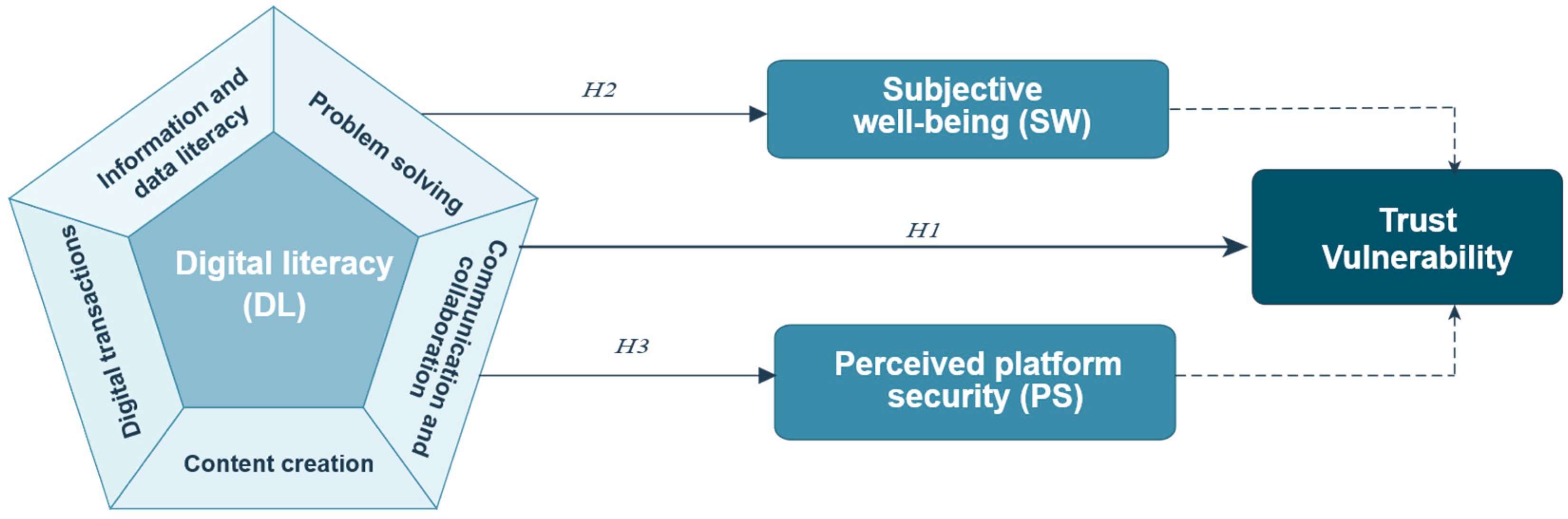
2.3. The Mechanisms Linking Digital Literacy to Trust Vulnerability: Psychological, Functional and Institutional Pathways
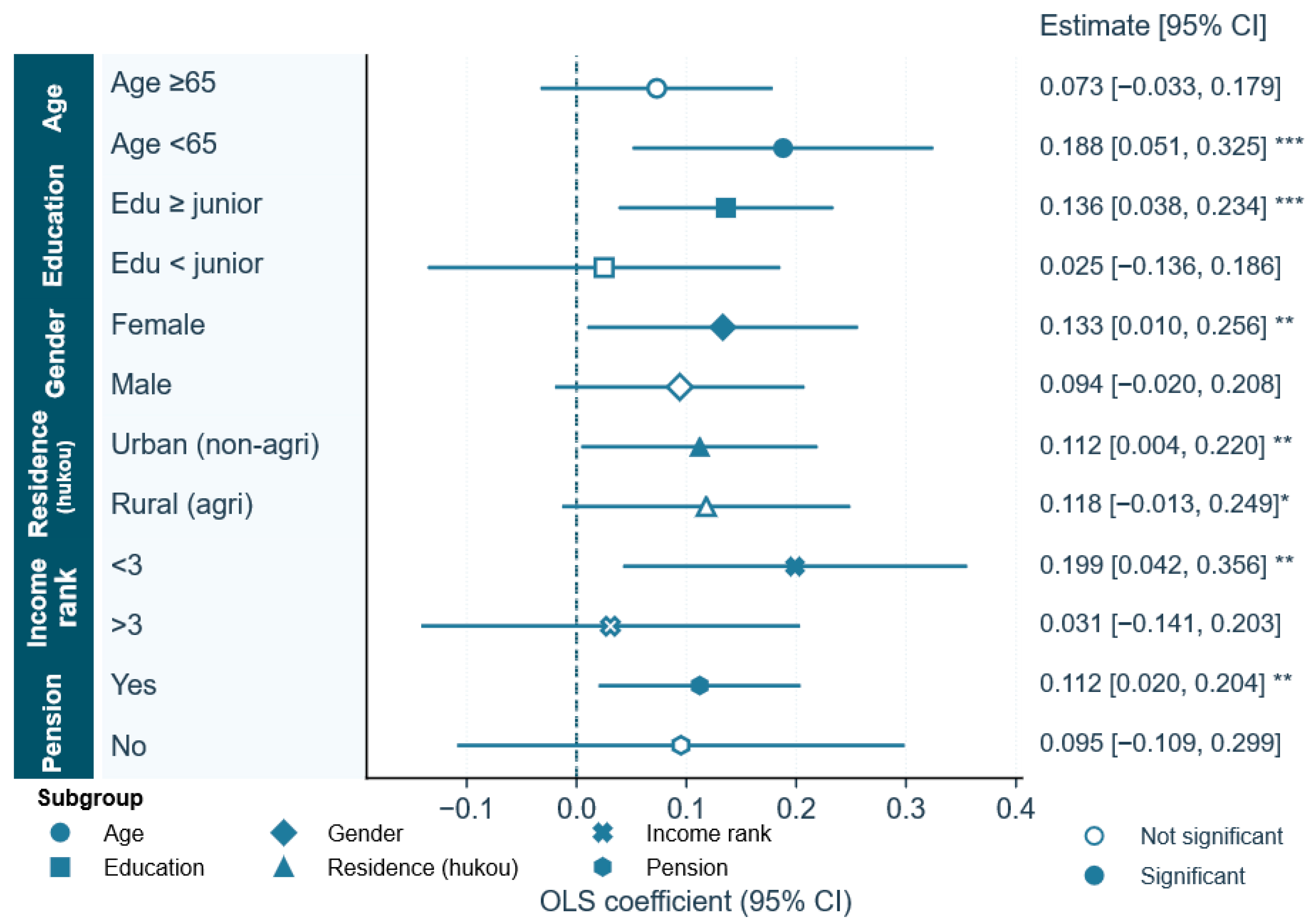
2.4. Theoretical Framework
3. Methods
3.1. Data and Sample
3.2. Measurement of Key Variables
3.2.1. Dependent Variable: Trust Vulnerability
3.2.2. Independent Variable: Digital Literacy
3.2.3. Mediators
3.2.4. Control Variables
3.3. Empirical Models
4. Results
4.1. Descriptive Statistics and Baseline Patterns
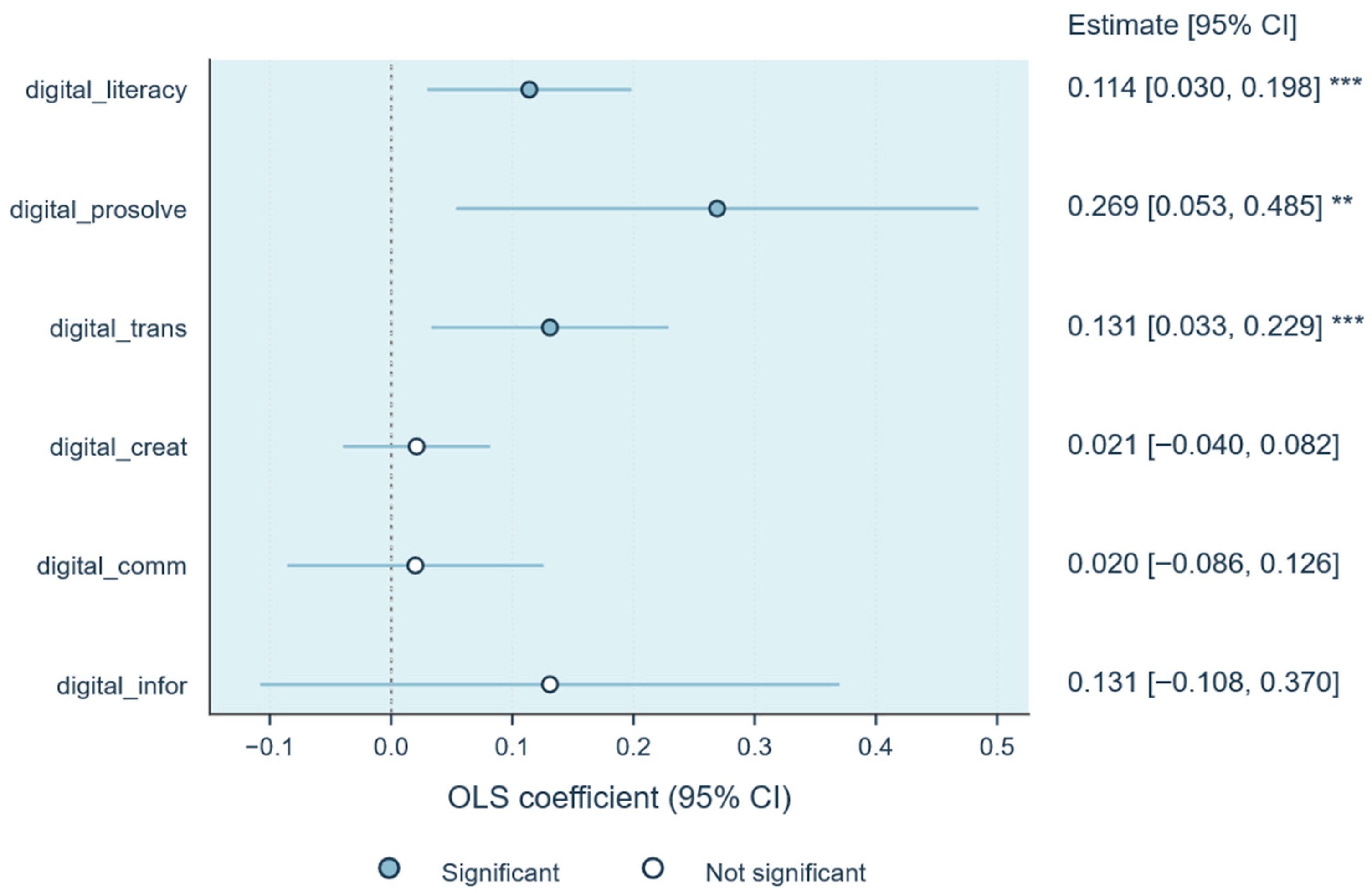
4.2. Direct Associations of Digital Literacy
4.3. Mediation Analysis
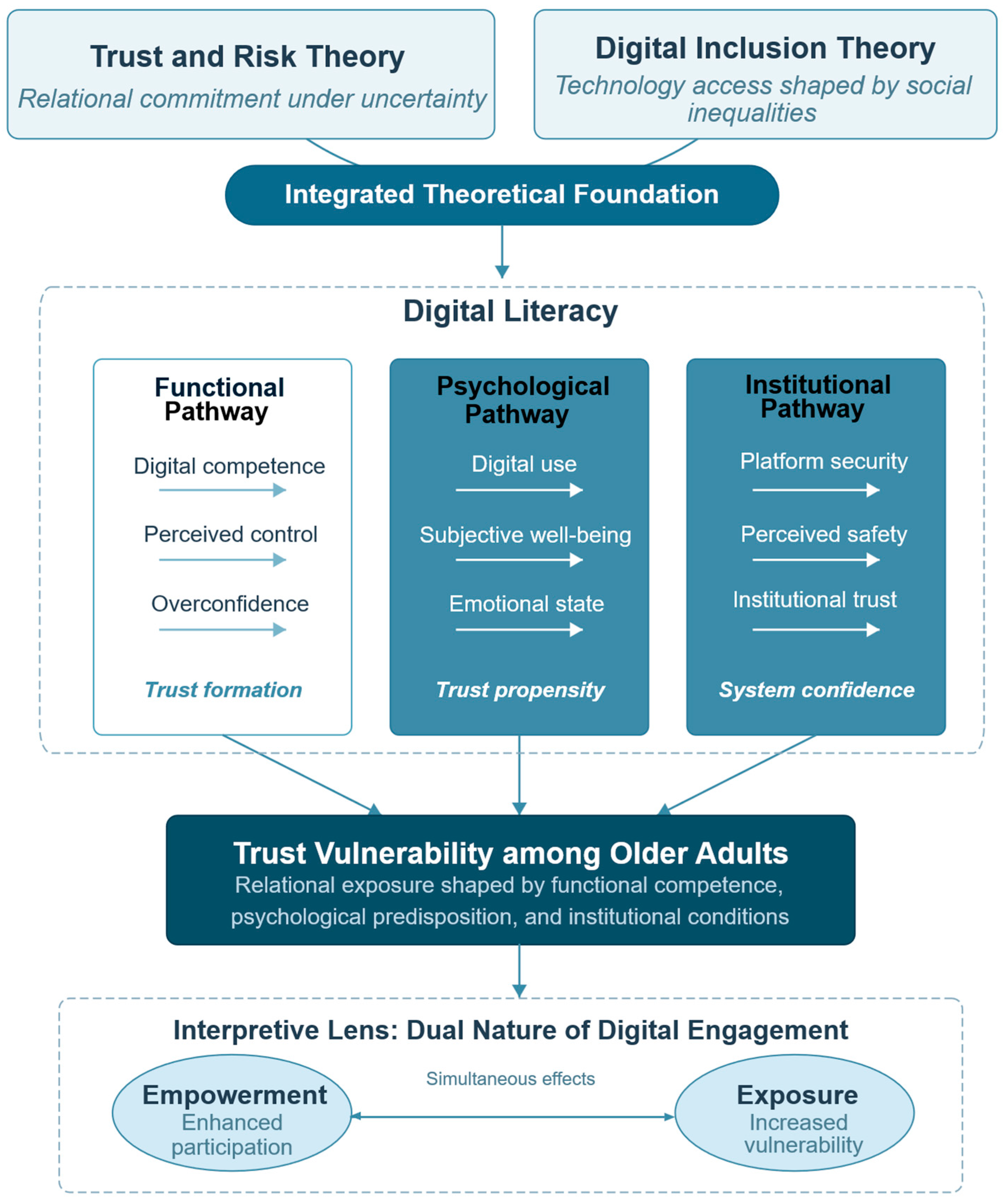
4.4. Heterogeneity Analysis
5. Discussion
5.1. Reinterpreting the Competence–Risk Paradox
5.2. Functional Versus Psychological Pathways
5.3. Policy Implications
5.4. Limitations and Directions for Future Research
6. Conclusions
Author Contributions
Funding
Institutional Review Board Statement
Informed Consent Statement
Data Availability Statement
Acknowledgments
Conflicts of Interest
Abbreviation
| CFPS | China Family Panel Studies |
Appendix A

| Variable Type | Variable Name (CFPS Code) | Definition | Measurement and Coding Description |
|---|---|---|---|
| Dependent variable | trust_strangers (QN10024) | Trust in strangers, measured on a 0–10 scale where higher scores indicate stronger trust and thus greater trust vulnerability. | QN10024 asks, “How much do you trust strangers?” (0 = cannot be trusted at all, 10 = can be fully trusted). Used as a proxy for trust vulnerability. |
| Independent variables (Digital literacy dimensions) | digital_infor (U93/U931; U94/U941) | Information and data literacy: frequency of short-video viewing and online learning. | U93, U931; U94, U941. Each daily activity = 1, otherwise = 0, summed to form a 0–2 index. Higher scores denote broader and more frequent information engagement. |
| digital_comm (QN953) | Communication and collaboration: perceived importance of the Internet for maintaining contact with family and friends. | QN953 rated on a 1–5 scale (1 = not important, 5 = very important). Higher values indicate stronger reliance on digital communication. | |
| digital_creat (U111) | Digital content creation: frequency of posting or sharing on WeChat Moments. | U111 records frequency of posting on WeChat Moments. Higher values indicate greater frequency of content creation. | |
| digital_trans (U1201–U1205) | Digital transactions: proficiency in using mobile payment platforms such as WeChat Pay and Alipay. | U1201–U1205 measure use and weekly frequency of payments. The mean of frequency items (U1204–U1205) forms a 1–5 scale where higher values denote greater transactional fluency. | |
| digital_prosolve (U92/U921) | Problem-solving competence: ability to use the Internet to address practical needs. | U92 (online shopping) and U921 (daily online shopping). Each daily activity = 1, otherwise = 0; summed to 0–2 index. | |
| digital_literacy (composite index) | Overall digital literacy level, integrating the five dimensions above. | Standardised dimension scores combined using principal component analysis (PCA); the first component retained as the composite digital literacy index. | |
| Mediators | SW (PCA composite) | Subjective well-being and perceived safety index. | Constructed using QM2016 (happiness, 0–10), QN12012 (life satisfaction, 1–5), QN12016 (confidence in the future, 1–5), QM3N (life meaning, 0–10), and CES-D items (QN406–QN420, reverse-coded where appropriate). All standardised and aggregated using PCA. |
| plant_security (U12071/U12072) | Perceived platform security: confidence in financial safety and data protection of mobile payment systems. | Mean of U12071 (“fund safety”) and reverse-coded U12072 (“concern about information leakage”). Higher scores indicate stronger perceived platform security. | |
| Control variables | male (QA002) | Gender. | 1 = male, 0 = female. |
| age | Age in years. | Continuous variable. | |
| hukou_rural (QA301) | Rural hukou registration. | 1 = rural, 0 = non-rural. | |
| edu (KW01) | Years of schooling. | Converted from highest educational attainment. | |
| income_rank (QN8011) | Self-rated income position. | QN8011: 1 = very low … 5 = very high. | |
| pension_insured(QI200/QI2001) | Pension coverage. | 1 = receives retirement benefits or pension insurance, 0 = none. |
| trust_vulnerability | digital_infor | digital_comm | digital_creat | digi-tal_prosolve | digital_literacy | gender | age | ruralhukou | edu | incomerank | pension_insured | |
|---|---|---|---|---|---|---|---|---|---|---|---|---|
| trust_vulnerability | 1.000 | |||||||||||
| digital_infor | −0.003 | 1.000 | ||||||||||
| digital_comm | −0.035 | 0.077 *** | 1.000 | |||||||||
| digital_creat | 0.089 *** | 0.117 *** | 0.073 *** | 1.000 | ||||||||
| digi-tal_prosolve | 0.101 *** | 0.173 *** | 0.099 *** | 0.267 *** | 1.000 | |||||||
| digital_literacy | 0.077 *** | 0.561 *** | 0.422 *** | 0.663 *** | 0.633 *** | 1.000 | ||||||
| gender | 0.148 *** | −0.027 | −0.051** | 0.076 *** | −0.016 | 0.007 | 1.000 | |||||
| age | 0.073 *** | −0.144 *** | −0.117 *** | 0.024 | −0.058 ** | −0.103 *** | 0.057 ** | 1.000 | ||||
| ruralhukou | −0.121 *** | 0.092 *** | 0.000 | −0.243 *** | −0.266 *** | −0.190 *** | 0.014 | −0.174 *** | 1.000 | |||
| edu | 0.123 *** | 0.013 | 0.057 ** | 0.256 *** | 0.298 *** | 0.269 *** | 0.172 *** | −0.134 *** | −0.405 *** | 1.000 | ||
| incomerank | 0.133 *** | −0.010 | 0.051 ** | 0.034 | −0.018 | 0.034 | 0.061 ** | 0.037 | 0.017 | 0.001 | 1.000 | |
| pension_insured | 0.078 *** | −0.033 | −0.028 | 0.123 *** | 0.106 *** | 0.085 *** | 0.001 | 0.234 *** | −0.246 *** | 0.137 *** | 0.060 ** | 1.000 |
| Variables | Trust_strangers |
|---|---|
| digital_literacy_mean | 0.076 * |
| (0.040) | |
| gender | 0.266 *** |
| (0.052) | |
| age | 0.013 *** |
| (0.005) | |
| ruralhukou | −0.155 *** |
| (0.058) | |
| edu | 0.011 * |
| (0.007) | |
| incomerank | 0.117 *** |
| (0.025) | |
| pension_insured | 0.083 |
| (0.066) | |
| Constant | −1.577 *** |
| (0.349) | |
| Observations | 1559 |
| R-squared | 0.063 |
| Subgroup Dimension | Variable | Group 1 (β (SE)) | Group 2 (β (SE)) |
|---|---|---|---|
| Gender (Male/Female) | digital_infor | −0.009 (0.160) | 0.327 * (0.186) |
| digital_trans | 0.142 ** (0.067) | 0.112 (0.075) | |
| digital_probsovle | 0.324 ** (0.153) | 0.179 (0.158) | |
| digital_literacy | 0.094 (0.058) | 0.133 ** (0.063) | |
| Age (≥65/<65) | digital_trans | 0.065 (0.066) | 0.235 *** (0.076) |
| digital_probsovle | 0.125 (0.146) | 0.461 *** (0.167) | |
| digital_literacy | 0.073 (0.054) | 0.188 *** (0.070) | |
| Hukou (Rural/Non-rural) | digital_trans | 0.104 (0.074) | 0.151 ** (0.068) |
| digital_probsovle | 0.325 * (0.182) | 0.233 * (0.137) | |
| digital_literacy | 0.118 * (0.067) | 0.112 ** (0.055) | |
| Education (≥Junior/<Junior) | digital_trans | 0.122 ** (0.058) | 0.132 (0.098) |
| digital_probsovle | 0.343 *** (0.124) | −0.178 (0.236) | |
| digital_literacy | 0.136 *** (0.050) | 0.025 (0.082) | |
| Income rank (<3/>3) | digital_trans | 0.250 *** (0.091) | −0.019 (0.097) |
| digital_probsovle | 0.428 ** (0.204) | −0.025 (0.247) | |
| digital_literacy | 0.199 ** (0.080) | 0.031 (0.088) | |
| Pension coverage (Yes/No) | digital_trans | 0.152 *** (0.055) | −0.001 (0.119) |
| digital_probsovle | 0.203 * (0.120) | 0.632 ** (0.262) | |
| digital_literacy | 0.112 ** (0.047) | 0.095 (0.104) |
References
- Aleti, T., Figueiredo, B., Reid, M., Martin, D. M., Sheahan, J., & Hjorth, L. (2025). Older adults’ digital competency, digital risk perceptions and frequency of everyday digital engagement. Information Technology & People, 38(8), 97–118. [Google Scholar] [CrossRef]
- Aly, H., Liu, Y., Khan, S., Anaraky, R. G., Byrne, K., & Knijnenburg, B. (2025). Digital privacy education: Customized interventions for U.S. older and younger adults in rural and urban settings. Technology in Society, 81, 102805. [Google Scholar] [CrossRef]
- Beck, U. (1992). Risk society: Towards a new modernity (M. Ritter, Trans.). Sage. [Google Scholar]
- Brashier, N., & Schacter, D. (2020). Aging in an era of fake news. Current Directions in Psychological Science, 29(3), 316–323. [Google Scholar] [CrossRef]
- Büchi, M., Just, N., & Latzer, M. (2017). Caring is not enough: The importance of internet skills for online privacy protection. Information, Communication & Society, 20(8), 1261–1278. [Google Scholar] [CrossRef]
- Carrasco-Dajer, C. M., Vera-Calzaretta, A. R., Ubillos-Landa, S., Oyanedel, J. C., & Díaz-Gorriti, V. (2024). Impact of a culturally adapted digital literacy intervention on older people and its relationship with health literacy, quality of life, and well-being. Frontiers in Psychology, 15, 1305569. [Google Scholar] [CrossRef]
- Chen, G. (2025). Toward a cooperative social world: An integrative study of international institutional trust. Cross-Cultural Research, 59(5), 579–614. [Google Scholar] [CrossRef]
- Cheng, X., Ge, T., & Cosco, T. D. (2024). Internet use and life satisfaction among chinese older adults: The mediating effects of social interaction. Current Psychology, 43(1), 717–724. [Google Scholar] [CrossRef] [PubMed]
- China Internet Network Information Center (CNNIC). (2025). The 56th statistical report on China’s internet development. Available online: https://cn.chinadaily.com.cn/a/202507/21/WS687deb03a310028a84abee5d.html (accessed on 25 December 2025).
- Choung, Y., Chatterjee, S., & Pak, T.-Y. (2023). Digital financial literacy and financial well-being. Finance Research Letters, 58, 104438. [Google Scholar] [CrossRef]
- Clohessy, S., Kempton, C., Ryan, K., Grinbergs, P., & Elliott, M. (2024). Exploring older adults’ perceptions of using digital health platforms for self-managing musculoskeletal health conditions: Focus group study. JMIR Aging, 7, e55693. [Google Scholar] [CrossRef] [PubMed]
- Cosgrove, J., & Cachia, R. (2025). DigComp 3.0: European digital competence framework. Publications Office of the European Union. [Google Scholar] [CrossRef]
- Dai, Y., Huang, Y.-H. C., Jia, W., & Cai, Q. (2022). The paradoxical effects of institutional trust on risk perception and risk management in the COVID-19 pandemic: Evidence from three societies. Journal of Risk Research, 25(11–12), 1337–1355. [Google Scholar] [CrossRef]
- Diener, E., Emmons, R. A., Larsen, R. J., & Griffin, S. (1985). The satisfaction with life scale. Journal of Personality Assessment, 49(1), 71–75. [Google Scholar] [CrossRef]
- Ding, Y., & Zhang, J. (2025). Does digital literacy affect the happiness of rural residents? Evidence from China. Frontiers in Psychology, 16, 1647907. [Google Scholar] [CrossRef] [PubMed]
- Ebner, N. C., Pehlivanoglu, D., & Shoenfelt, A. (2023). Financial fraud and deception in aging. Advances in Geriatric Medicine and Research, 5(3), e230007. [Google Scholar] [CrossRef] [PubMed]
- Glatz, C., & Schwerdtfeger, A. (2022). Disentangling the causal structure between social trust, institutional trust, and subjective well-being. Social Indicators Research, 163(3), 1323–1348. [Google Scholar] [CrossRef]
- Hadler, M., Vrečar, B., & Schaffer, R. (2025). Generalized trust as a foundation for online trust: Findings from Austria, greece, poland, the Philippines, and South Africa. Frontiers in Sociology, 10, 1504812. [Google Scholar] [CrossRef]
- Havers, B., Tripathi, K., Burton, A., McManus, S., & Cooper, C. (2024). Cybercrime victimisation among older adults: A probability sample survey in England and Wales. PLoS ONE, 19(12), e0314380. [Google Scholar] [CrossRef]
- Helsper, E. J. (2012). A corresponding fields model for the links between social and digital exclusion. Communication Theory, 22(4), 403–426. [Google Scholar] [CrossRef]
- Ho, S. M., & Hollister, J. M. (2013). Guess who? An empirical study of gender deception and detection in computer-mediated communication. Proceedings of the American Society for Information Science & Technology, 50(1), 1–4. [Google Scholar] [CrossRef]
- Hofer, M., Hargittai, E., Büchi, M., & Seifert, A. (2019). Older adults’ online information seeking and subjective well-being: The moderating role of internet skills. International Journal of Communication, 13, 18. [Google Scholar]
- Hu, M., Li, X., Li, M., Zhu, R., & Si, B. (2023). A framework for analyzing fraud risk warning and interference effects by fusing multivariate heterogeneous data: A bayesian belief network. Entropy, 25(6), 892. [Google Scholar] [CrossRef]
- International Social Survey Programme (ISSP). (2023). ISSP 2024 Digital societies: Source questionnaire. Available online: https://issp.org/wp-content/uploads/2023/12/ISSP2024_final-source-questionnaire.pdf (accessed on 25 December 2025).
- Ji, H., Dong, J., Pan, W., & Yu, Y. (2024). Associations between digital literacy, health literacy, and digital health behaviors among rural residents: Evidence from zhejiang, china. International Journal for Equity in Health, 23(1), 68. [Google Scholar] [CrossRef]
- Jones, H. S., & Moncur, W. (2018). The role of psychology in understanding online trust. In Psychological and behavioral examinations in cyber security. IGI Global. [Google Scholar] [CrossRef]
- Jumrana, C. I., & Ibrahim, C. (2023). Elderly digital resilience in responding to online fraud. In SSIK 2023: Proceedings of the regional seminar on community issues, SSIK 2023, Kendari, Province of Sulawesi Tenggara, Indonesia, September 20 (p. 137). European Alliance for Innovation. [Google Scholar]
- Kim, C., Tao, W., Shin, N., & Kim, K.-S. (2010). An empirical study of customers’ perceptions of security and trust in e-payment systems. Electronic Commerce Research and Applications, 9(1), 84–95. [Google Scholar] [CrossRef]
- Lazarus, S., Tickner, P., & McGuire, M. R. (2025). Cybercrime against senior citizens: Exploring ageism, ideal victimhood, and the pivotal role of socioeconomics. Security Journal, 38(1), 42. [Google Scholar] [CrossRef]
- Lee, H., Lim, J.-A., & Nam, H.-K. (2022). Effect of a digital literacy program on older adults’ digital social behavior: A quasi-experimental study. International Journal of Environmental Research and Public Health, 19(19), 12404. [Google Scholar] [CrossRef]
- Lee-Geiller, S. (2024). The moderating effect of digital literacy on the link between E-government effectiveness and trust in government (SSRN Scholarly Paper No. 4811022). Social Science Research Network. [Google Scholar] [CrossRef]
- Li, J., & Zhou, X. (2021). Internet use and Chinese older adults’ subjective well-being (SWB): The role of parent-child contact and relationship. Computers in Human Behavior, 119, 106725. [Google Scholar] [CrossRef]
- Li, S. (2025). Digital literacy and farmers’ non-farm employment-an empirical study based on CFPS. Sustainable Futures, 10, 100999. [Google Scholar] [CrossRef]
- Li, Y., Cao, Y., Wu, Y., & Mi, H. (2024). Risk factors for financial fraud among older chinese: An analysis based on charls data. Innovation in Aging, 8(Suppl. 1), 429–430. [Google Scholar] [CrossRef]
- Lin, X., & Wang, X. (2020). Examining gender differences in people’s information-sharing decisions on social networking sites. International Journal of Information Management, 50, 45–56. [Google Scholar] [CrossRef]
- Liu, N., Yin, J., Tan, S. S.-L., Ngiam, K. Y., & Teo, H. H. (2021). Mobile health applications for older adults: A systematic review of interface and persuasive feature design. Journal of the American Medical Informatics Association, 28(11), 2483–2501. [Google Scholar] [CrossRef]
- Livingstone, S., Mascheroni, G., & Stoilova, M. (2023). The outcomes of gaining digital skills for young people’s lives and wellbeing: A systematic evidence review. New Media & Society, 25(5), 1176–1202. [Google Scholar] [CrossRef]
- Lu, S. Y., Yoon, S., Yee, W. Q., Ngiam, N. H. W., Ng, K. Y. Y., & Low, L. L. (2024). Experiences of a community-based digital intervention among older people living in a low-income neighborhood: Qualitative study. JMIR Aging, 7(1), e52292. [Google Scholar] [CrossRef]
- Lucassen, T., & Schraagen, J. M. (2013). The influence of source cues and topic familiarity on credibility evaluation. Computers in Human Behavior, 29(4), 1387–1392. [Google Scholar] [CrossRef]
- Luhmann, N. (2018). Trust and power. John Wiley & Sons. [Google Scholar]
- Martinez, E. L., Jun, J. S., Rack, M., Biehler, S., Guo, X., & Chang, S. I. (2025). Perceptions on financial exploitation and technology-based solutions among older adults. Journal of Elder Abuse & Neglect, 37(5), 444–453. [Google Scholar] [CrossRef] [PubMed]
- Mattar, J., Ramos, D. K., & Lucas, M. R. (2022). DigComp-based digital competence assessment tools: Literature review and instrument analysis. Education and Information Technologies, 27(8), 10843–10867. [Google Scholar] [CrossRef]
- Mayer, R. C., Davis, J. H., & Schoorman, F. D. (1995). An integrative model of organizational trust. Academy of Management Review, 20(3), 709–734. [Google Scholar] [CrossRef]
- Moran, N. (2020). Illusion of safety: How consumers underestimate manipulation and deception in online (vs. offline) shopping contexts. Journal of Consumer Affairs, 54(3), 890–911. [Google Scholar] [CrossRef]
- Murayama, H., & Takase, M. (2025). Evaluating the effectiveness of digital social robots in reducing loneliness among community-dwelling older adults in Japan: Randomized controlled trial and qualitative analysis. JMIR Aging, 8, e74422. [Google Scholar] [CrossRef]
- National Bureau of Statistics of China. (2025). Statistical communiqué of the people’s republic of China on the 2024 national economic and social development [statistical communiqué]. Available online: https://www.stats.gov.cn/sj/zxfb/202502/t20250228_1958817.html (accessed on 25 December 2025).
- Nguyen, T. Q., Ngoc, P. T. A., Phuong, H. A., Duy, D. P. T., Hiep, P. C., McClelland, R., & Noroozi, O. (2024). Digital competence of vietnamese citizens: An application of digcomp framework and the role of individual factors. Education and Information Technologies, 29(15), 19267–19298. [Google Scholar] [CrossRef]
- Niu, H., Zhu, H., Sun, Y., Lu, X., Sun, J., Zhao, Z., Xiong, H., & Lang, B. (2022). Exploring the risky travel area and behavior of car-hailing service. ACM Transactions on Intelligent Systems and Technology, 13(1), 1–22. [Google Scholar] [CrossRef]
- Organisation for Economic Co-Operation and Development. (2023). OECD digital education outlook 2023: Towards an effective digital education ecosystem. Organisation for Economic Co-Operation and Development. [Google Scholar] [CrossRef]
- Palmisano, F., & Sacchi, A. (2024). Trust in public institutions, inequality, and digital interaction: Empirical evidence from european union countries. Journal of Macroeconomics, 79, 103582. [Google Scholar] [CrossRef]
- Park, Y. J. (2011). Digital literacy and privacy behavior online. Communication Research, 40(2), 215–236. [Google Scholar] [CrossRef]
- Pehlivanoglu, D., Shoenfelt, A., Hakim, Z., Heemskerk, A., Zhen, J., Mosqueda, M., Wilson, R. C., Huentelman, M., Grilli, M. D., Turner, G., Spreng, R. N., & Ebner, N. C. (2024). Phishing vulnerability compounded by older age, apolipoprotein E e4 genotype, and lower cognition. PNAS Nexus, 3(8), pgae296. [Google Scholar] [CrossRef]
- Pérez-Escolar, M., & Canet, F. (2023). Research on vulnerable people and digital inclusion: Toward a consolidated taxonomical framework. Universal Access in the Information Society, 22(3), 1059–1072. [Google Scholar] [CrossRef] [PubMed]
- Porumbescu, G. A. (2016). Linking public sector social media and e-government website use to trust in government. Government Information Quarterly, 33(2), 291–304. [Google Scholar] [CrossRef]
- Ragnedda, M., Ruiu, M. L., & Addeo, F. (2022). The self-reinforcing effect of digital and social exclusion: The inequality loop. Telematics and Informatics, 72, 101852. [Google Scholar] [CrossRef]
- Rau, M. A., & Premo, A. E. (2025). Systematic review of educational approaches to misinformation. Educational Psychology Review, 37(2), 43. [Google Scholar] [CrossRef]
- Rodríguez-Miranda, F. d. P., Illanes-Segura, R., Ceada-Garrido, Y., & Infante-Moro, J. C. (2025). Validation of a scale based on the DigComp framework on internet navigation and cybersecurity in older adults. Frontiers in Education, 10, 1520929. [Google Scholar] [CrossRef]
- Rossi, A., Carli, R., Botes, M. W., Fernandez, A., Sergeeva, A., & Sánchez Chamorro, L. (2024). Who is vulnerable to deceptive design patterns? A transdisciplinary perspective on the multi-dimensional nature of digital vulnerability1. Computer Law & Security Review, 55, 106031. [Google Scholar] [CrossRef]
- Schirmer, W., Geerts, N., Vercruyssen, A., & Glorieux, I. (2022). Digital skills training for older people: The importance of the ‘lifeworld’. Archives of Gerontology and Geriatrics, 101, 104695. [Google Scholar] [CrossRef]
- Singh, N., Misra, R., Quan, W., Radic, A., Lee, S.-M., & Han, H. (2024). An analysis of consumer’s trusting beliefs towards the use of e-commerce platforms. Humanities and Social Sciences Communications, 11(1), 899. [Google Scholar] [CrossRef]
- Soundararajan, A., Lim, J. X., Ngiam, N. H. W., Tey, A. J.-Y., Tang, A. K. W., Lim, H. A., Yow, K. S., Cheng, L. J., Ho, J., Teo, Q. X. N., Yee, W. Q., Yoon, S., Low, L. L., & Ng, K. Y. Y. (2023). Smartphone ownership, digital literacy, and the mediating role of social connectedness and loneliness in improving the wellbeing of community-dwelling older adults of low socio-economic status in Singapore. PLoS ONE, 18(8), e0290557. [Google Scholar] [CrossRef]
- Sundberg, L. (2024). Towards the digital risk society: A review. Human Affairs, 34(1), 151–164. [Google Scholar] [CrossRef]
- Sur, A., DeLiema, M., Vock, D., Boyle, P., & Yu, L. (2023). A microsimulation of well-being and literacy interventions to reduce scam susceptibility in older adults. Journal of Applied Gerontology, 42(12), 2360–2370. [Google Scholar] [CrossRef]
- Szerszynski, B. (1999). Risk and trust: The performative Dimension1. Environmental Values, 8(2), 239–252. [Google Scholar] [CrossRef]
- Thomson, R., Yuki, M., & Ito, N. (2015). A socio-ecological approach to national differences in online privacy concern: The role of relational mobility and trust. Computers in Human Behavior, 51, 285–292. [Google Scholar] [CrossRef]
- Tinmaz, H., Lee, Y.-T., Fanea-Ivanovici, M., & Baber, H. (2022). A systematic review on digital literacy. Smart Learning Environments, 9(1), 21. [Google Scholar] [CrossRef] [PubMed]
- United Nations Development Programme. (2024). From access to empowerment: Digital inclusion in a dynamic world. Available online: https://www.undp.org/policy-centre/singapore/publications/access-empowerment-digital-inclusion-dynamic-world (accessed on 25 December 2025).
- Warner-Søderholm, G., Bertsch, A., Sawe, E., Lee, D., Wolfe, T., Meyer, J., Engel, J., & Fatilua, U. N. (2018). Who trusts social media? Computers in Human Behavior, 81, 303–315. [Google Scholar] [CrossRef]
- Xin, Y., Weina, H., & Yan, D. (2025). Digital literacy impacts quality of life among older adults through hierarchical mediating mechanisms. Scientific Reports, 15(1), 19288. [Google Scholar] [CrossRef]
- Yan, Y., Deng, Y., Igartua, J. J., & Song, X. (2023). Does internet use promote subjective well-being? Evidence from the different age groups based on CGSS 2017 data. International Journal of Environmental Research and Public Health, 20(4), 2897. [Google Scholar] [CrossRef]
- Zhang, Q., & Awaworyi Churchill, S. (2020). Income inequality and subjective wellbeing: Panel data evidence from China. China Economic Review, 60, 101392. [Google Scholar] [CrossRef]
- Zhang, R. J. (2020). Social trust and satisfaction with life: A cross-lagged panel analysis based on representative samples from 18 societies. Social Science & Medicine, 251, 112901. [Google Scholar] [CrossRef] [PubMed]
- Zheng, J., & Zhang, T. (2023). The effects of the internet on well-being among older adults ageing in place: The roles of subjective income and social trust. China Perspectives, (134), 43–55. [Google Scholar] [CrossRef]
- Zhou, D., Li, Y., & Tirasawasdichai, T. (2022). Do online social interactions cultivate social capital? Evidence from a longitudinal study. Frontiers in Psychology, 13, 989137. [Google Scholar] [CrossRef]
- Zimba, A., Phiri, K., Kashale, C., & Phiri, M. (2025). Unveiling deception: A socio-economic analysis of smishing attacks on mobile money transaction users. Humanities & Social Sciences Communications, 12(1), 1880. [Google Scholar] [CrossRef]


| Variables | N | Mean | SD | Median | Min | Max |
|---|---|---|---|---|---|---|
| trust_vulnerability | 1583 | 2.414 | 2.302 | 2 | 0 | 10 |
| digital_infor | 1583 | 0.75 | 0.482 | 1 | 0 | 2 |
| digital_comm | 1583 | 4.247 | 1.065 | 5 | 1 | 5 |
| digital_creat | 1583 | 1.459 | 1.967 | 0 | 0 | 6 |
| digital_trans | 1583 | 1.374 | 1.256 | 0 | 0 | 5 |
| digital_prosolve | 1583 | 0.345 | 0.539 | 0 | 0 | 2 |
| digital_literacy | 1583 | −1.174 | 1.43 | −1.343 | −4.078 | 3.512 |
| wellbeing | 1583 | 7.678 | 1.993 | 8 | 0 | 10 |
| satisfaction | 1578 | 4.162 | 0.821 | 4 | 1 | 5 |
| futureconf_e | 1578 | 4.153 | 0.896 | 4 | 1 | 5 |
| lifemeaning | 1580 | 7.622 | 2.002 | 8 | 0 | 10 |
| cespca | 1568 | 0.226 | 1.795 | 0.608 | −8.258 | 2.304 |
| sw | 1564 | 0.237 | 1.616 | 0.391 | −6.526 | 2.582 |
| plantform_security | 1342 | 3.098 | 0.829 | 3 | 1 | 5 |
| male | 1583 | 0.557 | 0.497 | 1 | 0 | 1 |
| age | 1583 | 66.637 | 5.321 | 66 | 60 | 88 |
| hukourural | 1582 | 0.496 | 0.5 | 0 | 0 | 1 |
| edu | 1583 | 8.373 | 4.422 | 9 | 0 | 19 |
| income | 1583 | 3220.666 | 5515.653 | 2316.667 | 0 | 112,000 |
| income_rank | 1562 | 3.027 | 1.046 | 3 | 1 | 5 |
| pension_insured | 1580 | 0.812 | 0.391 | 1 | 0 | 1 |
| Variables | (1) | (2) | (3) | (4) | (5) | (6) | (7) | (8) | (9) | (10) | (11) | (12) |
|---|---|---|---|---|---|---|---|---|---|---|---|---|
| Trust Vulnerability No Controls | Trust Vulnerability + Controls | Trust Vulnerability No Controls | Trust Vulnerability + Controls | Trust Vulnerability No Controls | Trust Vulnerability + Controls | Trust Vulnerability No Controls | Trust Vulnerability + Controls | Trust Vulnerability No Controls | Trust Vulnerability + Controls | Trust Vulnerability No Controls | Trust Vulnerability + Controls | |
| digital_infor | 0.035 | 0.131 | ||||||||||
| (0.123) | (0.122) | |||||||||||
| digital_comm | 0.030 | 0.020 | ||||||||||
| (0.053) | (0.054) | |||||||||||
| digital_creat | 0.089 *** | 0.021 | ||||||||||
| (0.030) | (0.031) | |||||||||||
| digital_trans | 0.183 *** | 0.131 *** | ||||||||||
| (0.046) | (0.050) | |||||||||||
| digital_prosolve | 0.379 *** | 0.269 ** | ||||||||||
| (0.104) | (0.110) | |||||||||||
| digital_literacy | 0.166 *** | 0.114 *** | ||||||||||
| (0.039) | (0.043) | |||||||||||
| male | 0.607 *** | 0.605 *** | 0.599 *** | 0.579 *** | 0.622 *** | 0.602 *** | ||||||
| (0.118) | (0.118) | (0.118) | (0.118) | (0.118) | (0.118) | |||||||
| age | 0.029 ** | 0.028 ** | 0.027 ** | 0.034 *** | 0.029 ** | 0.032 *** | ||||||
| (0.012) | (0.011) | (0.011) | (0.012) | (0.011) | (0.012) | |||||||
| hukourural | −0.369 *** | −0.357 *** | −0.348 ** | −0.301 ** | −0.311 ** | −0.308 ** | ||||||
| (0.137) | (0.137) | (0.138) | (0.138) | (0.138) | (0.137) | |||||||
| edu | 0.029 * | 0.029 * | 0.028 * | 0.020 | 0.023 | 0.020 | ||||||
| (0.015) | (0.015) | (0.015) | (0.015) | (0.015) | (0.015) | |||||||
| income | 0.000 | 0.000 | 0.000 | 0.000 | 0.000 | 0.000 | ||||||
| (0.000) | (0.000) | (0.000) | (0.000) | (0.000) | (0.000) | |||||||
| income_rank | 0.272 *** | 0.270 *** | 0.270 *** | 0.274 *** | 0.274 *** | 0.269 *** | ||||||
| (0.058) | (0.057) | (0.058) | (0.058) | (0.058) | (0.058) | |||||||
| pension_insured | 0.194 | 0.200 | 0.191 | 0.191 | 0.178 | 0.180 | ||||||
| (0.151) | (0.151) | (0.151) | (0.151) | (0.150) | (0.151) | |||||||
| constant | 2.388 *** | −1.022 | 2.285 *** | −0.939 | 2.285 *** | −0.817 | 2.162 *** | −1.356 * | 2.283 *** | −1.019 | 2.608 *** | −0.946 |
| (0.110) | (0.814) | (0.225) | (0.852) | (0.071) | (0.795) | (0.086) | (0.810) | (0.069) | (0.801) | (0.073) | (0.795) | |
| N | 1583 | 1558 | 1583 | 1558 | 1583 | 1558 | 1583 | 1558 | 1583 | 1558 | 1583 | 1558 |
| R_squared | 0.000 | 0.062 | 0.000 | 0.061 | 0.006 | 0.061 | 0.010 | 0.065 | 0.008 | 0.064 | 0.011 | 0.065 |
| Variables | (1) Trust Vulnerability | (2) Subjective Well-Being | (3) Trust Vulnerability | (4) Trust Vulnerability | (5) Platform Security | (6) Trust Vulnerability |
|---|---|---|---|---|---|---|
| Subjective well-being | 0.022 (0.036) | |||||
| Digital literacy index | 0.114 *** (0.043) | 0.054 * (0.028) | 0.115 *** (0.043) | 0.114 *** (0.043) | 0.129 *** (0.016) | 0.113 ** (0.047) |
| Platform security | 0.005 (0.083) | |||||
| Constant | −0.946 (0.795) | −1.528 *** (0.545) | −0.991 (0.798) | −0.946 (0.795) | 3.105 *** (0.321) | −1.252 (0.916) |
| Observations | 1558 | 1544 | 1544 | 1558 | 1324 | 1324 |
| R-squared | 0.065 | 0.138 | 0.067 | 0.065 | 0.052 | 0.067 |
| Controls | YES | YES | YES | YES | YES | YES |
| Block | Subgroup | β (SE) |
|---|---|---|
| Age | Age ≥ 65 | 0.073 (0.054) |
| Age < 65 | 0.188 *** (0.070) | |
| Education | Edu ≥ junior | 0.136 *** (0.050) |
| Edu < junior | 0.025 (0.082) | |
| Gender | Female | 0.133 ** (0.063) |
| Male | 0.094 (0.058) | |
| Residence (hukou) | Urban (non-agri) | 0.112 ** (0.055) |
| Rural (agri) | 0.118 * (0.067) | |
| Income rank | <3 | 0.199 ** (0.080) |
| >3 | 0.031 (0.088) | |
| Pension | Yes | 0.112 ** (0.047) |
| No | 0.095 (0.104) |
Disclaimer/Publisher’s Note: The statements, opinions and data contained in all publications are solely those of the individual author(s) and contributor(s) and not of MDPI and/or the editor(s). MDPI and/or the editor(s) disclaim responsibility for any injury to people or property resulting from any ideas, methods, instructions or products referred to in the content. |
© 2026 by the authors. Licensee MDPI, Basel, Switzerland. This article is an open access article distributed under the terms and conditions of the Creative Commons Attribution (CC BY) license.
Share and Cite
Gao, K.; Zhang, H.; Cheng, Z.; Tang, B. Empowerment or Exposure? Digital Literacy and the Vulnerabilities of Trust in Strangers Among Older Adults: Evidence from China. Behav. Sci. 2026, 16, 497. https://doi.org/10.3390/bs16040497
Gao K, Zhang H, Cheng Z, Tang B. Empowerment or Exposure? Digital Literacy and the Vulnerabilities of Trust in Strangers Among Older Adults: Evidence from China. Behavioral Sciences. 2026; 16(4):497. https://doi.org/10.3390/bs16040497
Chicago/Turabian StyleGao, Kaixuan, Hui Zhang, Zeming Cheng, and Bin Tang. 2026. "Empowerment or Exposure? Digital Literacy and the Vulnerabilities of Trust in Strangers Among Older Adults: Evidence from China" Behavioral Sciences 16, no. 4: 497. https://doi.org/10.3390/bs16040497
APA StyleGao, K., Zhang, H., Cheng, Z., & Tang, B. (2026). Empowerment or Exposure? Digital Literacy and the Vulnerabilities of Trust in Strangers Among Older Adults: Evidence from China. Behavioral Sciences, 16(4), 497. https://doi.org/10.3390/bs16040497