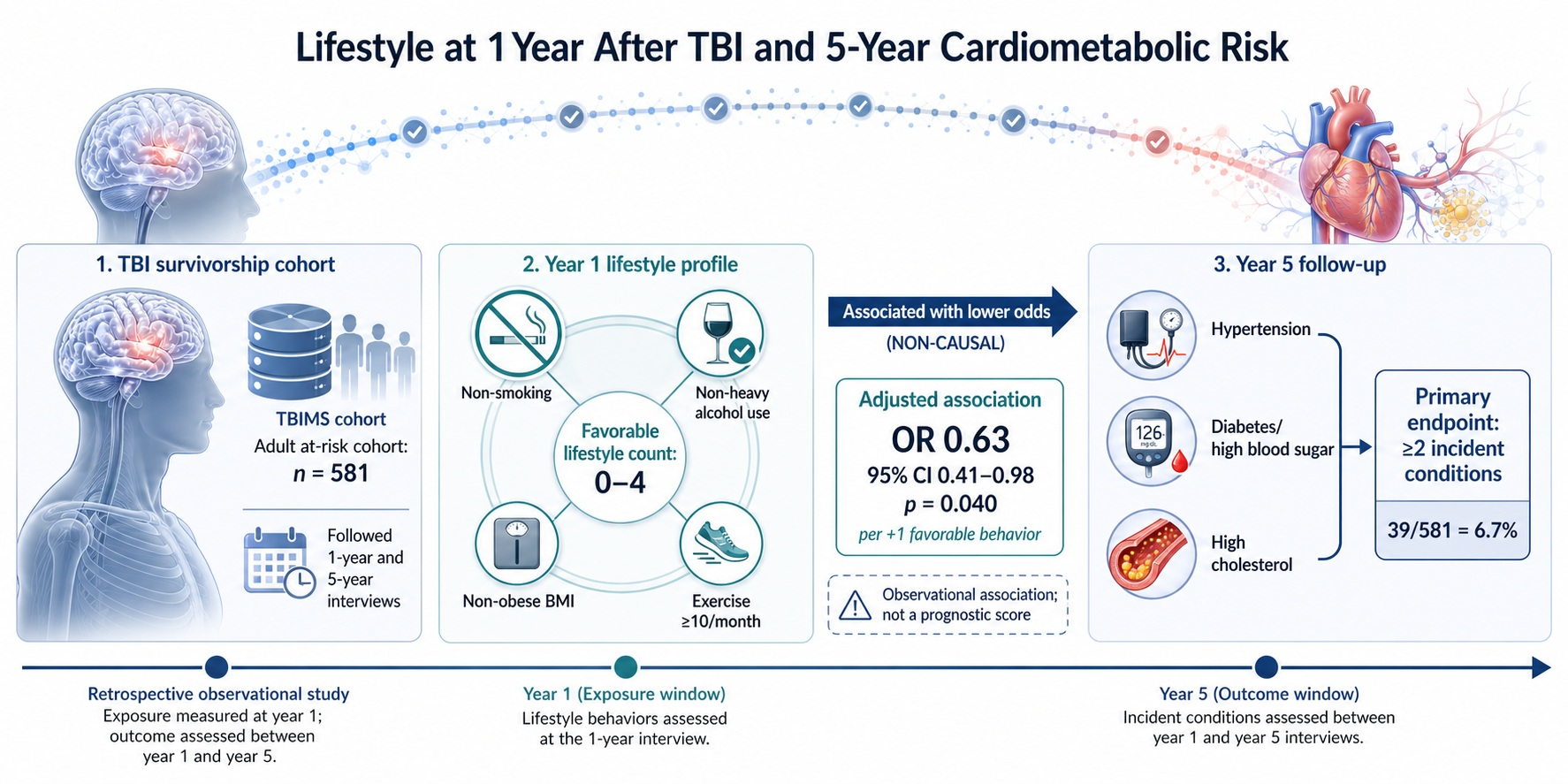

The First Year Matters: Lifestyle Behaviors and Five-Year Cardiometabolic Risk Factor Accumulation After Traumatic Brain Injury
 ,
,  ,
,  , ,
, , 
Abstract
1. Introduction
2. Materials and Methods
2.1. Study Design, Data Source, and Ethical Considerations
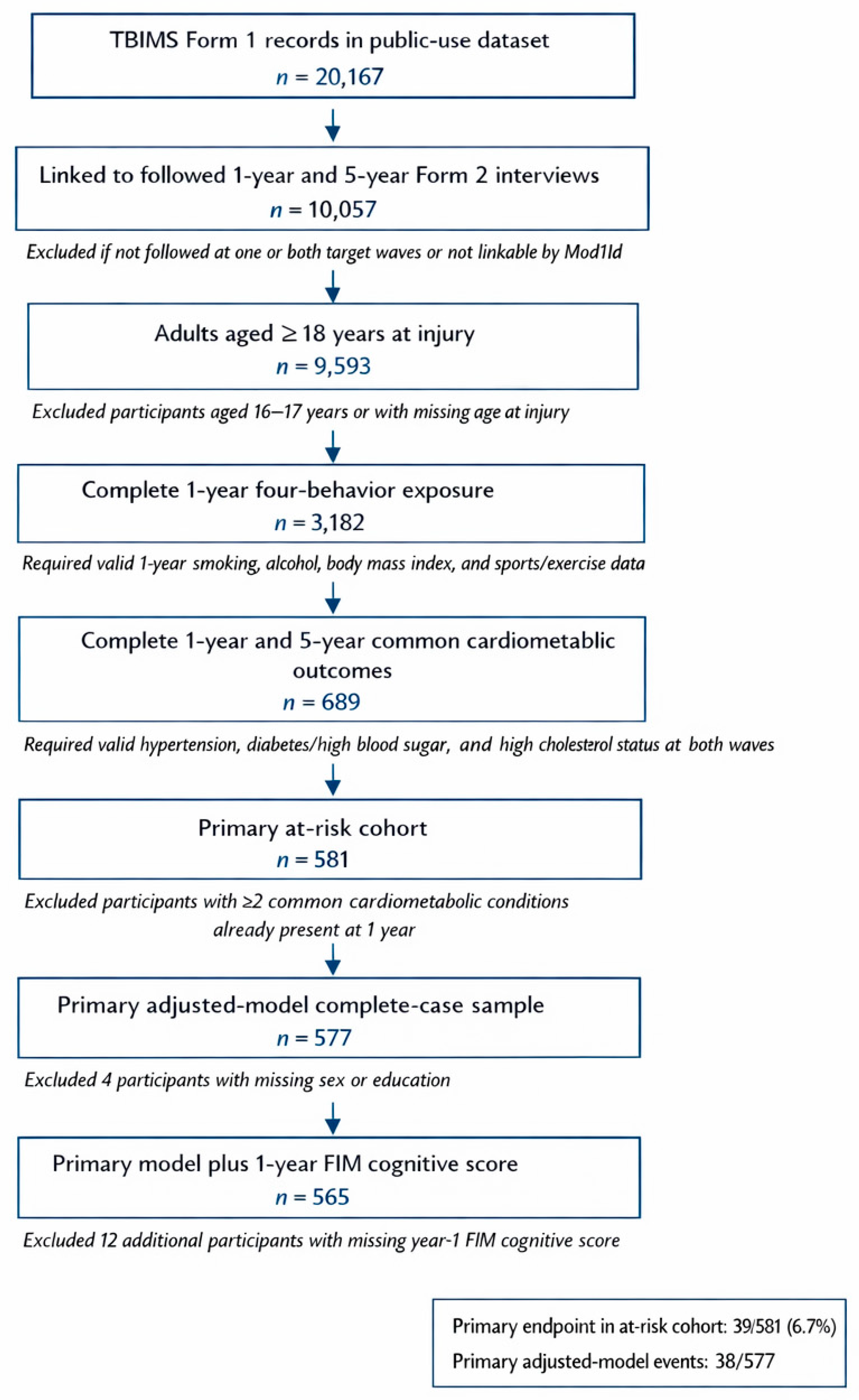
2.2. Eligibility Criteria and Cohort Construction
2.3. Outcome Definitions and Measures
2.4. Exposure Definitions
2.5. Covariates, TBI-Related Variables, and Data Handling
2.6. Statistical Analysis
3. Results
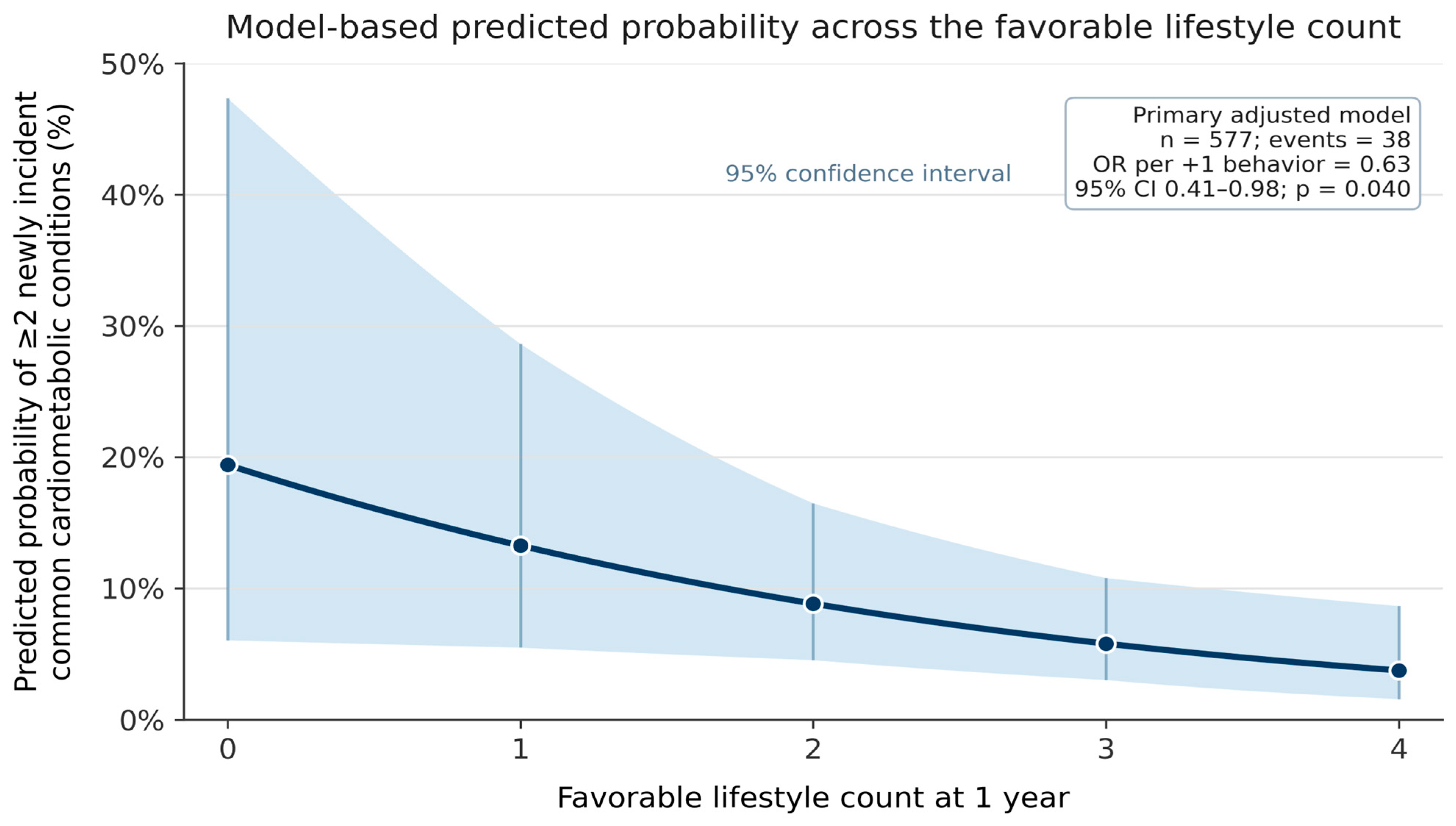
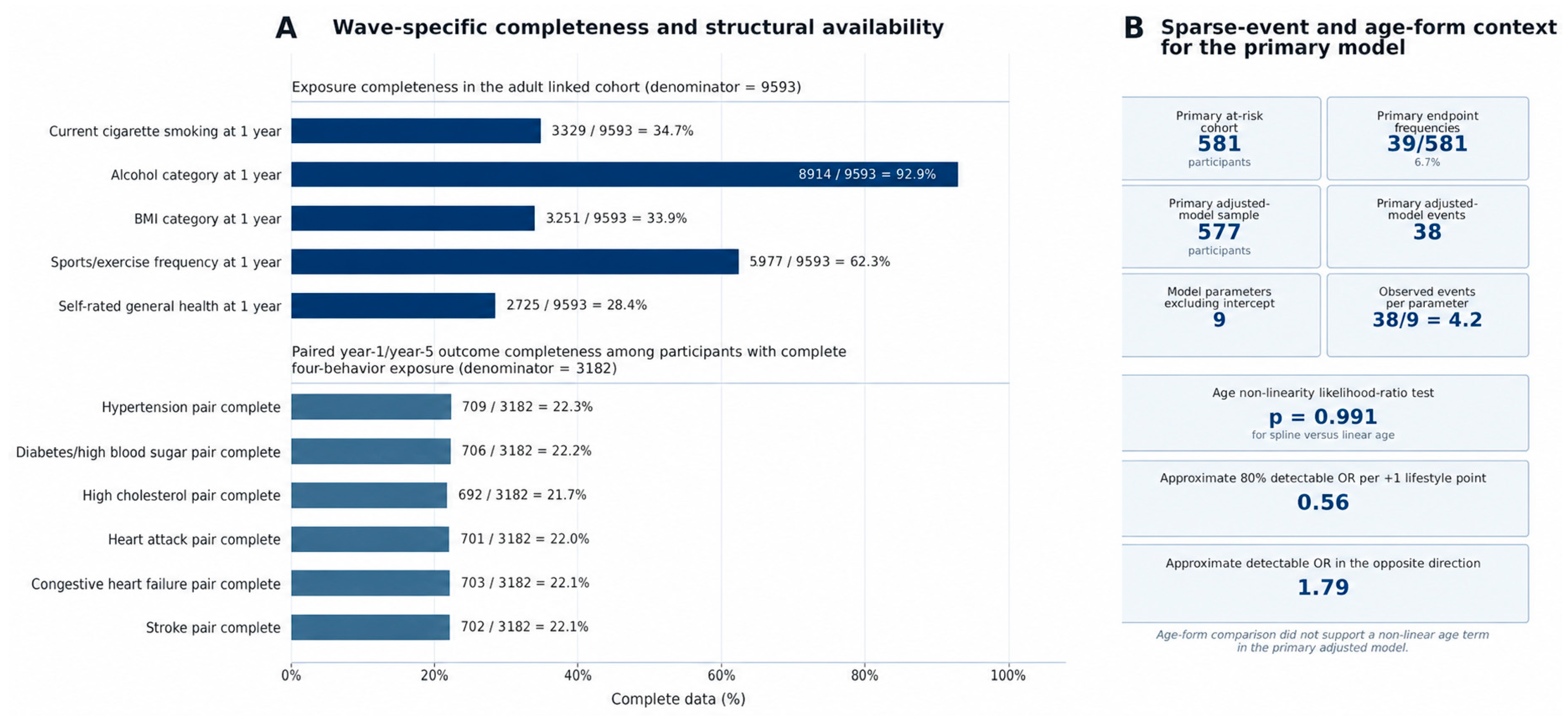
Association Analyses and Robustness Checks
4. Discussion
4.1. Interpretation in the Context of Current Evidence
4.2. Strengths, Limitations, and Clinical Implications
5. Conclusions
Supplementary Materials
Author Contributions
Funding
Institutional Review Board Statement
Informed Consent Statement
Data Availability Statement
Acknowledgments
Conflicts of Interest
References
- Gu, L.; Zhang, L.; Li, C.; Jiang, L.; Zhou, J.; Xie, Y.; Yang, J.; Jiang, C.; Zhang, L.; Jiang, Y.; et al. Global, Regional, and National Burden of Traumatic Brain Injury, 1990–2021: A Systematic Analysis for the Global Burden of Disease Study 2021. J. Neurotrauma 2025, 42, 1805–1815. [Google Scholar] [CrossRef] [PubMed]
- Zhong, H.; Feng, Y.; Shen, J.; Rao, T.; Dai, H.; Zhong, W.; Zhao, G. Global Burden of Traumatic Brain Injury in 204 Countries and Territories From 1990 to 2021. Am. J. Prev. Med. 2025, 68, 754–763. [Google Scholar] [CrossRef] [PubMed]
- Ogonah, M.G.T.; Botchway, S.; Yu, R.; Schofield, P.W.; Fazel, S. An umbrella review of health outcomes following traumatic brain injury. Nat. Ment. Health 2025, 3, 83–91. [Google Scholar] [CrossRef]
- Nelson, L.D.; Temkin, N.R.; Barber, J.; Brett, B.L.; Okonkwo, D.O.; McCrea, M.A.; Giacino, J.T.; Bodien, Y.G.; Robertson, C.; Corrigan, J.D.; et al. TRACK-TBI Investigators. Functional Recovery, Symptoms, and Quality of Life 1 to 5 Years After Traumatic Brain Injury. JAMA Netw. Open. 2023, 6, e233660. [Google Scholar] [CrossRef]
- Masel, B.E.; DeWitt, D.S. Traumatic brain injury: A disease process, not an event. J. Neurotrauma 2010, 27, 1529–1540. [Google Scholar] [CrossRef]
- Dams-O’Connor, K.; Juengst, S.B.; Bogner, J.; Chiaravalloti, N.D.; Corrigan, J.D.; Giacino, J.T.; Harrison-Felix, C.L.; Hoffman, J.M.; Ketchum, J.M.; Lequerica, A.H.; et al. Traumatic brain injury as a chronic disease: Insights from the United States Traumatic Brain Injury Model Systems Research Program. Lancet Neurol. 2023, 22, 517–528. [Google Scholar] [CrossRef]
- Corrigan, J.D.; Hammond, F.M.; Sander, A.M.; Kroenke, K. Recognition of Traumatic Brain Injury as a Chronic Condition: A Commentary. J. Neurotrauma 2024, 41, 2602–2605. [Google Scholar] [CrossRef]
- Pretz, C.R.; Dams-O’Connor, K. Longitudinal description of the glasgow outcome scale-extended for individuals in the traumatic brain injury model systems national database: A National Institute on Disability and Rehabilitation Research traumatic brain injury model systems study. Arch. Phys. Med. Rehabil. 2013, 94, 2486–2493. [Google Scholar] [CrossRef] [PubMed]
- Dams-O’Connor, K.; Ketchum, J.M.; Cuthbert, J.P.; Corrigan, J.D.; Hammond, F.M.; Haarbauer-Krupa, J.; Kowalski, R.G.; Miller, A.C. Functional Outcome Trajectories Following Inpatient Rehabilitation for TBI in the United States: A NIDILRR TBIMS and CDC Interagency Collaboration. J. Head Trauma Rehabil. 2020, 35, 127–139. [Google Scholar] [CrossRef]
- Forslund, M.V.; Perrin, P.B.; Røe, C.; Sigurdardottir, S.; Hellstrøm, T.; Berntsen, S.A.; Lu, J.; Arango-Lasprilla, J.C.; Andelic, N. Global Outcome Trajectories up to 10 Years After Moderate to Severe Traumatic Brain Injury. Front Neurol. 2019, 10, 219. [Google Scholar] [CrossRef]
- Dams-OʼConnor, K.; Mellick, D.; Dreer, L.E.; Hammond, F.M.; Hoffman, J.; Landau, A.; Zafonte, R.; Pretz, C. Rehospitalization Over 10 Years Among Survivors of TBI: A National Institute on Disability, Independent Living, and Rehabilitation Research Traumatic Brain Injury Model Systems Study. J. Head Trauma Rehabil. 2017, 32, 147–157. [Google Scholar] [CrossRef] [PubMed]
- Corrigan, J.D.; Hammond, F.M.; Sander, A.M.; Kroenke, K. Model of Care for Chronic Brain Injury. Arch. Phys. Med. Rehabil. 2025, 106, 145–149. [Google Scholar] [CrossRef]
- Izzy, S.; Chen, P.M.; Tahir, Z.; Grashow, R.; Radmanesh, F.; Cote, D.J.; Yahya, T.; Dhand, A.; Taylor, H.; Shih, S.L.; et al. Association of Traumatic Brain Injury with the Risk of Developing Chronic Cardiovascular, Endocrine, Neurological, and Psychiatric Disorders. JAMA Netw. Open 2022, 5, e229478. [Google Scholar] [CrossRef] [PubMed]
- Stewart, I.J.; Amuan, M.E.; Wang, C.P.; Kennedy, E.; Kenney, K.; Werner, J.K.; Carlson, K.F.; Tate, D.F.; Pogoda, T.K.; Dismuke-Greer, C.E.; et al. Association Between Traumatic Brain Injury and Subsequent Cardiovascular Disease Among Post-9/11-Era Veterans. JAMA Neurol. 2022, 79, 1122–1129, Erratum in JAMA Neurol. 2022, 79, 1206. https://doi.org/10.1001/jamaneurol.2022.3960. [Google Scholar] [CrossRef]
- Pinto, S.M.; Thakur, B.; Kumar, R.G.; Rabinowitz, A.; Zafonte, R.; Walker, W.C.; Ding, K.; Driver, S.; Venkatesan, U.M.; Moralez, G.; et al. Prevalence of Cardiovascular Conditions After Traumatic Brain Injury: A Comparison Between the Traumatic Brain Injury Model Systems and the National Health and Nutrition Examination Survey. J. Am. Heart Assoc. 2024, 13, e033673. [Google Scholar] [CrossRef]
- Skou, S.T.; Mair, F.S.; Fortin, M.; Guthrie, B.; Nunes, B.P.; Miranda, J.J.; Boyd, C.M.; Pati, S.; Mtenga, S.; Smith, S.M. Multimorbidity. Nat. Rev. Dis. Prim. 2022, 8, 48. [Google Scholar] [CrossRef]
- Pearson-Stuttard, J.; Ezzati, M.; Gregg, E.W. Multimorbidity-a defining challenge for health systems. Lancet Public Health 2019, 4, e599–e600. [Google Scholar] [CrossRef]
- Barnett, K.; Mercer, S.W.; Norbury, M.; Watt, G.; Wyke, S.; Guthrie, B. Epidemiology of multimorbidity and implications for health care, research, and medical education: A cross-sectional study. Lancet 2012, 380, 37–43. [Google Scholar] [CrossRef] [PubMed]
- Chudasama, Y.V.; Khunti, K.; Gillies, C.L.; Dhalwani, N.N.; Davies, M.J.; Yates, T.; Zaccardi, F. Healthy lifestyle and life expectancy in people with multimorbidity in the UK Biobank: A longitudinal cohort study. PLoS Med. 2020, 17, e1003332. [Google Scholar] [CrossRef]
- Dreer, L.E.; Ketchum, J.M.; Novack, T.A.; Bogner, J.; Felix, E.R.; Corrigan, J.D.; Johnson-Greene, D.; Hammond, F.M. Obesity and Overweight Problems Among Individuals 1 to 25 Years Following Acute Rehabilitation for Traumatic Brain Injury: A NIDILRR Traumatic Brain Injury Model Systems Study. J. Head Trauma Rehabil. 2018, 33, 246–256. [Google Scholar] [CrossRef]
- Pham, T.; Green, R.; Neaves, S.; Hynan, L.S.; Bell, K.R.; Juengst, S.B.; Zhang, R.; Driver, S.; Ding, K. Physical activity and perceived barriers in individuals with moderate-to-severe traumatic brain injury. PM&R 2023, 15, 705–714. [Google Scholar] [CrossRef]
- Olsen, C.M.; Corrigan, J.D. Does Traumatic Brain Injury Cause Risky Substance Use or Substance Use Disorder? Biol. Psychiatry 2022, 91, 421–437. [Google Scholar] [CrossRef]
- Tso, S.; Saha, A.; Cusimano, M.D. The Traumatic Brain Injury Model Systems National Database: A Review of Published Research. Neurotrauma Rep. 2021, 2, 149–164. [Google Scholar] [CrossRef]
- Corrigan, J.D.; Cuthbert, J.P.; Whiteneck, G.G.; Dijkers, M.P.; Coronado, V.; Heinemann, A.W.; Harrison-Felix, C.; Graham, J.E. Representativeness of the Traumatic Brain Injury Model Systems National Database. J. Head Trauma Rehabil. 2012, 27, 391–403. [Google Scholar] [CrossRef]
- Cuthbert, J.P.; Corrigan, J.D.; Whiteneck, G.G.; Harrison-Felix, C.; Graham, J.E.; Bell, J.M.; Coronado, V.G. Extension of the representativeness of the Traumatic Brain Injury Model Systems National Database: 2001 to 2010. J. Head Trauma Rehabil. 2012, 27, E15–E27. [Google Scholar] [CrossRef] [PubMed]
- Walker, W.C.; Stromberg, K.A.; Marwitz, J.H.; Sima, A.P.; Agyemang, A.A.; Graham, K.M.; Harrison-Felix, C.; Hoffman, J.M.; Brown, A.W.; Kreutzer, J.S.; et al. Predicting Long-Term Global Outcome after Traumatic Brain Injury: Development of a Practical Prognostic Tool Using the Traumatic Brain Injury Model Systems National Database. J. Neurotrauma 2018, 35, 1587–1595, Erratum in J. Neurotrauma 2020, 37, 905. https://doi.org/10.1089/neu.2017.5359.correx. [Google Scholar] [CrossRef]
- Hammond, F.M.; Malec, J.F.; Corrigan, J.D.; Whiteneck, G.G.; Hart, T.; Dams-O’Connor, K.; Novack, T.A.; Bogner, J.; Dahdah, M.N.; Eagye, C.B.; et al. Patterns of Functional Change Five to Ten Years after Moderate-Severe Traumatic Brain Injury. J. Neurotrauma 2021, 38, 1526–1534. [Google Scholar] [CrossRef] [PubMed]
- Lercher, K.; Kumar, R.G.; Hammond, F.M.; Hoffman, J.M.; Verduzco-Gutierrez, M.; Walker, W.C.; Zafonte, R.D.; Dams-O’Connor, K. Distal and Proximal Predictors of Rehospitalization Over 10 Years Among Survivors of TBI: A National Institute on Disability, Independent Living, and Rehabilitation Research Traumatic Brain Injury Model Systems Study. J. Head Trauma Rehabil. 2023, 38, 203–213. [Google Scholar] [CrossRef]
- Fogelberg, D.J.; Hoffman, J.M.; Dikmen, S.; Temkin, N.R.; Bell, K.R. Association of sleep and co-occurring psychological conditions at 1 year after traumatic brain injury. Arch. Phys. Med. Rehabil. 2012, 93, 1313–1318. [Google Scholar] [CrossRef]
- World Medical Association. World Medical Association Declaration of Helsinki: Ethical principles for medical research involving human subjects. JAMA 2013, 310, 2191–2194. [Google Scholar] [CrossRef]
- Maas, A.I.R.; Menon, D.K.; Adelson, P.D.; Andelic, N.; Bell, M.J.; Belli, A.; Bragge, P.; Brazinova, A.; Büki, A.; Chesnut, R.M.; et al. InTBIR Participants and Investigators. Traumatic brain injury: Integrated approaches to improve prevention, clinical care, and research. Lancet Neurol. 2017, 16, 987–1048. [Google Scholar] [CrossRef]
- Maas, A.I.R.; Menon, D.K.; Manley, G.T.; Abrams, M.; Åkerlund, C.; Andelic, N.; Aries, M.; Bashford, T.; Bell, M.J.; Bodien, Y.G.; et al. Traumatic brain injury: Progress and challenges in prevention, clinical care, and research. Lancet Neurol. 2022, 21, 1004–1060, Erratum in Lancet Neurol. 2022, 21, e10. https://doi.org/10.1016/S1474-4422(22)00411-2. [Google Scholar] [CrossRef]
- Lloyd-Jones, D.M.; Allen, N.B.; Anderson, C.A.M.; Black, T.; Brewer, L.C.; Foraker, R.E.; Grandner, M.A.; Lavretsky, H.; Perak, A.M.; Sharma, G.; et al. Life’s Essential 8: Updating and Enhancing the American Heart Association’s Construct of Cardiovascular Health: A Presidential Advisory From the American Heart Association. Circulation 2022, 146, e18–e43. [Google Scholar] [CrossRef]
- Lloyd-Jones, D.M.; Hong, Y.; Labarthe, D.; Mozaffarian, D.; Appel, L.J.; Van Horn, L.; Greenlund, K.; Daniels, S.; Nichol, G.; Tomaselli, G.F.; et al. Defining and setting national goals for cardiovascular health promotion and disease reduction: The American Heart Association’s strategic Impact Goal through 2020 and beyond. Circulation 2010, 121, 586–613. [Google Scholar] [CrossRef]
- Whelton, P.K.; Carey, R.M.; Aronow, W.S.; Casey, D.E., Jr.; Collins, K.J.; Dennison Himmelfarb, C.; DePalma, S.M.; Gidding, S.; Jamerson, K.A.; Jones, D.W.; et al. 2017 ACC/AHA/AAPA/ABC/ACPM/AGS/APhA/ASH/ASPC/NMA/PCNA Guideline for the Prevention, Detection, Evaluation, and Management of High Blood Pressure in Adults: A Report of the American College of Cardiology/American Heart Association Task Force on Clinical Practice Guidelines. Hypertension 2018, 71, e13–e115, Erratum in Hypertension 2018, 71, e140–e144. https://doi.org/10.1161/HYP.0000000000000076. [Google Scholar] [CrossRef]
- Grundy, S.M.; Stone, N.J.; Bailey, A.L.; Beam, C.; Birtcher, K.K.; Blumenthal, R.S.; Braun, L.T.; de Ferranti, S.; Faiella-Tommasino, J.; Forman, D.E.; et al. 2018 AHA/ACC/AACVPR/AAPA/ABC/ACPM/ADA/AGS/APhA/ASPC/NLA/PCNA Guideline on the Management of Blood Cholesterol: A Report of the American College of Cardiology/American Heart Association Task Force on Clinical Practice Guidelines. Circulation 2019, 139, e1082–e1143, Erratum in Circulation 2019, 139, e1182–e1186. https://doi.org/10.1161/CIR.0000000000000698. Erratum in Circulation 2023, 148, e5. https://doi.org/10.1161/CIR.0000000000001172. [Google Scholar] [CrossRef]
- US Preventive Services Task Force; Mangione, C.M.; Barry, M.J.; Nicholson, W.K.; Cabana, M.; Chelmow, D.; Coker, T.R.; Davis, E.M.; Donahue, K.E.; Jaén, C.R.; et al. Statin Use for the Primary Prevention of Cardiovascular Disease in Adults: US Preventive Services Task Force Recommendation Statement. JAMA 2022, 328, 746–753. [Google Scholar] [CrossRef]
- US Preventive Services Task Force; Davidson, K.W.; Barry, M.J.; Mangione, C.M.; Cabana, M.; Caughey, A.B.; Davis, E.M.; Donahue, K.E.; Doubeni, C.A.; Krist, A.H.; et al. Screening for Prediabetes and Type 2 Diabetes: US Preventive Services Task Force Recommendation Statement. JAMA 2021, 326, 736–743. [Google Scholar] [CrossRef]
- US Preventive Services Task Force; Curry, S.J.; Krist, A.H.; Owens, D.K.; Barry, M.J.; Caughey, A.B.; Davidson, K.W.; Doubeni, C.A.; Epling, J.W., Jr.; Grossman, D.C.; et al. Behavioral Weight Loss Interventions to Prevent Obesity-Related Morbidity and Mortality in Adults: US Preventive Services Task Force Recommendation Statement. JAMA 2018, 320, 1163–1171. [Google Scholar] [CrossRef]
- Bull, F.C.; Al-Ansari, S.S.; Biddle, S.; Borodulin, K.; Buman, M.P.; Cardon, G.; Carty, C.; Chaput, J.P.; Chastin, S.; Chou, R.; et al. World Health Organization 2020 guidelines on physical activity and sedentary behaviour. Br. J. Sports Med. 2020, 54, 1451–1462. [Google Scholar] [CrossRef]
- US Preventive Services Task Force; Krist, A.H.; Davidson, K.W.; Mangione, C.M.; Barry, M.J.; Cabana, M.; Caughey, A.B.; Donahue, K.; Doubeni, C.A.; Epling, J.W., Jr.; et al. Interventions for Tobacco Smoking Cessation in Adults, Including Pregnant Persons: US Preventive Services Task Force Recommendation Statement. JAMA 2021, 325, 265–279. [Google Scholar] [CrossRef]
- Patnode, C.D.; Henderson, J.T.; Coppola, E.L.; Melnikow, J.; Durbin, S.; Thomas, R.G. Interventions for Tobacco Cessation in Adults, Including Pregnant Persons: Updated Evidence Report and Systematic Review for the US Preventive Services Task Force. JAMA 2021, 325, 280–298. [Google Scholar] [CrossRef]
- GBD 2016 Alcohol Collaborators. Alcohol use and burden for 195 countries and territories, 1990–2016: A systematic analysis for the Global Burden of Disease Study 2016. Lancet 2018, 392, 1015–1035, Erratum in Lancet 2018, 392, 1116. https://doi.org/10.1016/S0140-6736(18)32338-9. Erratum in Lancet 2019, 393, e44. https://doi.org/10.1016/S0140-6736(19)31050-5. [Google Scholar] [CrossRef]
- von Elm, E.; Altman, D.G.; Egger, M.; Pocock, S.J.; Gøtzsche, P.C.; Vandenbroucke, J.P.; STROBE Initiative. The Strengthening the Reporting of Observational Studies in Epidemiology (STROBE) statement: Guidelines for reporting observational studies. PLoS Med. 2007, 4, e296. [Google Scholar] [CrossRef]
- Sterne, J.A.; White, I.R.; Carlin, J.B.; Spratt, M.; Royston, P.; Kenward, M.G.; Wood, A.M.; Carpenter, J.R. Multiple imputation for missing data in epidemiological and clinical research: Potential and pitfalls. BMJ 2009, 338, b2393. [Google Scholar] [CrossRef]
- Hernán, M.A.; Hernández-Díaz, S.; Robins, J.M. A structural approach to selection bias. Epidemiology 2004, 15, 615–625. [Google Scholar] [CrossRef]
- Peduzzi, P.; Concato, J.; Kemper, E.; Holford, T.R.; Feinstein, A.R. A simulation study of the number of events per variable in logistic regression analysis. J. Clin. Epidemiol. 1996, 49, 1373–1379. [Google Scholar] [CrossRef]
- Okura, Y.; Urban, L.H.; Mahoney, D.W.; Jacobsen, S.J.; Rodeheffer, R.J. Agreement between self-report questionnaires and medical record data was substantial for diabetes, hypertension, myocardial infarction and stroke but not for heart failure. J. Clin. Epidemiol. 2004, 57, 1096–1103. [Google Scholar] [CrossRef]
- Prince, S.A.; Adamo, K.B.; Hamel, M.E.; Hardt, J.; Connor Gorber, S.; Tremblay, M. A comparison of direct versus self-report measures for assessing physical activity in adults: A systematic review. Int. J. Behav. Nutr. Phys. Act. 2008, 5, 56. [Google Scholar] [CrossRef] [PubMed]
- Madley-Dowd, P.; Hughes, R.; Tilling, K.; Heron, J. The proportion of missing data should not be used to guide decisions on multiple imputation. J. Clin. Epidemiol. 2019, 110, 63–73. [Google Scholar] [CrossRef] [PubMed]
- White, I.R.; Royston, P.; Wood, A.M. Multiple imputation using chained equations: Issues and guidance for practice. Stat. Med. 2011, 30, 377–399. [Google Scholar] [CrossRef]
- Vittinghoff, E.; McCulloch, C.E. Relaxing the rule of ten events per variable in logistic and Cox regression. Am. J. Epidemiol. 2007, 165, 710–718. [Google Scholar] [CrossRef]
- Halabi, C.; Izzy, S.; DiGiorgio, A.M.; Mills, H.; Radmanesh, F.; Yue, J.K.; Ashouri Choshali, H.; Schenk, G.; Israni, S.; Zafonte, R.; et al. Traumatic Brain Injury and Risk of Incident Comorbidities. JAMA Netw. Open. 2024, 7, e2450499. [Google Scholar] [CrossRef]
- Johnson, L.; Williams, G.; Sherrington, C.; Pilli, K.; Chagpar, S.; Auchettl, A.; Beard, J.; Gill, R.; Vassallo, G.; Rushworth, N.; et al. The effect of physical activity on health outcomes in people with moderate-to-severe traumatic brain injury: A rapid systematic review with meta-analysis. BMC Public Health 2023, 23, 63, Erratum in BMC Public Health 2023, 23, 433. https://doi.org/10.1186/s12889-023-15240-7. [Google Scholar] [CrossRef]
- Smeding, S.; Colussi-Palaez, E.; Sherzai, D.; Zafonte, R.; Tran, D. The Application of Lifestyle Medicine in Traumatic Brain Injury. Am. J. Lifestyle Med. 2025. [Google Scholar] [CrossRef]
- Heinze, G.; Schemper, M. A solution to the problem of separation in logistic regression. Stat. Med. 2002, 21, 2409–2419. [Google Scholar] [CrossRef]
- Puhr, R.; Heinze, G.; Nold, M.; Lusa, L.; Geroldinger, A. Firth’s logistic regression with rare events: Accurate effect estimates and predictions? Stat. Med. 2017, 36, 2302–2317. [Google Scholar] [CrossRef]
- Mansournia, M.A.; Geroldinger, A.; Greenland, S.; Heinze, G. Separation in Logistic Regression: Causes, Consequences, and Control. Am. J. Epidemiol. 2018, 187, 864–870. [Google Scholar] [CrossRef]
- Kibria, F.; Bragina, O.A.; Trofimov, A.O.; Bragin, D. Bidirectional Interplay Between Traumatic Brain Injury and Cardiovascular Dysfunction in Athletes. J. Clin. Med. 2025, 14, 7712. [Google Scholar] [CrossRef]
- Mensah, G.A.; Fuster, V.; Murray, C.J.L.; Roth, G.A. Global Burden of Cardiovascular Diseases and Risks Collaborators. Global Burden of Cardiovascular Diseases and Risks, 1990–2022. J. Am. Coll. Cardiol. 2023, 82, 2350–2473. [Google Scholar] [CrossRef]



| Characteristic | Overall (N = 581) | No Primary Endpoint (n = 542) | Primary Endpoint (n = 39) |
|---|---|---|---|
| Age at injury, mean (SD) | 39.8 (17.7) | 39.1 (17.4) | 49.2 (18.9) |
| Female, n (%) | 146 (25.1) | 137 (25.3) | 9 (23.1) |
| Race/ethnicity: White, n (%) | 364 (62.7) | 343 (63.3) | 21 (53.8) |
| Race/ethnicity: Black, n (%) | 102 (17.6) | 95 (17.5) | 7 (17.9) |
| Race/ethnicity: Hispanic, n (%) | 90 (15.5) | 81 (14.9) | 9 (23.1) |
| Race/ethnicity: Other, n (%) | 25 (4.3) | 23 (4.2) | 2 (5.1) |
| Education: ≤High school/trade, n (%) | 297 (51.1) | 277 (51.1) | 20 (51.3) |
| Education: Some college/associate, n (%) | 158 (27.2) | 148 (27.3) | 10 (25.6) |
| Education: Bachelor’s or higher, n (%) | 123 (21.2) | 115 (21.2) | 8 (20.5) |
| Education: Unknown, n (%) | 3 (0.5) | 2 (0.4) | 1 (2.6) |
| GCS category: Severe, n (%) | 159 (27.4) | 152 (28.0) | 7 (17.9) |
| GCS category: Moderate, n (%) | 60 (10.3) | 57 (10.5) | 3 (7.7) |
| GCS category: Mild, n (%) | 163 (28.1) | 149 (27.5) | 14 (35.9) |
| GCS category: Intubated, n (%) | 2 (0.3) | 2 (0.4) | 0 (0.0) |
| GCS category: Missing, n (%) | 197 (33.9) | 182 (33.6) | 15 (38.5) |
| PTA duration: 0 days, n (%) | 37 (6.4) | 32 (5.9) | 5 (12.8) |
| PTA duration: 1–7 days, n (%) | 106 (18.2) | 102 (18.8) | 4 (10.3) |
| PTA duration: 8–28 days, n (%) | 224 (38.6) | 211 (38.9) | 13 (33.3) |
| PTA duration: >28 days, n (%) | 135 (23.2) | 124 (22.9) | 11 (28.2) |
| PTA duration: Still in PTA at discharge, n (%) | 74 (12.7) | 69 (12.7) | 5 (12.8) |
| PTA duration: Unknown, n (%) | 5 (0.9) | 4 (0.7) | 1 (2.6) |
| 1-year FIM cognitive score, mean (SD) | 30.6 (5.4) | 30.7 (5.4) | 29.6 (4.7) |
| Baseline common cardiometabolic burden: 0 conditions, n (%) | 423 (72.8) | 391 (72.1) | 32 (82.1) |
| Baseline common cardiometabolic burden: 1 condition, n (%) | 158 (27.2) | 151 (27.9) | 7 (17.9) |
| Domain | Category | Distribution or Frequency | Primary Endpoint n/N (%) |
|---|---|---|---|
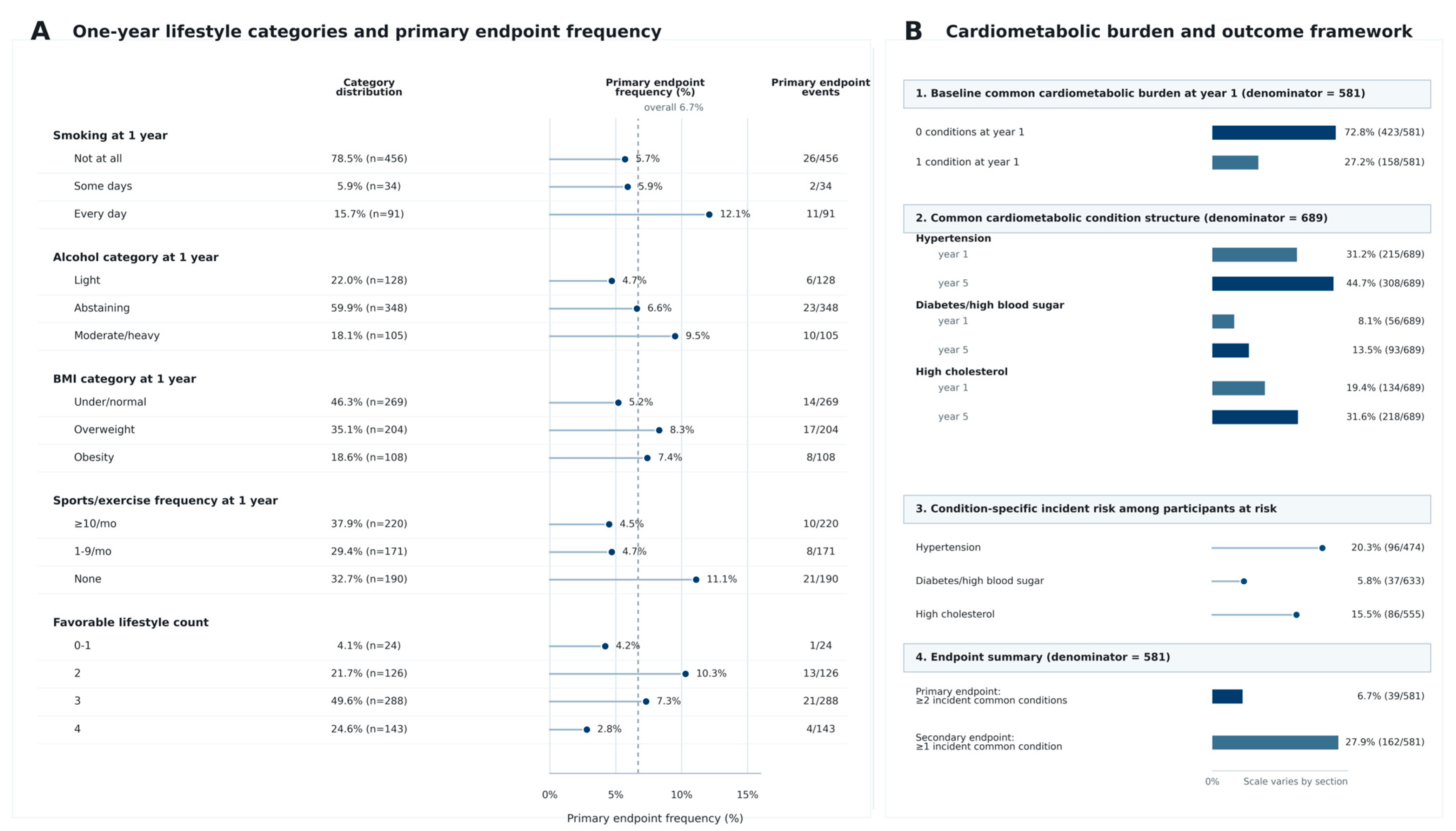
| Panel A. One-year exposure distributions in the primary at-risk cohort | |||
| Current smoking at 1 year | Not at all | 456 (78.5) | 26/456 (5.7) |
| Some days | 34 (5.9) | 2/34 (5.9) | |
| Every day | 91 (15.7) | 11/91 (12.1) | |
| Alcohol category at 1 year | Light | 128 (22.0) | 6/128 (4.7) |
| Abstaining | 348 (59.9) | 23/348 (6.6) | |
| Moderate/heavy | 105 (18.1) | 10/105 (9.5) | |
| BMI category at 1 year | Under/normal | 269 (46.3) | 14/269 (5.2) |
| Overweight | 204 (35.1) | 17/204 (8.3) | |
| Obesity | 108 (18.6) | 8/108 (7.4) | |
| Sports/exercise frequency at 1 year | ≥10/mo | 220 (37.9) | 10/220 (4.5) |
| 1–9/mo | 171 (29.4) | 8/171 (4.7) | |
| None | 190 (32.7) | 21/190 (11.1) | |
| Favorable lifestyle count | 0–1 | 24 (4.1) | 1/24 (4.2) |
| 2 | 126 (21.7) | 13/126 (10.3) | |
| 3 | 288 (49.6) | 21/288 (7.3) | |
| 4 | 143 (24.6) | 4/143 (2.8) | |
| Panel B. Common cardiometabolic burden and interval outcomes | |||
| Baseline common burden in at-risk cohort | 0 conditions at year 1 | 423 (72.8) | 32/423 (7.6) |
| 1 condition at year 1 | 158 (27.2) | 7/158 (4.4) | |
| Hypertension | Present at year 1 | 215/689 (31.2) | |
| Present at year 5 | 308/689 (44.7) | ||
| Incident between year 1 and year 5 | 96/474 (20.3) | ||
| Diabetes/high blood sugar | Present at year 1 | 56/689 (8.1) | |
| Present at year 5 | 93/689 (13.5) | ||
| Incident between year 1 and year 5 | 37/633 (5.8) | ||
| High cholesterol | Present at year 1 | 134/689 (19.4) | |
| Present at year 5 | 218/689 (31.6) | ||
| Incident between year 1 and year 5 | 86/555 (15.5) | ||
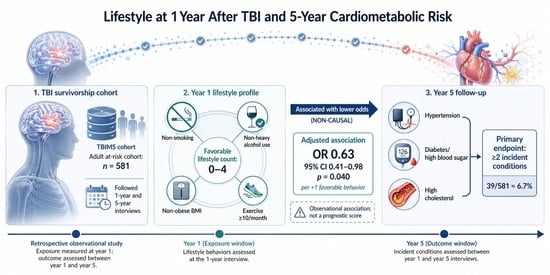
| Primary endpoint in at-risk cohort | ≥2 new conditions | 39/581 (6.7) | |
| Secondary endpoint in at-risk cohort | ≥1 new condition | 162/581 (27.9) |
| Outcome | Model | N | Events | OR per +1 Favorable Behavior (95% CI) | p |
|---|---|---|---|---|---|
| Primary endpoint: ≥2 newly incident common conditions | Model 1: unadjusted | 577 | 38 | 0.72 (0.48–1.07) | 0.100 |
| Model 2: + age, sex, race/ethnicity, education, baseline burden | 577 | 38 | 0.63 (0.41–0.98) | 0.040 | |
| Model 3: Model 2 + 1-year FIM cognitive score | 565 | 37 | 0.64 (0.41–0.99) | 0.047 | |
| Firth sensitivity: Model 2 covariates | 577 | 38 | 0.64 (0.42–0.97) | 0.037 | |
| Secondary endpoint: ≥1 newly incident common condition | Model 2: + age, sex, race/ethnicity, education, baseline burden | 577 | 160 | 0.74 (0.58–0.95) | 0.020 |
| Model 3: Model 2 + 1-year FIM cognitive score | 565 | 155 | 0.73 (0.56–0.94) | 0.016 | |
| Sensitivity endpoint: original 6-condition composite | Adjusted model with baseline 6-condition burden | 680 | 53 | 0.76 (0.52–1.10) | 0.143 |
| Domain | Contrast or Subset | Adjusted OR (95% CI) | p |
|---|---|---|---|
| Panel A. Component-level adjusted models for the primary endpoint | |||
| Smoking (ref: not at all) | N = 577, events = 38 | ||
| Some days | 1.21 (0.25–5.81) | 0.816 | |
| Every day | 3.33 (1.38–8.02) | 0.007 | |
| Alcohol (ref: light) | N = 577, events = 38 | ||
| Abstaining | 1.05 (0.40–2.78) | 0.915 | |
| Moderate/heavy | 2.10 (0.71–6.17) | 0.178 | |
| BMI (ref: under/normal) | N = 577, events = 38 | ||
| Overweight | 1.86 (0.84–4.12) | 0.127 | |
| Obesity | 1.72 (0.66–4.48) | 0.269 | |
| Exercise (ref: ≥10/mo) | N = 577, events = 38 | ||
| 1–9/mo | 1.07 (0.40–2.84) | 0.899 | |
| None | 2.45 (1.06–5.68) | 0.037 | |
| Panel B. Self-rated general health analyses | |||
| General health alone (ref: excellent/very good) | N = 486, events = 28 | ||
| Good | 2.91 (1.04–8.13) | 0.042 | |
| Fair/poor | 4.07 (1.37–12.11) | 0.012 | |
| Joint model (same subset) | N = 486, events = 28 | ||
| Favorable lifestyle count per +1 point | 0.82 (0.48–1.39) | 0.463 | |
| Good vs excellent/very good | 2.78 (0.99–7.83) | 0.053 | |
| Fair/poor vs excellent/very good | 3.71 (1.22–11.33) | 0.021 |
Disclaimer/Publisher’s Note: The statements, opinions and data contained in all publications are solely those of the individual author(s) and contributor(s) and not of MDPI and/or the editor(s). MDPI and/or the editor(s) disclaim responsibility for any injury to people or property resulting from any ideas, methods, instructions or products referred to in the content. |
© 2026 by the authors. Licensee MDPI, Basel, Switzerland. This article is an open access article distributed under the terms and conditions of the Creative Commons Attribution (CC BY) license.
Share and Cite
Calderone, A.; Bonanno, L.; Famà, F.; Ciancarelli, I.; Currò, A.; Quartarone, A.; Rifici, C.; Calabrò, R.S. The First Year Matters: Lifestyle Behaviors and Five-Year Cardiometabolic Risk Factor Accumulation After Traumatic Brain Injury. Med. Sci. 2026, 14, 265. https://doi.org/10.3390/medsci14020265
Calderone A, Bonanno L, Famà F, Ciancarelli I, Currò A, Quartarone A, Rifici C, Calabrò RS. The First Year Matters: Lifestyle Behaviors and Five-Year Cardiometabolic Risk Factor Accumulation After Traumatic Brain Injury. Medical Sciences. 2026; 14(2):265. https://doi.org/10.3390/medsci14020265
Chicago/Turabian StyleCalderone, Andrea, Lilla Bonanno, Fausto Famà, Irene Ciancarelli, Alessio Currò, Angelo Quartarone, Carmela Rifici, and Rocco Salvatore Calabrò. 2026. "The First Year Matters: Lifestyle Behaviors and Five-Year Cardiometabolic Risk Factor Accumulation After Traumatic Brain Injury" Medical Sciences 14, no. 2: 265. https://doi.org/10.3390/medsci14020265
APA StyleCalderone, A., Bonanno, L., Famà, F., Ciancarelli, I., Currò, A., Quartarone, A., Rifici, C., & Calabrò, R. S. (2026). The First Year Matters: Lifestyle Behaviors and Five-Year Cardiometabolic Risk Factor Accumulation After Traumatic Brain Injury. Medical Sciences, 14(2), 265. https://doi.org/10.3390/medsci14020265