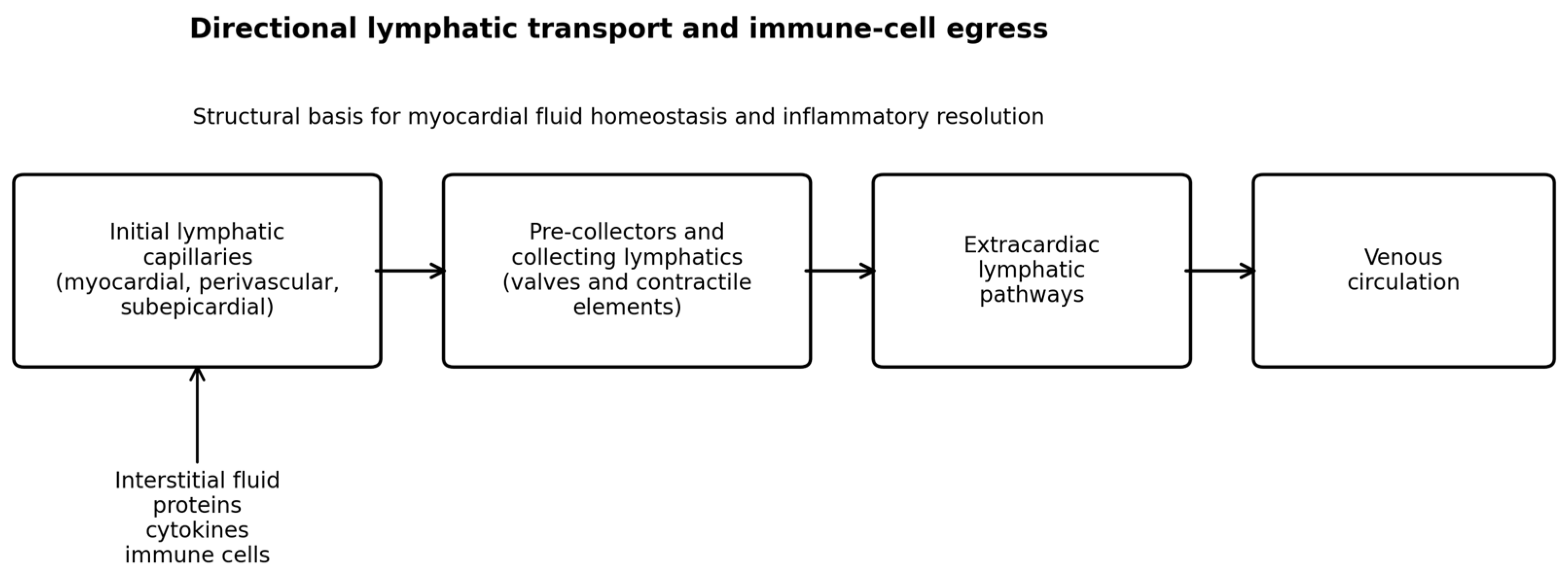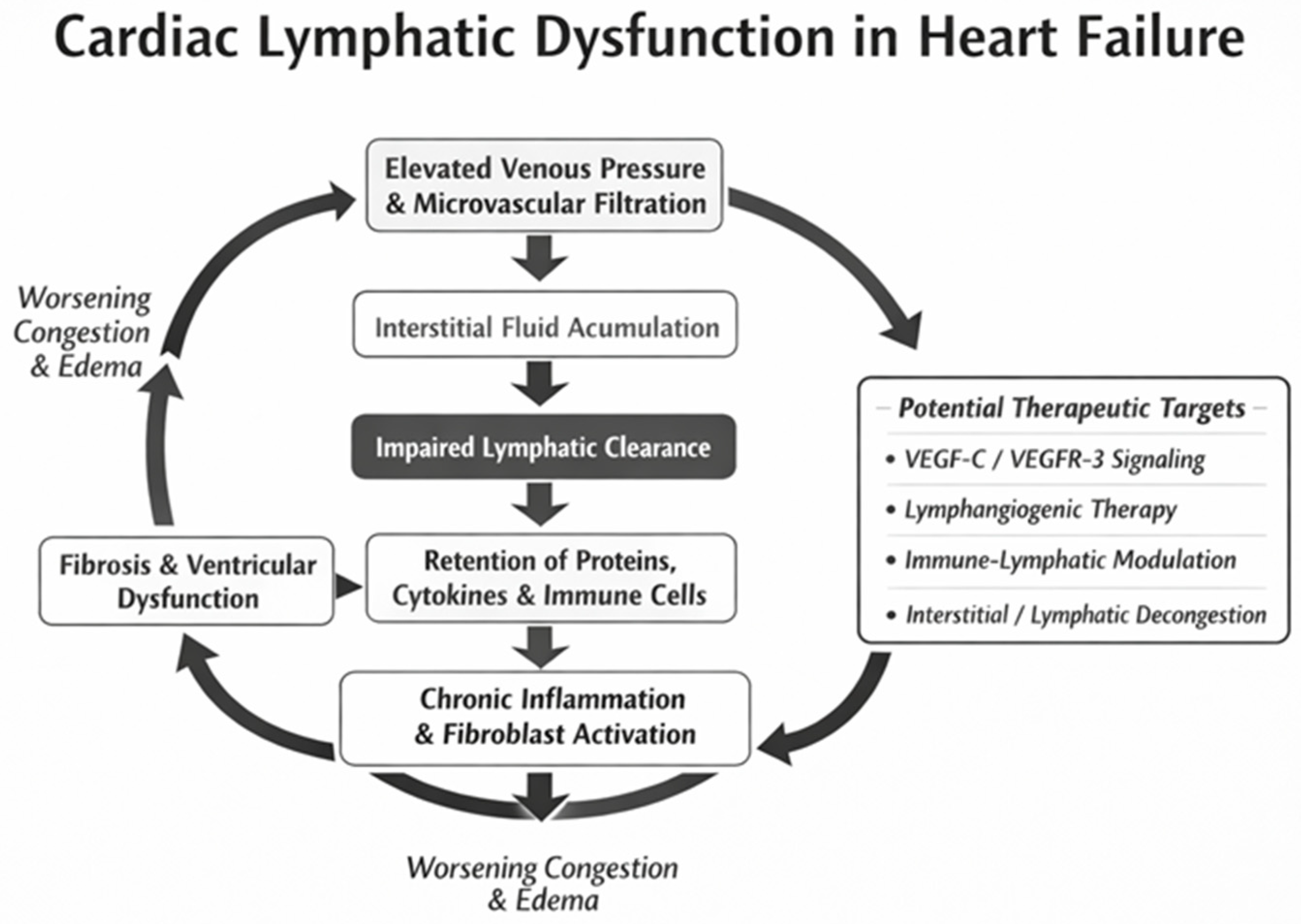

Cardiac Lymphatic Dysfunction in Heart Failure: A New Paradigm for Congestion, Inflammation, and Therapy


Abstract
1. Introduction
2. Methods of Literature Search and Bibliographic Extraction
3. Cardiac Lymphatic Anatomy, Development, and Physiological Function
4. Myocardial Edema as a Pathogenic Process
5. Cardiac Lymphatics in Myocardial Infarction and Post-Infarction Remodeling
6. Pressure Overload and Chronic Hemodynamic Stress
7. Cardiac Lymphatic Insufficiency as a Cause of Diastolic Dysfunction
8. Cardiac Lymphatics as the Link Between Congestion and Inflammation
9. Relevance to Heart Failure Phenotypes
10. Diagnostics: Toward a Lymphatic Phenotype of Heart Failure
11. Therapeutic Implications
12. Challenges and Future Directions
13. Conclusions
Funding
Institutional Review Board Statement
Informed Consent Statement
Data Availability Statement
Acknowledgments
Conflicts of Interest
References
- McDonagh, T.A.; Metra, M.; Adamo, M.; Gardner, R.S.; Baumbach, A.; Böhm, M.; Burri, H.; Butler, J.; Čelutkienė, J.; Chioncel, O.; et al. 2021 ESC Guidelines for the diagnosis and treatment of acute and chronic heart failure. Eur. Heart J. 2021, 42, 3599–3726. [Google Scholar] [CrossRef]
- Heidenreich, P.A.; Bozkurt, B.; Aguilar, D.; Allen, L.A.; Byun, J.J.; Colvin, M.M.; Deswal, A.; Drazner, M.H.; Dunlay, S.M.; Evers, L.R.; et al. 2022 AHA/ACC/HFSA Guideline for the Management of Heart Failure: A Report of the American College of Cardiology/American Heart Association Joint Committee on Clinical Practice Guidelines. J. Am. Coll. Cardiol. 2022, 79, e263–e421, Correction in J. Am. Coll. Cardiol. 2023, 81, 1551. [Google Scholar] [CrossRef] [PubMed]
- Braunwald, E. Heart failure. JACC Heart Fail. 2013, 1, 1–20. [Google Scholar] [CrossRef]
- Boorsma, E.M.; ter Maaten, J.M.; Damman, K.; Dinh, W.; Gustafsson, F.; Goldsmith, S.; Burkhoff, D.; Zannad, F.; Udelson, J.E.; Voors, A.A. Congestion in heart failure: A contemporary look at physiology, diagnosis and treatment. Nat. Rev. Cardiol. 2020, 17, 641–655. [Google Scholar] [CrossRef]
- Mullens, W.; Damman, K.; Harjola, V.P.; Mebazaa, A.; Brunner-La Rocca, H.P.; Martens, P.; Testani, J.M.; Tang, W.W.; Orso, F.; Rossignol, P.; et al. The use of diuretics in heart failure with congestion: A position statement from the Heart Failure Association of the European Society of Cardiology. Eur. J. Heart Fail. 2019, 21, 137–155. [Google Scholar] [CrossRef]
- Zile, M.R.; Bennett, T.D.; St John Sutton, M.; Cho, Y.K.; Adamson, P.B.; Aaron, M.F.; Aranda, J.J.M.; Abraham, W.T.; Smart, F.W.; Stevenson, L.W.; et al. Transition from chronic compensated to acute decompensated heart failure: Pathophysiological insights obtained from continuous monitoring of intracardiac pressures. Circulation 2008, 118, 1433–1441. [Google Scholar] [CrossRef] [PubMed]
- Frangogiannis, N.G. The inflammatory response in myocardial injury, repair, and remodelling. Nat. Rev. Cardiol. 2014, 11, 255–265. [Google Scholar] [CrossRef] [PubMed]
- Swirski, F.K.; Nahrendorf, M. Cardioimmunology: The immune system in cardiac homeostasis and disease. Nat. Rev. Immunol. 2018, 18, 733–744. [Google Scholar] [CrossRef]
- Kristjánsdóttir, I.; Thorvaldsen, T.; Lund, L.H. Congestion and Diuretic Resistance in Acute or Worsening Heart Failure. Card. Fail Rev. 2020, 6, e25. [Google Scholar] [CrossRef] [PubMed] [PubMed Central]
- Mann, D.L. Innate immunity and the failing heart: The cytokine hypothesis revisited. Circ. Res. 2015, 116, 1254–1268. [Google Scholar] [CrossRef] [PubMed]
- Prabhu, S.D.; Frangogiannis, N.G. The biological basis for cardiac repair after myocardial infarction: From inflammation to fibrosis. Circ. Res. 2016, 119, 91–112. [Google Scholar] [CrossRef]
- Frangogiannis, N.G. Cardiac fibrosis. Cardiovasc. Res. 2021, 117, 1450–1488. [Google Scholar] [CrossRef]
- Olszewski, W.L. The lymphatic system in body homeostasis: Physiological conditions. Lymphat. Res. Biol. 2003, 1, 11–21. [Google Scholar] [CrossRef] [PubMed]
- Moore, J.E., Jr.; Bertram, C.D. Lymphatic system flows. Annu. Rev. Fluid Mech. 2018, 50, 459–482. [Google Scholar] [CrossRef]
- Randolph, G.J.; Ivanov, S.; Zinselmeyer, B.H.; Scallan, J.P. The lymphatic system: Integral roles in immunity. Annu. Rev. Immunol. 2017, 35, 31–52. [Google Scholar] [CrossRef]
- Oliver, G.; Kipnis, J.; Randolph, G.J.; Harvey, N.L. The lymphatic vasculature in the 21st century: Novel functional roles in homeostasis and disease. Cell 2020, 182, 270–296. [Google Scholar] [CrossRef] [PubMed]
- Wiig, H.; Swartz, M.A. Interstitial fluid and lymph formation and transport: Physiological regulation and roles in inflammation and cancer. Physiol. Rev. 2012, 92, 1005–1060. [Google Scholar] [CrossRef]
- Telinius, N.; Hjortdal, V.E. Role of the lymphatic vasculature in cardiovascular medicine. Heart 2019, 105, 1777–1784. [Google Scholar] [CrossRef] [PubMed]
- Brakenhielm, E.; González, A.; Díez, J. Role of cardiac lymphatics in myocardial edema and fibrosis. J. Am. Coll. Cardiol. 2020, 76, 735–744. [Google Scholar] [CrossRef]
- Fudim, M.; Miller, W.L.; Rogers, J.G. Lymphatic dysregulation in patients with heart failure. J. Am. Coll. Cardiol. 2021, 78, 66–76. [Google Scholar] [CrossRef]
- Itkin, M.; Rockson, S.G.; Burkhoff, D. Pathophysiology of the lymphatic system in patients with heart failure. J. Am. Coll. Cardiol. 2021, 78, 278–290. [Google Scholar] [CrossRef]
- Vasques-Nóvoa, F.; Laundos, T.L.; Madureira, A.J.; Bettencourt, N.; Falcão-Pires, I.; Leite-Moreira, A.F. Myocardial oedema: Pathophysiological basis and role in diagnosis and risk stratification. ESC. Heart Fail. 2022, 9, 1436–1450. [Google Scholar] [CrossRef]
- Talle, M.A.; Robbertse, P.S.; Doubell, A.F.; Lahri, S.; Herbst, P.G. Characterizing myocardial edema and fibrosis in hypertensive crisis with cardiovascular magnetic resonance imaging. Sci. Rep. 2024, 14, 23509. [Google Scholar] [CrossRef]
- Ravaud, C.; Bonzanni, N.; Lund, A.W. Lymphatic clearance of immune cells in cardiovascular disease. Cells 2021, 10, 2594. [Google Scholar] [CrossRef]
- Henri, O.; Pouehe, C.; Houssari, M.; Galas, L.; Nicol, L.; Edwards-Lévy, F.; Henry, J.-P.; Dumesnil, A.; Boukhalfa, I.; Banquet, S.; et al. Selective stimulation of cardiac lymphangiogenesis reduces myocardial edema and fibrosis leading to improved cardiac function following myocardial infarction. Circulation 2016, 133, 1484–1497; discussion 1497, Correction in Circulation 2021, 144, e213. [Google Scholar] [CrossRef]
- Vieira, J.M.; Norman, S.; Villa Del Campo, C.; Cahill, T.J.; Barnette, D.N.; Gunadasa-Rohling, M.; Johnson, L.A.; Greaves, D.R.; Carr, C.A.; Jackson, D.G.; et al. The cardiac lymphatic system stimulates resolution of inflammation following myocardial infarction. J. Clin. Investig. 2018, 128, 3402–3412. [Google Scholar] [CrossRef]
- Houssari, M.; Dumesnil, A.; Tardif, V.; Kivelä, R.; Pizzinat, N.; Boukhalfa, I.; Godefroy, D.; Schapman, D.; Hemanthakumar, K.A.; Bizou, M.; et al. Lymphatic and immune cell cross-talk regulates cardiac recovery after experimental myocardial infarction. Arterioscler. Thromb. Vasc. Biol. 2020, 40, 1722–1737. [Google Scholar] [CrossRef] [PubMed]
- Trincot, C.E.; Xu, W.; Zhang, H.; Kulikauskas, M.R.; Caranasos, T.G.; Jensen, B.C.; Sabine, A.; Petrova, T.V.; Caron, K.M. Adrenomedullin induces cardiac lymphangiogenesis after myocardial infarction and regulates cardiac edema via connexin 43. Circ. Res. 2019, 124, 101–113. [Google Scholar] [CrossRef]
- Heron, C.; Dumesnil, A.; Houssari, M.; Renet, S.; Lemarcis, T.; Lebon, A.; Godefroy, D.; Schapman, D.; Henri, O.; Riou, G.; et al. Regulation and impact of cardiac lymphangiogenesis in pressure-overload-induced heart failure. Cardiovasc. Res. 2023, 119, 492–505. [Google Scholar] [CrossRef] [PubMed]
- Lin, Q.Y.; Zhang, Y.L.; Bai, J.; Liu, J.Q.; Li, H.H. VEGF-C/VEGFR-3 axis protects against pressure-overload-induced cardiac dysfunction through regulation of lymphangiogenesis. Clin. Transl. Med. 2021, 11, e374. [Google Scholar] [CrossRef] [PubMed]
- Pu, Z.; Shimizu, Y.; Hayashi, T.; Che, Y.; Suzuki, J.; Tsuzuki, K.; Narita, S.; Shibata, R.; Calvert, J.W.; Murohara, T. Cardiac lymphatic insufficiency leads to diastolic dysfunction via myocardial morphologic change. JACC Basic Transl. Sci. 2023, 8, 958–972. [Google Scholar] [CrossRef] [PubMed]
- Snelson, M.; Muralitharan, R.; Liu, C.F.; Markó, L.; Forslund, S.K.; Marques, F.Z.; Tang, W.H.W. Gut-Heart Axis: The Role of Gut Microbiota and Metabolites in Heart Failure. Circ. Res. 2025, 136, 1382–1406. [Google Scholar] [CrossRef]
- Tamayo-Gutierrez, A.; Ibrahim, H.N. The Kidney in Heart Failure: The Role of Venous Congestion. Methodist Debakey Cardiovasc. J. 2022, 18, 4–10. [Google Scholar] [CrossRef]
- Martens, P.; Rossen, J.; Lau, C.W.; Dupont, M.; Mullens, W. Targeting the lymphatic system for interstitial decongestion. JACC Basic Transl. Sci. 2021, 6, 882–884. [Google Scholar] [CrossRef] [PubMed]
- Rossitto, G.; Mary, S.; McAllister, C.; Neves, K.B.; Haddow, L.; Rocchiccioli, J.P.; Lang, N.N.; Murphy, C.L.; Touyz, R.M.; Petrie, M.C.; et al. Reduced Lymphatic Reserve in Heart Failure With Preserved Ejection Fraction. J. Am. Coll. Cardiol. 2020, 76, 2817–2829. [Google Scholar] [CrossRef] [PubMed] [PubMed Central]
- Aspelund, A.; Robciuc, M.R.; Karaman, S.; Mäkinen, T.; Alitalo, K. Lymphatic system in cardiovascular medicine. Circ. Res. 2016, 118, 515–530. [Google Scholar] [CrossRef]
- Dashkevich, A.; Bloch, W.; Antonyan, A.; Fries, J.U.; Geissler, H.J. Morphological and quantitative changes of the initial myocardial lymphatics in terminal heart failure. Lymphat. Res. Biol. 2009, 7, 21–27. [Google Scholar] [CrossRef] [PubMed]
- Klotz, L.; Norman, S.; Vieira, J.M.; Masters, M.; Rohling, M.; Dubé, K.N.; Bollini, S.; Matsuzaki, F.; Carr, C.A.; Riley, P.R. Cardiac lymphatics are heterogeneous in origin and respond to injury. Nature 2015, 522, 62–67. [Google Scholar] [CrossRef]
- Klaourakis, K.; Vieira, J.M.; Riley, P.R. The evolving cardiac lymphatic vasculature in development, repair and regeneration. Nat. Rev. Cardiol. 2021, 18, 368–379. [Google Scholar] [CrossRef]
- Brakenhielm, E.; Cao, Y. Cardiac lymphatics in health and disease. Nat. Rev. Cardiol. 2019, 16, 56–68. [Google Scholar] [CrossRef]
- Levick, J.R.; Michel, C.C. Microvascular fluid exchange and the revised Starling principle. Cardiovasc. Res. 2010, 87, 198–210. [Google Scholar] [CrossRef]
- Petrova, T.V.; Koh, G.Y. Organ-specific lymphatic vasculature: From development to pathophysiology. J. Exp. Med. 2018, 215, 35–49. [Google Scholar] [CrossRef]
- Kiseleva, D.G.; Kirichenko, T.V.; Markina, Y.V.; Cherednichenko, V.R.; Gugueva, E.A.; Markin, A.M. Mechanisms of Myocardial Edema Development in CVD Pathophysiology. Biomedicines 2024, 12, 465. [Google Scholar] [CrossRef]
- Kong, D.; Kong, X.; Wang, L. Effect of cardiac lymph flow obstruction on cardiac collagen synthesis and interstitial fibrosis in rabbits. Basic Res. Cardiol. 2006, 101, 253–258. [Google Scholar] [CrossRef] [PubMed] [PubMed Central]
- Nahrendorf, M.; Pittet, M.J.; Swirski, F.K. Monocytes: Protagonists of infarct inflammation and repair after myocardial infarction. Circulation 2010, 121, 2437–2445. [Google Scholar] [CrossRef] [PubMed]
- Ishikawa, Y.; Akishima-Fukasawa, Y.; Ito, K.; Akasaka, Y.; Tanaka, M.; Shimokawa, R.; Kimura-Matsumoto, M.; Morita, H.; Sato, S.; Kamata, I.; et al. Lymphangiogenesis in myocardial remodelling after infarction. Histopathology 2007, 51, 345–353. [Google Scholar] [CrossRef] [PubMed]
- Monaghan, R.M.; Page, D.J.; Ostergaard, P.; Keavney, B.D. The physiological and pathological functions of VEGFR3 in cardiac and lymphatic development and related diseases. Cardiovasc Res. 2021, 117, 1877–1890. [Google Scholar] [CrossRef] [PubMed] [PubMed Central]
- Berkeley, B.; Tang, M.N.H.; Brittan, M. Mechanisms regulating vascular and lymphatic regeneration in the heart after myocardial infarction. J. Pathol. 2023, 260, 666–678. [Google Scholar] [CrossRef] [PubMed]
- Glinton, K.E.; Ma, W.; Lantz, C.; Grigoryeva, L.S.; DeBerge, M.; Liu, X.; Febbraio, M.; Kahn, M.; Oliver, G.; Thorp, E.B. Macrophage-produced VEGFC is induced by efferocytosis to ameliorate cardiac injury and inflammation. J. Clin. Investig. 2022, 132, e140685. [Google Scholar] [CrossRef]
- Keller, T.C.S., 4th; Lim, L.; Shewale, S.V.; McDaid, K.; Martí-Pàmies, Í.; Tang, A.T.; Wittig, C.; Guerrero, A.A.; Sterling, S.; Leu, N.A.; et al. Genetic blockade of lymphangiogenesis does not impair cardiac function after myocardial infarction. J. Clin. Investig. 2021, 131, e147070. [Google Scholar] [CrossRef]
- Bizou, M.; Itier, R.; Majdoubi, M.; Abbadi, D.; Pichery, E.; Dutaur, M.; Marsal, D.; Calise, D.; Garmy-Susini, B.; Douin-Echinard, V.; et al. Cardiac macrophage subsets differentially regulate lymphatic network remodeling during pressure overload. Sci. Rep. 2021, 11, 16801. [Google Scholar] [CrossRef]
- Paulus, W.J.; Tschöpe, C. A novel paradigm for heart failure with preserved ejection fraction. J. Am. Coll. Cardiol. 2013, 62, 263–271. [Google Scholar] [CrossRef]
- Cuijpers, I.; Simmonds, S.J.; van Bilsen, M.; Czarnowska, E.; González Miqueo, A.; Heymans, S.; Kuhn, A.R.; Mulder, P.; Ratajska, A.; Jones, E.A.V.; et al. Microvascular and lymphatic dysfunction in HFpEF and its associated comorbidities. Basic Res. Cardiol. 2020, 115, 39. [Google Scholar] [CrossRef]
- Wada, H.; Suzuki, M.; Matsuda, M.; Ajiro, Y.; Shinozaki, T.; Sakagami, S.; Yonezawa, K.; Shimizu, M.; Funada, J.; Takenaka, T.; et al. Distinct characteristics of VEGF-D and VEGF-C to predict mortality in patients with suspected or known coronary artery disease. J. Am. Heart Assoc. 2020, 9, e015761. [Google Scholar] [CrossRef]
- Song, L.; Chen, X.; Swanson, T.A.; LaViolette, B.; Pang, J.; Cunio, T.; Nagle, M.W.; Asano, S.; Hales, K.; Shipstone, A.; et al. Lymphangiogenic therapy prevents cardiac dysfunction by ameliorating inflammation and hypertension. eLife 2020, 9, e58376. [Google Scholar] [CrossRef] [PubMed] [PubMed Central]
- Bråkenhielm, E.; Chen, Y.; Cao, Y. Lymphatics in the broken heart. J. Clin. Investig. 2021, 131, e153448. [Google Scholar] [CrossRef]
- Ji, R.C. The role of lymphangiogenesis in cardiovascular diseases. Heart Fail. Rev. 2022, 27, 1837–1856. [Google Scholar] [CrossRef]
- Shimizu, Y.; Luo, H.; Murohara, T. Disease-specific alteration of cardiac lymphatics: A review from animal disease models to clinics. Int. J. Mol. Sci. 2024, 25, 10656. [Google Scholar] [CrossRef]
- Hu, Z.; Zhao, X.; Wu, Z.; Qu, B.; Yuan, M.; Xing, Y.; Song, Y.; Wang, Z. Lymphatic vessel: Origin, heterogeneity, biological functions and therapeutic targets. Signal Transduct. Target Ther. 2024, 9, 9. [Google Scholar] [CrossRef]
- Liu, X.; Cui, K.; Wu, H.; Li, K.S.; Peng, Q.; Wang, D.; Cowan, D.B.; Dixon, J.B.; Srinivasan, R.S.; Bielenberg, D.R.; et al. Promoting lymphangiogenesis and lymphatic growth and remodeling to treat cardiovascular and metabolic diseases. Arterioscler. Thromb. Vasc. Biol. 2023, 43, e1–e10. [Google Scholar] [CrossRef]
- Biegus, J.; Pabon-Ramos, W.; Ponikowski, P.; Fudim, M. Design and rationale of the eLym system for decompensation of excess lymphatic fluid via the thoracic duct in acute heart failure (DELTA-HF). ESC. Heart Fail. 2025, 12, 1719–1726. [Google Scholar] [CrossRef] [PubMed]
- Salah, H.M.; Ebner, A.; Srinivasa, R.N.; Pabon-Ramos, W.; Chick, J.F.B.; Biegus, J.; Ponikowski, P.; Khalifa, A.; Fudim, M. Lymphatic drainage in patients with heart failure: A feasibility study. J. Cardiovasc. Transl. Res. 2025, 18, 291–294. [Google Scholar] [CrossRef]
- Gragnano, F.; Munciguerra, O.; Mattera Iacono, A.; Brignoli, M.; Chianese, R.; Limongelli, G.; Viscusi, M.; Calabrò, P. Device therapy nello scompenso cardiaco cronico: Un caso di cardiomiopatia ipertrofica trattato con terapia di modulazione della contrattilità cardiaca. G. Ital. Cardiol. 2022, 23, 23S–26S. [Google Scholar] [CrossRef] [PubMed]



| Pathophysiological Domain | Proposed Role of Cardiac Lymphatic Dysfunction | Consequence in Heart Failure |
|---|---|---|
| Interstitial fluid handling | Reduced clearance of myocardial ultrafiltrate | Persistent myocardial edema and tissue congestion |
| Protein and macromolecule removal | Retention of proteins, proteases, and matrix-active mediators within the interstitium | Increased interstitial oncotic load, matrix disruption, and sustained tissue swelling |
| Immune-cell trafficking | Impaired leukocyte egress and delayed clearance of inflammatory cells and debris | Persistent sterile inflammation and defective inflammatory resolution |
| Fibro-inflammatory signaling | Prolonged retention of cytokines and immune mediators with sustained fibroblast activation | Interstitial and perivascular fibrosis, ventricular stiffening, and maladaptive remodeling |
| Microvascular-interstitial coupling | Increased capillary compression and impaired diffusion associated with unresolved edema | Reduced oxygen delivery, impaired myocardial efficiency, and worsening dysfunction |
| Hemodynamic interaction | Venous hypertension reduces the pressure gradient for lymph return and further impairs drainage | Amplification of congestion despite conventional decongestive therapy |
| Ventricular remodeling | Chronic edema and inflammatory persistence promote extracellular matrix expansion and chamber dysfunction | Progressive systolic and/or diastolic impairment |
| Therapeutic implication | Lymphatic insufficiency identifies a potential target beyond intravascular volume reduction | Rationale for tissue-focused decongestion and lymphatic-restorative therapies |
| Clinical/Experimental Setting | Main Lymphatic Observation | Functional Implication | Key References |
|---|---|---|---|
| Myocardial infarction | Endogenous lymphangiogenesis is activated after injury but is frequently insufficient relative to tissue demand | Persistent edema, delayed immune-cell clearance, increased fibrosis, and adverse remodeling when lymphatic adaptation is inadequate | [25,26,27,28,47,48,49,50] |
| Therapeutic lymphangiogenesis after myocardial infarction | VEGF-C-driven or related lymphatic stimulation enhances lymphatic remodeling | Improved edema resolution, reduced fibrosis, improved inflammatory resolution, and better ventricular recovery | [25,26,28,49,55,56,57,58,59,60] |
| Pressure-overload remodeling | Cardiac lymphatic remodeling occurs during chronic hemodynamic stress | May limit inflammation and perivascular fibrosis, but functional adequacy is not guaranteed | [29,30,51] |
| Direct lymphatic insufficiency | Loss of cardiac lymphatic competence can itself induce myocardial edema, fibrosis, and hypertrophy | Diastolic dysfunction and heart-failure-like remodeling may develop even without primary infarction | [31] |
| HFpEF and obesity-related congestion | Reduced lymphatic reserve and combined microvascular-lymphatic dysfunction have been proposed | Chronic tissue congestion, impaired reserve, and diffuse interstitial remodeling may be promoted | [35,52,53] |
| Human heart failure and translational studies | Lymphatic dysregulation has been recognized as a clinically relevant component of congestion biology | Supports development of new phenotyping strategies and interstitial decongestion approaches | [20,21,32,34,61,62] |
| Interventional lymphatic decongestion | Thoracic duct or related lymphatic drainage strategies are under early investigation | Potential adjunct to standard diuretic-based decongestion in selected patients | [32,34,61,62] |
Disclaimer/Publisher’s Note: The statements, opinions and data contained in all publications are solely those of the individual author(s) and contributor(s) and not of MDPI and/or the editor(s). MDPI and/or the editor(s) disclaim responsibility for any injury to people or property resulting from any ideas, methods, instructions or products referred to in the content. |
© 2026 by the author. Licensee MDPI, Basel, Switzerland. This article is an open access article distributed under the terms and conditions of the Creative Commons Attribution (CC BY) license.
Share and Cite
Epelde, F. Cardiac Lymphatic Dysfunction in Heart Failure: A New Paradigm for Congestion, Inflammation, and Therapy. Med. Sci. 2026, 14, 266. https://doi.org/10.3390/medsci14020266
Epelde F. Cardiac Lymphatic Dysfunction in Heart Failure: A New Paradigm for Congestion, Inflammation, and Therapy. Medical Sciences. 2026; 14(2):266. https://doi.org/10.3390/medsci14020266
Chicago/Turabian StyleEpelde, Francisco. 2026. "Cardiac Lymphatic Dysfunction in Heart Failure: A New Paradigm for Congestion, Inflammation, and Therapy" Medical Sciences 14, no. 2: 266. https://doi.org/10.3390/medsci14020266
APA StyleEpelde, F. (2026). Cardiac Lymphatic Dysfunction in Heart Failure: A New Paradigm for Congestion, Inflammation, and Therapy. Medical Sciences, 14(2), 266. https://doi.org/10.3390/medsci14020266