
A New Scallop Species, Syncyclonema goyi sp. nov. (Bivalvia, Pectinida, Entoliidae), from the Upper Cenomanian of West Portugal

 ,
, 
 , , ,
, , ,  , ,
, ,  , ,
, ,  ,
,
Abstract
1. Introduction
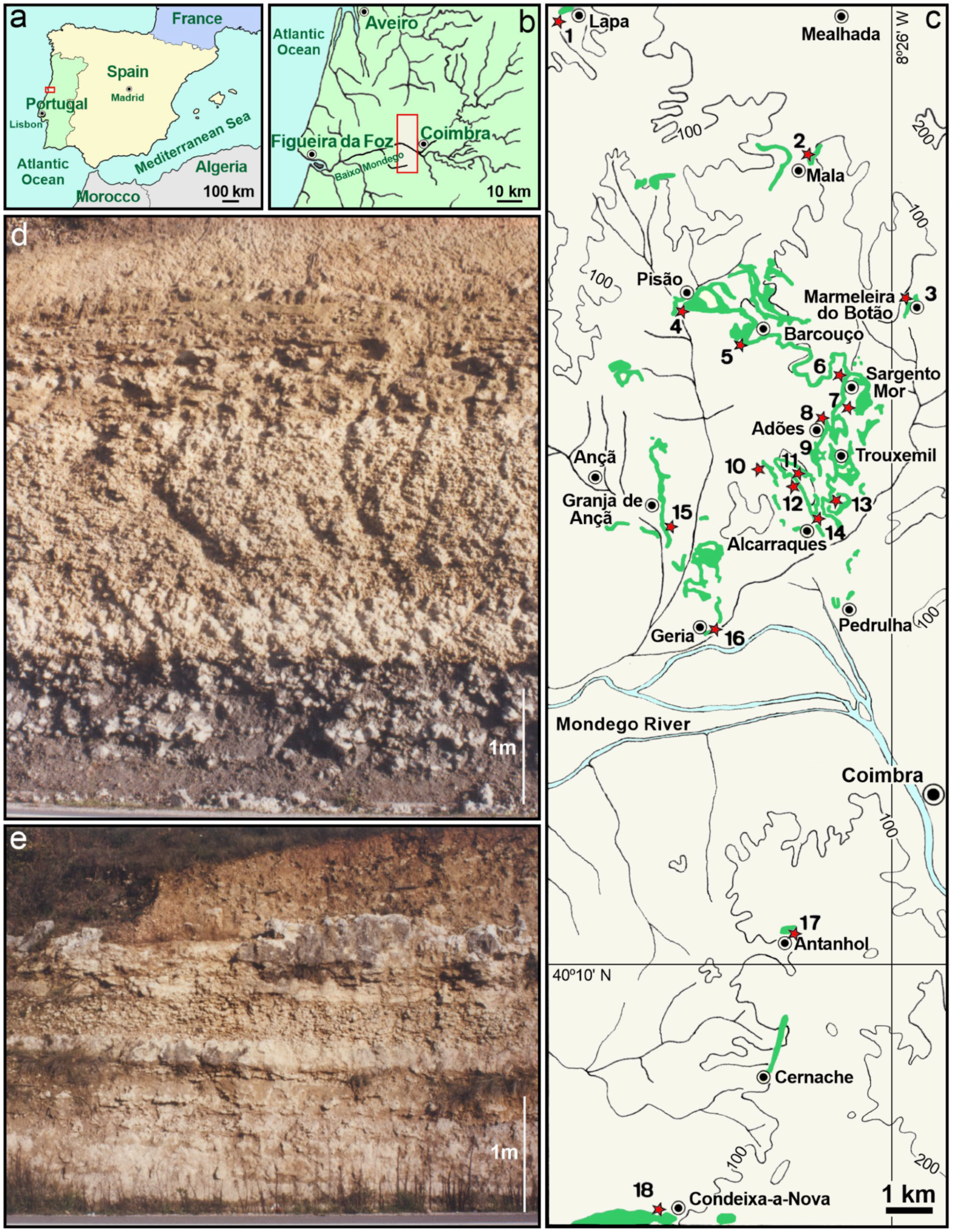
2. Geographical and Geological Setting
3. Materials and Methods
4. Systematic Palaeontology (by P. M. Callapez, F. Barroso-Barcenilla, M. Berrocal-Casero, and R. J. Pimentel)
4.1. Generic Diagnosis
4.2. Derivatio Nominis
4.3. Type Locality
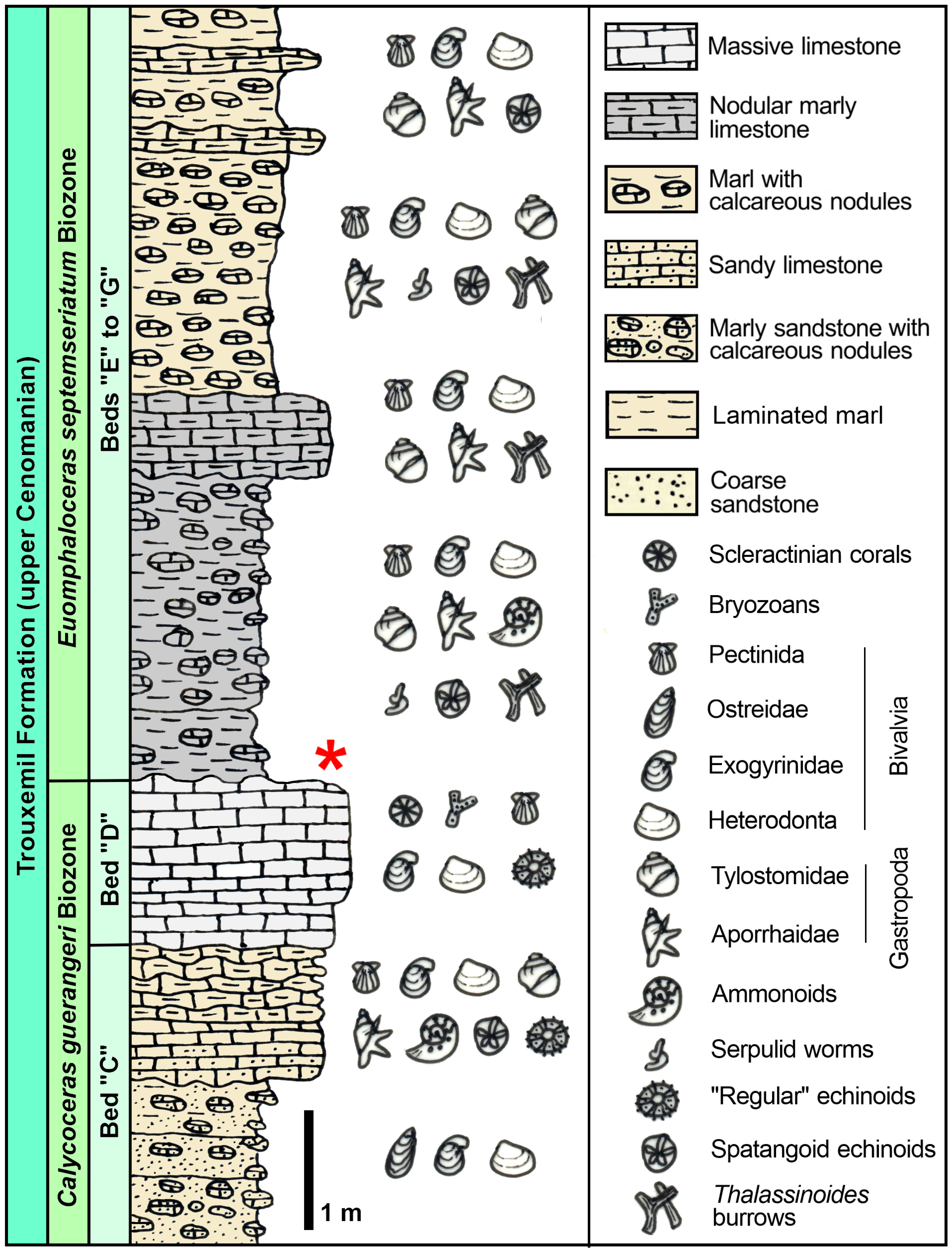
4.4. Type Horizon
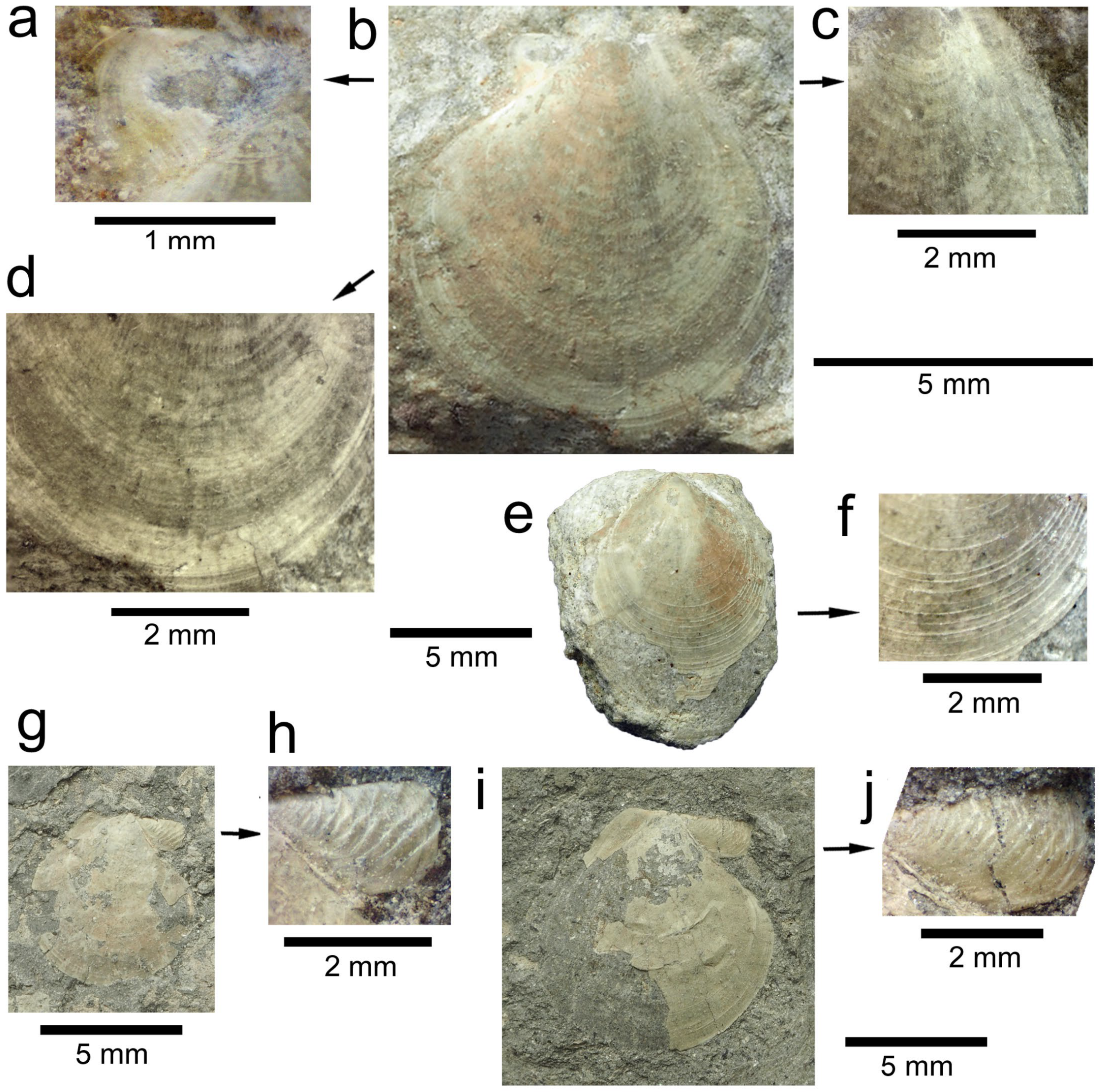
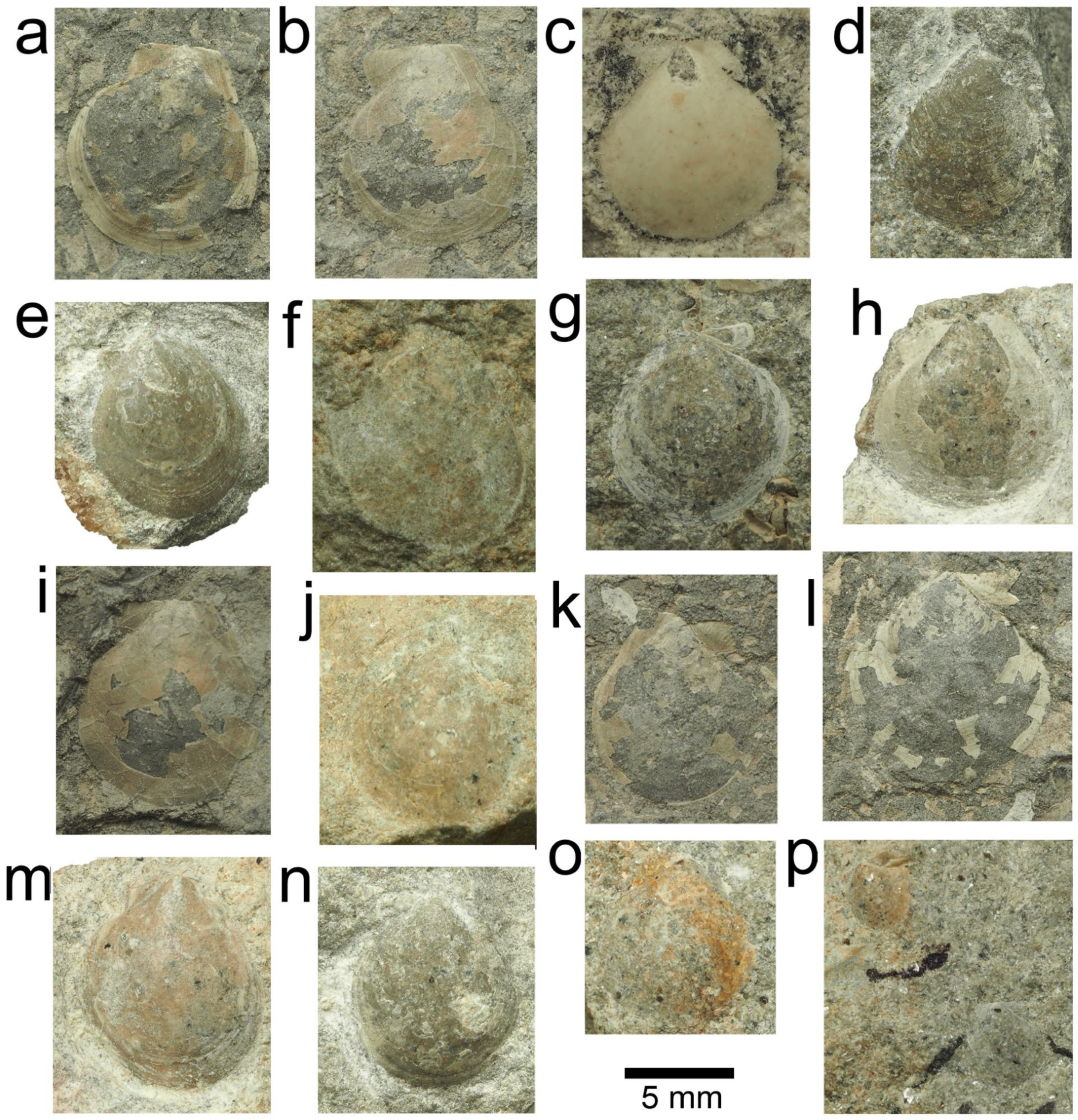
4.5. Diagnosis
4.6. Geographical and Stratigraphic Distribution
4.7. Discussion
5. Range and Palaeoenvironment
- (a)
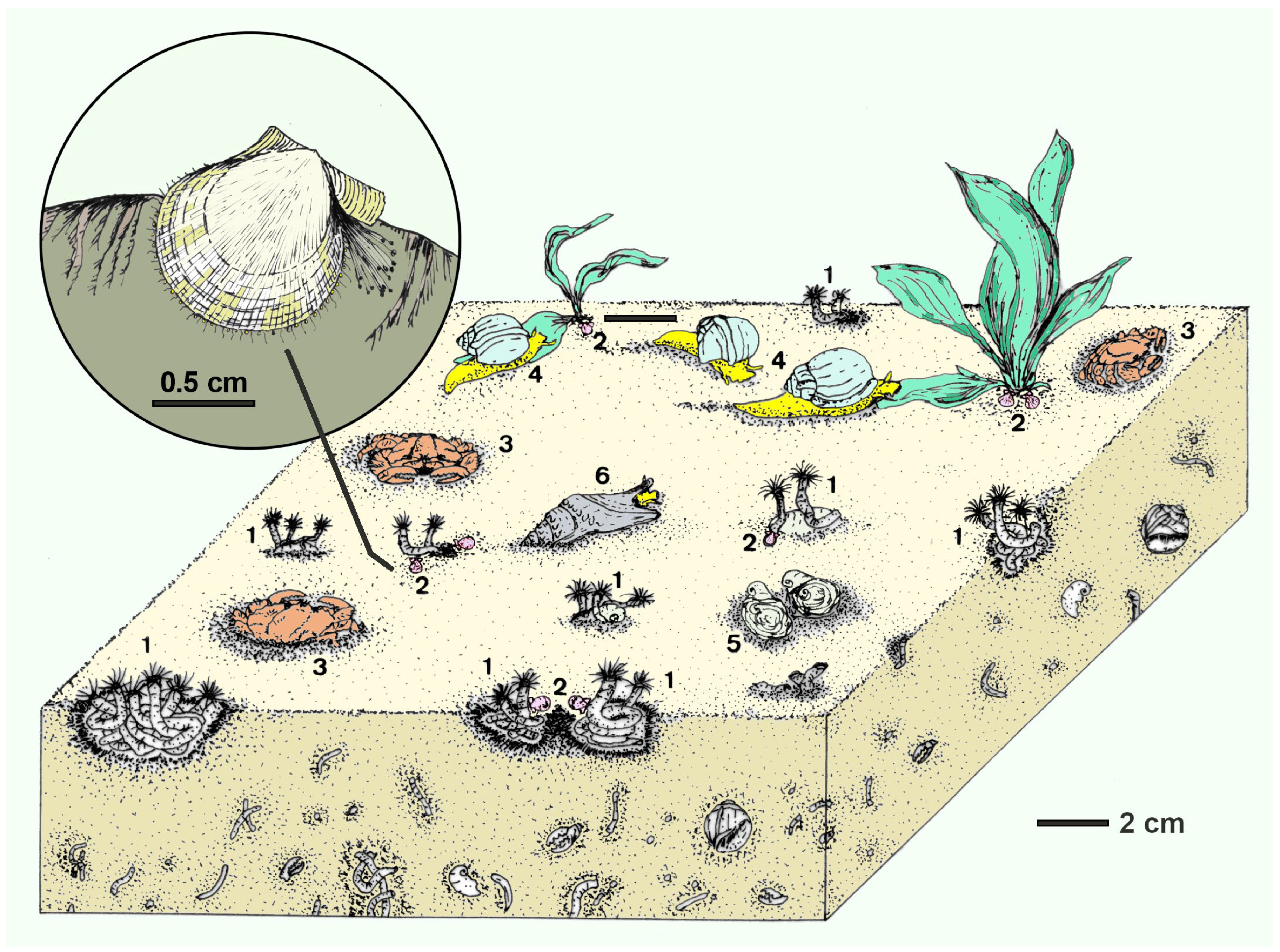
- Shallow infralittoral facies of micaceous, yellowish sandy limestones interbedded with fine-grained micaceous sandstones. These beds are characterised by the abondance of small tubes of serpulid worms, together with Rhynchostreon, small infaunal bivalves (e.g., Nuculana), gastropods (e.g., Aporrhais), and undetermined Decapoda claws. These invertebrates are part of a low-diversity faunal assemblage dominated by epifaunal suspension feeders (Figure 5), described as the “Syncyclonema ?simplicia and Serpula” fossil-association [53,54]. They characterise a shallow, low- to moderate-energy environment with elevated nutrient levels. According to Bishop [162], Syncyclonema-dominated assemblages may co-occur with Decapoda crustaceans (predominantly detritus feeders), where bioturbation by decapods potentially enhances nutrient recycling for suspension-feeding bivalves. This interpretation is consistent with the presence of undisturbed micaceous laminae, indicating limited sediment reworking.
- (b)
- Shallow infralittoral facies of finely laminated greyish marls. These beds are restricted to a limited area near Condeixa-a-Nova, adjacent to the southern margin of the studied region. The new species Syncyclonema goyi sp. nov. is highly abundant here, with its disarticulated valves co-occurring alongside crushed shells and moulds of Nuculana sp., small Pseudoptera anomala, Neithea hispanica, and Paraesa cf. faba, sometimes accompanied by numerous fragments of macroalgal calcified thalli. This assemblage can be interpreted as a relict of a suspension-feeder-dominated palaeocommunity adapted to a low-energy, fully marine environment with argillaceous, fine-grained substrates. The relatively oxygenated conditions, likely maintained by periodic currents or bioturbation, combined with the proliferation of macroalgae (possibly forming hardgrounds), provided attachment substrates for small byssate bivalves.
6. Conclusions
Author Contributions
Funding
Data Availability Statement
Acknowledgments
Conflicts of Interest
References
- Cox, I. The Scallop. Studies of a Shell and Its Influences on Humankind; “Shell” Transport and Trading Company: London, UK, 1957; pp. 1–135. [Google Scholar]
- Rombouts, A. Guidebook to Pecten Shells. Recent Pectinidae and Propeamussidae of the World; Robert Hale: London, UK, 1991; pp. 1–157. [Google Scholar]
- Kauffman, E.G. Cretaceous Bivalvia. In Atlas of Paleobiogeography; Hallam, A., Ed.; Elsevier: Amsterdam, The Netherlands, 1973; pp. 353–383. [Google Scholar]
- Dhondt, A.V. Systematic revision of Entolium, Propeamussium (Amusiidae) and Syncyclonema (Pectinidae, Bivalvia, Mollusca) of the European boreal Cretaceous. Bull. Inst. R. Sci. Nat. Belg. Sci. Terre 1971, 47, 1–95. [Google Scholar]
- Dhondt, A.V. Systematic revision of the Chlamydinae (Pectinidae, Bivalvia, Mollusca) of the European Cretaceous. Part 1: Camptonectes. Bull. Inst. R. Sci. Nat. Belg. Sci. Terre 1972, 48, 1–60. [Google Scholar]
- Dhondt, A.V. Systematic revision of the Chlamydinae (Pectinidae, Bivalvia, Mollusca) of the European Cretaceous. Part 2: Lyropecten. Bull. Inst. R. Sci. Nat. Belg. Sci. Terre 1972, 48, 1–81. [Google Scholar]
- Dhondt, A.V. Systematic revision of the Chlamydinae (Pectinidae, Bivalvia, Mollusca) of the European Cretaceous. Part 3: Chlamys and Mimachlamys. Bull. Inst. R. Sci. Nat. Belg. Sci. Terre 1973, 49, 1–134. [Google Scholar]
- Dhondt, A.V. Systematic revision of the subfamily Neitheinae (Pectinidae, Bivalvia, Mollusca) of the European Cretaceous. Mém. Inst. R. Sci. Nat. Belg. 1973, 176, 1–99. [Google Scholar]
- Dhondt, A.V. Systematic revision of the Chlamydinae (Pectinidae, Bivalvia, Mollusca) of the European Cretaceous. Part 4: Merklinia. Bull. Inst. R. Sci. Nat. Belg. Sci. Terre 1976, 52, 1–38. [Google Scholar]
- Dhondt, A.V. Répartition des bivalves (sans inocérames ou rudistes) dans le Crétacé moyen. Cretac. Res. 1981, 2, 307–318. [Google Scholar] [CrossRef]
- Dhondt, A.V. Bivalvia (Mollusca) from the Maastrichtian of Hemmoor (NW Germany) and their palaeobiogeographical affinities. Geol. Jahrb. 1982, A61, 73–107. [Google Scholar]
- Dhondt, A.V. Some Spanish Cretaceous bivalves. Cuad. Geol. Ibér. 1983, 8, 847–865. [Google Scholar]
- Dhondt, A.V. Bivalves ptériomorphes du Sénonien dans le Bassin parisien et le sud-ouest de la France. Géol. Méditerr. 1985, 10, 213–218. [Google Scholar] [CrossRef]
- Dhondt, A.V. Bivalves from the Hochmoos Formation (Gosau-Group, Oberösterreich, Austria). Ann. Nat. Hist. Mus. Vienna 1987, 88A, 41–101. [Google Scholar]
- Dhondt, A.V. Palaeogeographic distribution of Cretaceous Tethyan non-rudist bivalves. In New Aspects on Tethyan Cretaceous Fossil Assemblages; Kollmann, H.A., Zapfe, H., Eds.; Springer: Berlin/Heidelberg, Germany, 1992; Volume 9, pp. 75–94. [Google Scholar]
- Dhondt, A.V. Upper Cretaceous bivalves from Tercis, Landes, SW France. Bull. Inst. R. Sci. Nat. Belg. Sci. Terre 1993, 63, 211–259. [Google Scholar]
- Cleevely, R.J.; Morris, N.J. An introduction to molluscs and bivalves. In Fossils of the Chalk. Palaeontological Association Field Guides to Fossils, 2; Smith, A.B., Batten, D.J., Eds.; The Palaeontological Association: London, UK, 1987; pp. 99–160. [Google Scholar]
- Dhondt, A.V.; Dieni, I. Rudist-associated Cretaceous bivalves. Saito Ho-On Kai Spec. Publ. 1991, 3, 193–200. [Google Scholar]
- Dhondt, A.V.; Dieni, I. Non rudistid bivalves from Cretaceous rudist formations. Geol. Romana 1992, 28, 211–218. [Google Scholar]
- Dhondt, A.V.; Dieni, I. Non-rudistid bivalves from Late Cretaceous rudist limestones of NE Italy (Col dei Schiosi and Lago di S. Croce areas). Mem. Sci. Geol. 1993, 45, 165–241. [Google Scholar]
- Malchus, N.; Dhondt, A.V.; Tröger, K.A. Upper Cretaceous bivalves from the Glauconie de Lonzée near Gembloux (SE Belgium). Bull. Inst. R. Sci. Nat. Belg. Sci. Terre 1994, 64, 109–149. [Google Scholar]
- Smettan, K. Bivalven, Gastropoden und Serpuliden aus den Branderfleckschichten (Cenoman) der Fahrenbergmulde (Nördliche Kalkalpen, Bayern): Taxonomie und palökologie. Zitteliana 1997, 21, 99–158. [Google Scholar]
- Dhondt, A.V.; Freneix, S. Cretaceous bivalves and Alcide d’Orbigny. Comptes Rendus Palevol 2002, 1, 555–564. [Google Scholar] [CrossRef]
- Morris, N.J.; Knight, R.I.; Cleevely, R.J. Bivalves. In Fossils of the Gault Clay; Young, J.R., Gale, A.S., Knight, R.I., Smith, A.B., Eds.; Palaeontological Association Field Guides to Fossils, 12; The Palaeontological Association: London, UK, 2010; pp. 59–85. [Google Scholar]
- Schneider, S.; Jager, M.; Kroh, A.; Mitterer, A.; Niebuhr, B.; Vodražka, R.; Wilmsen, M.; Wood, C.J.; Zagoršek, K. Silicified Sea life. Macrofauna and palaeoecology of the Neuburg Kieselerde Member (Cenomanian to lower Turonian Wellheim Formation, Bavaria, southern Germany). Acta Geol. Pol. 2013, 63, 555–610. [Google Scholar] [CrossRef]
- Niebuhr, B.; Schneider, S.; Wilmsen, M. Kreide-Fossilien in Sachsen, Teil 1. Cretaceous fossils of Saxony, part 1.–5. Muscheln. 5. Bivalves. Geol. Saxonica J. Cent. Eur. Geol. 2014, 60, 83–168. [Google Scholar]
- Kunstmüllerová, L.; Košťák, M. Changes in bivalve assemblages at the onset of the OAE2 event in the Peri-Tethyan area (Bohemian Cretaceous Basin). Cretac. Res. 2024, 153, 105704. [Google Scholar] [CrossRef]
- Choffat, P.L. Recueil de Monographies Stratigraphiques sur le Système Crétacique du Portugal, Deuxième Etude, Le Crétacé Supérieur au Nord du Tage; Direction des Services Géologiques du Portugal: Lisbonne, Portugal, 1900; pp. 1–287. [Google Scholar]
- Beauvais, M.; Berthou, P.Y.; Lauverjat, J. Le gisement campanien de Mira (Beira Litorale, Portugal): Sédimentologie, micropaléontologie, révision des Madréporaires. Comun. Serv. Geol. Port. 1975, 59, 37–58. [Google Scholar]
- Ribeiro, A.; Antunes, M.T.; Ferreira, P.; Rocha, R.B.; Soares, A.F.; Zbyszewsky, G.; Almeida, F.M.; Carvalho, D.; Monteiro, J. Introduction à la Géologie Générale du Portugal; Serviços Geológicos de Portugal: Lisboa, Portugal, 1979; pp. 1–114. [Google Scholar]
- Lauverjat, J. Le Crétacé Supérieur dans le Nord du Bassin Occidental Portugais. Ph.D. Thesis, Université Pierre et Marie Curie, Paris, France, 1982. [Google Scholar]
- Sharpe, D. On Tylostoma, a proposed genus of gasteropodous molluscs. Q. J. Geol. Soc. Lond. 1849, 5, 375–380. [Google Scholar] [CrossRef]
- Sharpe, D. Remarks on the genus Nerinea, with an account of the species found in Portugal. Q. J. Geol. Soc. Lond. 1850, 6, 101–115. [Google Scholar] [CrossRef]
- Sharpe, D. On the Secondary District of Portugal which lies on the North of the Tagus. Q. J. Geol. Soc. Lond. 1850, 6, 135–201. [Google Scholar] [CrossRef]
- Choffat, P.L. Recueil de Monographies Stratigraphiques sur le Système Crétacique du Portugal, Première Etude, Contrée de Cintra, de Bellas et de Lisbonne; Section des Travaux Géologiques du Portugal: Lisbonne, Portugal, 1885; pp. 1–68. [Google Scholar]
- Choffat, P.L. Recueil d’études Paléontologiques sur la Faune Crétacique du Portugal, I—Espèces Nouvelles ou peu Connues; Section des Travaux Géologiques du Portugal: Lisbonne, Portugal, 1886; pp. 1–40. [Google Scholar]
- Choffat, P.L. Note sur le Crétacique des environs de Torres Vedras, de Peniche et de Cercal. Comun. Commissão Serv. Geol. Port. 1891, 2, 171–215. [Google Scholar]
- Choffat, P.L. Recueil d’Etudes Paléontologiques sur la Faune Crétacique du Portugal, II—Les Ammonées du Bellasien, des Couches à Neolobites vibrayeanus, du Turonien et du Sénonien; Section des Travaux Géologiques du Portugal: Lisbonne, Portugal, 1898; pp. 1–45. [Google Scholar]
- Choffat, P.L. Recueil d’Etudes Paléontologiques sur la Faune Crétacique du Portugal, Vols. III–IV—Mollusques du Sénonien à Faciès Fluviomarin—Espèces Nouvelles ou Peu Connues; Direction des Services Géologiques du Portugal: Lisbonne, Portugal, 1901; pp. 1–84. [Google Scholar]
- Choffat, P.L. Espèces nouvelles ou peu connues du Mésozoïque portugais. II—Espèces du Crétacique. J. Conchol. 1906, 54, 33–41. [Google Scholar]
- Costa, J.C. O Neocretácico da Beira Litoral. Publ. Mus. Lab. Miner. Geol. Fac. Ciênc. Porto 1937, 5, 1–33. [Google Scholar]
- Costa, J.C. Os fósseis de Aveiro e algumas considerações geológicas. Arq. Aveiro 1941, 7, 83–98. [Google Scholar]
- Moura, A. Alguns equinídeos regulares fósseis da Costa d’Arnes, Alfarelos, Coimbra. Mem. Notíc. 1958, 45, 61–72. [Google Scholar]
- Soares, A.F. Considerações sobre as Exogyra columba Lam., Exogyra flabellata Gold. e Exogyra olisiponensis Sharpe do Cretácico das regiões de Coimbra e Figueira da Foz. Mem. Notíc. 1960, 49, 21–40. [Google Scholar]
- Soares, A.F. Estudo das formações pós-jurássicas das regiões de entre Sargento-Mor e Montemor-o-Velho (margem direita do Rio Mondego). Mem. Notíc. 1966, 62, 1–343. [Google Scholar]
- Soares, A.F. Nouveau genre de Lamellibranche Hétérodonte du Crétacé du Portugal. Mem. Notíc. 1967, 64, 58–67. [Google Scholar]
- Soares, A.F. Uma nova espécie da família Trochidae—Calliostoma (Calliostoma) choffati—No Cretácico Superior de Portugal Metropolitano. Rev. Ciênc. Geol. Ser. A 1968, 1, 49–53. [Google Scholar]
- Soares, A.F. Estudo da distribuição dos ostreídeos do Cretácico Superior (Cenomaniano superior e Turoniano inferior) na região entre Sargento-Mor e Montemor-o-Velho (Margem direita do Rio Mondego). Rev. Ciênc. Geol. Ser. A 1968, 1, 55–72. [Google Scholar]
- Soares, A.F. Contribuição para o estudo do Cretácico em Portugal (o Cretácico Superior da Costa de Arnes). Mem. Notíc. 1972, 74, 1–56. [Google Scholar]
- Berthou, P.Y.; Brower, J.C.; Reyment, R.A. Morphometrical study of Choffat’s vascoceratids from Portugal. Bull. Geol. Inst. Univ. Upps. 1975, 6, 73–83. [Google Scholar]
- Berthou, P.Y.; Chancellor, G.; Lauverjat, J. Revision of the Cenomanian–Turonian Ammonite Vascoceras Choffat, 1898, from Portugal. Comun. Serv. Geol. Port. 1985, 71, 55–79. [Google Scholar]
- Amédro, F.; Berthou, P.Y.; Lauverjat, J. Nouvelles preuves de l’apparition au Cénomanien supérieur des premiers Vascoceras dans la série type de la basse vallée du Rio Mondego (Beira Litoral, Portugal). Bol. Soc. Geol. Port. 1980, 22, 153–162. [Google Scholar]
- Callapez, P.M. Estudo Paleoecológico dos Calcários de Trouxemil (Cenomaniano–Turoniano) na Região Entre a Mealhada e Condeixa-a-Nova (Portugal Central). MSc Thesis, University of Coimbra, Coimbra, Portugal, 1992. [Google Scholar]
- Callapez, P.M. Estratigrafia e Paleobiologia do Cenomaniano–Turoniano. O Significado do eixo da Nazaré-Leiria-Pombal. Ph.D. Thesis, University of Coimbra, Coimbra, Portugal, 1998. [Google Scholar]
- Callapez, P.M. Palaeobiogeographic evolution and marine faunas of the Mid-Cretaceous Western Portuguese Carbonate Platform. Thalassas 2008, 24, 29–52. [Google Scholar]
- Savazzi, E. Functional morphology and autecology of Pseudoptera (bakevelliid bivalves, Upper Cretaceous of Portugal). Palaeogeogr. Palaeoclimatol. Palaeoecol. 1984, 46, 313–324. [Google Scholar] [CrossRef]
- Barroso-Barcenilla, F.; Callapez, P.M.; Soares, A.F.; Segura, M. Cephalopod assemblages and depositional sequences from the upper Cenomanian and lower Turonian of the Iberian Peninsula (Spain and Portugal). J. Iber. Geol. 2011, 37, 9–28. [Google Scholar] [CrossRef]
- Barroso-Barcenilla, F.; Callapez, P.M.; Segura, M. Revision and new data of the Coniacian ammonite genus Hemitissotia in the Iberian Peninsula (Spain and Portugal). Paläontol. Z. 2013, 87, 201–217. [Google Scholar] [CrossRef]
- Barroso-Barcenilla, F.; Brandão, J.M.; Callapez, P.M.; Santos, V.F. Rediscovery of the holotypes of the Cenomanian (Upper Cretaceous) ammonites Vascoceras gamai Choffat, 1898, and Vascoceras barcoicense (Choffat, 1898). Cretac. Res. 2015, 56, 647–650. [Google Scholar] [CrossRef]
- Barroso-Barcenilla, F.; Antunes, M.T.; Brandão, J.M.; Callapez, P.M.; Santos, V.F. The d’Orbigny Palaeontological Collection of the National Museum of Natural History and Science, Lisbon, Portugal: Historical perspective and revision of Cretaceous Cephalopoda. Geodiversitas 2018, 40, 505–519. [Google Scholar] [CrossRef]
- Ozkaya de Juanas, S.; Barroso-Barcenilla, F.; Berrocal-Casero, M.; Callapez, P. Virtual fossils for widening Geoeducation approaches: A case study based on the Cretaceous sites of Figueira da Foz (Portugal) and Tamajón (Spain). Geosciences 2023, 13, 16. [Google Scholar] [CrossRef]
- Berthou, P.Y. Le Cénomanien de l’Estrémadure portugaise. Mem. Serv. Geol. Port. 1973, 23, 1–169. [Google Scholar]
- Berthou, P.Y. La transgression cénomanienne dans le Bassin Occidental Portugais. Geol. Mediterr. 1978, 5, 31–38. [Google Scholar] [CrossRef]
- Berthou, P.Y. Résumé synthétique de la stratigraphie et de la paléogéographie du Crétacé moyen et supérieur du bassin occidental portugais. Geonovas 1984, 7, 99–120. [Google Scholar]
- Berthou, P.Y.; Lauverjat, J. Essai de synthèse paléogéographique du Bassin Occidental Portugais au cours du Crétacé Supérieur. Ciênc. Terra 1979, 5, 121–144. [Google Scholar]
- Berthou, P.Y.; Ferreira Soares, A.; Lauverjat, J. Portugal, in: Mid Cretaceous Events Iberian Field Conference 77, Guide-book 1. Cuad. Geol. Ibér. 1979, 5, 31–124. [Google Scholar]
- Hancock, J.M.; Kauffman, E.G. The great transgressions of the Late Cretaceous. J. Geol. Soc. Lond. 1979, 136, 175–186. [Google Scholar] [CrossRef]
- Haq, B.U.; Hardenbol, J.; Vail, P.R. Mesozoic and Cenozoic Chronostratigraphy and Eustatic Cycles. In Sea-Level Changes, an Integrated Approach; Wilgus, C.K., Hastings, B.S., Kendall, C.G.S.C., Posamentier, H., Ross, C.A., Wagoner, J.C., Eds.; SEPM Special Publication: Tulsa, OK, USA, 1988; Volume 42, pp. 71–108. [Google Scholar]
- Hart, M.B. Cretaceous sea level changes and global eustatic curves; evidence from SW England. Proc. Ussher Soc. 1990, 7, 268–272. [Google Scholar]
- Hancock, J.; Kennedy, W.J.; Cobban, W. A correlation of the upper Albian to basal Coniacian sequences of Northwest Europe, Texas and the United States Western Interior. In The Evolution of the Western Interior Basin; Caldwell, W., Kauffman, E.G., Eds.; Special Paper; GAC: St. John’s, NL, USA, 1993; Volume 39, pp. 453–476. [Google Scholar]
- Hardenbol, J.; Thierry, J.; Farley, M.B.; Jacquin, T.; de Graciansky, P.C.; Vail, P.R. Mesozoic and Cenozoic sequence chronostratigraphic framework of European basins, Chart 1, Mesozoic and Cenozoic sequence chronostratigraphic chart. In Mesozoic and Cenozoic Sequence Stratigraphy of European Basins; Graciansky, P.C., Hardenbol, J., Jacquin, T., Vail, P., Eds.; SEPM Special Publication: Tulsa, OK, USA, 1998; Volume 60, pp. 3–13. [Google Scholar]
- Haq, B.U. Cretaceous eustasy revisited. Glob. Planet. Change 2014, 113, 44–58. [Google Scholar] [CrossRef]
- Callapez, P.M.; Gil Gil, J.; Garcia-hidalgo, J.; Segura, M.; Barroso-Barcenilla, F.; Carenas, B. The Tethyan oyster Pycnodonte (Costeina) costei (Coquand, 1869) in the Coniacian (Upper Cretaceous) of the Iberian Basin (Spain): Taxonomic, palaeoecological and palaeobiogeographical implications. Palaeogeogr. Palaeoclimatol. Palaeoecol. 2015, 435, 105–117. [Google Scholar] [CrossRef]
- Dinis, J.L.; Trincão, P. Controlos deposicionais e biostratigrafia da base dos ‘grés belasianos’ (Aptiano, Bacia Lusitaniana). Comum. Serv. Geol. Port. 1991, 77, 89–102. [Google Scholar]
- Dinis, J.L. Estratigrafia e Sedimentologia da Formação da Figueira da Foz—Aptiano a Cenomaniano do Sector Norte da Bacia Lusitânica. Ph.D. Thesis, University of Coimbra, Coimbra, Portugal, 1999. [Google Scholar]
- Dinis, J.L. Definição da Formação da Figueira da Foz—Aptiano a Cenomaniano do sector central da margem oeste ibérica. Comun. Inst. Geol. Min. 2001, 88, 127–160. [Google Scholar]
- Dinis, J.L.; Rey, J.; Graciansky, P.C. Le Bassin Lusitanien (Portugal) à l’Aptien supérieur–Albien, organisation séquentielle, proposition de corrélations, évolution. Comptes Rendus Geosci. 2002, 334, 757–764. [Google Scholar] [CrossRef]
- Dinis, J.L.; Rey, J.; Cunha, P.P.; Callapez, P.M.; Reis, R.P. Stratigraphy and allogenic controls on the western Portugal Cretaceous, an updated synthesis. Cretac. Res. 2008, 29, 772–780. [Google Scholar] [CrossRef]
- Wilson, R.C.L. A reconnaissance study of Upper Jurassic sediments of the Lusitanian Basin. Ciênc. Terra 1979, 5, 53–84. [Google Scholar]
- Wilson, R.C.L. Mesozoic development of the Lusitanian Basin, Portugal. Rev. Soc. Geol. Esp. 1988, 1, 393–407. [Google Scholar]
- Rey, J. Le Crétacé Inférieur de la marge atlantique portugaise: Biostratigraphie, organisation séquentielle, évolution paléogéographique. Ciênc. Terra 1979, 5, 97–121. [Google Scholar]
- Rey, J. Dynamique et paléoenvironnements du bassin mésozoïque d’Estremadura (Portugal), au Crétacé Inférieur. Cretac. Res. 1982, 3, 103–111. [Google Scholar] [CrossRef]
- Rey, J. Stratigraphie séquentielle et séquences de dépôt dans le Crétacé Inférieur du Bassin Lusitanien. Ciênc. Terra 2006, 6, 1–120. [Google Scholar]
- Rey, J. La dynamique sédimentaire des Bassins Lusitanien et de l’Algarve au Crétacé Inférieur. Ciênc. Terra 2010, 17, 45–52. [Google Scholar]
- Wilson, R.C.L.; Hiscott, R.; Willis, M.; Gradstein, F. The Lusitanian Basin of west central Portugal, Mesozoic and Tertiary tectonic, stratigraphic and subsidence history. In Extensional Tectonics and Stratigraphy of the North Atlantic Margins; Tankard, A., Balkwill, H., Eds.; AAPG Mem.; AAPG: Tulsa, OK, USA, 1989; Volume 46, pp. 341–361. [Google Scholar]
- Hiscott, R.N.; Wilson, R.; Gradstein, F.M.; Pujalte, V.; García-Mondéjar, J.; Boudreau, R.R.; Wishart, H.A. Comparative stratigraphy and subsidence history of Mesozoic rift basins of North Atlantic. AAPG Bull. 1990, 74, 60–76. [Google Scholar] [CrossRef]
- Pinheiro, L.; Wilson, R.; Reis, R.P.; Whitmarsh, R.; Ribeiro, A. The western Iberia margin, a geophysical and geological overview. Proc. ODP Sci. Results 1996, 149, 3–23. [Google Scholar]
- Rasmussen, E.S.; Lomholt, S.; Andersen, C.; Vejbæk, O.V. Aspects of the structural evolution of the Lusitanian Basin in Portugal and the shelf and slope area offshore Portugal. Tectonophys 1998, 300, 199–225. [Google Scholar] [CrossRef]
- Alves, T.M.; Gawthorpe, R.L.; Hunt, D.W.; Monteiro, J.H. Post-Jurassic tectono-sedimentary evolution of the Northern Lusitanian Basin (Western Iberian margin). Basin Res. 2003, 15, 227–250. [Google Scholar] [CrossRef]
- Alves, T.M.; Manuppella, G.; Gawthorpe, R.L.; Hunt, D.W.; Monteiro, J.H. The depositional evolution of diapir- and fault-bounded rift basins: Examples from the Lusitanian Basin of West Iberia. Sediment. Geol. 2003, 162, 273–303. [Google Scholar] [CrossRef]
- Alves, T.M.; Moita, C.; Sandnes, F.; Cunha, T.; Monteiro, J.H.; Pinheiro, L.M. Mesozoic–Cenozoic evolution of North Atlantic continental-slope basins: The Peniche basin, western Iberian margin. AAPG Bull. 2006, 90, 31–60. [Google Scholar] [CrossRef]
- Alves, T.M.; Moita, C.; Cunha, T.; Ullnaess, M.; Myklebust, R.; Monteiro, J.H.; Manuppella, G. Diachronous evolution of Late Jurassic–Cretaceous continental rifting in the northeast Atlantic (west Iberian margin). Tectonics 2009, 28, 1–32. [Google Scholar] [CrossRef]
- Dinis, P.A.; Dinis, J.L.; Tassinari, C.; Carter, A.; Callapez, P.M.; Morais, M. Detrital zircon geochronology of the Cretaceous succession from the Iberian Atlantic Margin, palaeogeographic implications. Int. J. Earth Sci. (Geol. Rundsch.) 2016, 105, 727–745. [Google Scholar] [CrossRef]
- Dinis, P.A.; Vermesch, P.; Callapez, P.M. Detrital zircon age signatures of the Mesozoic in the Lusitanian Basin and implications for the evolution of Iberia–Newfoundland conjugate margins. Terra Nova 2023, 35, 203–212. [Google Scholar] [CrossRef]
- Cunha, P.P. Estratigrafia e Sedimentologia dos Depósitos do Cretácico Superior e Terciário de Portugal Central, a Leste de Coimbra. Ph.D. Thesis, University of Coimbra, Coimbra, Portugal, 1982. [Google Scholar]
- Cunha, P.P.; Reis, R.P. Cretaceous sedimentary and tectonic evolution of the northern sector of the Lusitanian Basin (Portugal). Cretac. Res. 1995, 16, 155–170. [Google Scholar] [CrossRef]
- Callapez, P.M.; Barroso-Barcenilla, F.; Cambra-Moo, O.; Ortega, F.; Pérez-García, A.; Segura, M.; Torices, A. Fossil assemblages and palaeoenvironments in the Cenomanian vertebrate site of Nazaré (West Central Portugal). Neues Jahrb. Geol. Paläontol. Abh. 2014, 273, 179–195. [Google Scholar] [CrossRef]
- Santos, V.F.; Callapez, P.M.; Castanera, D.; Barroso-Barcenilla, F.; Rodrigues, N.P.C.; Cupeto, C.A. Dinosaur tracks from the Early Cretaceous of Parede tracksite (Cascais, Portugal): New implications on the sauropod palaeobiology of the Iberian Peninsula. J. Iber. Geol. 2015, 41, 155–166. [Google Scholar] [CrossRef]
- Berthou, P.Y. Albian-Turonian stage boundaries and subdivisions in the Western Portuguese Basin, with special emphasis on the Cenomanian–Turonian boundary in the Ammonite Facies and Rudist Facies. Bull. Geol. Soc. Den. 1984, 33, 41–45. [Google Scholar] [CrossRef]
- Berthou, P.Y. Zonation par les Ammonites du Cénomanien supérieur et du Turonien inférieur du Bassin Occidental Portugais. In Proceedings of the First Spanish Congress of Geology, Segovia, Spain, 14 April 1984; pp. 13–26. [Google Scholar]
- Segura, M.; Barroso-Barcenilla, F.; Callapez, P.M.; García-Hidalgo, J.F.; Gil, J. Depositional sequences and cephalopod assemblages in the upper Cenomanian—Lower Santonian of the Iberian Peninsula (Spain and Portugal). Geol. Acta 2014, 12, 19–27. [Google Scholar] [CrossRef]
- Hart, M.B.; Callapez, P.M.; Fisher, J.K.; Hannant, K.; Monteiro, J.F.; Price, G.D.; Watkinson, M.P. Micropalaeontology and stratigraphy of the Cenomanian/Turonian boundary in the Lusitanian Basin, Portugal. J. Iber. Geol. 2005, 31, 311–326. [Google Scholar]
- Choffat, P.L. Coup d’œil sur les mers mésozoiques du Portugal. Vierteljahrsschr. Naturforschenden Ges. Zür. 1896, 41, 294–317. [Google Scholar]
- Choffat, P.L. Sur le Crétacique de la région du Mondego. Comptes Rendus Acad. Sci. 1897, 124, 422–424. [Google Scholar]
- Choffat, P.L. Parallélisme entre le Crétacique du Mondego et celui de Lisbonne. Comptes Rendus Acad. Sci. 1897, 124, 519–521. [Google Scholar]
- Choffat, P.L. Faciès ammonitique et faciès récifal du Turonien Portugais. Bull. Soc. Géol. Fr. 1897, 25, 470–478. [Google Scholar]
- Berthou, P.Y.; Lauverjat, J. La limite Cénomano–Turonien. Essai de corrélation entre la série Portugaise à Vascoceras et les séries de l’Europe du Sud-Ouest et de l’Afrique du Nord. Comptes Rendus Acad. Sci. 1974, 278, 2605–2608. [Google Scholar]
- Berthou, P.Y.; Lauverjat, J. Le Cénomano–Turonien à Vascocératidés dans sa région type (embouchure du Rio Mondego, Beira Litoral, Portugal), corrélations avec le stratotype du Mans et d’autres séries téthysiennes. Newsl. Stratigr. 1975, 4, 96–118. [Google Scholar] [CrossRef]
- Berthou, P.Y.; Lauverjat, J. La limite Cénomano–Turonien dans les principaux faciès du bassin occidental Portugais. Comptes Rendus Acad. Sci. 1976, 282, 2143–2146. [Google Scholar]
- Soares, A.F. A “Formação Carbonatada” na região do Baixo Mondego. Comun. Serv. Geol. Port. 1980, 66, 99–109. [Google Scholar]
- Rocha, R.B.; Manupella, G.; Mouterde, R.; Ruget, C.; Zbyszewski, G. Carta Geológica de Portugal na Escala de 1:50 000. Notícia Explicativa da Folha 19C—Figueira da Foz; Serviços Geológicos de Portugal: Lisboa, Portugal, 1981; pp. 1–126. [Google Scholar]
- Soares, A.F.; Barbosa, B.P.; Reis, R.P. Esboço de enquadramento cronostratigráfico das unidades líticas pós-jurássicas da Orla Meso-Cenozóica Ocidental entre os paralelos de Pombal e Aveiro. Mem. Notíc. 1982, 93, 77–91. [Google Scholar]
- Soares, A.F.; Reis, R.P.; Daveau, S. Tentativa de correlação das unidades litostratigráficas da região do Baixo Mondego com as das bacias de Lousã e Arganil. Mem. Notíc. 1983, 96, 3–20. [Google Scholar]
- Barbosa, B.P.; Soares, A.F.; Rocha, R.B.; Manuppella, G.; Henriques, M.H. Carta Geológica de Portugal, Escala 1:50 000. Notícia Explicativa da Folha 19A—Cantanhede; Serviços Geológicos de Portugal: Lisboa, Portugal, 1988; pp. 1–46. [Google Scholar]
- Soares, A.F.; Marques, J.F.; Rocha, R.B. Contribuição para o conhecimento geológico de Coimbra. Mem. Notíc. 1985, 100, 41–72. [Google Scholar]
- Soares, A.F.; Lapa, M.; Marques, J.F. Contribuição para o conhecimento da litologia das unidades meso-cenozóicas da Bacia Lusitaniana a Norte do “acidente” da Nazaré (Sub-zona Setentrional). Mem. Notíc. 1986, 102, 23–41. [Google Scholar]
- Pimentel, R.J.; Audije-Gil, J.; Barroso-Barcenilla, F.; Berrocal-Casero, M.; Callapez, P.M.; Ozkaya de Juanas, S.; Segura, M. On the occurrence of Carentonosaurus Rage and Néraudeau, 2004 (Squamata, Pythonomorpha) in the Iberian Cretaceous, with description of a new species from the uppermost middle Cenomanian of West Portugal. Cretac. Res. 2023, 151, 105649. [Google Scholar] [CrossRef]
- Pimentel, R.J.; Barroso-Barcenilla, F.; Berrocal-Casero, M.; Callapez, P.M.; Ozkaya de Juanas, S.; Santos, V. On the occurrence of the Gar Obaichthys africanus Grande in the Cretaceous of Portugal: Palaeoecological and palaeobiogeographical implications. Geosciences 2023, 13, 372. [Google Scholar] [CrossRef]
- Berrocal-Casero, M.; Pimentel, R.; Callapez, P.M.; Barroso-Barcenilla, F.; Ozkaya de Juanas, S. On Segurasaurus (Squamata: Pythonomorpha), a new genus of lizard from the Cenomanian (Upper Cretaceous) of Portugal. Geosciences 2024, 14, 84. [Google Scholar] [CrossRef]
- Kennedy, W.J. Ammonite faunas and the “standard zones” of the Cenomanian to the Maastrichtian stages in their type areas, with some proposals for the definition of stage boundaries by ammonites. Bull. Geol. Soc. Den. 1984, 33, 147–161. [Google Scholar] [CrossRef]
- Kennedy, W.J. Integrated macrobiostratigraphy of the Albian to basal Santonian. Publ. Palaeontol. Inst. Univ. Upsala 1985, 5, 91–108. [Google Scholar]
- Kennedy, W.J. Ammonite biostratigraphy of the Albian to basal Santonian (Appendix 1). In Events of the Mid-Cretaceous; Reyment, R., Bengtson, P., Eds.; Pergamon Press: Oxford, UK, 1986; pp. 129–143. [Google Scholar]
- Bieler, R.; Mikkelsen, P.M. Bivalvia—A look at the branches. Zool. J. Linn. Soc. 2006, 148, 223–235. [Google Scholar] [CrossRef]
- Bouchet, P.; Rocroi, J.-P.; Bieler, R.; Carter, J.G.; Coan, E.V. Nomenclator of Bivalve Families with a Classification of Bivalve Families. Malacologia 2010, 52, 1–184. [Google Scholar]
- Bieler, R.; Mikkelsen, P.M.; Collins, T.M.; Glover, E.A.; González, V.L.; Graf, D.L.; Harper, E.M.; Healy, J.; Kawauchi, G.Y.; Sharma, P.P.; et al. Investigating the bivalve tree of life—An exemplar-based approach combining molecular and novel morphological characters. Invertebr. Syst. 2014, 28, 32–115. [Google Scholar] [CrossRef]
- Huber, M. Compendium of Bivalves. A Full-Colour Guide to 3,300 of the World’s Marine Bivalves. A Status on Bivalvia After 250 Years of Research; ConchBooks: Harxheim, Germany, 2010; pp. 1–901. [Google Scholar]
- Huber, M. Compendium of Bivalves 2. A Full-Colour Guide to the Remaining Seven Families. A Systematic Listing of 8,500 Bivalve Species and 10,500 Synonyms; ConchBooks: Harxheim. Germany, 2010; pp. 1–906. [Google Scholar]
- Carter, J.G.; Altaba, C.R.; Anderson, L.C.; Araujo, R.; Biakov, A.S.; Bogan, A.E.; Campbell, D.C.; Campbell, M.; Jin-hua, C.; Cope, J.C.W.; et al. A synoptical classification of the Bivalvia (Mollusca). Paleontol. Contrib. 2011, 4, 1–47. [Google Scholar] [CrossRef]
- WoRMS Editorial Board 2025. World Register of Marine Species. Available online: http://www.marinespecies.org (accessed on 17 November 2025).
- Newell, N.D. Classification of the Bivalvia. Am. Mus. Novit. 1965, 2206, 1–25. [Google Scholar]
- Moore, R.C. (Ed.) Treatise on Invertebrate Paleontology, Part N, Mollusca 6, Bivalvia; Geological Society of America and University of Kansas Press: Boulder, CO, USA, 1969; Volumes 1–3, pp. 1–490+491–952+953–1224. [Google Scholar]
- Waller, T.R. Morphology, morphoclines and a new classification of the Pteriomorphia (Mollusca: Bivalvia). Philos. Trans. R. Soc. Lond. B Biol. Sci. 1978, 284, 345–365. [Google Scholar] [CrossRef]
- Waller, T.R. New phylogenies of the Pectinidae (Mollusca: Bivalvia): Reconciling morphological and molecular approaches. In Scallops: Biology, Ecology and Aquaculture. Developments in Aquaculture and Fisheries Science, 35; Shumway, S.E., Parsons, G.J., Eds.; Elsevier: Amsterdam, The Netherlands, 2006; pp. 1–44. [Google Scholar]
- Linnaeus, C. Systema Naturae per Regna Tria Naturae, Secundum Classes, Ordines, Genera, Species, Cum Characteribus, Differentiis, Synonymis, Locis. Editio Decima, Reformata; Laurentii Salvii: Holmiae, Sweden, 1758. [Google Scholar]
- Beurlen, K. Beiträge zur Stammesgeschichte der Muscheln. Math.-Naturwissenschaftlichen Abt. Bayer. Akad. Wiss. München 1944, 1–2, 133–145. [Google Scholar]
- Gray, J.E. A revision of the genera of some of the families of conchifera or bivalve shells. Ann. Mag. Nat. Hist. Zool. Bot. Geol. Ser. 2 1854, 13, 408–418. [Google Scholar] [CrossRef]
- Teppner, W. Lamellibranchia Tertiaria, Anisomyaria II. In Fossilium Catalogus, I. Animalia, Pars 15; Diener, C., Ed.; W. Junk: Bberlin, Germany, 1922; pp. 67–296. [Google Scholar]
- Meek, F.B. Checklist of the invertebrate fossils of North America. Cretaceous and Jurassic. Smithson. Misc. Collect. 1864, 177, 1–40. [Google Scholar]
- Hall, J.; Meek, F.B. Descriptions of new species of fossils from the Cretaceous formations of Nebraska, with observations on Baculites ovatus and B. compressus, and the progressive development of the septa in Baculites, Ammonites and Scaphites. Mem. Am. Acad. Arts Sci. 1856, 5, 379–411. [Google Scholar] [CrossRef]
- Sowerby, J. The Mineral Conchology of Great Britain, or Coloured Figures and Descriptions of Those Remains of Testaceous Animals or Shells Which Have Been Preserved at Various Times and Depths in the Earth, vol. 3 (1818–1821); W. Arding: London, UK, 1818; Volume 2, pp. 1–251. [Google Scholar]
- Gabb, W.H. Synopsis of the Mollusca of the Cretaceous formations, including the geographical and stratigraphical range and synonymy. Proc. Am. Phil. Soc. 1861, 8, 150–245. [Google Scholar]
- Speden, I.G. Revision of Syncyclonema (Upper Cretaceous) and comparison with other small pectinid Bivalves and Entolium. Postilla 1967, 110, 1–36. [Google Scholar]
- Callapez, P.M.; Soares, A.F. A família Pectinidae (Mollusca, Bivalvia) no Cenomaniano-Turoniano do sector Norte da Orla Meso-Cenozóica Ocidental. Mem. Notíc. 1993, 115, 137–154. [Google Scholar]
- Sobetskiy, V.A. Paleobiological fades as exemplified by the Cenomanian Basin (southwestern Russian Platform). Int. Geol. Rev. 1967, 9, 713–722. [Google Scholar] [CrossRef]
- Nevesskaja, L.A. Morphogenesis and ecogenesis of Bivalves in the Phanerozoic. Paleontol. J. 2003, 37, 591–741. [Google Scholar]
- Nevesskaja, L.A. Ethological-trophic groups of bivalve mollusks and their distribution in the Phanerozoic. Paleontol. J. 2006, 40, 375–390. [Google Scholar] [CrossRef]
- Nevesskaja, L.A. Dynamics of taxonomic diversity of bivalves in the Phanerozoic. Paleontol. J. 2008, 42, 335–342. [Google Scholar] [CrossRef]
- Stephenson, L.W. The larger invertebrate fossils of the Navarro Group of Texas (Exclusive of Corals and Crustaceans and exclusive of the fauna of the Escondido Formation). Univ. Tex. Publ. 1941, 4101, 1–641. [Google Scholar]
- Stephenson, L.W. Larger invertebrate fossils of the Woodbine Formation (Cenomanian) of Texas. With Decapod crustaceans from the Woodbine Formation of Texas by H.B. Stenzel. USGS Prof. Pap. 1952, 242, 1–211. [Google Scholar]
- Anderson, F.M. Upper Cretaceous of the Pacific Coast. GSA Mem. 1958, 71, 1–378. [Google Scholar]
- Speden, I.G. The type Fox Hills Formation, Cretaceous (Maestrichtian), South Dakota. Part 2—Systematics of the Bivalvia. Bull. Peabody Mus. Nat. Hist. 1970, 33, 1–222. [Google Scholar]
- Woods, H. A Monograph of the Cretaceous Lamellibranchia of England, Part 4. Pectinidae; Palaeontographical Society: London, UK, 1902; pp. 145–196. [Google Scholar]
- Sobetskiy, V.A. K sistematike verkhnemelovykh pektinid srednego Prinestrovja [Contribution to the systematics of the Upper Cretaceous pectinids from the middle part of the Dniester River Basin]. Paleontol. Zhurn. 1960, 1960, 63–71. [Google Scholar]
- Skelton, P. Fluctuating sea-level. In The Cretaceous World; Skelton, P., Ed.; Cambridge University Press: Cambridge, UK, 2003; pp. 67–83. [Google Scholar]
- Callapez, P.M.; Barroso-Barcenilla, F.; Berrocal-Casero, M.; Cunha, P.P.; Dinis, P.A.; Lopes, F.C.; Ozkaya de Juanas, S.; Mendes, M.M.; Pimentel, R.J.; Santos, V.F.; et al. The Cretaceous post-rift series from the Portuguese onshore ranges of the West Iberian Margin and their history of research. In Cretaceous Project 200, Vol. 2: Regional Studies; Hart, M.B., Batenburg, S.J., Huber, B.T., Price, G.D., Thibault, N., Wagreich, M., Walaszczyk, I., Eds.; Special Publications of the Geological Society of London: London, UK, 2024; Volume 525. [Google Scholar]
- Stanley, S.M. Relation of shell form to life habits of the Bivalvia (Mollusca). Mem. Geol. Soc. Am. 1970, 125, 1–296. [Google Scholar]
- Stanley, M. Functional morphology and evolution of byssally attached bivalve mollusks. J. Paleontol. 1972, 46, 165–212. [Google Scholar]
- Vermeij, G.J. A Natural History of Shells; Princeton University Press: Princeton, NJ, USA, 1993; pp. 1–207. [Google Scholar]
- Dame, R.F. Ecology of Marine Bivalves. An Ecosystem Approach, 2nd. ed.; CRC Press: Boca Raton, FL, USA, 2012; pp. 1–271. [Google Scholar]
- Shumway, E.S.; Parsons, G.J. (Eds.) Scallops: Biology, Ecology and Aquaculture, 3rd ed.; Developments in Aquaculture and Fisheries Science, 40; Elsevier: Amsterdam, The Netherlands, 2016; pp. 1–1196. [Google Scholar]
- Berthou, P.Y. Répartition stratigraphique actualisée des principaux foraminifères benthiques du Crétacé moyen et supérieur du Bassin Occidental Portugais. Benthos 1984, 83, 45–54. [Google Scholar]
- Bishop, G.A. Occurrence and fossilization of the Dakoticancer assemblage, Upper Cretaceous Pierre Shale, South Dakota. In Communities of the Past; Gray, J., Boucot, A.J., Berry, W.B.N., Eds.; Hutchinson Ross Publishing Company: Stroudsburg, PA, USA, 1992; pp. 383–413. [Google Scholar]
- Morton, B. The biology and functional morphology of Fragum erugatum (Bivalvia: Cardiidae) from Shark Bay, Western Australia: The significance of its relationship with entrained zooxanthellae. J. Zool. 2000, 251, 39–52. [Google Scholar] [CrossRef]
- Sokolnikova, Y. Endobiotic microalgae in molluscan life. Fish. Aquat. Sci. 2022, 25, 499–516. [Google Scholar] [CrossRef]
- O’Connor, N.; Crowe, T.; Mcgrath, D. Effects of epibiotic algae on the survival, biomass and recruitment of mussels, Mytilus L. (Bivalvia: Mollusca). J. Exp. Mar. Biol. Ecol. 2006, 328, 265–276. [Google Scholar] [CrossRef]
- Vázquez, N.; Rodríguez, F.; Ituarte, C.; Klaich, J.; Cremonte, F. Host–parasite relationship of the geoduck Panopea abbreviata and the green alga Coccomyxa parasitica in the Argentinean Patagonian coast. J. Invertebr. Pathol. 2010, 105, 254–260. [Google Scholar] [CrossRef]
- Mies, M.; Sumida, P.Y.G.; Rädecker, N.; Voolstra, C.R. Marine invertebrate larvae associated with Symbiodinium: A mutualism from the start? Front. Ecol. Evol. 2017, 5, 56. [Google Scholar] [CrossRef]
- Katherine, A.B.; Hillman, J.R.; Jeffs, A.G. Macroalgae and conspecifics serve as critical attachment substrates for juvenile green-lipped mussels (Perna canaliculus) during different stages of development. J. Exp. Mar. Biol. Ecol. 2025, 588, 152108. [Google Scholar] [CrossRef]
- Harvey, M.; Bourget, E.; Miron, G. Settlement of Iceland scallop Chlamys islandica spat in response to hydroids and filamentous red algae: Field observation and laboratory experiments. Mar. Ecol. Prog. Ser. 1993, 99, 283–292. [Google Scholar] [CrossRef]
- Mendo, T.; Lyle, J.M.; Moltschaniwskyj, N.A.; Semmens, J.M. Early post-settlement mortality of the scallop Pecten fumatus and the role of algal mats as a refuge from predation. ICES J. Mar. Sci. 2015, 72, 2322–2331. [Google Scholar] [CrossRef]
- Pohle, D.G.; Bricelj, V.M.; Garcia-Esquivel, Z. The eelgrass canopy: An above-bottom refuge from benthic predators for juvenile bay scallops Argopecten irradians. Mar. Ecol. Prog. Ser. 1991, 74, 47–59. [Google Scholar] [CrossRef]
- Minchin, D. Biological observations on young scallops, Pecten maximus. J. Mar. Biol. Assoc. UK 1992, 72, 807–819. [Google Scholar] [CrossRef]
- Kamenos, N.A.; Moore, P.G.; Hall-Spencer, J.M. Attachment of the juvenile queen scallop (Aequipecten opercularis (L.)) to maerl in mesocosm conditions; juvenile habitat selection. J. Exp. Mar. Biol. Ecol. 2004, 306, 139–155. [Google Scholar] [CrossRef]
- Tettelbach, S.; Smith, C.; Weinstock, A.; Bonal, D.; Peterson, B.; Carroll, J. Comparative survival of bay scallops in eelgrass and the introduced alga, Codium fragile, in a New York estuary. Mar. Biol. 2010, 157, 249–259. [Google Scholar] [CrossRef]



| Specimen | UPD | L | W | AA |
|---|---|---|---|---|
| LV—Holotype (DCTUC-FA8-BR100) | 7.8 | 6.9 | 1.2 | 104° |
| RV—Paratype (DCTUC-QB48-BR108) | 8.8 | - | 1.4 | 102° |
| RV—Paratype (DCTUC-CX16) | 6.2 | 5.9 | - | 101° |
| RV—Paratype (DCTUC-CX34) | 8.3 | 8.4 | - | 97° |
| LV—Paratype (DCTUC--CX40) | 9.6 | 9.0 | - | 101° |
| LV—Paratype (DCTUC- CX14) | 9.4 | 8.6 | - | 90° |
| RV—Paratype (5062) | 9.2 | 8.5 | 1.2 | 93° |
| LV—Paratype (DCTUC- QB48-BR106) | 8.4 | - | 1.3 | - |
| LV—Paratype (DCTUC- QB48-BR107) | 8.4 | 7.4 | 1.4 | 90° |
| RV—Paratype (DCTUC-RF7) | 9.6 | 8.8 | - | 97° |
| RV—Paratype (DCTUC- QB55-BR108) | 8.9 | 8.3 | 1.5 | 108° |
| LV—Paratype (DCTUC- E34-BR112) | 9.1 | 8.9 | 1.4 | 96° |
| LV—Paratype (DCTUC-CX20) | 9.6 | 8.6 | - | 96° |
| RV—Paratype (DCTUC- A8-BR53) | 8.4 | 8.3 | 1.0 | 94° |
| RV—Paratype (DCTUC-CX22) | 9.1 | 8.0 | - | 94° |
| RV—Paratype (DCTUC-CX37) | 10.0 | 9.6 | - | 99° |
| LV—Paratype (DCTUC- E34-BR111) | 10.0 | 8.6 | 1.5 | 96° |
| LV—Paratype (DCTUC- QB55-BR113) | 8.8 | 7.9 | 1.4 | 91° |
| LV—Paratype (DCTUC- QB55-BR109) | 7.9 | 7.4 | 0.7 | 92° |
| RV—Paratype (DCTUC- QB55-BR110b) | 4.3 | 3.8 | 0.4 | 97° |
Disclaimer/Publisher’s Note: The statements, opinions and data contained in all publications are solely those of the individual author(s) and contributor(s) and not of MDPI and/or the editor(s). MDPI and/or the editor(s) disclaim responsibility for any injury to people or property resulting from any ideas, methods, instructions or products referred to in the content. |
© 2026 by the authors. Licensee MDPI, Basel, Switzerland. This article is an open access article distributed under the terms and conditions of the Creative Commons Attribution (CC BY) license.
Share and Cite
Callapez, P.M.; Barroso-Barcenilla, F.; Berrocal-Casero, M.; Brandão, J.M.; Comas-Rengifo, M.J.; Domingos, R.; Gomes, E.; Lopes, F.C.; Mendes, M.M.; Ozkaya de Juanas, S.; et al. A New Scallop Species, Syncyclonema goyi sp. nov. (Bivalvia, Pectinida, Entoliidae), from the Upper Cenomanian of West Portugal. Geosciences 2026, 16, 94. https://doi.org/10.3390/geosciences16030094
Callapez PM, Barroso-Barcenilla F, Berrocal-Casero M, Brandão JM, Comas-Rengifo MJ, Domingos R, Gomes E, Lopes FC, Mendes MM, Ozkaya de Juanas S, et al. A New Scallop Species, Syncyclonema goyi sp. nov. (Bivalvia, Pectinida, Entoliidae), from the Upper Cenomanian of West Portugal. Geosciences. 2026; 16(3):94. https://doi.org/10.3390/geosciences16030094
Chicago/Turabian StyleCallapez, Pedro Miguel, Fernando Barroso-Barcenilla, Melani Berrocal-Casero, José Manuel Brandão, Maria José Comas-Rengifo, Rúben Domingos, Elsa Gomes, Fernando Carlos Lopes, Mário Miguel Mendes, Senay Ozkaya de Juanas, and et al. 2026. "A New Scallop Species, Syncyclonema goyi sp. nov. (Bivalvia, Pectinida, Entoliidae), from the Upper Cenomanian of West Portugal" Geosciences 16, no. 3: 94. https://doi.org/10.3390/geosciences16030094
APA StyleCallapez, P. M., Barroso-Barcenilla, F., Berrocal-Casero, M., Brandão, J. M., Comas-Rengifo, M. J., Domingos, R., Gomes, E., Lopes, F. C., Mendes, M. M., Ozkaya de Juanas, S., Pereira, H. J., Perez-Cano, J., Pimentel, R. J., Santos, V. F. d., & Segura, M. (2026). A New Scallop Species, Syncyclonema goyi sp. nov. (Bivalvia, Pectinida, Entoliidae), from the Upper Cenomanian of West Portugal. Geosciences, 16(3), 94. https://doi.org/10.3390/geosciences16030094