


Abstract
Preventive conservation of historic buildings is crucial to avoid extensive damage, yet assessments are often reactive. Following mortar detachment at the Basilica of Santa María del Pi, this paper presents a diagnosis using Non-Destructive Testing (NDT). The study employed Horizontal-to-Vertical Spectral Ratio (HVSR) for subsoil analysis and Ground Penetrating Radar (GPR) for superstructure inspection. HVSR analysis differentiated fill material from compacted ground, revealing that most of the basilica rests on infilled soil, except the northern corner, suggesting differential settlement risks. Concurrently, GPR survey of vaults and roofs identified internal structures, specifically zones lightened with hollow ceramics, and mapped high-moisture anomalies via wave amplitude and velocity analysis. The study concludes that these methods are complementary, addressing distinct spatial domains. Integrating subsoil characterization with superstructure analysis provided a comprehensive diagnosis essential for long-term maintenance and preservation.
1. Introduction
Non-destructive testing (NDT) plays a crucial role in the preservation and structural assessment of Gothic cathedrals and other monuments of immense historical, cultural, and architectural value [1]. These structures, often centuries old, face ongoing deterioration due to environmental exposure, material aging, previous restoration interventions, and structural modifications. NDT techniques are employed to assess the condition of these buildings without compromising their delicate historic fabric.
The primary goals of NDT in Gothic cathedrals are to detect structural vulnerabilities, assess material integrity, identify hidden defects, and monitor changes over time. These studies support preventive conservation, inform restoration strategies, and ensure public safety. The most frequent pathologies investigated through NDT in Gothic cathedrals include cracks in masonry and vaults; moisture infiltration and rising damp; material degradation (e.g., stone weathering, salt crystallization); voids, delaminations, or hidden cavities; deformation or displacement of structural elements (e.g., buttresses, piers); and foundation settlements. While NDT techniques are indispensable tools in the diagnosis and conservation of Gothic cathedrals [2,3,4], no single method can provide a complete picture. Multimodal approaches tailored to the specific characteristics of each structure generally allow for a more robust assessment, supporting informed decision-making.
Several non-invasive techniques are commonly applied in these studies. However, the NDT methods rely on indirect measurements to infer a model of the structure, and all of them present specific capabilities and limitations. Ground penetrating radar (GPR) is extensively used for the detection of internal layers, voids, and moisture in walls and foundations due to its high-resolution imaging capabilities [2,5,6]. For surface and subsurface moisture identification, Infrared Thermography (IRT) allows for fast, contactless assessment, although it depends on environmental conditions [7,8,9,10]. Regarding material integrity, Ultrasonic Testing is reliable for assessing stone quality and detecting cracks [11,12,13,14], while Acoustic Emission and Impact-Echo techniques are employed to detect dynamic defect development using stress wave propagation [15,16]. For larger volumes, Seismic Tomography maps internal structural features and heterogeneities, though it requires complex data processing [11]. Visual examination of cavities is often performed using Endoscopy, which provides direct observation but requires physical access [17,18,19]. Geometric documentation is typically achieved through Laser Scanning or Photogrammetry, which capture high-resolution 3D models for deformation analysis [20,21,22,23]. Finally, foundation and subsoil characterization are often conducted using Electrical Resistivity [24] or Refraction Microtremor [25,26] to detect geological stratification. More recently, Passive Seismic has been applied to study monument foundations and map subsoil resonant frequencies [23,27].
Despite their utility, all techniques present a certain degree of uncertainty. Hence, to reduce ambiguity in interpretation, the combination of several techniques is a useful tool [28]. The optimal combination depends on the specific objective. Some methods supply supplementary information by measuring different parameters related to the same physical problem. A prime example is the integration of GPR and seismic tomography for the assessment of walls or columns. The former detects changes in electromagnetic properties (cracking, moisture), while the latter measures elastic wave velocities affected by similar material changes. Since both characterize the same physical medium, the resulting information helps reduce uncertainty. In other cases, methods provide complementary information by pointing to distinct physical problems or spatial domains. For instance, horizontal to vertical spectral ratio (HVSR) has typically been applied to soil response studies, but its integration with GPR or resistivity surveys is valuable for heritage maintenance [27], concerning not only the soil but also the dynamic behavior of the structure itself [23,29].
Recent literature provides significant examples of these multi-method approaches. To detect moisture and deterioration, authors have successfully integrated Infrared Thermography with GPR and hygrometry, providing both surface and subsurface mapping [30,31]. For the assessment of internal voids and delamination, GPR has been cross-validated with Ultrasonic Testing and Impact-Echo [32]. Crack and deformation assessment is often enhanced by combining Laser Scanning with Acoustic Emission [33]. Furthermore, comprehensive structural assessments have been achieved by merging LiDAR for geometry, GPR for internal structure, and Ultrasonic Testing for material integrity [23,34]. Regarding foundations, the combination of GPR for buried structures and HVSR for soil characteristics allows for the determination of changes in soils and structural foundations [23,27,35]. Therefore, distinct applications can be distinguished: the evaluation of geophysical properties for detecting internal damage, where GPR is widely recognized [36], particularly when combined with georeferencing of radar images [37] and the geometric characterization of structural elements.
However, despite the extensive use of these methods, specific gaps remain in the current literature. Most GPR studies in heritage buildings focus primarily on qualitative geometrical reconstruction, often overlooking the quantitative potential of signal attribute analysis for moisture estimation. Similarly, passive seismic surveys are rarely integrated with superstructure analysis to explain global structural pathology. The scientific novelty of this study lies in a dual contribution: firstly, from a methodological perspective, it moves beyond standard GPR imaging by applying a combined analysis of signal amplitude attenuation and velocity variations to provide a semi-quantitative estimation of moisture content in complex masonry. Secondly, from a diagnostic perspective, it proposes a multi-scale approach that links deep subsoil stiffness contrasts (identified via HVSR) with the degradation observed in the high vaults, demonstrating how independent geophysical datasets can be integrated to distinguish between acute active threats (drainage failure) and chronic structural risks (differential settlements).
The objective of this paper is to describe the comprehensive evaluation of a Gothic church by means of GPR and HVSR, analyzing the capability and limitations of combining these methods. Consequently, the specific research objectives are defined based on the geophysical anomalies anticipated from the preliminary survey. First, the study aims to map subsoil stiffness contrasts using the Horizontal-to-Vertical Spectral Ratio technique; specifically, to identify acoustic impedance contrasts likely associated with the transition between competent natural soil and loose anthropogenic fills (potentially related to pre-existing Romanesque foundations). This investigation seeks to correlate low-frequency amplification zones with observed differential settlements. Second, the internal geometry and moisture distribution of the roof are characterized using Ground Penetrating Radar. The analysis focuses on three key aspects: signal attenuation and scattering to delineate the structural layout (ribs and vault webbing); zones of high dielectric permittivity (low velocity) compatible with elevated moisture retention due to drainage failure; and incoherent scattering areas associated with internal voids or loss of fill cohesion. Thus, the methods are not spatially overlaid for cross-validation but rather used synergistically to build a complete diagnostic picture.
The paper is organized as follows: Section 2 details the case study, the Basilica of Santa Maria del Pi, and the applied geophysical methodologies (GPR and HVSR). Section 3 presents the results obtained from the subsoil analysis and the inspection of the roof structure. Section 4 discusses the integration of these results to assess the structural health and foundation stability. Finally, Section 5 summarizes the main conclusions.
2. Materials and Methods
2.1. Case Study: The Basilica of Santa Maria del Pi
The visual inspection of the basilica identified significant degradation in the vaulting system, manifested through cracking patterns, localized detachment of masonry units, and loss of mortar cohesion. These pathologies pointed to a potential reduction in the load-bearing capacity of the vaults and raised concerns regarding their global stability under permanent and variable loads. Furthermore, distortions observed in the masonry alignment were consistent with potential differential settlement mechanisms affecting the supporting structures.
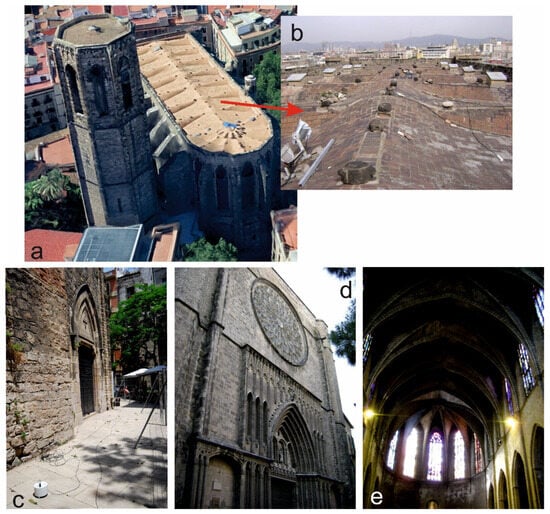
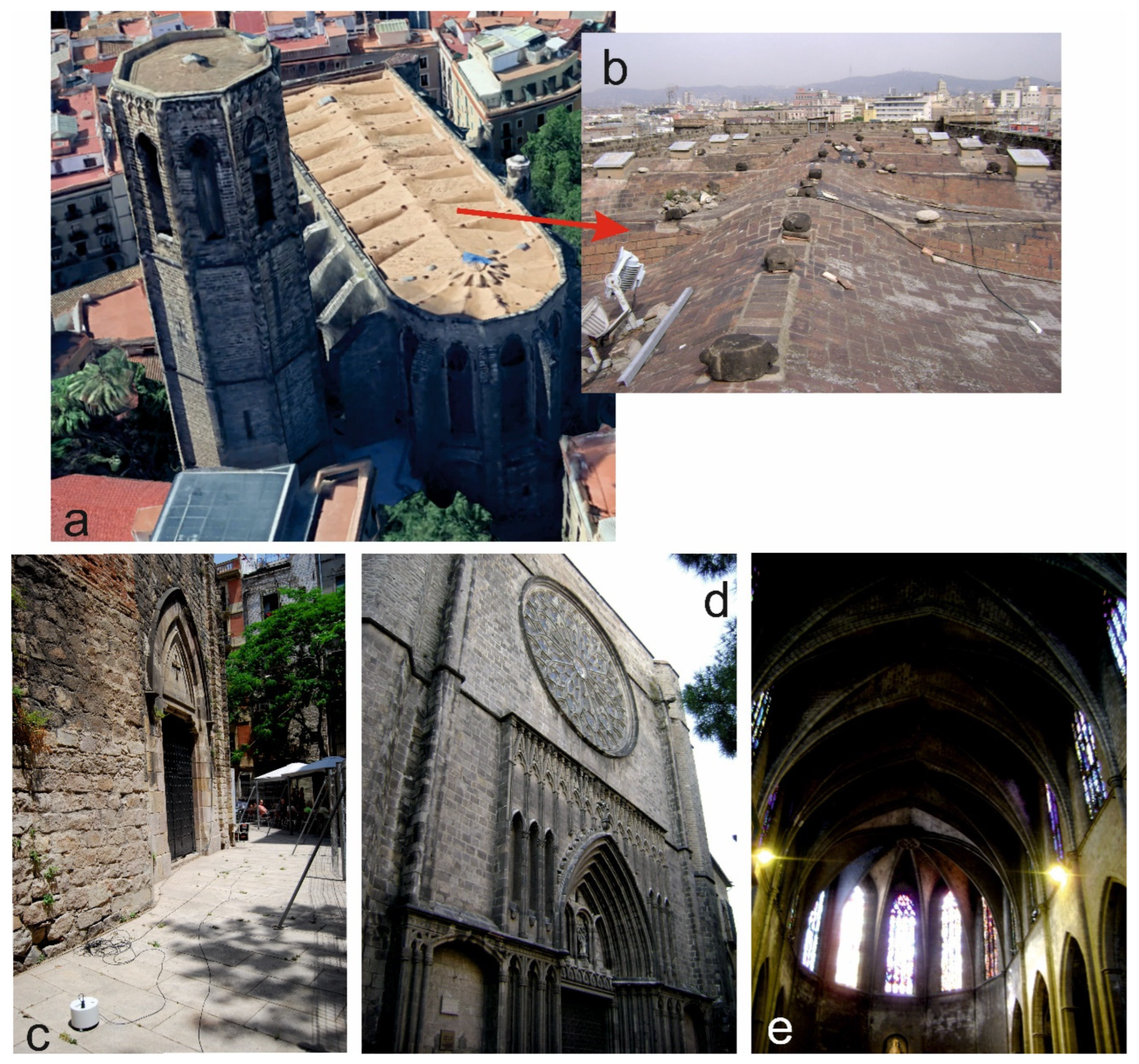
Santa Maria del Pi (Figure 1) is a representative example of the Catalan Gothic tradition, erected between 1319 and the early 15th century over a previous 10th-century Romanesque chapel [38]. The basilica is characterized by its volumetric austerity and structural clarity, exemplified by a single-nave configuration measuring 54 m in length, 16.5 m in width, and approximately 27 m in height. Unlike Northern European Gothic styles, the structure relies on deep internal buttresses located between the side chapels to channel vertical and lateral thrusts, eliminating the need for flying buttresses and allowing for a wide, uninterrupted interior space. It demonstrates an optimized balance between span, height, and material capacity. The vaulting system consists of ribbed masonry vaults with infill panels that function as stabilizing framework. Table 1 summarizes the main structural characteristics.
Figure 1.
Santa Maria del Pi Basilica: (a) aerial view; the red arrow indicates part of the roof area where the GPR survey was conducted (b); (c) lateral entrance and passive seismic sensor; (d) main entrance; (e) interior of the nave.
Table 1.
Main structural characteristics of the basilica.
The building was constructed primarily using Montjuïc stone [39,40], a local Miocene quartz-rich sandstone (arenite). Mineralogically, it is composed of 60% to 80% quartz grains with clay minerals and iron oxides. From a physical and mechanical perspective, the stone presents a density of 2.2 g/cm3 to 2.4 g/cm3 and moderate porosity, making it permeable to moisture absorption, which is a critical factor for the GPR analysis. Its compressive strength typically ranges between 30 MPa and 60 MPa. While durable, the material is sensitive to long-term weathering, air pollution and salt crystallization.
Historically, the basilica suffered significant damage, notably during the War of the Spanish Succession (18th century) and the Spanish Civil War (1936–1940), which destroyed the interior and the large rose window. Crucially for the current diagnosis, the 1957 restoration introduced iron reinforcements at the joints for some ashlar masonry arches. Water infiltration through roof cracks has since caused corrosion of these metallic inserts. The resulting expansive stresses have compromised the surrounding mortar and stone, leading to localized detachment of masonry fragments that motivated this study.
2.2. Methods
The fundamental principles of NDT methods are outlined with particular attention to the five major factors that influence the effectiveness of a survey: depth of penetration, vertical and lateral resolution, contrast in physical properties, signal-to-noise ratio, and prior knowledge of the structure. The selection of an appropriate method depends on these factors in relation to the specific problem under investigation [28]. Consequently, these techniques employed in this study are Ground Penetrating Radar using a GSSI (Geophysical Survey Systems, Inc., Nashua, NH, USA) equipped with a 400 MHz antenna for the assessment of the roof structure, and HVSR technique using a Lennartz Le-3D/20s sensor (Lennartz Electronic GmbH, Tübingen, Germany) for the subsoil characterization.
2.2.1. GPR Survey
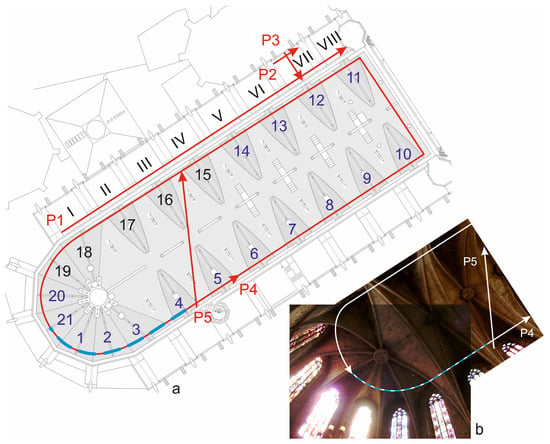
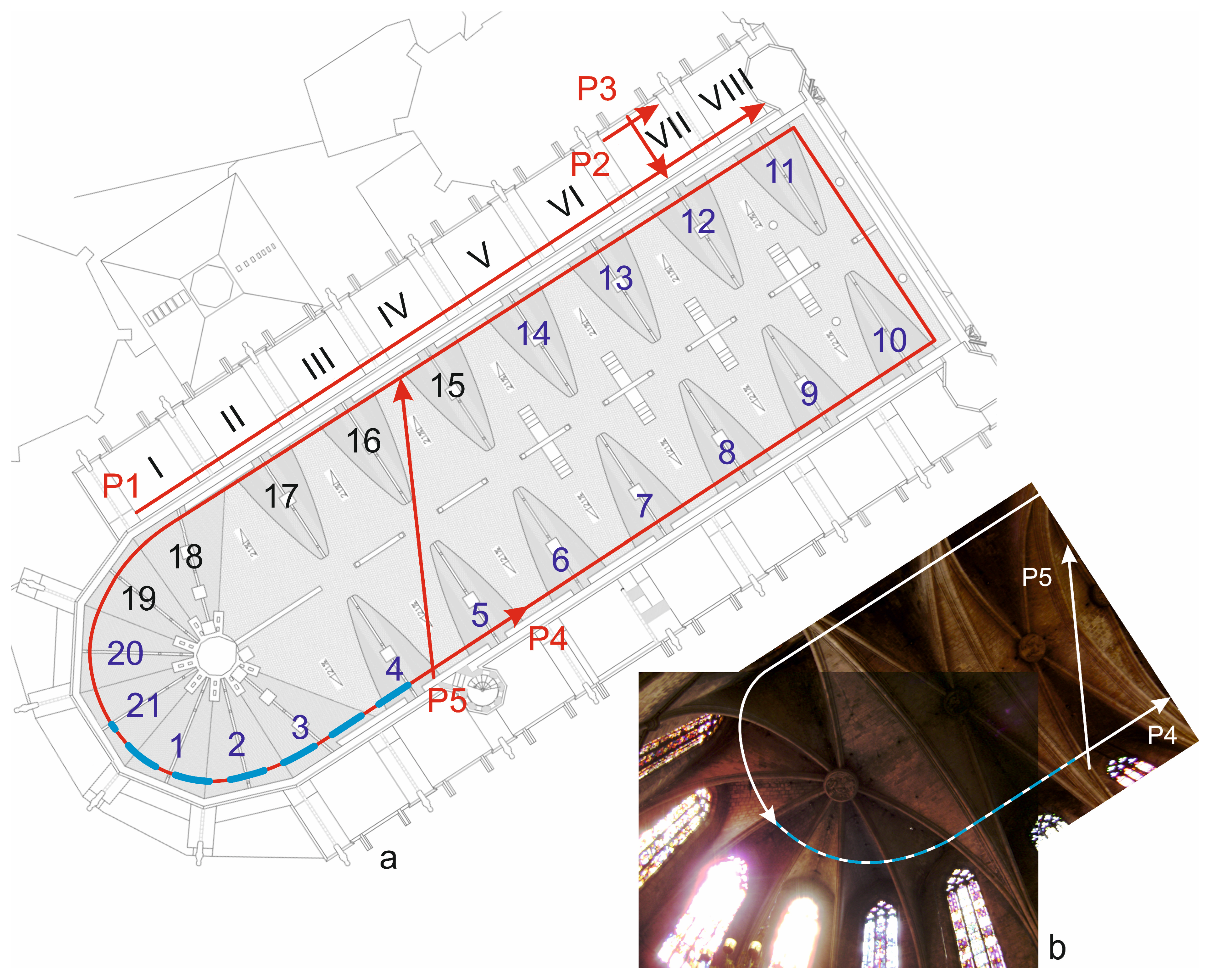
The GPR survey was conducted on the roof surface and over the lateral chapels, comprising a perimeter profile spanning the full extent of the structure and a diagonal transect. A shielded, ground-coupled pulsed radar system was used, and data were acquired in common-offset mode. The antenna operated at a central frequency of 400 MHz, chosen to provide an optimal balance between depth of penetration and vertical resolution. A 50 ns time window was selected; however, in many profiles, the signal-to-noise ratio deteriorated significantly beyond 40 ns, limiting the identification of coherent signals. Each A-scan consisted of 512 samples, resulting in a temporal sampling interval of approximately 0.1 ns. The spatial sampling density was 60 scans/m (approximately 1.67 cm trace interval). Figure 2 shows the position of radar lines on the roof, marked in red. The location of a segment of profile P4 on the apse is indicated on the interior photograph. The antenna position along each profile was determined using an odometer, and all the radar lines were mapped onto the floor plan of the basilica. The layout of the radar profiles was designed considering the specific geometry of the architectural elements under investigation.
Figure 2.
(a) GPR survey layout: P1, P2 and P3 (lateral chapels), P4 (perimeter profile spanning the roof circumference), and P5 (transverse). (b) Representative B-scan of the apse area (dotted blue segment on P4). Roman and Arabic numerals indicate chapels and structural arches, respectively. The arrows indicate the radar lines and the direction of the data acquisition.
The GPR data were processed using a band-pass filter defined by lower and upper cutoffs at 5 MHz and 850 MHz and plateaus at 100 MHz and 800 MHz. Subsequently, a 4-point gain function (values listed in Table 2) and energy decay gain were applied. Furthermore, due to the irregularity of the roof surface, a topographic correction was applied to the records corresponding to the roof profiles.
Table 2.
Filter sequence and gain parameters.
Finally, wave velocities were estimated in different zones by fitting diffraction hyperbolas. To estimate moisture variations, these velocities were used to derive the relative dielectric permittivity of the materials. Subsequently, Topp’s empirical equation [41,42] was applied to transform these permittivity values into approximate volumetric water content:
where θ represents the volumetric water content and εr the average relative permittivity of the medium, measured for each sector in the B-scan.
While this method provides an estimation rather than an exact measurement in heterogeneous masonry, it allows for the identification of relative contrast between dry and moisture-affected zones.
2.2.2. HVSR Method
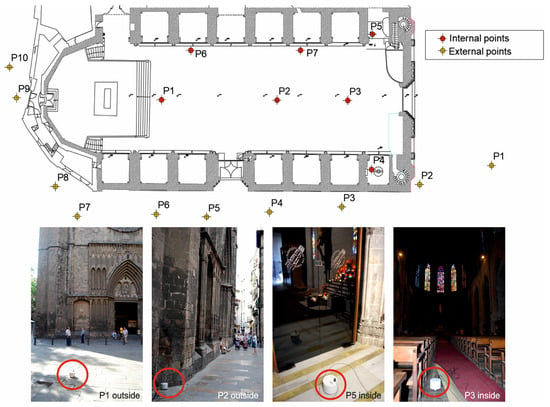
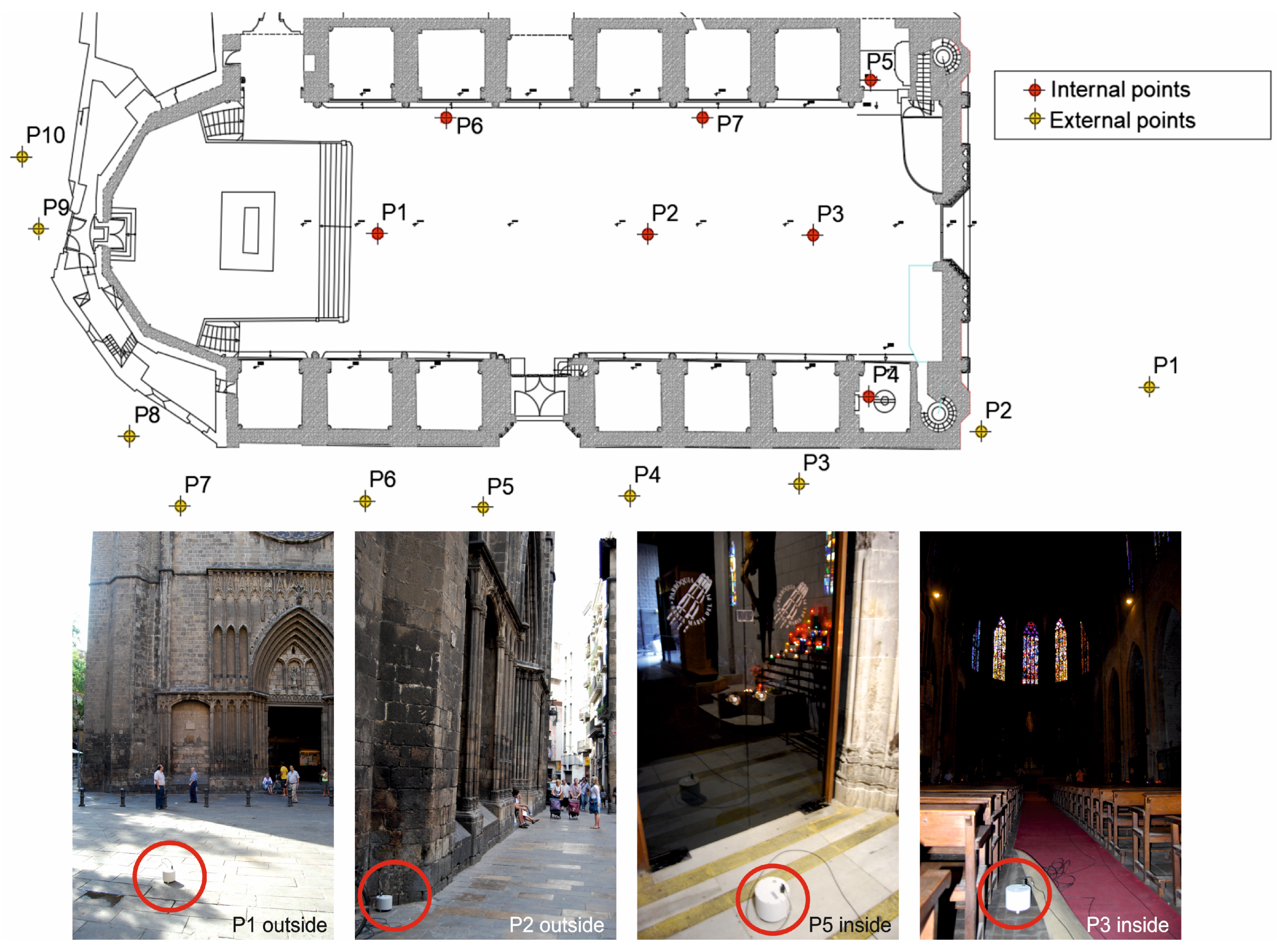
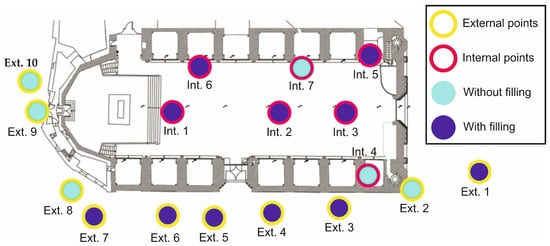
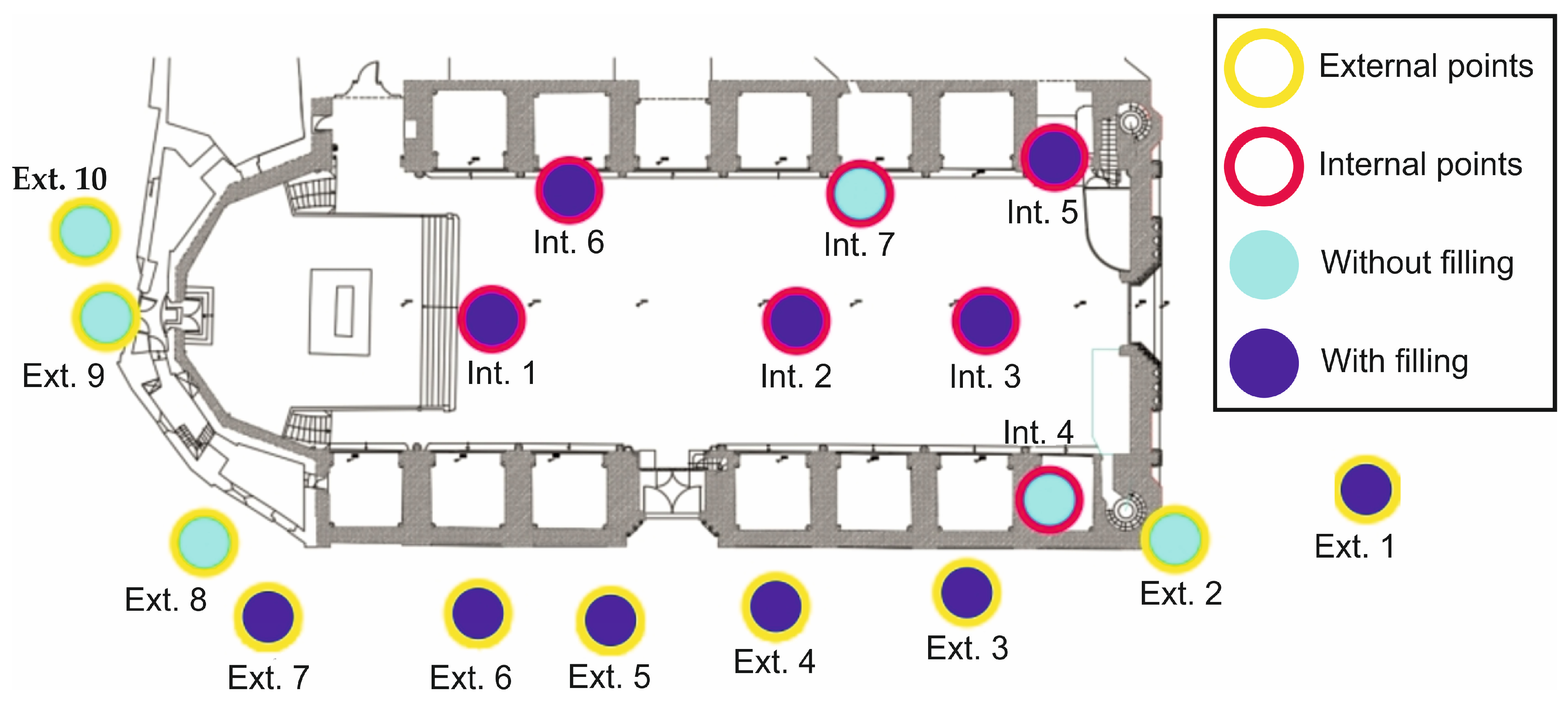
HVSR data were acquired at 17 locations (10 external and 7 internal), as shown in Figure 3. Ambient noise measurements were conducted using a Lennartz LE-3D/20s triaxial seismometer coupled with a Bruel and Kjaer Pulse 3560-B acquisition system. A recording duration of 10 minutes was established for each position to allow for sufficient statistical stability within this timeframe, following standard guidelines [43].
Figure 3.
Location of HVSR measurement points. Photographs show acquisition at exterior (1 and 2) and interior (5 and 3). The red circles indicate the sensor position in the photographs.
Data processing is divided into two independent stages. The first involves the selection of signal windows characterized by stationary noise, following the reliability criteria proposed by the SESAME guidelines [43]. This procedure allows for effectively discarding segments contaminated by local transient sources (e.g., vehicle traffic or pedestrian movement near the point). Removing these sources is critical, as they can modify the frequency content and bias the fundamental period estimation. The second stage consists of computing the spectral ratios using the valid windows selected.
Given the dense urban context of the Basilica, particular attention was paid to the quality control of the signals. Window selection was performed using a strict STA/LTA anti-trigger algorithm to efficiently discard transient anthropogenic noise (e.g., traffic, nearby pedestrians) in accordance with SESAME guidelines [43]. This method compares the signal amplitude over a short time window (Short Term Average, STA, typically 0.5 s to 2 s) with a longer background window (Long Term Average, LTA, typically 20 s to 60 s). Segments where the STA/LTA ratio exceeds a certain threshold value (Smax) are identified as transient events with noise and rejected, ensuring that only stationary background noise is processed.
In the second stage, the power spectral density (PSD) of the selected time windows was calculated. The frequency range was established from 0.05 Hz to 15 Hz, covering the sensor flat response spectrum and encompassing fundamental frequencies expected for both the soil and Gothic structure. To ensure consistent spectral smoothing across the logarithmic frequency scale, the Fourier spectra were smoothed using the Konno-Ohmachi algorithm [44,45] with a bandwidth coefficient of b = 40, following the standard practice in HVSR analysis. Finally, the HVSR was computed for each window, and the average curve and standard deviation were determined in accordance with the SESAME guidelines [43] criteria for reliability.
3. Results
3.1. GPR Assessment of Lateral Chapels
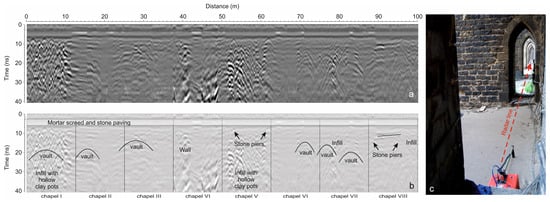
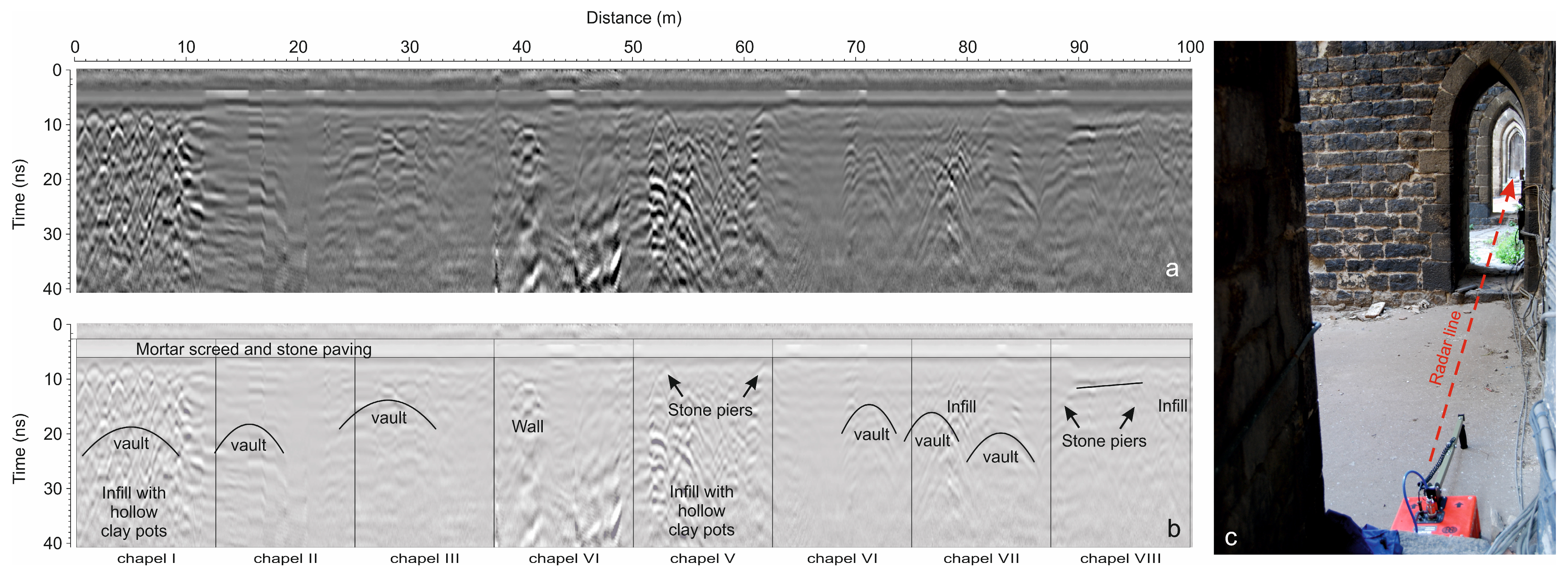
One of the structural elements surveyed was the roof of the lateral chapels (see Profiles 1, 2, and 3 in Figure 2). Profile 1 spanned the longitudinal extent of the eight chapels, whereas Profiles 2 and 3 were acquired over the seventh chapel. Figure 4 presents a photograph of the data acquisition in this area, alongside the GPR B-scan obtained in Profile P1.
Figure 4.
Profile 1: (a) GPR B-scan; (b) interpretation showing lateral chapels location and potential lightweight ceramic infill; (c) survey area and photograph.
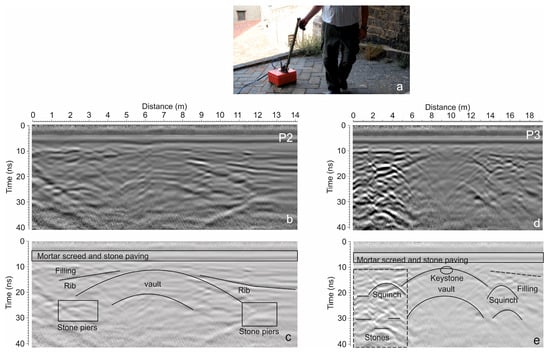
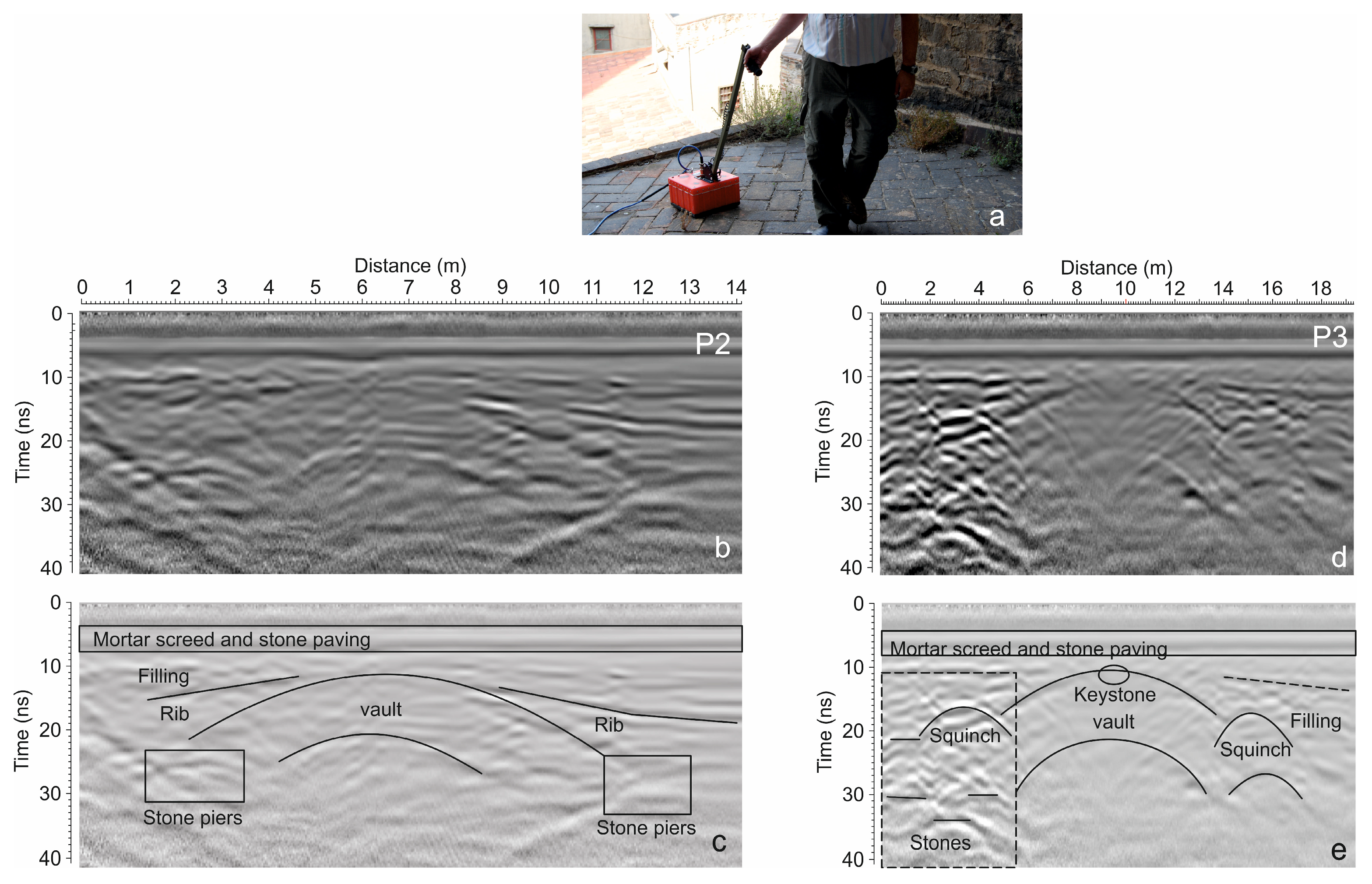
One of the chapels was surveyed using two additional profiles (P2 and P3, shown in Figure 2), with the results presented in Figure 5. The rib vault, formed by two intersecting vaults, is clearly identifiable in both profiles.
Figure 5.
(a) Data acquisition at Lateral Chapel VII. (b) Profile P2 B-scan and (c) interpretation. (d) Profile P3 B-scan and (e) interpretation.
In this case, no clear anomalies indicative of hollow ceramic infill were detected. However, along one of the lateral supports, the data suggests a composition of ashlar masonry in the lower section, characterized in the radargram as planar reflections with slight edge diffractions, while the upper section appears to be composed of fill material. Furthermore, the signal patterns observed at the arch supports are consistent with the geometry of squinches.
3.2. GPR Assessment of the Basilica Roof
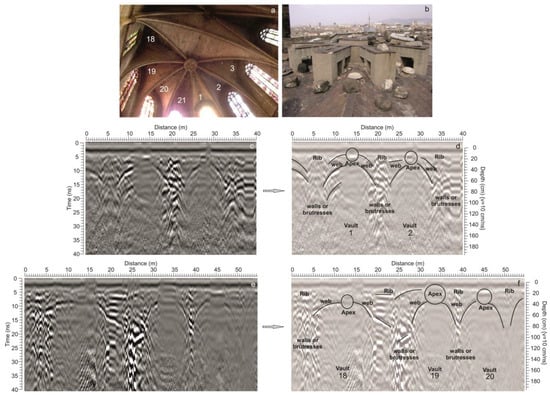
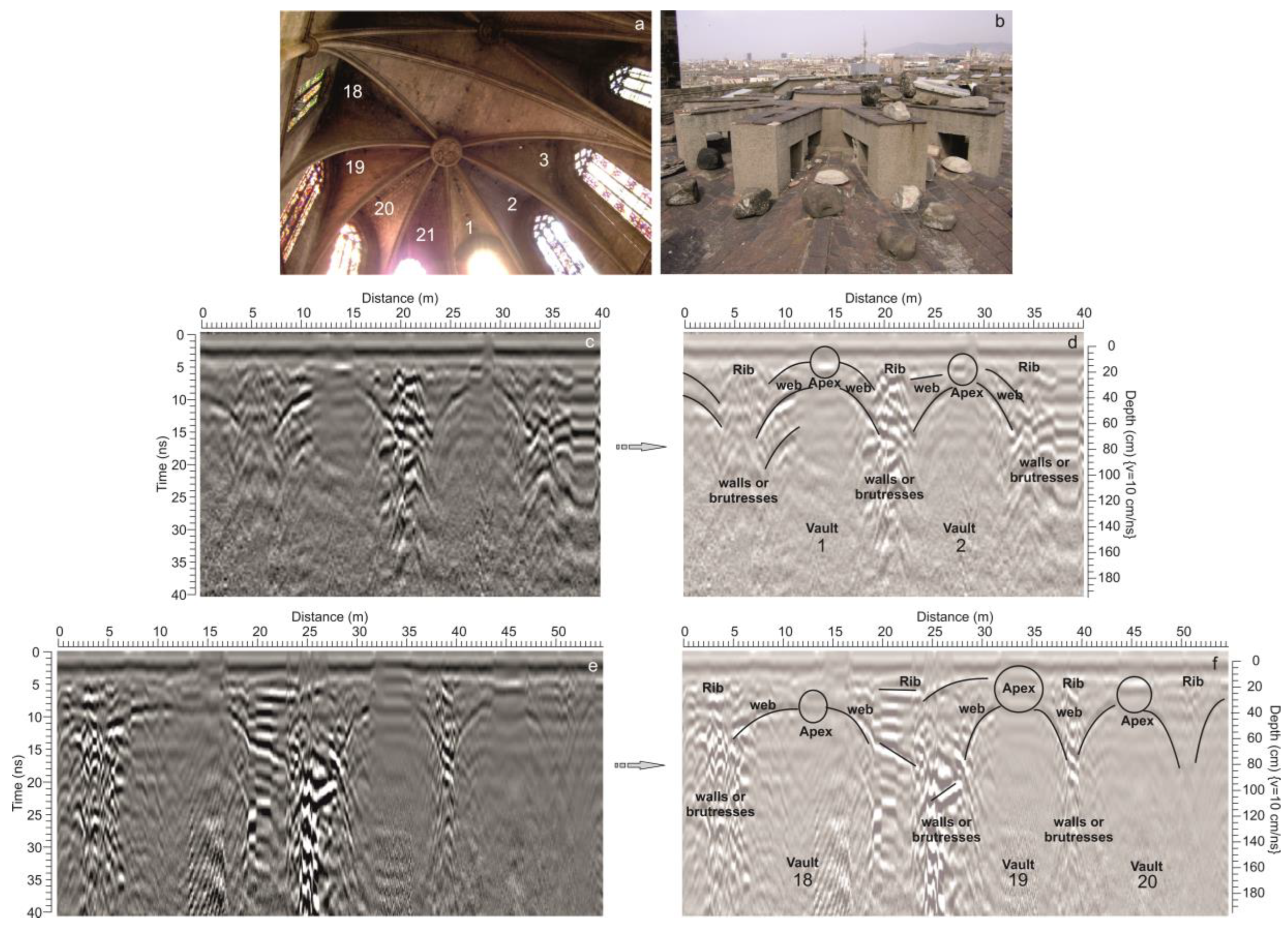
The B-scan records obtained on the roof allow for the identification of anomalies produced at the apex of each vault section. These anomalies are associated with the junction between the vault webs and the secondary ribs. Figure 6 shows a processed radargram of a specific vault where its main architectural features are identifiable. From the analysis of the radargrams, it is possible to reconstruct the geometry of the vaults beneath the roof.
Figure 6.
Architectural elements along Profile P4. (a) Interior and (b) roof views with vault numbering. (c) B-scan of vaults 1 and 2 and ribs and (d) interpretation. (e) B-scan of vaults 18, 19 and 20 and (f) interpretation.
To convert the time scales to depth in the structural profiles (Figure 6), a velocity analysis was conducted using hyperbola fitting on diffraction anomalies distributed across the survey area, generated by heterogeneities in the filling. The fitting is based on the reflection hyperbola equation:
where v is the average wave velocity (in cm/ns), x is the horizontal distance (in cm) between the antenna and the target, t is the two-way travel time (in ns) measured in the B-scan for each point of the hyperbola, and t0 is the two-way travel time (in ns) measured at the hyperbola apex.
This analysis revealed velocities ranging generally between 8 cm/ns and 12 cm/ns, reflecting the heterogeneity of masonry materials. Despite this local variability, which is later analyzed in detail for moisture estimation, a representative average velocity of 10 cm/ns (εr ≈ 9) was selected for the geometric reconstruction. This value was validated by correlating the radargram features with the known physical thickness of the visible architectural elements.
Based on this calibration, the radargrams display several reflections within the vaults that likely correspond to three distinct layers with different radii of curvature. The deepest anomaly is caused by the reflection from the keystone of the vault apex (Figure 6). The other two dominant anomalies are attributed to the dielectric interfaces at the intrados (inner surface) and the extrados (outer surface), separated by the thickness of the masonry. Between these anomalies, the signal is remarkably uniform. Therefore, materials in this zone are interpreted as homogeneous, suggesting a composition of ashlars without irregular filling material. Intermediate reflections between the primary ones likely indicate different layers within the arch structure. Moreover, the deepest anomaly (with lower amplitude) is consistent with the structural ribs that connect to the walls and channel the loads of the church roofing system.
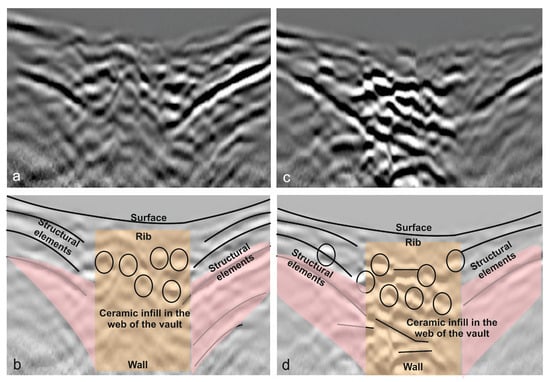
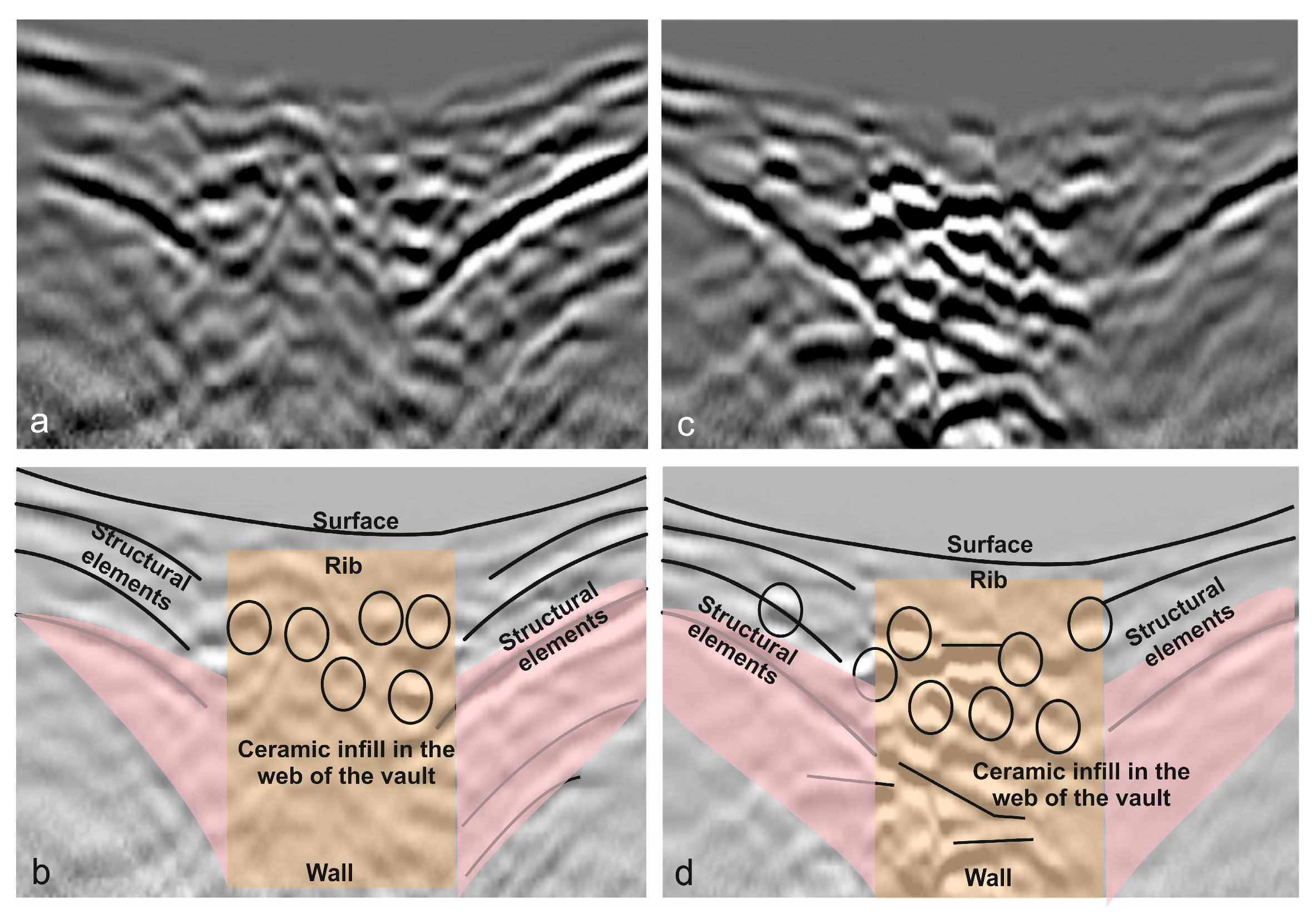
These characteristics are shown in the detailed B-scans in Figure 7, where a second distinctive feature is also highlighted: zones characterized by small hyperbolic reflections (marked in Figure 8 with circles). These anomalies appear in the thicker roof sections and are consistent with the presence of hollow ceramic vessels. In previous studies of mediaeval churches, this type of material has been identified as a lightweight infill used to reduce dead loads. Typically, this ceramic infill layer is between 0.7 m and 1 m thick and is embedded in rubble masonry mixed with lime mortar.
Figure 7.
Arch-column connections along Profile P5: (a,c) processed data; (b,d) interpretations. Pink color mark the vault haunches, and brown the web of the vault and the backfill.
Figure 8.
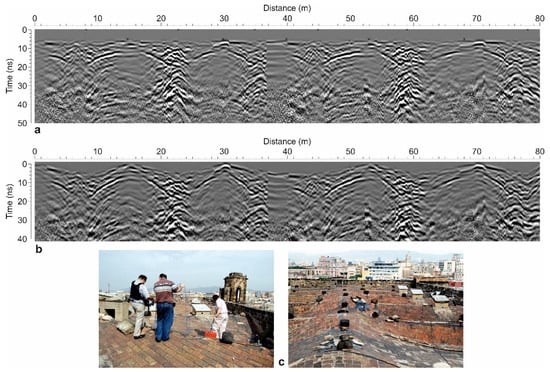
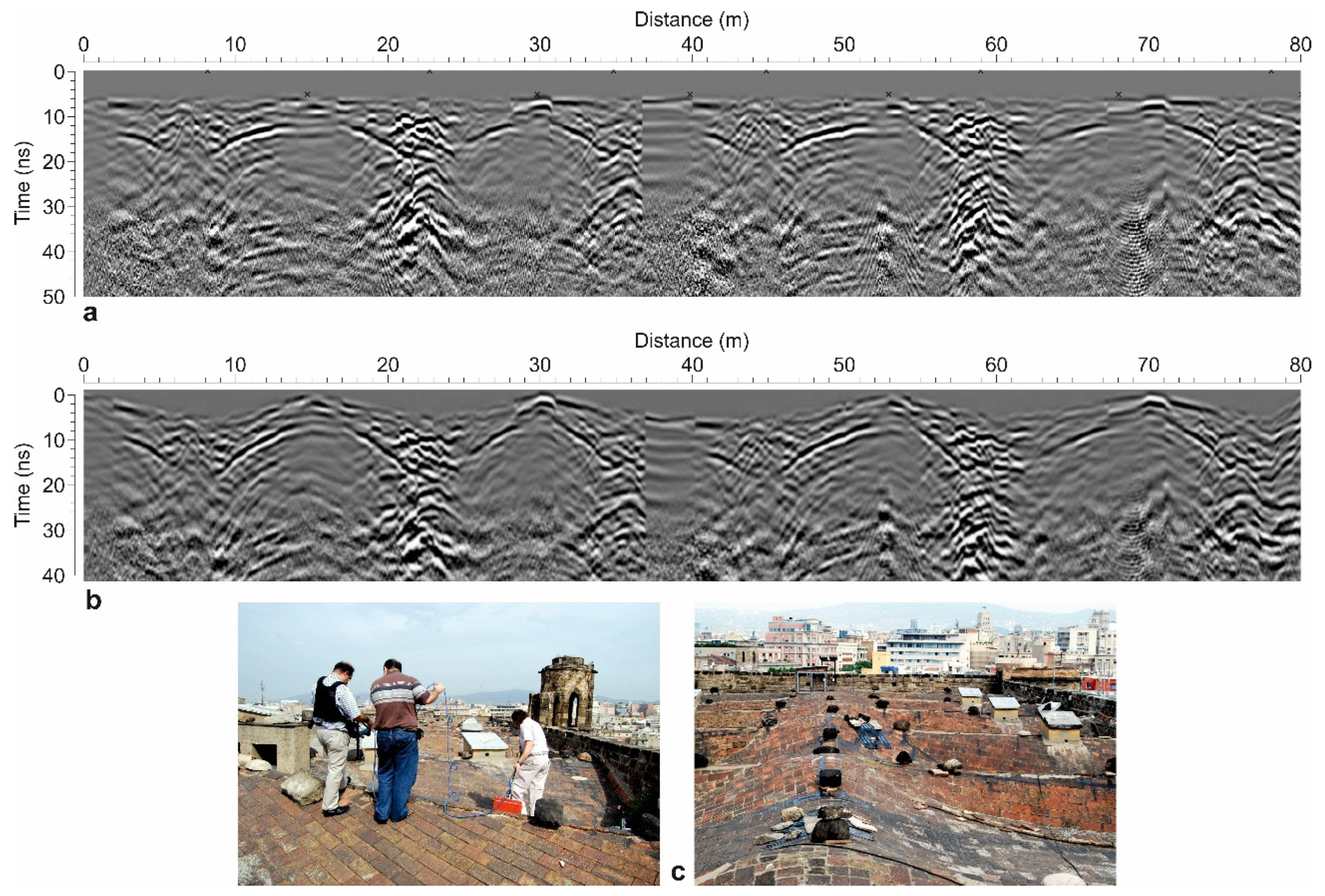
Profile P4 (80 m section): (a) data before and (b) after topographic correction. (c) Photographs of the roof and the vaults extrados.
An 80 m long section of the perimeter profile P4, whose position is detailed in Figure 2, was selected to illustrate the characteristic scattering patterns observed throughout the survey, specifically the structural reflections and the moisture-induced anomalies (Figure 8). This section extends over the lateral aspect of the nave and the apse. The figure displays the GPR data after the application of gain, background removal and band-pass filtering, presented both with and without topographic correction. The results allow for the identification of the vaults, the internal structure, and the upper reinforcement. They also indicate an irregular composition of the material between the vaults. By correcting the image for topography, it is possible to enhance the distinction between the vault structure and the intervening walls.
The GPR signatures, characterized by hyperbolic diffraction patterns and chaotic reflections in the infill layers, are consistent with the internal geometry of Gothic masonry vaults documented in similar heritage contexts, such as the Basilica of Santa Maria del Mar in Barcelona [2] and the Lecce Cathedral [5]. Furthermore, the identification of structural anomalies via non-destructive testing aligns with the diagnostic methodologies recently applied to the Seville Cathedral [3], confirming the efficacy of GPR in mapping complex historical stratigraphy.
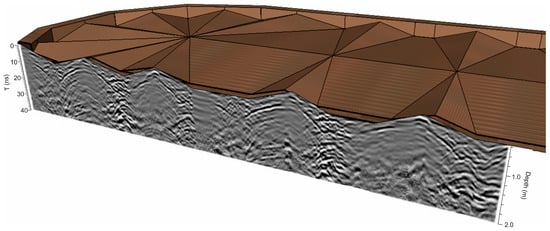
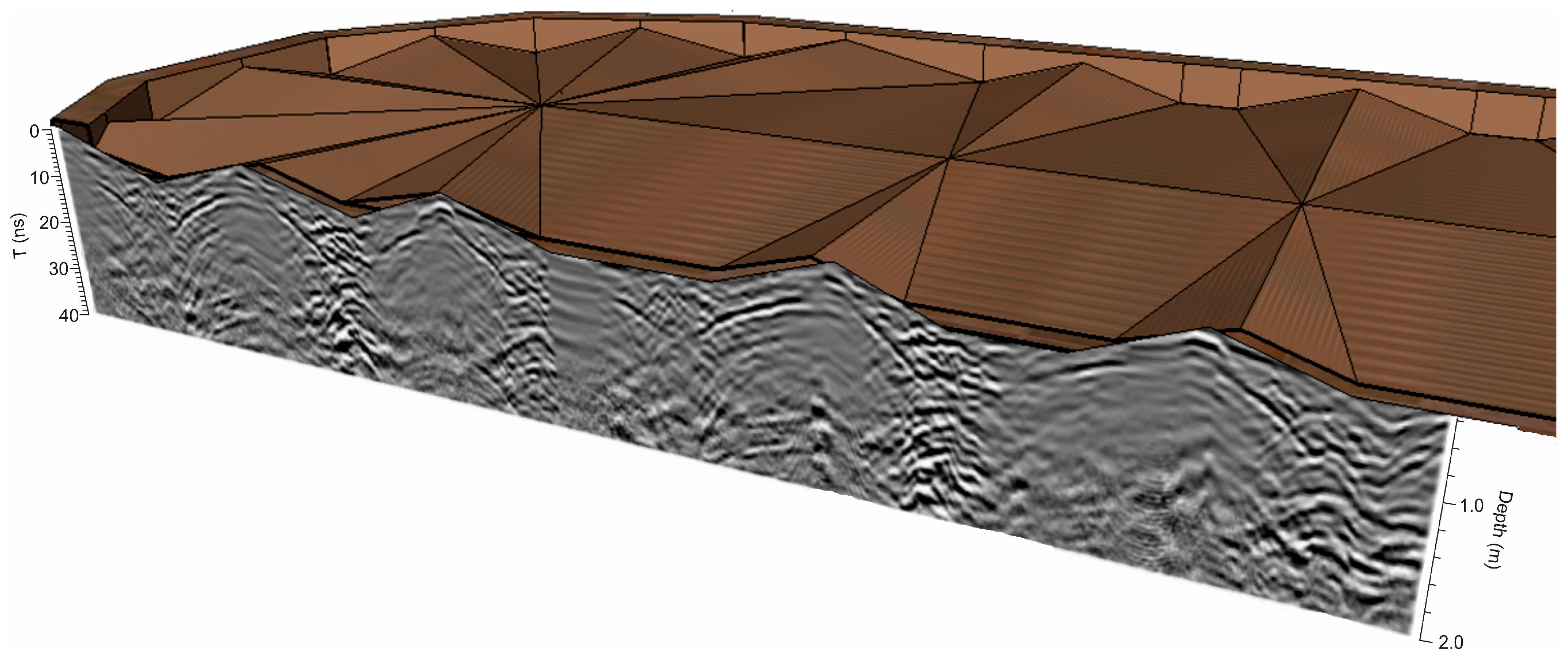
Figure 9 illustrates the roof, the vault extrados, and the corresponding GPR data to facilitate a better understanding of the structure. The roof structure is characterized by ribbed vaults that distribute loads and define the irregular geometry of the surface. The volume between the vaults is filled with varying materials. In this context, the extrados (the upper surface of the vault) serves a critical functional role of transmitting loads toward the supporting walls and buttresses. A distinctive feature of this Gothic vaulting is the structural primacy of the ribs. Unlike Romanesque precursors where ribs were often decorative, in this design, they function as structural guides, intersecting at specific nodes to direct thrusts. This arrangement forms a permanent stone framework, allowing lighter infill masonry (webbing) to be placed between the ribs. Thus, the vault functions as a skeletal system where the ribs provide the primary mechanical support, while the webbing acts as a thin shell. The extrados interface ensures the effective connection of this skeletal system with the roof covering and the counter-thrust elements.
Figure 9.
Ribbed vaults geometry and corresponding GPR data (time-to-depth conversion velocity: 10 cm/ns).
In addition, one of the most distinctive features of Catalan Gothic architecture is the emphasis on lightness and economy in the construction of roof vaults. Unlike the highly complex ribbed vaults of Northern European Gothic, Catalan builders favored wide, spacious naves with reduced vertical segmentation. To achieve this, specific techniques were employed to minimize the dead load of the vaults, most notably the use of thin webbing. Consequently, the infill between ribs was constructed using thin stone slabs or bricks, significantly lighter than the massive ashlar used in earlier Romanesque or French Gothic vaults. Moreover, hollow ceramic vessels were often placed within the webbing, dramatically reducing the weight of the structure. Furthermore, in Catalan churches, vaults usually had fewer ribs (often just the diagonals and the transverse arches) compared to the intricate star-shaped patterns of Northern Gothic. This simplification lowered construction costs and structural mass. Figure 9 illustrates the following elements: the vault webbing, zones of increased thickness where hyperbolic reflections are consistent with the presence of hollow ceramic vessels, and the junction between the ribs and the walls. Furthermore, a reflection at the vault’s apex is interpreted as a central rib.
3.3. Identification of Moisture in the Roof Structure Support
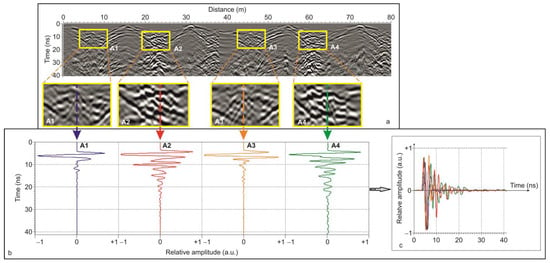
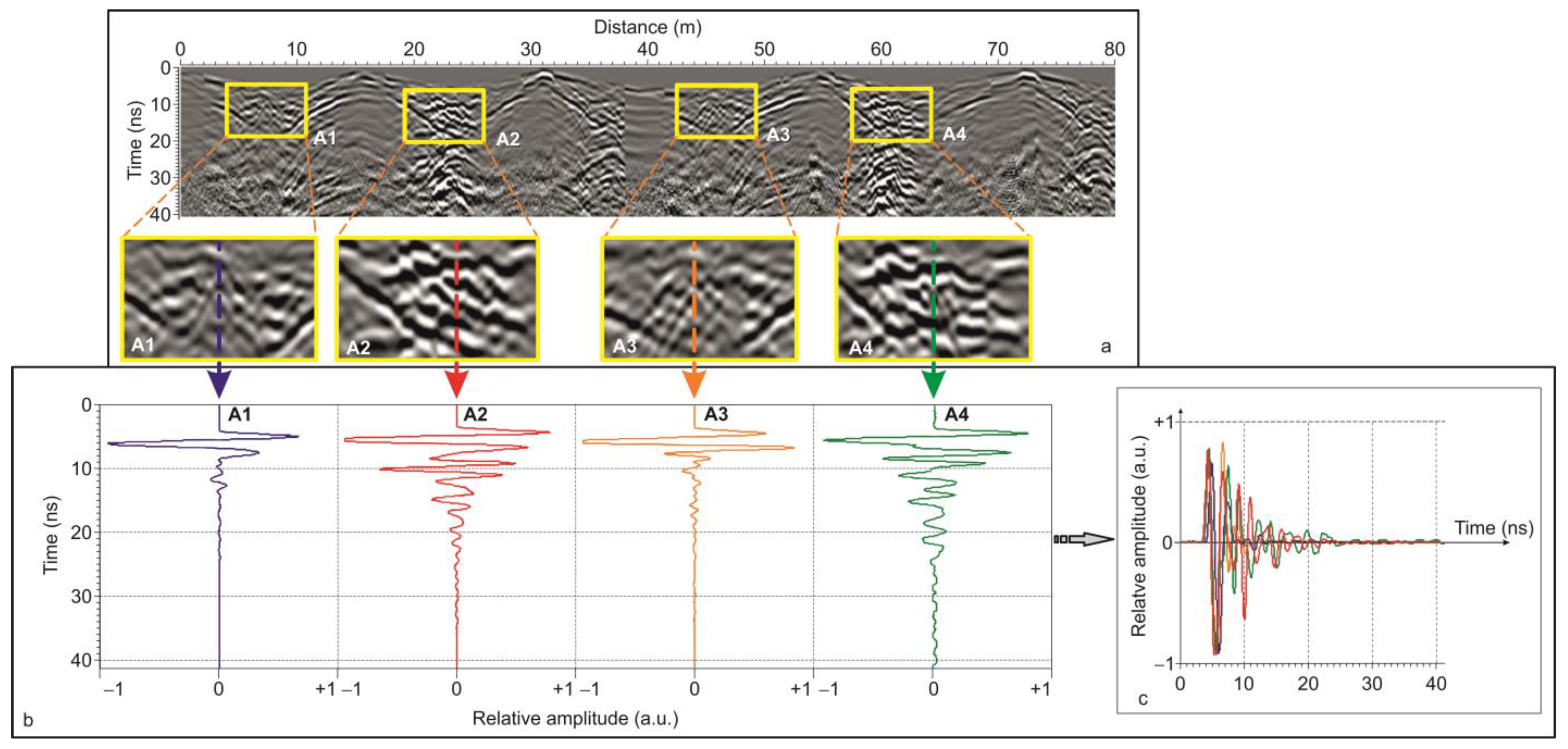
Beyond the structural analysis, which identified consistent geometric patterns across all GPR records, variations in the signal characteristics (specifically amplitude and decay) allowed for the assessment of potential damage. A representative example of these variations is observed in Figure 10. While the reflection patterns are morphologically similar across the arches, indicating a consistent construction technique, the signal energy varies drastically.
Figure 10.
P4 B-scan analysis: (a) section identifying infill zones (A1, A2, A3 and A4); (b) representative ungained A-scans; (c) trace comparison illustrating variations, being the amplitude in arbitrary units (a.u.) normalized to the maximum peak of the direct wave.
To clarify these differences, four specific anomalies were isolated for detailed analysis: A1 and A3 (appearing attenuated) versus A2 and A4 (appearing high-contrast). Figure 10 exemplifies this marked variation in signal amplitude, interpreted as incoherent or scattered energy. Figure 10a shows the B-scan and the zones’ location, while Figure 10b presents the individual ungained traces (A-scans) for each zone. The visual difference in the B-scan is confirmed by the comparative plot in Figure 10c. Here, the superposition of traces reveals a clear dichotomy:
- (a)
- Zones A1 and A3 (dry/healthy) exhibit low-amplitude reflections and slight signal attenuation.
- (b)
- Zones A2 and A4 (moist/damaged) exhibit high-amplitude reflections with a significant ringing effect, an increase in incoherent noise and longer decay times.
The marked increase in amplitude in zones A2 and A4 is interpreted as strong scattering energy caused by high dielectric contrast. Two possible hypotheses were considered to explain this contrast:
- (a)
- Moisture content. An increase in water content within the rubble masonry fill significantly raises the dielectric permittivity. This creates a stronger reflection coefficient at the interface between dry and wet materials, resulting in the higher amplitudes observed [46].
- (b)
- Material heterogeneity. Alternatively, the signal could be caused by localized changes in the filling materials (e.g., layers of debris) [46,47].
Examination of the B-scan of profile P4 (Figure 2) reveals that the highest amplitudes are detected in specific zones, invariably situated in the lower part of the vaults. The correlation between these high-amplitude zones and the lower part of the vaults suggests water accumulation due to gravity and potential drainage defects. This interpretation is supported by recent studies on moisture detection in heritage buildings. While signal attenuation is a common indicator in homogeneous media, Perez-Gracia et al. [30] and Solla et al. [47] demonstrated that in heterogeneous masonry, water saturation can generate high-amplitude scattering and ‘ringing’ noise due to sharp dielectric contrasts between dry and wet rubble. Our results mirror the moisture patterns observed in the masonry arch bridge of Lubians [47], where similar scattering phenomena were attributed to water accumulation in the fill.
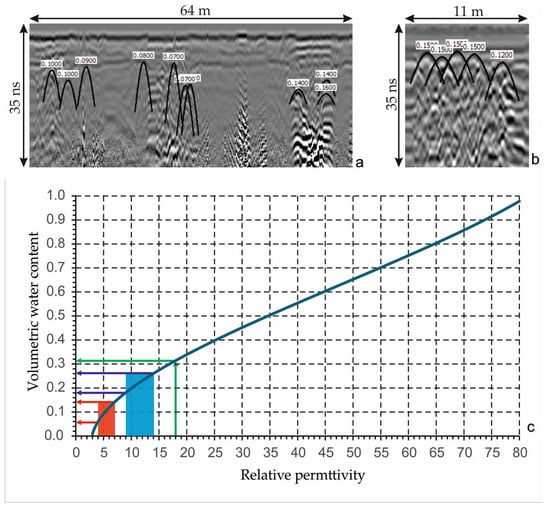
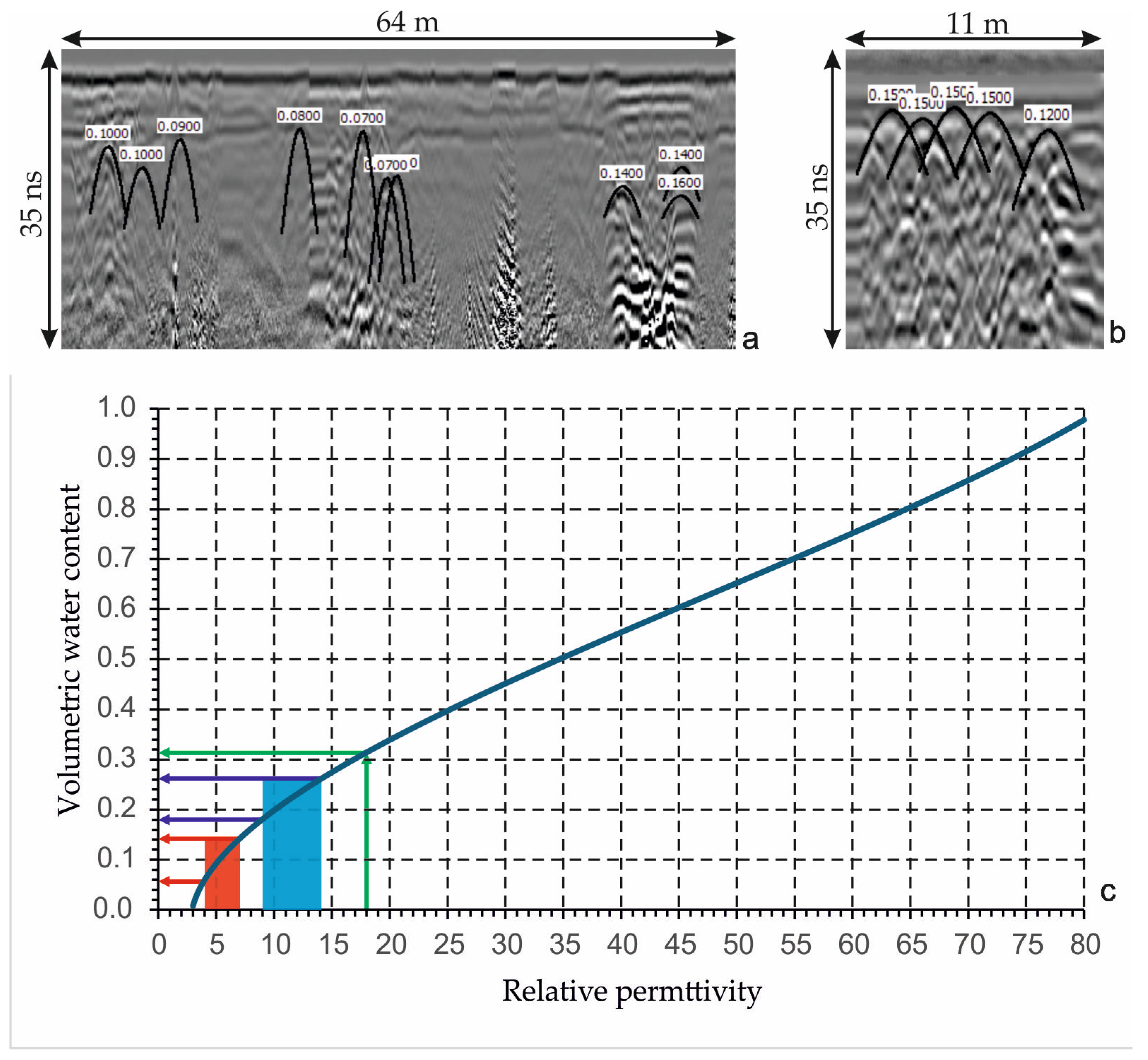
To validate the moisture hypothesis, a velocity analysis was conducted via hyperbola fitting (Equation (2)). These velocities were then converted to relative dielectric permittivity values.
Using the empirical relationship proposed by Topp et al. [41,42], widely accepted in GPR studies or estimating volumetric water content, θ, in porous media where specific petrophysical data is unavailable, we estimated m. Consequently, the use of the Topp equation (Equation (1)) in this study is intended to provide a qualitative to semi-quantitative estimation of moisture variability rather than an exact determination of absolute water content, which is consistent with the non-destructive and indirect nature of the geophysical data.
Figure 11 illustrates the results of this analysis. Two distinct sectors emerged: a low permittivity sector (red in Figure 11), where measured velocities ranged from 12 cm/ns to 16 cm/ns, corresponding to estimated water contents of 6% to 14% (consistent with the dry signatures of sections A1, A3), and a high permittivity sector (blue in Figure 11), characterized by lower average wave velocities and higher dielectric permittivities (9 to 18), suggesting water contents ranging from 18% to 27%, peaking at 32% in the most affected areas.
Figure 11.
(a,b) Velocity analysis on diffraction hyperbolas. (c) Relationship between relative permittivity and volumetric water content according to Topp equation [41,42]. The orange shaded area corresponds to the low permittivity range (dry masonry), while the blue shaded area highlights the high permittivity range associated with moisture saturation.
However, it is important to note that due to the heterogeneous nature of historic masonry, these values should be interpreted as relative semi-quantitative estimates rather than absolute measurements. Notwithstanding, these results provide quantitative support to the initial qualitative observation: the different amplitudes observed in structurally similar zones are effectively due to varying degrees of moisture saturation.
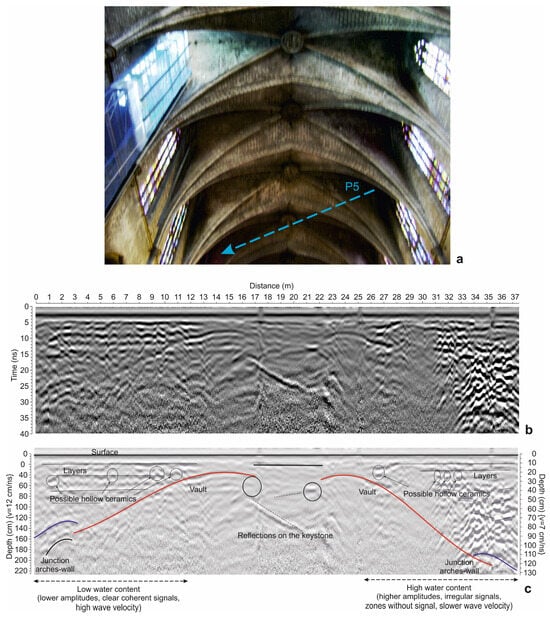
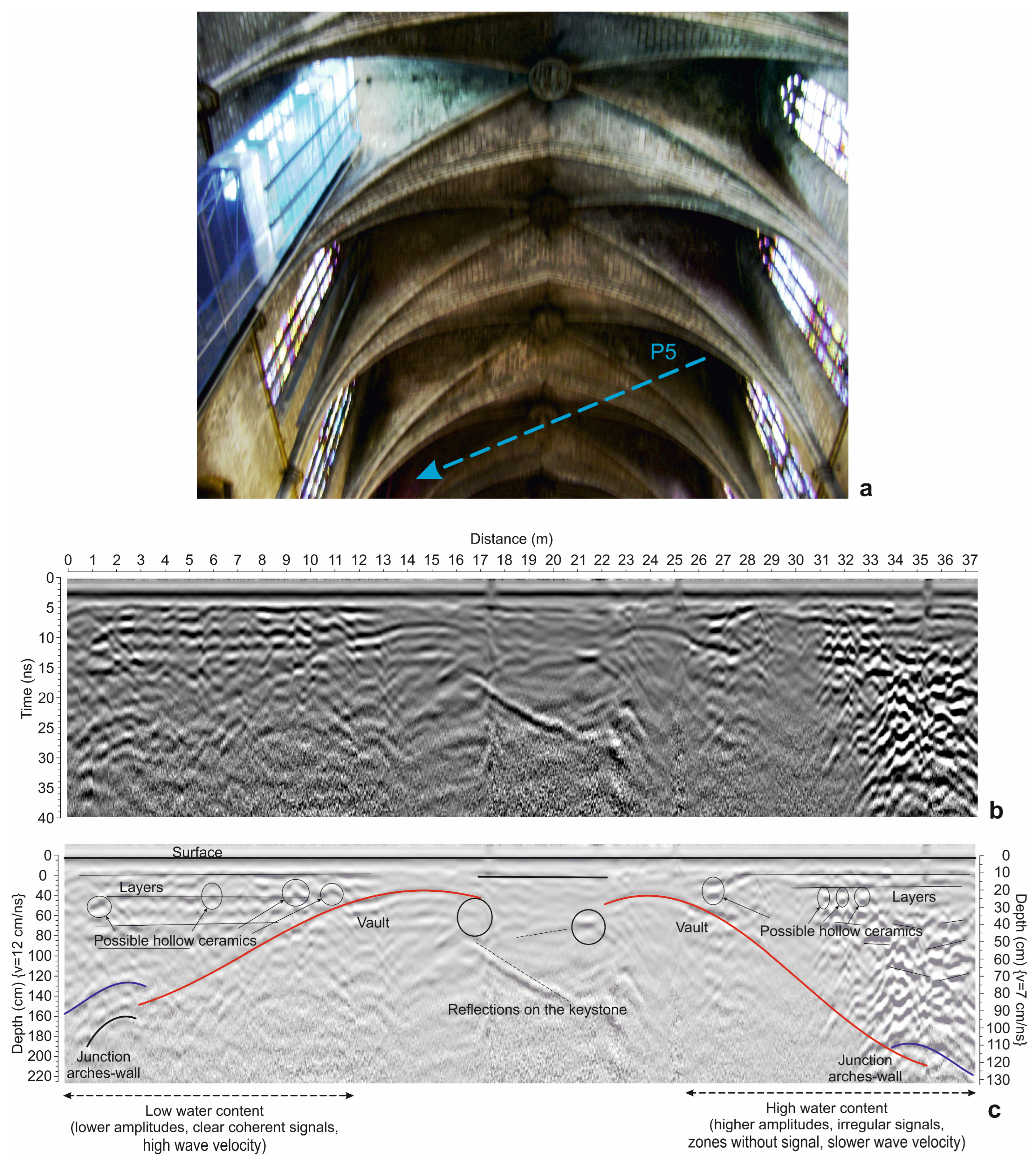
Another clear example illustrating GPR signal variations that serve as indirect indicators of water content is found in the B-scans acquired along radar line P5. This line traverses the roof, extending from the lateral chapel area (analyzed in profiles P1 and P3) to the region covered by profile P4, marked in blue in Figure 2. A representative B-scan is presented in Figure 12, along with a possible interpretation. Two distinct zones are clearly distinguishable. In the first zone, near the chapels, reflections are more defined, and signal amplitude is lower. Furthermore, hyperbola analysis yielded a high average propagation velocity of approximately 12 cm/ns. In contrast, the second zone exhibits higher amplitude reflections but reveals more irregular sectors: there is a lack of continuity in the ashlar and infill layers, and the signal completely disappears in certain areas likely due to attenuation. Velocity analysis determined an average velocity of 7 cm/ns. Consequently, this second zone suggests higher moisture content, which is consistent with the data observed in profile P4.
Figure 12.
Profile P5: (a) nave interior showing structural elements; (b) B-scan; (c) interpretation (velocities 12 cm/ns and 7 cm/ns for the left and right sectors, respectively).
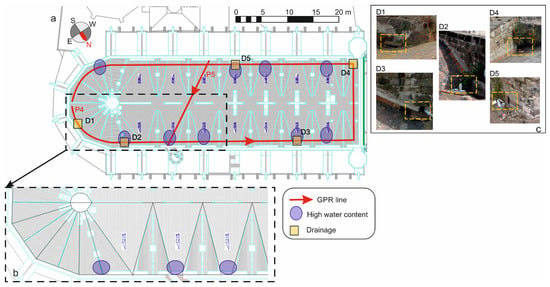
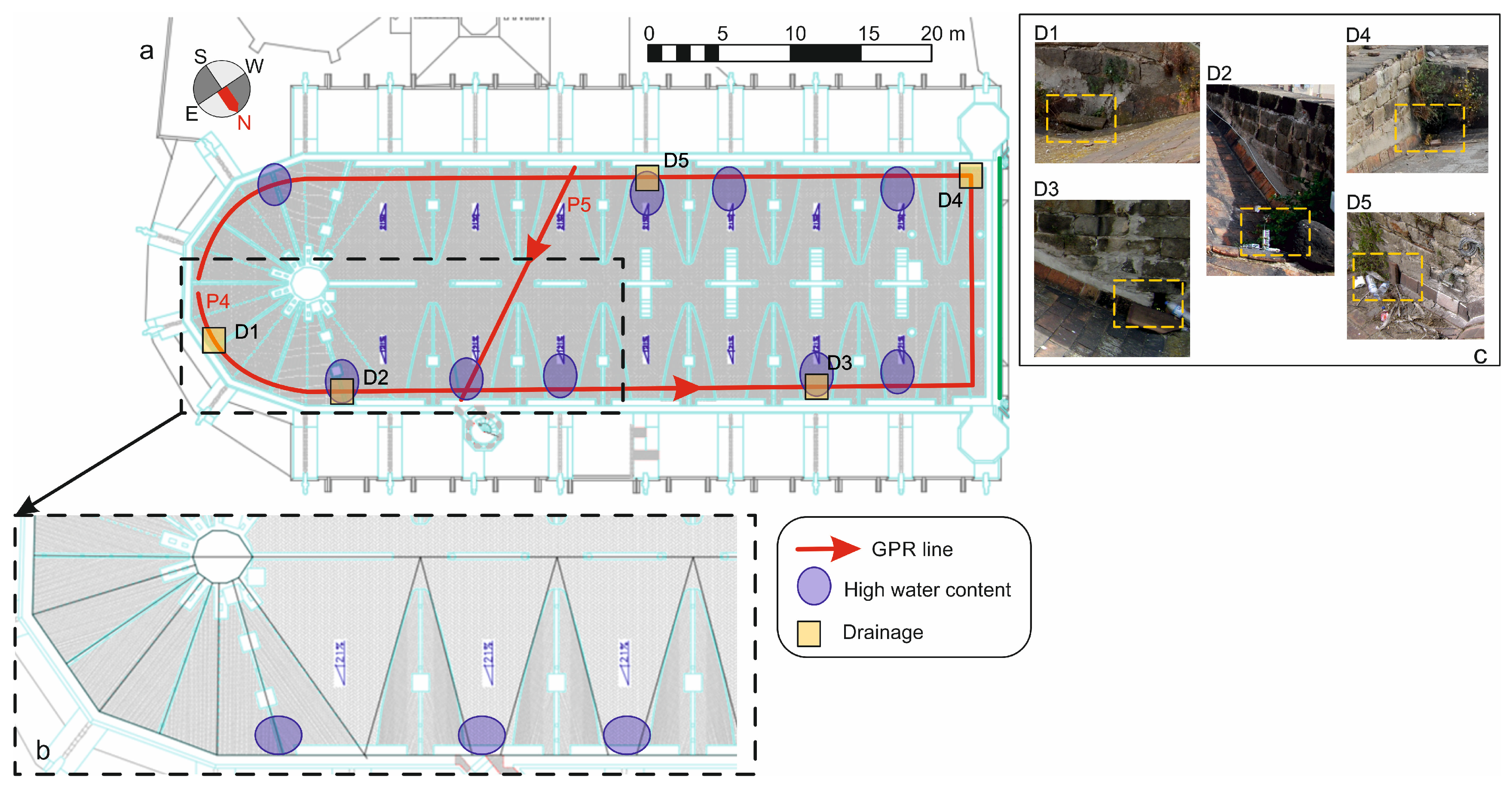
Figure 13 shows the location of the zones considered affected by moisture based on the B-scan analysis. In all cases, these are situated in the lower section of the vaults, where the rainwater drainage system is located. Therefore, the results suggest potential problems with some of these drains, either due to pipe breakage or clogging caused by debris. Although GPR provides indirect measurements, the interpretation of moisture zones is consistent with the drainage geometry. The areas exhibiting high-amplitude reflections and signal scattering coincide spatially with the lowest points of the vault valleys and the locations of the gargoyles. These zones are naturally prone to water accumulation and infiltration. Visual inspection of the masonry in these specific areas also reveals surface dampness and biological colonization, which correlates well with the geophysical anomalies observed.
Figure 13.
(a) Roof plan showing moisture anomalies in Profiles P4 and P5 and drainage locations. (b) Northeast sector detail. (c) Corresponding drainage point photographs.
The roof drainage system relies on the slope of the extrados of the vaults, which serves to channel rainwater towards drainage outlets located at the lowest points of the roof surface (Figure 13). From these outlets, rainwater is conveyed through downpipes or integrated drainage conduits designed for discharge. Although the system is simple and effective, factors such as cracks, structural damage, and the natural aging of the building fabric may lead to water infiltration. Additionally, the clogging of outlets by debris can cause water ponding, which further exacerbates infiltration and increases moisture content in the surrounding areas, contributing to long-term deterioration.
3.4. HVSR Ground Assessment
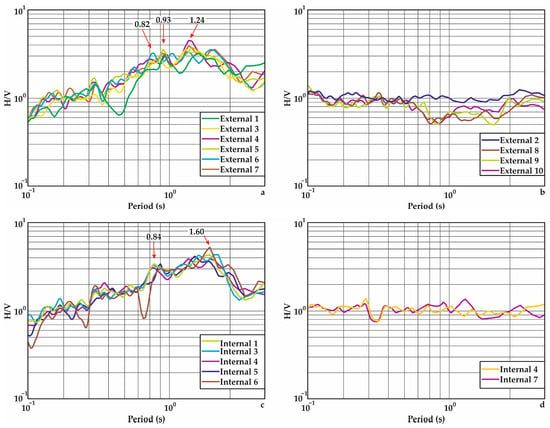
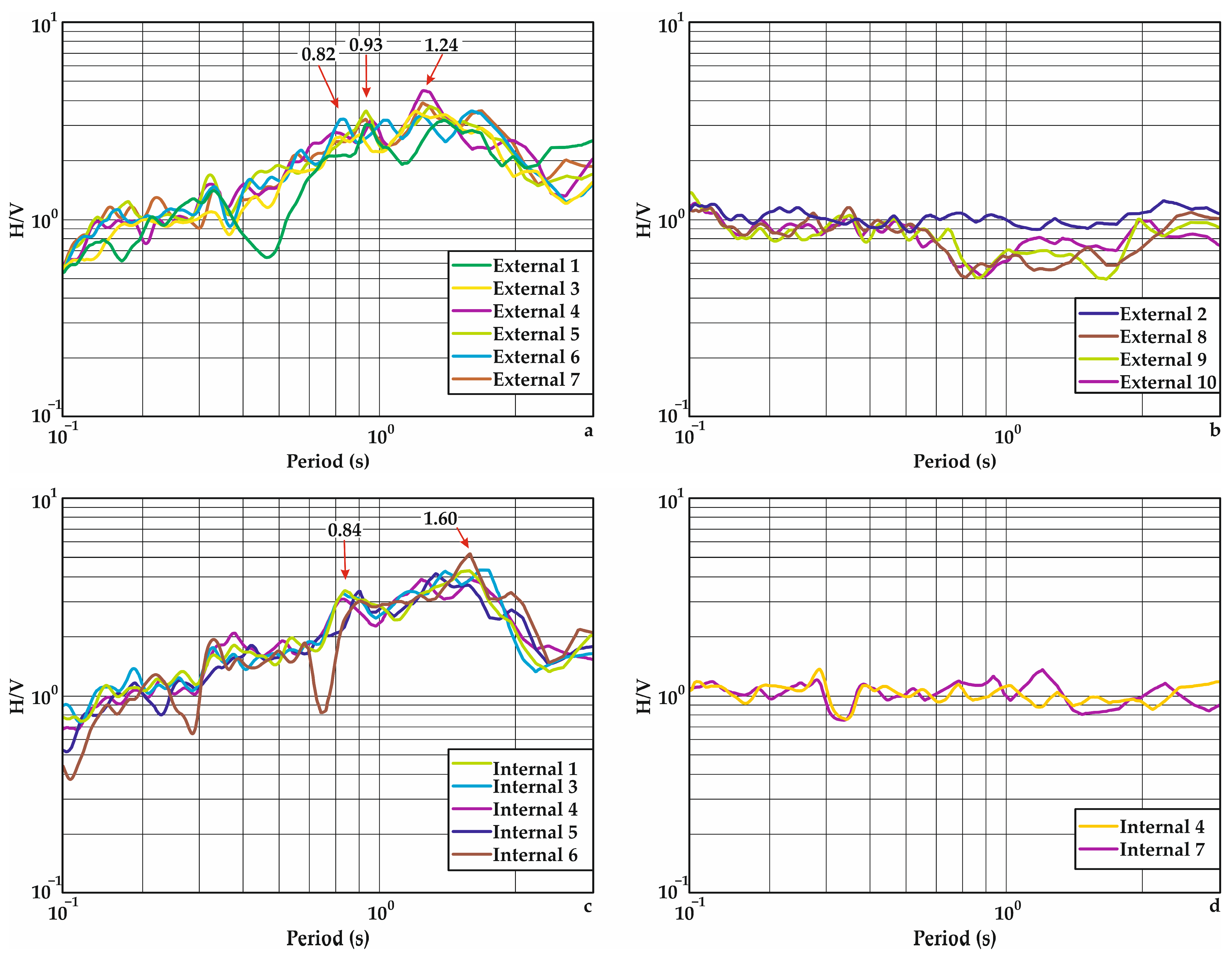
The Nakamura HVSR methodology [48,49] was applied to a set of ambient noise records obtained at 17 registration points located at the base of the basilica, allowing for the characterization of the foundation soil. Ten points were located on the outer perimeter of the basilica and 7 points positioned inside the nave. The results show a lateral variability in the maximum resonance values. This variation could indicate the presence of different strata within the underlying soil.
The HVSR results are represented by H/V spectral ratio graphs, obtained through mathematical data processing using the fast Fourier transform (FFT) applied to a set of time windows.
HVSR results show two types of responses: those with resonant peaks around 1 hertz (Figure 14a,c) and those without these peaks (Figure 14b,d). The resultant values are summarized in Table 3. The second group (showing no peak around 1 Hz) includes external points 8, 9 and 10 in the apse area, point 2 to the left of the main façade, and internal points 4 and 7. Regarding the points exhibiting a ground response close to 1 Hz, significant variations are observed among them, specifically from 0.81 Hz (external point 6, and internal points 1, 2 and 3) to 0.95 Hz (external point 4). At these same points, other peaks with slightly higher frequencies also appear (0.93 Hz and 1.24 Hz for external points, and 1.6 Hz for internal points).
Figure 14.
HVSR results showing the two types of soil response: with resonant peaks (a,c) and without them (b,d).
Table 3.
HVSR predominant periods for Internal (Int.) and External (Ext.) measurement points (values in seconds).
This lateral variability in soil response is common in Barcelona city and is usually associated with the course of old streams and paleochannels. Some streams cause a shift in the predominant period, while others lead to the appearance of multiple peaks, as observed in the Santa Maria del Pi church. In fact, Santa Maria del Pi church is located at the boundary of the Tertiary material outcrop, and it is supposed that the stream of Riera del Pi passed directly through this location [50]. However, simplified geological schemes do not account for the presence of these streams and paleochannels. Furthermore, the terrain where churches were built was typically leveled, often using anthropic fill. This is likely the case of Santa Maria del Pi, as the topography of the surrounding streets shows slight unevenness.
The mapping of the surveyed points onto the floor plan of the basilica, combined with the predominant period values calculated from ambient noise measurements, made it possible to identify the areas containing fill material and distinguish them from more compacted ground (Figure 15). The floor plan reveals that most of the basilica is built on fill ground, except for one sector corresponding to the northern corner, and two smaller localized areas inside the basilica where competent ground is estimated to predominate.
Figure 15.
Map showing the classification of soils based on HVSR results.
The fundamental frequency obtained matches the expected response for the Quaternary sediments indicated in the geological map of the region [50]. The reliability of the HVSR method for assessing soil–structure resonance in historical buildings has been widely validated in similar case studies, such as the structural monitoring of the Carmo Convent ruins [1] and the seismic refraction studies in Trabzon [26]. The spectral peaks observed here show a clear correlation with the impedance contrast typical of the Barcelona plain subsoil.
4. Discussion
This study validates the diagnostic potential of combining ground penetrating radar (GPR) and passive seismic (HVSR) methods for the assessment of complex historic structures, utilizing the Basilica of Santa Maria del Pi (Barcelona) as a pilot case. While GPR successfully characterized the roof masonry and moisture content, the passive seismic analysis provided critical information regarding the foundation soil. The combination of these independent analyses allows for a comprehensive understanding of the building pathology: linking soil stiffness variations (and potential differential settlements) with the structural deformation observed in the columns.
4.1. GPR Assessment of the Roof System
The GPR survey allowed the characterization of the internal geometry and pathology of the vaulting system. Regarding structural heterogeneity, the radargrams allowed for the discrimination of the internal filling material. As detailed in the analysis of the lateral chapels (Figure 4) and the main nave (Figure 7), zones of hyperbolic diffraction and incoherent scattering are consistent with loose, lightweight ceramic debris and rubble used for leveling the extrados. This identification of chaotic fill is consistent with similar GPR campaigns conducted on Gothic heritage in the Mediterranean region. For instance, Pérez-Gracia et al. [2] reported comparable reflection patterns in the roof of Santa Maria del Mar (Barcelona), attributing them to loose debris and pottery fills. Similarly, Leucci et al. [5] and Solla et al. [28] have highlighted the challenge of mapping irregular masonry thickness due to such scattering phenomena.
In terms of moisture anomalies, the analysis of signal attributes revealed localized areas of high attenuation. As suggested in the A-scan comparison (Figure 10), the possible wet zones (A2, A4) exhibit a marked increase in relative amplitude and signal scattering compared to the possible dry zones (A1, A3). This interpretation is supported by the velocity analysis and the application of the Topp equation (Figure 11), which estimates volumetric water contents reaching up to 32% in the most affected areas. These values should be considered relative estimates indicative of saturation trends. This semi-quantitative approach aligns with recent methodological proposals by Perez-Gracia et al. [30] and Solla et al. [47], who emphasized that amplitude attenuation is a more reliable indicator than travel-time velocity alone in porous masonry. Furthermore, our results corroborate the theoretical permittivity models for wet construction materials described by Topp et al. [41] and Hu et al. [42].
Significantly, these anomalies are not randomly distributed but are spatially aligned with the stormwater drainage sinks (Figure 13). This spatial correlation strongly suggests that the observed signal degradation is driven by active water infiltration due to drainage inefficiency.
4.2. HVSR and Geotechnical Profiling
The passive seismic monitoring provided a non-invasive stiffness map of the subsoil, highlighting a clear contrast in the foundation conditions. The spectral ratio curves (Figure 14) exhibit significant lateral variability. As summarized in Table 3, areas showing predominant periods exceeding 0.8 s indicate the presence of low-stiffness layers. These results support the hypothesis of anthropogenic fills, potentially archaeological remains from the previous Romanesque structure, underlying specific sections of the nave. This interpretation is supported by the work of Abu Zeid et al. [27], who successfully used passive seismic noise to map paleo-channels and archaeological interfaces in similar unconsolidated environments.
The planimetric distribution of these periods (Figure 15) reveals that most of the nave rests on filled ground. The transition zones between these softer fills (likely anthropogenic) and the stiffer natural soil identified near the northern corner, coincide with the differential settlement cracks observed in the masonry. This correlation suggests that the variable compressibility of the subsoil is a primary driver of the structural distortions.
Furthermore, the fundamental frequencies derived from the soil measurements (f < 1.25 Hz) are distinct from the expected theoretical frequency of the masonry structure (f > 2 Hz). This separation suggests that resonance phenomena are unlikely to be a risk factor, as the soil and the structure vibrate in different frequency ranges. This confirms the utility of HVSR for excluding soil–structure resonance risks in historical buildings, a phenomenon analyzed by Babacan and Akın [26], while providing a clear stratification model compatible with the geological maps of Barcelona [50].
4.3. Integrated Diagnosis
While GPR and HVSR operate on different physical principles and target distinct spatial domains without direct data overlap, their combined interpretation offers a holistic view. Rather than cross validating the same physical parameter, the methods complement each other: the GPR data localized acute triggers of degradation (moisture infiltration in the roof, Figure 12), while the HVSR data explained the chronic mechanisms (settlement due to soil heterogeneity, Figure 15). This integration strategy follows the diagnostic framework proposed by Diz-Mellado et al. [3] and Hidalgo-Sánchez et al. [4], where different NDT methods address specific scales of the problem. However, our approach mirrors the strategy of Piroddi et al. [35] and Pérez-Gracia et al. [23], using the methods as independent but complementary lines of evidence. The integration of these datasets provides a robust baseline for future interventions.
5. Conclusions
The comprehensive evaluation of the Basilica of Santa Maria del Pi demonstrates the efficacy of integrating distinct non-destructive methodologies to address the multi-scale challenges of heritage conservation.
Regarding the roof pathology, the GPR analysis successfully identified the internal structure of the vaults, distinguishing between structural masonry and lightweight ceramic filling. More critically, moving beyond qualitative imaging, the study applied a signal attribute analysis to semi-quantitatively estimate moisture retention zones, reaching volumetric water contents of up to 32%. The spatial correlation between these anomalies and the drainage system confirms that the primary degradation mechanism in the roof is active infiltration due to drainage failure.
In terms of foundation stability, The HVSR passive seismic survey revealed significant subsoil heterogeneity. The identification of low-frequency amplification zones indicates the presence of loose anthropogenic fills under the main nave, contrasting with stiffer natural soil in the northern corner. This geological transition aligns consistently with the observed cracking patterns, confirming that differential settlement driven by variable soil compressibility is the chronic cause of structural distortion.
Furthermore, the analysis of soil–structure interaction ruled out soil–structure resonance as a risk factor, as the fundamental frequency of the soft soil layers is sufficiently distant from the theoretical natural frequency of the Gothic structure.
Finally, regarding the methodological implications beyond this specific case study, the research highlights the transferability of this dual approach. By using a combination of GPR for acute problems (moisture) and HVSR for chronic issues (settlements), facility managers can objectively prioritize interventions. Immediate resources can be allocated to waterproofing drainage points, while long-term monitoring strategies can be established for the settlement-prone transition zones. This evidence-based diagnosis allows for the optimization of maintenance budgets, moving from reactive repairs to a targeted preventive conservation plan.
Author Contributions
Conceptualization, J.C., V.P.-G. and O.C.; methodology, V.P.-G.; software, O.C.; validation, V.P.-G. and O.C.; formal analysis, V.P.-G. and O.C.; investigation, J.C., O.C., V.P.-G. and V.S.; resources, J.R.G.D. and V.P.-G.; data curation, J.C. and J.R.G.D.; writing—original draft preparation, V.P.-G. and O.C.; writing—review and editing, V.P.-G. and J.R.G.D.; visualization, V.P.-G. and V.S.; supervision, V.P.-G.; project administration, V.P.-G. and J.R.G.D. All authors have read and agreed to the published version of the manuscript.
Funding
The authors acknowledge the financial support provided by the Ministerio de Ciencia, Innovación y Universidades, through the project PID2020-117374RB-I00 (MICIU/AEI/10.13039/501100011033), and by the Generalitat de Catalunya through project SGR 2021 01060. This work was also supported by the Horizon Europe Programme (Grant Agreement number 101129909). Views and opinions expressed are those of the authors only and do not necessarily reflect those of the European Union or the European Health and Digital Executive Agency (HADEA). Neither the European Union nor the granting authority can be held responsible for them.
Data Availability Statement
The data presented in this study are available upon request from the corresponding author.
Conflicts of Interest
The authors declare no conflicts of interest.
References
- Mendes, N.; Bianchini, N.; Karanikoloudis, G.; Blyth, A.; Scacco, J.; Flores Salazar, L.G.; Cullimore, C.; Jain, L. Preservation and Protection of Cultural Heritage: Vibration Monitoring and Seismic Vulnerability of the Ruins of Carmo Convent (Lisbon). Sensors 2024, 24, 6095. [Google Scholar] [CrossRef] [Scilit]
- Perez-Gracia, V.; Santos-Assunçao, S.; Caselles, O.; Clapes, J.; Sossa, V. Combining ground penetrating radar and seismic surveys in the assessment of cultural heritage buildings: The study of roofs, columns, and ground of the gothic church Santa Maria del Mar, in Barcelona (Spain). Struct. Control Health Monit. 2019, 26, e2327. [Google Scholar] [CrossRef] [Scilit]
- Diz-Mellado, E.; Mascort-Albea, E.J.; Romero-Hernandez, R.; Galán-Marín, C.; Rivera-Gómez, C.; Ruiz-Jaramillo, J.; Jaramillo-Morilla, A. Non-destructive testing and Finite Element Method integrated procedure for heritage diagnosis: The Seville Cathedral case study. J. Build. Eng. 2021, 37, 102134. [Google Scholar] [CrossRef] [Scilit]
- Hidalgo-Sánchez, F.M.; Torres-González, M.; Mascort-Albea, E.J.; Canivell, J.; Romero-Hernández, R.; Martín-del-Río, J.J. NDT spatial data integration for monumental buildings: Technical information management for the Royal Alcazar of Seville. Build. Res. Inf. 2023, 51, 625–647. [Google Scholar] [CrossRef] [Scilit]
- Leucci, G.; De Giorgi, L.; Ditaranto, I.; Miccoli, I.; Scardozzi, G. Ground-Penetrating Radar prospections in Lecce cathedral: New data about the crypt and the structures under the church. Remote Sens. 2021, 13, 1692. [Google Scholar] [CrossRef] [Scilit]
- Zhang, S.; Tang, L.; Li, P.; Guan, F.; Jia, Y.; Liu, Z. Forward modeling and application of ground-penetrating radar for hidden defects in a shipyard floor. J. Appl. Geophys. 2025, 239, 105760. [Google Scholar] [CrossRef] [Scilit]
- Elizalde, R.R. Marés Stone and Structural Slenderness: A Material-Based Diagnostic Study of Palma Cathedral. Constr. Mater. 2025, 5, 41. [Google Scholar] [CrossRef] [Scilit]
- Mercuri, F.; Cicero, C.; Orazi, N.; Paoloni, S.; Marinelli, M.; Zammit, U. Infrared thermography applied to the study of cultural heritage. Int. J. Thermophys. 2015, 36, 1189–1194. [Google Scholar] [CrossRef] [Scilit]
- Rosina, E.; Kavuru, M.; Parisi, E.I. Advancement of infrared thermography for built heritage. In Diagnosis of Heritage Buildings by Non-Destructive Techniques; Woodhead Publishing: Sawston, UK, 2024; pp. 23–47. [Google Scholar] [CrossRef] [Scilit]
- Garrido, I.; Solla, M.; Lagüela, S.; Rasol, M. Review of InfraRed thermography and ground-penetrating radar applications for building assessment. Adv. Civ. Eng. 2022, 2022, 5229911. [Google Scholar] [CrossRef] [Scilit]
- Debailleux, L.; Fanfone, M.P. Understanding the invisible: Interpretation of results in ultrasonic tomography of gothic masonry using metrology and geometry. In Diagnosis of Heritage Buildings by Non-Destructive Techniques; Woodhead Publishing: Sawston, UK, 2024; pp. 447–476. [Google Scholar] [CrossRef] [Scilit]
- Oh, J.K.; Lee, J.J. Feasibility of ultrasonic spectral analysis for detecting insect damage in wooden cultural heritage. J. Wood Sci. 2014, 60, 21–29. [Google Scholar] [CrossRef] [Scilit]
- Vasanelli, E.; Calia, A.; Luprano, V.; Micelli, F. Ultrasonic pulse velocity test for non-destructive investigations of historical masonries: An experimental study of the effect of frequency and applied load on the response of a limestone. Mater. Struct. 2017, 50, 38. [Google Scholar] [CrossRef] [Scilit]
- Yalçıner, C.Ç.; Büyüksaraç, A.; Kurban, Y.C. Non-destructive damage analysis in Kariye (Chora) Museum as a cultural heritage building. J. Appl. Geophys. 2019, 171, 103874. [Google Scholar] [CrossRef] [Scilit]
- Verstrynge, E.; Lacidogna, G.; Accornero, F.; Tomor, A. A review on acoustic emission monitoring for damage detection in masonry structures. Constr. Build. Mater. 2021, 268, 121089. [Google Scholar] [CrossRef] [Scilit]
- Di Gennaro, L.; Loreto, G.; Frunzio, G.; Rizzano, G.; Guarnaccia, C. Acoustic Emission for Structural Monitoring of Historical Masonry: An In-Field Application. Appl. Sci. 2025, 15, 7111. [Google Scholar] [CrossRef] [Scilit]
- Berto, L.; Doria, A.; Faccio, P.; Saetta, A.; Talledo, D. Vulnerability analysis of built cultural heritage: A multidisciplinary approach for studying the Palladio’s Tempietto Barbaro. Int. J. Archit. Herit. 2017, 11, 773–790. [Google Scholar] [CrossRef] [Scilit]
- Cantagallo, C.; Sangiorgio, V.; Varum, H.; Fiorito, F.; Fatiguso, F. Knowledge of the Built Heritage. In Digitization of Built Heritage: Approaches and Methods for Data Acquisition, Analysis, and Intervention; Springer Nature: Cham, Switzerland, 2025; pp. 23–110. [Google Scholar] [CrossRef] [Scilit]
- Saisi, A.; Borlenghi, P.; Gentile, C. Non-Destructive Testing and Synergistic Investigation of a Historic Tower. Buildings 2024, 14, 1101. [Google Scholar] [CrossRef] [Scilit]
- Chetverikov, B.; Trevoho, I.; Babiy, L.; Malanchuk, M. Determination of location of historical and cultural heritage objects using photogrammetric and geophysical methods. Geod. Cartogr. 2025, 51, 41–49. [Google Scholar] [CrossRef] [Scilit]
- Llabani, A.; Abazaj, F. 3D documentation of cultural heritage using terrestrial laser scanning. J. Appl. Eng. Sci. 2024, 22, 267–271. [Google Scholar] [CrossRef] [Scilit]
- Vinci, G.; Vanzani, F.; Fontana, A.; Campana, S. LiDAR applications in archaeology: A systematic review. Archaeol. Prospect. 2025, 32, 81–101. [Google Scholar] [CrossRef] [Scilit]
- Perez-Gracia, V.; Solla, M.; Fontul, S.; Caselles, O.; Balado, J.; Alva, R.; Rodriguez-Somoza, J.L.; González-Drigo, R. Combining GPR, Passive Seismic, and Load Testing With Computational Models in the Assessment of Historical Bridges: The Case Study of the Comboa Bridge. Struct. Control Health Monit. 2025, 2025, 5309473. [Google Scholar] [CrossRef] [Scilit]
- García-Nieto, M.C.; Martínez-Segura, M.A.; Navarro, M.; Valverde-Palacios, I.; Martínez-Pagán, P. A Geophysical Investigation in Which 3D Electrical Resistivity Tomography and Ground-Penetrating Radar Are Used to Determine Singularities in the Foundations of the Protected Historic Tower of Murcia Cathedral (Spain). Remote Sens. 2024, 16, 4117. [Google Scholar] [CrossRef] [Scilit]
- Díaz-García, G.; Farfán-Córdova, M. Application of MASW, Microtremor, and Seismic Refraction Tests for Buildings in Vulnerable Communities. Buildings 2025, 15, 1079. [Google Scholar] [CrossRef] [Scilit]
- Babacan, A.E.; Akın, Ö. The investigation of soil–structure resonance of historical buildings using seismic refraction and ambient vibrations HVSR measurements: A case study from Trabzon in Turkey. Acta Geophys. 2018, 66, 1413–1433. [Google Scholar] [CrossRef] [Scilit]
- Abu Zeid, N.; Corradini, E.; Bignardi, S.; Nizzo, V.; Santarato, G. The Passive Seismic Technique ‘HVSR’as a Reconnaissance Tool for Mapping Paleo-soils: The Case of the Pilastri Archaeological Site, Northern Italy. Archaeol. Prospect. 2017, 24, 245–258. [Google Scholar] [CrossRef] [Scilit]
- Solla, M.; Pérez-Gracia, V.; Lagüela, S.; Fontul, S. Applications of the ground-penetrating radar technique to heritage buildings: Case studies and combination with other non-destructive testing. In Diagnosis of Heritage Buildings by Non-Destructive Techniques; Woodhead Publishing: Sawston, UK, 2024; pp. 575–624. [Google Scholar] [CrossRef] [Scilit]
- Puertas, E.; Ávila, F.; García-Macías, E.; Gallego, R. Preventive Preservation of Rammed Earth Historical Heritage Through Continuous Monitoring, Architectural Inspections, and Data Fusion. Buildings 2024, 14, 3294. [Google Scholar] [CrossRef] [Scilit]
- Perez-Gracia, V.; Solla, M.; Fontul, S. Analysis of the GPR signal for moisture detection: Application to heritage buildings. Int. J. Archit. Herit. 2024, 18, 230–253. [Google Scholar] [CrossRef] [Scilit]
- Martorana, R.; Capizzi, P. Joint investigation with ground penetrating radar and infrared thermography as a diagnostic support for the restoration of two wall mosaics in the Church of St. Mary of the Admiral in Palermo, Italy. Heritage 2022, 5, 2298–2314. [Google Scholar] [CrossRef] [Scilit]
- Rucka, M.; Wojtczak, E.; Zielińska, M. Integrated application of GPR and ultrasonic testing in the diagnostics of a historical floor. Materials 2020, 13, 2547. [Google Scholar] [CrossRef] [Scilit]
- Bianchi, M.G.; Casula, G.; Cuccuru, F.; Fais, S.; Ligas, P.; Ferrara, C. Three-dimensional imaging from laser scanner, photogrammetric and acoustic non-destructive techniques in the characterization of stone building materials. Adv. Geosci. 2018, 45, 57–62. [Google Scholar] [CrossRef] [Scilit]
- Matias, M.; Almeida, F.; Moura, R.; Barraca, N. High resolution NDT in the characterization of the inner structure and materials of heritage buildings walls and columns. Constr. Build. Mater. 2021, 267, 121726. [Google Scholar] [CrossRef] [Scilit]
- Piroddi, L.; Colica, E.; D’Amico, S.; Galone, L.; Ingoglia, C.; Spagnolo, G.; Santostefano, A.; Zurla, L.; Crupi, A.; Lanza, S.; et al. Multi-Method and Multi-Depth Geophysical Data Integration for Archaeological Investigations: First Results from the Greek City of Gela (Sicily, Italy). Remote Sens. 2025, 17, 3561. [Google Scholar] [CrossRef] [Scilit]
- Utsi, E.C.; Penman, M. Combining Ground Penetrating Radar Data with Historical Research: The Scottish Royal Benedictine Abbey of Dunfermline. Archaeol. Prospect. 2025, 32, 676–706. [Google Scholar] [CrossRef] [Scilit]
- Persico, R.; Muci, G. Ground penetrating radar investigation and georeferencing without global satellite navigation systems: The case history of the amphitheatre of Lecce, Italy. Geophys. Prospect. 2023, 71, 1047–1055. [Google Scholar] [CrossRef] [Scilit]
- Balaguer, V. Las Calles de Barcelona: Origen de sus Nombres; Forgotten Books: London, UK, 1866; Volume 2, p. 166. (In Spanish) [Google Scholar]
- Gutierrez Garcia-Moreno, A.; Lapuente Mercadal, P.; Rodà de Llanza, I. (Eds.) Interdisciplinary studies on ancient stone. In Proceedings of the IX ASMOSIA Conference (Tarragona 2009); Documenta 23; ICAC: Tarragona, Spain, 2012. [Google Scholar]
- Casas, L.; Di Febo, R.; Parcerisa, D. Petrographic markers for archaeometric identification of montjuïc sandstone, the flagship stone of Barcelona (NE Spain). Minerals 2020, 10, 154. [Google Scholar] [CrossRef] [Scilit]
- Topp, G.C.; Yanuka, M.; Zebchuk, W.D.; Zegelin, S. Determination of electrical conductivity using time domain reflectometry: Soil and water experiments in coaxial lines. Water Resour. Res. 1988, 24, 945–952. [Google Scholar] [CrossRef] [Scilit]
- Hu, J.; Wang, X.; Zhang, F.; Zhao, Y. Experimental study on the variation of soil dielectric permittivity under the influence of soil compaction and water content. Geofluids 2022, 2022, 3575541. [Google Scholar] [CrossRef] [Scilit]
- SESAME. Guidelines for the Implementation of the H/V Spectral Ratio Technique on Ambient Vibrations: Measurements, Processing and Interpretation; European Commission—EVG1-CT-2000-00026 SESAME Project: Grenoble, France, 2004; Available online: https://sesame.geopsy.org/SES_Reports.htm (accessed on 10 October 2025).
- Konno, K.; Ohmachi, T. Ground-motion characteristics estimated from spectral ratio between horizontal and vertical components of microtremor. Bull. Seismol. Soc. Am. 1998, 88, 228–241. [Google Scholar] [CrossRef] [Scilit]
- Tang, J.; Duan, M.; Hu, J. HVSR-Based Peak Frequency Identification of S-Net Ocean-Bottom Stations for Site Characterization and Ground-Motion Prediction Models. Bull. Seismol. Soc. Am. 2025; early view. [CrossRef] [Scilit]
- Frąckiewicz, P.; Raszczuk, K.; Jasieńko, J. Identification of alternations in the structure of historical masonry walls using the GPR method accompanied with architectural survey in the former Piast Gymnasium in Brzeg. Civ. Environ. Eng. Rep. 2024, 34, 32–42. [Google Scholar] [CrossRef] [Scilit]
- Solla, M.; Lagüela, S.; Riveiro, B.; Lorenzo, H. Non-destructive testing for the analysis of moisture in the masonry arch bridge of Lubians (Spain). Struct. Control Health Monit. 2013, 20, 1366–1376. [Google Scholar] [CrossRef] [Scilit]
- Nakamura, Y. A method for dynamic characteristics estimation of subsurface using microtremor on the ground surface. Q. Rep. Railw. Tech. Res. Inst. 1989, 30, 25–33. [Google Scholar]
- Molnar, S.; Sirohey, A.; Assaf, J.; Bard, P.Y.; Castellaro, S.; Cornou, C.; Cox, B.; Guillier, B.; Hassani, B.; Kawase, H.; et al. A review of the microtremor horizontal-to-vertical spectral ratio (MHVSR) method. J. Seismol. 2022, 26, 653–685. [Google Scholar] [CrossRef] [Scilit]
- ICGC. Mapa Geològic de Catalunya 1:25.000 (Geoíndex); Institut Cartogràfic i Geològic de Catalunya: Barcelona, Spain, 2025; Available online: https://www.icgc.cat (accessed on 6 February 2026).

Disclaimer/Publisher’s Note: The statements, opinions and data contained in all publications are solely those of the individual author(s) and contributor(s) and not of MDPI and/or the editor(s). MDPI and/or the editor(s) disclaim responsibility for any injury to people or property resulting from any ideas, methods, instructions or products referred to in the content. |
© 2026 by the authors. Licensee MDPI, Basel, Switzerland. This article is an open access article distributed under the terms and conditions of the Creative Commons Attribution (CC BY) license.